Wednesday, January 5, 2022

Nerds of a Feather, Flock Together is Recusing from 2022 Hugo Awards


In 2021, Nerds of a Feather. Flock Together won the Hugo Award for Best Fanzine. It was our fifth nomination and first win in the category. However, we will not win our second this year - continuing an emergent tradition in this category started by our friends at Lady Business (and continued by 2020 winners The Book Smugglers), we are recusing ourselves from consideration for this year's award.

Why, you ask? Well, it's pretty simple: Fanzine is more than just an award category - it's a community. Over the years we've gotten to know our competitors for the award as peers, colleagues and friends. Really, "competitor" is a wrong term, because we aren't fighting over readers; rather, we all benefit from the community's growth and the conversations that emerge from that growth. We hope that other fanzines will benefit from the publicity and excitement that comes with being on the ballot, and have their own shot at taking home the big rocket. And while there's no guarantee we would win in 2022, we really just want to stand and cheer for our friends this year.

(We'll compete again in 2023.)

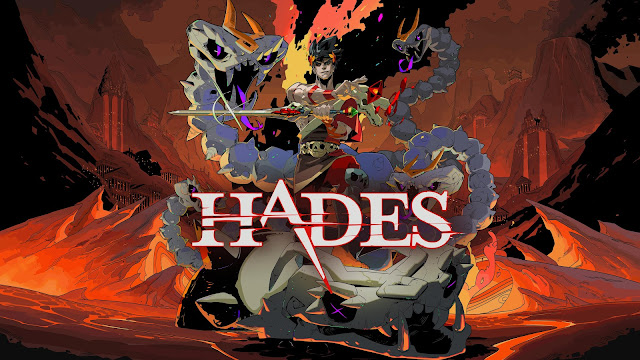
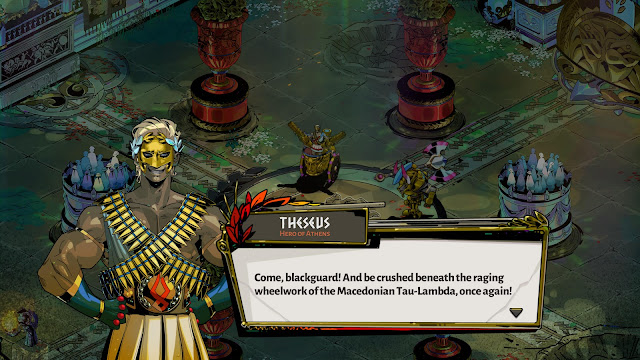
Microreview [Video Game]: Hades by Supergiant Games

 If at first you don’t climb your way out of hell, try, try again.


The main gameplay loop of Hades has players accompanying Zagreus in his many attempts to escape the Greek underworld. In this rogue-lite adventure, every failure (and success) advances both player skill and story. Hades has a way of making every failure feel meaningful, never frustrating. This is a title that excels in nearly every aspect of the medium. From the divine voice acting and masterful storytelling to the brilliant visuals and finely crafted gameplay, this game exudes quality and should not be missed.

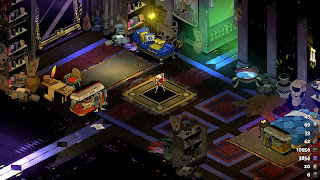
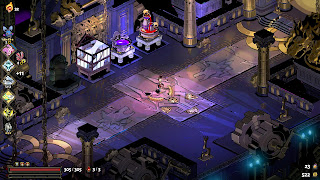
From the moment I booted up Hades, I could tell I was in for a treat. In traditional Supergiant style, the game has a gorgeous art style. Each environment is distinct; from the House of Hades to the Temple of Styx. Supergiant’s stylish characters and levels are still captivating after over eighty runs.

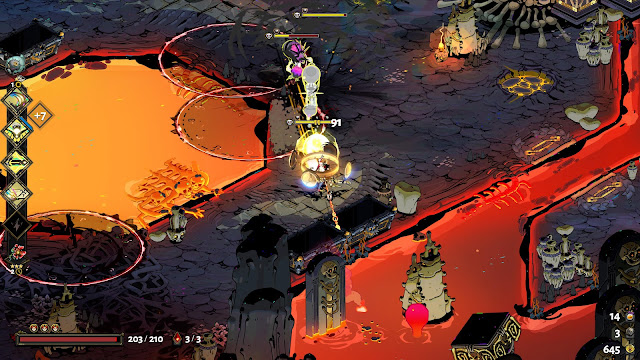
The developer was aware of the repetitive nature of the genre and instilled within Hades the gift of variety. Though running through the same gorgeous levels repeatedly is the hook of the game, every attempt feels different due to the variability of boons (power-ups from different Olympian benefactors) and the players' choice of weapon. Not only are there six unique weapons, but each one has various aspects to be unlocked which creates even more layers to the gameplay. For instance, the Heart-Seeking Bow's standard attack shoots a single charged up arrow and its special attack is a volley of arrows that shoots in a V formation before Zagreus. If the aspect of Chiron is equipped, every enemy struck by a standard attack gains a target for the special attack, turning that V formation into a volley of homing arrows that follow said enemy. Combo that with a certain character’s freezing boon and I would instantly put my enemy in stasis, allowing for more time to strategize when clearing a room.

In addition to the selected weapon, Zagreus also has access to his “cast”, an ability that shoots at enemies and can be leveled up (via Nyx’s Mirror of Night) and equipped with boons to have extremely different effects. An upgrade from the king of Olympus has Zag’s cast become a ball of electricity, chaining lightning between enemies, while a blessing from Dionysus sees that cast create an area effect that stuns enemies intermittently. The combination of different weapons, boons, Daedalus upgrades, and aspects make each run feel fresh.


What extends Hades’ longevity even further is the sheer amount of unique dialogue for each character. Offering any character nectar, whether it be Chthonic deities, Olympian kin, or shades of the underworld, results in an increased bond which leads to more conversation from any given character. In addition, each event encountered or surpassed may trigger a special dialogue with certain characters. This makes Hades aware of itself, like a unified composition where everything feels like part of the whole with nothing included for the sake of padding. Such a numerous amount of voice-overs and unique writing was an impressive inclusion that elevated the entire experience. After clearing the main story (about ten completed runs), I assumed the unique dialogue would dissipate soon after, but there was still so much the game had to give. It took the span of around eighty runs before I saw repeated dialogue from one of the bosses. This made me a bit sad, but also grateful for all the content Supergiant had created for the player.

Hades is a retelling of one of my favorite classic Greek myths with a Supergiant twist. Zagreus, son of Hades, wants to discover why his lineage has been hidden from him. While Zagreus is the biggest straying point from the myth, the character is an essential part of what makes the story work. Darren Korb lends his voice to the character and does a lovely job of bringing the cheeky young god to life. The casting for the rest of the gods and Greek denizens of Hades are impeccable. Cyrus Nemati’s portrayal of Theseus offered great comedic relief in the middle of each escape attempt.

The game’s soundtrack elevates every enemy encounter and increases the tension during fights while also causing relief when the heat dies down. My favorite song, “Good Riddance”, performed by Eurydice (Ashley Barrett) occasionally occurred on my treks through Asphodel. I would put my controller down and listen to the beautifully executed performance every time I entered her chamber and let the tune entrance and calm me during an otherwise adrenaline-fueled experience. Orpheus’ (Darren Korb) “Hymn to Zagreus” is a great showcase for Supergiant’s tongue-in-cheek humor. Without playing Hades, one could still appreciate what the soundtrack has to offer.

One of the things I respect most about Supergiant’s effort is their consideration for the player. After completing one run, I was given access to the Pact of Punishment: a list of additional challenges that increase the difficulty of the next escape attempt. One of these challenges adds a timer. Instead of keeping the clock ever ticking, Supergiant made sure to pause the timer if the player wanted to use a fishing spot, take a moment to select which boon they wanted, engage in conversation, or whenever they enter one of the respite chambers. Having trouble with the game? Turn on God Mode for a damage resistance buff that increases after each defeat (incurring no penalty to the player’s ability to unlock in-game items or trophies/achievements). Is the game getting too easy? Raise the heat level and increase the challenge in unique ways instead of making enemies mere bullet sponges. Hades puts the players’ needs and wants front and center, making for very few incidents where I wished things were different.

My lengthy playtime consisted of a few glitches, one of which occurred at the end of a thirty-two heat run (very high difficulty). The game didn’t offer me the item I needed to advance at the end of the run. I was pleased with my progression and boons during that attempt and was disappointed when I was forced to restart without a chance at the final boss. There were also a few times when I was unable to cure my poison despite depleting the antidote basin. This contributed to a few failed runs that exacerbated my irritation from combatting enemies with a poison mechanic. Though I loathe any sort of poison-inducing enemies, Hades makes it as bearable as possible—except the few glitches I encountered—by keeping the antidote a few dashes away.


When looking at Hades in its entirety, the few minor flaws I encountered didn't do much to alter my overall enjoyment of the title. In a sub-genre known for its difficulty, Hades never feels like a Sisyphean task. Every success and failure brings the player closer to the truth and every run made me love the game more. This game is a complete experience. It's the perfect example of a studio figuring out its purpose and leaning into development with every trick they’ve learned along the way. I find Hades to not only be Supergiant’s best game but one of the best video games of the last decade.

The Math

Objective Assessment: 9/10

Bonus: +1 for incorporating fluid sexuality seamlessly. +1 for additonal additional storylines to some of my favorite greek myths.

Penalties: -1 for ending my best run with a technical bug. -1 for poison mechanics at the end of each run.

Nerd Coefficient: 9/10

Posted by: Joe DelFranco - Fiction writer and lover of most things video games. On most days you can find him writing at his favorite spot in the little state of Rhode Island.

Orignally posted at: https://josephdelfranco.wixsite.com/pforp/post/hades-review

Tuesday, January 4, 2022

Some of the Best Books of 2021: A Conversation

Joe: 2021 was one heck of a year and sometimes felt like more of an extension of 2020 than its own distinct year. As someone who pays obsessive attention to the Academy Awards, the Oscar eligibility season was only ten months long rather than being a full year because the previous year had a 14 month eligibility window. I’ve long joked that the Hugo Award season is eternal, but 2021 legitimately had a twelve month experience with the awards just being given out a few weeks ago rather than a few months ago. That doesn’t even get into personal life stuff which will remain, well, personal.

On a typical year I would write up my Top 9 books of the year right around this time. I generally do a really good job staying on top of the genre and reading all the things. I still read all of the things last year, but some of the things I read were a lot more of the previous Hugo Award winners rather than the newest and shiniest books. I also caught up on a quite a few 2020 books that I had missed the first time around. It was a really good year for reading, but the end result is that I’m not quite up on all of the best of last year even for what is naturally a deeply personal list.

To that end, I’ve asked for a little help from my friends. Rather than doing a ranked list of some sort, Paul Weimer and Adri Joy are joining me to discuss a few of the books we loved last year and maybe put a quick spotlight on some books that we are still excited to read but just didn’t get to yet. There may be some overlap and that’s absolutely okay.

Adri, would you like to kick us off?

Adri: I’d like to kick off with Light From Uncommon Stars by Ryka Aoki (review), a big mashup of urban fantasy and science fiction tropes that tackles themes of family and belonging and finding the space to create, with a heavy emphasis on trans coming of age. It follows three characters: trans teen runaway Katrina Nguyen, violin teacher turned soul-broker Shizuka Satomi, and starship captain in hiding Lan Tran, as their lives intersect. Aoki’s narrative tackles some very difficult subject matter, particularly when it comes Katrina’s experiences of abuse, sexual violence and transphobia; even her “safe” landing with Shizuka is far from a true escape. Somehow, though, there’s a sense of gentleness and hope and individual goodness that shines through in Light From Uncommon Stars, and the result is a very powerful story.

The Unbroken, by C.L. Clark, had me rambling thirstily about cover art in my Strange Horizons review, and I wasn’t the only one: check the #TourainesArms hashtag on Twitter if you don’t believe me. (And thanks, Tommy Arnold, for the meal!) But this book could have been wrapped in the cover equivalent of a brown sack and I’d still want to rave about it, because it is probably the best take on colonial fantasy politics I’ve ever read. Taking inspiration from French colonisation of North Africa, The Unbroken stars Touraine, a conscript stolen from her home as a child and raised to be part of the colonial army, and Luca, a princess trying to cement her own power by crushing a rebellion - with Touraine as her proposed secret weapon. Full of conflicted loyalties and unwinnable scenarios, Clark’s debut also prominently features a ton of enemies-to-lovers romantic tension between its leads, which is the delicious icing on a many layered cake.

Jade Legacy, by Fonda Lee, wraps up the Green Bone Saga, a secondary world crime family saga that also demonstrates how the epic fantasy genre can totally work alongside late 20th and early 21st century tech and politics. At the centre of the Green Bone Saga is bioenergetic jade; when worn, it enables various superpowers like super strength, emotion reading and really cool jumps. Until the events of the trilogy, jade could only be worn by a few people from the country of Kekon, but when the technology arrives to enable its use worldwide, the Kaul family and their various rivals and allies find themselves playing a much larger political game to maintain their power and secure Kekon’s position in the world. Unlike its predecessors, Jade Legacy covers decades rather than years, and it’s a heart-poundingly, heartbreakingly successful conclusion to this intricate and wonderful series.

Also ending a brilliant trilogy on a high was Soulstar, by C.L. Polk, the culmination of the Kingston Cycle trilogy which began with Witchmark (review). Combining romance and a secondary world Edwardian-ish political adventure in a world where witchcraft has been banned but practiced in secret by an exploitative ruling class, Soulstar follows political activist and witch Robin Thorpe as she fights for widespread democratic reform following the moderate changes of the second book, and reconnects with her spouse after a long period of imprisonment. The queer and asexual representation in the romance is fantastic, but what really steals the show is the depiction of revolution: it’s a little hard to discuss without spoiling earlier books, but there’s a really satisfying story about political change of a kind which we don’t see often enough in fantasy. Read the whole trilogy to spend time with Miles and Grace Hensley and get the full effect.

The Liar of Red Valley by Walter Goodwater (review) was my most unexpected surprise of 2021: a gothic fantasy set in a small, weird American town, Goodwater’s book centres around Sadie, as she processes the death of her mother (the titular Liar of Red Valley) and tries to take on her legacy. What follows is a really intriguing deconstruction of tropes around Sadie and her position in this town, and a story that balances the cynicism of the genre with a genuine interest in showing how people can change and be mobilised to do good, when given the right opportunities. An absolute page turner.

Finally, I want to shout out some novellas. Three of my favourites were, in fact by the same author: These Lifeless Things (review), The Annual Migration of Clouds (review) and And What Can We Offer You Tonight form a fantastic trifecta of stories from Premee Mohamed, all riffing off themes of survival under apocalyptic circumstances. They’re all very different: These Lifeless Things is about an alien invasion that appears to literally rip apart the fabric of reality, and is told by two protagonists separated by decades who never formally meet; The Annual Migration of Clouds features a woman yearning to escape life in a tiny post-apocalyptic settlement, and living with a parasitic infection that affects her cognition in strange ways; and And What Can We Offer You Tonight features a sex worker in a hugely unequal society whose friend is killed and then reappears under mysterious, revolutionary circumstances. If those all sound equally good, and you read just one, make it These Lifeless Things, which is strange and wonderful and centres a fragile, wistful connection between people that broke my heart in the best way.

Wow, this has been a very fantasy-heavy list. I’ll do some honourable mentions too: Sorrowland by Rivers Solomon (review), The Jasmine Throne by Tasha Suri (review), She Who Became the Sun by Shelley Parker-Chan (review) and The Necessity of Stars by E. Catherine Tobler (review) are all equally worthy of your time! But I am out of space to talk and will pass back to you, Joe.

Joe
: Louise Erdrich has been on the edge of genre fiction for much of her career, depending on how you view her use of mythology and the supernatural in her fiction (and she did win a World Fantasy Award for The Antelope Wife in 1999). The Sentence is her latest novel. If we’re going for a genre connection seeing as this is a genre blog, the novel does feature a ghost. The Sentence is a novel very much of this moment. It is set, as many of Erdrich’s novels are, in Minnesota and in present day Minneapolis. The novel wraps itself around language, around books (it is set in Erdrich’s real life bookstore Birchbark Books), and while a significant portion of the novel is about understanding the haunting, it is also as much about understanding grief and love and trauma and identity and family and all of the stuff that goes into a major novel from a major novelist. But being a novel of this moment, except for a very small portion set a few years ago the novel begins in late 2019 and runs right through the first year of Covid, the murder of George Floyd in Minneapolis, and the subsequent protests. In some ways it is almost too close, too raw and too soon. Like so many of Erdrich’s novels, the storytelling is wrapped up in the emotional immediacy of it all. The Sentence is just on the edge of being too much but it manages to be just write and one of the finest novels I could hope to read last year.

Readers really can’t go wrong with Sarah Pinsker, whether it is a shorter work of fiction or novel length. We Are Satellites (review) is Pinsker’s second novel and she is building a legacy of excellence.

We Are Satellites looks at the near future of technology, with an implant designed to improve the focus and an ability to functionally multitask. It's such a boon to those who receive the implant, truly transformative except, no technology is perfect and there are always those left behind. Sarah Pinsker examines the social and personal consequences of such a transformative technology and how that technology is used by governments and countries. The scale of We Are Satellites is tight and personal to one particular family - and all of those dynamics are explored, but that family is used to widen the scope for so many permutations for how that technology can work and go wrong. We Are Satellites is really good, y'all.

I would be inclined to call 2021 the year of Seanan McGuire, but she is so prolific that many years could reasonably be called the year of Seanan McGuire (2019 was also particularly strong and 2022 is shaping up quite nicely). Be that as it may, I read no less than six new books from McGuire last year. There was a Wayward Children novella in Across the Green Grass Fields (review). One of my favorites was When Sorrows Come (review), the October Daye wedding novel filled with almost literal buckets of blood. There was an Incryptid novel, Calculated Risks (review), and then *another* Incryptid novel that was posted for patreon readers - Halfway Through the Wood. Staying in the same universe, Angel of the Overpass (review), the third Ghost Roads novel, was published and it was a doozy of a book. I can’t wait to see how that intersects back up with Incryptid again. And finally, a complete surprise to me was McGuire’s Dying With Her Cheer Pants on, a wonderful collection of linked short stories about cheerleaders taking on the supernatural and the world. Taken individually and especially as a whole, these have been some of my favorite reads of the year. Only Dying With Her Cheer Pants On stands alone, so if you’re not already into McGuire’s other series the other books listed here are probably not the best place to start - but if you’re a lapsed reader I’d definitely recommend getting back into them. Seanan McGuire’s fiction is pure joy.

Another don’t miss writer for me is K.B. Wagers. Out Past the Stars (review) is the sixth and, presumably, final Hail Bristol novel. It wraps up their Farian War trilogy and, ultimately, the overall story arc of Hail. Wagers goes hard with the Farian War novels, expanding the scope of what we know of this future galaxy and then leans in on the trauma, recovery, and found families. Wagers writes novels deeply laced with loyalty and compassion and filled with action and plotting Out Past the Stars is an excellent conclusion to the series. I would also talk about their novel Hold Fast Through the Fire here, but I’m not quite halfway through that second NeoG book and I won’t be finished by the time this goes live. But - I do heartily recommend both NeoG novels (A Pale Light in the Black (review) is the first).

Paul
: I wondered what was going to attract my attention now. Plenty as it so happens. It seems that while I read (by my own counts) equal amounts of SF and fantasy, I leaned a little more toward fantasy this year. Maybe the whole Pandemic has led me a bit more toward fantasy worlds than SF worlds this year. I don’t know. Parker-Chan’s She Who Became the Sun (review) scratched a lot of itches, some of them long standing for me in dealing with the alternate history of a place I don’t know enough about--China. I know the broad strokes of Chinese history in some aspects, but, say, the fall of the Yuan Dynasty (which Kublai Khan started) is a complete mystery to me. Fortunately, in recent years, I’ve read works like The Water Margin and watched movies like Red Cliff, so I could see the Chinese traditions (as well as the Western) that the author is engaging in dialogue with, although I am sure my understanding of those former engagements is at a surface level at best.

Shards of Earth (review) is a big screen Space Opera from a writer who has dipped his pen into just about every subgenre of SFF out there: Adrian Tchaikovsky. Shards of Earth features a quarreling found family on an itinerant space ship, big dumb objects (transformed planets, including the poor lamented Earth), mysterious aliens, chase narratives, secrets, and intriguing worldbuilding. It *is* everything I want and love in Space Opera and written to a pitch perfect level.

Reset by Sarina Dahlan surprised me. On a lark I signed up for it to review not knowing all that much about it and the author,and I fell hard for it. It is a very character driven piece, and it asks intriguing and deep questions about utopia, dystopia, and the prices to pay for a happy and stable society. There’s a love story in there too, and heartbreak, and an emotionally colored and crafted world. I connected with the book on a deep level in a way that surprised me going in, and I still keep thinking about it to this day.

I agree with you, Joe, about K.B. Wagers. Wagers’ novels have been a delight ever since Hail Bristol first swaggered ‘onto the screen”. The Neo-G definitely has lived up to that initial delight.

Other books that got my attention this year include A Desolation Called Peace (Arkady Martine, review), Water Horse (Melissa Scott, review), The Mask of Mirrors (MA Carrick, review) and The Unbroken (C.L. Clark). I am going to have a heck of a time with my Hugo nomination ballot, I tell you.

Joe: The other half of putting together a list of some of the amazing books published in a given year is recognizing that we missed out on an equal or greater number of amazing books. Some we missed because we just ran out of time and there are too many books and too few days to read them, others we missed because we didn’t find out about them until just yesterday, and yet others we still have not heard about but we are quite sure we would love if only we knew to read them. Here are some of the books we do know about from last year and hope to get to in the relatively near future.

We’ll start with three books from Paul.

Paul
: First up is Being Seen, Elsa Sjunneson. I especially should be reading Sjunneson given that she has won a fan writing Hugo. I don’t read enough book level or book length criticism and views of fandom and of genre fiction, and Being Seen definitely fits that bill.

Then there is Noor. Nnedi Okorafor’s work has always been solid for me ever since I picked up Lagoon and I just today saw a Gary K Wolfe review that makes me want to read Noor now now now (oh, Mount TBR). There are always unusual or seemingly incongruous elements in her genre work that somehow just WORK in the narrative and worldbuilding, that vibrance and sense of the unexpected is a joy to discover.

Finally, Far from the Light of Heaven. Tade Thompson is a strong voice and the concept behind his Space Opera, an escape room mystery, feels like a potential peanut butter and chocolate combination for me.

Adri: Oh no. This list. I do not want to think about it. One thing which happened to me last year was a total inability to read advance copies in time for publication and review, so I have an uncomfortably large folder of ebooks which I have obligations around. And I want to read them! I will read them! It's just... complicated.

Anyway. let’s start with a non-SFF title. Velvet Was the Night by Silvia Moreno-Garcia is a fascinating-looking noir by a must-read author for me, and yet… still it waits.

Anarchist publisher AK Press has started Black Dawn, a new speculative fiction series, and its first two titles are both waiting for me. One (A Country of Ghosts, by Margaret Killjoy), is a reissue, but Grievers, by adrienne maree brown, is a 2021 publication and looks excellent. Set in Detroit, it follows the path of a mysterious illness which instantly sends people from normal functionality to a nonresponsive state, and whose roots lie in the city’s history of loss.

As for other things on the shelf: The Actual Star (review) by Monica Byrne sounds totally bananas in the best way, telling three stories separated by millennia from an ancient Mayan story to a post-apocalyptic civil war. I’ve literally just started reading A Master of Djinn by P. Djeli Clark, and I already suspect if I’d read it earlier it would be on my first list. This is Our Undoing by Lorraine Wilson got basically hand sold to me by a friend at Fantasycon (hi Womble!) and I’m always down for some apocalyptic UK. The Memory Theatre by Karin Tidbeck looks like a kind of reverse portal fantasy, with children from a mystical and dangerous land called the Gardens setting out to our own world to find someone who can help them escape the fate that awaits them if they dare to grow up. Um, yes please.

Finally, let’s talk sequels. The Veiled Throne by Ken Liu is roughly the size of a breezeblock, which is why I haven’t got to that yet. I adore almost everything about The Dandelion Dynasty (aside from the first book taking its sweet time to introduce more than two female characters), a fantasy riff on classical Chinese storytelling, and I’m really interested to see where Liu takes his characters (and their airships!) next. I also have not yet read The Bronzed Beasts by Roshani Chokshi, which is astonishing given it's on my shelf and the last novel ended on a heck of a cliffhanger. And Tristan Strong Keeps Punching, by Kwame Mbalia, makes me tear up a little bit every time I think about that title and the characters and everything poor Tristan has been through - so I should probably find out how that one ends soon too. All in good time.

Joe: The list of 2021 novels that I haven’t read yet is long and distinguished and my saving grace for not having read them yet is that I’ve got some truly fantastic books left to catch up on. I won’t lean too heavily on not having read Fonda Lee’s Jade Legacy or the final Expanse novel, Leviathan Falls since both were published pretty late in the year. I’m absolutely going to get to them as soon as I can, but that’s less of a miss than it is that they’re so new.

After eagerly anticipating Helene Wecker’s follow up to The Golem and the Jinni for years now. With the “expected” publication date pushed back several times now I somehow missed The Hidden Palace’s release this summer. That first book was spectacular.

My biggest regret, such as it is for not injecting a book directly into my face the moment it was published, is for Savage Bounty, by Matt Wallace. We loved Savage Legion (review) here at Nerds of a Feather. It made my best of the year list for 2019 and was very well reviewed by Paul. I’m a huge mark for Matt’s writing. His Sin du Jour series of novellas is straight up one of my favorite things ever and Savage Legion fulfilled every promise made by the idea of an epic fantasy written by Matt Wallace. I’m long overdue to read Savage Bounty.

I could list another dozen books that I wanted to read and just didn’t for a bunch of different reasons (Black Water Sister and Chaos on CatNet both look really great, and I just got The Wisdom of Crowds from the library), but I think the most significant of the books I missed out on last year was She Who Became the Sun, by Shelley Parker-Chan - which should be evidences by both Paul and Adri discussing it as among the best books *they* read last year.

There are obviously far more spectacular books than we mentioned here but any “best of” list should not be considered exhaustive because it is inherently subjective to what we’ve actually read, the vagaries of our taste, and our understanding of the impossibility of reading enough. Which is why we wanted to highlight some of the books we missed. This was another excellent year of science fiction and fantasy and we’re happy to have shared some of it with you. 


Joe Sherry - Co-editor of Nerds of a Feather, Hugo Award Winner for Best Fanzine. Minnesotan. He / Him

Adri, Nerds of a Feather co-editor, is a semi-aquatic migratory mammal most often found in the UK. She has many opinions about SFF books, and is also partial to gaming, baking, interacting with dogs, and Asian-style karaoke. Find her on Twitter at @adrijjy

Paul Weimer. Ubiquitous in Shadow, but I’m just this guy, you know? @princejvstin.

Monday, January 3, 2022

Nanoreviews: Monkey Around, A Marvellous Light

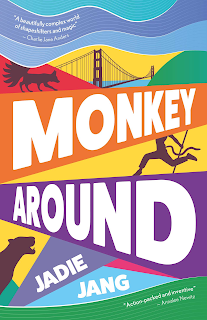
Monkey Around by Jadie Jang (Solaris)

Monkey Around is the debut from author Jadie Jang (aka Claire Light), an American urban fantasy which puts a ton of thought into "what would a secret group of mythical figures who live among humans look like in a nation formed of waves of immigration?" Protagonist Maya lives in the San Francisco of 2011, where she divides her time between volunteering for the Occupy movement, working at the local supernatural hangout, and running an Asian American magazine. She's also trying to work out exactly what's up with her weird blend of shapeshifting and reality bending superpowers: as a mixed race Asian adoptee with minimal ties to her birth culture, Maya has been dissuaded from trying to pursue her heritage too directly, but that doesn't mean she's not interested in knowing what, exactly, she is. (The reader will know, from the first sentence if nothing else, that she's an incarnation of the Monkey King... but Maya's going to take her time getting there, and you'll have to go with it.)

When shapeshifters start getting murdered, and a handsome crush enlists Maya and her boss Ayo to track down his sister, Maya finds herself drawn into a dangerous plan involving a powerful magical artefact: a stick that appears to have a weird hold on its owners. Maya's hunt for Chucha - a Nahual shapeshifter whose culture stems from the Aztecs - brings her into the orbit of said crush and his family dynamics, and when the shapeshifter murders start to take on a more personal turn, everything comes together in a neat, entertaining mystery, with Maya's strong narrative voice making the whole thing a very enjoyable read. There's a lot of set up for later instalments here: in particular, there's a second love interest who remains mysterious (BUT TOTALLY SUPERNATURAL) and there's clearly going to be some choices further down the line. While I'm not totally enamoured with those dangling plot threads, I am definitely on board for more of Maya's journey of self-discovery, and I'm excited to see where future books take the whole concept.


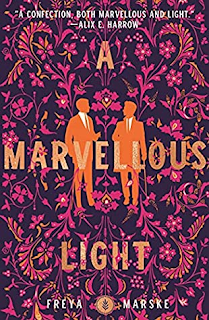
A Marvellous Light by Freya Marke (Tor Books)

Freya Marske's fantasy romance had a lot of buzz in my circles, and I'd be lying if I said I wasn't attracted by that cover alone: it's so pretty! So colours! Set in a version of England where magic is real and runs in old, wealthy families who go to some lengths to conceal themselves from the rest of society. Robin Blyth is a young baronet working at the civil service, trying to build a career in the shadow of his deceased parents' complicated legacy. When someone with a grudge against him appoints him to a bizarre, unheard of cabinet post after the disappearance of its former occupant, he isn't expecting to end up as liaison to a magical world he had no idea existed. His magical counterpart Edwin Courcey certainly isn't expecting a completely non-magical person to end up in the post, and before anyone can wipe Robin's memories and leave him none the wiser, he ends up the recipient of a strange, painful magical curse. The only solution lies in Edwin's family library, but that means Edwin needs to return to the family that consider him a weak disappointment, and try to shield Robin from the excesses of his sister and her gang of blustery, overzealous friends. Also, Edwin thinks Robin is cute, and Robin thinks Edwin is cute, and this being Edwardian England complete with period-appropriate homophobia, that takes some time to figure out.

A Marvellous Light is very, very good fun, driven by two characters who it's impossible to not want good things for. Both Edwin and Robin are a mess in quite different ways before coming into each others' orbit, and the way Robin reaffirms Edwin's magical talents is particularly noteworthy, hitting a lot of great emotional beats and creating a magical world full of stuffy, narrow thinking that we want to see both men triumph over (also, their sisters and female colleagues should triumph over it too - the other dudes can mostly fuck off). More books are planned, although as this is a romance series they will be following different characters: there's more of this world I'd like to see fleshed out, but this is a jolly entertaining way to kick things off.

Read the full review of A Marvellous Light by Roseanna here!


Adri, Nerds of a Feather co-editor, is a semi-aquatic migratory mammal most often found in the UK. She has many opinions about SFF books, and is also partial to gaming, baking, interacting with dogs, and Asian-style karaoke. Find her on Twitter at @adrijjy


Thursday, December 30, 2021

We hear you, 'Don't Look Up.' We're tired of the end of the world too

Not even this dark comedy about the stress of disaster prevention could match the absurd incompetence of our real world leaders

Every disaster movie starts with a scientist being ignored. It's less common for a disaster movie to continue and end with the scientist still being ignored, but that's the kind of world we live in now.

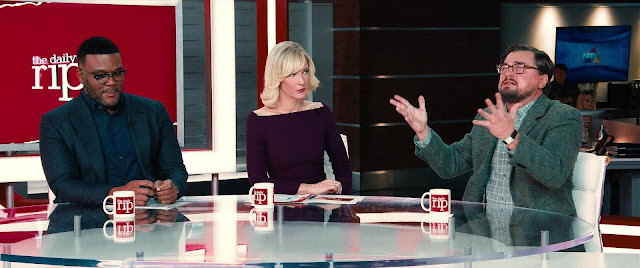
Don't Look Up, the latest film by writer and director Adam McKay, narrates the quest of two astronomers to warn the world about an imminent danger: a comet is on a direct course to hit our planet, it can kill everything that lives, and we're running out of time. In terrifyingly believable fashion, the government and the media are more concerned about how the end of the world affects their stock value and poll numbers than, you know, the end of the world. The film was originally conceived as a satire of inaction against global warming, but at the end of the second year of a devastating pandemic, it hits even harder.

Don't Look Up takes delight in mocking the vulgar banality of rating culture. Every character in a position of power has their priorities backwards, but this movie doesn't lose sight of the way our choices as consumers and as voters have been feeding those twisted priorities. The plot is science fiction, but a news cycle where celebrity breakups get more attention than human survival, a political system where disaster prevention is perversely timed for electoral advantage, a billionaire class willing to burn the world for more profit, and an internet where life-saving science is ridiculed by charlatans are not fictional at all.

In the film, as in our world, basic standards of scientific rigor are ignored for the sake of appearances, politicians turn matters of life and death into catchy slogans to ramp up partisan support, media strategists distort the facts because it doesn't look good to scare the public, and the only experts who can help solve the crisis are reduced to frantic rants on television as viewers yawn and click away.

Drowned as we are in alternative facts, it's exhausting to stand on the side of reality. Yes, global warming is happening, and yes, it's our fault, and yes, we should replace individual cars with mass public transportation. That's a fact. Yes, the coronavirus can kill you, and yes, you should still be wearing a mask, and yes, you need to get vaccinated. That's a fact. We're sick of talking to a void of smug, willful ignorance. (A few reviewers have had the outrageous nerve to say that no, this movie is the smug one.) Experts have tried all conceivable ways to get the message across, and yet reactionary pundits get to shout louder, because reptilian overlords and poisonous chemtrails get more online engagement. We'd be on our way out of the pandemic by now if our own governments hadn't contributed to making it worse time and time and time and time and time and time again.

There's no happy ending in Don't Look Up, because of course there isn't, because the people in charge are so selfish and callous that they deserve to blow up in a shower of raging lava. As for us here in reality, we don't know what other methods to use to get the world to take existential threats seriously. That's a point that critics of this movie have missed: of course it's crass, and unsubtle, and moralizing, and aggressive, because scientists have already tried civilized patience without success, and it's not a movie's job to give them the solution. Sometimes, the catharsis of watching the end finally come is a respite from the stagnation we're in. In such irrational times as these, the rational choice may be to yell in desperation.


The Math

Baseline Assessment: 6/10.

Bonuses: +1 for the eerie prescience with which this movie coincided with the real world's disastrous indifference for the COVID crisis.

Nerd Coefficient: 7/10.

POSTED BY: Arturo Serrano, multiclass Trekkie/Whovian/Moonie/Miraculer, accumulating experience points for still more obsessions.

Wednesday, December 29, 2021

In 'Resurrections,' the toxic legacy of 'The Matrix' is the new villain to defeat

The Matrix Resurrections knows you came for the cool kung fu, but the big reveal of this sequel is that The Matrix was never about the cool kung fu

Lana Wachowski is very much aware of how dangerous it was to ask for another Matrix movie.

In the first scene of The Matrix Resurrections, a self-professed fan of Neo watches a deliberately inaccurate remake of The Matrix, one where the female lead loses. Then this fan intrudes into the narrative, rescues one of her heroes, and exits a movie theater, running for her life.

The title of the movie she's desperately fleeing? The Root of All Evil.

What, pray tell, is the root of all evil? The love of money.

That's the horror Resurrections is trying to avoid, and despite its corporately mandated existence, it manages to not lose itself.

The movie keeps a close eye on this danger. One level upward, the original creator of The Matrix detects this invasion of the narrative. One of his characters is missing, but before he can deal with that, he's summoned by his boss, who tells him he's going to have to produce another entry in his videogame franchise. The boss drops a few commonplace lines about the nature of storytelling and authorship, but as soon as he mentions marketing, the scene turns surreal and monstrous. His lips dissolve and blend together, recalling the interrogation scene in The Matrix. In the original movie, this represents that Neo doesn't really have a voice of his own as long as he remains within the system. It happens just after he says he's going to call for help. This time, it happens just after the boss mentions the company's marketing department. Wachowski is making a very conscious choice by reusing this visual marker for the loss of voice right at the moment in the scene where the moneymaking potential of the new Matrix sequel is being discussed. It is unsubtle, because it needs to be, so unsubtle that the Analyst spells it out in the next scene: if Wachowski cared about the marketing, she'd lose her storyteller voice.

One shot in that scene with the Analyst shows us a window in his office with a bonsai positioned between him and Neo. The bonsai is an appropriate symbol for what he's done to Neo: a creature who could be much bigger, deliberately warped and mutilated and limited to an unnaturally small container. The purpose of growing a bonsai is to imitate the shape of the real tree, but within a controlled space. As the boss casually remarked a moment earlier, "We're still telling the same stories we've always told, just with different names, different faces."

The cheapened approach to storytelling involved in WB's demand for a new Matrix is reproduced with gleeful spite in the movie itself. Neo's coworkers hold a strategic meeting to plan the new videogame sequel, dropping "originality" and "fresh" as keywords, failing to grasp that turning them into keywords negates their meaning. The montage that follows has supposed creatives repeating the same trite explanations of the charm of the original Matrix, having the exact same conversations day after day. Neo, the story's creator, is clearly sick of hearing it. But the best part is the contrarian fan who says, "I didn't love the first one, like some of you. And, frankly, I've got zero tolerance for anything that requires a syllabus and a highlighter. I like my games big, loud, and dumb." Another developer continues that thought with "We need guns. Lots of guns." That's a very popular quote from the original Matrix, and the fact that it became a very popular quote is an example of how fans chose the wrong bits to fixate on. Naturally, it's a woman who counters this testosterone-poisoned brainstorming with "Mindless action is not on brand," but as soon as she says that, her point is cynically twisted into "Ideas are the new sexy." It's a disturbing montage to watch, because the notion itself is disturbing. You can't focus group your way to art, and it's futile to try to make The Matrix great again. The result would be a grotesque deformation of the real thing, like the bonsai in the Analyst's office.

So that's what Wachowski proceeds to give us. "Yet here we are" is something of a motif in Resurrections, uttered twice by characters intrigued by their incongruous presence in the story. You wanted one more Matrix movie, with the same heroes you loved as a kid? You realize that would mean dragging Neo and Trinity back from their corpses and enslaving them again? Come and see what that actually entails. You want a callback to Morpheus pausing dramatically to say "At last!"? That would be ridiculous. If you must have it, there, have it. But it can never hope to be more than off-color mockery, so it's a mockery that openly accepts it's a mockery. You want a repeat of Agent Smith ominously screaming "Mr. Anderson!"? That would be ridiculous. If you must have it, there, have it. But it can't be more than a half-remembered nightmare, so it's a nightmare that openly accepts it's a nightmare. It's not that Wachowski is trying and failing to remake a Matrix movie; she's still a master-level director. But she knows that The Matrix is unique and that WB's insistence upon its recreation must produce a confusing parody, a chaos of bullets and gore. So she embraces the parody. This is the opposite of what we saw in Space Jam: A New Legacy. If this first act of Resurrections feels like bad fanfiction of The Matrix, it's entirely intentional. After Neo and Trinity earned their victory at the end of Revolutions, it would be a vile desecration of these characters to make another Matrix, and to make another Matrix. That's exactly the point. The scene where Morpheus and Smith start destroying Neo's workplace is so outlandish that the Analyst has to step in and undo it. Scratch that. It doesn't work.

Wachowski's brilliance is to then proceed to show us what kind of story does work, given this mandatory ridiculous premise. You wanted exquisitely choreographed gunfights? Too bad, you're not getting that. You wanted a fearless hacker dude with a great haircut and a wicked trenchcoat? Nope, not that either. You wanted the stylized dance of dead bodies dropping? Nah. That was never the point of The Matrix anyway. And we've already seen what happens when people mistake aesthetic for substance, when the meaning is so coated in layers that it can be smuggled into serving the enemy. Wachowski is determined to not let anyone distort her creation this time. Yes, Resurrections is woke as hell. That's the whole point; The Matrix was always woke. But people were too distracted by the shiny sunglasses and vinyl jackets to get it. Even the Analyst is recruited to deliver the message: "it becomes a problem when fantasies endanger us or other people."

Wachowski has been taking notes on the colossal effect her creation has had on mass culture. In the simulated world, coworker Jude proclaims his love for The Matrix, but Neo couldn't care less. It's this annoying fan, coded as a lowkey predatory gamer bro, who literally drags him to reunite with Trinity. In a later scene, once Neo has escaped back into the real world, he meets another fervent fan in Berg, coded and written as unmistakably queer, and this time the encounter feels genuine. Wachowski is telling us exactly which fans she's talking to. She has no time to lose with red pill charlatans.

The conflict between the machines and the humans appears to have been translated in Resurrections into a conflict between neofascists who parasitize the message of The Matrix and the rest of us. The surviving humans in Resurrections have developed a sort of fan culture around the epic story of Zion's salvation. Crew member Lexy joined the rebellion because she felt inspired by Trinity. Captain Bugs was set on the path to freedom when she glimpsed Neo's true self.

It's worthwhile to discuss Bugs, because what she perhaps represents is more significant than the Alice in Wonderland reference. Bugs Bunny is the visible incarnation of WB, or at least the benevolent face of it. If we read the character of Bugs as the good side of WB, we get a more complete sense of what Wachowski is trying to say about her relationship to this media megacorporation. By writing a story where Neo is oppressed by WB marketing, but rescued by Bugs Bunny, she's choosing to focus on however much joy she can get out of an impossible situation. If Matrix 4 was going to happen regardless of her input, the choice still open to her was to have fun and be true to herself while doing it.

The next time Bugs reenters the original film, it's through a tear in the image, as if to say: Clearly reenactment didn't work, so let's try ripping a hole in The Matrix and see if something new can fit. Once again she's in a movie theater, but this time she's not running from a mediocre copy, but breaking her own path back into the true thing. The scenes of The Matrix projected onto a broken canvas are matched to playful dialogue by the new Morpheus, who doesn't bother trying to replicate the majesty of the original scene. You already know this scene. You don't need to watch it done the same way again. You don't need a remake of The Matrix. You've been here before.

Indeed, the new Matrix doesn't look like The Matrix. Faces are still lit with just the right intensity of shadow and contrast that you recognize as Wachowski house style, but the use of camera motions, color correction, and scene cuts has a warmer, gentler air to them. When operators talk to the human rebels, or when Neo talks to the Analyst through a mirror, Wachowski employs the same visual language of telepresence she perfected in Sense8. The emphasis is no longer on cool poses and slow motion acrobatics; instead, she casts a more intimate, more affectionate eye on these characters. There are fights, sure, but they're meticulously designed to not give you what you learned to expect from a Matrix fight. The new combat scenes look messy, ugly, disorienting, because violence is messy, ugly, disorienting. Resurrections isn't here to feed your inner kid's power fantasy of looking awesome shooting guns, because there really isn't anything awesome about shooting guns. You're supposed to get uncomfortable with violence.

And yet, here we are. The numerous comparisons to The Last Jedi are fully earned: our hero has grown weary of war and learned the folly of viewing the conflict that defined his life as a rigid binary opposition. The meaning of "our side" has become more fluid. This was, in a clever way, foreshadowed all the way back in Neo's first visit to the Oracle, when Morpheus advised him, "Try not to think of it in terms of right and wrong." And even when Neo is forced back into combat, his style of martial arts has become far less aggressive, not meant to fight what he hates, but to save what he loves. He's become a protector. Niobe even compares the dulling effect of war to the illusion of the Matrix: it distracts you from what matters. Wachowski did not revive Neo to have him fight a war; she brought him back to explore his vulnerability and his tenderness. If this is not the Neo you used to root for, too bad. This is the part of Neo that matters. And Wachowski does a fascinating dissection of what it is that makes the character of Neo special.

In the simulation, Trinity's fictional husband is a walking joke. He's not only called Chad, but played by the original stunt double for Keanu Reeves in the original Matrix. So this Chad is literally the part of Neo that kicked ass, the stoic macho, the action movie star. But now he exists separated from the core essence of Neo, which is not his kung fu moves, but his humanity. To incel radicals, this ought to be the ideal state: all of Neo's awesomeness, none of his feelings. And that's precisely what Wachowski treats as horrific. For who knows how many years, Trinity has been stuck with the Chad, and she can't wait to run away from him and what he represents. At one point she complains about the role the system has given her: "I remember wanting family, but was that because that's what women are supposed to want?" This is the equivalent of screaming the message in the viewer's face, because people evidently didn't get it twenty years ago: No, the oppressive system you need to wake up from is not feminism. The oppresive system you need to wake up from is patriarchy. Memo to the manosphere: Chad, the quintessential incarnation of toxic masculinity, is the enemy here. Get it? Trinity's moment of liberation is to kick the crap out of Chad. Get it? Are we being clear and unambiguous enough now? Or are you going to search for some way to pervert this franchise's message to justify rubbish incel theories again?

Wachowski knows all the complaints the manosphere will throw at this new Matrix. And she puts them in the mouth of the blabbering buffoon: the Merovingian, who sputters nonsensical protestations like "We had grace! We had style!" about the previous state of the Matrix. The movie's response: Go home, old man. No one cares about your nostalgia. At the end, the Analyst points out, speaking about the general public, "They don't want this sentimentality." The movie's response: Two lovers, hand in hand, flying in the sunshine.

Love is the perennial theme across all of Lana Wachowski's art. The Sense8 finale was appropriately titled Amor Vincit Omnia. As the Analyst properly explains, recapturing the magic of Neo is impossible without Trinity, not because of them as themselves, but because of what is created between them. And that's the secret at the core of the entire Matrix franchise: the power of the One was never about a fearless hacker dude with a great haircut and a wicked trenchcoat. The One was never an individual. The One is made from the link between human beings. It came into existence in the original Matrix when Trinity's love saved Neo's life; then it saved her life at the end of Reloaded; and it kept them going until the end of Revolutions. The answer was always love.

Let's go back to the Architect's speech in Reloaded: "Your five predecessors were, by design, based on a similar predication, a contingent affirmation that was meant to create a profound attachment to the rest of your species, facilitating the function of the One." For the machines, love is incomprehensible, but nonetheless exploitable. The weaponization of our empathy in order to wield its power against ourselves reaches its perverse culmination in the new Matrix, which mirrors the way neofascists have weaponized the liberation symbolized by the red pill in order to promote more oppression. As Bugs reveals, "They took your story, something that meant so much to people like me, and turned it into something trivial." Or, as the Analyst gloats, "Kind of ironic, using the power that defined you to control you."

And still, the solution, again, is love. The correct choice, every time, is love. The Oracle herself said it at the end of the previous saga: "the real test for any choice is having to make the same choice again." And she said it at the beginning: "Being the One is just like being in love." She wasn't speaking in metaphors. The power of the One is literally the power of heartfelt human connection, the only thing that can truly destroy fascism.

Now keep in mind that, in the videogame The Matrix Online, the Kid forms a faction called E Pluribus Neo. It's the same idea: the One is created by the ties between us. The Analyst's evil consists in intentionally frustrating that connection, splitting their unity into a binary he can feed off of. That's what keeps preventing a better future, the one the Oracle referred to in Reloaded when she said, "the only way to get there is together." Since the original Matrix, there were strong hints that even those in charge of enforcing the tyrannical system felt oppressed by it. Resurrections brings that theme to completion, with former oppressors working together with the rebels to bring the tyranny down.

The new backstory we learn about in Resurrections, meant to have occurred after Revolutions, is in line with several pieces of official canon established years ago in the videogame The Matrix Online: the failure of Zion, Niobe's rise through the ranks of leadership, the loss of the Oracle, and the emergence of rival factions within the machines. Although we're meeting a completely new enemy, Resurrections doesn't fall into the common late sequel trap of erasing the original sequels (see: Terminator Dark Fate), but also avoids the equally clumsy trap of having the new enemy make the original heroes' fight seem pointless in retrospect (see: Terminator Dark Fate). The reinvention of Smith is in concordance with the times: the face of fascism is no longer the angry law enforcement agent, but the approachable tech bro in business casual. This is a much more insidious version of Smith, because Jonathan Groff's image, even when crumpled in a grimace of pure hatred, is undeniably seductive. Where Hugo Weaving filled the screen with loud, incontrollable rage, Groff delivers the alluring kiss of death.

This Smith is more consciously in tune with his deep connection to Neo. There's an obvious erotic current to his pursuit of him. We're no longer at the point in Resurrections where we were surprised to hear a machine speak of love, but let's remember what was said at that time: love is just a word, and "what matters is the connection the word implies." If you lose yourself, you find your way back by means of love. Even after the Oracle had to adopt a new face, the way she could tell she was still herself was by her love of candy. That you know yourself by what you love is the key to the "know thyself" motto she kept on her kitchen.

There's a curious focus on domestic spaces in Resurrections. Many scenes are set in bathrooms, the battleground of this era's culture wars. Wachowski is answering to a popular consciousness partly shaped by her own work, and it's interesting that The Matrix is transformed from a movie into a videogame in the fictional world of Resurrections. On one level, this calls back to The Matrix Online, which had a vibrant fanbase. But on another, it refers to the nature of the Matrix itself as a digital simulation of reality. Every time Neo plugs into the Matrix, it must feel like entering a videogame with administrator privileges. So it makes complete sense that that's how Neo remembers his earlier life. To him, it wasn't a movie.

This gives Wachowski a prime opportunity to comment on the degradation of digital culture. There's no need to recruit Agents when anonymous masses can be deputized as bots. The final chase scene, where Neo pushes wave after wave of bots away from Trinity's motorcycle until they miraculously survive a series of explosions, almost reads like a Twitter user desperately hitting the block button against the bots and barely making it past the ensuing flame war. It's like Wachowski knew her work of love was going to be review-bombed, so she cast the bombs as literal suicide bots dropping onto our heroes.

In the end, she doesn't have to care about them. She can be fearlessly sentimental. She can be as woke as she wants. She can tell her stories in her own voice, from her unique artistic vision. She can be open about the message of love present in all her creations. She has come into full mastery of her craft. She's ready to paint the sky with rainbows.


Nerd Coefficient: 8/10.

POSTED BY: Arturo Serrano, multiclass Trekkie/Whovian/Moonie/Miraculer, accumulating experience points for still more obsessions.

Monday, December 27, 2021

Six Books with Sara A Mueller

 A consummate seamstress and horsewoman, Sara A Mueller writes speculative fiction. She lives in the Pacific Northwest with her family, numerous recipe books, and a forest of fountain pens. In a nomadic youth, she trod the earth of every state but Alaska and lived in six of them. She’s an amateur historical costumer, gamer and cook. The Bone Orchard is her debut novel from Tor.


Today she tells us about her Six Books


1. What book are you currently reading?

Mexican Gothic, by Silvia Moreno-Garcia. It has all the best halllmarks of gothic novels - remote, spooky house, weird insular family, horrible and ancient paterfamilias, crazed wife kept confined. Fog, nightmares, a once-powerful family rotting in the seat of their abusive power... and all of it is set in a culture that's inherently of the place. The ugly parts ring horribly true. The nightmares stick under your skin and make it crawl. Everything about this book is enthralling me.


2. What upcoming book are you really excited about?


Jade Legacy, by Fonda Lee. I loved the first two books in this series, and I am pretty well panting for the third one. The world is richly developed to the point that you can almost taste the air. The characters are complex, imperfect, wholly human, and wonderful. Even the ones I could throttle. Fonda's writing is gloriously evocative and silky smooth. Her combat scenes are chef's-kiss perfect... I. Can Hardly. Wait!


3. Is there a book you’re currently itching to re-read?

The Yiddish Policeman's Union by Michael Chabon. Alternate history is terrifyingly easy to screw up. It takes a single misstep to break the illusion of the world. Michael Chabon has done a spectacular job. The mystery works on the level of a police story, the alternate history is heartbreakingly believable, the characters are real people beset with problems large and small, and the challenges of an entire culture being uprooted. I also recommend the audiobook of this one. Peter Riegart does an amazing job as narrator. 


4. How about a book you’ve changed your mind about – either positively or negatively?

Growing up, I read a whole bunch of problematic books that to my eyes now range from 'disgusted sigh' right on up to 'Holy YIKES'. Most of them are from periods when I simply hadn't found better books - the series of small libraries I had access to had AMAZING librarians, but they didn't have massive sff sections. Heinlein, Asimov, Piers Anthony... the list is long and won't come as a shock to anybody who grew up reading sff in the 80's. And that's not to say I didn't enjoy all those books at the time; but as my reading material expanded, and my critical reading skills sharpened, I saw a broader view of the things I was reading. 


5. What’s one book, which you read as a child or a young adult, that has had a lasting influence on your writing?

The Thirteen Clocks, by James Thurber. My father read it to me in my childhood, and I've read it to more or less everyone I can get to sit still and listen to it. It gave me my first love of beautiful language. The prose has almost-meter. The way Thurber used precision language to elevate the reader's experience is a thing that never fails to leave me wanting to do better with my own work. 

This book should be read aloud for maximum effect, and I recommend borrowing a child if you don't happen to have one handy - or read it to your pet. It is a wonder, and a delight. It has a wicked Duke, a cursed Princess, a minstrel who isn't, and a Golux. There's a Todal that might be sent to punish evil-doers for not doing as much evil as they ought. There are spies and secret doors and clocks that don't go because Time froze to death. Neil Gaiman called it "probably the best book in the world". If you don't believe me, hopefully you'll believe him!


6. And speaking of that, what’s your latest book, and why is it awesome? 

The Bone Orchard is my debut, coming out March 22, 2022. Charm is a bone witch taken in the conquest of her homeland. Orchard House, her gentleman's club, has been a comfortable cage. All of Boren's politically ambitious come to... play... at Orchard House. But Charm has been the Emperor's mistress, mindlocked, for longer than most of his subjects have been alive; and they don't know her nearly as well as she knows them. As he lies dying, the Emperor tasks her to kill whomever poisoned him and to kill any of his sons who try to sit his throne. If Charm can survive, she will have her freedom. And her revenge.


Thank you, Sara!

POSTED BY: Paul Weimer. Ubiquitous in Shadow, but I’m just this guy, you know? @princejvstin.