Showing posts with label TCM Underground. Show all posts

Monday, June 24, 2013

Microreview [film]: The Foreigner

The then-brand-new World Trade Center.
The Meat

The Foreigner is a movie so obscure it doesn't even have a Wikipedia page. Not even a stub. Shot in New York in 1978 by a handful of people with seemingly a nickle and length of rope between them, there's really not much to recommend the film either narratively or technically. There's not really a story, so much as a vague idea being played out very slowly across its running time, the sound is so bad that long stretches of dialogue are totally incomprehensible, and no one in it, no matter how much responsibility they seem to have in the world of the story, looks any more than about 24 years old.

But The Foreigner is one of those odd gems that makes a fascination with cult cinema so rewarding. If you can soldier past the (very significant) problems with it, the movie offers its own set of rewards that are pretty much distinct from the experience you get watching a normal movie where you hope to get caught up in the human struggle of made-up characters. Shot over the course of one week by Amos Poe, who a couple of years earlier made what is considered the first documentary about punk music (The Blank Generation), you could argue that The Foreigner is the first punk feature film. It's rough, intentionally ugly in parts, transgressive, and was clearly done for the sake of doing it. Like punk music.

There's a fine line here, of course, between "rugged DIY experiment" and "who cares?" but the film's immediate impact on the small circle of artists involved in the scene that produced it (called No Wave Cinema at the time) was significant and lasting. I could describe the movie as some kids attempting to do their impersonation of Godard's Alphaville, which is accurate but also makes it sound like something your pretentious high school neighbor did last weekend. So instead, I'll describe this movie about a secret agent who is so secret neither he nor anybody else knows what his mission is as the filmic contemporary and equivalent of Blondie's self-titled 1976 debut album -- more memorable for what it started than for its own content. And Debbie Harry has a small part in The Foreigner, which is neat to see. The movie, its filmmakers, and others all revolved around CBGB's, and so the result is sort of an insider-outsider film, a film about outsiders made by a trusted member within that group.

The Math

Objective Quality: 2/10

Bounses: +1 for providing a DIY model and sense of what was possible to people like Jim Jarmusch, who was also in the scene at the time but not yet making films; +1 for achieving an evocative atmosphere unhindered by the movie's own technical shortcomings; +1 for the present-at-the-creation view of the late-70s NYC punk scene

Penalties: None, it would just feel like piling on.

Cult Film Coefficient: 5/10
This is how we make DIY title-cards.

[See explanation of our non-inflated scores here.]

Monday, March 11, 2013

Microreview [film]: The Sid Saga


The Meat

Sid Laverents was the American 20th Century.

Usually, this space concerns itself with cult films of the horror and/or sci-fi persuasion, but for The Sid Saga, we make a bit of an exception. I feel like Sid himself was an exception, yet his experience of 100 years on the piece of ground between Canada and Mexico in a very real (and surprisingly thorough) way sums up the "American" narrative. See, in 1985, a Southern California septuagenarian named Sid decided to turn his scrapbook into a documentary film. Within that scrapbook, he had chronicled his early years as the son of a poor, immigrant real estate speculator traveling around the Western United States, to his teenage years where he migrated to New York and became a vaudevillian and novelty performer as a one-man, 14-piece jazz band. Sid then got married and supported his small family as a sign painter and itinerant musician, before settling down in Florida. For a bit. Then his marriage went south, he transitioned into another one, and moved to California on the eve of World War II. Hearing that guys with defense jobs were less likely to get drafted and deployed, he landed just such a job in the aerospace sector, but got shipped out overseas anyway, spending the war in India. He came back to see another marriage dissolve, and transitioned into another one. Then, in his fifties and after two careers, he got laid off after 20 years building Cold War military gadgetry, and took up filmmaking. He sold a number of educational films he created, and he started racking up awards. That's where he stood between 1985-1989, when he created the first three parts of The Sid Saga by combining still photography, film, and animation. He returned to the project several years later, making a coda on video that chronicled the death of his third wife, his continued experiences as a filmmaker, and his courting of a new wife.

These are cynical times. Nobody seems to remember what America was supposed to be in the first place -- the only thing anyone can seem to agree on politically is that we're all headed in the wrong direction, but they can't agree on the whys and wherefores. I submit that Sid was what America was supposed to be. The child of immigrants, starting with nothing, Sid created and recreated himself over the course of a long life, thanks to his own hard work, ingenuity, and spirit. His story touches on the urbanization of America, World War II, the Cold War, the rise of suburbia, and how those manicured vistas and carefully cultivated fronts often contained families dissolving from within.

Sid's is a fascinating story, well told, and worth seeking out if you have the chance.

The Math

Objective Quality: 6/10

Bonuses: +1 for the amazing story wrapped up in what at first appears to be a home-movie package; +1 for general inventiveness and ingenuity in amateur filmmaking; +1 for Sid inventing double-bass drumming 30 years before its time; +1 for Sid's film Multiple Sidosis which often screens with The Sid Saga (see below)

Penalties: -1 for being seemingly impossible to find

Cult Movie Coefficient: 9/10. Very high quality/standout in its category.


[See explanation of our non-inflated scores here.]

Tuesday, February 26, 2013

Microreview [film]: The Baby


The Meat:

The Baby is the kind of movie where after each take, you get the feeling everybody involved hung their heads a little and whispered under their breath "How the hell did I wind up here?" Lead actress Anjanette Comer had worked with Marlon Brando, composer Gerald Fried was probably wondering if Stanley Kubrick would ever take him back after scoring that guy's first four movies, and the colossal Ruth Roman, who had worked with Jimmy Stewart, Kirk Douglas, and Alfred Hitchcock, probably had to drive past her own star on the Hollywood Walk of Fame to get to the set each day. Director Ted Post (who directed one of my favorite Twilight Zone episodes) probably didn't give too much of a damn, since this was only one of about 11 directing gigs he had from 1971-1973, actress Marianna Hill probably got the taste out of her mouth playing Fredo's wife in The Godfather, Part II, but during the making of this bad-boy (pun intended), I'm pretty sure everybody involved felt like there were in the blackest night of career disintegration. Here's why:

The Baby is about a social worker, Ann, grieving the loss of her husband and throwing herself back into her work with a vengeance. She takes on a particularly challenging case regarding the Wadsworth family -- a domineering mother, two busty daughters, and son Baby, a twenty-something-year-old man who is apparently mentally handicapped and still lives as a baby. You know, crib, diapers, sucking at a reluctant babysitter's tit, the whole thing. Ann doesn't believe that Baby's really handicapped, but that "negative reinforcement" from the crazy mom is responsible for his arrested development. She's not privy to one sister poking him repeatedly with a cattle prod for attempting to speak or stand, or the other sister climbing naked into the crib with him while he sleeps, but Ann appears to be onto something. Suffice to say, drinks will be drugged, multiple women hog-tied, throats slashed, and people will be ambushed with hatchets and meat cleavers. Which is I'm sure exactly where you saw this whole thing going, right?

The film's poster and reputation suggest a depraved horror movie, possibly in the lunatic matriarch sub-genre along with Tallulah Bankhead's nutty Mrs. Trefoile in Die! Die! My Darling, and user reviews suggest a twisted psychodrama with a shock ending along the lines of Sleepaway Camp, but this movie isn't really either of those things. It tries to be a little of each, and throws in a hint of possible inbred frolicking, but that's dropped as quickly as a nonsensical reversal of roles (who's really crazy here?) is picked up. I don't really want to spoil the ending in case you see it, but, seriously, just don't bother seeing it.

The Math

Objective Quality: 3/10

Bonuses: +1 for the cello-based score, which was inappropriately evocative of Bergman

Penalties: -1 for the series of twist endings, none of which make sense; -1 for the start/stop nature of the various transgressions/depravities trotted out in the movie

Cult Movie Coefficient: 2/10. Just bad.

[See explanation of our non-inflated scores here.]

Monday, November 19, 2012

Microreview [film]: Venus in Furs


The Meat

Not to be confused with the 19th century novel, the Velvet Underground song, or any of the other three or four other movies with the same title, this Venus in Furs is a surreal 1969 Euro-pop sexploitation movie from prolific exploitation director Jesus (or Jess) Franco. The film of his with the most name recognition is maybe Vampyros Lesbos. This one stars former teen idol heartthrob James Darren (about as far here from Gidget as you can get), the gorgeous Maria Rohm, and Klaus Kinski, also long of the exploitation film scene.

James Darren plays Jimmy, a down-on-his-luck jazz musician who finds a dead, naked girl washed up on the beach while he's trying to get away for a bit and get his head straight. Clearly, finding a dead hottie won't really help in that department, but things get even worse when he returns to Rio to get back into playing music and starts seeing her walking around in the living, breathing flesh. It turns out this is Wanda (Rohm), who was a naive innocent who fell into the hands of bloodthirsty sex deviants. They killed her, dumped her body, and somehow now Wanda is back and hungry for revenge. And also sex with Jimmy, but nothing serious, which gets him all tied up in knots inside.

I think. I mean, it's complicated. But I think that's about right. If you're in the mood for it, this is a pretty engaging movie, despite its many oddities and inscrutable elements. Make no mistake, no matter how into it you are, there are going to be moments where you're scratching your head and wondering if you missed something, but you probably didn't. If you're into abstract, this very 1960s erotic/horrific tone poem has its rewards. Not the least of which is the very catchy theme song, which is sung throughout.

The Math

Objective Quality: 5/10

Bonuses: +1 for Maria Rohm; +1 for the pervasive, expressionistic atmosphere throughout

Penalties: -1 for the unnecessary and cliched twist at the very end of the film.

Cult Movie Coefficient: 6/10. Still enjoyable, but the flaws are hard to ignore.

[See explanation of our non-inflated scores here.]

Wednesday, November 7, 2012

Microreview [film]: Riki-Oh: The Story of Ricky


The Meat (in this case, literally)

Have you ever seen a movie where a character in a fight realizes he has lost, commits harakiri, but, before dying, has a change of heart and attempts to strangle his opponent with his own steaming intestines?

No? Then you haven't seen Riki-Oh: The Story of Ricky.

TCM Underground screened this Hong Kong martial arts/prison movie the other day, which is stunning, because when I first saw it about ten years ago, its reputation was as literally the most disgusting and violent movie ever made. It turns out that the movie isn't nearly that -- not unless you find Itchy and Scratchy cartoons on The Simpsons legitimately disturbing. Anything by Gaspar Noe, anything that may or may not depict actual cannibalism, anything with graphic depictions of rape or child abuse, Twilight: Breaking Dawn, those are far, far more disturbing films because they appear to depict actual human beings in distress (or, in Twilight's case, actual audience members). Riki-Oh is a live-action cartoon that deposits gallons (what's a larger quantity than a gallon? hectares?) of blood at the audience's feet and says "I dare you not to tell your friends about me."

So if you are a fifteen-year-old boy, or an insatiable fan of Hong Kong action movies, or are high, then you will probably totally dig the following things that happen in Riki-Oh:
  • Several heads are punched (yes, punched) clean off
  • Ricky ties his own tendons back together with his teeth after being cut in a knife fight
  • Several intestines are punctured, either with knives or fists
  • A dog is kicked in half
  • At least two people are literally punched in the brain
  • Razor blades are consumed like candy
  • Several eyeballs go missing during fights
If right now you're struggling to contain your excitement, let me be very clear that none of this looks and/or feels any more realistic than accidentally spilling ground beef on your kitchen floor while trying to make chile rellenos. But if you're still excited about it, then by all means, hit up your local indie video store and bring this baby back to your dorm room.

The Math

Objective Quality: 4/10

Bonuses: +1 for the sheer inventiveness of finding this many ways to kill and maim in the least realistic ways imaginable; +1 for the evil assistant warden who keeps his breath mints in his glass eye; +1 for the warden himself, who seems to confuse the concepts of "kung fu" and "actually being a giant demon in human form."

Penalties: -1 for, well, most everything else.

Cult Movie Coefficient: 5/10. Problematic, but has redeeming qualities.

[See explanation of our non-inflated scores here.]

Wednesday, October 3, 2012

Microreview [film]: The Legend of Hell House

The Legend of Hell House

The Meat

There is a bright, interesting line, I believe, that can be drawn between Shirley Jackson's influential 1959 novel The Haunting of Hill House and Stephen King's pop culture titan The Shining, and that line goes directly through The Legend of Hell House, and its source material, which was written by Richard Matheson. In fact, I find it very difficult to discuss -- or even really think about -- The Legend of Hell House outside of the context of Shirley Jackson's book, and the 1963 genre movie classic it spawned, The Haunting, directed by the quietly masterful Robert Wise. Despite the overlap with The Haunting, Richard Matheson is a legend of the genre and was a huge influence on Stephen King, so this is a clear spiritual, and possibly even direct, influence on both the literary and film treatment of one of King's best-loved works.

In The Legend of Hell House, almost every element of the earlier Jackson/Wise works is recycled, and then turned up to 11. The basic set-up for both is the psychic investigation of a sprawling, Gothic mansion with a reputation for being haunted, and the four (two men, two women) poor, dumb souls who decide to spend a week in the house to investigate it. Needless to say, things go awry.

For me, The Haunting is still one of the finest horror movies ever made. It evokes a pervasive creepiness, relies on the psychological for its scares, and manages a not inconsiderable amount of them. Despite being made a decade later, after blood found its way into the movies, I found The Legend of Hell House to be a less frightening, and certainly less disturbing, film. That said, it brings in some interesting new additions to the discussion (like deviant, deviant sex!), and starts from a place where paranormal manifestations and occurrences are a given. The question at hand, then, is not whether something weird is going on at the Belasco House, but whether the source of it is a lingering personality (a ghost), or an imbalance in electromagnetic energy that can be scientifically measured and counteracted.

On the whole, an effective-enough film as a bridge between The Haunting and The Shining, though the former exceeds it in humanity and the latter exceeds it in terror.
Jack Nicholson in "THE SHINING"
"Heeeeeeere's....some familiar genre tropes!"
The Math

Objective Quality: 7/10

Bonuses: +1 for Richard Matheson's screenplay from his own book; +1 for the lower third date/time stamp throughout the film that would be reused by Kubrick in The Shining.

Penalties: -1 for hewing so very closely to The Haunting; -1 for the cool at first, then just kind of odd finale (prosthetic legs? wha?!?).

Cult Movie Coefficient: 7/10. An enjoyable experience, but not without its flaws.

[See explanation of our non-inflated scores here.]

Tuesday, September 4, 2012

Microreview [film]: Near Dark


The Meat

A small-town kid tired of the tedium of a hum-drum daily life meets an attractive vampire, falls in love, and gets "converted," only to find peril when the other vampires aren't exactly welcoming. Maybe this sounds familiar. Maybe it sounds like Twilight. Because it's pretty much Twilight.

On almost every conceivable level, though, Near Dark is much, much better than Twilight. It marks the directorial debut of Katherine Bigelow (Oscar-winner for The Hurt Locker), and its Western-Horror-Romance genre mash-up remains effective 25 years after its first release, even though we've seen countless derivations of a similar formula since. You've got your young, sexy conflicted vampire that sucks a stranger into her world of darkness (pun intended), and grim consequences ensue. Local teenager and family ranch-hand Caleb meets Mae, a beautiful stranger he takes for a late-night drive. Mae is a vampire of relatively recent vintage, and doesn't feel much connection with the violent, vengeful gang of vampires that she belongs to. She converts Caleb without his knowledge, and has to prevent her gang (led by sci-fi staple Lance Henriksen) from immediately killing him, promising that Caleb will learn to hunt and kill on his own. But can he really...?

What's nice is the lack of any whiny teen-angsty stuff to color the proceedings. In its place is a genuine sense of loss, especially when it comes to Homer, the child vampire that longs for someone to relate to. That struggle presages the lovely work of then-unknown Kirsten Dunst in Interview with a Vampire a few years later. The sense of family feels true-to-life, Caleb's desperation and confusion after his transformation feels more legitimate than many other movies' handling of the same idea, and the tension in scenes where the vampire gang makes their kills is appropriately taut. The Twilight comparisons these days are inevitable when watching Near Dark, but what this movie has and I always felt that other saga sorely lacked is a real, human heart at its core.

And that's important. We're dealing with blood here.

The Math

Objective Quality: 7/10

Bonuses: +1 for one of Bill Paxton's more energetic performances; +1 for never once actually using the word "vampire."

Penalties: -1 for the dubious method of resolving everything at the end.

Cult Movie Coefficient: 8/10. Well worth your time and attention.

[See explanation of our non-inflated scores here.]

Tuesday, June 5, 2012

Micro Review [film]: The X From Outer Space


The Meat

Look, I'll be honest, the only thing I really understand about this movie is that I love it. Starting with the swingin' 60s intro music that includes a spoken conversational break-down between a man and a woman that goes something like "Look, what's that up ahead? It's the future!" "Come on, everybody, let's embrace it!" to the fact that the name of the monster in this Japanese movie is filled with Ls, which are hard for Japanese folks to say, this movie is a masterpiece of oddity.

An entry in the Japanese kaiju genre (translation: "big friggin' monsters stompin' on stuff"), of which Godzilla is the most famous example, The X from Outer Space is about a group of Japanese astronauts (and one white girl) flying back and forth from Earth to Mars and the moon, maybe, while being regular 60s swingers. I think it takes them about a half hour to get to the moon, so when they return to Earth and figure out they forgot something, they just hop back on their ship and pop back to the moon real fast. On one of their trips, though, they get some gunk on their spaceship and it turns out to be an egg for a big monster that wants to get in on the action and step on Tokyo. Stepping on Tokyo is like the Super Bowl for giant alien/radioactive/mutated creatures. This particular monster's name is Guilala, and he's a giant space-chicken. Not kidding. Not one bit. He eats nuclear fuel, spits fireballs, and his only weakness is this foam that looks like fire extinguisher filler called "guilalanium," which causes him to shrink. This movie is bad in a very unique and magical way, and deserves to be more widely known. You could think of this as the Plan 9 from Outer Space of kaiju movies -- it's not "good" in any reasonable sense of the word, but there are definitely worse movies, and this one lives at the intersection of terrible and entertaining that makes it a truly rare bird of cult movies.

I caught this on TCM Underground a few years ago, and it's not on DVD. If you have a subscription, you can watch it on Hulu, thanks to their deal with Criterion.

The Math

Objective Quality: 5/10

Bonuses: +1 because the monster is a space chicken; +1 for the utter disregard for anything even approaching "science"; +1 for being so fundamentally Japanese; +1 for Guilala's recent and unexpected resurrection in a commercial for The Ladders job-seekers website:

Penalties: None. Like Billy the Kid vs. Dracula, if the description above sounds like a movie you'd enjoy, then there's no reason to dock it points for things like coherence, logic, or production value.

Cult Value Coefficient: 9/10

[See explanation of our non-inflated scores here.]

Wednesday, May 30, 2012

Micro Review [film]: Hausu


The Meat

Sometimes it's possible to have high expectations for something, and then feel a little disappointed when you experience it and discover it was exactly what you expected. It didn't have that little extra tweak that puts you just enough off-balance to get swept away. That's how I feel about the 1977 Japanese horror movie Hausu. It's the story of a group of schoolgirls who decide to spend their vacation at their friend's aunt's house. The girls all have names like Gorgeous (or Angel), Sweet, Kung Fu, etc., based on their personalities, and the aunt may or may not be dead, or a witch, or a cannibal, or all of the above, or she may just be a manifestation of the evil house. It's not important. And also, I think someone turns into bananas at some point.

This movie is totally bonkers, and from the very first shot - which is super cool - probably very different from anything else you've ever seen. It delivers on the promise of the genre, if the genre is "insane Japanese haunted house slasher movie," but it reaches its peak of weirdness early, and plateaus, which is kinda too bad. It's definitely worth a look, though, and if you're hoping for a big, climactic bloodbath, boy are you going to get your wish.

The Math

Objective Quality: 6/10

Bonuses: +1 for its early mix of horror and comedy; +1 for the fact that the director also made this utterly amazing commercial with Charles Bronson:


Penalties: -1 for brief but squirm-inducing, not-sure-if-she's-18 nudity

Cult Coefficient Value: 7/10

[See explanation of our non-inflated scores here.]

Wednesday, May 9, 2012

Micro Review [film]: Billy the Kid vs. Dracula


The Meat

At some point in 1965 or '66, some actual human being must have had this thought: "Let's get John Carradine to play a vampire again, but this time we'll stick him in the Old West, name the movie after two characters not actually appearing in the movie, and shoot the thing for a nickel in, say, my back yard in Encino!" The result, to our lasting chagrin or pleasure, depending on your predilection for cult movies, is Billy the Kid vs. Dracula.

John Carradine probably doesn't get the love he deserves -- this was a guy who played Preacher Casy in The Grapes of Wrath and made something like 9 other films with John Ford, played Abraham Lincoln in the Civil War drama Of Human Hearts, and inherited the role of Count Dracula from Bela Lugosi in the original Universal horror series. But then, over the course of his 50+ year career he also appeared in some of the worst movies ever made, and Billy the Kid vs. Dracula has to be one of the worst/most amazing of the bunch.

Please know that I fully appreciate the cognitive dissonance in what I am about to tell you: this awesome, awesome movie is one of the worst things I have ever seen. John Carradine, known for his trademark deep voice and facility with Shakespeare, pretty much just says "Grrr!" throughout the film. His character isn't actually "Dracula," since the producers would've had to license the name from Universal (how they got it in the title, I don't know), and the character referred to as "Billy the Kid," I have to assume, is not actually the outlaw of ill-repute, but just some random dude with the same nickname. No mention is ever made of him having murdered a bunch of people, being a hunted fugitive, or having supposedly been killed by that guy from CSI. He's pretty much just a ranch hand that wants to settle down with this girl Betty and live a quiet life. Too bad for him not-Dracula has rolled into town and would like to make Betty his own undead bride.

I know this sounds like gripping stuff, but make no mistake, this movie is terrible. The ranch house where most of the film is set is clearly just a modern house on what's probably a suburban corner-lot, the action is slow, tedious, and the special effects truly earn the pejorative "special defects." But if you don't laugh out loud while watching this train plummet off the tracks and into a ravine far, far below...well, you probably just aren't a fan of so-bad-they're-good movies in the first place.

The Math

Objective Quality: 2/10

Bonuses: +1 for simply existing; +1 for the way Billy finally defeats not-Dracula, which is better left unspoiled here; + 1 for the direction by William "One-Shot" Beaudine, who doesn't bother to call cut when characters refer to each other by the wrong names and even from beyond the grave scoffs at the idea of a "safety take"; +1 for John Carradine's entrance, lit from below with a bright red light in case we didn't get that he's eeeevil.

Penalties: None. Each "Bonus" is at best a left-handed compliment, so taking points away here would just be piling on.

Cult Value Coefficient: 6/10

[See explanation of our non-inflated scores here.]

Monday, May 7, 2012

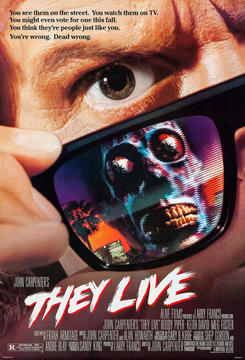
Micro Review [film]: They Live

The Meat

All you really need to know about They Live is this:

There is a moment when Rowdy Roddy Piper, the WWF wrestler, walks into a bank with a gun and says "I have come here to chew bubblegum and to kick ass, and I'm all out of bubblegum," at which point he begins shooting the hell out of the place because his magic sunglasses allow him to see most of the customers in the bank are actually skull-faced aliens masquerading as human beings and brainwashing us through advertising.

Cult immortality: achieved.

The Math

Objective Quality: 6/10

Bonuses: +1 for (see above paragraph); +1 for finding a way to mash up The Grapes of Wrath and Noam Chomsky in an alien sci-fi picture; +1 for offering legitimate social commentary that rings true 25 years later; +1 for its place in the canon of vintage John Carpenter movies; +1 for the last shot in the movie, which I won't spoil here.

Penalties: -1 for the seven-minute back-alley fight scene between Roddy Piper and Keith David (I know a lot of people like this, but it is literally seven minutes long); -1 for Roddy Piper's immediate, complete, and never-questioned transformation from mild-mannered day laborer into unstoppable killing machine.

Cult Value Coefficient: 9/10

[See explanation of our non-inflated scores here.]

Monday, April 30, 2012

Micro Review [Film]: Freaked


The Meat

The early 90s had a very unique and peculiar trash aesthetic that occasionally washed up on the shore of pop culture. If you're able, remember back to Spike & Mike's Sick and Twisted animation festivals, Ren & Stimpy, GWAR, and Green Jello's Cereal Killer Soundtrack, which all shared a Rat Fink-meets-Evil-Dead-II, eye-bulging, vein-popping style. Alex Winter (Bill S. Preston, Esq. of Bill and Ted fame) and his NYU film school friend Tom Stern embraced this aesthetic whole-hog, and were asked by MTV to produce a sketch comedy show called The Idiot Box. When that show was done, someone at 20th Century Fox inexplicably gave them $10,000,000 to make what become 1993's Freaked.

In Freaked, Bill (I'm just going to call him "Bill") plays a moronic TV celebrity who accepts a dump truck full of money from an evil corporation to go to South America and talk up a controversial liquid fertilizer, but falls afoul of a crazy freakshow operator who turns him into the hideous "Beest Boy," and throws him in with the rest of his mutated menagerie, all created using the liquid fertilizer in question and, apparently, a Nintendo system. The result is -- starting with the opening credits -- a brutal, stomach-churningly disgusting, insane, partially claymated gumbo that I expect you're either really going to love, or man, you're just not going to want to watch a single frame of. This film effectively derailed Bill's career. After its release (into only 2 theaters, Wikipedia tells me), Bill went from the co-star of a successful comedy franchise to a guy who didn't work again for four years, only to return with roles such as "TV Gangster" and "Subway Passenger."

For my part, I loved the Bill and Ted movies, and was partial to Bill above Ted, so I root for Bill, and he seems to have a pretty successful career now, especially as a director. And I expect Alex Winter must be pretty smart, and a hell of a nice guy, because here are some of the people who agreed to appear in Freaked, which was clearly never, ever, ever going to be a successful mainstream film: Brooke Shields, Keanu Reeves, Randy Quaid (not widely known to be crazy at the time), William Sadler (the wonderful character actor who next appeared on film in The Shawshank Redemption), Bobcat Goldthwait, Michael Stoyanov (at the time on the highly successful TV show Blossom), and Mr. T (who plays a bearded lady). I remember seeing a tidbit about this movie on Entertainment Tonight when I was maybe 15 years old, and being really excited that Bill was going to be in a new movie, but that was the last I'd heard of it until Turner Classic Movies scheduled it as part of their TCM Underground series this past weekend. So as much as I wanted to like the movie, and was excited to finally see it, I can't get behind it. I love cult movies that happen by accident -- amateur filmmakers who stumble across something evocative, Hollywood outsiders who build truly inept films around interesting ideas, or people who manage stunning feats of filmmaking with almost no resources. But Freaked seems to be one of those films that aspired to be a cult movie, and that, to me, is a fool's errand. Sorry, Bill.

The Math

Objective Quality: 2/10

Bonuses: +1 for the intriguing supporting cast; +1 for the makeup and effects which are grotesque but quite accomplished

Penalties: -1 for a pervasive we-know-how-clever-this-is attitude while not actually being very clever.

Cult Value Coefficient: 3/10

[See explanation of our non-inflated scores here.]
Tuesday, April 24, 2012

Micro Review [Film]: Equinox


Most Friday nights, Turner Classic Movies broadcasts an obscure, cult, or exploitation film as part of its TCM Underground series.

The Meat

Me and Equinox got off to a rocky start. It's not often that The Criterion Collection releases a B-movie, which it did with Equinox, so I was excited to see it pop up on the TCM Underground schedule. But then The Haunted Strangler happened. A late-career Boris Karloff vehicle, the Criterion release of The Haunted Strangler showed up at my house the day before Equinox aired, and I watched with increasing displeasure as this bizarre Karloff movie proceeded to swallow its own tail about 35 minutes in and just get more disjointed and worse from there. Having just been led astray by Criterion, when the first 10 minutes of Equinox proved totally inscrutable, I turned the thing off.

I poked around online to try to find out why this movie had been singled out for special attention, and I got an answer so unexpected that I gleefully waded through the murky (and slow...so, so slow) first 20 minutes of the movie to get to what makes it remarkable. It's definitely not the plot, where four kids go to the woods and...zzz...zzz...zzz...

Sorry. Look, you don't need to know what happens. Here's what's important: Dennis Muren -- the only living filmmaker with 9 Academy Awards to his name, the first visual effects artist to have a star on the Hollywood Walk of Fame, and a VFX pioneer who worked on five of six Star Wars movies, Terminator 2, and about 25 others -- co-wrote, directed, and created the stop-motion and effects shots in this movie right out of high school, on a budget of $6500. A lovely essay about the whole thing can be found over on the Criterion site. You have to slog through a whole lot of stilted dialogue, terrible ADR looping, exposition, and picnics before you get to it, but the stop-motion animation and other visual trickery that come in the second half of the film more than make it worth your while.

The Math

Objective Quality: 4/10

Bonuses: +1, hybridization of stop-motion and cel animation that no doubt makes Ray Harryhausen proud; +1, Muren's grandfather, who put up the money for the film, appears as the cackling -- and quite well kempt, I must say -- hermit who gives the poor, dumb kids a book of necromancy; +1, launching pad for arguably the most storied VFX career in Hollywood history; +1 for the film's connection to Forrest J. Ackerman and Famous Monsters of Film Land, which helped bring the collaborators together; +1, although not explicitly stated in any interview I could find, this film provided the clear inspiration for much of The Evil Dead, with many 1-for-1 parallels in terms of the magical book/Necronomicon, expository scenes, and animated shots.

Penalties: -1 for the nonsensical bookend narrative device about a reporter unable to find a story in this craziness about the dead kids with their crazy story about devil-worshipping park rangers and inter-dimensional rifts.

Cult Value Coefficient: 8/10

[See explanation of our non-inflated scores here.]

Saturday, April 14, 2012

Micro Review [Film]: The Iron Rose

[ed: This one comes courtesy of Vance from LA indie/folk band Scifi Romance.


The Meat

Here's a tip if you meet a French girl with a nice rack and convince her to meet you for a sex romp in a crypt the next day: check the cemetery hours, and set an alarm. Otherwise, as The Iron Rose informs us, you're in for a night trapped in the cemetery, occasional tumbles into open pits full of bones, premature burial, a little bit of dancing, naked time on a fantasy beach, and crepes (probably).

The cable guide listed The Iron Rose as a horror film, but it's not. Although...it is set in a cemetery, and since you can't put "Just a movie" as the genre, I guess "horror" was as good as anything. The thing is, though, on some level it really works. Probably because it's in French -  really the only acceptable language for visual mood poems.


The Math  

Objective Quality: 3/10

Bonuses: +1, random clown walking through the cemetery delivering flowers; +1, inexplicable second sex romp on a pile of skulls after beating each other with grave markers; +1, a surprisingly solid descent into madness; +1, the score, which is a bunch of reverbed-out clangs, panting, and baby-talk; +1, Francoise Pascal; +1, Francoise Pascal again, because man is she beautiful

Penalties: -1, Francoise is supposedly a professional dancer, but when she has her big crazy solo through the headstones, she looks more like a professional vertigo sufferer. Just say she's a photography student and be done with it.

Cult Value Coefficient: 8/10 ]