Showing posts with label Freya Marske. Show all posts

Thursday, October 26, 2023

6 Books with Freya Marske

Photo by Kris Arnold

Freya Marske is the author of A Power Unbound, A Restless Truth, and A Marvellous Light, which was an international bestseller and won the Romantic Novel Award for Fantasy. Her work has appeared in Analog and has been shortlisted for three Aurealis Awards. She is also a Hugo-nominated podcaster, and won the Ditmar Award for Best New Talent. She lives in Australia.

Today she tells us about her Six Books.

1. What book are you currently reading?

Some time in the last year I've become a horror reader, after assuming for a long time that I wouldn't be because I was far too much of a wuss to watch horror films. Turns out I was wrong! So now I'm having a wonderful time working out my tastes in a brand new genre. Right now, I'm almost done with my third book by Catriona Ward: her latest, Looking Glass Sound. This is a twisty, atmospheric, metafictional book that's sort of about a tragedy that takes place during a boy's holiday at the Maine seaside, and sort of about the fight over who gets to own and manipulate and publish that narrative several decades later. Every one of Ward's books is a unique and amazing creation which bends my mind around a few corners, and this is no exception.

2. What upcoming book are you really excited about?

I've been watching my mail impatiently for a promised ARC of Not Here To Make Friends, the third book in Jodi McAlister's 'Marry Me, Juliet' series. This is a really fun and tropetastic series of contemporary Australian romances, all set during the filming of a Bachelor-like dating reality TV show. I've loved the first two books in the series, and they've put me into a fever of anticipation for this third one: the story of the series villain and a long-suffering producer with whom she has a secret history. McAlister knows exactly what she's doing when it comes to constructing a good romance, and it's always a wonderful feeling to get to read something set in Australia given how US&UK-centric the genre usually is.

3. Is there a book you're currently itching to read again?

Many years ago, Shelley Parker-Chan kindly sent me a very-very-advance copy of a manuscript entitled She Who Became The Sun, for which the publication deal hadn't even been announced yet. I remember blasting through it in a single weekend, utterly enraptured by the story's propulsive craft, and knowing that it was going to be big. Now that the sequel, He Who Drowned The World, has been released, I'm looking forward to revisiting the first book before I dive into completing the duology. Shelly has an absolutely masterful way of simply telling a good story, and is far more willing than I am to put their characters (and readers) through agony along the way. I'm already donning my emotional armour in readiness to be deliciously destroyed.

4. How about a book you've changed your mind about - either positively or negatively?

It took me a long time to come around on the genre of romance. Not because I didn't enjoy love stories – I kept circling back to SFF books which had strong romantic plots, without questioning what it was about them that I found so appealing – but because I still had a mental block of misconceptions about Romance being a silly genre for silly girls. The authors that helped change my mind on romance were Courtney Milan, KJ Charles and Georgette Heyer. The experience of reading my first Heyer, Cotillion, was like sinking slowly into a warm bath full of bubbles. I couldn't believe I'd been denying myself such a straightforward pleasure, and the books of such an incredibly talented humorist, for so long.

5. What's one book, which you read as a child or a young adult, that has had a lasting influence on your writing?

I can't tell you how many times I read and reread The Little White Horse, a historical fantasy novel by Elizabeth Goudge. In many ways it's a kind-hearted Gothic – a young girl arrives at a grand house and starts uncovering its secrets – and I loved the depiction of a small English town full of interesting people, and a historical cycle of heartbreak and magic that the heroine is determined to break. I can definitely see the echo of it in my own writing. (It also has some absolutely wonderful lengthy descriptions of the food and drink served at parties and picnics, which I firmly believe are always a great addition to a book.)

6. And speaking of that, what's your latest book, and why is it awesome?

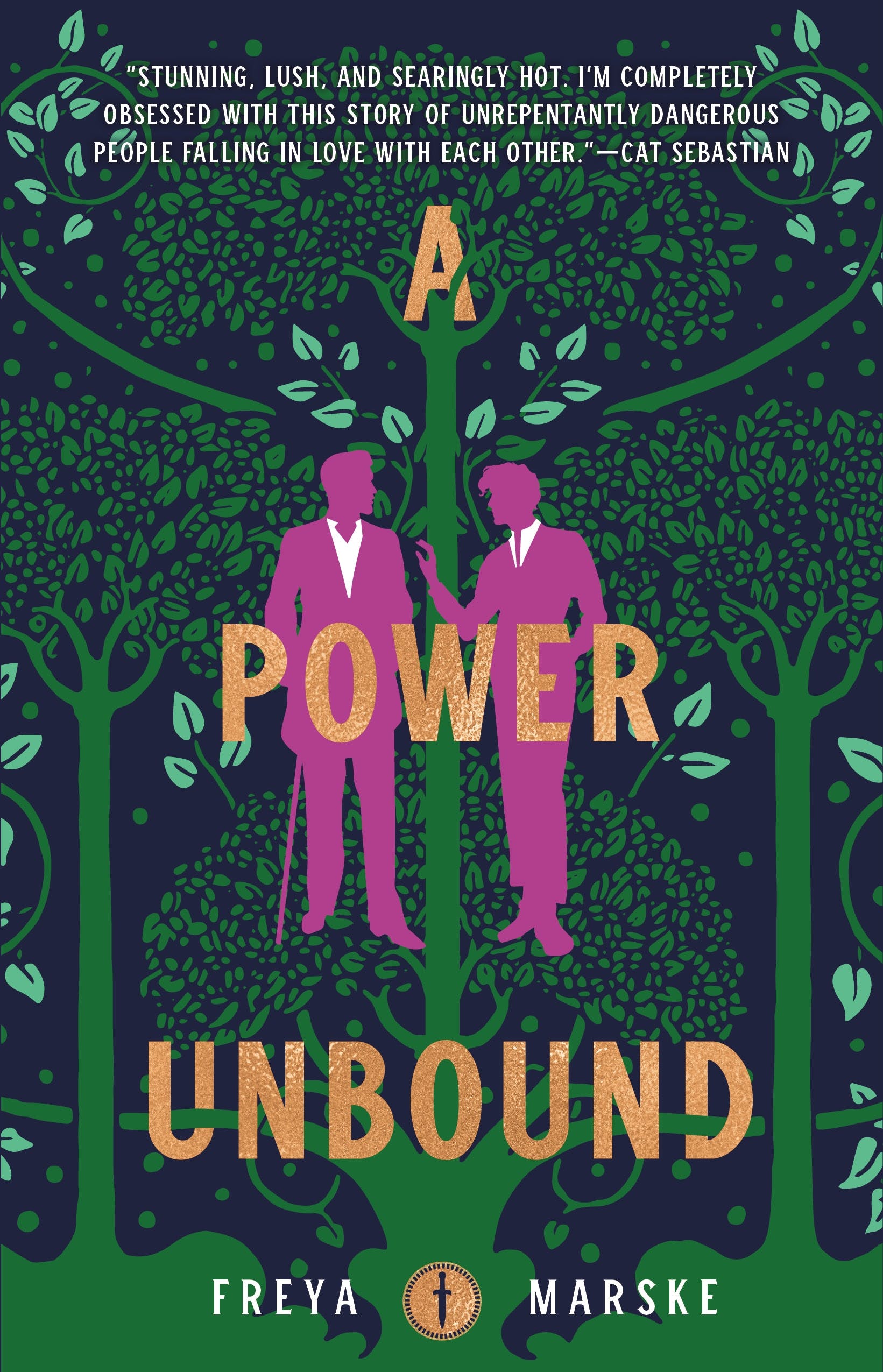
My latest book is coming out in November! A Power Unbound is the final book in the Last Binding trilogy, which is a series of queer romances cunningly disguised as a historical fantasy series set in Edwardian England. This third book pulls together all the main characters from the first two, and plunges them headfirst into heists and courtroom dramas and magical houses and bloody rituals. And it also contains the most turbulent and passionate (and kinky) of the three romances so far: the push-and-pull between Lord Hawthorn, posh sarcastic asshole who Would Like To Be Excluded From This Narrative, and Alanzo Rossi, working-class journalist and official enemy of the aristocracy. It's a bittersweet feeling to be leaving the series behind, but I'm wildly proud of this one!

Thank you Freya!

POSTED BY: Roseanna Pendlebury, the humble servant of a very loud cat. @chloroform_tea

Review: A Power Unbound by Freya Marske

Building on what comes before, a heady blend of adventure, politics and personal growth... with not a little flirting and sex thrown in for good measure.

A Marvellous Light, the first in Freya Marske's trilogy of queer Edwardian fantasy romances, was also my first ever review on Nerds of a Feather, lo those whole two years ago. It really doesn't feel that long at all, especially with regard to this series - three books across those two years is not to be sneezed at. And now we get to see the trilogy as a thing whole and complete, as well as go "ooh another book" and devour it whole (as I may or may not have done).

But I'll start with A Power Unbound simply as itself, rather than as the culmination of the series. As was teased relatively heavily before the book came out, it follows two characters we already knew - Lord Hawthorn, who has featured in both previous book, and Alan(zo) Ross(i) whom we met in the second installment - who had me tipping my head to one side and pulling a face when I found out. Because it is an... interesting pairing, to say the least. They have very different backgrounds, aims, pursuits, contexts, and, most critically, classes and they very much did not get on when last we met them. How... exactly is that going to work?

Well, the answer lies in a criticism I had of A Restless Truth, in fact. Where there, Marske dabbled briefly into examining the politics of the players in her world - peers and posh nearly all, bar one - but stopped short of actually interrogating it, here she's actually taken a full step into that thorny bush of problems. For all that romantasy in the style she's writing is relatively recently in vogue, she's also playing with tropes and settings that abound in non-magical romance stories, and one of those is, as she begins with, a set of characters who all come from the very upper echelons of society. Peerages everywhere. Can't walk through a room without stepping on a lord. And there's a lot to be said (and has been said by people who engage far more thoroughly with romance as a genre than I do) about what that means, when we fill our stories with only the tiniest percentage of the people in the world we're talking about. We get to play in beautiful settings - country manors with fashionable wallpaper and lovingly landscaped gardens - and gad about the country without needing to think of the cost, or the jobs our characters ought to be attending. But... it's a fiction, on top of the fiction we're already consuming. It hides behind it all the pain and suffering and struggle atop which those peers sit. And Marske does, in bits, pick up on this in her second book, without ever being fully willing to grasp the nettle.

But once you cast one of your two love interests as someone outside of that tiny circle of privilege, you do just have to go for it. And she does. And so she solves - to an extent (I'll come back to this) - her personality problem by making it explicitly somewhat political. Jack and Alan's relationship is entirely built on their respective places in the social hierarchy. It starts and ends with Alan being willing to tell Jack to his face that he's a rich bastard, and the reader having to sit with that, fully ponder it, as we get spelled out throughout the book what that truly means in a romantic relationship. What someone in Jack's position might take away from someone, the harm they could do. And what someone in Alan's might have to be willing to tolerate for the sake of simple survival.

And she lets it get incredibly messy.

Because these are two people for whom politics, sex, romance and conflict are all bundled together in a chaotic heap, with both of their coping mechanisms gearing towards bickering and sexual interests that intersect very very heavily with their contexts in life. And so, by focusing us on the politics upon which so much of this rests, she manages to create a very tight atmosphere and a palpable sexual tension that rockets you through the story... unless you pause to really think about it, that is.

Which is my "to an extent". For the duration of the book, especially if you read it in two hurried sittings, you can totally buy into what she's doing. You can enjoy the sniping and the sarcasm and the building heat of their interactions. It absolutely works. It ties in beautifully with a lot of what's happening in the world. But... when you come away from it after finishing the book, when you let it settle in your mind for a bit, you can't help but be convinced it won't last. That they don't really work together, at least not in the secure way the previous couples have. They're both, in and of themselves, really great characters, and their relationship developing is fascinating, but there's something not quite right about it, that feels like there's no chance it'll stand the test of time. Not so much happily ever after as happily for now.

But they are both great characters, individually, and for all that doubt, if you can focus purely on what happens in the book as it happens, it's an awful lot of fun. Their dynamic being such a confrontational one means there's a huge opportunity for banter and snark, and Marske does this exceptionally, while critically managing to stay on the right side of the line so neither of them says anything truly unforgiveable for the reader. They're assholes, but they're only assholes, not actually awful. This is particularly true for Hawthorn, who has been a sarcastic bastard throughout the series, and now gets to undermine that a little with his inner monologue, while continuing to be the same jackass we've known and loved throughout. For him, it was always going to be tricky trying to humanise him without overdoing it - yes, he's had some bad shit happen to him throughout his life, but if we push too hard into "actually he's all mushy on the inside", it ruins the fun. But she manages to tread the careful line both for the sake of his personality, and for allowing him to have genuine, traumatic life events while still having the narrative hold him somewhat accountable for his enormous privilege.

Alan though... Alan is just fascinating. There's a whole essay you could write about Alan and attraction and sex. The man has a lot going on. But in a story that is so wholly dominated by rich people and rich people problems, where he has to carry the entire weight of "so hey, remember the majority of the population isn't like this", he manages to do so while still being such a delight to read.

One of the ways in which his character - and his relationship with Jack - is resolved though is through the lens of sex, and this is where we start to see things veering off a little from the previous two... because there's a lot more sex, and a lot sooner, for the POV characters in this than previously. It makes sense in context - they're different people who are just much less het up about sex being the end point of a pre-existing romantic dynamic than other characters have been - but it gives the book a whole different pacing and vibe than what you might have expected going in. The sex is also rather less... vanilla. Which isn't to say it's a full kinkfest (it's really really not), but things have definitely kicked up a notch, even while looping back to some content we saw right from the beginning in book 1.

For me personally, this was a bit of a downside. Not because I don't think it ought to have been there - I think as a lens onto the characters it's incredibly useful and realistic, this is the relationship they would absolutely have - but simply because I am, in general, a massive sucker for pining. And neither of the two characters falling for one another here are capable of pining in any meaningful way. It's not in their nature. So if you love them, if you love how they relate, then it's a plus, because it is such an accurate, well-drawn reflection of them. But for me... it held the place of other things I'd have wanted to see more, even as I knew they made no sense. Preferences like this don't have to be logical.

But it is also emblematic a little of the series - where the first two are somewhat in lockstep in how they approach many things, the third takes a bit of a turn. It's more political, it's sexier, and it's more willing to look outside the bounds of the relationship that's happening and instead focus on a lot wider ramifications. Some of this was inevitable for the conclusion of a trilogy - we need that resolution to all the threads that have been teased out beforehand - but some of it does feel like it represents a true shift. It feels as though, in this book, Marske is interested in different things, different characters, different parts of her world, and while neither approach is better than the other, it's that change that feels a little... odd. Not bad, just unexpected.

That being said, there were some things that felt a little wedged in at the end that possibly could have done with a bit more work to make them fit. We gain a new character about two thirds of the way into the book, who changes an awful lot, who has an awful lot of information, and there simply isn't time to process most of it because we've got the crescendo of all the events of the series to deal with. Likewise, by getting to that crescendo, by getting all the information from various places that has to lock together to get us there, we get this sudden rush of all sorts of stuff that just never gets bedded down. The "other types of magic" that have been teased from book one, the things Flora Sutton was good at and that Edwin was so fascinated by, really needed fleshing out a bit more by the end of things. Not necessarily giving us answers, but defining the scope of the questions, would have been enough.

But this is often the way with trilogies, it's just disappointing when another one doesn't quite manage to land the ending. And it's most of the way there, it has most of the parts, we just have had so much time being able to acclimatise to new information through all the previous content that when we're deprived of that here, it feels all the worse for it. I'm hard-pressed to hold it against it too much though. I just had so much fun for so much of it, and for so much of the series, and the characters are so fun, and there's so much promise... I'm willing to forgive a little chaotic mess at the ending. It's not perfect, but it's still a great time, and without going into too much detail on exactly how it all goes down, I very much like the spirit of the choices made, even if not always the execution.

What I do think though, is that for all the changes in this entry into the series felt like a shift from what came before, maybe jarringly so, they're all good changes, they're things it's so worth exploring in stories like these, and I hope they speak to how future Marske books will go. Because the more I think about it, the more I would have loved this more thoughtful approach throughout the series - it's something so many fantasy/historical novels are sorely lacking, and there's so much more she could do with it, with time and maybe a new series or perspective character to play with. A whole series from someone like Alan Ross? Amazing. And so I keep my fingers crossed for more books from her, with more of this right from the start, so we can see how far she can run with it.

--

The Math

Highlights: Genuine engagement with the politics and inequalities of the time period, Jack Alston - snarkiest bastard in England, return to some very enjoyable background characters from book one

Nerd Coefficient: 7/10

Reference: A Power Unbound, Freya Marske [Pan Macmillan, 2023]

POSTED BY: Roseanna Pendlebury, the humble servant of a very loud cat. @chloroform_tea

Wednesday, August 31, 2022

Microreview[Novel]: A Restless Truth by Freya Marske

A playful tone, witty banter and a nautical lesbian murder mystery underscored by a keen awareness of gender in the Edwardian world make this romance almost as delightful as the previous book.


Following on from A Marvellous Light (in which our unmagical Edwardian protagonist discovers the secret magical society of Britain, which in a shocking coincidence needs his help in a matter of the highest stakes) and the discovery that Robert Blyth can see the future, and may need to use this power to help British magic, A Restless Truth picks up with Maud, his younger sister, who has followed his visions and investigations to fetch an elderly woman (another member of the Forsythia Club) from the USA so that they can safeguard her piece of the Last Contract. Of course, this does not quite go to plan, and instead of a leisurely cruise across the Atlantic back to England, Maud finds herself trying to solve a murder and elude thieves, all while trapped in a boat and uncertain whom to trust.

Where its predecessor rushes us throughout magical Britain on a somewhat whistlestop tour of the world Marske has created, A Restless Truth slows things down a little. The scene has been set, the stakes made clear, for what's going on in the overarching plot of the series, so there's time to leave our new protagonist Maud all at sea (wahey), and allow us to get to know her a little better. In fact, as Marske has Maud point out several times, the time spent travelling aboard ship is a liminal one, and the story plot mirrors this large - it embraces wholeheartedly that it's a middle novel in a trilogy, and instead of trying to alleviate the problems that normally brings, instead, it leans in hard.

And, for the most part, this works. It's not a book trying to be a dramatic start or end. Instead, it's a story that's all about how the pieces fit together, how beginnings become ends, discovering and changing. There's still a proper story to it, of course - Maud has her murder to solve - but in terms of where it fits into the metanarrative of a trilogy, Marske has embraced the middleness, the necessity of taking those fledgling ideas of Book 1 and fleshing them out, using them to lay the groundwork for the dramatic ending piece, and made a conceit of it. It is, overwhelmingly, a book about contextualising information we already have, or expanding it, with a murder mystery as a way to hold it all together, but somehow, because we're in on the joke, it doesn't feel all that clunky. And the information is really well integrated into the story as it's told - there are a number of characters who feel the need to tell Maud things about how the world works, but each time it feels very natural, very of the moment and necessary, and so it's easy to let that flood of information pass by unremarked.

Of course, part of the reason it feels so natural and necessary is that Maud is painfully naive. Where Robert as the protagonist of A Marvellous Light is ignorant of magical society, he is at least relatively worldly beyond that sphere - he confidently inhabits the world as he knows it in exactly the way you'd expect someone from the Edwardian nobility to do. Maud, however, is younger, more sheltered, and obviously a lot more female, and so her experiences of the world outside her parents, her brother and her close friends are... limited. Which is great, because it means she needs to be told things about magic, about the society she lives in, that we, as readers need to know. But it's also not great, because it doesn't always make her a fun character to live inside the head of. She has a number of "oh sweetie no" moments throughout the plot, and they're all very realistically done, I can see exactly how things lined up such that we'd be where we were... but that realism made them awkward and uncomfortable to read.

Luckily, Maud is balanced out by our other protagonist. Much like Edwin's magical expertise and introverted personality existed in A Marvellous Light as a pleasant contrast to Robert's labrador-jock energy, so here Maud's naivety wrapped over a core of solid self-belief and determination are counterbalanced by the very worldly, scandalous, but (unsurprisingly) haunted and insecure Violet. Violet has run away to the US in a flurry of gossip and is returning to Britain to claim a fortuitous inheritance. Violet is absolutely determined to be thought of as a strumpet and a scandal, and delights in knowing what's what - magically, societally and indeed, romantically. But this is where some of the awkwardness comes in. While Edwin is a shy love interest, he comes into the story knowing himself, his preferences, his sexuality, and so it's about them both realising there's a mutual interest. In A Restless Truth, we need to watch Maud... discover lesbians are a thing. And how sex works. And how porn is sometimes unrealistic. It's... a lot. Mostly well-managed, and with a surprisingly good use of what felt like period appropriate language to communicate what was being discussed (although, warning for those of a delicate constitution, the c-word gets dropped frequently and with casual abandon). But even the best handled version of the story still has a fairly short amount of time (the boat journey is less than a week) for someone to go from nought to romance. On the whole, I think it's good, and in some ways the ending has a pleasing realism that is often lacking in this kind of story, but it doesn't have quite the impact Marske manages for the romance between Robert and Edwin.

Outside of the dynamic between Maud and Violet, there are some wonderful characters and interactions - the curmudgeonly, dickish Hawthorn from A Marvellous Light makes a return, and even gets a genuine character arc, as well as all the best dialogue lines. There are also several old ladies who do not get relegated to the background, and in fact have interesting and genuine impacts on the plot, in ways that older female characters rarely manage, which was a delight.

We also get one relatively major character who isn't from the British nobility, and while we could have done with more of his dialogue and general story, Marske does use him to undercut some of the upper-class-overwhelm she's created, and remind us all that most of the cast of characters are living lives of extreme privilege. It's not entirely enough, but it is there, and when he does speak, Alan Ross brings something entirely necessary to the page. I'm hoping this is something we see more of in the third book of the trilogy. Alas, the same can't be said of race - one black American character (a singer) is introduced extremely briefly, but her page time is negligible, and the hint that we get when she's introduced that more might be done with her role in the story is quickly abandoned.

What does come through pretty hard, and that was mostly missing from A Marvellous Light, is an awareness of gender and gender roles in Edwardian society. Some of it is the bits you'd expect - Maud is a keen supporter of suffrage and wants to go to university - but some of it is also the flip side, with both Maud and Violet at times weaponising their femininity to get what they want from other people. At one point, Maud does so to one of the people working on the ship, and we see the scene through Violet's eyes, with an appreciation and a disdain for the manipulative nature of it all. Likewise, we get Violet's story of a woman "ruined" by sex and scandal, and going from British high society to being an actress in America, and how that impacts her day to day, how she is seen and how she has to curate her image, and critically, how she is fully aware that her survival in the role of strumpet is only possible because of the fortune she's inherited. None of these are the focus of the story, but they demonstrate Marske's interest in having us really inhabit the protagonists' realities, and they're all details I thoroughly enjoyed.

As well as these themes, the major one that runs through not just Maud's story but Violet's and even Hawthorn's as well, is the idea of how our families make us who we are - whether by example, by force or by leaving us determined to be the opposite of their expectations, and how different people reckon with that as they grow, or how they are unable to do so (because magic can make abstractions entirely real, for exciting heavy-handed metaphors). Within the major plot, there are a lot of threads about legacy, about what we leave behind, and the people it's left to, and about coming back to the things that made you who you are, and maybe realising you missed some truths, or assumed things unfairly as well. What we got in A Restless Truth was really well done on these, but the fullness of it won't be seen until we get the resolutions in the final volume.

On the whole, A Restless Truth is a good sequel to A Marvellous Light - deciding not to do entirely the same thing all over again (which would have been so easy to slip into), but instead embracing the need for a more settled, character and exposition-focussed interlude, before we presumably resume the action in book three. It lacks some of the impact and charm of its predecessor, but still manages enough joy and sparkle to be entirely worth the read, and makes me just as keen as I'd hoped to be to read the final volume of the story.

--

The Math

Baseline Assessment: 7/10

Bonuses: +1 for old ladies in a story with actual agency and influence on the plot

+1 giving a previously shallow and unlikeable character depth, hints of backstory and some incredible one-liners

Penalties: -1 could have done with expanding some of the points on class into more fully realised plot threads

Nerd Coefficient: 8/10 well worth your time and attention

Reference: A Restless Truth Freya Marske [Pan Macmillan, 2022]

POSTED BY: Roseanna Pendlebury, the humble servant of a very loud cat. @chloroform_tea

Monday, January 3, 2022

Nanoreviews: Monkey Around, A Marvellous Light

Monkey Around by Jadie Jang (Solaris)

Monkey Around is the debut from author Jadie Jang (aka Claire Light), an American urban fantasy which puts a ton of thought into "what would a secret group of mythical figures who live among humans look like in a nation formed of waves of immigration?" Protagonist Maya lives in the San Francisco of 2011, where she divides her time between volunteering for the Occupy movement, working at the local supernatural hangout, and running an Asian American magazine. She's also trying to work out exactly what's up with her weird blend of shapeshifting and reality bending superpowers: as a mixed race Asian adoptee with minimal ties to her birth culture, Maya has been dissuaded from trying to pursue her heritage too directly, but that doesn't mean she's not interested in knowing what, exactly, she is. (The reader will know, from the first sentence if nothing else, that she's an incarnation of the Monkey King... but Maya's going to take her time getting there, and you'll have to go with it.)

When shapeshifters start getting murdered, and a handsome crush enlists Maya and her boss Ayo to track down his sister, Maya finds herself drawn into a dangerous plan involving a powerful magical artefact: a stick that appears to have a weird hold on its owners. Maya's hunt for Chucha - a Nahual shapeshifter whose culture stems from the Aztecs - brings her into the orbit of said crush and his family dynamics, and when the shapeshifter murders start to take on a more personal turn, everything comes together in a neat, entertaining mystery, with Maya's strong narrative voice making the whole thing a very enjoyable read. There's a lot of set up for later instalments here: in particular, there's a second love interest who remains mysterious (BUT TOTALLY SUPERNATURAL) and there's clearly going to be some choices further down the line. While I'm not totally enamoured with those dangling plot threads, I am definitely on board for more of Maya's journey of self-discovery, and I'm excited to see where future books take the whole concept.


A Marvellous Light by Freya Marke (Tor Books)

Freya Marske's fantasy romance had a lot of buzz in my circles, and I'd be lying if I said I wasn't attracted by that cover alone: it's so pretty! So colours! Set in a version of England where magic is real and runs in old, wealthy families who go to some lengths to conceal themselves from the rest of society. Robin Blyth is a young baronet working at the civil service, trying to build a career in the shadow of his deceased parents' complicated legacy. When someone with a grudge against him appoints him to a bizarre, unheard of cabinet post after the disappearance of its former occupant, he isn't expecting to end up as liaison to a magical world he had no idea existed. His magical counterpart Edwin Courcey certainly isn't expecting a completely non-magical person to end up in the post, and before anyone can wipe Robin's memories and leave him none the wiser, he ends up the recipient of a strange, painful magical curse. The only solution lies in Edwin's family library, but that means Edwin needs to return to the family that consider him a weak disappointment, and try to shield Robin from the excesses of his sister and her gang of blustery, overzealous friends. Also, Edwin thinks Robin is cute, and Robin thinks Edwin is cute, and this being Edwardian England complete with period-appropriate homophobia, that takes some time to figure out.

A Marvellous Light is very, very good fun, driven by two characters who it's impossible to not want good things for. Both Edwin and Robin are a mess in quite different ways before coming into each others' orbit, and the way Robin reaffirms Edwin's magical talents is particularly noteworthy, hitting a lot of great emotional beats and creating a magical world full of stuffy, narrow thinking that we want to see both men triumph over (also, their sisters and female colleagues should triumph over it too - the other dudes can mostly fuck off). More books are planned, although as this is a romance series they will be following different characters: there's more of this world I'd like to see fleshed out, but this is a jolly entertaining way to kick things off.

Read the full review of A Marvellous Light by Roseanna here!


Adri, Nerds of a Feather co-editor, is a semi-aquatic migratory mammal most often found in the UK. She has many opinions about SFF books, and is also partial to gaming, baking, interacting with dogs, and Asian-style karaoke. Find her on Twitter at @adrijjy


Thursday, December 16, 2021

Microreview [Book]: A Marvellous Light by Freya Marske

A queer fantasy romance set in a magical version of Edwardian England, where an obscure branch of the civil service liaises with a secret world of magicians.

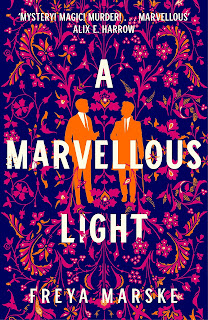
Cover artist: Will Staehle

The novel follows Sir Robert Blyth, a baronet in reduced circumstances, whose posting to a small parliamentary liaison role that no one has ever heard of leaves him not only discovering the magical counterpart to his own society, but trying to solve the mystery of his predecessor’s untimely disappearance. Unfortunately, the only help he seems to have in either of these things comes from his rather frosty magician opposite number, Edwin Courcey, and a helpful secretary somewhat dubious of his capabilities. Blyth and Courcey must work together, however distasteful the proposition seems, to navigate mysterious attacks, strange paperwork, unexpected visions and a hostile hedge maze, and possibly save every magician in England.

If I had to describe this novel in one word, it would be “delightful”. It’s a novel that, primarily, lives or dies on how much you like the two viewpoint characters, and Marske has made them both so absolutely charming in their different ways that I couldn’t help but be sucked in. Is it evident from the moment they meet that they’re going to fall in love? Entirely! Is this in any way a hindrance to enjoying watching it unfold? Only if you don’t like mutual pining.

In Blyth, Marske gives us a himbo hero, all kind heart and big fists, determined to be a good person, in spite of his upbringing by political, image-obsessed parents. He’s the face, for the most part, of the benevolent side of Edwardian England’s gentry. Someone for whom life has, up to now, always been easy and whose name alone does half the talking for him, and who thus has a blithely generous attitude to everyone he meets, at least until experience proves otherwise.

Courcey meanwhile, though in a semi-separate society to Blyth, has grown up dismissed by everyone who knows him for his weak magical talent, bullied by his family and derided for his bookish passions and personal reserve. He’s distrustful, inward focussed and wary of those he meets, ever expecting them to turn on him as he’s been taught everyone will.

Neither of them are stunningly original characters, nor is pairing them up romantically a masterstroke of invention, but they both manage to spring out of the page as rounded, believable people pretty much from the start, and that’s what sells the whole thing.

That, and Marske’s commendably light touch approach to the Edwardian setting. It would be very easy, with a novel like this, to go all in on the petticoats and manners, and throw everything at it in the name of worldbuilding, but she doesn’t – because she doesn’t need to. It’s an era many of us now have convenient short hand for, from novels and films from Sherlock Holmes to Jeeves and Wooster, and so we only need the outlines to understand the whole drawing. It’s not totally sparse – Marske spends plenty of time describing the specifics of certain places, or people’s dress when it matters – but she doesn’t labour the point where it’s not needed and this leaves her space to spend on both characters and plot, which lets the story feel pacey and driven. But it doesn’t overburden us, or fall to the risk of excessive twee that lurks whenever anyone writes about the Victorians or Edwardians.

It does however, also leave space for plenty of smut. Which wouldn’t be a problem, except that, in a couple of instances, I’m a little bit dubious about her grasp of… ahem… male anatomy. There’s a passage early on in which a character’s “lips and cock twitch in unison” when skimming a salacious novel, which was a mental image I’m really not sure I needed. Is it egregious? No. It’s nowhere near the equivalent of a male-written female character breasting boobily down the stairs. But it did cause me to pause, reflect, and wonder if I’d misread it. Nor is it incessant - there are only a few moments like that, here and there throughout the book – and so it is easy enough to ignore after the initial confusion. But it’s a strange contrast to how well-drawn everything else is.

Her light touch also carries through to her writing of character chemistry and the development of relationships. Especially in a novel leaning into the manners and aristocracy side of Edwardian, there would be a certain amount of emotional whiplash if any personal relationships progressed with much speed at all. And so the key high point of the romance writing, for me, is the mutual pining between Courcey and Blyth, building slowly through the book. Marske makes it impossible to imagine anything happening quickly in that relationship, in her world-building and in the personalities of her characters, and so leaves the reader balancing in wanting it all to continue to be drawn out, even as they yell “now kiss!” at the page.

We don’t learn a great deal about her magical society through the course of the story, it’s true, but I honestly think this is a boon, not a burden. There are no obvious unbound threads of questions that underpin how this specific novel hangs together, and she’s left space for revelations in the sequels (as I believe this is intended to be a trilogy). She’s given us enough for the story to work, and for none of the plot revelations to feel pulled out of hat, but as with how she portrays the time period, she’s not overburdened the reader with things that obscure the true focus of the book – the inner thoughts of the two viewpoints, and their burgeoning relationship. She’s left me wanting to learn more about her society, it’s true, but not feeling short-changed by what I’ve been given.

All in all, it’s an absolute cupcake of a book. It’s not a big, substantial meal that’ll leave you pondering it for days afterwards, but it cuts out any risk of it being too sickly sweet by being small, perfectly formed and… well… delightful. I'll take ten.

The Math

Baseline Assessment: 7/10.

Bonuses: +1 for instantly lovable characters

+1 for queer historical fiction, of which we always need more 

Penalties: -1 for somewhat implausible depictions of penis behaviour

Nerd Coefficient: 8/10 well worth your time and attention

Reference: A Marvellous Light Freya Marske [Pan Macmillan, 2021]

POSTED BY: Roseanna Pendlebury, the humble servant of a very loud cat. @chloroform_tea