Showing posts with label John Scalzi. Show all posts

Tuesday, April 1, 2025

Book Review: When the Moon Hits Your Eye, by John Scalzi


I have a confession to make: when I first heard of When the Moon Hits Your Eye I was *deeply* skeptical. I’ve been riding with John Scalzi since day one (to be transparent, I didn’t find out about the self published Agent to the Stars until after Old Man’s War) and I’ve truly enjoyed just about everything he’s had published. Scalzi’s science fiction is a lot of fun, I’ve really dug his move to standalone work with The Kaiju Preservation Society and Starter Villain and if I hated the cover for Starter Villain it’s probably not Scalzi’s fault (my wife liked the cover, so maybe I’m in the minority here).

Despite that, finding out that this book was about the moon turning into cheese still gave me a visceral reaction that could best be described as a cringe. The cover didn’t help.

Friends, I’m here to tell you that When the Moon Hits Your Eye is as delightful as you might hope it would be. It’s Scalzi, with everything that entails. Scalzi gives us the big concept and then treats it seriously (well, mostly). The moon has turned to cheese. Okay. What would that actually mean? Well, if the moon keeps its mass then it would be much larger. It’s brighter in the sky. It would be a bit of an existential concern on earth and there would be plenty of doubters and mockery and those trying to take advantage of the situation.

Would there be a moon mission? How would this impact the space program? What about the cheese mongers?

When the Moon Hits Your Eye has John Scalzi’s typical light touch and humor. Are there cheese jokes-a-plenty? There are. The obvious puns, of course, and ones that you need to be a bit more cheese invested to have thought of.

Does it work? Your mileage will vary, but as someone who really likes bad jokes (they’re all good jokes, Brent) and who typically gets on with Scalzi—When the Moon Hits Your Eye is a truly fun time with a ridiculous idea that I’m sort of surprised hasn’t been played with more often and more popularly.

There isn’t a true narrative arc to the novel in the sense of following one or two characters through their story. When the Moon Hits Your Eye follows a wide ranging cast of characters from astronauts to retired scientists to top level government officials to a rich asshole (aren’t they all) to competing cheese mongers to just regular people going about their lives and figuring what/how/or if they need to deal with the moon having been turned to cheese. We all still have to go to work even if the moon is cheese, after all.

The novel is a slice of life, if you will (I’m having a lot of restraint here, people). During a period of time when the moon first turned to cheese, this is how some people and the United States government reacted and responded. That's ultimately what we're working with here. Progressive snapshots that move forward in time and there is an overall arc to the world's and the reader's understanding of what happened and more or less what it means for their lives and the lives of those they love. 

The novel's hook is the concept. If you're down for a not really plotty examination of what happens when the moon turns into cheese that's funny and occasionally emotionally touching—this is the book for you. If you've read Scalzi before and his stuff works for you, this is an absolute winner. If Scalzi isn't your thing and you've tried, I'm not sure this will convince you. From my perspective, it's a delight. 

It’s a cheesy good time. It’s really grate and I truly brielieve that it couldn’t have been cheddar than this.

I’m not sorry. 

It's all gouda. 

--

Joe Sherry - Senior Editor of Nerds of a Feather, Hugo and Ignyte Award Winner. Minnesotan.

Tuesday, August 29, 2023

Nanoreviews: Councilor, Starter Villain


Councilor, by L.E. Modesitt, Jr

Because I’m a sucker for L.E. Modesitt, Jr’s fantasy novels and I am all in on how he writes a slow burn narrative that is as much focused on the day to day mundanity of life as it is on the exciting large set piece action sequences, Councilor scratches the exact itch that I have for this sort of fantasy.

Councilor is the second novel in L.E. Modesitt, Jr’s Grand Illusion sequence, following 2021’s Isolate. It is set in a somewhat more technologically advanced fantasy world with coal power and cars (but not electricity) and that is set even deeper in the middle of a fairly democratic political structure.

Most of Modesitt’s fantasy work involves political and philosophical discourse wrapped around the day to day as tension and potential large scale conflict builds from small incidents. Councilor takes that to the next level by living in the political. Now elected to the council which he once defended as a security aide, Steffan Dekkard is settling into this new role with the seriousness he undertook his previous.


Starter Villain, by John Scalzi

There has been a trend in science fiction and fantasy for a number of years now for very cozy stories, which I’m not sure is fully defined but which would reasonably include writers like Becky Chambers, Travis Baldree, TJ Klune. At a minimum, what I’m thinking about is genre fiction with a lighter touch and eschews a harsher darkness in the storytelling but also in tone. There is a separate conversation to be had regarding the definition of cozy science fiction and exactly what qualifies. This isn’t that space, but I mention it because it is something that was on my mind while reading Starter Villain.

John Scalzi has always had a light touch with his science fiction, and Starter Villain is no different. Starter Villain is a very Scalzi novel, meaning that the narrative zips along with snappy dialogue and even though there are potentially life threatening stakes they don’t feel quite as heavy as they might in other hands.

Starter Villain posits that after his estranged uncle dies, Charlie finds himself their heir to immense wealth and a super-villain’s business empire (including a secret lair inside a volcano) - with no idea of anything about this world even existing Charlie is brought in almost against his wishes and finds himself in a world of comic absurdity.

That’s where Scalzi’s light touch works through this every day guy thrust into a world of wealth and power and the thing is, Charlie does it with decency. That’s where I thought about the potential coziness of Starter Villain and how it just felt kind despite billionaires plotting to murder Charlie and take over the world. It’s the feel of the thing.

The core thing to note about Starter Villain though, is that it is just a straight up funny novel. Starter Villain was an absolute delight and a real riot. My wife and I would both snort and laugh out loud and share our favorite lines, which is more than we can say about many other novels - and that’s worth celebrating and sharing.


Joe Sherry - Co-editor of Nerds of a Feather, Hugo Award Winner. Ignyte Award Finalist. Minnesotan. He / Him

Monday, March 7, 2022

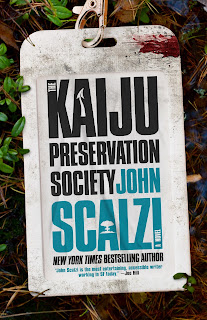
Microreview [book]: The Kaiju Preservation Society, by John Scalzi

Jurassic Park by way of John Scalzi.


If you’ve ever wondered what it would have looked like if John Scalzi wrote Jurassic Park instead of Michael Chrichton, you don’t have to wonder any longer because that’s the best comparison I’m going to come up with for The Kaiju Preservation Society. The only thing we don’t have (yet) is Richard Attenborough kindly reciting his iconic lines over sweeping camera shots showing the scope of what this new world looks like while the music swells and soars.

Very briefly, Jamie is a delivery driver after losing a much higher paying job, and after one particular delivery to a former acquaintance ends up receiving an offer to work for an “Animal Rights Organization” that needs extra grunt labor at the last minute and Jamie takes the job which turns out to be in a very remote location with no contact with the outside world for months. Everything about the context of the offer is incredibly sketchy but the money is transformatively good and jobs are becoming scarce.

That Animal Rights Organization happens to operate on an alternate Earth where giant monsters roam the land and everything on the planet is designed to kill a human - or it would be so designed if this was a world humanity was native to. The Kaiju Preservation Society is exactly that, an organization built around the preservation and conservation of these giant creatures that are not native to our world but can sometimes cross over. That’s where KPS comes in - both to respond, but also to prevent.

We’re pulled along the story of The Kaiju Preservation Society by new recruit Jamie and the other new recruits on their team - because everything is new to them there is opportunity to have natural info dumps for the reader and it works. Everything is discovery and the sense of wonder is enormous. I can’t wait for the movie version of The Kaiju Preservation Society (it’s been optioned for television, which means maybe sometime in the next ten years and maybe not). I can almost see the sweeping introduction of a lush, verdant world as Jamie and company get that moment of whoa.

I went a bit overboard last year watching kaiju movies. I didn’t expect the obsession, but there it was just waiting for me. I watched 30 Godzilla movies, another 3 Kong movies, and this year is fixing to have more of those giant monsters. What I’m saying, though, is that The Kaiju Preservation Society is hitting me right in the sweet spot just when I am most set up to appreciate it. It is a FUN book and, frankly, after two years into a pandemic that is not relenting - I absolutely needed this book. The Kaiju Preservation Society has all of the big monster goodness that readers could ask for and it is chock full of the goodness we’ve come to expect from John Scalzi.

It’s hard to really figure out how to consider a book in the context of others when you’re not quite the same person you were some fifteen years ago when you first discovered a particular author - John Scalzi in this instance. Thinking back to Old Man’s War, that novel became an absolutely iconic science fiction novel that set up this idea of SCALZI as a writer and really defined more than a decade of expectations.

If I have the story correct, Scalzi once sold a novel with the elevator pitch of “Man solves diplomatic crisis through action scenes and snappy dialogue” and minus the diplomatic crisis, that’s generally been a hallmark of his fiction. The Kaiju Preservation Society is not Old Man’s War, nor is it The Android’s Dream or The Collapsing Empire - it’s a different sort of novel, but it also has those hallmarks of classic and top notch Scalzi. There is plenty of snappy dialogue and legitimate laugh out loud moments mixed into discovery and adventure.

The Kaiju Preservation Society moves fast and is just the damned delight that I needed this year.


Joe Sherry - Co-editor of Nerds of a Feather, Hugo Award Winner. Minnesotan. He / Him

Thursday, May 13, 2021

Nanoreviews: Axiom's End, Angel of the Overpass, Murder by Other Means


Ellis, Lindsday. Axiom's End [St. Martin's Press]

It's interesting (to me) how a reader can know absolutely nothing about a book and avoid any sort of plot description and still be so very wrong about what the book is. It's a remarkable skill. With that said - Axiom's End deals with the idea that the United States has, in fact, made First Contact with an extraterrestial and, naturally, has covered it up. Nils Ortega is part of a group attempting to expose the government's lies and, it seems, gain as much publicity in the process. - but this isn't the story of Nils. This is the story of his daughter, Cora, who wants absolutely nothing to do with Nils, government conspiracies, and the unwanted attention it has brought to her life. Unfortunately for her, the truth about the cover up gets closer to her life than she wanted and she's in the middle of more conspiracy and truth about aliens than she ever would have imagined.

Despite featuring aliens and mind control and massive government conspiracies, Axiom's End is a fairly grounded novel because it's relatively tight to Cora's perspective and the reluctant hero works well here. One odd aspect to Axiom's End is that it's not set five minutes in the future, it's set five minutes in the past. Axiom's End is set in 2007, so during the second Bush administration. In some ways, it works better than actively being set during the Obama or Trump years or than making up a fictitious president. In other ways, it's just weird. The Bush / Cheney / Rumsfeld of it all feels like a different America and makes Axiom's End more dated than perhaps it should - though I do wonder what reading this in another ten years would be like. Either way, it's a solid science fiction novel. 
Score: 6/10


McGuire, Seanan. Angel of the Overpass [DAW]

Angel of the Overpass is the third of the Ghost Roads novels focusing on Rose Marshall, a ghost with a very full afterlife. The nature of her death (being hit and killed on the side of the road on the way to her high school prom) helped make her a ghost with a particular type of haunting (she's a phantom hitchhiker) but it's also made her a target over the decades from her murderer, a man (named Bobby Cross) who made a deal at the crossroads for eternal life. As with any of Seanan McGuire's novels, Angel of the Overpass is not about just one thing but if it was, it would be about Rose's potentially final fight against Bobby Cross and his attempts to end her life (again).

The Ghost Roads are a side series to McGuire's Incryptid novels - Rose Marshall is a minor side character there, but up until Angel of the Overpass there was minimal crossing over back to Rose's story. That changes here because the inciting incident takes place in the eighth Incryptid novel (That Ain't Witchcraft) - which presents a small barrier to entry - less so if you've at least read The Girl in the Green Silk Gown and Sparrow Hill Road, but this isn't a start novel it's the culmination of a journey.

Angel of the Overpass lives on the last third of the novel - if you've read enough of Seanan McGuire you'll be perfectly at home throughout the this novel but McGuire sets up that last act so well that even if you're "only" enjoying the ride you'll be strapping yourself in for that ending. Seanan McGuire escalates so well (spoilers, I guess, but there's a ghost dinosaur and it *works* for reasons). As a general rule, I enjoy the Ghost Roads but I don't love them like I do her Incryptid novels - but that ending - oh, that ending. It was glorious and wrenching. Seanan McGuire knows glorious and wrenching.
Score: 7/10


Scalzi, John. The Dispatcher: Murder by Other Means [Subterranean / Audible]

I dug The Dispatcher (my nanoreview) when I read it back in 2017 and I expected to equally enjoy a second Dispatcher novella should John Scalzi decide to write one. He did, and I did, and here we are. Murder by Other Means, like The Dispatcher was written as an Audible original - which means it was published (and presumably written) with being an audio book first and a print book second. I don't know quite what that means in terms of what the best way to enjoy this particular story because I don't listen to audiobooks for reasons so I only encounter the work via print. With that said, John Scalzi's writing in general and with Murder by Other Means in particular is smooth, breezy, accessible and straight up fun to read. That's what Scalzi does and that's what he does here.

Murder by Other Means is set in our world, except inexplicably 99.9% of all murder victims are brought back to life wherever they feel safe. Accidental death = death. Murder, well, you're probably coming back. It doesn't need to make sense. Accept it and roll with it. What that means is that if you *want* to commit a murder you've got to be a bit more creative about that and people around Tony Valdez start dying in pretty suspicious ways. There's a plot afoot and it's told with the wit and panache readers have come to expect from John Scalzi. I think Murder by Other means works better by following The Dispatcher rather than standing alone but it works fairly well on its own. Scalzi still makes sure everything is explained and the dots can be connected - which is actually what makes Murder by Other Means as much fun as it is, when Scalzi starts connecting the dots and bringing things together it's a bit of a murderous romp.
Score: 7/10


Joe Sherry - Co-editor of Nerds of a Feather, 5x Hugo Award Finalist for Best Fanzine. Minnesotan. He / Him

Thursday, September 17, 2020

Microreview [book]: The Last Emperox by John Scalzi

A fun book, but anticlimactic in its collapsage


(Note: While writing this review, I found it trickier than usual not to go into spoiler territory, and there's a fairly significant discussion of the trilogy ending ahead. I'll try and keep it as oblique as possible but spoiler sensitive readers will want to read the book first (spoiler free review: it's... fine.))

It is a well-accepted fact that some authors don't work for some readers. Even within our favouritest of favourite genres, there are books that just pass us by by people whose style, or storytelling focus never clicks. I am now ready to accept that John Scalzi is one of those authors for me but, here with yet another Scalzi book I yet again have no strong feelings about, I can't help coming out of the Interdependency - a series about entertaining people coming together against political intrigue and space battles to save the day, it should be perfect - feeling particularly frustrated that it has evoked no strong feelings of interest or engagement. 

The Last Emperox picks up where the last book in the trilogy left off - with an interstellar empire whose means of faster-than-light travel, a mystical phenomenon known as the "Flow", is closer than ever to collapse. Given that this interstellar empire literally calls itself "The Interdependency" and is almost entirely scattered across planets and habitats which aren't capable of independently supporting human life, this is a catastrophic event, and it's being made even more challenging by the squabbling elites who are more interested in making a profit off the collapse than in actually trying to save the people. In his review back in April, Joe notes that this backdrop is pretty on the nose for the compounding crises we're living in, and while there's certainly plenty to differentiate The Last Emperox from "our current political climate... in space!" (the hereditary monarchy being one of them) the device of having overwhelming problems which the characters have to find energy not just to survive but to push back against definitely feels... timely.

Enter Emperor Grayland II - also known as Cardenia Wu-Patrick - the young, unexpectedly competent and radical new leader of the Interdependency, who has spent the last two books dodging assassination attempts and trying to convince people that, yes, the Empire is in fact collapsing, with the help of her scientist-buddy-turned-boyfriend Marce and sweary ally Kiva Lagos. She also has the uploaded memories of all past Emperoxes (Emporex?) and the ancient king-in-a-spaceship-body they picked up in their last adventure. On the other side, we've got Nadashe Nohamapeton, fresh off her second failed assassination attempt and now engaged in a last-ditch coup attempt against the Wu family as a whole. At this point in the crisis, the political elite of the Interdependency have accepted that their world is changing, and the main decision they have to make is whether to act in the collective interest to save as many humans as possible (Cardenia's strategy) or to collect as much profit and political power for themselves as they can before leaving for the one safe, habitable planet that will remain after the Flow collapses. Aside from Cardenia and the Lagoses, almost everyone we meet among the political class is going for the latter option, and Cardenia lacks the political leverage to get them to act in a way that will save billions of lives. Plus, trying to deal with all that is hard when you're just trying to keep yourself from getting assassinated on the day-to-day, and also maybe squeeze in some quality time with your smart scientist boyfriend once in a while.

The Last Emperox is a lot of fun. It has characters who are enjoyable to be around, and a style which really brings the best out of them. Marce and Cardenia have a lot of opportunities to be sweet together, and Kiva's sections are deeply entertaining, showcasing the sweary captain-turned-political-leader's unique brand of cunning and resourcefulness. As a main antagonist, Nohamapetan could be less two dimensional, but the different ways in which she and Kiva respond to the same unpleasant living situation makes for an entertaining sequence. The bulk of the book (and these are not chonking volumes) is made up of their smartass dialogue and equally smartass inner voices as they banter, snark and swear their way through encounters with each other - and this is stuff that Scalzi is very, very good at. Full snark marks. It is possible that you will spend so much time enjoying this snark that you'll not be too bothered when you get to the end of the book and go "wait, weren't we going to see the Empire collapse?"

But for me, for all its fun and wit, I struggle to accept the fact that the Interdependency fails to deliver on the goalposts it actually sets up. Instead of being a plot about saving humanity, it becomes a plot about accumulating the power to do so. Probably. Hopefully. We think so, but we don't know. People have done shitty things with power before, but the distribution we end up here seems... OK. On one level, this plot brings in some nice pieces of history and background that have been set up across the trilogy, but it's also done in a curiously apolitical way, relying more on a deus ex machina technological device than an actual political triumph. Does it hit emotional beats? Sure. Does it complete an arc? Well, it gels with Cardenia's overall goals and arguably Kiva didn't really have an arc so much as a general drive to survive colourfully and entertainingly. For Marce, and for the entire concept of The Flow and what it meant for human society (you know, that whole "Interdependency" thing) the closure provided in The Last Emperox doesn't really answer many questions, just handwaves them off by tying up the political plot, and then draws the curtain just when success might happen. Plus, as a political triumph, it entirely relies on our read of the specific character it relates to: and yes, it works, because we are invested in the character, but it's not a particularly interesting answer to the question of cooperative action (you know, that whole "interdependency" thing rearing its head again). To be fair, the series where it does means that it escapes having to grapple with more potentially grim scenes that might throw off the tone of the series - this is no Expanse, the mistakes have bodycounts but not on the scale that it could be - but it feels like a "well, OK" sort of ending compared to the scale of the premise.

And that's ultimately how I feel about the entire Interdependency trilogy. It's enjoyable, its fun, it's diverting, with an author at Scalzi's level I've no doubt it does exactly what he intends it to do. There's always room for more popcorn-y sci fi adventures from authors who are thoughtful about what our spacefaring future might look like. If I were picking this up on a best Hugo ballot, I'd be just fine with reading it (see also: it's short) - but I'd also be quite annoyed at whatever it is in here is passing me by. Overall, though, while this might be your sort of space opera, I have to leave it with a shrug and an acceptance that this was probably never going to work out.

The Math

Baseline Score: 7/10

Bonuses: +1 Entertaining characters and smart dialogue

Penalties: -2 Unsatisfying closure, doesn't pay off on the promise of its premise

Nerd Coefficient: 6/10 

POSTED BY: Adri, Nerds of a Feather co-editor, is a semi-aquatic migratory mammal most often found in the UK. She has many opinions about SFF books, and is also partial to gaming, baking, interacting with dogs, and Asian-style karaoke. Find her on Twitter at @adrijjy

Reference: Scalzi, John, The Last Emperox [Tor Books, 2020]

Wednesday, April 8, 2020

Nanoreviews: Mississippi Roll, The Last Emperox, The Ghosts of Sherwood


Martin, George R.R. (editor). Mississippi Roll [Tor]

The twenty fourth volume of the long running Wild Cards series doesn't have as high a barrier to entry as that might seem. While not as perfect an entry point as the eighteenth, Inside Straight, Mississippi Roll doesn't require as much knowledge of the full series. Sure, being familiar with the triad starting with Fort Freak would help - but that gives shading.

Mississippi Roll is a ghost story set on an old mississippi riverboat and it's very effective at the beginning of the story (where we learn the reason for the haunt) and it's effective in the last third - but the storytelling does fall flat a bit in that middle third. I'd have to check again to see which stories are the ones that didn't work as well as the others since this is a mosaic novel, but the overall story is coherent and fits together. There are moments and sections the novel hums along (there should be a riverboat metaphor here), but while the middle section doesn't quite sink the book (there it is), Mississippi Roll doesn't quite achieve the promise of the either the wonderful beginning or the ultimate payoff.
Score: 6/10


Scalzi, John. The Last Emperox [Tor]

Our own Paul Weimer introduced me to a concept he called "wrong book in the moment", which encapsulates my experience of reading The Last Emperox, which is that perhaps reading a novel dealing with the impending end of civilization as that universe knows it may not play as well during the time of a global pandemic when I am concerned about the future of employment, childcare, of the general state of life right now.

It's not that all literature is to be escapist or that John Scalzi is under any obligation to write the story that he meant to write - but I could never tell while reading The Last Emperox whether the novel didn't quite work for me or if the novel did not work for me now. There's a distinct difference.

Scalzi's writing is typically easy, breezy, and while perhaps not a cover girl it is often a refreshing and delightful reading experience. That is still the case in The Last Emperox, but somehow it doesn't all come together for me in ways that it did in The Collapsing Empire and The Consuming Fire. For a concluding novel The Last Emperox more seems like setting up yet one more book. The storylines here are wrapped up, but it all comes across as a bit of a rush. Also, and this is very much small potatoes, but the profanity in The Last Emperox seems far more excessive and forced here than in the previous two novels. The Last Emperox is better than my criticism suggests, but so many years of reading Scalzi has my expectations set higher. Or maybe I just need to read this again when there is not a perpetual level of stress and gloom overriding everything that I read.
Score: 7/10


Vaughn, Carrie. The Ghosts of Sherwood [Tor.com Publishing]

Relative to the above idea about reading a book that brings relief from the world and for which the experience of reading it is not overwhelmed by the aforementioned perpetual level of stress and gloom, I present to you The Ghosts of Sherwood, Carrie Vaughn's take on the Robin Hood mythos. Or rather, she continues on years after the standard Robin Hood mythos and answers the questions I never thought to ask - what would Robin and Marion's children be like? What adventures would they get up to?

Readers, The Ghosts of Sherwood was everything I ever wanted in a story and so much more. It's a friggin delight. I've loved Robin Hood stories for decades, whether it is Errol Flynn, Disney, or Kevin Costner (fight me) and what Carrie Vaughn does so well with The Ghosts of Sherwood is get at a raw sense of joy that is present in the best and most iconic Robin Hood stories. Even in the terrible moments of the story, there is still a pervasive sense of joy, wonder, and delight. There are so many more stories to be told with these kids and in and around Sherwood that I can't wait for the next novella (and hopefully the next and the next after that).
Score: 8/10


POSTED BY:  Joe Sherry - Co-editor of Nerds of a Feather, 4x Hugo Award Finalist for Best Fanzine. Minnesotan. He / Him.

Monday, March 30, 2020

New Books Spotlight

Welcome to another edition of the New Books Spotlight, where each month or so we curate a selection of 6 new and forthcoming books we find notable, interesting, and intriguing. It gives us the opportunity to shine a brief spotlight on some stuff we're itching to get our hands on.

What are you looking forward to? Anything you want to argue with us about? Is there something we should consider spotlighting in the future? Let us know in the comments!


Bennett, Robert Jackson. Shorefall [Del Rey]
Publisher's Description
As a magical revolution remakes a city, an ancient evil is awakened in a brilliant new novel from the Hugo-nominated author of Foundryside and the Divine Cities trilogy. 

A few years ago, Sancia Grado would’ve happily watched Tevanne burn. Now, she’s hoping to transform her city into something new. Something better. Together with allies Orso, Gregor, and Berenice, she’s about to strike a deadly blow against Tevanne’s cruel robber-baron rulers and wrest power from their hands for the first time in decades.

But then comes a terrifying warning: Crasedes Magnus himself, the first of the legendary hierophants, is about to be reborn. And if he returns, Tevanne will be just the first place to feel his wrath.

Thousands of years ago, Crasedes was an ordinary man who did the impossible: Using the magic of scriving—the art of imbuing objects with sentience—he convinced reality that he was something more than human. Wielding powers beyond comprehension, he strode the world like a god for centuries, meting out justice and razing empires single-handedly, cleansing the world through fire and destruction—and even defeating death itself.

Like it or not, it’s up to Sancia to stop him. But to have a chance in the battle to come, she’ll have to call upon a god of her own—and unlock the door to a scriving technology that could change what it means to be human. And no matter who wins, nothing will ever be the same. 
Why We Want It: With the follow up to 2018's excellent Foundryside, Robert Jackson Bennett is a favorite of the Nerds of a Feather flock. We'll read whatever he writes.


Jingfang, Hao. Vagabonds [Saga]
Publisher's Description
A century after the Martian war of independence, a group of kids are sent to Earth as delegates from Mars, but when they return home, they are caught between the two worlds, unable to reconcile the beauty and culture of Mars with their experiences on Earth in this spellbinding novel from Hugo Award–winning author Hao Jingfang. 

This genre-bending novel is set on Earth in the wake of a second civil war…not between two factions in one nation, but two factions in one solar system: Mars and Earth. In an attempt to repair increasing tensions, the colonies of Mars send a group of young people to live on Earth to help reconcile humanity. But the group finds itself with no real home, no friends, and fractured allegiances as they struggle to find a sense of community and identity, trapped between two worlds.

Fans of Kazuo Ishiguro’s Never Let Me Go and Naomi Alderman’s The Power will fall in love with this novel about lost innocence, an uncertain future, and never feeling at home, no matter where you are in the universe. Translated by Ken Liu, bestselling author of The Paper Menagerie and translator of Cixin Liu’s The Three-Body Problem, Vagabonds is the first novel from Hao Jingfang, the first Chinese woman to ever win the esteemed Hugo Award. 
Why We Want It: We've been looking for Vagabonds for a few years now. After Jingfang's Hugo Award winning story "Folding Beijing", we've been looking to see what she would write next (only one of her subsequent stories have been translated into English). Vagabonds her Jingang's debut novel.


Kozloff, Sarah. The Cerulean Queen [Tor]
Publisher's Description
Sarah Kozloff's breathtaking and cinematic epic fantasy series The Nine Realms, which began with A Queen in Hiding, comes to a thrilling conclusion in The Cerulean Queen. 

The true queen of Weirandale has returned.

Cerulia has done the impossible and regained the throne. However, she's inherited a council of traitors, a realm in chaos, and a war with Oromondo.

Now a master of her Gift, to return order to her kingdom she will use all she has learned—humility, leadership, compassion, selflessness, and the necessity of ruthlessness. 
Why We Want It: We've been following Kozloff's debut series with four novels in four months and we want to see how it all ends. The first book, A Queen in Hiding, wasn't quite the novel we expected it to be but it also hooked us on reading more.


Roth, Veronica. Chosen Ones [John Joseph Adams Books]
Publisher's Description
SAVING THE WORLD ONCE MADE THEM HEROES. SAVING IT AGAIN MAY DESTROY THEM. 

Fifteen years ago, five ordinary teenagers were singled out by a prophecy to take down an impossibly powerful entity wreaking havoc across North America. He was known as the Dark One, and his weapon of choice—catastrophic events known as Drains—leveled cities and claimed thousands of lives. Chosen Ones, as the teens were known, gave everything they had to defeat him.

After the Dark One fell, the world went back to normal . . . for everyone but them. After all, what do you do when you’re the most famous people on Earth, your only education was in magical destruction, and your purpose in life is now fulfilled?

Of the five, Sloane has had the hardest time adjusting. Everyone else blames the PTSD—and her huge attitude problem—but really, she’s hiding secrets from them . . . secrets that keep her tied to the past and alienate her from the only four people in the world who understand her.

On the tenth anniversary of the Dark One’s defeat, something unthinkable happens: one of the Chosen Ones dies. When the others gather for the funeral, they discover the Dark One’s ultimate goal was much bigger than they, the government, or even prophecy could have foretold—bigger than the world itself.
And this time, fighting back might take more than Sloane has to give. 
Why We Want It: Veronica Roth's Divergent trilogy was compelling enough that we want to see what else she might have for us. The first novel in her Carve the Mark didn't quite, well, hit the mark - but it's time to give Roth another go with Chosen Ones. Prophecy and a Dark One in North America is different enough.


Scalzi, John. The Last Emperox [Tor]
Publisher's Description
The Last Emperox is the thrilling conclusion to the award-winning, New York Times and USA Today bestselling Interdependency series, an epic space opera adventure from Hugo Award-winning author John Scalzi. 

The collapse of The Flow, the interstellar pathway between the planets of the Interdependency, has accelerated. Entire star systems—and billions of people—are becoming cut off from the rest of human civilization. This collapse was foretold through scientific prediction . . . and yet, even as the evidence is obvious and insurmountable, many still try to rationalize, delay and profit from, these final days of one of the greatest empires humanity has ever known.

Emperox Grayland II has finally wrested control of her empire from those who oppose her and who deny the reality of this collapse. But “control” is a slippery thing, and even as Grayland strives to save as many of her people form impoverished isolation, the forces opposing her rule will make a final, desperate push to topple her from her throne and power, by any means necessary. Grayland and her thinning list of allies must use every tool at their disposal to save themselves, and all of humanity. And yet it may not be enough.

Will Grayland become the savior of her civilization . . . or the last emperox to wear the crown? 
Why We Want It: The first two volumes of The Interdependency have been straight up excellent and we're excited to see how Scalzi closes out the trilogy. Interestingly enough, this is the first time Scalzi has committed trilogy. New Scalzi is always a cause for celebration.


Vo, Nghi. The Empress of Salt and Fortune [Tor.com Publishing]
Publisher's Description
With the heart of an Atwood tale and the visuals of a classic Asian period drama, Nghi Vo's The Empress of Salt and Fortune is a tightly and lushly written narrative about empire, storytelling, and the anger of women.

A young royal from the far north, is sent south for a political marriage in an empire reminiscent of imperial China. Her brothers are dead, her armies and their war mammoths long defeated and caged behind their borders. Alone and sometimes reviled, she must choose her allies carefully.

Rabbit, a handmaiden, sold by her parents to the palace for the lack of five baskets of dye, befriends the emperor's lonely new wife and gets more than she bargained for.

At once feminist high fantasy and an indictment of monarchy, this evocative debut follows the rise of the empress In-yo, who has few resources and fewer friends. She's a northern daughter in a mage-made summer exile, but she will bend history to her will and bring down her enemies, piece by piece.  
Why We Want It: We're always interested in the novellas from Tor.com Publishing, but in a year filled with highly anticipated novellas Empress of Salt and Fortune is right up near the top that list. We're here for everything about this novella.


Joe Sherry - Co-editor of Nerds of a Feather, 3x Hugo Award Finalist for Best Fanzine. Minnesotan. He / Him.

Monday, January 28, 2019

Nanoreviews: The Prisoner of Limnos, Pocket Apocalypse, The Consuming Fire


Bujold, Lois McMaster. The Prisoner of Limnos [Spectrum Literary Agency, 2017 / Subterranean Press, 2019]

With The Prisoner of Limnos, Bujold brings to a close the major story arc of the Penric and Desdemona novellas, that being the gradual romance of Penric (temple sorcerer and host of the demon Desdemona) and Nikys (widow, interesting person in her own right). The plotline is the rescue of Nikys's mother, but the beating heart is Penric's somewhat awkward courtship of Nikys.

This isn't the Penric novella to start with. While I recommend all of them, at least start with Penric's Mission followed by Mira's Last Dance to get the Penric / Nikys storyline. But, with the background and emotional story. beats of the characters already set, The Prisoner of Limnos is a wonderful novella. Bujold is a grandmaster.
Score: 8/10


McGuire, Seanan. Pocket Apocalypse [DAW, 2015]

With Australia on the verge of a lycanthropic outbreak, Alexander Price returns in this fourth Incryptid novel from Seanan McGuire. Shelby Tanner, another crytopzoologist and Alex's girlfriend, asks Alex to come home with her and help her family and her organization protect the continent from an outbreak they may not be equipped to control.

Despite the overwhelming aggression of Shelby's family towards Alex, Pocket Apocalypse is an entertaining and satisfying read. Seanan McGuire set a strong standard of expectation with the first two Verity Price novels, but has succeeded to raise the bar with her two Alex Price offerings. Pocket Apocalypse opens up a new continent, widens the cryptid world, and reminds us that the Aeslin Mice truly are one of the greatest creatures in fantasy fiction.
Score: 7/10


Scalzi, John. The Consuming Fire [Tor, 2018]

If the Collapsing Empire moved at a breakneck pace, Scalzi slows down the narrative of The Consuming Fire just a touch. The Flows between the worlds are still collapsing, few believe it is happening, and Emperox Greyland II is preparing for both her Empire's survival of that collapse as well as from the internal threats moving against her. There's a lot going on, and Scalzi manages it all with his trademark wit and skillful ease of storytelling.

I expected a bit more Flow collapsing to occur in this novel and for that part of the story to progress faster and further than it did. One of the remarkable achievements of a series featuring the impending disappearance of rapid interstellar travel is that Scalzi manages to open and widen that universe in new and interesting ways that offer unexpected directions for this series to go. If you've read Scalzi before, if you've enjoyed his novels and were delighted by The Collapsing Empire, you should expect to be equally delighted by The Consuming Fire.
Score: 8/10


POSTED BY: Joe Sherry - Co-editor of Nerds of a Feather, 2017 & 2018 Hugo Award Finalist for Best Fanzine. Minnesotan.

Monday, October 1, 2018

New Books Spotlight

Welcome to another edition of the New Books Spotlight, where each month or so we curate a selection of 6 forthcoming books we find notable, interesting, and intriguing. It gives us the opportunity to shine a brief spotlight on some stuff we're itching to get our hands on.

What are you looking forward to? Anything you want to argue with us about? Is there something we should consider spotlighting in the future? Let us know in the comments!


Dickinson, Seth. The Monster Baru Cormorant [Tor]
Publisher's Description
A breathtaking geopolitical epic fantasy, The Monster Baru Cormorant is the sequel to Seth Dickinson's "fascinating tale" (The Washington Post), The Traitor Baru Cormorant.
Her world was shattered by the Empire of Masks.
For the power to shatter the Masquerade,
She betrayed everyone she loved.
The traitor Baru Cormorant is now the cryptarch Agonist—a secret lord of the empire she's vowed to destroy.
Hunted by a mutinous admiral, haunted by the wound which has split her mind in two, Baru leads her dearest foes on an expedition for the secret of immortality. It's her chance to trigger a war that will consume the Masquerade.
But Baru's heart is broken, and she fears she can no longer tell justice from revenge...or her own desires from the will of the man who remade her.
Why We Want It: The Traitor Baru Cormorant was a bad ass novel of a woman trying to get her revenge on an empire from the inside, and the moral compromises she has to make to rise high enough to effect that change. Monster Baru is the sequel and I need this in my life.


Rivera, K. Arsenault. The Phoenix Empress [Tor]
Publisher's Description
Once they were the heirs to a prophecy that predicted two women would save an empire.

Now Shefali is dying—and her wife is unaware of the coming tragedy. Shizuka is too busy trying to reunite a fractured empire and right the wrongs of her ancestors.

As the Imperial Army gathers against a demonic invasion, Shizuka must do all she can with an empire on the brink of civil war.
Why We Want It:  I have not read The Tiger's Daughter but I've been inundated with the praise that novel has received. It has been enough to push that novel much farther up my reading queue and to get my attention firmly planted on its follow up, The Phoenix Empress.


Robinson, Kim Stanley. Red Moon [Orbit]
Publisher's Description
Red Moon is a magnificent novel of space exploration and political revolution from New York Times bestselling author Kim Stanley Robinson.
It is thirty years from now, and we have colonized the moon.
American Fred Fredericks is making his first trip, his purpose to install a communications system for China’s Lunar Science Foundation. But hours after his arrival he witnesses a murder and is forced into hiding.
It is also the first visit for celebrity travel reporter Ta Shu. He has contacts and influence, but he too will find that the moon can be a perilous place for any traveler.
Finally, there is Chan Qi. She is the daughter of the Minister of Finance, andwithout doubt a person of interest to those in power. She is on the moon for reasons of her own, but when she attempts to return to China, in secret, the events that unfold will change everything – on the moon, and on Earth.
Why We Want It: Would you believe the only Kim Stanley Robinson I've read is last year's Hugo finalist novel New York 2140? I've meant to read more, I've got at least two of his novels that I can think of on my bookshelf downstairs, but I'm overdue to read more. The title has obvious echoes of Robinson's classic Red Mars and the novel itself deals with the colonization of the Moon by China, which is a solid and plausible future. I mostly enjoyed New York 2140 and this should be another major novel from Kim Stanley Robinson.


Scalzi, John. The Consuming Fire [Tor]
Publisher's Description
The Consuming Fire—the sequel to the 2018 Hugo Award Best Novel finalist and 2018 Locus Award-winning The Collapsing Empire—an epic space-opera novel in the bestselling Interdependency series, from the Hugo Award-winning and New York Times bestselling author John Scalzi
The Interdependency, humanity’s interstellar empire, is on the verge of collapse. The Flow, the extra-dimensional conduit that makes travel between the stars possible, is disappearing, leaving entire star systems stranded. When it goes, human civilization may go with it—unless desperate measures can be taken.
Emperox Grayland II, the leader of the Interdependency, is ready to take those measures to help ensure the survival of billions. But nothing is ever that easy. Arrayed before her are those who believe the collapse of the Flow is a myth—or at the very least, an opportunity that can allow them to ascend to power.
While Grayland prepares for disaster, others are preparing for a civil war, a war that will take place in the halls of power, the markets of business and the altars of worship as much as it will take place between spaceships and battlefields. The Emperox and her allies are smart and resourceful, but then so are her enemies. Nothing about this power struggle will be simple or easy... and all of humanity will be caught in its widening gyre.
Why We Want It: I delighted in The Collapsing Empire, to the point that I was reading in the car on the way to the airport so I could finish it before we left for a week's vacation (side note, I generally don't take hardcover books with me on trips, more often I'll bring a paperback to leave someplace for some random stranger to find a book and be delighted by it - the Scalzi is a keeper). The Collapsing Empire was fantastic, but it was also so very clearly the first part in a longer story. The Consuming Fire is that second part and I am so excited to read it.


Stearns, R.E. Mutiny at Vesta [Saga]
Publisher's Description
Adda and Iridian have survived the murderous AI that tried to kill them in Barbary Station...but now they'll need all of their ingenuity to escape the evil megacorporation that wants to own them, in this second space adventure in the Shieldrunner Pirates trilogy.

Adda Karpe and Iridian Nassir have escaped the murderous AI that was trapping them on Barbary Station, and earned themselves a place on Captain Sloane’s fabled pirate crew. And now that they’ve arrived at Vesta, Sloane’s home base, they can finally start making a living stealing from well-off megacorporations.
Unfortunately, the political situation has deteriorated in Captain Sloane’s absence. Adda and Iridian find themselves trapped in a contract with Oxia Corp., one of the very megacorporations they'd hoped to prey on, forced to rob and intimidate targets they'd never have chosen on their own. If they're ever going to have the independent life together that they've always wanted, they'll have to free themselves from Oxia Corp. first. Meanwhile, the inhuman allies who followed Adda and Iridian from Barbary Station have plans of their own, which may be more dangerous than the humans involved could imagine. It will take not one but five heists, and every bit of ingenuity Adda and Iridian have to escape from Oxia and find the life they’ve always dreamed of…if they can survive.
Why We Want It: I'm a bit behind and haven't read Barbary Station yet, but I'm still sold on Navah Wolfe's description of that first book as "lesbian women of color space pirates versus a murderous AI". This is my reminder that I need to get on that because Mutiny at Vesta is coming up!


Wells, Martha. Exit Strategy [Tor.com Publishing]
Publisher's Description
Martha Wells's Murderbot Diaries, a wildfire science fiction phenomenon about an antisocial AI learning to care, comes to a thrilling conclusion with Exit Strategy. 
Murderbot wasn’t programmed to care. So, its decision to help the only human who ever showed it respect must be a system glitch, right?
Having traveled the width of the galaxy to unearth details of its own murderous transgressions, as well as those of the GrayCris Corporation, Murderbot is heading home to help Dr. Mensah—its former owner (protector? friend?)—submit evidence that could prevent GrayCris from destroying more colonists in its never-ending quest for profit.

But who’s going to believe a SecUnit gone rogue? 
And what will become of it when it’s caught?
Why We Want It: What? You don't know about Murderbot? The first novella, All Systems Red, only won the Hugo, Nebula, and Locus Award for Best Novella. The next two are just as delightful as the first. Exit Strategy is the fourth and final Murderbot novella, though a full length novel was recently announced.


POSTED BY: Joe Sherry - Co-editor of Nerds of a Feather, 2017 & 2018 Hugo Award Finalist for Best Fanzine. Minnesotan.

Wednesday, May 30, 2018

Reading the Hugos: Novel

Welcome to the first article in our Reading the Hugos series, 2018 Edition! Hugo Awards season is one of my favorite times of the literary year, though it does ultimately run almost as long as the major league baseball season - neither of which is a complaint.

Today we are going to take a look at the six finalists for Best Novel. Only one of the novels, The Stone Sky, was on my nominating ballot. If you've at all followed the Hugo Awards over the last two years, you'll know the first two novels of N.K. Jemisin's Broken Earth trilogy won the award for Best Novel (The Fifth Season and The Obelisk Gate). Both books were spectacular and the awards were well earned. Two in a row put Jemisin in rarified company, but a third Hugo in a row for Jemisin would cement her legacy as the most important fantasist working today. I may be spoiling this article, but she is. The Broken Earth as a whole is that good and The Stone Sky as an individual novel is that good.

Let's take a look at the finalists, shall we?


The Collapsing Empire, by John Scalzi (Tor)
New York 2140, by Kim Stanley Robinson (Orbit)
Provenance, by Ann Leckie (Orbit)
Raven Stratagem, by Yoon Ha Lee (Solaris)
Six Wakes, by Mur Lafferty (Orbit)
The Stone Sky, by N.K. Jemisin (Orbit)


Provenance: This is a novel which took a while to settle out from under the weight of unfair expectations that I placed on it. Once it did, I was able to engage more fully with Leckie's story of truth, lies, and cultural identity. Provenance is a strong novel in its own right, and in the end, I appreciated Leckie's light touch in how she connected it to the larger Ancillary universe.

It's just that when we look back on Leckie's career in twenty years, I suspect Provenance will be viewed as minor Leckie. It's good, please don't take this the wrong way, but the Ancillary trilogy was a major accomplishment and Provenance is "just" a very good book. I appreciated how Provenance pushed me to think about historical documents and relics, how their perception of importance could override the truth they should represent. There's great stuff to chew on here. (my review)


The Collapsing Empire: From my nanoreview: "As often happens when reading a new John Scalzi novel, I didn't want to put this down. Filled with wit, warmth, humor, fantastic characters, and Scalzi's trademark snappy dialogue, The Collapsing Empire is a treat and a delight to read."

I read The Collapsing Empire just before flying out for a week's vacation that I didn't want to take a hardcover book on. I only had a couple of chapters remaining, so I asked my wife to drive to the airport so I could finish the book before we left. I didn't want to miss a thing and I absolutely didn't want to wait a week to see how Scalzi wrapped it up. Unsurprisingly for the first book in a series, The Collapsing Empire ended in a bit of a cliff hanger. It felt a touch more incomplete than the average series opener, but Scalzi's fiction is just a pure delight to read and The Collapsing Empire is no different.


New York 2140:  It's interesting to contrast New York 2140 with The Collapsing Empire. They are completely different novels without much in common at all. The Collapsing Empire is a fast paced far future science fiction space opera. New York 2140 is set in our immediate future with a world dealing with predicted and disregarded sea rise (until it was too late and every coastal city was underwater.) It's a novel tightly focused on a specific place and the realistic and perhaps prescient response to climate change and rising seas. Scalzi's novel is driving plot. Robinson's is glorious death by all of the details, where even the info dumping becomes a character (and one of the most effective and borderline DeLillo-esque). The point here isn't that one novel or technique is inherently superior to the other, but rather that the Hugo Awards pushes the reader to think about novels in relation to each other. That's where those interesting points of comparison and contrast pop up

Where Robinson also differs from other climate disaster novels (see Stephen Baxter's excellent 2008 novel, Flood, for another point of contrast) is that he is less interested in the big flashy response and solution and dials in on how people would survive and thrive in such an environment. We may often picture cities abandoned, but more than likely Robinson's vision how the new intertidal zones of a city may be reclaimed and resettled is how things would actually play out.

There is perhaps half of a plot in New York 2140. The novel is more of a slice of life, writ large and spread across a handful of disparate viewpoint characters. It's effective, but takes more of a commitment and patience to wait for Robinson to begin to pull them together. When those threads do come together, they do coalesce into something bigger and more impressive than the first chapters might have suggested. Not having read most of his work, I can't say if New York 2140 is Major KSR or Minor KSR, but it is ultimately a novel with heft and importance.


Six Wakes: A locked room murder mystery featuring clones, in space. Six Wakes offers a fresh take on all of that. The crew of a ship is murdered, all six of their clones wake up missing memories. One of them is the murderer. It's one hell of a concept for a novel and Lafferty absolutely crushes it. Shana loved Six Wakes and I share her admiration for the novel.


Raven Strategem: I've read that Raven Strategem is more accessible to readers than Ninefox Gambit and that Yoon Ha Lee doesn't engage in the same sort of info dumping that he engaged in with the his first novel. I'm not so sure, though I don't have a passage to quote to elaborate. I think that it is more that we, the readers, are more fully accustomed to the work that Yoon is doing here.

Raven Strategem is as straight up of an interstellar war novel as we are likely to get from Yoon Ha Lee, which is to say that there are plots within plots and mathematical digression and a tightly constructed narrative that thrills at all moments. Raven Strategem is smart science fiction, examining warfare itself and questioning the assumptions behind systems of government. It's damn good, people.


The Stone Sky:The Stone Sky is the culmination of the best and the greatest fantasy trilogy written today and I still think I might have been understating the case when I reviewed the novel last year. Forget, if you can, the two previous Hugo Award wins for The Fifth Season and The Obelisk Gate. If you can do that, you still have to deal with the weight of the raw excellence of those two novels. Jemisin has set a standard and a level of expectation that is nearly impossible to meet, let alone surpass.

And yet.

Jemisin has set an impossible standard for herself, but her control in telling one unified story shows off the skill of an author at the height of her powers. The Stone Sky more than lives up to the promise and standard of those first two Broken Earth novels. The Stone Sky caps off a stunning epic fantasy trilogy. The Broken Earth is a monumental achievement in fantasy fiction and as good as the first two books were, it is because of the stunning accomplishment and achievement of The Stone Sky as a novel. It truly is in a class alone. Forget for a moment the opportunity to make history here for N. K. Jemisin to win three consecutive Hugo Awards for Best Novel. The Stone Sky flat out deserves to win the Hugo Award on its own merits. (my review)


My Vote:
1. The Stone Sky
2. Raven Strategem
3. Six Wakes
4. New York 2140
5. The Collapsing Empire
6. Provenance


POSTED BY: Joe Sherry - Co-editor of Nerds of a Feather, 2017 & 2018 Hugo Award Finalist for Best Fanzine. Minnesotan. 

Wednesday, April 4, 2018

New Books Spotlight

Welcome to another edition of the New Books Spotlight, where each month or so we curate a selection of 6 forthcoming books we find notable, interesting, and intriguing. It gives us the opportunity to shine a brief spotlight on some stuff we're itching to get our hands on.

What are you looking forward to? Anything you want to argue with us about? Is there something we should consider spotlighting in the future? Let us know in the comments!


Ireland, Justina. Dread Nation [Harper Collins]
Publisher's Description
At once provocative, terrifying, and darkly subversive, Dread Nation is Justina Ireland's stunning vision of an America both foreign and familiar—a country on the brink, at the explosive crossroads where race, humanity, and survival meet. 

Jane McKeene was born two days before the dead began to walk the battlefields of Gettysburg, Pennsylvania—derailing the War Between the States and changing the nation forever.

In this new America, safety for all depends on the work of a few, and laws like the Native and Negro Education Act require certain children attend combat schools to learn to put down the dead.

But there are also opportunities—and Jane is studying to become an Attendant, trained in both weaponry and etiquette to protect the well-to-do. It's a chance for a better life for Negro girls like Jane. After all, not even being the daughter of a wealthy white Southern woman could save her from society’s expectations.

But that’s not a life Jane wants. Almost finished with her education at Miss Preston's School of Combat in Baltimore, Jane is set on returning to her Kentucky home and doesn’t pay much mind to the politics of the eastern cities, with their talk of returning America to the glory of its days before the dead rose.

But when families around Baltimore County begin to go missing, Jane is caught in the middle of a conspiracy, one that finds her in a desperate fight for her life against some powerful enemies.

And the restless dead, it would seem, are the least of her problems. 
Why We Want It: Per the author, Dread Nation is a post-reconstruction novel about zombies and racism. Also, the cover. That cover is magnificent is as much a selling point as anything else I'm going to read about the book.


Miller, Sam J. Blackfish City [Orbit]
Publisher's Description
“Miller gives us an incisive and beautifully written story of love, revenge, and the power (and failure) of family in a scarily plausible future. Blackfish City simmers with menace and heartache, suspense and wonder. Plus, it has lots of action and a great cast of characters. Not to mention an orca and a polar bear!” —Ann Leckie, New York Times bestselling author and winner of the Hugo, Nebula, and Clarke Awards 

After the climate wars, a floating city is constructed in the Arctic Circle, a remarkable feat of mechanical and social engineering, complete with geothermal heating and sustainable energy. The city’s denizens have become accustomed to a roughshod new way of living, however, the city is starting to fray along the edges—crime and corruption have set in, the contradictions of incredible wealth alongside direst poverty are spawning unrest, and a new disease called “the breaks” is ravaging the population.

When a strange new visitor arrives—a woman riding an orca, with a polar bear at her side—the city is entranced. The “orcamancer,” as she’s known, very subtly brings together four people—each living on the periphery—to stage unprecedented acts of resistance. By banding together to save their city before it crumbles under the weight of its own decay, they will learn shocking truths about themselves.

Blackfish City is a remarkably urgent—and ultimately very hopeful—novel about political corruption, organized crime, technology run amok, the consequences of climate change, gender identity, and the unifying power of human connection.  
Why We Want It: I'm not as familiar with Sam Miller's work, though the praise I've seen for his last novel, The Art of Starving, is immense. This was has piqued my interest. There's an orcamancer. That's awesome.


Newman, Emma. Before Mars [Ace]
Publisher's Description
Hugo Award winner Emma Newman returns to the captivating Planetfall universe with a dark tale of a woman stationed on Mars who starts to have doubts about everything around her. 

After months of travel, Anna Kubrin finally arrives on Mars for her new job as a geologist and de facto artist in residence–and already she feels she is losing the connection with her husband and baby at home on Earth.

In her room on the base, Anna finds a mysterious note, painted in her own hand, warning her not to trust the colony psychiatrist. A note she can’t remember painting.

When she finds a footprint in a place that the colony AI claims has never been visited by humans, Anna begins to suspect that she is caught up in an elaborate corporate conspiracy. Or is she losing her grip on reality? Anna must find the truth, regardless of what horrors she might discover or what they might do to her mind.  
Why We Want It: I'm a bit behind on my Emma Newman reading, but I loved Planetfall, Newman's novel of interstellar colonization, and though I should really read After Atlas next, I'm putting this here as a reminder to get to it. Before Mars is the third volume of Newman's loose trilogy and the strength of Planetfall has interested in all of it.


Scalzi, John. Head On [Tor]
Publisher's Description
"As much as Scalzi has the scientific creativity of a Michael Crichton, he also has the procedural chops of a Stephen J. Canell to craft a whodunit with buddy-cop charm and suspects aplenty—most of them in someone else's body." —USA Today 

John Scalzi returns with Head On, the standalone follow-up to the New York Times bestselling and critically acclaimed Lock In. Chilling near-future SF with the thrills of a gritty cop procedural, Head On brings Scalzi's trademark snappy dialogue and technological speculation to the future world of sports.

Hilketa is a frenetic and violent pastime where players attack each other with swords and hammers. The main goal of the game: obtain your opponent’s head and carry it through the goalposts. With flesh and bone bodies, a sport like this would be impossible. But all the players are “threeps,” robot-like bodies controlled by people with Haden’s Syndrome, so anything goes. No one gets hurt, but the brutality is real and the crowds love it.

Until a star athlete drops dead on the playing field.

Is it an accident or murder? FBI agents and Haden-related crime investigators, Chris Shane and Leslie Vann, are called in to uncover the truth—and in doing so travel to the darker side of the fast-growing sport of Hilketa, where fortunes are made or lost, and where players and owners do whatever it takes to win, on and off the field. 
Why We Want It: At this point I'll read pretty much anything John Scalzi writes. I was slightly nervous going into Lock In because it was a significant departure from the space based awesomeness he normally writes, but I really enjoyed that book. Head On is the mostly standalone sequel to Lock In, so I'm on board. Plus, it's written by Scalzi. Of course I'm there!


Wallace, Matt. Taste of Wrath [Tor.com Publishing]
Publisher's Description
With seven books for seven sins, Taste of Wrath is the adrenaline-fuelled finalé to Matt Wallace's Sin du Jour series, which Chuck Wendig calls "a raucous, riotous tale of culinary madness"! 

Bronko and his team of crack chefs and kitchen staff have been serving the New York supernatural community for decades. But all that could be about to change.

The entity formerly known as Allensworth has been manipulating Bronko and his team from Day One, and the gang at Sin du Jour have had enough.

Old debts are called in, and an alliance is formed with the unlikeliest of comrades.

Some will die. Some will descend. And some will rise.  
Why We Want It: You've probably already seen my review of Taste of Wrath. I love this series with all of my twisted heart and Wallace nails the friggin ending. It's bittersweet, but it had to be. I heartily recommend every one of the Sin du Jour novellas and if you're only just hearing about them, I entreat you to go start with Envy of Angels and prepare yourself for the delight you are about to encounter.


Valente, Catherynne M. Space Opera [Saga]
Publisher's Description
The Hitchhiker’s Guide to the Galaxy meets Eurovision in an over-the-top galactic science fiction spectacle from bestselling author Catherynne Valente where sentient races compete for glory in a universe-wide musical contest—where the stakes are as high as the fate of planet Earth.

A century ago, the Sentience Wars tore the galaxy apart and nearly ended the entire concept of intelligent space-faring life. In the aftermath, a curious tradition was invented—something to cheer up everyone who was left and bring the shattered worlds together in the spirit of peace, unity, and understanding.

Once every cycle, the civilizations gather for the Metagalactic Grand Prix—part gladiatorial contest, part beauty pageant, part concert extravaganza, and part continuation of the wars of the past. Instead of competing in orbital combat, the powerful species that survived face off in a competition of song, dance, or whatever can be physically performed in an intergalactic talent show. The stakes are high for this new game, and everyone is forced to compete.

This year, though, humankind has discovered the enormous universe. And while they expected to discover a grand drama of diplomacy, gunships, wormholes, and stoic councils of aliens, they have instead found glitter, lipstick, and electric guitars. Mankind will not get to fight for its destiny—they must sing.

A band of human musicians, dancers, and roadies have been chosen to represent Earth on the greatest stage in the galaxy. And the fate of their species lies in their ability to rock. 
Why We Want It: I really don't know what to say if the first paragraph of the publisher's description doesn't do it for you. It really is the most amazing book description I think I've ever read.


POSTED BY: Joe Sherry - Co-editor of Nerds of a Feather, 2017 & 2018 Hugo Award Finalist for Best Fanzine. Writer / Editor of the mostly defunct Adventures in Reading since 2004. Minnesotan.