Showing posts with label WB. Show all posts

Monday, June 29, 2026

Woman of Tomorrow deserved better than this lackluster adaptation

Supermeh

(First things first: of course the dog survives. This movie may be mediocre, but they’re not that foolish at Warner.)

The comic book Supergirl: Woman of Tomorrow is a wonderful piece of art. It dances between moments of striking action, serious thought and generous color. It absolutely deserved its Hugo nomination in 2023. So it’s a strange whiplash to sit for the two hours of this year’s Supergirl, which supposedly adapts the comic but unnecessarily restricts itself to an emotional range between ennui and sullenness, and to a visual palette of dirty yellows and dusty browns. If this is the movie Warner chose to make, one has to ask: why did they adapt that particular comic, and what did they like about it, and why doesn’t it show up anywhere in the movie?

In Supergirl, Superman’s cousin Kara is drinking away her childhood trauma when she meets Ruthye, an orphan on a mission of revenge. Ruthye hopes that Kara can help her hunt down the interstellar outlaw who killed her family, but Kara can’t be bothered to get involved—that is, until said outlaw poisons her dog. Now it’s personal. During the quest to find the cure for her dog, Kara learns to become a heroine.

The basic outline of the plot has a lot of potential for drama that the film doesn’t fully utilize. When we meet Kara, she’s a mess. Unlike Superman, who didn’t witness the end of Krypton, Kara was old enough to live through the whole tragedy, and though her cousin is a fellow Kryptonian, she doesn’t feel he’d understand her suffering. So she routinely travels to planets where the red sun cancels her superpowers so she can numb her pain with alcohol. The encounter with Ruthye should give Kara an opportunity to create a meaning and a purpose for her suffering by serving as a guide to another orphan who is also confused and directionless, but instead we get clumsily inserted blocks of exposition and endless moralizing.

For a movie that is set on several planets, Supergirl looks disappointingly bland. Space locations should be weird and surprising, but the set designs we get look generic and lazy. I’m going to show you an image from the comic and one from the movie so you understand the magnitude of the problem.


Supergirl sends us to half a dozen planets that look all the same and may as well be any dilapidated neighborhood on Earth. Aside from the briefest shots of alien faces in the background, there’s very little sense of the wonder of traveling across the galaxy. On its own, this movie looks just ugly. But as an adaptation of Woman of Tomorrow, it’s unforgivable.

And as an action movie, it’s scattershot. Not only does it resort to conveniently depowering Kara too often; when she’s at full power, it’s not clear how much strength we should expect of her. Last year we had Superman punching a kaiju and holding a whole building with his hands; here Kara struggles to deal with a handful of bandits. There’s a ridiculous scene where the plot forgets that she has superhearing and X-ray vision, and the villain stabs three innocents right under her nose, while she’s less than a block away and actively searching for him. The moment provides juicy drama, but it shouldn’t happen with this character.

This is not exactly a bad movie, but rather one that had great material on its hands but took the boring option every time. The villain’s visual design is so over the top that it goes full circle into forgettable, the twists are obvious (there’s a family of helpful locals that have WE WILL BETRAY YOU painted on their faces), the pacing is broken by misplaced flashbacks, and the delivery of some crucial character-defining lines is careless. In the trailer, Kara says “My cousin sees the good in everyone, and I see the truth” with the tone of proper gravitas that it deserves; in the actual movie, she blurts it out like she’s annoyed at the thought. Does she disapprove of Clark’s philosophy? Does she disagree with being a hero? What does it say about Kara that she finds it easier to connect with a dog than with Clark? We get no clue.

Supergirl should have been the story of a detached loner who discovers a cause worth the risk, a cynic who learns to care. But it stays stuck in cynic mode for too long, and in the end it’s hard for the viewer to care, either.

Oh, and Lobo is there too. I don’t know why.

Nerd Coefficient: 5/10.

POSTED BY: Arturo Serrano, multiclass Trekkie/Whovian/Moonie/Miraculer, accumulating experience points for still more obsessions.

Wednesday, July 16, 2025

Film Review: Superman (2025)

Who knew you could laugh during a Superman movie?

After the long night of the Snyderverse, the new Superman feels like a much-needed palate cleanser. Features of superhero stories that you'd think are commonplace feel new again: Look, this movie has colors! The jokes are funny! Team Good is fun to be around! The plot respects Jimmy Olsen! Superman is actually a hero this time!

This is a promising start for the new universe of DC movies under the lead of James Gunn. Without losing any time in recapping the origin story we all know, without flashbacking to how Clark Kent moved to Metropolis or met Lois Lane or discovered his true origin or became a superhero, we jump right into the action and, curiously, address the same question that the Snyderverse raised but didn't know how to handle: can a world of squishy, breakable humans trust a Superman? The movie immediately exposes the question's disingenuousness: this version of Superman is not a newcomer. He has spent day after day doing nothing but help people. Anything he might need to prove to humanity is already proven. If by this point Lex Luthor still has an obsession with exposing Superman as a threat, that's a Lex problem.

I've always liked the versions of Lex Luthor that view Superman's existence as a personal insult, as a negation of all the human effort and potential that Lex obviously sees himself as the apex of. It's fun enough to have a Lex who is just a greedy businessman whose unethical corporate practices get thwarted by the Daily Planet, but it's far more interesting to have a Lex who can't resist comparing himself to Superman. I was skeptical about the casting of Nicholas Hoult, but upon watching the finished movie, I was sold. Hoult brings a burning intensity to the role, a consuming rage that prevents Lex from noticing the incongruity of his cause: one of the superpowered soldiers he builds to kill Superman says, "I gave up my humanity for this." Lex claims to be a defender of humanity, but in the process he breaks every standard of human dignity. The fact that he can't see how his methods contradict his goals turns him into a tragic character in the classical sense.

Lex is so focused on his quest that he doesn't even realize that the world has already shown him to be wrong. His assumption is that an uncontrollable Kryptonian is a threat to everyone. But there's already an uncontrollable Kryptonian flying around: Superdog, and he's the sweetest, most adorable chaos beast. (As the perpetually exhausted guardian of a chaos beast, I can relate to Superman's frustrations.) The interactions between Superman and his indestructible pet are among the high points of the movie; they make for great comedy and reveal important sides of both characters: Superdog is playful but not malicious; Superman can get exasperated but never lashes out.

This characterization of Superman as played by David Corenswet is fundamental for the tone of the movie. Whereas the Snyder version would get back at a bar bully by destroying his means of subsistence, the Gunn version braves a river of antimatter to keep a baby safe, and feels sad when a rampaging kaiju is killed. This Superman is genuinely kind, to the point of wishing to save the enemies that are punching him in the face. Other superheroes think he's too naïve, but it's that solid trust in the best side of people that ends up saving him at a key moment in the plot.

The implied rebukes to the Snyder Superman don't stop there. The Kents are infinitely better human beings in this version; in particular a touching scene with Jonathan Kent helps Clark sort out how to make sense of the revelation that he was sent to Earth as a conqueror. Even when he has his hands occupied fighting superpowered monsters in the middle of Metropolis, he goes out of his way to minimize collateral damage (again, such a basic display of goodness should go without saying, but remember that Snyder's Superman lowered the bar beneath the Earth's mantle).

As great and awesome as Superman is in this incarnation, he doesn't save the world alone. Lois Lane isn't afraid to question the political implications of his actions in his face, and she convinces the rest of superheroes to grow past their motivated apathy. One character whom Lex had blackmailed into villainy switches to Team Good upon seeing Superman's kindness firsthand. And Eve Tessmacher, the trophy girlfriend that Lex parades everywhere, turns out to be the most important character in the movie: even as Lex uses her for her shallow bimbo image, she cleverly weaponizes that same shallow bimbo image to help defeat Lex.

The relevance of Superman has been questioned many times, usually in the form, "If he can punch anything, what is a challenge for him?" This movie gives him a problem he can't punch his way out of: a crisis of identity exacerbated by the manipulation of public opinion. This mirrors the status of the character in real life: both Superman (the heroic icon) and Superman (the movie) need to prove themselves to a world that has stopped believing in Superman. Both emerge victorious because they don't stop believing in goodness. Ironic cynicism is soooo tired, and it should never have been mixed with this character. Gunn understands that a successful story about Superman is one that sticks to the simple ideals that have always defined him, not as lip service, but as a guiding theme of the action. Superman shouldn't win because he punches harder. He should win because decency and compassion are actually stronger.

Nerd Coefficient: 8/10.

POSTED BY: Arturo Serrano, multiclass Trekkie/Whovian/Moonie/Miraculer, accumulating experience points for still more obsessions.

Monday, April 21, 2025

Film Review: The Day the Earth Blew Up

An explosion of fun despite WB's efforts to memory-hole it

It's a small miracle that The Day the Earth Blew Up survived Warner Bros. Discovery's ongoing self-destruction in the pursuit of quick profit. A buddy comedy in the classic stooge/straight man format, this movie reignites hope for the continued existence of the Looney Tunes in an increasingly hostile corporate ecosystem. It's a cliché to read every movie as a statement on its own production, but the fact that the plot of this one involves a fearless creative fighting a company's stagnant recycling of the same old flavors under new packaging deserves, in the context of David Zaslav's disastrous tenure at the head of the studio, at least a moment of admiration.

Another of the creative choices that make this movie work so well is that it resists the easy temptation to use the entire Looney Tunes cast. The Roadrunner and Bugs Bunny are arguably more famous, but their presence would have muddled the narrative focus. The versions of Porky and Daffy used here, as adoptive brothers learning to lean on each other's distinctive strengths, is the emotional throughline that sustains the plot from beginning to end, with Porky fulfilling the role of the responsible and reasonable half of the duo and Daffy in the role of, as the kids say these days, a total chaos goblin. These two had appeared together in numerous classic WB shorts, most notably the science fiction parody Duck Dodgers, with the noteworthy reversal that Daffy was the one in charge while Porky was his insecure sidekick. This time, the dynamic between them hinges on the mission to keep their childhood home from being demolished by the city government, a pursuit that gets complicated by Daffy's newfound obsession with alien conspiracy theories and Porky's newfound obsession with the cute and brilliant Petunia, a scientist in search of the perfect bubblegum flavor (and who will taste literally any substance, edible or not, which I'm sure is a subtle joke about the fact that pigs are omnivorous).

Also commendable is the choice to stick to a 2D look that both honors the history of the characters and takes advantage of their expressive flexibility in ways that 3D attempts have failed to. Despite the massive progress made by digital video technology since the days of hand-drawn animation, the fact remains that cartoon faces and bodies can stretch and flatten much more effectively when the eye isn't distracted by the quasi-realism of a 3D shape.

The Day the Earth Blew Up makes extensive use of cartoonish exaggeration to ease the joining of the disparate tones it needs to juggle: it's a delightfully demented comedy full of slapstick zaniness, but also a creepy alien invasion thriller with disturbing body horror, but also a heartfelt personal drama about learning to manage the frictions of a chosen family. That's a huge load of complex emotional content to express via flat images, and the movie excels at the task by drawing from the decades of cinematic artistry that constitute the legacy of WB animation. For a silly story about talking animals who fight a chewing gum invasion with the power of rotten eggs, it can boast some beautiful achievements on the technical side of the moviemaking process.

Despite being produced with the tools and practical advantages of digital animation, the look of the movie maintains the tactile solidity of hand-painted backgrounds. The degree of care on the part of the team of artists is noticeable in both outdoor daylight scenes and indoor dimly lit ones. The deliberate way some shots appeal to the evocative effect of shadows and contours brings to mind better days in WB history, such as the early seasons of Batman: The Animated Series. Whether a plot beat needs to be funny or spooky or sentimental, each decision in the visual style serves to bolster the script's intention.

Not that the writing needed any help. The Day the Earth Blew Up is composed of a cavalcade of great joke after great joke after great joke. The director knows how to sustain an energetic pace without becoming overwhelming or confusing. Even when the screen gets filled with flamethrowers and giant maces and neon-green goo and a small army of wind-up dentures and unadvisable chemical experiments and an infestation of termites and prehensile bubblegum (yes, seriously), following the action feel effortless. It's really tricky to animate nonstop frantic movement while ensuring that the viewer doesn't lose the thread of the action. That's where I can bounce off a production like Star Trek: Lower Decks, and where The Day the Earth Blew Up succeeds while making it look easy.

As a bonus treat, it is thanks to the success of The Day the Earth Blew Up that Coyote vs. Acme has been rescued from oblivion, which in some way turns the act of watching it into a message to Zaslav about how wrong he is to disrespect the Looney Tunes and how necessary these characters still are.

(Also, Daffy is apparently a trans boy, which is not only fully in line with the Looney Tunes' venerable tradition of pushing the boundaries of gender expression, but is also a welcome counterweight to WB's horrendously ill-advised plans concerning a certain wizard school.)


Nerd Coefficient: 8/10.

POSTED BY: Arturo Serrano, multiclass Trekkie/Whovian/Moonie/Miraculer, accumulating experience points for still more obsessions.

Tuesday, August 29, 2023

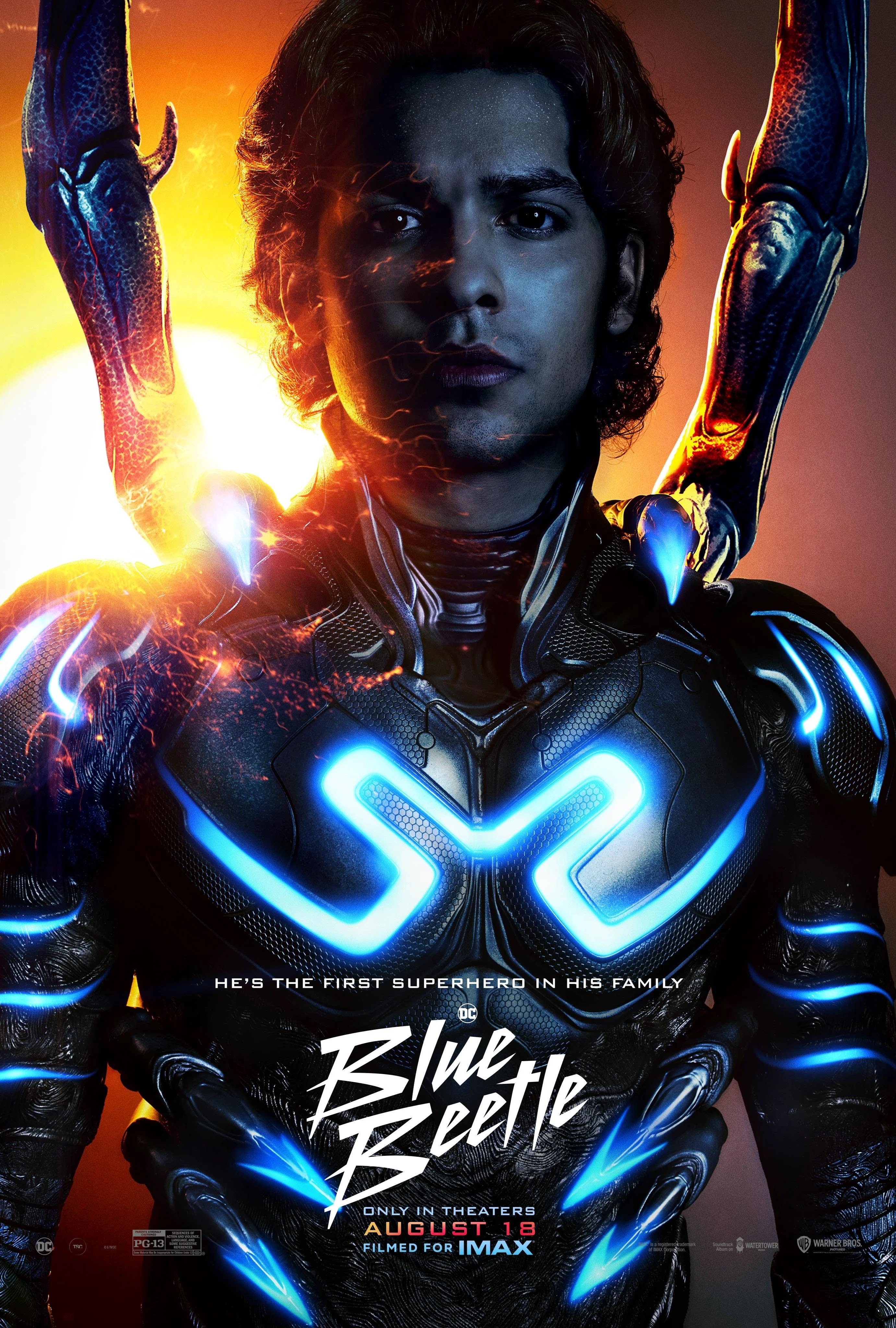
Microreview: Blue Beetle

Family bonds are stronger than corporations—try telling that to Warner Brothers

Writing about Blue Beetle, I can’t help but paraphrase Porfirio Díaz to describe the film: “So far from God, so close to the DCEU.” This film is currently tumbling in the box office due to a combination of the consistently sub-optimal decisions made by Warner Brothers, the ominous pallor of Zack Snyder, and the bewildering variety of misdeeds of Ezra Miller. It is such a shame, I thought as I walked out of the theater, because it’s a far better movie than its regrettable IP companions would merit.

I’ll be the first to admit that in raw storytelling it isn’t the most original; it follows the established beats of many superhero origin movies, perhaps being the most similar to Sam Raimi’s first Spider-Man movie. George Lucas once said: “Don’t avoid the clichés—they’re clichés because they work!” And the result is a film that works. The CGI is good, the action is good, and overall it is an enjoyable experience.

What is the most innovative and interesting aspect of the film is its portrayal of family. All too often, family in superhero stories is an act of fridging, like Uncle Ben or Thomas and Martha Wayne; or exile, like that of Kal-El from Krypton, or abduction, like that of Peter Quill. Here, to the film's benefit, the family of Jaime Reyes, the titular superhero, is fully involved in the story from the beginning. Jaime has greatness thrust upon him in the presence of his entire family, three generations living in a single house.

That family is Mexican-American, and it feels fitting that a superhero from a culture not beholden to the stultifying individualism of white America would have a much more communal plotline. Family matters in this movie, each member is fully fleshed out, and they feel like a real family. This is bolstered by how unapologetically Mexican-American they are, with their culture taking center stage. A striking example of this is the scene where Jaime first sees himself in his suit in the reflection of the glass covering an image of Our Lady of Guadalupe. The idea here is that the ‘superhero,’ so often portrayed as a Christ figure, becomes Mexican in the way that Our Lady of Guadalupe represents Christianity becoming Mexican.

It is in this clear and proud revelry in its Mexican heritage that Blue Beetle shows again what Black Panther and Shang-Chi showed, that diversity in superhero films is something worth fighting for. There’s plenty of moral reasons to do it, but there’s a narrative one I want to highlight. I am neither Mexican nor Black nor Chinese; my father is a white American and my mother is Filipina, but I found the protagonists in all these films to feel more real, in some way, than many white superhero film protagonists, and that’s because these films make a big deal out of heritage. The typical white male superhero is portrayed as a (white) everyman, someone who could be anyone, and in doing so, doesn’t feel like anyone real (it’s Magneto's strong grounding in real history that makes him such a compelling character to me). Real people have heritages, cultural backgrounds. Jaime therefore feels like somebody, rather than anybody, and in that specificity he is more relatable to me.

(Also—I love his grandmother. She’s great and has surprising depths, some of which I wish were given more specificity.)

The film is clearly trying to give a counterpoint to the Reyes family in the villains, as there are some family connections among them. However, it is nowhere nearly as well developed as that of Jaime’s. Sure, they didn’t need nearly as much, but it could have been fleshed out better, especially given that one of them is purported to have Brazilian ancestry like the actress who plays her, Bruna Marquezine. There could have been a stronger statement about how, to quote Tolstoy, every unhappy family is unhappy in its own way.

I ended Blue Beetle wishing that the Reyes family were my own. It’s striking that a superhero movie would make me feel this way, given how individualist the genre can be. It’s so human, so wholesome, even when confronted with alien technology and malicious corporations. It is a film that deserved so much better than it did, and a better company behind it.

Highlights: Great family dynamic, especially the grandmother.

Nerd Coefficient: 8/10.

POSTED BY: Alex Wallace, alternate history buff who reads more than is healthy.

Tuesday, August 2, 2022

Nanoreview [film]: DC League of Super-Pets

Finally, someone at Warner Bros. Pictures remembered that Superman stories can have fun

Amid all the difficulties that have beset the increasingly fragmented and directionless DCEU, it's a relief to watch a Justice League movie where no one's career is ruined and you walk out of the theater feeling hopeful.

DC League of Super-Pets comes at a delicate moment for Justice League IPs. While the TV side of Warner Bros. has found the formula to make Superman exciting for two years now, the filmmaking division is in a state of limbo, and the fans are understandably tired. There's no word on when Superman will appear again; who will play Batman next is anyone's guess; the upcoming Flash film is overshadowed by a dumpster fire of scandals; we no longer have a Cyborg; and the latest Wonder Woman film was a mess of bad choices. You know you're in trouble when the only member that still enjoys a solid standing in your superhero team is Aquaman.

So here comes Krypto to save the day. In this hilarious and heartwarming story, the superdog learns to adopt a more mature view on friendship, as he relinquishes ownership over Superman's life in recognition of Lois Lane's new central position. Krypto's journey leads him to make friends with other superpowered animals and explore different views on what friendship can be. Interestingly, this arc is told in parallel with that of the villain Lulu, a guinea pig who believes Lex Luthor is her best friend, but in typical Luthor style, he saw her only as a tool. These two case studies are just transparent enough to reach the intended viewers, but still complex enough to leave them mulling over their own assumptions of what a healthy friendship should look like.

After the lively and flashy action scenes, the perennial Warner talent for slapstick comedy, and the poop jokes, there's an additional possible reading of DC League of Super-Pets, one for Superman's adult fans. Krypto's big lesson is that he needs to stop acting so possessive over Superman, stop trying to control what his life can and cannot include, and be willing to let him be truly happy. If fans took Krypto's example and let go of their possessive behavior, maybe the DCEU could grow toward a less toxic direction.


Nerd Coefficient: 7/10.

POSTED BY: Arturo Serrano, multiclass Trekkie/Whovian/Moonie/Miraculer, accumulating experience points for still more obsessions.

Wednesday, December 29, 2021

In 'Resurrections,' the toxic legacy of 'The Matrix' is the new villain to defeat

The Matrix Resurrections knows you came for the cool kung fu, but the big reveal of this sequel is that The Matrix was never about the cool kung fu

Lana Wachowski is very much aware of how dangerous it was to ask for another Matrix movie.

In the first scene of The Matrix Resurrections, a self-professed fan of Neo watches a deliberately inaccurate remake of The Matrix, one where the female lead loses. Then this fan intrudes into the narrative, rescues one of her heroes, and exits a movie theater, running for her life.

The title of the movie she's desperately fleeing? The Root of All Evil.

What, pray tell, is the root of all evil? The love of money.

That's the horror Resurrections is trying to avoid, and despite its corporately mandated existence, it manages to not lose itself.

The movie keeps a close eye on this danger. One level upward, the original creator of The Matrix detects this invasion of the narrative. One of his characters is missing, but before he can deal with that, he's summoned by his boss, who tells him he's going to have to produce another entry in his videogame franchise. The boss drops a few commonplace lines about the nature of storytelling and authorship, but as soon as he mentions marketing, the scene turns surreal and monstrous. His lips dissolve and blend together, recalling the interrogation scene in The Matrix. In the original movie, this represents that Neo doesn't really have a voice of his own as long as he remains within the system. It happens just after he says he's going to call for help. This time, it happens just after the boss mentions the company's marketing department. Wachowski is making a very conscious choice by reusing this visual marker for the loss of voice right at the moment in the scene where the moneymaking potential of the new Matrix sequel is being discussed. It is unsubtle, because it needs to be, so unsubtle that the Analyst spells it out in the next scene: if Wachowski cared about the marketing, she'd lose her storyteller voice.

One shot in that scene with the Analyst shows us a window in his office with a bonsai positioned between him and Neo. The bonsai is an appropriate symbol for what he's done to Neo: a creature who could be much bigger, deliberately warped and mutilated and limited to an unnaturally small container. The purpose of growing a bonsai is to imitate the shape of the real tree, but within a controlled space. As the boss casually remarked a moment earlier, "We're still telling the same stories we've always told, just with different names, different faces."

The cheapened approach to storytelling involved in WB's demand for a new Matrix is reproduced with gleeful spite in the movie itself. Neo's coworkers hold a strategic meeting to plan the new videogame sequel, dropping "originality" and "fresh" as keywords, failing to grasp that turning them into keywords negates their meaning. The montage that follows has supposed creatives repeating the same trite explanations of the charm of the original Matrix, having the exact same conversations day after day. Neo, the story's creator, is clearly sick of hearing it. But the best part is the contrarian fan who says, "I didn't love the first one, like some of you. And, frankly, I've got zero tolerance for anything that requires a syllabus and a highlighter. I like my games big, loud, and dumb." Another developer continues that thought with "We need guns. Lots of guns." That's a very popular quote from the original Matrix, and the fact that it became a very popular quote is an example of how fans chose the wrong bits to fixate on. Naturally, it's a woman who counters this testosterone-poisoned brainstorming with "Mindless action is not on brand," but as soon as she says that, her point is cynically twisted into "Ideas are the new sexy." It's a disturbing montage to watch, because the notion itself is disturbing. You can't focus group your way to art, and it's futile to try to make The Matrix great again. The result would be a grotesque deformation of the real thing, like the bonsai in the Analyst's office.

So that's what Wachowski proceeds to give us. "Yet here we are" is something of a motif in Resurrections, uttered twice by characters intrigued by their incongruous presence in the story. You wanted one more Matrix movie, with the same heroes you loved as a kid? You realize that would mean dragging Neo and Trinity back from their corpses and enslaving them again? Come and see what that actually entails. You want a callback to Morpheus pausing dramatically to say "At last!"? That would be ridiculous. If you must have it, there, have it. But it can never hope to be more than off-color mockery, so it's a mockery that openly accepts it's a mockery. You want a repeat of Agent Smith ominously screaming "Mr. Anderson!"? That would be ridiculous. If you must have it, there, have it. But it can't be more than a half-remembered nightmare, so it's a nightmare that openly accepts it's a nightmare. It's not that Wachowski is trying and failing to remake a Matrix movie; she's still a master-level director. But she knows that The Matrix is unique and that WB's insistence upon its recreation must produce a confusing parody, a chaos of bullets and gore. So she embraces the parody. This is the opposite of what we saw in Space Jam: A New Legacy. If this first act of Resurrections feels like bad fanfiction of The Matrix, it's entirely intentional. After Neo and Trinity earned their victory at the end of Revolutions, it would be a vile desecration of these characters to make another Matrix, and to make another Matrix. That's exactly the point. The scene where Morpheus and Smith start destroying Neo's workplace is so outlandish that the Analyst has to step in and undo it. Scratch that. It doesn't work.

Wachowski's brilliance is to then proceed to show us what kind of story does work, given this mandatory ridiculous premise. You wanted exquisitely choreographed gunfights? Too bad, you're not getting that. You wanted a fearless hacker dude with a great haircut and a wicked trenchcoat? Nope, not that either. You wanted the stylized dance of dead bodies dropping? Nah. That was never the point of The Matrix anyway. And we've already seen what happens when people mistake aesthetic for substance, when the meaning is so coated in layers that it can be smuggled into serving the enemy. Wachowski is determined to not let anyone distort her creation this time. Yes, Resurrections is woke as hell. That's the whole point; The Matrix was always woke. But people were too distracted by the shiny sunglasses and vinyl jackets to get it. Even the Analyst is recruited to deliver the message: "it becomes a problem when fantasies endanger us or other people."

Wachowski has been taking notes on the colossal effect her creation has had on mass culture. In the simulated world, coworker Jude proclaims his love for The Matrix, but Neo couldn't care less. It's this annoying fan, coded as a lowkey predatory gamer bro, who literally drags him to reunite with Trinity. In a later scene, once Neo has escaped back into the real world, he meets another fervent fan in Berg, coded and written as unmistakably queer, and this time the encounter feels genuine. Wachowski is telling us exactly which fans she's talking to. She has no time to lose with red pill charlatans.

The conflict between the machines and the humans appears to have been translated in Resurrections into a conflict between neofascists who parasitize the message of The Matrix and the rest of us. The surviving humans in Resurrections have developed a sort of fan culture around the epic story of Zion's salvation. Crew member Lexy joined the rebellion because she felt inspired by Trinity. Captain Bugs was set on the path to freedom when she glimpsed Neo's true self.

It's worthwhile to discuss Bugs, because what she perhaps represents is more significant than the Alice in Wonderland reference. Bugs Bunny is the visible incarnation of WB, or at least the benevolent face of it. If we read the character of Bugs as the good side of WB, we get a more complete sense of what Wachowski is trying to say about her relationship to this media megacorporation. By writing a story where Neo is oppressed by WB marketing, but rescued by Bugs Bunny, she's choosing to focus on however much joy she can get out of an impossible situation. If Matrix 4 was going to happen regardless of her input, the choice still open to her was to have fun and be true to herself while doing it.

The next time Bugs reenters the original film, it's through a tear in the image, as if to say: Clearly reenactment didn't work, so let's try ripping a hole in The Matrix and see if something new can fit. Once again she's in a movie theater, but this time she's not running from a mediocre copy, but breaking her own path back into the true thing. The scenes of The Matrix projected onto a broken canvas are matched to playful dialogue by the new Morpheus, who doesn't bother trying to replicate the majesty of the original scene. You already know this scene. You don't need to watch it done the same way again. You don't need a remake of The Matrix. You've been here before.

Indeed, the new Matrix doesn't look like The Matrix. Faces are still lit with just the right intensity of shadow and contrast that you recognize as Wachowski house style, but the use of camera motions, color correction, and scene cuts has a warmer, gentler air to them. When operators talk to the human rebels, or when Neo talks to the Analyst through a mirror, Wachowski employs the same visual language of telepresence she perfected in Sense8. The emphasis is no longer on cool poses and slow motion acrobatics; instead, she casts a more intimate, more affectionate eye on these characters. There are fights, sure, but they're meticulously designed to not give you what you learned to expect from a Matrix fight. The new combat scenes look messy, ugly, disorienting, because violence is messy, ugly, disorienting. Resurrections isn't here to feed your inner kid's power fantasy of looking awesome shooting guns, because there really isn't anything awesome about shooting guns. You're supposed to get uncomfortable with violence.

And yet, here we are. The numerous comparisons to The Last Jedi are fully earned: our hero has grown weary of war and learned the folly of viewing the conflict that defined his life as a rigid binary opposition. The meaning of "our side" has become more fluid. This was, in a clever way, foreshadowed all the way back in Neo's first visit to the Oracle, when Morpheus advised him, "Try not to think of it in terms of right and wrong." And even when Neo is forced back into combat, his style of martial arts has become far less aggressive, not meant to fight what he hates, but to save what he loves. He's become a protector. Niobe even compares the dulling effect of war to the illusion of the Matrix: it distracts you from what matters. Wachowski did not revive Neo to have him fight a war; she brought him back to explore his vulnerability and his tenderness. If this is not the Neo you used to root for, too bad. This is the part of Neo that matters. And Wachowski does a fascinating dissection of what it is that makes the character of Neo special.

In the simulation, Trinity's fictional husband is a walking joke. He's not only called Chad, but played by the original stunt double for Keanu Reeves in the original Matrix. So this Chad is literally the part of Neo that kicked ass, the stoic macho, the action movie star. But now he exists separated from the core essence of Neo, which is not his kung fu moves, but his humanity. To incel radicals, this ought to be the ideal state: all of Neo's awesomeness, none of his feelings. And that's precisely what Wachowski treats as horrific. For who knows how many years, Trinity has been stuck with the Chad, and she can't wait to run away from him and what he represents. At one point she complains about the role the system has given her: "I remember wanting family, but was that because that's what women are supposed to want?" This is the equivalent of screaming the message in the viewer's face, because people evidently didn't get it twenty years ago: No, the oppressive system you need to wake up from is not feminism. The oppresive system you need to wake up from is patriarchy. Memo to the manosphere: Chad, the quintessential incarnation of toxic masculinity, is the enemy here. Get it? Trinity's moment of liberation is to kick the crap out of Chad. Get it? Are we being clear and unambiguous enough now? Or are you going to search for some way to pervert this franchise's message to justify rubbish incel theories again?

Wachowski knows all the complaints the manosphere will throw at this new Matrix. And she puts them in the mouth of the blabbering buffoon: the Merovingian, who sputters nonsensical protestations like "We had grace! We had style!" about the previous state of the Matrix. The movie's response: Go home, old man. No one cares about your nostalgia. At the end, the Analyst points out, speaking about the general public, "They don't want this sentimentality." The movie's response: Two lovers, hand in hand, flying in the sunshine.

Love is the perennial theme across all of Lana Wachowski's art. The Sense8 finale was appropriately titled Amor Vincit Omnia. As the Analyst properly explains, recapturing the magic of Neo is impossible without Trinity, not because of them as themselves, but because of what is created between them. And that's the secret at the core of the entire Matrix franchise: the power of the One was never about a fearless hacker dude with a great haircut and a wicked trenchcoat. The One was never an individual. The One is made from the link between human beings. It came into existence in the original Matrix when Trinity's love saved Neo's life; then it saved her life at the end of Reloaded; and it kept them going until the end of Revolutions. The answer was always love.

Let's go back to the Architect's speech in Reloaded: "Your five predecessors were, by design, based on a similar predication, a contingent affirmation that was meant to create a profound attachment to the rest of your species, facilitating the function of the One." For the machines, love is incomprehensible, but nonetheless exploitable. The weaponization of our empathy in order to wield its power against ourselves reaches its perverse culmination in the new Matrix, which mirrors the way neofascists have weaponized the liberation symbolized by the red pill in order to promote more oppression. As Bugs reveals, "They took your story, something that meant so much to people like me, and turned it into something trivial." Or, as the Analyst gloats, "Kind of ironic, using the power that defined you to control you."

And still, the solution, again, is love. The correct choice, every time, is love. The Oracle herself said it at the end of the previous saga: "the real test for any choice is having to make the same choice again." And she said it at the beginning: "Being the One is just like being in love." She wasn't speaking in metaphors. The power of the One is literally the power of heartfelt human connection, the only thing that can truly destroy fascism.

Now keep in mind that, in the videogame The Matrix Online, the Kid forms a faction called E Pluribus Neo. It's the same idea: the One is created by the ties between us. The Analyst's evil consists in intentionally frustrating that connection, splitting their unity into a binary he can feed off of. That's what keeps preventing a better future, the one the Oracle referred to in Reloaded when she said, "the only way to get there is together." Since the original Matrix, there were strong hints that even those in charge of enforcing the tyrannical system felt oppressed by it. Resurrections brings that theme to completion, with former oppressors working together with the rebels to bring the tyranny down.

The new backstory we learn about in Resurrections, meant to have occurred after Revolutions, is in line with several pieces of official canon established years ago in the videogame The Matrix Online: the failure of Zion, Niobe's rise through the ranks of leadership, the loss of the Oracle, and the emergence of rival factions within the machines. Although we're meeting a completely new enemy, Resurrections doesn't fall into the common late sequel trap of erasing the original sequels (see: Terminator Dark Fate), but also avoids the equally clumsy trap of having the new enemy make the original heroes' fight seem pointless in retrospect (see: Terminator Dark Fate). The reinvention of Smith is in concordance with the times: the face of fascism is no longer the angry law enforcement agent, but the approachable tech bro in business casual. This is a much more insidious version of Smith, because Jonathan Groff's image, even when crumpled in a grimace of pure hatred, is undeniably seductive. Where Hugo Weaving filled the screen with loud, incontrollable rage, Groff delivers the alluring kiss of death.

This Smith is more consciously in tune with his deep connection to Neo. There's an obvious erotic current to his pursuit of him. We're no longer at the point in Resurrections where we were surprised to hear a machine speak of love, but let's remember what was said at that time: love is just a word, and "what matters is the connection the word implies." If you lose yourself, you find your way back by means of love. Even after the Oracle had to adopt a new face, the way she could tell she was still herself was by her love of candy. That you know yourself by what you love is the key to the "know thyself" motto she kept on her kitchen.

There's a curious focus on domestic spaces in Resurrections. Many scenes are set in bathrooms, the battleground of this era's culture wars. Wachowski is answering to a popular consciousness partly shaped by her own work, and it's interesting that The Matrix is transformed from a movie into a videogame in the fictional world of Resurrections. On one level, this calls back to The Matrix Online, which had a vibrant fanbase. But on another, it refers to the nature of the Matrix itself as a digital simulation of reality. Every time Neo plugs into the Matrix, it must feel like entering a videogame with administrator privileges. So it makes complete sense that that's how Neo remembers his earlier life. To him, it wasn't a movie.

This gives Wachowski a prime opportunity to comment on the degradation of digital culture. There's no need to recruit Agents when anonymous masses can be deputized as bots. The final chase scene, where Neo pushes wave after wave of bots away from Trinity's motorcycle until they miraculously survive a series of explosions, almost reads like a Twitter user desperately hitting the block button against the bots and barely making it past the ensuing flame war. It's like Wachowski knew her work of love was going to be review-bombed, so she cast the bombs as literal suicide bots dropping onto our heroes.

In the end, she doesn't have to care about them. She can be fearlessly sentimental. She can be as woke as she wants. She can tell her stories in her own voice, from her unique artistic vision. She can be open about the message of love present in all her creations. She has come into full mastery of her craft. She's ready to paint the sky with rainbows.


Nerd Coefficient: 8/10.

POSTED BY: Arturo Serrano, multiclass Trekkie/Whovian/Moonie/Miraculer, accumulating experience points for still more obsessions.

Tuesday, August 10, 2021

The Suicide Squad is silly, morbid, gory, hilarious, and surprisingly topical

In contrast with the MCU's cowardice, the DCEU has no problem portraying America as the bad guy

It took a second try and years of waiting, but we finally got a decent Suicide Squad movie.

To summarize: when the brutal dictator of the fictional banana republic of Corto Maltese is violently overthrown by another, equally brutal dictator, but which happens to be aligned in opposition to the US, a sinister agency of the US government created to do the dirty work in secret drags members of the incarcerated population into service (a comic-book fantasy exaggeration of a practice that is, by the way, still fully legal). However, their mission is not to kill the new dictator, but to prevent him from getting his hands on dangerous alien research that had been kept hidden in Corto Maltese for sketchy reasons having to do with exiled Nazis and good old US image management. The attempt at foreign intervention goes horribly wrong, and our Suicide Squad has to choose what it wants the US to stand for.

The criticism of American foreign policy is refreshingly overt here. This same year, The Falcon and the Winter Soldier excelled in tortuous mental gymnastics to find a way to maybe imply, in a subtle, roundabout manner, that influencing world politics by force might, perhaps, have iffy effects, to then hasten to clarify that no offense was meant to any general watching the show.

WB's answer to that? Hear Bloodsport tell it to Peacemaker:

"I think liberty is just your excuse to do whatever you want."

I'm no fan of wrestlers in cinema, but John Cena brings his best big brute game to the role of the Peacemaker, openly defined by the director as a caricature of American heroism, a sentient moral contradiction that would happily murder for the cause of peace. This character does more than provide easy jokes: he's the embodiment of why si vis pacem para bellum is a repugnant stance. His unthinking commitment to putting the country's reputation above issues of human rights or historical memory is just one of the many jabs at macho posturing one can find in this movie (along with the brilliant casting choice of hiring the actor whose career is essentially defined by Rambo to play a beast who prowls the jungle eating enemy soldiers one by one).

Over against the hypermasculine icon of the American soldier single-gunnedly fixing the world, The Suicide Squad offers a moral alternative in the collective force of those who have been despised or ignored, symbolized here by a swarm of hungry rats, but explained in a helpful flashback as a metaphor for the lofty purpose that every one of us can aspire to. Crucially, it is not men and their guns who defeat the final boss monster of the movie, but women and their sense of responsibility: Harley Quinn fulfilling a promise to the Javelin, the Ratcatcher carrying on her father's principles.

Speaking of fathers, there is a curious choice of theme running through The Suicide Squad. The standard by which the movie separates good from bad characters is how they treat children. Time after time, the script judges a character by this criterion. We know the Peacemaker is a monster because he'd be willing to kill children for his precious ideals; likewise, Amanda Waller is established as a monster because she threatens to throw a minor into the deadliest prison in the country for a minor theft. Colonel Flag decides to go against his superiors and expose their dirty secrets when he learns they were responsible for unethical experimentation on children. Harley Quinn almost marries a bloodthirsty tyrant who is drawn toward her symbolic anti-system status (a move that mirrors the unholy love affair between American progressives and Third World dictators), but draws the line at the execution of children.

Once one notices this theme, it's striking how strongly it constitutes the moral axis of the story. Polka Dot Man, Bloodsport and Peacemaker were abused as children, and their respective ways of processing that trauma defines their characters. Polka Dot Man channels his anger via delusion. Bloodsport prefers to stay away from his daughter to avoid being a negative presence, but steps up to protect her the instant she's in danger. And in a brief but meaningful shot, Peacemaker lets us see that he doesn't disapprove of the horrific mistreatment he received from his father.

Finally, the legacy that persists of the American presence in Corto Maltese is the not-quite-dead Weasel, a serial killer of children, set on the loose.

Ratcatcher is the only cast member with a healthy parental relationship. It's the love her father gave her as a child that equips her with the tools to save the day. First, she saves her own team, when her compassion defuses the threat presented by traveling with King Shark. And at the end, she saves the world while explicitly renouncing American interventionism.

The problem with movies about American interventionism resembles the problem with war movies in general, in that it's hard to criticize the thing without somehow also exalting the thing. The Suicide Squad takes care to tell us very clearly where it stands. Casting Rambo as a man-eating monster is one way. But the choice of Panama as the location to film this tale of catastrophe is loaded with symbolic resonance. As it happens, the US launched a widely condemned military invasion of Panama in 1989, presumably to remove its dictator, but the operation also had to do with preserving American control over the Canal Zone. Urban warfare destroyed entire city blocks and displaced thousands of Panamanians. The legacy of this damage persists today.

Aware of the weight of this thematic link, The Suicide Squad introduces a second theme, one of generational responsibility. If we've established that those who hurt children are the bad guys, what should be our response? In its final moments, the movie no longer filters this issue through individual characters, but through the imagery of the collective. The symbolic point of the story when the treatment of this theme begins is marked by the sudden appearance of rain, which Harley Quinn interprets as charged with erotic meaning. A dirty joke early in the movie had already foreshadowed the notion of Corto Maltese as a land full of fertile potential. What is at stake is the lives of millions.

Starro the Conqueror is one extreme of this moral question. It weaponizes its own offspring to the point that they are referred to as extensions of itself, tools with which it builds a population of mindless servants. The Ratcatcher is the opposite extreme. She also relies on the strength of the collective, but she respects her army of neglected creatures. She didn't come to Corto Maltese to conquer it; she's every bit the herald of freedom that the Peacemaker only pretends to be (note that her signature weapon resembles a torch held aloft).

The Suicide Squad, WB's reinvention/reboot/relaunch/redress of its disastrous, similarly-named 2016 title, is a much more competently produced film that fully earns its The that marks it as The movie adaptation of the DC Comics supervillain team that people will choose to remember. Director James Gunn has succeeded at course correction for the DCEU (sorry, the Serververse) with a version of the Suicide Squad that is everything its predecessor failed to be: dark but not tedious, fast-paced but not confusing, hyper-violent but not juvenile, graphic but not off-putting, ridiculous but not annoying. In short, a movie one can be entertained by. That's all we were asking for. But it's also a conscious dissection of the damage caused by American military interventions, a solidly researched topic that should not be treated as shocking or controversial, as Marvel has been doing. Point awarded to WB on this one.

The Math

Baseline Assessment: 8/10.

Bonuses: +1 for somehow making a cannibalistic shark a funny concept, +1 for juggling an overcrowded cast without confusing the viewer, +1 for fluid action choreography.

Penalties: −1 for underutilizing Peter Capaldi, −2 for inconsistent Spanish (there are oddities of word choice, but the most salient problem is that, for a Caribbean island, Corto Maltese somehow manages to have a dictator with an Argentinean accent and a guerrilla leader with a Brazilian accent).

Nerd Coefficient: 8/10.

POSTED BY: Arturo Serrano, multiclass Trekkie/Whovian/Moonie, accumulating experience points for still more obsessions.

Thursday, July 29, 2021

I have seen hell, and its name is Space Jam: A New Legacy

This production is an insult to the art of moviemaking and an act of violence upon the viewer


When I joined the team at Nerds of a Feather, the editors explained the blog's official policy to me as striving to stand "on the charitable side of honest." I've made my sincerest effort to keep that principle in mind during these months, as I analyzed stories that were great and others that were less great. In the case of Space Jam: A New Legacy, the charitable thing to do is to advise you to skip it. There's no possible defense of it. One cannot even entertain the case that its merciless stuffing of the viewer's eyeballs with one immensely uninteresting scene after another serves, as in the original Space Jam, to showcase the feats achievable with the latest advances in animation technology. That argument wouldn't hold here, firstly because digital animation is having a wonderful moment in the 21st century without the need for Space Jam's help, and secondly because telling uninteresting stories as an excuse to boast great animation is a niche firmly held by Love Death + Robots. This? This didn't need to exist. In a nutshell, LeBron James plays basketball and wins. There, I spoiled it. Now you don't have to watch this irredeemable pile of rubbish.

Space Jam: A New Legacy was not made for Looney Tunes fans, or for basketball fans, or for digital animation fans. It was made for Warner Brothers marketing executives. Somewhere in the corporate hierarchy, someone must have issued a memo demanding a boost of renewed relevance for properties that were fading from popular awareness. As if conceived from the segment of film discourse that believes spotting the reference to prove you're a "real fan" is an aesthetic category, we have a product, because calling it a movie is an insult to words, that in the years to come may remain bizarrely satisfying to people who enjoy cataloguing tiny faces in a crowd. And that's because its main selling point isn't even LeBron James, or Bugs Bunny, or Don Cheadle (you know, the world-renowned superstars who actually do something in the story), but the hundreds of obscure characters that are there just to be there. Possessed by the inexplicable urge to cheer in the general direction of a basketball game regardless of their individual personalities or even which emotional beat is happening, they invest Space Jam: A New Legacy with the incongruous property of being rewatchable only for the characters who have no role or purpose or reason to be in the story. This is the limit state of intertextuality: a text that only points to other texts, but lacks its own meaning. Meaning, you say? What's meaning? Look, there's Wilma Flintstone waving at us!

Making references is not bad in itself. But the reference needs at least to be understood. Remaking Rabbit of Seville with only the barest musical resemblance and without the meticulous match between melody and action is to miss the point of what made Rabbit of Seville the masterpiece it is. To make a Road Runner joke where it is Wile E. Coyote who succeeds at using the paint-on-the-wall trick to mislead and trap the Road Runner (instead of the other way around, as God intended) is to catastrophically misunderstand the dynamic that defines these characters and to blaspheme against seven decades of cartoon history. Wile E. Coyote's whole shtick is that he never captures his prey. If you don't get that basic fact, you shouldn't be making a Looney Tunes movie.

In a crude resemblance of the way the first Space Jam managed to insert some critique of itself (Daffy Duck illustrating how much Warner Brothers likes to kiss its own ass, Bugs Bunny dreading the prospect of being used as a mascot to sell tickets), A New Legacy comes surprisingly close to denouncing its own existence. The plot starts with LeBron James being invited to let Warner Brothers use his image in movies. This fictional version of him understands that athletes generally don't make good actors, and refuses. The pathetic characters meant to represent Warner Brothers executives are appropriately despondent at their dearth of good ideas—they're so uncreative they literally let a computer write their corporate plan. But before a terrible movie and a digital abomination can be prevented, the soulless evil at the heart of Warner Brothers captures LeBron James and forces him to play. To highlight the violence of the whole production, he then kidnaps thousands of viewers from the real world. A New Legacy knows too well that we're prisoners begging for the show to end.

But this is not the full extent of how much A New Legacy despises itself. When Bugs Bunny flies through the Serververse (which I guess is how we have to call the DCEU from now on) to recruit the rest of the Looney Tunes, we find them already integrated into the plots of better movies. When the legendary cartoon stars would rather be doing more exciting and fulfilling things somewhere else, and even LeBron James is playing a version of himself who would never have agreed to be here, what we have is a story that is almost crying for help, aware of its own absurdity and unable to stop.

Nothing matters. Nothing has meaning. No story has value except as a brand. What did Road Runner want in the Mad Max world? What motivated Foghorn Leghorn to ride a dragon over Westeros? What was Speedy Gonzales looking for in the Matrix? Why did Lola Bunny feel the need to train with the Amazons? Well, who cares? Those scenes are purely irrelevant. Entire worlds are dragged into this monstrosity for no purpose. They're there just to be there. They're there for you to point and say, "I get that reference." They're there to remind you how much Warner Brothers owns. During the climactic match, the screen is filled with face after face of famous extras and the viewer's attention is at a loss. Where are we expected to be looking at? In any given frame of the game, our athletic star's graceful moves compete with Pennywise hiding behind Agent Smith hiding behind the Penguin in the background. No part of the screen is meant to occupy the main focus, because the studio wants you to notice each and every last of its properties. The established conventions of visual storytelling go out the window, as do the narrative principles of logical worldbuilding and clearly defined stakes (why did the villain even need to make a bet when he could just keep his prisoners?) and the rules of basketball (what happened to the three-second rule, or to running with the ball, or to blocking fouls, or to not kicking the ball, or to consistent scorekeeping?).

In 1996, Michael Jordan won his Space Jam when he realized he could use the rules of the cartoon world. It's a form of fantasy, but an internally consistent one. In this new version, the day is saved by the infinite use of cheat codes. Rules? Narrative expectations? Emotional investment? Realistic parenting? The implicit pact of respect between creators and viewers? Nah. All that matters is that Warner Brothers invented a shiny new way to rob the graves of a dozen movies to dress up the ghost of one. Space Jam: A New Legacy is a repugnant exhibition of the most vulgar kind of self-congratulation, unworthy of the classics it cannibalizes and with no right to claim two hours of your time. Just like the Looney Tunes, you're better off in other movies. You were never the audience this thing was meant to please.

Nerd Coefficient: 2/10. Seriously, comprehensively, profoundly bad.

POSTED BY: Arturo Serrano, multiclass Trekkie/Whovian/Moonie, accumulating experience points for still more obsessions.

Tuesday, August 9, 2016

Review: Suicide Squad

Bad heroes, or just bad?


For all my cynicism around movies, blockbusters and shared universes, to say nothing about outright negativity when it comes to Zack Snyder directing anything beyond a hair spray commercial, I have been stupidly excited for Suicide Squad. The tale of a group of bad guys pressed into service by an even worse person, to do... something. It doesn't really matter, because we're here to see the WORST. HEROES. EVER.

And boy oh boy, do they deliver. Really, it starts and ends with Jared Leto's Joker. His antics are far and away the highlight. His antics included sending gifts to other Squad ('SKWAD') members, including, but not limited to:
  • Live rats
  • Dead pigs
  • Bullets
  • Sex toys
  • Pornography
Classic Joker! This lead Viola Davis to threaten to pepper spray him if he came near her, which doesn't seem like the kind of thing the Clown Prince of Crime would take kindly to, but maybe it earned her some grudging respect.

You have to admire the Squad's ('SKWADZ') commitment to who they are- bad, hard criminals. You have Harley able to hold her breath for five full minutes, or Killer Crock listening to recordings of other cannibals in order to preserve his craving for human flesh. It's truly unsettling to see, and one of the many ways Suicide Squad stands out.

The villain, in a story about villains really stands out: Rarely will you find one more menacing or twisted than David Ayer. Keeping the Squad ('SKWAD') imprisoned for months, and conducting twisted experiments on them is truly grotesque. It started as soon as they were in his thrall- forced into a 'therapy' session, where they where tricked into revealing childhood trauma, phobias and their deepest insecurities. These were then used against them as 'motivation' later. Truly devious.

He pulled some very standard villain stuff, as well- forcing the Squad ('SKWAD') to fight each other, even inflicting a weird Stockholm syndrome on them, to where that whole SKWAD thing got tattooed on each other, probably because they had all bonded over surviving such trauma. Everyone, except Deadshot, anyway, but he barely appears at all except to comment on how he doesn't hate the Joker (he does) and to comment on how horny the rest of the Squad ('SKWAD') is (this is probably true). Deadshot is pretty lame, is what I am saying.

In his greatest act of villainy, though, Ayer made a whole movie using the members of the suicide squad, and it was basically on par with the other current DC movies. For as fascinating as the Suicide Squad is, and what a great villain Ayer is, you would have thought they'd make a better movie.

The Math:

Baseline: 5/10

Bonuses:
+5 for having some of the best stories around the making of a movie ever

Penalties:
-5 for those stories being way better than the actual movie

Conclusion: 5/10 problematic, but has redeeming qualities