Showing posts with label lovecraft. Show all posts

Thursday, October 9, 2025

Cult Film Review: In The Mouth of Madness (1994)

Cosmic horror without the Lovecraft


This month, just in time for Halloween, the Criterion Channel launched a John Carpenter retrospective. I took the opportunity to revisit 1994's In the Mouth of Madness, one of the strangest John Carpenter films... and I feel like that's saying something.

Fresh off of Jurassic Park in 1993, Sam Neill went to work for John Carpenter, playing insurance investigator John Trent. We meet Trent ranting and raving as orderlies at an insane asylum drag him into a padded room. The next morning, when asylum psychiatrist Dr. Wrenn visits Trent to get his story, he opens the door to find Trent has drawn symbols all over his room, clothes, and face, and he begins to unfold his tale of madness.

John Trent was not always the raving maniac Dr. Wrenn sees before him. No, indeed. Trent was once a successful, can't-bullshit-a-bullshitter insurance investigator. The popular horror author Sutter Cane, Arcane Publishing's biggest literary star, has disappeared, and Arcane wants Trent to find him. Trent reluctantly accepts the assistance of Cane's editor, Linda Styles, but believes from the start that this whole thing is a fakeout—an elaborate publicity stunt designed to generate headlines for Cane's new novel, In the Mouth of MadnessTrent tries to do his research, grabbing copies of all of Cane's novels, but they're too scary. They wind up getting inside his dreams, and maybe even into his waking reality. Maybe everybody's waking realities. A spike in violent crime seems to be tied to people who read Cane's books. And it comes home for Trent while he sits at a restaurant and a man wielding an axe smashes through a plate glass window, coming for Trent before the police shoot the attacker. It turns out this madman was Cane's agent, and right before he raised the axe over Trent's head, he asked a question everyone seems to be asking:

"Do you read Sutter Cane?"

In the same way that Stephen King sets much of his work in the fictional town of Derry, Maine, in the film Sutter Cane sets his work in the idyllic New England town of Hobb's End. Trent realizes that design elements consistent across Cane's various novel covers fit together and form a map to the fictional town. So he and Styles set off to follow the map and see where it takes them. After trading off behind the wheel, Trent falls asleep in the passenger seat, and while Styles drives, things get weird. A figure looms up out of the darkness, the road seems to vanish, the figure returns, but different, then again, then there's a crash, or is there? The radio distorts, goes out, the night seems to bend around Styles, and then... poof. It's daytime and they're in Hobb's End.

That's all the plot summary you get, because after that, the film begins playing with reality in very interesting and increasingly labyrinthine ways. If you haven't seen the film, I don't want to take any of the fun out of it. But extremely telling is the exchange about Cane's books that Trent and Styles have on the road right before he hands over the wheel:

Trent: What's to get scared about? It's not like it's real or anything.

Styles: Well, it's not real from your point of view, and right now reality shares your point of view. What scares me about Cane's work is what might happen if reality shared his point of view.

Trent: Whoa, we're not talking about reality here. We're talking about fiction. It's different, you know?

Styles: But reality is just what we tell each other it is. Sane and insane could easily switch places if the insane were to become the majority.

I have to be honest: that line hit a little closer to home these days than it probably did in 1994. I do remember renting this movie (on VHS!) when it came out, and when it ended, I felt so perplexed, so surprised by the final moments of the film, thinking that I must have missed something, that I rewound it back to their arrival in Hobb's End and watched it again. Watching it this time, having vaguely remembered that experience from 30 years ago, I was a little more prepared to simply go on the journey that Carpenter and writer Michael De Luca wanted to take me on.

If you are a fan of Carpenter and/or Stephen King, this movie is a ton of fun. Carpenter throws in a number of signature visuals that are reminiscent of The Thing, and the movie really nails the Stephen King vibe, not only with the setting but down to the author font on the paperbacks. But one of the most enjoyable aspects of the film is the way it manages to give the viewer a full-on cosmic horror experience without H.P. Lovecraft. Sure, there are a ton of homages to Lovecraft, but it's not his mythos, not his settings, and not his baggage.

Like many people, I can no longer enjoy the work of Lovecraft—certainly not the way I could at maybe 13 years old, reading paperbacks with evocative titles full of odd, elliptical stories that hinted at a hostile cosmos and latent dangers outside of the realms of our perception. But Lovecraft's racism and eugenicist views, which revealed themselves in tropes I wasn't equipped to fully understand at that age, make the experience of reading him one I can no longer find much joy in. And while there are a couple of good ones, Lovecraft film adaptations tend toward the schlocky and cheap, as name-recognizable IP in the public domain might lead you to believe.

So I'm grateful to John Carpenter for In the Mouth of Madness. It scratches the cosmic horror itch in a satisfying way, and wraps it in something of a puzzle box narrative that's akin to a film like Mulholland Dr. but very much in the horror genre. I'm happy to recommend this without having to caveat it.

In the Mouth of Madness is currently streaming on the Criterion Channel (October 2025), and Tubi with commercials.

Monday, August 24, 2020

Paying a visit to Lovecraft Country


SFF television is quickly becoming more active in discussions around the politics of race.

A lot has been made out of the fact that a significant portion of the audience of HBO's new Watchmen had not heard a word about the single worst act of racial violence in American history until they saw the first minutes of the first episode. A gripping reminder, perhaps, of the indifference that the contemporary America feels about the more shady bits of its backstory.

Turns out that I was actually better informed than many of my fellow viewers because I had some cursory knowledge about what went down in Tulsa in 1921 – thanks not to my keen grasp of history but to another piece of SFF: the novel Lovecraft Country by Matt Ruff. The Greenwood massacre is something of a formative experience for important characters in both the newest interpretation Watchmen and Lovecraft Country, even though in the latter it is a more of a living memory for them as the story is set in 1950s.

I read the book a couple of years ago for Nerds of a feather, flock together and have since been waiting for the TV adaptation to materialize. Now that the first episode has been out for a week, I guess it's a good time to say a word or two about it. I'm obviously writing this without seeing eight tenths of the first season, so let's hope that the upcoming episodes won't render anything I say completely silly. Time will tell, for example, if we'll see the Tulsa events on screen at some point.

For television, Lovecraft Country was developed by Misha Green with people like Jordan Peele and J.J. Abrams as executive producers. Ruff's novel-looking collection of interconnected tales was initially a proposal for a TV series, so maybe the process should be called reverse engineering rather than adaptation. Whatever took place, it carefully preserved very much of the source material, at least judging by the first two episodes. Not counting one gender-swap and surname changes, every character seems like they are lifted straight from the book.

The story starts with the protagonist Atticus Freeman returning home to Chicago through states that are unfriendly for black people such as he, and running into vehicle trouble on the road. Now we meet him on a bus as opposed to his own car in the novel, but either way, getting where they are supposed to go is way easier for whites when the car breaks down.

The problem of traveling in Jim Crow America and staying safe is a central to the plot in many ways. Atticus's family is in the business of publishing a guidebook called The Safe Negro Travel Guide which lists the establishments in which black customers can expect to be welcome and stay alive. Even though it sounds like one, it is not a dark joke. Books like that really existed, and having Atticus's uncle George compile them in the story provides an economic solution for drawing the extended family in sticky situations and adventures.

So, the show is called Lovecraft Country. George and Atticus are huge fans of pulp literature and science fiction, including H.P. Lovecraft, and they get into a discussion about his works right in the first episode. There's remarkably little love for Lovecraft to go around these days, compared to just ten years ago. Even though his problematic batshit insane racist views were discussed here and there, Lovecraft was one of the absolute greats of fantastic horror.

For decades, nobody questioned the fact that a World Fantasy Award trophy that was a bust of the author who had written, for example, a poem titled "On the Creation of Niggers” describing a creature that was half-human and half-beast. When the bulby-eyed Lovecraft statue was finally retired in 2015, his most ardent admirers were so unhappy that they even returned the trophies they had previously won. As much Lovecraftiana is published as before, but the most memorable new works explicitly take aim at the racial attitudes of Lovecraft and his works. Victor LaValle's "Ballad of Black Tom" rewrote the "The Horror at Red Hook" from the viewpoint of a black protagonist, and other such works are making it hard to even think about Lovecraft without considering his politics.

In Lovecraft Country, all the Lovecraftian monstrosities are there to make a very specific political point. Indeed, Shoggoths are roaming the night and there are things with way too many eyes and tentacles (and consonants in their names), but evil-wise they are nothing compared to the darkness of Jim Crow. It's a good premise, even though it reduces the Lovecraftian to a gallery of slimy monsters, missing all the bleak lonely horror that I would actually consider Lovecraft's claim to fame. Beings from alien dimensions and the fact that there used to be towns where non-whites are killed if they don't leave before the sun sets are both terrifying.

One could argue that all the Lovecraftian elements are more or less window dressing and could be replaced with other horror lore just as easily. What is borrowed from Lovecraft are some names of horrific creatures, obsession about ancient magic books and assorted plot elements. What cemented his reputation and got him canonized is, I think, the cosmic horror and the feeling of being alone and in constant danger in a cold, brutal universe.

This is a feeling you don't get to experience with Lovecraft Country. Here, good triumphs, family takes care of each other and the atmosphere is cozy. That's probably as anti-Lovecraftian as it gets.

The novel is a happy book about awful stuff in which nobody is really going to get hurt. In the last pages, we leave the black cast laughing together when they have again defied all odds and made it out of their latest adventure in one piece. It's not yet certain that the show will be all like that. Actually, the second episode which just landed might suggest that the main characters can get hurt more seriously here, but the future episodes will tell what kind of Lovecraft Country we are going to be able to visit this time.

I'm sure that somewhere there are Lovecraft nerds itching to remark that the story isn't entirely accurate in all bibliographic details, and they're right. Lovecraft's vile poem mentioned earlier was never published and it had not yet been even discovered at the time when Atticus, his father and uncle George are discussing it in Lovecraft Country. Personally, I don't particularly care as it makes a better story this way, but it's a bit fast and loose here and there. In all honesty, I don't think that actual black science fiction fans in the 1950s would be as understanding as Atticus and George are about the undertones of Lovecraft's work. At times they feel more like stand-ins for contemporary SFF fans, but that's how it is. Lovecraft Country is entertainment and not a dissertation. 

SPACEFARING KITTEN, an extradimensional enthusiast of speculative fiction, comics, and general weirdness. Contributor since 2018. @spacefaringk

Wednesday, October 3, 2018

Microreview [Book]: Lovecraft Country, by Matt Ruff

"Stories are like people, Atticus. Loving them doesn't make them perfect," The Safe Negro Travel Guide publisher George Berry tells his nephew Atticus Turner in the beginning of Matt Ruff's Lovecraft Country.

Berry is sort of an old wise man character in the novel, always there delivering helpful truths and constructive advice when needed. Here he is unraveling Atticus's – and his own – conflicted feelings towards science fiction and fantasy literature. They are both in love with genre classics such as Edgar Rice Burroughs and H.P. Lovecraft but at the same time register that the authors and their works are deeply problematic, especially from the viewpoint of black readers which is what both men are.

The novel takes place in 1950s, but this discussion is a flashback. It is possible that they are supposedly discussing racist undertones of Lovecraft's fiction during the same decade when Moore's Ford lynchings and other infamous killings and home burnings happened, not to mention less lethal forms of systematic oppression in Jim Crow America. I'm not completely convinced that a person who publishes a guidebook dedicated to keeping traveling black Americans safe and alive would really be as generous as uncle George here, but this lingering doubt of the plausibility of the characterization is about the only negative thing I have to say about the novel.

Come to think of it, I'm also not quite sure whether Lovecraft's racism would really have been a talking point among fans in 1940s. Fantasy fandom was happy to give his busts around for 40 years during much, much more modern times, after all, stopping only occasionally to contemplate whether the bust was flattering enough to its source. Ruff's characters and their concerns may seem a bit contemporary at times, but I don't think that it spoils any of the fun, frankly.

Lovecraft Country is formed of consecutive paranormal tales which foreground different members of the novel's cast. The cast is all-black and that is the point – even (or especially) the story which begins with a mysterious metamorphosis of one of the characters into a white-skinned version of herself really draws its power from the discussion of race: how black Americans of the not-so-distant past were second-class citizens in an unbelievable variety of ways. "Nevermind the paranormal stuff – isn't that just horrific?" is to me the question that the book is asking its reader.

Actually, the horror fantasy content of the novel is so un-horrific that it is extremely unlikely to scare anybody. Ruff's light-hearted tone makes it clear from the beginning that nothing too brutal is going to happen to any of the novel's main characters. There is a sinister white shadow looming over all the cheerful action, however, and the mix of registers is interesting. It's a happy book about awful stuff.

In the novel, familiar horror and science fiction tropes are contrasted with the deep-rooted racism and bigotry of the era, and the latter is what the reader will probably consider otherworldly. Moving in to a haunted house is nothing compared to the neighbors who try to spook and vandalize the new home owners to move out of a previously white-only block. What's more, buying a property in the first place was a bureaucratic nightmare for people of color, and Ruff has the infodumps to prove it.

So, there might be a Shoggoth or two running loose in the bushes, and Cthulhu cults scheming to open gateways to alien dimensions, but neither are as dangerous as white sheriffs.

Ruff's book started out as a TV series pitch – it was meant to be an X-Files style show in which the excuse for weekly paranormal adventures was that the characters were collecting data for The Safe Negro Travel Guide. Even though the original pitch was unsuccessful, we are in fact going to see what the people putting together this twisted Hitchikers' Guide to the Galaxy are going to look like on the screen, because now there is a TV show in the works.

I recommend reading the book first, though, because Ruff's prose has levels that the camera probably won't capture.


***

The Math

Base Score: 7/10

Bonuses: +1 for combining unimaginable horrors with truly unimaginable horrors, +1 for winks to readers versed in pulp classics of the genre.

Penalties: -2 for cardboard cut-out characters (-1 in case you are not as severely allergic as I)

Nerd Coefficient: 7/10 – "A mostly enjoyable experience"

Reference: Ruff, Matt. Lovecraft Country [HarperCollins 2016]

***

POSTED BY: Spacefaring Kitten, an extradimensional enthusiast of speculative fiction, comics, and general weirdness. Contributor since 2018.

Monday, January 26, 2015

Microreview [film]: The Whisperer in Darkness

Almost (but ever so slightly not) as wonderful as its predecessor


Film adaptations of Lovecraft are almost universally terrible. Until I watched the special features on the second disc of The Whisperer in Darkness (totally worth the purchase price), I never really had a clear idea as to why. But very astutely, writer/director Sean Branney and co-writer Andrew Leman pointed out in a behind-the-scenes featurette that the eponymous story this film was based on was really only the first two acts of what needed to be three acts in order to make a complete film. Most Lovecraft stories, they said, left off the third act to which they were building. That wily Lovecraft — giving you a beginning, a middle, and leaving the end to your imagination so he'd never get caught writing The Matrix: Revolutions. Maybe that's the real heart of why so many of the films have been terrible — filmmakers either had to scrap everything but some basic idea of the story and then build something entirely new, or invent a third act based on what Lovecraft only hinted at in his actual story.

Branney and Leman decided to go with the latter approach. They fleshed out the characters, built out the world a little, but tried to stay pretty true to the source material for about an hour. After that, it was off to the races with new material to bring the whole thing to a satisfying close. The result is as good a Lovecraft film as you're likely to see...unless you see these guys' earlier version of The Call of Cthulhu (which was one of the first film reviews I wrote for this site).

The Whisperer in Darkness centers on a folklorist and skeptic named Albert Wilmarth who gets invited to a remote Vermont farm by Henry Akeley and his son George to investigate the Akeleys' claims that terrible crab creatures were washed up in a flood and began slinking about the woods. Now I'll admit I had the "crab pe-pole, crab pe-pole" chant from the "South Park is Gay" episode of South Park stuck in my head for the rest of the movie, but that says more about me than it does about the movie. When Wilmarth arrives at Henry's farm, Henry informs him that he had been wrong to fear the crab people, and they were actually benevolent travelers from outer space that were going to open a portal to a select few humans and allow them to travel among the stars with them, in the form of disembodied heads existing in steampunk electrical jars...but Wilmarth smells a rat. If you're not already getting all tingly because of that sentence, I'm afraid there's no hope for you. 

This film was created by the H.P. Lovecraft Historical Society, which tries to create films as they may have been if Lovecraft's stories had been adapted at the time of their initial publication. So The Call of Cthulhu, published in 1926, was made as a silent film, with stop-motion effects and German Expressionistic lighting and set design. The Whisperer in Darkness was written in the 1930s, so the film is a black-and-white, creepy thriller in the vein of a Universal monster movie, made with miniatures and dramatic, high-contrast lighting, a mid-Atlantic accent or two, and a lot of suggestion. It mixes in some 21st century digital technology, too, sometimes for good and other times less so. On balance, it feels slightly less engrossing than Cthulhu in part because it's less foreign to present sensibilities, but it shares a wonderful sense of immersion in Lovecraft's world, despite the feeling that it could've been a bit shorter and all the more improved for that leaner narrative.

The Math

Baseline Assessment: 6/10

Bonuses: +1 for doing just a hell of a job on an effect- and atmosphere-heavy film made using severely limited resources; +1 for the head-in-a-jar effect, which must've been some badass Frankenstein dream-come-true for the filmmakers to shoot; +1 for a real 1-2 punch of an ending

Penalties: -1 for playing the same dramatic moments too many times as the film pushed toward the finish line

Cult Film Coefficient: 8/10. The dread lord Cthulhu would find it a worthy offering.


Monday, June 30, 2014

Microreview [book]: Annihilation by Jeff VanderMeer

Lost Meets Lovecraft in the American South


VanderMeer, Jeff. Annhihilation [Farrar, Straus & Giroux, 2014]

I'm not exactly well-versed in the New Weird. Sure, I've read a bit of Mieville and the stray short story here and there, but my experience with weird fiction mostly starts and ends with Lovecraft. Who better, then, to turn to than Jeff VanderMeer--highly-regarded writer and co-editor, with wife Ann, of the definitive New Weird collection?

Annihilation is the story of an scientific expedition to "Area X," a space located somewhere in the American South, where an unexplained event has occurred, causing the Southern Reach--an administrative unit of unclear origins--to wall it off from the rest of the US. The book takes the form of a journal kept by a member of the expedition--a biologist, who has been sent to investigate Area X alongside a psychologist, an anthropologist and a surveyor. This is the twelfth such expedition; all the others ended in disaster, or with the mysterious reappearance of participants on the other side of the border. 

As this is a journal, the narrator does not feel the need to give the reader much background, but we do get snippets of information here and there. All four participants in the expedition are female, and we learn that at least one previous expedition was all-male. The biologist's husband was a member of the eleventh expedition. No one is allowed to enter Area X with anything other than antiquated equipment. 

The team discovers a tunnel, which the biologist insists is a submerged tower; it is not on their maps. They investigate, and discover odd writings--in English--that are apparently made up of organic matter. Shit gets really weird. But what is going on? What, moreover, do the other team members know? Do they all have the same mission, or are there hidden agenda? 

That's about as good a description as I can manage, because this compact novel is, for lack of a better term, extremely weird. It is also dense, challenging and very well written. Though VanderMeer has tried to distance himself from Lovecraft, the book does exude a Lovecraftian attraction to the grotesque, while the biologist's voice does recall Randolph Carter. The main difference, I think, is that Lovecraft's protagonists find the strangeness they encounter terrifying; VanderMeer's biologist, by contrast, finds it fascinating. Or, put another way, where they are repelled, she is attracted.

Annihilation also reminded me of Lost--and specifically, the Dharma Initiative storyline as it was presented in the second season. We are given a space where conventional assumptions are challenged, and a scientific mission to map out and understand the underlying mechanisms that account for it; and we are shown how that environment complicates and problematizes the scientific endeavor. Area X traces a straight line, in this respect, to the Zone in Boris and Arkady Strugatsky's masterpiece Roadside Picnic.

The book ends without much resolution, while the nature of Area X remains largely mysterious. I'm not sure how much is explained in the sequel, Authority, and to be frank, I'm also not sure how much I want to be explained. Annihilation is appealingly murky. If you're up for a seriously crazy freakout, this is the book for you.


The Math

Baseline Assessment: 8/10

Bonuses: none awarded.

Penalties: none awarded.

Nerd Coefficient: 8/10. "Well worth your time and attention."

***

POSTED BY: The G--purveyor of nerdliness, genre fanatic and Nerds of a
Feather founder/administrator (2012).

Monday, September 9, 2013

Microreview [TV]: Scooby-Doo! Mystery Incorporated, Season 1


The Meat

Let's not beat around the bush: there has been a lot of bad Scooby-Doo. As a matter of fact, even if we grew up loving Scoob, re-watching the original series (arguably the best there was) as adults holds pretty much nothing but nostalgia value. But Cartoon Network managed -- however briefly -- to give us the best Scooby-Doo series ever, in the form of Scooby-Doo! Mystery Incorporated. Let me be clear, this show isn't "Good for being Scooby-Doo," it's just good television, period. Look, I mean it's not Breaking Bad, but if you're a fan of smart animation, this one should be on your list.

There are a lot of elements familiar to the Scooby-Doo formula here, like the weekly bad guy in an impossible costume with an asinine plan for revenge or minimal personal gain, but new elements, too, like more in-depth character development and a serialized mystery that spans the entire season. The show draws writing talent from all over the animation spectrum, from Animaniacs, The Powerpuff Girls, Johnny Bravo, Batman: The Animated Series, and many more shows, and this creative team deftly walks the line of self-awareness without ever tipping into empty self-parody. The show weaves in very smart references to H.P. Lovecraft and Harlan Ellison (who provides his own voice), Vincent Price, Alien, Twilight, and other Hanna-Barbera series from throughout the last fifty years. You're not going to miss anything if you're not steeped in Cthulhu lore, for instance, but catching the references is fun.

Also fun is trying to place the excellent voice cast, which is deployed as deftly as everything else in the series. In the first episode, they cast Casey Kasem as Shaggy's dad, and it keeps going from there. Frank Welker is back as Fred (as he's been since Day 1) and Scooby, James Hong nearly reprises his role as David Lo-Pan from Big Trouble in Little China, there's a partial Seinfeld supporting cast reunion with Patrick Warburton (Puddy) and John O'Hurley (J. Peterman), recurring parts for Lewis Black, Maurice LaMarche (The Brain), Linda Cardellini (Freaks & Geeks), Vivica A. Fox, Udo Kier (as a murderous parrot), and Gary Cole (Lumberg from Office Space). And the writers give them a ton of memorable quotes, like two of my favorites from one episode:
  • Fred: Quick, whose bones are the most delicious?
and
  • Scooby: Those churros look suspicious.
For all the silliness that goes on between the members of the Mystery, Inc. gang (Fred, for instance, can't choose between his love for Daphne and his love for making complicated traps), there's some real darkness that creeps in, as well. There are meaningful betrayals and disappointments, some of the bad guys are actually kind of brutal, and there are some jaw-dropping moments that I can safely say I never expected to see in an episode of Scooby-Doo. I watched the show with my four-year-old, but she's a unique kid who wants to grow up to marry Darth Vader, so on the whole I'd recommend showing it to slightly older kids (you can check out our handy Nerds of a Feather Guide to Nerducating Your Children for further reference), or just watch it on your own. That's cool, too.

The Math

Objective Quality: 7/10

Bonuses: +1 for the writing; +1 for the voice cast; +1 for naming the weird girl at school "Hot Dog Water."

Penalties: -1 for ringing the romance-between-gang-members bell a little too hard; -1 for Cartoon Network pulling the plug on the series after Season 2.

Nerd Coefficient: 8/10, which means you should should add it to your Netflix list, like now, man.

Monday, April 29, 2013

Alert! Cult Movie Titles Expiring from Netflix

Just a heads-up for those of you who subscribe to Netflix Instant: This Wednesday, May 1, hundreds of titles are expiring and will no longer be available to view instantly. These include a ton of 1950s sci-fi and classic horror titles (many of which I've reviewed here at Nerds of a Feather).

Some of these titles include:
  • Gog
  • Invisible Invaders
  • Burn, Witch, Burn
  • The Call of Cthulhu (independent silent film from 2005)
  • Beyond the Time Barrier
  • Dr. Phibes Rises Again (campy Vincent Price classic)
  • The Flight that Disappeared
  • The Black Sleep
  • The Dunwich Horror (loosely based on the Lovecraft story)
  • Red Planet Mars
  • The Crimson Cult (Boris Karloff and Christopher Lee)
  • I Bury the Living (one of my favorite b-horror movies)
  • The Brain that Wouldn't Die
So stock up on Mountain Dew or Starbucks gift cards and start watching, folks. We're less than 24 hours away from B-moviemageddon!

Monday, December 17, 2012

2012 Nerd Gift Guide: Vance

Star Trek Pez: For the Nerd Who Can't Wait for Into Darkness
Currently, Star Trek: The Next Generation is celebrating its 25th anniversary, and the TNG Collectors' Edition Pez set is available at many fine retailers such as Rite-Aid and, potentially, Walgreens. But if you do a little digging, you can still find the Star Trek Pez dispensers for the Original Series. They're a little pricier, since they're out of production, but that's only...logical. Amazon

A Dusty Delorean: For the Nerd Who Knows Everything Was Better Back in the Day
I have the Back to the Future: Part II edition at home, and I can attest that this is a pretty neat tribute to the films. The car itself is about a foot long, with push button-activated lights and sounds, including a teensy flux capacitor inside the cabin that actually fluxes. Or, lights up. This new Back to the Future: Part III edition is fitted with railroad wheels, steampunkish stylings, and a healthy patina of Old West dust. Entertainment Earth
Back to the Future III Rail Ready Time Machine Vehicle

Cuddle-thulhu: For the Nerd Who Just Needs a Good Hug
Got a case of "the Mondays"? What could cheer you up better than Cthulhu, the Crawling Chaos himself, the Thing that Should Not Be, in cuddly plush hand-puppet form? That's what I thought: nothing. Not even a shipful of Norwegian saliors' souls. Entertainment Earth
Cthulhu 17-Inch Hand Puppet

Tuesday, October 23, 2012

We Rank 'Em: The Roger Corman-Vincent Price Poe Movies

From 1960-1965, Roger Corman released eight films that were billed as being based on the works of Edgar Allan Poe (we'll come to the "billed as" part later). All but one of them starred Vincent Price. Taken together, they represent arguably the high-water mark of Corman's directorial work, they cemented Vincent Price's status as a horror icon, and helped establish the screenwriting career of the unbelievably influential Richard Matheson.

I confess that ranking these movies proved much harder than I anticipated, since I love all of them, and each for different reasons. But I nevertheless persevered, for the sake of our faithful Nerds of a Feather readers...

Bonus: An Evening of Edgar Allan Poe
Not officially part of the canon, since Corman didn't direct it, this is a collection of staged recitations of Poe short stories performed by Vincent Price. The second part of the Midnite Movies double feature on the Tomb of Ligeia disc from MGM, this collection showcases a series of remarkable performances by Vincent Price, and I don't believe it's very widely known, even among Price fans. Pieces include The Tell-Tale Heart and The Cask of Amontillado.

7. Tomb of Ligeia
Ligeia has some of my favorite locations from the series, including the crumbling stone cemetery where Price buries his beloved bride at the beginning of the film. It inflates to feature length some of the situations that fueled either subplots or shorter segments in other Corman anthology films, and combines elements of several Poe stores under a single title. The result is enjoyable and atmospheric, but maybe not as memorable on the whole as the other films in the series.

6. The Pit and the Pendulum
Stephen King will disagree with me for not putting this one higher on the list, but while The Pit and the Pendulum pioneered many of the stylistic traits that would become synonymous with the series, the later films used them to more mature effect. The vividly saturated camera filters and bizarre angles helped define the rest of the series, and gave one of Poe's best-loved stories a tangential, but emotionally consistent treatment.

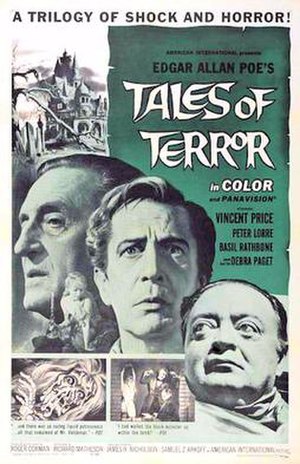
5. Tales of Terror
An anthology film that features three segments culled from possibly a half-dozen Poe stories, this movie straddles the line between outright Gothic horror and comedy. Other films in the series would commit to one or the other and do each better, but the wine-tasting competition between Vincent Price's effete and refined wine connoisseur and Peter Lorre's town drunk is unbelievably winning and plain fun. Basil Rathbone's appearance as an unscrupulous medium/psychiatrist is also noteworthy and sets up a fantastically...drippy...climax.

4. The Raven
Outright comedy, The Raven pits Vincent Price, who dabbles in white magic, against mighty sorcerer Boris Karloff, who began the evening by turning Peter Lorre into a raven. A young Jack Nicholson's appearance as Peter Lorre's son should give aspiring actors everywhere hope, because Jack is one of the greatest screen actors of all time, but man, he's not very good in this. This is a legitimately funny movie, and come on - it stars Vincent Price, Peter Lorre, Boris Karloff, and Jack Nicholson. What's not to love?

3. House of Usher
The one that started it all. A bleached-blonde Vincent Price is a sight to behold, but still, and after I-don't-know-how-many viewings, I'm not sure if it's a good sight or not. Premature burials, centuries-old tombs, a family curse, possible incest, this lurid adaptation is straight from the Gothic horror playbook and would've made Matthew Lewis himself proud. And when the house starts coming down, matte paintings and miniatures or not, it's pretty awesome.

2. The Haunted Palace
One annoying feature of the Corman-Poe movies was their habit of splashing non-sequitur lines of Poe's stories or poetry on the beginning and/or end of the movies a propos of nothing...certainly not anything we've just seen onscreen. But here The Haunted Palace really takes the cake, since it's not even based on anything Poe ever wrote, and divorced of their original context, the lines of Poe that are slapped onto it almost literally have no meaning at all. Of the films in the series, this is probably the most faithful adaptation, but it's an adaptation of The Case of Charles Dexter Ward by H.P. Lovecraft, which is one of Lovecraft's best novellas. The movie is a wonder of art direction, has some memorably eerie scenes of mutant townspeople, and a nice dual performance by Price.

1. The Masque of the Red Death
Here, Vincent Price is his most vile and gleefully evil, the colors are the most saturated, the camera effects the most extreme, and the actual emotional content of the film the most engaging. Most of these films are like windows into Grand Guignol dysfunction, which is lurid fun. But Masque of the Red Death has a real sense of good and evil, right and wrong, and characters who have to make choices between the two. If these films are guilty pleasures for me (which they aren't really, since I don't feel guilty for liking them, in all their mustache-twirling archly villainous glory), this one makes the strongest argument for simply being a good movie.

Wednesday, October 10, 2012

Microreview [film]: The Call of Cthulhu


The Meat

H.P. Lovecraft has a shaky inspirational track record when it comes to film. Most film adaptations of his fiction are abysmally bad, and this is all the more confusing when you consider how good almost everything else Lovecraft inspired is. Take, for simply two examples, Metallica from 1984 to 1986, and the career of Stephen King. What is it about Lovecraft's dense, intricate fiction that has made it so hard to adapt that probably the best Lovecraft adaptation is a movie that pretends to be something else entirely -- an Edgar Allan Poe adaptation? (The Haunted Palace, a 1963 entry in the Roger Corman-Vincent Price series of Poe collaborations, actually based on Lovecraft's novella The Case of Charles Dexter Ward)

If director Andrew Leman's adaptation of Lovecraft's seminal The Call of Cthulhu is any indication, it may be because Lovecraft's stories and prose are decidedly of their own time. So what Leman did, he left the story where it belonged, and in 2005 he made a silent film out of it. This adaptation of the 1926 story was inspired by the idea that it would be a "timely" adaptation of a story written and published when the visual currency of the day had non-sync sound. Writer Sean Branney's transposition of the story to the screen is straightforward, almost literal, hewing to the original structure of the story, but the execution is nearly flawless. The opening credits could pass for vintage, and while the movie is clearly shot on digital video (there's no recapturing the look of that old, slow film shot on hand-cranked cameras) and the green screen process shots are obvious, everything from the camera framing to the character makeup to the staging and performances are totally credible signatures of silent film. But beyond that, with limited resources these filmmakers leveraged their creativity and design prowess to bring Lovecraft's imagination to life.

To date, this is my favorite discovery I've made on Netflix Instant, where you can still catch the movie and I recommend you do so in time for Halloween. You can buy the DVD from the filmmakers here.

And yes, Cthulhu makes an appearance. And he is stop-motion. And he is awesome.

The Math

Objective Quality: 6/10

Bonuses: +1 for the opening credits alone; +1 the dream sequences in R'lyeh; +1 for the combination of old-school and new-school visual effects techniques (which they call the "Mythoscope" process); and +1 for the balls to even attempt this thing in the first place.

Penalties: -1 for feeling a little bloated even at only 47 minutes

Cult Movie Coefficient: 9/10. Very high quality/standout in its category.

[See explanation of our non-inflated scores here.]

Wednesday, September 5, 2012

Microreview [games] - Cthulhu Dice


The Meat

Cthulhu + Dice + Steve Jackson Games = Fun

Horror master H.P. Lovecraft published the “Call of Cthulhu” in 1928.  Since his debut, Cthulhu has been slowly causing sailors and cultists to lose their mind.  The creature Lovecraft described as "an octopus, a dragon, and a human caricature” has been permanently cemented in horror and nerd culture. Recently, it would seem Cthulhu has been getting ready to wake from his not-dead sleep, with oodles of 'hulhu cropping up all over pop culture (ie, Facebook). 
An unconventional, but democratic,
way of restoring the Ancient Ones to power.

When you take someone with the pedigree of Steve Jackson (Munchkin, Zombie Dice, etc. – look at www.sjgames.com for a full offering) and add in the cosmic entity of bad mental hoodoo that is Cthulhu, you have yourself a pretty enjoyable game.  The rules are simple.  You battle other cultists in a contest to see who can remain sane the longest. 

Each individual starts out with a certain number of sanity marbles, and if Cthulhu causes you to lose all of your marbles then you go insane.  The last sane cultist wins.  On your turn you roll a 12-sided die and either roll Cthulhu himself (everyone loses a sanity marble), a tentacle (you steal someone else’s sanity token), an elder sign (you take a sanity marble from Cthulhu) or yellow sign (whoever you are rolling against loses one sanity marble to Cthulhu).

That’s it!  It is a game so simple a five-year old can master it.  No, seriously.  My five-year old son Henry has mastered this game and wins 80% of the time.  It is more fun with more people (up to 6!)  Games last anywhere from 2-10 minutes and are quite enjoyable

The Math

Objective Quality: 8/10

Bonuses: +1 for creating a Cthulhu game for kids!

Penalties: -1 for Henry constantly demolishing me in this game.

Game Coefficient: 8/10. Well worth your time and attention.

[See explanation of our non-inflated scores here.]