Showing posts with label science fiction. Show all posts

Friday, June 5, 2026

Book Review: The Final Chronicle of Yeneh by Jo Miles

A potent anti-colonialist novel that sets its stakes on not just the fate of a planet and a species, but more importantly, the heart and soul of its main character

Ada Quintrall is the heiress to the Dukedom of Corbridge. Her grandfather the Duke has managed the aforementioned dukedom, which is actually on the planet Corbridge, in a future where humans have gone to the stars. The terraforming of the planet has been a harsh affair, and the native life has resisted. But when Ada finds out the long connection between her family and that native life, she is forced to confront what her grandfather and her family have done, and her complicity in it. And what is to be done about it.

This is the story of The Final Chronicle of Yeneh by Jo Miles.

The Final Chronicle of Yeneh plays with a number of genres in order to explore its overall themes, which are, unapologetically, anti-imperial, anti-colonial and anti-authoritarian in nature. Let’s begin with the most unexpected, and that is portal fantasy. In the story of The Final Chronicle of Yeneh, Ada learns that her ancestor wrote a bestselling fantasy series (The Chronicles of Yeneh, hence the book title). As the novel proceeds in its opening phases, Ada realizes that the native inhabitants of the planet are not mindless “plants,” but rather are the fantasy species from her ancestor’s book. Just how and why this is true, and what it means, puts a portal fantasy frame front and center in the book.

As this is a science fiction novel, the nature of the world, combined with the portal fantasy already alluded to, gives the setting and the story a significant layer of science fantasy. It retains this even as the novel progresses; the novel isn’t as interested in hard SF as it is in the sociological, political and personal stories. You don’t get any sense of what the interstellar drive is or how it works, for example. That’s not the kind of novel this is.

And then we get into the worldbuilding and some more genre-bending. In this future, a portion of a diasporic humanity has decided to reinstitute aristocracy as a social system. It is explained that in a world where some people turn away from merciless post-Capitalism, the appeal of personal rule by means of hereditary aristocracy for some planets was strong. It’s not a new idea¹ to have an aristocratic “feudal” future.² Miles, however, does it a bit differently. Aristocratic nobles like Ada’s family are not the only social system out there; it’s made clear that there are still capitalistic systems, and aristocratic ones, and even socialistic ones. There is a plurality of social systems in Miles’ universe, and while we are under an aristocratic one in this book, a main character, Zamora, is from Luna, which is mainly a socialist state, This does set up some cultural distrust at first between Ada (as an aristocratic heiress) and Zamora, and in general between Zamora and the population of Corbridge.

And then there is the straight-up science fiction as a genre. Ada (and Zamora) understand that the natives of the planet are more than just “plants” (as Zamora already argued); moreover, there is an entire civilization in the toxic and dangerous zones beyond what has been colonized and terraformed by the humans. So we switch up into the novel’s anti-colonial, anti-imperial and pro-ecological themes. With the previous layers to this, this makes The Final Chronicle of Yeneh a science fiction novel with interesting and intriguing underpinnings, providing a fresh story in the process.³

But beyond all that genre-mixing and worldbuilding, this is a very personal story, focused on Ada, who as heiress to her grandfather, is confronted with the ecological, sociological and personal costs of imperialism, colonialism and the rapacious nature of her family and her family’s legacy. It’s a painful story for her in some ways, especially as it puts her on the other side of her grandfather and her legacy once she completely learns those costs and takes a stand. The novel is about those costs, and the difficulty of that change. And as importantly as coming to terms with that legacy, the novel is about taking action, making recompense and taking active steps to do better.

Yes, while Ada herself is in a position of privilege (at least at the outset), the novel’s message is that people can and do make a difference—and indeed must do so in order to effect change. Change is hard and is scary, but it is possible, with action. That is a message that the novel hits home, and it is a very necessary message in this day and age.

In sum, what The Final Chronicle of Yeneh does, brilliantly, is to channel Miles’ excellence in character depth and make the very soul of the main character, Ada, to be as important as the fate of the native Yeheneh and of the planet Corbridge. It stirs a swirl of portal fantasy and a hint of science fantasy into a far-future story that examines and criticizes colonialism, imperialism and exploitative social systems. Miles’ focus remains tight and sympathetic, having us join Ada on her own journey to recognizing, confronting and acting on working on systemic problems on Corbridge and beyond.

Highlights:

  • Strong character focus and background
  • Interesting space future sketched in and intriguing
  • Bold anti-colonial, anti-imperial message, told well

Reference: Miles, Jo. The Final Chronicle of Yeneh [Horned Lark Press, 2026].

¹ Melinda Snodgrass’s Imperials Saga has capitalism evolve into a Spanish-focused monarchy and aristocracy, in space. And of course, there is always The Mote In God’s Eye by Niven and Pournelle.

² Obligatory note that feudalism, as you might think of it, really didn’t exist as you might think of it. The huge variety of local political systems in Western Europe really put paid to that notion. Read the works of David Perry and Matthew Gabriele, among others, to learn more. (e.g. The Bright Ages).

³ The worldbuilding about the local inhabitants of the planet has resonances to many previous works of science fiction. You can certainly look at The Word for the World is Forest by Ursula K LeGuin. I also see touchstones to the work of Adrian Tchaikovsky and James Cameron’s Avatar universe.

POSTED BY: Paul Weimer. Ubiquitous in Shadow, but I'm just this guy, you know? @princejvstin.

Wednesday, May 13, 2026

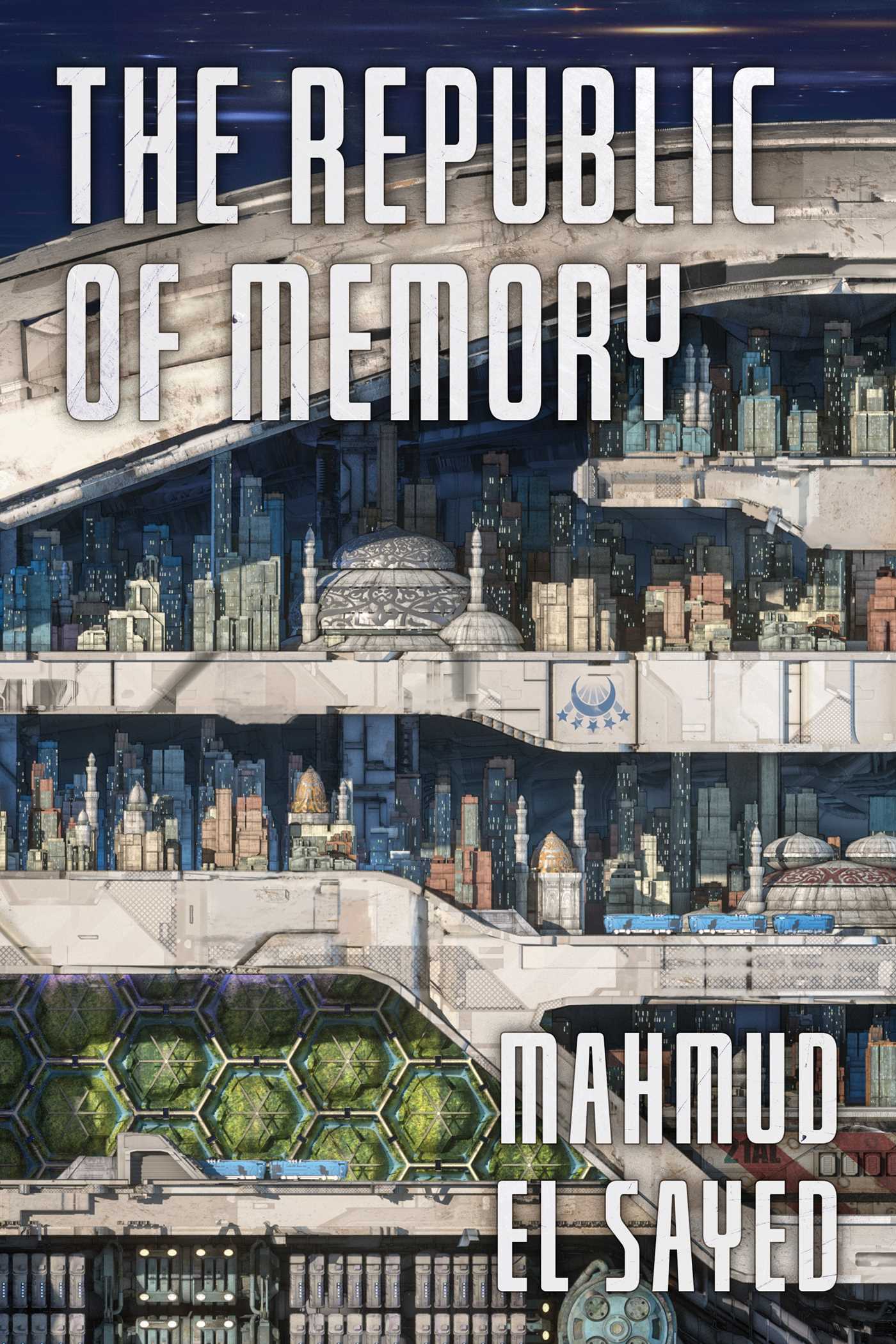
Book Review: The Republic of Memory by Mahmud El Sayed

Captain (A)merica must die

The Republic of Memory | Book by Mahmud El Sayed | Official Publisher ...
cover artist: Marcel de Neuve

Mahmud El Sayed’s The Republic of Memory is that rarest of things -  a proper space opera that has no real interest in what the West has to say about space or stories. El Sayed is a former journalist of Egyptian descent and he was there for the Tahrir Square protests in Egypt largely known to westerners (if they know it at all) because of its central role in the Arab Spring as it unfolded in Egypt. 
 
Mahmud is London based right now and won the Future Worlds prize in 2023 for an earlier version of this story that now finally makes it into print.
 
I mention these biographical facts because they are pertinent not just to the style and nature of the story in an authorial sense but also in terms of the themes and characters within the pages. 
 
This next paragraph contains mild spoilers about the plot so if you want to skip it and move on to the next part of the review feel free to do so. The Republic of Memory is about a generation ship sent out from earth on a very long (centuries long) journey to colonise another world. The people sending them are, if not quite then almost a world government centred in the Levant and entirely ruled over by an AI overclass. As becomes clear right at the start of the novel, something goes wrong back home, the threat of mutually assured destruction finally becoming a promise and the ship is ordered to turn back with its precious cargo of rich and powerful people to rebuild in the aftermath. Instead of doing so, the crew destroy the AI and continue on their way – their reasons not fully clear to themselves or us. What follows is set centuries later but still far from their destination as the various societies and factions that manage the functioning of the generation ship reach a breaking point. 
 
(Spoilers over) The story follows a number of PoVs but the crucial two, Damietta and Iskander, begin the novel. El Sayed puts these two characters (young family members) on seemingly opposite sides of the social divide and through this we have our way into the story. Damietta is a young woman in a close knit and culturally conservative family who chafes at the constraints she feels in her life. She is privileged as far as it goes with a good life laid out before her, but that’s the problem – that life is laid out before her with no deviations, no creativity and no chance at making choices other than those the people around her approve of. 
 
Damietta doesn’t know what choices she really wants to make – her horizons are too constrained for her to understand what she might actually want and, as for so many people, this leaves her with the only choice available – break things. Damietta is the person who reminds us that we all want to be able to make choices (not in the sense of the hero’s journey but in the sense of being able to determine who we are for ourselves) and when those choices are suppressed we will, reasonably even if the choices themselves are unreasonable, make choices to break whatever is within reach – be that ourselves or others. 
 
Damietta cannot see her privilege – her constraints leave her idolising resistance movements, rejecting authority and looking to engage in acts of rebellion regardless of the consequences because she cannot see how her life could be worse. And sure, in the immediate her life can be worse but a life whose practical choices might deteriorate is still nothing when compared to a life where self-determination is absent. One is waves on the ocean rocking the boat, the other is drowning without being able to die.
 
Iskander is a lawyer (of sorts) working for Administration, the distant overclass that manages the entire generation ship (called the Safina which literally means vessel or ark in Quranic Arabic). He is the face of authority, able to open doors and go places others can’t because of his role. He sits with two faces – one facing his community as the person they look to when they want to get married or get things done and one facing Administration as their loyal functionary ensuring their rules are followed without causing riots. Iskander is the willingly colonised actor, trying to see both sides, aware of the tensions, embodying them in his very person but looking to make the world work. Sometimes that’s for the better, sometimes that’s bending the rules and sometimes that’s following them. Iskander exists on a kind of personal capital – a currency he has to spend that is built up through the cautious and cunning use of his position. His effectiveness built on people seeing him as just reliably enough on their side to help them get what they need and want when Admin might otherwise say no while knowing that his power comes from Admin’s overall approval.
 
Iskander is the classical sepoy, the good native, the conflicted coconut, the collaborator who both legitimises the oppressor but also subverts their authority. 
 
El Sayed does a truly brilliant job of ensuring that we see their points of view. This isn’t a political treatise; it’s a story about people whose lives are political from the moment they’re born to the moment they die (and beyond). Why? Because for so many people this is the world they live in and to see it on the page is utterly brilliant. 
 
What I mean is that El Sayed isn’t writing about politics here – the story isn’t a metaphor for non-western experiences of colonialism. He’s both way beyond that, deep into postcolonial Arabfuturism, but also interested in these people in and of themselves. What Iskander wants, what his dreams are, what Damietta discovers in her journey to finding a way to express what’s inside her in a way that makes sense to her, consequences and all, is at the heart of this story. Whatever else it is, The Republic of Memory is a personal journey for people whose lives are…complicated. 
 
And how complicated they are because the Safina isn’t just Iskander, Damietta, their family and their community. It’s made up of communities from across old earth whose roles and cultures are disparate and essential to making the ship work. From hydroponics to medical to engineering and those who mine for resources beyond the ship, the tasks of keeping a mechanical world flying through the void are endless and demanding. What’s worse is that the ship is gradually deteriorating no matter how hard the people work at keeping it all working in harmony. 
 
It’s unclear whether the slow collapse of the ship’s systems is the fault of Administration, the inevitable result of destroying the AI at the start of the voyage or whether it’s simply entropy presenting its bill. The answer to the question depends on who you ask and their place within the ship. 
El Sayed has rolled together caste (or class if you’re a westerner), gender, functional essentialism, racism and post-colonialism into a single pressure cooker of a story. He is aware of and plays with a host of different ideas; from a variety of communisms and communitarianisms to capitalisms, religious expressions of different kinds including manifest destiny through to AI as god. 
 
However, central to everyone’s life in this novel is a gift economy. In a capitalist society where the rule of law tries to ensure transparent equity for all concerned this would be called bribery. Where there is no cash, per se, and the levers of power are invisible and asymmetric beyond family and community units it is called gift economy – bringing an official’s favourite sweets, making sure someone’s cousin got the car they wanted at a good price and so on. You might call it a society built on social obligation.
 
What I’m trying to say is that El Sayed’s novel is that truly remarkable thing in English – a speculative story that regurgitates precisely none of the prevailing Western ideas about how the world should be run and rests on none of those foundations. Beyond that it does what it wants not by eschewing consideration of these possibilities (after all, Administration is a specific proxy for American hegemonic power over countries like Egypt and how client states must come to operate for maximum benefit for their rulers), but by understanding and reflecting how complex politics between different factions is especially when relationships are stable. After all, it is successfully navigating complexity that allows stability to be sustained as the deliberately untrained and willingly ignorant are discovering in the Strait of Hormuz at the time of writing this. 
 
The last thing I want to comment on here is language. It seems to me that language and its use, its control and its boundaries are central to building consensus but also to building and controlling communities. The societies in The Republic of Memory aren’t split by culture or skin colour but by language with the mantra that anyone can learn a new language with the goal of preserving social mobility. It’s a cunning sleight of hand because it wilfully ignores the power of community and relationship and culture in building social capital while remaining superficially utopian. 
 
El Sayed delivers so much of this novel through conlangs, creoles and macaronic structures that you need to take your time to understand the rhythms of what he’s built. I think that is very, very important because in language and how people use and deploy it you find the real levers of power being expressed. What words you use at home versus what you use when speaking to power are revelatory, and throughout El Sayed reminds us that language is, at all times, a tool not simply for consensus but for control and subversion. 
 
The Republic of Memory is the first of a duology and as a way of working through modern global politics, personal lives within that context and as an exploration of how you and I survive such potentially crushing pressures it’s an extraordinary achievement. 


--


The Math


Highlights:

  • Amazing languages!
  • Proper political SF
  • Non-western viewpoint
Nerd coefficient: 9/10, a powerful exploration of what worlds look like when seen from a postcolonialist perspective. A superb starting point for people interested in Arabfuturism.

Reference: El Sayed, Mahmud, The Republic of Memory [Orion 2026].

STEWART HOTSTON is an author of all kinds of science fiction and fantasy. He's also a keen Larper (he owns the UK Fest system, Curious Pastimes). He's a sometime physicist and currently a banker in the City of London. A Subjective Chaos, BSFA and BFA finalist he's also Chair of the British Science Fiction Association and Treasurer for the British Fantasy Society. He is on bluesky at@stewarthotston.com.

Wednesday, April 29, 2026

Book Review: Anti-State, by Allen Stroud

Cold war space opera done right

Cover Artist: Nick Wells
There’s a real resurgence of space opera right now and I’m here for it. I love a good adventure out in the stars and I’m easy as to whether it’s hard science or full of space wizards. 

Space opera, like epic fantasy, allows us to entirely transpose our experience into one functionally and practically distinct from the real world. In so doing we get the freedom to ask questions via metaphor, world building and fantastical elements about hard real-world issues. In the last couple of years we’ve seen space operas talk about AI, consciousness, the nature of work, meaning and purpose. We’ve seen them address fascism, resistance, representation, the complicity of capitalism with authoritarianism and unpack the nature of sexuality and gender. 


Into this mix comes Allen Stroud’s Anti-State, a stand-alone novel in an Expanse-like setting in which Stroud has already written a whole shelf of entries. No real prior knowledge is needed to read this one although it does refer to events in other books and feature many of those characters in greater or lesser roles. 


Stroud’s main character is disabled in the sense that she is missing limbs and that is presented as exactly what it is – factually and without fuss. It’s an interesting choice both in terms of representation and in how it’s handled by a character who spends much of the story in a low gravity environment. There’s technology to help solve her challenges, but they aren’t there to heal her or to ‘make her complete’. This approach is good to see, not simply for representative purposes but because there’s some interesting commentary around what it means to have a body in a low gravity environment vs. Earth standard gravity. 


The story itself is in deep cold war territory with the overall structure owing as much to Smiley’s People as it does to spaceships flashing through the void to blow one another up. The most obvious comparison is with James S. A. Corey’s The Expanse series – set as both are within the solar system and concerned as they are with the politics of earth extending to the rest of the system. There’s no proto-molecule in this but it does share the same concern with being at least moderately faithful to proper physics. It’s hard science fiction as far as that ever goes and there’s plenty of text highlighting just how much space will kill you at every opportunity. 


We have allusions to Martian politics, independence, rebellions and there are, lurking in the background, rogue billionaires with tech that can rival the militaries of space faring states. 


This isn’t novel – this could be a story about submarines fighting it out in the North Atlantic without too much changing with the talking heads in London, Berlin and Washington instead of on spaceships and asteroids and lunar colonies. 


That’s not necessarily bad – you know what you’re going to get, and it delivers on that competently without rocking the boat. It’s a somewhat nostalgic approach to space opera with strong golden age vibes intersecting with more modern concerns such as where it explores what it means to be human in the context of advanced technological systems. 


What worked for me was the layered world, the sense that there were politics and people and stuff happening of which the events in this story are only a part. I like that feeling of being in a wider world. I liked the focus on space being deadly and low gravity being a thing that impacts every single aspect of a life lived within its grasp.


I also largely liked the overall story of secret plots unravelling, of people with torn loyalties discovering where they truly want to put their faith and, most of all, I liked the small scale of it. Sure, the stakes are high, adventuring in space will do that, but at the same time they concern a small group of people in a set of tin cans adrift in an ocean of nothing. They might travel millions of miles but they remain determinedly fixed in a locked room whose seals keep them alive as much as trap them. 


The ideas here are small too – not all in a bad way. Stroud explores the little impacts of technology, distance and logistics that conventional space travel (i.e. without the fantasies of FTL or warp drives or anti-gravity) have on people. Loss of bone density, the lack of decent food, shortages of power, the challenge of changing direction when you’re travelling at thousands of kilometres an hour. 


I’d like to have had some larger ideas here around what it means for human society to be out there and these are there a little, but are also largely subsumed within the context of a military hierarchy that gives the book the occasional feel of mil-SF (although without any of the fetishization of guns and violence).


The one place where the politics/world building doesn’t quite work for me is in this military context and hence the larger ideas also don’t quite connect. The reason for this is my own view that the idea that ‘governments have the best tech’ is not just outdated but permanently in the rear-view mirror. This is where the book’s Cold War vibe is least convincing, although most consistent because I think that’s the last time governments could reasonably be said to have tech not available to the general public. 


These days it is entirely private companies developing that tech and selling it to our governments and it is almost entirely private companies exploring space. The question of how polities here on earth could extend their ‘national’ boundaries into space is just assumed rather than explored and the same for the corporate elements. The private companies in the novel are nefarious which isn’t hard to believe but they aren’t well realised which is a shame. 


Still, Anti-State is a decently executed and complex political thriller set in space. Its tight scope delivers a compelling story despite its other flaws.


--


The Math


Highlights:

  • Spaceships
  • Proper orbital mechanics
  • Politics and plots

Nerd coefficient: 6/10, a layered political thriller as at home in space as it would be in the 1970s North Atlantic

Reference: Stroud, Allen, Anti-State [Flame Tree Press, 2026].

STEWART HOTSTON is an author of all kinds of science fiction and fantasy. He's also a keen Larper (he owns the UK Fest system, Curious Pastimes). He's a sometime physicist and currently a banker in the City of London. A Subjective Chaos, BSFA and BFA finalist he's also Chair of the British Science Fiction Association and Treasurer for the British Fantasy Society. He is on bluesky at@stewarthotston.com.

Tuesday, April 14, 2026

Book Review: When There Are Wolves Again by E.J. Swift

The journey from here to there you've been waiting for

When There Are Wolves Again by E.J. Swift: Review by Niall Harrison ...
Cover Artist: Jack Smyth
I write this review the weekend after When There Are Wolves Again won the BSFA prize for best novel of 2025 (published late Oct 2025 in the UK and Mar 2026 in the US). I had been on UK radio the week before telling people it was going to go on and win a load of prizes. I’m glad to have been right.

So you can stop there if you wish. When There Are Wolves Again is a triumph of a novel – you should go read it.

For those of you who remain, here’s a more detailed review of this exceptional novel.


When There Are Wolves Again follows two women from 2020 through to 2070. Both women are young at the beginning and we travel with them through one version of the energy transition and how a society wrestles, successfully, with the consequences of climate change.


Yes. This is a speculative climate novel. It is also the speculative climate novel I’ve been waiting for, for a decade since I spoke at a conference in London and gave a speech saying that climate fiction was following behind the science and there were no great stories about climate yet.

Why it sits in this space for me is threefold.


Firstly, this isn’t dystopia and nor is it hopepunk (if we can accept such a classification). This is a contemporary speculative novel that is about science and hope. It is classic SF in the sense that it posits the use of science to solve our problems and presents us with a roadmap that outlines what that could look like in one version of this world.


Yet it departs from golden age, NASA sponsored vibes in several key ways. It is about community, it is also about ordinary people who are struggling to make sense not just of the world but of themselves and out of their struggles we see choices that impact the world around them.


This centring on a journey through the troubles rather than existing in the aftermath of failure or in some far distant world where all our problems have been magically solved is central to why this feels like what will come to be seen as the defining text of climate fiction.


Secondly, this story is situated. Most importantly, it isn’t situated in America and it very definitely has no sense of destiny of exceptionalism to it. Swift writes of the UK with a deftness that captures the heart of Britain in the 2020s but extrapolates what this looks like across the next 50 years with a delicate touch. This lightness in the face of catastrophe exists because she has chosen to follow two women, Lucy and Hester, as they live through these times. These women aren’t chosen ones, they’re not technocrats or genius techbros – they’re ordinary people who have (extra)ordinary lives whose choices where they are situated make the difference. It’s clear all the way through that Hester and Lucy are a microcosm of the UK, that millions of others are acting, changing, choosing, that community is central to what allows hope to flourish and the challenge of transition to be met. I think this story could be told across a number of European countries with similar characters, but I do not think this story would survive in this form with these sentiments if situated elsewhere. This is no criticism of other places, just that Swift has localised her narrative in the most successful way possible – the UK is essential to the story she’s telling.

Third and far from final – this is a generational novel. Unlike Kim Stanley Robinson’s The Ministry for the Future, this sits with just two people and it’s as concerned with their lives as it is with anything else. Technology here, politics, utility, they are all secondary to how two women navigate a world they want to live in. There’re no grand gestures, no sweeping social policies or discoveries that these two enact. They simply live and we follow them. It’s generational specifically in the relationships Lucy and Hester have – from grandmothers to wolves to brothers and strangers, to found family and networked community – Wolves is about how human networks make the difference, not science on its own. You could argue that human networks are the substrate for politics and, sure, but the politics in Swift’s story is the thing you and I do from day to day to lift up the people around us, not what our voted representatives do in their grand palaces.


More than this, the story decentres humanity as part of its narrative. We don’t get points of view of animals or anything so cliché. Instead we see a humanity on a journey to reclaim the truth that it is part of this world, not over and above it, not to one side. It is a decentring that brings into focus the damage of an exploitative capitalism and questions our willing collaboration in myths that elevate humanity above everything else – including that which allows us to live in the first place.

Swift, in decentring humanity has written something uniquely humane and hopeful. This is a tremendous novel that treads lightly and doesn’t trumpet its achievements because to do so would be anathema to the world she is writing into being. I have been reflecting upon it in the weeks since I finished it and keep coming back to this: it’s a world I would actually want to live in and that, for speculative fiction, is extremely rare.

--


The Math


Highlights:

  • Wolves!
  • Hope and science
  • Two women making choices that change the world for people around them
Nerd coefficient: 9/10, a meditative hopeful story that stares the challenges ahead of us in the face and offers a hopeful solution to the journey we have to make.

Reference: Swith, E. J., When There Are Wolves Again [Arcadia 2025].

STEWART HOTSTON is an author of all kinds of science fiction and fantasy. He's also a keen Larper (he owns the UK Fest system, Curious Pastimes). He's a sometime physicist and currently a banker in the City of London. A Subjective Chaos, BSFA and BFA finalist he's also Chair of the British Science Fiction Association and Treasurer for the British Fantasy Society. He is on bluesky at@stewarthotston.com.

Friday, April 10, 2026

Review: The Photonic Effect by Mike Chen

The Photonic Effect wears its twin inspirations on its sleeve, and boldly launches Chen’s work into the subgenre of space opera and makes it so.

These are the voyages of the GCF Horizon. Its mission was to establish and map a new trade route for the Cluster. Instead, it spent ten years in a gravity well with a host of other trapped ships. Upon escape and return to Cluster space, they had found that in the decade since, a civil war had broken out. Now, with the experimental photonic drive that allowed them to escape the gravity well, the Horizon is seen as a tool, or a weapon, by both sides. And it turns out they have unfinished business with the Lumersians in the gravity well. Although the costs of pursuing that might be high indeed for the crew, and perhaps far beyond, as well.

This is the story of Mike Chen’s turn into space opera, The Photonic Effect.

Star Trek, in several of its incarnations, particularly TNG and Voyager are two of the clear antecedents and inspirations for Chen’s Horizon. This is in terms of the ship, the multi-species nature of the crew, the Federation-like Cluster. In terms of characters, our focus is primarily on the bridge and engineer crew of the Horizon, just like a typical Star Trek episode or series. Our Captain, Demora Kim, even has a Star Trek catchphrase, “Take us there.” Like any Star Trek series, we have a multi-species crew. In addition to the humans, including a human from another universe (thanks to that gravity well), the Horizon also has a Dwyen, a humanoid species with a pack-based hierarchical structure and outlook. And then there is Chuck… who is rather unusual and not really an active member of the crew at present, although he was crucial to the Horizon’s return to normal space. Given that Chen has written a DS9 comic, it’s clear and easy to see how he is channeling Star Trek into his unique world.

The other inspiration is a somewhat more complicated and in some aspects, darker one to draw from on occasion. And that would be the videogame series Mass Effect. Mass Effect, for those who have never played the games, takes place in a galaxy where humans are the new kids on the block and eager to prove themselves. The game can turn dark and complicated, with various forces and factions striving in a cutthroat galaxy, including secret factions and powers that the player character is engaged with. And to be truthful, the Horizon does feel much more like the Normandy from Mass Effect than most of the mainline Star Trek series central ships, except maybe Voyager. The ship is not all that large, and it is not even built well for war,¹ which makes people coveting it all the more perilous for the crew of the Horizon. They cannot shoot their way out of situations, even if they would consider doing so.

With these two powerful influences, Chen has the tools to tell his own tale and develop his own story and ’verse. Chen relies on a core set of characters and is interested in telling a story of how this flawed found family has to deal with the challenges of return, their own limitations, flaws and failures, and how to forge and come together to face threats. From Kim on down, we get a set of complicated and multi-sided characters much more DS9 in some ways in terms of characters than other Star Trek characters. Or, again, see Mass Effect. The fail points and weaknesses of the characters make each of them real, and engaging to read and follow.

Chen keeps his points of view on three characters:

Kim, the Captain, as our primary character, and the framing device at the front tells us this is her retirement interview and debriefing of her last mission. Kim went through a lot to try and get crew back home, and paid a price herself in seemingly losing her chance at romance with the aforementioned Chuck. Kim is interestingly flawed, often caught in bad decisions or situations, and has to strive to regain her crew’s trust, and to do better.

Another primary point of view is Tanav. Tanav isn’t part of the crew, not exactly; he’s an entertainer from another universe whose ship got caught in the gravity well. Circumstances forced him, along with other ships, to get on board the Horizon. He’s not crew, but he acts in a capacity of an entertainer. Tanav is conflicted—he misses his home universe, although his relation with his parents was rather complicated. And in a ship full of officers and engineers, he does wind up being a bit of an odd man out. Tanav’s story is one of growth in the face of conflict and fire, and it shows you don’t have to be the Captain or Chief Engineer to be a hero.

Third, Neera is the Chief Engineer on board the Horizon, and is the aforementioned Dwyen, which allows Chen to play with humanoid but not quite human. Chen does a great job not only in appearances, but going further and giving Neera a distinctive verbal cadence. I will bet that when I listen to the audiobook, I will be able to tell when Neera is speaking by the way she constructs her sentences, distinctive from all others. Like Kim, she’s imperfect, and her choices in trying to get the photonic drive to work wind up with major consequences for everyone.

The whole situation, seen in flashback and recollection, of that last mission that had the Horizon in the gravity well for ten years is an excellent bit of writing, dribbling out details from their ordeal and how they had to make sacrifices and paid costs in order to stay alive. In this way, it feels a lot more like a darker Voyager and much more into Mass Effect territory in that regard. And all that provides backstory and ballast to the core crew of the Horizon, including the characters who don’t get viewpoints.²

Chen has two crucial characters who are not from the original mission, and since they don’t have the ballast of the backstory of having gone to the well and having that connection to the crew, or to the world, they don’t come off quite as well. Commander Matthews, foisted onto the Horizon upon their return to the Cluster, definitely has an agenda of his own, and his antagonistic relationship with the crew provides much tension. He’s a more classic sort of square-jawed hero, and one, in roleplaying terms, that has gone on the heavy side of combat and physical skills that most of the rest of the characters cannot begin to match. The other character I will not mention, as they become the ultimate antagonist of the book. The slow reveal of their true plans and intentions is an excellent bit of craft on the part of the author.

The unusual nature of Matthews vis-à-vis the rest of the crew makes it clear that this is a much more late Star Trek than early Star Trek in terms of the characters’ approach to problems. The relatively weaponless nature of the Horizon and the lack of skills in weapons and tactics (Matthews excepted) means that the problems faced and solved usually fall to cleverness, or engineering, or science, as opposed to high-grade weaponry and battle tactics.

And the book is a lot of fun to read. If you are a fan of Star Trek, or Mass Effect, this book is relevant to your interests in creating a familiar yet unique space opera world. And if you ever wondered what you would get by mixing that peanut butter and chocolate, this book, like it was for me, will entirely be your jam. It’s entertaining, deep, philosophical, reflective; and when the action beats need to happen, Chen delivers. The world portrayed is a rich space opera ’verse with enough detail beyond the bounds of the Horizon itself to invite the playground of the imagination.

The book closes off Kim’s story, but given that this is a retirement debriefing on page one, the reader must surely guess that this is the end of her career anyway. The adventure may continue with the Horizon, and with other members of the crew, but as primary point of view and this being Kim’s story, the novel is not, as you might be worried, first in an endless series. Like the rest of Chen’s oeuvre to date, it is a standalone novel that provides an excellent story, flawed and memorable characters, strong worldbuilding and much more for the reader to discover.

Highlights:

  • Mass Effect × Star Trek = entertaining space opera
  • Strong set of flawed and interesting characters
  • Rich and interesting world

Reference: Chen, Mike. The Photonic Effect [Saga Press, 2026].

¹ A reference point for me that Chen probably did not intend comes from the board game Star Fleet Battles, which is set in a version of the Star Trek universe. In that game, there is a design for a Federation cruiser that is very much defanged for war but has high capabilities for science and long-range reconnaissance—the Galactic Survey Cruiser. The Horizon feels a lot more like a Galactic Survey Cruiser than a regular Federation ship.

² There is a tuckerization from Star Trek, too. Watch for it!

POSTED BY: Paul Weimer. Ubiquitous in Shadow, but I'm just this guy, you know? @princejvstin

Friday, April 3, 2026

6 Books with John Chu


John Chu is a microprocessor architect by day, a writer, translator by night. He has been a finalist for the Hugo, Nebula, Locus, and Ignyte Awards, won the Best Short Story Hugo for "The Water That Falls on You from Nowhere" and won the Best Novelette Nebula for "If You Find Yourself Speaking to God, Address God with the Informal You." The Subtle Art of Folding Space is his first novel.

Today he tells us about his six books.

1. What book are you currently reading?

Matching Minds with Sondheim by Barry Joseph. Stephen Sondheim, of course, is one of greatest writers of musical theater of all time. He was also a great creator of games and puzzles. This book explores this aspect of his work to give us more insight into his creative process. Also, it has some of the puzzles and games he created. As you read the book you are, in fact, also matching minds with Sondheim.


 2. What upcoming book are you really excited about?

I was lucky enough to read an advance copy of What We Are Seeking by Cameron Reed, the author who wrote The Fortunate Fall. It’s a bit lengthy, but I absolutely devoured it. The novel is unabashedly and unapologetically queer. It is an unflinching exploration of gender that takes place on a world whose native living beings have a genuinely alien lifecycle that defy our implicit categorization of living beings. ((I apologize for the awkward wording of that last sentence. I’m trying to avoid spoilers.) All of this takes place in an epically far-future milieu. There is so much to unpack with this novel and it is all fascinating.

I believe both Cameron Reed’s novel and mine have the same release date [April 7th]. Buy both!

3. Is there a book you’re currently itching to re-read?

I don’t generally re-read books. I’m not the world’s fastest reader. Also, the day job and writing doesn’t leave much time for reading. So, I prioritize works that I haven’t read over works I have. At this point, my (virtual) to-be-read pile is so large that I don’t know whether I will ever make my way through. And yet, I keep adding to it.

That said, there are books like The Palm-Wine Drinkard by Amos Tutuola that are so far outside my lived experience, I feel like perhaps I need to read it again before I can claim with a straight face that I have read it. In grad school, I rushed through The Book of the New Sun in my spare moments and I would love to experience those novels again at a more leisurely pace. While I’m at it, by sheer coincidence, I read A Fire Upon the Deep while I was studying network architecture. (A novel computer network is a tangential part of my PhD dissertation.) So much of that book referenced what I was also learning about and researching at that moment. It might be nice to revisit that book in a context where that is not the case.

 4.  A book that you love and wish that you yourself had written.

I read Arkady Martine’s A Memory Called Empire and was instantly smitten. It is a gorgeously written novel and very much the novel about assimilation that I wanted to write. The book is trenchant about the effects of imperialism and the contradictions it inevitably creates. Mahit is so true to life in that she both admires the culture of the empire, seeing its value, and understands viscerally the cost of that culture. She does this through, in part, the context of language, which is a topic near and dear to my heart.

5. What’s one book, which you read as a child or a young adult, that holds a special place in your heart?

I’m going to mention two because I can’t decide. 

The first is The Phantom Tollbooth by Norman Juster. Malka Older, who read it recently, posted about it on social media and from that I have to conclude, sadly, that the Suck Fairy has gotten to it. Fear of this is one reason why I never revisited or passed it on to my nieces when they were the right age for it. I gave them more contemporary books. The Phantom Tollbooth, I should note, was already pretty old when I read it. So, maybe the right time to read it was when both you and the world was young enough not to know better.

That said, baby me was absolutely delighted by the sheer invention of all the places Milo visited. I ate up all the absurdity and wordplay. 

That brings me to the second book, The Westing Game by Ellen Raskin. It’s another book that I’m afraid to revisit, lest I find out the Suck Fairy has gotten to that, too. This book almost sparked the love mysteries and sheer wordplay that I still have today. Again, tiny me eeked and gasped at every revelation. Tiny me reveled in the clever way Ellen Raskin manipulated words. 

There is a Chinese translation. One day, I may have to get my hands on it just to see how the translators navigated some potentially thorny issues as the wordplay is very much part of the mystery. (Again, I’m being vague so as to avoid spoilers for a novel that’s nearly 50 years old.) Maybe I should have mentioned this as a novel that I’m itching to re-read. (It depends on whether you call reading it in a different language re-reading.)

6. And speaking of that, what’s your latest book, and why is it awesome?

My latest (read: first) book is called The Subtle Art of Folding Space and it comes out on April 7th from Tor Books. To reference question 4b, this is, to some extent, the book about assimilation that I did write. Right off the bat, the main character, Ellie, is accused of being insufficiently Taiwanese by her sister and, throughout the book, Ellie finds herself navigating the expectations of not just her family but multiple cultures. 

That, however, is the context for a story about the sometimes thankless job of making sure the world keeps working. Ellie is sent off by her sister Chris to the skunkworks, the machinery that generates the physics of the university, to replace a worn part. Chris can’t do it as she insist on being the one and only person to take care of their comatose mother. However, her cousin Daniel shows her that physics has been deliberately modified to keep her mother alive. It’s also causing spurious errors all over the universe. Right at the start, she is forced to make a decision no one should ever be forced to make: the life of her mother or the proper functioning of the universe.

The novel deals with family, assimilation, and the responsibility to make the world work, but it’s also a lot fun. It has both a secret cabal that threatens to topple the order of the universe and a man who makes food appear out of thin air on command. It has both a library with too many physical dimensions and a librarian who is a giant tree trunk mounted on top of a giant spider. It encompasses both the messy aftermath of a death and a car that spontaneously turns into a rhinoceros. I hope the novel captures the absurdity and joy of life and I hope people have as much fun reading it as I have writing it.

Thank you!

Thank YOU, John. 

You can also read a review of The Subtle Art of Folding Space here.

POSTED BY: Paul Weimer. Ubiquitous in Shadow, but I’m just this guy, you know? @princejvstin.
Wednesday, March 4, 2026

Book Review: The Salt Oracle, by Lorraine Wilson

 Beware ghosts looking for a home

The Salt Oracle | Book by Lorraine Wilson | Official Publisher Page ...
Cover art: Sam Gretton

The Salt Oracle is the second of Wilson’s books set in a world where the internet turned into ghosts. If you’ve not read her first (and stand alone) book in this setting, We Are All Ghosts In The Forest then I highly recommend you get out there and correct your error. 


This setting has it that something happened within living memory that effectively ended our online world with the consequence that all the digital data we created floats out there in the real world like electronic ghosts looking for people to haunt and places to dwell. Starkly, getting haunted is often terminal for the poor afflicted victim. I don’t think I’m doing it justice because this can sound like just another twist on a post-apocalyptic wasteland kind of story. However, Wilson comes at this with very different concerns on her mind. In some ways her themes are similar to Emily St John Mandel’s Station 11 which is more interested in a world that is very much not based on the grim toxic horror of Lord of the Flies (and so beloved of men writing in this space).


The Salt Oracle is about an old rig in the North Sea (so think the Scottish coastline) that, in the wake of the big crash, has been repurposed as a research facility that largely survives by providing weather forecasts to the surrounding communities. The crash has left the currents unpredictable, the sea full of ghosts and spirits who are capricious and with satellites and computers non-functional in this new world it’s effectively impossible for shipping to function otherwise. 


At the heart of the facility’s weather program is a young girl called the Salt Oracle for she appears to be uniquely connected to the ghosts of the sea and, as a result, able to predict the weather with enough accuracy that it saves lives and makes some small amount of trade and shipping possible. 


The rig is peopled with a host of characters, all of whom have histories, trauma and relationships both on and off the facility that inform their world. However, what fights to the top of every character’s priorities is their status on the rig – because it’s an open secret that the Salt Oracle is the cause for their success and many people would like to be in control of this young woman for their own benefit. The facility must satisfy or at least play these different factions off against one another if it wants to maintain its independence and its precarious existence where it is free to do what everyone on board wants to do – which is to eek out a bit of stability to think and research and explore. 


Wilson’s prose is superb – evocative, poetic and frequently beautiful. She evokes the sense of the sea and the wildness of sparsely inhabited places with an eye to their unpredictability, their untamed nature. If her prose is reckless it is in service to the places she is describing, the lives she is portraying and it’s that choice to zoom into people’s lives with the techniques of describing nature and big open skies that helps her stand out from the crowd (unique setting aside). 


Ostensibly a murder mystery set in a single location this too is simply a trapping for Wilson to explore what’s really interesting to her – building back after disaster. It’s not simply the apocalypse out there in the big wide world that’s examined here, but the traumas of everyday life, the trauma of surviving that are in focus. Wilson’s characters aren’t all fully abled. They aren’t brilliant heroes overcoming. Her people are those who would have struggled no matter the shape of the world. This lens is revelatory because it allows Wilson to suggest to us that we spend too much time trying to build worlds where trauma is absent and it is only the unlucky (or unworthy depending on your ideology) who have to wrestle with difficulty. That we spend too much time seeing struggle as aberration.


In the main character, Auli, a researcher who suddenly becomes head of her department when her beloved long-time mentor is found dead, we have a central character who is full of worn-down edges, difficult decisions and hard choices. She is a mess not in terms of bad decisions, but in terms of someone who’s tried to just live their life despite the vicissitudes of the world around her. Auli is competent (and if competency porn is your thing, the Salt Oracle has another thread to recommend it), but she is not a genius, she is good but not a saint, she is a hero but not on a hero’s journey.


Wilson gives us a world in which the people here are of age – they don’t need to discover themselves or the world – they need to face themselves because if they don’t they may just perish from that lack of emotional and practical flexibility. This can be hard for people who’ve only ever lived their lives in peace to understand or empathise with because Auli and her colleagues are people who’ve exercised their agency to survive. 


That might sound grand, and it is, sometimes survival is agency. Yet it’s the very least of things because wouldn’t we all rather be comfortable enough to say that we exercise our choices to choose the clothes we want to wear or the job we want to work or the place we want to go on holiday? The agency of the lucky stands in contrast to the agency of everyone else. 


And that would be enough – exploring interesting people’s lives in interesting times. What takes The Salt Oracle from well executed story with beautiful prose into the realms of the special is that Wilson also wants to ask us what healing looks like, what community looks like and how we build those things in the face of existential pressure and continuous challenge. 


Her answers are both interesting and, to me, convincing. She suggests through her characters that we focus on people sized problems that we can reach out and touch. I confess that I’ve spent much of my life trying to tackle big problems – unwilling as I have been to address symptoms (as I wrongly saw them) when the root problems remained unreformed. I have mellowed as I’ve grown older and the pattern in the Salt Oracle is one I recognise in myself. It’s not a shying away from the system and the problems built into its structure but a recognition that substance, significance, is built at the human level, not the level of grand gesture and sweeping policy. 


She’s also clear that healing occurs even when we’re taking on new injuries, that it doesn’t wait for stability or the right time – our hearts, our bodies, our minds are looking to right themselves regardless of what new things arrive. This too is often forgotten when we think about building, about community. We assume there are clean lines between now and then, between good times and bad. Wilson’s rig and Auli’s investigation and subsequent decisions are specifically about making choices when times remain tough but we have to keep on living. 


There was a gentle sense in We Are All Ghosts In The Forest of learning to live with what was lost, with the ghosts of what might have been if our lives hadn’t been upended, our trajectories trashed. The Salt Oracle runs along a different but parallel track. What does it look like to rebuild when nothing is certain, when life might fall apart all over again without warning? What is a world where the values you bring with you might be what break you again and again upon the rocks?


I appreciate the emotional heft of this question – it’s very personal to me as I enter my third year of suffering from ME brought on by Long Covid. Solvej Balle’s, On the Calculation of Volume, can be read as what it means to live inside chronic illness and in this The Salt Oracle is a companion work. Apocalypse as chronic illness, as persistent disadvantage. Not the end of the world but not one in which we can hope for grand success. You can see how for many people this is an intersection where the words chronic illness could for example be replaced by structural racism or sexism or classism or queer-phobia.


The apocalypse here functions very specifically to hem in our characters, to limit their possible successes because it is still unfolding, still finding its path through the world. More than that, Wilson’s apocalypse is still finding itself and its meaning. For so many renderings of the apocalypse it’s a pretext to something else or an end in itself. Wilson gives us apocalypse as agent seeking meaning and that overlay weaves itself into the choices the characters have before them. 


If all this sounds ponderous then Wilson’s tender regard for her characters in tough times ensures it’s anything but. We have a story about hope and as with all good stories about hope, hope means something when the outcome could and perhaps should, render hopefulness as wanton naivety. 


The Salt Oracle is beautiful, kind, hopeful and tenderly fragile.

I’m also delighted to discover that it’s been shortlisted for the 2025 BSFA award for best novel. It is well deserved.

--

Highlights:

  • Ghost whales
  • Mysteries and science
  • Hopefulness and community

Nerd coefficient: 9/10, a beautiful, haunting story about building back, community and hope with ghosts, mystery and thrilling action.

References: Wilson, Lorraine, The Salt Oracle, [Solaris 2025].

STEWART HOTSTON is an author of all kinds of science fiction and fantasy. He's also a keen Larper (he owns the UK Fest system, Curious Pastimes). He's a sometime physicist and currently a banker in the City of London. A Subjective Chaos and BFA finalist he's also Chair of the British Science Fiction Association and Treasurer for the British Fantasy Society. He is on bluesky at: @stewarthotston.com.

Thursday, February 26, 2026

Book Review: The Subtle Art of Folding Space

A story of two sisters and their tangled relationship, plus maintenance of the laws of the universe

Ellie lives in Boston. She is on her way to DC, where her elder sister Chris has been taking care of their mother, whose condition has slipped into a coma. Chris is the type of elder sister that never, ever stops telling Ellie how worthless she is, how much she clearly doesn’t love their mother as much as Chris does.

Oh, and did I mention that Chris has sent a number of assassination attempts Ellie’s way?

Oh, and did I also mention that their family is among a secret group of people who maintain this universe, and others?

This is the story of The Subtle Art of Folding Space, short story author John Chu’s jump from shorter forms into a full-length novel.

There is a point in the novel where Ellie, and a few others, are discussing the fact that within their society there is apparently a secret cabal of universe tinkerers, maintainers and builders, and how it’s a problem that there are secret factions amongst them. It’s funny, but Ellie never seems to consider that she herself, and all of her colleagues, are in fact a secret cabal within the wider universe, and universes, that the secrecy goes from the very beginning. So let me explain:

Ellie, Chris, their mother, family members and others, some of which are not from this particular universe, and some of which are most definitely not human, are members of a group of people who build, debug and maintain universes, including our own. They do this by means of an attached “sub-universe” called the “skunkworks.” That’s where the universe can be tweaked. Those who can do this are expected to do it not for their own gain, but as an unheralded public good, and as needed. Ellie may not be her mother (who is and was Chief Builder), but when she finds that there’s new hardware and code in the skunkworks, and that someone is exploiting design flaws, she’s forced into action.

The mechanics, methodology and paradigm of maintaining the universe feel somewhat like computer programming, when you have some very old code that has not been completely debugged and probably can’t be. That means continual work for people like Ellie. Just how this all came to be in the first place, and how someone can get initiated into this, are never made clear, but the programming of the universe is a scaffold for telling a story of heart with these characters and their relationships.

Take Chris and Ellie. Chris, as mentioned above, continually tells Ellie she is not good enough and really doesn’t love their mother. Plus the assassination attempts, and the gaslighting. The novel takes pains to have Ellie slowly really realize just how toxic Chris’s relationship with her is, and how it is not a normal sibling rivalry relationship, but something worse. The untangling and exegesis of the Ellie-Chris relationship is what this novel is all about. The skunkworks, the machinations, the secret societies, changes to the universe, and intrigues, all really in the end boil down to Ellie’s relationship with her older sister.

This means that readers who are hoping for even more crunchy details on how these universe maintainers do their work are going to be a bit disappointed. Just enough detail is there to tantalize the reader (such as mentioning casually that a century ago they had to add quantum mechanics to the universe), but it does not go endlessly deep. The sense that we get, and is explicated directly at points, is that maintaining the universe is a thankless job, if you are playing it straight and not for your own gain. It’s a lot of work, scut work, to keep the machinery of the universe running, especially when it’s filled with exploits and code problems.

But the book really isn’t about the mechanics of all this. This is a book about the characters in that space, and what they do, and why, and how they relate to each other. There are also hints, as mentioned above, of various philosophies within the factions of how to do all this.¹

Besides Ellie and Chris (who is not actually on screen so much but remains a looming antagonist), the other major character we get is their cousin Daniel. He is a prodigy of the skunkworks on axes that Ellie is not, and it is clear that he, for all his affability, is extremely competent—and dangerous. I also liked Ahdi, who is Daniel’s boss in the hierarchy (or is he?), and has some rather startling skills of his own. Through Ahdi we get a window into the greater world of the people who maintain the skunkworks of this and other universes, and it’s a tangled relationship map that Ellie, Chris and Daniel are only just getting themselves into.

In many ways, this feels like a multiverse modern world novel that is in conversation with Max Gladstone’s Craft Wars books. Both authors have a strong sense of humanity and relationships, queer-positive worlds, and characters that are dealing with some often unhinged and mighty powers (magic on one side, multiversal manipulation on the other). But what counts is how people deal with such power, and the philosophies of handing it. A lot of the Craft Wars is about how to maintain societies and what it means to siphon off power for your own ends, even with the best of intentions. Here, Ellie and Chris’s relationship, and the fate of their mother, falls squarely into that conversation.

The novel reaches an inflection point in the sisters’ relationship, a very satisfactory ending to a self-contained story. Anyone who has had strained relations with a sibling, especially revolving around their relationship with their parents, can see and get a lot out of the Ellie-Chris relationship. The skunkworks and the problems, personal and otherwise, revealed in the course of the novel are not resolved, and if Chu wanted to write more in this multiverse (I do think he has a lot more to say about power than what he has said here, again, like the Craft Wars ’verse does), I think there’s room here to really explore these ideas with an aggressively character-centered focus.

In other words, I certainly read more novels set in this multiverse.

Pass the bao, and some more novels, John!

Highlights:

  • A very strong focus on character dynamics, the Ellie-Chris relationship in particular
  • Universe maintenance as computer programming of an old and somewhat creaky system
  • This novel made me hungry for bao

Reference: Chu, John. The Subtle Art of Folding Space [Tor, 2026].

¹ The description of exploits and how the universe can be circumvented reminds me a bit of the description of how magic works in Charles Stross’ Laundry Files ’verse, specifically The Regicide Report.

POSTED BY: Paul Weimer. Ubiquitous in Shadow, but I'm just this guy, you know? @princejvstin.

Tuesday, February 17, 2026

Book Review: All That Is in the Earth, by Andrew Knighton

 Sometimes you really shouldn't cross that line

Cover: Jay Johnstone


All That Is in the Earth is the new novella from Andrew Knighton, a british author who has many, many books under other people’s names and is still finding his niche in terms of publishing under his own name. 


This novella is published by Luna Press. Luna is one of the mainstays of British indie publishing, alongside Wizard’s Tower Press, NewCon Press and Blackshuck Books. This is Luna’s 24th (that’s right) novella. Both they and NewCon have published long standing series of novellas of which each entry is worth your time. They don’t get as much recognition as some of their US counterparts but the quality and consistency is worth your investigation.


Knighton’s novella is largely set on the planet of Abaddon, a quarantined colony where some catastrophe struck and no one survived. At least that’s what Clifford believes before he ends up there when the station he’s on is attacked and destroyed. 


Abaddon’s fate has not simply attracted a deadly quarantine but also every corporate and war mongering interest in Knighton’s world and each of them are looking to find a way to profit from what happened even if no one is quite sure what happened or why. 


Clifford is a scientist, specifically a biologist. He is not a gun slinging soldier or a genius or a hero but a quietly competent scientist who doesn’t really understand the politics of his own people’s interest in the planet let alone those of other polities. 


This leads to a set of intriguing encounters as Clifford discovers each and every one of his assumptions about Abaddon is wrong. 


It has been said that with a novella you get to ask maybe one, sometimes two, questions – the short form nature of the structure meaning that there’s little time for more, at least if you want to present these central ideas well. Knighton is, I think, most interested in asking two questions – the first being what it means to survive disaster and the second being about what it takes to turn strangers into community. 


Clifford is a man without resources or relevant skills when he arrives on Abaddon. He immediately ends up with people who have both and his biggest challenge is understanding them and determining how he gives back. 


What particularly struck me is that Knighton shows us a handful of different ways of organising societies and communities and the pros and cons are touched on lightly and shown through the values of each of the different people from those backgrounds as Clifford comes across them. Yet within that Knighton makes the case that people remain people; that there’s some kind of goodness in us that, if given the chance, transcends the social values we’re fed from birth. 


I’m not sure I agree with that – I think the programming we receive from birth is largely invisible to us and comes in flavours that are as fundamental as what kind of textures and noises and smells we think are acceptable and which provoke basic revulsion but nevertheless his choice in presenting the world this way allows him to pick at the question of what it takes to step past the barriers we each erect to keep those not like us out. 


Knighton is clear that those barriers are sometimes raised for the sake of safety but only as much as those barriers are also raised arbitrarily based on originating conditions we can no longer identify or because to have different ones would threaten the interests at the centre of our societies. 


Given Abaddon is a place where you’re absolutely going to die, the stakes are such that they can puncture those barriers and allow people to cross between each other’s ways of life in the name of survival. It’s deftly done – there is no growth of a happy family or community around Clifford and those he meets. 


People don’t live long on Abaddon through no fault of their own and where that does help them breach their preconceptions about one another, no one survives long enough to grow something more than that. As a metaphor for how external pressure can provoke unexpected cooperation but also stymie it as well, Abaddon works really well.


Clifford’s role in much of this is as observer and babe in arms learning his first steps while hoping not to fall down a hole and die. It largely works. Clifford’s own journey is a little undercooked – perhaps my own preference here and even a measure of the success of the story because I wanted more than what I got. Specifically Clifford’s actual skill as a biologist is taken halfway towards a conclusion but then we finish our time with him. It’s frustrating but I concede that this thread of the story isn’t really the point of Clifford’s stay on Abaddon.


All That is in the Earth is about having one’s eyes opened to others, to the worlds they inhabit and about the questions vis a vis ourselves that arise when we realise that other people are as real and fragile as us.


--


Highlights:

  • Lots of different types of community on stage
  • Alien fauna and flora
  • a thoughtful questioning of what makes for strangers and friendship

Nerd coefficient: 7/10, a gentle but carefully structured novella about what it takes to cross over our boundaries.

References: Knighton, Andrew, All That is in the Earth. [Luna Press, 2026].

STEWART HOTSTON is an author of all kinds of science fiction and fantasy. He's a sometime physicist and currently a banker in the City of London. A Subjective Chaos and BFA finalist he's also Chair of the British Science Fiction Association and Treasurer for the British Fantasy Society. He is on bluesky at: @stewarthotston.com.