Showing posts with label cult films. Show all posts

Monday, November 11, 2024

GUEST POST: Pontypool Stage Show Review by Alasdair Stuart

Pontypool is my favourite horror movie. Adapted from Tony Burgess’ cult novel, it follows the crew of a tiny Canadian local radio station on the night that a virus spread through language breaks out in their small town. As they become the story, and the story becomes a killer, the three must work out how to communicate with each other and the world. It’s intensely humane, relentlessly funny and unlike anything else I’ve ever seen.

It's ridiculously appropriate then that a story about a linguistic virus should evolve so well. As well as the excellent original book, there’s an audio drama using the movie’s cast and now, the show has jumped the Atlantic to land in the home of the other Pontypool, Wales.

For the next week, a stage production of Pontypool is playing in the Millennium Centre’s Westin Studio in Cardiff. I saw it last week, chatted to the director and had an incredibly good, fun night.

 This is a show that’s deeply Welsh in fascinating, subtle ways. In addition to relocating the story to the valleys, it also leans into the very real cultural divide between the different elements of the UK and the stories we tell ourselves about where we come from and who we are. No one tgells those stories louder than Grant Mazzy, the exiled shock jock at the heart of the play. Lloyd Hutchinson plays him with Clarksonian glee, revelling in the sound of his own voice and trying not to think about how far it carries. Thrown out of the BBC, Grant is a legend in his own lunchtime, performatively railing against the dying of the light from Beacon Radio’s tiny studio.

His only appreciative audience is Megan Davies, played by Mali O’Donnell. The production assistant for Beacon is intensely competent, cheerful and likes everyone, the social glue that holds Grant and producer Rhiannon Briar played by Victoria John together. O’Donnell and John are both fantastic and there’s a smartly handled dynamic between the two women that does the vital work of grounding the story. We find out as the story goes on that Rhi is guilt-ridden over the fact Megan is at the station. Not because of what she does but because of how small it is and how few opportunities there are. Grant is exiled here, Rhi feels like she’s the sole defender of the station status quo and Megan is quite happy where she is, even if Rhi isn’t. Three people at three different stages of their career, all crammed into a tiny studio on the day the world ends. Elements like that, and the universally strong cast give the play a foundation it only ever builds on. Its characters do the same, clinging to their training, using their job as a shield even as they slowly realise just how much trouble they’re in. John is especially good in this regard playing Rhi as furious, terrified, exhausted and relentless she’s just trying to understand the problem, even as Grant is trying to make the problem his road home.

The problem itself is chillingly well realised, and movement coordinator Lucy Glassbrook has given the virus victims (Referred to as ‘Conversationalists’ in the original text) a chilling set of common movements as the virus overtakes them. Director Dan Phillips uses this as a handle to crank the tension with the second half featuring an extended sequence where the radio staff are locked in with multiple victims. Because the event is so unprecedented, and Grant is often so self-absorbed, we notice before they do and the ‘IT’S BEHIND YOU!’ tension is cut with the horror of watching someone be taken over to create some gloriously dark theatrical horror. Philips and Robinson give us multiple cups too, with Corwyn Jones is particularly impressive as ‘helicopter traffic reporter’ Ken Loney who witnesses the original breakout in a manner that shatters his, his colleagues’ and our illusions that anything is safe.

That’s the big takeaway from the show. Hefin Robinson’s script comes at the original idea from a different angle that makes it both more focused and humane and, if anything, bleaker. Grant’s motivations are an oil and water slick of personal gain and altruism and as the second half continues and order collapses, he rises to the occasion whether anyone wants him to or not. Dan Phillips peppers that act with some glorious moments of theatricality, all of which land like the arcing flashlight blows of one character clubbing another to death on a near blacked out stage. Language, music, implication and psychology all mix in the increased damaged studio and your perception of the characters shifts even as the language they’re using does. The ending, whose final line has been on my tattoo list for years, is subtly retooled too, as Grant both tries to save the world and redeem himself. It’s not the end of the world, it’s not even the end of the show, but it’s the end of Grant Mazzy’s exile and God help anyone in his way.

 Every choice this show makes is smart. Every performance is top notch. The production looks brilliant. It deserves a longer run, a wider audience and a lot of acclaim and if you’re a horror fan and can make it to Cardiff, you need to see it.

Pontypool is currently playing at the Millennium Centre in Cardiff until November 16th.

--

Alasdair Stuart is a professional enthusiast, pop culture analyst, and writer behind the award-nominated weekly newsletter, The Full Lid. He is a multiple Hugo finalist and co-owns the Escape Artists podcast network. He can be found on bluesky.

Friday, May 24, 2024

Hail to the King: A Tribute to Roger Corman

Roger Corman, whose eight-decade career in Hollywood earned him nicknames like “The King of the B Movies,” died last Thursday at the age of 98.

I cried. Telling my children, I did.

As the resident cult film nerd here, I have written a lot about Roger over the years (he told me to call him “Roger,” so I will), and it is one of the great joys of my life that writing for this site gave me the opportunity to interview him.

As a fan, I get to be an admirer and advocate for his work. It’s commonplace to dismiss b-movies or genre movies as cash-grabs or just dumb, but I will always stand up and say that I unironically think many of the movies that Roger made are capital-G Great, and if you happen to know the circumstances or budget constraints under which they were produced, that makes them even more compelling accomplishments. They are often archly funny, or stunningly atmospheric, or racially progressive, or culturally subversive, or formally experimental. No Roger Corman film will ever be a guilty pleasure for me. I mean, some of the hundreds of films he produced stink — I doubt he’d argue — but most of the films he directed and many of the high points of the ones he produced are take-me-to-my-happy-place films that I will watch forever.

And my kids love them! What a joy it has been to share with my kids the Roger Corman/Edgar Alan Poe films, first at home on video and then more recently on the big screen thanks to Los Angeles' own American Cinematheque repertory screenings. Last month I took two of my daughters to see House of Usher, and a few months ago I took most of my family to see Masque of the Red Death on a newly-struck 35mm print on the big screen. As part of American Cinematheque's ongoing Hail to the King: The Films of Roger Corman series, I kept hoping that Roger might make it out to one of the screenings. That I might be able to say hi again, and introduce my girls. The screenings are ongoing, and we will keep attending, but it makes me sad that the joy of seeing Roger in person again is forever off the table. 

As someone who loves classic films and Hollywood history, I can only sit in awe of the careers he impacted directly. The names of people who worked for Roger are all out there and have been repeated a million times — Ron Howard, Francis Ford Coppola, Jack Nicholson, Martin Scorsese, Jonathan Demme, Peter Bogdanovich, James Cameron, Gale Anne Hurd, Dennis Hopper, Bill Paxton, Joe Dante — the legendary writers he relied on, like Richard Matheson, Robert Towne, and Charles Beaumont, and the actors whose careers he resurrected, re-framed, or extended, like Vincent Price and Boris Karloff. I’m not sure any individual in the 97-year history of talking pictures has had a more significant roster of talent (that's right -- Roger Corman was born the year before talking pictures were introduced). These Corman-alumni are largely responsible for independent films existing at all. The landmark book on the rise of independent cinema is called Easy Riders, Raging Bulls — and both of those eponymous movies trace their roots to Roger. 

My friend Howard Rodman, past president of the Writers' Guild of America, said when Roger passed that the last of the Founding Fathers was gone. Howard meant “of Cinema.” The last of the Founding Fathers of Cinema. Writ large. In Christopher Nolan’s Academy Award acceptance speech for Oppenheimer, he pointed out that movies are only about 100 years old. Roger Corman helped shape them for almost the entire time we’ve been watching these flickering lights on our various screens.

Now...as a filmmaker, Roger has been a guiding light. When I was in film school, I couldn't afford film stock or processing. I couldn't necessarily get professors to sign off on certain projects I wanted to do. So I just did what I needed to do to Make The Thing. I shot on video, I made the phone calls and got the buy-in and found the collaborators and Made The Thing. And then I submitted The Thing to the film festivals and competitions that featured all of the officially-sanctioned projects...and I beat them. My producing partner had a closet full of Vincent Price VHS tapes he'd grown up on, most of them directed by Roger Corman. When I got the chance to shoot the interview with Roger, I called my friend Mark to help me film it --Mark had worked with me on a number of scripts, Public Service Announcements, and other projects for probably a decade -- and as we were setting up, Mark told me how he had grown up watching Death Race 2000 at his grandmother's house. I found my people by finding people who found the movies through Roger Corman.

How to say this? I'm not being hyperbolic -- I do not think I am the same person in this world without Roger Corman. And I'm not even somebody who he hired! 

Look, Billie Jean King said, "You have to see it to be it." I understand that Billie Jean King didn't mean, "white guy sees white guy do a thing," but making films is tremendously expensive, and our most recent Writers' Guild Strike was explicitly about making it possible for people who aren't independently wealthy to make filmed content. I have four Emmy Awards and a career in making films that literally provides for my family. I have a Hugo Award for writing for this site, which I do largely because of the films Roger Corman opened me up to. I just...I don't think my life exists as it is without Roger Corman. 

And that's a hell of a thing! 

If you have heard any of the news stories, you heard all the names, and you probably thought "wow," or whatever. But what gets lost when you talk about a legend is that it's really...it's just a human being, and they don't walk through their day as A Legend. When I reviewed the documentary Corman's Worldthe moment that most struck me was when Jack Nicholson almost broke down in tears at the thought that someone wouldn't respect Roger. He said, "If Roger doesn't know how important he is, I'll go to his house and tell him right now." Utterly Singular Hollywood Legend Jack Nicholson believes that he owes his career to Roger Corman. 

I am very lucky. I got to tell Roger Corman myself that he inspired me as a director.

That interview I did with him — since he was always producing, an off-camera comment that took place after we wrapped our conversation and we were breaking down the cameras led to me coming back to discuss a potential film project with him. Per IMDb, Roger has 491 producing credits. His first was in 1954, the same year On the Waterfront came out, and he has a few more coming out still. That averages out to a little over seven movies a year, for seventy years. If Roger hadn’t done it, the idea that anybody ever could have done it would have been utterly unbelievable.

Gale Anne Hurd, whose legendary career as a producer includes the Terminator films, Aliens, and The Walking Dead, got her first job in movies with Roger. In a recent interview with journalist Madeline Brand, she said of Roger’s passing, “There’ll never be another.”

There will never be another. 

I am sad the Roger is gone. But I am so, so grateful that he was here.

Roger Corman
1926-2024

Tuesday, November 6, 2018

Frankenstein at 200: What Monstrosity Looks Like

One might have been forgiven, in 1966, for thinking, "Welp, that's the end of Frankenstein, right there." It was in that year, you see, that the world got Jesse James Meets Frankenstein's Daughter. In this, um, "movie," notorious outlaw Jesse James escapes down to Mexico, where the only doctor in town, and the inhabitant of the ancient castle in the village — you know, one of those great ancient, European-style castles that tiny Mexican villages are always known for — is Doctor Frankenstein's granddaughter. Not daughter, but that's the least of our worries. Jesse's traveling with his only surviving gang member, Hank, who's hurt. When Maria Frankenstein, the "doctor," sends Jesse out into the village to get medicine for Hank, she takes the opportunity to chop out Hank's brain, give him a new one, and turn him into a beefy kill-machine. Even when compared to its awful, awful companion film Billy the Kid Versus Dracula, produced by the same company in the same year, this movie is stunningly incompetent. Words simply fail.

If it were a piece of literature or a cultural icon any less durable than Mary Shelley's Frankenstein, it would have seemed like the gas tank was entirely empty at that point. The book was 150 years old, after all, and James Whale's iconic films were both over thirty years old, and had been followed by over a decade's worth of increasingly dubious sequels and spin-offs that saw Frankenstein's monster paired with several members of the Frankenstein family tree, the Wolfman a few times, Dracula, Abbott and Costello, and...at some point, who could even keep track? So when you've got fly-by-night, drive-in movie producers putting Frankenstein's heirs in the Old West, it would sure seem like the creative well was dry, and the world might have had its fill of Frankenstein movies.

And yet.

You may recall Harry Potter Daniel Radcliffe's recent turn in Victor Frankenstein. Or you might recall the stage play Frankenstein with Sherlock Holmes Benedict Cumberbatch and Johnny Lee Miller. Or, unfortunate soul, you may recall the film I, Frankenstein in which the creature gets caught up in the, um, ancient war between...*checks notes*...I guess gargoyles and demons? And there were in the 1990s Roger Corman's Frankenstein Unbound, which featured time travel, and Kenneth Branagh's Mary Shelley's Frankenstein, which featured Branagh and Academy Award-winning screen icon Robert DeNiro wrestling naked in some type of amniotic goo. The point is, if the world should one day tire of reincarnating Mary Shelley's creature, it will be a long, long time hence.

But Shelley's work has invited re-interpretation ever since its original publication 200 years ago — even by Shelley herself. The book first achieved prominence not upon its initial, anonymous publication, but upon its first adaptation to the stage, in 1823. The success of the stage play led to the publication of the second edition of the novel that same year, and the first time Mary Shelley was credited as the author. In 1831, Shelley herself radically altered the text, and published a new version of the book, which takes much of the blame for the events in the novel away from Victor Frankenstein and attributes it rather to fate. There is something primal in Shelley's story, something fundamental that has found continued resonance with the human spirit even through the seismic upheavals in culture, society, and technology that have taken place over the last two centuries.

Shelley's original version of the text carried this epigraph, taken from Milton's Paradise Lost:
Did I request thee, Maker, from my clay
To mould me Man, did I solicit thee
From darkness to promote me?
Guillermo del Toro has called Frankenstein the ultimate teenage novel, a book forever echoing familiar adolescent feelings like, "I didn't ask to be born," and "How can the people who gave me life not understand me at all?" That is an apt observation, and almost certainly contributes to the book's longevity. And it can't be ignored that Shelley wrote the novel when she was a teenager, herself. But baked into del Toro's observation is a perspective, and it is the Creature's. Del Toro's implicitly suggesting that the reader does and should identify with the Creature, and it is the "monster" who is the point-of-view character. I feel the same way, which is something I discussed in the first installment of this series.

But I also feel that the lessons of the novel, or the cautions and warnings baked into it, extend far beyond one's adolescence and are lessons we must continually re-examine and re-visit on a societal level, specifically because of the cultural and technological upheavals that have led from Shelley's youth to our present. We have accrued greater power over life and death than ever could have been imagined in even the most outlandish speculations of 1818. The casualties of World War I 100 years later could scarcely have been imagined, let alone the notion that organ transplants would one day become routine medical practice. The "horror" of Shelley's imaginings — pillaging corpses for their organs to put into another body — has now saved countless lives. And, unless I am consumed by flame and if I die with my driver's license on me, one day part of me will live on in someone else. Hopefully it's a good part...

As long as humankind is faced with the question of "Though we can do this thing, should we do this thing?" I believe Frankenstein will stay with us, constantly re-invented and re-imagined for our times and our contemporary struggles. And, sure, for crappy movies here and there that are just trying to get mileage from the name. But Mary Shelley seemed to believe that Victor Frankenstein was the guilty party, and his creation Frankenstein's first victim. That's how I read it, anyway, sitting here 200 years later. And that remains instructive. What are the ramifications of our decisions? Our technologies? Our innovations? What might the human cost be? What constitutes "acceptable losses" in the pursuit of knowledge?

But maybe none of this applies to you. I doubt it applies to me. I am neither a creator of technologies nor a wielder of great power. So the thing that I take away from Frankenstein, and the thing that maybe we all need to be reminded of more than anything else, is that those who are different from us are no less human, and we all, in fact, have an obligation to one another. This is not, I think, a lesson we will ever fully learn, and if we need Mary Shelley's Creature to remind us of this from time to time, then long may he live.

Published by Vance K — co-editor and cult film reviewer for nerds of a feather, flock together since 2012, songwriter, and longtime Franken-fan.

Tuesday, December 5, 2017

Microreview [film]: The Haunted World of Edward D. Wood, Jr.

In which we see that Ed Wood's story is better than...well...any of Ed Wood's stories


I'm on record as saying I think Ed Wood is probably the best movie ever made about making movies. It came out in 1994, and a year later, apparently to capitalize on the sudden name recognition generated by the Tim Burton movie, the independently-produced documentary version of the same events came out. It is very odd, but also very touching.

If you are not familiar with the events of Ed Wood, it's going to be hard for me to summarize what this documentary's about, but I'll give it a go. Edward D. Wood, Jr. was a World War II veteran who moved to Los Angeles after the war to try to get into the picture business. When the story of Christine Jorgensen — one of the first Americans to openly undergo gender-reassignment surgery — hit the news, Ed Wood managed to land the job of directing an exploitation picture called, I Changed My Sex. Ed landed the job because he was secretly a transvestite, which he revealed to the film's producer. After promising to shoot the movie in three days, Ed wrote a script about the life he was leading, keeping his transvestism secret from his girlfriend Dolores Fuller. Dolores would go on to write hit songs for Elvis Presley and Nat King Cole. The resulting movie, ultimately released as Glen or Glenda? is one of the most incomprehensible things ever set to film. And it stars Bela Lugosi. Ed and Bela met somehow, I guess there are a couple different versions of what went down, and became...probably...friends. Bela hadn't worked in a while, and needed money. Ed would keep Bela employed until Bela's death, and I kid you not, beyond. The three films they made together are widely thought of as some of the worst movies ever made. Also appearing in them are Tor Johnson, a Swedish professional wrestler, Vampira, an out-of-work late-night horror TV host who was the inspiration for Disney's Maleficent and, later, Elvira, and a group of friends, some actors, chiropractors, girlfriends, investors' kids, and whoever else would be in them for nothing. Ed's "masterpiece," which was finished after Bela died, was actually financed by a Baptist church in Beverly Hills, and Ed got the cast and crew to agree to be baptized as a condition of financing.

Phew. Ok, so all that is in Ed Wood, and familiar to anybody who's seen it. But it is remarkable to hear the people who were actually involved tell the story. The filmmakers got EVERYBODY. They got Bela's only son, they got Dolores, and the woman who stole Dolores' part in Bride of the Monster because of a misunderstanding about her investing in the production, they got Ed's ex-wife and step-son, they got surviving members of Ed's casts and crews, they got Maila Nurmi (Vampira), they even got the pastor of the Baptist church that paid for Plan 9 from Outer Space. And things you think, "Well, that probably didn't happen like that," while watching Tim Burton's movie, you find out, no, it pretty much happened like that.

Ed's story was not a happy one, though. He died a homeless alcoholic at the age of 54. While not lingering on it, the movie doesn't skip over Ed's last years, in which he was usually drunk and making pornographic films. Similarly, Ed's relationship with Lugosi has been the subject of a lot of speculation and some recrimination. Was Ed a heartless, exploitative fraud who ruined Bela Lugosi's legacy (a position held by Bela Lugosi, Jr.), or were they actually friends? Did Ed give something to Bela in the legendary but then-forgotten actor's final years that Bela cherished? To hear Ed's stepson recount visits to Lugosi's house, for instance, you might be inclined to think that, yeah, the two were odd but close friends. As the film ends, and each of the interviewees signs off on their final memories of the actual man — not the character named "The Worst Director of All Time," but the actual human being that they knew for better and worse — the movie is profoundly touching. To hear these people express their regrets for not understanding Ed's cross-dressing at the time, for not being there when they felt he may have needed them most, or for some, how much it meant to them that they were with him right to the end...it's moving stuff.

Ed Wood was not a good filmmaker. But he was loved, and he was complicated and frustrating and misunderstood, and when he was gone, he was missed. And for all of its complexity and murkiness, I think his story is a meaningful one, and I'm glad we have it.

The Math

Baseline Assessment: 6/10

Bonuses: +1 for getting all the interviewees they got; +1 for an unexpectedly evocative emotional experience; +1 for being quite frank about topics that were emotionally perilous for some of the people on camera; and +1 for Maila Nurmi's sorry-not-sorry admission that Orson Welles gave her an STD

Penalties: -1 for a little bit of narrative unevenness in terms of who-did-what-when; -1 for being mostly talking heads, but what are you gonna do?

Nerd Coefficient: 8/10. I feel like this is a must for fans of Wood, but also a good watch for anybody invested in independent or cult filmmaking

Posted by Vance K — cult film reviewer and co-editor of nerds of a feather since 2012. For reviews of other documentaries about cult film figures, check out Corman's World and Spine Tingler! The William Castle Story.

Tuesday, November 21, 2017

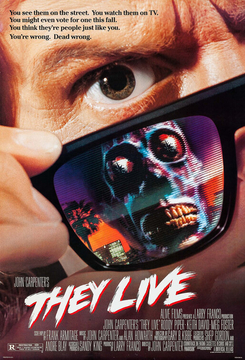
Microreview [film]: They Live directed by John Carpenter

Cardboard Carpenter


I’ve always been a huge John Carpenter fan, and I have fond memories of They Live. So I recently decided to revisit the film and see if it has stood the test of time. Verdict: not a bad film, but not exactly good either.

They Live is the story of a drifter named John Nada (Rowdy Roddy Piper) who arrives in Los Angeles seeking work after an unspecified economic crisis. It’s never clear whether the film takes place in the present or near future, so the crisis is either the 1987 savings & loan crash or a stand-in for it. John  finds work on a construction site, where he meets Frank Armitage (Keith David). Armitage takes Nada to a homeless encampment straight out of Steinbeck. But the encampment, it turns out, is actually a cover for an underground movement seeking to expose the fact that the world is being taken over by aliens, who see humans, and the Earth, as resources to be exploited. After discovering a pair of sunglasses that allow him to see who is human and who is not, Nada embarks on a vision quest to destroy the transmitter that makes the aliens look human.

It’s pretty interesting to watch They Live in 2017. It serves as a reminder that the anxieties of the present—economic precarity, inequality, environmental degradation, the militarization of law enforcement and declining social mobility—were just as scary in 1988 as they are now. The anti-capitalist, anti-elite message of They Live might also resonate with viewers in 2017, given the emergence of “democratic socialism” (i.e. continental social democracy with a pointless new name) and economic populism in general. I also thought it was interesting that Carpenter made the connection between alien exploitation of the Earth and the historical exploitation of the developing world.

Beyond that, though, it's just not a great film. Carpenter's best films, like Halloween, Escape from New York and The Thing, have incredible presence. They are moody, full of atmosphere and deep shadows. For that, one can credit both his peculiar approach to direction and the memorable synth scores he made himself. They Live just doesn't match up. The music--such an integral part of his earlier work--does nothing to build tension. Worse, the film suffers from uncharacteristically poor direction. There are all these weird pauses throughout the film: between lines, in the middle of action scenes, and so forth. And it doesn't help that both Piper and co-star Meg Foster turn in the most wooden of wooden performances.


In the end, They Live has some neat ideas but suffers from execution problems that I found frustrating. It's okay, but not better than okay.


The Meat

Baseline Assessment: 6/10.

Bonuses: +1 for Keith David, the world's greatest character actor.

Penalties: -1 for weird pauses and sluggish pace; -1 for disappointed score from a great film composer.

Nerd Coefficient: 5/10. "Meh."

***

POSTED BY: The G--purveyor of nerdliness, genre fanatic and Nerds of a
Feather founder/administrator, since 2012. 

Tuesday, July 18, 2017

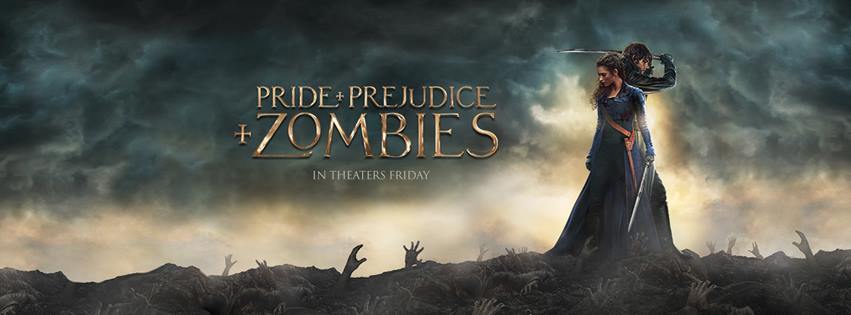
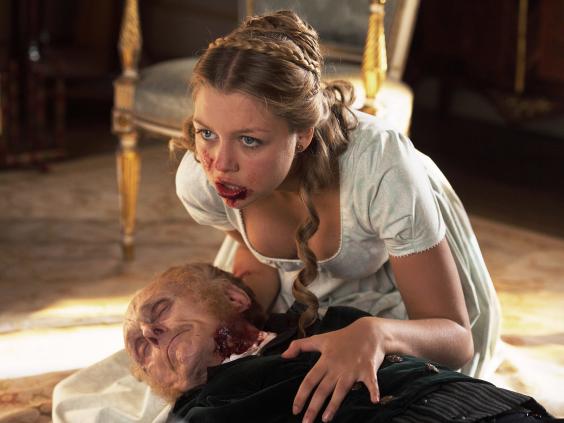
Guest Post: Erin Horáková on Pride and Prejudice and Zombies

Please join us in welcoming Erin Horáková, who is here today to discuss the book/film Pride and Prejudice and Zombies. Erin is a southern American writer who lives in London. She's working towards her literature PhD, which focuses on how charm evolves over time. She blogs at Charmed Life. -G 


I stared at the Facebook message in horror. Had a uni friend truly linked me to the trailer for the (inevitable) film of the book Pride and Prejudice and Zombies on the assumption that I would be pumped about this? Had she, in her sweet innocence, failed to notice that I am a hideous snob put on this earth to roll my eyes at the ‘classic novel and SFnal creature’ book trend? WAS MY BRAND INVISIBLE? Pride and Prejudice and Zombies was the last film on earth I would ever be willing to watch.

But as Austen teaches us, no plan survives contact with one’s sisters. Meghan was born ten years after me because god thought that up until then I’d had it too easy. Twenty years later she sat sulking through our low-key Halloween celebrations, and I felt guilty for dragging her prematurely into my fogeyish idea of a hot night (I had a roast dinner and a full-length black mourning veil to lunge out at trick-or-treating children in—what more could be wanting?). She suggested we watch Pride and Prejudice and Zombies, and apparently I am slightly more prone to guilt even than to pretentiousness, because I agreed to let that happen in my home.


It was better than I expected it would be, at least in some ways. The serious threat the zombies represent in Pride and Prejudice and Zombies has given the Bennet sisters a bit more of a common cause, and the altered way they interact in Pride and Prejudice and Zombies is winning. Matt Smith’s Mr Collins (the Bennet sisters’ obnoxious cousin and the heir to their family’s money) is a delight. The fact that Moffat Who pretty entirely spoiled Matt Smith’s tenure as the Doctor is honestly one of Moffat’s greatest blunders (and there are so many entries in contention for the title). As an actor, Smith (who has Jon Pertwee’s sense of comedic timing, and his somehow not at all conflicting capacity for gravitas) deserved so much better.

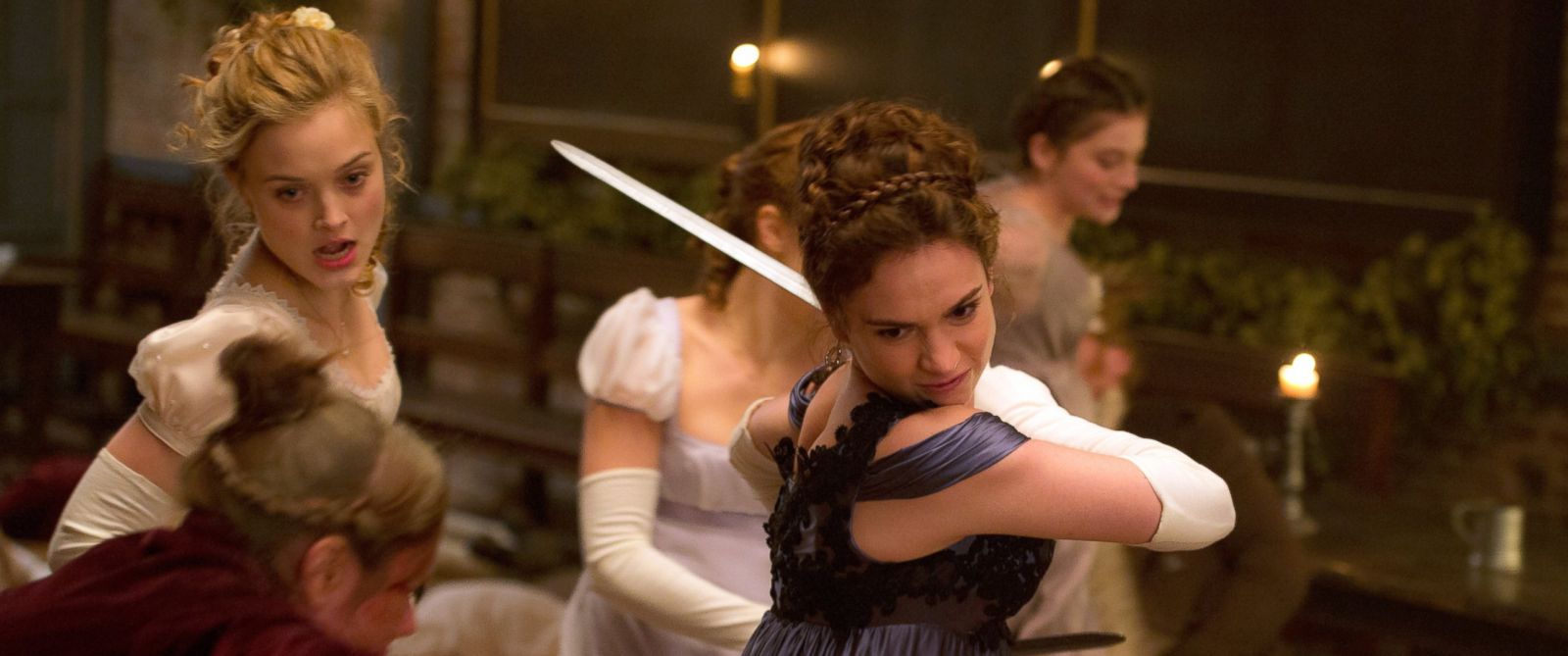
I’m quite charmed by the well-executed decision to make Lady Catherine (Darcy’s obnoxious aunt, who wishes she were in control of the whole of their family’s money, and could thus make people fall in line with her plans with greater alacrity) more friend than foe. In P&P&Z, she’s an epic swordswoman who’s lost an eye facing zombie hordes. It’s a Dickensian gesture: if Shakespeare is Dickens’ authorial dad, then Austen is his mom,* and he inherited her habit of paying attention to how economics play out in social dynamics and her enjoyment of absurd people. But he loves his grotesques, and half the time he can’t help himself from coming back around and bailing them out, dusting them off and offering them back up to the audience as reformed Goodies, to delight in as he does. The impulse to Save Lady Catherine because she is preposterous and thus fun is somewhat back-read from later audiences’ period-drama familiarity with him. I think Lady Catherine rehabilitations owe something to Copperfield’s Aunt Betsey, directly or in-.

[*Despite the irritating time (circa Nickleby, to Forster (because of course)) he claimed to have not yet read her. Austen’s Victorian popularity only jumped sharply in 1870, the year Dickens died, due to her nephew publishing a very popular biography of her.]

Austen herself could only really be said to evince this recuperative impulse in the case of the protagonist of Northanger Abbey, or possibly with the eponymous protagonist of her early novella, Lady Susan. But neither treatment works in quite the same Dickensian ‘spare your darlings’ way as Pride and Prejudice and Zombies’s reformation. Nor is a desire to harness the formidable Lady C for the forces of good unique to this Pride and Prejudice adaptation. The loose but amazing 1940 Pride and Prejudice script by Aldous Huxley (yes, this actually happened, and no, no one can explain why—all the dry, factual ‘needed the money’ reasons in the world cannot amount to the Reason This Happened) similarly saves her, making her a cantankerous but wily, complicit matchmaker. Precedented or no, Pride and Prejudice and Zombies’ ‘you’ve heard of Lady Catherine?’ flash-away to the woman herself atop a pile of corpses is gold. Yeah we have, fam.

After an introductory scene in which Darcy attends a party and does his zombie-hunting job (but not quite well enough), and then everyone at said party dies in a zombie attack right after he leaves (more on this later), we come to a belated but well-done expository opener. Oh snap, it’s backstory conveyed via a toy theatre! Nineteenth-century toy theatres are amazing, and it’s great to see this period piece brought back as a staging mechanism! The illustrations are a bit pre-Punch and thus feel spot on, though I think of the device itself as more quintessentially mid- to late-Victorian, so it was slightly jarring for me in this context. But listen, almost nothing in Pride and Prejudice and Zombies makes a lick of period sense, so this is small beer.

Perhaps more importantly, this opener sets the zombie invasion in the context of empire. Britain’s growing imperial power is here phrased as ‘trade’, and the zombie plague is presented as something brought back via those exchanges. That renders this zombie epidemic almost a reboot of the 14th century Black Plague. There are, however, a couple of problems with this: we don’t get so much as a mention of what’s happening in Asia (if this plague even has the same initial vector—there are in-story reasons to suspect it doesn’t), or on the continent, etc. This is incredibly irritating, because this movie is global enough in scope that the absence of this information nags at me. These questions are relevant to the plot’s stakes and mechanics.

Second, it’s late in the game to describe the interactions by which this plague arrived with an ‘egalitarian trade’ model. By this point in history Britain was starting to go full East India Company, which was less ‘multicultural trading post’ and more ‘site of atrocities and hellish vision of the coming power of industrial capitalism’. The zombies are thus, implicitly, an ‘Empire Writes Back’ affair. Which would be fascinating, if we got into it, but we don’t really. Instead we get an odd Orientalism en passant: accomplished society women train to fight zombies in monasteries in Japan or China. They then, for Reasons Unknown, come home from these possibly safer (?) lands to this cursed plot, this upturned earth, this zombie-ridden realm, this England. Pretty clearly, regency ladies just know kung fu now because bitchin’.

‘Isn’t it cool though, for women in the past to just be kick ass in retellings?’ I don’t know, isn’t that kind of a shallow, awkwardly appropriative, unthreateningly lean-in White Feminism that doesn’t accidentally ignore wider social implications so much as have to ignore them because it’s a relentlessly anti-systematic, obfuscating placebo for real change?

There’s no real mention of what the men do in this regard, or why local fighting schools haven’t been established, or how this monastic training affects gender norms (or the women’s Anglicanism). You may think that’s a ridiculous ask, but we’re sitting here in an adaptation of a novel that is all about the psychology of social structures, which retains and relies on a lot of that novel’s tensions. Yet none of these new elements have been thought through and integrated into the network of questions from which the romantic energies of this adaptation’s plot are still derived.

The timeline and geography of this invasion are major plot points, and yet they make no sense. So the aristocrats holed up in London, built a big wall around the city, then trickled back out? The logistics of this elude me—they built it while under attack? From what direction, Portsmouth? But never mind. More importantly, a major metropolitan area was comparatively safe from a plague for the first time in history? What happened to the peasants outside this Attack on Titan wall? If the peasants died, who the hell made and is making food, and what the hell use is aristocratic money if grain production got wiped out? Barbara Tuchman’s A Distant Mirror: the Calamitous 14th Century called, it has some medieval realness to serve you about labour, class and rising wages after a ton of agricultural workers suddenly die.

I am baffled as to why the Pride and Prejudice and Zombies’ writer (I apologise if he was better here, but I doubt it: I’m not reading this book myself to find out for sure, y’all die on your swords if you feel like it) and/or the film team didn’t want to do the work to figure this stuff out. Isn’t that—the most interesting part? Of this process? Yes, it’s a one-joke gag book (that spawned a trend, made an obscene amount of money and generated a film adaptation, so whatever it started as: here we are!), but who could help themselves from sitting down and working out the alternate history consequences of Georgian England with Zombies? You could even retain the original plot pretty tightly—like, go do something else for an hour, come back, and I’ll have a plot outline for this. It’s not just not hard, it’s irresistible as a cursed gong in Charn, and yet this film does not ring that gong and I literally cannot understand why.

Georgette Heyer would have written a much more fun version of this book, I am just saying.

The world-building never quite works, and thus the ways it increasingly derails the plot of the original novel get weirder and worse as the film ramps up to its shaky, unsatisfying finale. Wickham was a zombie all along, because. He wanted to become Zombie King, which is a Thing, because. He still abducts Lydia, here unromantically, because. Some pretexts are given, but I will not insult you by relaying these. Everything with Dastardly Wickham and the Intelligent Zombies is poorly done (good band name, though).

The end sequence involves Darcy quasi-murdering a few hundred sentient zombies by reducing them to an animalistic state. These zombies were abstaining from consuming human brains in order to keep hold of their personalities and to prevent their full transformation. Darcy snuck some of the real deal into their communion wine (they’re clinging hard to religion in order to maintain their sense of humanity) to test their degree of control. They failed his test en masse.

There’s not much reason for Darcy’s doing this, and that’s—totally not moral, as well as being actively and pointlessly dangerous for himself and others? I mean, perhaps he was trying to get rid of these zombies’ sentience so that they couldn’t control other zombies, as they have some power to do, and harness the unintelligent zombie hordes as a killing force. But we don’t get much evidence that this whole community (including half-zombified children) had any intention of doing that. It’s not even a threat the protagonists lay out as a motivation. It seems like the story’s Evil Plan might just have been Zombie Wickham’s gig. In which case, even in this pacey action film, murdering a parish should have given Darcy some pause, even if it was for the greater good. His transition from landowner to military man has made him, if anything, less conscious of his responsibilities towards others: a dangerous way of thinking about power and violence. And responsibility towards others was always Darcy’s lynchpin as a character—the thing he had from the beginning that constituted his inner core of decency, the thing he failed to demonstrate among strangers, and the thing he reaffirms his commitment to and enlarges his definition of in order to emerge from the novel as a more mature person and ‘win’ his plot objectives/become a man Elizabeth can love.

While the new plot doesn’t cohere, the adaptation also puts a great strain on the original romance. Underlyingly, Darcy and Elizabeth are no longer mistaken about certain aspects of how to view the world and in need of learning and growth, both in themselves and towards one another. P&P&Z is like a version of North and South where Thornton just moves to the City and starts stock trading, and Margaret’s down for it. The fundamentals of Pride and Prejudice-ness are out of joint. Given the gravity of the external threats, the misunderstandings in Pride and Prejudice and Zombies don’t quite have the space to blossom into a vast Sleeping Beauty thorn-barrier of awkwardness that the characters nonetheless manage to overcome, as per the original. The adaptation’s plot doesn’t take advantage of its new structure to build in good replacements for these lost components. You know what’s a really good model for adapting Pride and Prejudice to a structure with additional external conflicts, especially if you’re already drawing on the mid-century work of Dickens and Friends? Especially given the over-abundant critical comparisons between zombies and the poor? It’s Elizabeth Gaskell’s regional novel/industrial action thinkpiece/romance, North and South. To be shallower, in part Pride and Prejudice and Zombies' romance also plops wetly on the ground like the flesh a zombie tears through and discards in its relentless quest for brains because this Darcy is so shite and charmless, and has two, three facial expressions tops. A static picture of Colin Firth in the 1997 adaptation, with some new dialogue read over it like a visual novel, would have been more emotive.

Pride and Prejudice and Zombies' well-paced and not insultingly bad, exactly, but the romantic structure’s collapse is indicative of how, in general, the adaptation is pretty insipid. Take our opening voiceover. “It is a truth universally acknowledged that a zombie in possession of brains must be in want of more brains. Never was this truth more plain than in the recent attacks at Netherfield Park, in which an entire household was slaughtered by a horde of the living dead during a whist party.” That’s gone from a cute observation to just—a statement, and the follow up line just makes me angry, because it is so bad. How is this so bad? It’s because the writer never actually understood the prose of Austen’s novel and what it was doing, at a basic, functional level. This is some tin-ear, ‘never read a period novel in my life’ bad steampunk business. Why do people do this?

Oh they’re literally fighting during Darcy’s first bungled proposal. Because they’ve got like, animosity. They’re fighting, now. With kung fu. Like Kung Fu Hustle, but with a very limited sense of humour. I get it. The lighting is that Twilight ‘blue tights over the lens’ affair that makes things look Serious and Grim and Like There’s About To Be A Tornado in The Total Absence Of Appropriate Weather Conditions For That.

This Mr Bennet is super concerned with risks to his daughters’ lives, which, fair, but I’m not sure why he’s suddenly so woke to this given that Mr Bennet’s being too philosophical and go-with-the-flow is the whole problem of his character. It’s his entire personality in the original novel, and the driving engine behind his attitude towards the family’s problematic inheritance situation and his inattentiveness regarding Lydia, which endangers all his daughters and sees Lydia (whether she immediately understands it or not) screwed forever. Mrs Bennet was in some ways right: it really is fucking imperative to get all these daughters married off, and the plot absolutely rescues this family in Lydia’s deliverance and in Jane and Elizabeth’s unlikely good marriages. So why, even in the adversity of a zombie attack, given that the family always had serious problems their patriarch refused to deal with, would Mr Bennet be characterised by vigilance—more so than many of his contemporaries? He’s not an idiot (though most of the people in this film seem to be, playing fast and loose with established zombie protocol despite recurring evidence of the threat (curiously no one we see is grieving or traumatised in the wake of these events, which helps the plot zip along but neutralises audience investment in the threat)), but that’s so not him.

The feebleness of the adaptation is my whole issue with this book trend. This? Is a garden variety fanfic idea. Everyone has written a Pride and Prejudice fusion. I’m not even implicating myself as an eater of sour grapes to say that I have, because your nan’s written one at this point. And a lot of them are better than this. It’s a matter of preserving plot energies, or replacing them with something with at least equal weight—shifting the structure to accommodate your changes. And this? Is but a meh execution, a fumbled telling of a tale as old as time. I could have more fun perusing Derbyshire Writer’s Guild than paying to see this film. I have done, many a time. Only this fic’s by a boy, and done for profit. You can even win a Nobel for mediocre fanfic, provided you’re ‘giving under-served minorities voices in the canon’ as a white male, working in a female-developed medium, recycling its strategies (I am never over how much I hate the reception of Coetzee’s Foe—I know the Nobel is really more of a collective lifetime achievement award than For A Given Book, but Coetzee’s Foe-based acceptance speech strongly associates Foe with this recognition). If you’re Updike, Gertrude and Claudius sells decently. If you’re Shakespeare’s Sister, as it were, you’re off on an lj com, probably this_england or shakespearekink. (Yes, still—Tumblr hasn’t necessarily been great for Shakespeare or many other non-mega fandoms.)

It’s just such a common and depressing occurrence. Very little about these assignments of recognition and reward are about differences in how good the people involved are. I don’t begrudge the P&P&Z guy his money, exactly, but I do want it understood that the confidence to approach a press agent with this, that agent’s acceptance of the idea, the marketing and its success are all gendered as hell, and that this book and film are a weak joke, feebly delivered.

Pride and Prejudice and Zombies is Amateur Hour, if you read it as fanfic. It doesn’t work as horror. I was never scared, either in the moment (and I am easy for a jump scare) or more conceptually and substantively. It’s mediocre, considered as action. It doesn’t work as romance. It’s a bit more fun as science fiction, though the premise is ludicrously under-explored and the plot, as it comes to us, is jumpy as a jackrabbit. The zombie comedy vein (which includes titles such as Shaun of the Dead, Zombieland, etc.) has been mined more professionally. Same for parody, really. It is, to the best examples of the zombie story in all its guises, as solitary Old Man Jenkins the gold-panner with his farmed out claim is to industrial mining operations. Occasionally Old Man Jenkins turns up a nugget, but by and large he spends his days chafed by howling winds that seem to embody his regret for all the mistakes he’s made in his life, all the choices that led him here, to this. He will die alone, and no one in five years’ time will ever turn to anyone else and say, ‘hey, want to watch Pride and Prejudice and Zombies?’

Friday, October 21, 2016

Interview: Matthew Irvine on Carnival of Souls

Matthew Irvine is a film professor, producer, and director. He is also the rights-holder to one of my all-time favorite cult films, Carnival of Souls. The movie was made in 1962 by a team of filmmakers in Kansas who worked together making industrial and educational films for their day-jobs, and decided to make a feature film after director Herk Harvey found an abandoned amusement park in Utah. It had a quiet reputation as a gem of truly independent horror films, but for years, collective wisdom held that the film was in the public domain, so terrible copies of it proliferated. But now there's an unbelievably gorgeous version out from the Criterion Collection that just arrived in stores. I got to talk with Matthew about how he got involved with the movie, and some of the backstory behind how we got here.

NF: What's your connection to Carnival of Souls? What drew you to it?

MI: I got involved in the film a long time ago when I got out of film school. A few people including my manager, thought my MFA Thesis film had a tone to it similar to this old cult film called Carnival of Souls. I had never seen the film until my Thesis film was screened at the Tokyo International Student Film Festival. While there, a few audience members, usually older folks, wanted to talk with me about my film as it gave them the same feelings that this old film did back in the early 1960’s, Carnival of Souls. The funny thing was that the non-Japanese people at the fest didn’t really respond to my film, so I guess you could say I was “big in Japan” for a short time. When I got back to the states I made sure I got a hold of CoS (on VHS I believe) and finally watched it. At the same time that was happening, I was stating to work with Peter Soby, Jr. who was at Shoreline Pictures, I believe. He saw my film and the two of us connected right away. As fate would have it, he was involved in getting a sequel to CoS made. So, my connection all kind of came from that. I wrote what I thought was a damn good and faithful sequel and it eventually landed at Trimark Pictures. Well, at least the concept of doing a sequel did. My understanding was that Trimark got Wes Craven interested in lending his name to the making of a sequel and when that happened, well...it’s a common story of how people get their first entry into the business. My friends Steve Jones and John McNaughton told me that you have one choice on how you enter the film business and that is to either bend over or lay down because either way, you’re gonna get screwed. Being from Chicago though, I didn’t take kindly to that so I pursued obtaining all rights to the film as the Trimark pictures sequel was a one-off. Peter Soby and I hired an attorney to do a chain of title on the film to make sure the film was not in public domain, as many people falsely believe it is. The chain came back totally clean and we went directly to Herk Harvey and John Clifford and offered to purchase the negative and all rights to the film.

NF: At that time, did CoS already have the reputation of being a public domain film?

MI: I made sure it was NOT in public domain before I pursued the rights. The film has been floating around for some time with the belief that it is Public Domain but that is just not the case. We have done cease and desist actions over the years because people think it is in Public Domain. There are still those that could care less whether it is in Public Domain or not, they are going to do what they want with what they have to make a buck. Most every dvd, even the “colorized” version are from crappy prints that are not worth watching, IMHO. Peter and I just expected that there are people that will never be convinced that the film is not in Public Domain. Not everyone thinks that way though. A lot of people have approached us over the years asking if they could screen the film at festivals here and there and we almost always grant the request as long as no money is involved because I like to know the film is still being shown and appreciated. It screened at the Louvre a couple years ago and they contacted me before they included the film in their film retrospective. Of course I said yes. I think Herk would be pretty proud to know that his film screened at the most famous art museum in the world.

NF: Do you know where the public domain assumption came from? How did you go about finding the chain of title and verifying it was still protected?

MI: There was a bankruptcy thing that occurred where the distributor closed shop and it was assumed that CoS was part of their library, which it was not. But Herk and John had real jobs and did not have the time to pursue anything legally until interest in the film was revived in the late 90’s. They then did a director’s cut of the film and re-established copyright ownership on the film and story. The negative was being stored at the Eastman House in New York and all other elements to the film were with Herk and John in Kansas.
Herk Harvey, director and head spook in Carnival of Souls

NF: There are a number of other DVD releases — including at least one colorized one you mentioned — from video distributors that specialize in Public Domain films. When Criterion initially released the film on DVD, were they aware that it was still under copyright protection?

MI: Yes. We made that deal with them originally, but through MPI Media as an intermediary. MPI made an agreement with Peter and myself, and then made a deal with Criterion for a remastered DVD. I provided all the elements for that release and it was done with my full cooperation. Unfortunately I didn’t see a dime from that but I didn’t get involved in CoS to get rich, I got involved because it was a film worth saving and treating with respect and care.

NF: What went into creating this blu-ray release? What was the process like for restoring the film and working with Criterion?

MI: The Academy Archives did the remastering of the negative. And I believe Criterion worked with them on the Blu-Ray. I know the people who did the restoration and they love the film and treated every frame as though it were Citizen Kane.

NF: It's the rare totally independent horror film that rises to the status of curation alongside Bergman and Kurosawa movies. I mean, it's definitely rough around the edges, but the movie seems to sort of rise above. What do you think it is about Carnival of Souls that makes it a standout when so many films of similar pedigree were only at their best when they were fodder for Mystery Science Theater 3000 (RiffTrax has tackled CoS but the movie stands alone - ed)?

MI: I think it was the way it was shot. Herk wanted to make a different film. Different from what most “Hollywood” films were like. I think this helped influence the way it was shot. It really has a weird tone to it. Yes, it is cheesy in spots but it only adds to the overall surreal quality to the movie, in my opinion.

NF: When can we expect Herk Harvey action figures in the Entertainment Earth catalog? Or, what's next for the film?

MI: We have been talking about doing a straight-remake of the movie for some time now. We actually have a couple producers interested. But at this point, I’m like I don’t care to make a schlocky remake for a fast buck; that already happened (Wes Craven allowed his name to be put over the title in a 1999 re-imagining of the movie that should be avoided at all costs. - ed.). If we do a remake it will be something worthy of the original film. Something that is different, weird, creepy, original. Something that would make Herk proud. I don’t have “Fuck You” money but I do have “Fuck You” time. I have been involved in CoS for so long that I won’t do anything with it until the right people come along and want to treat it seriously, like Criterion and the Blu-Ray. We had other offers for a Blu-Ray release but went with Criterion because, they’re like the Cadillac of that particular film market.

Posted by Vance K - cult film reviewer and co-editor of nerds of a feather, flock together since 2012, musician, and Emmy-winning producer.

Tuesday, October 18, 2016

ESSENTIALS: 24 Cult Films for Late, Late Nights

I feel like I should preface any list of "Best" cult films or "Most Important" cult films with the disclaimer that there is no list. The thing that makes cult films memorable is that they are a representation of a unique voice, and different voices appeal to different people. Plus, there are just so, so many movies out there, nobody can see them all. If you've got a film that you (or you and your friends) love and quote and everybody else thinks you're nuts, I think you're doing the thing right, and it doesn't matter if that movie's on a list anywhere or not.

The other key thing about cult films is that they are usually produced outside of the mainstream, so a lot of lists of "Best Cult Films" that I see online are rehashes of movies like The Big Lebowski or Office Space, which were box office flops, but gained a second life through word-of-mouth after their disappointing theatrical runs. I love both of those movies, and they certainly have cult followings — Office Space prompted Swingline to actually make a red stapler, and The Big Lebowski started a religion — but now they're so well-known I don't need to invoke them here.

Since I get to make this list, I wanted to focus on movies that didn't show up on the other lists. I also wanted to stay away from "The Worst Movie Ever" kinds of films (plus, I already covered that ground), and try to share movies that I think are legitimately good, or moving, or compelling, even if you can see their seams sometimes.

These are in no particular order, but they are all perfect for late nights or rainy days:

1. Carnival of Souls

After a traumatic accident, a woman becomes drawn to a mysterious abandoned carnival. - IMDb

Mistakenly thought to be in the public domain for decades and widely available in grainy, garbled versions, Carnival of Souls has a new blu-ray release from Criterion with restored picture and sound that really shows off this movie for what it is. It's a legitimately eerie movie, beautifully shot, full of evocative imagery and intelligent subtext. This movie also has special significance for me, because seeing the original Criterion Collection release of this movie alongside films by Renoir, Godard, Kurosawa, and Bergman was the first time I really understood that cult films didn't have to be a guilty pleasure. That release made me realize that there were other people like me who loved both art house cinema and outsider cinema and took them equally seriously.

2. Chimes at Midnight

The career of Shakespeare's Sir John Falstaff as roistering companion to young Prince Hal, circa 1400-1413. - IMDb

For many years, the crown jewel of my DVD collection has been a DVD-R of this movie, which was only briefly released on VHS and was extremely difficult to find and even more difficult to own. But this is another movie that Criterion has recently rescued from the pit of abysmal picture and sound quality. And good thing, too. This movie and the never-completed Don Quixote were Orson Welles' dream projects. Constructed from texts pulled from four Shakespeare plays, Welles made John Falstaff, who has more lines than any other character in Shakespeare, the tragic hero of his own movie. The larger-than-life Welles plays the larger than life mentor to Prince Hal, later King Henry, and the thread of wasted talent and unbridled excess that runs through the film cannot help but reflect on the former boy-wonder of Welles himself. It is a movie that was financially and logistically hard to make and it shows, but it is full of stunning images, and a truly heart-rending conclusion.


3. A Bucket of Blood

A frustrated and talentless artist finds acclaim for a plaster covered dead cat that is mistaken as a skillful statuette. Soon the desire for more praise leads to an increasingly deadly series of works. - IMDb

I will go to the mat with anybody who says Roger Corman isn't a good director. He's certainly known as a producer of exploitation films and for launching the careers of people who went on to be iconic directors, but his directorial work (which he pretty much stopped doing in the late-1970s) was extremely sharp, both in terms of visual style and intelligence. A Bucket of Blood is one of the best satirical take-downs of the art scene I think I've ever watched, and it wraps it inside the costume of a schlocky horror movie. It's funny, full of gentle social commentary, and has just enough of an "ick" factor to create some intentionally cringe-worthy moments. If you've ever wanted to see the Beat Generation get some comeuppance, this one's for you.

4. Faster Pussycat, Kill Kill

Three go-go dancers holding a young girl hostage come across a crippled old man living with his two sons in the desert. After learning he's hiding a sum of cash around, the women start scheming on him. - IMDb

I'm much more of a Corman guy than a Russ Meyer guy, but when it comes to exploitation films, you have to give Russ Meyer his due. Meyer is most closely associated with busty women with quick tops, but there's actually no nudity in this, his best-known movie. Busty women, sure, and car races, and inexplicable danger aplenty. This movie is also notable for being the source of most of the movie dialogue samples used in White Zombie's breakout album La Sexorcisto: Devil Music, Vol. 1. That's actually what got me to watch this movie in the first place.


5. Blacula

An ancient African prince, turned into a vampire by Dracula himself, finds himself in modern Los Angeles. - IMDb

There are a lot of 1970s blaxploitation movies you can watch and have a pretty great time with, but the thing I love about Blacula is how William Marshall's performance really elevates this movie way past what you think it would be from the amazingly schlocky title. He was primarily a Shakespearean actor, plays the character of Prince Mamuwalde totally straight, and sells it. This movie is at its heart a love story, and despite some *ahem* lines that ring out particularly jarringly to modern sensibilities, the performances in this movie should earn it far more prominence among horror fans than I think it currently has.


6. Killer of Sheep

Stan works in drudgery at a slaughterhouse. His personal life is drab. Dissatisfaction and ennui keep him unresponsive to the needs of his adoring wife, and he must struggle against influences which would dishonor and endanger him and his family. - IMDb

This underground film shot in south Los Angeles in the early 1970s is not to be confused with a blaxploitation film. This is a poetic and deeply touching movie that went unseen for over two decades because of rights clearance issues with the music in the film. The picture of daily life in Watts that it shows is both stifling but also affirming and moving. When it was added to the National Film Registry in 1990, that helped raise awareness for the movie, and ultimately led to a limited theatrical release in 2007. It is now available on DVD.


7. I Bury the Living

Cemetery director Robert Kraft discovers that by arbitrarily changing the status of plots from empty to occupied on the planogram causes the death of the plots' owners. - IMDb

I came across this one on a Public Domain movies site years ago, and I was pleasantly surprised. What the description here doesn't include is that the director doesn't want to be killing people, and begins thinking that he's descending into madness. As this starts to happen, there are a couple of visual effects sequences that are really striking, and take on the air of a twisted re-imagining of Fitzgerald's "eyes of Dr. T.J. Eckelburg." The film suffers a little from a Scooby-Doo ending, but there are rumors that there was a different ending originally shot. That's going to have to be one for the angels, though, because in 1958 nobody was keeping alternate endings of B-pictures around for archivists to find later.

8. Billy the Kid vs. Dracula

Dracula travels to the American West, intent on making a beautiful ranch owner his next victim. Her fiance, outlaw Billy the Kid, finds out about it and rushes to save her. - IMDb

I reviewed this movie before, and you can read that at your leisure, but for our purposes here I will simply quote one line of that review: "At some point in 1965 or '66, some actual human being must have had this thought: 'Let's get John Carradine to play a vampire again, but this time we'll stick him in the Old West, name the movie after two characters not actually appearing in the movie, and shoot the thing for a nickel in, say, my back yard in Encino!'" The IMDb description is actually not correct: Carradine is never identified as Dracula because they didn't want Universal suing them, and "Billy" in the film did not have a previous career as a notorious outlaw. So if this sounds like it's up your alley, it probably is. If it doesn't, man, you've been warned.

9. Plan 9 from Outer Space

Aliens resurrect dead humans as zombies and vampires to stop humanity from creating the Solaranite (a sort of sun-driven bomb). - IMDb

This is also an objectively bad movie, but Edward D. Wood Jr. deserves a place on this list if for no other reason than that Ed Wood is maybe the greatest movie ever made about movies. Plan 9 is also, and I don't know anybody who would argue with me on this, the closest Ed Wood ever got to making a decent movie. The idea of a bomb made out of the sun's rays is not the worst sci-fi idea ever, and the story is more or less coherent. As opposed to, say, Glen, or Glenda?. Plus, the reach of this movie has been remarkable, from the Tim Burton biopic to the name of Glenn Danzig's record label, so it's worth watching if you haven't actually seen it. May I recommend watching Ed Wood and then Plan 9 as a double-feature?


10. Primer

Four friends/fledgling entrepreneurs, knowing that there's something bigger and more innovative than the different error-checking devices they've built, wrestle over their new invention. - IMDb

Of course, if you'd actually like to see a good sci-fi movie made for no money, you might want to skip ahead a few decades to Primer. This movie has a reputation for being quite a mind-bender of a time-travel movie, and it does not disappoint. I would argue that only with (many) multiple viewings and some graph paper could you actually untangle what's happening in all the different timelines, but at a certain point, it doesn't matter. The storytelling is dizzyingly complex, but you get the impression director Shane Carruth knows what's going on, and that he's going to take you somewhere worthwhile, so you go along. It's a tense and confusing ride, but I'm not aware of another movie like it. I actually prefer Carruth's poetic, disjointed follow-up Upstream Color, but start here.

11. It's Such a Beautiful Day

Bill struggles to put together his shattered psyche, in this new feature film version of Don Hertzfeldt's animated short film trilogy. - IMDb

As long as we're talking about bending minds, let's also dip our toes into the animation end of the pool. Don Hertzfeldt bends minds with the best of them, and I am truly at a loss as to how he is able to tell such elliptical stories with stick figures and still elicit powerful emotional responses from me. I am a big fan of Don Hertzfeldt, and this re-packaged collection of three of his related short films is a perfect example of why. Bill seems to be emotionally falling apart, but then it seems like he's actually mentally falling apart. His journey yo-yo'ing closer to and farther away from "sanity" and "reality" is both tremendously imaginative and tremendously moving. Hertzfeldt's World of Tomorrow short film was absolutely robbed of an Oscar, too, for whatever that's worth.

12. Sita Sings the Blues

An animated version of the epic Indian tale of Ramayana set to the 1920s jazz vocals of Annette Hanshaw. - IMDb

Animator Nina Paley made this animated feature film on her own. By herself. Alone. Feature film. Bill Plympton does the same kind of thing, and I am simply in awe of these artists. Paley's movie tells the story of Sita and her lover Rama from the Hindu epic Ramayana, and intertwines that tale with the story of the dissolution of Paley's own marriage. It's simply a beautiful, enthralling piece of work that not only explodes with imagination, but is full of beautiful visual design, too. It blurs the line between myth, fiction, and documentary, and is set entirely to torch songs. What's not to love?


13. The Beaver Trilogy

It begins in 1979 with the chance meeting in a Salt Lake City parking lot where filmmaker Trent Harris is approached by an earnest small-town dreamer from Beaver, Utah. - IMDb

And speaking of blurring lines...man, this one's something. As quick as I can tell it: Trent Harris was working at a TV station in Utah when they got their first video camera, and he was testing it in the parking lot when a guy called "Groovin' Gary" spotted him and came over.Gary always wanted to be on TV, and had his car adorned with images of Olivia Newton-John. He invited Harris back to Beaver for a talent show that Gary wanted recorded. In it, Gary dressed in drag and performed *as* Olivia Newton-John, to the befuddlement and ridicule of the small, conservative town. That really happened. A couple of years later, Harris moved to LA, and fictionalized the story a bit, and shot it as a short film with a pre-Fast Times Sean Penn. A couple of years later, while at USC film school, he made another go at the same story with a pre-Back to the Future Crispin Glover. If you can't find this amazing, unique gem, track down the new documentary The Beaver Trilogy, Part IV, which tells the whole story in stunning fashion.

14. The Sid Saga

Spurred by house guests Bob Sandstrom and Karlene Sandstrom leafing through his scrap book and asking about photographs in it, Sid Laverents begins to tell his life story. - IMDb

This is simply one of the crown jewels of amateur cinema. I don't know how to find it, except UCLA shows it sometimes and it occasionally airs as part of the sporadic TCM Underground series. But it is truly unforgettable, with Sid Laverents taking viewers through a stunning, three-part filmic biography that not only tells the story of Laverents, but of 20th Century America, too. It begins in poverty and vaudeville, goes through World War II, the 1950s and Cold War, the aerospace boom and introduction of the space program, and finally the rise of amateur film and videography that put storytelling tools into the hands of everyday people. And it's all told first-hand from Laverents, who lived it all. I reviewed this film a couple of years ago, and it is absolutely worth tracking down.

15. Head

The Monkees are tossed about in a psychedelic, surrealist, plotless, circular bit of fun fluff. - IMDb

Whoever wrote this IMDb summary can suck it. This is anything but "fan fluff." This is the weirdest damn thing, and as far from the Monkees TV show as I can really imagine. It's a smart, self-indulgent, self-reflexive piece of meta-storytelling made by Jack Nicholson and Bob Rafelson, who would immediately after this project go on to collaborate on Five Easy Pieces, with Nicholson exploding into the mainstream world in Easy Rider in between. The Monkees got a bad rap at the time, and I think it persists, that they were just a slapped-together attempt by a record company to make an American version of the Beatles. That may have been their genesis, but their songs are great, the guys were interested in things beyond the show, which came through in songs like "Randy Souse Git" and this film, which was reportedly the first time Americans had seen the now-famous footage of  the South Vietnamese Chief of Police executing a handcuffed Viet Cong prisoner. Fan fluff, right? This was Tor Johnson's final film, and also, in a restroom, Peter Tork gives Davy Jones the advice that, "Nobody ever lends money to a man with a sense of humor."

16. The X from Outer Space

The spaceship AAB-Gamma is dispatched from FAFC headquarters in Japan to make a landing on the planet Mars and investigate reports of UFOs in the area. - IMDb

In the 1960s, the Shochiku studio in Japan, which was known for more serious, art-house films like those of Yashujiro Ozu, decided it wanted to get in on some of that sweet Godzilla money that Toho was pulling down, and this film was their attempt. In it, some swinging astronauts jet back and forth between Earth, the moon, and Mars for reasons that are clear, but don't make any logical sense. While exploring, they get some goo on the ship, which hatches into a giant space chicken called Guilala. The English dub of this movie is legitimately terrible, but the original Japanese version, subtitled, is wonderful. It is everything I love about silly, 1960s monster movies, and may even exceed some of the Godzilla movies with shady aliens in them.

17. Suspiria

A newcomer to a fancy ballet academy gradually comes to realize that the school is a front for something far more sinister and supernatural amidst a series of grisly murders. - IMDb

This movie, by Italian horror icon Dario Argento (who also co-wrote the unmatched Once Upon a Time in the West), is the real deal. It's creepy, scary, grisly, bloody, mysterious, and atmospheric. It hits all of my favorite notes of horror movies, and has an ending that is serious nightmare fuel. Emerging from the giallo scene in Italy, it took things a step farther, and is really not for the faint of heart. But man, this is such a great horror movie. I've written before about the line that connects certain films between the 1950s and early 60s, ultimately resulting in Rosemary's Baby, and I think Rosemary in turn made Suspiria possible.


18. Bay of Blood

An elderly heiress is killed by her husband who wants control of her fortunes. What ensues is an all-out murder spree as relatives and friends attempt to reduce the inheritance playing field, complicated by some teenagers who decide to camp out in a dilapidated building on the estate. - IMDb

Staying in Italy with a giallo contemporary of Argento's, we have Mario Bava's Bay of Blood. Bava was making his mark a decade before Argento hit the scene, so a lot of what Argento would build on came from Bava. And it goes way beyond that. Because Bay of Blood is not a "proto-slasher" movie, it is a full-bore, perfect example of a slasher movie, made almost a decade before slasher movies were a thing. You could pretty much take the cliched rules laid out in Scream that govern slasher movies and apply them one-for-one to this movie, but if that's the case, that means this movie invented those rules. I don't know if American filmmakers in the early 1980s looked at this movie and drew inspiration, or if Bava was simply ahead of his time, but this movie is about as good as straight slashers get, and it accomplished that while creating the lexicon, so I think that's one hell of an achievement.

19. The Wicker Man

A police sergeant is sent to a Scottish island village in search of a missing girl whom the townsfolk claim never existed. Stranger still are the rites that take place there. - IMDb

When I was in college and found 1) the Internet and 2) a pair of amazing video stores near my dorm, I spent some time combing a bunch of lists to find movies to rent. The Wicker Man consistently showed up on lists of "the scariest movies ever made" and that sort. So I rented it and I thought it was stupid. But I just sort of missed it — there's something sticky about this movie. Even though I didn't think I liked it, something made me want to revisit it, and when I did, a switch flipped and I fell in love with this movie about the collision of modern life, Christianity, and very, very old pagan beliefs that have still never really gone away. It's a movie with a lot going on under the surface, and which was also plagued for decades with a "the movie that could've been" legend that told the tale of how we never got to see the director's real vision of the movie. That has since been solved, despite the original camera negatives being used as fill underneath the M1 motorway connecting London to Leeds. And for what it's worth, my copy of The Wicker Man DVD actually came in a wicker box.

20. Equinox

Four friends are attacked by a demon while on a picnic, due to possession of a tome of mystic information. Told in flashbacks by the sole survivor. - IMDb

To be honest, this movie is mostly remarkable because of the people that worked on it. As a film on its own, it's only ok, and the present-day framing device of a police detective interviewing a survivor of all that went down is...clumsy at best. So you've really got to have some patience to get to where the movie begins to cook. This film was created by friends who met through Forest J. Ackerman (Uncle Forry), who founded Famous Monsters of Filmland in Los Angeles, and decided to make their own film. These friends, including Jack Woods and Dennis Muren, went on to become transformational figures in Hollywood through their contribution to sound and visual effects. It's truly remarkable to see their first film, knowing that they went on to redefine the modern cinematic language. No hyperbole. There are entire passages of The Evil Dead and Evil Dead 2 that are cribbed directly from this film, and while the humans-talking-to-each-other portion of the movie is clunky, the finale, made from stop-motion, rotoscoping, and glass mattes, is legitimately badass.

21. Incubus

On a strange island inhabited by demons and spirits, a man battles the forces of evil. - IMDb

You notice how vague the plot summary for this movie is? That's about right. I mean, what I remember from this movie is William Shatner and some girl hiding in a barn, and then I think they ran for a bit...and maybe one of them was briefly possessed, but I couldn't swear to that. This movie is totally forgettable except for one kinda important thing: it was spoken entirely in Esperanto. You know what Esperanto is, right? It's an invented language that blends elements of the Romance languages, English, and probably a few other languages into what was hoped to be a universal language. Created in the 1880s, it took almost 100 years to make a movie in the language, and that was Incubus. So if you want to watch a movie where Bill Shatner speaks a made-up language, this is your only option, folks. Who gives a shit if it is entirely, and utterly, forgettable otherwise? But look: I have friends who have learned Swedish to watch Bergman movies in the native language, and friends who have learned Japanese to watch anime in its native language (I have undeniably awesome friends), so if you want to be able to turn the subtitles off in Incubus, you can currently learn Esperanto in the free language-learning app Duolingo on your phone.

22. Venus in Furs

A musician finds the corpse of a beautiful woman on the beach. The woman returns from the dead to take revenge on the group of wealthy sadists responsible for her death. - IMDb

This is definitely an outsider kind of film. I haven't seen any other of Jesus "Jess" Franco's films, but from what I know, a number of his films have veered into the more hardcore elements of mixing sex and cinema. Venus in Furs certainly has sex and nudity, but what it has more of, and in spades, is atmosphere and intrigue. The story is told through the eyes of Jimmy, a jazz musician, who sees a beautiful girl at a swanky party, then finds her merdered body on the beach, then sees her again, walking around. There's a wonderful current of I Spit on Your Grave-style cosmic retribution for sexual violence that runs through the movie, but mainly it's just sort of out-there and entrancing. Like the jazz musician at the center of the movie, you're never quite sure what's going on, and you're kind of ok with that because it's a unique ride you want to get to the end of.

23. The Masque of the Red Death

A European prince terrorizes the local peasantry while using his castle as a refuge against the "Red Death" plague that stalks the land. - IMDb

To be honest, I didn't realize this was my favorite of the Roger Corman/Vincent Price/Edgar Allan Poe movies until I wrote songs about a bunch of horror movies, and the one I wrote for this one turned out to be my favorite. Like in Bucket of Blood above where Roger Corman is a good director, and in Blacula where performances can elevate an otherwise straight exploitation film, for me Hazel Court makes this movie. There are a number of wonderful things in this one, from the dwarf circus performer who murders a friend of Prince Prospero (Vincent Price) to avenge an insult to a girl he loves, to the amazing set design that was the apotheosis of the Corman/Price/Poe look, that if I have to let this one movie stand in for all the wonderful films in this series of movies, I'm happy to do so. If you can only watch one Roger Corman movie this Halloween season, I recommend this one.

24. Perversion for Profit

This anti-porn short film shows a flood tide of filth engulfing the country in the form of newsstand obscenity. - IMDb

This is maybe a bit of a cheat. This isn't a narrative film or documentary, but I guess you could say it's a sort of outsider cinema. This instructional film was created in 1965 to warn America of the dangers of the secret filth hiding in the newsstands in the form of comics, men's, and women's magazines. This film is amazing in many ways. There's the slice-of-life sense of giving the modern-day viewer a picture of what life was like in the mid-1960s, and what people could see walking into the corner drug for a magazine, but mainly it's a totally un-self aware look at the hypocrisy of the morality police. The fact is that this movie is a half-hour of words talking about how terrible the "smut" problem is in America, while showing the "smut" in question in full detail. There are very tiny black bars over nipples or eyes, but it's clear to see that this film became, in a sense, exactly what it beheld. By damning pictures of nude women while showing pictures of nude women, today this seems like a way to get soft-core porn into the hands of moral crusaders who could only enjoy nude bodies if they felt they were also condemning them. This movie is a really interesting artifact that says a lot more about the people who made and watched it than it does about they people they were trying to denigrate. It's a fascinating time-capsule that conveys a very different message these days than it was originally meant to.

Posted by Vance K — Emmy-winning producer, folk musician, and cult film reviewer and co-editor of nerds of a feather, flock together since 2012.