Showing posts with label Star Wars. Show all posts

Monday, July 20, 2026

TV Review: Maul: Shadow Lord

A fun space opera crime story that sneaks in a bit of commentary


I think it’s telling that both the Legends continuity and the Disney continuity of the Star Wars franchise both saw it fit to bring Darth Maul back from the dead. He was undoubtedly an imposing character. His lines were generic, sure, but Ray Park provided him with some great physical acting. He also got great makeup, great choreography, and a cool lightsaber. In the new canon, there’s a fair bit of him, but it’s spread among different shows and is difficult to track the whole way through. Now, though, he gets his own show to shine in, that being Maul: Shadow Lord on Disney Plus.

It’s only natural, I think, that the way Disney figured out how to let Darth Maul survive was to make him a crime lord. It’s a way of living that is both obviously cruel as well as opposing the power structure under which he lives. He can be cruel, raspy, imposing as he was in his appearance in The Phantom Menace, but with no need to follow pre-established rules on the nature of the Sith, nor any involving potential service to either side of the Clone Wars. This setup lets him be his own agent, beholden to only himself, free to be as ruthless as he can to entertain us.

One of this show’s strengths is its visual design. You are treated to a story set mostly in a single city on a single planet. The city has clear inspiration from Blade Runner with more obvious departures from reality. For an episode or two, I wondered if it were the same city planet as seen on a moon in The Mandalorian and Grogu but that turned out not to be the case. But as so many cities in science fiction are seen only at nighttime, advertisements glowing like gemstones against the dark, you also get to see the city in the day. It reminded me of some of the older parts of New York I’ve been to. Even better, you get a sense what it is like for the normal people of this city to live here. It seems to have a certain car (or speeder) dependence that makes commuting a chore, but it’s still a thing people not involved in high politics or crime experience - something that the Star Wars franchise historically has not been great about showing.

This is a crime show, and about half of it is a cop show. Other than Maul and his organization, the other major group of characters (barring an important duo) is this planet’s local constabulary. The investigator we follow, played by a suitably weary, suitably gruff Wagner Moura, is in some ways the platonic ideal of a cop show protagonist - divorced, teenage son, throws himself into his work in order to stay sane, but nevertheless with a moral core that will not let him take the easy way out of a morally difficult situation. Another character in the station is Two-Boots, a protocol droid adapted to police use whose programmed imperatives conflict with his own sense of duty.

In this section of the show, it will bring up inevitable comparisons to Andor. This isn’t Andor, and it was never going to be the deep dive into the nature of fascism that Tony Gilroy blessed us with. This show does, however, have its own element of commentary on the nature of imperialism that is hidden in the background, probably not intentional, and manifests itself in a way that may have simply been clumsy writing: whenever the Empire is mentioned, it is mentioned as a foreign entity, a thing that the characters very much do not identify themselves with. They don’t refer to the ISB, or any other named agency in the way that American cops in a mundane police drama may refer to the FBI, they refer to ‘the Empire’ as if they were not its own reluctant citizens.

This plotline, then, is an extended discussion of the nature of a political community. To play on an old Chinese saying: the galaxy is vast, and the Emperor is far away. The Empire, being a fundamentally personalist regime, cannot micromanage every city on every planet in every system in every sector. As such, it is easy for those who avoid attracting Coruscant’s attention to get away with a lot. The great mistake Two-Boots makes is assuming that the Empire exists to help people (and no I am not considering the Yuuzhan Vong here), and contacts Coruscant for assistance. The new Imperial presence spends its time terrorizing the city, caring far more about its sense of order rather than any actual care for the rights and livelihoods of its people. The commentary on the nature of fascism is rather blunt: these people are only using what ills you to gain power and to satisfy their own lust for domination. It is a lesson learned the hard way, both in this show and in our own world.

Maul’s operation and entourage, on the other hand, are not as rich. They are entertaining, certainly, pleasingly ruthless when dealing with other criminals who have crossed them. But just among them, and not their interactions with others, is rote: they are your typical space opera crime syndicate doing typical criminal things. This is where the connections to the broader franchise lore are the thickest, particularly near the end. It’s fun, yes, but it’s not particularly substantial. This segment of the story is the part most purely what people love Star Wars for, and it works on that level.

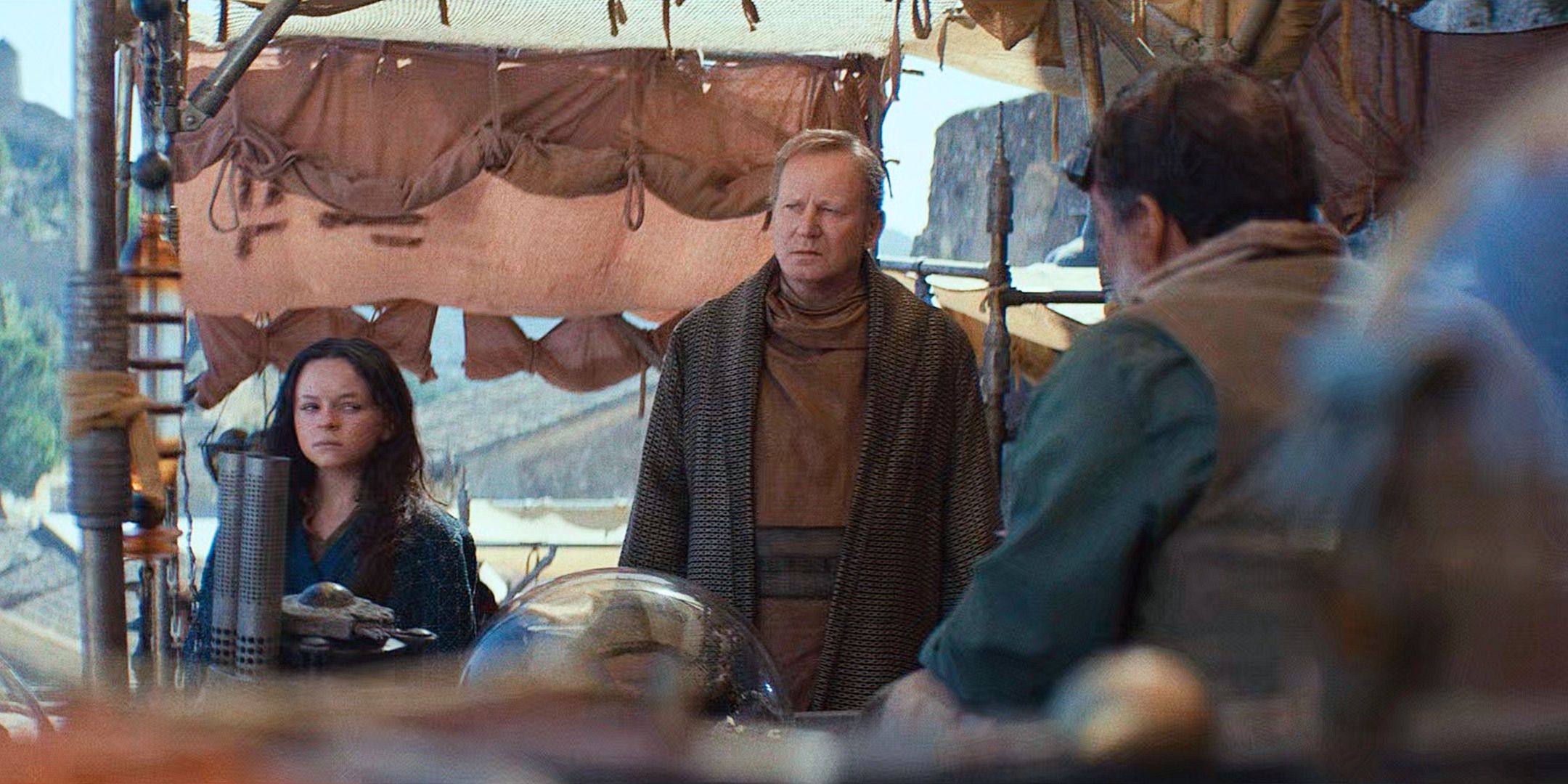
The other set of characters are two Jedi, master and apprentice, who happened to be on this world when Order 66 was issued and their comrades in the Order were duly felled. They are refugees, homeless, dispossessed by the change in regime and stranded on a world they barely know. To go on about their plight would spoil too much of what makes this story work as well as it does, but they are worth watching, too. They serve to reveal the nature of characters around them, for they elicit positive change in police characters and pure ruthlessness from Maul’s enterprise and from the Imperial forces that have come to impose their own will.

So, ultimately, no - Maul: Shadow Lord is not fundamentally another incisive commentary on the dangers of democratic backsliding. What it is is a fun space opera show with some thematic depth if you decide to dig in a bit. It is, satisfyingly, just a bit more than what we expected it to be, and I think, ultimately, that was enough. As a longtime Star Wars fan, I had fun with this show, and I think that other fans of this franchise will also have fun with it.

--

POSTED BY: Alex Wallace, alternate history buff who reads more than is healthy

Monday, June 8, 2026

Film Review: The Mandalorian and Grogu

Want to watch basically just a no-stakes, super-long episode of The Mandalorian on a huge movie screen this summer while eating popcorn? You can.

A long time ago (3 years), in a galaxy far, far away (Hollywood)...

Dave Filoni and Jon Favreau had just finished writing season 4 of The Mandalorian TV show. But amid all of the hubbub of the 2023 Writers Guild of America strike, LucasFilm decided to hold off filming it and instead prioritized making a Mando movie. And that, my friends, is why The Mandalorian and Grogu exists. 

Once you learn this, everything all starts making a lot of sense. Here are the answers to a few questions I know you'll have right off the bat:

  • Yes, it's essentially a two-hour episode of the TV show that's released in time for summer blockbuster season. 
  • No, it doesn't reveal any interesting lore or invest in heavy world-building.
  • Yes, it has the typical Filoni-esque easter eggs, fun cameos and Clone Wars-style easy, clean, G-rated storytelling.
  • No, there's absolutely no reason this had to be a movie.
  • Tragically no, (for me), the Armorer isn't in it. 

The plot

Our guy Din Djarin is enjoying life as a single dad and contracting for the New Republic. As per usual, he's tasked with a tit-for-tat mission: If he agrees to rescue Rotta the Hutt, son of Jabba the Hutt, his aunt and uncle will provide intel on the location of post-Imperial Warlord Commander Coin. 

He finds out that Rotta, voiced by an unrecognizable Jeremy Allan White, is a popular gladiator on the cyberpunk planet of Shakari. The whole plot revolves around Djarin rescuing and/or escaping from various monsters, creatures, and aliens and double-double crossing the Hutt aunt and uncles. 

There's not much to it, though it does get a little convoluted. It's the standard fare of any Mandalorian episode, really. Problem --> learn about McGuffin to fix said problem --> encounter difficulty --> Obtain McGuffin --> Watch Grogu eat something.

What makes a Star Wars movie a movie


Lest it sound like I'm one of those fans who pooh-poohs nearly every Star Wars entry into the canon, The Mandalorian and Grogu isn't a "bad" film, and this is coming from someone who used to post weekly Mando recaps here. There's just...not much to think about. And maybe that's okay! If the goal for LucasFilm was to launch a fun Star Wars movie for the summer that's just a popcorn movie, I have absolutely no qualms with that. There are definitely things to like about it (more below). 

But Star Wars movies, in general, are emotional gateways for fans. Watching Luke stare into the binary sunset on Tatooine, witnessing Anakin and Obi-Wan's final duel on Mustafar, and experiencing Jyn Erso and Cassian Andor's final embrace on Scarif— these are the moments that stick in our hearts and have followed us into adulthood. Even the polarizing Last Jedi had moments of awe, shock, and absolute sadness.

For a Star Wars movie to have no stakes goes against everything we love about the franchise. Djarin and Grogu get into some tough scrapes in this movie, but there is never a single second where you worry about them not coming out on top. There's even a scene where Grogu has to take care of Djarin for a few days as he lies unconscious recovering from a venomous dragonsnake bite (in a great parallel to Pedro Pascal as Joel recovering in The Last of Us — he's always a down-on-his-luck single dad, isn't he?). 

The things I liked

I've probably said this before, but I like any glimpse into the Star Wars universe writ large, and seeing gorgeous tableaus on the big screen is always a delight. I particularly enjoyed:

  • The murky, swampy Hutt planet of Nal Hutta, including the rusty towers that folks will recognize from Jabba's palace on Tatooine. That little bit of continuity just hits different.
  • Visiting the cyberpunk planet of Shakari was an interesting addition to the Star Wars "clime-as-planet" database. Though futuristic in shape and feel, it was actually inspired by 1920s Prohibition-era Chicago. It felt lived in and different from the hyper-modern versions of Coruscant we've seen over the years. 
  • Ludwig Göransson, who also does the score for the TV show, really outdid himself with the Shakari theme. He takes the Eastern-style pipe and synth leitmotif we're familiar with and incorporates streaking synths and neon audio bursts that creates a Blade Runner-meets-Star Wars vibe. It's Outrun/vaporwave/synthpop but set in space. It slaps.
  • The various monsters and beasts are a blast to watch — but then they better be, as it's the only action/plot device in the film. 
  • If you live long enough, you get to watch your heroes become X-wing pilots. Seeing Sigourney Weaver don the iconic helmet and go careening through an alien planet was absolutely Ripley-level badassery.

At the end of the day, I'm glad I went and saw this on the big screen on the Thursday before Memorial Day. It was me and a handful of other hardcore Star Wars fans, and we all laughed and reveled together at certain points. It didn't affect me emotionally at all, but maybe that's not always necessary for a fun movie. Like I mentioned earlier, I appreciate any time spent in a galaxy far, far away.

I just may not be able to convince other folks to go with me. 

--

The Math


Baseline score: 6/10

Bonuses: Martin Scorsese as an alien food stall owner; the killer synth score;

Penalties: No real soul; Grogu is experiencing Flanderization; absolutely zero stakes; I cannot take a Hutt with six-pack abs seriously.

Gonk droid count: 0

POSTED BY: Haley Zapal, NoaF contributor and lawyer-turned-copywriter living in Atlanta, Georgia. A co-host of Hugo Award-winning podcast Hugo, Girl!, she posts on Instagram as @cestlahaley. She loves nautical fiction, growing corn and giving them pun names like Timothee Chalamaize, and thinking about fried chicken.

Monday, May 11, 2026

Book Review: Inquisitor: Rise of the Red Blade

Come for the lightsabers, stay for the intense analysis of alienation


I knew I was in for an experience with Delilah Dawson’s Star Wars novel Inquisitor: Rise of the Red Blade when I looked at the first page of the book and found that it contained a trigger warning for the fact that, over the course of the novel, a character commits suicide. I was blindsided a bit - I don’t expect Star Wars to handle such delicate material. Whatever hesitation or trepidation I may have had was assuaged as Dawson’s novel ended up the most emotionally intense novel in the franchise that I have ever read. I was frankly astounded.

The novel is, ultimately, a novel about the process of radicalizing terrorists, but the terrorists are the dark side. Such organizations prey on a very particular type of person: the isolated, the disaffected, the angry, the sort of person who is utterly dissatisfied with their lot in life and is prone to lashing out. Your potential terrorist here is Iskat Akaris, a padawan of the Jedi Order of an unknown species from an unknown planet, with no heritage to look back towards and no approval from the Order to be found. Her master is cold, her peers hate her for an attempt of demonstrating ability with the Force having gone dangerously awry, and her duties frustrate her and bore her in every measure.

But the other side of terrorist radicalization is the side that our media and our governments like to pretend does not exist. It is the society around these disaffected people that makes them disaffected in the first place. For white nationalist terrorists today, their recruiting grounds are angry young white men who haven’t got what they feel they’ve earned (or in many cases, entitled - be that status or prestige or women or money). For Islamist terrorists, their recruiting grounds are majority-Muslim areas of Western countries that are neglected by their governments, never allowed to truly be neighbors by societies that hate them. It is then unsurprising that groups like al-Qaeda or ISIS or al-Shabaab fill the void, offering them a righteous cause and a pacific Jannah for the price of committing murder.

That uncaring, miserable environment in this novel is the Jedi Temple. The Jedi Order has always had this mystical component to it, a sort of space opera version of an Eastern monastic order, with added martial arts and laser swords. Here, that religious element is brought forth, and it is not simply a religion; in this novel, the Jedi Order is a cult. The Masters tell Iskat again and again that the Order cannot fail; the Order can only be failed. That is the message the Order gives her again and again; her feelings are invalid, her problems are irrelevant, and her suffering is a sin. For daring to stand up, to be herself, she is punished.

The way Dawson writes the Jedi Order in this novel reminded me of the writing of people who have left toxic religious organizations; the one I’ve read the most is Chrissy Stroop, an exvangelical writer who has gone into great detail about the toxicity of American evangelical culture; similar writers have talked about the miseries inflicted by the Catholic Church, or the Jehovah’s Witnesses, or the Church of Jesus Christ of Latter-Day Saints (Mormons), among many others (not all of them Christian). The throughline through all of these groups is that they create a problem and market the solution. A toxic Evangelical church will deny its members the right to consume secular media. The Jehovah’s Witnesses discourage its members to have friends outside the Church. The Catholic Church denies its followers the ability to have a healthy relationship to sexuality (or a sex life at all to queer people). The Mormon Church discourages its followers from reading about Mormon history from outside approved sources. And the Jedi Order denies its younglings any outside attachment, any family, any love. The Jedi Order only offers a laundry list of obligations, a culture of silence, and a demand for utter obedience.

Dawson has created this setting of the Jedi Temple that is just suffocating. The most aggravating thing, for the reader and for Iskat, is that the Order simply does not view a padawan as a being entitled to the dignity of reason. Again and again and again, she is met with thought-terminating cliches that resolve no issues, solve no problems, ease any tensions. Even as she is proven right in the field of battle, they find reasons to demote her and snub her.

She is discontented, but crucially, she is also violent. She feels at her most self-actualized when she is fighting. She is first deployed at the Battle of Geonosis not long after the first shots of the Clone Wars were fired, and she revels in slaughtering Geonosians. She goes against orders on a subsequent mission, creating diplomatic headaches, but even the Order has to admit that she was effective. You would hope that the Order would find a way to channel this aggression in a useful way, if only on the battlefield, but instead they assign her to teach children. Teaching is of course a worthy calling but it is clearly not the best use of her talents.

From there, the plot rolls on with the inevitability of a boulder running down a mountain, crushing everything before it. Iskat is Yoda’s maxim personified: fear leads to anger, anger leads to hate, and hate leads to suffering. Yoda was speaking on the individual level, within the confines of a single conscience, but here you see a version that interplays between individual and broader society. The Jedi fear Iskat, and she fears the Order in turn. The Jedi come to rage at Iskat, leading her to rage at the Order in turn. The Jedi, ultimately, inflict much suffering on Iskat, and Iskat takes all the fury that has welled up within her and unleashes it on the galaxy at large.

The tragedy of the whole thing is enhanced by the possibility of another outcome. There is a sequence where Iskat finds her homeworld (discovered, by pure chance, after someone she meets on a mission recognizes her species) and visits it. This is a world that has decided to reject galactic civilization entirely. There are no starports on this planet, as they have only received misery and death from the merchants from the sky. They are the Sentinelese of this universe, or perhaps the Piraha; they have rejected any attempt to be made ‘legible’ by galactic civilization. They are the highland people of Zomia. They are also reminiscent of the residents of Hydros, the planet of seas and of archipelagos from Robert Silverberg’s novel The Face of the Waters (which I had the fortune to read not long before this novel), a planet whose indigenous species rejects space travel, and whose human colonists came with the knowledge they would never leave.

All of that is to say that her homeworld is a place where Iskat could have existed without all the cruelties and, bluntly, bullshit of the Jedi Order. This is a place where Iskat could have chosen to be Iskat, to be her own person among her own kind. You see in the people here someone who Iskat could have been without the cruelty of galactic civilization. The tragedy of it all comes when Iskat decides she has to leave, to be involved in the misery of the universe. She hasn't been corrupted so much as she has been angled into following a logic of decision-making that can lead only to destruction. And that is what is so painful about it - Dawson has persuaded you that this could have ended no other way.

There is something about the way that Dawson has conjured her images that is so striking in this book. There are multiple images in this novel that I can recall very well some time after reading it. The best of these, by far, is the ending, the last shot of the movie in your mind, that has the cinematic, epic, romantic quality of many great works of film, the Star Wars films themselves by no means the only example. It is that last image, that last painful, searing image, that made me wish that Disney would have the chutzpah to adapt this into a visual format.

I remember feeling a very, very slight twinge of offense when I read that Denis Villeneuve described his Dune movies as ‘Star Wars for adults.’ Realistically, of course, I know what he meant, and I know George Lucas made the first film for children in the style of the serials of his own childhood, and I know how it’s marketed, and Villeneuve’s films are astounding. This book, I think, is what Star Wars for adults, if that is a thing that should be brought into existence to begin with, should look like. There are a lot of meaty ideas in here that a child may not be able to digest (but a brainy teenager, on the other hand, I suspect would profit very much from this). I am confident in saying that this is one of the best works the franchise has produced. If Disney is brave they will pay for more like it, and hopefully from Delilah Dawson.

--

Reference: Dawson, Delilah Inquisitor: Rise of the Red Blade [Random House Worlds, 2023]

POSTED BY: Alex Wallace, alternate history buff who reads more than is healthy.

Monday, July 7, 2025

Rebellions Are Built on Hope: Andor S2E10

In season two, I never expected to become such a fan of Luthen and Kleya.

With an intense stare, Luthen fixes his wig in the mirror. He's richly dressed, with a large ring on his hand.

In some ways, episode nine is the end of Andor season two in that it wraps up the Ghorman plotline and Cassian’s arc with Bix and his dedication to the rebellion. In the final three episodes, the season pivots to align with Rogue One and present the characters we expect to see in the movie (and wrap up the loose ends of the ones we don’t). While not as smooth a storytelling experience as season one, episode ten is an intense story that stands alone to show the beginning and end of Luthen and Kleya’s relationship. 

In “Make It Stop,” Kleya and Luthen prepare to meet Lonni (Robert Emms), their inside person at the ISB. This type of meeting has become even riskier after Mon Mothma’s speech a year ago. Back then, Cassian had urged Luthen to leave Coruscant because it was only a matter of time before the ISB found him, but Luthen has held on for another year. Even he recognizes the risk as he says to Kleya: “I think we used up all the perfect.”

When Luthen meets with Lonni, the plan that was revealed by Krennic in episode one becomes clear to Luthen. The energy program was a lie to obscure building the Death Star. Lonni was able to find this information by breaking into Dedra Meero’s files. Unfortunately for Lonni, Luthen’s dedication to the cause means Lonni cannot walk away with this information, and Luthen leaves him dead.

After Luthen walks away, the next shot is sideways, showing how this information has repositioned his worldview. Now, all that matters is that someone is able to deliver the information to the Rebel Alliance—but Lonni revealed to Luthen that Dedra is going to target him very soon.

Luthen leaves out Lonni’s warning about Dedra’s impending raid when he gives Kleya the information about the weapon and the engineer, Galen Erso. In a rare protective moment, Luthen insists Kleya leave with the information while he returns to the shop to burn their comms, knowing Dedra might arrive—and that she does. 

Watching Dedra and Luthen finally meet was a scene we’d all been waiting for and had a level of intensity that had me literally at the edge of my seat. After the violence of Ghorman and the espionage surrounding Mothma’s speech, this moment of doublespeak where they both, for a few seconds, play at not knowing the other, was a different kind of intensity. 

Luthen resumes his role one last time as the rare artifact salesman for the wealthy as Dedra walks in, claiming she has an artifact to sell him. At first, they test each other, such as when Dedra asks if everything is “real” and Luthen states there are only two pieces of “questionable provenance,” which is of course a reference to them standing there, but Dedra ends their conversation by revealing the Imperial starpath unit that had originally brought Luthen and Cassian together. Luthen knows this is the end for him, and Dedra revels in the moment, producing a memorable exchange between fascist and anti-fascist:

Dedra: “You disgust me.”

Luthen: “You want to know why?”

Dedra: “Everything you stand for.” 

Luthen: “Freedom scares you.”

He goes on to say one of my favorite lines from Luthen: “The rebellion isn’t here anymore. It’s flown away. It’s everywhere now. There’s a whole galaxy out there waiting to disgust you.”

While Luthen has quite the bodycount to his name, one reason he’s good at what he does is because he is not exempt from this same violence. In order to take his secrets with him, he stabs himself. At this moment, the episode turns, and the second half focuses on Kleya as she realizes she must make sure Luthen dies. 

The second half of the episode is interspersed with flashbacks, including when Kleya and Luthen first meet. In a parallel to Cassian, Luthen rescues Kleya from another genocide committed by the Empire. He is complicit in this genocide as a Sergeant, his radio calling out the acts of violence being committed outside the ship he is currently hiding in: people are ordered to stand against a wall, followed by blaster fire and screaming. Other orders demonstrate the mass killing. It’s never made clear what planet this genocide is happening on, but it parallels Ghorman and Cassian’s planet of Kenari, where there are so few survivors. 

As Kleya prepares to infiltrate the hospital where Luthen is being kept alive by a machine, the flashbacks show them fencing antiquities and observing Imperial atrocities. At first, young Kleya, radicalized by genocide, is frustrated with their progress, but the more senior Luthen helps her keep from burning up in her rage: “We fight to win. That means we lose, and lose and lose and lose, until we’re ready. All you know now is how much you hate. You bank that. You hide that. You keep it alive until you know what to do with it.”

A young child with long hair, Kleya, stands next to the ruggedly dressed Luthen as they try to sell an item at a market on a sunny day.

Even as a child, Luthen doesn’t call Kleya his daughter, and throughout the show, while there is care in their relationship, they appear more as partners than familial. Yet, Kleya’s careful mask comes down as she murders her way into the ISB-controlled hospital wing and reaches Luthen’s bedside. Without hesitation, she releases the machine keeping Luthen alive, but she does allow herself a brief show of affection before she hurries out, escaping back to the Coruscant hideout with the information about the building of the Death Star. 

While most of the episode is focused on Kleya and Luthen, Dedra is in the process of learning an important lesson about fascism—they eat their own. As Robert Evans and his co-hosts on It Could Happen Here point out in their breakdown of episodes 10-12, Dedra is a parallel of the spunky cop who breaks a few rules to take down the big bad, but Andor reveals the copoganda of this type of figure through Dedra, who is not someone we root for but rather a fascist who committed genocide. Dedra is arrested by the ISB even though she’s finally completed her longtime mission to capture Axis. She's worked hard to achieve this moment, but rather than be rewarded, she's immediately arrested by a man who used to be her underling and is now put in a position of power over her. She cannot breakthrough the fascist patriarchy even though she is a believer in their ideology.  

The episode’s final shot is a slow fade to black of Luthen’s body. Without him, it’s questionable if Yavin would have existed, and certainly, Cassian wouldn’t have joined the rebellion. While Luthen is not the most sympathetic character, he does dedicate everything to the cause, as he points out in his monologue to Lonni in episode ten of season one: “I’ve given up all chance at inner peace. […] I’m damned for what I do.” 

In perhaps a less dramatic tone, activist Dean Spade puts it this way: “Do I want to be in the fight until I die, even though I don’t know how it’s going to turn out? Because that’s how everyone who has fought for liberation had to BE. It’s being with the uncertainty. Part of that, for me, is shifting our sense of ourselves from some good outcome that can definitely happen towards just the pleasure of being with each other in the struggle.”

Many characters exhibit this sense of purpose, and the show demonstrates multiple ways of living in this moment, from Luthen’s loss of inner peace to Maarva’s speech at the end of season one where she describes how she’d live her life differently, declaring, “Fight the empire!” Luthen and Kleya are one of these paths, and the show makes few judgements about the different paths or tools to fight the Empire, but what it is important is that dedication to the fight.

--

POSTED BY: Phoebe Wagner (she/they) is an author, editor, and academic writing and living at the intersection of speculative fiction and environmentalism.

Monday, June 30, 2025

Rebellions Are Built on Hope: Andor S2E9

In episode nine, “Welcome to the Rebellion,” Mon Mothma begins to understand the cost of what she has been supporting financially for years

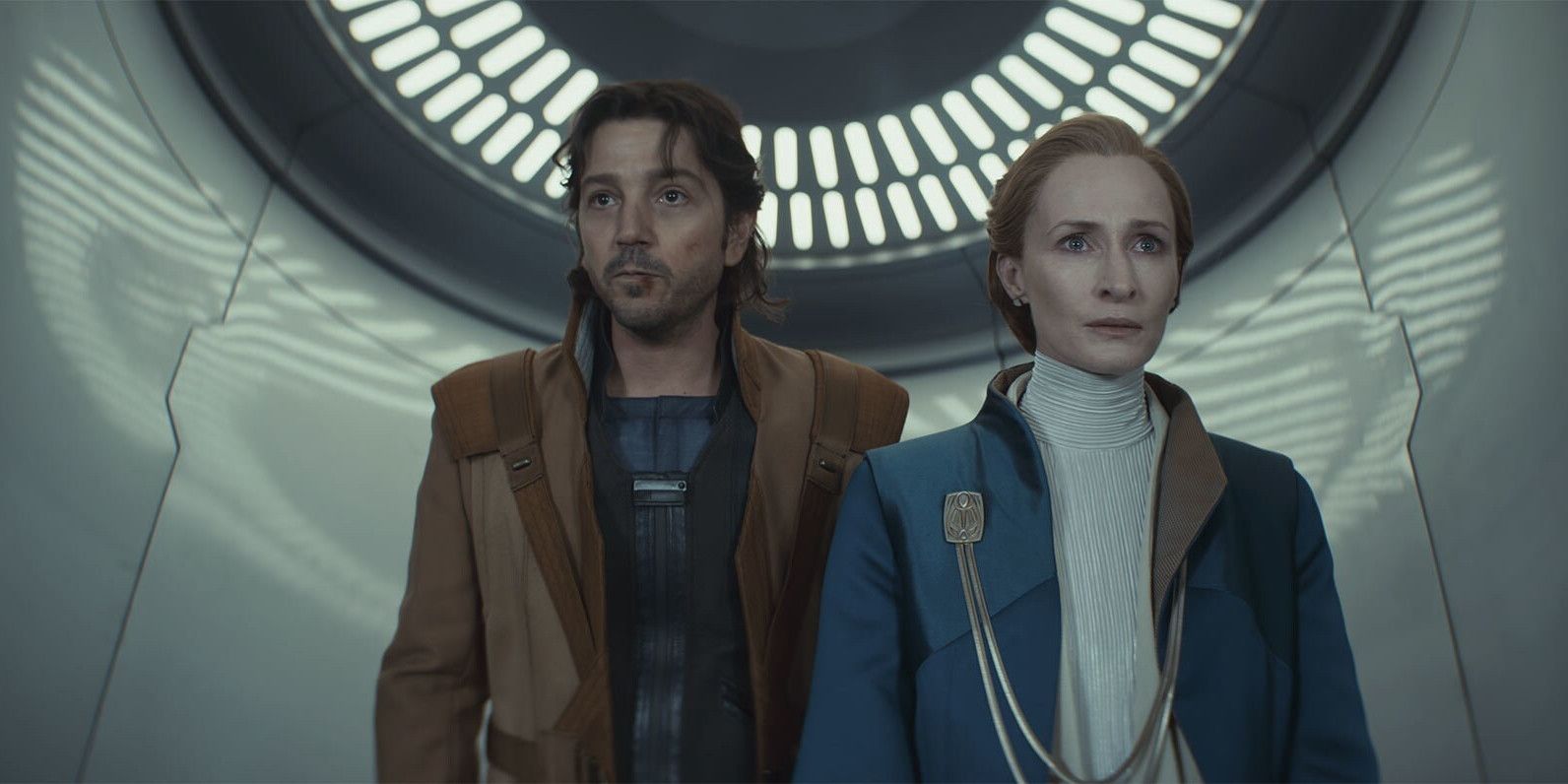
Cassian in a brown coat stands next to Mothma in a blue cloak. They are both serious looking as they wait to exit an elevator.

The episode opens with the Ghorman ambassador being arrested in the wake of the Ghorman massacre. Bail Organa (Benjamin Bratt) and Mon Mothma know now is the time for action, especially since the Imperial news is continuing the propaganda machine. As Organa says, “The winner writes the story.” To which Mothma responds, “Well, they haven’t won yet.”

It’s Mon Mothma’s moment to use her power in the Senate to attempt to make a difference. Organa decides to stay to buy more time for Yavin to develop, but after her speech, Mothma will flee to Yavin and join their leadership.

While prepping for her speech, her assistant, Erskin (Pierro Niel-Mee), finds a listening device, which Mothma destroys, alerting the ISB that something may be happening in her office. She goes to the plaza to practice her speech, where Luthen finds her. Perhaps unsurprisingly to viewers, her assistant works for Luthen and was recruited at the wedding of Mothma’s daughter. Mothma sees it as a betrayal that neither Luthen nor Erskin told her about the connection, but Luthen sees it as her assistant protecting her. Even so, feeling betrayed by Luthen, she struggles to trust his next piece of intel—that the extraction team Bail Organa has prepped to take her to Yavin has been infiltrated.

Meanwhile, Cassian is exhausted and shaken after escaping the Ghorman massacre. He meets with Kleya to receive what he claims will be his last mission with Luthen. She confronts him: “You’re tired. It’s too much, it’s too hard. You were a witness to the Ghorman massacre; one would think there’d be no stopping you.” He emphasizes he needs to “start making my own decisions,” but Kleya has a response for that, too: “I thought that’s what we were fighting for.”

Even so, he agrees to help rescue Mothma and enters the Senate as a reporter, at the same time as Organa’s compromised team also enters with an ISB agent in their group. Cassian connects with Erskin, using the now iconic line, “I have friends everywhere.” Even though Mothma immediately dismissed Erskin, he continues to help make sure she escapes.

In the senate, Mothma waits for Organa to create an opening for her. Earlier in the episode, an ISB agent had made clear that no pro-Ghorman senators would be allowed to speak, and the glimpses of the Senate narrative throughout the episode continue the Imperial line that the Imperial soldiers are “martyrs,” and that the Ghormans were not massacred but causing an insurrection. With some political maneuvering, Organa is able to break through the blockade of voices and yield the floor to Mothma. When his ploy works by invoking a specific Senate rule about emergencies, the ISB immediately orders the shutdown of the feed.

Mon Mothma see from the waist up wearing blue. She stands in her senate bay about to give her speech.

I often comment on the brilliant monologues and speeches throughout the show, but Mothma’s speech is perhaps the most important and moving in our current moment. Since I heard her speech, I have not been able to stop thinking about the line, “The death of truth is the ultimate victory of evil.” Immediately after the episode ended, I had to look up when the episode had been filmed, because it felt impossible that Gilroy and his team had written this speech with such prescience, but in interviews, Gilroy has discussed they had wanted the speech to feel as timeless as possible, which they achieved. With rising fascism and the violence of empire globally, there are certain patterns, and the pertinence of Mothma’s speech comes from recognizing those patterns and exploring them in Andor.

Rewatching this episode, the “death of truth” shook me even more as the U.S. enters yet another war on the lie of weapons of mass destruction, as more of my neighbors are disappeared off the streets of my rural hometown under the lie of being “illegal” or a “criminal,” of watching the lie that Palestinians are receiving “aid” when they are instead being murdered while world governments do nothing. Mothma counters the death of truth by speaking the truth aloud, which is when the Senate reacts to her speech: she calls the Ghorman massacre “unprovoked genocide.” Saying the word at that moment is what causes the Senate to react, and is part of claiming that truth. Words like “genocide” and “fascism” are brushed aside as extreme, as incendiary, but Mothma’s speech shows the power of using the word in the right moment, of calling something what it is.

Interestingly, Andor sets up this as being one of the most important moments in Mothma’s career. In the Senate, we see moments of her advocating for different ideas—especially for the Ghormans throughout  both seasons—but we don’t necessarily see her as being impactful in the Senate. Rather, in season 1, she is useful to Luthen because she funds his actions. In season 2, her attempt to help the Ghormans with a petition is ineffective, and even she knows that. Instead, her disruption of the Senate and her speech being aired is demonstrated as being impactful as opposed to her political power. I’ve been curious about what tactics of resistance Andor shows as working versus failing. For example, Ghorman’s plaza protest fails, but Mothma’s speech scares the Empire into frantically cutting it off.

Importantly, the only reason the Empire doesn’t succeed in immediately silencing Mothma is because of two unnamed technicians. These two technicians have maliciously followed the rules in order to slow down operations by locking out their supervisor. The exchange is worth repeating:

Supervisor: “It’s locked. Why is it locked?”

Technician: “It’s supposed to be.”

Supervisor: “It hasn’t been all year.”

Technician: “We know. We fixed it.”

Supervisor: “What?”

Technician: “We checked the protocol.”

Supervisor: “Open it.”

Technician: “You need the sequence key.”

Supervisor: “So let’s have it.”

Technician: “We took it up to the security office yesterday…”

The technician even speaks slowly compared to the frantic supervisor, who runs off to find the key, while the technicians smile to each other. Much like the hotel clerk Thela, this example of how to commit malicious compliance—a way to gum up the Empire without breaking any rules—is yet another example of praxis in this show that anyone can do off the screen.

At the very end, Mothma’s speech is cut off, but she’s successfully delivered her message to the galaxy, and finds Cassian standing outside. With the help of Erskine, Cassian kills the ISB agent on Organa’s team, then they escape to her ship. The titular moment of this episode comes as they are hurrying away from the dead body of the ISB agent and Mothma is struggling with the moment of violence, getting her hands dirty in a different way than she’s used to: “I’m not sure I can do this.” Cassian responds: “Welcome to the rebellion.” 

Cassian brings Mothma to the safehouse where he and Bix used to live, and he’s informed by Kleya and Erskine that Yavin will take over Mothma’s travel, and Cassian will essentially be written out of the story in order to make a grander narrative for Yavin. Cassian takes this in stride, but it mirrors how Mothma’s very public moments, like her speech, can only happen because of the work of Luthen, Cassian, and Kleya, which they receive little to no credit for.

These types of moments undermine the larger hero’s journey that Star Wars is so known for. The only reason these heroic moments happen—like Mothma’s speech or blowing up the Death Star—is because of the unsung work of people like Cassian, Bix, Wilmon, the hotel clerk, and the technicians, and all the other large and small acts of defiance.


POSTED BY: Phoebe Wagner (she/they) is an author, editor, and academic writing and living at the intersection of speculative fiction and environmentalism.

Monday, June 23, 2025

Rebellions Are Built on Hope: Andor S2E8

In "Who are you?", the best episode of season two—and a top-tier moment in television generally—, we bear witness to the Ghorman Massacre. 

A shot of stormtroopers walking down steps into a plaza full of Ghormans.

Content Warning: Discussion of domestic violence, violence against protesters.

As Cassian is preparing for his assassination of Dedra Meero, the plaza is opened and the Ghorman Front immediately starts to rally people. In a surprising moment of clarity, the leader of the Ghorman Front, Carro Rylanz, points out the danger of gathering, but his rebels refuse to listen to him. Meanwhile, Dedra speaks to her supervisor, Major Partagaz about the plan. “The only story that matters is Ghorman aggression,” he says. “The threats, the inexplicable resistance to imperial norms.” He points the success of their propaganda and media, revealed in the board meeting during episode one: “Our struggles with Ghorman are well documented at this point.” 

In a great piece of cinematic storytelling, a few minutes later as Syril walks through the memorial plaza, a news reporter repeats Partagaz’s lines about resistance to imperial norms. The propaganda plans have fully taken over the media, demonstrating there is no help for the Ghor from the story being recorded by traditional media sources. They are fully part of the Imperial machine.

As Syril makes his way to ask Dedra what’s going on, he’s confronted by Carro Rylanz as people file by, chanting: “We are the Ghor! The galaxy is watching.” Rylanz tells Syril about the mining equipment that’s been witnessed on different parts of the plant, which Syril still tries to deny, but at this point, Rylanz knows Syril must have been helping the Empire and says: “What kind of being are you?” Syril has no response, and Rylanz demands to know: “What’s in our ground? What is it you’ve been sent to steal from us?” Like Rylanz, though, Syril has no knowledge of the mining as Dedra has kept it from him. 

He tries to see Dedra, but he’s blocked by other Imperial officers as things become more volatile during the protest. When he is finally brought in to see her, she reveals the plan he has already guessed. In this moment, Syril finally finds his agency, even though it’s through an exertion of power via domestic violence. In true fascist fashion, he can’t express himself except through domination (as opposed to being dominated by the other women in his life who dictated his agency, such as his mother or Dedra). He chokes her while asking about the mining. His shock seems to have two layers—the destruction of the planet and people he’s come to admire to some degree and the fact his girlfriend kept the information from him. He rushes out to join the crowd.

While Syril’s capability of violence has been demonstrated in season one when he tried to find Cassian, this intimate partner violence demonstrates a shift in his character. Throughout season two, Syril has received much of what he’s wanted. His partner is an officer in ISB, his mother is finally respecting him, and he’s on a special mission for the Empire. Importantly, much of these “successes” haven’t happened due to his choices. In a brilliantly acted scene early in the season, Dedra tells his mother, Eedy (Kathryn Hunter), that she will control how much Syril sees his mother and that contact will be dictated by if Eedy can behave. Syril trades one domineering relationship for another. While it does seem like Dedra cares for him in her own way—both of their abilities to care dictated by their lack of empathy—Syril is also controllable, which is why he’s the perfect person to infiltrate the Ghor, because Dedra knows she can control him. 

As Syril realizes he’s been used by his partner, he watches the breakdown of the protest in the plaza as the new recruits from the previous episode are sent out to clear a path to the memorial. While their commanding officer says that’s a bad idea, the officer in charge of the operation sends them out anyway.  

In an intensely powerful moment, Lezine starts singing the Ghorman national anthem. The crowd picks it up, and soon the whole plaza is singing, united in this moment of oppositional nationalism. As they sing, the green recruits go out to clear a path to the memorial, and the crowd grows angry, harassing them while stormtroopers blocking off the plaza observe the situation. Above the plaza, a sniper watches while TIE fighters fly over. 

Partagaz orders Dedra to continue the plan: a sniper takes out one of the young recruits, which prompts the imperial forces to open fire, including the stormtroopers. What had been a crowd singing the Ghorman national anthem becomes stormtroopers and imperial officers shooting into a plaza. A few of the Ghorman Front have blasters, but most of them are unarmed civilians. The sniper continues to take out people from the rooftop.

In the panic, Syril watches the stormtroopers kill people he had been working with, murder the citizens he’d walked past every day, and destroy the plaza his office had overlooked. In a series of slow moments, the camera focuses on Syril standing still in all this violence. 

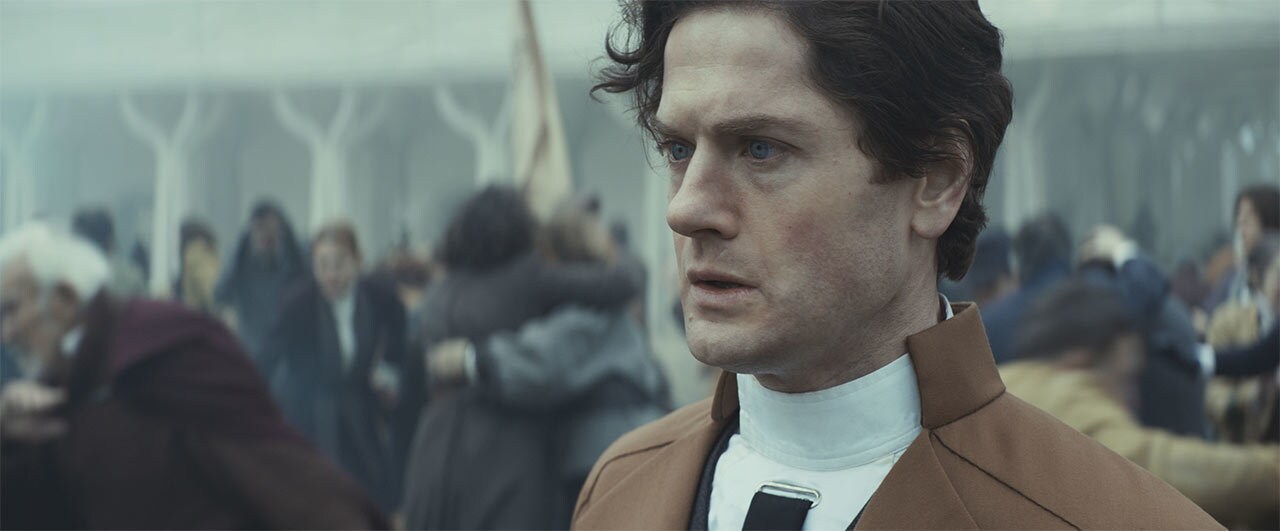
A close up of Syril's face as a panic crowd is blurry in the background.

Several commentators have suggested that Syril might have had some sort of awakening in these moments, and Disney’s official episode guide seems to support that reading as the episode summary states: “[Syril] comes to the realization that he’s been a pawn for the Empire’s machinations.” It’s easy to want to look for redemption for Syril. While he’s not a sympathetic character, we do come to know him intimately over the course of two seasons, from seeing the inside of his bedroom and how his mother treats him to the manipulation from his partner, Dedra. But, he’s always been an active part of the Empire. He wasn’t swept up into it out of necessity or drafted into the stormtroopers or even just passively involved. One of the first introductions to Syril is while he attempts to create an even more stringent sense of law and order on Ferrix. It’s his dream to be recruited by Dedra to be a spy, even if the reason for his spying is at first a lie. To me, what makes Syril such a compelling and well-written character is not this moment where he perhaps regrets his actions but because he is as dedicated to the cause as Cassian or Luthen. Cassian also has moments where he questions their tactics, but he still has resolve. So does Syril as his opposite.

Meanwhile, as Syril is having these confrontations, Cassian is quick to recognize the gathering in the plaza is a bad idea and will end in violence. As he hurries to check out of the hotel, the bellhop, Thela, tells Cassian, “Don’t worry, you were never here. Didn’t log you in.” This moment demonstrates some of the brilliance of the storytelling in Andor—and I want to point out a similar moment in the next episode. Gilroy and his team take careful pains to show how one resists. The tools are documented, and this moment is one of them. Thela breaks a small rule in order to make sure Cassian remains undetected. When Cassian responds that he hopes everything works out, Thela says: “Rebellions are built on hope.” By giving this key line to Thela, it emphasizes even more that it’s not the great leaders like Cassian, Bix, Vel, and Luthen who make the rebellion work, it’s the small acts of resistance that create great opportunities. As Nemik from season one says in his manifesto: “Remember that the frontier of the Rebellion is everywhere. And even the smallest act of insurrection pushes our lines forward.”

Cassian joins the Ghorman protest outside, trying to find Wilmon, as they both realize the stormtroopers are prepared to “kettle” the Ghorman, cutting off their escape in a great visualization of tactics currently being used against protestors in L.A. these past few weeks. Much like Thela’s small act of resistance, Gilroy and his team also show the tactics of empire to disrupt protest. The stormtroopers contain the protestors, fly intimidating TIE fighters over the crowds, and, most importantly, they start the violence by killing one of their own people to then pin on the protestors. K2 units are released on the crowd, and their efficient violence and nearly impenetrable armor makes them horrific enemies as they are able to crush people to death. 

In the violent chaos, Cassian still tries to complete his mission of assassinating Dedra, and as he is about to take the shot, Syril finally sees him in the crowd. Syril reacts with an intensity of violence that we nearly saw when he threatened to kill his partner. Now, he turns all that anger onto Cassian, the man he’d hunted and had caused him to lose his job. It’s a brutal fight as they both go for the soft parts—the eyes, mouths—and use whatever weapons are at hand as the Imperial forces continue to massacre the Ghorman. 

Syril is relentless, dragging himself upright after an explosion that Cassian thinks has taken him out. He finds a gun and has Cassian in his sights. With desperation in his voice, Cassian asks: “Who are you?” Cassian’s lack of awareness of Syril’s existence makes Syril hesitate. It’s easy to imagine what might be going through his mind, that the only reason Syril is standing in that plaza, a contributor to a massacre, is because of Cassian, the man he became obsessed with. In that moment of hesitation, Syril is shot through the head by Rylanz.

In interviews, Gilroy and Diego Luna have talked about how they had to fight to keep the line “Who are you?” in the episode, which seems wild. The moment provides so much clarity for Syril’s character—all that hatred for a person who doesn’t even know him. As a piece of anti-fascist media, this moment feels important to the broader message. A necessary tool of fascism is an “other” that can be blamed for the ills of the world. On an interpersonal level, Cassian represents that “other” for Syril (and from a casting perspective, Diego Luna and Kyle Soller replicate the current fascist othering happening in the U.S. right now). This question from Cassian dramatizes how all that hate from Syril is a one-way street and not representative of reality. Rather, Syril was trying to turn something he'd imagined into reality.

After Syril’s death, Cassian and Wilmon escape the plaza. Wilmon chooses to stay on Ghorman to help his girlfriend, a member of the Ghorman Front. In the final shots, Wilmon’s girlfriend Dreena (Ella Pellegrini), attempts to broadcast what happened during the massacre. Wilmon also charges Cassian to spread the story. 

A close up of Cassian's face as he cries listening to the message asking for help for the Ghorman's.

A long shot shows Cassian’s face as he escapes and Dreena's message plays as narration: “We are under siege. We are being slaughtered…” This message contrasts with the news media, which shares the Imperial narrative that the Ghor started the violence and that the dead imperial officers are martyrs (including Syril). 

What makes this episode, and the following episode “Welcome to the Rebellion,” so important is the familiarity of it all. Videos on TikTok juxtapose shots from these episodes with protests actively happening across the country as I write. Someone graffitied an ad for Andor, adding a speech bubble to Luthen’s mouth condemning ICE. Like the best revolutionary media, Andor has captured our current moment. While Gilroy has stated in interviews that this season wasn’t meant to be predictive, the prescience is still uncanny and speaks to Gilroy and his team’s understanding of fascism.

In a recent video post, resistance scholar Dr. Tad Stoermer points out that Andor is “practically an instruction manual” and sums up what he sees as the takeaway: “Resistance, to have any hope of success, requires regular people…to risk, to sacrifice, to lose with no force on their side other than their own will. […] What are you …willing to risk…for a better world you might never live to see?”

--

POSTED BY: Phoebe Wagner (she/they) is an author, editor, and academic writing and living at the intersection of speculative fiction and environmentalism.

Monday, June 16, 2025

Rebellions Are Built on Hope: Andor S2E7

In "Messenger," we return to Yavin, where things have become much more official

Bix and Cassian shown from the waist up on a lush planet. They stand outside their home on Yavin 4, surrounded in greenery.

In episode 2, we have a final shot showing the famous structures of Yavin after watching what remains of Maya Pei’s rebels destroy each other—and put Cassian at risk—with their infighting. Somehow, out of that, we see Yavin 4 has grown into something much more familiar. The organized, rebel activity mirrors what viewers have come to expect from Rogue One and A New Hope. Even so, that history of infighting still remains, and the sharp hierarchy, while helping to organize an army as opposed to Maya Pei’s grungy fighters, chafes against Cassian and other Luthen operatives who have come to Yavin.

Cassian and Bix have settled down at Yavin even though both are still operatives. Bix is in a more stable place of mind after killing the root of her traumas a year ago, and she and Cassian have a beautiful home, which is one of my favorite aspects of the Yavin scenes. In comparison to the gloomy bolthole of Coruscant where Cassian and Bix spent the previous year, the lush greenery of Yavin feels welcoming and peaceful, even as they work to build an army. It’s a glimpse into the type of world they are fighting for.

Wilmon returns with a message from Luthen, asking if Cassian is ready to work. He’s been organizing with the people on Ghorman, and now has a mission from Luthen to assassinate Dedra Meero, the destroyer of their hometown of Ferrix. At first, Cassian rejects the idea. He’s separated himself from Luthen as he helps to grow Yavin, while Wilmon is still dedicated to Luthen’s cloak-and-dagger approach. He accuses Cassian: “You act like Luthen’s the enemy.” But Cassian has a more measured approach to Luthen and says: “That would be easier.”

As I continue to rewatch and write about Andor, Luthen becomes more interesting of a character. He’s not a one-dimensional hero, nor are his tactics portrayed as a warning or villainous. He is a path toward organizing against the Empire. Not the only path, as Cassian is pointing out to Wilmon, but a path that made Yavin possible, even if Luthen left bodies in his wake. As Luthen says in his excellent monologue in season 1: “I’ve made my mind a sunless place. […] I’m damned for what I do.”

While so many characters shine in season 2, I haven’t spent much time talking about Syril Karn, one of the most fascinating characters of this season. On Ghorman, he’s living his dream of being an ISB spy for the empire and working under his girlfriend, Dedra Meero. He’s successfully infiltrated the Ghorman Front, but his position is put at risk when a supposed rebel attack occurs. The Ghorman Front claims not to have done it, but every news outlet is reporting “another terrorist attack overnight” and a continued “terror campaign.” Of course, the use of this word “terrorist” brings to mind the previous episode where Krennic has the great line: “My rebel is your terrorist, something like that.” Of course, Krennic understands the power of propaganda as, in the first episode, he hired a media team to control the story around the Ghorman.

Indeed, Krennic’s plan is coming to fruition, and Pendergast alerts Dedra that they are moving forward with the original plan to mine the planet in such a way as to destroy it. The Ghorman people will be forced to relocate, as the planet will be destabilized.

Dedra and Syril’s relationship feels the strain of this situation. He’s being manipulated, but he doesn’t understand how much he’s actually being shut out as he has no idea the planet is going to be destroyed. His Ghorman Front contact slaps him when he tries to explain the situation, and he begins to realize more is going on than his girlfriend told him. Dedra tries to smooth it over by saying they’ll be rewarded, but his desire to know what is about to happen overwhelms his trust in her.

Meanwhile, the Ghorman Front is struggling. Mirroring the Maya Pei scenes from the first arc, the members are fracturing as they try to decide what to do. Their leader, Carro Rylanz, is only in favor of peaceful protest: “Peaceful resistance is not pretending. It’s the only thing that carries any dignity.” The younger members of the group are looking for more direct action as the Imperial occupation grows worse. Lezine ultimately brings the group back together, reminding them of their shared love for Ghorman.

We also get a quick glimpse of the bellhop, Thela (Stefan Crepon), from when Cassian came to Ghorman to investigate the Front. He’s now joined the group, and when Cassian returns to Ghorman along with Wilmon to take on Luthen’s mission, Thela recognizes him. He warns Cassian about a protocol they have at the hotel in terms of alerting the Imperial occupiers of new arrivals. Like Lezine, I love Thela’s character because he’s a regular person working a service job who still wants to stand up for what he believes in. These characters are powerful inclusions in anti-fascist storytelling because it gives the average viewer an entry point. Not everyone will be Cassian, but anybody can be the bellhop who doesn’t follow procedures exactly and keeps his mouth shut about seeing Cassian come in under a different alias.

I’ll end on a small scene that, like so many of the quieter moments, not only builds out the world, but corresponds closely with leftist/organizing circles. At the beginning of the episode, Cassian is dealing with a blaster wound that isn’t healing properly. Bix tries to convince him to visit a “Force healer” (unnamed but played by Josie Walker), which he wants nothing to do with because he thinks they are all fakes. While they are arguing within the vicinity of the Force healer, she senses his presence and walks over. She offers to try to heal his blaster wound, and she successfully helps him. She also senses via the Force that Cassian has an important part to play in the rebellion and appreciates his clarity of vision: “All that you’ve been gathering, the strength of spirit.”

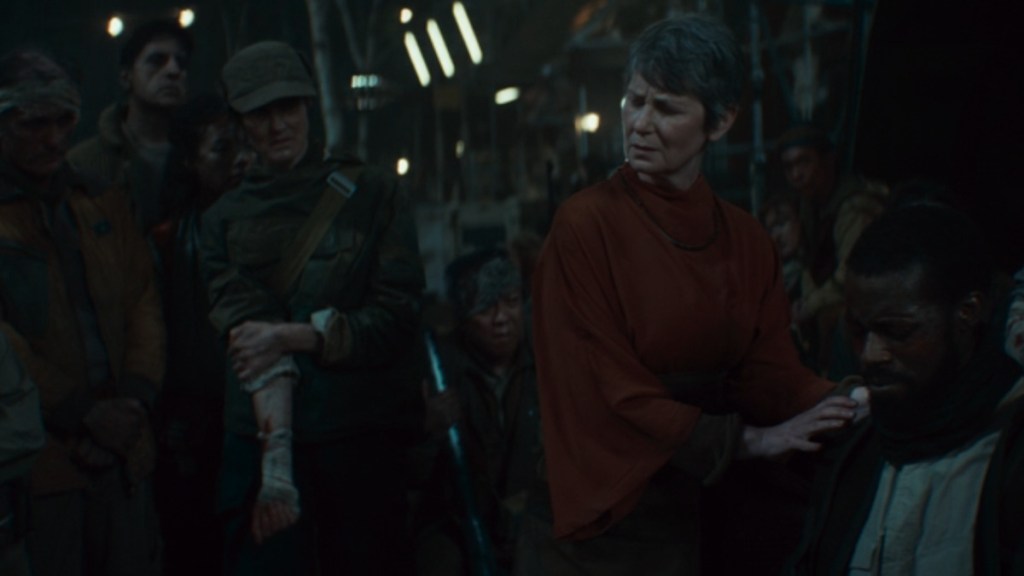
A group of rebels stand around a Force healer dressed in red. She is an older white woman with gray hair, and she has her hands on a person's shoulder with a look of concentration on her face.

What I enjoyed about this scene was how it recontextualizes the Force as an alternative or subversive spiritual practice. In many leftist circles, there’s this reach for something spiritual or holistic beyond Judeo-Christian beliefs. Sometimes, this takes the form of returning to older spiritual practices that have been destroyed by empire, such as Indigenous ways of knowing or pagan/heathen practices. Placing Force-sensitive people like the healer or Chirrut ĂŽmwe (Donnie Yen) from Rogue One in this framework is an interesting addition to the worldbuilding in the way it mirrors actual leftist spaces.

The Force healer also has one of the most beautiful descriptions of Cassian when talking to Bix about what she felt through the Force: “Most beings carry the things that shape them, carry the past. But some, very few, your pilot, they’re gathering as they go. There’s a purpose to it. He’s a messenger.”

Of course, within the context of Rogue One, we know what message he has to carry, but this line also has much more immediate implications for Ghorman.


POSTED BY: Phoebe Wagner (she/they) is an author, editor, and academic writing and living at the intersection of speculative fiction and environmentalism.

Monday, June 9, 2025

Rebellions Are Built on Hope: Andor S2E6

As things heat up on Ghorman, episode six provides an important look into Luthen's character.

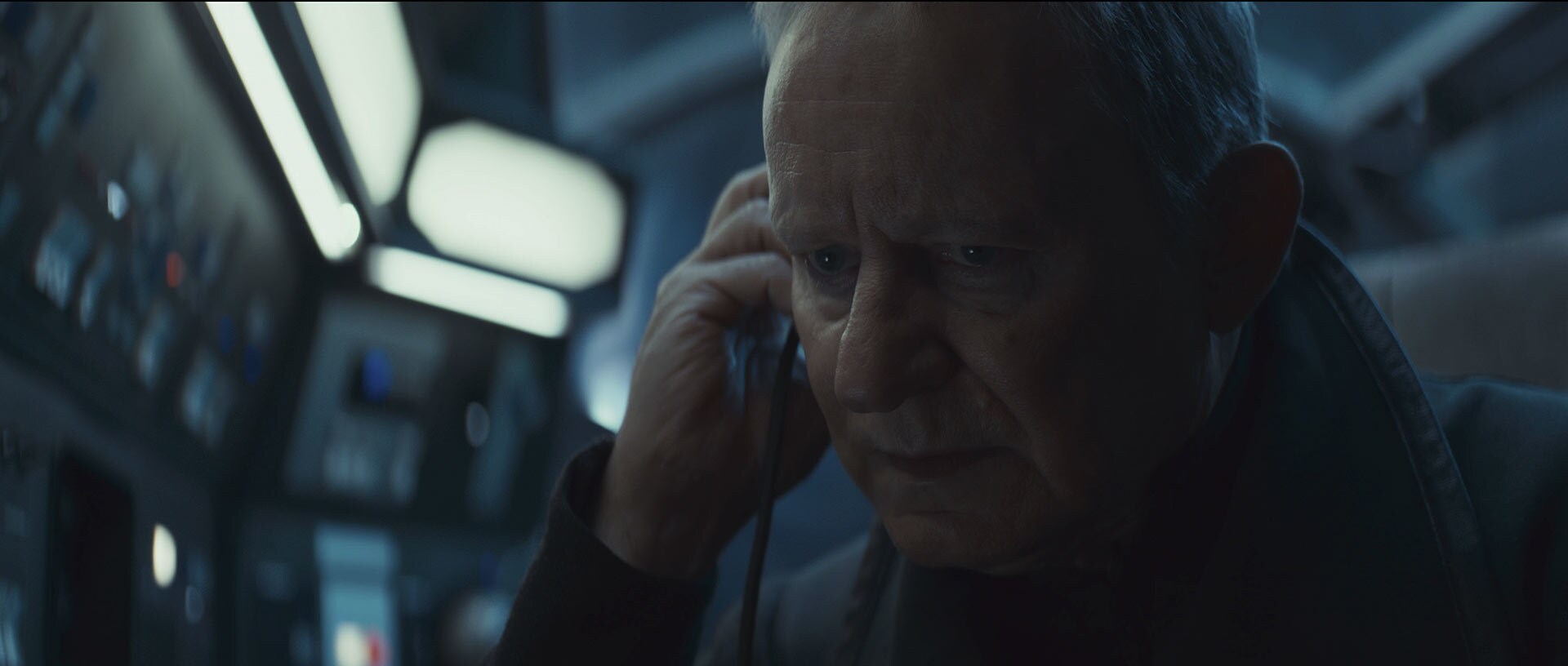
a close up of Luthen's face--an older man with gray hair--as he listens to a listening device. Behind him in dull blues and silvers is a blurry space ship interior.

Episode six, “What a Festive Evening” marks the end of the second small arc out of four. The next arc is, arguably, the most important of the show and a high point in U.S. television. While this episode does not contain the gravitas of the next three episodes, it still has an important job of showcasing that Luthen’s ability as a leader is rarely rooted in kindness or empathy.  

Luthen picks up Cassian still disguised as a fashion designer after his interview with the Ghorman Front, but he’s surprised and disappointed when Cassian says to not be involved: “They started too late, now they’re rushing.” Luthen pushes back, which leads to one of the great exchanges that starts to shift Cassian’s thinking:

Cassian: “I’m thinking like a soldier.”
Luthen: “Think like a leader.”

With Luthen, Cassian obeys orders. He doesn’t think beyond that. He goes where he’s told and completes missions with great success. In order to become the Cassian of Rogue One, though, that will have to change. In season one, Cassian goes from a-political thief to becoming part of Luthen’s team determined to defeat the Empire at any cost. In season two, he needs to become the leader able to inspire a group of rebels to sacrifice themselves to deliver the Death Star plans. This exchange with Luthen begins to mark that change in Cassian. 

But, Luthen doesn’t listen to Cassian. On Ghorman, Vel (Faye Marsay) has now arrived, unbeknownst to Cassian. She’ll be working with her former lover from the Aldhani heist, Cinta (Varada Sethu). Vel told Luthen she’d only take the job if Cinta were on it. Their love rekindles, and they both realize that it is Luthen keeping them apart. Much like Luthen’s meddling with Cassian and Bix’s relationship, Vel says that she and Cinta are worth more to him apart than together. To Luthen, they are tools in his mission to destroy the Empire at any cost—not to support them as full human beings.

Together, Vel and Cinta try to teach the untested Ghorman Front how to run an operation. While the Ghormans chafe under their orders, they agree to work together and do as they’re told, including remaining unarmed. At first, the heist to steal the secret imperial weapons—organized by Syril to trap the Ghorman—goes smoothly, until one of the Ghorman, Lezine from the townhall, arrives and wants to know what’s going on. Another Ghorman pulls a gun on him, a struggle ensues, and ultimately Cassian’s prediction comes true. They weren’t ready. They didn’t follow orders and brought a gun when only Vel and Cinta were supposed to be armed. 

The gun goes off—and Cinta dies.

As they escape with Lezine carrying Cinta’s body and Vel struggling to contain her emotions, she says one of the great lines of season two. To the young rebel who accidentally shot Cinta and is now breaking down into tears, she says: “This is on you now. This is like skin.”

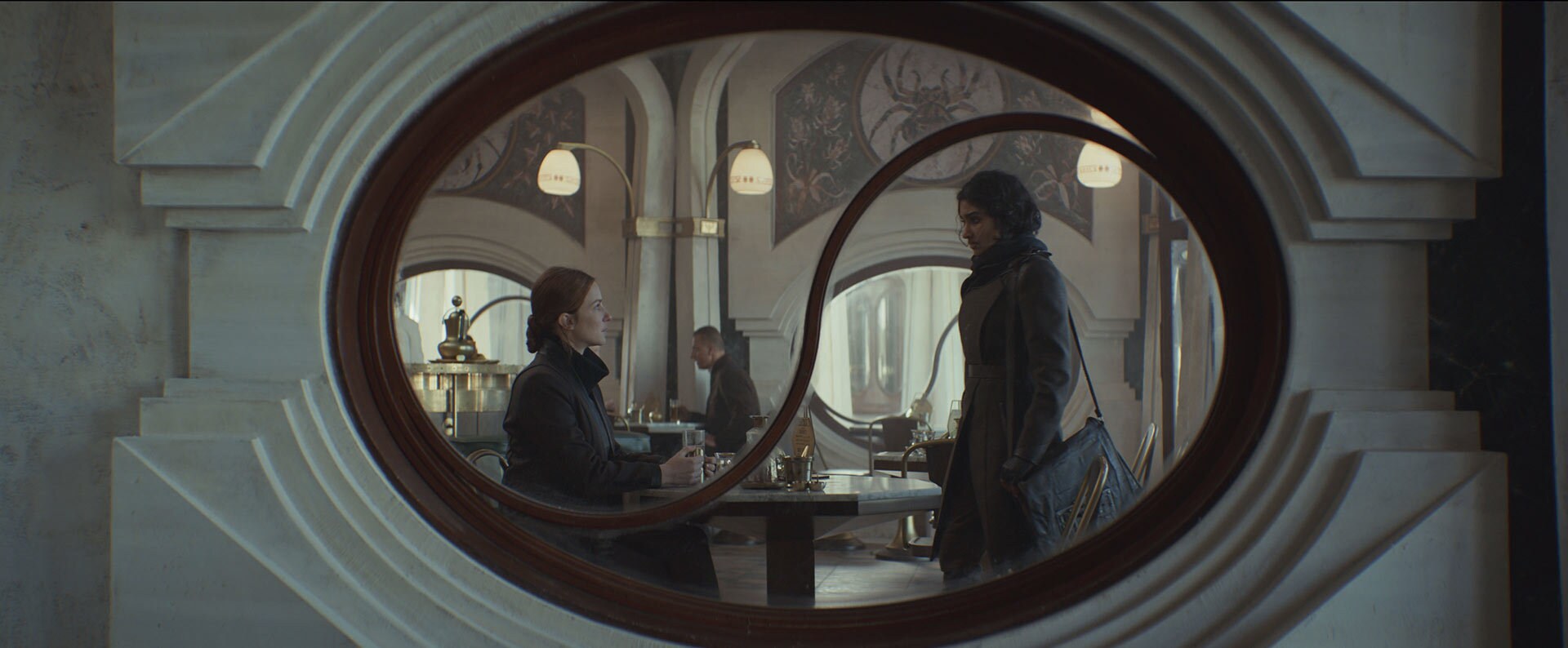
Vel and Cinta face each other in a fancy tea shop. Vel is sitting a table while Cinta stands before her.

Meanwhile, Luthen and Kleya have their own problems as a listening device they planted in an antique in Davo Sculden’s home is about to be discovered. They get dressed up and party with the Imperial officers and politicians, including Mon Mothma and Director Orson Krennic. In one of the standout performances of the episode, Kleya must sneakily remove the bug right in front of Krennic. Much like this whole three-episode arc, this party sequence leans into Tony Gilroy’s previous work on spy films. As the tension rises, though, we also get to see two incredible actors traded barbs from opposite sides of the aisle as Mothma needles Krennic. She greets him immediately with: “How pleasant to see you free of the witness stand,” which prompts the snarky back and forth. 

While Mothma is unaware that Kleya is trying to remove a listening device, the rising tension between her and Krennic is the perfect cover for Kleya, leading to one of Krennic’s great lines: “My rebel is your terrorist, something like that.” Of course, this is the great irony of watching any Star Wars property in the twenty-first century. The actions the “good guy” rebels take are what the U.S. government would label as acts of terrorism (this is especially clear in Rogue One where Saw Gerrera’s forces are dressed to look West Asian). While many commentators have made this connection between rebel/terrorist in the past, Andor including it so openly in the dialogue continues to build the antifascist narrative as clearly as possible.

The episode ends on two high notes. As Luthen and Kleya walk out, they joke that they should have offed Krennic at the party, which, considering all the pain that Krennic and his Death Star cause, is a darkly funny moment. Additionally, the episode ends with a delightful moment of revenge. Luthen sends Bix on a mission to kill the man who tortured her. We learn earlier in the episode that his method of torture was so successful that the Emperor wanted to expand it—but Bix gets there first. She puts him in the chair and leaves him to the same torture he put her through. On the way out, Cassian blows up the building as they walk away in an epic shot. One of my favorite small details about that moment is, on the soundtrack, Nicholas Britell titled that track “The Bix Is Back.”

While this trilogy of episodes doesn’t end on the high note of “Harvest” in the first arc, it does set up the viewer for some of the best television I’ve seen in years—perhaps some of the best storytelling Star Wars has to offer. Importantly, we see Luthen beginning to crack. While he’s been effective in building the rebellion in the early stages, as it continues to grow and face opposition, he and Kleya struggle, even leading him to say to her: “We’re drowning.” He’s never been the comforting type to Cassian or Bix, but as he struggles to defeat the Empire at any cost, the people under him suffer. 

But even so, the rebellion is growing and spreading….


POSTED BY: Phoebe Wagner (she/they) is an author, editor, and academic writing and living at the intersection of speculative fiction and environmentalism.

Tuesday, June 3, 2025

Andor and the Reimagining of Star Wars

Star Wars, as a franchise, is almost 50 years old. It remains extraordinarily popular—as much or more than any other cinematic universe. At the same time, nearly all Star Wars properties are divisive in some way.

As I noted in the introduction to our special series Star Wars Subjectivities:

...search around the internet and you'll find many a lengthy opinion piece on which Star Wars properties are good and which ones are bad. Some will be Original Trilogy fanatics like me, others will tell you how secretly great the Prequels are. Others still will opine on how The Last Jedi is really a Top 3 Star Wars film sandwiched between two cinematic commercials for Disney theme park rides.

This is not only true for the films, but also for the various television shows, animated series, video games, books and comics that bear the Star Wars logo. Except Andor. I have yet to meet someone who loves Star Wars but dislikes Andor. Sure, I've met people who found the first season a bit dry and joyless (as I did, at the time), but not one fan who thinks it's bad. Nearly everyone—fans and critics alike—agree that it's good. Many think it's the best Star Wars property ever made.

I'm too heavily invested in the Original Trilogy to go that far—after all, it did change the way we think about movies. But after the masterpiece that is season 2, I think there's a serious case to be made for Andor. I want to delve deeper into why this show is so compelling to so many people—and, in the spirit of Star Wars Subjectivities, why it is so compelling to me.

(Before getting started, I'd like to note that Phoebe has written extensively on the show, including a great review of Andor Season 1, as well as an essay for Star Wars Subjectivities on Andor as community action—and is currently running a weekly review series breaking down each episode (ep 1, ep 2, ep 3, ep 4, ep 5). All are must reads, if you ask me. This will be a complementary take.)

Andor is a grown-up story for grown-ups

Star Wars has always tried to thread the needle between its two core audiences: adults and children. I discovered the Original Trilogy as a boy—and it captivated me the way media only can when you are that age. But the genius of the Original Trilogy is that it continues to captivate as you grow older. However, when George Lucas launched the prequel trilogy in 1999, it was obvious to all of us who were now teenagers or adults that these films were not aimed at us, but at a new generation of children. At Cannes in 2024, Lucas said that people like me were just grumpy because we weren't looking at the films through 10-year old eyes.

It's true that I never saw the prequels through 10-year old eyes, but I have consumed a metric ton of children's media over the years—as an adult—and can say with confidence that The Phantom Menace and Attack of the Clones are not good, not even by the relaxed standards of children's media. As I wrote about The Phantom Menace:

The writing is bad. The acting is bad. The direction is bad. The production is bad. The pacing is bad. The design is bad. The effects are bad. The characters are bad. The plot is bad. The concept is... well... okay, maybe this could have actually been a good movie, in theory, but unfortunately... the execution is, in a word, bad. Like, bad on a very basic, fundamental level.
Or as Vance more succinctly put it in his piece on Attack of the Clones:
Of all the millions of stories that could exist in that galaxy far, far away, Lucas picked the wrong ones to tell in these prequels.

Nearly everyone, including yours truly, agrees that Revenge of the Sith is a much better film. The story is actually interesting—and highly political, weaving the tragedy of Anakin's turn to the dark side alongside the broader tragedy of the Republic's dissolution and the death of democracy. It has its cringe kid content moments ("Nooooooooo!"), but ultimately Revenge of the Sith aspires to be a serious film for whoever is watching, regardless of age. Like the Original Trilogy, Revenge of the Sith successfully threads the needle between its core audiences.

Most Star Wars content since has attempted the same feat. In the Disney era, this has worked sometimes (e.g. Mandalorian, Ahsoka) but more often not (e.g. Solo, The Book of Boba Fett, Obi-Wan). You could argue that success just boils down to quality, but the fact is that designing content for the broadest possible audience usually leads to bland, mediocre fare that is passable to everyone but not great to anyone.

Perhaps for this reason, Disney has recently grown more and started to develop properties specifically for each audience. I'm focusing on Andor here, but Skeleton Crew is also worth mentioning—it's a true kids' show designed for parents to watch with their little ones. And it's good!

Meanwhile, Andor is a mature show written for adults, a complex political drama set against a dark background, featuring hard-boiled characters who shoot first and don't fight according to Queensbury rules. There are no adorable creatures, no comic relief characters and no Jedi. Instead, there are real people struggling against very real oppression, making tough choices that don't always work out—and which almost always come at a high cost. Yet it is also a moving, sensitive and stirring portrayal of those people and the terrible world they were born into. I'm still astonished that this is a Star Wars story—and that it is almost the exact Star Wars story I've long wanted to see told.

The best Star Wars stories enhance the Original Trilogy; the worst cheapen it

This is something I've been chewing on since we ran Star Wars Subjectivities back in 2023. The Original Trilogy is the keystone for the Star Wars universe. All subsequent works—whether in film, television or other media—are essentially contextualizing those films. More precisely, they try to either (a) help you understand why things happen the way they do in the Original Trilogy; or (b) explore the aftereffects and consequences of what happens in the Original Trilogy. The good stuff adds richness, depth and gratifying exposition to a story with a lot of whitespace, or render something silly, well, less silly—in all cases enhancing the Original Trilogy.

Consider this example: In A New Hope, we learn that rebel spies managed to obtain plans for the Empire's Death Star. When Darth Vader boards the Tantive IV, he is specifically looking for those plans—which Princess Leia gives to the droid R2D2, with instructions to hand them over to the Jedi Master Obi-Wan Kenobi. The plans demonstrate a fundamental weakness in the Death Star's design, which the Rebel Alliance hopes to exploit, thus winning a first major victory in their rebellion against the Empire.

Rogue One tells the story of how those rebel spies obtain the plans and transfer them to the Tantive IVAndor then gives us the backstory for one of its main characters, Cassian Andor. But it doesn't only do that. We get a deep dive into Mon Mothma, the political leader of the Rebel Alliance—who has a small but compelling role in Return of the Jedi. And we get to see the Rebellion—and the Empire—from a range of perspectives, from Senators to regular people (none of whom, I'll note, are lightsaber-wielding Force sensitives of destiny).

In every way possible, Andor fleshes out the story and world presented in the Original Trilogy, enhancing our understanding of what happens, why it happens and who is important to the story it tells.

Contrast this with the Disney-era Sequel Trilogy. In The Force Awakens, director JJ Abrams eschews the opportunity to explore the New Republic's struggles to govern under the power vacuum left by the Empire's dissolution (which all of us who participated in this roundtable were keen on), in favor of... just remaking A New Hope with new, less interesting characters and cheaper-looking sets. As Haley put it, Abrams remade A New Hope for Gen Z. And that's probably the nicest way to put it.

The Last Jedi is more daring, but its aspirations are weighed down by inconsistent writing and direction, plot holes and—again—the misguided urge to just remake a film that everyone already loves (in this case, The Empire Strikes Back). As I wrote in a (fairly grumpy) review back in 2017:

This brings us to the on-going Disney trilogy, which so far has presented a vision of... the exact same one as the Original Trilogy. Actually, there is a mild subversion of the original trilogy’s meta-narrative, but one so mild that it's barely a critique. Once again, we have a ragtag group of plucky individuals who confront immense power and (are sure to) triumph against all odds. And the films hit you over the head with the referential frying pan. Starkiller Base from The Force Awakens is the Death Star, but bigger! Kylo Ren is Darth Vader, but emo! Luke’s island is Dagobah, salt planet is Hoth, casino planet is Cloud City and so forth and so on. It's the same old same old, only with crappier design and little romance—the kind of thing dreamed up by corporate executives with checklists in hand and theme park rides in mind.*

So how does the Sequel Trilogy function as Star Wars canon? Not well—and especially not well when the big reveal occurs in Rise of Skywalker (which all of us in the Disney Star Wars roundtable agreed is the worst of the three). All it achieves is to make the Original Trilogy less consequential in terms of canon, while rendering the few redeeming bits of The Last Jedi null and void in favor of insipid fan service that didn't even appeal to the fans who complained about The Last Jedi. I can say one good thing about it, though: it features such an unsatisfying ending that this instantly rendered all those contrarian critiques of Return of the Jedi null and void. After all, why would anyone complain about that ending when there's another one that's so drab, colorless and utterly devoid of life?

We finally see the Empire for what it really is

Back to Andor, this is the first major piece of Star Wars media where we truly see the Empire for what it is. And I don't mean that we get a quantitatively higher level of grimdark badness (the Empire destroys a planet in A New Hope, after all, and it's hard to get much worse than that). What I mean is this: in Andor, we get to see how Imperial rule is experienced by noncombatants; we get to see what animates the Imperial project; and we come to understand why the Empire behaves the way it does.

These are not zealots of the 20th-century grimoire, animated by nationalistic hatreds, a radically remade society or a murderous desire for purity. Rather, the Empire is more or less a traditional empire. It is a fundamentally extractive enterprise, the way Dutch colonialism was fundamentally extractive in present-day Indonesia—that is to say, the Empire is motivated by the straightforward desire to take and hoard.

For example, in Season 2, we learn that Director Krennic needs a mineral called kalkite for his top secret Death Star project; a rich source of the mineral exists beneath the crust of the planet Ghorman, a sparsely populated colony world whose leadership had backed the Separatists during the Clone Wars, but mining the kalkite from Ghorman would render the planet unstable—and unsuitable for habitation. Krennic gathers a council of officials from the various military branches, directorates of the Imperial bureaucracy and, of course, the Imperial Security Bureau (ISB) to discuss their options. The meeting is straightforwardly designed to evoke the 1942 Wannsee Conference, where a group of 15 Nazi officials decided to exterminate Europe's Jewish population (as Tony Gilroy himself has stated).

But while there's no doubt that the Empire will commit genocide, if it decides that doing so will further its goals, the Empire isn't motivated by any specific hatred for the people of Ghorman. Rather, the people of Ghorman are an inconvenience, as is the need for their removal—so the conspirators decide to look for alternatives, but ready a plan to reduce any blowback they might face if they ultimately decide to commit genocide and the mass ethnic cleansing of the planet.

Despite the aesthetic similarities between the Empire and Nazi Germany, this is not at all like the Holocaust, which was the culmination of several decades of consistent, ideological antisemitism from a political party founded on the premise that Jews were to blame for just about everything. It is, I'd argue, much more like the atrocities committed by both land-based and seafaring empires: there was something the empire wanted, there were people in the way—and if there was no more expedient way to take it, they would deploy extreme levels of violence to get it. This is bad, by the way—very bad; just not bad in the specific way the Nazis were bad, or as consistently bad as the Nazis were.

For me this as a refreshing take. Popular media routinely ignores 95% of human history while obsessing over a few historical cases, relating anything and everything to said cases. But there is a lot more material to draw on, and the fact that Andor steps out from the shadow of the ever-present Nazi analogy to portray the Empire in ways that evoke other things is, to me, one of the things that give the show depth.

Andor is about people making difficult choices

One of the show's main subplots focuses on the radicalization of Mon Mothma, who by Return of the Jedi has become the leader of the Rebel Alliance. But when we are introduced to Mon Mothma, she is if anything a beneficiary of the Empire. That is not to say she supports the Empire (we know she does not), but that her class privilege—being a wealthy, connected human from the core worlds—gives her the option to pretend the evil isn't happening and keep living her life of luxury. She does not, but we see, by the end, most members of her social circle will choose to follow the path of least resistance.

This contrasts with life outside the core worlds, where societies are mixed (human and non-human), few people are rich, life is harsh and the decision to rebel is more often imposed than chosen. As it is for Cassian Andor. Resistance, though, comes in many forms—and requires many kinds of sacrifices.

Andor portrays a range of resistance fighters—from the patrician senators Mon Mothma and Bail Organa to art dealer turned spymaster Luthen Rael and his indefatigable protĂ©gĂ© Kleya Marki (played by a scene-stealing Elizabeth Dulau); from the hard-boiled Cassian Andor and Lezine to Supervisor Jung, Luthen's mole within the ISB. None are "chosen," none are Force sensitives; all are simply people trying to do the right thing as best they can under terrible circumstances. These are heroes every resistance movement can claim, from the mighty to the ordinary. All play their part, at great cost, because they cannot simply stand by.

Andor isn't just great Star Wars; it's great science fiction

If it isn't clear already, I see Andor as a triumph. It is—easily, in my view—the best Star Wars story since the Original Trilogy. It achieves this feat by taking bigger, bolder risks than any other film or series since Return of the Jedi hit theaters in 1983.

But it isn't only one of the best Star Wars stories ever told—it is also one of the best science fiction stories ever developed for television. Indeed, if you were to swap out all the Star Wars content and replace it with standard space opera content, it would be just as effective a story. This is rarely true, even for the Star Wars stories I love. It is very difficult for me to see, to cite one example, how The Mandalorian would work outside a Star Wars context—and I love The Mandalorian.

Hats off, then, to Tony and Dan Gilroy, to Diego Luna, Stellan SkarsgĂĄrd, Genevieve O'Reilly, Elizabeth Dulau, and to everyone else involved in the making of this absolute masterpiece.

***

(My view is not an institutional one. There are other ways of looking at all these films and shows, which are well represented across our flock. Haley loves the prequels—all the prequels. Paul enjoyed The Force Awakenseven I did the first time around, as did Joe. Arturo has argued that The Last Jedi is significant, in that it redefines what it means to be a Jedi—and then poses a novel theory, that the film is about the meaning of fandom. It's definitely an interesting theory, one worth engaging with.) 

***

POSTED BY: The G—purveyor of nerdliness, genre fanatic and Nerds of a Feather  founder/administrator, since 2012.