Showing posts with label Golden Age of Television. Show all posts

Tuesday, May 21, 2019

How to End a Game of Thrones

It was the best of times; it was the blurst of times...


[Warning: Spoilers Everywhere]

The year was 2006. My fiction reading list was maybe 60% science fiction but 0% fantasy. It had been this way for years, after my love for second world fantasy died on a hill called The Wheel of Time. Subsequently, I had internalized normative cultural discourses that devalue fantasy unless packaged as “magic realism.” Former NOAF contributor Jemmy, however, had other ideas.

At that time we were working for the same company, our offices strategically located in a neighborhood famous for its second-hand bookstores. We would often visit them during our lunch hour; without fail, Jemmy would pester me about this fantasy series that he claimed “changed everything.” But I was resistant, that is, until he bought me a copy of George R. R. Martin’s A Game of Thrones and I relented.

So I read the first chapter, and then the next, and then the next. Within a few days I had devoured A Game of Thrones in its entirety, proceeding to devour its sequels, A Clash of Kings and A Storm of Swords. I couldn’t get enough, so I moved on to other series; I was most definitely back on the fantasy train.

I have issues with those 3 books, some quite serious, but for my money the worldbuilding, character development and punctuated narrative moments are as good as any in the genre. Furthermore, despite their heft, these books feel meticulously planned, tightly plotted and rich with narrative detail. Most importantly, they revived my interest in fantasy and led me to discover a range of authors I otherwise might not have read: Andrzej Sapkowski, Gene Wolfe, Elizabeth Bear, N.K. Jemisin, Steven Erikson, Kate Elliot, Django Wexler and many others.

I like to think of those first three books as a complete trilogy with an ambiguous ending. It’s a coping mechanism that helps me deal with the fact that the next two books - A Feast for Crows and A Dance with Dragons - are such disappointments; a single, bloated novel in two 1,000-page installments; a failed attempt to “get to Mordor” that aptly demonstrates the importance of a good editor in no uncertain terms. And it helps me deal with the fact that Martin may never finish the series.


Enter the Series...

When Game of Thrones launched in 2011, I was excited. Early indications suggested HBO would go all out adapting the series. Like many fans of the book series, I hoped this it would serve as a catalyst for Martin to finish the series. Instead, it has finished the story for him. But more about that in a bit.

The initial season was a masterful adaptation of the first novel, which is far tighter in both narrative and geographic scope than its sequels. Many of the actors looked and felt exactly like their written counterparts; some – like Jorah Mormont and Tyrion Lannister – were an improvement.


The second through fourth seasons captured much of what made A Clash of Kings and A Storm of Swords effective as novels, though they also amplified the shock value of their punctuated moments. In truth, there’s nothing in the show that isn’t also represented in the books, but the show frequently makes explicit what is relayed secondhand or merely suggested in the books. To put it another way, the books already make it clear how common murder, rape and torture are in this world, but the show positively revels in it. The effect is to cheapen their impact; we are frequently shown how grim and dark this world is, but little or no time is spent on exploring the implications and consequences of all the grim darkness. Not in any meaningful way, at least.

On the other hand, the show pulls off a fairly remarkable feat: adapting a sprawling fantasy epic for a medium that can do plot and character, but routinely struggles with the kind of myth- and world-building that are essential to second-world fantasy.

As with the books, though, things degenerate once the moves on to interpreting A Feast for Crows and A Dance with Dragons. Though mercifully eliminating the horrid Quentyn Martel storyline, nearly everything else that made those books a tedious slog is recreated for television (only now with more rape and torture!). The low quality of storytelling from these books mars seasons 3 and 4, and (in my view) outright ruins seasons 5 and 6.

In season 7, Benioff and Weiss officially moved past the source material altogether (though apparently with some input from Martin). Like many fans, I was deeply skeptical of their ability to right the ship. In fact, I probably would have quit the series if I hadn’t been worried that this was the only ending we’d ever get. Only, I found the experience oddly liberating – for the first time since season 2, I wasn’t comparing the show negatively to the books, even to the books I didn’t care much for.

Season 7 has its share of head scratchers - most notably, Jon Snow’s incredibly stupid plan to risk half the elite warriors under his command on a commando mission to bag a wight to show Cersei (who, predictably, is unmoved). But it was dirty fun.

The narrative decisions in season 8 are better, but nearly all require more exposition than they are given. Danaerys becoming the “Mad Queen” is a perfect example: history is replete with individuals who begin as idealists and end as ideologues; who through struggle come to believe the ends justify the means; or who believe the justice of the cause confers infallibility onto its avatar.

By the season finale, It is clear Danaerys has become all these things - only we haven’t made that journey with her. Rather, it happens so fast that you’re left wondering if it was something Tormund said, or that time Jon didn’t want to kiss her. It would have been much better, and much more believable if we’d had a few more episodes of developing paranoia and anger.


The season finale is, in a word, polarizing. Long-anticipated series finales often are, and several times I’ve been on #TeamKvetch (e.g. BSG). But I found this denouement quietly gratifying.

Bran becoming king is a bit weird, until you realize the whole point is to devalue kingship. And I was neither here nor there on Arya the Pirate (though what a great spinoff that would make). On the other hand, I Ioved Sansa asserting the independence of the north - regardless of the fact that her brother sits on the proverbial Iron Throne. Jon rejoining Tormund and Ghost felt equally appropriate, as did Brienne honoring Jaime in the annals of the Kingsguard - a touching act that almost helps you forget that bizarre moment when their friendship became gratuitously (and unnecessarily) sexual.

My favorite moment, though, comes when Tyrion waits for the new Small Council - which includes Brienne, Sam and new Lord of Highgarden and Master of Coin Bronn - and nervously keeps adjusting the chairs. It’s a tiny detail, but one that speaks volumes to the endurance of hope.

I don’t know if Martin will end his books the same way, or if he will ever end them at all. I certainly hope he does. But if he doesn’t, then at least we have this - a poignant and cathartic end to the journey we started so long ago.

Friday, September 1, 2017

How I Learned to Stop Worrying and Start Watching GAME OF THRONES Again

Winter is an asshole


[Warning: spoilers everywhere]

I'll admit I'm not the biggest fan of HBO's Game of Thrones. I'd read the first four A Song of Ice and Fire books twice by the time the show debuted in 2011, and have strong, positive feelings about the first three. I love the characters, the meticulous detail that George R. R. Martin put into world building, and the lore. And of course on top of that, the books are impossible to put down. I spent many a night prying my eyes open by sheer force of will, determined to find out what happened next.

Then came the show, which in its first season seemed like a near perfect distillation of A Game of Thrones. The actors embodied the characters they played; the sets brought Westeros to life; and the lore--it was there too. I was beyond excited for Season 2, when the show would move on to the events portrayed in my favorite of the books, A Clash of Kings.

Only, I found myself slowly falling out of love with the show. You see, it's impossible to capture all the detail of a 700+ page book in a 10-episode season, and that was doubly true once the scale of the drama shifted from the closed-door intrigues of A Game of Thrones to the cross-continental wars of A Clash of Kings. So the writers and producers had to pick and choose what they would bring to screen, as well as take some shortcuts. All quite understandable, really.

Unfortunately, they chose to emphasize what are to me the most problematic and least attractive elements of the books, namely, their excess of cruelty and sexual violence. And the show didn't *just* emphasize these elements; it made them more central, upfront and over-the-top. Meanwhile, I was getting less of the things that made reading the books a magical experience for me--less than I wanted, at least.

At the same time, the source material was still really good, so despite having issues with the show, I was still getting a visually arresting, immersive television adaptation of books I really liked. Thus I could hold out hope that show might actually fix A Feast for Crows and A Dance with Dragons, the latter of which I found simultaneously tedious and splatterpornographic.

I would be disappointed, as the show retained most of the tedium and, once again, chose to amplify the splatterporn. The worst came in Season 5, which lingered on some of the most agonizingly boring storylines in A Feast for Crows (e.g. the sparrows, Dorne) and then chose to depart from the books in order to burn a child alive at the stake. That was it for me. I was done.

Only, then Season 7 rolled around--the first that would not have Martin's novels as a guide.* And given that we're still waiting for The Winds of Winter, six years after A Dance with Dragons, there's a good chance that the book series will never be done. So for those of us who've invested a lot of time and thought into the story, this may be the only form of closure we ever get. I decided to catch up with Season 6--which was very good at points, and not very good at others. But I was excited again, more than I had been since the start of Season 2.

[*The show moves past the books midway through Season 6, to be precise.]

So how was Season 7? To quote...


"It Was the Best of Times...


Season 7 is, in a word, campy. But don't take that the wrong way--campy can be great too. And this season was gratifying in a lot of ways.

To begin, I appreciated the shift in how the show treats sexual relationships. Both Game of Thrones and A Song of Ice and Fire are very rapey. The books feature more rape than the show, while the show makes up for that by making every rape graphic and in-your-face rather than, say, a reference within in conversation. The low point, for me, was Sansa's rape by Ramsey in Season 5 (which, one notes, is not in the books). Season 7 stops using rape as a go-to device to illustrate how grim and dark this world is. And as far as I'm concerned, that's a very positive development.

But that's not all. Season 7 also allows its characters genuinely romantic moments, so much that the contrast with previous seasons is immediately striking (Jon's doomed relationship with Ygritte notwithstanding). And somehow, among all the things that don't make sense about Season 7 (more on that later), the budding romance between Jon and Danaerys does--on a personal level, at least.

I also appreciated the renewed focus on action. One thing Martin does exquisitely well, and which has also translated well in the TV adaption, is maneuvering chess pieces to build tension and momentum toward rare but superbly-rendered set-piece action scenes. Well, the first 3 books/4 seasons of the show do that at least. In truth, the maneuvering got really wearying in A Feast For Crows/A Dance with Dragons, as well as in Seasons 5 and 6 of the show, where it essentially became an exercise in wheel spinning. So it was nice to see the producers de-emphasize intrigue in favor of more action. That's what the series needs at this point. Even Euron Greyjoy, that most ridiculous and cartoonish of characters, stops talking long enough to give us an epic sea battle.

Trogdor!!!!! I mean...Drogon!!!!!
Also welcome, while Season 7 contains a lot of violence, it doesn't linger on moments of cruelty like the show has previously, to ever-diminishing effect. That breaks the cycle of always needing to go further, from rape to torture to castration to child sacrifice. Instead, we get dragons burninating the countryside--a moment we've all been waiting for. Hell, I don't even think I'd mind if the rest of the show was just Danaerys engulfing the show's many villains in flames. Especially Euron. That guy's annoying as shit.

If that means Game of Thrones feels a bit more like an Arnold Schwarzenegger film, and a bit less like I-Claudius-with-extra-splatter, then that's okay in my book. Oh, and Littlefinger getting punked by badass sisters Sansa and Arya? That was a lot of fun.


...it was the Blurst of Times."


As much fun as Season 7 is, it's also littered with incongruities, plot holes and absurd narrative devices. Readers/viewers who have invested a lot of time and energy into the story may be on board with the shift in tone (emphasis on may), but most I've spoken to are frustrated with the decline in plotting.

The most obvious sign is the emergence of teleportation in Westeros. Armies traverse land or sea in hours rather than days or weeks, while ravens deliver messages instantaneously--from the northernmost to southernmost points of the Seven Kingdoms, no less. I get that the writers need to speed things up, but this strains credulity.

Worse, in my opinion, is the revelation that Jon isn't just the child of Lyanna Stark and Rhaegar Targaryen, but the legitimate heir to the throne. Because apparently the High Septon annulled Rhaegar's marriage to Princess Elia Martell--for reasons unknown and despite their having multiple children--and simply didn't bother to tell anyone about it. Oh, and Jon's real name, Aegon Targaryen, is already the name of Rhaegar's other son.

WTF is this garbage
This isn't just implausible, though it is certainly that. Rather, it's the show reverting to that hoariest of hoary fantasy tropes: the proverbial pig farmer who turns out to the the prophesied one, which in turn allows him to ascend to the throne and marry the princess without upsetting the precious class hierarchies of medieval pseudo-Europe.

In doing so, the show violates a core tenet of Martin's novels: that the true heroes are not the obvious heirs, but rather the outsiders and castaways. Not Ned, Robb, Stannis, Viserys or Jaime, but Jon, Arya, Davos, Danaerys and Tyrion. (Also Sansa, but only after circumstances force her to shed her insider status.) The pig-farmer-to-prince trope does away with that by telling us that, appearances notwithstanding, the outsider was in fact never an outsider at all. It's corny, and actually kind of fucked up when you think about it. To be a hero, you have to be born with a hero's blood in your veins. I have a very hard time imagining that Martin signed off on this one; it feels like an innovation born of convenience by people who are now adrift at sea without the sage as their navigator.

The absolute worst thing about Season 7, though, is Jon's ill-fated quest to bag a wight. Why does he do this? To convince Cersei, the entirely self-interested and wholly dishonest usurper of the throne, to join up in the fight against the Night King and his army of undead warriors. This is, prima facie, a bad idea because, as I mentioned, you simply cannot trust Cersei to do anything but look out for herself. It is also a baffling idea because, as we see in Episode 4, Cersei no longer has an army to offer.

Even if Jon doesn't get this at first, you'd think that someone would tell him. Danaerys, for example, who crushed the Lannister army and executed its Warden of the South (and his heir).  Or Tyrion, who watched it happen and is allegedly a pretty smart fellow.

The smart play, of course, would have been to occupy Highgarden. It is the breadbasket of Westeros, its castle is currently unoccupied, and the one-time army of occupation done got burninated. Cersei's ability to raise another army, and keep it loyal over time, is predicated entirely on her access to the riches of Highgarden.

But no! Instead Jon, one of the two most important figures in the fight against either Cersei Lannister or the Night King, traipses off north of the wall with a motley crew of other important figures in order to bag the wight, only to attract literally the whole army of the dead. So what do they do? They call Danaerys via insta-raven, who shows up with all her dragons. The Night King throws an ice spear through Viserion, who then becomes a fucking badass ice dragon. And at the end of the season closer, Viserion the Ice Dragon burninates (freezinates?) the Wall.

Cool, but...
The emergence of an ice dragon in and of itself is not surprising--Martin did wrote a novel called The Ice Dragon, after all. But it only happens, in the show, because Jon starts acting a careless idiot, risking everything for nothing, when he could have risked far less for much more. Now, thanks to his stupidity, the wall is toast, the Army of the Dead is on the march and the Night King has a fucking ice dragon.

This is a hallmark of bad writing, to the point where it has a name (coined by SF writer James Blish, no less): the idiot plot. It's clear, in my eyes at least, that the writers are now just looking for the fastest way to get their ducks in a row. And in this case, the duck is a dragon on the other side of the wall.


Conclusion: Dumb Fun is Both Dumb and Fun

Summing up my feelings about Season 7 is basically a fight between heart (which likes it) and head (which does not). Heart wins out, in the end, for the simple reason that head's been increasingly lonely since the end of Season 1. Despite its many problems, Season 7 has a ton of gratifying fan moments, while (1) upping the action quota, (2) moving on from Dorne and the sparrows and (3) abandoning earlier seasons' obsession with sexual violence and cruelty all help transform the show into something I can just have fun with again, rather than endure for the sake of keeping up with things.

At the same time, it is dumb. At times it is very, very dumb. It's too bad the writers didn't have a full 10 episodes to work with, something that might have helped them get the Night King over the wall in a way that's more consistent with the spirit of Martin's books. Nonetheless, I'm glad I got back on board. Here's to Drogon and Rhaegal burninating the shit out of the Night King in 2019.


***

POSTED BY: The G--purveyor of nerdliness, genre fanatic and Nerds of a
Feather founder/administrator, since 2012. 


Friday, April 11, 2014

Best of All of Us: Year Two

Today we nerds of a feather celebrate our second anniversary! It's been real--and at times surreal. But it's always been fun, thanks the the crew of smart, interesting and generally likeable people Vance and I have enticed, sweet-talked, cajoled and coerced into contributing to the site. We now have a grand total of 10 (10!) regular writers, including ourselves--not to mention the individuals who have generously donated their time and thoughts as guest writers and interview subjects (more on them next week). For now, though, to celebrate, I thought I'd compile the Best of All of Us: Year Two (regular contributors edition). For each writer, I provide the most popular post since April 11, 2013 and my personal favorite. And for those who have been with us since the beginning, you can note that I've put our contributors in the order by which they joined.

Oh, and how could I forget? Thanks to all everyone--readers, fellow bloggers, authors, filmmakers and so forth--who have supported and continue to support us as we go forward. You are what makes this whole project special to all of us, and for that we are eternally grateful. 

Now, on to Best of All of Us: Year Two... 

-The G


The G

Most Popular: Draft Hugo Ballot 2014 (1/22/14)

Favorite: True Detective Conquers All (3/11/14)

The Hugos thing was fun to write, as it gave me the chance to heap praise upon some deserving folks. But as far as personal favorites go, well, it's got to be the love letter Philippe and I wrote to the Greatest Television Show Ever. The most fun criticism to write, after all, tends to be that which come from intersections of rational consideration and emotional fervor--either of the proselytizing or righteous condemnation variety. And, frankly, Philippe and I might as well have been hawking "mainlining the secret truth of the universe" tests on Hollywood Blvd. Yet while we might be accused of True Detective zealotry, everything we say about the show is true!
"Sure, True Detective came in familiar packaging--the police procedural, the hardboiled detective story, the hunt for a serial killer, etc. But it kept hinting that it would metamorphose into full-blown horror. There were the little hints sprinkled throughout the season--the recurring patterns, the more-than-coincidental names, the literary references, the signposting. The Yellow King! Carcosa! We grew certain of such things. But in truth, True Detective used the symbolism and iconography of horror to establish its apocalytptic atmosphere. This is noir, pure and simple, a small-scale holocaust of the human soul--Lovecraft without the tentacled bodies; Revelations without the horsemen."


Vance

Most Popular: Beer and Sci-Fi Pairings (3/25/14)

Favorite: Spurs to Spandex: Why Westerns Died and Superheros Fly (5/13/14)

Vance's pairing of craft beers to speculative/SF television programs has become our all-time most popular post. But while its awesomeness cannot be denied, I nevertheless prefer the essay where he relates the shift in Hollywood film archetypes, from the gunslinging cowboy to the superpowered vigilante, to changes in how Americans view the society they live in, their socio-economic prospects and the attainability of "the American Dream." It's probably the most serious thing we've ever published, and by extension, might be the best.
"But reality has begun to approximate this magical aspect of our daily narrative. Peter Parker, Steve Rogers, Harry Potter, Carrie Underwood, Jennifer Hudson, Snooki, and all of the Kardashians share one thing in common: they were unknown, regular people who had something inside of them just waiting to be discovered and exploited on a larger stage. They were destined for greatness. We watch reality TV and Superhero Movies wishing that someone would see past our own humble situations, recognize our latent talent or nobility, and lift us out of our everyday lives."


Molly

Most Popular: Comic Con from Afar -- Second Annual Lamentation (7/23/13)

Favorite: Ender's Game: Heart But No Smarts (11/4/13)

Every year Molly compiles the best intel and video footage from San Diego Comic-Con--wishing from afar that she were there. It's something I've come to look forward to in July. But my favorite post of hers has to be this conflicted review of the Ender's Game film adaptation. See, like me, Molly finds Orson Scott Card's political activism nauseating. Unlike me, though, she loves the Ender novels. This review is thus both a fan confronting a flawed adaptation of a treasured book and a fan navigating difficult questions of whether art can be separated from the artist.
"The movie left out pretty much all the thinkier parts of the book - the entire subplot of Peter/Locke and Valentine/Demosthenes manipulating the politics on Earth, the complex strategies in the battle room, and the denser moral debate on xenophobia. For the most part, it was ok to me that the movie was a heavy-handed spectacle, because that's how Ender's Game the book fits into the rest of the Enderverse: it's a prequel, a flashy podracery bit of awesome that appeals to our baser, pubescent tastes of violence and space war."


Mikey

Most Popular: Tales from a Board Gaming Convention: Geekway to the West (5/16/13)

Favorite: Tales from a Board Gaming Convention: Geekway to the West (5/16/13)

Mikey does a lot of things for this site--including his weekly (must read) roundup of new comics. But his con coverage just can't be beat--and this assessment of five wholly different but equally compelling board games convinced me to bust out the Catan box and get that wood-for-sheep business going again. Next time I'm in Mikey's neck of the woods, you know I'm dropping by for a session of Space Alert (which I really, really need to get my hands on, by the way).


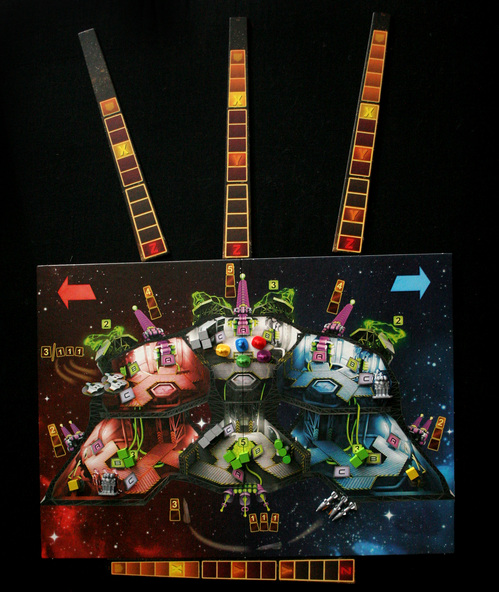
"Space Alert is a real-time, cooperative game in which you assume the role of a crewman of a spaceship stranded in an asteroid field.  As a team you work together through a series of rounds as dictated by a CD that takes you through a 10 minute senario. During these frantic 10 minutes, the players all play their actions face down and communicate to one another what steps they are taking. Whether you are giggling the mouse to keep the computer from falling asleep to firing lasers at a target you hope is in range, you won't know if you were successful until you resolve everything upon completion of the CD."


Philippe

Most Popular: Microreview [book]: The Revisionists (7/10/13)

Favorite: Man...or Astroman? (And some stuff about the nineties, Bakersfield, and sci-fi) (5/10/13)

Philippe's posts often have an nostalgic air, drawing lines between the products of geekdom and his personal journey through three decades of nerd culture. While I love his reviews, this piece about the retrofuturist surf band Man...or Astroman? really hits the spot for me. It's funny, personal and skewers the inauthenticity of today's endlessly cycling nostalgias. Plus it's about an awesome band. 

"The nineties had little of today’s triumphalism, the constant lauding of how awesome and connected things are today. Networks and such. This is an era that has little time for the past. The past is still mined—we’ve gone through the eighties over the last few years—without the conscious, often celebratory nostalgia that accompanied nineties retro. Is anyone actually looking longingly at the eighties? Nineties surf bands with sci-fi personas were homages to a simpler time."


Jemmy

Most Popular: Microreview [book]: The Republic of Thieves by Scott Lynch (8/19/13)

Favorite: All Hail the Black Company! (11/5/13)

Jemmy's review of Scott Lynch's latest swashbuckler has been a huge hit for us--and is slated to appear in in Speculative Fiction 2013, an anthology of the best blog commentary on SF/F. However, I'd argue that Jemmy's paean to Glen Cook's gritty "band of brothers"-style fantasy series is far and away his best work of our second year. I mean, come on--he takes one of the most underrated and important fantasy series of the past 40 years and elevates it to the level of greatness it rightly deserves! And it's beautifully written too.
"Glen Cook's series presaged the darker turn in fantasy--to the grit and darkness that we now tend to associate with writers like Joe Abercrombie, George R.R. Martin, Steven Erikson, Scott Lynch, and Ian Esslemont, to name but a few of the good ones. But Cook's original novel, The Black Company, was written in 1984. That's nearly thirty years ago! Twelve years before A Game of Thrones! So I expected a rather quaint version of grimdark (a quaint pseudo-grit?). After all, wasn't Cook writing in the era of Terry Brooks and David Eddings, when heroes existed to save kittens, pet bunnies, fulfill prophecies, and tell the reader that the world will work out just fine?"


Brad

Most Popular: Tiny Tina's Assault on the Dragon's Keep (7/1/13)

Favorite: Tiny Tina's Assault on the Dragon's Keep (7/1/13)

Brad's series on the various Borderlands expansion packs have been hugely popular, and the game series' goofy humor seems to perfectly fit Brad's own. I routinely laughed out loud, and nowhere more than in his review of Borderlands' send-up of epic fantasy. Plus Bunkers & Badasses.
"Nearly everything...is a melange of Tolkein, Game of Thrones, and D&D, down to the vending machines. Marcus Munitions has become Marcus Missiles and it warns you to, "Watch out for those orcs!" Zed's Apothecary quips, "Have fun storming the tower." There's another reference to a movie I just watched, The Princess Bride. It felt a bit like walking around in Skyrim with corrosive sub-machine guns and missile launchers...."

Dean

Most Popular: AiIP: The Self-Publishing Manifesto (4/15/13)

Favorite: AiIP: Support Your Local Bookstore (even if you buy digitally) (7/15/13)

Dean's self-publishing column is a monthly highlight, and his running series on how indie authors can avoid the Amazon trap has been very informative. My favorite installment is the one where he discusses how indie authors can support local bookstores--even when selling ebooks. Independent bookstores are very important to me, and so this is naturally my personal favorite. 

"I see a lot of authors buying into the Amazon-or-nothing thinking. Amazon has anointed Hugh Howey as the king of self-publishing for his Wool series, including his comments in such places as their GoodReads acquisition press release, wherein he compares Amazon to 'the cool guy next door marrying your mom'...But why at the exclusion of everything else? What possible benefit does that have for the author, the reader or the literary community?"


Zhaoyun

Most Popular: We Rank 'Em: Best Computer (PC) Games of the mid-1990s (8/2/13)

Favorite: Microreview [book]: A Kingdom Besieged by Raymond E. Feist (7/13/13)

This was a tough one for me, because I really like how the 1990s PC game essay captured the nostalgia-seeking mentality of the thirty-something geek (even if I don't agree with all of the individual choices). But as good as it is, Zhaoyun's epic takedown of Raymont E. Feist's mailed-in latest takes the cake for me. The result is highly entertaining, if slightly depressing, and exemplifies what we're trying to do with our review content.
"Weep for Feist—how far he has fallen! How sloppy his writing has become, how formulaic his plots, how uninteresting his characters. My theory? Blame video games. He stopped writing full-time so he could help create several games based on the Midkemia world(s), notably Betrayal at Krondor (excellent) among many others (most of which were utterly forgettable/bad). Unsurprising, given this context, that he...has written less a novel and more a novelization of a game concept: generic characters no reader would identify with who are exposed to a range of uninspired role-playing-esque encounters."


English Scribbler

Most Popular: Microreview [book]: Lagoon by Nnedi Okorafor (3/19/14)

Favorite: Microreview [book]: Once Upon A Time In Hell by Guy Adams (12/30/13)

English Scribbler is not only our newest regular contributor, but probably also the funniest. And so I have to bypass his excellent review of Lagoon for the more tongue-in-cheek charms of the review he did of Guy Adams' second B-movie inspired horror/western mashup. I mean, the following quote needs no exposition, does it....

"Sure, I've been to a cowboy boot store in Kansas, I've drunk whisky in Santa Fe and I've successfully panned for gold (in Legoland in Denmark, but it still counts), but I have no right to write such cod Wild West nonsense. I'm sat in a Victorian flat in London wearing a cardigan and sipping ginger tea. The only Westerny things in my eyeline are the 'Dude' in the 'Dude, Where's My Car?' credits on the telly, and the cat's Lee Van Cleef stare. Ok, at the time I wrote the review I was actually sat by the side of the Mekong river so had at least a little Martin Sheen voiceover in my head but that's no excuse. Especially concerning a book written by a Brit with a superb and uncorny usage of Old West lingo."


Tuesday, March 11, 2014

True Detective Conquers All

Today Philippe and I mourn the passing of True Detective, a show that will return but in fundamentally different form. We present our eulogies, point-counterpoint style, though in truth we agree far more than we disagree. WARNING: some heavy-duty spoilers, so don't continue if you haven't finished the series yet.


The G - Remember when people used to argue over whether The Wire or Breaking Bad was the best American TV show of all-time? Yeah, fuck that. Sure, I still haven't gotten around to Breaking Bad (I know, I know), but here's the thing: True Detective isn't just the best TV show I've ever seen, it's pretty much the best TV show I can imagine ever seeing.

Now, I could cite any number of things as proof of its greatness: the acting, the dialogue, the depth of characterization. But plenty of other Golden Age of Television shows have these things as well. And it's not the deep social commentary either. The Wire is, in essence, a literary ethnography of the American inner-city and its on-going decay; Breaking Bad, I've heard, does the same for the suburban middle-class; The Sopranos for the American family; etc. True Detective has that kind of stuff too, though its philosophical musings are a bit more abstracted.

It is worth lingering on the acting for a minute, though. It's a thing now for well-regarded film actors move to the small screen, but most of them, frankly, kinda blow. I mean, that Christian Slater/Steve Zahn bullshit ABC is currently trying to smear on the walls? Come on. Matthew McConaughey's portrayal of the idiosyncratic pessimist philosopher/cop Rust Cohle, on the other hand, is a revelation--a portrayal so focused and purposive that, for each 60 minute episode, it positively annihilates any memory of Dazed and Confused. For 60 minutes, McConaughey is Rust Cohle. And as the show progresses, it dawns upon you that Woody Harrelson's meat-and-potatoes cop Marty Hart may in fact be the more complex character. It's a subtle portrayal, which McConaughey's Rust is not, and that's partially attributable to the writing and direction, but it's also testament to how fucking good these actors are in these roles.

And then there's Michele Monaghan's Maggie Hart. She's has gotten some flak for her "vindictiveness" from some, and written off as a plot device by others, but those are shallow readings in my book. Maggie is a good mother and wife driven to the edge by her philandering drunk of a husband, and who, when she reaches that point of no return, stands up to Marty and refuses to back down--even when he threatens violence. This is a scene about consequences (for both Marty and Maggie) of the choices we make, and about agency--Maggie's agency. To the degree that it is about Marty and Rust, it exists to outline the uncomfortable relationship between Marty's personal misogyny and the gendered violence he and Rust confront during the course of their work as detectives.

It is also worth lingering on that confrontation scene, because in fact no violence comes. And for a show centered on the serial murder of women and girls, True Detective for the most part eschews the exploitative, sexualized and festishized violence that plague this category of show, and resists splatterpornography. True Detective lingers on the threat or intimation of violence, not the cheap thrills of graphic cruelty and gore. 

And I could go on about how True Detective, more than any other show I've seen, manages to be both highly critical of religious power and deeply respectful of religious beliefs and religious people.

But while of these things are unambiguously good, if I were to identify the elements of this show that are near unprecedented, the things that set it apart from just about anything ever made or anything that will ever be made for the small screen, American or otherwise, it would be two things and two things only.

No American show has ever had such a clear artistic vision

This is art, the way Ingmar Bergman and Andrei Tarkovski films are art. Plenty of Golden Age shows have great dialogue, memorable characters and heady atmosphere. But True Detective is the first show I've seen since Twin Peaks that cares--I mean, really, really cares--about what image and sound can actually do. But Twin Peaks was only really good in that way when David Lynch was in the director's chair. Cary Joji Fukunaga, by contrast, directs all eight episodes. True Detective has a distinct, consistent and incredibly well-implemented artistic vision. It's slow, ponderous, abstracted and careful, the way The Seventh Seal or Solyaris are slow, ponderous, abstracted and careful.

There are so many little moments of wonder in True Detective, from the cultish death scene that opens the premiere to the quasi-Lovecraftian horror of Childress' Carcosa, from the overhead shots of Rust's pickup on the freeway to the panoramic views of Louisiana--its foreboding jungles, swamps and the evidence of humanity's decline. And they fit the script as well as you could imagine. As James Poniewozik writes, on one of my absolute favorite moments in the series:

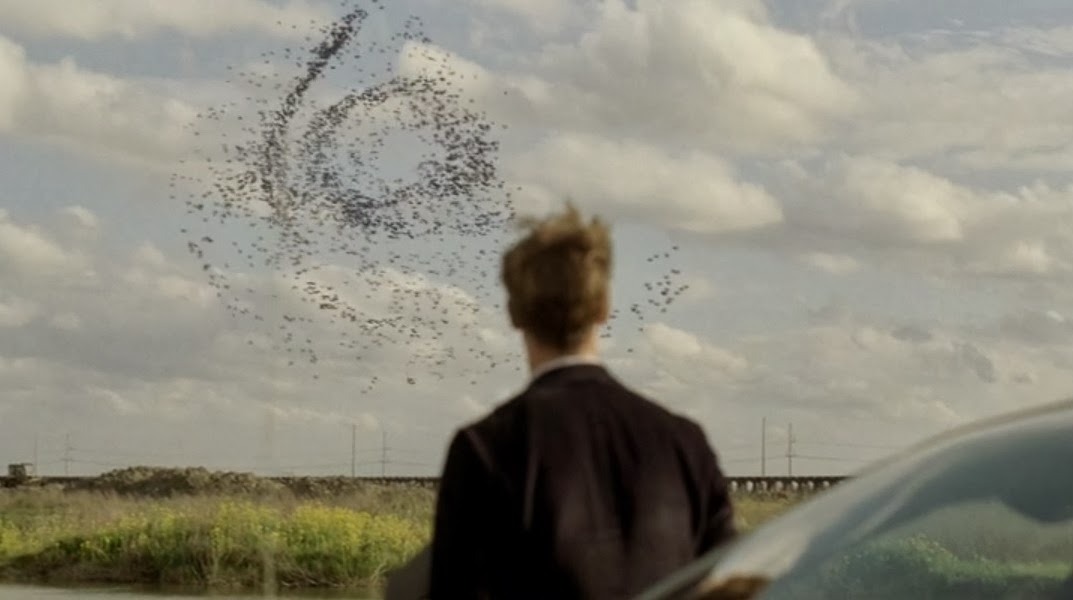
Streetlights streak like heavenly bolts; clouds on the horizon take on an apocalyptic glow; the swamp and backwoods seem haunted. “The visions—there were times that I was convinced that I’d lost it,” Rust says. “There were other times I thought I was mainlining the secret truth of the universe,” and that hits home with a striking visual at the end of the episode, when a flock of birds seems to briefly resolve itself into an intelligible pattern before Cohle’s eyes and ours.

This is the heart of genre darkness

Shows that contain mysteries about the nature of the mystery (Twin Peaks, Lost, BSG, etc.) tend to produce an awkward discourse between writers and fans, where writers drop clues and red herrings, fans develop theories, and writers struggle to create a solution that both satisfies the investigators and still manages to surprise everyone.

The result is almost inevitably disappointing to at least some corners--and True Detective is no different. Sure, True Detective came in familiar packaging--the police procedural, the hardboiled detective story, the hunt for a serial killer, etc. But it kept hinting that it would metamorphose into full-blown horror. There were the little hints sprinkled throughout the season--the recurring patterns, the more-than-coincidental names, the literary references, the signposting. The Yellow King! Carcosa! We grew certain of such things.

But in truth, True Detective used the symbolism and iconography of horror to establish its apocalytptic atmosphere. This is noir, pure and simple, a small-scale holocaust of the human soul--Lovecraft without the tentacled bodies; Revelations without the horsemen.

At heart, True Detective is noir, real noir the way Raymond Chandler wrote it. Not the crapsack pessimism of James M. Cain or Jim Thompson, but the deep anguish of Marlowe's world, where the good take punch after punch and still get up and come back for more; where victories are small but meaningful.

The series ends on an optimistic note, as if to argue that it isn't all meaningless. “Well," Rust says as he looks to the stars. "Once there was only dark. You ask me, the light’s winning.” 

With Fukunaga leaving and the show reverting to direction-by-committee, True Detective may never scale these heights again. Perhaps no TV show ever will. I'm fine with that.


***

Philippe: There was never a King in Yellow. No Carcosa, no black stars, no Hastur emerging from the bayou.

Your disappointment was intentional. There were never going to be any revelations or resolutions, nothing that would make sense of it all. It was just murder. Creepy fucking murders that we all overanalyzed. Like Rust, we frantically sought meaning in True Detective, though we feared, perhaps unconsciously, that there was nothing there there. And there wasn’t.

Nic Pizolatto did something brilliant: he’s made manifest the madness that Robert W. Chambers associated with the The King in Yellow.

The play at the center of The King in Yellow not only drives its readers insane, but it provokes obsession, fervent speculation, and endless theorizing among the masses. Did Pizzolatto intend for True Detective to provoke a similar outcome, to cause us to ponder every possible angle, to fall into an online rabbit hole, Googling “Carcosa” and “the Yellow Sign”? Did Pizzolatto seek to make real the madness Chambers imagined?

I want to say yes. Perhaps I am giving him too much credit. Perhaps our collective obsession was simply a typical reaction to such a symbolically dense work of art.


There’s no need to rehash the theories and speculations—we’ve all been proven wrong. There is a larger conspiracy that remains unsolved. As the anchor revealed, Errol Childress’s relation to the Tuttle clan was denied. Maybe there was witchcraft, bayou voodoo meshed with medieval Catholic folklore. Or maybe the Tuttles are a bunch of sadistic psychos whose pageantry was intended to instill terror in their victims.

The pessimistic season finale would certainly have pleased Rust. There’s no resolution in life, no bigger picture, no hidden meanings. There’s flesh and murder. Pain, suffering, and senselessness. Nietzsche, Lovecraft, and Camus knew this. Rusyy knows it. Some of us have accepted this fact, though most of us cling franticly to mythologies and empty platitudes that prevent us from seeing the world in all its meaningless and chaotic glory. “Everything happens for a reason.” Sorry, things just happen. Like murder.

So, in case you didn’t listen to Rust’s pontificating this season, the finale was there to remind you: there’s no fucking point to all.

The philosophy of True Detective has been criticized by philosophers. I am a philosophical layman, but I feel that this criticism is misplaced. The haters have called out Rust for being a rather shallow and superficial philosophers. But what exactly is wrong with his philosophy? Life is a pointless circle from which we cannot escape. As anyone who has struggled with addiction or bad relationships knows all too well, this is how the world works. This may go against out Protestant American individualist penchant for self-improvement. It’s certainly possible, but few of us ever become better people. We remain who we are. And we keep smoking.

This isn’t Satre’s analytical acrobatics, 50,000 words to make a simple point. This is Camus’s directness, bashing us over the head with the simple and seemingly cruel absurdity of it all. There’s no need to read Being and Nothingness, at least not for most of us. The Stranger and True Detective have the same message: It’s all pointless. (Read this for someone smarter than me making a better argument. I’m a sociologist, after all.)

 Of course, Rust doesn’t live by his own philosophy. He is seeking meaning through solving the case, the paying the debt he and Marty owe. And that’s the point: we all seek meaning, because the chaos of it all is terrifying. Plus, it’s a cop show. That we got any philosophy from it is a considerable accomplishment.

Last point: I absolutely loved the show’s last scene. Rust and Marty finally got to be buddies. Buddies are the best.

***

Monday, September 30, 2013

Why Breaking Bad was *the* Show of Our Time

There will be books written and august journalistic institutions like The Atlantic will talk about what it all meant, so I know these themes will all be expounded on with greater detail and clarity as time unfolds before us, but I can still play in their sandbox for a few minutes.

First, spoilers will probably follow. I'm not that worried about it. If you haven't watched the Breaking Bad finale, maybe stop here.


Breaking Bad was, simply put, the show of our time. People mention The Wire and The Sopranos along with Breaking Bad in current discussions of "The Best Show Ever," but that's not exactly what I'm talking about. Through a happy convergence of both internal and external factors, Vince Gilligan's AMC drama became a mirror held up to society and to ourselves, and a vehicle for real-world change in the television industry. To wit:

Internal (Thematic) Resonance

Here is a brief look at some of the themes that ran from the pilot episode to the finale of Breaking Bad, and that contributed to both the relatability and the inevitable heartbreak viewers felt for the characters. These themes were never didactically paraded before the audience, but they formed the first assumptions of the show. Without these elements, the show fundamentally could not exist.

The Death of the Middle Class. The Whites were a stereotypical, middle class family with what are becoming stereotypical middle class problems. They were immediately relatable. We got to see in flashbacks their pride at buying their first house together as a young couple starting a family, and we saw the sad end of that dream in a gutted house behind a chain-link fence. Just like so many millions of Americans did as they watched their houses lapse into foreclosure. Many of those families took out their rage at the system on the houses themselves. I saw that firsthand, and it was heartbreaking. In the real world, nine months after Breaking Bad premiered on AMC, Lehman Brothers declared bankruptcy. As we know, that event triggered a wave of mutilation that washed across all of America, where only the unbelievably wealthy were allowed to continue as they were. For the rest of the country, the idea of a comfortable middle class existence – so long the picture of "The American Dream" – suddenly seemed like a taunt or a fairy tale. The same thing happened to Walter and his family when he got his lung cancer diagnosis.

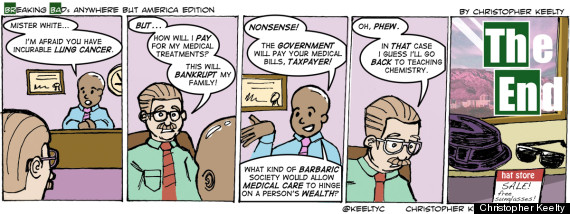
The Abhorrent U.S. Healthcare System. Maybe you've heard that one party currently wants to undermine all Congressional credibility in an effort to send U.S. healthcare back to an intolerable status quo. The Huffington Post ran this great comic panel the other day:
Forget everything else. Everything that came after. Possibly the most horrifying consequence of Walter White's meth empire was the midair collision of two airliners in Season 2. Those that died didn't get their turn on the show to become three-dimensional characters, but that was wholesale destruction of lives and families that never would've happened if Walt had been able to stay in his teaching job after his diagnosis. Which brings us to...

The Crumbling U.S. Educational System. We see two products of Walt's classroom in each episode: Walt and Jesse. Despite his years of service, Walt's cancer diagnosis is a death sentence – either for him, if he forgoes treatment, or for his family if he tries to pay for it – which speaks to the way teachers are treated today in terms of financial and social rewards. And Jesse was one of those kids that slipped through the cracks. Jesse may say "bitch" a lot, but he's a smart guy, man. Emotionally troubled, for sure, but only Walt and Jesse can make the blue. Lots of other folks try, but they're the only ones that can do it. Jesse had one of the most severe curses of our time: unrecognized potential.

The Failed War on Drugs. I wrote at length a few months ago about the transition from "The American Dream" being something based on hard work to something based on magical transformation. Walter White's personal transformation isn't particularly magical, but in his desperation at watching the hard work version of success evaporate, he turned to the other one, looking for a scenario where somebody could make $600,000 in about six months. And that opportunity was literally waiting for him on the street corner, under the watchful eye of his DEA agent brother-in-law.

But Don't Worry. None of this Applies if You're Rich. Elliott and Gretchen Schwartz have basically all the money in the world. They can easily pay for Walt's cancer treatment, and offer to do so. Walt's pride prevents him from accepting their offer – as Walt's pride prevents him from taking every road that doesn't lead to damnation. Walter and his family's struggles are a remote abstraction for the Schwartzes. They feel bad for him, sure, but they can never know the lived-in quality of Walt's desperation...or his resentment toward them. But in the end, Walt hands his money over to these two in order to get it into the hands of his family. They help Walt win, to get what he's always said he wanted, because as Walt says, no one would think twice about them handing over $10 million dollars to anyone they want. They are above the system.

External (Industry) Resonance

Any debate about Breaking Bad's place in the television pantheon is necessarily subjective. But it lies at the crossroads of many objective, substantial changes to what's going on in television now.

The Golden Age of Television. That's what folks are calling it these days. But I haven't seen The Wire, and I only saw the first season of The Sopranos because that's all my college roommate had on DVD. Didn't see Weeds or Nip/Tuck or Dexter, either. That's because those shows all aired on premium, subscription-based channels I can't afford. AMC broke that mold with Mad Men, and that show's success paved the way for Breaking Bad ever getting it's shot. But the knock on Mad Men was always that it was a critical and awards-season darling that never brought in the numbers. Each season's finale scored fewer viewers then its premiere, topping out at about 3.4 million viewers. Breaking Bad brought the numbers, though. It brought the darkness, too, which not only made similarly dark AMC shows possible, but also darkened up other networks' fare, like USA, who used to live by the adage of a "fruit bowl" in every shot. Anybody watch the final season of Burn Notice? That was some bleak shit, right there. Before the ratings and cultural success of Walter White's downward spiral, I wouldn't have thought such an ending was even possibly for that show, and new USA additions like Graceland were darker and edgier from Day 1. AMC's position on the basic cable tier made larger and more diverse audiences possible. The big-four networks will follow suit, if they aren't already.

The Role of Technology (Netflix, etc.) in Viewership. Different people say different things about how significant the impact of Netflix was in terms of growing Breaking Bad's audience, but from my personal experience, I can attest that I would not have been glued to my TV tonight had it not been for the hours I spent with episodes of the show on Netflix. The fact is, before the Season 5 premiere, the show's biggest audience had been around 3 million viewers. Season 5.2 premiere = 6 million. Series finale? North of 6.6 million (Correction: 6.6 million was for "Granite State." Series finale pulled north of 10 million.). Those are revolutionary numbers both in terms of growth and in terms of non-sports basic cable. Other shows have been in the same neighborhood (Burn Notice beat the networks on Thursday night for a while with around 7 million viewers) but none have followed this trajectory. Only Netflix has their internal numbers, but they have said that their analysis of how people watch popular television shows using the service (*cough* Breaking Bad) gave them the confidence to invest hundreds of millions of dollars in shows like House of Cards, Orange is the New Black, and the fourth season of Arrested Development. If you read the Vulture article I linked to above, you'll see they don't want to give Netflix too much credit, and spend a lot of time talking up DVR ratings. In the same way that The Office was able to stay on the air because NBC started taking iTunes downloads into account, other shows are seeing their chances at staying on the air improve as delayed-viewing numbers for shows like Breaking Bad swell the total audience far beyond what the Nielsen overnights are able to quantify.

So that's it. Now, let the books be written.

Poor Andrea.