Showing posts with label Kate Elliott. Show all posts

Thursday, October 23, 2025

Book Review: The Nameless Land by Kate Elliott

Elen’s story continues and finishes in a land of lost magic, royal intrigue and much more

The Nameless Land is the second half of the duology started in The Witch Roads. The setup of the book as described in the first one holds: Deputy courier Elen winds up escorting a royal prince to the north, but things do not quite go as planned, with intrigue, conflict and revelations about Elen’s extra-empire origins in the final chapter.

And so we continue on with her story. The novel really can’t be taken on its own; it really is pretty much written as a second half. While there are references, now and again, back to events in the first book (especially in times of explanation), the novel relies on you having the preceding situation freshly in mind in order to fully appreciate the intricacy of the plotting. That also makes it difficult to recount the specifics of this novel without a lot of foreground explanation.

So let it be said that the scheming and intrigues of the first novel, between and within the Royal Court, as well as the provinces of the Empire, get an additional factor, as Elen and the others find themselves heading into territory only Elen knows—lands outside the Empire itself, her origins. So, in this half of the duology. Elliott expands the physical playground by introducing new societies, characters and conflicts. She does a great job in hooking them into the existing worldbuilding and further complicating the plot. Elliott loves to contrast how the Empire does things versus those (and there are multiple values of that) who handle a world where the Pall is a threat. Elen’s extra-empire origins, a secret she has mostly held from everyone (even Kem), become extremely important in the main thrust of this book. Through her unexpected return to her roots, we get a rich sense of someone who has a perspective on what she’s seeing that she doesn’t always share with her compatriots, but shares with the reader.

Also, once again, we have some small sections from the Imperial investigator Luviara, providing an outside perspective here and there. And once again, Elliott shows that more characters than just the protagonist(s) can have their own arcs and developments. We find out what Luviara has really been up to all this time, and why. I must say,as much as I love Elliott’s worldbuilding, her mastery of character may be even better and stronger.

As a result of all this material that we get, the classic “stop asking questions and start answering them” rubric for this book in terms of its placement doesn’t quite fit the duology as a whole as one might expect if these were two separate books rather than one book split into two. What this means is that there’s a lot of run-up, especially counting the first book’s narrative, to the point that, when the final revelations of what is going on and what is to be done become clear, and Elen and the others are forced into decisive final action, it is a timebomb that goes off with explosive speed and power and narrative compression. This is not to say that nothing happens, but there is a continual slow burn, and bursts of action, up to when everything goes off. Elliott has plotted both novels very carefully and pays off the promises made way back at the beginning of The Witch Roads.

In keeping with that, Elliott has the space, will and interest to continue to explore her fascinating set of characters and include new ones. The universe is queer, diverse, with many women in varying kinds of power, and at the same time, thanks to the Empire, has a chance to criticize various abuses and frames of power, including patriarchal ones. Readers of the first book will see that Elen’s nephew Kem’s story and their attempt to hold onto and make their own destiny and autonomy are a strong strand within this book. Also, looking at the novel as half of a single work, one can also see that the story of Elen is, in the end, a romance. But to say more about that would be spoilery. Readers of the first book can be assured, however, that the second book does return to the romance of the first novel, unexpectedly but delightfully.

The novel doesn’t quite explain everything in the plot and background explicitly and completely, and does leave a lot of wonder and mystery in the playground of the imagination. We do get some answers and a rough sense of why things are as they are, as far as the characters know them. The reader can piece together a little more of the background of the world that the characters miss, but there is still plenty of mystery left in this world.

The obvious pairing for this book is another duology: The Witch King and Queen Demon by Martha Wells. Both are interrogating imperial societies, one pair as a resistance to a hegemon, and the others as people living in a quite flawed one—but one that has a purpose given the dangers of the world around them with the Pall¹. Both interrogate gender and gender roles within a narrative, although Elliott is far, far more direct about it than Wells. Both of the books feature fascinating worldbuilding, with a setting that doesn’t stand still. Here Wells has the better of it hopping in time and space with Kai in both books. Elliott, on the other hand, has a character with a wider perspective, but the considerations of past societies are as overhangs and problems of the past affecting and poisoning the present. Both novels, moreover, talk about the uses of history and narrative and how misunderstanding what happened in the past can lead to issues in the present. The novels aren’t quite in dialogue with each other, since they were written contemporaneously. However, in a time and age when questions about power, empire, control, gender, autonomy and more are prevalent in our society, The Nameless Land takes its place with The Witch Roads, and with Wells’s novels, among others, in exploring these themes and concerns of our society, our moment—and beyond.

I know there will be at least one more story set in this fascinating universe. Once again, Elliott has paired characters with a deep and fascinating setting, and while Elen’s story is clearly finished here, there is still much to see and many more potential stories to tell in this world. And the geopolitical situation at the end of this novel is significantly changed compared to the start. Elliott’s worlds are never static and never go status quo ante. I’m sure that will influence what comes out in any subsequent story. I look forward to reading it, and more of them.

Highlights:

  • Ably completes the second half of the single story
  • Much more detail about Elen’s homeland
  • Strong character-focused narrative
  • Alas, still no live Griffins!

Reference: Elliott, Kate. The Nameless Land [Tor, 2025].

¹ Given the other two societies we see in the novel and how they handle the Pall and its threat, is the Empire the best of a bad set of choices for dealing with it? I think Elliott is deliberately showing us a variety of possibilities here, and that there is no definitive best society. But even given it being terrible in many ways, I think the Empire is a preferable society for the average person to live in.

POSTED BY: Paul Weimer. Ubiquitous in Shadow, but I’m just this guy, you know? @princejvstin.

Tuesday, March 18, 2025

Book Review: The Witch Roads

The first part of Elliott’s newest fantasy series that hits the power chords of her themes.

Elen is a deputy courier, a position she has gotten by luck, and skill, and a secret she dare not tell. She walks the roads of the province she lives in, delivering messages, scouting the terrain and always looking for the dreaded Spore. But when a prince from the Imperial Palace comes on a quest of his own, Elen, and her ward are caught up in intrigue, magic, adventure, and the revelation of long buried secrets on all sides.

Her story, the story of Kem, and of the prince are the heart of The Witch Roads, the newest fantasy novel from Kate Elliott.

The Witch Roads is a novel that I could spend an entire goodly sized review discussing just the plot and setup of the world that Elliott builds here. I am not going to focus so much on the plot on this one and after explaining the world, instead explore the book from a broader, thematic angle If you’ve read Elliott’s previous work, just about any of her previous work, you know that she likes complicated, intricate plots that a reader can sink into. Complicated characters. Intricate worldbuilding. But as much as I could tell you about the characters and plots, I want to tackle this a little differently.

So let me tell you about this world. Elliott has put us in the outer ring of an empire that has seen rises and falls, a stratified realm with strong class and social divisions and expectations of duty. We’re not quite at the borders of the Empire at our starting place of Orledder Halt, but we’re well removed from the center of power (that comes in the form of the prince and his entourage). This is a world that is rightly afraid and is fighting a battle against an incursion of something magical, dreadful and dangerous. It takes two forms--the Pall, which are whole areas covered by a dangerous fog, and the Spore, a magical corrupting power that can corrupt and control plants, animals... and people. The Spore is mostly found in the Pall, but can and does irrupt randomly in places and those irruptions must be dealt with quickly, or else whole communities are at risk from the Spore.

The titular Witch Roads are roads that the empire has built that resist the power of the Pall and the Spore alike. These are what allows the empire to still be an empire, although going off road is dangerous and that’s where people like Elen as deputy courier come in, as well as higher ranked people such as Wardens and Surveyors. This is thus an Empire trying its best to hold together and hold on against an implacable threat, as well as incursions from the aivar, who are non humans who are a threat at the Empire’s borders.

There is a richness to the world and its features that readers of previous Elliott novels will love. There are Griffin riders (a distant call to the Eagle Riders of the Crossroads universe). Strange ancient ruins. Cuisine, drink and food. The layout of officials residences. Heart Temples. Elliott packs a lot of story into her worldbuilding, it’s not only immersive, but it tells a lot about the story she is trying to tell. And there are funny and delightful bits in the worldbuilding too. When you read this book, read carefully how Halts are described in terms of name, setting and location. When you get it... you will get it. I was most amused.

But even more important than this world are the themes that Elliott hits. These are her power chords, you have seen these in other works of hers, but here she is...unleashed in a way few of her other books have really tried to grab. This is a platonic ideal of Elliott laying out themes she cares about on the table, all the while wrapping it up in that aforementioned worldbuilding, complicated characters and intricate plotting. When I think about this world, I think about the worldbuilding, sure but I think, more than in previous Kate Elliott’s books, about the themes she explores here.

Elliott’s first theme is bodily autonomy and choice. She tackles this in all of her main characters and many of the minor ones at all. Elen and Kem’s origins, which are slowly revealed throughout the book (until a Octavia Butler Wild Seed-like part at the end where all is revealed) are shown as a narrative of Elen, Kem and her late partner Ao’s desire to be able to control their destiny and fate and autonomy. Multiple times, it is revealed, they have been on the run in a search for that, fighting against worlds, places, people, who would take it away from them. Elen’s time in Orledder Halt where we meet here has been the longest time of peace for her...a peace disrupted by the arrival of the prince.

Kem fits into this because, and it is a spoiler, we learn that Kem has been seeking choices of their own, and in fact, although born female in body, has chosen to be a man. This choice, although a right, is challenged, and Kem’s seeking of his own path and autonomy is right from the first pages, when Elen is taking him on his rounds, seeking to offer him the path she had as a Courier. What Kem actually wants for himself finally becomes clear, and it is a constant struggle for the young man to find and hold his place and find his own autonomy of body and place in a society that is very much stratified and resists that. Elen’s concerns for Kem and her wardship (you could call it motherhood) and her hopes and fears for Kem run smack into Kem’s own desires and needs and it is a great source of conflict, drama and story.

And then there is the prince. The prince comes from privilege, power and people acceding to his power...except when it seems that others are scheming against him, in quite deadly fashion. But when he encounters a Haunt, and is possessed by the Haunt, we are once again set on questions of autonomy and power. The Haunt claims that he can’t possess someone unwillingly, but his possession of the prince seems like a borderline rule-skirting case at *best*. While the OG prince is an unsympathetic character at best, and the Haunt-prince very much more appealing (there are even sparks between Elen and him), we are always reminded of the autonomy problem--did the prince, who is, according to the Haunt, sleeping while the Haunt possesses him for his own ends, really a consenting party to this arrangement?

And then there are of course questions of loyalty, duty, sacrifice and honor that I’ve noticed in Elliott’s work at least since the Crown of Stars series. With Elen, the Haunted prince and everyone else on the road, the plotting and worldbuilding collide with that duty as the Haunted prince seeks his own end, the Prince’s retinue must be kept from knowing what happened, and Elen and Kem caught in the middle of it all. Intrigues and betrayals and tangled loyalties rise up in the minor characters, as Elliott expertly gives them their own arcs, minor spotlights, and story backgrounds. Like many of her works, the minor characters of Elliott’s work get more character building than some (to remain nameless) authors' primary characters.

There are also minor themes here and there, especially regarding the nature of history and what is recorded, and even a touch of exploring the consequences of colonialism and xenophobia as well.

I have enjoyed the shorter works that Elliott has offered lately (The Keeper’s Six, Servant Mage) and hope for more in those worlds, especially The Keeper’s Six (longtime readers know that I am all about multiverses, thank you very much). The Witch Roads is Elliott in full on fat fantasy (although this is not as long as some of her other fantasy and SF novels) mode. It's the first in a duology, and the ending is a stopping point, not an offramp point. But my nature as a Elliott stan is well known, and so I know what I am signing up for. And there is such richness in this story, that I can commend the book to you even if the story is not yet complete.

One thing, and its not Elliott’s fault, is that the Amazon page for the book gives away what turns out to be a tremendous spoiler that I am glad I did not read before reading the arc of this book. Caveat lector.

--  

Highlights:

  • Big fat Kate Elliott fantasy in the Kate Elliott style. 
  • Strong and immersive Worldbuilding
  • Power chords of classic Elliott themes, unvarnished and in full force
  • Beautiful and evocative cover.

Reference: Elliott, Kate, The Witch Roads, [Tor Books, 2025]

POSTED BY: Paul Weimer. Ubiquitous in Shadow, but I’m just this guy, you know? @princejvstin.

Thursday, January 30, 2025

Review: The History of the World Begins in Ice by Kate Elliott

A diverse set of stories and essays set in Kate Elliott’s world of Cold Magic (Spiritwalker)

The Spiritwalker/Cold Magic books by Kate Elliott are self-described as taking place in a post-Roman Afro-Celtic icepunk regency fantasy setting. That’s a lot of adjectives and nouns, but the complexity of this Earth, that never was but resonates with our own, is a rich invention that, beyond the bounds of the three novels, begs for more development, involvement and exploration.

The History of the World Begins In Ice: Stories and Essays from the World of Cold Magic is here just for that. We get a curtain pulled away to watch the author develop and create a setting from more angles and facets than the novels you “see on the screen.” A lot of worldbuilding for novels, especially in SFF, is below the waterline of the iceberg, never to be seen. Given the wide range of writing that Elliott had already done in developing this setting, bringing it all together seemed like a no-brainer. And given that the Spiritwalker series is (unusually for Elliott) a first-person point-of-view series, having stories from other perspectives is a way to get some of the wider-screen experience you get in many of her other works, in bite-sized formats. And the essays give a look underneath that waterline.

So what’s here?

The three quarters of the book are fictional pieces arranged in chronological order, starting decades before the events of the novels, up to a story about the youngest daughter of Andevai and Cat, thirteen years after the series ends. We get a variety of points of view, characters, themes, and styles, ranging from the origin story of Kemal, far to the east, to the epic poem of the Beatriceid, to a story about a little girl who is convinced what she wants to be when she grows up... but more importantly, wants to find her stuffed animal. The stories are relatively light, fresh, and delightful. I had read several of these before, and it’s good to have them in one place. Many were unavailable for years until this volume came along.

For me, the last quarter is where this book really sings and comes to light. Don’t get me wrong, I love the Beatriceid, and The Secret Journal, and much else in the fictional section. But it is when Kate starts talking worldbuilding that I sit up and *listen*. We get essays on why Kate wrote this book, the thinking process behind the magic system, the geography (Doggerland represent!), the development of the Antilles creole, character development studies, maps, and more. You can guess how much detail and research goes into a thick Kate Elliott book and series; here is where she shows her work and the way it’s done. The true extent of the “iceberg” is revealed. I found the essays on the creole language particularly fascinating; it’s the deepest dive I’ve seen on the subject short of talking with a full-on linguist.

One last thing to note is that the book is well illustrated throughout. Some of these stories and works, such as The Secret Journal of Beatrice Hassi Barahal¹, already had copious artwork, but others are newly commissioned for this edition. Like the artwork for The Secret Journal, the addition of art for this work really completes the book, and it would not be nearly as compelling without it. Through the history of the Spiritwalker series, the art really has gone hand in hand with the writing, and I am pleased that tradition continues here. The galley review copy proudly lists the artists’ names on the cover. Part of the reason to get this book in print is to get the artwork (which really is wasted on a digital screen).

The last and important thing to ask about this book is: Who is it for? If you are a fan and reader of Kate Elliott’s Spiritwalker series, this review just confirms known facts, and you may have purchased this already. (If not, get thee to a bookstore or library.) If you are a reader of hers but haven’t read the Spiritwalker books and have been curious about them, you might like this collection if for no other reason than its “back half.” The process of Elliott’s worldbuilding and the facets of it may well be in your interest... and this collection in general might then spur you to pick up Cold Magic.

But what if you haven’t read any Kate Elliott? Is this volume for you? This is where I feel uncomfortable and conflicted. I want to say yes, because I do want her work widely read and loved as I love it. But the stories are atypical of her longer SFF works (when she’s written things like even novellas, it felt like an ill-suited fit for her). She’s widescreen, big screen all the way. So while you get tastes of the world she has built in Cold Magic, the stories do resonate better if you have some “buy-in” to that world, so reading the origin story of Kemal, or the Beatriceid, or the funny misadventures of Rory in To Be a Man may just not land quite as much without that background.

So I’m going to have to reluctant come down on the answer of *mostly* no. If you’ve never read any of the Spiritwalker books, or any Kate Elliott, this is not the place to start with it. Unless, maybe if you are a fantasy writer, or aspire to be, and want to see how a master writes an intensely built and created world. For those people, the last portion of the book may be an invaluable guide.

For those curious, Kate has a blog post on where to start with her work, written in a unique format.


Highlights:

  • Great art that compliments the writing
  • Fascinating worldbuilding essays
  • Welcome return overall to the Spiritwalker 'verse

Reference: Elliott, Kate. The History of the World Begins in Ice: Stories and Essays from the World of Cold Magic [Fairwood Press, 2024].

¹ A formatting criticism that really doesn’t fit elsewhere: I am glad that I had read The Secret Journal before. As it so happens, the electronic review copy I had was not formatted well, and treated this section of the book like a PDF, which made it impractical and unpleasant to read on my Kindle. I skimmed through a physical galley I had to make sure I had not forgotten details of the story. I hope the final electronic copy does not suffer the same issues.

POSTED BY: Paul Weimer. Ubiquitous in Shadow, but I’m just this guy, you know? @princejvstin.

Tuesday, February 27, 2024

Cool Books I Read While I Was Too Sad to Review

If a review copy lands in the inbox when the reviewer is too overwhelmed to read it, does it even get a review?

Well, no, obviously it doesn't. Despite my fervent hopes, the review fairy did not visit me once while I was having a Big Bad 2023 to magic away my Netgalley obligations and show love to books during my period of chronic distraction. But the books continued to be good, and I'm going to cover some of them here in not-even-nano-sized review chunks.

Case in point: The Saint of Bright Doors by Vajra Chandrasekera was a 2023 highlight. I've seen a lot of deservedly flattering comps for this novel, a story of divine destiny denied set in a fantasy Sri Lanka:  my own mind was drawn to Sofia Samatar and Ursula K. Le Guin while reading, with a few of the bleak vibes I last felt in A.K. Larkwood's The Unspoken Name. For a story that really invites comparisons, however, Saint of Bright Doors is very much making its own mark on modern genre - and I'm sure there are plenty of threads of Sri Lankan and wider South Asian influence that I missed entirely.

Highlights of the reading experience for me included the way the story's geography seems to literally rearrange itself around the absurd authoritarianism of Luriat's state politics, the portrayal of gods and unknowable supernatural forces co-existing with a mundane, modern setting, and the greatest first person pronoun drop in genre history. This is an essential novel and I hope we'll be talking about it for years to come.

Translation State by Ann Leckie was a novel I hoped to feel similarly about. This latest standalone-ish instalment in Leckie's Imperial Radch universe is a solid, thought provoking piece of SF (Clara has some excellent provoked thoughts here) but it hasn't withstood the test of time as a standout novel for me, Don't get me wrong, I love the Presger translators, and I highly appreciated the way Leckie gives us crumbs of further context without really making anything clearer about the setting's most mysterious alien race. Less attractive on reflection is the treatment of alien biological urges as fundamentally irresistible in a way that would simply not make sense if the author were talking about humans. Protagonists Reet and Qven are, for different reasons, terrified of the urges of their alien heritage, but all Presger translators simply have to go through "puberty" in the way their creators designed, so oh well, suck it up kids, they'll be fine once it's done. 

I understand the narrative is setting up questions about personhood in general, not creating any deliberate queer parallels, but gender is so integral to the setting as a whole, and aliens so often used as a stand-in for human queerness (and neurodivergence) that it's hard not to think about Qven and Reet's lack of choice through that lens. It would be nice to see stories that think more about how alien queerness would manifest, from the starting assumption that of course it would manifest in any sentient species, but I'll keep searching for those books elsewhere. In the meantime, any Imperial Radch is good Imperial Radch, but this one didn't hit "great" for me.

Joe and I share a love of Seanan McGuire's October Daye series, and while he does the honours of the full Nerds of a Feather reviews, I also found time for both of last year's double-Toby entries, Sleep No More and The Innocent Sleep. These are the 17th and 18th books in the series respectively, and they effectively act as companion novels to each other: Sleep No More follows series protagonist October - a fae changeling - as she grapples with the effects of a reality-altering mass illusion, while The Innocent Sleep breaks with series tradition to focus on her Cait Sidhe husband Tybalt, who is working against the illusion from the outside. The actual points of narrative overlap didn't set my world on fire (In one book, October thinks Tybalt looks angry! In the next book, we learn Tybalt is angry!), but the double-bill allows McGuire to let loose with the most unsavoury conventions and darkest corners of fae society in a way that brings the series full circle to its earliest vibes. There's also more time across the books to feature a wide set of supporting characters - including one unexpectedly sympathetic "recast" - who demonstrate the breadth of the series' worldbuilding. As always, I'm eager for more.

Let's talk about some more underrated series! Claws and Contrivances is the second in Stephanie Burgis' Regency Dragons romances and it's just as delightful as the first: an intricate and often hilarious plot of misunderstandings and reversals, sprinkled with fun dragon naturalism and centred around a young protagonist with a lot to learn and a LOT of willing accomplices to her various schemes. Unlike the first book in the series, Scales and Sensibility, Claws and Contrivances takes place in a fundamentally loving family environment where queerness and difference are accepted, and it's the perfect backdrop for Rose Tregarth and her nerdy, autistic-coded love interest Aubrey to fall for each other.

Furious Heaven by Kate Elliott is anything but light, both in content and in physical weight. As Paul covered in detail, this is a 750 page chonk retelling events from the life of Alexander the Great, except Alexander is now Princess Sun, daughter of Eirene of Chaonia, an expanding galactic power rubbing up against the much larger might of the Phene while trying to maintain their own powers at home. If you know the history of Alexander the Great, you'll probably recognise more moments from real history, but it's certainly not necessary to enjoy the combination of pew-pew space battles, irreverent epithet-laden narration, "oh no she DIDN'T" politicking, and silly teenagers with entirely too much power. Go look up the facts afterwards to find out which bits really happened (no genetically modified four-armed people in antiquity, unfortunately), and get some knowledge useful for pub quiz as a bonus!


Adri, Nerds of a Feather co-editor, is a semi-aquatic migratory mammal most often found in the UK. She has many opinions about SFF books, and is also partial to gaming, baking, interacting with dogs, and Asian-style karaoke. Find her on Bluesky at adrijjy.bsky.social.

Thursday, April 27, 2023

Interview: Kate Elliott, author of Furious Heaven

 Kate Elliott is a science fiction and fantasy author who has been writing novels for over 30 years. With works ranging from the epic fantasy to space opera, she is known for interesting characters, intense worldbuilding, and often, doorstopper length writing. Today, Paul Weimer asks Kate about Furious Heaven, the second novel in her space opera Sun Chronicles, following Unconquerable Sun, which shares all of those virtues and then some.

What's the pitch for Furious Heaven? 

The same as for Unconquerable Sun: Gender swapped Alexander the Great, in space. But much bigger in plot, worlds, theme, consequence, and word count. It reflects the expansion of Alexander’s actual life in ways no one, at the time, could have predicted.  

Furious Heaven, being a sequel to Unconquerable Sun, is a middle book in a series. How has the writing of this been the same, and different than other series that you have done? 

My goal with each of the three books of this trilogy has been, and continues to be, to shape each individual volume as if it is a standalone. Unconquerable Sun completes several of its major plot threads and, I believe, ends at a satisfying point. If I’ve done my job right, the reader will feel they’ve read a complete story and ALSO wish to read more.

Middle volumes are peculiarly hard. It’s important, in my opinion, to avoid “adding more beads onto the string” -- that is, just to add more incident without complicating or expanding on the original elements of the story. A middle volume can add layers, unexpected twists and outcomes; it can deepen the characters and guide the reader into new landscapes and unknown dangers only hinted at in book one. That’s how I worked with (for example) Shadow Gate (Crossroads), Cold Fire (Spiritwalker), and Poisoned Blade (Court of Fives), which are all second volumes in trilogies that make the story bigger and show the reader new places and new conflicts.

With Furious Heaven I specifically wanted to do my best to make the story readable by someone who hadn’t read book one, while also having it build on what had come before. This meant finding a way to open the book as I would if it were my first look into the world, while concurrently reminding the returning reader of the things they recalled or liked about the characters and situation. It’s important to re-introduce the reader regardless, even if the story continues from a cliff hanger, because in many cases there will have been a break since they read the first book. A middle book needs to get the reader’s feet under them as quickly as possible before it charges ahead, but it does need to offer that grounding.

In addition, given the publication gap between book one and book two, and the likely gap coming for book three, I wanted the book to come to a close at a place that would leave the reader feeling they had gotten many things they wanted, and could manage the wait. So no cliffhanger but rather, I suppose, implicit promises about what lies ahead.

The book was challenging to write, very complex, and, in the end, really rewarding.

You have a number of new POVs to go with the ones introduced in Unconquerable Sun. How did you decide on picking them, especially Apama, given their position vis a vis the Republic? Are there POV shifts in other series you've read that have done this well?

Apama first appears in book one. She may seem like a minor character in book one but that’s simply because I needed to spend more time with Sun and her Companions. I always knew Apama’s role would expand in book two, as it does. She’s my absolute favorite gender swapping in the story, although not in the way people may think.

In book one I wanted to keep a tight hold on the number of POVs: Sun (and Hetty) and Persephone as the major POVs with Zizou and Apama as secondary POVs. The story’s focus is on the Republic of Chaonia. Even Apama’s side story, in book one, is focused on the republic for plot-relevant reasons I won’t go into here in case a reader hasn’t read book one and doesn’t want spoilers.

Book two expands the story. Because I knew how big the canvas was going to get, I decided not to limit myself to the original four (five, if you count Hetty, which one should, although one could argue that Sun and Hetty’s POVs are the same--one soul in two bodies). I had to decide how many POVs to add, while also not overwhelming the reader with too many POVs.

In the end I made two choices.

The first choice was to add Makinde as a secondary recurring POV because I needed a viewpoint into locations and battles where I knew Sun couldn’t be. His POV is very structured and deliberate in terms of the choices I made about when and how I used him to reveal information and events. He’s also funny, and of course he is accompanied by Dozer.

The second choice was to create “interludes” that would follow a single POV for a single episode, and then not return to that POV (even if that character might recur in the story). These interludes bridge gaps of time or distances so I don’t have to say “four months passed.” They also allow glimpses into how wide ranging the consequences of Sun’s actions become. When the POV remains tight on a central figure or figures, it can be hard for the reader to see the ripples and the debris. I wanted to bring into view the consequences of the great campaign in the worlds it touches and among the people who live through it, for good and for ill.

Of massive epic stories I’ve read recently enough to recall well, I think both Ken Liu’s Dandelion Dynasty (The Grace of Kings) and Fonda Lee’s Green Bone Saga (Jade City) do an excellent job with multiple POVs. They mostly follow specific key characters but also deftly drop into the heads of secondary characters exactly when that perspective is needed.

Persephone remains my favorite character outside Sun herself, but it's hard to stare at the Sun long. I felt she bore different narrative weight than in the first novel. How do you use middle novels to develop the meat on the bones of her and other characters? Are there novels you've read that do that particularly well?

Persephone is always following the narrative plan ordained for her, and the reason why her POV, alone of all POVs, is in first person.

Book one really provides a basic introduction to the world(s), the characters, and a sense of the plot. Everything expands in book two, including the character depth --at least that is obviously my intention and hope. I want readers to feel they understand the main and secondary characters even better by the end of book two.

In addition, life experience alters people. Sun and her crew are all young in book one: in their early 20s, what we would call “fresh out of college.” People deepen and mature as they age. In addition, the intense experiences they live through in book two will naturally have an effect on people’s outlook, moods, understanding, and goals. So the book has to represent and reflect that as well. I’m not a fan of stories in which people undergo massively intense and traumatic experiences and seem not to change at all or have any reaction or lingering effects. One of my goals in Furious Heaven was to start showing that slow process as well, often unremarked or ignored, but real.

In the case of Persephone, she only tells us what she wants us to know, so it’s important to read between the lines and look for the things she isn’t telling us.

I’ve recently read the first six books of the Marcus Didius series (Silver Pigs), by Lindsey Davis, about a retired soldier turned private eye in ancient Rome. Davis does a good job of feeding us a bit more about our hero with each book, so with each subsequent volume we get a better sense of him, his relationships with others, his strengths and weaknesses, and an idea of how he will probably approach the various problems he’s confronted with. That kind of slowly expanding character development is, in my opinion, key to retaining reader interest in a long running serial like a mystery series. If you know everything there is to know about the character in book one, and nothing about them ever changes, then plot alone rarely is enough to keep readers engaged. Or at least, it isn’t for me as a reader.

What non fiction books did you read to inspire your world and your characters? 

I have read a lot of history to build the world of Sun and her Companions. Instead of deluging you with a long list, I’ll share six books that have been crucial in influencing how I approached the world(s) and people.

The memoirs and histories of Alexander’s campaign written at the time have survived into the modern day only in fragments. Therefore, the four main classical accounts of the Alexander history date from the Roman era, when they still had access to those now-fragemented and missing histories from Alexander’s time that are now lost to us. I mostly follow Arrian’s The Campaigns of Alexander because I like it. My edition of choice is The Landmark Arrian edited by James Romm and translated by Pamela Mensch.

Carol Thomas’s Alexander the Great In His World is honestly a fantastic world building tool whether or not a person is writing about Alexander. Thomas situates him by describing various elements of the world he was born into, the landscape, the societies, and the people he knew, and how he fit in with those elements. It’s a great way to understand how any given person emerges from the landscape they live in.

China In Ten Words by novelist Yu Hua (To Live, The Seventh Day, Brothers) is a set of essays about modern China. These astute essays helped me think about how most societies are in a constant back and forth between what they want to say they are and how they are to really live in. 

Last Stand of the Tin Can Sailors and Neptune’s Inferno are both histories by James Hornfischer that examine, in close detail, two specific naval battles in the Pacific Theater during World War 2. To reconstruct the battles he used first hand accounts as well as interviews he himself conducted with (by now elderly) survivors. These two books offer insight into the chaos and terror of battle as well as the courage and determination of those who fought. 

Popular science book Life on the Edge: The Coming of Age of Quantum Biology, by Johnjoe McFadden and Jim Al-Khalili gave me a lot of food for thought. Among other things, it influenced how I describe the Riders.

What's your favorite detail, worldbuilding element, or filip that you introduced into this world in Furious Heaven?

There are so many Easter Eggs in this book, and I love them all, especially the obscure ones. For the purposes of this interview I’ll highlight how much fun I had turning commonplace proverbs and sayings that mention everyday animals into commonplace proverbs and sayings that mention dinosaurs in the place of the original animals.

You have a wide range of books written, and you once did a "boy band" comparison of your books. How would you classify Unconquerable Sun and Furious Heaven in that rubric?

You’re referencing this post, the one pinned to top of my (inactive) blog:

http://imakeupworlds.com/index.php/2015/02/where-should-i-start-with-your-novels/

Here’s what I said about the Sun books: “This is the show you don’t want to miss!”

Thank you, Kate!

POSTED BY: Paul Weimer. Ubiquitous in Shadow, but I’m just this guy, you know? @princejvstin.


Monday, April 17, 2023

Review: Furious Heaven by Kate Elliott

Kate Elliott’s Furious Heaven continues her genderflipped Alexander the Great in space as we truly get into the more well known parts of his history.


Unconquerable Sun introduced us to Kate Elliott’s Princess Sun of Chaonia, the daughter of Queen-Marshal Eirene, a young and ambitious woman in a world of interstellar Empires struggle and Chaonia not so long freed from the yoke of the mighty Phene empire, dreams of retribution upon it.  In an epic story, we were introduced to Sun and her companions as a surprise attack by the Phene ultimately brought Sun glory as she turned back the strike. 


Now, in Furious Heaven, the story of Sun and her companions continues.


One of the games to play as a reader of these novels, if you are aware of the original history they are based upon, is to play “Spot the moment or part  in Alexander’s history this is based upon”. What surprised me slightly in the first novel was that while this is the story of Sun, based on Alexander, the action takes place in the reign of Philip, or Eirene (Philip being genderflipped too).  When we get to this second novel, Furious Heaven, the question in my mind became this as I started reading--when was Eirene going to die? The death of Philip II of Macedon is one of the great world-changing events in world history, for it set Alexander on his path to eventual global conquest. One can argue what-ifs of world history all day long, but if Philip isn't assassinated when he is, Alexander doesn’t get his campaigns and his shattering of Persia.


Another aspect, and it is far more spoilery to discuss, is how and why Eirene dies. The death of Philip II and the discourse and discussion on that assassination and its motives and true origin is something that has consumed scholars of ancient history since the moment Philip was put in the ground, and there is still no definitive answer to this day. We have a killer, who did not live long, but their motives, backer, plans are a nebulous mystery. You might say that Philip’s death is the JFK assassination of its epoch. (and yes, one of the theories is that Russia, err, the Persians, funded the whole thing).   Elliott makes use of this ambiguity and provides an in-universe answer which I will not discuss for plot reasons, but she uses the main line that history does--that Alexander takes the death of his father and uses it as a rallying call, that happens here, too. Given that the death of Eirene happens at about the quarter turn of the book, the rest of the book starts laying out Sun’s campaigns against the Phene. 


But not just Sun’s story. In the first novel, one of our major point of views is the “Wily Persephone”, Persephone Lee, somewhat renegade daughter of a major House of Chaonia, wh becomes one of Sun’s companions in the wake of her twin brother (and also former Companion)’s tragic death. The story of Unconquerable Sun is not only that of Sun but also of Persephone and how Persephone winds up slotting herself into the role of Companion, how her glory, reflected moon to Sun, gets to shine itself. 


Furious Heaven keeps Sun and Persephone as viewpoint characters, and adds a new one, and this one a Phene. Given that the bulk of the novel is Sun’s struggle against the Phene, it makes sense from a narrative standpoint to have a point of view that counterpoints both Sun and Persephone, who is on team Sun at this point. Although, there is some question whether Persephone is or should be more loyal to Lee House, or to Sun herself. Persephone’s nature, too, which was touched upon in the first novel, really gets a work out  Persephone finds herself in some very crossed loyalties as the novel progresses and a lot of drama and high stakes character development.


And that really is the strength of this thick (750 pages novels).  Sure, there is plenty of space opera action for those who want that sort of thing. Space fleets clashing. Action and mayhem and the tricks and strategy of Sun, who really is Alexander the Great in space--brash, impulsive, driven, and brilliant. Intense and crunchy worldbuilding, borrowing from ancient history here, inventing wildly and deeply there. Crackerjack and well thought out plotting, drawing the various threads and elements from both sides and making the large gargantuan book work as a read that keeps you turning the pages.  Kate Elliott’s book has all of this in spades and all are good reasons to read this book (after reading Unconquerable Sun, I wouldn’t start here)


What this book does and why I read a Kate Elliott book for, at the bottom, what she does best is to create amazing characters and explore their limits, challenges, drama and development. Taking Persephone Lee, the Wily Persephone, and putting her through a lot of challenges, and drama. Sun is a force of nature, difficult to look at without squinting. There is less from Sun’s point of view than what you might think in the novel and I think that is a good and deliberate choice, since she is so iconic. She is not inhuman, her relationship with Hetty is touching and moves the heart and soul. 


On the other hand Persephone is far more human, far more vulnerable far more of a character to ring changes and challenges upon, and Elliott does this ably.


Just as Persephone was the “new kid on the block” in the first novel, we do get a new Companion as a POV character in the book on the site od the Chaoians, and that is the Valiant Makinde. Like Persephone, it is happenstance, and sudden decision on Sun’s part, and his backstory that catapults him into the ranks of Companions. Even more than the first novel, especially after Eirene’s death, there is some very good work here in showing how and why and who Sun picks as Companions as to how her mother did it. James, Alika and the others form a formidable team and group. There are many Companions and they do not all get equal screen time. (Alika, for example, is more downplayed here than in the previous novel).  


But then there is the Phene. Apama At Sabao is a pilot, a lieutenant in the forces of the Phene, but far from the halls of power. Her story which only at the end really intersects with Sun’s, in addition to giving us a human view on the Phene, gives us connections to other characters, like Admiral Manu, who seems to be based on Mnemon of Rhodes, a Greek who was in the service of Persia. Apama has to make difficult decisions, especially on a personal level. Catapulted into politics and conflict, when she would rather be a Lancer pilot, Apama shows us the costs of war on a number of levels and the sacrifices one must make. It also shows the nuance of the novel in showing there is heroism and strength on both sides of a war, and nuance.  We also get some brief interludes from other points of view, seeing these characters (especially Sun) from different points of view as the conflict erupts, flares and the aftermath of same happens. 


I did elide over the worldbuilding previously but I will spend a few moments here to talk about it if you will indulge me, since my love of worldbuilding is well know to readers of my reviews. As mentioned before, this is a genderflipped Alexander the Great in space. All of these polities are refugees of an Earth lost, they have pieces of our heritage but only fragments. It was a long and arduous trip (and we learn more about it from Sun’s explorations as well as the knowledge of Apama) and a lot of the old world was lost. The fact that the events now echo the past is not lost on, and is even commented on makes me think of a bit of properties such as Battlestar Galactica. Resonances between our past and our future. Is it by design? The workings of Lady Chaos? There are no definitive answers but Elliott sure likes bringing it up, sometimes in philosophical debate and sometimes by bold action.  Sure, the Phene are sort of the Persians, except when they are not. The Mishirru are the Egyptians, except when they are not  There is interesting technology for how interstellar travel works (and how it fails miserably). Channel Idol continues to be an interesting innovation, showing how a cognate of Alexander the Great could use media to her advantage. 


Sun is a brilliant, fearless and solar character and if you want to follow her through the first book, you will want to in this second. Like the book says in its opening epigraph:


“There is but one true sun

And each of us

Casts nothing more than her

Reflected glory


She, and too, the author herself, is indeed the spear cast at the furious heaven and I look forward to see where that spear lands in the third and final book.


Reference: Elliott, Kate, Furious Heaven, Tor Books, 2023


POSTED BY: Paul Weimer. Ubiquitous in Shadow, but I’m just this guy, you know? @princejvstin.


Thursday, December 8, 2022

Microreview [book]: The Keeper's Six by Kate Elliott

A Mother trying to find her kidnapped son...but she is an interdimensional traveler, and her son’s kidnapper is a Dragon.


Esther is awoken in the middle of the night by a cryptic call for help from her son. Moving quickly, despite her being on the outs for a past transgression, Esther gets the “band” together for an interdimensional trip to find and retrieve her son. When it turns out that it is a Dragon, and the Dragon wants to make a deal to get her son back, the stakes for Esther, her son Daniel, and the rest of her team just got much higher and hotter. And when it turns out that this is tied to that aforementioned past transgression, things truly are getting complicated.

This is the story of Kate Elliott’s The Keeper’s Six.

The story at the core of The Keeper’s Six, for me, was clearly the maternal bond between Esther and her son Daniel, and what Esther can and is willing to do in order to get her son back from the clutches of the Dragon that has kidnapped him. Everything else builds off of that relationship, from the other relationships in the story, to the worldbuilding, and in fact, the entirety of the plot, including revelations as to what has gone on before, and why. Like nearly every other Kate Elliott book or story I’ve read, the characters come first, and like a goodly portion of Elliott’s work, her main character is not a dewy eyed youth learning the ways of power for the first time, but an experienced woman, a mother, even. 

There are, of course, writing challenges when your main character knows much more than the reader, and you want to bring across a heck of a lot of worldbuilding (this IS a Kate Elliott story after all). Elliott solves this problem, and deepens Esther in the process, by adding Shahin to the mix.  As the plot unfolds, and we meet the kidnapper of Daniel, Shahin, one of the servitors of the Dragon, Shahin is, even though he is a servitor of a Dragon, extremely untutored in the ways of Keeps, entrepots and the Beyond (the interdimensional space). Since he gets attached to Esther’s team as factotum for the Dragon, this provides Esther, our sole POV character and narrator, a chance to explain things to him, and thus to us.  It does take a little bit to get to Shahin, so the canny reader who has read Elliott before will ride along until some of the explanations are forthcoming.

There is a lot of layering of the plot and worldbuilding. Confined to novella length, this story feels like a short story for Elliott (who, as you know, Bob, tends to write in large widescreen format. Very large widescreen format). This results in a lot of information density packed into a shorter space than usual for her, and so the story is particularly rich in detail, be it character, worldbuilding, and plot. The story rewards attention, sprinkles clues, asks questions, and a clever reader may get a leg up on that.  A hint: the names of the characters matter greatly in this story. 

In the main, though, Elliott posits a multiversal world where travelers can travel and trade between worlds, but the interstitial space, the Beyond, is *highly* dangerous. Only certain people can do it, and the optimum (and indeed maximum size) of a team to travel the Beyond is Six. Everyone has their own roles and positions on a team, and they are all important. For instance, Esther is a Lantern, with the magical ability to produce light and see in darkness. This is important in the Beyond where the periods of brightness are, in fact, the deadliest. I kept thinking of Apocalypse World style splatbooks for the six roles on a Keeper’s team (and now you see where the title comes in) and how they have niche protection and important jobs. I did have questions on how people gain these roles, but the relative economy of words meant that not all of my questions on magic and worldbuilding get answered (and frankly, over-explaining to the point of paralysis is NOT something Elliott does. She tells us enough)

This limitation to six people on a team also changes the focus of her interdimensional/multiversal world from potential conquests and war to one of trade, commerce and exchange. You simply couldn’t get an army from one world to another, it would be logistically and practically impossible to try and, say, conquer Earth1. Instead, Keeps (the locations that impinge both in the Beyond as well as one of the worlds of the multiverse) engage in trade, commerce and act as waystations. Although there are physical threats in the beyond, in general, violence is not a good answer to problems. The kidnapped Daniel is a Keeper, which means in a Six’s team, he manages and keeps the home fires burning, literally. So even if he wasn’t Esther’s son, his loss is a Big Deal, since it threatens the Keep itself.2

An interesting strain in the novel is the idea of hospitality and the bonds and strictures of guests and visiting places. In a interdimensional space where the environment, to say nothing of other threats, can kill you, the rules of guests and hosting people at Keeps, Hoards and entrepots are important, crucial. Even for all the conflict in this universe, what Elliott brings across in her multiverse world here is how important those customs and strictures are, and those who manage such hospitality, and those who receive it.2

There is also a lot of wry humor in the novel, too, especially when we find out what Daniel has been doing while imprisoned in the Dragon’s hoard, and the results of his time there, among a lot of character humor as well. Esther’s team know each other, have a history, and thus have a lot of banter, dialogue (and yes, conflict) to go along with it. 

The Keeper’s Six is a complete story in one novella length piece. If you have been Elliott-curious and want to start somewhere, I think this is a great place to start, even more so than Servant Mage, which feels more like the first part of a longer work. This story is contained (although I admit, there is a big fat hook for more stories set in this verse--and I would be very down for more stories following that hook). 

Kate Elliott’s work is full of rich worldbuilding, magic, cultures, environments, excellent plotting, and above all of those, deep and interesting characters that come alive on the page. The Keeper’s Six embodies the virtues of her work, for fans old and new alike. It’s been a very long while since Elliott has gone interdimensional with her writing, and I am, to be clear, hoping for more from Esther and her team.

The Math

Baseline Assessment: 8/10

Bonuses: +1 For an enthralling mother-son story with strong characters and bonds.

+1 for excellent touches of humor and levity amongst a fascinating multiversal world

Penalties: -1 A couple of pieces of worldbuilding not explained might have been welcome. Maybe.

Nerd Coefficient: 9/10

Reference: Elliott, Kate.The Keeper's Six [Tor dot com, 2022]

POSTED BY: Paul Weimer. Ubiquitous in Shadow, but I’m just this guy, you know? @princejvstin.


---------

1. It should be noted that in the world of The Keeper’s Six, Earth is a *backwater*, a minor trading world at best. Earth governments do not know of the Beyond (something not true of more central worlds) 

2. Although we don’t spend much time there, the Hawaiian location of the Keep made me want to visit Hawaii. 

3. As I wrote this review, a political stunt regarding the transport of refugees comes very much to mind. Not that the treatment of refugees isn’t anything new, but it was particularly poignant for me that I read this book at the same time. 

Friday, March 25, 2022

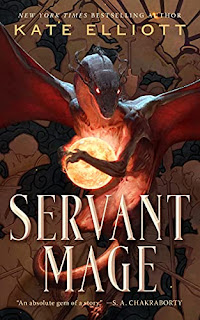
Microreview: Servant Mage by Kate Elliott

All the virtues of Kate Elliott’s work, in a new world, at concentrated novella length.

Fellian is the titular Servant Mage. Her lot is a hard one, for a crust of bread and some meat scraps and a place to stay, she uses her fire magic talents for the purposes of lamplighting, for the Republic that has overthrown the mage-dominated monarchy. Her indenture is involuntary, and seemingly designed, like a company store, to last forever--even to take a bath adds to one’s term of service. A failed attempt at escape could doom her to decades more in service. So when a group of rebels offer her her freedom in exchange with help in rescuing some pro-monarchist refugees trapped in a mine, Fellian’s choices are not as easy as one might think, and her goals and powers are more than anyone believes, including Fellian.

This is the story of Kate Elliott’s latest novella, Servant Mage.

The worldbuilding and development of the same is something I read for in Elliott’s work as much as the characters (and when I first started reading her, I focused exclusively on that, and only a bit later realized--hey, these characters are really well done TOO). I like to see where I perceive resonances and influences in people’s worldbuilding.  In Servant Mage, the historical/sociological perspective of the world kept dragging my mind to both the English Civil War of the 17th Century and the French Revolution of the 18th Century. The newish head of the government that has toppled the old Monarchy is called the August Protector, but the Nobility has suffered greatly in a “we are all equal” (except for the Mages of course, who must serve) in status and rank. The very culture itself is being rewritten in a way reminiscent of some of the odder consequences of the French Revolution. The Monarchists are a constant threat (or perceived threat) but there do not appear to be any concerns about threats outside the borders. Fellian’s origins and home ground, to me, feel a lot like the highlands of Scotland, held only loosely by the central government.

Where Mages fit into this history and culture is one of the hearts of the novella’s worldbuilding. While the previous monarchy does not appear to have been a full on Mageocracy, Mages clearly were in high roles of power, authority and also used to support the royal regime and the nobility, so that when the revolution came, the role of mages was cast down to servants, close to outright slavery in some cases, and clearly trying to diminish and harness their power. We don’t get an outright sense of how many people are born mages in this world, but the simpler magics (such as Fellian’s lamp lighting) are woven into the assumptions and practices of the world. We get a story of where magic reportedly comes from, and much more.

The magic itself is of a five part Western Classical Elemental (Earth, Air, Water, Fire, Aether) at its base, with some additional elements involving spirits and demons. There is much discussion and debate regarding the nature of magic, and its nature does wind up driving some of the plot, as well as the character development. With the mages stuck in the asylum, and rogue mages considered dangerous, I got a bit of a Dragon Age bit of feel in how magic is used, viewed, and feared, especially in this brave new world of the Lord Protector. I also got a bit of the Exalted Dragon Blooded as well sort of feel in how magic can be potentially combined by practitioners.Having Fellian, who only is really aware of, much less using, a fraction of her potential, as our viewpoint character, gives us a perspective that is mage-centered, but also provides for a lot of opportunity for the reader, and Fellian, to learn.

One interesting commentary Elliott puts into the worldbuilding is the nature of story and how events are transmitted. (With commentary on information, its control, and who is taught and what are they taught).  Fellian learns/is told a couple of perspectives on a historical event--the fall of the last Monarch, and judging how things actually happened is left for the reader to sort through the sides to the story. This is difficult enough to do with multiple points of view, but here Elliott walks a tightrope in collapsing it into a single person’s mind and perspective. This subsequently makes me wonder about a few of the other things we are told, and how much truth, lies, falsehoods and false hopes are contained within those as well. 

So let’s jump to the characters. Our story is a single POV from our titular Servant Mage, Fellian. Right away from the beginning Elliott lays down the essentials of her nature, her ability, and her drives. If character traits can be said to be Chekov’s Guns, all of them that we see early in the novella, before she winds up on the road, are primed, and eventually fired. Strongly defined women with multisided and complex personalities as our viewpoints and guides into a world and story IS Elliott’s jam, and Ferrian brings that in spades. Elliott uses her knowledge and ignorance in helping to flesh out that aforementioned worldbuilding, but even as a young Mage backfooted by events, she wastes no time in trying to take command of her own destiny, her own wants and desires. I’ve read too many series and novels, maybe you have too, where the main character, especially a young one, gets buffeted and dragged about with a lack of agency for a lot of the book. This is especially true of female characters and by authors who shall remain nameless and should know better.  Not so with Elliott’s work.  Fellian may be in a position of weakness, being a servant/slave at the beginning,  but she is no passive passenger in her own story. 

The remainder of the Mages that Fellian winds up with are a diverse and interesting lot. We get a prickly relationship with the leader of the group, right off, as Fellian’s attempts to negotiate the price of her help runs straight into his needs and wants. The remainder of the mages each get their moments, not only to show what their magic can do, but how they fit in with society, and with each other. There are plenty of revelations about the characters which makes it difficult to talk about them without being spoilery; Elliott’s characters wonderfully and vividly fitting into the story, plot and world. But, given Fellian is our only POV, it is she that we learn most of, and best. 

Elliott’s work is generally of longer, even doorstopper length. Having her work in a novella is like going from the rich wine of her regular work to something more like a distilled liqueur, the alcohols of her character, worldbuilding, and writing concentrated all the more. I had a tension between racing through this, heady and joyful at reading it, and wanting to slow down a bit and savor the complex flavors brought to the palate. I freely admit my biases here. I've been reading Elliott’s work for a couple of decades now, so my enthusiasm for her work is also well known.

In the end, Servant Mage feels like the opening to another world and series, and its ability to stand alone is a bit precarious, I feel. There is a balancing act between providing an offramp to readers who want to end with the one story, and providing rope for readers who might want more, and need to be persuaded and urged to salivate at the prospect of a second or more stories with the characters and the world. For all that written fiction is hundreds, thousands of years old, these balancing acts are like approximate solutions, and what works for one set of readers may not work for another. 

However, as I look at it from as objective a position as I can, there is a complete story here, the goals of Ferrian as we see them at the beginning of the novella are met. There is a fillip in the book where a reader might think she would take a different course, but Elliott’s strength of writing character and consistency of characters and their needs, wants and goals is something to hold onto throughout the novella. That said, the achievement of her goal and the revelations of same leads to a whole new set of possibilities and goals...it may be an ending, but it really feels more like the first “book” in a longer piece and the ending makes no bones about it. So there is an offramp for readers who want to stop here, but it's a relatively thin and mild one. As for me, I will be continuing down the road, awaiting more from the author in this world, with Fellian as her main character (although I would not be admiss to more perspectives. Even today, a single POV is a bit unusual and different for me to read in an Elliott work)

---

The Math

Baseline Score: 8/10

Bonuses: +1 for strong and vivid worldbuilding, concentrated into a novella length.

+1 for excellent characterization of our protagonist, managing a multisided perspective from a single point of view.

Penalties: -1 Is there an offramp for readers who want to one and done this? Not quite certain. 

Nerd Coefficient: 9/10  

POSTED BY: Paul Weimer. Ubiquitous in Shadow, but I’m just this guy, you know? @princejvstin

Reference: Elliott, Kate. Servant Mage [Tordotcom, 2022] 

Friday, February 26, 2021

Nanoreviews: Battle Ground, The Very Best of Kate Elliott, Calculated Risks


Butcher, Jim. Battle Ground [Ace]

For a seventeenth novel in a long running series expected to conclude somewhere around book twenty three or twenty four, most of Battle Ground (right up until the very last chapters) sure felt like a series ending book. Battle Ground is, functionally, a 400 page battle. Peace Talks, published a few months earlier, marked Jim Butcher's return after six years and that novel was a set up to an apocalyptic final battle. This book is that battle.

Battle Ground rewards long time readers of the series with connections and reconnections a plenty as everyone shows up for the fight. Granted, moreso than with other novels I would question why someone who wasn't a long time reader of the series would jump in here. Heck, I've only read the first five Dresden Files novels and then books fifteen and sixteen before this, so I'm sure I missed all sorts of context and tips of the hat - but with at least *some* knowledge of the series and, more importantly, the more recent novels - Battle Ground works.

Your mileage may vary, of course, to your interest level in one very long and increasingly escalatingly dire fight with the occasional pause to breath, plot, quip, and raise the personal stakes. It's impact is truly tied to your investment in the series. If you've been riding with Harry Dresden and friends (and foes), this is a necessary novel - though again, it's a whole LOT of battle. If you've read this deep into the series, you're going to read this.
Score: 7/10


Elliott, Kate. The Very Best of Kate Elliott [Tachyon]

Kate Elliott is best known for her long form epic fantasy, novels stretching upwards towards a thousand pages (each) of worldbuilding and top notch storytelling. Without being familiar with the full breadth of her career, the idea of Kate Elliott writing short fiction is surprising. Though she has written far more novels than stories, Elliott's short fiction stretches almost as far back to her first novels.

As with any collection, which stories hit with a given reader can vary. For me, two of my favorites are "On the Dying Winds of the Old Year and the Birthing Winds of the New" and "The Gates of Jorian", both stories where I wanted to know far more about the rest of the world and where the stories went after the last page. Granted, the former is part of the Crossroads world (Spirit Gate, Black Wolves, etc) - but the larger point is that with the best of her stories Elliott's worldbuilding is suggestive of the work she normally does over hundreds of pages.
Score: 7/10


McGuire, Seanan. Calculated Risks [DAW]

Calculated Risks is just about as experimental as a tenth novel in a series can be. After an absolutely wild ending to Imaginary Numbers, Sarah Zellaby is on another world with Antimony Price, cousin Artie, and a couple of others. If that wasn't bad enough (and it is), Antimony and co. don't recognize Sarah as family, they recognize her as the predator her species is. That's a problem. 

This is a novel taken just about as far away as can be from everything familiar with the Incryptid series, except for Sarah and Antimony. Calculated Risks is told with the wit and heart as readers have come to expect and love from Seanan McGuire, but the usual cryptids and the threat from the Covenant are not part of this book. Calculated Risks is about survival on an alien land and getting back home no matter the cost.

It's a bold move on McGuire's part and as she does so many times, she pulls it off perfectly. Though - while Seanan McGuire often presents multiple entry points into her long running series and ease readers in who might not remember what came before, Calculated Risks is not that entry point. Readers need to be already invested in the story being told to be able and willing to jump in. At the bare minimum, this is truly the second half of the Sarah Zellaby story began in Imaginary Numbers. Long time fans will find much to love here.
Score: 8/10

POSTED BY: Joe Sherry - Co-editor of Nerds of a Feather, 4x Hugo Award Finalist for Best Fanzine. Minnesotan. He / Him.

Monday, January 4, 2021

Top 9 Books of the Year

Some people do a top ten list, others do a top eleven (insert your outdated Spinal Tap joke here), some may go shorter, though I don't understand those people. My list is 9 books long. Why? Partly to be a little bit different and partly because I want the tenth spot on my list to be reserved for that really great book which I simply did not get the chance to read during 2020. That really great book may also be something I have only heard whispers about and I may not discover for several more years. Whatever that tenth great book is, I’m holding a spot for it on my list.

Also, there is no doubt that this list, like every other list out there is built entirely on the combination of the books I've actually read with my own prejudices, taste, preferences, and the choices I made when selecting books to read across the breadth of 2020. That's really what we're saying when we say we've put together a list of the "Best Books of the Year". It's the best we've read, the best we can remember, the best based on what we appreciate in speculative fiction. One of the other best books I've read this year is Louise Erdrich's latest novel The Night Watchman, but this is a speculative fiction blog focusing on more nerdy endeavors, so for the sake of theme I'll limit this list to science fiction, fantasy, and everything in between and around the edges.

Most years I think I stay fairly well on top of the genre and will read most of the significant novels of the year. I'll miss some, of course, but granting my abovementioned prejudices, taste, preferences, and choices - on the whole, I know the shape of the year and there's usually only a handful of books that I wanted to read that I didn't get to before it comes time to make this list. 

This is obvious, but 2020 has not been a typical year in any stretch of the imagination and for numerous reasons I've missed out on a whole lot of really exciting novels which I do still absolutely plan to read next year - but I can only consider those books which I've actually read. Keeping reading after the list for a brief discussion of the stuff I missed out on. Remember that open tenth spot? 

This Top Nine List is more or less in order. The top two slots are a complete lock, but ask me tomorrow and some titles may shift around a bit. The order you see below is not the order in which I started this article. Whichever order the list is in, these are the nine novels published in 2020 which I feel were the strongest titles of the year.


1. The City We Became
: I find it difficult to write about The City We Became without talking about N.K. Jemisin's previous novels even though they have absolutely nothing to do with The City We Became, but that's because the explosive excellence of her Broken Earth trilogy set a level of expectation that I was legitimately anxious that The City We Became would not be able to live up to. It was an impossible task that was only relieved by this novel being just about as different from those historic novels as can be - but the thing is that N.K. Jemisin is writing at the top of her game and while my apprehensions were founded because how the hell do you follow The Broken Earth, the answer is - with this. 

The City We Became is the personification of New York City writ large, a city being born into something greater and distinct beyond just being a significant city(which is a concept I absolutely adore) and Jemisin turns the whole thing into a cosmic battle that is absolutely intense and raw and everything I didn't know that I wanted from a novel. This was an absolutely incredible experience. Adri reviewed The City We Became earlier in the year and thought highly of it, but I absolutely loved it. I don't think that's because I had a childhood on Staten Island and Adri did not, but you never know. Also, having a childhood on Staten Island would not make me the hero of this book so perhaps I won't lean too much onto that connection.


2. Harrow the Ninth
: Gideon the Ninth was an impossible debut, bold and astounding and groundbreaking and, as Adri put it in her review, "the queer NecRomantic murder mystery you've been missing all your life". It was just about as spectacular a debut as a writer could have and Tamsyn Muir could have ridden the coattails of that novel and given readers more of the same. Even granting the ending, Gideon's voice was so singular and so iconic that to move away from it would be unthinkable. And yet, Harrow the Ninth does exactly that and throws everything you think you know from Gideon the Ninth in question. Frankly, its maddening. It is also flawlessly accomplished. 

The scope of what Tamsyn Muir attempts and achieves in Harrow the Ninth is staggering, which is why I'd like to quote Adri's review of Harrow to conclude. Muir spends at least half of Harrow on a knife edge and a single slip would invite disappointing failure. Muir's hand is steady.

"And that's the real big question, with a book this dense and complex and self-contradictory: is Muir going to pull it off? In a word: fuck yes. It's that payoff to a deeply ambitious structure that really puts Harrow over the top, even when compared to its juicy but more classically-plotted predecessor; it takes serious talent to turn part of your sequel into a nonsensical retcon of the events of the previous book without completely losing your audience, let alone to turn that retcon into a vital strand of the plot and a vehicle for character growth in its own right. Even when it's refusing to take itself and its own genre seriously on the surface, every twist in Harrow's tale draws the audience deeper into its terrifying, ridiculous, mystical world and the people within it. This is a rare series that lives up to its hype and then some, and Harrow the Ninth one of the best books I've ever read."


3. Savage Legion
: I've written at various lengths about Matt Wallace's Sin du Jour series of gonzo-culinary urban fantasy novellas (here's my review of the final volume, Taste of Wrath, with links to the previous six). While I'm going to talk about Savage Legion a bit here, I can't help but to make my strongest recommendation to go find a copy Envy of Angels, starting reading, and thank me later. But we're not here to talk about Sin du Jour (well, you're not. I'm always here to talk about Sin du Jour). We're here to talk about Savage Legion - Matt Wallace's epic fantasy debut, a twist in the concept of what Epic Fantasy (capital letters) does and can do within the framework of the sub genre. We're here to talk about why it's so friggin good. 

Paul Weimer wrote about Savage Legion back in June (which feels like two lifetimes ago) and does a great job covering the scope of what Wallace is working with here. Weimer writes, "the novel is a much more complicated and inventive novel than the title, cover and promotional matter led me and might lead you to believe. There are potent themes here that Wallace is exploring, the writer’s ambition to write a story that talks about some fundamental and difficult subjects, even in a secondary world setting far removed from our own, is done with verve, nuance and burgeoning skill. The role and power of the poor in society. Oppression, control of news and information, and endless war. The horror of war, environmental degradation, resource extraction and the uses of power. It’s a heady cocktail that Wallace plays with. It’s even more impressive with the savage and bloody battle scenes, the slice of life character moments, and the nuanced relationships that develop between various characters in the novel. While I am annoyed and call out again the novel is not what it seems to be, the action sequences are top notch, pulse pounding, and excellently done, a real highlight of the book."
 
While I acknowledge Paul's point that the promotion of the book focused on Evie's storyline of forcibly joining the legion and the novel is so much more, but I do not share his annoyance with that fact because I've never expected Matt Wallace to just tell a simple story of pulse pounding action. Matt Wallace doesn't write simple. Of course, far be it for me to complain about someone else taking issue with a book's promotion given my own history.  The point, of course, is not about the promotion of Savage Legion, successful as it may have been in drawing Paul and I towards the novel. 

The point is that everything about Savage Legion kicks ass. Yes, the action scenes which are specifically written to kick ass do, in fact, kick ass. Wallace writes action like nobody's business. But it is Wallace's deft treatment and handling of the socio-political in this novel which really sings. Everything is vibrant and rich and immediate. It's not that you can't look away, it's that you don't want to. Savage Legion is a fucking accomplishment.


4. Unconquerable Sun
: These days Kate Elliott is most known for her epic fantasy novels - Crossroads, Spiritwalker, Crown of Stars, Black Wolves, and Court of Fives. Unconquerable Sun is a return to her science fiction roots - though like a good space opera it does read in some ways like epic fantasy in space (which, I think, it is an entirely separate essay and conversation). Given the high concept of "gender-bent Alexander the Great in spaaaace", that works remarkably well. High concepts and elevator pitches are nice and fun, but at least for me it's all about the execution and my trust in the writer. I have nothing but trust in Kate Elliott and she has earned every bit of it. Unconquerable Sun nails the whole thing. 

Other than having once seen Oliver Stone's Alexander movie starring Colin Farrel and having forgotten just about everything in that movie, I don't know the story of Alexander the Great. It's just a name, a half forgotten legend. It doesn't matter. Kate Elliott may be using that as the framework, but it shouldn't be considered a barrier to entry. Unconquerable Sun is a science fiction epic, a story of family and high political plotting and drama. It's a novel of ambition, both Sun's and of the author's. Kate Elliott doesn't reach for the stars, she lives there and Unconquerable Sun shines as brightly as can be. 

If you don't believe (which you should), perhaps check out Paul's review of the novel. He mentions one bit of Elliott's worldbuilding which might be my favorite bit of this wonderful novel, "her use of the idea of Channel Idol. How does one try and come up with an interstellar idea of Arete (excellence) in a way to mirror Alexander’s rise to power, fame and reputation? Easy. Create an interstellar network of news and entertainment called Idol. Add in a Eurovision like contest called Idol Faire." It's a side bit of shade and color to the novel, but it is so well constructed it feels as natural as it anything else.


5. The Ministry for the Future
: This is the first novel on the list that I've previously written about, so I'm going to crib from myself while talking about it. 

"It may be a stretch to call The Ministry for the Future the last major novel of Kim Stanley Robinson, though I listened to an interview with Robinson where he did suggest this may be exactly that because he was changing his novel writing focus after the intensive work to put together this novel and the last several. If so, The Ministry for the Future is one heck of a way to close out this chapter of his career.

Though it begins with absolute horror, The Ministry for the Future is ultimate a hopeful novel. Robinson looks hard at our present and pushes towards the global, societal, ecological, and economical catastrophes that are looming and makes them happen. Then, he offers hope for how humanity could (and arguably must) transform our cultures to tackle the very real climate breakdowns that are occurring. This isn't much of a spoiler to say that it would require a fundamental change to human culture and that there will be some nations (the United States, say) who lag behind in effective response.

The Ministry for the Future is an impressive work of imagination and prognostication. It offers a road map that we are unlikely to take until things are too late, but then that is not much different from the path taken in the novel."
 
One point which I'd like to rehash a bit is the idea that The Ministry for the Future is a significant work of imagination and a major and important novel. As big as Kim Stanley Robinson is within the field of science fiction, I believe his work has ranging impact in the wider world. While I'm not sure the extent of Robinson's impact, he is very effective in shining a light on the consequences of our collective actions and to propose a way forward.  He's also a heck of a storyteller. If you don't believe me, maybe Barack Obama's opinion carries a little more weight.


6. A Pale Light in the Black
: In just four years K.B. Wagers has become one of my favorite science fiction storytellers. They have published five books in the Indranan and Farian War series (so far!) and I was surprised that A Pale Light in the Black came out before The Farian War was complete, but any (brief) hesitation I might have about starting a new series from a favorite author was gone on the first page. Oh. Right. I'm in good hands and on comfortable ground. 
 
More than anything else, A Pale Light in the Black is fun. There is heady, serious science fiction that wants to teach you a lesson while telling a story (this is not a knock, look back at my thoughts on The Ministry for the Future) and that science fiction is great (told you). There is also room for the science fiction that takes your hand and pulls you along on a romp of a ride, thrilling you at every turn. Some do it with epic space battles an others do it with a fabulous cast of characters you want to be friends with and follow along on any of their adventures, whether it is drinking with your crew in the bar or participating an an intra-service military skills competition. A Pale Light in the Black is the second kind and is a pure friggin delight to read from start to finish. 

By now I've pretty much ceded the reviewing of K.B. Wagers' novels to Paul. He's done a bang up job and, frankly, he's far more prolific and consistent of a review than I can hope to be right now. As such, this would be an excellent time to check out his review of A Pale Light in the Black

What I think I appreciate most about A Pale Light in the Black is *who* the book is focused on. The Near Earth Orbital Guard. NEO-G. It's the Coast Guard in space, which is just about perfect. They, like the actual U.S. Coast Guard perform an incredibly important mission and are highly skilled professionals who save lives. They, like the actual U.S. Coast Guard are often looked down upon as being a lesser branch of the military (which is wrong and incorrect, they have a particular mission and perform it with excellence, but the idea remains - I also wrote that previous sentence the week the new Space Force were announced to be Guardians, so we'll see how that condescension shakes out). So when it comes to the Boarding Games, the aforementioned military competition, the NEO-G team has a lot of somethings to prove. 

I've also gotten this far without mentioning Jenks, the most delightful damn character I've read this year, which is why we've got Paul taking point on the reviews.


7. Stormsong
: Witchmark was one of the quietly buzziest debuts of 2018, which sounds absurd on the face of it but (at least from my perspective) the story of Witchmark built and built until it was one of the most significant novels of the year. In the end, Witchmark was a World Fantasy Award winner and a Nebula Award finalist, among others. I described Witchmark as "a lovely novel and excellent debut" and I stand by that. It was excellent, but it is also a novel that has been slightly diminished in my estimation by the passage of time. I admit, I may be one of the only readers to have had that reaction given how beloved a novel it was and the award recognition it received. 
 
Then came Stormsong, a novel which exceeded any expectation I had. Everything Witchmark did well (which was a lot) Stormsong did better. Plus, it added a more than heavy dose of political intrigue to go with the top notch interpersonal relationships C.L. Polk crushed in Witchmark. But what Polk does so exceptionally in Stormsong is the melding of the political with the personal - which, I suppose is what politics can be, the personal writ large. 

Stormsong is exceptional storytelling. The smoothness and the naturalness of Polk's storytelling in Stormsong is an absolute wonder.


8. Architects of Memory: Each year has several prominent debut novels and, generally, two or three or them are likely to make my list of favorites. Architects of Memory was one of my more anticipated debuts and I'm quite happy that it live up to the anticipation. I may not have been able to read all of the books (debuts or otherwise) I wanted to this year, but the ones I did were quite good. I'm not the only one who thinks so. Sean Dowie wrote about Architects of Memory back in October and had this to say:

"The most singular talent of Architects of Memory is finding a new bent on a space opera story—a genre that’s been well-trodden so thoroughly and covered in footprints that it can seem impossible to find a patch of your own. And while Karen Osborne does steps on patches that have been stepped on by seemingly every sci-fi author, there are idiosyncrasies to characters and twists regarding alien life that more than make it fresh. While characterization isn’t at the top of the novel’s mind, it does do a much-more-than-serviceable job of establishing believable motivations and ample depth to keep you caring.

But the greatest joy of Architects of Memory lies in its plot and the themes they develop. Whether it tackles individuality and collectivity, the belligerent survival instincts of humanity, or relationships in secrecy, it lays the foundation for those themes and builds upon them, never leaving them underdeveloped along the way. The most intriguing theme is how memory is so tied up with our sense of self. We’re a collection of the knowledge we accrue and the relationships we build, but without memory, those things slip through our fingers like sand. Love can change from everlasting to a brief sensation. Familial bonds that we preoccupy ourselves with if the world around us is rotten becomes lost if our memory – our personal storage locker that tethers all our meaning – is gone.  

Space operas can sometimes be so unwilling to take risks and stray from conventions that they’re forgettable. Stories that have edifying substance don’t matter if they immediately leave our memory. The best way to counteract that is to have original characters, and hard-hitting themes despite how well-trodden some story beats are. Architects of Memory does that. Its craft, emotional intelligence, and smooth writing style work to create a gem that will be at the top of my mind for a long time."


9. The Relentless Moon
: One thing I appreciate about Mary Robinette Kowal's science fiction is that it is ultimately optimistic. If I may be excused the pun, and even if not, I might suggest that her science fiction is relentlessly optimistic. Sure, the Lady Astronaut series began with a meteorite crashing into and devastating the Earth, but each of the novels have been about problem solving and a belief that the seemingly insurmountable is something that - with enough science, ingenuity, and hard work - can actually be overcome. To quote myself, The Relentless Moon is "about striving towards excellence and truly building a better tomorrow even in the face of a devastating future."

With The Relentless Moon, Kowal moves past the focus of Elma York of the first two Lady Astronaut novels, away from the race first into space and then Mars. Kowal brings the focus to the Moon (it's in the title, after all). The focus is on the moon, but also on the challenges of Earth. Not everyone is satisfied (let alone happy) about the existence of the space program and the diverted resources that could be better used to recover from the meteorite. That's the deepest core of the novel. 
 
To further quote myself, 
 
"There's a lot going on in The Relentless Moon and Kowal keeps everything moving and flowing together with remarkable deftness and an underlying compassion that smooths the edges off even the harshest aspects of the novel - including Nicole's eating disorder, racial issues, domestic terrorism, and a desperate fight for survival on the Moon. Everything is handled with sensitivity, though Kowal does not shy away from the emotion of the worst moments - it's more that Kowal is such a smooth writer that the reader is in safe hands. The novel leans into the pain, but with a light touch.

The Relentless Moon is more than the pain, of course. I am very much not the first to appreciate the generally healthy marriages in the Lady Astronaut novels, but reading about a relationship where both partners support each other and recognize the sacrifices they make to achieve goals and just build each other up is absolutely refreshing. Equally refreshing, especially perhaps when reading this novel during a pandemic, is that science is celebrated and problems are typically solved by smart people working very hard to come up with a solution. To paraphrase both Mark Watney (The Martian) and Vanilla Ice: if they have a problem, yo they'll solve it by sciencing the shit out of it. That's delightful. It's also important. There is violence in The Relentless Moon, but it is mostly off stage. The struggle is that of science, engineering, imagination, and decency. This novel, like the two Lady Astronaut novels before it, is about striving towards excellence and truly building a better tomorrow even in the face of a devastating future. The Relentless Moon is hopeful science fiction, and that's something worth celebrating - especially when it's this good."

 
As I mentioned in the introduction, for as many books as I read in a year, there is always something amazing that I missed and that I just didn't have time to get to. Or, as plugged in as I try to be, that I just haven't heard of (or heard enough about). As much as I wanted to, I did not read Black Sun (Rebecca Roanhorse), The Burning God (R.F. Kuang), Ring Shout (P. Djeli Clark), Network Effect (Martha Wells), Elatsoe (Darcie Little Badger), The Once and Future Witches (Alix E. Harrow), Piranesi (Susanna Clarke), Mexican Gothic (Silvia Moreno-Garcia), Machine (Elizabeth Bear), Axiom's End (Lindsay Ellis), A Deadly Education (Naomi Novik), The Angel of Crows (Katherine Addison), among others. The list of highly recommend and presumably stellar novels that I just didn't get to read this year is long and distinguished. That's the reason for the tenth spot on the list.
 

POSTED BY: Joe Sherry - Co-editor of Nerds of a Feather, 4x Hugo Award Finalist for Best Fanzine. Minnesotan. He / Him.