Showing posts with label Ann Leckie. Show all posts

Tuesday, February 27, 2024

Cool Books I Read While I Was Too Sad to Review

If a review copy lands in the inbox when the reviewer is too overwhelmed to read it, does it even get a review?

Well, no, obviously it doesn't. Despite my fervent hopes, the review fairy did not visit me once while I was having a Big Bad 2023 to magic away my Netgalley obligations and show love to books during my period of chronic distraction. But the books continued to be good, and I'm going to cover some of them here in not-even-nano-sized review chunks.

Case in point: The Saint of Bright Doors by Vajra Chandrasekera was a 2023 highlight. I've seen a lot of deservedly flattering comps for this novel, a story of divine destiny denied set in a fantasy Sri Lanka:  my own mind was drawn to Sofia Samatar and Ursula K. Le Guin while reading, with a few of the bleak vibes I last felt in A.K. Larkwood's The Unspoken Name. For a story that really invites comparisons, however, Saint of Bright Doors is very much making its own mark on modern genre - and I'm sure there are plenty of threads of Sri Lankan and wider South Asian influence that I missed entirely.

Highlights of the reading experience for me included the way the story's geography seems to literally rearrange itself around the absurd authoritarianism of Luriat's state politics, the portrayal of gods and unknowable supernatural forces co-existing with a mundane, modern setting, and the greatest first person pronoun drop in genre history. This is an essential novel and I hope we'll be talking about it for years to come.

Translation State by Ann Leckie was a novel I hoped to feel similarly about. This latest standalone-ish instalment in Leckie's Imperial Radch universe is a solid, thought provoking piece of SF (Clara has some excellent provoked thoughts here) but it hasn't withstood the test of time as a standout novel for me, Don't get me wrong, I love the Presger translators, and I highly appreciated the way Leckie gives us crumbs of further context without really making anything clearer about the setting's most mysterious alien race. Less attractive on reflection is the treatment of alien biological urges as fundamentally irresistible in a way that would simply not make sense if the author were talking about humans. Protagonists Reet and Qven are, for different reasons, terrified of the urges of their alien heritage, but all Presger translators simply have to go through "puberty" in the way their creators designed, so oh well, suck it up kids, they'll be fine once it's done. 

I understand the narrative is setting up questions about personhood in general, not creating any deliberate queer parallels, but gender is so integral to the setting as a whole, and aliens so often used as a stand-in for human queerness (and neurodivergence) that it's hard not to think about Qven and Reet's lack of choice through that lens. It would be nice to see stories that think more about how alien queerness would manifest, from the starting assumption that of course it would manifest in any sentient species, but I'll keep searching for those books elsewhere. In the meantime, any Imperial Radch is good Imperial Radch, but this one didn't hit "great" for me.

Joe and I share a love of Seanan McGuire's October Daye series, and while he does the honours of the full Nerds of a Feather reviews, I also found time for both of last year's double-Toby entries, Sleep No More and The Innocent Sleep. These are the 17th and 18th books in the series respectively, and they effectively act as companion novels to each other: Sleep No More follows series protagonist October - a fae changeling - as she grapples with the effects of a reality-altering mass illusion, while The Innocent Sleep breaks with series tradition to focus on her Cait Sidhe husband Tybalt, who is working against the illusion from the outside. The actual points of narrative overlap didn't set my world on fire (In one book, October thinks Tybalt looks angry! In the next book, we learn Tybalt is angry!), but the double-bill allows McGuire to let loose with the most unsavoury conventions and darkest corners of fae society in a way that brings the series full circle to its earliest vibes. There's also more time across the books to feature a wide set of supporting characters - including one unexpectedly sympathetic "recast" - who demonstrate the breadth of the series' worldbuilding. As always, I'm eager for more.

Let's talk about some more underrated series! Claws and Contrivances is the second in Stephanie Burgis' Regency Dragons romances and it's just as delightful as the first: an intricate and often hilarious plot of misunderstandings and reversals, sprinkled with fun dragon naturalism and centred around a young protagonist with a lot to learn and a LOT of willing accomplices to her various schemes. Unlike the first book in the series, Scales and Sensibility, Claws and Contrivances takes place in a fundamentally loving family environment where queerness and difference are accepted, and it's the perfect backdrop for Rose Tregarth and her nerdy, autistic-coded love interest Aubrey to fall for each other.

Furious Heaven by Kate Elliott is anything but light, both in content and in physical weight. As Paul covered in detail, this is a 750 page chonk retelling events from the life of Alexander the Great, except Alexander is now Princess Sun, daughter of Eirene of Chaonia, an expanding galactic power rubbing up against the much larger might of the Phene while trying to maintain their own powers at home. If you know the history of Alexander the Great, you'll probably recognise more moments from real history, but it's certainly not necessary to enjoy the combination of pew-pew space battles, irreverent epithet-laden narration, "oh no she DIDN'T" politicking, and silly teenagers with entirely too much power. Go look up the facts afterwards to find out which bits really happened (no genetically modified four-armed people in antiquity, unfortunately), and get some knowledge useful for pub quiz as a bonus!


Adri, Nerds of a Feather co-editor, is a semi-aquatic migratory mammal most often found in the UK. She has many opinions about SFF books, and is also partial to gaming, baking, interacting with dogs, and Asian-style karaoke. Find her on Bluesky at adrijjy.bsky.social.

Wednesday, September 13, 2023

Lindsay, Leckie, and LeGuin: A century of pronouns and gender in SFF


Ann Leckie’s Imperial Radch series burst upon the SFF world in 2013, drawing notice for (among other things) its linguistic worldbuilding. The Imperial Radch, the central power of the series, speaks a language that lacks any gender distinction in the pronouns. Linguistically, this feature in itself is hardly unusual. There are many languages spoken today (on Earth) that do not distinguish gender in their pronoun systems, ranging from Imbabura Quichua in Ecuador (pai), to Finnish (hän), to 252 other languages listed in the World Atlas of Language Structures as lacking all gender distinctions in their pronoun system (Siewierska, 2013).1  

No, what made the Radchaai gender invariance striking was that Leckie chose to render that single, gender-neutral pronoun in English as she. And since the narrator, Breq, is Radchaai, every character in the book is rendered as she, regardless of their own individual gender identity. Furthermore, in a nod to the Sapir-Whorf hypothesis, speakers of Radchaai struggle to recognize gender as a property of humans.2 When Breq is forced to use gendered pronouns in other languages, she3 often resorts to guessing, based on what she knows of that culture’s arbitrary and idiosyncratic cues, and hoping she got it right. To Breq, categorizing humans as one gender or another is as pointless as many English speakers find categorizing inanimate nouns. In Spanish, key is feminine and bridge is masculine. In German it is the reverse, and what is more, girl is neuter. Bantu languages distinguish as many as ten, fifteen, even twenty different categories, at which point even the most classical grammarian gives up on the idea of sex-based gender terms and just calls them ‘noun classes’ (Marten 2021). Surely, thinks many an English-speaker, this grammatical ornamentation is an entirely unnecessary and frivolous complication. Likewise, to Breq, pronouns and gender. 

But Leckie is not the first person to employ pronouns as a tool of linguistic world-building. Indeed, she is only the latest in a long series of SFF authors who have departed from English language pronoun conventions to enrich their creations. And by tracing the strategies these authors have used throughout the years, we can also trace the concerns of the time in which those authors were writing, both on the macro level of decades and generations, and also on the micro-level of years that separate a book and its sequel. 
If we start our historical journey at a nice round centuryish ago, we discover that the neopronouns ae/aer are not, in fact, terribly neo. They were first introduced in 1920 by David Lindsay in his novel A Voyage to Arcturus, to describe the phaens:

[T]his person, although clearly a human being, was neither man nor woman, nor anything between the two, but was unmistakably of a third positive sex, which was remarkable to behold and difficult to understand. In order to translate into words the sexual impression produced in Maskull’s mind by the stranger’s physical aspect, it is necessary to coin a new pronoun, for none in earthly use would be applicable. Instead of “he,” “she,” or “it,” therefore “ae” will be used.

Note that the link between sex and gender is taken for granted. The need for a new pronoun has nothing to do with social self-presentation in the phaens, and everything to sex and procreation:

He found himself incapable of grasping at first why the bodily peculiarities of this being should strike him as springing from sex, and not from race, and yet there was no doubt about the fact itself. Body, face, and eyes were absolutely neither male nor female, but something quite different. Just as one can distinguish a man from a woman at the first glance by some indefinable difference of expression and atmospheres altogether apart from the contour of the figure, so the stranger was separated in appearance from both. As with men and women, the whole person expressed a latent sensuality, which gave body and face alike their peculiar character.... Maskull decided that it was love—but what love—love for whom? It was neither the shame-carrying passion of a male, nor the deep-rooted instinct of a female to obey her destiny. It was as real and irresistible as these, but quite different.4

Now, to be sure, Lindsay’s brainchild is hardly a masterpiece of progressive foresight. In 1920, it was an uphill battle to suggest that male passion need not be shameful; that female sexual pleasure need not stem from a biological urge to “obey her destiny,” and Lindsay was evidently not interested in fighting that battle. But he could at least suggest that it was possible for people to land in a third box—even if you had to go to Arcturus to find them.

If we jump forward half a century, to 1968, Ursula LeGuin continued this conversation about gender in The Left Hand of Darkness, and it’s quite striking to compare the choices Lindsay made with LeGuin’s decisions. Some of the contrasts are simply related to differences in world-building. Where Lindsay’s phaens have all the sexual organs, perpetually in abundance, LeGuin’s Gethenians have none of them, most of the time. Only when they enter the biological state known as kemmer once a month do they develop sexual characteristics, becoming either male or female, and possessed of an incredibly strong sexual drive. When kemmer ends, the Gethenian reverts to androgyny until the next month, when they may develop an entirely different set of sexual characteristics from before.

All or nothing, fixed or shifting, genders that don’t obey the male/female binary will run up against the question of pronouns. Lindsay, as we have seen, invented completely new ones. Intriguingly, although you’d imagine LeGuin’s readership in the 1960s would be willing to match Lindsay’s in their appetite for adventurous pronouns, LeGuin herself was more linguistically conservative. She decided to stick with the ‘gender neutral’ pronoun he/him/his in all contexts, defending this choice in an essay written from 1976: 

I call Gethenians “he” because I utterly refuse to mangle English by inventing a pronoun for “he/she” “He” is the generic pronoun in English, dammit. (I envy the Japanese, who, I am told, do have a he/she pronoun.) But I do not consider this really very important.

Yet ten years later, in 1989, LeGuin revisited that essay,5 and describes how she changed her mind entirely not too long after such a breezy dismissal of the importance of pronouns: 

This “utter refusal” ... collapsed, utterly, within a couple of years more. I still dislike invented pronouns, but now dislike them less than the so-called generic pronoun he/him/his, which does in fact exclude women from discourse; and which was an invention of male grammarians, for until the sixteenth century the English generic singular pronoun was they/them/their, as it still is in English and American colloquial speech. It should be restored to the written language, and let the pedants and pundits squeak and gibber in the streets. 

Despite its grammatical conventionality, The Left Hand of Darkness is a much more thoughtful meditation on gender and society than A Voyage to Arcturus. Part of that is that it’s just a better book. But it’s also a book written in a society that had moved on in which conversations about gender it’s willing to engage in. Linguists in the 1960s and 1970s were engaging in lively discussions about how sexism is encoded in language,6 and whether he truly is as neutral and generic as people (like LeGuin in the 1960s) like to claim.7 In this context, LeGuin’s Gethenians don’t just represent a wonky biology that requires a matching pronoun. If they did, then their pronouns would have to change every time they enter and exit kemmer. No, the Gethenians allow LeGuin to explore the idea that gender need not dictate one’s role and recognized capacities. That gender is not, in fact, a necessary part of society. 

Yet, like Lindsay, LeGuin was still controlled by the idea that sexual identity directly affects personality. Because, as we learn in Chapter 7, “the sexual impulse is tremendously strong in [kemmer], controlling the entire personality, subjecting all other drives to its imperative.” For all that the Gethenians are not sexual or gendered most of the time, the fact remains that when they acquire sexual organs, sex becomes dominant in defining their identity.

Furthermore, for all her progressive thoughtfulness, LeGuin still catered to a default male perspective. Beyond the decision to use default ‘he’ for Gethenians, she also presented the world of Gethen through the perspective of Genly Ai, a visitor whose own biology has fixed his gender as biologically male (a property that the Gethenians view as a bit perverse, to see a human who is perpetually and continuously a sexual being). And as the perpetually sexual and perpetually male Genly Ai grows closer to his Gethenian companion Estraven, who—if not always male—was always coded with male pronouns, we find that LeGuin also catered to a default heterosexual perspective. A certain amount of rhetorical gymnastics are used to sidestep the queer potential growing in the nascent intimacy and eventual sexual attraction between them.  (LeGuin does say, in the same essay where she revisits her pronoun decisions, that she also regrets this knee-jerk assumption in her worldbuilding. Her views changed remarkably in the space of that decade.) Indeed, more generally on Gethen, a committed couple will match their biological sex 50% of the time they enter kemmer, and yet when Gethenians are in kemmer, they only ever choose heterosexual partners. Once again, sexual attraction and sexual identity cannot be separated from procreation, even on Gethen.

Jump forward another half century, and we have in Ann Leckie’s Imperial Radch books another set of perspectives separated by a decade. The originally Ancillary series came out in 2013, and her most recent installment in that universe, Translation State, came out just this year, in 2023 (reviewed (by me!) on Nerds Of a Feather here). And once again, we can trace developments in social concerns about gender by looking at the differences between Leckie in 2013, and Leckie this year.

From the beginning, Leckie was not so considerate of the default male, default het, default binary conventions as LeGuin was. Indeed, she is downright provocative.8  Rather than treading a truly neutral path with default they, as LeGuin later wished she had done, Leckie builds a world where the default coding is female. Although superficially this decision had the same effect as LeGuin’s genderless society with default male coding—the same pronoun for everyone!—its impact was very different. Not only was the male perspective entirely erased, but the Radch isn’t like Gethen, where everyone is by default sexless. In the Radch, people still have sexual organs in profusion. Those organs are simply uncoded by gender. And that idea made a vocal, active subgroup of science fiction readers extremely uncomfortable. The very idea of it! People with the same plumbing doing things, cats and dogs living together, mass hysteria

What the original Ancillary books did not do, however (or not much), was touch on questions of gender identity or trans issues. How could they? Gender isn’t a thing in the Radch. Everyone is she. It’s as impossible to misgender someone within the Radch as it is for a 21st century human, whose culture simply does not recognize the concept of questors, to misquestor another 21st century human. 

I don’t know whether Leckie was deliberately side-stepping the issue, as LeGuin did on Gethen, or whether she merely overlooked it. Breq observes in Ancillary Justice that ‘the cues meant to distinguish gender changed from place to place, sometimes radically, and rarely made much sense to me’ (pg 3). This recognition that gender can be arbitrary certainly leaves open the possibility of transgender people outside the Radch. Yet, later, in a rather entertaining sequence in Ancillary Sword, we learn about the historical tendency of an annexed system, the Athoeki, to make ‘a division between people with penises and people without’ (pg 84), which is agreed among the Radchaai to be parochial and bizarre. Of course, there are more than just the Athoeki outside the Radch, but it is striking that one of the most in-depth discussions about gender-having, non-Radch is still explicitly linking gender to biology. 

Within the original Ancillary trilogy, it seems, Leckie was primarily interested in exploring what happens when gender and biological distinctions are both removed entirely from society. She wasn’t quite yet ready to explore what happens when they’re still present, but delinked in the way that is necessary for building a trans-inclusive society. 

And this decision is understandable, given the publication date of 2013 for Ancillary Justice. In 2013 society was not talking about trans rights the way it was talking about gender roles. 2013 was a lot longer ago, culturally, than it feels to middle aged ladies like me. Gay marriage in the US was not legal. J. K. Rowling had not yet alienated her readership with her anti-trans views. Trans people existed,9 but trans equality was not yet in the public spotlight the way it is now. Politicians were much more het10 up about which adults got to marry than about which people were allowed which kind of medical care. Forget banning gender-affirming surgery and hormone therapy—abortion was still legal in 2013. In 2013, only a decade ago, the dominant gender-related questions still centered on male-female binary oppositions. Sheryl Sandburg published Lean In in 2013. Remember Lean In? It’s the book that suggested that workplace sexism could be fixed if only women changed their behavior.
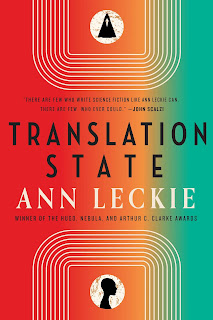
By 2023, however, trans rights have become a rallying cry for the progressive left (and a target of hate for the reactionary right), and Leckie has expanded the world of the Radch to address it in a fascinatingly deft way in her new book Translation State. Because, although the Radchaai do not distinguish gender in their pronouns, there are cultures around the Radch that do. The Athoeki of ten years ago stuck with a traditional Earthlike male/female-style binary, but in Translation State Leckie has introduced other cultures that have finally, fully delinked gender and sex, allowing more than just male-female binaries, and respecting people’s own choices about which gender category they use. 

And when these people interact with the Radchaai, they get misgendered. Unlike Breq, who at least makes an effort to guess at what the correct gender coding might be, most other Radchaai don’t even bother. In Translation State, when a Radchaai official is explicitly and repeatedly corrected, she waves it off with a disdainful ‘Whatever. Anyway . . .’ 

This is not, in the world of the book, any kind of transphobia at work. To be transphobic, you must believe that gender is immutable; to believe that gender is immutable you must know what gender is, and the Radch are entirely blind to it. Rather, in the world of the book, this attitude is a reflection of the political dominance of the Radchaai, and their refusal to recognize cultural traditions that they do not posess themselves. This is an American asking a colleague whether they have plans for Easter Break, assuming that of course the colleague is Christian. This is a bathroom technology engineer assuming that of course all hands look like white hands, resulting in automatic soap dispensers refusing to dispense soap for people of color. It is cultural imperialism behind these misgenderings, not transphobia.

And yet—and yet and yet and yet. Even though the Radchaai can’t see gender, it’s hard not to read the repeated misgenderings as transphobia. It feels oddly reminiscent of white people who insist that they ‘don’t see color’ and then proceed to indulge in all sorts of racial microaggressions. 

The insidiousness of this transphobic flavor to the Radchaai is characteristic of Leckie's deft touch. She never has the broader conversation explicitly with her readers. Her books are never about gender and pronouns, not the way that LeGuin’s work was, or even the bits dealing with the Phaens in Lindsay’s work. Leckie doesn’t have her characters discuss gender and pronouns explicitly. She doesn’t use them as mouthpieces, having them speechify her worldview, engage with each other to present The Gender Issue. Indeed, the books are very straightforwardly discussions of the consequences of cultural dominance and imperialism. But by simply presenting the treatment of gender and pronouns as she does, with their transphobic resonances, she forces the readers to have the conversation with themselves.

In the Ancillary books, Leckie also forced people to confront gender relations without ever explicitly discussing them, simply through the nature of the Radchaai’s pronoun system. This was an an important conversation in 2013. And now, Leckie is forcing people to confront transphobia and gender identity without ever explicitly discussing it, again, simply through the nature of the Radchaai’s pronoun system. In the space of a decade, the same linguistic worldbuilding has been repurposed to engage with the evolution of ongoing issues, without ever making those issues the focus of the book. It’s more elegant than Lindsay—no surprise there—but I’d argue it’s also more elegant than LeGuin. It’s all rather quite brilliant, actually.

——

1 This number is an order of magnitude more frequent than the other possible systems of pronoun gender expression listed. Although WALS is not an exhaustive inventory of all languages, it is constructed with a particular eye toward representing the range and scope of diversity across human languages (Comrie et al 2013), and so I’m inclined to believe that non-gendered pronoun systems may well be the rule, rather than the exception, to human language grammars.
2 Earthling speakers of Quichua and Finnish and 252 other languages do not have this problem.
3 Breq’s own relation to gender is not quite the same as other Radchaais’, because she is not a human. Rather, Breq’s body is one of many biological avatars of a spaceship’s AI, which controls many human bodies as extensions of her own consciousness. I use ‘she’ here simply because it’s what Breq would use for herself.
4 This sequence goes on quite a bit, with a lot of rather quite rude remarks demands on the part of Maskull, who says things like, ‘Never mind that. It is your sex that interests me. How do you satisfy your desires?’ At least buy the nice phaen a drink first!
5 If you have read The Left Hand of Darkness, I highly, highly recommend reading this revisitation. It’s called ‘Is Gender Necessary: Redux’, and it is formatted in two columns, with the original text on the left, and LeGuin’s revisions and annotations about how her thinking has shifted in the intervening years on the right. It is effectively a three-way conversation between LeGuin-in-1968, LeGuin-in-1976, and LeGuin-in-1989. One LeGuin is brilliant; three LeGuins are triply so. See references for link.
6 For a very accessible example of one such discussion, see ‘Language and Woman’s Place’, by Robin Lakeoff, 1973, link in references. She even talks about the use of ‘he’ as the neutral, unmarked pronoun for mixed groups.
7 I’m reminded here of a line from James H White’s ‘Sector General’ stories, originally written in the 1960s and 1970s, which offers an interesting perspective on the universal use of he: ‘. . . When O’Mara became quiet and polite and not at all sarcastic, when he began treating a person as a patient rather than a colleague in other words, that person was in trouble up to his or its neck.’ His or its. Not His, hers, or its, but his or its. Clearly, ‘his’ can’t be truly a gender neutral universal pronoun, or else it would have included aliens who individually would take ‘its’. And since this book is wildly misogynistic in many, many other ways (oh, good gravy, far too many ways to remain within the scope of a footnote), I think it’s unlikely that White intended for ‘his’ to mean ‘his or her’ the way grammarians intended. ‘His’ meant ‘his’. Women need not apply.
8 She is not the first to be deliberately provocative, of course. Samuel R Delaney springs to mind as a writer who made a point of pushing all sorts of boundaries with respect to gender identity and sexuality a generation before Leckie. But Delaney was not representative of the SFF reading public’s preferences. Indeed, his willingness to push boundaries cost him publishing contracts with Bantam when he explicitly included the AIDS epidemic in his Nevèrÿon books in the 1980s (Lucas 2023). He would not spring to mind so easily if he were not so exceptional in his work, if he were not an exception to a more general tendency.
9 Trans people have always existed.
10 Get it? Get it?

——

References

Comrie, Bernard, Matthew S. Dryer, David Gil, and Martin Haspelmath. 2013. Introduction.In: Dryer, Matthew S. & Haspelmath, Martin (eds.) WALS Online (v2020.3) [2013]. https://doi.org/10.5281/zenodo.7385533 (Available online at http://wals.info/chapter/44, accessed on 14 July 2023).

Lakoff, Robin, 'Language and the Woman's Place'. Language in Society 2(1). [Cambridge University Press 1973]. (Available online at https://web.stanford.edu/class/linguist156/Lakoff_1973.pdf, accessed 2 September 2023).

Leckie, Ann, Ancillary Justice. [Orbit 2013].

Leckie, Ann, Ancillary Sword. [Orbit 2014].

Leckie, Ann, Ancillary Mercy. [Orbit 2015].

Leckie, Ann, Translation State. [Orbit 2023].

LeGuin, Ursula K., The Left Hand of Darkness. [Ace Books 1969].

LeGuin, Ursula K., Is Gender Necessary? Redux. In: Dancing at the Edge of the World: Thoughts on Words, Women, Places. [Grove Press 1989]. Available online at https://americanfuturesiup.files.wordpress.com/2013/01/is-gender-necessary.pdf, accessed 2 September 2023].

Lindsay, David, A Voyage to Arcturus. [Methuen & Co., Ltd 1920].

Lucas, Julian, How Samuel R. Delany Reimagined Sci-Fi, Sex, and the City. [The New Yorker, 10 July 2023](Available online at https://www.newyorker.com/magazine/2023/07/10/samuel-r-delany-profile, accessed on 2 September 2023).

Marten, Lutz, 'Noun Classes and Plurality in Bantu Languages', in Patricia Cabredo Hofherr, and Jenny Doetjes (eds), The Oxford Handbook of Grammatical Number, [Oxford Handbooks, 2021]. (Available online at https://doi.org/10.1093/oxfordhb/9780198795858.013.26, accessed 16 July 2023).

Sandberg, Cheryl, Lean In: Women, Work, and the Will to Lead. [Knopf 2013].

Siewierska, Anna, Gender Distinctions in Independent Personal Pronouns. In: Dryer, Matthew S. & Haspelmath, Martin (eds.) WALS Online (v2020.3) [2013].  https://doi.org/10.5281/zenodo.7385533 (Available online at http://wals.info/chapter/44, accessed on 14 July 2023).

White, James H., Beginning Operations. [Tom Doherty Associates, 2001].

CLARA COHEN lives in Scotland in a creaky old building with pipes for gas lighting still lurking under her floorboards. She is an experimental linguist by profession, and calligrapher and Islamic geometric artist by vocation. During figure skating season she does blather on a bit about figure skating. She is on Mastodon at wandering.shop/@ergative.

Thursday, August 3, 2023

Review: Translation State, by Ann Leckie

 A thoughtful but plodding reflection on self-determination


 For readers of Leckie’s Ancillary trilogy, or the standalone follow-up Provenance, the setting of Translation State, the new entry in her Imperial Radch universe, is familiar, as, indeed, are some side characters. But this book also stands alone well, so readers looking for a single-book sized entrance into the world of the Radch could do worse than to start here.

The focus of this book is the Presger, a mysterious alien race that commands the power to take apart any ship they encounter, and held in check only by a treaty they’ve struck with humans and other species in their portion of the galaxy. Why they agreed to uphold the treaty in the first place is something of a mystery: clearly the Presger do not require or benefit from its non-aggression provisions, since they are in no danger from anyone. But this treaty is all that keeps non-Presgers safe from Presgers, so everyone is extremely keen to make sure that things go well and no one causes trouble. Now that a new sentient species has demanded recognition under the treaty, a massive Conclave is in progress to renegotiate the terms, and everyone is nervous and keener than ever to keep the Presger happy.

Dominant among humans are the Imperial Radch, a huge empire whose influence and power affect everything that happens in other human polities. Yet the main characters in this book are not Radchaai, but inhabitants of smaller polities and territories, each with their own priorities that do not necessarily align with the Radch. Three intertwining plot threads structure this narrative. First, we have Enae, from Saeness Polity, who upon the death of hir family’s matriarch is kicked out of hir family home and shunted off to a government job where sie is assigned make-work non-tasks. That non-task turns out to be to track down a Presger fugitive who disappeared 200 years ago. No one expects Enae to find anything — the trail went cold centuries ago — but the Presger have requested it, and everyone wants to keep the Presger happy. And Enae—finally free of hir family obligations — is keen to do the job properly. 

Enae's investigation leads hir to Reet, a young man living in the Sovereign Territory of Zeosen. Reet has struggled with strong and perplexing urges since childhood, namely a burning desire to rip people's skin off and see what's underneath. So far, he has not acted on it, but he (understandably) struggles to fit in, and so has spent his life drifting without purpose. This directionlessness finds direction when Reet is adopted by the Siblings of Hikipu, a splinter ethnic group who insist on seeing him as the descendent of a lost leader who disappeared when their ancestral home of Lovehate Station was destroyed and the Hikipu had to flee. 

Finally, we have Qven, a young Presger Translator-in-training. Translators are a population of altered humans, engineered by the Presger to serve as intermediaries between the utterly incomprehensible Presger and everyone else. One alteration is an overpowering instinct toward cannibalism, which leads Translator children to eat each other with distressing casualness. (The urge dissipates with adulthood.)  Qven's problem is the opposite of Reet's: Instead of lacking direction and seeking it out, Qven chafes against their imposed future that they cannot find a way to escape.

The eventual conjunction between these three plot lines was not, in the end, terribly surprising, but it did a lovely job of developing the politics of the Raadchai sphere at both macro and micro levels. This was accomplished most effectively with Reet’s storyline. As he learns, the Hikipu fret against the dominance of another group, the Phen, in Zeosen, and their fretfulness sometimes turns violent. Moreover, the more radical among their number claim that the Presger do not actually exist, that they are a hoax, a bogeyman invented to keep other polities subservient to the Radchaai. This political and ethnic strife is set in counterpart against Reet’s adoptive family, who belong to another minority group, the Chirra, and are perpetually striving to show that they are the ‘good ones’. They counsel all their children to avoid taking too much interest in political causes, because when minority groups start getting political — as the Hikipu do — the response is much harsher than when majority groups start causing trouble. When the Presger and the Radchaai start taking an interest in Reet, his association with the Hikipu naturally becomes problematic. This entire conversation was rich and chewy and well-constructed, showcasing the kind of political world-building that Leckie excels at.

Qven’s storyline offers an eerie look into the upbringing of Presger Translators that I’m sure readers of the Ancillary books have been craving. For all that Translators started out as biological humans, Presger intervention has changed their biology dramatically: beyond the childhood cannibalism thing, adult Translators are impelled to Match with others, a process that creates a single mind spread across multiple bodies. These properties are hinted at in the original Ancillary trilogy with Translators Dlique and Zeiat, and I had to stop at one point and go back to read those bits to remind myself how it worked. But where Dlique's glimpses into this part of Presgerdom were played as a humourous weirdness to highlight the alienness of everything related to the Presger, Qven’s deeper exploration of that part of this universe was grim and sad. 

In particular, the process of Matching is invoked rather awkwardly as a rape metaphor. I can’t quite put my finger on why this parallel bothered me so much. Possibly it was that its treatment seemed too uncomfortably human to fit in to this studiedly inhuman Presger world. Yet, given the later discussion about self-determination and humanness in opposition to Presger alien-ness, that objection seems less a bug than a feature. Possibly the problem was that it was that it was more heavy-handed that Leckie's usually deft touch. Or possibly it was that I’m so sick of sexual assault as a plot element in my fiction that, no matter how disguised and metaphorized it is, I itch when I encounter it. Anyway: content warning there.

This theme of self-determination characterizes much of the book from various angles. Reet looks for a purpose in his life, choosing to align himself with the Hikipu when they offer him a place, even though he doesn't really believe he is what want him to be. Qven has a brief arc in which e chooses a pronoun that is not the typical they used by most Presger Translators (although, to be sure, the use of they might be less about gender identity and more about the fact that adult Translators have Matched with others and so form a single mind composed of multiple sentient beings. For Presgers, it seems, they is not the singular they, but a truly plural one. Pronoun pedants, rejoice!). These small choices are then reflected in a much larger conflict in the second half of the book, revolving around how much freedom Reet and Qven have to declare their own species alignment. Officially, the Presger treaty grants this choice to all sentient beings, but which in practice gets complicated where Presger Translators are involved. (Remember, no one wants to make the Presger angry, and the Translators are very anxious not to let Qven go.) 

If these questions of self-determination had been an undercurrent theme against some other primary plot conflict, it would have worked brilliantly. The Ancillary books accomplished this so, so well, with their intertwining threads that blended together the personal arc of the narrator, the primary conflict with the many-splintered selves of the ruler of the Radch, and the brilliantly envisioned discussion of imperialism and its political and cultural consequences. 

But Translation State did nothing so complex. The focus on self-determination wasn't an undercurrent theme that served as a foundation to enrich an intertwined plot. Rather, it was the entire plot of the second half of the book, and just in case the reader missed its importance, we were treated to an enormous amount of speechifying. When the speechifying paused, we got instead long stretches of soul-searching and hesitation and even a bit of that tiresome trope of two people who want the same thing but don't allow themselves to act on that desire because each thinks the other doesn't want it and why can't they just talk to each other?! I found myself highlighting paragraphs of navel-gazing that re-trod the same ground as previous pages of navel-gazing, writing peevish annotations: ‘Get on with it already!’

This book needed something else. Some other plot element to bulk up the second half. And the potential was there to do that brilliantly. For example: Lovehate station, the ancestral origin of the Hikipu, was destroyed a few hundred years ago under mysterious circumstances. But that's roughly the same time that Presger translator fled. What happened? Is there a connection? (Surely there must be a connection.) Then, the Siblings of Hikipu are particularly eager to find the descendants of the ruling family, the Schans, who had a reputation for being brutal and bloodthirsty. Are the Schans related to the rogue Translator? Is this Schan bloodthirstiness in fact the Presger predilections for cannibalism making its way into the historical record? And why did that 200-years-ago Presger Translator flee, anyway? And why are the Presger so keen to find out what happened to this runaway only now, 200 years later? I also would have liked to know quite a bit more about the workings of Presger Translator politics, which are built around clades and family lines that are claimed to not be important, but which are in fact vitally fundamental in Translator society. Leckie does politics so well; I'm sure she could have done something fascinating with that, rather than leave us with these tantalizing hints.

All of these plot threads could not only have been explored in substantially more detail, but also linked up with the treaty renegotiations in such a way as to lend more urgency and resonance to Qven and Reet’s quest for self-determination. But they're not. They're dropped, and the gaps are filled up with introspection and tedium.

 — 

Highlights

Nerd coefficient: 6, enjoyable, but the flaws are hard to ignore

Brilliant political world-building

Plodding reliance on introspection

       Properly alien aliens

Cannibalism and vivisection in scads

CLARA COHEN lives in Scotland in a creaky old building with pipes for gas lighting still lurking under her floorboards. She is an experimental linguist by profession, and calligrapher and Islamic geometric artist by vocation. During figure skating season she does blather on a bit about figure skating. She is on mastodon at wandering.shop/@ergative

Reference: Leckie, Ann. Translation State, [Orbit, 2023].

Tuesday, December 10, 2019

Adri and Joe Talk About Books: The Best of the Decade

As we near the end of a decade we had the highly original thought of looking back at some of the best novels of the last ten years. Ten years is ultimately as arbitrary of a way to divide and group novels as any, but it serves as sufficient reason to reflect back on some of our favorite novels and discuss which have had lasting impact on the genre, on us as readers, and what just stands out as just really damn good books.

Any list of the nine or ten (or fifty, or five hundred) “best” novels is subject to the biases and perspectives of the writers putting the list together. What we find to be excellent may not line up with someone else. We may not have read a book that otherwise would have found a place here. We might not have agreed on a particular book, but this is our consensus of nine of the best novels from the last ten years. And, because we can’t just create a list and let it go, we’ve selected three more novels as our personal honorable mentions. Even then, we still mourn the novels we left off due to arbitrary space reasons.

We don’t expect there to be consensus as to the absolute rightness of our list, but we hope it sparks conversation about some really great books that we loved.

So here we go.


Range of Ghosts, by Elizabeth Bear (2012): Elizabeth Bear is something of a chameleon of a writer. Whether it is near future cyberpunk thrillers, urban fantasy, alternate historical vampire fiction, espionage, space opera, steampunk, a Criminal Minds meets the X-Files mashup, or epic fantasy - Bear can write it all.

Eschewing the trappings of the stereotypical European setting, Range of Ghosts is silk road epic fantasy - meaning that the novel has a more Mongolian flavor and has an entirely different cultural grounding than what is so often considered “traditional epic fantasy”. Bear pulls no punches in delivering a full realized and top notch epic with rich characterization and incredible worldbuilding. The magic and religion and battles of Range of Ghosts is handled with a deft touch and the best thing is that all of this is set up for something far larger. Range of Ghosts is Elizabeth Bear at the height of her considerable powers. (G's Review) (Joe)


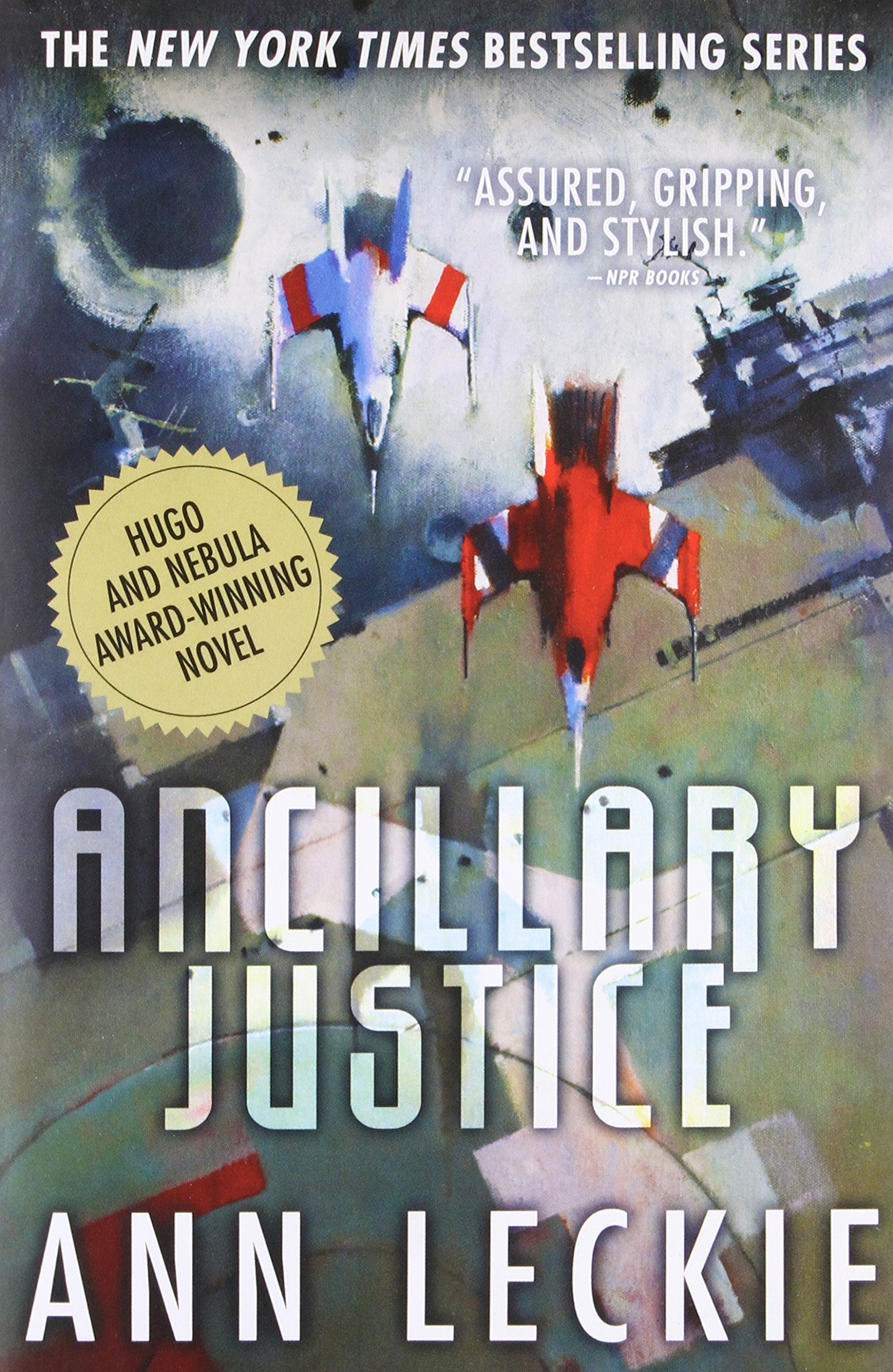
Ancillary Justice, by Ann Leckie (2013): The story of Breq, a woman who was once the AI of the spaceship Justice of Toren, spread across hundreds of “Ancillary” bodies. Now Justice of Toren has been destroyed, and Breq, the sole survivor, single handedly bent on revenge towards the Emperor who set her and her crew up to die, begins in this crushingly good space opera, full of tea ceremonies and folk songs and the exploration of an empire whose vision of “civilisation” is synonymous with its own culture. The dual narratives of Ancillary Justice, which tell of both Breq’s present and the events leading up to her death as a spaceship. Its a novel which operates with respect and care for the space opera tropes it deploys, while challenging any traditional assumptions about what aspects of human culture might be taken up by a remote spacefaring civilisation - to the Radchaai, gender is not a thing, but gloves very much are, and the ruling consciousness of Emperor Anaander Mianaai is spread across thousands of clones, who may or may not be working for completely common purpose. And, of course, its all driven by pitch-perfect action in both timelines, as Justice of Toren tries to hold it together on what it doesn’t realise will be its final mission, and Breq makes her way across the galaxy on her hopeless revenge mission. (Joe's review)  (Adri)


The Goblin Emperor, by Katherine Addison (2014): The term "hopepunk" might have been coined by Alexandra Rowland a couple of years after the release of Katherine Addison's highly-charged elven political fantasy, but the centering of kindness and decency even in the most lonely and high pressure of circumstances was already a standout feature of this novel back in 2014, giving it an undisputed edge over other contenders in the "young royal out of their depth" field. The Goblin Emperor is the story of Maia, the unwanted fourth child of the elvish emperor, who was born from a political marriage with a woman from neighbouring goblin kingdom (elves and goblins, being in this world, different races of the same species, and elven prejudice against goblins being therefore far more akin to racism than any possibly-justifiable biological taboo). Raised in seclusion with only abusive minders for company, Maia is therefore as surprised as anyone when an assassination of his father and three half-brothers propels him to the throne. What follows is his attempts to develop alliances and figure out who to trust in a court he's barely set foot in before now: a task he rises to with grace and skill, despite the many enemies who would rather not see him on the throne. Come for the courtly intrigue; stay for the way Addison effortlessly includes the characters' ear movements into their facial expressions without it getting weird. (Jemmy's review) (Adri)


The Fifth Season, by N.K. Jemisin (2015), by N.K. Jemisin: We’re not ones to claim that any subjective list of the best of anything is invalid because the list maker did not include our particular favorite, but we would definitely give the side-eye to any list of the best science fiction and fantasy of the last ten years that didn’t at least consider N.K. Jemisin’s The Fifth Season.

The Fifth Season was an absolutely brilliant opening novel to Jemisin’s Broken Earth trilogy. When I wrote about the novel in 2016, I had this to say “While the worldbuilding in The Fifth Season is superb and extraordinary, it does not hold a volcano's breath to how strongly written the novel is and just how incredible these three women are. The nature of the terribly oppressive world of The Stillness, really of the Sanze Empire, is examined through the lives, actions, heartbreaks, oppression, heroism, grief, discovery, and amazing characters of Damaya, Syenite, and Essun. Jemisin will rip your heart out.” I have no doubt that not only is The Fifth Season stands out as one of the best of the decade, The Fifth Season will hold up as one of the all time great fantasy novels. (Joe's review) (Joe)


Black Wolves, by Kate Elliott (2015): Do you want an epic fantasy where most of the primary characters are fully mature adults? What about a world that sets up a particular worldview and culture and then spends the rest of the novel deconstructing everything we thought we knew about it? What about a novel dealing with persecuted minority cultures, oppressive religions, and a question about how reliable memory is when considering history? Black Wolves has all that. Highly competent women bringing the excellence in a variety of ways? Black Wolves has that. A very high body count and solid action? Black Wolves has that. Giant eagles? Black Wolves has that, too.

Black Wolves is as epic as epic fantasy can get and it was an incredible start to what should have been one of the best new series of the last ten years, except that we’re not getting the sequel because of publishing. Readers - Black Wolves is as good an epic fantasy novel as any that has been published in the last ten years and beyond, and even though I know that I am unlikely to get the follow up, I still heartily recommend everyone go read Black Wolves. You won’t be disappointed. (Joe's review) (Joe)


Infomocracy by Malka Older (2016) Informocracy is a bold and brilliant thought experiment on democracy, a novel which takes as its starting point a not-too-distant future where many nation states have dissolved in favour of a system of microdemocracy in which "centenal" units of one hundred thousand people elect their governments from a range of globally-active parties. What makes this possible, we are told, is the global system of Information, which provides an augmented reality fact-check to citizens in all parts of their daily lives, providing a particularly important service when it comes to the once-a-decade elections. Of course, with a new global system comes a new global bureaucracy, and Informocracy follows a couple of cogs in that machine - idealistic campaign manager Ken and Information agent (and maybe a spy) Mishima - as they try to keep the system working over a particularly hot election cycle.

What makes Informocracy special is not just the world it creates, but the book's ability to engage and invest us in the agency of its main characters, while still showing their relative helplessness in the face of the global political system they operate in. By introducing the concept of narrative disorder - a compulsion to fit objectively unrelated or coincidental occurrences into a satisfying but misleading single story - Older's series presents a political thriller that questions the very foundations that allow it to exist, while still delivering something that satisfies on all the levels that matter. Like many books on this list, it's here because its stayed with me well beyond reading, and I hope it's a book we continue to associate with our own political moment when we're looking back on genre in future decades. (Charles' review) (Adri)


Every Heart a Doorway, by Seanan McGuire (2016): Reading Every Heart a Doorway was like coming home again to a story that I didn’t know that I had lost. It is a beautiful and heart wrenching story of kids who don’t belong anywhere except perhaps the one place they can’t get back to. Every Heart a Doorway is a portal fantasy where all of those kids who went through a wardrobe or a secret door and had adventures and a place to belong had to come home to a world that didn’t believe them and couldn’t understand them. What happens to those those kids when they come home? What happens is that Seanan McGuire writes a beautiful novel that seared itself so deep into my heart that it touched emotions I’m still not able to fully talk about almost four years later.

I wrote about the novel, “Perhaps moreso than any other book I am likely to read this year, my emotional response to Every Heart a Doorway has everything to do with who I am now and who I was when I was a teenager. I wish this is a story I could have discovered when I was twelve. I love this book with a warm and full heart as an adult, but I would have lived in Every Heart a Doorway as a child. I would have made friends with these children even though their experiences were so alien to mine. I can't imagine that I would have noticed that Nancy is asexual and that Kale is trans, or that I would have understood either concept. That part of the story wasn't for the child I was, but each of those elements are very much for other kids who would never see who they were in a story like this one. It matters that it doesn't matter for the story, if that makes sense.”

It is a beautiful, beautiful novel and I am so glad that it exists in the world. (Joe's review) (Joe)


Jade City, by Fonda Lee (2017): You've never read epic fantasy quite like this. The opening volume of Lee's Green Bone saga introduces readers to the island of Kekon, a culturally Asian island shrugging off decades of occupation and now ruled by rival gang families trained up in using bioreactive jade to power feats of martial arts prowess. The narrative follows various members of the No Peak clan - clan leader Kaul Lan and his siblings, the loyal but vicious Hilo and reluctantly repatriated sister Shae, as well as Anden, a cousin in his final year of training to be a Green Bone - as they try to see off challenges from the rival Mountain clan, as well as responding to wider geopolitical factors shaping the destiny of Kekon. Lee's writing is nothing short of outstanding in the way it brings the world of the Kauls to life, whether it's depicting regular scenes of Janloon street life or cinematically showcasing the supernatural powers of the Green Bone warriors. And, of course, it's all in service of a story that had me absolutely hooked from beginning to end, as we watch (possibly through our fingers) as the Kauls and their allies fight, torture, murder, get murdered, fall in love, make business deals (sensible or otherwise), fail to impress elderly parents, fight some more, and otherwise make difficult choices in service of family, honour and jade. (Adri's review) (Adri)


The Light Brigade, by Kameron Hurley (2019): It is a bold move to describe a book from the current year as one of the decade’s best, but The Light Brigade is a bold novel in the tradition of Starship Troopers, The Forever War, and Old Man’s War - which is not an opportunity to simply list the titles of significant military science fiction novels but a recognition of where The Light Brigade should be considered in a larger science fiction conversation and as to which novels get to be held up of classics of the genre which revitalize and engage with its past. The Light Brigade does all of that while telling a strong story about a soldier in the middle of an absolutely messed up war that is messed up even further when her combat drops sometimes place her in the wrong battle at the wrong time. Dietz is often not when she is supposed to be, and Hurley ties together all of the complicated timelines and fits it together perfectly. (Paul's review) (Joe)


As we discussed in the introduction we couldn't leave well enough alone and just live by a list of 9 novels which we believe are some of the best of the decade. And even after putting together our honorable mentions, there are still novels we feel like were just on the cusp of making the list. Joe nearly included The Calculating Stars and An Unkindness of Ghosts, and Adri regretfully left off Monstress and Ninefox Gambit. There have been so many excellent novels these last ten years, and here's a few more that we thought were pretty great.


Adri’s Honourable Mentions


Sorcerer to the Crown by Zen Cho (2015): Zen Cho's Sorcerer Royal books are set in an alternate regency world where magic and faerie are everyday parts of life for many people, but magic in Britain is considered entirely the province of elite white men, closeted away in an academy while elite young women with magic attend special academies to repress their powers and people outside the elite are left to their own various devices. It's only when the position of Sorcerer Royal falls, through an accident of bonded familiars, to Black former slave Zacharias Wythe, raised by the former holder of the post as part son and part racist curiosity, that the rest of the establishment finds itself confronting the realities of their own changing society. Meanwhile, Zacharias' attempt to hold on to the post brings him into contact with Prunella Gentleman, mixed-race ward of a women's "magic" school and a powerful, irrepressible force of nature in her own right. Racism and elitism in the British empire are heavy subjects, but Cho is able to use the conventions and wit of a Regency novel to eviscerate the white supremacist assumptions and the ridiculousness of the characters upholding them, all while offering a brilliant, hilarious adventure in a compelling alternate world. I loved it. (We missed reviewing this, but here's Adri's review of Book 2, The True Queen)


After Atlas, by Emma Newman (2016). Because of the time at which I read Planetfall, Emma Newman's series of a dystopian Earth - and the various factors and faiths that cause people to leave it - is embedded in my brain as a foundational example of science fiction. From the troubled, grief-stricken extrasolar colony of Planetfall itself, to the claustrophobic, unsettling mysteries of the Martian colony in Before Mars, the series combines a challenging vision of a future under technologically advanced capitalism, with a realistic but always compassionate look at what happens to people trying to survive, and their own personal traumas and mental health challenges. For this list, though, my pick has to be After Atlas, the story of Carlos Moreno, a corporate indenture investigating the murder of the leader of a religious cult - who also happens to be a figure from his own difficult childhood. Carlos' journey to figure out the truth leads him to uncover secrets both past and present about the Atlas mission, and the powerful figures attempting to control it, and humanity's access to the stars. It's a compelling mystery, but what really brings After Atlas to life is its vision of future life: where people and their rights can be bought and sold by corporations, "real" food is an unimaginable luxury to the majority of the population, and intrusive AR advertising is a reality for anyone not wealthy enough to turn off the algorithms that control it. Terrifying in its real-world implications, and compelling in its treatment of characters, After Atlas is by far my favourite "dystopia" of the decade, and a book that everyone should check out. (Sorry, we don't have a review of any of the Planetfall novels, but they're delightful)


This Is How You Lose The Time War by Amal El-Mohtar and Max Gladstone (2019): This Is How You Lose the Time War is perhaps the weirdest book on this list - an epistolary romance between two rival agents for immensely powerful future factions ("techy-mechy" Agency and "viney-hivey" Garden), charting their travels through dimensions as they try to nudge futures in the direction of their respective overlords, and the letters they leave each other in various ephermeal forms throughout the timeline. In my review for Strange Horizons, I said that This Is How You Lose The Time War's greatest strength is "its exquisitely pitched story of romantic connection and its ability to bring all other aspects of the novella—its epistolary form, its expansive and yet understated worldbuilding, its themes of connection and agency and change—into the service of that emotional core. It's a romance whose portrayal of human connection is all the more powerful for the fact that it takes place between two beings who are otherwise not comprehensible to us, leaving their hopes, fears, and longing as the only elements left for a reader to cling to, and thus turning the love between Red and Blue into the most important thing in an unimaginably large multidimensional time war." I also mentioned it was the only book of 2019 to make me cry, and while that's not quite true any more (but that's a story for next decade's roundup) it still stands out as one of the most pure emotional experiences I have had reading a book - all the more incredible for the fact that it packs such a punch in novella length. (Paul's Review)


Joe's Honorable Mentions


Annihilation, by Jeff VanderMeer (2014): I find myself at a loss as to how to talk about Annihilation. There’s an expedition into Area X, the location doesn’t exactly matter but it’s in the American South presumably somewhere in Florida. What we know is that we don’t know anything. Area X is weird, it is unexplained - nobody knows exactly how or when it appeared and took over the land - and it is largely unexplored even though there have been eleven previous expeditions to do so. They haven’t gone well. This is the twelfth expeidtion.

Annihilation is weird, a little obscure, thrilling, occasionally claustrophobic, terrifying, and absolutely fantastic. I’m not sure there’s another novel like it, not even Authority or Acceptance - the two follow up novels to Annihilation. There are also few other novels this decade that have stuck with me for as long as this one has. I find myself thinking about the novel again and again, never quite getting anywhere with my thoughts but just wondering and letting the atmosphere of my memory wash over me. Even that is unsettling, just like everything is in the book. It’s an exceptional novel. (G's Review) (Joe)


Uprooted, by Naomi Novik (2015): Readers of childhood fairy tales will find so much that is familiar in Uprooted, but Naomi Novik is holding up a twisted mirror to those fairy tales while still holding tightly to the heart of what we so love and remember. Novik may not be completely deconstructing fairy tales here, but she is definitely playing with the form.

The star, driving force, and shining heart of Uprooted is the character of Agnieszka. The more conventional fairy tale that Novik appears to be telling in the first chapter is not necessarily the one that we get as the novel progresses. Agnieszka appears to be a wilting character, shrinking back from the anger and ubruptness of the dragon. This is not who she becomes. Through her own strength of character and intelligence, Agnieszka begins to grow into the person she never would have dreamed she could or would become. The concept of this Agnieszka would have been as alien and as foreign to her as the reality of life at court. Though still raw and impulsive, the progression of the novel begins to give her the seasoning required to not only help in the fight against The Wood, but also to become the sort of character parents will want to use as an example to their children.

Fairy tales are for kids, right? Uprooted straddles that line. It is both very much a novel that adults can, should, and will appreciate. Adults will recognize many of the things that Novik is doing in tweaking some of the conventions of fairy tales, but will also enjoy the novel simply for what it is. Older kids will enjoy Uprooted for simply being a kick-ass book with an awesome heroine and an exciting story for which they simply must know what happens next. Naomi Novik has a little bit for everyone in Uprooted. (Joe's review) (Joe)


Into the Drowning Deep, by Mira Grant (2017): If I told you that this was a novel about mermaids, you’d probably have visions of Disney and The Little Mermaid and maybe some vague sense of unease if you have recollections of historical depictions and sirens. Mira Grant’s mermaids are terrifying, compelling, and all too plausible. Grant herself said that the novel “does for mermaids what Jurassic Park did for velociraptors” and that’s entirely true. Into the Drowning Deep is a true page turner of the highest quality - you might not be able to sleep after, but you’ll want to stay up for one more page, one more chapter. (Joe's review) (Joe)


Joe Sherry - Co-editor of Nerds of a Feather, 3x Hugo Award Finalist for Best Fanzine. Minnesotan

Adri is a semi-aquatic migratory mammal most often found in the UK. She has many opinions about SFF books, and is also partial to gaming, baking, interacting with dogs, and Asian-style karaoke. Find her on Twitter at @adrijjy. 

Wednesday, February 20, 2019

Microreview [Book]: The Raven Tower by Ann Leckie

Leckie's foray into fantasy delivers on mythology and worldbuilding, told through a distinctly non-human lens.

Cover design by Lauren Panepinto
Image by Arcangel Images
Ah, ravens. They're smart, they're beaky, they come in murders, and many in our world are better Londoners than I am. They're also the subject of more than their share of both folklore and, through that, fantasy interest. Whether they're harbingers of death, guides to the spirit world, speakers of prophecy and truth or otherworldly tricksters, there's a lot of mileage in these feathery next-level dinosaurs. Now, in Ann Leckie's first novel-length foray into fantasy, a raven god is front and centre, alongside a cast whose human members often play second fiddle to their divine counterparts.

Many readers will be familiar with Leckie for her science fiction work: the superlatively brilliant Ancillary Justice, its sequels, and the same-universe standalone Provenance. On the surface, The Raven Tower is a very different book. We find ourselves in Vastai, a low-tech, small-scale polity, whose citizens fear and worship the forest, envy the better harbour of their neighbour (in one timeline, at least) and have come to rely on the blessings of a specific god to keep their town flourishing. Gone are the spaceships and corpse soldiers, but the presence of the gods themselves - who are very much real in this world, and regularly appear to humans - means that The Raven Tower feels just as connected with non-human intelligences as Leckie's previous works, and just as accomplished at giving those intelligences believable motivations and voices.

(The rest of the review has spoilers for a very early reveal. If you want to go into the Raven Tower without forewarning, stop reading here - or come back once you're 5% of the way in and know what I'm talking about!)

The Raven Tower leans into its myth-heavy, language-driven setting, not least by setting up a second person narrative: a mysterious voice who addresses the ostensible protagonist, Eolo, as if telling his own story to him. In the opening scenes, this narrator is present but not directly involved in the action, and the voice's narration of these scene-setting events - in which Eolo's companion Mawat, the heir to the Raven Tower, returns to witness the death of his father - feels oddly full of conjecture and uncertainty, as it reflects both Eolo's uncertainty and the voice's own unfamiliarity with him. This uncertainty is a jarring place to start a story, but it's worth the effort as we establish the parameters of the world of Vastai: a land ruled not by a monarch but by a "lease", a hereditary ruler given powers and privileges by their Raven god, but compelled to sacrifice themselves when the Raven's "instrument" (their animal body) dies. Mawat, who has been brought up expecting to ascend on his father's intentionally premature death, arrives back to instead learn that his father appears to have fled the tower and his uncle has taken on the Lease's position instead. This should be impossible, based on how the Raven has always operated, and Mawat's reaction to the discovery sets in motion a chain of events that threaten the very foundations on which the Tower and its inhabitants stand.

It very quickly becomes clear, however, that this is not just Eolo's story, but that of our narrator - and that our narrator is not, as it initially seems, a human servant in the Raven Lease's employ, but a god in their own right. Most often referred to as The Strength and Patience of the Hill (though, for the sake of simplicity and help anyone still skimming while hoping to not get too spoiled, I'll keep referring to them as "the narrator"), the character addressing us is revealed to be immeasurably old, potentially very powerful, and has sat unmoved through geological ages of change and comparatively recently found themselves interacting with humans. Existing fans of Leckie's work will find it easy to believe in her ability to turn this narrator - a large rock who hates almost all change on principle - into the novel's most compelling character. From here on out, the second-person adventures of Eolo and the humans of Vastai are interspersed with the narrator's history and their interpretations of the events of the present. In Leckie's world, gods gain power from human worship and offerings, and are able to change reality using this power - but they must be careful not to deplete their own strength in doing so. The risk a god of any size faces is how to ensure they can sufficiently impress and meet the demands of their worshippers - and, perhaps, see off challenges from rival gods in the process - while not giving up too much of themselves in the process, or making promises that force them into doing so in future.

What the narrator's identity does mean is that the characterisation and interactions of the human characters in the "present" sections are deliberately viewed through a lens of distance and opaqueness. It takes some considerable time to gain an understanding on Eolo beyond what the narrator guesses about him at the start of the tale, plus a few external observations which make it clear that he is a trans male character; many of the other human characters are given only hints of characterisation through understated or indirect means. While this is entirely in keeping with the position of the narrator and their understanding of humans (and selective interest in what makes them interesting), it did make the start of the novel slower and more challenging to get into than I expected. Leckie is so good at portraying human modes of affection and care (even when they're being filtered through non-human characters like Breq) that it's hard not to miss that here, but the comparative lack of focus on relationships and connection in the novel's early stages means that the connections that do develop on the page - not least that between the narrator and The Myriad, a fellow god who enjoys manifesting as a cloud of mosquitoes - are that much more precious and interesting.

As you'd expect from an author with Leckie's skills, the plotting, especially the weaving together of the past and present narratives, is spectacular. Central to this are the twin mysteries of the book's past and present: what's going on with that whole Raven Lease thing, and, somehow more interestingly, how did a rock whose sole previous experience with movement was "hover off the ground by a foot for a few minutes" apparently travel hundreds of miles to become linked with the Raven Tower? Again, likely because of the nature of the narrator, it was the human plotline that took longer to warm up for me, but once it does it's pretty great, setting up a culture whose elites are intricately tied to gods whose reality and power has never been questioned. Of particular note is the delegation from Xulah, a trio of foreigners who take an early interest in Eolo but clearly have their own agenda at play, involving their own snake god and Vastai's larger neighbour Ard Vustika. However - and given the banal content of some of these scenes, I can't quite believe this is true - it was the elements from the narrator's past that I found myself waiting for, time and time again. This means, just to be entirely clear, that I was comparatively speeding through sections on political intrigue and protest in order to get back to the narrator's time waiting out a mini ice age or establishing god-specific language for B vitamins. The characterisation is just that good.

Ann Leckie's last couple of books have been on the comfort reading side for me, and on a personal level, I did miss that from The Raven Tower. However, that should in no way be taken as a criticism of what it does deliver. The elements that make The Raven Tower dense and alien and unsettling are also what makes it so good, and if you give it time and attention, this is an immensely rewarding read. I'll be eagerly watching the skies for Leckie's next book, and giving any giant rotating stones and smart-looking ravens in my future the respect they clearly require.

The Math

Baseline Score: 8/10

Bonuses: +1 I have never been so interested in all-powerful sentient rocks

Penalties: -1 It's initially hard to get past the lack of connection with human characters

Nerd Coefficient: 8/10

POSTED BY: Adri is a semi-aquatic migratory mammal most often found in the UK. She has many opinions about SFF books, and is also partial to gaming, baking, interacting with dogs, and Asian-style karaoke.

Reference: Leckie, Ann. The Raven Tower [Orbit, 2019].