Showing posts with label Daniel Abraham. Show all posts

Tuesday, October 3, 2023

Review: Age of Ash (Kithamar #1) and Blade of Dream (Kithamar #2), by Daniel Abraham

A structural experiment that doesn’t quite work out

Jacket design by Lauren Panepinto

; Jacket art by Daniel Dociu


z
The perspective of a story’s narrative can have enormous consequences for how readers react to its events. This is why head-hopping and multi-POV structures are so effective. When done well, we can see the internal motivations of an action in one chapter, and then explore the external effects or perceptions of that same action in another. When done extremely well, it can overset a tale entirely, yanking out our foundational assumptions and collapsing our understanding of how things fit together into a pile of rubble, from which a new understanding can emerge.

This is what Abraham is aiming to do with the first two books of his Kithamar trilogy. The first, Age of Ash, was a solid introduction to the city of Kithamar, characterized primarily by its very sensitive exploration of how grief can cause people to do unhinged, ill-thought-out, usefully plot-advancing things. Alys, a street crook from the poorest district of Kithamar, learns that her brother has been killed carrying out some shady plot. Fuzzy-headed with grief and rage, and lacking the kind of social—or indeed physical—safety net that might support less impoverished and desparate people through such a terrible time, she sets herself to discover what her brother was up to, and why he got killed. Her only help comes from the well-meaning efforts of her friend Sammish, who is equally impoverished and desperate, and who helps Alys because she nurses a hopeless romantic flame in her bosom that, it’s clear, will never be returned.

Through a series of blundering, unwise, and entirely believable actions, Alys finds herself wrapped in the same threads that wound her brother to his death, threads that she willingly entangles herself in, because to understand what happened to her brother she must take on his role in the world. Yet these same entanglements, however well (or poorly) they tie her to her brother’s memory, alienate Sammish, who finds herself working against Alys's adopted goals, undertaking actions on her own initative, motivated by her own moral compass in a way that Alys is incapable of doing. As Alys becomes progressively more isolated, she undertakes progressively more reckless actions, and events build and develop in extremely satisfying ways. Alys's journey through her grief, and her emotional arc as she comes to terms with what her brother was, and what she is becoming, is executed beautifully and skillfully, in a way that I don’t think I’ve seen done in this way in all my years of devouring SFF as a genre.

Intercutting this character arc is a broad plot that is much more workmanlike: An evil entity has haunted Kithamar for generations, but it requires a certain maguffin to complete its plans. Mystical opponents work against it, a stranger comes to town, the ruling family gets up to unthinking hijinks that interfere with the evil influence’s plans, and Alys and Sammish are tangled up in the thick of it.

Age of Ash ends with a temporary—but by no means permanent—setback to the entity's schemes, leaving open multiple avenues for it to pursue its evil plans and advance the plot further. Yet the ending doesn’t feel like a cliffhanger, because Alys and Sammish’s contributions to the story are tied up quite beautifully, in ways that are true to their characters and their character arcs. I was contented to finish with their stories when I finished the book. The trilogy is not about them as characters; they simply inhabited the first book and helped nudge the events to the next stage.


This is why Blade of Dream, the second book in the series, simply did not work for me. Because in Blade of Dream, events do not proceed to the next stage. We go back to the beginning again. Structurally, it’s clear what it’s intended to do. It relates the same events from Age of Ash, taking place over the course of the year, starting with the death of one ruler, old Prince Ausai, and ascension of his heir, and ending with the death of the second ruler and the ascension of a third. But the same events of this turbulent year are now related from a different set of perspectives. Rather than viewing the titanic struggles for control of the city from the perspective of street rats Alys and Sammish, now we see it from the perspective of the wealthy, the royal.

The problem with this structural exercise, though, is that we don’t really learn anything new. The events of Age of Ash were not unclear or mysterious. They were pretty straightforward by the end. I knew what the maguffin did; who opposed it; why the various participants in the power struggle did the things they did. Seeing all of the same events from the other side didn’t shed any new light or overset any old understandings. The same characters appear and do the same things, and nothing changes the second time round. As just one example, in Age of Ash, Alys is ordered to kill a canoodling couple, and we see the event unfold from her perspective. In Blade of Dream, we see the same sequence from the perspective of the canoodlers. But nothing was gained by revisiting the event. The canoodling couple did not do anything unexpected or enlightening; they were not privately advancing the plot in any way before they were interrupted by assassins. They were canoodling. Then Alys arrived. And I already knew what was going to happen, so there was no drama or suspense about it. You shouldn’t be bored by assassination attempts in your books, and I was bored. That’s a bad sign.

Perhaps there are balls set in motion in Blade of Dream that I’m not seeing, because they’re still rolling quietly into position. It’s not impossible. Abraham is a very fine writer, with a wonderful grasp on setting and character and complex social and political machinations. Don’t forget that he’s one half of James S. A. Corey, author of The Expanse, which set a new bar for modern space opera. (Also don’t forget that he’s written two outstanding fantasy series before now—The Long Price Quartet and The Dagger and the Coin—which I cannot recommend highly enough.) Possibly Kithamar will explode into the brilliance of a structural long game when Book 3 rolls around. I certainly plan to read it. 

But the fact remains that Abraham wrote a rather dull, repetitive Book 2 while he heaved those balls into position. I sincerely hope that Book 3 makes my patience worth it. But if it begins with the same death of Old Prince Ausai, and I have to slog through that same year a third time over, I’ll be very annoyed.

--

Highlights

Nerd coefficient: 6/10: still enjoyable, but the flaws are hard to ignore

Highlights:

  • Beautiful emotional arcs (book 1)
  • Very well-developed city-as-character
  • Repetitive structural conceit

CLARA COHEN lives in Scotland in a creaky old building with pipes for gas lighting still lurking under her floorboards. She is an experimental linguist by profession, and calligrapher and Islamic geometric artist by vocation. During figure skating season she does blather on a bit about figure skating. She is on Mastodon at wandering.shop/@ergative.

References:

Abraham, Daniel. Age of Ash. [Orbit 2022]

Abraham, Daniel. Blade of Dream. [Orbit 2023]
 

Monday, June 4, 2018

Summer Reading List 2018: Joe

There are many things in this life which I really, really like. Two of them are reading books and making lists. A third would be making lists about reading books. Strangely, I'm not sure if I want to read a book about making lists, so we'll just move right on from there, shall we?

It is something of a tradition here at Nerds of a Feather to post one's Summer Reading List. Now, since I've been adulting for quite a number of years, the concept of "summer" doesn't have quite the same cache for me as it might have two decades ago. I have to go to work in July much the same as I do in February. And while the summer does mean more trips up to the family cabin, now that I have a child, some of that time spent reading on a swing overlooking a lake with a beer in my hand is going to be spent playing with my children. This is not a bad thing.

With all of that said, I do rather enjoy making lists about books. Nerds of a Feather is a genre blog, so while I plan to continue to read more non fiction each year and I've been reading an increasing amount of non SFF fiction, I do still get through more than one hundred books each year, so what I'm going to highlight is some of the science fiction and fantasy I plan / hope to read this summer.

For those keeping score at home, I have read four of the six books I have listed in both 2016 and 2017. I have decided against listing those books here, even though I do plan / hope to read Kate Elliott's The Gathering Storm, Katharine Kerr's Days of Blood and Fire, and Roger Zelazny's Nine Princes in Amber.


1. Space Opera, by Catherynne M. Valente

Are there readers of this blog who don't know about Catherynne Valente's gonzo-awesome-Eurovision-in-Space novel? It hardly seems possible at this point because if you want to talk about a novel that has completely blown up in all the places I see online, that's it. Every time I see something more about Space Opera, the buzz inside my brain gets louder and louder to the point that in a year which does not have a new N. K. Jemisin novel (go read the Broken Earth trilogy), Space Opera has risen to become the Must Read novel of the year.


2. King Javan's Year, by Katherine Kurtz

It's been a year since I last wrote an entry in my Reading Deryni series (The Harrowing of Gwynedd). I am long overdue to revisit the Eleven Kingdoms. King Javan's Year was the first Deryni novel I read, which is one hell of a novel to start the series with. It was here I learned Kurtz would build up a novel of hope and then send it all crashing down in blood and horror. Perhaps because he was my introduction to this world, Javan has remained one of my favorite characters over the years. I can't say that I'm hesitant to read this because I know how it all shakes out because I included Camber the Heretic in my re-read and to paraphrase a point I made about that novel, George R. R. Martin doesn't have anything on Katherine Kurtz. I think it is rather that re-reading King Javan's Year means that my re-read is almost to an end and I don't have this foundational and formative novel to look forward to in the immediate future.


3. The Left Hand of Darkness, by Ursula K. Le Guin

Late last year I started to read Le Guin's Hainish novels and because it's the way I'm wired, I started with her earliest published volumes: Rocannon's World, Planet of Exile, City of Illusions. Now it's time to get to the heavy hitters of The Left Hand of Darkness and The Dispossessed, two novels which have loomed in and over my consciousness of science fiction for almost as long as I have known about science fiction as a genre with a history.  I have owned the copy of The Left Hand of Darkness sitting on a pile of books next to  my bed for far more years than I am comfortable admitting. It's well past time to remedy this.


4. Stretto, by L. Timmel Duchamp

I first read Duchamp's excellent novel Alanya to Alanya back in 2008 and worked my way through the Marq'ssan Cycle into July 2010 when I read the fourth volume, Blood of the Fruit. I can't say why I held off reading Stretto for these eight years, but I have. The Marq’ssan Cycle, as a whole, is a deeply feminist series of social and moral ideas played out in bold and clear strokes with characters actively conscious of motivation, identity, and theory. The ideas here are what is important. I may need a refresher on the series so far, but I'm ready to finish this one up.


5. Company Town, by Madeline Ashby

This first hit my radar back in 2016 (when it was published) and the word was that the book was damned fantastic. Far be it for me to complain that a novel I've never read seems to have been under-read and under-appreciated, but the sense that I have is that Company Town is both under-read and under-appreciated (though, fully appreciated by those who did read the novel). Company Town has been on my "to-read" list since before publication and it's time to move it up. 


6. A Shadow In Summer, by Daniel Abraham

These days Daniel Abraham is best known for being one half of the writing team behind The Expanse, James S.A. Corey. Back in 2006 he published his first epic fantasy novel, A Shadow in Summer. It received an immense amount of praise, if not the sales to follow. I bought the first two books in the series shortly after publication, but as happens all too often, never cracked the cover. Perhaps this summer is a good time to remedy that.


POSTED BY: Joe Sherry - Co-editor of Nerds of a Feather, 2017 & 2018 Hugo Award Finalist for Best Fanzine. Minnesotan. 

Friday, October 6, 2017

Microreview [novella]: Strange Dogs, by James S.A. Corey

A delightful—because contained in scope—science fiction-y “what if”  


Corey, James S.A. Strange Dogs. Orbit, 2017.

Buy it here.


I am of the considered opinion that this little novella represents a return to form for Abraham and Franck (aka “James S.A. Corey”), as they retreat from the flamboyant villainy of Marco Inaros into something much more provincial, as it were. Of course, the tale they tell has important implications for future Expanse novels: it helps show the broad outline of the threat—and opportunity?—Holden, Nagata et al will soon face from the rogue Martian operations led by Duarte. Since, up until this point, Duarte and his entire world has been shrouded in an impenetrable veil of mystery (from the perspective of the Roci’s crew), it was a great decision by Abraham and Franck to: a) take us behind that veil, and b) hang the story around a child (of limited but growing understanding), who sees the world through (relatively) innocent eyes.

When this child encounters the arch-nemesis of the solar system, Duarte, in the flesh, she of course knows nothing of his infamy, and finds him kind and accommodating. And when the child stumbles upon some of Duarte’s top-secret experiments, she finds them rather less monstrous than the reader has been conditioned to expect. That’s why having the story be told through a child was such a good idea: she doesn’t have any pre-conceived notions that proto-molecule tech = evil, and as a result, is able to see opportunities denied to those more judgmental adult humans who have encountered proto-molecule hybrids in the past. Is it perhaps fair to say that the only ‘evil’ in the proto-molecule is the foul intentions of the humans (like Jules-Pierre Mao, etc.) who sought to use it for their own ends?

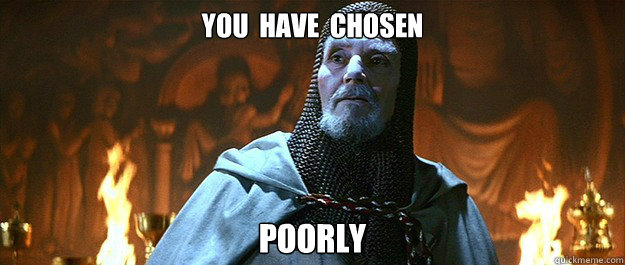
Finally, ask yourself this question: if something terrible happens to someone you love, and a couple of glowing alien ‘dogs’ seem to offer that person a second lease on life (of a sort), would you reject them? And if so, why? Isn’t any kind of life better than the awful finality of death? And besides, there’s no evidence (yet) of that sort of miraculous assistance being weighed down with any Mephistophelean baggage. Our young heroine certainly comes to that conclusion, and I think many of us would follow her lead, even if (like her) we can’t really understand or predict the far-reaching implications of accepting alien organisms’ help. It seems we must stay tuned for the next entry in the Expance series to hear whether she chose wisely or (like Donovan!) ‘poorly.’
  

The Math:


Objective Assessment: 7/10

Bonuses: +1 for drastically limiting the scope of the story, +1 for giving us a ‘child’s eye view’ of the world and its ethical quandaries

Penalties: -1 for, in my opinion, exaggerating the degree to which children’s understanding is primitive (they grasp intuitively a lot more than many adults appear to realize), and having her stream of consciousness be correspondingly ‘kid-like’

Nerd coefficient: 8/10 “Take that, Babylon’s Ashes!”


[Does this score seem low to you? Check our scoring system here to see why it’s plenty high!]


Like Zeus’s brainchild Athena, this review sprang fully formed from the mind of Zhaoyun, a devotee of speculative science fiction (even more than space opera!) since time immemorial and contributor to Nerds of a Feather since 2013.

Friday, September 22, 2017

Microreview [book]: Babylon's Ashes (book six of The Expanse), by James S.A. Corey

 A rather anticlimactic conclusion to the Holden/Nagata vs. Inaros saga, with too much Holden and Inaros and not enough Nagata!

Corey, James S.A. Babylon's Ashes. Orbit: 2016.
Buy it here if you wish. 

When The Dark Knight Rises (clumsily!) began building up the villain’s mystique of Bane, we knew two things right away: Batman would fight him twice, and the first time he would be utterly defeated. It is this initial defeat which increases the melodramatic payoff of his eventual victory: we know how tough the enemy is, because we’ve seen it first-hand.
Bane = a worthy adversary; Inaros = an annoying fop
A similar narrative convention is at work in books five (Nemesis Games) and six (Babylon’s Ashes) of The Expanse. Marco Inaros is the Bane of the solar system: he (to hear him retell it) single-handedly rocked (see what I did there?) the inner planets’ equilibrium, nearly destroying Earth. This corresponds to Bane’s initial victory over Batman; so far, so good. But all of this build-up is to increase the melodrama when Batman (or in this case the dynamic duo of Naomi Nagata and Jim Holden) eventually triumphs against this formidable foe. And this is where, in my opinion, Babylon’s Ashes missteps.

It turns out Inaros just isn’t that compelling a villain, and perhaps as a consequence of this, the good guys’ inevitable victory over him isn’t particularly cathartic. In one sense that shouldn’t matter, since of course it’s entirely up to Daniel Abraham and Ty Francks what sort of villain to create, and nothing mandates a “tougher than you can believe” archetype. The problem, as I see it, is that they fell into this narrative trope without having the right sort of villain for it. Inaros is simply a megalomaniac with a flair (sort of) for PR, but his ridiculous behavior and blunders end up alienating many of his erstwhile supporters. This leeches the catharsis right out of the mano y mano confrontation at the end, since in a manner of speaking Inaros has already been beaten, in small ways, numerous times before this.

If the big, bad wolf who wrecked the solar system is nothing more than a navel-gazing fool, it cheapens the hard work the crew of the Roci (et al) have to do to bring him to heel. Indeed, we are left with a somewhat less favorable impression of the super-crew, since defeating a moron like Inaros apparently taxed them to the limit of their abilities! Surely there was something less explosive they could have done to knock out all those rail guns in the ‘slow zone’? I mean, was that really the best plan they could come up with, these brightest minds in the solar system?

Despite Marco Inaros being a nincompoop, the writers chose to focus a bit too much on him and in particular, his thirst for vengeance against Holden, the man who kept humiliating him. Fair enough, to be obsessed with a pissing contest seems in character for the petty Inaros, but why did the writers let him and his quest to destroy Jim Holden dominate the story? A much more compelling storyline, it seems to me, would have been in a more explicit opposition between the methods and worldviews of Nagata and Inaros, since one way of thinking of this book is as a battle for the soul of Filip, their son. Besides, Nagata is a much more interesting character than Holden (of whose earnestness, if we’re all being honest, we’re getting a bit tired, aren’t we?).

Nothing against Alex and Amos, but in general, the male characters of this series just aren’t as compelling as the female ones: the Naomis, Bobbies, Michios, and Clarissas (to say nothing of the indefatigable Avasarala herself!). One humble suggestion for future installments in this probably interminable series: stick with the ladies! (I’m happy to say that their latest novella does precisely this, telling the story of an interesting tweenaged girl growing up on Laconia—stay tuned for my review!)


The Math:

Objective assessment: 7/10

Bonuses: +1 for having such great female characters (but see ‘penalties’ below)

Penalties: -1 for the narrative mismatch between the fop Inaros and his Bane-like mystique, -1 for focusing too much on the boring male characters and too little on the ladies of the system!

Nerd coefficient: 6/10 “Still enjoyable, but the flaws are hard to ignore”


[Does a mere 6/10 seem low to you? Check out our scoring system here, and learn why it’s actually not bad!]


Zhaoyun, who to be honest is more a fan of ‘spacemance’ than of space opera per se, has been inhabiting The Expanse since it burst onto the scene, and has been a regular(ish) contributor at Nerds of a Feather since 2013.

Wednesday, September 6, 2017

Microreview [book]: Nemesis Games, by James S.A. Corey

‘The gang’  (and, you know, everyone else) imperiled—a satisfying ante-upper indeed!

Image result for nemesis games

You can buy it here

Since there was a bit too much familiarity about the crew of the Roci by book four—a sense that if they pooled their efforts they could somehow triumph against any obstacle, even an alien one—it seemed the series was building to a problem serious enough to jeopardize the synergistic relationship the four had. Sure enough, Nemesis Games almost immediately sends all four main crew members off on disparate quests, with little chance to affect each others’ situations.

This sort of ‘scattered to the ends of the earth solar system’ setup entails some risks. Since we have grown accustomed to having the Roci’s crew (not to mention the Roci herself, practically a fifth main cast member at this point) demonstrate the importance of interpersonal relations by solving every problem together, how will the story proceed if we, the readers, are denied the pleasure of seeing them work together (and denied any meaningful glimpse of the Roci, out of commission temporarily due to damage sustained in Cibola Burn)?

I’m pleased to say that the authors of The Expanse did a masterful job of what is essentially back-story exposition (no easy task to avoid the typical sort of “You know I don’t like snakes…(and I'm saying this now because lots of snakes are in the near future)” clumsiness, but they managed it!), giving us a major glimpse into everyone’s past (well, everyone but Holden). We learn, in essence, some of the key reasons such a skilled group were on the Canterbury in the first place: what they were running from, and why. Since the core relationship on the Rocinante is the one between Holden and (Naomi) Nagata, it is only fitting that it is this romance which is most directly imperiled by the reemergence of these shady pasts.

All this might sound pretty small-time—the ghosts of the main characters’ misdeeds rearing their ugly heads might be scary to those individuals, but it would hardly measure up to the sort of civilization-ending threat these four (+ the Roci) have faced previously. At the risk of being terribly mysterious (thank you, The Sphinx from Mystery Men!), I’ll say only that the stakes turn out to be all too high, the threat all too dire. Just when we thought the worst that was in store was the addition of new crew members to the Roci, and the risk that both the diegetic dynamic and the reader’s appreciation for the tight-knit crew of four could be shaken, we discover that the true danger is to the core of human civilization itself!

Does the "Holden+Nagata, Alex and Amos too" dynamic survive this dire challenge? Is this, in fact, the best Expanse book yet? (Given The G's almost visceral dislike for the first book in the series, one could optimistically say that it must be getting better overall!)  You’ll just have to read it to find out! (Alternatively, you could check out my forthcoming review of book six, Babylon’s Ashes—check back here on NOAF soonish!)

The Math:

Objective Assessment: 7/10

Bonuses: +1 for masterful exposition, without a single “But you KNOW I can’t eat strawberries!” ham-fisted foreshadowing, +1 for successfully upping the ante—with a vengeance!

Penalties: -1 for describing Nagata’s protracted ordeal in what struck me as a conspicuously pseudo-scientific manner (in essence, hit stuff with a wrench after a serious physical injury/setback, but still get one’s message through without being “permanently damaged”, to quote Vader)
Funny how main characters seem to survive just about anything, eh Naomi? Keep swimming around unprotected in deep space--I'm sure everything will work out!

Nerd coefficient: 8/10 “A bit of alright”, as the Australians say!


***
[Puzzled by our scoring system? Learn why 8/10 is an exceedingly high score here.]

Reference: Abraham, Daniel and Ty Frank. Nemesis Games. Orbit, 2016.

All the comments and opinions written here are solely Zhaoyun’s, longtime lover of space opera and fantasy literature and reviewer for Nerds of a Feather since 2013, and should not necessarily be taken to represent all Nerd-kind.

Friday, August 25, 2017

Microreview [book]: Cibola Burn (book four of the Expanse series)

The weakest entry in the series (so far)…and yet still great fun!


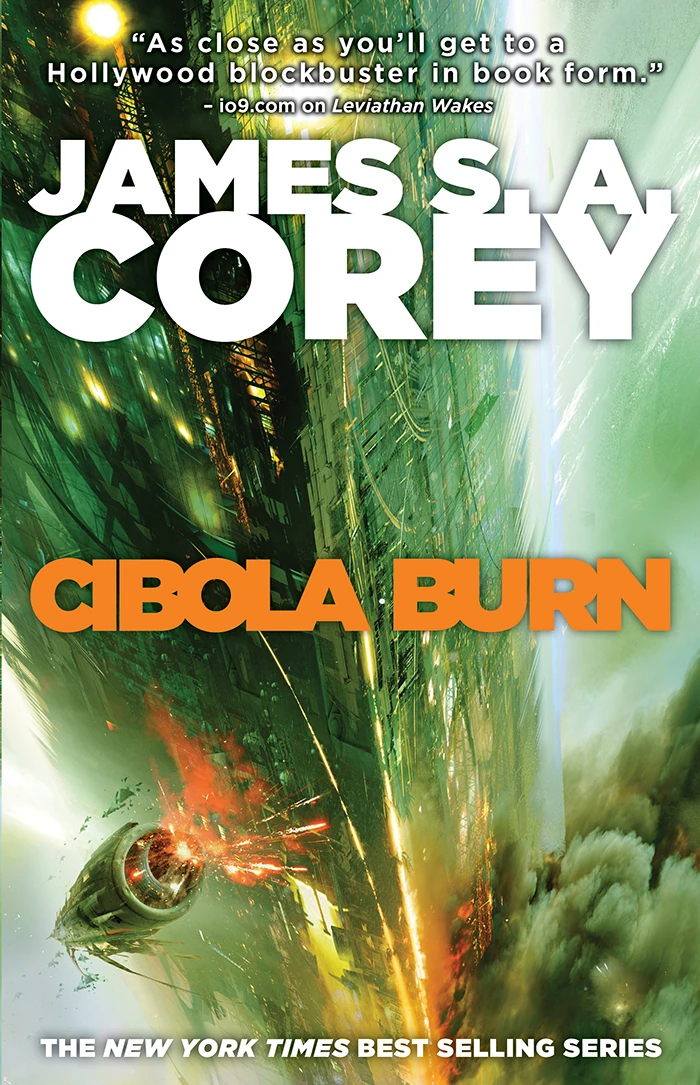
Corey, James S.A. Cibola Burn. Hachette Book Group, 2015.
Buy it here.

So here’s the thing—I’m a big-time fan of the Expanse series. At the point I’m writing this review, I’ve read the first five books, and enjoyed them all to varying degrees. The first one got things off to an explosive start, the second one continued that momentum, and the third one upped the excitement ante. Like the first three books of Robert Jordan’s near-interminable Wheel of Time series, the first three almost felt like a stand-alone trilogy, one which had reached a mostly satisfying (if open-ended) conclusion. The question is, how could the authors of The Expanse sustain this impressive pace into book four?

Well, the answer is they couldn’t (though they came close). Overall, Cibola Burn was certainly entertaining, but (like book four of the Wheel of Time) it felt rather anticlimactic.  It’s plenty interesting, but there’s a slight diminishing-returns sense of “they’re at it again” when we see the crew of the Roci solve every problem with trademark skill (if not ease). We are, of course, unable to doubt the overall trajectory of the Holden + (ghost) Miller duo: like the Teenage Mutant Ninja Turtles series theme song, we know “the good guys win and the bad guys lose.” 

Also true of most books, movies, etc.
So it’s no spoiler to say that they manage another miraculous save. My sense is that the authors wrote themselves into a bit of a corner with what film reviewers of every Jason Statham movie would have described as a ‘high-octane’ plot in the first three books, leaving them no room to up the ante.


Perhaps it would be best to see the Expanse as more of a single unit (albeit one whose end is not yet in sight), in which case it would make sense to have something of a lull in the middle, or (like in one of those mix tapes John Cusack raves about in High Fidelity) after a few fast-paced hits in the beginning. By that logic, we might reasonably expect a return to ‘high octane romp’ form in book five. To see if this is the case, check in next Friday for a review of Nemesis Games!

The Math:

Objective assessment: 7/10

Bonus: +1 for somehow turning the entire gate/1000 worlds thing into a manageable story

Penalty: -1 for not quite overcoming sequel fatigue

Nerd coefficient: 7/10 "Enjoyable experience but not without a flaw or two"


To learn more about our unique scoring system, see here.

It is I, Zhaoyun, explorer extraordinaire of space operas of all shapes and sizes, and reviewer for Nerds of a Feather since time immemorial (2013), who brings you this message.

Monday, June 20, 2016

Microreview [book]: The Spider's War by Daniel Abraham

The final stretch less traveled. 


Finishing a series that you've really enjoyed is often a bittersweet experience. On the one hand, you get some closure. On the other, it's like you're saying goodbye to an old friend. But the end of Daniel Abraham's fantasy series, The Dagger & the Coin, left me with very different feelings. In fact I'm not sure I've quite processed it yet, and that's why I've been sitting on this review for over a month now. Allow me to explain...

Epic fantasy series tend to have a common structure:

Hero(es) live pleasant or at least predictable life. Pleasant/predictable life disrupted by evil forces. Evil forces necessitate action, but evil forces strong! Hero(es) travel long distances to escape evil forces. Along the way, hero(es) build coalition against evil forces. Things look bad for hero(es) until the last minute, when hero(es) obtain item or allies that promise to turn the tide against evil forces. Climactic battle leads to defeat of evil forces and restoration of pleasant/predictable life.

Across the first four volumes of the series, Abraham stuck pretty closely to this formula. Sure there were some innovations--the dragon-made races of humankind, the central role of bankers in the drama--but The Dagger & The Coin was good, principally, because it was an unusually smart and likeable iteration of traditional epic fantasy. Then along comes the The Spider's War and the formula gets thrown out the window. Here's how...

WARNING: heavy spoilers after this point.


Monday, June 6, 2016

Tia's Summer Reading List 2016


I didn’t do too badly on my summer reading list last year, conquering both the Mistborn and the Magicians trilogies for one, except that I didn’t actually read either of those over the summer. Apparently, I struggle to read when baseball is on TV and the sun is shining outside. BUT, have no fear, I have found a solution this year: the audiobook. The audiobook, when well narrated, is one of the greatest (and technically oldest, I guess) forms of storytelling ever. It makes any commute or chore worthwhile and allows you to enjoy a good story while participating in an outdoor adventure like hiking or biking or canoeing or fishing or whatever is your thing.

I am by no means an audiobook pro, but I’ve learned a few tips: 1) the narrator is EVERYTHING. Listen to a sample before you buy; and 2) consider Audible’s subscription service. Audiobooks can get expensive, especially if you go for long ones, but with Audible’s subscription services, you get one free credit/book a month at the $15/month rate which is way better than paying full price (which can approach $50). See here for more money saving tips.

I still plan on reading some print though, and I’m open to suggestions for great audiobooks and tips from audiobook experts. 

Enough ado....

1. Harry Potter and the Half-Blood Prince by J.K. Rowling, narrated by Jim Dale (Audiobook). So far I have clocked around 80 hours in Harry Potter listening and words can hardly describe the experience. The narrator, Jim Dale, is phenomenal, and his voice is like liquid happiness. Having read the books and seen the movies so often, I didn’t think there was any way to relive the feeling of experiencing Harry Potter for the first time, but I have found that in the audiobook. If you are a Harry Potter fan, I highly recommend this experience.


2. Harry Potter and the Deathly Hallows by J.K. Rowling, narrated by Jim Dale (Audiobook). Naturally, this follows.


3. Uprooted by Naomi Novik (Print). This book seems very much up my alley. I like that it is a stand-alone, as a new series is too much for a summer commitment. As I’m sure I don’t need to point out, Uprooted has received much praise, both in the greater SF/F community and here on NOAF.


4. The Eye of the World by Robert Jordan (Print or Audio, not sure). Yes, I know this completely contradicts my previous statement about not wanting to start a series, but I am actually only interested in reading this first book. I keep going back and forth about diving in to the behemoth that is Wheel of Time so I think it is best to just test the waters.


5. The Lies of Locke Lamora by Scott Lynch, narrated by Michael Page (Audiobook). This is another ‘must read’ that I downloaded an e-book sample for but never read more than a few pages. I hear good things about the audio version so I will at least give the first in this series a listen.


6. The King's Blood by Daniel Abraham (Print). Amazon just informed me that I purchased this item on May 10, 2012. Shortly after I stopped reading it because I was appalled by Abraham’s representation of women. Here’s the thing… I can’t remember why. More than once recently this topic has come up in conversation and I want/need to reread this book so I can tell you all why I feel this way, if indeed, I still do.


----

POSTED BY: Tia  -- overambitious reader and Nerds of a Feather contributor since 2014

Wednesday, September 3, 2014

Microreview [book]: The Widow's House by Daniel Abraham

Epic Fantasy with Something to Say


Daniel Abraham's The Dagger & The Coin is one of my favorite on-going epic fantasy series (previous reviews of vols. one, two and three). It is briskly paced, elegantly written, full of memorable characters and features some innovative world-building. In other words, it's very easy to like and very difficult not to get sucked into. Plus unlike, say, the Malazan series, this one has a gentle learning curve, making it a superb recommendation for newcomers looking to branch out after reading George R. R. Martin.

Book #3, The Tyrant's Law, has been my favorite to date, in large part because of how it tackled genocide and ethnic cleansing. (Read the book now, in light of the atrocities committed by ISIS in Iraq and Syria, and you see how Abraham got it right.) But also because of the way Abraham cuts the heaviness with good old fashioned questing fun. In sum, it's an easy-breezy book and a smart/weighty book at the same time--without being trite about the heavy stuff.

Warning: Spoilers for The Tyrant's Law and The Widow's House Follow!

The Widow's House picks up where we left off, with Antea's victorious armies still on the move but getting stretched thinner and are beginning to crack. Dawson Kalliam's son Jorey has been named Lord Marshall by his "friend," the tyrant Geder Palliako, and ordered to march on Porte Oliva, where Cithrin has escaped to after fleeing the conquered Timzinae city of Suddapal (and Geder's romantic advances). Marcus and Master Kit, meanwhile, now face the daunting task of convincing Inys, the final dragon, to fight on their side against Geder and the Spider Priests.

To call this a fast-paced adventure would be to do the term a disservice. Usually I'm the kind of reader who sits down for an hour or two, then puts the book down and does something else (but repeats the process regularly everyday). But in this case I was physically unable to stop myself from reading "just...one...more...chapter." And then another. It takes a special kind of story to transform me from my usual plodding self into a binge-reader like Jemmy; this is certainly that kind of story, and The Widow's House even more than previous volumes.

At times, though, it feels as if Abraham is pushing the pedal down a bit too hard. I've noted the elegance of Abraham's writing style in the past, and that's still generally the case here. But the prose feels a bit stripped down in comparison to previous volumes, and dialogue overly reliant on witty banter (a stylistic trope of fantasy writing if there ever was one). And the uneveness among the perspective characters that mars the first three volumes is still present: the Marcus and Cithrin chapters are still much better than the Clara ones, though her character has improved over the course of the series.

This time, however, it was the Geder chapters that dragged: he's one of the most interesting and unique characters in the series--a likable Stalin, if you will. But the problem of what makes him tick feels even more glaring now than it did the last time around, because whereas Antea was invincible in The Tyrant's Law, basically everyone is screwed in The Widow's House. Antean armies, backed by the persuasive oratory of the Spider Priests, cannot lose; but now, being of limited number and having committed all sorts of atrocities, they can't really keep the territory either. Rebellions pop up everywhere and are especially fierce where Timzinae fight to avenge their massacred and enslaved fellows. Meanwhile, the Spider Priesthood has also fractured, with an "apostate" seizing control of an Antean city and declaring High Priest Basrahip the "true apostate." Basrahip, for his part, thinks this is great. The setup *should* be a great opportunity to develop Geder's character beyond "awkward nerd feels slighted by girl/commits genocide." Alas, the opportunity is missed. 

(And it's not just Geder: Clara and her son Jorey also do things that don't quite make sense, knowing what we do about them and their circumstances.)

At the same time, the setup does work to illuminate the major sociopolitical theme of the book: the self-destructive nature of zealotry, which turns in upon itself as inevitably as it infects the those looking for easy, all-encompassing answers. Abraham literalizes the metaphor through the spiders that infect the blood of the priests; we're told that the spiders sow discord through unwavering belief, to the point where "the tainted" will use any excuse to fight the "unbelievers." It's not subtle, but neither is zealotry. Case in point: human history.

Nothing beats a good purge
That's pretty dark, right? Maybe grim-dark, even? Yes and no. Much has been made about the gritty or "grimdark" turn in fantasy, with battle lines drawn. In two essays (first one, second one), I've suggested the problem isn't in the concept but in execution--that gritty/grimdark fantasy can be very good but often isn't, and that it needs to tackle the meaning and consequences of violence, not just use it to paint in the background. The Dagger & The Coin is, in a sense, both emblematic of the gritty turn in fantasy and anathema to what most people (supporters and detractors alike) think of when they hear the term. It's not gory at all--most violence happens off-stage or is left to the imagination. But the causes and consequences are fundamental to the story being told. It is a gritty story, but told in a purposefully not gritty way. The success of Abraham's approach and execution, I think, marks the series as unique among what's currently being published in fantasy.

So it's a good book--a very good book, even. And even though it doesn't quite address the flaws of the series, it does introduce some new wrinkles, while reminding you why you fell in love with this world in the first place.

One final thing: Abraham introduces a potential solution to the problem of the Spider Priests at the end of the book. I won't spoil it here, but I will tell you that it traces back to late Medieval/early Renaissance banking (a running theme of the series, and Cithrin's vocation). It's...quite odd. Maybe the next installment will make things clearer, but at present I'm scratching my head a bit, wondering where things are going. Suffice to say, how that develops might impact my feelings about The Widow's House ex post facto. For now, though, I'm willing to assume Abraham knows what he's doing, even if I don't.


The Math

Baseline Assessment: 8/10.

Bonuses: +1 for being ultra-fast-paced, well-written fantasy adventure; +1 for taking a substantive/non-splatterpornographic approach to dark and disturbing thematic matter.

Penalties: -1 for Geder motivation issues; -1 for getting a bit too literal with the metaphors.

Nerd Coefficient: 8/10. "Well worth your time and attention."


***

POSTED BY: The G--purveyor of nerdliness, genre fanatic and Nerds of a
Feather founder/administrator (2012).


 Reference: Abraham, Daniel. The Widow's House [Orbit, 2014]

Tuesday, June 17, 2014

Summer Reading List: Zhaoyun

Zhaoyun's Fantastic (with a few post-apocalyptic romps thrown in) Summer Reading List--"it's better than the ones you had in high school"


1. Reached by Ally Condie.

Which way Cassia will go—to Ky or Xander? If this is sounding a little like a soap opera/eerily similar to The Hunger Games trilogy idea of a tempestuous love triangle, well—it is. But it's still entertaining! It was in my "Time Permitting" category last summer, and time did not permit. But here's hoping time will graciously give permission this year!


2. Half a King by Joe Abercrombie 
(release date: July 2014)
  I, like Jemmy, am half in love with Abercrombie (clarification: we're in love with his work!), so this book coming out is one of the most exciting things happening this entire summer!


3. The Widow's House by Daniel Abraham (release date: Aug 2014)

W00t! I love this series, and I'll be fighting tooth and nail with my fellow-feathered Nerds for the privilege of reviewing this latest installment of Abraham's magisterial Dagger and Coin series.


4. Sand by Hugh Howey

Wool sold me on Howey, and his earlier work like Half Way Home wasn't too shabby either; now it's time to examine his latest offering, and see which direction he's going—backwards, or to new and ever more dizzying heights of brilliance!


5. Valour (sic!) by John Gwynne 
(U.S. release date: July 2014)

 His first book, Malice, was very nice indeed, and I have Dickens-level (i.e., "great", get it?) expectations for the sequel!


6. The City of Mirrors by Justin Cronin (release date: Oct 2014)

The conclusion to Cronin's excellent (book one) or at least very very good (book two) vampire saga—who wouldn't jump at the chance to devour it? Technically, it's not really coming out this summer, not until the fall, but the way I see it, that just means I'm more likely actually to have time to sink my teeth into it (wink wink).

This list brought to you by Zhaoyun, sf/f aficionado and member of Nerds of a Feather Quorum of Twelve (ish) since early 2013.

Friday, June 21, 2013

Summer Reading List: Zhaoyun

Zhaoyun's Dark yet Fantastical Summer Reading List!

As I huddle directly under the air conditioner trying to stave off heat stroke this summer, my thoughts have turned, unsurprisingly, to humanity's rather robust contribution to the warming cycle currently in full swing here on planet Earth, and whether it spells doom for us all, a la The Day After Tomorrow (though honestly, right now a freak cold spell sounds pretty awesome). So you may notice, in my summer reading list below, a certain apocalyptic theme.  However, I'm by no stretch of the imagination a pessimist, which is why the books I read tend to get through that nasty apocalypse business relatively quickly and get on to the "post" part, the joyous rebuilding of civilization...

1) The Twelve, by Justin Cronin

   A while back I wrote a review of Cronin's first book in this trilogy, The Passage, which was phenomenally good (the book, that is, not necessarily the review!), so I've been looking forward to reading the second installment ever since, and methinks summer is the time to do it.  Ah, how nice it will be to return to the world of uber-vampires and Amy and, in the middle of it all, the surviving blood banks (I think you know what I mean).


2) Island in the Sea of Time, by S.M. Stirling
   90% of the people who read this blog, I am quite certain, have a) seen Revolution, and b) are just a bit conflicted about it.  Objectively, we all know that despite an intriguing starting premise and a well-directed pilot, the show is terrible, suffering from ham-handed, repetitive, wildly implausible story-telling (and utterly unstable characters!) so bad it's almost impressive, in a way. And don't even get me started about the younger brother and his moment of fame. I wish I could interview the execs at NBC who green-lit the second season, or possibly dissect their brains to rule out the possibility that they're aliens and perhaps, just perhaps, get to the bottom of their colossal idiocy in renewing such a terrible series after it had already started to (or continued to!) founder big-time.


If you're anything like me, this is how you look after enduring an episode of Revolution...

   That's the objective appraisal of the show: an interesting idea that was totally ruined by people who don't understand how to tell a story—and might be aliens.  But the romantic in me still finds something to like about the basic premise. This got me thinking: where did the premise come from?  It certainly didn't originate with any of the pod people running the show! Shame on you for lending your name to the crapfest, J.J. Abrams!
   Well, I can't be totally sure, but my money's on it being lifted from Stirling's Dies the Fire, which explores how human society might falter and adapt in a world suddenly and inexplicably deprived of electricity (in any form, including batteries, etc.) or effective gunpowder. And Dies the Fire was pretty interesting, and even with the annoying Wiccan utopia thing it was loads better than Revolution, at any rate (did I just damn it with faint praise?), so I decided I'd like to see where Stirling's idea for this sort of world came from, and it turns out he started his exploration of this unique universe in his Nantucket series, which is sort of the reverse—an ancient world where a small group does have access to advanced technology. Move over, Revolution! It's time to revisit ancient Greece...but this time, I'm bringing my AEGIS cruiser!

 
3) The rest of The Strain trilogy by Guillermo del Toro, Chuck Hogan
   The first book, The Strain, was quite good—its first half was absolutely fantastic, and the second half, while slightly disappointing due to all the clumsy exposition, wasn't too bad either.  It reads an awful lot like a novelization of a screenplay, a story screaming to be made into a chilling action/horror movie (and judging from the title of book three, a pretty dark one at that), which is no surprise considering Guillermo del Toro is one of the co-authors.  While I'm excited to read the rest of the trilogy, I sure hope this series wasn't the real reason del Toro ended his involvement with The Hobbit! I like Jackson as much as the next Tolkien fan(atic), 


but I would've loved to see what del Toro could do with the story, and I can't help but think we wouldn't have gotten such a languid, trying-to-be-LOTR-but-coming-up-short first movie if he'd been in control.


4) The Tyrant's Law, by Daniel Abraham
   I'm just finishing the second book in the series now, and am leaning toward agreeing with Jemmy's review, in that I feel it's significantly better than the already very entertaining first book. Given the glowing review The G gave this book, as well as the fascinating guest post we had by Abraham himself recently, my interest in The Tyrant's Law is well and truly piqued!


5) Miss Peregrine's Home for Peculiar Children, by Ransom Riggs
   Do you ever get just a little sick of endless, monotonous lines of words, words, words, for hundreds of pages on end? Who was it who arbitrarily decreed that children can enjoy more sensorily engaging illustrated works but adults have to snooze their way through dry text? (I'm thinking of you, A.R. Burn!) This brings me to why I've chosen a borderline Young Adult book for my list.  I've been told by a source I trust that it's a) very good, and b) text interwoven with vintage photographs, an idea I find intriguing.
            I guess it's time for confessions, as well: I kind of like YA fiction, and I'm only slightly afraid to admit it! The Hunger Games, for example: the first one was pretty good, the sequel was okay, and the third one was mind-numbingly awful, but I certainly don't regret reading them—they were fun! These sorts of stories are so simple to read they're like Prozac in book form, and I'm hoping to get another dose from good old Miss Peregrine and her weird kids!


Time Permitting:

6) Reached, the conclusion of the Matched trilogy, by Ally Condie.
   See #5 for why adding corny post-apocalyptic romances to my list is okay. And if it's the same old tired trope of love triangle, that doesn't make it any less deliciously entertaining to figure out, at long last, which way Cassia will go: to Ky or Xander. Regarding the character names, I really want to say "You can't make this stuff up" but of course that's pretty much what Condie did...
   Anyway, the second book, Crossed, was a let-down after Matched, the excellent first book, so I'm hoping Condie can bring back the magic of Matched in book three!


7) Extinction Point, by Paul Antony Jones

   I don't know anything about this book, but honestly, what's not to like, given the title?

Wednesday, June 12, 2013

GUEST POST: Stories Outside History by Daniel Abraham

We are proud to present a guest post by fantasy and science fiction author Daniel Abraham! Regular readers of this blog are doubtlessly familiar with our reviews of Daniel's work, most recently the excellent and thought-provoking fantasy novel The Tyrant's Law. A prolific writer, Daniel also writes urban fantasy under the name MLN Hanover and co-writes the Hugo-nominated Expanse space opera series as James S. A. Corey (with Ty Franck). He has also written the graphic adaptation of A Game of Thrones for Dynamite and numerous short stories and novellas, the most recent of which ("The High King Dreaming") was a standout in Jonathan Strahan's top-notch Fearsome Journeys anthology. 

What you may not know is that Daniel is an equally accomplished critic of fantasy and science fiction--his piece on historical accuracy and "realism" in fantasy fiction for A Dribble of Ink is a must-read for any fan with a critical eye. Today Daniel revisits the topic of fantasy's relationship to history...


There's a way in which all stories are fantasies, but there's also a way in which some stories aren't.

I came to the conclusion a few years ago that reading is essentially an act of performance. When we read, we imagine the scenes described before us in a way that's a lot like remembering or dreaming them. When the passage talked about the smell of the sea and the darkness of the sky, we as readers evoke those sensations, putting them together based on whatever experiences we have that apply. We create a drama that each one of us experiences alone. How I imagine Frodo and the Balrog probably isn’t quite the way you do. How I hear Lord Peter Wimsey speak is probably a little different. The finest details and even whether those details are part of the experience will change from reader to reader, and even from reading to reading. Which is to say that the experience of a story – as opposed to the experience of grammar – is an act of imagination, no matter what the content of that story may be.

I live in the early twenty-first century. I have no direct experience of Weimar Germany. Or 1800s England. Or Napoleon's final prison on Elba. Or – more to the point – of Bag End, Winterfell, or Barsoom. Whenever I read a story, I am evoking places, people, actions, and states of mind that are outside my immediate experience. But some stories lay claim to a special status. To one degree or another, they claim to be real. That can range from "Based on a True Story" claims like the Amityville Horror books to any piece of fiction that takes a setting in the present or historical past. By placing characters and events in the world we know – or feel like we know, anyway – the story gains something. I may not have been to ancient Rome, but I've seen it depicted before. I am aware of who Julius Caesar was, who Brutus was, what a toga looks like, just the way I have a sense of Edwardian England or the suburbs of Chicago. A shared cultural background gives information that the writer then doesn't have to put on the page. It gives the since that what we read could have happened (and maybe really did).

The stories we call fantasy give that up. They take place outside of history, outside of the world, outside, that is to say, of plausibility. The deaths of Boromir and Ned Stark have no relationship to the deaths of Constantine and Alexander the Great. It isn't only that the events didn't happen at the same time, they didn't happen at times that could be compared. The yardstick of history becomes meaningless.

The obvious advantage is that it gives writers more freedom. The struggle between York and Lancaster may have a documented outcome, but Stark and Lannister has no other source to take information from. It's tempting to say that this distance is what makes fantasy powerful, but I think that's a mistake. As a reader, my experience of fantasy isn't that, by being outside of my world, it becomes less connected to me. On the contrary, the experience of reading it seems more personal. More my own. That doesn't some from greater distance, but greater intimacy. It's a puzzle I haven't entirely solved, but I have some clues that I've followed, and some guesses that I've made.

The first fantasies I remember engaging with were pretend games I played with my mother. I was young enough at the time that my connection to the real world didn't extend much past my front yard anyway. Any world I spun up was as good as another. It was only when I started school that the question of whether it was real or not – whether it was right or wrong – was an issue. The real world where everyone agrees to common facts was something that school and education constructed for me over the course of years. It's a necessary context, and it allows for civilization to exist. I don't resent it.

But when an author starts a story by saying I can throw all that out, I fall back into that more intimate kind of dream. Yes, maybe it looks a little like something I know – there's a king, maybe, or a free city built on lagoon, or a train station at the edge of a city that's never existed – but for the most part, I've stepped back into a pretend game, and it feels a little disloyal to the world. There's a joy in that. And more than that, there's a power.

The roots of fantasy have often been instructive, and they've often been a little dangerous. Fables, fairy tales, parables and the stories about the gods all functioned to make the world make sense, not by cataloging it but by framing it. And it seems to me modern fantasy still has that in its blood. It is a literature that is equal parts swashbuckling playground adventure and ideas. To the degree that it is escapism, it can tell us what we're escaping from. To the degree it reflects our own world back to us, changed to let us see ideas freed from the particulars of history, and in my lifetime, that is most often concerned with the loss of innocence and the futility of war. 

I don't think it's coincidental that the two great tentpole fantasies of the last century – Tolkien's Lord of the Rings and George RR Martin's A Song of Ice and Fire – are first and foremost meditations on war. Lord of the Rings is an extended argument about the morality of disarmament and the redemptive power of mercy. A Song of Ice and Fire is profoundly sorrowful story about the futility of petty, vicious wars in the shadow of an overwhelming catastrophe. Both speak to the weariness of war and the human cost of violence.

By stepping outside the flow of history, fantasy gives us the toolbox to tell stories that are about deeper concerns, and often ones that we don't have other places to talk about. Because all fantasies, whether they say it or not, begin with "Once upon a time, but not now and not here" and those of us who love them, love that. And we love it because it isn't true.

Tuesday, June 11, 2013

Summer Reading List: Jemmy

The Nerds of a Feather summer reading extravaganza continues! I know, I know... In this era of whistleblowers, fears of government intrusion on our daily lives, and in an increasingly problematic and stress-filled world, the biggest issue on all of your minds is obviously: What on earth is Jemmy going to read over the summer? It sure has been the foremost thing on my own mind. So I'll put us all at ease with this post. So just what is on Jemmy's reading list? I've either given you 5 books, or 23, depending on how you count...

1. The Tyrant's Law, by Daniel Abraham (Book 3, The Dagger and the Coin). 

I am super excited about reading this book, and continuing with the series. The G and I have thus far had inverse opinions of Books 1 and 2. He loves Book 1, while I am more partial to Book 2. One of the things Abraham does very well with this series is that he shows the simple, childlike quality of evil and depravity... and that he makes horrible atrocities all the more disturbing by recounting them in an almost lighthearted manner, without celebrating its grit, its blood, or its gore. I am really looking forward to this installment of the series!


2-4. The Books of the South: Tales of the Black Company, by Glen Cook (Shadow GamesDreams of SteelThe Silver Spike).

I have to admit, I am in love with Glen Cook's Black Company. I was introduced to the Black Company relatively recently, and have only worked my way through the Books of the North, the first three novels. Despite the fact that they were written almost 30 years ago, they still feel fresh as a baby's unsoiled bottom. I found it strange, yet heart-warming(?) to find myself knowingly rooting for Evil, and not caring about it... and it feels equally fresh that Cook writes of Good as just as morally complicit and depraved as their arch-enemy... I can't wait to work my way through this as well. And if you are thinking about picking up Glen Cook, it can't hurt that Steven Erikson has described the Black Company as akin to "reading Vietnam War fiction on Peyote."    

5-12. The Culture, Ian M. Banks.

I must have been living under a rock, because I completely missed the fact that Ian M. Banks was terminally ill. So it came as a shock when I learned that he passed away. I think as a proper science fiction fan, the only way I can really celebrate his life is by working my way back through all of his Culture novels. I have already read Consider Phlebas, The Player of Games, The Use of Weapons, and Excession, so I am looking forward to getting through all the rest.     

13. The Emperor's Knife (Tower and Knife Trilogy, Book 1), by Mazarkis Williams.

I actually just received a review copy of this in the mail. I have not heard much about this series, but I am more than a little interested to find out! Expect a review of this book sometime over the summer... 


14-23. Re-read Malazan Book of the Fallen, by Steven Erikson.

I literally blasted through this series a few years ago, reading every book in the span of a few months. Now, with a baby on the way and a lot of sleepless nights ahead of me, I think I'm ready to work my way back through them. I remember thinking that the Malazan Book of the Fallen was equal to, or perhaps even better than, GRRM's A Song of Ice and Fire. I plan on blogging my way through my reread of the Malazan Book of the Fallen, so I look forward to the chance to rekindle my love for the Malaz world, its powerful ideas, and its truly black yet unforgettable humor.