Showing posts with label space opera. Show all posts

Friday, October 9, 2026

Deja Boo: Event Horizon

An eye-gouging good time!


It’s an odd thing, watching elements of your childhood, particularly ones that you didn’t even know were remarkable, fade into legend. Ask [extremely old guy voice] kids these days, and they will be incredulous at what us ‘90s kids did, and were allowed to do. What do you mean, you just… went out? How did your parents know when to pick you up? How did they know you were safe? How did they even know where you were? (We just did, friends’ parents or a quick collect call message*, they didn’t until we got home, they didn’t). We roamed all over the small, country town I grew up outside of with just bikes and the confidence that none of the (disturbingly high number of) serial killers known to be active in Western Washington were targeting teenage boys. Probably. As far as we knew.

My neighbor growing up either contributed to this vagrancy or helped protect us from it. He was an ideal neighbor, his kids were grown, he had way more money than us, and used it to collect classic cars, for which he build a massive garage/shop, in which he put a home theater—doing so in the ‘90s was no small accomplishment. He was obsessed with movies, buying literally every single movie that came out every single week. His DVD* collection was enormous. Best of all, he allowed us to go in there whenever we wanted, provided we didn't make a mess or steal too much of his beer.

All this is to say, I had unfettered access to a lot of R-rated movies at a young age. Combined with my love of scifi, I was very excited to watch this very grown-up scifi movie called Event Horizon. I’ve written all this without having seen it since that day, because ~12-year-old-me was traumatized. I wanted to do this part of the writeup because I honestly don’t know if it’s a good movie or not, or if it’s scary or not, or if my younger, squeamish self was just too shocked by someone ripping their own eyeballs out. It seems to have enjoyed a resurgence lately, with comics explaining backstory, Sam Neil passing and his brilliance getting the appreciation it has always deserved, and the idea of it being a Warhammer 40k prequel all having brought it back into at least some level of public consciousness.

So now it’s time to face my fears and rewatch it. Hang tight, read a magazine in the lobby or something.

Still here? Good. Before we get to the (literal) gory details, I have to say that, for a mid-‘90s movie, Event Horizon holds up remarkably well. Some of the effects, mostly those related to zero gravity, look somewhat dated, but not terribly so. The opening and closing credits have some very ‘90s electronic music which Trent Reznor would have improved upon, but that’s not present in the film itself.

This movie provided the epiphany that apparently my favorite genre is lost in space** or at sea. I read way too many books about shipwrecks, I love Alien, I will defend Sunshine until my dying breath, so this is right up my adult alley. Did it scare me out of my mind, like when I was a kid? Of course not; I’m old and jaded now. However, it was brilliantly tense and did an amazing job of building suspense all throughout. Despite a brief text intro, it immediately gives us the feeling that something isn’t right. One of the very clever ways this is done is by transitions. They’re never slow fades, or wipes, but smash cuts that seem to occur right as something is about to happen. It creates these mini-jumpscares that create a sense of unease. When the action happens later, and there are really scary things happening, we are primed for not knowing what is around the corner—especially since a key component of the characters’ horror is their deteriorating mental state, as they hallucinate and can’t be sure what is real or not—in a way, neither can we.

At the center of all this uncertainty is Dr. Weir, played brilliantly by Sam Neil. When we meet him, he is ostensibly there to help a rescue crew, as he tries to humbly ingratiate himself to them. The film doesn’t tell us when, exactly, his descent into madness happens (more on this in a sec), but it clearly happens earlier, and more willingly, than his shipmates. His actions become more unnerving as the film progresses, and his motives are more and more in question, and he clearly knows more than he initially let on. Neil plays this part so perfectly, his voice always level and sinister—but somehow disarming.

The recent comics that are a prequel that follows the journey of the Event Horizon spell out his motives—which we do see in the movie, having essentially driven his wife to suicide with his obsession with his work—as well as going into what happened in the seven-year period the ship was missing. While I enjoy this, and it adds to the mythos, one of the strengths of the film is that it doesn’t show us all this. There’s a fair amount of gore (not as much as I remember!), but their trip into the Chaos Realm/hell is only shown in brief flashes. Just like Weir’s embrace of Chaos is not pinpointed, this contributes to the overall unease of the setting, instead of just splashing gore all over the walls (although that does literally happen).

Grounding the whole affair is Lawrence Fishburne’s Captain Miller, who is delightfully hard-assed, and really just wants to do his job and go home—even when that job turns out to be trying to stop a literal portal to hell from opening in Neptune. His stories and interactions with the rest of the crew actually make me think that the “normal,” lived-in part of the Event Horizon universe would make for more interesting story fodder than the prequel/sequel comics that explore, ya know, literal hell. Or maybe all of that is what ultimately leads to humanity as we know it in the Warhammer 40k universe? I stand by that fan theory, because it’s awesome.

In conclusion—if you haven’t seen Event Horizon, I highly recommend it. If you watched it at way too young of an age like me, I recommend it even more.

—DESR

Dean Smith-Richard is the author of 3204AD, and will definitely publish something again one day, probably. He loves to cook, play baseball, and is way too much of a craft beer nerd. He lives in the Pacific Northwest, and likes the rain, thank you very much.

* I have to explain this too, don’t I?

**Ironically, it is apparently impossible to make a decent modern version of Lost in Space.

Wednesday, September 9, 2026

Happy 60th Birthday, Star Trek

Going where no TV series has gone before

If there’s a Major League of SF TV, it’s an honored place where only the truly memorable names are enshrined. The full list of the Best of the Best is perpetually subject to revision, but a few entries are beyond dispute. The Twilight Zone. The X-Files. Doctor Who. Orphan Black. Babylon 5. The Expanse. Future versions of this list, I daresay, will surely include newer masterpieces like Sense8, Severance and Andor. And at the top of the very top sits the endlessly influential and inspiring TV franchise that predicts a future where diversity and collaboration are our biggest strength: the simultaneously silly, profound, comforting, irritating, topical and strange Star Trek.

The Star Trek franchise is far from perfect. Too often it has failed its own message. Fans can name exactly which episodes were so outrageously sexist or racist that they shouldn't be shown when introducing new people. Whether a given producer would be respectful to the actresses he hired has been a lottery. And yet, we continue to stubbornly love this ongoing story, despite its many stumbles. Much like the republic for which it stands, we love the promise of Star Trek more than its track record in fulfilling it.

It’s a simple but potent idea: that the future will be open to everyone. Star Trek shows us a prosperous. peace-loving, educated civilization that welcomes people of all origins, all languages, all body types. The United Federation of Planets has built a culture that prefers dialogue instead of aggression, learning instead of fear, cooperation instead of avarice. It was a daring, necessary idea in the ’60s, when the US was going through a crisis of identity regarding its place in the world and its foundational ideal of equal rights for all; and it remains a daring, necessary idea now that xenophobia, patriarchy and willful ignorance have returned with a vengeance. Against those forms of hatred, Star Trek presents us with a potential future worth striving for.

The themes that recur in all iterations of the franchise form a generally consistent stance. We should meet the universe openly, without suspicion or malice. We should value curiosity together with skepticism. We should explore the vast space within us as deeply as that outside us. We should beware those who manipulate religion to control others. We should cultivate the integrity to live by our values, but paired with the prudence to not impose them by force. We should feel at home in the universe wherever we are. We should invite our enemies to become our allies. We should not take our freedom for granted, but we should also trust that good actions will inspire many more. We should embrace the precious diversity that surrounds us.

In a science fiction ecosystem too often dominated by big guns and flashy fights, Star Trek has stayed firmly, unapologetically humanistic. Star Trek recognizes the historical abuses of science and still defends the worth of science as a tool to improve our lives. It takes note from the calamities of history and asserts that they are not inevitable. The stars and the worlds that live under their light are not there to be conquered, but to be met with respect, as equals. And the search for knowledge, if done honestly and fairly, will protect us from our most shameful impulses.

The type of plot that characterizes a Star Trek episode is most often a moral parable where thorny questions are translated into personal drama. This is a franchise that doesn’t feel intimidated by big ideas. The nature of personhood, the extent of our mutual responsibility, the proper counterweights to political power, the uses of mythmaking, the value of reason when faced with irrational forces—Star Trek has space for everything. Such confidence in the power of truth has sustained the same ongoing story for 60 years and is capable of keeping it alive for many more. Now is a doubtful moment for all things Paramount, but if the history of Star Trek proves anything, it’s that the fans’ love for it is a force that should not be underestimated.

It’s with that love that I say to you, Star Trek: Thank you for all the mind-blowing concepts and the fun moments. Thank you for taking a stand against exclusion, prejudice and narrow-mindedness. Keep pointing the way to a future where everyone has a fair chance to grow and keep learning. Keep reaching for the wonders that are out there in the infinite realm of imagination. Keep boldly going.


POSTED BY: Arturo Serrano, multiclass Trekkie/Whovian/Moonie/Miraculer, accumulating experience points for still more obsessions.

Monday, July 20, 2026

TV Review: Maul: Shadow Lord

A fun space opera crime story that sneaks in a bit of commentary


I think it’s telling that both the Legends continuity and the Disney continuity of the Star Wars franchise both saw it fit to bring Darth Maul back from the dead. He was undoubtedly an imposing character. His lines were generic, sure, but Ray Park provided him with some great physical acting. He also got great makeup, great choreography, and a cool lightsaber. In the new canon, there’s a fair bit of him, but it’s spread among different shows and is difficult to track the whole way through. Now, though, he gets his own show to shine in, that being Maul: Shadow Lord on Disney Plus.

It’s only natural, I think, that the way Disney figured out how to let Darth Maul survive was to make him a crime lord. It’s a way of living that is both obviously cruel as well as opposing the power structure under which he lives. He can be cruel, raspy, imposing as he was in his appearance in The Phantom Menace, but with no need to follow pre-established rules on the nature of the Sith, nor any involving potential service to either side of the Clone Wars. This setup lets him be his own agent, beholden to only himself, free to be as ruthless as he can to entertain us.

One of this show’s strengths is its visual design. You are treated to a story set mostly in a single city on a single planet. The city has clear inspiration from Blade Runner with more obvious departures from reality. For an episode or two, I wondered if it were the same city planet as seen on a moon in The Mandalorian and Grogu but that turned out not to be the case. But as so many cities in science fiction are seen only at nighttime, advertisements glowing like gemstones against the dark, you also get to see the city in the day. It reminded me of some of the older parts of New York I’ve been to. Even better, you get a sense what it is like for the normal people of this city to live here. It seems to have a certain car (or speeder) dependence that makes commuting a chore, but it’s still a thing people not involved in high politics or crime experience - something that the Star Wars franchise historically has not been great about showing.

This is a crime show, and about half of it is a cop show. Other than Maul and his organization, the other major group of characters (barring an important duo) is this planet’s local constabulary. The investigator we follow, played by a suitably weary, suitably gruff Wagner Moura, is in some ways the platonic ideal of a cop show protagonist - divorced, teenage son, throws himself into his work in order to stay sane, but nevertheless with a moral core that will not let him take the easy way out of a morally difficult situation. Another character in the station is Two-Boots, a protocol droid adapted to police use whose programmed imperatives conflict with his own sense of duty.

In this section of the show, it will bring up inevitable comparisons to Andor. This isn’t Andor, and it was never going to be the deep dive into the nature of fascism that Tony Gilroy blessed us with. This show does, however, have its own element of commentary on the nature of imperialism that is hidden in the background, probably not intentional, and manifests itself in a way that may have simply been clumsy writing: whenever the Empire is mentioned, it is mentioned as a foreign entity, a thing that the characters very much do not identify themselves with. They don’t refer to the ISB, or any other named agency in the way that American cops in a mundane police drama may refer to the FBI, they refer to ‘the Empire’ as if they were not its own reluctant citizens.

This plotline, then, is an extended discussion of the nature of a political community. To play on an old Chinese saying: the galaxy is vast, and the Emperor is far away. The Empire, being a fundamentally personalist regime, cannot micromanage every city on every planet in every system in every sector. As such, it is easy for those who avoid attracting Coruscant’s attention to get away with a lot. The great mistake Two-Boots makes is assuming that the Empire exists to help people (and no I am not considering the Yuuzhan Vong here), and contacts Coruscant for assistance. The new Imperial presence spends its time terrorizing the city, caring far more about its sense of order rather than any actual care for the rights and livelihoods of its people. The commentary on the nature of fascism is rather blunt: these people are only using what ills you to gain power and to satisfy their own lust for domination. It is a lesson learned the hard way, both in this show and in our own world.

Maul’s operation and entourage, on the other hand, are not as rich. They are entertaining, certainly, pleasingly ruthless when dealing with other criminals who have crossed them. But just among them, and not their interactions with others, is rote: they are your typical space opera crime syndicate doing typical criminal things. This is where the connections to the broader franchise lore are the thickest, particularly near the end. It’s fun, yes, but it’s not particularly substantial. This segment of the story is the part most purely what people love Star Wars for, and it works on that level.

The other set of characters are two Jedi, master and apprentice, who happened to be on this world when Order 66 was issued and their comrades in the Order were duly felled. They are refugees, homeless, dispossessed by the change in regime and stranded on a world they barely know. To go on about their plight would spoil too much of what makes this story work as well as it does, but they are worth watching, too. They serve to reveal the nature of characters around them, for they elicit positive change in police characters and pure ruthlessness from Maul’s enterprise and from the Imperial forces that have come to impose their own will.

So, ultimately, no - Maul: Shadow Lord is not fundamentally another incisive commentary on the dangers of democratic backsliding. What it is is a fun space opera show with some thematic depth if you decide to dig in a bit. It is, satisfyingly, just a bit more than what we expected it to be, and I think, ultimately, that was enough. As a longtime Star Wars fan, I had fun with this show, and I think that other fans of this franchise will also have fun with it.

--

POSTED BY: Alex Wallace, alternate history buff who reads more than is healthy

Wednesday, May 13, 2026

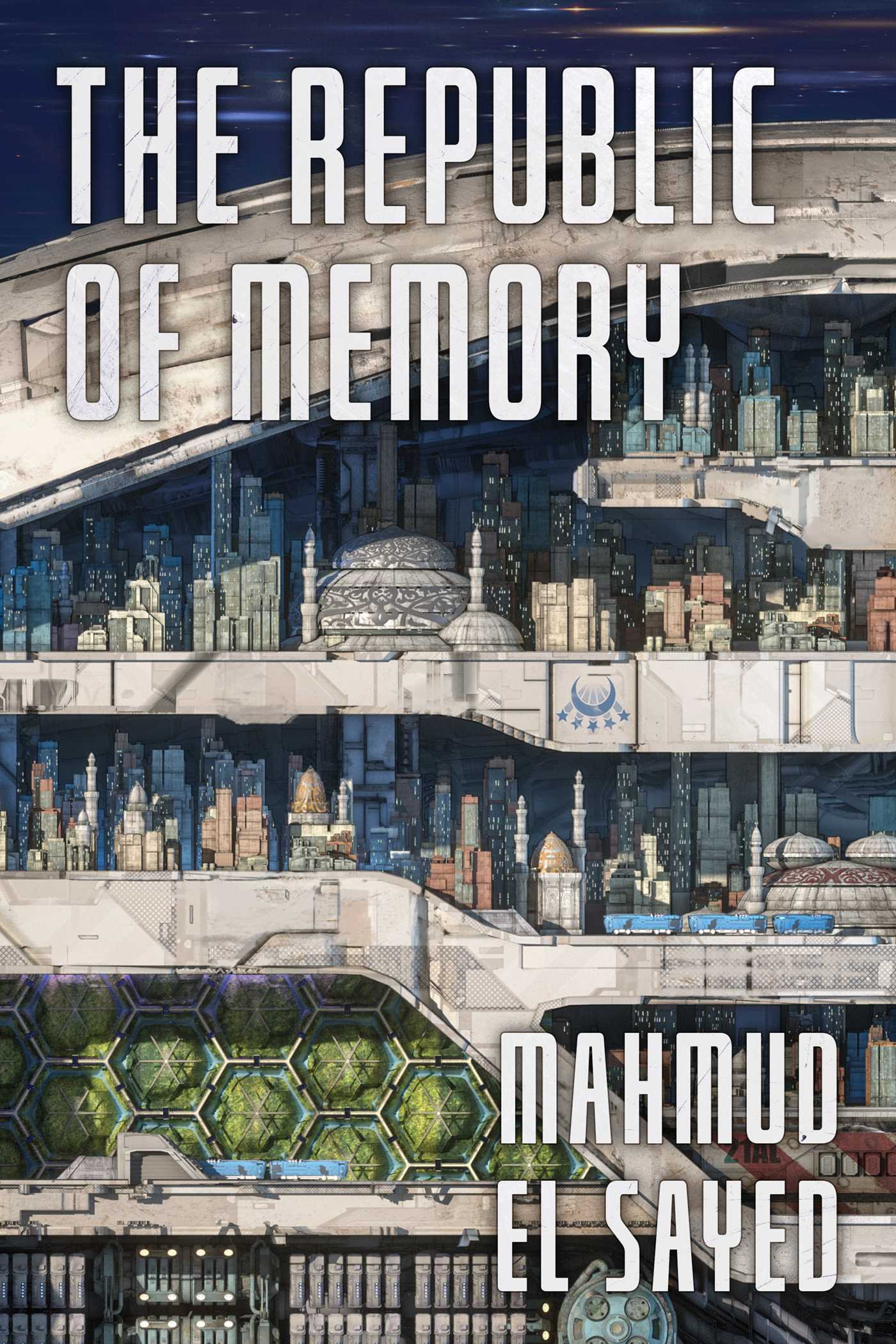
Book Review: The Republic of Memory by Mahmud El Sayed

Captain (A)merica must die

The Republic of Memory | Book by Mahmud El Sayed | Official Publisher ...
cover artist: Marcel de Neuve

Mahmud El Sayed’s The Republic of Memory is that rarest of things -  a proper space opera that has no real interest in what the West has to say about space or stories. El Sayed is a former journalist of Egyptian descent and he was there for the Tahrir Square protests in Egypt largely known to westerners (if they know it at all) because of its central role in the Arab Spring as it unfolded in Egypt. 
 
Mahmud is London based right now and won the Future Worlds prize in 2023 for an earlier version of this story that now finally makes it into print.
 
I mention these biographical facts because they are pertinent not just to the style and nature of the story in an authorial sense but also in terms of the themes and characters within the pages. 
 
This next paragraph contains mild spoilers about the plot so if you want to skip it and move on to the next part of the review feel free to do so. The Republic of Memory is about a generation ship sent out from earth on a very long (centuries long) journey to colonise another world. The people sending them are, if not quite then almost a world government centred in the Levant and entirely ruled over by an AI overclass. As becomes clear right at the start of the novel, something goes wrong back home, the threat of mutually assured destruction finally becoming a promise and the ship is ordered to turn back with its precious cargo of rich and powerful people to rebuild in the aftermath. Instead of doing so, the crew destroy the AI and continue on their way – their reasons not fully clear to themselves or us. What follows is set centuries later but still far from their destination as the various societies and factions that manage the functioning of the generation ship reach a breaking point. 
 
(Spoilers over) The story follows a number of PoVs but the crucial two, Damietta and Iskander, begin the novel. El Sayed puts these two characters (young family members) on seemingly opposite sides of the social divide and through this we have our way into the story. Damietta is a young woman in a close knit and culturally conservative family who chafes at the constraints she feels in her life. She is privileged as far as it goes with a good life laid out before her, but that’s the problem – that life is laid out before her with no deviations, no creativity and no chance at making choices other than those the people around her approve of. 
 
Damietta doesn’t know what choices she really wants to make – her horizons are too constrained for her to understand what she might actually want and, as for so many people, this leaves her with the only choice available – break things. Damietta is the person who reminds us that we all want to be able to make choices (not in the sense of the hero’s journey but in the sense of being able to determine who we are for ourselves) and when those choices are suppressed we will, reasonably even if the choices themselves are unreasonable, make choices to break whatever is within reach – be that ourselves or others. 
 
Damietta cannot see her privilege – her constraints leave her idolising resistance movements, rejecting authority and looking to engage in acts of rebellion regardless of the consequences because she cannot see how her life could be worse. And sure, in the immediate her life can be worse but a life whose practical choices might deteriorate is still nothing when compared to a life where self-determination is absent. One is waves on the ocean rocking the boat, the other is drowning without being able to die.
 
Iskander is a lawyer (of sorts) working for Administration, the distant overclass that manages the entire generation ship (called the Safina which literally means vessel or ark in Quranic Arabic). He is the face of authority, able to open doors and go places others can’t because of his role. He sits with two faces – one facing his community as the person they look to when they want to get married or get things done and one facing Administration as their loyal functionary ensuring their rules are followed without causing riots. Iskander is the willingly colonised actor, trying to see both sides, aware of the tensions, embodying them in his very person but looking to make the world work. Sometimes that’s for the better, sometimes that’s bending the rules and sometimes that’s following them. Iskander exists on a kind of personal capital – a currency he has to spend that is built up through the cautious and cunning use of his position. His effectiveness built on people seeing him as just reliably enough on their side to help them get what they need and want when Admin might otherwise say no while knowing that his power comes from Admin’s overall approval.
 
Iskander is the classical sepoy, the good native, the conflicted coconut, the collaborator who both legitimises the oppressor but also subverts their authority. 
 
El Sayed does a truly brilliant job of ensuring that we see their points of view. This isn’t a political treatise; it’s a story about people whose lives are political from the moment they’re born to the moment they die (and beyond). Why? Because for so many people this is the world they live in and to see it on the page is utterly brilliant. 
 
What I mean is that El Sayed isn’t writing about politics here – the story isn’t a metaphor for non-western experiences of colonialism. He’s both way beyond that, deep into postcolonial Arabfuturism, but also interested in these people in and of themselves. What Iskander wants, what his dreams are, what Damietta discovers in her journey to finding a way to express what’s inside her in a way that makes sense to her, consequences and all, is at the heart of this story. Whatever else it is, The Republic of Memory is a personal journey for people whose lives are…complicated. 
 
And how complicated they are because the Safina isn’t just Iskander, Damietta, their family and their community. It’s made up of communities from across old earth whose roles and cultures are disparate and essential to making the ship work. From hydroponics to medical to engineering and those who mine for resources beyond the ship, the tasks of keeping a mechanical world flying through the void are endless and demanding. What’s worse is that the ship is gradually deteriorating no matter how hard the people work at keeping it all working in harmony. 
 
It’s unclear whether the slow collapse of the ship’s systems is the fault of Administration, the inevitable result of destroying the AI at the start of the voyage or whether it’s simply entropy presenting its bill. The answer to the question depends on who you ask and their place within the ship. 
El Sayed has rolled together caste (or class if you’re a westerner), gender, functional essentialism, racism and post-colonialism into a single pressure cooker of a story. He is aware of and plays with a host of different ideas; from a variety of communisms and communitarianisms to capitalisms, religious expressions of different kinds including manifest destiny through to AI as god. 
 
However, central to everyone’s life in this novel is a gift economy. In a capitalist society where the rule of law tries to ensure transparent equity for all concerned this would be called bribery. Where there is no cash, per se, and the levers of power are invisible and asymmetric beyond family and community units it is called gift economy – bringing an official’s favourite sweets, making sure someone’s cousin got the car they wanted at a good price and so on. You might call it a society built on social obligation.
 
What I’m trying to say is that El Sayed’s novel is that truly remarkable thing in English – a speculative story that regurgitates precisely none of the prevailing Western ideas about how the world should be run and rests on none of those foundations. Beyond that it does what it wants not by eschewing consideration of these possibilities (after all, Administration is a specific proxy for American hegemonic power over countries like Egypt and how client states must come to operate for maximum benefit for their rulers), but by understanding and reflecting how complex politics between different factions is especially when relationships are stable. After all, it is successfully navigating complexity that allows stability to be sustained as the deliberately untrained and willingly ignorant are discovering in the Strait of Hormuz at the time of writing this. 
 
The last thing I want to comment on here is language. It seems to me that language and its use, its control and its boundaries are central to building consensus but also to building and controlling communities. The societies in The Republic of Memory aren’t split by culture or skin colour but by language with the mantra that anyone can learn a new language with the goal of preserving social mobility. It’s a cunning sleight of hand because it wilfully ignores the power of community and relationship and culture in building social capital while remaining superficially utopian. 
 
El Sayed delivers so much of this novel through conlangs, creoles and macaronic structures that you need to take your time to understand the rhythms of what he’s built. I think that is very, very important because in language and how people use and deploy it you find the real levers of power being expressed. What words you use at home versus what you use when speaking to power are revelatory, and throughout El Sayed reminds us that language is, at all times, a tool not simply for consensus but for control and subversion. 
 
The Republic of Memory is the first of a duology and as a way of working through modern global politics, personal lives within that context and as an exploration of how you and I survive such potentially crushing pressures it’s an extraordinary achievement. 


--


The Math


Highlights:

  • Amazing languages!
  • Proper political SF
  • Non-western viewpoint
Nerd coefficient: 9/10, a powerful exploration of what worlds look like when seen from a postcolonialist perspective. A superb starting point for people interested in Arabfuturism.

Reference: El Sayed, Mahmud, The Republic of Memory [Orion 2026].

STEWART HOTSTON is an author of all kinds of science fiction and fantasy. He's also a keen Larper (he owns the UK Fest system, Curious Pastimes). He's a sometime physicist and currently a banker in the City of London. A Subjective Chaos, BSFA and BFA finalist he's also Chair of the British Science Fiction Association and Treasurer for the British Fantasy Society. He is on bluesky at: @stewarthotston.com.

Wednesday, April 29, 2026

Book Review: Anti-State, by Allen Stroud

Cold war space opera done right

Cover Artist: Nick Wells
There’s a real resurgence of space opera right now and I’m here for it. I love a good adventure out in the stars and I’m easy as to whether it’s hard science or full of space wizards. 

Space opera, like epic fantasy, allows us to entirely transpose our experience into one functionally and practically distinct from the real world. In so doing we get the freedom to ask questions via metaphor, world building and fantastical elements about hard real-world issues. In the last couple of years we’ve seen space operas talk about AI, consciousness, the nature of work, meaning and purpose. We’ve seen them address fascism, resistance, representation, the complicity of capitalism with authoritarianism and unpack the nature of sexuality and gender. 


Into this mix comes Allen Stroud’s Anti-State, a stand-alone novel in an Expanse-like setting in which Stroud has already written a whole shelf of entries. No real prior knowledge is needed to read this one although it does refer to events in other books and feature many of those characters in greater or lesser roles. 


Stroud’s main character is disabled in the sense that she is missing limbs and that is presented as exactly what it is – factually and without fuss. It’s an interesting choice both in terms of representation and in how it’s handled by a character who spends much of the story in a low gravity environment. There’s technology to help solve her challenges, but they aren’t there to heal her or to ‘make her complete’. This approach is good to see, not simply for representative purposes but because there’s some interesting commentary around what it means to have a body in a low gravity environment vs. Earth standard gravity. 


The story itself is in deep cold war territory with the overall structure owing as much to Smiley’s People as it does to spaceships flashing through the void to blow one another up. The most obvious comparison is with James S. A. Corey’s The Expanse series – set as both are within the solar system and concerned as they are with the politics of earth extending to the rest of the system. There’s no proto-molecule in this but it does share the same concern with being at least moderately faithful to proper physics. It’s hard science fiction as far as that ever goes and there’s plenty of text highlighting just how much space will kill you at every opportunity. 


We have allusions to Martian politics, independence, rebellions and there are, lurking in the background, rogue billionaires with tech that can rival the militaries of space faring states. 


This isn’t novel – this could be a story about submarines fighting it out in the North Atlantic without too much changing with the talking heads in London, Berlin and Washington instead of on spaceships and asteroids and lunar colonies. 


That’s not necessarily bad – you know what you’re going to get, and it delivers on that competently without rocking the boat. It’s a somewhat nostalgic approach to space opera with strong golden age vibes intersecting with more modern concerns such as where it explores what it means to be human in the context of advanced technological systems. 


What worked for me was the layered world, the sense that there were politics and people and stuff happening of which the events in this story are only a part. I like that feeling of being in a wider world. I liked the focus on space being deadly and low gravity being a thing that impacts every single aspect of a life lived within its grasp.


I also largely liked the overall story of secret plots unravelling, of people with torn loyalties discovering where they truly want to put their faith and, most of all, I liked the small scale of it. Sure, the stakes are high, adventuring in space will do that, but at the same time they concern a small group of people in a set of tin cans adrift in an ocean of nothing. They might travel millions of miles but they remain determinedly fixed in a locked room whose seals keep them alive as much as trap them. 


The ideas here are small too – not all in a bad way. Stroud explores the little impacts of technology, distance and logistics that conventional space travel (i.e. without the fantasies of FTL or warp drives or anti-gravity) have on people. Loss of bone density, the lack of decent food, shortages of power, the challenge of changing direction when you’re travelling at thousands of kilometres an hour. 


I’d like to have had some larger ideas here around what it means for human society to be out there and these are there a little, but are also largely subsumed within the context of a military hierarchy that gives the book the occasional feel of mil-SF (although without any of the fetishization of guns and violence).


The one place where the politics/world building doesn’t quite work for me is in this military context and hence the larger ideas also don’t quite connect. The reason for this is my own view that the idea that ‘governments have the best tech’ is not just outdated but permanently in the rear-view mirror. This is where the book’s Cold War vibe is least convincing, although most consistent because I think that’s the last time governments could reasonably be said to have tech not available to the general public. 


These days it is entirely private companies developing that tech and selling it to our governments and it is almost entirely private companies exploring space. The question of how polities here on earth could extend their ‘national’ boundaries into space is just assumed rather than explored and the same for the corporate elements. The private companies in the novel are nefarious which isn’t hard to believe but they aren’t well realised which is a shame. 


Still, Anti-State is a decently executed and complex political thriller set in space. Its tight scope delivers a compelling story despite its other flaws.


--


The Math


Highlights:

  • Spaceships
  • Proper orbital mechanics
  • Politics and plots

Nerd coefficient: 6/10, a layered political thriller as at home in space as it would be in the 1970s North Atlantic

Reference: Stroud, Allen, Anti-State [Flame Tree Press, 2026].

STEWART HOTSTON is an author of all kinds of science fiction and fantasy. He's also a keen Larper (he owns the UK Fest system, Curious Pastimes). He's a sometime physicist and currently a banker in the City of London. A Subjective Chaos, BSFA and BFA finalist he's also Chair of the British Science Fiction Association and Treasurer for the British Fantasy Society. He is on bluesky at: @stewarthotston.com.

Tuesday, April 21, 2026

Book Review: The Language of Liars by S. L. Huang

Linguistics science fiction that isn't just the Sapir-Whorf hypothesis redux? And that will emotionally devastate you? Hook it to my veins.


The first thing you need to know about The Language of Liars by S. L. Huang is that none of the characters in it are human, and that's great. 

It's not at all surprising that space-faring science fiction tends to focus on situations that at least contain some humans, even when they're a mixed species galaxy. Writing the alien is, I imagine, pretty hard, because aliens that feel properly alien but are still written to be accessible to a reader's emotions surely take some work to get right. It's a tight balance. I don't blame people for not doing it. But when someone does... it's always a little bit exciting. If I'm going to imagine a galaxy that contains a wide array of sentient life, it's nice to get a chance to revel in the unfamiliarity of it, to truly explore what that imagined spectrum of life looks like.

Huang predominantly explores that unfamiliarity via the medium of language, unsurprisingly given the novella's title. The main character, Ro, is a linguist, who has trained hard to become fluent in one specific language but with a lot of facility in a wide array of others. Moreover, Huang has written him as someone gregarious and chatty, whose internal monologue (and external dialogue, sometimes) is peppered with little factoids about this or that language and how it relates to culture and physiology of this or that species.

But Huang also takes care to embed Ro's narrative in his own body, as well as his thoughts about those of other species. While they never provide a full, clear description - the typical look in the mirror scene of the start of many novels - Ro experiences the world in terms of his physiology, and that is deftly conveyed in his internal monologue. We know he is furred, that he has two hearts, we know about his empathic capabilities, the shape of the world he lives in and how that reflects the shape of his own body. It's very well done, and very necessary. If a story is going to explore a perspective outside of the humanoid this way, downplaying it takes away half of the fun. 

Ro is, in mind and body, the perfect balance of strange and accessible, not least because of his own alienation within his society. He feels like an outsider, someone whose behaviour doesn't quite meet the demands of his elders, and in that difference he gives us a window into what that normal looks like, and what the deviation from it feels like for Ro. He is the ideal window into a story that goes on to focus on these kinds of alienations and disconnections.

The second thing you need to know about The Language of Liars is that it spans a whole universe of worlds, and their interlocking needs and differences. In brief, deft strokes, Huang manages to create the sense of a vast, complex and interlocking, galaxy spanning set of polities, not just through Ro's understanding of language, but in a wider, political sense. This is a universe whose function demands the constant mining and utilisation of a specific resource - meridian - to bridge the gaps between worlds. Many of those worlds, including Ro's own, would cease to function without it and lack the means to produce their own basic needs, right down to oxygen. While the story focuses in on Orro - Ro's world - there are constant nods and gestures to the other places within it, their needs, their respective status compared to Orro, their political inclinations and oppositions. Huang has the knack of explaining little but giving just a big enough suggestion of it to let me nod and carry on. Everything has enough sense to fit with intuition, to imply the necessary complexity, without having to get into the weeds of intergalactic trade routes. For which I'm grateful, because that's not really what I'm here for reading (sorry economics nerds). But it's also very difficult to do well, and a skill I think is particularly critical for novella authors.

There's a narrowing of priorities necessary to make a good novella, to cutting all the things that need to be cut to make something substantial fit into the space of 155 pages as this book does. There are a lot of ways to achieve it, but Huang has cut themself off from a lot of them by going for this high stakes - because boy the stakes are indeed high - and wide space narrative. And so, if they can't focus in tight and small, they instead have to skim things, hint things, let the reader do some of the work of embedding this world into plausibility. Luckily, they have done so masterfully.

The third thing you need to know about The Language of Liars is that even if you see the end coming, even if you know what the story is going to tell you about this world before you get there, the revelation is still going to hurt. Ask me how I know. I had an inkling early on that I might know where some of the clues were pointing, but it truly did not matter one bit. The discovery, the way Huang set up and deployed the information the book coalesces around, does not rely on surprise to deliver its value.

Such plot summary as I'm willing to give is this: Ro is a linguist studying to make what's called a "jump", that transports him into the body of an alien race called the Star Eaters. It's a rare talent for linguists on his world, but a necessary and highly honoured one, one that Ro is desperate to achieve as a way to prove his worth to the society he struggles to fit into (despite his great talent for languages). And, despite and because of his doubts about himself, he succeeds. The Language of Liars is the story of what happens when he does so.

It's about language, about relationships between people, about exploitation and the weight of moral decisions, and who gets to make them. And it's about the big impacts of small decisions, not just the sweeping horrors of the universe but the tiny, individual atrocities that can be committed too. It handles all of those things incredibly well, bringing them together to deliver a gut punch at the end that gets into a lot of big ideas about how history and politics work, and what the right choice is in a hard place.

And a last, little, enormous thing you need to know about The Language of Liars is one you'll only learn properly if you read it yourself: that it is an incredibly bold book, because it leaves you in a state of unresolved emotion that is far more productive than any tidy conclusion would be. Huang has made such a good decision in how they close this story, and the sort of thoughts they leave the reader to experience in the aftermath.

That ending, that sucker punch and the refusal to give the reader an easy closure, is the capstone of a bold, interesting, deep book, and a very worthy end indeed to the complexity of the story they've given us up until that point. The Language of Liars is an exquisitely formed novella, a stunning example of what good writing, good ideas and a willingness to do something different can achieve, without the need for sprawl.

And it's a book of science fiction linguistics that isn't just a rehash of the Sapir-Whorf hypothesis. That's a gold star right there.

--

The Math

Highlights: a story situated well in alien mind and culture, deep and full use of language to great effect, big stakes tackled thoughtfully

Nerd Coefficient: 9/10

Reference: S. L. Huang, The Language of Liars, [Tordotcom, 2026].

POSTED BY: Roseanna Pendlebury, the humble servant of a very loud cat. @chloroformtea.bsky.social

Friday, April 10, 2026

Review: The Photonic Effect by Mike Chen

The Photonic Effect wears its twin inspirations on its sleeve, and boldly launches Chen’s work into the subgenre of space opera and makes it so.

These are the voyages of the GCF Horizon. Its mission was to establish and map a new trade route for the Cluster. Instead, it spent ten years in a gravity well with a host of other trapped ships. Upon escape and return to Cluster space, they had found that in the decade since, a civil war had broken out. Now, with the experimental photonic drive that allowed them to escape the gravity well, the Horizon is seen as a tool, or a weapon, by both sides. And it turns out they have unfinished business with the Lumersians in the gravity well. Although the costs of pursuing that might be high indeed for the crew, and perhaps far beyond, as well.

This is the story of Mike Chen’s turn into space opera, The Photonic Effect.

Star Trek, in several of its incarnations, particularly TNG and Voyager are two of the clear antecedents and inspirations for Chen’s Horizon. This is in terms of the ship, the multi-species nature of the crew, the Federation-like Cluster. In terms of characters, our focus is primarily on the bridge and engineer crew of the Horizon, just like a typical Star Trek episode or series. Our Captain, Demora Kim, even has a Star Trek catchphrase, “Take us there.” Like any Star Trek series, we have a multi-species crew. In addition to the humans, including a human from another universe (thanks to that gravity well), the Horizon also has a Dwyen, a humanoid species with a pack-based hierarchical structure and outlook. And then there is Chuck… who is rather unusual and not really an active member of the crew at present, although he was crucial to the Horizon’s return to normal space. Given that Chen has written a DS9 comic, it’s clear and easy to see how he is channeling Star Trek into his unique world.

The other inspiration is a somewhat more complicated and in some aspects, darker one to draw from on occasion. And that would be the videogame series Mass Effect. Mass Effect, for those who have never played the games, takes place in a galaxy where humans are the new kids on the block and eager to prove themselves. The game can turn dark and complicated, with various forces and factions striving in a cutthroat galaxy, including secret factions and powers that the player character is engaged with. And to be truthful, the Horizon does feel much more like the Normandy from Mass Effect than most of the mainline Star Trek series central ships, except maybe Voyager. The ship is not all that large, and it is not even built well for war,¹ which makes people coveting it all the more perilous for the crew of the Horizon. They cannot shoot their way out of situations, even if they would consider doing so.

With these two powerful influences, Chen has the tools to tell his own tale and develop his own story and ’verse. Chen relies on a core set of characters and is interested in telling a story of how this flawed found family has to deal with the challenges of return, their own limitations, flaws and failures, and how to forge and come together to face threats. From Kim on down, we get a set of complicated and multi-sided characters much more DS9 in some ways in terms of characters than other Star Trek characters. Or, again, see Mass Effect. The fail points and weaknesses of the characters make each of them real, and engaging to read and follow.

Chen keeps his points of view on three characters:

Kim, the Captain, as our primary character, and the framing device at the front tells us this is her retirement interview and debriefing of her last mission. Kim went through a lot to try and get crew back home, and paid a price herself in seemingly losing her chance at romance with the aforementioned Chuck. Kim is interestingly flawed, often caught in bad decisions or situations, and has to strive to regain her crew’s trust, and to do better.

Another primary point of view is Tanav. Tanav isn’t part of the crew, not exactly; he’s an entertainer from another universe whose ship got caught in the gravity well. Circumstances forced him, along with other ships, to get on board the Horizon. He’s not crew, but he acts in a capacity of an entertainer. Tanav is conflicted—he misses his home universe, although his relation with his parents was rather complicated. And in a ship full of officers and engineers, he does wind up being a bit of an odd man out. Tanav’s story is one of growth in the face of conflict and fire, and it shows you don’t have to be the Captain or Chief Engineer to be a hero.

Third, Neera is the Chief Engineer on board the Horizon, and is the aforementioned Dwyen, which allows Chen to play with humanoid but not quite human. Chen does a great job not only in appearances, but going further and giving Neera a distinctive verbal cadence. I will bet that when I listen to the audiobook, I will be able to tell when Neera is speaking by the way she constructs her sentences, distinctive from all others. Like Kim, she’s imperfect, and her choices in trying to get the photonic drive to work wind up with major consequences for everyone.

The whole situation, seen in flashback and recollection, of that last mission that had the Horizon in the gravity well for ten years is an excellent bit of writing, dribbling out details from their ordeal and how they had to make sacrifices and paid costs in order to stay alive. In this way, it feels a lot more like a darker Voyager and much more into Mass Effect territory in that regard. And all that provides backstory and ballast to the core crew of the Horizon, including the characters who don’t get viewpoints.²

Chen has two crucial characters who are not from the original mission, and since they don’t have the ballast of the backstory of having gone to the well and having that connection to the crew, or to the world, they don’t come off quite as well. Commander Matthews, foisted onto the Horizon upon their return to the Cluster, definitely has an agenda of his own, and his antagonistic relationship with the crew provides much tension. He’s a more classic sort of square-jawed hero, and one, in roleplaying terms, that has gone on the heavy side of combat and physical skills that most of the rest of the characters cannot begin to match. The other character I will not mention, as they become the ultimate antagonist of the book. The slow reveal of their true plans and intentions is an excellent bit of craft on the part of the author.

The unusual nature of Matthews vis-à-vis the rest of the crew makes it clear that this is a much more late Star Trek than early Star Trek in terms of the characters’ approach to problems. The relatively weaponless nature of the Horizon and the lack of skills in weapons and tactics (Matthews excepted) means that the problems faced and solved usually fall to cleverness, or engineering, or science, as opposed to high-grade weaponry and battle tactics.

And the book is a lot of fun to read. If you are a fan of Star Trek, or Mass Effect, this book is relevant to your interests in creating a familiar yet unique space opera world. And if you ever wondered what you would get by mixing that peanut butter and chocolate, this book, like it was for me, will entirely be your jam. It’s entertaining, deep, philosophical, reflective; and when the action beats need to happen, Chen delivers. The world portrayed is a rich space opera ’verse with enough detail beyond the bounds of the Horizon itself to invite the playground of the imagination.

The book closes off Kim’s story, but given that this is a retirement debriefing on page one, the reader must surely guess that this is the end of her career anyway. The adventure may continue with the Horizon, and with other members of the crew, but as primary point of view and this being Kim’s story, the novel is not, as you might be worried, first in an endless series. Like the rest of Chen’s oeuvre to date, it is a standalone novel that provides an excellent story, flawed and memorable characters, strong worldbuilding and much more for the reader to discover.

Highlights:

  • Mass Effect × Star Trek = entertaining space opera
  • Strong set of flawed and interesting characters
  • Rich and interesting world

Reference: Chen, Mike. The Photonic Effect [Saga Press, 2026].

¹ A reference point for me that Chen probably did not intend comes from the board game Star Fleet Battles, which is set in a version of the Star Trek universe. In that game, there is a design for a Federation cruiser that is very much defanged for war but has high capabilities for science and long-range reconnaissance—the Galactic Survey Cruiser. The Horizon feels a lot more like a Galactic Survey Cruiser than a regular Federation ship.

² There is a tuckerization from Star Trek, too. Watch for it!

POSTED BY: Paul Weimer. Ubiquitous in Shadow, but I'm just this guy, you know? @princejvstin

Friday, March 20, 2026

Book Review: Hell's Heart by Alexis Hall

Horny and intellectual by turns, this sapphic, spacefaring adventure is Moby Dick for the digital age.

I'll freely admit that a lot of things in this book are jokes, because I have a very short attention span and like kid myself that facetiousness is the same as satire.

So says I, the cryptically-monikered narrator of Hell's Heart, a sapphic reimagining of the story of Moby Dick, set on a ship out to hunt leviathans in the roaring storms of Jupiter. And on one level, this is a perfectly accurate summation of the novel. It's absolutely jam-packed with jokes. They range from the subtle, the referential (if you can read Latin, there are a number of sometimes apt, sometimes rather less so quotations that you may recognise, more on this later), through a Muppets gag, all the way to a long-running repeated bit about "sperm" being a funny word. It would be very easy to read this book and read it light, to skim across it with the glib, flippant tone the narrator offers, and be content. The narrator, as characterised, often seems to want you to do exactly that. It would be a perfectly good reading, and a great time. And, yes, conceivably both facetious and satire.

But it would be an incomplete one. Because Alex Hall is doing a heck of a lot more in Hell's Heart, and that is both its strength and its weakness.

To be clear before I dig in too deep, I've never read the whole of Moby Dick, and even my partial encounter with it was a time ago best measured in decades. But I have the cultural awareness of it as a novel that many do, so my perspective on it comes from a place of rough familiarity, but without the detail for a full comparison.

To start with the weakness, it's quite a long book. Not as much as its inspiration, but my copy clocks in at 464 pages, which is still relatively chunky, and more to the point long enough to start feeling long. In that time, while Hall packs in a lot of content, a lot of themes, a lot of angles (and less sex than might be expected, but still plenty), by the end, it starts to feel like there are a small number of major pieces that are being proffered up to the reader on rotation. Around page 370 or so, all of these were feeling just that little bit too familiar, so I was very glad once Hall finally got around to the dramatic end piece. And think to some extent the length is a product of doing all those different things all together and at once - they have to keep circling around and getting their various turns to make sure they're all covered off before the big finale. And just for that little while, for a short span of pages... it did get a tiny bit stale. Everything just became that bit too familiar. They hadn't quuuuite paced it right.

Which is a real shame, because in nearly every other way, that packed in variety was what made the book so enjoyable.

Starting with the religion stuff, of which there was quite a lot. In the space future Hall envisages for the setting of Hell's Heart, there are three major and a number of minor churches, but the ones that figure most into the story are the Churches of Liberty and Prosperity, and a cult referred to as the Church of Starry Wisdom, or just Wisdom. The first two are clearly based on Christian textual traditions (based on quotes, names and various pieces of information dropped across the book) but with radically different intents, both to each other and to my (admittedly weak and very Anglican-focussed) understanding of modern Christianity. Living up to their names, they preach a doctrine of radical personal freedom and profit respectively, and how those tenets interact with life in a solar system of dispersed exocolonies and habitats is deeply threaded through much of the story. The protagonist herself is a semi-lapsed Prosperity disciple, and she keeps coming back to her personal upbringing and relationship to money, profit and belief throughout the story. Which makes sense on a voyage where a captain is going to start prioritising vengeance over bringing in the goods that everyone signed on to hunt to earn their pay.

Meanwhile the Church of Starry Wisdom has a very different theology - they believe we're all going to succumb to the great beast, devourer of worlds, but that some are destined to be devoured before others, and those last-to-be-eaten are the chosen. Great beast, you say? In a monster hunting book? Yes, exactly. You see where that's going.

On the one hand, all of the religions are inherently parodic. Not necessarily of real world faiths, but certainly of strands within modern belief. It is hard to read a section in which the rich man and the camel passing through the eye of the needle story of the Bible is canonically interpreted as a mandate to be rich, and not see that this is poking fun at capitalism as we know it right now. And when that sits alongside pay-to-pray church services... well, it's not subtle. But it's also actually quite effective, and a lot of that is because the main character is really ambivalent about the extent to which she believes it all. There's a fair amount of musing on what it means and how it figures into her life, and that doubt makes it more than just a funny poke at the real world.

Instead, it's part of how Hall is drawing a hypercapitalist space future hellscape, from which space-whale hunting is a legitimate escape for those with few means and debts to pay.

Part of this hellscape is a medical one - several characters throughout the book are shown to have biological amendments, upgrades or replacements in their bodies, and a number of them are in perpetual debt to Aphrodite Corp. because of it - healthcare being extremely proprietary. There's even a throwaway line about someone being punished for inheriting copyrighted genes. And yes, this too is obviously satire, but it sits in that good and fuzzy zone of obviously satirical while also real enough to be effective worldbuilding. Because I is one of those characters with debts - hers being for unspecified body mods that I was interpreting as something gender-related but which is never made wholly clear in text - and the way that that is emphasised by her, and by the world around her in text makes her decision to run off to this incredibly dangerous, gross and difficult career make a lot more sense than it might otherwise do.

Another part, and this is something that only comes up in a few small lines but which nontheless made a deep impression on me, is the way Hall envisages art in this horrible vision of the world. This is a world with a divide between human-produced and procedurally generated art, it seems, and that is such a horrible, biting window into a possible future that I had to pause for a minute when I got to it. I've read a number of stories about and full of AIs in the last couple of years, and yet this little tiny glimpse in a book about space whales somehow grasped it all the better.

I suppose it's because the book is very much about, among all the other things, inequality and desperation. And that is so real, so graspable, that all the SFnal trappings around it work all the more.

That desperation is also part of what makes the narrator work so well, because it undercuts and grounds her sometimes... well, as she says, facetious tone. In some ways, she reads very similarly to another Hall narrator, Puck from Mortal Follies and Confounding Oaths. Both of them are incredibly cagey about real names, for one thing. But where Puck starts and ends with that light, mischievous tone they share, that fey nature, I is just as much defined by her wants, her humanity and her seriousness as by her rejection of it. Over 464 pages, the lightness might have worn thin without something substantial to be glimpsed underneath it. It comes in fits and bursts, but it's there, and it turns the lightness into something darker than just a person with a certain approach to life. The humour becomes coping mechanism, tied up into the darkness to which it offers a contrast. I is simultaneously comedic and tragic.

Outside of I, most of the other characters don't get an awful lot of depth. There are short portraits of key figures, but they take something of a sidebar to her main interests - digressions and sex jokes. Some of them are, themselves, jokes. Many of the ones that aren't are obvious parallels to characters from Moby Dick, especially the mates, and the Ahab figure, genderbent and referred to only as A. Her madness - characterised in part by a wholly different register of speech than the rest of the crew, archaic and formal and itself calling back to the source text - is made compelling. We can see why I loves her, just as we can see why that adoration (possibly infatuation is a better word, given how one-sided it all is) is absolutely toxic to her.

The other part of her madness is another thing that made me do a big "oof" and put the book down for a little while, for that sudden face slap of too close, too real. The captain has in her quarters a "networked machine intelligence", a computer programmed to provide advice, data processing and predictions, but in a chatty, colloquial manner. A machine with which she develops an unhealthily codependent relationship as it gives her the information she wants and the answers that best reinforce her existing priorities and intentions. Horribly familiar, isn't it? It's a damnably good take on that kind of obsession, updated to the modern world, and I sort of hate how effective it is.

The other character who gets genuine page time and development is... less easy to sum up. Her name is Q, and she is obviously a reflex of Queequeg from the original. In this multiplanetary (and more) future, however, her home is old earth, rather than Queequeg's South Pacific Island origin. In this future, Terrans, with their strange tattoos, are seen as backwards and barbaric compared to those in the habitats and expoplanet colonies. They are strange, insular and possibly cannibals, and don't have the same religions or priorities as the "exodites".

Given the obvious racial dynamics of the original, this is an interesting choice of update. And one I'm still not entirely sure how to take. Because on the one hand, Hall has taken a number of the stereotypes included in the original text and just shifted them over wholesale, but on the other, he's given them some aspects and accoutrements that point in opposite directions. My understanding (as above, incomplete) of the original text is that Queequeg is heavily othered and given a strong desire to visit "Christendom" which... brings up a whole bunch of associations. So to pivot that othering into a character who is from the most familiar place in this setting for us as readers seems to me a very deliberate choice to engage with the problems of the original.

Likewise, while Q in Hell's Heart speaks mostly in a language none of the other characters understand... that language is Latin, which comes with a bunch of assumptions about prestige and worth for a lot of readers. And if you either can read Latin or fancy googling it as you go through the book, you discover that Hall has cheekily used this as a way to pull in quotations from a wide, wide pool of sources. Some of them are Biblical, which makes a lot of sense for this retelling and the direction they choose to take most of the story. But some are drawn from Classical authors like Cicero and Catullus. Indeed, there is a phenomenally effective sex scene early on where Q speaks to I only in quotes from Catullus' erotic poetry. So again, Hall is taking a racist portrayal and making some very deliberate choices about how to mess with it, how to hold it in conversation with the original.

Q is also one of the very few seemingly altruistic characters in the book. While all the exodites are busy being out for profit (or worshipping an embodiment of entropy that just so happens to have white supremacy baked into its hierarchy of the universe), Q operates on a moral compass more easily comprehensible to the reader (even as it's opaque to I). Which on the one hand reinforces that she is the familiar one, not the Other. But on the other plays into ideas of the noble savage.

Does it work? I'm honestly still not sure. The Latin does, and there are moments where they deploy it brilliantly, where the quotes are exactly perfect for that piece of dialogue, and where I's uncomprehending response is a humorous dissonance. But as a whole thing? Maybe?

Despite my above complaint about length, I think possibly Q needed more page space in order to fully work through her character and its relationship to Queequeg. It's a big thing to grapple with, and while it's clear Hall is grappling with it, I think it's not quite clear what the actual thesis of it all is. It's just sort of all... there, in a jumble, not quite sorted out. And for something so messy, there does need to be some sorting.

Even aside from the Latin, Hall does like to play with language and quotation quite a lot throughout. And that? That is successful.

I mostly speaks a very modern vernacular - and one that screams "excessively online millennial" to me, an excessively online millennial - which is extremely informal and irreverent. Most of the exodites speak a slightly less sex-joke-laden version of the same. But some characters are marked out by their dialogue, and every time Hall does this, it's interesting. In the Captain, it's a sign of increasing madness, as she slips past modern formal right into "hast thou". In one of the Wisdom followers - who suffers an accident that either is making him hallucinate or given him access to the voice of something numinous, depending who you ask - it is likewise a sign of madness, but of a different kind. He speaks in riddles, taken as prophecies, but I think every single one is a Shakespeare quotation. Certainly I spotted a lot of them in his dialogue. Given I's resonance with Puck in a previous Hall work, this felt like a slightly elaborate, subtle joke. But it also worked really well because he feels immediately distinct from all the other speakers, and from the self we met at the beginning of the book. In a sea (so to speak) of mostly indistinct background characters, it gives the reader an instant cue that this one needs attention and that this one is, now, different.

And indeed, offers a stark contrast to I's dick jokes. Because Hall didn't pick the dick jokes bits of Shakespeare.

It's those contrasts, more than anything, which are the heart of Hell's Heart. Between modes of speech, between humour and tragedy, between the old text and the new. So much of the story feels like a homage to or an argument with Moby Dick, even to someone not familiar with the original text. There are long digressions about whale physiology and the logistics of hunting, of the realities of a long journey spent cooped up together with a limited number of people in a small space, surrounded by an environment that wants to kill you, which is itself full of monsters. It feels, in those, stunningly close to its predecessor. And then up comes the irreverence, the absolute refusal to take some of the core premises seriously, and that contrast brings it to life. Just as in real-world whales, the resource being hunted in the gassy seas of Jupiter is "spermaceti", or "sperm" for short. And I did not count how many times I comes back to this, to teehee about it being a funny word, but if I did I would run out of fingers and probably toes as well. And yet it's also doing some serious thinking about capitalism and religion. Hall keeps you coming and going, never quite settled into one thing, one feeling, throughout the whole of the story. I is by turns a philosopher, a slut, a pilot, a girl, a problem - and those in her own words - and it is her effervescent changeability that sustains the story most. She speaks directly to the reader, always chatty, always lively, often metatextual, and creates a sense of conversation and relationship between herself and us for the duration of the story. She takes us by the hand and leads us through the ups and downs of her life and self.

She - this complex, quixotic, messy, terrible, excellent character - is what makes the story sing. And because she, and it, are so many different things, she makes it a rich text. Where I found myself focused on the capitalism, I'm sure someone else would linger elsewhere. That someone else might be me, on a future reread even. Yes, it's a long book, and yes, it might be overstuffed. Yes, that's even a problem. But it is also a strength, and one that makes this book worth reading, despite and because of its faults.

--

The Math

Highlights:

Nerd Coefficient: 7/10

Reference: Alexis Hall, Hell's Heart, [Tor Books 2026]

POSTED BY: Roseanna Pendlebury, the humble servant of a very loud cat. @chloroformtea.bsky.social

Monday, March 16, 2026

TV Review: Starfleet Academy

A more than worthy successor to Discovery, somewhat undercut by mixed messaging

Starfleet Academy is proof that a six-decade-old ongoing story can still find ways to feel fresh if it dares try the unusual. Prodigy already showed how the same elevated ideals that sustain the Federation can be adapted for child protagonists, and Lower Decks brought much-needed levity to the franchise’s sometimes suffocating self-importance. The newest iteration, set in the 3000s after the United Federation of Planets has been broken apart and reforged, blends the thrill of space adventure with the angst of teen drama. But the most unusual aspect of Starfleet Academy isn’t even the soap opera side of it; it’s that, extremely rarely for a Star Trek series, it’s driven more by the internal exploration of characters than by clever plot-solving. So I think it may be a worthwhile exercise to analyze the show in the same manner: by focusing on the characters.

Caleb. The show’s protagonist had a childhood traumatized by the Federation, after his mother was sentenced way too harshly for having been at worst an accessory to murder. This defining incident shapes all his relationships: he’s learned to expect to end up alone, so he’s reluctant to bond. This is made evident from the big gestures, like the way he lashes out at his new friends each time they get too close, to the small ones, like his habit of hoarding food (which is a real behavior in children who were abandoned). This issue gives him both a clear direction and a weakness: he has a mission to find his mother, but everything else is secondary to it, so he doesn’t allow himself to experience life. He can’t commit to his girlfriend because he feels too emotionally exposed with her (it doesn’t help that she’s a literal mind-reader), and he can’t participate in a Klingon bonding ritual because he’s still waiting for the family he lost. This is interesting characterization, but it gets resolved too neatly by the end of the season.

Genesis. Our favorite obsessive overachiever has a simpler but harder drama to deal with: as the daughter of a Starfleet admiral, she enters the Academy having already a mountain of second-hand expectations dumped onto her. She’s definitely talented, as well as a quick learner and a natural leader, but she can’t bring herself to believing that her successes are her own, even after she’s proven multiple times that she can improvise resourcefully, notice the details that matter in a moment of urgency and somehow always know the right thing to say to comfort a friend. That’s her tragedy: she treats everyone with much more care and understanding than she’s willing to give to herself.

Darem. This one is fascinating to watch evolve. We first meet him as an arrogant child of aristocrats (we eventually learn he’s literally engaged to a princess), used to being the center of attention and not above hurting others to get his way; over the course of the season, he realizes he doesn’t need to keep putting up an image of flawlessness for parents who don’t even care enough to answer his calls. This frees him to start searching for who he is in reality, and it turns out he’s a loyal friend with a bottomless capacity for empathy—that is, unless you’re dating his crush, in which case he can still be a pain to deal with. His newfound willingness to make fun of himself still needs more practice.

SAM. What can I say about this bubbling avalanche of positivity, our beloved Queen Sam Samallina of Samonita? On one hand, she has an unquenchable thirst for life, an earnest curiosity for a universe she can’t get enough of. On the other hand, she has an entire species’ fate in her hands, being an envoy from sentient holograms with the assignment to study us squishy organic beings and report on whether we’re still a danger to artificial lifeforms. That’s a massive responsibility for someone only four months old, which comes back to bite when she suddenly has to deal with violent trauma without having the emotional resources that come from actually having lived. In a beautiful case of metaphor turned literal, she almost dies because she’s literally too pure for this world. After she quickly-but-not-really (there’s some serious time dilation involved) gains the maturity she needs to maintain a stable personality, she becomes an even more compelling character to watch: now she has enough perspective to critically examine both the person she used to be and the way her friends responded to that version of her.

Jay-Den. Once again there’s only one Klingon in Starfleet, and this time he’s a pacifist studying medicine. This is a refreshing change from the repetitive way this species has been portrayed in Star Trek. Of all the colorful and strange cultures we’ve seen across the decades of this franchise, Klingons have been among the ones that make the least sense. I always wondered how their civilization lasted all the way to the space era without exterminating itself. Now that we’re in the 3000s, the Klingons’ situation is much different: they’ve lost their empire, they’re reduced to a handful of clans, and their collective survival is in question. Jay-Den’s family drama (about being a son of hunters who eschews violence) gets resolved fairly early in the season, and from then on he’s relegated to something of a background role, which is a pity because he’s just the sweetest and his romance subplot is adorable.

Tarima. Ah, Tarima. What shall I do with you, you Manic Pixie Dark Phoenix. This was the character I struggled the most to understand. Her backstory is that, in a species of born telepaths, she’s an exceptionally (even alarmingly) gifted one, and the medical treatments she’s had to live with in order to keep her powers within safe limits have prevented her from fully knowing herself. Frustratingly, this also prevents the audience from getting a sense of what her deal is. She’s reserved, but impulsive, but apprehensive, but uninhibited, but distant, but bold. To be fair, her best scenes are those where her directness cuts through Caleb’s tendency to lie to himself.

Captain Ake. As a centuries-old being who has seen everything, it makes sense that she has little patience for Starfleet’s excessive love of formality and protocol. I love the way she commands respect as a captain without bothering to perform the part. Because the show is mainly focused on the younger characters, we learn about Ake’s personal drama late in the season (she once made a tactical decision that cost her son’s life), but the additional fact that it was her fault that Caleb grew up without his mother gives us enough to chew on in the meantime. The only regrettable moment with her is the finale, where it feels like the Federation comes off as too implausibly clean-handed for the times of hardship that followed the Burn.

With equal parts romance, comedy and technobabble, Starfleet Academy is remarkably well directed, acted and written (I want to single out Kirsten Beyer, who is proving to be by far the best writer in New Trek), although it shares with Discovery a questionable plotting choice: in the 3000s, with the Federation in pieces and the galaxy in dire need of new leaders, why try to remake the same old Federation that already failed, instead of coming up with something different and more suited to the new political reality? Aside from that oversight inherited from its predecessor series, this is a laudable step forward for the franchise, especially after recent disappointments like the nostalgia vomit that was Picard season 3, the inconsistent mess that was Strange New Worlds season 3, and the unforgivable calamity that was the Section 31 film. More of this, please.

Nerd Coefficient: 7/10.

POSTED BY: Arturo Serrano, multiclass Trekkie/Whovian/Moonie/Miraculer, accumulating experience points for still more obsessions.