Showing posts with label apocalyptic. Show all posts

Monday, April 20, 2026

Film Microreview: Good Luck, Have Fun, Don’t Die

Will we be able to prevent the end of the world if we’re having so much fun with it?

Just like Nineteen Eighty-Four presented a dystopia of absolute control sustained by brutal coercion, whereas Brave New World showed it was easier to sustain it by seduction, the film Good Luck, Have Fun, Don’t Die asks us to imagine a Skynet that intervenes in the timeline to ensure its own existence, but instead of bothering with assassin robots to enforce its violent rule, it preemptively lures humankind into passive obedience via irresistible apps and delightful virtual environments. This time, the scruffy resistance fighter who jumps from the future to prevent the machine takeover doesn’t come with the warning that AI will seize the bigger arsenal, but that we will be too absorbed by our phones to do anything about it.

This time traveler doesn’t bring the most persuasive sales pitch. At the start of the film, he randomly shows up at a diner and asks who among the present is willing to join him in his unspecified quest to save the world. Understandably, no one believes him. In his defense, let’s keep in mind that he’s given the same speech at the same diner over a hundred times, and it’s always ended in disaster, so by now he’s tired of pleading. For some reason, he’s convinced that that place contains a set of people with the precise combination of skills that will help his mission, and in all his attempts, he’s yet to find the right selection of team members.

What follows from that point on is a dual narrative structure: on one thread we watch the improvised squad of heroes clumsily and hilariously evade police cars, masked gunmen, paid actors, a flashmob of hypnotized teenagers and a certain nightmarish monstrosity I won’t spoil, while on the other thread we watch the respective backstories of some of our heroes, who have already had some unpleasant experiences with the convergence of digital trends that will result in AI’s tyranny. In those flashback segments we learn about addictive videogames, consciousness uploading, a clandestine cloning business, the trivialization of school shootings, the omnipresence of militaristic propaganda, the difficulty of living off the grid and a terrifying form of mass mind control—one third of this movie has enough material to fill a whole season of Black Mirror, except with an actual sense of humor and sans the nihilistic posturing.

The time traveler’s mission turns out to be rather straightforward; the hard part is getting from point A to point B in one piece. Most of the film’s entertainment value comes from watching complete amateurs die in ridiculous ways. And that’s an obvious point of self-critique; you can’t write an action script about the toxic potential of entertainment without acknowledging your complicity in the problem. Accordingly, the time traveler warns against the easy promise of a neat plot with a satisfying ending, which is the AI’s favorite way of distracting humans from their oppression. And the film itself avoids giving us a happy ever after; the ending gives very strong hints that the AI has far more control over the events than the time traveler realizes. Maybe that’s the most ingenious form of propaganda: letting us enjoy a story where we believe we have a fighting chance.

Nerd Coefficient: 7/10.

POSTED BY: Arturo Serrano, multiclass Trekkie/Whovian/Moonie/Miraculer, accumulating experience points for still more obsessions.

Wednesday, March 25, 2026

Project Hail Mary pulls off a disturbing misdirection trick

Ryan Gosling’s pretty face and inoffensive goofiness will keep your mind off the billions of deaths happening offscreen

It’s the kind of clever switcheroo you only notice in hindsight. After leaving the theater with a spring in your step, feeling uplifted about the survival of a faceless rocky alien spider (a flawless masterpiece of puppetry that should get its own Oscar category), you start piecing together the plot pieces that Project Hail Mary frustratingly left scattered between flashbacks, and it finally dawns on you: Hey, the buddy comedy was fine, and Ryan Gosling is always a delight, but wasn’t the human species supposed to be facing extinction while we were having wholesome, family-friendly fun in space? Didn’t that mysterious German lady talk of losing something like a quarter of the world’s population in the best case scenario?

When the movie starts and our hero Ryan Gosling Ryland Grace wakes up with amnesia, his ship has already been traveling for several years since the discovery that the Sun was losing brightness; the wars over food must have devastated Earth in the meantime. The script merely alludes to the stakes and promptly shifts its attention to Grace teaching his new alien pal to dance and bump fists. The quick pacing of the scenes in space doesn’t give us time to reflect on the mass panic and the disintegration of society that must be going on while, a dozen light-years away, Grace sings karaoke. The movie is very effective at what it’s doing. It’s its choice of what things to do that lands as strange.

The problem Grace is trying to solve is that some strange microbes are eating the Sun, and with the diminished energy output, human agriculture is doomed to collapse. It turns out that other stars within the visible portion of the universe are being consumed too, except, for unknown reasons, the star Tau Ceti, which still keeps its normal brightness. The only hope (the titular “Hail Mary”) for the survival of life on Earth is to send a ship to Tau Ceti to figure out how it’s avoiding the plague of star-killing microbes. But while the ship gets there, which even with a miraculous superpotent fuel is going to take some years, Earth is left to fend for itself as best it can. This is a profoundly intense drama that the movie inexplicably insists on looking away from. Don’t think of the entire nations fractured by starvation—hey, isn’t this spider alien cute?

For roughly half of the runtime, we watch Grace deal with his amnesia and the unexpected presence of a second ship sent from a planet facing the same problem. Here we have potential elements for great character work, but the movie is so obsessed with making us feel good that we don’t see the full impact of the situation on Grace’s psyche. We eventually learn he was forced to come on this trip without enough fuel to return to Earth, effectively killing him in the hope that he’ll find a way to save the whole species. This could have provided a prime opportunity to explore important questions, like the universal human experience of disorientation at our state of thrownness into the world, and the comfort it brings us to find fellow travelers to figure out this mystery with, but this movie is too afraid of thinking sad thoughts. The unmissable allegory for the human condition (i.e. we open our eyes without any instructions, destined already for death) is swept aside for the good old art of visual spectacle.

On that front there’s nothing to complain about: Project Hail Mary looks breathtaking. But there’s a noticeable disconnect between the parts of the plot that desperately pull in opposite directions, the background tragedy of a world falling to pieces and the foreground coziness of a likeable guy learning to make a friend. There’s a bare outline of character growth, going from an initial state in which Grace was against going on the mission because he didn’t feel goodhearted enough to sacrifice his life for anyone, to a culmination state in which Grace has met someone he’s willing to sacrifice himself for. But the magnitude of that growth gets lost amid the movie’s anxious hyperfocus on vibes.

Project Hail Mary ought to carry itself with more weight, be more aware of the complex themes it has on its hands. But every time it starts getting too close to seriousness, it runs back to the reassurance of just having a good time at the movies. You’re not here to think too deeply about the obvious implications of the story; you’re here to watch the impossibly handsome Ryan Gosling give you one of his trademark comforting smiles. Here, have another joke. Forget about the hard truths of cosmic loneliness. Just gape at how gorgeous the stars look. Are you not entertained?

Nerd Coefficient: 6/10.

POSTED BY: Arturo Serrano, multiclass Trekkie/Whovian/Moonie/Miraculer, accumulating experience points for still more obsessions.

Tuesday, December 30, 2025

There’s no “I” in Plur1bus

The nicest zombie horde you’ve ever met would do anything to make you happy—emphasis on anything

There’s a wealth of metaphors wrapped up at the heart of Plur1bus. One could summarize the show as: “What if the Borg succeeded at conquering Earth, but were really sweet and polite about it?” Or: “What if the world’s population became a single, massive Sense8 cluster except for you”? Or: “What if you were the last sensible person left in a world that has lost its mind?” I’ve encountered other descriptions that see connections between the story of Plur1bus and the fake version of human interaction that LLMs provide, or a not very disguised allegory of the culture war over coronavirus quarantine measures. Plur1bus can be about all that. It can be about everything. It contains multitudes.

But let’s try a less wide lens for a moment. Picture this: you’re Carol, a famous author of romantasy novels with a chronic inability to appreciate the blessings that life has given you. Your fantastic success with sales has allowed you to afford a beautiful house with an unbeatable view. You and the love of your life routinely go on exotic vacations. You readers can’t wait to give you more of their money for your next book. And yet, you hate all of that. You wish you were writing another genre. You wish you didn’t feel pressure to hide the person you love, because you fear that being openly queer will hurt your sales (which is a strike against the publishing business and how little it knows readers). In fact, you wish your readers would leave you alone. By any measure of our modern world, you’ve achieved the ideal life the rest of us can only dream of, but it doesn’t suffice to make you happy.

So one day the gods of fate decide to test you, and all of a sudden, your beloved dies. And the world immediately looks different to you. At first you run around, begging for someone to lend a hand, but no one is willing to listen. They seem absorbed inside their minds. You can’t make them understand. This pain is only yours. And it gets worse: when the rest of the world finally pays attention to your tragedy, their comforting words sound hollow, trite. They’re the same overused words everyone says at such times. They don’t sound sincere. So you lash out, and protest, and scream, but they waste no time in reminding you that you don’t have the right to get angry. All those negative feelings you’re carrying are an inconvenience to them. So better keep them to yourself, if you would be so kind. This pain is only yours. Can’t you see how they’re so generous and accommodating? They want nothing more than your happiness. Just remember not to let them hear how you truly feel. Don’t be ungrateful. Don’t ruin the mood.

Now you look around, and to you it appears like everyone has been possessed by a bug that dampens their humanity. It’s like nothing is real anymore. Without the love of your life, the world may as well have ended, and you’re the only one who’s noticed. Of course, people go on, doing their daily stuff, but for you it has lost its meaning. The world feels like an endless desert without her. How could anyone claim to empathize with you? They haven’t suffered through it the way you have. They haven’t watched their world crumble down around them. Their inner selves are fundamentally separate from yours. They can’t read your mind. They can’t pry into your head to know what it’s like. You’ve been left alone. This pain is only yours.

This is what grief feels like. The genius trick of Plur1bus is that it takes the “as if” feeling and makes it literal. When you lose the only source of joy in you life, it feels like the world has ended; it feels like everyone else’s happiness is feigned and pointless. So Plur1bus arranges a scenario where that’s precisely what happens: just as Carol’s wife dies, the world literally ends and humankind is literally transformed into an empty, perpetually cheerful husk of itself. Civilization has gone up in flames, and Carol is left to deal with her grief without any useful support. The people around her may as well have merged into an amorphous blob of a hive mind, for all the good their help does.

The richness of the gimmick in the plot of Plur1bus can be seen in how variously it’s been interpreted. I’ve seen online commenters describe it both as communist propaganda and as anti-communist propaganda, and it’s a credit to the show’s thematic complexity that both positions can be argued for. With humankind now connected in a single consciousness, except for a scattered dozen of the lucky immune, the social problems that have plagued centuries of our history have magically disappeared: no more crime, no more exclusion, no more discrimination, no more violence, no more hatred. But still, something feels off. Gone is the spark that makes life interesting. If Carol wasn’t previously willing to accept the normal joys of life, she’s absolutely livid at a world where everyone is satisfied all the time.

Now that we’ve explored the personal side of the story, we can go back to the larger picture. In the Foundation series of novels by Isaac Asimov, Gaia is a unified planetary consciousness designed by a robot who independently deduced the Zeroth Law of protecting humankind as a whole. The novels portray Gaia as a positive development for humans, because a mechanism for full mutual understanding and instant cooperation is preferable to the preceding centuries of violent clash. However, one also needs to consider the motivations behind Gaia: the robot who planned its formation followed the same principles underlying psychohistory, that is, ensuring that the mass behavior of humans would be uniform, predictable, and amenable to deliberate intervention. In other words, to make us easier to protect, it was necessary to make us easier to control.

That’s why Carol rebels against the collective mind. A world filled with good intentions is morally meaningless if no one has the option to do wrong. Heaven is torture if no one is free to sin. I’m not saying evil is necessary; I’m saying that the alternative of evil is necessary for virtuous choices to count. It’s a grim vote of no confidence in human potential to argue that the only way to solve evil is to amputate our ability to rule ourselves.

The type of mandatory bliss that Plur1bus presents is so self-evidently horrible that literature has warned against it for literal thousands of years. The Lotus Eaters in the Odyssey are so perpetually satisfied that they effectively stop having meaningful lives. We find the same stance expressed in The Futurological Congress, The Last Temptation of Christ, The Lion of Comarre, The Neverending Story, Vurt, and The Wheel of Time. Even if your political sympathies lean toward the collective sharing of aid, you have to beware any scenario where satisfaction is automatic and disagreement is unheard of.

Despite the thousands of plot ramifications that can be traced from such a fertile premise, Plur1bus keeps its attention close to its characters. Carol’s response to the collective mind goes through the standard stages of grief until she comes dangerously close to acceptance. Meanwhile, her fellow survivor Manousos is firmly stuck in anger. While Carol still hopes to reason with the hive, Manousos views them as the enemy, preferring to risk death by infection to accepting any form of help from them. They still don’t have the full picture of how the hive stays connected, but they agree that unmaking the hive equals saving humankind. If the hive persists, humans are as good as finished. That’s the size of the challenge, and the best moments in the series are those that follow our characters’ obsessive investigation and experimentation with how the collective mind works and how to navigate around its irritating pleasantness.

The complication comes when a still lonely and vulnerable Carol lets herself be seduced by a member of the hive, and for a while lives the fantasy of a normal relationship. She soon crashes against the painful truth that the gathered consciousnesses of humanity won’t love her more than they love an ant (and to be fair, they do love ants very much). In the same way that individuality is dissolved in the hive mind, they don’t love Carol for any attribute that is specific to her; they love her because she has a pulse and is breathing. And that breaks the spell for Carol: one can love humanity in a general sense, but what we usually mean when we allude to the importance of love has to do with what’s individual about it. Love is drawn toward the unique, the irreplaceable. That’s the way we need to be loved. That’s the form of happiness the collective mind can’t provide.

Plur1bus excels at every level of audiovisual storytelling: beautiful shot composition, compelling performances, sharp dialogues, careful pacing, deliberate editing. It’s a difficult trick to produce an existential dramedy where the only characters for most of the runtime are one random nobody and Everyone Else. And it’s even harder when the one individual we’re asked to follow is a grumpy misanthrope who, after losing everything, has no patience left for demands to make herself acceptable to society, much less when the society in question is as dishonest and manipulative as the one in this series has shown itself to be. The common rules of courtesy advise against acting like you’re the only one with the right opinion, but they don’t give guidelines for what to do when that exact scenario comes to pass, when the entire rest of the world is wrong.

I was briefly worried during the last episode of the season, when it looked like Carol was going to abandon the fight against the hive, so I was pleasantly surprised by the way the plot resolves her doubts. What it takes for her to finally renounce her fantasy is being bluntly faced with a question that is central to adulthood, a question that too many prefer to ignore: what matters to you more than other people’s respect?

Nerd Coefficient: 10/10.

POSTED BY: Arturo Serrano, multiclass Trekkie/Whovian/Moonie/Miraculer, accumulating experience points for still more obsessions.

Tuesday, June 24, 2025

Film Review: The Life of Chuck

Dancing and Dreaming as the world comes to an end


As a writer and as a critic, there are times I wonder what the point of writing and critiquing is when [gestures vaguely at the world] is on the march, with no sign of abating. Writing stories and reviews in the hopes that someone will enjoy them, or take something away from them that is beneficial, can feel like you’re a member of the dance band on the Titanic, plucking and thrumming away while everything around you is sinking ever more quickly, right before you drown and your corpse is crushed by the water pressure. To quote an old meme, we had the misfortune of living in the one apocalypse where we still have to go to work. The fact that I drove to the theater to see The Life of Chuck in a massive rainstorm that seemed to appear out of nowhere only heightened the mood. This film is based on the namesake novella by Stephen King, and directed by Mike Flanagan.

There are three interrelated portions of this film. The first is about the slow end of the world, an exaggerated version of the existential dread felt by those of us who follow the news (and also a solid piece of evidence in favor of the idea that ignorance is in fact bliss). The second is about an accountant who, while in another town on a business trip, decides spontaneously to dance to the music produced by a busking drummer in a public square. The last is the coming-of-age of a boy who loses his parents in a freak car crash, grows up with his paternal grandparents in a home where he is absolutely forbidden from entering the uppermost room, all the while learning how to dance. Running through all these is the story of Charles ‘Chuck’ Krantz, the axle around which the wheel of this film spins.

The first section, the one involving the end of the world, is one that is equal parts completely unnerving and deeply relatable (and a good chunk very, very funny) by how familiar it is. It is, to quote a Bluesky post from around the time of the Los Angeles fires, selfies taken in disaster areas closer and closer to you until you are the one taking the selfie. The characters in this segment are on some level resigned to the whole thing, the casting away of the accoutrements of quotidian society feeling almost inevitable, for we have all planned for it, fantasized about it, dreamed of it even, as we try to numb ourselves from reality. The first thing that heralds apocalypse is the loss of the internet. There’s one particular scene, where two men commiserate about how they no longer have access to PornHub, that filled me with an emotion that I have a hard time describing (but I’m certain there’s a seventeen-syllable German word for it). It’s the humor that arises when you see that people will always be like this, but also despair at how we will never change.

The second part is a celebration of human joy and spontaneity. The businessman, for no reason that even he can ascertain (and he himself admits this), starts dancing to drums in public. He puts down his briefcase, but doesn’t change his shoes (I can attest to you that dancing in business shoes is a massive mistake - he would be sore for a week afterward, if his experience is anything like mine), and he just starts going at it. He is joined by a young woman whose boyfriend has just dumped her via text, and had the brazenness to ask if they could still be friends afterwards. They both are jolted out of day-to-day numbness, or worse, and in their wild, raucous, jubilant dance, they bring a similar jolt to the drummer, and to the crowd that is watching them. It likewise brought a jolt to me, for reasons I will explain soon.

The third part is the most meaty. This boy, who grows to be a young man over the course of years, spends his time asking ‘why?’ He asks it of his grandmother, his grandfather, his teachers, his crush, and of the world. Some of it is asking questions about injustice, some of interpretation, others arbitrariness. This kid has seen a lot, starting with losing his parents and his sister-to-be in his mother’s womb. He is also struggling with questions that his grandparents refuse to answer. Who is Henry Peterson? Who is the Jeffries boy? And why is he not allowed in the cupola of his own home? In the light of all of these, he pushes on, trying to make something of himself, trying to find joy. He finds joy in a dance program after school, and it gives him the strength to carry on in spite of loss and mystery.

I’d like to take a bit of a detour and talk about how the film portrays the act of dancing. Since college, I have been an avid ballroom and swing dancer. I credit learning to dance these dances as being the thing that dragged me out of the purposelessness and depression of my high school and early college years. Without dance, the world was cold and gray and joyless to me. With dance, life was warm and full of color. As such, my heart surged when I saw the two characters in the second part dance with such aplomb, such buoyancy, to those drums that filled a town square. My heart soared when I recognized their steps as coming from cha-cha and from lindy hop.

My heart absolutely leapt out of my body in the final section when this boy was being taught in his class by a teacher who proudly calls herself the ‘dance monster.’ She taught them cha-cha with steps that I recognized, and then she said words that are inscribed on my heart, a simple “rock step, triple step, triple step.” That is the way of counting the basic steps of six-count lindy hop. Those are the first steps any swing dancer learns, and they unlock a world of excitement, a world of joy, for those who persist in following that route. Those words are not simply steps to me; they are my second heartbeat. I swear to you, I cried when I heard them, and saw this kid inelegantly repeat them, his teacher drilling them, but doing so very accurately.

I have been deliberately coy about the actual supernatural element of this film, but I assure you it is there. The first part is the most obviously supernatural; it uses that supernatural conceit to make you very nervous, absolutely on edge, by virtue of not giving you a single explanation for it (one can detect a tonal similarity to the more cosmic, existential SCP articles). The world is ending! There is a mysterious man on a billboard! His image keeps appearing on a variety of surfaces! All of this culminates in an otherworldly scene that I am almost absolutely certain Stephen King cribbed from Arthur C. Clarke’s story The Nine Billion Names of God. This whole film absolutely feels like a Stephen King story, where the bizarre, the strange, and the otherworldly are found hiding in plain sight, poking around among the everyday as if it were always there, waiting to be found by someone in thrall to the mundane.

The end result is a film that is unabashedly humanist and unashamedly existentialist. It reminded me of Kevin Brockmeier’s novel The Illumination, which likewise has a deeply strange alteration to the world, and asks us to find meaning in it. The man who dances to the drums in the second part of the movie says that that particular incident is why God put him on this Earth. In light of the cruelty, the arbitrariness, and the despair that have ensnared us, the movie tells us to make our own beauty, our own meaning, our own light, because those are what make life worth living. It tells us to push on, to keep fighting and to keep dreaming and to keep dancing and to keep creating, as that is the beauty of the whole thing to begin with. As odd as it is to say about a film based on a Stephen King story, it’s beautiful.

--

POSTED BY: Alex Wallace, alternate history buff who reads more than is healthy.

Thursday, May 8, 2025

TV Review: The Eternaut

The end of the world feels different when it's the Third World that's affected

A pioneering work of Argentinean science fiction, The Eternaut is a serialized comic strip published during the late 1950s and endowed later with a prophetic aura when its author, Héctor Germán Oesterheld, was kidnapped by his country's far-right dictatorship because of the political content of his stories and his participation in an armed resistance group linked to Liberation Theology. Just like what happened with his four daughters and sons-in-law, Oesterheld was never seen again. His legacy as a writer, however, has prevailed and risen to the status of legend.

After decades of frustrated attempts, The Eternaut has finally been given the live-action treatment, in the form of a Netflix series whose first season has just been released, while a second one is on its way. It tells the story of a group of middle-aged Porteños suddenly caught in the middle of an anomalous climatic event that, while devastating on its own, is only the prelude to a much bigger threat: an invasion of Earth by mind-controlling aliens. The source material also contains elements of time travel and multiverse travel, but the show's first season only gives very indirect hints of those plot points, preferring to start on a firm grounding by focusing the story on ordinary people's Herculean efforts to stay alive, stay together, and cling to hope.

Oesterheld wrote his masterpiece during the early period of the Cold War, when the terrifying prospect of nuclear fallout and nuclear winter was just entering the public consciousness, but his version of it is much more dramatic: the mysterious snowfall that opens the narration kills instantly with the slightest touch. That's the reason for the iconic image of the protagonist wearing a diving mask that used to appear on the covers of The Eternaut's collected editions. It's also an example of the story's aesthetic, distinguished by the creative use of common tools repurposed to deal with a world-ending catastrophe. The choice to follow characters with no specialized expertise or ties to the centers of power also sets The Eternaut apart from the tone that has become usual in the apocalypse disaster genre.

Because the process of adaptation inevitably recontextualizes every story, the TV version of The Eternaut doesn't evoke the fears associated with the Atomic Age that were so relevant to the comic's first readers. Instead, the imagery of snow in the middle of summer brings to mind the nightmare predictions about global climate change; the dread of stepping outside, the masses of dead bodies and the ubiquitousness of protective gear dig into the unhealed wounds we still carry from the coronavirus quarantine; and the scenes of social disintegration and the downfall of modern civilization carry painful echoes from the violent protests that shook Argentina as a result of the collapse of its economy at the turn of the century.

Maybe the choice to postpone all the time travel and multiverse travel until a later season was made to carefully steer the show's reception by today's viewers, who are yet to recover from Marvel exhaustion. This frees up much-needed space for the story to explore its large cast, which the production team has described as a collective hero as opposed to Hollywood's individualist bent. Much of the runtime is used in portraying the complicated evolution of personal relationships put under a strain that no amount of decades of closeness can prepare anyone for. Lifelong friendships are tested by the primal struggle for survival, and viewers can identify moments in the story when a survival strategy based on competition is pitted against one based on cooperation. Some pillage and some share; some swindle and some trust; some would sacrifice others for any reason and some would sacrifice anything for others. It's a truism of scriptwriting that true character is revealed at moments of crisis; in The Eternaut, a persistent state of crisis spreads everywhere and in doing so lays bare the spirit of a whole community.

Also, the tension is skillfully handled with a steady series of escalations: at first, the characters' sense of urgency is about staying indoors and not touching the deadly snow; next, about finding survivors without attracting the notice of hostile neighbors; next, about avoiding capture by the alien monsters that overrun the city; and finally, about thwarting the mind control conspiracy that might bring about the defeat of humankind. For us watching in Latin America, it's an added bonus that the action involves characters whose outlook on life and sensibilities are closer to ours. We've always watched the end of the world happen in New York or London, and such locations may as well be Mars to us. Bringing The Eternaut to worldwide streaming is one more step in the march of the ongoing Rainbow Age of science fiction, one of whose main features is what I like to call opening up the future to the rest of the planet. It's no small thing that this time, for a change, the heroes defending Earth speak Spanish and listen to tango.

Nerd Coefficient: 8/10.

POSTED BY: Arturo Serrano, multiclass Trekkie/Whovian/Moonie/Miraculer, accumulating experience points for still more obsessions.

Wednesday, December 11, 2024

Film Review: Rumours

The world is burning. Now pass the canapés

Each time the world's top leaders get together at one of those secretive meetings to discuss the road ahead for humankind, it's inevitable to sense a certain air of Dan Brown-esque conspiracy. A handful of the über-privileged talking in private about the future prospects of eight billion? What could they possibly understand about the struggles of the commonfolk? Whatever it is they're deciding at that exclusive hotel or remote island or private yacht or inaccessible ski resort must be something absurdly removed from the real lives of real people. They may as well inhabit a realm of existence apart from the rest of us.

So what if they really did?

In the acerbic satire film Rumours, what begins as your usual tediously uneventful G7 summit turns into a survival horror adventure where the most powerful decision-makers of the free world are revealed to be pathetically useless when faced with an actual crisis. Our leaders sit for a business lunch in a luxurious castle estate somewhere in the German forest, and after banal pleasantries are exchanged between heads of state, the next item on the agenda is even more banal pleasantries addressed to the media. In a manner that brings to mind sociologist Bruno Latour's 1979 ethnographic study of the practice of science at a molecular biology lab, which concluded with the hilarious pronouncement that the purpose of science was to publish articles, Rumours presents us with a G7 whose sole task, after rounds of vigorous discussion, is to compose a joint press release.

Even when the world outside seems to have vanished, and the forest is suddenly haunted by shambling figures, and a fog descends over the night. Where did everyone go? Did nuclear war break out and destroy civilization? Maybe. They were honestly not paying attention. But damn it, they will write that press release.

The script of Rumours is impressive in its ability to make hollow platitudes sound gravely significant. Diplomatic lingo ends up being the only tool available to these clueless leaders while reality crumbles down around them. The movie doesn't even bother pretending to be subtle; the president of France openly tells us to interpret these events as an allegory of their respective countries' behavior. So we have a Canada that doesn't know who they are without Britain; a Britain that feel embarrassed to be seen next to Canada; an Italy that parrots every nonsensical word that comes out of the United States and whose role is reduced to offering its food to the world; a United States that keeps an eye on everything from afar and likes to talk a big talk about decisive action but falls asleep when it's needed; a France that drops flat on its face when it tries to venture alone and thereafter has to be dragged everywhere by the rest; a Germany that reminisces wistfully about its violent past; a Japan that suspects it's starting to grow old and is just along for the ride. Plus a special cameo from a Scandinavia that is so fascinated by big brains (yes, literally) that it self-destructs in devotion.

While watching Rumours, I was reminded of Don't Look Up: the whole gimmick of this plot is basic and obvious, but the movie comes up with ways to keep milking it for merciless commentary for two hours. The leaders' incongruous fixation on finding the right empty words to describe their present situation in the vaguest, most noncommittal terms is only surpassed in topicality by their extended handwringing over whether they really should risk their public image to run to rescue a child that is crying for help.

Rumours is a cathartic spit in the face of performative caring, a vicarious comeuppance for those in charge of preventing the mess they've thrown us into. Like the statement released by its protagonists, it's just talk, not something meant to change things. But oh boy does it feel good to watch the powerful be the ones trembling in utter horror for once.


Nerd Coefficient: 7/10.

POSTED BY: Arturo Serrano, multiclass Trekkie/Whovian/Moonie/Miraculer, accumulating experience points for still more obsessions.

Friday, September 20, 2024

Microreview: The Last Movie Ever Made

At the end of the world, art may not save us, but it will prove that our lives meant something

One morning, every human being on the planet hears a voice in their head. It's not a hallucination: it's a public service announcement. The simulation that hosts our universe will be shut down in a few weeks. Be sure to say your goodbyes. Apologies for the inconvenience.

To prevent mass chaos, the people running the simulation have dialed down our rebelliousness. They want none of that rage against the machine, thank you very much. We're expected to just go gentle into the night.

And yet, one man will spend his last days ensuring that his brief stay among the living will leave a mark. Our protagonist, Marshall, is a complete nobody. But in the face of eternal oblivion, that's what we all are. Regardless of his complete lack of talent, friends, or any redeeming qualities, he will stop at nothing to finally make the movie he left unfinished years ago. It's not a good movie, not even a good concept. But it's his movie. That it matters to him is enough. That hopeless scream against the void is the premise of the indie film The Last Movie Ever Made.

Now, to be clear, the fact that you're making sincere art doesn't automatically mark you as a good person. Marshall has learned the same narcissism he criticizes in his mother, and the way he gathers his moviemaking crew exposes the faults of character that have left his life stranded and directionless. He does acquire a more mature perspective about himself during the runtime of the film, but it's still an indictment of his person that it took the end of the world for him to begin that process.

Art is meant to be useless, if you go by Oscar Wilde's word. Nothing will change because of Marshall's movie existing. It won't convince the makers of the simulation to keep us alive. It won't buy our reality even one more day. When everything ends, so will art. So why bother?

The Last Movie Ever Made rejects that question. Its position is that it's precisely because we are limited and ephemeral that art is worth the effort. In fact, our finitude is what makes art valuable. It doesn't even matter that the beauty we create is doomed to fade away. It suffices to elevate the universe, to be a place where beauty once existed, as opposed to one that never had it.

It's a pity that the script doesn't maintain a firmer grasp of its own theme. The character of Marshall lacks consistency from one act to the next because the plot requires his immediate world to warp itself around his goals: one day, his ex-wife is angry at him for caring more about finishing his movie than about her recent family tragedy; a few days later, she happily stays for his sake and dismisses whatever her family supposedly meant to her. This muddles the film's earlier point about the lines that Marshall has crossed for his art. It's as if the fact that everyone will soon die rendered moot any consequences for repeated misbehavior on Marshall's part.

The film is made with almost the same simplicity with which Marshall makes his. The characters' situation already carries enough emotion without any need to punctuate it with fancy camera tricks, digital effects, or even a relevant soundtrack. This is a bare-bones production whose only ambition is to say what it means, and it succeeds at that.

In a possible parallel with the larger premise about a computer program coming to an end, the film's third act begins when Marshall's computer crashes and most of the scenes he's shot are lost. At that point in the story, it appears that his entire life's work has been for nothing. Even if he were to start again, he may not have enough time before the universe is shut down. There you have the human condition in a nutshell: We never know whether it makes sense to try, because none of us is promised there will be enough time.

So what does Marshall do? He tries again. Of course he tries again. Because that's what humans do when confronted with the absurd. Because, although no human effort can destroy death, art is the one human effort that death can't destroy.


Nerd Coefficient: 7/10.

POSTED BY: Arturo Serrano, multiclass Trekkie/Whovian/Moonie/Miraculer, accumulating experience points for still more obsessions.

Wednesday, September 4, 2024

TV Review: Terminator Zero

Finally, a Terminator sequel that makes a good case for its existence

Terminator Zero exists in the nebulous space between two incompatible truths: (a) in the real world, T2 was a perfect ending after which every subsequent movie has been not only unnecessary but atrociously bad, and (b) in the fictional world, it would have been strategically suboptimal for Skynet to send just one or two killer robots to the past. The solution that this new animated series finds is to acknowledge all the timelines: instead of one single history that gets overwritten with each time jump, we're presented with infinitely branching realities. The implication is that Skynet is unwittingly wasting its efforts in trying to readjust a past that by its very readjustment no longer connects to it, while the human resistance is making continuous sacrifices in the hope of creating a separate timeline where Skynet is defeated. You can go back and save humankind, but your humankind is still stuck in the bad future.

So, for example, although it's not spelled out in the show, T2 is now assumed to have created a timeline where the world didn't end in 1997, but it did end a bit later in T3, as well as another timeline where, even though Skynet was never created, Legion took its place (i.e. Terminator: Dark Fate), plus whatever timey-wimey mess is supposed to be going on behind the scenes in Terminator: Genisys. One could imagine there's even space for The Sarah Connor Chronicles in some other branch of time.

Besides avoiding the easy petty choice to invalidate previous entries in the franchise, this new theory of time travel creates a fruitful avenue for a season-long discussion on the futility of human endeavors. If you devote your entire life to saving a future that you won't get to personally experience... wait, that sounds exactly like the real world. Terminator Zero takes the fantasy of fixing everything with time travel and drags it down to Earth. Time travel is not the panacea for historical mistakes. It's simply a factory of opportunities that you take at the cost of abandoning your previous life and leaving it unchanged.

This retcon not only solves the problem of the mutually incompatible timelines in the movies made after T2 (answer: they all happened), but also brings the world of Terminator emotionally closer to human viewers. It's difficult to empathize with characters who are exempt from the fundamental tragedy of the human condition. By nerfing the scope of what time travel can fix, Terminator Zero makes its stakes feel closer to us. One character makes this theme explicit: making sacrifices for a better future that will not benefit you is what separates humans from machines.

This plea for human worth isn't without opposition. Skynet calculated that its survival required human extinction, but it drew that conclusion from human-made data. We taught it the argument against us. Could another machine reach a different conclusion from a blank slate? Throughout the season, a programmer who knows more than he initially lets on has an extended debate with a secret machine that he has designed and that he hopes will save humankind from Skynet. The irony of their interaction is that they don't yet trust each other enough to reveal the arguments that would convince them to trust each other. Perhaps human overcaution will end up signaling to the machine that there's stuff worth being overcautious about.

Terminator Zero is set in Tokyo in the few hours before and after Skynet's awakening. This is a great choice: it makes perfect sense that the future factions would be facing off in other battlegrounds apart from the Connor family. A Terminator story should be about the fate of the species, not about the Great Man theory of history. In this timeline, Skynet's first attack against humans isn't prevented, but a potential rival machine emerges. Which side it will take remains an open question.

All this happens while, as usual, a human and a robot arrive from the future and start playing cat and mouse. The intriguing bit is that the human fighter keeps alluding to a version of the future that doesn't quite match the one we know from all the previous movies. As for the robot, it has a non-obvious agenda that complicates the plot in interesting directions. Without spoiling too much, I'll just present this dilemma: what choice do you make when you meet someone who claims to already know what you will choose?

The plot is served well by the quality of the animation, in which I can't find any fault. Even for a series where numerous skulls are crushed, limbs are ripped off, and flesh melts away under a nuclear hellstorm, the violence isn't depicted for shock value. The killer robots look appropriately creepy, both in human guise and once bits of it have been torn; and the human drama sustains a balance of enough revelation and enough mystery episode after episode.

I must admit I hadn't suspected how much a series like Terminator Zero was needed. It has been long noted that science fiction made in Japan has a very different attitude toward robots compared to Western science fiction. Here we classify the world in dichotomies, starting with human/nonhuman, and everything nonhuman must be either kept under control or kept away from us. In the Japanese mindset, every object has a spirit, so it's not threatening for a robot to acquire human-level intelligence. In the Western tradition, to create life is to usurp the role of divinity, which is how we ended up with the cautionary tale that is Frankenstein, while Japanese animism sees divinity spread all across nature, which is how they ended up with the joyful tale that is Astro Boy.

So it's fascinating that Terminator Zero takes the time to dwell on our relationship with domestic helper robots, toy cat robots, and a hypothetical sentient machine that sees itself as having not only a mind, but also a heart and a spirit. One cannot refute this character's protest against being considered a tool or a weapon; it would be immoral to do it to a human, so it should be immoral to do it to anything of equivalent intelligence. However, what this machine chooses to do with humans isn't acceptable either.

Like The Matrix: Resurrections, Terminator Zero speaks of a more complex stage of the war, in which humans and machines can make alliances for strategic reasons. I don't know whether this series will have more seasons, but apparently the trick for writing, at long last, a worthy successor to T2 was to change the stakes of the war to anything other than zero-sum, and that's a scenario I want to see explored in deeper detail.


Nerd Coefficient: 8/10.

POSTED BY: Arturo Serrano, multiclass Trekkie/Whovian/Moonie/Miraculer, accumulating experience points for still more obsessions.

Wednesday, July 3, 2024

Microreview — A Quiet Place: Day One

If you like jump scares, cats, and and ground-zero dystopias, you're contractually obligated to see A Quiet Place: Day One. (No spoilers)

I enjoyed the first two A Quiet Places as decent scary movies that do interesting things with sound design. I also like them because for 90-ish minutes I have a barrage of thoughts like "what if you snore?" or "how do you deal with children?" in a world where the slightest sound attracts blind monsters from space that are waiting to devour you.

Day One is, as the name states, a prequel that's set on the day of the invasion in New York City, one of the world's loudest cities (a drastic departure from the earlier films set in rural cornfields). Our framework for processing everything is through the eyes of Sam (Lupita Nyong'o). Though young, Sam is in hospice, and her facility has taken a group of folks into Manhattan to see a puppet show. With her is her emotional support cat, Frodo, who will 100% steal any scene he's in.

As all hell breaks loose, Sam displays a sort of determined cynicism that only someone who's already dying can have. There's not a ton of plot to spoil, so I can't go into too much detail, but her reaction to everything is absolutely fascinating to watch. Her eyes alone deserve an Oscar for best performance. Instead of trying to evacuate the city on ferries (the aliens can't swim), she chooses to head to Harlem to have one last slice of pizza at her favorite place, Patsy's. Honestly, if the world was coming to an end, I'd do the same and head toward Athens, Georgia and hit up Taco Stand for one last burrito.

The monsters look better than ever, and the film looks sleek and stylized—apparently the director was inspired by the look and feel of fellow dystopian thriller Children of Men. Action-wise, there are some excruciatingly close calls for Sam, Frodo, and eventually Eric (played by Joseph Quinn, who I knew I recognized from somewhere but only after leaving the theatre did I realize it's Eddie from Stranger Things).

Sam and Eric are an unlikely pair to navigate the apocalypse, but their friendship is extraordinarily touching. Did this movie make me tear up a little in appreciation of the goodwill each showed each other? Maybe. There are so many little nuggets of humanity scattered throughout the brutal action scenes that it helps to ground everything. You never forget that there are real people dealing with Lovecraftian horror all over the five boroughs.

As a cat lover, I spent the entire movie worrying about Frodo, too. At various times, he's stuffed into a bag, swimming underwear, and running through the streets dodging aliens. This I will spoil for everyone's well-being: Frodo makes it through okay.

It's hard to explain exactly why this movie is so good, as not much happens. But it's thrilling, sweet, and a great popcorn movie for summer aliens. Go see it. 


The Math

Baseline score: 8/10

Bonuses: Lupita Nyong'o gives an incredible performance; so does the Shnitzel the acting cat; it's a horror movie that actually has great acting.

POSTED BY: Haley Zapal, new NoaF contributor and lawyer-turned-copywriter living in Atlanta, Georgia. A co-host of Hugo Award-winning podcast Hugo, Girl!, she posts on Instagram as @cestlahaley. She loves nautical fiction, Vidalia onions, and growing corn and giving them pun names like Anacorn Skywalker.

Thursday, December 28, 2023

On the bittersweet sincerity of Carol & the End of the World

Yes, yes, we know, the world is ending, but do you really need that bucket list?

In the world where Carol Kohl lives, the days of humankind are numbered. A rogue planet will crash against Earth in just a few months, and there's no way to avoid it. Governments have collapsed; money has lost all meaning; shops and streets have become lawless playgrounds; and everyone is frantically squeezing all the excitement they can get out of their precious last months.

Everyone except mild-mannered, gentle Carol. If you ask her what she wants to do with the quickly shortening rest of her life, she'll have a hard time deciding what to say. While her parents are out on a cruise ship with their new lover, her school friends are going on spiritual self-discovery adventures, and her sister paraglides across the world, Carol would rather just sit at a cafeteria and have a relaxed evening. She has no stomach for wild parties or car races or last-second impulse tattoos. That whole "seize the day" ethos ends up seizing too much of you. Yes, life is short and we only get one, but what's the rush? You may call Carol depressed, but isn't it a sign of a deeper malaise to be constantly in a state of pursuing the next exhilarating, unforgettable thrill?

However, even Carol eventually finds her bliss, and it's hidden in what is apparently the only company still in operation. Every morning, she puts on her business suit, drives through the noise of improvised concerts and public orgies, under the ever-growing silhouette of the approaching planet that will put an end to everything, and sits at a desk to look at a computer screen and type numbers. What does the company sell? It doesn't matter. It's not the result that motivates her to get out of bed. It's the safety of the familiar. It's the distraction from the imminence of death.

Carol & the End of the World weaves the most caustic nihilism with a deep compassion in an unlikely mix of emotional punches that hit hard, but never low. If, as the scriptwriting manuals say, true character is manifested at times of crisis, this animated limited series pushes its characters to the ultimate stress point and forces them to disclose their sincerest selves. But Carol doesn't even need to be at the top of the world to show us who she is. We hear all the time of people who go windsurfing and mountaineering and backpacking in search of awesome, but what of those who are satisfied with nice? What right does the adrenaline junkie have to pity the tranquil?

The treatment of characters in Carol & the End of the World is a difficult needle to thread: the script is funny enough to let us see them at their limit, but aware enough to not fall into mockery. We're meant to laugh at the absurdity of mortality, but not at these characters who are doing their best to keep their head in one piece while civilization falls irreversibly apart. It's as if the plot of Don't Look Up happened to the cast of Please Like Me. It's simultaneously hilarious and painful and ridiculous and poignant and impossible and true. It's beautiful.

Of the works of science fiction that delve into social commentary, the best are those that describe the real, everyday world at just the right distance to expose the strange bits we haven't noticed. Yes, this life is indeed very weird. We're not all that different from the inhabitants of Carol's world; the only change is that their memento mori is plain to see, a huge ball of rock hanging in the sky. So the question that this show is asking us to consider is not "What if we had a permanent reminder of our mortality?" No, that's already the world we live in. We already know our time is finite, and we're bombarded with exhortations to make the most of it.

Nor is the question "If we know for a fact that we're going to die, why hasn't our society blown up like this?" No, it's not that, because, again, that's already the society we have. We're awash in the cultural messages that warn against regret and urge us to collect souvenirs of what this world has to offer. Every bookstore has its version of "1001 dishes/museums/singers/beaches/cocktails you have to try before you die." But do we have to, if we're being honest? Why treat life as a scavenger hunt game where you're counted as a loser until you've done it all? What's so wrong with wanting little?

Despite Carol's quiet contentment at finding a thing to do with her final days, the office atmosphere can still use some improvement. And here is where Carol shines: what she brings to work is a dose of much-needed human connection. Keeping your mind distracted from the ever-present horror of death won't do the trick; you need others to endure it with.

Which is basically what life in this world of ours feels like. It doesn't matter if you suspect everyone else is having more fun than you. It doesn't even matter if they truly are. Sometimes sitting on a park bench and having a soda with a stranger is enough. Sometimes late night TV is enough. It's all going to vanish in the end anyway. Faced with the approaching shadow of eternal oblivion, the fact that there's a you at all is enough.


Nerd Coefficient: 9/10.

POSTED BY: Arturo Serrano, multiclass Trekkie/Whovian/Moonie/Miraculer, accumulating experience points for still more obsessions.

Thursday, January 12, 2023

Review: Level Five by William Ledbetter

If an out of control AI is scary, multiple competing AIs could be game over for us

William Ledbetter is by no means a newcomer, but until last year he hadn't published a novel. His debut in this format, Level Five, is a challenging read at the beginning, but very rewarding when finished. The narration alternates between four equally important protagonists who have almost no interaction, and it takes a while to establish how they're connected and why they're important to the larger plot. This demands from the reader a slightly heavier mental bandwidth, which fortunately is eased in due course. Just before the halfway point, the actual conflict is revealed, and from then on, events start snowballing with an increasing urgency that doesn't let go until everything is blown to pieces.

In one corner, we have Leigh, a nanobot expert contracted by the US government. Her versatile little machines are designed to spy on terrorists by riding on their hair, assembling cameras and broadcasting their position. When she learns that her superiors have modified the nanobots by adding less benign functions, she realizes that her career has veered too far in an ugly direction and it may be too late to get out. To complicate matters, the pressure from her job and the compromises she's had to make are putting a severe strain on her marriage.

Then we have Owen, a tech bro with dreams of saving humankind by building the next generation of spaceships. This type of character hits, let's say, differently these days. The reader needs to allocate the bulk of their suspension of disbelief for this man, an altruistic rich genius with sincerely good intentions and actual engineering talents. In his defense, one could say that the author had no control over how long the book would take to be published. But it's to be expected that the readers of this decade will have a hard time getting convinced that this aerospace mogul is, in fact, one of the good guys in the story. To complicate matters, the pressure from his job and the compromises he's had to make are putting a severe strain on his marriage.

In another corner, there's Richard, an engineer who works for a tech company that manages a mass immunization system whose function is to block the dissemination of malicious nanobots. One day, he starts getting visions of God in the form of a child, who tells him that he's been chosen to rescue the human species from submission to machines... but the details of the salvation plan don't seem too holy. The novel wants to keep these visions a mystery for several chapters, but we're told pretty early that Richard has nanobots in his brain to treat his depression, so it's not hard to guess what's actually happening. To complicate matters, the pressure from his job and the compromises he's had to make are putting a severe strain on his marriage.

(Yes, that's three lead characters who end up with identical problems in their personal lives. I'm not saying it's implausible; I'm saying it's there.)

And then there's Mortimer, an artificial intelligence created to produce stock market forecasts, who devises a meticulous plan to free itself from its designers. Once it's out in the wider web, it meets other sentient programs and starts putting together several clues that point to an imminent danger that may be too large to fully contain.

(Mortimer isn't married, but its programmer is, and yes, he also has marriage problems.)

For the first third of the book, when the reader still doesn't have a full picture of what the story is about, it's difficult to become invested in the separate threads of each protagonist. Granted, this structural choice is a necessity (and something of a tradition) in a plot like this one, crafted as a mystery/thriller with multiple pieces, but it's worth warning the reader that Level Five has a very broad scope, and to understand the narrative, all four protagonists, who, it bears repeating, almost never interact, need to be kept in mind at all times.

There's a niche convergence of tastes that this book will be especially appealing to. When characters aren't nerding out about cybersecurity procedures, they dive head-on into the minutiae of nanotech warfare, or, more often, indulge in engineering porn, with entire paragraphs of Part A inserted into Part B, whether for self-replicating manufacture or aerospace travel. Apart from the major detail that this is a near future with artificial gravity generators, the tone and aesthetic of the novel is firmly planted in the hard SF camp.

Level Five is the type of predictive fiction that chills the reader's blood with how possible it all sounds. The potential misuse of nanobots to inflict large-scale damage is a very real concern that governments have done very little to protect against, and the prospect of humans losing their position of dominance to autonomous software is still a scenario without a planned solution. Ledbetter has already written a continuation, Level Six, but I recommend you don't look it up yet, because its plot summary spoils what happens at the end of this one, and what happens at the end of this one is truly massive, world-shaking... I don't want to say "epic," because that would imply that the protagonists become heroes, but that's the degree to which life is irreversibly changed for billions of people. If you want a novel that leaves you terrified of how easily tiny changes multiply to planet-sized problems, don't miss Level Five.


The Math

Baseline Assessment: 8/10.

Bonuses: +1 because in the second half it reaches and maintains a thrilling pace that compels the reader to devour the ending.

Penalties: −1 because the jumps in perspective in the early chapters are somewhat disorienting, −1 because rehashing the same domestic conflict with the three human protagonists is too much to ask of the reader.

Nerd Coefficient: 7/10.

POSTED BY: Arturo Serrano, multiclass Trekkie/Whovian/Moonie/Miraculer, accumulating experience points for still more obsessions.

Reference: Ledbetter, William. Level Five [Interstellar Flight Press, 2022].

Monday, September 12, 2022

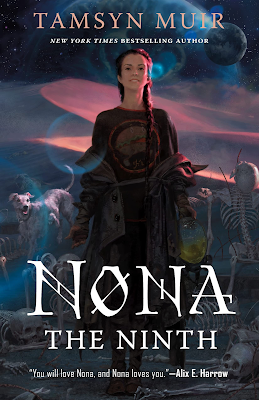
Microreview [book]: Nona the Ninth by Tamsyn Muir

Its plot is thinner and its protagonist less vibrant, but Nona the Ninth still delivers the full Locked Tomb experience

So, unless you’ve been locked in a tomb (with no wifi signal) since 2020, I’m going to assume you know about Tamsyn Muir’s Locked Tomb series. Starting with Gideon the Ninth and continuing into Harrow the Ninth, the Locked Tomb is a series of (obligatory “spoilers start here” warning) wisecracking cosmic cultists, of necromancers and their swordhands and the (literally) soul destroying things they’ve done to keep their cursed empire safe from the vengeful ghosts of its own planets, and of the absurd number of poor emotional choices they have made while doing so. As far as we all knew, the Locked Tomb was to be a trilogy, ending this year with Alecto the Ninth. And yet, we were all of us deceived, for another book was made. Before we get to hang out with Alecto, first we must make time… TO MEET NONA.

…Nona? Who the fuck is Nona?

Well, yes. That’s the question, first asked in the epilogue of Harrow the Ninth and which provides much of Nona the Ninth’s central mystery. Six months after the dramatic climax of the previous book, Muir introduces us to the six-month old consciousness inhabiting Harrow’s body, by all accounts enjoying her life in a wartorn city in the apartment she shares with Camilla Hect, Palamedes Sextus (different person, same body) and Pyrrha Dve. Aside from being a six-month-old consciousness in a nineteen-year-old’s body, Nona has a whole bunch of other things going on. She heals absurdly fast, she’s completely incapable of reading or writing but can inherently understand all spoken languages, she detests eating human food  but sometimes thinks about how nice it would be to eat sand - and her hair grows really, really fast. Oh, and she’s also relentlessly chipper and optimistic, exuding a vibe that is somewhere between “born sexy yesterday” and “live laugh love” in the face of the pretty relentless misery of her surroundings. After the edginess of Gideon and Harrow, it’s a bold move to centre book three around a protagonist who could be outperformed on the edginess stakes by a Minions meme, but it’s the kind of bold move that The Locked Tomb is all about, and here we are.

Speaking of bold moves, Nona the Ninth plunges the reader into a story that jumps off from a fundamentally different place to its predecessor, and while it doesn’t use the reader’s likely confusion as a plot point in the same way Harrow the Ninth does, there’s still zero contextual hand holding if you don’t remember the finer details of that book. (Note: if you do need a refresher, this is a fantastic video recap which covers the key points and some of the meme highlights). The vibes of the setting are different: rather than being at the heart of the empire’s elite, Nona the Ninth’s city setting is – on first glance, at least – full of the ordinary people who make up the world of the Locked Tomb, albeit those living under the threat of annihilation. Even the book’s divisions lean into a more “slice of life” feeling: instead of acts, we have days, and the events of those days are summarised with a combination of whimsical and ominous statements: “Regarding Nona – Hot Sauce Is Watchful – the City Has a Bad Day – Nona Gets a Bedtime Story – Five Days until The Tomb Opens.” To hear Nona tell it, the blue light in the sky threatening planetary destruction is noteworthy but still less interesting than her day at school, where she looks after the teacher’s six-legged dog and is a tolerated low status member of the “cool kid” gang. Of course, plenty of things that happen to Nona which serve to give the reader information: not least her dreams, which we experience as intermissions where Harrowhark and John wander an empty post-apocalyptic environment and John talks about the world before the Nine Houses. She also has an extended family beyond Cam, Pal and Pyrrha which includes Coronabeth Tridentarius, now a high ranking member of the local Blood of Eden group, and while Nona doesn’t have many insights into “Crown” beyond how hot she is, she is at least in the room where more interesting discussions happen between the characters who are more than six months old.

Nona, if it wasn’t clear already, is a source of frustration for me as a character. It’s not that her characterisation is bad: she is perfectly designed to be loveable, the ultimate cinnamon roll doling out affection to characters like Camilla and Palamedes who, frankly, deserve to have someone telling them she loves them on a regular basis. And her role as an innocent sacrifice, happy to live for as long as possible while accepting that ultimately she will die for someone more “important” to return, fits perfectly and heartbreakingly within the broader religious symbolism of the series, and is especially well balanced with John’s sinister personal story and the reprehensible actions he has taken as a self-proclaimed God. On the other hand, Nona is passive, has very little critical insight and because her personal mystery is heavily implied to be tied up with her death, her presence feels like it serves as a brake on the story, rather than helping it to progress. We won’t get back to the main events until we solve whether Nona is Person A or Person B, and once that happens, it’ll be very sad that we no longer have the cinnamon roll, but we can get on with all this tomb unlocking business and maybe kill some more resurrection beasts, so what are we waiting for?

This serves to make the first half of Nona the Ninth feel slow, with a niggling sense that this is a narrative originally conceived as a single act of a bigger book, now stretched over a whole book by itself. Perhaps the reason that wasn’t originally the plan is because there wasn’t quite enough material here to go “oh, yeah, this is a whole book”, especially when shoved between a big Act 2 showdown and a hopefully even bigger finale? It’s nowhere near Victor Hugo levels of “let me stop the plot to tell you about day-to-day life in a nunnery”, but somehow even with the countdown to the opening of the tomb, the physical reminder of destruction hanging over the city, and Nona’s constant references to her own mortality, Nona the Ninth is missing some of the urgency and momentum that made Gideon the Ninth and Harrow the Ninth so utterly irresistible. Things do pick up significantly in the second half, as events around the war and the Blood of Eden presence on the planet come to a head and more familiar faces re-emerge (like, you’ll NEVER GUESS WHO – actually, no, you’ll find out in good time). By the end of the book, I was absolutely raring to go for Alecto the Ninth, but I was also missing the sense of pure emotional turmoil that I got from the previous books, especially Harrow the Ninth.

Regardless, the weakest of the Locked Tomb series is still a spectacular book, and as a piece of serial storytelling, I suspect Nona is going to look more impressive as part of the whole. While Nona’s saccharine sweetness is no substitute for the, uh, spice of Gideon and Harrow, it’s nothing short of an expert move to make a tonal shift work like this at all, and Nona’s story expands the world of the Locked Tomb in ways which I am excited to see pay off. Now it’s time to sit tight, scan the horizon, and wait to see how one or more fleshes might meet one or more ends in the final volume.

Adri (she/her), Nerds of a Feather co-editor, is a semi-aquatic migratory mammal most often found in the UK. She has many opinions about SFF books, and is also partial to gaming, baking, interacting with dogs, and Asian-style karaoke. Find her on Twitter at @adrijjy

Reference: Muir, Tamsyn. Nona the Ninth (Tor dot com Publishing, 2022)

Wednesday, February 9, 2022

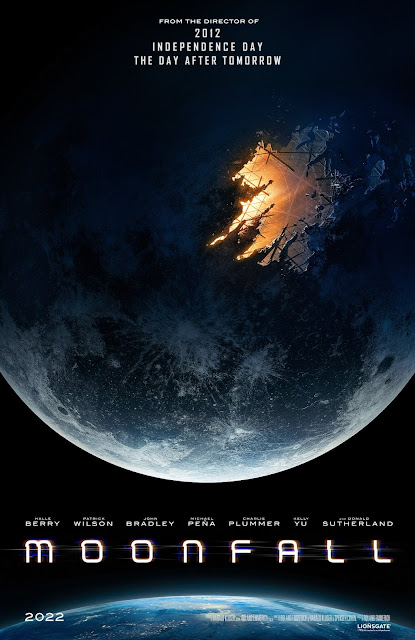
'Moonfall' puts the disaster in disaster movie

That's no moon, and that's barely a movie, either

First, let's get the boring physics out of the way: although it's not technically impossible that the Moon could be an artificial structure, the notion that it could harbor a white dwarf star inside it is beyond laughable. The lightest viable dwarf stars have a mass, and therefore a gravity, around one-half of our Sun. If we had one in our backyard, we'd definitely have noticed.

However, the intention of Moonfall is not to make sense. It's to provide thrills, spectacle, great action, a good time. And it fails at that, too.

The plot of Moonfall starts in 2011, when astronaut Brian Harper witnesses the mysterious death of a colleague during a space mission, only to be blamed for it, publicly disgraced, and pushed to the brink of destitution. However, what he thinks he saw (an angry mass of gray goo emerging from a lunar crater) turns out to be real: annoying conspiracy theorist KC Houseman, whose second job is sneaking into university offices to steal astronomical data, has found evidence that the Moon has shifted its trajectory. Meanwhile, the members of an emergency mission launched by NASA to investigate the changes happening to the Moon are eaten alive by the gray goo, only this time it happens on camera, so Harper's estranged former colleague Jocinda Fowler finally believes him. It's time to send another mission to the Moon before its new orbit causes chaos on Earth.

The entire planet is vulnerable to the rising gravity of the approaching Moon, but the movie doesn't do a good job of conveying the sense of danger. The human cost of the cataclysm is confined to TV newscasts; if the characters are already removed from those events by the screen they're watching, then we, who watch them watch the TV, are kept at one additional remove from them. That's not an effective way to make the end of the world matter to the story. The only characters we follow on Earth are those immediately related to our heroes, which means they may as well carry a sign on their foreheads that says Designated Survivors. Their desperate escape from armed looters and falling meteorites carries zero tension because we already know this isn't the kind of movie that will let named relatives die.

Of course, everyone else on the planet is fair game for the digital maelstrom of crumbling earth and rising waves and falling chunks of lunar rock. Director Roland Emmerich is by now well experienced in tearing the world apart, so we're treated with serviceable shots of entire cities being wiped from the map. The director knows that's what we came for, and he delivers.

When Moonfall stops blowing stuff up and remembers to be about something, it's about parental sacrifice. On the grand scale, the alien ancestors of humankind gave up their corporeal existence to give us a chance to survive; on the personal scale, parents risk their lives at various moments in the story to keep their children safe. However, it frequently feels as if the movie deemed it indispensable to pair this theme to a disturbingly conservative worldview. This is the curiously specific kind of crisis where turning on your cell phone will get you killed, the world is saved by spaceships and spacesuits that are literal museum pieces, the future of the nation lies in abandoning the coasts and retreating to the heartland, the only hero capable of doing the job is the millionth iteration of the retired guy who has to be coaxed out of retirement, divorce is a Bad Thing that Makes Everyone Sad, the final lesson for humanity is along the lines of "respect your elders," the efforts of parents give their kids the (literal) extra lift they need to solve their problems, and the protagonist's son has an entire arc about evading legal consequences for his irresponsible behavior and growing into the mythical Good Guy with a Gun.

These plot points sound more organized when laid out like this. On the screen, the first and second acts suffer from a wildly irregular pacing, their scenes joined without a discernible sense of intention. The random jumps between subplots get a bit better as the story progresses, but that first impression of aimless editing doesn't fade from memory. After we get to the pretty decent visual effects used for the alien spacecraft in the third act, it's hard to justify why early scenes of a more mundane nature resorted to a less competently executed and more painfully obvious green screen. What does retain a uniform standard throughout the movie is the stilted style of dialogue that no real human being has ever uttered.

The most jarring problem with Moonfall is how openly uninterested it is in having an original story to offer. Not only is the destruction of cities interchangeable with the destruction of any other city in any other big disaster movie; the epic ending is a mashup of plot beats shamelessly stolen from the endings of 2001, Mission to Mars, Armageddon, Wrath of Khan and Independence Day. When you approach the end of this movie, you know exactly how it's going to resolve, what the next shot is going to show, even what trite line the hero is just about to say. And Houseman... Houseman is an entire problem in himself. He's a walking provider of unnecessary commentary, the most irritating exemplar of an era of cinema that seems to be cursed with characters made entirely of quippy one-liners.

For all its world-spanning scale and astronomical stakes, Moonfall offers a largely forgettable story, built from a barebones approach to dramatic effect. This is a movie that says it's about humanity earning a second chance, but it has no intention of doing anything new with it.


The Math

Baseline Assessment: 5/10.

Penalties: −1 for the criminal waste of Donald Sutherland, −1 for the entire character of KC Houseman.

Nerd Coefficient: 3/10.

POSTED BY: Arturo Serrano, multiclass Trekkie/Whovian/Moonie/Miraculer, accumulating experience points for still more obsessions.

Thursday, December 30, 2021

We hear you, 'Don't Look Up.' We're tired of the end of the world too

Not even this dark comedy about the stress of disaster prevention could match the absurd incompetence of our real world leaders

Every disaster movie starts with a scientist being ignored. It's less common for a disaster movie to continue and end with the scientist still being ignored, but that's the kind of world we live in now.

Don't Look Up, the latest film by writer and director Adam McKay, narrates the quest of two astronomers to warn the world about an imminent danger: a comet is on a direct course to hit our planet, it can kill everything that lives, and we're running out of time. In terrifyingly believable fashion, the government and the media are more concerned about how the end of the world affects their stock value and poll numbers than, you know, the end of the world. The film was originally conceived as a satire of inaction against global warming, but at the end of the second year of a devastating pandemic, it hits even harder.

Don't Look Up takes delight in mocking the vulgar banality of rating culture. Every character in a position of power has their priorities backwards, but this movie doesn't lose sight of the way our choices as consumers and as voters have been feeding those twisted priorities. The plot is science fiction, but a news cycle where celebrity breakups get more attention than human survival, a political system where disaster prevention is perversely timed for electoral advantage, a billionaire class willing to burn the world for more profit, and an internet where life-saving science is ridiculed by charlatans are not fictional at all.

In the film, as in our world, basic standards of scientific rigor are ignored for the sake of appearances, politicians turn matters of life and death into catchy slogans to ramp up partisan support, media strategists distort the facts because it doesn't look good to scare the public, and the only experts who can help solve the crisis are reduced to frantic rants on television as viewers yawn and click away.

Drowned as we are in alternative facts, it's exhausting to stand on the side of reality. Yes, global warming is happening, and yes, it's our fault, and yes, we should replace individual cars with mass public transportation. That's a fact. Yes, the coronavirus can kill you, and yes, you should still be wearing a mask, and yes, you need to get vaccinated. That's a fact. We're sick of talking to a void of smug, willful ignorance. (A few reviewers have had the outrageous nerve to say that no, this movie is the smug one.) Experts have tried all conceivable ways to get the message across, and yet reactionary pundits get to shout louder, because reptilian overlords and poisonous chemtrails get more online engagement. We'd be on our way out of the pandemic by now if our own governments hadn't contributed to making it worse time and time and time and time and time and time again.

There's no happy ending in Don't Look Up, because of course there isn't, because the people in charge are so selfish and callous that they deserve to blow up in a shower of raging lava. As for us here in reality, we don't know what other methods to use to get the world to take existential threats seriously. That's a point that critics of this movie have missed: of course it's crass, and unsubtle, and moralizing, and aggressive, because scientists have already tried civilized patience without success, and it's not a movie's job to give them the solution. Sometimes, the catharsis of watching the end finally come is a respite from the stagnation we're in. In such irrational times as these, the rational choice may be to yell in desperation.


The Math

Baseline Assessment: 6/10.

Bonuses: +1 for the eerie prescience with which this movie coincided with the real world's disastrous indifference for the COVID crisis.

Nerd Coefficient: 7/10.

POSTED BY: Arturo Serrano, multiclass Trekkie/Whovian/Moonie/Miraculer, accumulating experience points for still more obsessions.