Showing posts with label marvel. Show all posts

Thursday, July 17, 2025

TV Review: Ironheart

Not the usual superhero origin story

A flawed protagonist making repeatedly questionable choices does not fit the typical trope of a superhero story. Even as a slow-paced origin story, Ironheart avoids the traditional heroic hints or setups. For those seeking a save the world, save a friend, or get justifiable revenge premise, this is not that series. Instead, we have a complex character study in a uniquely paced story that’s hard to turn away from.

Riri Williams (Dominique Thorne) is a genius MIT engineering student obsessed with building a perfect Iron Man-style suit. She earns money for her pet project by helping students cheat and she soon gets expelled and is forced to return to her mom Ronnie (Anji White) and their middle-class Chicago neighborhood. While home, she is tormented by memories of her step-father Gary and her best friend Natalie being killed in a drive-by shooting. With even fewer resources available, she accepts an invitation to join a high-tech crime gang to help them physically attack and coerce billionaires into handing over their corporate assets. The gang is led by the charismatic but clearly sinister Parker Robbins (Anthony Ramos), a.k.a. The Hood, who wants to use Riri’s suit in their heists. When Riri has an urgent tech need, she turns to insecure black market tech dealer Joe (Alden Ehrenreich), a.k.a. Zeke, and coerces him into supplying her. Riri notices that Parker’s hood is exuding sinister magic and tries to figure out how to control its power by consulting with a mother/daughter mage duo. Despite her descent of questionable choices, Riri is surrounded by a supportive community of allies, including her surprisingly patient artist mother Ronnie, her talented and supportive friend Xavier (Matthew Elam), quirky mage Zelma (Regan Aliyah), and her insightful and sentient AI NATALIE (Lyric Ross). Riri alternates between pushing them away and embracing them as she tries to stop Parker and the nefarious evil that lurks inside him.

Ironheart is a mix of high points and frustrating inconsistencies. Dominique Thorne is excellent as the tortured, stressed-out genius. Her character’s personality is completely believable and immersive. The ensemble cast is surprisingly appealing. Riri’s mom Ronnie defies the stereotypical hero mom portrayal by being patient, firm, and surprisingly practical when it comes to tracking down the supernatural help her daughter needs. The heist gang consists of colorful characters who steal the scenes they are in. On the other hand, the story suffers from inconsistencies that are hard to ignore. Riri is a genius but can’t get a high-tech job to support her hobby. She’s traumatized by her friend being murdered in a drive-by but chooses to work with a violent crime gang who knows where her family is. And the heist gang’s corporate theft goals seem confusingly unlikely to be sustainable from both a contract enforceability or ongoing criminal liability perspective. This is where you need your willing suspension of disbelief—for the real-life logic leaps, not for the sci-fi tech and the magic.

However, these conflicting plot elements work when filtered through the mind of a flawed protagonist. An unreliable narrator or flawed protagonist is always an interesting storytelling device. In many ways, she seems bent on self-destruction in a way that corresponds to some variation of survivor’s guilt for the loss of her friend. She is introspective, stubborn, and emotionally damaged, with behavior that seems intentionally focused on a series of bad choices. Riri draws her inspiration from Tony Stark, a character with significant personality challenges and anti-hero vibes. Although the two characters are from very different backgrounds and life experiences, they are parallel in terms of their arrogant and sometimes irresponsible worldview.

Surprisingly, my primary comparison for Ironheart is The Bear, another working-class Chicago-based introspective series. Both shows feature uptight genius creators whose internalized trauma leads to toxic behavior and trouble for those who care about them. The ensuing chaos is played out in a uniquely paced, personality-centered story that’s hard to turn away from. Some superhero origin stories involve an immature character making bad or selfish choices that come back to haunt them before they make the pivot to heroism. Peter Parker in Spider-Man had a rough start before finding his way. Rogue in the X-Men started out as a villain before she found her heroic side. Ironheart is a story I watched waiting for the heroic realization to arrive. But when it does finally arrive, Riri remains complicated and continues to make surprising choices in a way that is intriguing but different from the norm. If you are looking for a traditional hero epic, this is not that story, and you will likely feel frustrated. But if you are interested in a complex character study with solid acting and entertaining side characters, Ironheart is a show that will give you plenty to analyze.

Nerd Coefficient: 7/10.

Highlights:

  • Appealing, unevenly paced artistic vibe
  • Frustrating protagonist making confusing choices
  • Excellent lead and supporting cast

POSTED BY: Ann Michelle Harris – Multitasking, fiction-writing Trekkie currently dreaming of her next beach vacation.

Tuesday, February 25, 2025

Film Review: Captain America: Brave New World

Neither brave enough nor new enough

There has always been a tension in how a particular sort of liberal-leaning-leftist viewer has perceived the character of Captain America (and I absolutely include myself in that qualification). As an American, particularly a Filipino-American, there is a part of me that has been seduced by America’s self-flattering myths, and perhaps worse, wants to be seduced. As stirring old Red Army marching songs make you want to believe in the worker’s utopia of the Soviet Union and forget about the Holodomor and the Rape of Berlin (I’m reminded of what Joseph Goebbels said about Battleship Potemkin: “anyone who had no firm political conviction could become a Bolshevik after seeing the film”), the best Captain America media makes you want to believe in the old pablum about the land of the free and the home of the brave, and forget about the carnage in Gaza. Chris Evans as Steve Rogers certainly made you want to salute Old Glory, to believe in white America’s view of itself. He (Evans and Rogers both) is what the twentieth century would have called “All-American”—white, blonde, and wholesome. In the Disney+ series The Falcon and the Winter Soldier, Disney made Sam Wilson, played by Anthony Mackie, the new Captain America, which attracted aplomb and controversy as he is Black. Mackie and Wilson get their first spin at the role on the big screen in 2025’s Captain America: Brave New World.

This is a movie that, for better or worse, has a very defined place within the broader mythos of the Marvel Cinematic Universe. I have seen people frustrated that it is in some ways a sequel to 2008’s The Incredible Hulk, the only time Edward Norton ever played that role. It is a film I confess to have enjoyed. The ties to that film are made very clear by virtue of the very important role of Thaddeus “Thunderbolt” Ross, now played by Harrison Ford in his gruff twenty-first-century demeanor. The thematic thread that connects this film and the Hulk film is that they are focused more than other MCU entries on the interaction between superheroes and the United States government. The film uses some of these connections in smart ways, but those who wanted a broader political statement will see any such statement hampered by the politics of the plot, and the politics of The Walt Disney Company.

It is Ford’s President Ross around which so much of the film’s themes rotate. He has served in a number of incidents involving superheroes and their adversaries, and he has parlayed that into a successful presidential run. As you would expect, he has skeletons in his closet that come into play over the course of the story, all running through high-level politics. He is a geopolitical hawk and a loud personality, reminiscent of a certain current occupant of the Oval Office, but compared to that one, Ross is so lucid I would pick him in a heartbeat. The film portrays him as a deeply flawed, ambitious man, obviously a climber. But it also gives him a moral core, a certain sense of decency, that he can act on when prompted enough, especially by Sam Wilson. It is there that the film becomes divisive.

Walking out of the theater and later discussing it with a friend as I drove him to a board game night, I concluded that Captain America: Brave New World is an enjoyable enough supervillain film whose politics I disagree with; my friend said that is what he expects of MCU movies, and I can’t really disagree with him. I like Sam Wilson in this role as a patriotic hero, and Ford is good as Ross. The action is well done, with appropriate weight given to punches, and there is a very good scene involving fighter jets. None of those are really the issues I have with this film. The issues come from the fact that I studied international relations in college with plans to join the US Foreign Service, until I read about the Nixon Administration’s support of the Bangladeshi Genocide so that it could keep Pakistan as an intermediary during the leadup to Nixon’s visit to China, was terrified at the prospect of becoming another Archer Blood, and then decided I couldn’t morally accept such employment.

I think this is a good time to note the presence of Ruth Bat-Seraph, played by Shira Haas, who has been the subject of some internet controversy. The character Ruth Bat-Seraph is a form of the comic character Sabra, who in-universe is Israeli, as is her actress. The name ‘Sabra’ refers to a prickly pear native to the land between the Mediterranean and the Jordan, often used as an affectionately jocular autonym referring to how Israelis are said to be prickly on the outside but sweet on the inside. Certain groups on the internet find her name deeply offensive, as Sabra is also the name of one of the refugee camps (along with Shatila, which is commonly mentioned in tandem) in Lebanon, where Israeli-backed Maronite militias slaughtered innocent Palestinians and Lebanese Shias (a fact that directly preceded the founding of Hezbollah) during the Israeli invasion of that country in the ’80s. The character was created two years before the massacre, so I am confident that the name is a coincidence. Its actual portrayal in the film is rather bland, frankly; anything of real interest, including the name ‘Sabra,’ is hacked off in an attempt to dodge controversy in light of the Palestinian Genocide; she is mentioned to have been born in Israel in a way that perhaps vaguely refers to the Mossad’s reputation, but I can’t really detect any commentary beyond that. I don’t view the presence of an Israeli character in itself to be offensive (much as I don’t find the presence of a Russian character, vis-à-vis the invasion of Ukraine, to be offensive in itself), but I have seen her presence brought up in broader (legitimate) critiques of how Disney relates to the Israeli government. All told, the whole thing has amounted to a tempest in a teapot.

The case of Ruth Bat-Seraph is emblematic of a broader problem with the film, going right down to its foundations. The whole plot is framed as a single bad actor within the US government exploiting the weakness of a flawed politician who nevertheless has some decency. There is never, at any point, an attempt to interrogate the structures of the American government that could make any of this story, any of these deceptions and deaths, possible. The film comes closest through the abandoned super soldier Isaiah Bradley, played by Carl Lumby and imported from The Falcon and the Winter Soldier, but it never goes as far as it really ought to have. Such a critique would have been extremely relevant given the American-backed razing of Gaza, but there is absolutely no engagement as to why this country, founded on slavery and genocide, feels entitled to bestride the world as a colossus, murdering tens of millions without accountability. There is no attempt to see how this corrodes a nation’s morality. The first sequence of the movie is set in Mexico, and another is set in the Indian Ocean. The film is just close enough to realizing that corrosion, as Aimé Césaire so boldly put it in 1950’s Discourse on Colonialism, but the film is simply not brave enough.

That is really the core issue with the film: it is not brave enough (ironic, given its literal title), and it really doesn’t bother being new enough either. By the end of watching it, you will have spent roughly a hundred minutes with a reasonably entertaining superhero movie, which is about what I expected. The problem, ultimately, is that this movie was exactly what we expected it to be, and nothing more.

--

Nerd Coefficient: 6/10.

POSTED BY: Alex Wallace, alternate history buff who reads more than is healthy.

Wednesday, March 27, 2024

TV Review: X-Men '97

A nostalgic return to the addictive X-Men adventures of the '90s

Back in the '90s—before iPhones and streaming apps—a long week of work or school would be rewarded with a lazy Saturday morning of sugary breakfast cereal and X-Men cartoons. The original X-Men: The Animated Series stood out from the other Saturday morning entertainment because of its diverse characters, edgy storylines, heavy social justice commentary, and soap-opera-level romantic entanglements. Although X-Men comics had been around for decades, the weekly episodes brought the adventures of billionaire mentor Charles Xavier and his team of sarcastic, imperfect, stressed-out superheroes to a wider audience.

The original Saturday morning animated series ran from 1992 to 1996. Eventually, three feature films were made, followed by other animated X-Men shows and even more feature films. However, after all the expansions in film, television, and comics, Disney+’s X-Men '97 instead returns to the retro format of the 1990s series and picks up where the '90s show left off. X-Men '97 is not a reboot, adaptation, or sequel. It is a continuation. Watching it feels like stepping back in time. X-Men '97 assumes viewers know the entire previous backstory of the characters, so viewers who have never consumed X-Men in any form may need to skim a few episodes of the original show (also conveniently available on Disney+).

Here’s a quick refresher: Charles Xavier is a powerful telepath who runs a school for “gifted” children in an era when humanity is evolving to a new level of superhuman capabilities. “Gifted” means mutated into having some sort of superpower. (Younger viewers can think of the story as a precursor to My Hero Academia.) Contrary to other superhero stories, in X-Men those with special powers (mutants) are hated and feared by the rest of humanity. As a result, they often hide their true nature or must face overt racism and abuse. Xavier builds a school where young mutants can learn in safety and hone their special powers. As the students grow up, they become X-Men, a team of superbeings who act as guardians and protectors from various villains while still trying to live their day-to-day lives. Each member of the team has their own terrifying power, tragic backstory, and complicated emotional baggage to navigate as they learn to trust each other while battling powerful villains. A primary antagonist in the show is Xavier’s lifelong best friend/frenemy, Erik Lehnsherr a/k/a Magnus (a/k/a Magneto). Magnus wants to violently confront the oppression mutants face from humans while Xavier wants to pursue peaceful co-existence. The struggle is a general allegory of the Civil Rights Movement of the 1960s. Throughout the series, the two philosophies battle as Magneto wreaks havoc and Xavier tries to save and protect. In the finale of the first series, a critically injured Charles Xavier says an emotional goodbye to his young students, leaving original X-Man, Scott (Cyclops) as de facto leader.

X-Men '97 opens in the post-Xavier era. A well-armed hate group, the Friends of Humanity, is using newly acquired weapons to hunt down, neutralize, and kill those with special powers. Scott struggles to lead the team in Xavier’s absence while also dealing with the rise in hate crimes against mutants and dealing with his wife Jean’s pregnancy. Telepath Jean wants Scott to abandon the X-Men so they can raise their child in peace. But things take a turn when long-time adversary Magneto appears with a startling message from Xavier.

As in the original series, the core members of the team are the focus of the show. The new show particularly focuses on Scott, Jean Grey, and Storm/Ororo, who can manipulate the weather. Also featured is Rogue, a southerner who debilitatingly absorbs the powers and memories of anyone she touches, so she spends her life avoiding direct contact with others. This complicates her romantic entanglement with Remy (Gambit), a Louisiana native who can charge objects with energy and use them as weapons. Additional returning characters are fan-favorite Wolverine, Beast, Jubilee, Bishop, and Morph.

Despite the advances in animation since 1996, X-Men '97 maintains the old, slightly stiff animation style of the '90s show. The show also maintains the original visual design and voice style of the characters, which further draws viewers into the retro effect. Many of the characters, including Rogue, Storm, and Wolverine, have the same voice actors from the original series. For those looking for nostalgia, this will be a welcome surprise. Although the character design for most of the X-Men remains the same, a few are slightly changed. Jubilee’s face and eye design is updated; and Morph, the shapeshifter, now has a pale, helmet-like head versus the regular, average human face he had in the original series. Morph is also used as a gateway to brief visuals of other X-Men when he momentarily shapeshifts into offscreen heroes, including Colossus, Angel, and Psylock. His flash transformations into familiar old characters are a fun surprise each time.

The initial episodes of X-Men '97 each end with great plot twists to hook viewers, especially if they’ve never read the comics. Wild plot twists and mature themes were a defining element of the original series, making it a gateway for future animated stories like Avatar: The Last Airbender, Naruto, and other animated series that move beyond surface fights and adventures and dig into emotions and relationships. X-Men '97 continues to lean into that original storytelling strategy, and will fill a nostalgic place in the hearts of long-time viewers. And, with the intense and expansive source material to draw from, X-Men '97 should have plenty of complicated and emotional plot twists to maintain the new show for as long as needed.


Nerd Coefficient: 7/10.

Highlights

  • Lots of nerdy nostalgia
  • Old-fashioned art design and animation
  • Strong social commentary and great plot twists

POSTED BY: Ann Michelle Harris – Multitasking, fiction writing Trekkie currently dreaming of her next beach vacation.

Tuesday, June 6, 2023

Spider-Man: Across the Spider-Verse Review

Across the Spider-Verse is exactly what a sequel should be

The follow-up to the critically acclaimed 2018 hit Spider-Man: Into the Spider-Verse swings into theaters with a heavy burden to bear: simply live up to the expectations set up by its predecessor. Not an easy task considering the previous film topped the long-awaited The Incredibles 2 for the best animated film Oscar at the Academy Awards. Despite the burden, Across the Spider-Verse not only succeeds in this but exceeds its predecessor in some ways. This film is a treat not only for the eyes but for the heart as well.

Without his old spider-friends, Miles Morales hits a low. Having made friends that understand him, his struggles, and his view of the world, all the rest becomes a bit dull. Luckily for us, through unintended (yet at times hysterical) consequences, our hero finds himself on a multi-dimensional romp that extends its web beyond Miles’s world and into those of many other spider-people. The primary villain is introduced early and seems to be a one-off intro to the film. A quick, easily discarded “villain-of-the-week.” But as the film progresses, we see the horrifying possibilities of the Spot. The introductory battle is comical, action-packed, and only a taste of what Across the Spider-Verse has in store for its viewers.

The writing is brilliant, with almost every comical quip hitting its mark. Considering every spider-person in every universe has some sense of humor, it’s impressive to see each of them aptly apply their humor in specific situations that succeed within the narrative framework. With so many moving pieces, it’s commendable that the writers rarely stumble with any of their spider-folk. This extends to the serious moments too. The frustration of being a parent is palpable (especially the parents of Spider-Man), the desire to do the right thing despite negative repercussions weighs heavy, and the conflicting anxiety of choosing to help a friend or save the multiverse pulls at the heartstrings. Phil Lord, Chris Miller, and David Callaham nailed it.

Miles’s Afro-Latino heritage plays a large part in who he is and how he is accepted in not only his world but in the entire multiverse. I found the storyline within the spider-people's HQ to be an allegorical exploration of Miles’s entire existence. Being a minority in a place where people don’t think you should exist (or that one should “go back to where you came from”) hits home for many, and seeing Miles’s solution to the problem play out on screen is both rewarding and inspiring. Ensuring Miles never forgets who he is and where he comes from does the character, and in turn the film, a great service.

On the other side of the emotional coin, Gwen’s personal issues are explored. Again her side is allegorical, but in this case in regards to trans acceptance. Struggling with her father’s denial of who she is and the choices inherent to her is reflected by the bleeding watercolors that sink ever down. The despair she feels at losing the person she trusts most to protect her is on full display with the dialogue and reinforced by the beautiful animations that represent the mood. The brilliance is in the obvious yet subtle implementation and spot-on delivery. The film doesn’t outright mention Gwen being trans, but the trans symbols surrounding her are quite apparent. A trans flag can be seen on her father’s police officer uniform, a “Protect Trans Kids” sign hangs above the door of her bedroom, the colors primarily used in her world share the same color with the trans flag, and the lighting used when displaying her are frequently blue, white, and pink. Easy to glance over if you were not paying attention, but the repetitive use caught my eye.

While comedy and drama are on an equal balance, the third element of any great superhero film is here in full force: the action. The smooth yet stop-motion-like animations flow so perfectly. Each combat or escape scene plays out with a precision that complements each character. Each spider-person and villain has a unique take on combat, regardless of how similar many of their ability sets are. Renaissance Vulture fighting three different spider-people is an amazing intro that sets the pace of the film. Watching the combat scenes kept me engaged throughout, and the escape scenes felt like I had a web shot stuck to my chest as I was yanked along for the ride. This is where the animation style flexes its biggest muscle, as up to six different styles come together in the harmonic cacophony that never lets up. This movie is worth it for the action alone, but I’m glad it’s so much more.

With quips, web thwips, and feeling trips all in beautiful equilibrium, one would think the setting would seem to be somewhat of an afterthought. Luckily for us, this is yet another visual treat. Each world is beautiful and distinct. Even when representing many different New Yorks, the artists and animators ensure that the viewer can not only see a difference but feel it. Gwen’s world has a more watercolor feel. Earth-616 boasts a more lively atmosphere, while Earth-42 contains heavy shadows, indicative of its more oppressive environment. The seedy underworld of Spider-Man 2099 contrasts with the pristine skylines of the technologically advanced society up above (anyone for a quick trip to the moon?). The fusion of Mumbai and New York City makes for the comical Mumbhattan, the world where Pavitr Prabhakar is Spider-Man. I can go on and on about how well they’ve represented each Earth, but it’s better to use one’s own eyes because what we have here is an absolute delight.

The VO performances here boost the film into the stratosphere. I can list every major voice actor here, but it would do a disservice to all the people who deliver only a few short lines. Each character is important and it’s frequently the smaller characters that deliver memorable lines, each one placed with a purpose (usually comical). One could say that much of it is fan service, but it isn’t there for the sake of being fan service. It serves the narrative, the world, and the characters, and almost every performer has a stellar performance here.

At the beginning of the film, I had a bit of trouble hearing the dialogue. I wasn't sure if it was my specific theatre or the sound itself. Upon doing some research, I discovered others had similar issues, though at different parts of the film. If there had been no one else in the theatre, it may have been less noticeable, but as it was, it hampered the opening moments of the film for me, if only slightly. My only other major negative criticism of the film comes at the end. Though I knew it was coming, it’s still a bit annoying to see a “To Be Continued…” with a wait time of a year. Most of the plot points aren't wrapped up when all is through.

Despite a major cliffhanger that introduces a new plot line in the film’s last ten minutes, the themes that the film set out to explore are done well and reach great heights with satisfying exploration and discovery, the allegory is subtle and accurate, and the characters all grow in unique ways. This is the continuation of Into the Spider-Verse and an amazing setup for Beyond the Spider-Verse (coming March 2024). Exhilarating action scenes, tender character sequences, and near-flawless humor put Across the Spider-Verse among the best films of this year, and definitely above many other superhero films. Every person who worked on this film should be proud of what they’ve accomplished. Not only do I want to see this again in theaters, but I look forward to having it in my BluRay collection so I can share it with friends for years to come. This isn't just a great animated film; it's a great film, period. It's an example of what this specific medium can achieve with the proper vision.

March 2024 can’t come soon enough.


The Math

Objective Assessment: 9/10

Bonus: +1 for phenomenal animation and writing, +1 for living up to the first film.

Penalties: −1 for audio issues, −1 for the cliffhanger ending.

Nerd Coefficient: 9/10


Posted by: Joe DelFranco - Fiction writer and lover of most things video games. On most days you can find him writing at his favorite spot in the little state of Rhode Island.

Monday, February 28, 2022

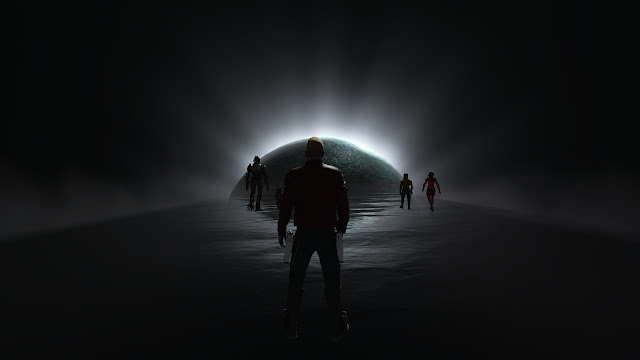
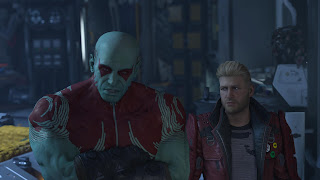
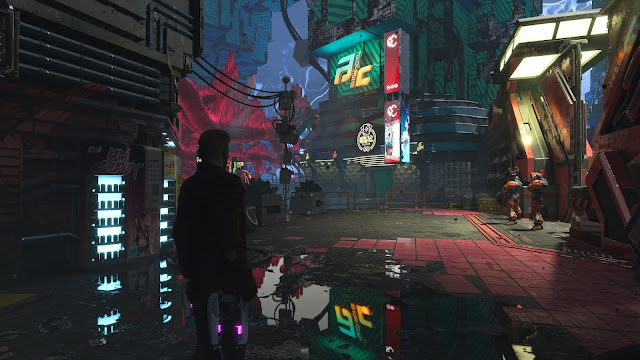
Microreview [Video Game]: Marvel's Guardians of the Galaxy by Eidos-Montréal

Get your Walkman ready for this one.


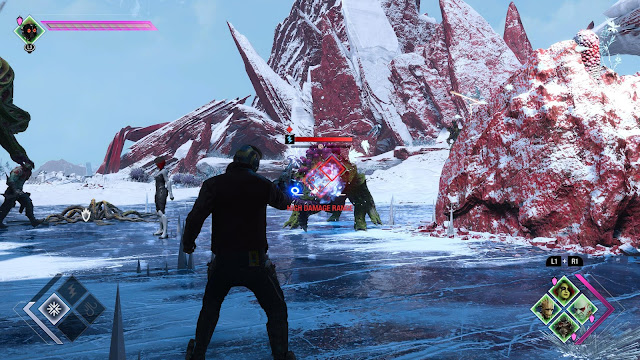
Marvel’s Guardians of the Galaxy begins with our eclectic heroes attempting to make a name for themselves. In typical Guardians’ fashion, they try to achieve this in a way familiar to them; by breaking the law. As one can imagine, this leads to conflict with the Nova Corps officials. After that, well, things get a little wild. At one point, with the protagonists entrapped, I found myself using the singing voices of the Guardians—to the tune of “Don’t Worry, Be Happy” by Bobby McFerrin—to compel/repel a space llama to eat some wires so that we could free ourselves from our rooms. Yes, I typed that correctly.

Marvel’s Guardians of the Galaxy
isn’t just ‘80s classic music, hair metal, massive explosions, hordes of religious zealots, vicious wild beasts, dogfights in space, intergalactic travel, and well-timed jokes sprinkled throughout a video game. Those things are all included, to be sure, but that only scratches the surface of this wonderful narrative-driven superhero game by Eidos-Montréal. Under all the wild theatrics of the galactic threat, the game digs into the trauma of each protagonist, fleshing out each character in the process (except for Groot who repeats the same three words). The game shows that no matter how jagged or irregular puzzle pieces are, if flipped around enough times, they may just be a perfect fit.

In contrast to many big-name superheroes, the Guardians' main draw is that they’re a team. The Guardians have the initial instinct to run when they need to deal with their problems, but find solace when they turn to their companions. Some of the best moments in this game come from the tender interactions between all of the Guardians, not only does the team become stronger as a whole, but so does the narrative. Overcoming personal hurdles unlock in-game abilities that can be used in combat. These abilities lead to more options while taking down the wild beasts and promise-driven enemies encountered throughout the adventure.


While the narrative has a great arc, there are some minor technical gripes I had throughout my journey. Stiff and sometimes janky animations lead to the ruining of some serious moments. For example, every time Peter Quill has a one on one conversation with one of his crew-mates, it ends abruptly with them quickly doing an about-face and exiting the room. They could have just discussed their years of enslavement or the death of their family, and then they quickly exit the room. It's an awkward animation that was overlooked, or worse ignored, by the developer. This game is also guilty of having button prompts in which the player unknowingly advances the narrative. This can sometimes be frustrating for someone who wants to explore an entire area before moving forward.

But what about the gameplay? Unfortunately, this is where the game loses most of its luster. The traversal is hindered by pedestrian platforming mechanics that don’t feel great when using them, not to mention the lack of a sprint button. While Star-Lord does have jet boots to boost forward, it’s irritating to have to constantly press the button every second to increase movement speed.

I am thankful for the puzzles, simple as they were, as they add a fun bit of variety that takes advantage of the different Guardians’ abilities. Groot can build bridges and lift platforms with his roots, Gamora can cut through certain objects or help boost Peter up to platforms he couldn't reach otherwise, Drax uses his strength to move otherwise immovable objects, and little fuzzy—sorry Rocket—can hack things and climb into small openings. This represents Peter Quill’s position as leader, as the player issues these commands wherever necessary to advance.


In between all the fun story beats and puzzles, there are some enemies to kill. If I’m being honest, the combat wasn’t the best part of the game. While no means awful, the combat doesn’t reach the heights of other great superhero games like Marvel's Spider-Man or Batman Arkham Asylum. Serviceable, unmemorable. You can use Star-Lord’s blasters and elemental abilities to take down enemies, as well as a few special abilities which can be unlocked through leveling up or spending some of the in-game collectible currency. In addition to Star-Lord’s abilities, the player can command the other Guardians to use their abilities in combat scenarios. There are moments of fun to be had to be sure, but I would sometimes get stuck in the command menu while trying to fight enemies, which in turn would ruin the combo I had. Over time, I figured out what was going on, but it wasn’t initially intuitive.

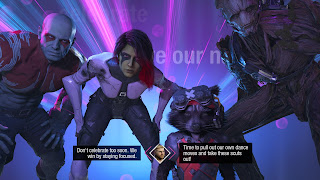
I give Eidos-Montréal credit for ensuring the game had a plethora of enemies to be overcome with different strategies that consistently force the player to use their newly unlocked elemental and stagger abilities. When the team is down and out (or when you accidentally press the wrong buttons), Star-Lord can rally everyone with the Huddle ability. Here, the other Guardians come to Star-Lord with eager enthusiasm for the current battle or come to complain about their predicament. It’s up to the player to choose the correct dialogue option, a failed one only gives partial benefits, while the correct one excites the team. At one point, Drax told me that my speech made no sense, and then we launched into battle to the tune of “Never Gonna Give You Up” by Rick Astley. I couldn't help but laugh aloud.

Speaking of laughing, Marvel’s Guardians of the Galaxy is a treat when it comes to witty banter and well-timed punchlines. Drax’s consistent barrage of impeccably placed dialogue is commendable. I can’t count the number of times he made me chuckle, not to mention the rest of the team yelling at each other across the Milano. The fastidious writing team at Eidos-Montréal succeeded in capturing the comical essence of this ragtag group with utter proficiency.

In addition to the dialogue choices mid-battle, there are other areas of the game where choices are presented. Throughout the journey, Star-Lord is given options in how to respond to his teammates. Should he boost up the morale of the whole team, or give in to the melancholy to try and relate to how they’re feeling? Should he back Rocket or Gamora? Join in on the teasing or make everyone back off? Even better yet, there are some sequences in the game where the player choice will change the entire level that must be navigated. While they don't have any impact on the overall story, they do offer some extra replay value for a second run.


What would a comic-book-based video game be without references to its source material? Guardians has many unlockable costumes hidden throughout the game, some that reference the comics, others the MCU films. These are a nice nod to the other media appearances of these heroes while also contributing a little background info. Other collectibles include items that can be used to trigger unique dialogue with different members of the team. Finding these items was always great because I knew I’d get some more character lore once I got back to the Milano.

For all that Marvel’s Guardians of the Galaxy gets wrong, it does a lot more right. While the combat and platforming can be lackluster, the writing team deserves a lot of credit for lifting this game above its mechanics. The story, characters, music, and jokes are the heart of this microtransaction-free super-hero adventure and I look forward to seeing more Guardians games in the future.


The Math

Objective Assessment: 7/10

Bonus: +1 for well-placed dialogue throughout the entire runtime. +1 capturing the essence of the Guardians of the Galaxy. +1 for Lady Hellbender.

Penalties: -1 mediocre gameplay. -1 for odd and janky animations.

Nerd Coefficient: 8/10

Posted by: Joe DelFranco - Fiction writer and lover of most things video games. On most days you can find him writing at his favorite spot in the little state of Rhode Island.


Thursday, June 4, 2020

Interview: Lauren Beukes and Fryda Wolff


"The safe choice? Walk away. But when has Jessica Jones ever played it safe?


Jessica Jones has made an art of ignoring her particular brand of super-powered trauma. But these days, she's giving the whole "self-care" thing a try. Seeing a therapist, finding healthier coping mechanisms (read: no business-hours drinking), working toward not wanting to punch things all the time. Maybe even taking the occasional case that won't eat her alive. A simple missing persons case seems like just the ticket. But when a boy's body turns up under an overpass in what looks like a cut-and-dried OD, Jessica can't let it go and dives headlong into an obsessive search for answers."

Marvel's Jessica Jones: Playing With Fire launched on Serial Box on May 28th, with new episodes available every Thursday.   Jessica Jones' dry sense of humor,  her brand of "self care", and a simple missing person case, what could possibly go wrong? (well, everything of course, and that's what makes this so addictively entertaining!).

The 16 epsisode season was written by Lauren Beukes, Vita Ayala, Sam Beckbessinger, Zoe Quinn, and Elsa Sjunneson, and narrated by Fryda Wolff.   When the publicist reached out to see if I'd be interested in interviewing Beukes and Wolff, I jumped at the chance.  You know Lauren Beukes from her novels Afterland, Broken Monsters, The Shining Girls, and Zoo City.  You know Fryda Wolff from her voice acting work in the video games Darksiders Genesis,  Bloodstained: Ritual of the Night, Fortnight, and many others. She's also the voice of Moxie, an AI companion for kids.

Beukes and Wolff were kind enough to answer my questions about writing for audio, getting to write in the Marvel Universe, home audio recording, collaborating with other writers, and so much more. Because they both have drasically different roles in the creation of Marvel's Jessica Jones: Playing with Fire, I was able  to ask each of them different questions. 

Let's get to the interview!

NOAF: Some voice actors and audiobook narrators will study the material closely before doing the recording, others barely look at ahead of time in hopes of recording their authentic reaction. Which is your preference?

Fryda Wolff: For audiobooks it's always recommended the actor read the material in full before recording, because otherwise you'll find yourself reading page 300 and suddenly you see " . . . he said, in his strong French accent." And oops you've been performing that character in your natural accent because you didn't have this information before. Luckily for me, Jessica Jones: Playing with Fire was written in short, digestible chapters, so I had plenty of time to go through the script before we got to work.

NOAF: Were you a Jessica Jones fan before recording this show for Serial Box? Did you do any special research to make your voice match Jessica's world?

FW: I had seen the first season of Jessica Jones on Netflix, and found it so intense I could only watch maybe 20 minutes of an episode at a time, but I did eventually get through it. The acting was top notch, which is why it put me on edge. I started season two once I was confirmed for this serialized fiction, and it put me right back in the world. My personality's baseline is to be cynical and jaded so playing Jessica's not a stretch for me, which helps.

NOAF: Were there any scenes that were particularly fun, or particularly challenging to record?

FW: The opening scene (which is available to preview) where Jessica’s fighting thugs in an ice cream truck sets the tone for the story. Absurd things might be happening but Jessica's gonna Jessica and tell you what's up in a flat tone, as she's the unflappable straight woman. Getting to say absurd things with a straight face is always a fun challenge.

NOAF: You have a home recording booth. Can you walk us through how you renovated a room in your house to be a professional recording booth?

FW: With real estate prices being what they are in Los Angeles (single family homes in my neighborhood start at around $1.5 million), I rent a two-bedroom apartment. There are loads of options you can find online if you're in the market for a prefabricated vocal booth. Mine happens to be from VocalBooth.com, though I would rather have purchased from Studiobricks.com. Traditional vocal booths made from wood require a team of people with muscles and power tools to assemble and disassemble, they're an enormous hassle. My 4x6 vocal booth weighs about 1700 pounds and so it must be on the first floor or it will crash through a second floor. Whereas Studiobricks are lightweight panels made from foam and can be hammered together with a mallet. Having a vocal booth is a job requirement for a voice actor. I bought the booth originally so I wouldn't have to record during a certain time of day or night, or wait for the sounds of lawnmowers and barking dogs to stop, so I could ensure my auditions would be high quality.

The investment has since paid itself off many times over, and now that we're in a work from home scenario due to the COVID-19 pandemic, I was already prepared to record studio quality audio for clients from home.

NOAF:Your previous career was in video game design, and video game sound design.  In your opinion, how have video games evolved over the last ten years? Where do you think they'll be 15 or 20 years from now?

FW: I think art and media evolve together as they’re a direct reflection of what artists were feeling in the time they were made. Now that some game companies are making the effort to have more diverse hiring, we see better inclusion in the writing. Technology has always pushed towards the cyberpunk aspiration of making the virtual more real, so we see expanding tech and titles in the VR space. We also have accessibility for tools, like free or subscription-based game engines and middleware. Many universities as well as specialized vocational schools teach various facets of game development. You can also now crowdfund to finance your project, rather than be solely at the mercy of a publisher’s investment.

Ten years ago, some of these advantages were just a dream. Years from now, I expect we’ll see even more interesting, stimulating and diverse storytelling. VR tech will be cheaper and perhaps most households can afford a set, maybe schools will issue them to kids for distance learning and homework. Maybe coding and game development will be taught in primary schools as a standard. Performance and motion capture tech will also get cheaper over time; maybe you'll be able to mocap and animate your own game at home, even if your budget is small. I think accessibility and diversity are the keys to expanding games as a medium, and if those principles are supported then the artistry can only adapt and grow.

NOAF: Were you a Jessica Jones fan before you worked on this project?  What kind of research did you do, to really get into Jessica's mind?

Lauren Beukes: I'm a huge fan of the original Bendis comics and the TV show, but I also have a deep love for noir, which does not, nearly, have enough troubled female detectives, so it was a thrill to be able to play in her universe and her head.

NOAF: What was it like, to collaborate with so many different writers, and to write in someone else's world?

LB: I love collaborating. It's possibly my favourite thing. Other minds are amazing and surprising, and it means you might get stuck sometimes, but you're never stuck alone. I loved working with these brilliant people, their unique perspectives and voices and insight. It was very much gestalt – more than the sum of our parts.

NOAF: How did the team decide who was going to write which episodes?  Any funny stories about how particular scenes were plotted out or designed?

LB: We settled it with an old-fashioned rage-in-the-cage, home-made weapons, anything goes, no backsies. No, that’s not right. We used our words and talked it out. What was interesting was how particular episodes really resonated with different writers. It was very organic and democratic. Elsa was excited to write the Matt Murdock chapters because it's the first time the blind Daredevil has been written by an actual blind writer. Vita called dibs on the big fight scene, and Zoe wanted to delve into the psychological trauma and head games. I wanted to kick it off, set the tone and then we brought in another wonderful South African writer, Sam Beckbessinger, post-writers room, to write some of the later chapters.

NOAF: Did the episodes you wrote have to be a specific length? Did this cause any unexpected challenges?

LB: Serialized fiction is not for scaredy cats. We had to ensure the chapter were short and punchy enough for audio, but also end on a high note, or a low one, that will propel the audience to the next chapter. It’s about telling compelling and compulsive stories.

NOAF: Knowing that the final product would be an audio recording, did you need to make any changes to your writing style to accommodate the change in medium? How (if at all) was writing for audio different than writing a novel?

LB: I've written for animation and most of my novels are in audio too, so I'm used to thinking about the weight of words and how things sound, but I did have to suppress my natural instinct of going on for a full page of dialogue with no breaks.

NOAF: Thank you so much!

POSTED BY: Andrea Johnson lives in Michigan with her husband and too many books. She can be found on twitter, @redhead5318 , where she posts about books, food, and assorted nerdery.
 

Wednesday, May 8, 2019

Review Roundtable: Avengers: Endgame


At the end of April a little movie came out called Avengers: Endgame, which has been getting something of a buzz in genre circles, seeing as how it brings together ten years of big budget Marvel Cinematic Universe (MCU) storylines in one big action-packed conclusion. Here at NoaF HQ we’ve been following the ups and downs of the MCU for some time (some longer than others), and have many capital-F Feelings ranging from excitement to confusion to mild bafflement about this culmination of an era.

Today I’ve gathered Brian, Mike, Phoebe and Vance to chat about our Endgame reactions: what made us punch the air in glee and what had us sliding down in our seats in frustration. Needless to say, all the spoilers are ahead and you really shouldn’t be here unless you’ve had a chance to see the movie first.

Adri: So, Endgame! That was fun. Even more fun than I expected after, you know, all the dead people and the feelings about them.

Brian: First impressions are that I thought this was a great conclusion to all of the movies that came before it. The MCU could stop here (it won’t, but it could) and I would be completely satisfied.

Vance: The woman seated next to me -- and I’ve never experienced this in a movie theater -- started taking deep, centering breaths the moment the lights went down. And I love her for it. Infinity War was a gauntlet for fans, yet she was there opening day for whatever came next, no matter how gutting. Turned out the movie was a lot of fanservice, so she made it through. As did I!

Phoebe: I’m going to date myself by saying I was fifteen when Iron Man came out and I thought it was the coolest movie I’d ever seen (beside Lord of the Rings of course). I’ve seen every MCU movie in theaters except Ant Man and the Wasp, which I regret because I loved that movie. I grew up with these movies, and this just totally satisfied me eleven years later. I cheered, clapped, laughed, bawled, and said thank you.

Mike: I definitely enjoyed the movie and look forward to watching it again, but it felt very slow as they tracked down the stones in the previous movies. I felt there was too much humor and not enough action. Although I greatly appreciated Captain America joining the Hydra agents in the elevator in what I expected to be a brawl, only to lose it when Cap whispers “Hail Hydra” and proceeds to simply walk out with Loki’s staff.

Brian: I’m with you on the plodding pace. I can string together the important moments in my mind, and they don’t really add up to three hours of movie. But I watch at least three hours of terrible TV weekly, so I’ll take “great but a bit slow” without much complaint. Agree that the elevator scene is a great subversion of expectations, and also just the tiniest hint at the Secret Empire story. Not that I want them to put that story on screen.

Adri: I thought the combination of humour, emotions and action built into something incredibly cheesy, but I don’t mean that in a bad way at all: it really works. There’s quite a long first act of feelings which is mostly engaging and builds off dynamics that are a decade in the making. With the exception of expecting us to care about Hawkeye’s family which is… hmmm...

Vance: Hawkeye’s dumb farm family is the thing I have always hated the most about the MCU. Asking us to care about it all of a sudden is akin to asking us, in On Her Majesty's Secret Service, to suddenly care about one of James Bond’s bedfellows. The ship has sailed, I don’t buy in. That said, I at least believed it as a motivation for Hawkeye going batshit before we get into the real meat of the movie.

Adri: Farm family out of the way, we get into TIME TRAVEL, which lets us go on a mostly-greatest-hits tour of some of the other films, underlining how far some of the Avengers have come along the way. Once things start to coalesce into a climax, there’s a really satisfying pay-off to each of the beats. Yes, it means you can see some of them coming from a mile off (time travel plus Captain casually stopping by Peggy’s office in a midpoint scene adds up to a pretty obvious decision for his “retirement”) but that just makes it even more gratifying when those moments hit. Obviously I have lots of time for subversion in fiction too, but it’s so enjoyable to watch a story that’s already had its twists and turns and is now going to milk every moment out of the one path to its conclusion. It also makes it feel like an actual movie structure - despite the fact it starts in the immediate aftermath of Inifinity War - with well-managed tensions, rather than the big messy action-fest that was its predecessor.

Brian: The choice to immediately deal with Thanos and then flip to undoing what he had done was more interesting than I expected out of the film. It’s also a little funny that, in a world where magic exists, the solution was scientific, even if the science is pretty magical. But wow, how many cans of worms did they open with the introduction of time travel to these movies? I appreciate that the basic premise is things changed in the past can’t affect the future, and they spin off their own timelines. But if the Sorcerer Supreme (thank you for returning, Tilda Swinton) controls the Eye of Agamotto and knows Strange isn’t around until five years after the New York invasion, wouldn’t she also know that Thanos is going to dust half of the galaxy’s population? Time travel always opens a lot more doors than it closes.

Vance: Hat tip to my friend Caroline for sharing this article that offers a really game explanation of the time travel dynamics. TL;DR: the time travel actually does kinda makes sense, but just go with it. It’s fun. It’s fine. Leave it alone.

Mike: While I was expecting this to be emotional, I was not surprised for how powerful it was for the characters to travel back in time and connect with individuals they had previously lost. My favorite of these meetings was Thor and his mom. I love the way she talked about his current condition and wanted him to make things right for himself and not to worry about her. I also love that other Asgardians call Rocket Raccoon ‘rabbit’.

Adri: Remember how I told you all I’d seen all of the canon movies except the second Thor and I hoped that one didn't turn out to be in any way important to the plot here? All I can say is OH COME ON. His Mum died? Natalie Portman went to Asgard? I still appreciated this moment - Full use of Chris Hemsworth's comic abilities was appreciated, and despite the fat jokes I actually thought Thor’s arc was probably the most satisfying of the core group, given he didn’t have quite as obvious a place to go as Iron Man and Cap did. But I did spend ten minutes squirming and hoping not to be spoiled.

Brian: I am a Thor: The Dark World hater and I guess, yeah, it’s a little important to the complete narrative. Still wouldn’t recommend anyone pressed for time to watch it though. Ragnarok is a lot better and literally sets up Infinity War.

Vance: I like Thor 2, and don’t apologize for it (because like what you like, folks! It doesn’t matter if your co-contributors think you’re dumb!). Kat Dennings is a joy in it. But that aside, from Ragnarok through Infinity War through Endgame, Thor’s story is truly, deeply moving. My heart breaks for the character. Again, it would be better if his weight weren’t played for laughs, but his descent into oblivion is a) a strong choice by the filmmakers b) totally understandable, and c) fertile ground for setting up his final confrontation with Thanos.

Phoebe: I love all the Thor movies due to the Norse mythology (one of the reasons I started researching Norse myth was because I saw the first Thor and thought, hmm, that’s not right.) I’m also a HUGE Loki fan--which was one way that Endgame disappointed me honestly. They did so little with Loki, didn’t resurrect him, and didn’t let time travel Thor interact with his dead brother who he’d reconciled with at the end of Thor: Ragnarok. To follow up on the fat phobia, while I was disappointed the few times it was obvious we were supposed to laugh at his fatness, I actually wonder how much of the fat phobia comes from the audience. It was immediately obvious to me that it was a symptom of PTSD and, surprisingly, he never returned to washboard abs Thor, the usual end to such a trope. He remained “fat Thor” even when he fought Thanos, and he looked way more badass and viking-y. If anything, the audience response showed how much farther we need to go as humankind to accepting different types of people and recognizing suffering.

Vance: I’m with you. I wondered how much of the fat-shaming was more on the audience than the filmmakers. I thought it was a strong choice and I appreciated it.

Adri: I mean, to me having one fatphobic joke is one too many and I completely understand why many people don’t want to “look past that” to whatever the filmmakers intended, even if it sort of came good in the end with the Viking aesthetic and his arc, and eventual alignment with the Guardians of the Galaxy, which has been a few movies coming.


Adri: While I’m on the complaints train: the “scene of women” does not make the lack of representation over ten years right, Marvel. Especially because the vast majority of those women just show up with no emotional arcs at the very last minute. I also had no time for the sacrifice of Black Widow, and while I know Scarlett Johansen is a bit frustrating as an actor it’s such a shame Natasha Romanoff never truly got the development she deserved up to this point, even though she turned into a brilliant character without that focus. It’s really telling that what we’ve lost by the end is mostly women and a robot, and the funeral we end up going to isn’t Romanoff’s.

Phoebe: I’m going to jump in here to comment on the “women assemble” scene as I’ve been calling it. I totally agree that it doesn’t end the bad representation throughout the series, but to be honest, I cried during that scene. Was it patronizing? Probably.

Brian: Thank you for articulating better my complaints about that 5 second scene, Adri. I’ve seen a lot of people (idiots) bandying about that Marvel ruined the movie by going full SJW, and this is literally not it. Those characters and the women playing them deserve better.

Mike: My biggest gripe was Black Widow’s death. My wife disagrees with me, but I felt it was cheapened by her and Hawkeye fighting over who would sacrifice themselves (obviously it was going to be her because of his family). Her death hit me a bit harder when Hulk talked about trying to bring her back when he wielded the stones.

Adri: What I hated most about this - and there are many aspects I hate - is that this movie really drives home the fact that Natasha’s family are the Avengers, and that of all the characters she is the one that has poured the most into relationships with the rest of the group over and above any outside attachments. I think we’re supposed to accept that Hawkeye has more reason to live because he has a flesh-and-blood family but, in a narrative that’s about the Avengers where those characters are completely on the side, it feels cheap and unearned and utterly disrespectful to her character and the things that are important to her, undermining the actual sense of sacrifice which this scene was supposed to set up.

Vance:
I’ll push back a tiny, tiny bit here. I don’t take issue with anything you’ve said at all, but just offer a slightly different read. I think Hawkeye is willing to sacrifice himself for his flesh-and-blood family, but Nat is willing to sacrifice herself for her adoptive family. I’m not certain the audience is asked to accept that one has more right to go on living than the other. It’s certainly a valid read of the scene, but what the filmmakers *intended* is murky. I think whatever an individual audience member takes away from it is 100% valid. I just don’t want to step on the landmine of saying “the filmmakers intended zyx,” when that really can’t be known without talking to them. For me, I hated to see Nat go, and I very much questioned why we were being asked to accept that, but the movie itself didn’t give me a clear-enough answer to really speak to it. I felt like both Nat and Gamora going off the Soul Stone cliff made me uneasy...but it’s hard to unpack, personally, what I thought the movie was asking of me. I mean, I think the farm family is dumb, so for sure I’d rather Nat have stayed topside.

Adri: I guess the thing is, in the genre which literally coined the concept of “women in refrigerators”, setting up a subplot like the unavoidable Soul Stone sacrifice and then having two women go off that cliff with similar lingering death shots shows, at the very least, a disappointing lack of self-awareness of this trope and its impact on female representation.


Mike: My favorite arc over this epic event is Nebula’s. She grew a great deal in a limited number of films from a villain with a troubled past who would stop at nothing to please her father to someone who confronted her demons from her childhood, made amends with her sister, and finally got closure from her father only to have Thor ruin the moment by chopping his head off.

Adri: I agree that Nebula’s a great character here. She also gets an interesting arc with Gamora and her past self, which really underlines how far Nebula has come (although underscoring that by killing her past is… hmm) while also suggesting that Gamora’s development over the past movies, and especially her role in Infinity War, never mattered to her as a character? I guess I see where that’s coming from, but it drives home the fact that Nebula is really the only Guardians of the Galaxy character with any interesting emotional depth. More Nebula!

Vance: I love how they’ve taken Nebula from a 100% baddie to a 100% empathetic central character. I’m curious to see where they take Gamora going forward. I loved the TV show Chuck, which ended with one of the two love interests having their memory wiped, and the open question of “What happens next between them?” There are no more Chuck episodes, but I like the narrative space created by the question of “Will these two misfits fall in love again under different circumstances?” Again, I had problems with the Gamora/Soul Stone element in Infinity War, but I’m intrigued by the narrative possibilities this suggests for Guardians of the Galaxy Vol. 3.

Adri: Any other favourite moments people want to share? Captain America making full use of Thor’s hammer got a loud “WHAAAAAAT” from one particular lad at the back of our cinema, joined by the rest of us cheering in appreciation. I’m still not quite sure how it happened, but in the moment it’s so epic I don’t really care. (Insert Doctor Horrible Captain Hammer joke here). Also, Wakanda turning up first in the ending battle was a big hit!

Mike: My favorite moment in the entire film may have been old man Cap passing his shield to Falcon. I went into this film expecting Captain America to die and prepared myself for that reality, but loved the fact that after returning the Infinity Stones he went home, had his dance with Agent Carter, and lived a normal life.

Another moment that really hit me emotionally was Iron Man hugging Spider-Man after they reunite. I often don’t like humor during certain emotional scenes, but Peter telling Iron Man “this is nice” during the long hug was very sweet and hit close to home as a father.

Brian: Yeah, I’m pretty heartless and this moment really hit me. It was a nice wrap around from Tony watching him turn to dust in his arms to returning to finish the fight.

Vance: I told my daughter, “You know how Infinity War starts on Earth with Tony telling Pepper he wants a kid...and you know how through the whole movie he calls Peter ‘Kid’?” And her eyes bugged way out. I thought this moment was a really nice moment for both of them. It’s the kind of fanservice that I feel like we’ve all earned...and I guess the characters have, too.


Brian: Iron Man was the beginning and the end of this cycle of movies, and my favorite Iron Man moment, possibly my favorite MCU moment, is the bits in Iron Man 3 where Tony has to come to terms with the fact that he threw himself into a gaping void with a nuclear weapon to defeat an alien invasion of Earth and survived. Selfless acts weren’t Tony’s thing but he did it, and again, in the conclusion of Endgame, he did something he knew could end badly for him personally without hesitation. He came out of a very comfortable, happy retirement to save the world one more time. The whole Tony Stark arc is well done.

Vance: Seconded. Tony Stark’s last words are, “I am Iron Man,” which is such a perfect punctuation mark on these 10 years of filmmaking for all of the reasons Brian just pointed out.

Brian: Also, I was very excited when Captain Marvel came out of the sky to punch holes in Thanos’ giant spaceship. She’s very good at that. I expected and did not get more Ronan the Accuser, which is weird because Captain Marvel seemed to go out of its way to make that character cooler than when he was just some bland antagonist in Guardians of the Galaxy.

Adri: So, now that it’s over (except that it’s not): any last thoughts? Mine is that I now have to round off my MCU "first ten years" experience by catching up on, er, Thor: The Dark World...

Vance: Do it. Kat Dennings is hilarious, and it’s the buffest Hemsworth ever got, which is really saying something!

Mike: Overall the movie and all of the movies in the MCU were a monumental success. I loved the simple twists this finale provided, learning early on that the Infinity Stones were all turned to dust by Thanos, Loki making off with the cosmic cube, Thor’s current state, and was truly not sure what to expect next. I even enjoyed how they managed the time travel and had some funny jabs at Back to the Future. I’m not sure where I would rank it among the MCU films, but it is likely in the top 5. It provided a fitting end that my entire family enjoyed.

Brian: Looking forward, I guess we know some of the direction of future MCU movies with Spiderman: Far From Home and Guardians of the Galaxy Vol. 3 on the horizon, but nothing about the overall future of the series. I’m guessing some of that is up in the air as Disney now owns the X-Men too and could integrate them and their rich history into these stories. I’m excited for that future.

Vance: If I can be permitted to wander a bit into the weeds, I would like to address how we have never in the history of cinema seen anything like this. I distinctly remember sitting in the theater during Lord of the Rings: Return of the King, when the armies are massing at the Black Gate, and thinking, “I have never, ever seen anything like this.” Like all works of artistry that move a medium forward, those innovations, once realized, become relatively easy to copy. We see scenes like that Lord of the Rings moment routinely now. But I had the thought before Endgame, “I wonder if I’ll have another moment like that?” I did, kind of, but it wasn’t visual -- it was narrative. This is essentially the season finale of the most expensive TV show in history. Endgame is the coherent final product of 16 directors and at least 35 writers. The script alone for Infinity War and Endgame (which were reportedly shot simultaneously) would’ve had to be around 400 pages long. The scale of the production is mind-boggling. So while there was certainly visual spectacle on display in Endgame, I do want to take my hat off to the complexity of the undertaking that Marvel just delivered. Universal Monsters died on the vine after only one film, and DC’s best movie (by far) has been Teen Titans Go! To the Movies. Marvel has moved the goal line for cinematic storytelling, and I’m just glad as a fan I got to see Iron Man opening day, and now Endgame all these years later.

Adri: Thanks for joining me today, all, and I look forward to our next chat!

Nerds Assemble:

Adri is a semi-aquatic migratory mammal most often found in the UK. She has many opinions about SFF books, and is also partial to gaming, baking, interacting with dogs, and Asian-style karaoke.

brian, sci-fi/fantasy/video game dork and contributor since 2014

Mike N. aka Victor Domashev -- comic guy, proudly raising nerdy kids, and Nerds of a Feather contributor since 2012.

Phoebe Wagner currently studies at University of Nevada: Reno. When not writing or reading, she can be found kayaking at the nearest lake.

Vance K — co-editor and cult film reviewer for nerds of a feather, flock together since 2012.


Wednesday, March 20, 2019

Microreview [Movie]: Captain Marvel

It might be years overdue, but Captain Marvel finally provides a great first outing for its unapologetically powerful main character.


I'm relatively late and slow on the Marvel cinematic universe, and the fact that they've spent ten years and twenty movies without having a female-fronted superhero film is, let's be honest, quite a big part of that scepticism. When you're a woman interested in the stories of women (or, let's be honest, anyone who isn't the same muscly white man seventeen different times), it's hard to get enthusiastic about a franchise with high barriers to both entry and continuation which doesn't want to speak to you. As a space opera fan, I've seen (and liked) both Guardians of the Galaxy movies, and I tried the original Avengers, but it wasn't until Black Panther came on the scene that I started looking into what I've been missing. I'm still very much behind on the main arc, ignorant of everything that happens in Infinity War and a lot of the previous instalments too (who's this Bucky guy anyway?*) and currently weighing up whether to catch up on that main story in time to see the next Avengers in cinema or just to let that milestone pass me by.

Luckily, with the exception of a post-credits scene I probably shouldn't have stayed for anyway, none of this matters with Captain Marvel, which has a couple of returning faces but mostly blazes its own trail in a mid-90s setting that both capitalises on elder-millennial nostalgia for that decade and conveniently avoids any tricky "so why hasn't this woman been around in the 20 previous films" questions in-universe. This lack of baggage does more than make the film accessible: it allows it to build its own themes and turn this into a convincing, enjoyable and kickass origin story for the Captain to take centre stage.

Not that you'd realise it from the movie's beginning: Captain Marvel starts in the middle of a story that it feels like we should already be clued up on, though it does bring us up to speed and justify the decision pretty quickly. Vers, soldier on an alien planet, has been having nightmares that seem to be about a past she can't remember. She's been enlisted into Starforce as the Kree - an advanced civilisation run by an AI - fight a galaxy-spanning war against the Skrull, green-skinned shapeshifters who can mimic the form and voice of anyone they see. Vers' old life was apparently wiped out by a Skrull invasion, and Starforce are now moulding her and her interesting magic-fist powers into a level-headed fighting force via the mentoring of Jude Law's Yonn-Rogg, and is ready to do her bit to protect the rest of her people. After being captured and forced to relive some odd memories, including those of a "Wendy Lawson" on Earth, Vers decides to take matters into her own hands and go looking for Lawson against Yonn-Rogg's orders, with a sense that she might be tracking down something from her own past in the process.

If you've seen the posters, you won't have trouble figuring out "hey, this Vers lady is the one on the posters", and it's not going to come as a surprise to any but the most precious of filmgoers that Vers' memories are from her pre-Kree life on Earth: one in which she was Carol Danvers, ace pilot for Project Pegasus. The extent to which Captain Marvel's plot surprises is going to depend very much on how well-versed you are with the character's comic history and her wider place in the Marvel universe. Having picked up, like, 3 issues of Kelly Sue DeConnick's original Captain Marvel run - which entrenched the character's promotion from her previous iteration as Ms Marvel and made space for the rise of Kamala Khan in the process, I had very little background for the Kree-Skrull war and the history of characters like Yonn-Rogg and Lawson. Since watching the movie and doing a bit more research, it looks like the roles of these characters pay service to, but don't exactly follow, their comic book iterations. It also looks like we missed something great by not having the Kree wandering around in rainbow-coloured Captain Planet uniforms, as was apparently a Thing in the comics for a long time?


Hello. (Image: Marvel)
Whether it's wandering confidently around mid-90s Earth in a "laser tag" uniform, or reflecting her character's emotional journey as she tries to unpick what has been done in her past and understand how to move forward, Larson does well with the material she's given, although the emotional journey stuff isn't quite as exciting to watch as her lighter scenes, and I hope that comedic potential is played up more in future outings. What's refreshing is that Captain Marvel is explicitly shown as an ass-kicking sensation from the moment the movie begins, winning brief friendly victories over Yonn-Rogg by power-fisting him across a room, fighting her way out of an entire ship of Skrull with her arms encased in metal, and then getting a finale action sequence that felt like an absolute dream of well-realised power. Carol Danvers is an unapologetically, uncomplicatedly strong character and while that makes me a little worried for how she's going to be used in future, for this story it's just a joy to watch. The emotional journey is also extremely well backed up by the supporting cast, especially young Nick Fury (Samuel L. Jackson), and Danvers' best friend and platonic life partner Maria Rambeau (Lashana Lynch) as well as Maria's daughter Monica, who needs to get her superhero upgrade in the MCU sooner rather than later.

Because it does many things well, the blind spots in this movie do become more obvious. One huge one is the role of Gemma Chan as Minn-Erva, the only other woman on Vers' Starforce team and haver of many close-ups and few lines. None of the characters on the team get much development but having Chan's character apparently exist only to be kind of bitchy and indifferent to Vers is deeply frustrating, especially because the rest of the Kree are so dude-heavy. It's also frustrating, in a movie that gives such interesting roles to black characters like Fury and the Rambeaus, that the only rep for Asian women is painted blue and consigned to a flat role in the sidelines. I felt Annette Benning's role as Wendy Lawson also didn't live up to its potential, which would have been to really build up between the older Lawson and her pilot protegee. As it is, it's made competely obvious that Danvers feels that way about Lawson without actually giving the two the screen time to play it out for an audience. And while I do think Brie Larson knocks it out of the park in the role, especially in her 90s grunge girl aesthetic, I would just love to live in a world where the first movie-carrying woman could be something other than white and conventionally attractive. There's still so much to unpack here about who does and doesn't get the opportunity to shine, and while I welcome this as a good baby step, it still is one and it's hard to get too excited about the glacial progress of representation on film.

Captain Marvel is a great film, and as every woman led film outside of "chick flick" genres needs to be a great film in order to justify its own existence, that's something that we can all breathe a sigh of relief about as well as celebrating. Its smart message about self-belief, regardless of the limitations people feel entitled to stick on you, is one that works particularly well for a female superhero, and is overt about sexism without it overtaking the narrative or overshadowing her unique journey or the fact that she's probably the strongest and best thing I've seen happen to this franchise. I came out of Captain Marvel immensely pleased that I'd made the time for it, and up to 7.6% more likely to watch Avengers: Endgame next month: a victory all round.

*Note: this line is just for effect. Please do not write to me explaining who Bucky is.

The Math

Baseline Score: 8/10

Bonuses: +1 Floats elegantly on the sea of male tears; +1 The 90s are back!

Penalties: -1 There is still so much to be done to ensure diverse representation beyond a white woman and some black supporting characters.

Nerd Coefficient: 9/10

POSTED BY: Adri is a semi-aquatic migratory mammal most often found in the UK. She has many opinions about SFF books, and is also partial to gaming, baking, interacting with dogs, and Asian-style karaoke.