Showing posts with label science fiction. Show all posts

Wednesday, October 28, 2026

Game Review: Control Resonant, Remedy Entertainment

 A seamless story about transition

Control: Resonant, "A Completely Standalone Experience" - Inven Global
Art director: Elmeri Raitanen


This review is long and contains spoilers. You have been warned.


Control was a game that hooked me with its design, its (somewhat uneven) play and its absolutely incredible world building. Set in a universe that includes Alan Wake’s stories and built with obvious love for the SCP Foundation’s communal and very online take on urban horror and contemporary folklore, it was one of the most unique AAA games of the last decade. 


Control Resonant is its direct sequel and although it picks up seven years after the events of the first game the story is a single through line following the Fadens. There’s no space in this review to talk about the choice of centring a game on the end of a lockdown. Suffice to say it infuses much of the framing of the story and people in it as a dark and bleak post-apocalyptic narrative.


In Control, Jesse Faden comes to the Oldest House searching for her brother, Dylan. The Oldest House is a building in Manhattan, New York, inside of which the Federal Bureau of Control has its headquarters. The FBC’s job is to find and contain unusual artefacts who have the weirdest and often the most horrific impact on the world. From cameras that freeze whatever they photograph to karaoke machines that won’t let you stop dancing until someone sings a song perfectly, this is old school creepy pasta given immersive teeth.


In Control Resonant, Dylan, who was in a cell inside The Oldest House throughout all of Control, is set free because the threat at play in the first game has got free and invaded New York. As part of this disaster, Dylan’s sister, Jesse has disappeared, last seen muttering about a coming disaster and saying she had to fix it. 


Dylan, who was contained because he is responsible not just for hundreds of deaths but also seemingly responsible for the very threat that’s escaped The Oldest House, suddenly finds himself free and tasked with saving the world. 


Unsurprisingly, Dylan is not sure how he feels about this and the game follows him as he searches for his missing sister and tries to understand himself all while facing off against the threats hovering just outside the front doors of The Oldest House.


The game begins with a lengthy section of exploration in a folded up Manhattan that feels a lot like elements of the Spiderman games but with Escher geometry and a very uncanny vibe. That’s all fine but it’s hardly innovative especially as at the beginning you can’t really access a lot of the terrain.


However, quickly enough you end up with some unique and uniquely implemented traversal skills that open up this twisted, folded version of Manhattan in incredible ways. You don’t simply run up walls, you change the direction of gravity and can do so from moment to moment. You can fly through the air, change gravity and land on the side of a building as if its vertical walls a the floor. 


It quickly becomes mind bending in the best possible way. There are sinkholes that are fractal apartments repeating in all directions, old parks that are traversal challenges coupled with finding lost memories, there are battles with yourself and with your insecurities that observers call you out on – remembering who you were and the harm you’ve done. 


There’s even pixellated levels that cast doubt on all your memories. 


And from there it proceeds to get weirder and weirder. The weirdness in this game is different to its predecessor which focused less on weird geometries and more on the urban folktales of SCP. The weirdness here is in the world and level design not the quests and tasks that Dylan has to tackle. Even the combat, which has no parrying or blocking, reflects the sense that Dylan has to confront the challenges of Control head on.


The game design twists and turns, telling the story through action as much as through found notes and recordings, through the scattered art galleries (each with a different artist featured), through secret underground locations that belong to a rival organisation and even through the finding of stuffed toys for a sad teleporting labrador. 


There were several set pieces that had me put the controller down and sit there looking at the screen contemplating the story, the world and what I was seeing. It is not just beautiful, the beauty is in service to the most important aspect of Control Resonant; its story. 


And here’s where the spoilers begin.


In Control, there is a board who run the FBC. They effectively choose the director and protect the FBC from threats. In a conversation with Jesse they say that there never was a Jesse Faden and a Dylan Faden. They say ‘there was only ever Jesse Dylan Faden’. 


In a conversation with Dylan in the first game, Dylan recounts his memories and tells Jesse he remembers being a girl. And they then both remark on how both Jesse and Dylan are gender neutral names.


There is this strange sense in the first game that either one or both of Jesse and Dylan aren’t real, that the event which saw them separated and their town destroyed might have been responsible for them existing in the first place. It’s not fully explored but there is enough to cast doubt over whether Jesse and Dylan are entirely real people. In a world where astral travel, monsters who destroy you by hissing in your mind, and buildings with infinite geometry exist it’s of a piece to learn that the main characters are also, potentially, evanescent in their being.


Control Resonant takes this story and builds on it so strongly that I’d say Control and Control Resonant are a single story with a single through line and it’s a glorious piece of work. 


In Resonant, Dylan discovers very early that Jesse is out there still attempting to save the world (and explicitly to save him). He is able to find echoes of her and help her at crucial moments. They’re never quite together and occupying the same space at the same time, but they are there, capable of helping one another. 


Importantly, the design here has Jesse slowly losing her memories over time because of what she’s attempting – she is fading away even as your character progression means that Dylan is growing stronger. After each encounter with Jesse you receive a video recording/memory of her which is shot in pink and purple and blue and white.


While you’re exploring this story the world is also growing bigger and it turns out there are three forces you need to deal with. One is the Hiss, the other is a ‘Hedron’ which is ‘patterning’ the world and the last is a runaway fungus that’s co-opting everything it comes into touch with and absorbing it into a single big entity. 


Each of these are ways of expressing physical and mental dysphoria. The Hiss are a constant whisper that distorts and breaks those who hear it – so much so that the only real defence for most people is to do an Odyssey and block up their ears lest the siren call of the Hiss destroy them. In its most lucid moments those effected by the Hiss can be heard calling out things such as ‘you will be beautiful,’ and ‘you will be transformed.’


The Hedron changes the physicality of that which it encounters, turning people into geometric shapes, breaking them apart and reshaping them and the world around them into sterile and static geometries.


The fungal threat is centred on a single mind to which everything else ends up conforming. That mind originally wanted to liberate people but is stuck now, changing them against their will to be one way only.


Each of these threats, thematically, are about the kinds of assault people with dysphoria face. Control Resonant is making the player face metaphors of what it means to live untransitioned in a world which not only doesn’t understand what that feels like but is far too often hostile to that experience.


Dylan’s original rampage was when he succumbed to the Hiss – that constant voice telling him he had to be different from the person he was, that who he was, was unacceptable, was unworthy and if only he changed he would be perfect.


Now he’s faced with this fear of a repeat in himself but also with externalised threats, each one of which want to change him physically and emotionally, in order to be acceptable. The irony here is that these changes are liberating but are ways of constraining who Dylan is, of forcing him to be something he’s not.


It’s only when he’s in purple and pink with Jesse that you see the real Dylan – someone who can see the possibility of what it means to be himself.


Underlying this come two other components. Firstly, the thread that Jesse and Dylan might actually be the same person. That Jesse made Dylan, indeed wanted to become Dylan and that this broke her, her family and even the community where she lived. 


It may be that for Dylan to live, Jesse has to fade away because they are two aspects of one person and Jesse, the first of them, made Dylan, the second, as the true representation of who she really is. 


Dylan is unwilling to let her go – there is too much of who she is that is meaningful for how he understands himself and there’s a battle here between how to become and what it means to let go of a past which damaged you.


The game helps the player confront the idea that Dylan is who Jesse wants to be and Jesse is someone that Dylan can’t let go of – because to be himself he has to hold onto her. 


The second is how Dylan, emerging from his fear, his self-harm, his damage, starts to reconnect with people. His handler in the game is a woman called Zoe who treats him as if he matters even and especially when others don’t.


Yes, they fall in love but it’s that fragile love of people who are emerging from deep trauma – gentle, delicate, liable to take a wrong turn but also fierce and beautiful and a flower that blooms amid the ruins of destruction. Zoe becomes Dylan’s anchor because she’s a person who’s prepared to see him as he is – when the world is demanding he change to be acceptable, she is the one who sees him and says ‘yes’ to who he really is.


There’s a set piece where Dylan is effectively lost in a fractally repeating maze of apartments and the FBC abandons him. He has no way home. Except Zoe never gives up, risking her job to help him find a way home. It’s an incredible moment, accompanied by astonishing music and amazing level design. It’s also not the only moment where you simply don’t want it to end even as I was crying over Dylan’s experience and my own empathy towards him.


Right at the end of the game we learn that Dylan’s birth certificate has been reissued – making him real in the eyes of the world. He has never been real until this moment. Only Jesse existed. Now she’s (not quite) gone and he is what remains and this tiny thing, this birth certificate, acknowledges that Dylan Faden is a man and is real and belongs as a person and it’s a startling and magical moment. 


Control Resonant is my game of the year. It is a game about the challenges and hardships of transition but it is also a game about the beauty of becoming who you have always been no matter what. It is a game with banging music, incredible writing, unique world building and a commitment to this tale of a brother and sister who might actually be a girl who became a boy and how they save the world by embracing themselves. I could play it and play it and play it without ever getting bored.


--


The Math


Highlights:

  • Astonishing design
  • Amazing gameplay and music
  • A story that is moving and beautiful

Reference: Remedy Entertainment, Control Resonant [2026]


STEWART HOTSTON is an author of all kinds of science fiction and fantasy. He's also a keen Larper (he owns the UK Fest system, Curious Pastimes). He's a sometime physicist and currently a banker in the City of London. A Subjective Chaos, BSFA and BFA finalist he's also Chair of the British Science Fiction Association and Treasurer for the British Fantasy Society. He is on bluesky at: @stewarthotston.com.

Friday, October 23, 2026

Book Review: Cello's Gate by Maurice Africh

A science fantasy novel that is perhaps not quite greater than the sum of its parts. 

Captain Grey has a problem. He’s a pirate, and a good one, but the local gendarmes are always dangerous and trying to keep his airship, The Trench, flying in the air, costs a lot of money and effort. That’s why when he is offered an extremely lucrative commission to go to an island no one can get to, in order to get a MacGuffin (the first in a series) that he doesn’t think really exists--he is willing to do it. Adventure is afoot on a journey to the island and surviving its dangers, from traps, to wildlife, to an immortal being that might have created all of magic itself.

This is the story of Cello’s Gate, by Maurice Africh. 


For all of the crunchy worldbuilding in the novel, Cello’s Gate is a novel that runs very strongly on vibes. It borrows and slightly modifies a lot of those vibes and those parts and puts them all together, not always in an optimum configuration, leaving some of the interesting parts of the worldbuilding feeling like they don’t quite seem to comfortably work together or sometimes even at all. The book is a patchwork of these elements, sometimes going at cross purposes. 


Let’s go for the high concepts and beats. Our main character, Captain Grey Shimada owns the airship the Trench as the ostensible pirate, although, like nearly all protagonist pirates I find in SFF, he’s not truly a pirate, or not very much so. He has a found family of fighters and rogues and outcasts of various types, including the pilot being married to another crew member.¹ His father, who he is somewhat rebelling against, is an important admiral.² He is hired by a client, Dalia Auber, who insists on coming along with her muscle, to find the seven Stones of Indigo. These seven are the basis of all magic in this science fantasy world, but someone who gets all seven would have unlimited cosmic power³. Once on the island, the group has to deal with a variety of tests, challenges, and traps. Also, there is a rival group after the stones and a confrontation with their superior numbers and firepower is the real enemy.⁴


There’s plenty to this complicated world and the characters and their backstories. Aside from Grey we get a few situations where the backstory of one or other of the characters unspools and the world builds from that. The thing is, it doesn’t all seem to fit together. I can’t make real sense of Grey’s story to begging with, he starts off as a bit of a failson hanging out with childhood friends. An especially harsh punishment for their antics sends him off to military school and away from his friends. We then go to 17 years later, and surprise, not only is Grey now a pirate, his two childhood friends are suddenly on the pirate ship he has, and part of the crew. We don’t see his father on screen except in the prologue, but just how this relationship and world is supposed to work, especially since his father backed him getting a ship, is a little murky. And the book almost feels like it was originally written that there were no holdovers from the prologue to the actual narrative, but suddenly there was a chance and we get two of them. 


Then there is the tech and the magic. The setting might have too much going on here--it’s a steampunk world with firearms, and airships, but also a complicated magic system, and also there are classes of people in that magic system. There are people who are Immortal, and people who are preternatural fights, Knights, and others. A revelation comes that there are even forbidden(?) hybrids of these as well. The author’s favorite must be the Crest Knight, since we have Dot, part of Grey’s crew, Rook, who is the bodyguard to the Immortal client, Dalia, and it turns out one of the antagonists on the island is a Crest Knight as well. Crest Knights fight so fast and so furious, that their fights are described in bullet time terms.⁵ The physical combats, and there are a number of such set pieces of various kinds, are well written and are a highlight of the book. But then there are people like the Immortals, who straight up come back from the dead when killed. It’s a painful and unpleasant process, but that is their magic. Minn, Grey’s childhood friend,and something that is not quite a crush, not quite a relationship (even after knowing her for two decades) is an Oracle and can get precognitive flashes of the future. There are other kinds of magic that we hear about but for the most part do not actually see in this narrative. 


Speaking of science fantasy again, though, a more general thought. Science fantasy is a hard trick to pull off, to make both the science fiction and the fantastic sides of the equation equally interesting, useful, powerful and important. As noted above, there is a lot of magic in this verse, of a wide variety of kinds that seems tied to the stones. As far as science, there are airships, and jamming fields and a variety of technology. Magic, though, with one noticeable and big exception, seems to win any straight up conflicts with science and technology that we see in the book. I suspect maybe the author was doing a bit with this. It does seem that magic is by far the more dominant half of the paradigm. 


Given that the novel is 600 pages, all of this worldbuilding and all of this wide variety of elements to the narrative does help fill up the pages. But for all of the invention in some places, the novels reaches for reference and allusion again and again and again, and the serial numbers aren’t always filed off well enough. 


However, it should be said that novel doesn’t drag, and it does know how to breathe, although the timing of the changes in point of view were sometimes off, and the withholding of information at some points only annoyed me rather than amplified my interest. On the other hand, the novel does well with a queernorm verse, something that is becoming much more the default, and less something I need to highlight except for contra examples. And, of course, this is the first in a planned series, since Grey and his crew only reach the first stone in this novel, and there are six more to go afterwards. 


Will I go on with the series? I am frankly not sure. With a lot of the heavy lifting of stuffing this world with its ideas in the first volume, it's possible that subsequent books will have a lot less of a gear shift issue than in this one. I hope so. Worldbuilding, as much as I love it, needs to flow from and to the plot and characters. The author here seems to have wanted to put in All the Cool Things into their worldbuilding, and many of them are cool, but not all of them, to me, feel like they should be in the same universe as each other. 


--


The Math


Highlights:

  • Thick and chonky science fantasy

  • Not quite the sum of its parts

  • Good action and adventure beats.

Nerd coefficient: 6/10 

Reference: Africh, Maurice, Cello’s Gate, [Saga 2026]

¹ So, in essence, channeling Firefly, even if the Pilot is the wife here. There is also some Guardians of the Galaxy as well. 

² A Number of Anime have this father-son dynamic. It does make Grey more than a Mal Reynolds clone, at least, although I am not sure how it fits all that well. 

³ Despite my Aladdin joke, it’s the Infinity Stones, naturally

⁴ Given all the traps and puzzles, there is an Indiana Jones feel to it all. 

⁵ So the Matrix, with hand weapons. 

⁶ Here is a bonus secret endnote instead of a footnote, since I couldn’t work this into the narrative of the review. I didn’t like the title at all. We don’t find out who or what Cello is until late in the novel, and it doesn’t tie in with the theme or plot of the novel at all. In my view, a book title is important to attracting readers--even today, Netgalley, when requesting a book, has “Book Title” as one of the reasons you are attracted to a book.  And frankly, for me, Cello’s Gate doesn’t do that. The cover is very good, and does tell you what you are getting, right up to Dot’s not-quite light sabers.  But the title? No. It fails for me.  POSTED BY: Paul Weimer. Ubiquitous in Shadow, but I'm just this guy, you know? @princejvstin. 

Tuesday, September 15, 2026

Game Review: Saros by House Marque

 Who is the King in Yellow?

Soluce Saros - Soluce Saros | SuperSoluce

Artist: Simone Silverstri

Saros, directed by Greg Louden and written by Alex Meer is Housemarque's spiritual successor to Returnal, the 2021 bullet hell first entry from the developer. Returnal was about grief, about guilt and took the form of a journey through a science fiction version of Hades as the main character, Selene wrestled with her own memories and her culpability in the death of her child. This combining of intense third person action with a story that really plumbs the depth of personal despair is repeated here although the narrative is very, very different.  

Saros, like Returnal, is a third person action RPG with roguelite elements that has you dying repeatedly and dodging endless streams of incoming fire. Returnal’s reference points were the Ancient Greek underworld, small town European grief and the concept of how we navigate such terrors. 


Saros takes its reference points from The King in Yellow by Robert W. Chambers, a forerunner of modern cosmic horror who has influenced everything from Lovecraft to True Detective. Interestingly I think Saros has a deeper reference point which is less Chambers than Chambers’ own inspiration – the 1886 story, "A Man in Carcosa" by Ambrose Bierce. 


As with Beirce’s story, the main character in Saros, Arjun Devram, played brilliantly by Rahul Kohli, wakes from sleep to find himself lost in a strange and uncanny wilderness. Saros transposes Carcosa from an ancient ruin on Earth to a futuristic planet far from home being exploited by a callous corporation called Soltari. Arjun is security for a small team sent to discover what has happened to previous expeditions to this planet. One of those expeditions included Arjun’s partner, Nitya and that, really, is why he’s here – to find her and to save her. 


Right from the start Arjun’s main drive is that of a man who thinks he has to save those around him but despite his best efforts he cannot save even those closest to him, let alone find his lover. This drive, this solipsism, rooted as it is in a strange toxic form of masculinity is not left unquestioned and unchallenged and what Arjun discovers about his relationship and himself is devastating but subtlely foreshadowed right from his first conversations.


The story unfolds as you progress through items you can collect – logs, recordings, memories and the like. You also meet the occasional NPC who each have their own agendas and have very little interest in Arjun’s goals. 


What’s brilliant about this manner of storytelling is that you can engage with it as much or as little as you like – the gameplay is thrilling – solid weapons, tough levels, fantastic design and plenty of secrets. If you wanted you could ignore every element of the story and simply blast your way through the game. 


That’s not for me and I’m glad because the story is masterfully delivered. I won’t spoil it here except to say that what you learn about both Carcosa and Arjun is brilliantly layered – the story of Carcosa itself, a ruin by the time Arjun arrives, its once majestic world slowly being revealed as a place riven by war and slavery and hubris.


Alongside Carcosa is Arjun’s journey of self-discovery, the kind that only someone who wakes with no sense of looking back and no questions about his past can uncover and it’s suitably grim and unhappy. 


Finishing this game then comes with the deep satisfaction of beating that final boss together with shock and ambivalence about who you learn the characters are and what they’ve done to reach this point. This contrast is well structured and the writing adds to that. Kohli gives a great performance as a man who doesn’t look back, who can only travel forwards but who neverthless, slowly, comes to realise that these drives aren’t noble at all, but are really acts of self-preservation whose impetus is obscuring and erasing his own flaws. 


Arjun is the kind of man who, having done something bad, doubles down at each opportunity until he becomes something truly monstrous. Equally as interesting is Saros’ view of whether, having made that journey, you can step away from the edge. There’s a scene right at the end where he’s facing everything about himself and he’s stood there, defeated, accepting and vulnerable and all of this is captured in Kohli’s face without any words, the kind of shot you expect to see in the cinema.


All of this only works as a story if the game does too – it’s heavy material and not one many action RPG players might gravitate towards if it was handled too obviously. Fortunately Saros’s play is, as already mentioned, great but on top of that, the cinematography, the camera and the world building are phenomenal with a colour palette and design aesthetic that feels ancient, vibrant and distinct all at once whether you’re in wild mountains, fetid swamps or angelic cathedrals.


Leading you through the game is Sam Slater’s incredible soundtrack. Intense, grinding, piercing and very, very heavy, it propels you through fights, holds you tight during cut scenes and memories and never lets up. Slater’s better known as a Drone Metal artist but that sensibility works perfectly here where internal conflict is externalised in blasting away at dozens of different enemies each with their own unique patterns and strategies.


The soulslike elements work well and difficulty is what you might expect with such a game although there are some really neat mechanisms that allow you to tailor the gameplay to your own preferences (at least to an extent). 


It’s rare for me to just keep playing a game, to keep exploring, to keep shooting when the credits are done, but Saros is an experience so smooth with so many little spots to explore and story elements to uncover that I’m still thinking about it now a month after I properly finished it and got the ‘true’ ending hidden from those who stop after the initial credits roll.


Saros is gaming done right and I look forward to whatever Housemarque do next.


--


The Math


Highlights:

  • Incredible action
  • A remarkable story about culpability and self-knowledge
  • A non-western viewpoint
Nerd coefficient: 8/10, visceral, brutal combat combined with gorgeous visuals and a great story. Highly recommended.

Reference: Housemarque, Saros [Sony Entertainment, 2026].

STEWART HOTSTON is an author of all kinds of science fiction and fantasy. He's also a keen Larper (he owns the UK Fest system, Curious Pastimes). He's a sometime physicist and currently a banker in the City of London. A Subjective Chaos, BSFA and BFA finalist he's also Chair of the British Science Fiction Association and Treasurer for the British Fantasy Society. He is on bluesky at: @stewarthotston.com.

Tuesday, September 8, 2026

Book Review: Spread Me, by Sarah Gailey

Guys, is this a romance?

Cover art for Spread Me by Sarah Gailey, featuring a geodesic habitat dome with many tentacles dangling down below, intertwining with the title.
cover art by Anders Røkkum

There are two Sarah Gaileys. One writes whimsical romps about rootin-tootin hippo-riding cowpokes (hippo-pokes) who do heists, and queer anti-patriarchal librarians on horseback who do revolutions. The other writes… um… well, works like Spread Me.

Don’t get me wrong. I like both Gaileys. It’s just very important to know which one you’re getting before you dive into a work. This one is written by the second Gailey, the one who wrote Just Like Home. This is important information for setting expectations.

Gif from Arrested Development: Michael Bluth takes a paper bag from the fridge labeled 'dead dove do not eat', opens it, recoils, then says 'I don't know what I expected.'

Spread Me is a slim tale covering the misadventures of a research group in a near-future American Southwest, where repeated waves of pandemics have swept over the world and made a remote research assignment deep in the desert, far away from other people and contagions, look awfully attractive. Kinsey leads this research team, funded by some vague Big Money organization to do some vague Biology Research™. The logistics and funding and motivation for her project are simultaneously unconvincingly hand-wavey and also utterly irrelevant to the primary story, which is about what she and her team find underneath the sands of the desert.

It’s a sex pollen sex-virus-fungus-lichen thing. It’s a sex-microbiotum. It’s a sexy shmexy microscopic hive mind crittur thing. Despite a whole entire scene with a microscope, the science is as unimportant as the funding and project objectives. This book keeps its eyes on its prize: the sex-critter spreads by infecting things, and it wants to infect Kinsey. And although it seems to infect other people through incidental contact, with Kinsey it is determined to be an STI. The only problem is, it hasn’t quite figured out how to (a) make its hosts sexually attractive people, and especially not to (b) Kinsey in particular, who has her own particular tastes. She keeps bacteriophage macrophotography pinups behind her mirror for special alone time. Unfortunately, the crittur doesn’t know this, so it needs to experiment.

Cue the sexy body horror. How do you feel about a mouth-encrusted torso? A hand with a tongue on it?* ** An armpit with a vagina in it?*** My book group loved it. Kinsey also likes it—and that’s weird, because Kinsey typically finds humans pretty meh. No capsids, you see. An insufficiency of flagella.

So is that her superpower? Does she escape infection by the power of being a microbosexual?

Hah, not a chance! This book is not about defeating the evil sex infection that wants to take over the world. This book is about owning your kink, communicating with your partner about what you want, learning what they want, listening to each other and figuring out what it will take to make a relationship work. As my book group remarked, “Guys, is this a romance?”

It’s certainly something. Gailey always takes the horrific and makes it weirdly wholesome. There’s the occasional nod to conventionality here— some very boring interstitial chapters that flash back to how the research team met and coalesced, providing backstory and character depth that in a horror book would lend poignancy to their eventual fates. But if this is a romance, then what do we need with backstory focusing on secondary characters, when all the interesting stuff is happening now, between Kinsey and her body-modding love interest/horrifying world-threatening parasitic infection?

This book is not for everyone. I’m not sure it was for me. It definitely was for my book group, though. So pay attention to your AO3 tags, my friends: This is one of those Gailey books. Dead dove, do not eat. You have been warned.

* But a cold tongue, because there are no lungs or breath attached.
** Yes, I know that hands are warm whether or not they have tongues on them! But remember, the science of warm-blooded bodies is not the point here.
*** This was the point where I got on Bluesky and started yelling at Gailey directly, who responded with a polite series of emojis.

Nerd coefficient: 7/10, an enjoyable (for some!) experience, but not without its flaws.

Highlights:

  • Sexy body horror
  • Owning one's kink
  • An appreciation of the value of communication in partners

Reference: Gailey, Sarah. Spread Me [Tor Nightfire, 2025].

CLARA COHEN lives in Scotland in a creaky old building with pipes for gas lighting still lurking under her floorboards. She is an experimental linguist by profession, and calligrapher and Islamic geometric artist by vocation. During figure skating season she does blather on a bit about figure skating. She is on Mastodon at wandering.shop/@ergative or on Bluesky at https://bsky.app/profile/ergative-abs.bsky.social.

Friday, August 21, 2026

Book Review: Shroud by Adrian Tchaikovsky

A first contact novel on an unusually hostile alien planet. 


An Adrian Tchaikovsky science fiction novel has a big overarching pattern with endless variation. A strange setting in space or on a planet. Alien intelligences that don’t work like human ones at all, but slowly there is understanding between the alien and the human. The alien intelligences can and often are strikingly different than our own, and are not humans with headridges. 


His 2025 Hugo finalist effort in this regard is Shroud. 


The future depicted in Shroud is a rather bleak one--Corporatocracy goes to the stars, and like a capitalist von Neumann machine, is spreading in sub-light ships and cryosleep. Reach a new system, set up extraction facilities, get the minerals and materials to expand and move on. You are woken out of cryosleep if you are useful and the ROI on your food, water and air is there. It’s next stage Capitalism in a terrifying iteration. Capitalism ruined Earth... but also got us to the stars and allowing us to swarm, slowly, across the galaxy. 


Enter our main character and point of view: Juna Ceelander. Unlike the other members of her team, she doesn’t have a technical speciality in their Special Projects division. She instead is the interface between the specialists and their boss, Bartokh. Her teammates assume that being the interface means she is just sleeping with the Director and isn’t good at anything. The politics and conflicts aboard ship are reminiscent of a number of toxic workplaces in SFF (like, say The Mercy of Gods by James S A Corey).


In any event, the team is soon confronted that the titular planet of Shroud is even stranger than they thought..A planet totally in the dark, and with aliens who live on broadcasting, essentially, radio frequencies. A cold and strange world. But there is life here, definitely, and perhaps even more. There is enough here that Juna and the Special Projects division gets a bunch of resources to investigate the surface. Life of this complexity (and maybe even out right intelligent) has never been encountered before. 


And. then, in short order, disaster happens. Juna and Mai and Bartokh get into the modules that Mai and special projects have made and manage to get down to the planet, leaving their destroyed portion of the spaceship behind. They land on a planet where everything uses radio, where they are the only creatures that can see. Oh and they are in pods they cannot leave, or they will die, quickly and messily.


And then the plot really gets going. 


The backbone of this is a classic “cross the planet” quest as our survivors, inside of their modules, try to get to the one location where they might be rescued--the beanstalk that they have set up at the “pole”. The novel turns into a road trip--but a road trip where Juna’s point of view is broken up by the point of view of the intelligent alien species. It’s a fascinating balancing act as we see Juna and the others’ actions interpreted and misinterpreted by the aliens, and vice versa by means of their interspersed points of view. We also get, in Tchaikovsky fashion, an omniscient drop in here and there. This omniscient bit gives us the backbone of how life evolved on Shroud and how it rose to intelligence and its current position. I don’t know that these sections are strictly necessary--one can enjoy the plot and worldbuilding without them, but it feels like a tip of the hat to Tchaikovsky’s The Doors of Eden where all the alternate worlds’ divergences are explained in interstitial chapters. I do feel that at the bottom, that the appeal of Tchaikovsky’s novels are rooted strongly in their worldbuilding and that superstructure is *fun* for the author to show off for us.


Going back into the mainline of the novel, we see this at work. While we get bits and pieces until the crash-landing onto the planet, it is on the planet that the nature of the aliens and the interrogation of alien biology that Tchaikovsky is making her, becomes clear. We’ve had in prior novels aliens based on almost Lamarckian recombination (Alien Clay). The spiders which mark many novels and novellas in his oeuvre. Aliens who rearrange planets into art pieces. And much more. Here, Tchaikovsky builds a world and creates aliens who work and adapt on the principles of mechanics and mechanical engineering. 


Tchaikovsky also has a lot of fun with puncturing some of the assumptions that have accreted over first contact. This is a first contact novel, to be sure, but that contact is a long process that really doesn’t even work well until the denouement. The humans’ attempt to use the Fibonacci sequence to communicate (the whole math as the universal language) comes in with contemptuous humor in the novel. Getting the point of view of the aliens to these communication attempts helps illustrate for the reader just how off the map this is for the denizens of Shroud. They are mechanical engineers working by iterative trial and error rather than anything like theory. That’s how they evolved to be what they are. So yes, that trial and error does finally pay off, but it is a long pay-off for the humans and aliens to finally be able to talk to each other.


As much as it is the aliens’ story, the novel really is Juna’s story, much more than the other humans, especially since we don’t have another human point of view. Juna is not sleeping with Bartokh, and in fact as an understudy for everyone, has a small amount of knowledge in everything. More importantly, she has flexibility of thought that allows her to work with the more technically minded Mai to manage the journey. At several points, Tchaikovsky makes the subtext text: the flexibility and adaptability of Juna is why Mai and Juna can make a go of this wild idea at all.¹ But that goes to the aliens’ nature and the “whatever works” realpolitik of trying to make a go of it in extremely harsh conditions. 


Shroud is a paean to engineering, from the nature of the aliens, to the ways that the humans try to understand Shroud as a planet, and, eventually, work to leave it after being stranded there. It occasionally goes into the highbrow in thinking about how we could come up with aliens that exist in its lightless, high radio environment, but at it’s core, its a journey of survival across a wild world rendered expertly. 


It’s a science fiction novel that is unapologetically and in the central core of what we understand science fiction to be, and to do. To put it in the context of the other 2026 Finalists for Best Novel for the Hugo Awards, it’s the most mainstream Science Fiction of the lot by far. Death of the Author is metafictional, immersed in the idea of stories, who tells them, why they are told, and how they are told. A Drop of Corruption, The Incandescent, The Raven Scholar and The Everlasting are all fantasy novels. Fantasy has had a real surge in the 2020’s; Shroud feels like it is not in step with the other novels at all (Death of the Author feels different, too, in a different way, much of a literary chassis). However, with two Best Novel nominees last year, and Shroud this year, Tchaikovsky, even given that he writes fantasy as well (The Tyrant Philosophers novels and novellas, most particularly lately) seems to be the science fiction author of award prominence and in the mind of Hugo voters. Shroud cements that reputation and place.


--


Highlights:
  • Unapologetic Space Opera. 
  • Strange and well done Tchaikovsky aliens, high engineering style
  • Shows the versatility of the author. 
Reference: 
Tchaikovsky, Adrian, Shroud, (Orbit, 2025)

¹ Tchaikovsky seems to riffing off of Heinlein’s “Specialization is for insects” idea. Juna is the anti-specialist, but she is adaptable enough to be the essential member of the survivors.


POSTED BY: Paul Weimer. Ubiquitous in Shadow, but I'm just this guy, you know? @princejvstin.

Friday, June 5, 2026

Book Review: The Final Chronicle of Yeneh by Jo Miles

A potent anti-colonialist novel that sets its stakes on not just the fate of a planet and a species, but more importantly, the heart and soul of its main character

Ada Quintrall is the heiress to the Dukedom of Corbridge. Her grandfather the Duke has managed the aforementioned dukedom, which is actually on the planet Corbridge, in a future where humans have gone to the stars. The terraforming of the planet has been a harsh affair, and the native life has resisted. But when Ada finds out the long connection between her family and that native life, she is forced to confront what her grandfather and her family have done, and her complicity in it. And what is to be done about it.

This is the story of The Final Chronicle of Yeneh by Jo Miles.

The Final Chronicle of Yeneh plays with a number of genres in order to explore its overall themes, which are, unapologetically, anti-imperial, anti-colonial and anti-authoritarian in nature. Let’s begin with the most unexpected, and that is portal fantasy. In the story of The Final Chronicle of Yeneh, Ada learns that her ancestor wrote a bestselling fantasy series (The Chronicles of Yeneh, hence the book title). As the novel proceeds in its opening phases, Ada realizes that the native inhabitants of the planet are not mindless “plants,” but rather are the fantasy species from her ancestor’s book. Just how and why this is true, and what it means, puts a portal fantasy frame front and center in the book.

As this is a science fiction novel, the nature of the world, combined with the portal fantasy already alluded to, gives the setting and the story a significant layer of science fantasy. It retains this even as the novel progresses; the novel isn’t as interested in hard SF as it is in the sociological, political and personal stories. You don’t get any sense of what the interstellar drive is or how it works, for example. That’s not the kind of novel this is.

And then we get into the worldbuilding and some more genre-bending. In this future, a portion of a diasporic humanity has decided to reinstitute aristocracy as a social system. It is explained that in a world where some people turn away from merciless post-Capitalism, the appeal of personal rule by means of hereditary aristocracy for some planets was strong. It’s not a new idea¹ to have an aristocratic “feudal” future.² Miles, however, does it a bit differently. Aristocratic nobles like Ada’s family are not the only social system out there; it’s made clear that there are still capitalistic systems, and aristocratic ones, and even socialistic ones. There is a plurality of social systems in Miles’ universe, and while we are under an aristocratic one in this book, a main character, Zamora, is from Luna, which is mainly a socialist state, This does set up some cultural distrust at first between Ada (as an aristocratic heiress) and Zamora, and in general between Zamora and the population of Corbridge.

And then there is the straight-up science fiction as a genre. Ada (and Zamora) understand that the natives of the planet are more than just “plants” (as Zamora already argued); moreover, there is an entire civilization in the toxic and dangerous zones beyond what has been colonized and terraformed by the humans. So we switch up into the novel’s anti-colonial, anti-imperial and pro-ecological themes. With the previous layers to this, this makes The Final Chronicle of Yeneh a science fiction novel with interesting and intriguing underpinnings, providing a fresh story in the process.³

But beyond all that genre-mixing and worldbuilding, this is a very personal story, focused on Ada, who as heiress to her grandfather, is confronted with the ecological, sociological and personal costs of imperialism, colonialism and the rapacious nature of her family and her family’s legacy. It’s a painful story for her in some ways, especially as it puts her on the other side of her grandfather and her legacy once she completely learns those costs and takes a stand. The novel is about those costs, and the difficulty of that change. And as importantly as coming to terms with that legacy, the novel is about taking action, making recompense and taking active steps to do better.

Yes, while Ada herself is in a position of privilege (at least at the outset), the novel’s message is that people can and do make a difference—and indeed must do so in order to effect change. Change is hard and is scary, but it is possible, with action. That is a message that the novel hits home, and it is a very necessary message in this day and age.

In sum, what The Final Chronicle of Yeneh does, brilliantly, is to channel Miles’ excellence in character depth and make the very soul of the main character, Ada, to be as important as the fate of the native Yeheneh and of the planet Corbridge. It stirs a swirl of portal fantasy and a hint of science fantasy into a far-future story that examines and criticizes colonialism, imperialism and exploitative social systems. Miles’ focus remains tight and sympathetic, having us join Ada on her own journey to recognizing, confronting and acting on working on systemic problems on Corbridge and beyond.

Highlights:

  • Strong character focus and background
  • Interesting space future sketched in and intriguing
  • Bold anti-colonial, anti-imperial message, told well

Reference: Miles, Jo. The Final Chronicle of Yeneh [Horned Lark Press, 2026].

¹ Melinda Snodgrass’s Imperials Saga has capitalism evolve into a Spanish-focused monarchy and aristocracy, in space. And of course, there is always The Mote In God’s Eye by Niven and Pournelle.

² Obligatory note that feudalism, as you might think of it, really didn’t exist as you might think of it. The huge variety of local political systems in Western Europe really put paid to that notion. Read the works of David Perry and Matthew Gabriele, among others, to learn more. (e.g. The Bright Ages).

³ The worldbuilding about the local inhabitants of the planet has resonances to many previous works of science fiction. You can certainly look at The Word for the World is Forest by Ursula K LeGuin. I also see touchstones to the work of Adrian Tchaikovsky and James Cameron’s Avatar universe.

POSTED BY: Paul Weimer. Ubiquitous in Shadow, but I'm just this guy, you know? @princejvstin.

Wednesday, May 13, 2026

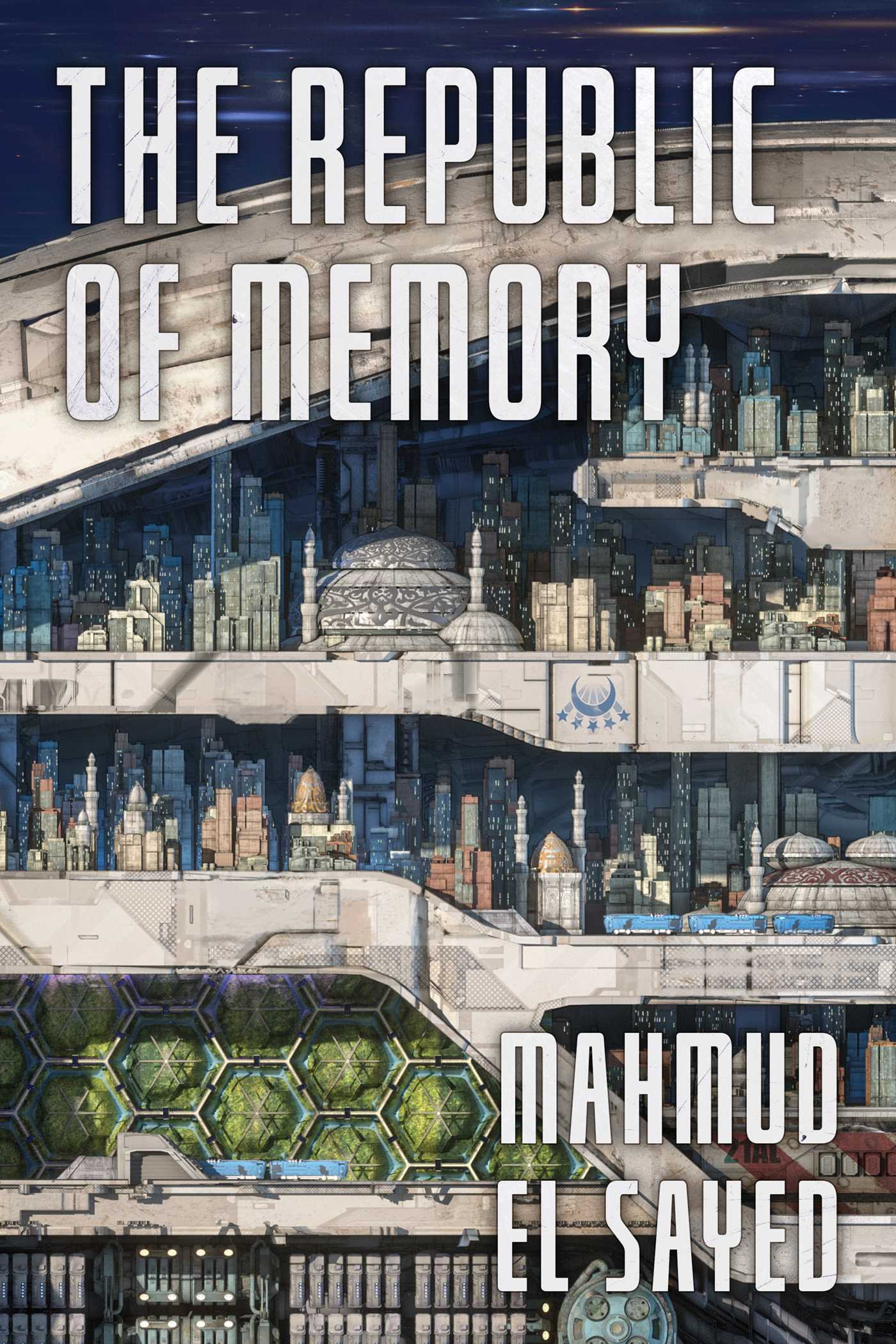
Book Review: The Republic of Memory by Mahmud El Sayed

Captain (A)merica must die

The Republic of Memory | Book by Mahmud El Sayed | Official Publisher ...
cover artist: Marcel de Neuve

Mahmud El Sayed’s The Republic of Memory is that rarest of things -  a proper space opera that has no real interest in what the West has to say about space or stories. El Sayed is a former journalist of Egyptian descent and he was there for the Tahrir Square protests in Egypt largely known to westerners (if they know it at all) because of its central role in the Arab Spring as it unfolded in Egypt. 
 
Mahmud is London based right now and won the Future Worlds prize in 2023 for an earlier version of this story that now finally makes it into print.
 
I mention these biographical facts because they are pertinent not just to the style and nature of the story in an authorial sense but also in terms of the themes and characters within the pages. 
 
This next paragraph contains mild spoilers about the plot so if you want to skip it and move on to the next part of the review feel free to do so. The Republic of Memory is about a generation ship sent out from earth on a very long (centuries long) journey to colonise another world. The people sending them are, if not quite then almost a world government centred in the Levant and entirely ruled over by an AI overclass. As becomes clear right at the start of the novel, something goes wrong back home, the threat of mutually assured destruction finally becoming a promise and the ship is ordered to turn back with its precious cargo of rich and powerful people to rebuild in the aftermath. Instead of doing so, the crew destroy the AI and continue on their way – their reasons not fully clear to themselves or us. What follows is set centuries later but still far from their destination as the various societies and factions that manage the functioning of the generation ship reach a breaking point. 
 
(Spoilers over) The story follows a number of PoVs but the crucial two, Damietta and Iskander, begin the novel. El Sayed puts these two characters (young family members) on seemingly opposite sides of the social divide and through this we have our way into the story. Damietta is a young woman in a close knit and culturally conservative family who chafes at the constraints she feels in her life. She is privileged as far as it goes with a good life laid out before her, but that’s the problem – that life is laid out before her with no deviations, no creativity and no chance at making choices other than those the people around her approve of. 
 
Damietta doesn’t know what choices she really wants to make – her horizons are too constrained for her to understand what she might actually want and, as for so many people, this leaves her with the only choice available – break things. Damietta is the person who reminds us that we all want to be able to make choices (not in the sense of the hero’s journey but in the sense of being able to determine who we are for ourselves) and when those choices are suppressed we will, reasonably even if the choices themselves are unreasonable, make choices to break whatever is within reach – be that ourselves or others. 
 
Damietta cannot see her privilege – her constraints leave her idolising resistance movements, rejecting authority and looking to engage in acts of rebellion regardless of the consequences because she cannot see how her life could be worse. And sure, in the immediate her life can be worse but a life whose practical choices might deteriorate is still nothing when compared to a life where self-determination is absent. One is waves on the ocean rocking the boat, the other is drowning without being able to die.
 
Iskander is a lawyer (of sorts) working for Administration, the distant overclass that manages the entire generation ship (called the Safina which literally means vessel or ark in Quranic Arabic). He is the face of authority, able to open doors and go places others can’t because of his role. He sits with two faces – one facing his community as the person they look to when they want to get married or get things done and one facing Administration as their loyal functionary ensuring their rules are followed without causing riots. Iskander is the willingly colonised actor, trying to see both sides, aware of the tensions, embodying them in his very person but looking to make the world work. Sometimes that’s for the better, sometimes that’s bending the rules and sometimes that’s following them. Iskander exists on a kind of personal capital – a currency he has to spend that is built up through the cautious and cunning use of his position. His effectiveness built on people seeing him as just reliably enough on their side to help them get what they need and want when Admin might otherwise say no while knowing that his power comes from Admin’s overall approval.
 
Iskander is the classical sepoy, the good native, the conflicted coconut, the collaborator who both legitimises the oppressor but also subverts their authority. 
 
El Sayed does a truly brilliant job of ensuring that we see their points of view. This isn’t a political treatise; it’s a story about people whose lives are political from the moment they’re born to the moment they die (and beyond). Why? Because for so many people this is the world they live in and to see it on the page is utterly brilliant. 
 
What I mean is that El Sayed isn’t writing about politics here – the story isn’t a metaphor for non-western experiences of colonialism. He’s both way beyond that, deep into postcolonial Arabfuturism, but also interested in these people in and of themselves. What Iskander wants, what his dreams are, what Damietta discovers in her journey to finding a way to express what’s inside her in a way that makes sense to her, consequences and all, is at the heart of this story. Whatever else it is, The Republic of Memory is a personal journey for people whose lives are…complicated. 
 
And how complicated they are because the Safina isn’t just Iskander, Damietta, their family and their community. It’s made up of communities from across old earth whose roles and cultures are disparate and essential to making the ship work. From hydroponics to medical to engineering and those who mine for resources beyond the ship, the tasks of keeping a mechanical world flying through the void are endless and demanding. What’s worse is that the ship is gradually deteriorating no matter how hard the people work at keeping it all working in harmony. 
 
It’s unclear whether the slow collapse of the ship’s systems is the fault of Administration, the inevitable result of destroying the AI at the start of the voyage or whether it’s simply entropy presenting its bill. The answer to the question depends on who you ask and their place within the ship. 
El Sayed has rolled together caste (or class if you’re a westerner), gender, functional essentialism, racism and post-colonialism into a single pressure cooker of a story. He is aware of and plays with a host of different ideas; from a variety of communisms and communitarianisms to capitalisms, religious expressions of different kinds including manifest destiny through to AI as god. 
 
However, central to everyone’s life in this novel is a gift economy. In a capitalist society where the rule of law tries to ensure transparent equity for all concerned this would be called bribery. Where there is no cash, per se, and the levers of power are invisible and asymmetric beyond family and community units it is called gift economy – bringing an official’s favourite sweets, making sure someone’s cousin got the car they wanted at a good price and so on. You might call it a society built on social obligation.
 
What I’m trying to say is that El Sayed’s novel is that truly remarkable thing in English – a speculative story that regurgitates precisely none of the prevailing Western ideas about how the world should be run and rests on none of those foundations. Beyond that it does what it wants not by eschewing consideration of these possibilities (after all, Administration is a specific proxy for American hegemonic power over countries like Egypt and how client states must come to operate for maximum benefit for their rulers), but by understanding and reflecting how complex politics between different factions is especially when relationships are stable. After all, it is successfully navigating complexity that allows stability to be sustained as the deliberately untrained and willingly ignorant are discovering in the Strait of Hormuz at the time of writing this. 
 
The last thing I want to comment on here is language. It seems to me that language and its use, its control and its boundaries are central to building consensus but also to building and controlling communities. The societies in The Republic of Memory aren’t split by culture or skin colour but by language with the mantra that anyone can learn a new language with the goal of preserving social mobility. It’s a cunning sleight of hand because it wilfully ignores the power of community and relationship and culture in building social capital while remaining superficially utopian. 
 
El Sayed delivers so much of this novel through conlangs, creoles and macaronic structures that you need to take your time to understand the rhythms of what he’s built. I think that is very, very important because in language and how people use and deploy it you find the real levers of power being expressed. What words you use at home versus what you use when speaking to power are revelatory, and throughout El Sayed reminds us that language is, at all times, a tool not simply for consensus but for control and subversion. 
 
The Republic of Memory is the first of a duology and as a way of working through modern global politics, personal lives within that context and as an exploration of how you and I survive such potentially crushing pressures it’s an extraordinary achievement. 


--


The Math


Highlights:

  • Amazing languages!
  • Proper political SF
  • Non-western viewpoint
Nerd coefficient: 9/10, a powerful exploration of what worlds look like when seen from a postcolonialist perspective. A superb starting point for people interested in Arabfuturism.

Reference: El Sayed, Mahmud, The Republic of Memory [Orion 2026].

STEWART HOTSTON is an author of all kinds of science fiction and fantasy. He's also a keen Larper (he owns the UK Fest system, Curious Pastimes). He's a sometime physicist and currently a banker in the City of London. A Subjective Chaos, BSFA and BFA finalist he's also Chair of the British Science Fiction Association and Treasurer for the British Fantasy Society. He is on bluesky at: @stewarthotston.com.

Wednesday, April 29, 2026

Book Review: Anti-State, by Allen Stroud

Cold war space opera done right

Cover Artist: Nick Wells
There’s a real resurgence of space opera right now and I’m here for it. I love a good adventure out in the stars and I’m easy as to whether it’s hard science or full of space wizards. 

Space opera, like epic fantasy, allows us to entirely transpose our experience into one functionally and practically distinct from the real world. In so doing we get the freedom to ask questions via metaphor, world building and fantastical elements about hard real-world issues. In the last couple of years we’ve seen space operas talk about AI, consciousness, the nature of work, meaning and purpose. We’ve seen them address fascism, resistance, representation, the complicity of capitalism with authoritarianism and unpack the nature of sexuality and gender. 


Into this mix comes Allen Stroud’s Anti-State, a stand-alone novel in an Expanse-like setting in which Stroud has already written a whole shelf of entries. No real prior knowledge is needed to read this one although it does refer to events in other books and feature many of those characters in greater or lesser roles. 


Stroud’s main character is disabled in the sense that she is missing limbs and that is presented as exactly what it is – factually and without fuss. It’s an interesting choice both in terms of representation and in how it’s handled by a character who spends much of the story in a low gravity environment. There’s technology to help solve her challenges, but they aren’t there to heal her or to ‘make her complete’. This approach is good to see, not simply for representative purposes but because there’s some interesting commentary around what it means to have a body in a low gravity environment vs. Earth standard gravity. 


The story itself is in deep cold war territory with the overall structure owing as much to Smiley’s People as it does to spaceships flashing through the void to blow one another up. The most obvious comparison is with James S. A. Corey’s The Expanse series – set as both are within the solar system and concerned as they are with the politics of earth extending to the rest of the system. There’s no proto-molecule in this but it does share the same concern with being at least moderately faithful to proper physics. It’s hard science fiction as far as that ever goes and there’s plenty of text highlighting just how much space will kill you at every opportunity. 


We have allusions to Martian politics, independence, rebellions and there are, lurking in the background, rogue billionaires with tech that can rival the militaries of space faring states. 


This isn’t novel – this could be a story about submarines fighting it out in the North Atlantic without too much changing with the talking heads in London, Berlin and Washington instead of on spaceships and asteroids and lunar colonies. 


That’s not necessarily bad – you know what you’re going to get, and it delivers on that competently without rocking the boat. It’s a somewhat nostalgic approach to space opera with strong golden age vibes intersecting with more modern concerns such as where it explores what it means to be human in the context of advanced technological systems. 


What worked for me was the layered world, the sense that there were politics and people and stuff happening of which the events in this story are only a part. I like that feeling of being in a wider world. I liked the focus on space being deadly and low gravity being a thing that impacts every single aspect of a life lived within its grasp.


I also largely liked the overall story of secret plots unravelling, of people with torn loyalties discovering where they truly want to put their faith and, most of all, I liked the small scale of it. Sure, the stakes are high, adventuring in space will do that, but at the same time they concern a small group of people in a set of tin cans adrift in an ocean of nothing. They might travel millions of miles but they remain determinedly fixed in a locked room whose seals keep them alive as much as trap them. 


The ideas here are small too – not all in a bad way. Stroud explores the little impacts of technology, distance and logistics that conventional space travel (i.e. without the fantasies of FTL or warp drives or anti-gravity) have on people. Loss of bone density, the lack of decent food, shortages of power, the challenge of changing direction when you’re travelling at thousands of kilometres an hour. 


I’d like to have had some larger ideas here around what it means for human society to be out there and these are there a little, but are also largely subsumed within the context of a military hierarchy that gives the book the occasional feel of mil-SF (although without any of the fetishization of guns and violence).


The one place where the politics/world building doesn’t quite work for me is in this military context and hence the larger ideas also don’t quite connect. The reason for this is my own view that the idea that ‘governments have the best tech’ is not just outdated but permanently in the rear-view mirror. This is where the book’s Cold War vibe is least convincing, although most consistent because I think that’s the last time governments could reasonably be said to have tech not available to the general public. 


These days it is entirely private companies developing that tech and selling it to our governments and it is almost entirely private companies exploring space. The question of how polities here on earth could extend their ‘national’ boundaries into space is just assumed rather than explored and the same for the corporate elements. The private companies in the novel are nefarious which isn’t hard to believe but they aren’t well realised which is a shame. 


Still, Anti-State is a decently executed and complex political thriller set in space. Its tight scope delivers a compelling story despite its other flaws.


--


The Math


Highlights:

  • Spaceships
  • Proper orbital mechanics
  • Politics and plots

Nerd coefficient: 6/10, a layered political thriller as at home in space as it would be in the 1970s North Atlantic

Reference: Stroud, Allen, Anti-State [Flame Tree Press, 2026].

STEWART HOTSTON is an author of all kinds of science fiction and fantasy. He's also a keen Larper (he owns the UK Fest system, Curious Pastimes). He's a sometime physicist and currently a banker in the City of London. A Subjective Chaos, BSFA and BFA finalist he's also Chair of the British Science Fiction Association and Treasurer for the British Fantasy Society. He is on bluesky at: @stewarthotston.com.