Showing posts with label Nanoreviews. Show all posts

Thursday, February 26, 2026

Nanoreviews: Overgrowth, Aunt Tigress

Overgrowth by Mira Grant

It’s been fifteen years since Mira Grant published Feed, the first of the Newsflesh novels. It’s been ten years since Chimera, the conclusion of the Parasitology trilogy, followed by the phenomenal Into the Drowning Deep in 2017. Since then Grant has published a kickass YA Alien novel and a handful of novellas, but even so, it’s been a while since we’ve had what feels like a “proper” Mira Grant novel, for whatever exactly that means.

Overgrowth asks what it would look like if a little girl told anyone who would listen that she was really an alien in the form of a human and the alien armada was coming… and that girl was telling the truth. As told by Mira Grant, the open pseudonym of Seanan McGuire, which is important because there is a sort of personal narrative style that Grant/McGuire works in, where most characters speak in a very specific explanatory descriptive way, and it’s something that I’ve appreciated reading a LOT of McGuire’s work over the last decade.

The Mira Grant name is where McGuire writes her more horror-themed science fiction novels and novellas (rather than as Seanan McGuire, which gets more urban fantasy/fantasy). Overgrowth is absolutely horrifying. That little girl at the heart of the novel’s premise—she walked into the woods one day and didn’t come back. Something else did, and that something else looked like the girl, moved like the girl, and sort of talked like the girl, but not exactly, and when she said that she was an alien, most people thought it was trauma, but the parents also knew that something was wrong.

I’m not going to say that this is a sort of horror that only parents can understand or relate to, because I don’t think that’s actually the case at all—but it is a horror that I feel more viscerally as a parent. It’s the combination fear of something happening to either of my children, but I know my kids. I know who they are as growing people, and I can scarcely imagine the raw horror of my son or daughter being there but being “not right”. It’s terrifying.

That’s also not truly what Overgrowth is about, because it’s about what happens when that kid (and others) are grown, still telling the same story, and the the aliens actually show up. What happens *then*? How does the world respond to those people who said they weren’t human in the face of evidence that something is coming? We can guess how governments would react based on years of evidence of how they treat actual humans they choose to deem a threat or a “security concern.” We can guess how other people will react to someone truly “other” because we’ve seen that in our lifetimes and our parents’ lifetimes. We know the stories.

All that is before the aliens actually show up, which isn’t really a spoiler. It’s kind of the premise behind the setup. If those kids weren’t lying, *something* has to arrive, and more than likely given that this is a Mira Grant novel, they’re not gong to be coming in peace.

If you’re down for this premise and for Mira Grant’s light touch with horror and characterization, Overgrowth is one of my favorite books of the year so far. There’s a lot to like here. Overgrowth is not going to open up your veins and make readers viscerally feel every bit of fear and terror and gore. It’s not that sort of book, and Grant (so far) has not quite been that sort of writer (though it’s been a very long time since I’ve read Newsflesh or Parasitology), but that’s also not what you go to Mira Grant for. You read Mira Grant for one hell of a premise, fast-paced storytelling, and a very specific characterization. Overgrowth hits the mark.


Aunt Tigress by Emily Yu-Xuan Qin

I often think of urban fantasy debuts the way I remember Seanan McGuire’s Rosemary and Rue or Jim Butcher’s Storm Front: there’s enough to interest me, but not quite to hook me into the series, but I absolutely need to read one to two more books because the hook is almost certainly coming, and once it sets, I’ll be fully invested for another twenty books.

Aunt Tigress is an exciting debut urban fantasy from Emily Yu-Xuan Qin set in Calgary and wrapped in Chinese and First Nations mythology. I’m… interested. Tam Lin is part magical tiger, with a human mother and a tiger on her father’s side. Everything starts with the death of Tam’s titular Aunt Tigress, who appears to have been a truly awful person, and it turns out that perhaps Aunt Tigress was murdered, and Tam wants to find out what happened despite her withdrawing from her magical heritage. A university classmate, Janet, latches on to Tam and helps her on her quest. Misadventures ensue.

I bounced off this idea during the novel, but I wonder if there will be more Tam Lin novels, and if so, in what way the mythology of Tam Lin and Janet and faerie might play into that. Having a character named Tam Lin is one thing. Tam having a love interest named Janet is something else. That’s not really germane to Aunt Tigress, but given some distance, it’s something I’m thinking about.

Aunt Tigress is a wild adventure that starts relatively grounded and ends up on a truly magical mystery tour (™) through a mystical cosmos of sorts. I didn’t love this, but I’ll read another from Qin to see how she develops as a storyteller.


PUBLISHED BY: Joe Sherry - Senior Editor of Nerds of a Feather. Hugo and Ignyte Winner. Minnesotan.

Tuesday, July 22, 2025

Nanoreviews: Demon Daughter. Installment Immortality, Overcaptain


Demon Daughter, by Lois McMaster Bujold


A very gentle story, one of my favorites of the series. In Demon Daughter a young girl, Atta, is washed ashore following a shipwreck and for reasons ends up in the care of Penric, who (if you haven’t been keeping up with this series) is basically a semi itinerant priest who deals with cases of demon possession.

Demon Daughter ends up a combination of a small domestic drama and a question of the nature of demon possession in this universe and it is small and it is quiet, but it is deeply powerful. Atta is possessed by a very young demon and that allows for the perspective of Desdemona to come very much to the forefront of this novella.

This is the twelfth novella in the Penric and Desdemona series and for a reader who has been along for the ride since the first volume, Demon Daughter is deeply satisfying.


Installment Immortality, by Seanan McGuire


I have to wonder how close we are getting to an end point with the Incryptid series. That’s not a statement of exhaustion, but an observation of the stories McGuire is telling at this point. Spoilers will likely abound - but the previous book, Aftermarket Afterlife, had the Covenant (if you know you know) launching major attacks against the Price-Healy family and our heroes hitting back with a counter attack utilizing the ghostly skills of Mary Dunlavy to hit the Covenant at their main chapterhouse. Installment Immortality sort of deals with the consequence of that, in that it is focused on what happens to a ghost who blows everything up and can’t quite get away from the bomb and also gives an update on the state of the Covenant following that attack.

On the assumption Seanan McGuire isn’t just getting starting fifteen books into the series, It seems like we’re getting close to a potential end game for Incryptid (this is also notable after reading the description for next year’s book Butterfly Effects).

That’s neither here nor there when thinking about Installment Immortality, but the future of the series was weighing on my mind when reading it.

What Installment Immortality does well is tell what is functionally a side story from the main Price family action. Still a ghost getting to do ghost things Mary Dunlavy is put on a quest to put a stop to Covenant agents attacking the ghosts of America - and through this examines the consequences of several books ago regarding cousin Arthur (again, this will make sense if you know the series - I don’t know that I’d recommend jumping in here even though it’s a new narrator and those are typically jump in spots).

As a general rule I love this series. Seanan McGuire has done a fantastic job making Incryptid feel very lived in. We’ve been on a *journey* with this family and everything is familiar even with McGuire is doing new things, shifting perspectives, and making things generally uncomfortable for her characters. It’s impossible to read Installment Immortality in a vacuum. It’s the fifteenth book in a series that I’ve been reading for many years after diving headfirst into Discount Armageddon.

If Installment Immortality isn’t one of my favorite books of the series, and it’s not, it is still an overall satisfying read but I think primarily for those who have been along for the ride and it doesn’t hit some of the highs of earlier books in the series.


Overcaptain, by L.E. Modesitt, Jr


Alyiakal returns in Overcaptain, the latest entry in L.E. Modesitt’s long running Saga of Recluce. Following the events of From the Forest, success comes with a price and Alyiakal has been promoted, assigned to close a military post that has been a hot mess, and further assigned to be deputy Commander to an officer who doesn’t want the help.

There’s a trend in the Recluce series of extremely competent men who don’t fit the perfect political mold of those in power but who do their jobs so well their advancement cannot be denied but are given continually impossible tasks that are designed to either fail or kill them (or both). If you’re down for that, along with the understanding that Recluce novels live in the mundanity of their protagonists day to day lives that hint and build towards a much greater conflict.

Modesitt’s prose is smooth and Overcaptain is languorous easy reading. I continually describe Recluce as comfort reading, which isn’t to say that the action itself is comfort but Overcaptain (and the rest of the series) is a book to sink in and just live in this world for as long as it takes to make it to the end. The journey is the point of Recluce, much less so than the destination - but the destination always includes some fireworks.

Overcaptain is another solid entry in the Saga of Recluce.


PUBLISHED BY: Joe Sherry - Senior Editor of Nerds of a Feather. Hugo and Ignyte Winner. Minnesotan.

Monday, February 17, 2025

Nanoreviews: Uncharted 4: A Thief's End; Cyberpunk 2077: Phantom Liberty; Stray

The G catches you up on some quality titles 

Uncharted 4: A Thief's End - Remaster (PS5, PC) 

I went straight into this remastered PS4 classic after finishing the excellent Indiana Jones and the Great Circle. I was not disappointed. A Thief's End is considered by many to be the best entry in the series, and a fitting end to the story of Nathan Drake, treasure hunter. The remaster is superbly done, with crisp high-res graphics and subtly optimized gameplay. This one features a lot more action and a lot less stealth than Indiana Jones, and on balance I prefer stealth - but the 3rd person shooting and platforming are all well done. The story is surprisingly compelling, focusing as much on interpersonal relationships as the quest for Henry Avery's treasure. I have two complaints, though. First, whereas Indiana Jones captures the sense that you are a human being with physical limitations (which heightens tension in key moments), the action here is more like what you find in a superhero film drunk on CGI and VFX. I found that annoying and distracting. Second, there's no map! Sure the game is pretty linear, but there are more open stages - making the decision to forego a map super annoying. Rating: 8/10.

Cyberpunk 2077: Phantom Liberty (Series X, PS5, PC)

Cyberpunk 2077 is one of my favorite games of the past decade - I've played through it twice and will probably do so one more time. It's that good. Phantom Liberty is a meaty addition to the story, designed to be played about 2/3 of the way through the main story. It opens up a new section of the map, Dogtown, which is the autonomous fiefdom of a warlord and his private army. The story begins with a downed plane, carrying the President of the USA. You are contacted by a member of her inner circle to go into Dogtown to save her. But nothing - as you can imagine - is what it seems. As you progress through the storyline and its many double-crosses, Phantom Liberty poses interesting questions on the nature of consciousness in a transhuman, AI-powered social landscape. As far as expansion packs go, this one is about as good as they come - and definitely a worthwhile purchase for fans of the game. Unfortunately, it's not quite as compelling as the main questline. Rating: 8/10. 

Stray (Series X, PS5, PC)

In this one, you - a cat - become lost in an underground world populated by robots. Your journey to the surface uncovers a dark secret - as well as a message of hope. Sound enticing? That barely does the game justice. Stray is beautifully rendered, melancholic and completely absorbing. In fact, it's one of the most remarkable games I've ever played. My only complaint is that it isn't long enough. Rating: 10/10. 

--

POSTED BY: The G--purveyor of nerdliness, genre fanatic and Nerds of a Feather founder/administrator, since 2012.

Monday, February 10, 2025

Nanoreviews: Star Wars Outlaws, Indiana Jones and the Great Circle, Ratchet & Clank: Rift Apart

A roundup of video games The G has been playing lately.

Star Wars Outlaws (Series X/S, PS5, PC)

Haley reviewed this one back in September—and her take mostly holds for me too. So instead of reinventing the wheel, I'll just add a bit of color from my personal experience with the game. First the good. Outlaws is a charming game that does a fantastic job immersing you in one of the most interesting geographies and time periods established in Star Wars canon: the Outer Rim under partial Imperial occupation. Gameplay is modeled after the earlier Assassin's Creed games, deploying the same mix of stealth, action and platforming. Once you get into the flow of things, it's pretty great. Now the bad: it takes 5-10 hours to get into the flow of things, and before that matters, Outlaws is a frustrating mess. Most people won't stick it out, unfortunately—and that's on Ubisoft. The main culprit is the broken save system, which allows you to quick save unless you are on a mission, where you are captive to a badly-implemented checkpoint system that only allows one autosave at a time—coupled with the fact that, if you load up a previous save, all the NPCs you blasted or knocked out respawn. A lot of early missions force you to replay long sequences that can fall apart with one tiny timing mistake. It's the bad kind of challenging, to be honest. But, again, once you're past that, this largely (but not fully) smooths over and the game ends up being a lot of fine. Recommended for stealth enthusiasts, Star Wars stans and the very patient only.

Score: 7/10 (same as Haley).


Indiana Jones and the Great Circle (Series X/S, PC)

Another licensed property, this time an Xbox exclusive published by Bethesda Software—and developed by MachineGames, a Swedish studio founded by refugees from Starbreeze Studios. That DNA is very much in evidence here, as Indiana Jones and the Great Circle immediately reminded me of Riddick: Escape from Butcher Bay—one of the best licensed properties I've ever played. Indiana Jones and the Great Circle is up there as well. It's a first-person action game that will bring the Uncharted series to mind for most folks, and it's true—there is a lot in common in terms of both gameplay and thematic content between Great Circle and Uncharted 4 in particular. But, while both games are very good, they don't really feel the same. The shift to first-person gives it a level of immersion that you don't quite get from the third-person perspective, so you really feel like you are Indiana Jones. And the vibes are just different, like comparing James Bond to Jason Bourne. The game is beautiful, expertly paced and —despite not having a quick-save function— presents a decent challenge that never gets tedious or frustrating (I'm looking at you, Outlaws). It really does feel like you're in an Indiana Jones film. One small quibble: the map is terrible—though at least there is a map (now I'm looking at you, Uncharted 4).

Score: 9/10.


Ratchet & Clank: Rift Apart (PS5)

I've been a fan of this series since the original came out for PS2. Ratchet & Clank was one of Sony's most popular exclusive properties during the PS2 and PS3 eras, releasing a whopping 12 titles from 2002 to 2013. But then the series took the PS4 era off, as the devs focused on other projects (including the well-regarded Spider-Man games). Rift Apart is a triumphant return to the market, combining series mainstays like crazy weapons and tight platforming action with some new gameplay dynamics, like the ability to traverse interdimensional rifts. The writing is quite good, with an engaging story and strong characters—including Rivet, a Lombax-like Ratchet fighting an even worse version of Dr. Nefarious in her dimension. Now, the not so good... while the game is generally a lot of fun, the boss battles get very repetitive. They aren't especially hard, just long and, well, they're all pretty much the same.

Score: 8/10.


***

POSTED BY: The G--purveyor of nerdliness, genre fanatic and Nerds of a Feather founder/administrator, since 2012.

Tuesday, December 31, 2024

Nanoreviews: Private Rites, Orbital, Three Eight One

A roundup of three British novels that play with genre and form to create something a little bit special

Private Rites by Julia Armfield

Julie Armfield is a pioneer in the microgenre of "melancholy lesbians," and has followed up her last sad banger Our Wives Under the Sea with another tragic hit, this time a climate-fiction/horror-adjacent reimagining of King Lear, in which three queer sisters navigate their lives and relationships, especially with one another, in the aftermath of the death of their famous architect father, all against the backdrop of a world being steadily drowned by unending rain.

The main focus of the text throughout remains on the three sisters, using each of them as viewpoint characters, interspersed with some others, including the city itself (predominantly washes of beautiful descriptions of place and vignettes of the various inhabitants trying to live their lives in this damp, changing, drowning world). But the rain is constant—its fact and effects a touchstone throughout the story, never the focus but constantly noticeable just out of the corner of your eye. And so, by the time we reach the end, it is a looming horror that overwhelms the true plot of the story, the disintegrating psychodrama of betrayal and inheritance.

What I found most interesting, and something I think Armfield manages very well, is how the climate-fictional aspects of the story do not read as SFnal in tone, sharing more with litfic and horror respectively in how they are presented—this is a story that rejects explanations, whose climate change takes on a hint of the arcane before the end—and uses it instead as a setting, a psychological spectre and an act of god, not something to be reckoned with or solved, or even survived, but merely endured. Or perhaps weathered (ha). It loses no power from being treated this way, and perhaps even gains some—there is a weight to treating the climate disaster aspect as something unstoppable, unsolvable, that lingers long after the book is done, and felt more impactful on me at least than any number of stories that tackle the issue more head on.

Like all of Armfield's books, Private Rites is chock full of beautiful prose work, lush descriptions of place that unite the profound and the mundane, and sad, queer women in whose interiority we are allowed to revel, finding almost uncomfortable levels of sympathy with their most personal thoughts. It is gripping in all its aspects, and in my opinion may be her best work yet.

Nerd Coefficient: 10/10.

Reference: Armfield, Julia. Private Rites [HarperCollins, 2024].


Orbital by Samantha Harvey

If we count Orbital as genre, the Booker has been on a three winner SFF streak, with 2022's The Seven Moons of Maali Almeida, 2023's Prophet Song and now Orbital. But that's a big if. The events of the story—such as there even are events—may not have strictly happened as yet, but they fall so closely into the realm of the possible that it feels an enormous stretch to call this speculative work, unless you consider all fiction that contains space travel to be that by default. In any case, whether or not it comes in under a technicality, its mode is far from the usual for genre fiction, and therein lie both its strength and its weakness. We follow six astro/cosmonauts on the ISS through one day—sixteen passes over the surface of the Earth—as they muse on their place in the universe, their relationship with Earth, each other and their loved ones, and the new manned mission to the moon they witness launching. They don't do much, and what they do isn't the focus anyway—instead it's a book of pondering, a rolling set of banger one-liners and intensely evocative descriptive passages, lush and wallowing in its use of language. All of which it does stunningly.

The problem comes with the unrelenting sameness of that—Harvey does a great job of evoking wonder at the view from the window of a tin can in space, and at the marvel of space travel at all, genuinely working to craft that emotional response where other books might rest on the assumption that the feeling comes pre-packaged in the reader (which it does not in me). But that feeling—that awe at everything—persists regardless of the variation in content, even when dealing with the cramped mundanities of astronaut life, and the lack of tonal variation rather wears the wonder thin by the end of its (quite short) duration.

However, what it does it does do remarkably well, and only begins to overstay its welcome towards the end. If, unlike me, you are truly dazzled simply by the reality of space travel, it may well continue to land all the way through.

Nerd Coefficient: 7/10.

Reference: Harvey, Samantha. Orbital [Vintage Publishing, 2023].


Three Eight One by Aliya Whiteley

A story of two texts. The first, a fantastical, quest-like, quasi-mythological narrative of a girl who must leave her home village to go on a ritualised journey. The second, in the margins of this, the footnotes of a far-future archivist, reckoning with her life via her connection to this text from a time far outside her ability to fully contextualise.

Three Eight One uses the interrelation of these two stories, their contrast in tone, in voice and in formatting on the page, to examine our relationship with the past and the present, with the nature of humanity and what might be lost to make a utopia, with the things that remain constant no matter how much humanity changes, and with the power of stories.

In the quest narrative, Fairly has to leave her village to follow the Horned Road, as is traditional for young people. This begins by pressing a button on a chain device, switching the narrative from third into first person, and far from the last time format will be played with in such a manner. Her progression through the quest—neatly parcelled out into sections, each of precisely 381 words—becomes increasingly stranger, leading us through a world that feels both modern and alien, both using and defying the tropes of fantasy as we know it. Even alone, Fairly's story, with its interrogation of the motivations of quests, of power structures and community, with its ambiguous and thought-provoking ending, would be worthwhile.

But it is not alone, and it is the annotation from the future author which, for me, really makes this book. We slowly learn through the story that she writes from a time so far ahead of ours as to render some of the context of the story beyond her grasp—the way that she talks about details of narrative and place make it clear through subtle repetitions the extent of her ignorance, despite her profession that she lives in an age of knowledge. We see glimpses into her world, a utopia she considers hard-earned but worthwhile, a world without conflict but where much has been lost to secure that safety. But we also see simple glimpses into her life, into her emotional relationship with a text from a long-dead civilisation. The connection that she herself can barely explain to a text she doesn't fully understand is one of the most compelling things in the story, and watching it develop over the pages, intertwining with that story itself, is incredibly rewarding.

Add to that her development in the later half of the book, where we meet her older, wiser self, and learn how her life has been shaped beyond the boundaries of the text she's annotating, and it becomes even more special.

Above all, it's a book of subtlety, refusing to spell things out for the reader but instead trusting them to make their own connections, while making sure all the tools are available to do so if they're willing. It's a book full of thoughtfulness, and one to sit with, digest and discuss, and one of the most fascinating things I've read this year.

Nerd Coefficient: 9/10.

Reference: Whiteley, Aliya. Three Eight One [Rebellion Publishing, 2024].


POSTED BY: Roseanna Pendlebury, the humble servant of a very loud cat. @chloroformtea.bsky.social

Tuesday, December 24, 2024

Quick round: My recent readings

The year ends, and it's time for another summation of the various readings I've been able to complete in between the big reviews (here's my post for the first half of the year).

This has been my itinerary for the latter half of the year:

At the Edge of the Woods by Masatsugu Ono, translated from the Japanese by Juliet Winters Carpenter
(Two Lines Press, 2022)

A work-at-home father hears strange sounds from the nearby forest while his pregnant wife is visiting family. More a portrait than a story, this book abounds in luxurious poetic imagery that doesn't quite coalesce. The man's little son has a close link with the creatures in the forest, but the mystery is kept locked from the reader. There's passing mention of war, flooding and a refugee crisis, but they're just background decoration. Dialogues meander with no logical endpoint, scenes are abruptly cut, and character choices, especially those of the little kid, make no sense. The surreal events don't help tell a story; they're just there to give vibes.
Nerd Coefficient: 4/10.

Griso: the One and Only by Roger Mello, translated from the Portuguese by Daniel Hahn
(Elsewhere Editions, 2024)

This short but delightful picture book follows a lonely unicorn searching for its herd across landscapes and centuries, each gorgeously illustrated in a different art style. From 20th-century surrealism to Medieval illuminated manuscripts to ancient Greek pottery to Tang dynasty murals to Persian bas-reliefs to Egyptian wall hieroglyphs to Indian miniature painting to DIY chapbooks to prehistoric cave art, our unicorn can travel the world to its edge and back, stretch, mutate, metamorphose, be every color or none, talk to buffaloes and narwhals, and meet unexpected companions that will give meaning to its journey.
Nerd Coefficient: 9/10.

Kenai by Dave Dobson
(self-published, 2023)

The winner of the third Self-Published Science Fiction Competition is a very strange book. Alas, the only meaningful way to properly speak of its qualities is to spoil it: imagine the plot of Tenet set in the Pandora ecosystem of Avatar. At the beginning, the novel appears to be about a xenoarchaeological exploration, but it quickly shifts into a breakneck solo infiltration/heist thriller, then a small first contact drama, then a time travel puzzle, then a war/survival adventure. I promise it all makes sense when put together. The first-person narration gives us a compelling protagonist with a fully delineated personality, forged by fire in a backstory marked by hard choices and regrets. Definitely a worthy winner.
Nerd Coefficient: 8/10.

Stranger to the Moon by Evelio Rosero, translated from the Spanish by Anne McLean and Victor Meadowcroft
(New Directions, 2021)

Regular humans share an unnamed town with a different subspecies of humans, who are hermaphrodites and eschew clothing. In this town, the clothed subjugate the unclothed with every form of bigotry, including namecalling, public ridicule, segregation, ostracism, and legalized murder. We follow the perspective of an unclothed person narrating from inside a closet in the only house where the unclothed are allowed to live, which serves as both shelter and prison. Our protagonist describes with a sharp eye the peculiar social rules of this town and the extent of the evil that people will commit if it's deemed publicly acceptable.
Nerd Coefficient: 7/10.

Clone by Priya Sarukkai Chabria
(Zubaan, 2018)

In a rigidly stratified dystopia of post-human slave castes, one slave dares hope for more. As it turns out, this slave is a clone of a high-ranked government figure who died mysteriously when she was just about to publicly challenge the established order. Will the clone finish the job? With a Buddhist perspective on the equalizing effect of suffering and death, tracing a whirlwind trajectory from the extravagance of cruel spectacles for the amusement of the spoiled elites to a series of extended flashbacks of previous reincarnations, this novel argues for the indestructible dignity of humanity even under the most horrific circumstances.
Nerd Coefficient: 7/10.

The Other Shore by Hoa Pham
(Goldsmiths, 2024)

A girl in Vietnam acquires psychic powers after a near-death experience. Blessed by a goddess of compassion and guided by her beloved grandmother's spirit, she's soon afterward hired to help identify unmarked graves of soldiers, but when she notices that the Vietnamese government doesn't honor all dead combatants equally, she starts disobeying orders, taking bigger and bigger risks out of her sense of duty to the restless spirits. This novel addresses thorny questions about reconciliation, authoritarianism, migration, the limits of patriotic loyalty, our responsibilities toward our dead and the compromises that must be made in a world of imperfect rules.
Nerd Coefficient: 6/10.

Neighbors by Michael H. Payne
(CreateSpace, 2014)

A young man has been banished to a psychiatric hospital by his detestable rich father. His strange neurological disease has put him in a wheelchair, with the side effect of opening his mind to the speech of animals. He doesn't take long to make fluffy and feathered friends around the block, and he's now eager to take the next big step and make his first human friend. Only two problems: he has very little experience with human interaction, and not all animals approve of his newfound gift. With deep empathy and brutally honest humor, this novel crafts from slice-of-life sketches a tender portrait of self-reinvention that dares laugh in the face of life's everyday absurdities.
Nerd Coefficient: 8/10.

Prime Meridian by Silvia Moreno-Garcia
(Innsmouth Free Press, 2017)

In a near-future Mexico City ravaged by even worse economic inequality than the real one, a young woman barely managing to make ends meet with soul-crushing rent-a-friend gigs has a dream that refuses to die: the dream of one day saving enough money to emigrate to Mars. To do what? It doesn't matter. On Earth she has no career, or loving family, or romantic prospects, or nice neighborhood, or a reason to look to the future. She doesn't know what Mars can give her; all that matters is leaving. This short novel captures with hard-hitting precision the snowballing of little disappointments and resignations that precedes every migrant's choice to leave normal life behind.
Nerd Coefficient: 6/10.


POSTED BY: Arturo Serrano, multiclass Trekkie/Whovian/Moonie/Miraculer, accumulating experience points for still more obsessions.

Tuesday, December 10, 2024

Nanoreviews: Alliance Unbound, Nuclear War, Adrift in Currents Clean and Clear


Alliance Unbound
, by C.J. Cherryh and Jane S. Fancher


Follow up to 2019’s Alliance Rising (my review) and only the second Alliance / Union novel published in the last fifteen years, which is far too long for my taste which is a statement I’ll make while ignoring the ten plus Alliance / Union novels I have yet to read. Alliance Unbound jumps right into the action of the previous novel with Ross Monahan having taken refuge on Finity’s End, a top of the line and incredibly powerful merchant ship following the takeover of his family’s ship, The Galway, during the conclusion of Alliance Rising.

It’s a little difficult to talk about Alliance Unbound without talking about the larger galactic politics and how this book fits into the larger series of generally connected novels because the actions with both Alliance Rising and Alliance Unbound center around the founding of the titular alliance between merchant ships to counter the encroaching power of the Earth Company as a border and buffer against the Union of other worlds and space stations. It’s both incredibly important for understanding the underlying landscape (spacescape?) of Alliance Unbound and not at all important because with very limited exceptions across some thirty novels, these books can be read and enjoyed in any order.

The core of Alliance Unbound is the founding of the Merchanter’s Alliance and my favorite bits of the novel are the ones that are dealing with the minutiae of interstellar politics and the issues merchant ships have with Earth Company (and it’s projected power of the home planet against ships and stations it views as their property even when years can pass between possible communication). The Neihart family of Finity’s End is compelling, though certainly a bit heavy handed as the rich / powerful merchant family, as they work on getting the last two family run ships signed on to the Alliance and discover a possible Earth Company

It’s not just the devil being in the details, it’s what the novel hangs on. Fans of Cherryh will find a lot to like here, especially if Cyteen was a hit though Alliance Unbound is shorter and moves around more than that novel but it has some of the same delightful awkwardness and power politics of Cyteen.


Nuclear War: A Scenario
, by Annie Jacobson


The most truly frightening book I’ve read in a long time is Annie Jacobson’s Nuclear War: A Scenario. The “A Scenario” part is incredibly important here because Nuclear War isn’t a novel though part of it is fiction and it’s not a non-fiction work even though a significant portion of Nuclear War is deeply researched history and background detail for how Annie Jacobson knows what she knows and how she is building this scenario of what a nuclear war would actually look like with a minute by minute (and sometimes second by second) explanation of what would happen if…

In Nuclear War Jacobson takes us from the second a surprise attack from North Korea is launched against the United States. Jacobson walks readers through how quickly detection occurs, how information gets relayed from the detection points through military commands to the President, what potential barriers to communication and decisions are in place, what policies are in place to guide those decisions, how little time there really is make those world altering decisions, what can go wrong, and what little hope there really is for the rest of us if there is a nuclear launch.

Nuclear War is part fiction. Unless we all live in a simulation that is continually reset, this hasn’t happened. Nuclear War isn’t a novel, though. It’s a thought experiment wrapped in deep and intensive research about how this all works with more information than we might have imagined is out there (but with so much more still so deeply classified that the only way out is via a deathbed confession, which, according to Jacobson, is functionally how some of the policy detailed in this book did come out).

Nuclear War isn’t science fiction and it’s not even the “five minutes in the future” sort of storytelling that bleeds into the genre but I can’t help but think of Nuclear War: A Scenario as being tangentially related in the sense of what writers could take from this book to build off onto their own terrifying futures. Clearly being riveted to Annie Jacobson’s incredible creative nonfiction and being terrified out of my gourd as to how little we’ll know until it’s too late (and hoping that somehow Nuclear War can be a warning call to today’s global leaders) wasn’t enough that I needed to start thinking about how this book could impact genre fiction as well.

That was almost how I began writing about Nuclear War, actually. I wanted to make an argument about how Nuclear War could fit into genre awards as a nonfiction work or a “Related Work” as the Hugo Awards go. This isn’t a genre work and is only genre adjacent in the sense that science fiction has a long history of thinking about how nuclear war could impact the world, the future, and everything around it. And yet - Nuclear War is so immediate that it seems to be a part of everything. Want to know what the future could look like? Read Nuclear War. Want an underpinning to the next decade of near future science fiction? Read Nuclear War. I don’t know. Nuclear War feels right as being genre adjacent, but I also look at a lot of things through a genre adjacent lens.


Adrift in Currents Clean and Clear
, by Seanan McGuire


It’s taken ten novellas, but Adrift in Currents Clean and Clear is the first miss for me in the Wayward Children series. It’s worth noting, as a well established fan of Seanan McGuire that this “miss” in this instance means that I enjoyed it fine but my level of expectation is significantly higher for this series and its emotional resonance than it is for other stories.

Adrift in Currents Clean and Clear is the tenth novella in Seanan McGuire’s Wayward Children series which began in 2016 with the practically perfect Every Heart a Doorway (my review). The general concept is that some children who don’t quite belong in whatever life situation they are in will find a doorway with the words “Be Sure” written above and when they pass through they are dropped in a weirdly magical world where the rules are all quite different but the child in question finds a place in which they truly belong. The series as a whole is about belonging, and the books alternate between the worlds through the doorway and the kids who come back home again and are very much not the same person they were before going through.

This is one of the through the doorway stories and features Nadya, her life in a Russian orphanage, her adoption into the United States, and her journey through a doorway. Nadya was previously seen in Beneath the Sugar Sky (my review) and frankly, at this point I don’t remember a thing about Nadya’s prior appearance or how she interacted with Eleanor West’s.

To that point, Adrift in Currents Clean and Clear felt somewhat more disconnected from the wider series (perfectly reasonable in a through the doorway story) but possibly more importantly Adrift in Currents Clean and Clear doesn’t *seem* to add much to the series / world beyond where it will certainly connect with other readers far more than it did with me. Coming off of the two Antsy books which had a truly compelling lead character and a new take on the wider universe (multiverse?), Nadya’s journey into the drowned world was lacking something.

Seanan McGuire is historically very good at layering her series work and seeding little bits that will pay off in big ways later, so I’m more than willing to be absolutely wrong in another three books about how this is secretly the second best Wayward Children book. I don’t expect that because despite the giant turtles, immigration, and physical disability, Nadya’s story is much less immediate and feels like it has been told before.

All of this sounds far more negative than I intend it to be and that’s one hundred percent tied to how much I love Every Heart a Doorway and how successful most of the Wayward Children novellas are. A novella that is absolutely fine and lovely only pales in comparison to those stories that shine as bright as so many from this series. It’s good. It’s doesn’t reach the heights of the rest of the series.


Joe Sherry - Senior Editor of Nerds of a Feather, Hugo and Ignyte Award Winner. Minnesotan.

Monday, November 4, 2024

Nanoreviews: Lyorn, Haunt Sweet Home, Extinction

Lyorn by Steven Brust

Many of Steven Brust’s novels, at least in his Jhereg sequence, play a narrative game with structure—sometimes with a food recipe, sometimes as a gothic novel—and in Lyorn Brust plays with the structure of musical theater. Smarter readers than I will be able to tell you how significant that structure is to the actual novel, but at a minimum I think it’s because it helps Brust maintain interest in what he is writing because he is also working out if he can pull off a Vlad Taltos story while doing something else.

With Lyorn he absolutely pulls it off and makes the gimmick work. This certainly could be a “your mileage may vary” situation if you’re typically not into theater, or into musical theater in particular, but Brust plays with the theater world while weaving in the story of the assassin in hiding (and bits of the larger relationship storyline of Vlad and his ex-wife Cawti, which frankly is the core of the series to me) and if it’s not a romp and not quite a farce, Lyorn is a delightfully fun book.

Lyorn is the seventeenth novel in the Vlad Taltos series (out of a proposed nineteen) and is thus far the latest novel in the chronology, taking place after the events of 2014’s Hawk (book 14; the two books between Hawk and Lyorn are set earlier in the chronology). This is the book where it finally feels like Brust is making a real push towards a series ending of some sort.


Haunt Sweet Home by Sarah Pinsker

Haunt Sweet Home is a perfect story to read just before Halloween. A young woman gets a job as an intern on a reality-haunted-house show (think Ghost Hunters or any of those paranormal investigation shows) and readers get a solid behind-the-scenes on how those shows are constructed through the introduction of Maya to an unfamiliar workplace.

That’s interesting, but not quite enough to make Haunt Sweet Home a good spooky season read. Where Sarah Pinsker shines is in slowly ratcheting up the weirdness, because all is not quite as it seems, and Maya is caught up in the middle of something a lot weirder than a TV show that fakes hauntings.

Pinsker is a master storyteller who doesn’t tell the same story twice, and Haunt Sweet Home is another outstanding story filled to the brim with heart. There’s haunts in the aforementioned weirdness, absolutely. No question. But Pinsker’s telling of Maya’s story is that of a woman beginning to find out who she is and who she wants to be. I’m not sure Haunt Sweet Home is a coming-of-age story when the person coming of age is in her mid-twenties, but that’s the vibe Pinsker brings. Plus ghosts. Don’t forget about the ghosts.


Extinction by Douglas Preston

The way I want to describe Extinction is that it’s like Jurassic Park, except it’s bringing back mammoths and other more recently extinct animals, and adds in a murder plot possibly by some ecological terrorists—but that’s really only the initial frame job of the book. Honestly, as much as I generally enjoyed Extinction, that is also the story I generally wish the full novel was.

Extinction (the novel) rolls into the secrets of the extraordinarily wealthy company reversing the extinction (the concept) of multiple species and how far that research may go, and ultimately *that* is the direction the novel pushes. My experience reading Extinction was an exercise in continually resetting my expectations of what sort of novel it would turn out to be—which on one hand is perhaps what I should want, because Extinction is all about discovery. On the other hand, every reset was a turn away from the parts of the novel I most enjoyed. I’m in the minority on this, I think.

The ultimate problem I have, for a novel I generally enjoyed, is that, when the scope of the real story is finally widened far enough to get to what’s actually going on, my reaction was to raise one eyebrow like I’m the Rock raising the People’s Eyebrow, and start to back away from the storytelling.

It’s fine.


Joe Sherry - Senior Editor of Nerds of a Feather, Hugo and Ignyte Award Winner. Minnesotan.

Tuesday, August 27, 2024

Cool Books I Read While I Was Too Overwhelmed To Review

You want reviews? I've got reviews! Small ones!

Back in February, I rounded up some recent-ish books that I received review copies of, and read, but couldn't find the time or headspace to review at the time. Well, surprise! There were more books that I still hadn't got around to reviewing! This is the second round of clearing the decks for me, inspired in no small part by all the great reviewers and creators I got to hang out with at Glasgow Worldcon. Let's get back into it:

The Last Hero by Linden A. Lewis wraps up the trilogy that began with The First Sister, and it's a book that particularly deserves attention for anyone looking for more books in the vein of Emily Tesh's Hugo winning Some Desperate Glory. While Lewis' trilogy doesn't have that book's 90 degree plot swerves, it offers a much deeper look at what radicalisation and deprogramming look like when the bullets are actually flying, and we get to watch the young protagonists from across different factions—the fundamentalist Geans, the caste-based Icarii and the marginalised Asters—grapple with what is expected of them within their respective systems, and the price of trying to overthrow them. Add in some great bits of worldbuilding and a hefty dose of character gender feelings, and you've got a trilogy well worth checking out.

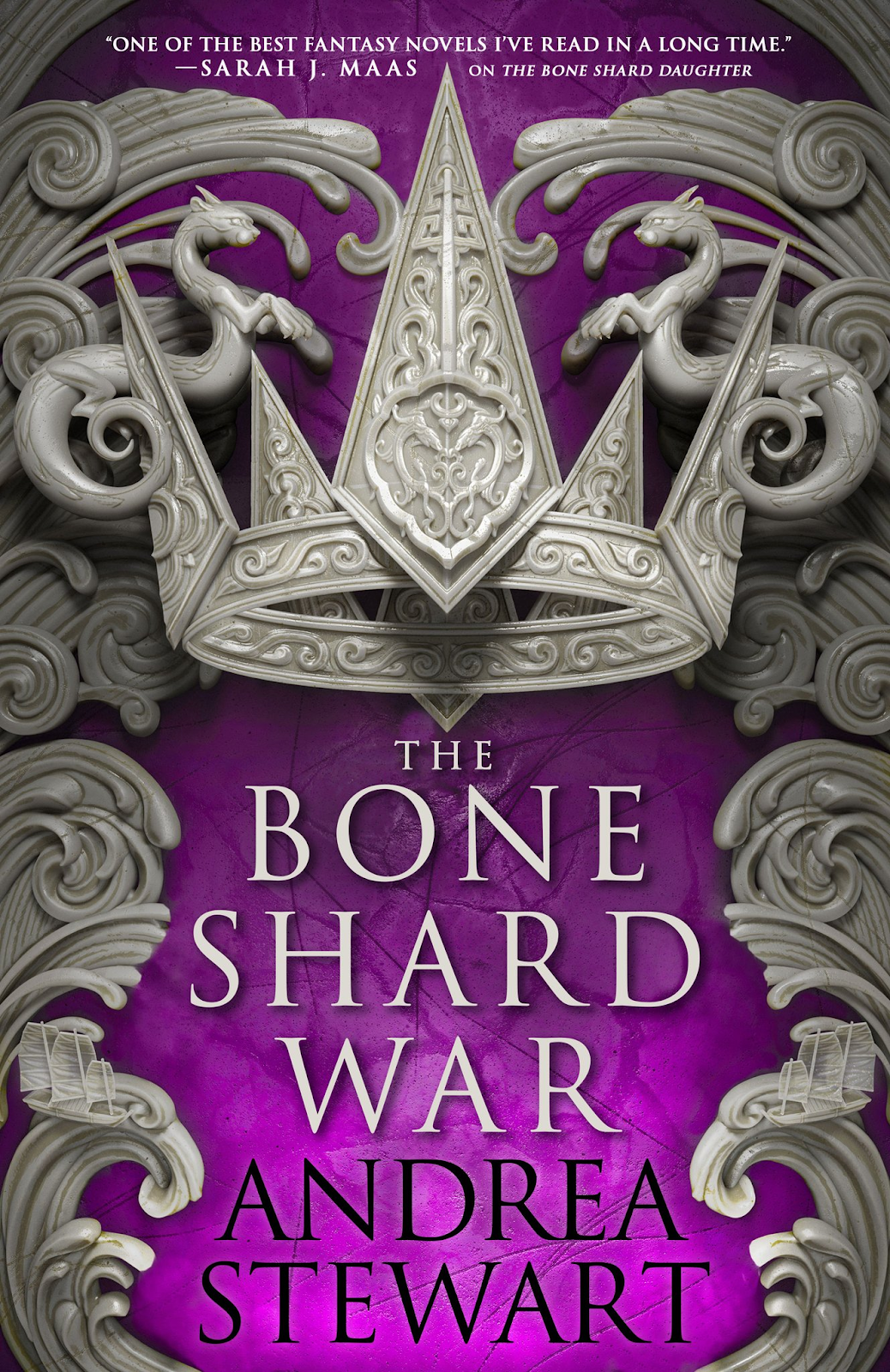
The Bone Shard War by Andrea Stewart also closes out a trilogy (the Drowning Empire) about exploitation and the cost of change, and especially grapples with the question of who ends up on top when said exploitative system is overthrown. It is also, deliciously, about earnest but silly youths in love, who are being kept apart and even forced into betrayals! At this end of the Drowning Empire, the brutally high cost of bone shard magic isn't as viscerally present, and that feels like a bit of a loss despite the emergence of new magics and the rediscovery of how this world functions, and (relatedly) what those cute animal companions that the main characters picked up have been about this whole time. While it has its ups and downs, this is a cool trilogy by an author I hope to see even better things from in future.

Book three, but not a series ender, The Mystery of Dunvegan Castle by T.L. Huchu is part of the Edinburgh Nights series, and while I'll forgive this year's Hugo voters for not putting it on the best series ballot, my patience on that front is not endless (nor will the series be). These books are the chronicles of Ropa Moyo, a highly motivated Zimbabwean-Scottish teenager who is offered entry to a prestigious occult library... as an unpaid intern. This time, Ropa's aspirations and hustle come fully up against the barriers placed in her way, and this series does a great job of showing how institutional racism and classism are perpetuated not just by bigots in the institution, but by people who limit their allyship or try to offer "meritocratic" entry points rather than fighting the corner for marginalised people. It's an interesting shift for Ropa—who, to this point, has been a bit naive about her circumstances and whether she can just push through them—and it makes me even more eager to see what book 4 brings.

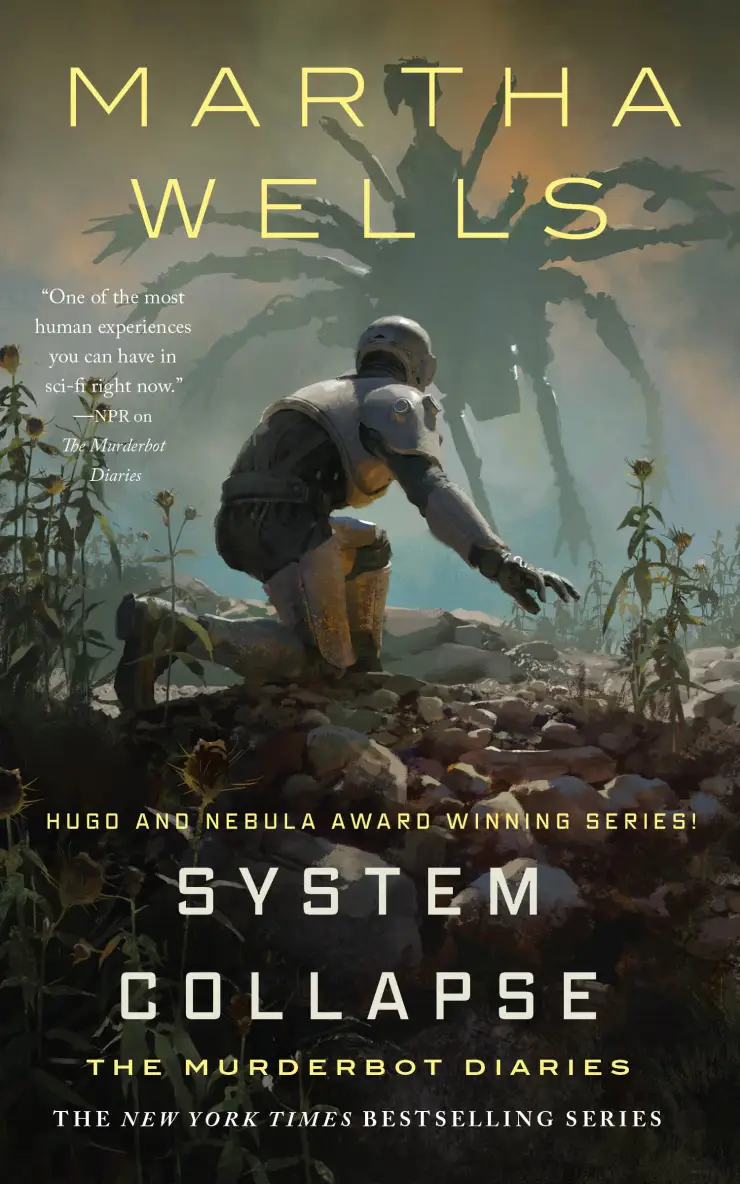
System Collapse by Martha Wells. The second Murderbot novel feels structurally closer to the novellas than the previous Murderbot novel, and at this point the recommendation is "if you like Murderbot, you'll like this Murderbot." Unlike the rather static-feeling Fugitive Telemetry, System Collapse does push things onwards from Network Effect in an interesting way, both literally (conflict de-escalation through documentaries!) and in Murderbot's character development and how it narrates its story. We quickly learn that Murderbot is not working at full capacity, and that it is keeping something from us about how this happened, and while the reader is used to the quirks and selectiveness of Murderbot's narration, this withheld information immediately puts the reader off balance, adding an extra layer of tension to both the conflicts and the crew relationships that are both staples of this series. Of course Murderbot and friends save the day with the power of love and justice—not that Murderbot itself puts it quite that way.

The Ten Percent Thief by Lavanya Lakshminarayan wasn't a Subjective Chaos Award winner this year, but it was an interesting addition to a stacked ballot. This mosaic novel, centred around a future Bangalore now known as Apex City, shows us the ins and outs of a society where citizens are constantly tested against the "Bell Curve". The city's residents are constantly striving - through conspicuous displays of capitalist productivity - to be promoted to the super-privileged ten percent, and to avoid deportation outside the city to join the "Analogs", who are treated as sub-human and denied basic ameneties by a city that nevertheless relies on them for its continuation. Through the novel, we see both confident Virtuals and those barely clinging on inside the system, as new technologies create further alienation; we also see, though not with as much depth as I would like, the way in which Analogs are organising themselves to resist and overthrow their oppressors. It didn't add up as well as I wanted it to, but there's a lot going on here for readers to enjoy, especially if you like Black Mirror-esque technological absurdities and the overthrow of transparent dystopias.

Untethered Sky by Fonda Lee was just beneath the Hugo finalist cut-off this year, and it's a very well-crafted fantasy novella: Ester's story has a strong thread of revenge, but there's also more going on: her progressing in her vocation as a rukher to a roc named Zahra, the relationships she builds with her comrades (and her bird), and the strains of being part of a military campaign whose political and propaganda motives seem at odds with actually making the Kingdom safer. Untethered Sky does suffer from the "author of incredible thing (Green Bone Saga) goes on to write pretty good thing" but it works great. 

The Lies of the Ajungo by Moses Ose Utomi is an incredible book, and somehow it's not on the Hugo longlist, but it is on the Ignyte novella shortlist so we can celebrate that recognition at least! The best thing about this story is its worldbuilding, which feels like it's come straight out of a fable: the protagonist comes from the "City of Lies," which has made the terrible bargain to cut the tongue out of every adult resident in return for an annual allocation of water from the Ajungo. This, of course, means that its residents can no longer tell their own story, and that their own history is now in the hands of their oppressors. When almost-13-year-old Tutu leaves the city in search of water to save his mother, he somehow avoids the disappearance that has befallen every other child who has left, and instead he finds out the truth behind the Ajungo's conquests and where his city falls within it. Amazing stuff.

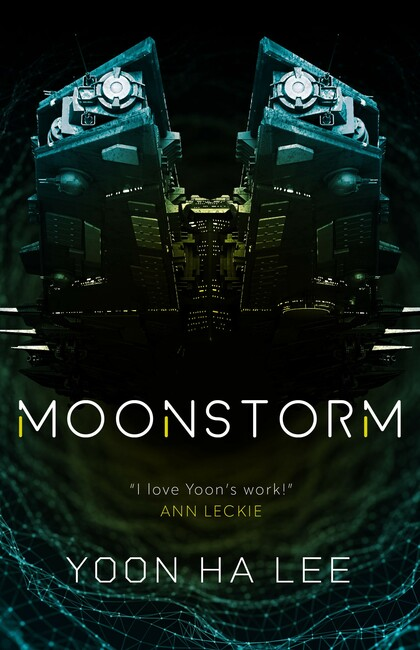
Finally, Earth-space adventure Beyond the Hallowed Sky by Ken MacLeod, fantasy adventure The Wolf of Oren-Yaro by K.S. Villoso, and mecha-YA Moonstorm by Yoon Ha Lee are all series openers which fall into the "fun, but probably not reading on" category for me—a category which I need to be more firm in maintaining, as the list of books gets bigger and my time on this Earth grows shorter (fatalistic? me?) I did enjoy MacLeod's speculation of near-future superpower blocs, especially the split between Anglophone death capitalism and optimistic-but-also-vaguely-sinister European socialism; and The Wolf of Oren-Yaro did not disappoint with its main character's Bitch Queen credentials, but had me shrugging at its relative cliffhanger ending rather than rushing to download the second book. Moonstorm, I am simply not the target audience for, and that's OK! I think this is a great contender for the Lodestar list, especially since books by authors who have also been nominated for adult SFF do very well there, and I hope that this story of giant robots, terrible empires, friendships, rivalries and betrayals IN SPACE finds each and every one of its people.


Adri, Nerds of a Feather co-editor, is a semi-aquatic migratory mammal most often found in the UK. She has many opinions about SFF books, and is also partial to gaming, baking, interacting with dogs, and Asian-style karaoke. Find her on Bluesky at adrijjy.bsky.social.

Tuesday, June 25, 2024

Quick round: My recent readings

What a time to be a nerd. These days it looks like people from everywhere are producing an endless wealth of speculative fiction, and my ever-growing TBR pile has become an ominous reminder of the finitude of life. And yet, all through recent months, I've managed to steal a few minutes here and there to catch up with the interesting titles I've come across. Here's a quick round of things I've been reading up to this point in the year:

The Lies of the Ajungo by Moses Ose Utomi
(Tor, 2023)

For generations, in exchange for desperately needed water, the City of Lies has been forced to pay the Ajungo Empire with the tongues of its people. But one child risks going on a journey across the desert, hoping to find water elsewhere. The story unfolds with the texture and cadence of ancient myth, even as it deals with the quite modern evils of state propaganda, predatory trade agreements and the suppression of dissident voices. Of particular merit is the characterization of the protagonist, whose growth from nothing to people's paragon follows a natural emotional progression. Within the limited size of a novella, the author finds space to speculate on the ways that the deeds of flesh-and-blood people can become part of a community's traditional tales and, eventually, end up joining the ranks of mythical heroes.
Nerd Coefficient: 7/10.
The Last Dreamwalker by Rita Woods
(Forge Books, 2022)

Every third daughter of a third daughter in this lineage of Black women can visit other people's dreams and influence their actions via their subconscious. A catchy premise, but one the novel doesn't develop much. While the author takes care to show the inherited pain of this family, especially in chapters set centuries in the past, the story moves too slowly and the conflict lacks intensity. The protagonist has just buried her mother and learned that she's inherited a house in South Carolina. From then on, most of the wordcount is used in creating a grounded picture of the Gullah landscape, climate, language, rhythm of life and customs, which isn't without literary merit, but what is supposed to be the plot (a lifelong resentment between relatives) barely happens at all, and its resolution lands without impact.
Nerd Coefficient: 4/10.
Food for Thought by Ariana Ferrante
(Brigid's Gate Press, 2023)

Limos is the goddess of drought, barrenness, starvation, and withering. Demeter is the goddess of agriculture, fertility, abundance, and blooming. They have always been opposite forces: the hunger and the feast, need and satiation. Divine decree forbids them from ever meeting, because no one knows what disaster may result from their contact. Will desire and satisfaction annihilate each other? Or will something more interesting happen? In this little book, the myths of Erysichthon and Persefone are retold from the point of view of Limos, to whom mortals pray only when they have an enemy to destroy. Through her burgeoning obsession with Demeter, she discovers that even the all-giving mother of crops can yearn for things she can't give to herself. Luckily for both, Limos knows all there is to know about unmet wants.
Nerd Coefficient: 6/10.
Sunflowers Rise in a Midnight Sky by Avery Davis, illustrated by Tang Wei
(self-published, 2024)

In this fantasy poem, accompanied by drawings made with delicate sensibility, what is merely imagined in dreams comes to life. Purple grass, purple cows, winking shadows, polka-dot flowers, cats that tell jokes, trees that dance, ladybugs wearing lipstick, violinist birds, frozen water that turns into cake, gigantic lollipops, flying popcorn, mutable words, spiders made of diamond, mermaids that sleep on seaweed, dancing berries, tunnels made of water... all in the span of one night. Reality opens a brief door to impossible wonders until the sun rises again. Even the adult reader will be charmed by this exuberance of childlike fancy.
Nerd Coefficient: 7/10.
Nature Fights Back, edited by Nikki Mitchell
(self-published, 2023)

From five-eyed rabbits to all-devouring storms to city-sized snails to robot-worshiping birds to armies of walking fish to forests capable of holding really long grudges, this charity anthology of short fiction enumerates the grievances our planet could raise against our irresponsible ways and then relishes in the description of each form of vengeance we deserve to have befall us. As may be expected, many of the stories are set in post-apocalyptic climate dystopias, typically with survivors trekking long distances through the ruins of civilization. The overuse of this image gives the book an air of tedious repetition, sometimes punctuated with a bit too much glee at the skewering of Big Bad humans. This book is best read on those frustrating days when the world seems too broken and your inner misanthrope needs validation.
Nerd Coefficient: 6/10.

The Loneliness of the Abyss by Dimitris Vanellis and Nikolas Kourtis, translated from the Greek by Abraham Kawa
(Europe Comics, 2023)

A Greek legend tells that Alexander of Macedon found an elixir of immortality, but his sister accidentally drank it in his stead. Cursed by the gods to roam the seas forever, she's now a dreadful menace to any sailors unlucky enough to run into her and fail to tell her what she wants to hear. In this stunningly illustrated comic, done in a deliberately limited palette that accentuates the contrasts of tragic emotions, the monster reappears in the present day. What do you do when you meet a legend? Do you feed her delirium to save your life, or do you risk her wrath to seek your freedom? Whichever your choice, remember: tales of the Greek gods very rarely have a happy ending.
Nerd Coefficient: 7/10.
The Quavering Air by Simone Snaith
(Broken Wheel Books, 2023)

More a D&D campaign log than a novel proper, this is the story of a band of heroes recruited from across the known world to fix a cosmic misalignment that has opened a portal through which infernal pests have started an invasion. From what I can guess, there are apparently two planets that must never come into contact, and the key to keeping them isolated is to guard two big clocks that must always remain mismatched. However, the richly evocative worldbuilding is relegated far into the background, because our confusingly named and therefore easily confusable heroes must roll for initiative in almost every chapter. There are tantalizing allusions to the nature of this universe and the various creatures and intelligent beings that inhabit it, but the author was more interested in describing complex (and admittedly well executed) fight scenes than in telling a story.
Nerd Coefficient: 6/10.
The Legend of Charlie Fish by Josh Rountree
(Tachyon Publications, 2023)

In the days preceding the Great Galveston Hurricane of 1900, a psychic girl and her little brother become orphans and must flee an intolerant town. Luckily, they are adopted by a kind man who was passing by. Less luckily, they run into a pair of scoundrels trying to capture a human/fish hybrid they plan to display at a freak show. This novel skillfully immerses the reader into the perspective of a psychic who is too young to process mental content like an entire town's prejudices or a road bandit's murderous intentions or a sapient animal's instinct to rejoin the herd. Apart from some extended and awkwardly placed flashbacks, the main plot covers just a few days in the children's lives, but the brilliantly chosen turn-of-the-century setting was the kind of time when world-shattering change could happen in the blink of an eye.
Nerd Coefficient: 7/10.
The Island by Sean Platt and Johnny B. Truant
(Sterling and Stone, 2023)

What begins as a very interesting surreal allegory for the clashing desires inside the human mind ends up unraveling into a too obvious didactic device. Our protagonist is a widowed father whose shameless infidelities pushed his wife to suicide, and now he's stuck without knowing how to process the guilt he still refuses to admit to himself, or how to keep raising his daughter without hurting her any further. But we only learn all this by the book's midpoint; the beginning is a fantasy tale of two equally powerful gods who don't know why they've been confined to an island to do meaningless, repetitive work for eternity. Turns out this fantasy represents the turmoil in the protagonist's head, but by the time we have the full picture, what follows is the kind of trite, saccharine claptrap you find in the self-help aisle of the bookstore.
Nerd Coefficient: 4/10.
Harlequin Butterfly by Toh EnJoe, translated from the Japanese by David Boyd
(Pushkin Press, 2024)

Proving for the trillionth time that the best stories are those about stories, this short but delightful book quickly proposes several questions to the reader: Can we record the process of learning a language in real time? Can it be done in the same language that is being learned? Is knitting like writing? And if so, is it translatable? Are there books that can only be understood in specific situations, like being on a plane or under a cat? And how can such books be written? By following the shifting and nebulous identities of a nomad writer, a detective of writers, and perhaps a couple more hard-to-identify bystanders, we may catch some priceless ideas the way one catches a butterfly: with a delicate net, preferably one woven from thoughts.
Nerd Coefficient: 9/10.
The Living and the Rest by José Eduardo Agualusa, translated from the Portuguese by Daniel Hahn
(MacLehose Press, 2023)

Like any work of magical realism, it all seems normal enough at first. A literary festival gathers authors from all over the African diaspora on a little island just off the Mozambican coast. As they exchange opinions on writing, publishing, and African identity, a mysterious storm cuts off the island from the rest of the world for days on end. Soon the authors start seeing their characters walk on the street as if they were real people. Time dissolves as if erased by the rain, and some characters find the story of their entire lives, extending even into the future, inside completed novels. It becomes impossible to tell literary inventions apart from flesh and blood, and the difference no longer matters. For all they know, the outside world may as well have ended.
Nerd Coefficient: 7/10.


POSTED BY: Arturo Serrano, multiclass Trekkie/Whovian/Moonie/Miraculer, accumulating experience points for still more obsessions.