Showing posts with label Tia. Show all posts

Tuesday, June 20, 2017

Microreview [film]: Wonder Woman


Wonder Woman opened to much ado, and critics are raving, at least in the SF/F realm, saying Wonder Woman is the superhero you’ve been waiting for, even going as far as to call it a ‘love letter to feminism'. Look, I get it, we’ve been waiting a reeeeeely long time to see a female superhero smash box office numbers, but just because it now exists, doesn’t mean it’s the one.


(Mild spoilers may follow)

The film opens with young Diana, daughter of Hippolyta, the leader of the Amazons, and Zeus (I assume you know who he is), desperately wanting to train as a warrior but forbidden to do so by her mother. Like a good little bad ass, she sneaks out and trains anyway, until her mother finds out many years later and dictates that fine, she can train, but she must be trained harder and fiercer than any warrior before her. The final training scene ends with Diana displaying a show of power she didn’t know she possessed. Shortly after, a WWI plane breaks the protective barrier surrounding Themyscira and Diana (Gal Gadot) rushes out to save the drowning pilot Steve Trevor (Chris Pine). From him she learns that the outside world is involved in a terrible war, and knowing that the god Ares is bound to return to reign destruction, Diana sets out with Steve, against her mother’s wishes, to kill Ares and end the war.

multipass
This is where the movie becomes rather contrived at times. Of course, in the ‘real world’ Diana is the stereotypical fish out of water, and incredibly reminiscent of Leeloo Dallas – beautiful and innocent and guided through society by an obvious love interest, but incredibly fierce and independent at times. And while the initial battle scene at Themyscira was magnificent to watch, the fight scenes throughout the film were far too Matrix-esque, down to the often rubbery-looking Diana. Wonder Woman herself is very sexy, which in and of itself isn’t a bad thing, but the film seemed to be mostly shot from the male gaze, with many upward body shots of Diana in her short armor. This was especially disappointing since the film was directed by a woman.

Overall, Wonder Woman was a decent superhero film. It was flashy and entertaining and Gal Gadot stole every scene she was in. Chris Pine was fantastic as well and the chemistry between the two was a pleasure to watch. I agree with most of fandom when the say it was exciting to see a solo female superhero finally grace the big screen and shatter box office expectations (Wonder Woman wasn't even playing in the Big D, IMAX-like room at my local theater, I assume due to low turnout expectations), and Diana had some great one liners like ‘what I do is not up to you’ directed at Steve Trevor, but it very much falls short of being the female representation we’ve all been waiting for. As my wonderful partner (who is often exasperated by my relentless critique of pop culture) pointed out when the credits rolled, she still needed the man to save the world at the end – just like Leeloo, and Furiosa, and the many other ‘strong female leads’ that came before.

The Math

Baseline Assessment: 7/10

Bonuses: +1 for showing haters that a female led and directed movie can be highly successful, +1 for the few, but great, scenes where Diana's independence is highlighted (e.g., 'what I do is not up to you') 

Penalties: -1 for needing the love of/for a man to recognize her true potential, -1 for the male gaze thing

Nerd Coefficient: 7/10 - an enjoyable experience, but not without its flaws

----
Posted by: Tia  nerds of a feather contributor since 2014

Monday, February 13, 2017

Microreview [TV]: The Expanse

The rare adaption that outshines its source.


SyFy’s The Expanse is arguably the best show on television right now. It’s at least the best science fiction show in quite some time. It is an action packed and nuanced space opera with phenomenal acting and character profiles that has viewers glued to the TV every week. Best of all, it does all of this despite the source material. That is not to say that the book series isn’t good, it is a fun read but is at times rather problematic. The G nicely points out the main problems with the first book in the series in his Leviathan Wakes review, so I won’t reiterate. But the show overcomes many of these issues leading to one of the best on-screen adaptations to date.

Here are some of the areas where SyFy’s The Expanse succeeds as a great on-screen adaption of a series:

1) The Characters: I can’t agree with The G more that one of the major weaknesses of Leviathan Wakes is the characters. This is not entirely surprising to me as I’ve had issues with Abraham's characters before and stopped reading Dagger & Coin because of it. However, the characters are, to me, what makes the show so great. Where author James S.A. Corey gave us meek but supposedly intelligent (I say supposedly because we never really see evidence of it) Naomi, SyFy gave us bad ass, commanding, OPA-involved Nagata. Amos, who is my all time favorite character in the show, comes off as a bloated meat head stereotype in the book, but SyFy and actor Wes Chatham transform him into a multidimensional figure who is fierce and loyal and whose background is seeping out little by little each episode.


Book Holden is almost frustratingly naïve and a horrible captain, but not in that ‘I’m supposed to be a horrible captain because its part of my character arc’ sort of way – he just plain sucks as a captain. In Leviathan Wakes he is constantly buzfeeding raw information across the universe because he thinks that people should know everything that’s going on before even he has a chance to process it. TV Holden still releases sensitive information (once) and does so as a failsafe before he is captured by the Martians. SyFy gave him a believable reason to do this. Thank you SyFy. Even Alex, the swashbuckling pilot who exists solely to fly the ship in the book becomes layered and sympathetic in the show.

Finally, there is Miller. The G states that Miller is just your standard run-of-the-mill grizzled veteran cop, which is true. This is not lost in the show. In fact, Miller was my least favorite show character the first time I watched it, precisely for this reason. I felt that being so one-dimensional he didn’t at all fit with the rest of the cast of characters. The funny thing is though, that Miller turned out to be my favorite character in the book, because in bookverse, the other characters are less dimensional than even he. Oh, and lets not forget Jared Harris as Andersen Dawes. Dawes is a character that gets fleeting mention in Leviathan Wakes, but nearly outshines everyone in the show.

2) The plot: Like any good adaption, The Expanse inserts or ups the drama at times, but somehow (/s) figures out a way to do it without boobs or rape. For example, in the book the survivors of the Canterbury route their shuttle to a Martian ship, a journey that takes many days – whereas in the show they are captured by this ship, prompting Holden to release a statement that Mars may have been behind the attack on the Cant and if Mars kills them then there is your proof - in a sense securing the safety of him and his crew. There was also the decision to overlap Avasarala and Earth politics from Book 2 with the goings on from Book 1, which enables the viewer to better understand what is happening throughout the universe at the time.

3) Pacing. Last but not least, a major nod has to be given to whoever decided on the structure and pacing of the first season. I watched the show first and it blew me away when I read the book to discover that the first season only covers half of the first book. Almost always in adaptions (in fact, I can’t think of an occasion when not), each season corresponds to a book. Often times this results in details or arcs being left out or modified, and usually not for the better (coughgameofthronescough). The brilliant soul who thought ‘you know what, I see a clear beginning, middle, and end here with Eros’ deserves an Emmy. Because not only do you get to keep the integrity of the source material, you don’t have to make shit up (coughgameofthronescough) to keep the story line going through multiple seasons. Bravo.

Overall, The Expanse is an exercise in how to properly adapt a book to screen. It is by far my favorite show on air and I’m excited to see if they can keep it up (looking good so far). Despite how it may sound, I do actually like the books. Perhaps this is because I can infuse the better TV characters over poorer book ones when warranted, but as I continue along reading, the books seem promising.

The Math

Baseline Assessment: 7/10

Bonuses: +1 for Nagata, +1 for pacing and structure, +1 for Avasalara's wardrobe

Negatives: -1 for the slow start

Nerd Coefficient: 9/10 - very high quality/standout in its category

Tuesday, January 10, 2017

Microreview [periodical]: National Geographic Gender Revolution

(read excerpts here)

Gender nonconformity is the major civil rights movement of our time. As members of this and leaders of the next generation, it is so important to become educated on the rapid and radical shifts in societal thinking, regardless of our personal opinions or beliefs. National Geographic, realizing this, developed a special issue to look at cultural, social, biological and personal aspects of gender. Now, as unprecedented (IMO) as this is, it is important to remember that just because a new movement begins, doesn’t mean the old fights are over. Take the cover of the issue, for example. It identifies individuals in a range of gender identities, but somehow neglects to include a female. I am not the first to point this out, and you can read a deconstruction of this and the alternate cover here.

I originally thought this issue would be devoted primarily to developing an understanding of the transgender community. However, it addresses gender across the spectrum which is even more pressing, since shifts in the gender norms effect everyone, not just those in specific communities. The issue opens with a short Q&A with writer and activist Gloria Steinem and author, activist, and tech executive Sheryl Sandberg. I found Sandberg’s commentary more poignant than Steinem’s because it was less existential and more direct, but both had great things to say. The next section of the magazine is a glossary of gender-related terms, developed in consult with scholars of the subject. This is a great and informative section that gives a good background on the foundation of the movement. An even more important section follows called Helping Families Talk About Gender, which is a must read for anyone who interacts with children. I was really excited to read about Girls, Boys, and Gendered Toys but this section takes up less than one half of one page, and only barely touches on issues like that fact that “girls” puzzles have fewer pieces and the girl oriented product line Lego Friends focuses on playacting, not construction. I think this is a really important issue and I’m disappointed to see it given so little space in this Special Edition.

National Geographic Gender Revolution continues on to look at how gender is defined by children and for children. A good excerpt from this section can be found here. The magazine also interviews several nine-year olds to find out how they think their lives might be different if they were a boy or girl. The answers are often disheartening but not at all surprising. We also get a wonderful(ly depressing) infographic on the gender gap index (determined by health, education, economic, and politics) across the world where we see that there is not one country where females are even close to reaching equality with males. The next 25 pages focus on Rethinking Gender primarily among adolescents. This is also a terrific read for parents or anyone who interacts with children because it fosters understanding of how children and adolescents are defining their gender identity in today’s society, where terms like gender nonconforming are replacing terms like tomboy, and how to help children and adolescents navigate this already confusing time in their lives when they are expected to balance personal feelings with societal pressure.

We next get an exposition on defining masculinity and then a rather lackluster section on females. Tucked away at the end of the magazine, the section devoted to women takes up 50 pages, 30 of which are photographs. Now, this is more space given to females than males, but the discourse on masculinity, particularly men in western society, is much more nuanced. The American Girl section is given 6 pages of text, all 6 of which are devoted to body image. In highlighting body image as the most important cultural issue among females in today's western society, National Geographic is essentially still contributing to the problem by implying that body image is the only thing important to women. Of course, body image is an important issue that girls in the US and other western cultures face, but it is not by any means the only one. There is no analysis of other primary female gender-related issues in today’s society like wages, education, politics, workplace dynamics, etc, except for the aforementioned infographic and another pictorial noting international statistics and titled: It’s Hard to Be Female -- but there is no exposition on what that actually means.

Overall, I commend National Geographic for devoting an entire issue of their iconic magazine to this important discourse. I wasn’t able to find any good statistics on their reader demographic, but I presume there were more than a few subscribers who were shocked to see this in their mailbox. I hope they read it, and honestly, I hope you read it to. As I’ve said numerous times, many sections of this edition are must reads for anyone who interacts with children, as the cultural landscape is shifting so rapidly in terms of defining gender. I think it’s a great thing, personally, I just hope that the existing gender problems don’t become overlooked as we expand into a new era. However, if we can achieve a gender nonbinary society these gender-based differences should cease to exist all together.

The Math

Baseline Assessment: 9/10

Bonuses: +1 just for creating this special edition, +1 for examining gender throughout the spectrum

Penalties: -1 for leaving a female off the cover, -1 for not further exploring the influence of gendered toys on children, -1 for reducing the primary discussion on female gender in western society to body image

Nerd Coefficient: 8/10 'well worth your time and attention' primarily because it exists, but don't forget about it's flaws

------
PS's:

National Geographic provides a downloadable discussion guide for parents and teachers if you are interested in more information.

You can buy the magazine online or anywhere where National Geographic is sold. I got mine at Costco for $4.

There will be an accompanying TV program airing on Feb 6 at 8/7c on the National Geographic channel. You can see a sneak peak here.

---------
POSTED BY: Tia


Friday, December 30, 2016

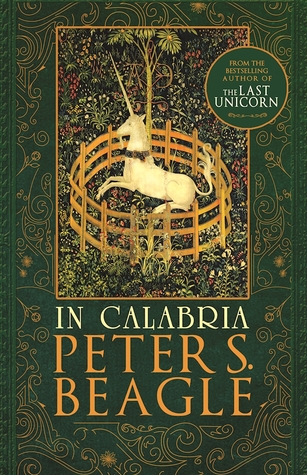
Microreview [book]: In Calabria by Peter S. Beagle

A modern day fairy tale...

Image result for in calabria peter s beagle

In Calabria is a romantic novella set in modern day Italy. It tells the story of Claudio Bianchi, a middle aged man who lives alone on his farm in pastoral Calabria, purposefully isolated from much of the modern world. The majority of his human interaction comes from the mail carrier, who braves Bianchi’s dirt road every day, and the mail carrier’s younger sister Giovanna who is learning the ropes. Bianchi finds friendship primarily with his animals, many of whom are as grizzled and curmudgeonly as he, until one day a magnificent unicorn appears on his property and changes his life forever.

Bianchi suffered a great loss many years ago and has since secluded himself on his farm, with no company except his dog, cats, goats, and cows. But it becomes clear to him that this unicorn did not choose his land at random, and that heavy with a colt she will need him as much as it turns out he needs her. Eventually, reality and the times come crashing down Bianchi’s door, but he handles it poised and stoically, waiting for it all to pass. Bianchi’s life becomes even more complicated, though, when an unlikely friendship develops into something more, spilling over all the emotions the unicorn has brought to his surface.

If this story sounds like a fairy tale, that because it is in a way. It is truly a romantic tale of love and loss and how hope never really abandons us. The animals as characters are phenomenal, especially given how Beagle builds their personalities solely through their actions and Bianchi’s reactions to them (no talking animals here). I feel obligated to comment on the stark age difference between two of the characters who become romantically involved, but honestly, it doesn’t bother me because both parties acknowledge it and choose to proceed anyway. Because really, age ain’t nothing but a number… it is situations where actresses are told they’re too old to play the love interest of someone in their own age bracket when there is a problem, for example.

The Math

Baseline Assessment: 7/10

Bonuses: +1 for characterization of the animals, +1 for the use of Italian colloquialisms that squeezed my heartstrings
Penalties: -1 very picky here, but I found the novella a bit slow a times

Nerd Coefficient: 8/10 "well worth your time and attention"


------
POSTED BY: Tia    nerds of a feather contributor since 2014

Tuesday, December 20, 2016

Holiday Gift Guide: Gadgets, Electronics, and Apps


It's that time of year again, where we struggle to buy the perfect gift for that special [fill in the blank] in your life. This year, the Nerds of a Feather, Flock Together crew is teaming up to bring you their favorite books, toys, entertainment, and gadgets, etc. to help make the process easier.

Stop by each day this week to see our suggestions.

Today...Gadgets, Electronics, and Apps!

The G: "For the solitaire lover in your life"


For me to play a game on my phone, it needs to essentially be some form of solitaire--the kind of thing you can play in 5-10 minute sessions, doesn't require much concentration and, as such, lends itself to endless replay while waiting for person X to arrive or event Y to start. But I also want something more than just solitaire, and that's exactly what Card Crawl provides. It's fantasy-based with addictive gameplay and a reward system that lets you trade in points (accrued by success and not by in-app purchases) for special cards. And the game itself is both simple and deep. Basically, there are five kinds of cards: monsters, which hurt you; swords and shields, which hurt monsters; potions, which heal you; coins, which give you points; and special cards, which can do all sorts of fun things. The trick is trading in as many swords, shields and potions as possible for coins, but so many that you can't survive a hand full of monsters. It's a lot of fun. And free! (Available for iOS and Android.)


Tia: "For the not really a morning person in your life"


Chances are you've stayed up way too late reading or playing video games (or maybe even doing something responsible like homework or caring for a child) and have struggled to get out of bed the next morning, hitting the snooze button numerous times. Or, perhaps you're one of the unfortunate souls that must rise in the dark, before the sun has reared it's beautiful head. Personally, I used to have 6 alarms set on my phone in various increments and would often sleep through many of them and then awake startled at one of the awful sounds. Welp, that dragon has officially been slayed and my magic weapon is the Phillips Wake Up Light. It's not a miracle worker mind you, but I no longer need alarms on my phone and I now often awake before the soft subtle beep that this golden egg exudes. The reason is the sunrise simulation the device offers. Around half an hour before the alarm is set to go off, the Wake Up Light starts gradually brightening to prepare your body for waking up the natural way (triggering your circadian rhythm), and by the time the beep sounds you are already almost fully awake. Now, I don't wake up singing and am still tired in the morning, but it is no longer the vicious battle of slapping my hand around my night stand to silence whatever evil demon is screaming in my ear. There are many different models to choose from but I just went with the bottom of the barrel and it was the best money I spent in a really long time. I purchased this as a gift for my brother this year (who also inherited the 10 phone alarm gene) and I recommend you get one for yourself and any other non-morning person in your life.


Brian: "for the too-connected homeowner in your life"


Gogogate2 by Gogogate

I got a Gogogate 2 to solve a dumb problem, but it turned out to be really neat. It allows you to control and monitor your garage door (among other types of outdoor gates) via your smartphone. It connects directly to your garage door opener and wifi network. With some setup, you connect it to an app on your smartphone, slap a sensor on your garage door, and now you can see on your smartphone whether it's open or close, and then open or close it. Big deal, but you can also allow remote access (using strong passwords, obvs), and now you can check on your garage door, open, or close it from your smartphone anywhere. No more sharing your garage door code with family or friends, you can just open and close it for them from your phone! It can be configured to send you alerts when your garage door is open for more than 10 minutes, or whenever it opens or closes. You can also do neat (dumb) things like tie it in a roundabout way to an Amazon Echo and now you can open and close your garage door using just your voice! I wouldn't necessarily call this a "fun" device, but it does useful things and I never fail to enjoy opening my garage door from a block away with my phone.


Joe: "For lovers of calm and beautiful games"


After recommending Prune last year, I'd like to recommend another mobile game. Originally released in 2014, Monument Valley is a beautiful and quiet game filled with puzzles featuring optical illusions and manipulation for the player to find their way through the paths blocked by weirdly creepy crow people. Monument Valley is a touch on the short side and it's not the most difficult of games, but it is a fun and calming piece of art.

Friday, November 25, 2016

Microreview [film]: Fantastic Beasts and Where to Find Them


Fantastic Beasts and Where to Find Them is the latest installment in J.K. Rowling’s Wizarding World. Written and produced by her, it follows Newt Scamander (author of the textbook of the same name) as he travels to New York City in the 1920s with a case full of magical creatures. In America, like in Britain, wizards are in hiding under the Statute of Secrecy, but here they fear persecution from groups like the Second Salemers, who believe witches should be burned or flogged. Magical beasts are banned in NYC but when Newt arrives something magical is already terrorizing the city. As you can imagine, bringing a suitcase full of magical creatures into a big city could be a recipe for disaster and as expected, some of the creatures escape.

The character development in the film is quite good, for the main characters at least. I think credit in this right goes equally to Rowling and the actors who play these characters. Eddie Redmayne in particular is wonderful as Newt Scamander. He is humble and funny and caring, and fierce when he needs to be. Queenie is my second favorite, and she fits into Rowling’s m.o. of having ‘beautiful’ female characters be more complex than traditional media usually allow.

All that said, there is a certain magic missing from the film. The sense of wonder and awe is just not the same with the Harry Potter series, and I think a lot of that is due to the fact that this is a story told only through film. I read (and listen to) the Harry Potter series very frequently and that sense of wonder and magic is always there, no matter if it’s the first or hundredth iteration. Rowling's writing in Harry Potter proper is so charming and much care is given to minutia. A lot of that is lost in this film translation. For example, there are a few glaring continuity issues. Newt spends the first quarter of the film trying to catch a niffler, which is cute and fun and all, but he could have easily caught it in three seconds with a summoning charm. And also, I’m pretty sure you need to have a wand to apparate, even side-along, and I can't believe that it’s possible to apparate with a muggle. 

The overall story is also quite contrived. That’s not to say that the Harry Potter series didn’t follow known story telling tropes, but Fantastic Beasts is highly predictable throughout and the climax and resolution feel like an afterthought.

There is one thing though that really makes you appreciate film as the medium for this story, and that is Newt's case. I was a bit disgruntled up to this point, missing the magic and feeling a bit bored by the story, despite Redmayne’s stellar performance, but then we get to see inside Newt’s case.


The case reminds me a lot of Hermione’s purse, and Newt reminds me a lot of Hagrid, and there is an erumpent, which makes me think longingly of Luna and her father and that all makes my heart smile. But I miss reading about the wizarding world in book format. I just do. While there are some writers and filmmakers who can bring that wonder and hidden detail alive in film, Fantastic Beasts just isn't there. I’m sure there are hidden treasures to be discovered upon multiple viewings, but the problem is, I have no desire to see this film again. While it was entertaining for sure, nothing about it grabbed ahold of me or left me wanting more.

The Math

Baseline assessment: 7/10

Bonuses: +1 for Redmayne’s performance, +1 for the case

Negatives: -1 for the uninspiring ending, -1 for the lack of wonder

Nerd Coefficient: 7/10 - an enjoyable experience, but not without its flaws

----
POSTED BY: Tia  Harry Potter fanatic first, everything else second, and nerds of a feather contributor since 2014

Reference: Fantastic Beasts and Where to Find Them. dir David Yates. written by J.K.Rowling

Thursday, November 10, 2016

A Message From The Hogwarts Sorting Hat

Illustration: Jim Kay

In times of old when I was new
And Hogwarts barely started
The founders of our noble school
Thought never to be parted:
United by a common goal,
They had the selfsame yearning,
To make the world's best magic school
And pass along their learning.
"Together we will build and teach!"
The four good friends decided
And never did they dream that they
Might someday be divided,
For were there such friends anywhere
As Slytherin and Gryffindor?
Unless it was the second pair
Of Hufflepuff and Ravenclaw?
So how could it have gone so wrong?
How could such friendships fail?
Why, I was there and so can tell
The whole sad, sorry tale. 
Said Slytherin, "We'll teach just those
Whose ancestry is purest."
Said Ravenclaw, "We'll teach those whose
Intelligence is surest."
Said Gryffindor, "We'll teach all those
With brave deeds to their name,"
Said Hufflepuff, "I'll teach the lot,
And treat them just the same." 
These differences caused little strife
When first they came to light,
For each of the four founders had
A House in which they might 
Take only those they wanted, so,
For instance, Slytherin
Took only pure-blood wizards
Of great cunning, just like him,
And those of sharpest mind
Were taught by Ravenclaw
While the bravest and the boldest
Went to daring Gryffindor.
Good Hufflepuff, she took the rest,
And taught them all she knew, 
Thus the Houses and their founders
Retained friendships firm and true.
So Hogwarts worked in harmony
For several happy years,
But then discord crept among us
Feeding on our faults and fears. 
The Houses that, like pillars four,
Had once held up our school,
Now turned upon each other and,
Divided, sought to rule.
And for a while it seemed the school
Must meet an early end,
What with dueling and with fighting
And the clash of friend on friend 
And at last there came a morning
When old Slytherin departed
And though the fighting then died out
He left us quite downhearted.
And never since the founders four
Were whittled down to three
Have the Houses been united
As they once were meant to be. 
And now the Sorting Hat is here
And you all know the score:
I sort you into Houses
Because that is what I'm for,
But this year I'll go further,
Listen closely to my song: 
Though condemned I am to split you
Still I worry that it's wrong,
Though I must fulfill my duty
And must quarter every year
Still I wonder whether sorting
May not bring the end I fear. 
Oh, know the perils, read the signs,
The warning history shows,
For our Hogwarts is in danger
From external, deadly foes
And we must unite inside her
Or we'll crumble from within
I have told you, I have warned you....
Let the Sorting now begin.

- J.K. Rowling, Harry Potter and the Order of the Phoenix  

Tuesday, November 1, 2016

Microreview [book]: The Librarians and the Lost Lamp by Greg Cox

“The history of Iraq is the history of mankind.”


It’s no surprise that I am a big fan of TNT’s The Librarians. Sure, it’s campy in that 90's A Kid in King Arthur’s Court kind of way, but it is self-aware and constantly pushing boundaries. The kick ass military Colonel tasked with guarding the lives of the Librarians is none other than supermodel Rebecca Romijn. The math wiz is also female and the art and humanities expert is rough and tumble cowboy. There was even one episode where Cassandra was transformed into prince charming, with women swooning over her left and right. Needless to say, when the opportunity arose to read Greg Cox’s The Librarians and the Lost Lamp, based on the show, I couldn’t resist.

From the start, reading this book is like watching an episode of the show, and Cox absolutely nails the feel of the setting and the characters. The story jumps around in time between a Flynn mission in 2006 and a today mission with the present day Librarians. Both missions involve tracking down Aladdin’s lost lamp before Ali Baba’s Forty Thieves (a.k.a. The Forty) find it. There are flying carpets, famous book fragments, lost tombs, and everything else you would expect from a campy magical artifact retrieval tale. The book is fast paced and very well written, and can definitely satisfy a rainy weekend, despite being completely predictable (think Indiana Jones and the Last Crusade).

Now, there are plenty of mysterious, lost, and rumored magical artifacts to choose from for all walks of culture. But at a time when even mentioning the Middle East raises taboo flags, and those from there are being shunned and discriminated against by many in Western society, Cox and the Librarians chose to write about Middle Eastern mythology. Flynn’s story begins with him arriving in the Baghdad Green Zone in 2006, to investigate a raid on the National Museum of Iraq where a priceless artifact, the oldest known copy of Arabian Nights, was stolen. The museum curator he meets with is female, and her danger is real as she is almost abducted on her way home for having stopped to by some spices at the market. As I read about her and Flynn trying to hide from the Forty in the Green Zone while military helicopters roved overhead, and them eventually being smuggled to Iran in search of lost pieces of Islamic culture, I couldn’t help but think how poignant it is that this topic was chosen. It would have been easy and safe to write about the Librarians searching for Aphrodite’s magic girdle or one of the hundreds of other magical objects of Western culture, but Cox and The Librarians, never ceasing to push societal boundaries, chose to remind us that “the history of Iraq is the history of mankind”, which is something we should never forget.

The Math

Baseline Assessment:  6/10
Bonuses:  +1 for being a fast and fun read, +1 for continuing to push boundaries
Negatives:  -1 for complete predictability
Nerd Coefficient:  7/10 "an enjoyable experience, but not without its flaws"

---
POSTED BY: Tia  lover of campy mythology tales and nerds of a feather contributor since 2014

Reference: Cox, Greg. The Librarians and the Lost Lamp [Tor, 2016]

Friday, October 7, 2016

Microreview [book]: That Night Alive by Tara Deal

A perfect amalgamation of poetry and prose


Each year, Miami University Press holds a novella contest that is open to anyone wishing to submit an 18,000 -14,000 manuscript of original fiction. The winner receives some cash, a standard contract, publication, and 10 copies of the book. It’s a pretty sweet deal. I recently reviewed the 2014 winner, Fountain by Tote Hughes and was really impressed by its imagination and execution. This year’s winner That Night Alive by Tara Deal, is no exception.

That Night Alive exists in a seemingly post-apocalyptic world. We see it through the eyes of our narrator, a crypto-journalist diagnosed with a deadly disease. However, the novella is not about her crypto-journalism, rather it is about her waiting for her prescribed date of death and reflecting on her life and career. But it is not a somber tale either, and in fact has no traditional plot or arc as readers are used to. It jumps around in space and time as the narrator looks through a collection of paint chips and remembers her former cities and apartments, as well as the writing she never really finished. It is, essentially, a recollection of experiences and thoughts that define this character we know we will soon have to part with.

The novella reads as a perfect amalgamation of poetry and prose. This is not easy to do, but Deal does it very well. One of the things I loved most about the 2014 winner, Fountain, was the ambition and execution. Many authors take on imaginative and ambitious projects, but only the great ones can pull it off. Like Tote Hughes, Tara Deal is able to accomplish this and then some. She takes a story which has no traditional plot arc so to speak, writes it as poetry, and keeps you engaged until the end, where you are left with a bittersweet sense of longing.

The Miami University Press novella contest should definitely be on your radar. I have read two of the winners so far and have been doubly impressed with the imagination, ambition, execution, and artistic merit of these books. It is great to see an organization give worth and reward to literary artists outside of the mainstream.

If you like poetic prose, you should read That Night Alive by Tara Deal. You will not be disappointed. You can buy it from the publisher here (also available on Amazon and B&N).

The Math

Baseline Assessment: 6/10

Bonuses: +1 for successful combination of poetry and prose, +1 for unique and successful story with no arc

Penalties: none

Nerd Coefficient: 8/10 well worth your time and attention

---- 
POSTED BY: Tia  Nerds of a feather contributor since 2014

Reference: Deal, Tara. That Night Alive [Miami University Press, September 20, 2016]

Monday, September 12, 2016

We Rank 'Em: Star Trek TV Series


It goes without saying that Star Trek is one of, if not the, most influential franchises of all time. In celebration of the 50th Anniversary of the first episode, the team here at Nerds of a Feather put our heads together to determine the all time best Star Trek TV series. Naturally, no one person rated the series the same, so we resorted to our trusted group rating system, where we each rank to our liking and then take the group average.

6. Enterprise

Enterprise is no one's #1
- This is not Star Trek. There is no better world offered here, just a hodgepodge of the worst of the previous Treks: arrogant and paternal white dude captain, thin moralizing of us vs. them total war, confusing time travel bullshit, and a twist ending that...did not work in the slightest. This was the wound that killed Star Trek as I knew it. (Charles)

- Deeply flawed but finally found a soul in the fourth season, just in time to get canceled. I can't recall much of the series, but I'll never forget that it started the fourth season with alien nazis and that's when it started to get really good. It had the absolute worst opening theme. (Brian)

- Overall: 0/10. This is one of the worst shows ever. Bonuses: None. Penalties: ALL THE PENALTIES. IT IS THE PREQUELS OF STAR TREK. (Dean)


5. The Animated Series

TAS is no one's #1
- I know that limited animation (cost- and time-saving shortcuts, familiar from shows like Scooby-Doo: Where Are You?) isn't for everybody. But the original cast in stories that are at least as solid as an average TOS episode makes me tremendously happy. And the flashes back to Spock's youth in the episode "Yesteryear" I think formed the basis for a lot of the flashbacks in the 2009 STAR TREK reboot and at least one lyrical reference in a Weezer song, so consider me a fan. (Vance)

- I wish I had a cartoon like this growing up. It has not aged well at all, but the crew is all there (plus some interesting additions) and the adventures are pulled directly from the Original Series. While it doesn't stand well on its own, it has some big names attached to it and it certainly keeps the spirit of the Original burning bright. (Charles)


4. Voyager


Voyager is Dean's #1
- Overall: 7/10. I love Voyager because it is basically a pure adventure with great characters. Bonus: +1 for Janeway. (Dean)

- In the nature of Star Trek, Voyager embraces diversity in its cast. What stands out most to me are the female characters in more traditional male roles, like Janeway the captain and B'Ellana the chief engineer. I recently re-watched an episode the dealt with pregnancy and childbirth. Relatability is important in genre TV, and Voyager's diverse cast and overall premise - feeling trapped and lost but not giving up hope - is relatable to many. (Tia)

- This show took a complex political situation and then shot it to a remote corner of the galaxy, surrounded by deadly enemies. The hook was brilliant, and yet some of the complexity Trek was known for fell away in favor of looking at what these people would do to survive and to get back home. (Charles)


3. The Original Series

TOS is Vance's, The G's, and English Scribbler's #1
- There is some cognitive dissonance for me here because I don't think TOS is the best Star Trek show, but it is my favorite. I remember seeing WRATH OF KHAN in the theater, and I was only four years old when that came out, so Kirk, Spock, Bones, and the original crew simply are Star Trek to me. The hits on this show are some of my favorite sci-fi stories ever, even though the lows are just terrible. But "City on the Edge of Forever" more than makes up for "Spock's Brain" and "The Way to Eden." (Vance)

- The original boasted a delightful dynamic between Kirk, Spock, and Bones, with some episodes and a vision of the future that were revolutionary at the time. To say that the series has aged well, though...some episodes have, and some have most certainly not. (Charles)

- Watching TOS is like reading classic literature. At times the plot doesn't hold up well but hearing "to boldly go.." is like reading "wherefore with thee came not all hell broke loose." The dramatic acting is my favorite part of the show. It has the passion and feel of an old time movie and surprisingly deep themes and dialogue. And okay, I'll say it: Kirk is dreamy. But those pants. I just can't handle the pants. (Tia)

- It's the groundbreaking start of the franchise. The highs are very high, but the lows are real low. It's not the most even series, but it's still a classic. (Brian)

- Overall: 6/10. Bonuses; +1 maybe hindisght, but for doing what it did for SciFi. Penalties: -1 for only being OK when you really watch it. (Dean)

(It's worth noting that the difference in ranking averages between DS9 and TOS was one tenth of a point.)

2. Deep Space Nine

DS9 is Tia's and Charles' #1
- This show, more than any of the others, pushed the boundaries of how Star Trek could be told, spinning vast mythologies and character arcs that paid off in tremendous ways while weaving episodic mysteries and series-spanning storylines. It stripped away the pearly veneer of the Federation and yet still made it something worth fighting for, something worth dying for, in ways that I never felt the earlier shows managed to capture. Still my favorite show of all time. (Charles)

- I love DS9 so much because it feels different than the other Star Trek Series while still feeling like Star Trek. I really like the space station dynamic which gets us off the bridge and into the lives of civilians, but we still get the traditional upper level Star Fleet characters too. Bonuses: +1 for POC captain, +1 for Dax. (Tia)

- It broke the mold by focusing not on a ship, but a space station and the incredibly diverse group inhabiting it. It also escaped the episodic nature of all other series. (Brian)

- Overall: 6/10. Babylon 5 is the best show ever, and I love DS9 because it feels a lot like Babylon 5. That doesn't sound like the praise I quite mean it as, the trade and politics of the show are great. Bonuses: +1 for being brave enough to depart the standard formula. Penalties: -1 for just kind of being there sometimes, -1 for the cast not always being strong. (Dean)

- If I needed to recommend this show to anybody, I would simply have to tell them about the episode "Trials and Tribble-ations," and I think the show's greatness would be self-evident. (Vance)

1. The Next Generation

TNG is Brian's, Shana's, and Jemmy's #1
- Best crew, best stories, best ship. This is my generation's Star Trek for a very good reason. I rewatch it yearly. (Brian)
- Aptly named, this show took much of the promise of the original and offered more characters, more complexity, and a more vibrant and connected universe (and it lasted for more than three seasons). So much was established in this series, and yet it often suffered because of its strictly episodic structure and its unwillingness to question certain key problems with the Federation. (Charles)

- This was the series I grew up with on TV, and I readily admit it's a better show than the original. The crew is fantastic, the inclusion of Worf on the Enterprise speaks to the welcome optimism of the Star Trek universe, and I have never not wanted a holodeck. (Vance)

- Where TNG wins for me is when the cast are experiencing things that are foreign to them but normal to us. Right now I'm thinking of them being trapped in a Casino and them eating scrambled eggs. Other times I find this show kind of boring (gasp, I know) and can't really bond with the characters. Bonuses: +1 for Worf, Penalties: -1 for the ugliest Enterprise interior ever. (Tia)

- Overall: 7/10. Real talk: This is the best crew. Every single character is fantastic- I could go on, but you know it as well as I do. Bonus: +1 for Picard being the best Captain. -1 for every stupid episode where they get stuck in the bloody holodeck in some 20th century setting gaaaaah stop. (Dean)

----
Compiled by: Tia  inspiring couch potato and Nerds of a Feather contributor since 2014

Friday, September 2, 2016

INTERVIEW with E.D.E. Bell


Today Nerds of a Feather welcomes fantasy author E.D.E Bell, whose newest novel The Fettered Flame, second in the Shkode Trilogy, hit shelves yesterday. I am a big fan of both The Fettered Flame and the trilogy's fist book The Banished Craft (you can buy both here) and am really excited to talk to Bell about her awesome characters, story, and publishing company!


E.D.E. Bell is a graduate of the University of Michigan with an MSE in Electrical Engineering and works as an advisor in technical intelligence. After hours, she pursues her dream of writing epic fantasy with the support of her husband and three amazing children. A passionate vegan and enthusiastic denier of gender rules, she feels strongly about issues related to human equality and animal compassion and loves to inspire thought through her writing. She loves cats and trees.


NOAF: The Banished Craft, which is the first in the Shkode trilogy, introduces us to some pretty awesome characters - particularly some awesome female characters. These females (the humans at least) exist in a world that openly discriminates against them, but your characters are constantly challenging the status quo. Here is one of my favorite articles about female representation in SF/F and all media really. To summarize, the author breaks down some of the major issues surrounding female representation, primarily that of the ‘strong female character.’ Her major points are that a) strong does not mean physical strength; b) having a female be the chosen one does not alone qualify them as strong character; c) a female does not have to shed femininity to be a strong character; and finally d) there is more than one kind of woman in the world. I feel that the Shkode series hits all of these notes. Cor, Francie, Ma’Bay’, Mica, etc. are all distinct individuals - they are mothers, doctors, scholars, wizards, carpenters, and alcoholics. When you set out to write, do you purposely focus on developing your main female characters in opposition to traditional representation, or do you just write them the same way you write all your characters?

BELL: For me, those are very close to the same thing. By understanding that females and males are equally diverse and complex, we’re already defying the narrative that somehow females must be either “traditional” or “strong” or otherwise binned into restrictive roles. In many ways, I have my parents to thank for that—being raised in an equalist household I didn’t understand sexism until I was exposed to it in the outside world.

If you’re already in that mindset, the characters will naturally have deeper personalities, strengths, and weaknesses. On that note, I’ve also noticed that readers are more apt to criticize the personality flaws in female characters than in the male—a statement, I think, on the expectations society places on women, and very often that women place on other women. Even in fiction, readers expect the females to either be mysterious and beautiful or strong and flawless. It’s not how it works.

NOAF: Building on that, two of your main characters are expectant mothers. They are also forces to be reckoned with, fighting to save the world. Usually in books, film, and TV, women get to be mothers OR warriors, not both. Also, in the case of Jwala, it was not lost on me that some of the other dragons comment that she is perhaps too old to be a new mother. When you wrote these characters and scenes, did you specifically want to address some of the issues women face during pregnancy, or rather was the purpose to include this aspect of womanhood that SF/F usually ignores?

BELL: I answer a lot with “both,” but first, that’s how engineers answer questions, and second, the world is complex. I do like challenging traditional views of pregnancy as well as motherhood. When I was first pregnant, I was shocked how differently people began to treat me, from seeming to judge every aspect of when, why, and how I was pregnant, to assessing my every bodily function and treating me like I was going to shatter if I moved. It was invasive and nearly inescapable. And then it was surprisingly more invasive when I became a mother without pregnancy—the questions people ask! And then, as your children get older, it doesn’t stop. People think your parenting is their business, much more so, I think, when you’re a woman.

Also, pregnancy is so often treated in SF/F as the means of producing a treacherous or secret heir to the throne, or eliciting a pinnacle of vulnerability in a character. In the real world, people are just pregnant. And they still need to pick stuff up at Kroger’s and call their mom, and it’s not always such a plot twist. I loved the idea of exploring all of that. The other mothers in the story showcase different aspects as well. Calci raises her own son, plus her friends’ child for whom she has the same motherly bonds, but whom she does not feel able to claim in the same way. And Ma’Bay’ has the most children in the story, but has never been pregnant. And she is no less of a mother, or a woman, for it.

NOAF: I want to talk about Cor a little bit, particularly her cultural background. Cor doesn’t eat meat or animal products, and you write her sharing her home cooked food with others. There was one scene in particular in The Banished Craft, when Cor and Iohn are at an event and Cor buys a pear to hold herself over until she can eat at home. Iohn proceeds to confront her about her diet, saying it isolates her from everyone. I don’t think many people realize how discriminatory others can be over something so seemingly insignificant as what another person doesn’t eat. This scene is particularly poignant because Cor never tries to push her cultural beliefs on anyone, especially Iohn. I personally don’t eat a standard diet and it is something I have faced a lot of resistance over. I bring emergency food places when I know there won’t be anything for me to eat, and I’ve even heard that line Iohn spouted more than once. You talk about including vegan themes and characters here, but did you include this particular scene primarily to highlight some of Iohn’s characteristics, or to bring to light how discrimination comes with even the slightest deviation from the norm?

BELL: Am I allowed to say “both” again? The story is always first and foremost. And, so, a scene like this does highlight the characters’ personalities and relationships in ways that just telling the reader would not. Cor’s feelings toward Iohn, Iohn’s discomfort with her affection, the tension between them, the strength of Cor’s own convictions, these are all highlighted in a scene like that. Flaws and struggles are important in any believable personality, and certainly in a hero.

I also have a lot of readers who are vegans, interested in the topic, or people of other beliefs who sympathize with these little cultural angles, such as the situation above, or someone offering to get you food and having to caveat their generosity to prevent them giving you something you won’t eat. Or having to ask a street vendor about their ingredients or fabrics. And, yes, having to take your own food to social events. Those aspects provide familiar moments to people like you and me that are not present in most fiction.

This also goes back to your previous question about gons (dragons) commenting on Jwala’s age. I think it’s important not to forget the broad range of prejudice: age, personality, relationship status, background, speech, appearance, ability—I could go on forever. There are so many ways people can suffer when we aren’t thoughtful. I am still waiting for society at large to recognize there is a chasm of difference between political correctness and respect.

NOAF: Continuing with the theme of compassion towards animals, and moving on to the dragons(!), I found the gons’ compassion for animals very heartwarming - from Atesh’s mice to Londew’s dog. It is also comforting to see the male characters as the ones with these strong compassionate connections. Male representation also suffers from biases, with males often pigeon-holed into the machismo role, but you allow Atesh and Londew to embrace their compassionate side as well.

BELL: A common trap of intended female empowerment is to denigrate males. I detest and reject anti-male sentiments, such as men are stupid, or only think with their __, yet I so often see these sort of barbs praised as hilarious or witty. I don’t think these sort of comments are funny at all, nor justified as a response to female oppression. I get how women are treated by our society and we’ve got to fix it, but I don’t think the solution is this “girls rule” mentality – honestly, the concept offends and frightens me - for so many reasons. I want to live in a world where people are equal partners, with different personalities and skills, working together to make society a thriving environment. And that means we’ve got to address sexism in all forms, from all genders and to all genders. That means women need to readdress the pressures we put on each other (a whole separate topic) as well as our attitudes toward men. In the real world, the men I know are compassionate, emotional, vulnerable, and often subject to as many pressures as women are of subduing or hiding these traits. I reject the ideal of the “compassionate male” to the same extent I do the “strong female” - in my opinion, these labels only serve to reinforce prejudice and societal restriction. My advice to the world: if a woman is strong, just call her strong. Don’t sound so surprised that she’s also a woman.

Shale is another character who aspires to a female profession in his world: cooking and catering. I hoped the rigidity of his own societal boundaries helped accentuate that point, that the resistance people face in being their true self is by no means a female-only problem.

To the animal welfare themes, I’ve learned that I have to walk a delicate line. (I actually think this is unfortunate; so many people have become closed to open discussion and differing points of view.) This story is meant to be enjoyable, first, and thought-provoking, second. It’s meant for all open-minded people, not for any one group. However, I do have a lot of vegan readers, and I want to create a friendly space for them. Yet it feels like if I even nod to a character’s veganism, it bothers people. So my message to readers is: if you’re a vegan, yes, me too—hugs, and I hope there are elements you enjoy. If you’re not, well, I’d love you to read also. Most of my best fans are non-vegans, who understand that my trilogy, as well as me, are about so much more than one subject.

NOAF: Some times when authors try to incorporate diversity, especially a lot of different types of diversity, it comes out feeling forced. This is not the case with the Shkode trilogy. I’m thinking particularly of Ma’Bay’ (the town doctor) and Lav’der, who are very obviously in a same sex relationship but are presented to the reader naturally and not at all as something out of the norm. In fact, your writing of diversity as a whole is very natural, as if you have a deep understanding of the internal and external struggles people face when they live on the fringes of what is socially acceptable. Is it your compassionate nature that allows you to really embrace what your characters are feeling in the moment?

BELL: Ma’Bay’ is probably my favorite character, after the narrator, known as Mother. Ma’Bay’ plays a pivotal role in the series, and yet remains understated throughout it. Not all heroes in life are heralded. Sometimes they are just good people that contribute to society, help people out, and never get much credit. Ma’Bay’ and Lav’der’s relationship is not a prominent topic of discussion for a variety of reasons. First, it’s a bittersweet nod to hundreds of years of LGBT+ culture in our society – good people living wonderful, productive lives, being forced to describe each other as friends or roommates while there’s no real secret to protect. Second, it presents their family as a wonderful, normal entity. If they don’t have an issue with it, why should the reader? It also speaks to a level of cultural hypocrisy, where these women live in a society so firmly against same-sex relationships, yet if they’ve got a good doctor in town and she helps their families, they’re willing to give it a pass. Honestly, it’s this sort of soft oppression that fires me up the most. The idea of oppressing people you’ve never met, but looking the other way for people that one knows and respects. It’s got to stop.

As for my own nature, I don’t think it’s all nature. I think a lot of compassionate behavior is learned and practiced, which is why it’s important for people to talk (and write) about these subjects. I also believe in the ancient philosophy that to hold a point of view, you need to be able to see all points of view. So despite my own strongly-held views, I am a very open person. So, I do tend to see all my characters in a compassionate light; what makes them tick as well as what holds them back, and the ways they may view life differently than other characters, and sometimes than me. I do hope this adds a richness to the story.

I also explore other types of gender diversity in the story. There are main characters who are pansexual as well as asexual, but I didn’t address this overtly in the story, because I look forward to the day where identity and sexuality aren’t always the headline. As the trilogy goes on, a transgender dragon is introduced—a character not defined by this aspect of her life. Besides the fact that transgender dragons should totally be a fantasy trend, I wanted to contrast that against other gender and orientation themes that emerge in the series. I can’t get into it without spoilers, but I saw people not understanding an important distinction (a character outwardly appearing to be one gender does not necessarily mean they have that gender identity or that they are transgender) so I wanted to make that point.

One last note: for readers specifically interested in the LGBT+ themes, they are more prominent in the second book. So keep reading.

NOAF: Building upon this theme of diversity, the Shkode trilogy has a ton of different diverse characters, human and dragon, some that have just passing roles in the story. I found that the many different points of view allowed for more engaging world building. Was this your intention when including so many different characters, or did they all just kind of come into existence as the story progressed?

BELL: There are two related issues here. One is the number of characters, and one is the use of passing characters to help world-build or portray a specific element of the story. I received a fair amount of criticism in Spireseeker for the simplicity of the plot-line. In fairness, it was my first novel. But I took the challenge to heart, perhaps too much to heart, coming up with a cast of characters rather complex for three books. Some people have criticized that and others have praised it. Either way, I’ve learned a lot for the future. That said, I would never abandon the use of passing characters. I want every scene to read like its own short story, and I do think an occasional outside perspective helps build the larger picture.

NOAF: The Banished Craft and The Fettered Flame are published by Atthis Arts, LLC, which is your own independent partnership publishing company. Can you tell us a little about Atthis Arts and what big plans you see for the future?

BELL: Yes, I’d love to. I’m very proud of Atthis Arts. From a business standpoint, what makes us different is we provide a hybrid between traditional publishing and self-publishing, balancing the pros and cons of each. From an artistic perspective, having a publisher owned by an author ensures that the author’s artistic vision is always at the center of the process, while still maintaining an appropriate balance.

Besides my own books, we’ve published the first book in the Anna’s Nightmare Series, When They Come Calling by Kansas City author Sarah Fleming Mountford. It’s a fresh-feeling adult urban paranormal that’s getting great reviews, and we hope to publish the sequel next year. We’re also working now with New Zealand author E.G. Wilson on her young-adult dark urban sci-fi story, the Voiceless Duology, for which we have a crowdfunding campaign online right now. We’re also providing author services to assist other indie authors. It’s an exciting time for the company.

Something I’m very proud of is our philosophy of non-discrimination, which brings a very non-forced type of diversity to the team. That means our primary criteria for publication include a strong author with a strong voice, but don’t include thinking like I do. An Atthis Arts title could be very different than an E.D.E. Bell title, and I’m fine with that. People are all in different places with their views and how it affects their art.

NOAF: Attis Arts also utilizes crowdfunding for other projects like the Lyric Poets Project (which sounds amazing by the way!). Tell us a little more about the Lyric Poets Project and what needs to happen for it to get off the ground.

BELL: The Lyric Poets Project was our first big crowdfunding failure, which is a shame, because the team had a really stellar idea, I think, and put a lot of love into moving it forward. I just think we didn’t have the right exposure to get it off the ground, and maybe not the right model to get to parents. The basic concept of The Lyric Poets Project is to get a complete, but not fully edited, manuscript into the hands of middle-grade readers, who walk through the editing process, providing inputs that are considered by the professional editing team. In the end, each Lyric Poet gets a copy of the published novel to see their editing skills in action. A group of Michigan 4th graders participated in a pilot last fall, and we received some great edits to this year’s LPP novel, Foreverafter: An Odd Adventure by Virginia author K.J. Quint, a fun and imaginative story filled with big and colorful imagery. We are now reaching out to 3rd-5th grade classrooms to complete Foreverafter this fall and spring. If you know of any young fantasy adventure lovers, please have their parent or teacher visit LyricPoetsProject.org to find out how they can participate.

NOAF: Your Shkode books in particular are very beautiful, from the full dust covers to the chapter illustrations. Do you have a lot of say in the design or do you give full artistic license to your artists? 

BELL: Oh, thank you. I love them too. As for the covers, Anna Rettberg is an amazing artist and since she’s very busy now, I’m really honored and grateful she’s finishing the cover art for the trilogy. It’s a funny question you’ve asked, because I think I’ve driven her crazy with specifics as to the layout and details (though, she insists it’s fine). That said, I can barely draw passable stick figures, so while the concepts and some of the details are based on my design and vision, the art itself and the way it comes together so beautifully is all Anna. As for the chapter illustrations, the idea of the hands to introduce the setting was proposed by artist Ben Riddlebarger as a simpler, more elegant alternative to the idea that I had. And I love Ben’s maps so much – they are conceptual rather than literal, meant to give the reader a sense of the world(s) rather than be an exact depiction. I also encourage readers to note the individual chapter title illustrations throughout Spireseeker. The stylist who has cut my hair for many years, Kyle Walblay, lovingly crafted each of them, and I think they add so much to the story.

NOAF: And finally, I have to ask… When can we expect the final Shkode book, have you started writing?

BELL: I wrote the finale over the summer, and while it needs some rasslin’ around, I think it’s a pretty effective first draft. I’m particularly pleased with the ending. I’ll be working with editors over the fall and winter, and then we’ll run a crowdfunding campaign in February to help with the production costs. (Me and my hardcovers, you know.) I currently expect a 01 September 2017 release date for the finale – each book being released a year apart. There is always a temptation to rush it out, but I’d rather take the time to go through the editing stages and get it right.

As I discussed in the Foreword to The Fettered Flame, each of the books in the trilogy is different. The first was introductory, and I went a little out there on the second book. I am personally a Book 2 person, but I’ve learned there are people who prefer the directness of Book 1 to the more exploratory themes of Book 2. And I have good news for both camps: Book 3 is focused on being a finale, in many ways a balance between the first two books that should appeal to most readers. I’m very proud of it, and most of all, I hope people read and enjoy it.

Tia, thanks so much for this interview; great to be with you today, and I’m so honored that you and your team at Nerds of a Feather enjoy what I’m doing!

NOAF: We do! I think I can speak for the whole team when I say that diversity and inclusion are really important to us, and we all care a lot about representation in our treasured genre. We also have a soft spot in our collective heart for independent artists who stand apart from the mainstream and do something beautiful, wonderful, and meaningful.


If you would like to check out all of E.D.E Bell's books, visit her author pages at Amazon and Goodreads. You can get your own signed hardcover of The Banished Craft and The Fettered Flame from Atthis Arts Bookstore or get e-verisons here and here (Kindle/MOBI) or here and here (Nook/EPUB).


------
POSTED BY: Tia 

Tuesday, August 16, 2016

Microreview [book]: Harry Potter and the Cursed Child by J. K. Rowling, John Tiffany, & Jack Thorne

a.k.a. Harry Potter and the Cursed Child Parts 1 & 2, Special Rehearsal Edition Script

a.k.a. Harry Potter and the Plot of Convenience

a.k.a. Harry Potter and His Lightning Shaped Plot Device


This review contains spoilers for Harry Potter and the Cursed Child, but if you haven’t read it yet don’t worry, you’re not missing much.

It is no secret that I am not a huge fan of what Rowling has been doing with the Potterverse, but after some soul searching, I decided to approach Harry Potter and the Cursed Child with an open mind and an open heart. Because, like nearly every other Harry Potter fan out there, I would love nothing more than another Harry Potter book. But as I’m sure you know by now, Cursed Child is not actually a book – it’s a script (to a two-part play that the vast majority of Harry Potter fans will never get to see) – and it was not actually written by J.K. Rowling, despite her name being plastered across the cover.

Surprisingly, the fact that Cursed Child is a script is likely its best feature. Good dialogue is very hard to write and Jack Thorne does a great job of advancing the plot solely through dialogue with small snippets of set direction throughout. Although, I found the overuse of the word ‘discombobulated’ off-putting, but perhaps discombobulated is a British-ism that this American isn't used to (English Scribbler?)... personally, I’d have gone with disoriented.

Harry Potter and the Cursed Child begins right where Deathly Hallows left off, with the (god awful) epilogue and the children of the original series characters heading off to Hogwarts. And here is where begins an entire play of nothing but cheap plot devices. For example, the children are all overly familiar with and fond of reiterating the events of the series proper, which is an unnecessary stating of the obvious, thank you very much. It begins with Rose Granger-Weasley telling Albus Severus Potter (ugh) that it is VERY important who you sit with on your first Hogwarts Express ride because that is how their parents all met. The two of them end up sitting with Scorpius Malfoy, Draco’s son, and in an obvious reversal of Sorcerer’s Stone, Albus decides to be friends with Scorpius (who is the opposite of his father at that age) and Rose un-approvingly leaves the compartment. As you might remember from the epilogue, prior to boarding the train Albus expresses concern that he’ll be sorted into Slytherin, and he is, which of course makes him a terrible human being and everyone hates him for it. Not really, but it is the source of much resentment throughout the story, as Albus spends most of it ala Harry in OOTP minus the moldy Voldy connection to excuse it all.

The story then jumps ahead to the students’ fifth year where the major plotline is an attempt to go back in time to save the life of Cedric Diggory, of all people. This is orchestrated by Voldemort’s daughter and yes, you read that right. Apparently Voldemort got it on with Belletrix in the back of his tour bus nine months before the Battle of Hogwarts. Anyway, the product of the Voldastrange ship apparently needs Albus and Scorpius to fulfil one of the most lame prophecies ever:

When spares are spared, when time is turned, when unseen children murder their fathers: then will the Dark Lord return

I mean, now we’re not even trying anymore.

Anyway the boys get their hands on the supposed last time-turner in existence, which Hermione hides in her book shelf using a series of crappy puzzles. Their first attempt to save Cedric results in an altered timeline where Ron and Hermione do not get together causing Hermione to become a shrew, ya know, as all women do when they don’t find a man. Wait a minute Cursed Child, I have something here for you…
Cursed Child is put in time out (see here for context)

The second attempt to save Cedric involves Albus and Scorpius blowing him up like a balloon which apparently humiliates Cedric to the point that he drops out of the Tri-Wizard Tournament and becomes Death Eater extraordinaire, resulting in an altered timeline where Voldemort reigns supreme.

‘But you mentioned Hermione!’ I can hear you saying. ‘What about Harry, Hermione, and Ron?’ Well, don’t tighten your nostalgia strings yet. The trio are now in their 40s, and despite having been married for like what, 20 years, Harry and Ginny still have zero chemistry. Ginny is sports editor at the Daily Prophet, Harry is the Head of Magical Law Enforcement (and not an Auror), Hermione is Minister of Magic of course, though she doesn’t really get much respect, and Ron is such a joke that he literally runs the joke shop but for some reason is never there and is always at the Ministry of Magic to conveniently be involved in all important conversations. Very rarely do any of these characters seem like their old selves which is either a lack of understanding or execution or both by the author.

When Albus disappears Harry’s scar starts hurting again and for some reason shows him exactly where Albus is. Rita Skeeter has published what seems to be The Goblet of Fire, which all of the kids have read front to back so they know exactly what to do and where to go to find Cedric. Dumbledore has a portrait in Harry’s office, because… actually I have no idea why he would have a portrait in the Head of Law Enforcement’s office, and so on with the cheap plot devices.

I could go on, but I won’t. The play is just not very good. The plot sucks and is not at all original. It doesn't take much imagination to give your beloved characters children and have those children basically relive the events of the original characters, and that is pretty much what is going on here. I know there were convenient plot devices in the series proper, but they were enveloped by extraordinary exposition, world building, and character development. It just doesn’t work here. I’m sure the production is very beautiful and well-acted, but I, like you, will probably never get to see it.

We can, however, thank Harry Potter and the Cursed Child for two excellent Potterverse revelations: 1) the Hogwarts Express trolley witch is a knife handed warden ninja warrior, and 2) even wizards have to worry about floo-ing while intoxicated.

Oh, and by the way, I have no idea who the ‘cursed child’ is supposed to be – Delphi (Voldy’s kid)? Albus? Scorpius? Theodore? 

After reading this it has become clear that we really don't need any more Harry Potter books. I agree that his story is over. But that doesn't mean we can't have more books in the Potterverse. In particular, I think Fantastic Beasts, with a well done (read: put some effort into it) American wizarding world could make a fantastic (pun not intended) series of novels.  Fanfictioners unite!

The Math

Baseline Assessment: 8/10 because it starts with Harry Potter and the..

Bonuses: +1 for being surprisingly easy to read for a script

Penalties: -2 for making Hermione miserable without a husband, -1 for Harry’s scar serving as a missing child beacon, -1 for completely devaluing Ron to the point where he serves no purpose except poor comic relief, -1 for not even trying to create unique new characters or plotlines, -1 for dropping the ball with the only potentially good new character of Scorpius who is mostly just lame jokes and self-proclaimed geekiness which is defined only by reading books, -2 for using the names Harry Potter and JK Rowling to promote this as the eighth Harry Potter story but producing nothing but lazy drivel

Nerd Coefficient: 1/10 - especially bad considering what it claims to be and for playing on fan emotions to make money because you know that’s why they published this crap.

-------
POSTED BY: Tia   forever Harry Potter fan and Nerds of a Feather contributor since 2014

Reference: Thorne, Jack. Harry Potter and the Cursed Child [Scholastic, 2016]