Showing posts with label Ray Bradbury. Show all posts

Tuesday, October 1, 2019

LET'S FRIGHTEN CHILDREN! Books Under Bedsheets

Much of the genesis for this series came to me when my daughter asked if I would take her to see the Scary Stories to Tell in the Dark movie. Those three original Alvin Schwartz books (with their oozing, teeth-filled illustrations by Stephen Gammell) were a staple of my childhood, and while Christopher Pike, R.L. Stine, and a couple other authors were working in the middle-grade horror space (although I'm not sure if Goosebumps itself was a thing yet), I wound up giving those a miss and leaping straight to Stephen King at a pretty young age.

I think the first Stephen King book I read was Christine, because I dug old cars. But relatively quickly, I found myself immersed in what was at the time the Dark Tower trilogy. There are things I read when I was 12 that still stick with me. "Go then, there are other worlds than these," is a line and moment that has never been far from me since. The Eyes of the Dragon was another pivotal King novel for me, because it was my introduction to fantasy. By the time I read it, I had friends that were big into Lord of the Rings, but that series and world had never interested me before. After reading Eyes of the Dragon, however, I quickly scooped up a copy of The Hobbit in the next convenient book sale.

I've spent most of my time in this series talking about movies because that's really my area of relative expertise, but reading scary stories was a huge part of my own, youthful indoctrination. So I reached out to the rest of the NoaF flock to see what their experiences with horror were as young readers, and if there were any noteworthy titles we could pass along.

Gateway Books

Like they were for me, the series of Scary Stories to Tell in the Dark books and the novels of Stephen King were the gateway to horror for many of our writers who got into the genre at a young age.

Dean made the interesting recommendation of Roald Dahl, who I wouldn't have thought of, but it's a very astute suggestion. I read Charlie and the Chocolate Factory to my kids many times, as well as The Fantastic Mr. Fox (big fans of the movie in my house), but it wasn't until I was reading them The Witches, when I caught myself thinking, "Wait...this is waaaay dark." Dean also recommended A Series of Unfortunate Events, which skews more creepy and sinister than outright horrific, but is certainly in the same neighborhood that we're discussing.

Adri writes, "Maybe the single biggest horror influence in my young life was Robin Jarvis, especially the Deptford Mice trilogy, which was about a group of anthropomorphic mice struggling against the influence of an all-powerful evil cat god. Horror highlights included the trip to the countryside with a series of murders descending into scenes of creepy ritual in the middle book, and one character whose final fate is to get banished outside of the main timestream so he experiences the world an instant behind all other living things. The worldbuilding was dense and bizarre, the story was totally cool with killing off characters (the first book literally opens with the father of the main family getting eaten by the god-cat), and I sincerely hope they still hold up today because in my memory they were amazing."

In addition to another vote for Scary Stories..., Chloe offers this: "As the former child who at age 4 watched Aliens so much she wrecked the VHS and whose 8-year-old sick day reading was The Stand, my suggestions for what children can handle is, um, skewed. But — Goosebumps, Coraline, a lot of Robert Westall's stories (more for 10+ ages), and Something Wicked This Way Comes." I was very pleased to see this one show up on her list. Something Wicked... is probably my favorite Bradbury novel, for what it's worth.


Rites of Passage

There is, to be sure, a certain solitary pleasure in horror. A musician friend of mine, who is one of the most amazing drummers I know of, she recently shared the unattributed quote, "Sometimes the fear won't go away, so you'll just have to do it afraid." And that stuck with me.

As much fun as it was to read Scary Stories to Tell in the Dark with friends and enact the jump-scares built into those books, most of our true fears are quiet, and private. And while there is magic in watching a scary movie among friends (here I recall my 15th birthday, spent as a sleepover with an all-night marathon of movies like Silence of the Lambs and Mario Bava's Black Sabbath) or even among strangers in a theater, so too is there a sense of growing up, of the passing of rites, in huddling under bedclothes with a flashlight and a scary book, and walking through the fire by oneself. The flames may resemble ghosts, or goblins, or dead friends or uncanny versions of relatives, rabid dogs or haunted cars, terrifying lands full of magic or mystery, or a carnival come to town. However they shake, and whatever shadows they cast, eventually we must each face the flames on our own.

This is, to me, the great gift of horror, and why I have thought so much about passing it on to my kids. No matter what movies I watch with them, there will be scarier ones out there. Just like no matter what challenges in life I attempt to prepare them for, there will yet be greater ones ahead, entirely unlooked-for. No matter how I try to cushion the blow that ultimately lets them know there is profound, inexplicable evil in this world, I know that blow will always fall. The best I can do is lay the groundwork for the next, more frightening movie, or the next, more frightening revelation, and hope that, however feebly, I have helped them to cultivate the tools necessary to confront it.

Now, then. Let’s frighten children.

Posted by Vance K — cult film reviewer and co-editor of nerds of a feather since 2012. Late-night, white-knuckled page-turner since...approximately...the man in black fled across the desert, and the gunslinger followed.

Tuesday, September 18, 2018

Microreview [Film]: Fahrenheit 451


With some dystopian themes taking hold in our everyday reality and the success of Handmaid's Tale TV series, it may seem like a good time for HBO to revisit other classics of dystopian science fiction. This year, they released a new movie adaptation of Ray Bradbury's Fahrenheit 451 – the novel about firemen burning books because different opinions and worldviews create unhappiness, and about literati rebels fight back by the way of illicit bookcrossing and memorizing whole novels.

The story is recognizable for the fans of the novel, I guess, even though writer-director Ramin Bahrani (together with his co-writer Amir Naderi who is an established director in his own right) has played around with the characters and events quite a bit.

There's a lot to modernize in a novel that is a 65 years old speculative future, of course, but I wouldn't describe much of it as very successful. There are new books to fight about, for sure: We see the book-torching firemen burn a copy of a Harry Potter novel and Clarisse McClellan – transformed from the teenage neighbor appearing in Bradbury's novel into a fire brigade's unwilling informer and eventually the protagonist's love interest – is memorizing Zadie Smith's White Teeth.

Instead of soap opera parlor walls (or whatever it was everyone was addicted to in the novel) the citizens of this new world seem to be obsessively consuming reality TV broadcasts of raids by the firemen. It is never explained and it has no consequence for the story, but all the emoticons and comments appearing on the building-size displays suggest some kind of social media aspect to this technology, even though everything and everyone seems to be firmly under the bootheels of their paramilitary rulers. Any amount of free expression is hard to reconcile with the vision, so the world starts to come apart at the seams if you consider it too closely. Some hard drives get torched with the books and there are computers and networks around but the rebels mostly stick to reading and smuggling dead-tree editions which seems a bit unpractical.

The main character is still Guy Montag (played by Michael B. Jordan) from the novel, a fireman who starts having second thoughts about what he's doing, but Bahrani has completely dropped his wife to make room for Montag's romance with McClellan. As a consequence, the film doesn't have a person who would stay desensitized by the stale state-approved entertainment as a contrast to Montag who has woken up. That's perhaps one of the biggest things making the film less engaging. Showing us only the conflict between firemen and their opponents leave much of this dystopian world unexplored.

Of course, there's only so much the film can do, given its source material. Fahrenheit 451 is ultimately making a philosophical armchair argument, and transforming that into high-adrenaline political action was never an easy task. For anybody living in 2018, banning fiction as a way to lessen tensions between different worldviews is as nonsensical a proposition as it gets, because practically all other imaginable kinds of human interactions (social media, journalism etc) are much more effective in polarizing societies around the world today. Perhaps this would have been an interesting theme to look into in the movie adaptation, and quite possibly something that Bradbury would be thinking about if he was writing Fahrenheit 451 today.

The haunting character of fire brigade captain Beatty played by Michael Shannon, the musical-esque opening scene in which firemen sing in their fire truck, and occasional cool visuals are about the only solid things about this movie. In addition, the ending is your cup of tea if you enjoy over-the-top poetic and metaphoric moments and can manage to suspend your disbelief in the book-loving rebels' arguably rather silly master plan.


The Math


Base Score: 4/10

Bonuses: +1 for "Down the red-hot valley, lo! The phantom armies marching go! Salamander ho! Salamander ho!"

Penalties: -2 for missing so many opportunities to be a relevant adaptation of a novel that was highly relevant

Nerd Coefficient: 3/10 – "Very little good I can say about this"

Reference: Fahrenheit 451 [HBO 2018]

***

POSTED BY: Spacefaring Kitten, an extradimensional enthusiast of speculative fiction, comics, and general weirdness. Contributor since 2018.

Monday, April 17, 2017

DYSTOPIAN VISIONS: Fahrenheit 451


Dossier: Bradbury, Ray. Fahrenheit 451. [Ballantine Books, 1953]

Filetype: Book

File Under: Statist Dystopia

Executive Summary: Guy Montag is a fireman. Long ago, in a time remembered only in rumors, firemen put out fires, but since homes were rendered fireproof, the new vocation of the fireman is to burn — and burn books, specifically. On the way home one night, Guy meets his new neighbor, a teenage girl named Clarisse, who is odd. She doesn't watch the walls — room-sized televisions that constantly feature vapid, incomprehensible, but addictive soap operas — she believes in conversation, and thinks that there is value in experiencing nature. This is all totally foreign to Montag, but she insists he is more like her than he realizes. Montag returns home to find his wife Mildred has overdosed on sleeping pills. He calls the paramedics, who perform this kind of routine nightly, and who assure Montage that she will wake the next day with no memory of what has happened.

Montag spends more time with Clarisse, until she suddenly disappears, and on his next fire callout, he watches a woman immolate herself rather than have her books destroyed in front of her. Montag, without thinking, secrets a book away for himself, and sneaks it home. After witnessing this woman's suicide and stealing the book, Montag begins unraveling. As it happens, he has stolen a number of books over the last year or so, but doesn't know what to make of them or of himself. Montag's fire chief, Captain Beatty, pays a house call on Montag to see why he has missed work, and casually lectures about how books were slowly banned in the name of public happiness, since people increasingly found books to be a troubling source of introspection and led to discontent.

Soon enough, Montag returns to work, but finds his next call to be out to his own home. Montag is faced with the decision to burn his own home and attempt to re-assimilate into a monolithic society he no longer feels he belongs in, or to try to fight back and see what happens next when the game goes off the rails.

Dystopian Visions: Americans read fewer and fewer books every year, but even so, I like to think most people would agree that an outright ban on books would be something to be universally resisted. Nevertheless, Bradbury here constructs a future society where the written word has come to represent certain patterns of thought — discontent, self-reflection, empathy, abstraction — that the government has deemed harmful to the populace. There is a pervasive passivity to the citizenry that echoes that of Huxley's Brave New World, except in this case the general numbness of the average citizen isn't engendered by drug use or casual sex, but instead by an addiction to vacuous television programs. In watching "the parlor walls," which utilize software that make them interactive and personalized, so that the people on TV look at Montag's wife and ask, "What do you think, Mildred?" people are made to feel included, loved, and important, and the heavy lifting of thinking about their lives or why bombers are flying overhead every day need not be undertaken. It is a world that criminalizes thought. And where Shakespeare wrote that "the devil can cite Scripture for his purpose," Bradbury gives us the figure of Captain Beatty, who is well-read and conversant in how the world came to its current form, and argues eloquently that all is as it should be. "The bigger your market, Montag, the less you handle controversy," he says, in laying out the reasons why the people themselves, not the government, not really, decided that it was in everybody's best interest if we all just put matches to anything that might be in the least provocative.


Utopian Undercurrents: Like so many of the dystopian works we've looked at in this series, our heroes are the outliers, and everybody else is pretty happy. They may be existing only a single rung on the ladder above lobotomized wards of the state, but they're happy enough about it. They don't question, their basic needs are met, and they're comfortable. This fundamental note that sounds across so many volumes and imaginings of future, terrible societies suggests that it is a commonly-held belief that the majority of mankind really don't care about anything outside of their own animal comfort. Bradbury works to undercut this a little, however, in that the vague war hinted at throughout most of the book does make an appearance at the end, and it's reasonable to assume that Montag's "difference," his outsider status or way of thinking, actually prolongs his life, rather than the opposite.


Level of Hell: Seventh. If you're a free-thinker, it doesn't get much worse, but if you're happy to veg out in front of the walls, you're pretty ok. Until the bombs start falling. Easy to imagine a sequel where this same landscape is as hellish as it gets.

Legacy: Simply put, this is one of the foundational texts of the dystopian genre. So many works owe so much to this book that the entire genre would likely be a different animal without it.

In Retrospect: This is a very, very short book that nevertheless manages to weave a compelling story that echoes very clearly with things that are going on today, and have been going on since its original publication. It's a book that manages to hit square in the zeitgeist, whenever a reader happens to come to it. I read this book twice, probably 25 years apart, and it was as resonant the first time as is was last month. There is a prescience in Beatty's recounting of a society's collapse into illiteracy that still sets off warning bells in the modern reader. There are some limits to the characterization, and in some ways those are improved upon in Francois Truffaut's film adaptation, but it's still a book that earns its reputation, and does nothing to harm Bradbury's inclusion on the Mt. Rushmore of sci-fi writers.


Analytics

For its time: 5/5
Read today: 5/5.
Oppressometer Readout: 10/10.


Posted by Vance K — co-editor and cult film reviewer at the now-Hugo nominated nerds of a feather, flock together since 2012, musician, and Emmy-winning producer.

Wednesday, April 5, 2017

DYSTOPIAN VISIONS: It's Always Happened Here

For reasons that are probably pretty obvious, I recently picked up a copy of Sinclair Lewis' novel It Can't Happen Here. I'd actually never read it, though it had been on my mind for a while. A film I directed a couple of years ago made liberal use of public domain WPA posters for set decoration, and a number of posters for the stage adaptation of Lewis' book wound up slightly out-of-focus behind our actors' shoulders. During the edit, I often found myself thinking, "I should read that one of these days."

Not familiar with it? I'll brief you:

In 1935, Pulitzer Prize-winning novelist Sinclair Lewis wrote a book about fascism coming to America. Let that year sink in. 1935. In real life, Hitler wouldn't go into Poland for four more years. The book begins in 1936, the tale of an alternative future where FDR loses the presidential election to populist Buzz Windrip. And just so you're clear, yes, his name is basically "Buzz Fart." In 1936, in our actual timeline, Franklin Roosevelt won re-election for the first time, and would go on to win re-election twice more. In Lewis' novel, Buzz Windrip is a guy who talks a lot like our current, actual, president did on the campaign trail. Seven days after his inauguration, he has used his personal militia to imprison all the Congressmen (they were all men in '35) who wouldn't willingly play ball. Within a year, the states have been dissolved, the country re-divided into districts, and those without jobs or those found guilty (by virtue of being suspected) of dissent have been rounded up and placed into concentration camps. The main character of the book is Doremus Jessup, the editor of a small-town Vermont newspaper. Since the free press has been the enemy of the people since 1791, Doremus falls under particular scrutiny from the new regime, tries to flee the country but is prevented, and takes up surreptitiously printing pamphlets about the horrors that are happening under President Windrip, but which are not being reported. This is actually how fascist governments work, as evidenced by the recent uprisings in Ukraine, where old Communists are only now learning of the horrors that took place under Stalin.

Early discussions about this series, Dystopian Visions, were taking place about the time I started reading the book, and I kept trying to figure out which bucket to put Lewis' novel into. On the one hand, the author certainly never intended it to be a genre novel, likely never considered himself of the tradition of H.G. Wells and Jules Verne. On the other hand, while reading it I couldn't escape the similarities between It Can't Happen Here and other books I was reading in preparation for the series, such as Fahrenheit 451 and one of the ur-dystopias, 1984. This is a Literary novel, written before the term "speculative fiction" had any currency, but it's clearly speculating, and fiction, so should I be writing a Dystopian Visions Dossier about it? What makes this alternative future different from the alternative history in Keith Roberts' Pavane, for instance? Does the fact that it takes place only a year into the future make it inherently different from 1984, which was set 35 years in the future?

I don't know. But to the larger point, it doesn't matter. Because what really jumped out at me was that Lewis was painting a picture of a dystopian United States based on the real-world example of Germany's descent into fascism, which was really happening as Lewis typed. The horrors he was "imagining" for the United States were simply transposed from what was actually going down in a real country just across the Atlantic. This, for me, put the idea of "dystopia" into a totally different context. Maybe because I'm white, and my folks are middle-class, and because I went to college, the idea of dystopian literature always seemed cautionary. I think, originally, many of the hallmark works of dystopian literature were no doubt intended to be cautionary, rather than descriptive. The "what if?" asked by college graduates of what could lie ahead on one of any number of possible roads. But looking at the wide world around me today, beyond any fears of fascism or tyranny engendered by the current administration and its troubling relationship to what words mean, it's clear that dystopia is not the sole province of the speculative. You cannot convince me that a man who was a doctor in Aleppo, Syria, ten years ago with a prosperous career and happy family and has now found himself in a refugee camp or on a mortally overcrowded boat to Europe, or even trying to care for the sick and wounded in a bombed-out hospital still in Aleppo, isn't living in an honest-to-God dystopia right now. And you cannot convince me that American citizens suffering under the "separate but equal" conditions of Jim Crow laws in 1935, as Sinclair Lewis imagined a fascist America, were not living in a dystopia. Yevgeny Zamyatin and Orwell and Bradbury described dystopian police states where agents of the government could and did exercise total power over a person's body, possessions, and even life. How is that different from the real-life situation that untold millions of Americans faced because they were black and born in the century following the Civil War and before the Civil Rights Act? A situation where the government has codified its antagonism toward a huge group of people, to such an extent that those individuals must go so far as to rely on a secret book to try to stay safe while traveling, feels like the trappings of a dystopian novel. How much different is one from the other? Or, if I'm being really honest, how much different is it from the lives of many Americans right now who are living in fear of their next traffic stop? Worried that flashing lights in their rearview mirror might mean they'll never see their families again?

The point is, speculative fiction is always about "now." Usually, authors are projecting the fears they feel right now into some imagined future, but that means those stories are still anchored in the "right now" part of the equation. Listen to a few X Minus One episodes to get a handle on the anti-Communist zeitgeist of the 1950s and 1960s, whether the episodes are set on a distant planet or in a distant future. But you can also, if you're willing, read dystopian literature with an eye on what they tell us about our "now." Dystopian societies — the ones we read about, the ones that have become canon, and the ones that continue to be written today — are presented as situations to be avoided. So it can't hurt to close your eyes and listen to echoes of those societies that are sounding all around us right now.

The idea of dystopia being some far away puddle of quicksand we can avoid if we're vigilant is, itself, a trap. The fact is, there are some of us — perhaps "others" that may sit just outside of our usual field of view, perhaps not — existing in Orwellian conditions right now, here and abroad. The parallels to the works we've become so familiar with are inescapable. More than one veteran I know has described trying to get care from the VA as Kafka-esque. I think, increasingly, it is becoming crucial to not let the lessons of these writers remain in some far-off place I'd love to sidestep if only I stay on top of my sample ballots I get in the mail. It is important to recognize not only that it can happen here, but it does happen here, and it has always happened here.

It's up to all of us to do better. We've been warned.

But that's one of the gifts of nerdery and one of the long-standing fantasies when we make heroes of ourselves in stories. From War Games, where the computer nerd is the one guy capable of averting nuclear war, to Shaun of the Dead, where a pair of nitwits are perfectly positioned to battle zombies because of all the movies they've watched, to Galaxy Quest, where actors from a campy sci-fi TV show are able to fight off real aliens, it is the nerds who wind up ready to face a challenge because fandom has prepared them.

Maybe this is an actual opportunity for us to step into the breach. We may not all get a chance to fight the zombies, or the aliens, but if we look around and see something going on that looks like a stepping stone to The Hunger Games, we've been prepared enough to hopefully make some noise about it. Or, if we remember the image of the citizens of Fahrenheit 451 at the mercy of their screens, which dominate their lives and blot out the opportunity to speak to each other or notice what nature looks like anymore, maybe we can have a little more awareness of our own actions and behaviors. Maybe we can approach some of our interactions with a little more critical thought. Because it seems like the two things so many dystopian works prize above all else are critical thinking and human connection. Almost like those are antidote to dystopia.

So as we all move together into a future that is in many ways shaped by the predictions of science fiction, or a desire to actually make those awesome gadgets we all grew up desperately wishing were real, it can't hurt to recognize that we've already inherited some conditions that we've been warned against, and it can't hurt to take actions that try to move the needle away from those conditions.


Posted by Vance K — cult film reviewer, sometime book reviewer, goddamn folk musician, Emmy-winning producer, and Hugo-nominated co-editor of nerds of a feather, flock together since 2012.

Monday, September 23, 2013

Celebrating Banned Books Week

Here at Nerds of a Feather, we're especially big nerds about reading. For most of the contributors, I think it is fair to say that the printed word and the deeply personal effects certain books have had on our lives have shaped who we are and what we are now doing with those lives. But it is also a sad fact that if a book has something important to say that challenges the status quo — especially when it comes to race, sexuality, gender relations, or if it deigns to use "bad" words — somebody somewhere has tried to ban it.

And they have too often succeeded.

I wanted to write a post to call attention to Banned Books Week (www.bannedbooksweek.org) which is going on right now. Book banning is, sadly, not a thing of the past, however. There are still those who crusade against writers and against people's right to read certain writers. Me, I say read everything you can and make up your own mind. Here is my tribute to some of the books that have landed on the chopping block of people who are trying to keep impressionable children from reading things that will make them better critical thinkers and less malleable by those who would prefer that with "banners flying and with drums beating we'll be marching backward, backward through the glorious ages." (Inherit the Wind)

Leave in the Comments section below anything you'd like to say about controversial or banned books that have influenced you.

The Great American Novel
Whatever your personal nominee for "The Great American Novel" might be, you would find many allies if you chose To Kill a Mockingbird, The Great Gatsby, or The Grapes of Wrath. All of them are essential reading for anyone seeking to understand the United States and its struggles in the 20th century. The Grapes of Wrath was the earliest profound experience I ever had with a book. I probably read it for the first time when I was 12, and the world was immediately and forever changed for me.

Advocates for Conscience
Two of the books that most influenced me and made me feel through their staggering emotional impact the real power of what writing can do were also pulled from schools because of concerns that teens might read in print words that they say out loud daily — Catch-22 and Slaughterhouse-Five. That World War II is popularly regarded as the last "noble" war is partially because people like Kurt Vonnegut, who witnessed how ignoble human beings murdering each other en masse really looks up close, wrote books like these in that war's aftermath. Their lessons have permeated the culture ever since, changing how we perceive the very essence of wars. As the saying goes, nobody wins a war.

Advocates for Racial Harmony
The lesson of books like Richard Wright's Native Son and Ralph Ellison's inimitable Invisible Man are that there are unnecessary societal barriers placed between people of different races that are detrimental to all of us. It's an ugly problem with ugly ramifications, but writers who call attention to it have routinely been shouted down by people who would rather make denials and claim that these problems have been left in the past, and often they couch their objections to these works in terms of explicit language or mentions of sexuality.

Advocates for the Possible
Notable sci-fi writers like Ray Bradbury, Robert Heinlein, and the above-mentioned Kurt Vonnegut have come under attack repeatedly, again usually for language. The greatest irony probably belongs to the repeated challenges to Bradbury's anti-book banning novel Fahrenheit 451, which has been allowed in some classrooms only in a bowdlerized version.

And Finally, Advocates for Innocence
Maurice Sendak had a way of communicating the primal relationship to reality that most children have that has not been matched. But one time he drew a penis on a little boy (little boys do have penises, much to the chagrin, I'm sure, of people who got In the Night Kitchen banned), and he had the audacity to write a book where an angry little boy didn't know how to deal with his feelings and dreamt of running away to someplace where he could be in charge (Where the Wild Things Are). I proudly read my children books by Maurice Sendak, and it gives me endless pleasure to imagine them one day doing the same for their children.
And finally, a picture of an adorable kid wearing an
"I Read Banned Books" shirt.

Tuesday, June 25, 2013

Richard Matheson, Rest in Peace. (1926-2013)


On Sunday, June 23, we lost a titan when Richard Matheson passed at the age of 87. When we lost Ray Bradbury, I wrote a piece memorializing him, so to not do so for Matheson would be a dereliction of duty, a shirking of my well meaning nerd blogging responsibilities.
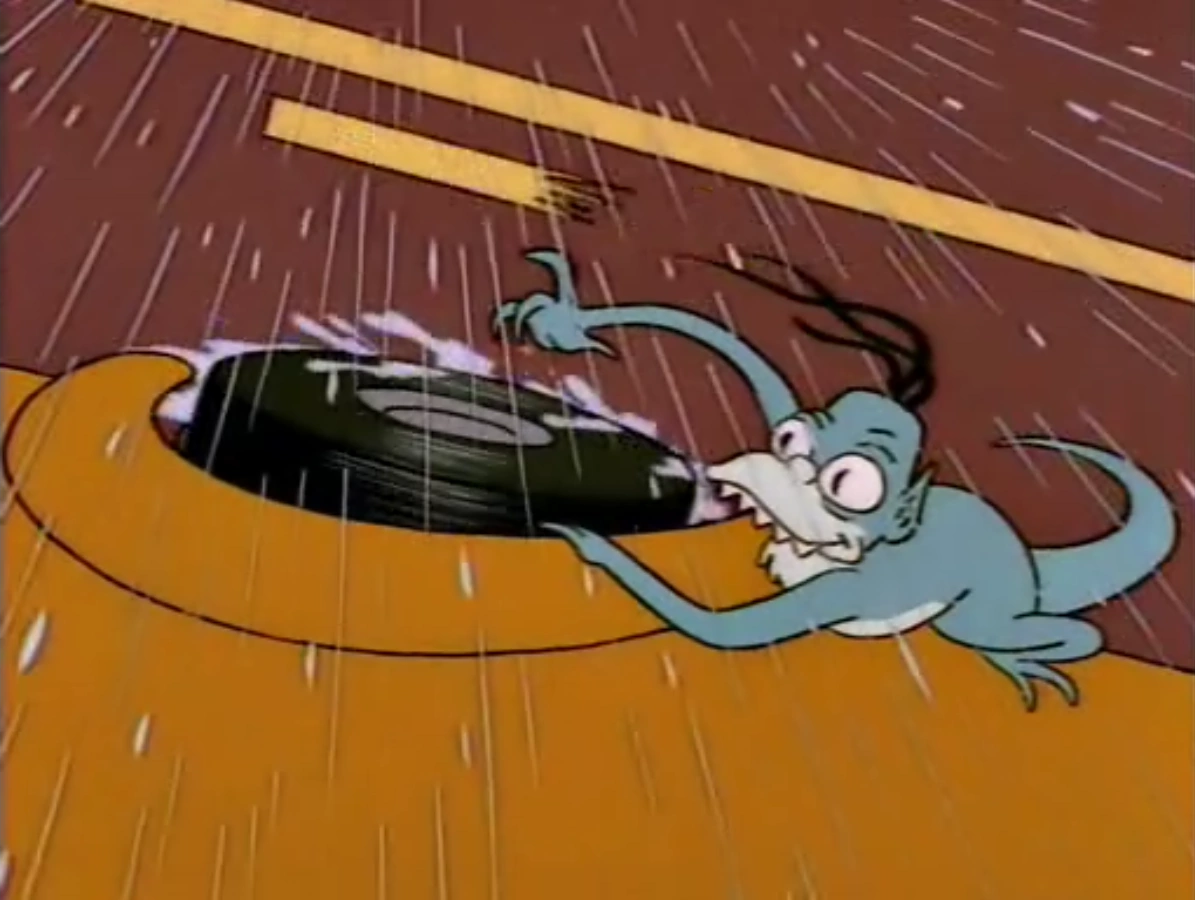
Also, Hans Moleman driving an AMC Gremlin.
Like Bradbury's, Matheson's output was prolific, diverse, and influential. His name, however, was not as widely known. When I discovered him in my early 20s, I was shocked to learn that I had already known a great deal of his work, and that it had all come from the same mind. Richard Matheson gave us more pop culture sci-fi hallmarks than arguably anyone else ever has. William Shatner losing his mind in an airplane after seeing a gremlin on the wing in The Twilight Zone episode "Nightmare at 20,000 Feet" (and the amazing Simpsons' Treehouse of Horror parody "Terror at 5 1/2 Feet"), a panicked father hearing his daughter's disembodied voice and unable to reach her in "Little Girl Lost" (and the amazing Simpsons' Treehouse of Horror parody "Homer3"), and many other non-Simpsons related moments such as zombies.

Yep, zombies.

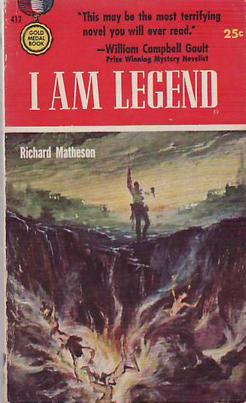
Here's where things get really interesting to me about Matheson's legacy. In 1954, Matheson published a very, very cool book called I am Legend about a scientist who appears to be the last living man on earth and spends his days killing members of the horde of zombie-vampires that torment him and now roam the city in the wake of a global plague that reduced humanity to insatiable carnivorous automatons. Starting with the 1964 Vincent Price picture The Last Man on Earth, there have been three adaptations of the book, including Charlton Heston in 1971's The Omega Man and 2007's Will Smith picture I Am Legend. I will intone in my best old man voice that none of these are nearly as good as the book, either in their plot, character development, or overall emotional impact. But for Matheson, the most faithful adaptation of his book was an uncredited one -- George A. Romero's Night of the Living Dead, which we can all thank for every modern zombie story since 1968, and which Brad Pitt can thank for giving him the biggest box office opening of his career. World War Z and I am Legend are almost totally compatible, and the story of Matheson's Robert Neville and his heartbreakingly misguided quest could just as easily be a series of journal entries in Max Brooks' epistolary novel.

Zombies have been around since ancient times, but Matheson codified in a single work (that is usually characterized as a vampire novel) almost all of the hallmarks that we now consider to be fundamental to the zombie genre. The plague/epidemic, the mindless hordes that want to eat the living, the isolated hero against an onrushing wave of non-humanity. All that. But he also advanced the haunted house genre, in print and on film, as I discussed in my review of Hell House, helped bring about the supernatural/psychological thriller genre with Burn, Witch, Burn, which I also reviewed for this site, and gave Boris Karloff's career a lovely, and loving third act through a series of films with Roger Corman. He also helped launch Steven Spielberg's directing career, which is nice, since our lives would all be slightly more empty without Indiana Jones in them (not Matheson's character).

I think I probably have more films/TV shows on my shelf written by Richard Matheson than by any other writer. I think I have reviewed more films written by Richard Matheson on this site than I have any other writer. If you have not read him or sought out his films, treat yourself to them.

Richard Matheson, you were Legend.

Wednesday, December 5, 2012

50s Sci-Fi: X Minus One

From the far horizons of the unknown come transcribed tales of new dimensions in time and space. These are stories of the future; adventures in which you'll live in a million could-be years on a thousand may-be worlds.

These are the words that kicked off each episode of X Minus One, a sci-fi radio series that ran on NBC from 1955-1958. I like old-timey radio shows, but everything I'd ever come across had been mostly mysteries or dramas, things like Orson Welles' Mercury productions, The Many Lives of Harry Lime, a series of "prequels" to The Third Man, Suspense!, which would sometimes land guest stars like Peter Lorre, and The Shadow, which was just kinda bad.

But it wasn't until recently I came across the 50s sci-fi goldmine that is X Minus One. Like most of these old radio shows, there are some clunkers -- and it'll take a smarter man than me to figure out the 1950s fixation on creepy dolls -- but there are also dramatized short stories from Ray Bradbury, Robert Heinlein, Philip K. Dick, and Theodore Sturgen, among others. This is vintage, present-at-the-creation type stuff, here, before these guys were really famous, let alone legends. The shows were co-sponsored by sci-fi pulps like Galaxy Science Fiction and Astounding Science Fiction, and drew from all of the writers that were being published prominently there.

What these radio shows really do is plug you directly into the zeitgeist of the time. We can watch classic sci-fi movies now and recognize the markers of Cold War paranoia, the fixation with the brand-new space race, and the ignorance of what lay beyond our atmosphere, but it's not the same.  Listening to several of these shows, you begin to realize how dominated they are by tales of invasion, and how every single plot -- from brainwashing our kids out from underneath us to staging a ticker-tape parade down 5th Avenue -- to take over the world is really just a plot for the dirty Commies to take over the Good Ol' US of A.

But setting aside the anthropological interest, these things are just pulpy fun. And you can't top hearing vintage commercials for Pabst Blue Ribbon right after the secretly embedded Venusians just killed the secretly embedded Martians and we're wondering how the private eye who found them is going to get out of *this* fix...

You can find X Minus One episodes on the Internet Archive (link embedded below) or as podcasts through iTunes. I imagine you can find them on CDs still, too, but that might be a little too much retro for one person to handle all at once.

HTML5 Player:


Flash Player:

Friday, August 17, 2012

Nerdgasm! Interactive Mars Panorama on Your Phone


I found out about this on TheAtlantic.com (original article) -- there is an interactive, 360-degree panorama of Mars made from assembled Curiosity Rover pictures, and when you access it on your phone, it uses the built-in accelerometer and compass to re-orient the image in real-time. That means as you sit in your desk chair and spin slowly around, your office turns into freaking Mars.

Freaking Mars.

The planet Mars.

Wednesday, June 6, 2012

Celebrating Ray Bradbury

Ray Bradbury came of age in a system that no longer exists, and by virtue of the idiosyncrasies of that system, a tireless work ethic, a long life, and a prodigious imagination, he wound up making an artistic contribution that we will likely never see equaled.

When he was born, sound had not yet come to movies, and King Kong had its premiere when Bradbury was 13. Five years later, his love of that movie and others like it led him to a friendship with Forrest J. Ackerman and Ray Harryhausen, who were each to become luminaries in the film (and film fandom) landscape. Bradbury published his first short story in 1938, when these things were true:
  • People read magazines
  • Magazines published short stories
  • People read short stories
  • Writers were routinely paid for writing
  • Not everyone on the planet wanted to be a writer
None of these things are true anymore, but Bradbury was able to amass a resume of published work, mostly in sci-fi magazines, and forge a novel from many of his related, Martian-themed short stories (The Martian Chronicles) before television had reached its infancy, so when TV arrived and began looking for writers, they found Ray. Still writing prose all the while, he contributed to TV movies, and beginning with It Came from Outer Space, theatrical films. He continued contributing TV scripts for imminently influential shows like The Twilight Zone and Alfred Hitchcock Presents.

He wrote every day. And to accomplish that amount of work, let alone that amount of quality work, he certainly had to. His ingenuity, dedication, and ability corresponded with, essentially, the advent of popular culture. Bradbury positioned himself across three (four, if you include radio) media outlets at the time when entertainment began taking shape as a commodity, and kids began stockpiling it in their bedrooms and imaginations. Kurt Vonnegut, Bradbury's contemporary and friend, came from journalism, segued into sci-fi short stories for magazines, and then departed for what I think most people would call "literature." But Bradbury stayed put, always a champion of speculative fiction, and always available to lend advice and/or encouragement to other writers, so his influence achieved an unprecedented breadth and depth. He was a drop of ink in the well of American entertainment, and his contribution is present for everyone who draws water from it today. If you've ever watched anything with "Star" in the title or enjoyed a Steven Spielberg movie, you can thank Ray Bradbury.

As The G mentioned earlier today, Ray Bradbury's loss has a special significance for those of us in Los Angeles, because Ray was one of us, and an active voice in the writing community here. His 90th birthday party was held at the Mystery and Imagination bookstore in Glendale, and I was very pleased to be able to take my little boy, who was three at the time. He still remembers it, and hopefully will for a very long time. He will not meet the likes of Ray Bradbury again. The world has moved on -- in many ways that Bradbury imagined it would -- and I can say in all seriousness, they just don't make 'em like that anymore. His life represented a happy intersection of a person, time, and place, and we are all the beneficiaries.

You'll be missed, Ray. But thank you for everything.

RIP Ray Bradbury


Today, the science fiction and fantasy world has lost one of its true originals. As per the LA Times:

Author of more than 27 novels and story collections — most famously “The Martian Chronicles,” “Fahrenheit 451,” “Dandelion Wine” and “Something Wicked This Way Comes” — and more than 600 short stories, Bradbury has frequently been credited with elevating the often maligned reputation of science fiction. Some say he singlehandedly helped to move the genre into the realm of literature.

NY Times:

By many estimations Mr. Bradbury was the writer most responsible for bringing modern science fiction into the literary mainstream. His name would appear near the top of any list of major science-fiction writers of the 20th century, beside those of Isaac Asimov, Arthur C. Clarke, Robert A. Heinlein and the Polish author Stanislaw Lem. 
In Mr. Bradbury’s lifetime more than eight million copies of his books were sold in 36 languages. They included the short-story collections “The Martian Chronicles,” “The Illustrated Man” and “The Golden Apples of the Sun,” and the novels “Fahrenheit 451” and “Something Wicked This Way Comes.” Though none won a Pulitzer Prize, Mr. Bradbury received a special Pulitzer citation in 2007 “for his distinguished, prolific and deeply influential career as an unmatched author of science fiction and fantasy.”

...and the WaPo:

Although slowed in recent years by a stroke that meant he had to use a wheelchair, Bradbury remained active into his 90s, turning out new novels, plays, screenplays and a volume of poetry. He wrote every day in the basement office of his home in the Cheviot Hills neighborhood of Los Angeles and appeared from time to time at bookstores, public library fundraisers and other literary events around Los Angeles. 
His writings ranged from horror and mystery to humor and sympathetic stories about the Irish, blacks and Mexican-Americans. Bradbury also scripted John Huston’s 1956 film version of “Moby Dick” and wrote for “The Twilight Zone” and other television programs, including “The Ray Bradbury Theater,” for which he adapted dozens of his works. “What I have always been is a hybrid author,” Bradbury said in 2009. “I am completely in love with movies, and I am completely in love with theater, and I am completely in love with libraries.”

For Angelinos like me, Bradbury's passing touches a personal nerve as well...he was a fixture at the annual LA Times Festival of Books and, even at 91, heavily involved in the city's literary life, and did much to maintain the literary heart of a city often overly focused on film and television. He was approachable, friendly and always willing to talk to a fan, of which there were many.

You'll be missed, Ray...