Showing posts with label game of thrones. Show all posts

Wednesday, April 3, 2024

Review: 3 Body Problem Season 1

Netflix's adaption of Liu Cixin's Hugo Award-winning novel succeeds thanks to Benioff & Weiss making necessary changes to the story to make it more human — all without sacrificing the science and complexity of the original text.


Liu Cixin's The Three-Body Problem won both the Hugo and Nebula Awards in 2015, garnering acclaim the world over for his ambitious and highly scientific ideas. For years, rumors of adapting it to the screen swirled, with many expressing skepticism about the practicality of adapting the worldbuilding, complex technology, and vast epochs of time to the screen.

When Netflix tapped David Benioff and D.B. Weiss as showrunners — known to the world as the wildly successful duo who brought us Game of Thrones — they upped the ante. Bringing in these two was a declaration of incredible intent, demonstrating that Netflix was going to give this adaptation the full weight and force of money, talent, and special effects to the tune of $20 million per episode. But perhaps more importantly, choosing the Game of Thrones showrunners meant by proxy that they would be able do something very crucial: focus on the human aspect of the story — something that Liu's novel was lacking. 

I and my Hugo, Girl podcast co-hosts read The Three-Body Problem a few years back. As I started the first episode, I realized that I only could remember the broadest of strokes of the plot — aliens, the Chinese revolution, and extraordinary extraterrestrial technology. I went back and listened to the episode as a refresher and my initial take back then was "incredible science fiction with mindblowing ideas and concepts, but the characters were as flat as pancakes and completely dull." 

This makes sense why I couldn't remember much of the tiny details. It appears that the showrunners did as well. There are great changes to the smaller aspects of the story in Netflix's adaptation, much like what happened in Game of Thrones. That wildly popular show often succeeded because of its complex characters — the persistence of Jon Snow, the evolution of Sansa Stark from waif to cold-blooded heroine, the incredibly unlikeable yet somehow still sympathetic Cersei Lannister. George R.R. Martin's prose can be divisive (I could never get into it, despite multiple attempts with multiple books), but the show succeeded in many ways because of the adaptation of its characters to the screen. I'm not even much of a fantasy fan, but Game of Thrones hooked me in for all eight seasons. And even though Benioff & Weiss lost the thread by the last season (poor Danerys), the first five seasons are classics of 21st century prestige TV.

A Brief Plot Overview


This first season spans about 50 years, beginning with a woman named Ye Wenji who witnesses her father's death during a struggle session in China during the Cultural Revolution. She ends up at a work camp, but thanks to her background in physics, is sent to an isolated station to work on China's equivalent of SETI. She receives a message from extraterrestrial life forms who warn her not to respond — but owing to her deep dissatisfaction with life on Earth and skepticism of human progress and growth, essentially says "come on down." This sets in motion the approach of the Tri-Solaran species towards Earth.

In the present day, human scientists across the globe are dying by suicide, including members of a tight-knit group of physicists. These individuals receive secretive and suspicious packages containing VR headsets with technology decades beyond what humans are currently capable of. The game features immersive experiences meant to solve a society's three-body problem — because of the setup of their solar system, they live and die according to stable and chaotic eras. 

It turns out, however, that this is not just a game. The society is actually real, and these Tri-Solarans (so named for their three suns), have fled their solar system and are on the way to ours seeking refuge and a more consistent life. They'll be here in 400 years, and it's unclear if there's anything we can do to stop them.

Here on Earth, we've figured out what's happening, and there are two warring factions. One that seeks to prevent this takeover, and one, the secretive Earth-Trisolaran Organization (ETO) that's a fifth column working to aid the aliens in their takeover. I'll leave the plot details here so as to avoid major spoilers, but the story revolves around how present-day humankind must face this 400-year distant threat, including how we act now, how we prepare logistically, and how we look for hope. It's also important to note that season one starts to crib early from the second book in this trilogy, The Dark Forest

What Works

If it's not extremely apparent, a lot is happening in season one, but it never seems overwhelming. But by adding in new characters — and making them likable, complex, and oftentimes funny — it narrows in the scope of huge, world-quaking issues to make them more manageable. Science fiction can sometimes feel cold and sterile, but by slowing the show down and letter characters breathe and be messy, it makes it more human. It makes the dreaded sci-fi infodump less of a one-time discharge and more of an evenly distributed and consistent sprinkling, like how the inmates in The Great Escape get ride of tunnel dirt by the pocketful.

The graphics and visual storytelling are also stellar. The book is filled with huge, galaxy-sized ideas and technology, and a big chunk of the plot occurs inside of a video game. Much like the challenge of adapting Ready Player One, taking parts of The Three-Body Problem and switching effortlessly between a virtual world and the real one took some thought, and they pulled it off with aplomb. 

Another great example of adapting high-tech physics to the screen was with the sophons. The Trisolarans, in a last-ditch effort to control Earth from 400 light years away on their slow approach to our planet, devote the last of their time and resources to creating sophons — an extremely advanced nanotechnology that allows them to create 11-dimensional supercomputers that can control things on Earth. 

Plotwise, they're essentially deus ex machinas, as they're so advanced that they do nearly anything: make humans die by suicide, manipulate camera film, and more. I thought it would be nearly impossible to depict these tiny things visually, but they pull it off. 

There's been talk that this show hasn't quite met Netflix's ambitious expectations, and that because of this, the subsequent production of the planned sequel seasons may be in doubt. I hope that this isn't true, because this has such grand potential of epic storytelling to come. Most TV shows take place over a few years at best., but 3-Body Problem is so grand in scope that it's  building up centuries of planning and anticipation, and I think the story deserves to be told. 

--

The Math


Baseline Score: 8/10


Bonuses: The graphics are fantastic (especially the depiction of sophons); the primary friend group of scientists are very likable; Ser Davos Seaworth the Onion Knight, the High Sparrow and Samwell Tarly are GoT stars that have big roles in season 1; the nanofiber destruction of the ship in the Panama canal is one of the coolest TV sequences I've ever seen; some incredible needle drops help underscore the emotional heft of key scenes.

Penalties: The ideas presented are complex and full of hard science — I think Benioff & Weiss took a big swing reaching for mass appeal beyond genre fans, but it may still be a bit too intense and intellectual for an average TV view clicking around for an easy watch.


POSTED BY: Haley Zapal, new NoaF contributor and lawyer-turned-copywriter living in Atlanta, Georgia. A co-host of Hugo Award-winning podcast Hugo, Girl!, she posts on Instagram as @cestlahaley. She loves nautical fiction, growing corn and giving them pun names like Timothee Chalamaize, and thinking about fried chicken.

Thursday, May 23, 2019

Game of Thrones Recap (by someone who read a few books and is on Twitter)

After eight seasons, numerous awards and breeding an obsessive fanbase on the level of Star Wars or Harry Potter, the Game of Thrones TV has aired its final episode. Maybe you need catching up on all that has transpired, or maybe you just want to relive all the best moments from the TV event of the decade. We here at NoaF have you covered.

There's just one catch: I have never seen the show, so I am just going based off what I know from my friends who tweet about it, and that I read the first few books up until the crow one, I think.

So pull up a chair for a semi-NSFW and possibly spoiler-ish but I can't be sure recap.

Season One: okay look, there is only one good thing about Game of Thrones, and that is that it kills people. This is the hook, that the guy who is the traditional fantasy hero gets his head cut off in (I think?) the first episode. Also: Ned. His name is Ned. Possibly my favorite thing is that they try to fantasy it up to "Neddard". This is a dude who definitely had his books dumped in a puddle when he was at, uh, Stark High or whatever. What a dorky name. He deserved to die. Also: Sean Bean.

Also, we get on the incest train super early. Based on what I remember, it follows the book pretty closely, which is to say: there is incest, attempted child murder, successful child murder and rape. So, so much rape. I think there were some wolf-things? That were symbolic? Did that go anywhere? I feel like they got offed sorta quick in the book, but maybe I am wrong. Anyway, season one wraps up with a lot of people dead and raped. Also 'Robb', Neddard's oldest, is in charge of their kingdom and they leave the [ten minutes of Googling] Seven Kingdoms.

Finding the best meme was the hardest part of this
Season Two: It's called "Game of Thrones" but there is only the one pokey throne, right? What's up with that? Shouldn't there be multiple thrones? I get that there are houses, because nowadays anything fantasy has to have houses or some such grouping, but I don't think they EACH have a throne - do they? I feel like that should be addressed in more detail. Maybe if there were thrones - plural - they wouldn't have to fight over the one. Look, I'm just trying to help.

Sorry all but I am really stuck on the names here. How do we have 'Robb', 'Ned' and 'Joffery', all really close to real world names and then have junk like 'Slynt' and 'Daenerys'? Did I even spell that right? I neither know nor care.

Speaking of Daenny, the one little bit I saw was her brother getting offed, because he is probably the most annoying character in all of literary history, so I made sure to watch that clip. I don't know what season that happens in, but it happened, so I am telling you about it. I think he was supposed to be king or something and he whined a lot about that (until he died, obv).

The White Walkers are establishing themselves as (A) a real thing that exists and (B) a real threat to the World of Men or whatever this particular fantasy approximation of medieval Europe calls it. Which raises the question of why there is a big-ass wall that the Stark clan has been up there saying ominous things and manning said wall all there years, if the threat is just a myth. Either way, they are here now and ready to make memes. The kid who got hucked out a window goes up past the wall at one point and has a vision quest or something. It's probably important.

Season Three: ooops, the whole raven thing takes place in this season. Anyway, he goes up beyond the wall and becomes Professor X. Meanwhile, the incest twins aren't a thing anymore and Jamie loses a hand. He gets some sort of redemption arc, or garners some sympathy according to twitter.

The important thing is that this is the Red Wedding season, which was great if you had read the books and could be all smug when people were always like "OMG GoT has soooo many twists and kills off soooo many people". You could look very knowing and tell them "you have NO idea". Then the Red Wedding happened and people FA-REEK-ED. It was glorious. It also revealed the flaw in the whole 'kill-everyone-who-seems-important' plot device, namely you stopped caring about anyone until they had been around for a while. It also started to telegraph that, hey maybe Jon Snow and Dragon Girl are the ones who really matter.

Season Four: We are in LOST/Wheel of Time territory now. Lots of stuff is going on, and I care about exactly none of it. This is about where I bailed on the books, because the writing was on the wall about Martin never writing another dang word. According to Wikipedia, Season three covers about 2/3 of A Storm of Swords, while Season Four is the rest. This is a crime. Fantasy writers, please learn brevity.

In any case, things are happening. Daenareays gets married against her will to Aquaman (is he who kills her brother? I think he was), and then falls in love with him, because of his very large [sounds of Joe ripping the keyboard from my hands from 2,000 miles away] [all our Hugo hopes are dashed forever] I'm not sure if the show makes it clear, but the book was VERY DETAILED about why she fell in love with him.

Then Aquaman, in true GoT B-character style, dies. Dannyerrous gets three dragon eggs around this time, but they are obviously not REAL dragon eggs, because dragons aren't real, just like the ice dudes aren't and oooooooooh I get it. Wait, isn't the series called A Song of Ice & Fire? Why is the show called something different? This joke post is getting FAR too involved. I have SO many questions and I don't know if the show has answers. Are we allowed in the Hugo losers party so I can ask GRRM these things?

Season Five: Like eighteen people have tried to rule and died in the last several seasons. At the time, their lives and deaths were SUPER important and you had very definite opinions about how they died, but now you can't name them, except the one whiney kid (no, the other one).

Also, the Stark girls have started to come into their own. One was super whiney at first, and she is getting to be a real bad ass. And the other one is... there? I think? Or did she die? Arya! That's it! Are ya... still alive? She is! Glad we settled that.

On the other continent or whatever, Denny Tarpaper has an army of freed slaves, which the people she got them from didn't count on and they get killed. Seems like the sort of thing they should have seen coming, or at least put in the contract. Also, I think in the book, they do the standard "give them a puppy and then make them kill it" bad guy thing. Is that in the show? I feel like there would have been more tweets about puppy murder.

Puppy murder aside, Season Five is is season that launched a thousand shirts, when Tire Iron uttered the immortal phrase "I drink and I know things", thus giving alcoholics a great catch phrase and permission to use alcohol abuse in place of a personality. It doesn't work, gang, I have been trying for damn near 34 years.

Season Six: Game of Thrones twitter: HOW CAN YOU NOT WATCH GAME OF THRONES? IT IS THE CULTURAL TOUCHSTONE OF OUR TIME!

Also Game of Thrones Twitter: WHAT THE #^%$ IS THIS GARBAGE? WHO WROTE IT, A DRUNK MONKEY WITH A BROKEN TYPEWRITER?

All this is to say, season six doubles down on middling middle episodes and I don't actually know what happens. It seems like no one else, including the actual audience, writers, showrunners, or creator of the whole damn thing do either.

I'm sensing a pattern.

Season Six contains the Hodor episode. That is the only plot point I gleaned.

Season Seven: As a writer, I am so envious of George R. R. Martin. First of all, only ERB has ever called him out on the R.R. thing. Second, he is living every writer's biggest fantasy - making millions of dollars off your book being turned into a massive success while you don't actually do any writing. Wikipedia says seasons seven and eight are based on his outline for Winds of Winter and A Dream of Spring. HIS OUTLINE. Let me in on this scam, I am BEGGING.

Also, did winter ever actually come? Or is it a metaphor for the night king? According to my twitter feed, he is a very big threat, mostly by nature of one menacing gif. Maybe he pronounces it 'jif'. Now THAT'S evil.

Speaking of, and I say this with every cynical, nihilistic bone in my body: Who is the bad guy here? I mean, is it just 'everyone' and that's the message? I guess Jon and Bran (is his back from his walkabout yet? Rollabout? This IS Lost, isn't it?) are pretty cool. But maybe the, uh, walkers? are actually the good guys. Have we listened to their plans for healthcare and infrastructure? Normally I am not one for talking to an army of the dead bent on destruction, but it's not like the humans are doing such a bang up job. Y'all have towns. Hold a town hall or something.

There are alliances, betrayals, etc, but literally no one cares at this point. Dragons or GTFO.

Season Eight: WE MADE IT Y'ALL! So many hours gone. So much emotional investment. I mean, from you. I spent like 45 minutes, and most of that was looking for a tweet I couldn't even find. Fun fact, a close friend got married recently, and I was his best man. I didn't find out until, like, the week of the wedding that it was (lightly) Game of Thrones themed. I posited they may have missed a few key ideas in the series about romance and weddings, but it went unheeded, and no one (so far as I know) died at his wedding, which was sort of a let down.

On to the show. I am going to serious up for a second, because I know a lot of you care very deeply about this show, so as far as I can tell, there are three(ish) things you need to know about season eight:


  1. Jon and Danny have sex, then stop having sex, because it turns out they are related, which everyone hopefully saw coming the second they both survived more than a full season. 
  2. Bran is the king! Horay for the KLDA!
  3. Season Eight is horrible.
And that's it! It ends on a season full of great moments... well, a few I guess. It ends on a underwhelming note that leaves fans dissatisfied, upset and/or outright angry. For that, at least, I can call it one of the most entertaining shows of all time.

-DESR


 Dean is the author of the 3024AD series of science fiction stories (which should be on YOUR summer reading list). You can read his other ramblings and musings on a variety of topics (mostly writing) on his blog. When not holed up in his office tweeting obnoxiously writing, he can be found watching or playing sports, or in his natural habitat of a bookstore. 

Wednesday, May 22, 2019

Ode to GoT Nihilism


When a genre accumulates enough history, traditions, tradition-conscious fans and demolition-ready clichés, a certain kind of work will emerge: something that takes everything a little further, makes it a little more believable and makes everything that came before look a little silly.

That's what happened to superhero comics in 1980s with Watchmen (by Alan Moore & Dave Gibbons, 1986-87) and Dark Knight Returns (by Frank Miller, 1986), and now it has happened to audiovisual epic fantasy. Or, well, to be fair it probably happened almost a decade ago in 2011 when we first found out that unexpectedly decapitating the show's protagonist is indeed possible and not all dwarfs in fantasy have to be small fake Scots who are heavily invested in the mining industry.

For those in the audience who had read Martin's books there was nothing unexpected in Ned Stark's death (or any of the other Stark deaths), of course, but majority of the millions of viewers (including me) has never read a single line of Song of Ice and Fire. 

So, Game of Thrones is finished. What are we left with?


A monumental piece of work that all future fantasy shows will probably be compared to, whether that makes any sense or not. Just as any morally complex superhero work interrogating its genre and history will always be measured against Watchmen, any piece of fantasy television that tries to look beyond the Manichean moralities of Tolkien is going to be evaluated with Game of Thrones at the back of everyone's head.

Whereas Watchmen was "the superhero story to end all superhero stories" (which it of course didn't do), Game of Thrones maxed out everything in the epic, post-Tolkien fantasy: more characters, more exquisitely constructed world, more nihilist politics and royal succession play-offs, more mysterious religions, more brutal battle scenes (nevermind the goofy military tactics in season 8), more sex and incest. It's a "fantasy TV show to end all fantasy TV shows", in the sense that all future fantasy entertainment will be informed by GoT on some level.

Watchmen seemed like the ultimate takedown of superhero lore. Wholesome, child-friendly superheroes were exposed as reactionary superjerks, alienated superhumans or in the very least a bit unstable people with unorthodox sex drives — that is basically the history of superhero comics in 1987-2019. I can safely predict that going forward, heroes in epic pseudo-medieval fantasy shows will have to make difficult and morally grey choices, suffer brutality and brace themselves for some complex, deadly scheming.

For me, the special ingredient of the show was always the nihilist outlook, something quite nonexistent in pre-GoT audiovisual fantasy. Despite all pompous talk about honor, gods or good and evil, there's no getting around the fact that political power grows out of the barrel of a gun (or it's medieval counterparts), as Mao Zedong opined. Nobody is safe and cruel things happen to people who don't deserve them. These themes will probably be developed further in post-GoT shows. Hopefully they'll be a little more thoughtful than the bulk of "edgy" 90s superheroes and choose to emulate other aspects than just tone-deaf brutality and sexual violence.

One can perhaps make the case that it was in some sense visionary to butcher children, soon-to-be mothers, old women and animals on-screen in the most popular and most expensive TV show of all time to underline that nobody is ever safe. However, I was more impressed with less bombastic lessons of nihilism, like Littlefinger's plot (in season 4, I think) featuring Ser Dontos Hollard, the fat lord who Joffrey wanted to kill but Sansa Stark saved by making him the court fool in some earlier season. Dontos's thank you speech to Sansa about his house's demise is heart-breaking — we think we know the character and sympathize with his bleak circumstances — but later it turns out that it's all part of an elaborate hoax put together by Littlefinger.

Playing with characterization and audience expectations, it's the small details like this that made the show really memorable for me. Sadly, poignant details cleverly playing with the characterization and audience expectations are exactly what was missing from the final season. What also seems to have disappeared somewhere along the way is the show's nihilist attitude altogether. Sure, Daenerys becomes a cruel despot in the end, but that is easily fixed with a knife through her heart, and justice and harmony prevail.

What in seven hells is that?


This was supposed to be a world in which Hollywood morality is challenged and everything is complex and precarious. I really feel we would have deserved an end in which all the good lords and ladies of Westeros are ready to stab each other in the back to get just a little more power. Instead, all we get from the final minutes of the great struggle for power is the phrase "Uncle, sit down" — like the democratic presidential primaries needed any more weaponizable pop culture quotes at this point.


POSTED BY: Spacefaring Kitten, an extradimensional enthusiast of speculative fiction, comics, and general weirdness. Contributor since 2018. 

Tuesday, May 21, 2019

How to End a Game of Thrones

It was the best of times; it was the blurst of times...


[Warning: Spoilers Everywhere]

The year was 2006. My fiction reading list was maybe 60% science fiction but 0% fantasy. It had been this way for years, after my love for second world fantasy died on a hill called The Wheel of Time. Subsequently, I had internalized normative cultural discourses that devalue fantasy unless packaged as “magic realism.” Former NOAF contributor Jemmy, however, had other ideas.

At that time we were working for the same company, our offices strategically located in a neighborhood famous for its second-hand bookstores. We would often visit them during our lunch hour; without fail, Jemmy would pester me about this fantasy series that he claimed “changed everything.” But I was resistant, that is, until he bought me a copy of George R. R. Martin’s A Game of Thrones and I relented.

So I read the first chapter, and then the next, and then the next. Within a few days I had devoured A Game of Thrones in its entirety, proceeding to devour its sequels, A Clash of Kings and A Storm of Swords. I couldn’t get enough, so I moved on to other series; I was most definitely back on the fantasy train.

I have issues with those 3 books, some quite serious, but for my money the worldbuilding, character development and punctuated narrative moments are as good as any in the genre. Furthermore, despite their heft, these books feel meticulously planned, tightly plotted and rich with narrative detail. Most importantly, they revived my interest in fantasy and led me to discover a range of authors I otherwise might not have read: Andrzej Sapkowski, Gene Wolfe, Elizabeth Bear, N.K. Jemisin, Steven Erikson, Kate Elliot, Django Wexler and many others.

I like to think of those first three books as a complete trilogy with an ambiguous ending. It’s a coping mechanism that helps me deal with the fact that the next two books - A Feast for Crows and A Dance with Dragons - are such disappointments; a single, bloated novel in two 1,000-page installments; a failed attempt to “get to Mordor” that aptly demonstrates the importance of a good editor in no uncertain terms. And it helps me deal with the fact that Martin may never finish the series.


Enter the Series...

When Game of Thrones launched in 2011, I was excited. Early indications suggested HBO would go all out adapting the series. Like many fans of the book series, I hoped this it would serve as a catalyst for Martin to finish the series. Instead, it has finished the story for him. But more about that in a bit.

The initial season was a masterful adaptation of the first novel, which is far tighter in both narrative and geographic scope than its sequels. Many of the actors looked and felt exactly like their written counterparts; some – like Jorah Mormont and Tyrion Lannister – were an improvement.


The second through fourth seasons captured much of what made A Clash of Kings and A Storm of Swords effective as novels, though they also amplified the shock value of their punctuated moments. In truth, there’s nothing in the show that isn’t also represented in the books, but the show frequently makes explicit what is relayed secondhand or merely suggested in the books. To put it another way, the books already make it clear how common murder, rape and torture are in this world, but the show positively revels in it. The effect is to cheapen their impact; we are frequently shown how grim and dark this world is, but little or no time is spent on exploring the implications and consequences of all the grim darkness. Not in any meaningful way, at least.

On the other hand, the show pulls off a fairly remarkable feat: adapting a sprawling fantasy epic for a medium that can do plot and character, but routinely struggles with the kind of myth- and world-building that are essential to second-world fantasy.

As with the books, though, things degenerate once the moves on to interpreting A Feast for Crows and A Dance with Dragons. Though mercifully eliminating the horrid Quentyn Martel storyline, nearly everything else that made those books a tedious slog is recreated for television (only now with more rape and torture!). The low quality of storytelling from these books mars seasons 3 and 4, and (in my view) outright ruins seasons 5 and 6.

In season 7, Benioff and Weiss officially moved past the source material altogether (though apparently with some input from Martin). Like many fans, I was deeply skeptical of their ability to right the ship. In fact, I probably would have quit the series if I hadn’t been worried that this was the only ending we’d ever get. Only, I found the experience oddly liberating – for the first time since season 2, I wasn’t comparing the show negatively to the books, even to the books I didn’t care much for.

Season 7 has its share of head scratchers - most notably, Jon Snow’s incredibly stupid plan to risk half the elite warriors under his command on a commando mission to bag a wight to show Cersei (who, predictably, is unmoved). But it was dirty fun.

The narrative decisions in season 8 are better, but nearly all require more exposition than they are given. Danaerys becoming the “Mad Queen” is a perfect example: history is replete with individuals who begin as idealists and end as ideologues; who through struggle come to believe the ends justify the means; or who believe the justice of the cause confers infallibility onto its avatar.

By the season finale, It is clear Danaerys has become all these things - only we haven’t made that journey with her. Rather, it happens so fast that you’re left wondering if it was something Tormund said, or that time Jon didn’t want to kiss her. It would have been much better, and much more believable if we’d had a few more episodes of developing paranoia and anger.


The season finale is, in a word, polarizing. Long-anticipated series finales often are, and several times I’ve been on #TeamKvetch (e.g. BSG). But I found this denouement quietly gratifying.

Bran becoming king is a bit weird, until you realize the whole point is to devalue kingship. And I was neither here nor there on Arya the Pirate (though what a great spinoff that would make). On the other hand, I Ioved Sansa asserting the independence of the north - regardless of the fact that her brother sits on the proverbial Iron Throne. Jon rejoining Tormund and Ghost felt equally appropriate, as did Brienne honoring Jaime in the annals of the Kingsguard - a touching act that almost helps you forget that bizarre moment when their friendship became gratuitously (and unnecessarily) sexual.

My favorite moment, though, comes when Tyrion waits for the new Small Council - which includes Brienne, Sam and new Lord of Highgarden and Master of Coin Bronn - and nervously keeps adjusting the chairs. It’s a tiny detail, but one that speaks volumes to the endurance of hope.

I don’t know if Martin will end his books the same way, or if he will ever end them at all. I certainly hope he does. But if he doesn’t, then at least we have this - a poignant and cathartic end to the journey we started so long ago.

Monday, May 20, 2019

George R.R. Martin is Still Not Your Bitch, and other stories

When Neil Gaiman wrote his famous and infamous essay "Entitlement Issues" (most well known for the pull quote "George R.R. Martin is not your bitch.") in 2009, it had been four years since the publication of A Feast for Crows and it still would be another two years before Martin published A Dance With Dragons.

In his essay, which was really more a response to a reader question, Gaiman noted that Martin (or any author) is not working on contract to the reader, that buying an earlier volume in a series does not entitle the reader to a later volume at any time other than which the author is ready to produce it.

I'm sympathetic to both the frustrated reader as well as the frustrated writer. I've been online for too long as I've gotten older and I'm aware of many of the issues preventing writers from getting that next book out, whether it is health issues, publisher issues, or just that book just being really fucking difficult to write, I get it. As much as someone can who doesn't actually write fiction can get it, I get it. It can still be frustrating for the reader when the next series volume doesn't come out when previous books were on a more predictable timeline.

It has now been eight years since the publication of A Dance With Dragons and in that time HBO will have begun and finished all eight seasons of Game of Thrones, the television show based off of Martin's novels (on the off chance any reader of Nerds of a Feather was not aware of the show or its source material)

I'm not here to legislate a single thing regarding what GRRM should or should not do with his time, how long it should take to write a book, or make any demands. I've seen the comments readers make online when Martin dares to mention Wild Cards or any ancillary project he might be working on or even any aspect of his personal life that doesn't involve the completion of The Winds of Winter. Frankly, those readers are assholes and I want no part of their vitriol. It is toxic. It is unhealthy. It is not what I'm about.

Ever since the show surpassed the books, I've been in the same place as every other reader who is watching Game of Thrones - uncertain as to how closely the show will mirror the novels and in what ways the show and books will be different. Will the series end at the same point the show does? Does Arya still kill the Night King? I've already lamented (in private) the difference in Sansa's storyline from the book to the show, and many readers have been disappointed by the absence of Lady Stoneheart in the show.

I still want to know how those stories will resolve, perhaps now more than ever. How close is the show to Martin's original plan? Assuming Danaerys putting King's Landing to the dragon was GRRM's idea, will the (mostly) vitriolic response to "The Bells" change Danaerys's story arc in the books at all?  Does it matter?

Of course, waiting for the next book in a series is nothing new to genre readers. In the eight years
since A Dance With Dragons, I've lost much of my eagerness and rapt anticipation for The Winds of Winter (which is not to say that a real announcement won't ratchet my excitement level up to eleven in a third of a second). It's been eight years since Patrick Rothfuss published The Wise Man's Fear and I've seen the same frustration (and hate) online directed at Martin also directed at Rothfuss. But fans of Melanie Rawn have waited twenty two years for The Captal's Tower, the concluding volume in her Exiles trilogy. The Mageborn Traitor was published in 1997. Even twenty two years isn't all that unusual in the genre, though.

It's not the most of original thoughts to say that even though I'm (fairly) patiently waiting for The Winds of Winter and The Captal's Tower and that year 948 Deryni novel from Katherine Kurtz that she hasn't even announced she's working on, I'm not really waiting for them. There's a LOT to read out there. I'm working my way through this year's Hugo Award finalists. I finally caught up on the Vorkosigan novels from Lois McMaster Bujold, which only means that I have three more Chalion novels and all of the Sharing Knife to go. Also, do you have any idea how far behind I am on Kate Elliott's work? Feminist Futures has reshaped what I want to read and when, and there's an ocean of great stuff out there.

I'm not saying that it isn't worthwhile to be frustrated when a favorite writer is taking longer than you'd like with your favorite series. I get it. But I also tell my four year old son that throwing a fuss isn't going to make the time go by faster. If he knew how to spell and type, he'd probably be on twitter complaining that having to wait three days to see grandma is an excessively long time. Everything is relative.

I've long disagreed with Gaiman, at least in part, with the idea that purchasing book one in the series only entitles the reader to that one book purchased. I agree with Gaiman that purchasing a book is purchasing a book and that yes, you are only entitled to the one book you purchased. There is, however, an implicit promise by the author that when a book is "Book One of The Gibbelhead Fountain" that there is an intent to deliver a complete story that provides an ending.

For those keeping score at home, I don't include a series where each novel stands on its own even if it is building a larger world and gradually a greater story on top of the individual discrete stories of the novel. Think Seanan McGuire's Incryptid or Diana Rowland's White Trash Zombie series.

This should go also without saying, but tied to that implicit promise is that besides the reality of the entire publishing industry is an understanding that life is a very good reason for a novel to not come out when "expected" - whether it is health, family, or simply because writing a novel with excellence is really fucking difficult.

What I don't care about is how long it takes for my favorite writer to publish the next novel in my favorite series.


Joe Sherry - Co-editor of Nerds of a Feather, 3x Hugo Award Finalist for Best Fanzine. Minnesotan.

Friday, December 15, 2017

Holiday Gift Guide: Movies & TV

Vance: For the Cinephile in your life

Filmstruck (www.filmstruck.com)


Imagine you're sitting at home some night. Maybe it's cold out, or hot out, or raining. The video store's closed, and has been since 2007, but you definitely have a WiFi connection and don't feel like binge-watching that must-see show that everybody's always making you feel guilty about not seeing. What you really want to do is watch a silent comedy. Or a French movie about high society, or about low society, or a future, animated society. Or something Orson Welles made. Or, hell, just pretty much anything in black-and-white. That's where Filmstruck comes in. A partnership with Turner Classic Movies and the Criterion Collection, Filmstruck has a rotating crop of classic and contemporary films that include curated lists grouped around directors (such as Early Bogdanovich, or Agnes Varda, or Auteurs in Space), or regions (such as Films of the Diaspora, or Life in Tel Aviv, or Films of the French Occupation), or themes (about organized labor, or punk, or poverty), as well as your regular browse functions that allow you to search library titles. Not everything is highbrow fare, though. They recently featured the films of Mario Bava and Val Lewton, recently did a series on Roger Corman (our interview), and are still streaming one of my favorite kaiju trainwrecks, The X from Outer Space (review). It's kind of a cinephile's playground, and costs less than Hulu's ad-free service. 

Dean: For the binge-watcher in your life

I think I watched more TV this year than I have in any before, so I have a few suggestions:
Westworld is probably the best show I have ever seen. I adore it start to finish, and I know (for once) I'm not alone in that assessment. In an era of binge-watching simply because we can, Westworld demands it, every episode making you scream for the next one - and when it's all done, you have to go back and watch it again. And again. ($39.99, Amazon).


American Gods is nearly as good, and we're not going to talk about the fact that season one is shaping up to be a mess with the showrunners leaving. But season one is great! Fans of scifi/fantasy/surrealism will adore this. ($24.96, Amazon)


Game of Thrones: I AM, however, fairly alone in not liking Game of Thrones. But lots of people do, and buying people what they like is what gifts are about, right? And if you're going to get them this, you may as well go all out and get the Night King (that's his name, right? Or is that WoW?) bust.  ($149.99, Amazon)


Brian: Get Out - Jordan Peele (director)


Despite what the Golden Globes may classify it as, Get Out is not a comedy. It's a brilliant horror movie that achieves more tension and terror with human beings than with gallons of blood and masked psychopaths. The premise is simple: Chris Washington is a black man who is going to meet his white girlfriend's parents for the first time. It's a movie designed to make you feel uncomfortable, and it does so with incredible success and wit. Though it has a few very good laughs in it, the point isn't to entertain you so much as make you feel what Chris feels, and he doesn't have a fun time.

The G: Robocop (Criterion Edition)


Many action films in the '80s simultaneously embodied and critiqued Reagan-era notions of macho nationalism and money-makes-right, but none quite as well as Paul Verhoeven's masterpiece of action cinema. You can watch it as a straight-forward action flick about a good job with robotic powers cleaning up a dirty city, or you can watch it as a satirical take on privatized security and corporate greed. Because it's both! And in the era of Blackwater, private prisons and mass automation, Robocop is as relevant as ever. Plus Criterion editions come with all sorts of goodies.


Sean: Gintama: the live-action version


Gintama continues to be an amazing parody of all things anime/history/etc., and the usual well-placed fears about live-action adaptations of this sort of brilliance were, I am happy to report, actually misplaced in this case! So for the lovers of quirky movies around you, take a chance on Gintama! But then again, even the best live-action version can't measure up to the original anime, so maybe just play it safe and get the animated Gintama film instead...


Limitless: the TV series

I know what you're thinking: why watch a TV series based on only a pretty good movie? I'll tell you why: because of the brilliant parody said series did of Ferris Bueller's Day Off, that's why! It was a shot-for-shot remake at times! So kill two birds with one stone: give the TV-phile an entertaining show and an adrenaline burst of nostalgia for the 80s!

Friday, September 1, 2017

How I Learned to Stop Worrying and Start Watching GAME OF THRONES Again

Winter is an asshole


[Warning: spoilers everywhere]

I'll admit I'm not the biggest fan of HBO's Game of Thrones. I'd read the first four A Song of Ice and Fire books twice by the time the show debuted in 2011, and have strong, positive feelings about the first three. I love the characters, the meticulous detail that George R. R. Martin put into world building, and the lore. And of course on top of that, the books are impossible to put down. I spent many a night prying my eyes open by sheer force of will, determined to find out what happened next.

Then came the show, which in its first season seemed like a near perfect distillation of A Game of Thrones. The actors embodied the characters they played; the sets brought Westeros to life; and the lore--it was there too. I was beyond excited for Season 2, when the show would move on to the events portrayed in my favorite of the books, A Clash of Kings.

Only, I found myself slowly falling out of love with the show. You see, it's impossible to capture all the detail of a 700+ page book in a 10-episode season, and that was doubly true once the scale of the drama shifted from the closed-door intrigues of A Game of Thrones to the cross-continental wars of A Clash of Kings. So the writers and producers had to pick and choose what they would bring to screen, as well as take some shortcuts. All quite understandable, really.

Unfortunately, they chose to emphasize what are to me the most problematic and least attractive elements of the books, namely, their excess of cruelty and sexual violence. And the show didn't *just* emphasize these elements; it made them more central, upfront and over-the-top. Meanwhile, I was getting less of the things that made reading the books a magical experience for me--less than I wanted, at least.

At the same time, the source material was still really good, so despite having issues with the show, I was still getting a visually arresting, immersive television adaptation of books I really liked. Thus I could hold out hope that show might actually fix A Feast for Crows and A Dance with Dragons, the latter of which I found simultaneously tedious and splatterpornographic.

I would be disappointed, as the show retained most of the tedium and, once again, chose to amplify the splatterporn. The worst came in Season 5, which lingered on some of the most agonizingly boring storylines in A Feast for Crows (e.g. the sparrows, Dorne) and then chose to depart from the books in order to burn a child alive at the stake. That was it for me. I was done.

Only, then Season 7 rolled around--the first that would not have Martin's novels as a guide.* And given that we're still waiting for The Winds of Winter, six years after A Dance with Dragons, there's a good chance that the book series will never be done. So for those of us who've invested a lot of time and thought into the story, this may be the only form of closure we ever get. I decided to catch up with Season 6--which was very good at points, and not very good at others. But I was excited again, more than I had been since the start of Season 2.

[*The show moves past the books midway through Season 6, to be precise.]

So how was Season 7? To quote...


"It Was the Best of Times...


Season 7 is, in a word, campy. But don't take that the wrong way--campy can be great too. And this season was gratifying in a lot of ways.

To begin, I appreciated the shift in how the show treats sexual relationships. Both Game of Thrones and A Song of Ice and Fire are very rapey. The books feature more rape than the show, while the show makes up for that by making every rape graphic and in-your-face rather than, say, a reference within in conversation. The low point, for me, was Sansa's rape by Ramsey in Season 5 (which, one notes, is not in the books). Season 7 stops using rape as a go-to device to illustrate how grim and dark this world is. And as far as I'm concerned, that's a very positive development.

But that's not all. Season 7 also allows its characters genuinely romantic moments, so much that the contrast with previous seasons is immediately striking (Jon's doomed relationship with Ygritte notwithstanding). And somehow, among all the things that don't make sense about Season 7 (more on that later), the budding romance between Jon and Danaerys does--on a personal level, at least.

I also appreciated the renewed focus on action. One thing Martin does exquisitely well, and which has also translated well in the TV adaption, is maneuvering chess pieces to build tension and momentum toward rare but superbly-rendered set-piece action scenes. Well, the first 3 books/4 seasons of the show do that at least. In truth, the maneuvering got really wearying in A Feast For Crows/A Dance with Dragons, as well as in Seasons 5 and 6 of the show, where it essentially became an exercise in wheel spinning. So it was nice to see the producers de-emphasize intrigue in favor of more action. That's what the series needs at this point. Even Euron Greyjoy, that most ridiculous and cartoonish of characters, stops talking long enough to give us an epic sea battle.

Trogdor!!!!! I mean...Drogon!!!!!
Also welcome, while Season 7 contains a lot of violence, it doesn't linger on moments of cruelty like the show has previously, to ever-diminishing effect. That breaks the cycle of always needing to go further, from rape to torture to castration to child sacrifice. Instead, we get dragons burninating the countryside--a moment we've all been waiting for. Hell, I don't even think I'd mind if the rest of the show was just Danaerys engulfing the show's many villains in flames. Especially Euron. That guy's annoying as shit.

If that means Game of Thrones feels a bit more like an Arnold Schwarzenegger film, and a bit less like I-Claudius-with-extra-splatter, then that's okay in my book. Oh, and Littlefinger getting punked by badass sisters Sansa and Arya? That was a lot of fun.


...it was the Blurst of Times."


As much fun as Season 7 is, it's also littered with incongruities, plot holes and absurd narrative devices. Readers/viewers who have invested a lot of time and energy into the story may be on board with the shift in tone (emphasis on may), but most I've spoken to are frustrated with the decline in plotting.

The most obvious sign is the emergence of teleportation in Westeros. Armies traverse land or sea in hours rather than days or weeks, while ravens deliver messages instantaneously--from the northernmost to southernmost points of the Seven Kingdoms, no less. I get that the writers need to speed things up, but this strains credulity.

Worse, in my opinion, is the revelation that Jon isn't just the child of Lyanna Stark and Rhaegar Targaryen, but the legitimate heir to the throne. Because apparently the High Septon annulled Rhaegar's marriage to Princess Elia Martell--for reasons unknown and despite their having multiple children--and simply didn't bother to tell anyone about it. Oh, and Jon's real name, Aegon Targaryen, is already the name of Rhaegar's other son.

WTF is this garbage
This isn't just implausible, though it is certainly that. Rather, it's the show reverting to that hoariest of hoary fantasy tropes: the proverbial pig farmer who turns out to the the prophesied one, which in turn allows him to ascend to the throne and marry the princess without upsetting the precious class hierarchies of medieval pseudo-Europe.

In doing so, the show violates a core tenet of Martin's novels: that the true heroes are not the obvious heirs, but rather the outsiders and castaways. Not Ned, Robb, Stannis, Viserys or Jaime, but Jon, Arya, Davos, Danaerys and Tyrion. (Also Sansa, but only after circumstances force her to shed her insider status.) The pig-farmer-to-prince trope does away with that by telling us that, appearances notwithstanding, the outsider was in fact never an outsider at all. It's corny, and actually kind of fucked up when you think about it. To be a hero, you have to be born with a hero's blood in your veins. I have a very hard time imagining that Martin signed off on this one; it feels like an innovation born of convenience by people who are now adrift at sea without the sage as their navigator.

The absolute worst thing about Season 7, though, is Jon's ill-fated quest to bag a wight. Why does he do this? To convince Cersei, the entirely self-interested and wholly dishonest usurper of the throne, to join up in the fight against the Night King and his army of undead warriors. This is, prima facie, a bad idea because, as I mentioned, you simply cannot trust Cersei to do anything but look out for herself. It is also a baffling idea because, as we see in Episode 4, Cersei no longer has an army to offer.

Even if Jon doesn't get this at first, you'd think that someone would tell him. Danaerys, for example, who crushed the Lannister army and executed its Warden of the South (and his heir).  Or Tyrion, who watched it happen and is allegedly a pretty smart fellow.

The smart play, of course, would have been to occupy Highgarden. It is the breadbasket of Westeros, its castle is currently unoccupied, and the one-time army of occupation done got burninated. Cersei's ability to raise another army, and keep it loyal over time, is predicated entirely on her access to the riches of Highgarden.

But no! Instead Jon, one of the two most important figures in the fight against either Cersei Lannister or the Night King, traipses off north of the wall with a motley crew of other important figures in order to bag the wight, only to attract literally the whole army of the dead. So what do they do? They call Danaerys via insta-raven, who shows up with all her dragons. The Night King throws an ice spear through Viserion, who then becomes a fucking badass ice dragon. And at the end of the season closer, Viserion the Ice Dragon burninates (freezinates?) the Wall.

Cool, but...
The emergence of an ice dragon in and of itself is not surprising--Martin did wrote a novel called The Ice Dragon, after all. But it only happens, in the show, because Jon starts acting a careless idiot, risking everything for nothing, when he could have risked far less for much more. Now, thanks to his stupidity, the wall is toast, the Army of the Dead is on the march and the Night King has a fucking ice dragon.

This is a hallmark of bad writing, to the point where it has a name (coined by SF writer James Blish, no less): the idiot plot. It's clear, in my eyes at least, that the writers are now just looking for the fastest way to get their ducks in a row. And in this case, the duck is a dragon on the other side of the wall.


Conclusion: Dumb Fun is Both Dumb and Fun

Summing up my feelings about Season 7 is basically a fight between heart (which likes it) and head (which does not). Heart wins out, in the end, for the simple reason that head's been increasingly lonely since the end of Season 1. Despite its many problems, Season 7 has a ton of gratifying fan moments, while (1) upping the action quota, (2) moving on from Dorne and the sparrows and (3) abandoning earlier seasons' obsession with sexual violence and cruelty all help transform the show into something I can just have fun with again, rather than endure for the sake of keeping up with things.

At the same time, it is dumb. At times it is very, very dumb. It's too bad the writers didn't have a full 10 episodes to work with, something that might have helped them get the Night King over the wall in a way that's more consistent with the spirit of Martin's books. Nonetheless, I'm glad I got back on board. Here's to Drogon and Rhaegal burninating the shit out of the Night King in 2019.


***

POSTED BY: The G--purveyor of nerdliness, genre fanatic and Nerds of a
Feather founder/administrator, since 2012. 


Friday, January 8, 2016

Game of Thrones Overtakes A Song of Ice and Fire

Disclaimer: this is an opinionated opinion piece where I say what everyone else is thinking but no one is saying. Consider yourself warned.

-Tia


In case you haven’t noticed, GRRM recently announced that the sixth A Song of Ice and Fire novel: The Winds of Winter will not be published before Season 6 of Game of Thrones airs, surprising no one. He, and others in fandom assure us that this won’t really spoil the book series too much and we should all feel bad for George because he seems so depressed about it.


This makes me mad. Like, REALLY F***ING MAD. Like, straight up PISSED OFF. 

The show is ABSOLUTELY going to spoil the books! Anyone who says different is in denial. I think deep down inside we all sort of hoped that maybe GRRM would get the books out in time, or that HBO would say, “aw shucks guys, ok, we’ll do Dunk and Egg for a while.” Some, including Martin himself, attest that the show and books are two different entities at this point, and even though they will end up at the same place, the journey will be different. Again, no. If we find out from the show that Danny swoops down on Drogon spitting fire to destroy the army of white walkers attacking the wall and accidently melts the wall down and then the Others overtake Westeros and kill everyone…the book is spoiled. If we can’t figure out how to do that thing on Twitter where it blocks all tweets including the phrase “Game of Thrones” and JON SNOW LIVES comes across our feed… the book is spoiled. If in the show Sansa rises from the crypts of Winterfel riding the ice dragon… the book is spoiled, regardless how she finds the dragon.

Let me tell you something... George R.R. Martin is our bitch.

From the second he signed away the rights to the unfinished series, he had an obligation to his readers to finish the story before the show caught up. I understand that he doesn’t like deadlines, and I understand that he has other projects, and I understand that he feels bad about it all, but I don’t care. The show has, in my personal opinion, turned into a vile thing. With every season it continues to butcher the source material by reducing it to a series of television tropes. It has negatively changed the storylines of many of the main characters, turning some of the series’ strongest female characters into victims of rape. I’ve written about how problematic this trope is before. It makes me especially mad in the case of Sansa. Critics argue...what does it matter if it was Jeyne or Sansa? It matters a lot because Sansa is a main character with influence in the story, and she now becomes a product of overcoming sexual violence and her arc here on is thus defined by Ramsay’s actions. In fact, I’m sure the viewers already figured how horrific a character Ramsay was and we could have done without a rape all together. Speaking of, how about that god awful scene where Jamie rapes Cersei in the Sept of Baelor in Season 4? In the books we’re supposed to have grown to sympathize with Jamie and not like Cersei or approve of her actions. Twisted by the show, we are expected to feel bad for Cersei and all the adversity she has to overcome, like being raped by her brother. No. Oh, and, lets not forget that they recently burnt a little girl alive, just in case the rape of Sansa didn’t hit the shock value quota for Season 5.

And, really, I’m okay if the show wants to diverge from the source material (not okay with the added rapes and child burning though) given that the source material remains just that, the source material. Now though, this has all changed. From this point forward the books will be a divergence from the show, not the other way around. I only watched one episode of Season 5 because I wanted to see Arya enter the House of Black and White (which ironically was barely even a speck in the episode titled “The House of Black and White”) and I still know all the controversial crap HBO pulled this past season, just by being on the internet. It is going to be really hard to NOT have the show ruin the upcoming books for me, and this makes me really sad.

Sure, the show is a wild success and many people (book readers included) really enjoy it. But I’m not one of them. I think I speak for many fans when I say that I have invested a lot of time and emotion into A Song of Ice and Fire and I am SO sad that GRRM is not going to be the one to tell me how it all ends—or even if Jon Snow lives, and who his parents are, and if Arya ever sees Nymeria or her family again, and what happens to Bran, and so many other things.

This feels like the end of a ASOIAF as we know it. What motivation is there for an author to finish a story once the future of so many characters' arcs and the greater plot itself have been revealed? And how can he truly write unbiasedly once the show airs? Together, GRRM and HBO have ruined what is arguably one of the greatest and most influential works of modern fantasy. I don't blame HBO since they're a corporate money grubbing conglomerate, but I do blame Martin and his publishers and his lawyers. This should never have been allowed to happen contractually.


-------
POSTED BY: Tia   Nerds of a Feather contributor since 2014 who really needs to figure out how to do that thing on Twitter in a vain attempt to gain some semblance of control over not being spoiled by Season 6

Friday, December 4, 2015

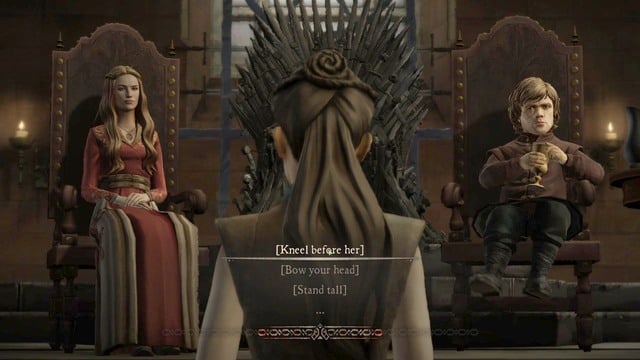
Microreview [video game]: Game of Thrones, Season One for PC/Mac (Telltale Games)

A Fistful of Ironwood


Telltale Games' latest is an adaptation of the HBO show Game of Thrones (not George R. R. Martin's books). It features relatively high production values, a moody score and strong voice acting from Peter Dinklage, Lena Headey and others. And it does a very good job of immersing you into the bleak, pseudo-medieval world of Westeros.

Game of Thrones tells the story of House Forrester, who followed the Starks to war against the Lannisters. After the Red Wedding, House Forrester finds itself in a precarious position relative to its historical rival, House Whitehall--who are bannermen to Roose Bolton, the new Warden of the North. In Episode One, you take control of several key members of House Forrester as they desperately try to save the house: young Lord Ethan, his sister Mira (who is a handmaiden to Margery Tyrell) and Gared, who was squire to Lord Gregor before his murder before the gates of the Twins. Later episodes also take you to the Wall and across the narrow sea.

This was my first experience with Telltale's signature style of narrative gaming. Of course I'd heard all the praise, and those of you who read my game reviews know how much I value story and narrative in the platform. But I just hadn't gotten around to it. Now I have, and I came away impressed with the Telltale model.

Game of Thrones is, in essence, an interactive cartoon. What you might call cut scenes in a traditional game make up the majority of the experience here. Interspersed, however, are dynamic conversations and a smaller number of action scenes, where the interactivity is limited to timed mouse swipes and key presses.


Taken on its own, that probably sounds a bit dull. But the passive scenes are fantastically well done; as an original story set in the Song if Ice and Fire universe, this one grabs you quickly--more so, I might add, than most tie-ins (Martin's Dunk and Egg books included). What's more, the interactive sequences, though simple in mechanical terms, are presented and paced in such a way that you can't let your attention wander--even for a minute.

My favorite aspect of the game, though, was how it deals with conversations. As in most modern RPGs, what you say can affect the way the game unfolds. But unlike most modern RPGs, you have a limited response time--which both forces quick thinking and forces you to live with your decisions. As it happens, not every conversational choice matters--one seemingly important set of decisions in Episode One, for example, all lead to the same conclusion. Many do, however, and in often unexpected ways. Not only does this lend tension and immediacy to the experience, but provides an incentive to replay the game.

The main problem with Season One is that, as the story progresses, the grimdarkness grows less and less well suited to the medium. The books and, to a greater degree, the series revel in their pessimism. Good exists, but never without complications, while evil lurks to a degree in every heart. In the end, only power, really, gets you anywhere--and one's grasp on power is so limited that many narratives inevitably go unresolved. This is fine for books and TV, but in a game you want to feel like you can actually accomplish something, and I'm not sure that's entirely true here. Given the smaller scale of the story here, it would have been possible to alter the formula while retaining that view of the broader world the game takes place in.


My other issue relates back to the simplicity of the gameplay, which as noted above is an overall strength of the game. However, around Episode Four my attention started to wander, and it never quite returned. Granted, I binge-played this game, so maybe it works better with breaks between episodes. But in a game this long, I generally want a bit more diversity in the experience.  


In the end, Game of Thrones is an interesting experience, and is sure to appeal to diehard fans of the show, as well as fans of previous Telltale games. For me it was significantly more up than down, but there were some notable misfires--most notably in how the game concludes.


The Math

Baseline Assessment: 8/10

Bonuses: +1 for simple game mechanics put to good use; +1 for narrative tension

Penalties: -1 for the unsatisfying resolution; -1 for repetition fatigue.

Nerd Coefficient: 8/10. "Well worth your time and attention."


***

POSTED BY: The G--purveyor of nerdliness, genre fanatic and Nerds of a
Feather founder/administrator, since 2012.

Wednesday, February 4, 2015

To the Making of Many Books, There is no End

One of the most effective and unexpected twists, I think, in any writing out there was Ned Stark's death in Game of Thrones. The gravity of the moment, the hero trajectory he was on, and then, in the space of a few pages, all of that vanished and you're left to read frantically on, to see how the GoT universe stitches up the wound.

Yeah, yeah, we know.
Only, as the series progressed, and the bodies piled up, the weight of the twist couldn't be replicated. Instead, with the introduction of each new character, one yawns and waits for them to die. A smart, clever and poignant plot twist is reduced to a low impact moment.

This, I think, is to be expected. Stories have been told, in a variety of mediums for a long ass time (that's the technical term). Many of those stories rely on a certain hook to get you to stick around- frequently in the form of an unexpected twist. Hell, M Night Shyamalan made a whole career out of doing it, and not even doing it well. But he's an excellent case in point- you only get one shot at the big reveal. No one is surprised at a character being dead all along OMG, a la The Sixth Sense.

And so, new works try to twist the twist- outsmart the audience, to where it becomes a chess match. They expect this, so I will do this, but they expect that, so I do something else.

This really stood out to me recently, watching Tinker Tailor Soldier Spy, which, incidentally, if you haven't seen it, rectify that now. It's most excellent. In any case, as the (quite complicated) plot drew to its conclusion, I found myself hoping there wasn't a twist. I had this kind of sinking feeling that (SPOILER ALERT) Oldman's character was somehow the bad guy all along. Just let the bad guy be the bad guy, I thought. I was relieved to find that that's what happened. The plot stood up well enough that it didn't have to out-clever itself (END OF SPOILER ALERT).

Look at the recent GrimDark discussion on this space- it's the same evolution, just with GRIT. Each iteration has to be dirtiest, more gruesome than the last because it's already been done before. And so, instead of standing out, it all just kind of blends together, into a grey amalgamation of one-upsmanship.

I wish I had a super great conclusion, but I don't. Write better stories and movies, maybe. But really an observation of what I see, particularly from the SFF world. A lot of focus on individual devices and twists, and less focus on telling good stories.

-DESR

  Dean is the author of 3024AD and the ongoing SciFi Choose-Your-Own-Adventure, The Venturess. He is an engineer, and geek about many things. He lives and writes in the Pacific Northwest. You can listen to him ramble on Twitter and muse on his blog.

Wednesday, December 10, 2014

Microreview [book]: The World of Ice & Fire by George R.R. Martin, Elio M. Garcia, J.R., and Linda Antonsson

Don't judge a book by its...


This book has been on my radar ever since the folks over at Westeros first announced it many years ago. It was my longest pre-order on amazon ever, clocking in at almost two years (20 months to be exact). Initial discussions pinned WoIaF as a coffee table book to serve as a sort of encyclopedia of the ASoIaF world. Perhaps talks of the cover initially described it as a world map, perhaps I made that up in my own head, but for years I was expecting this book to have an ornate, front to back cover adorned with a decorative map of the Known World. Needless to say, when they released the official cover (which you see here) I was pretty disappointed. I understand that they designed it this way to stylistically match the current ASoIaF run. I also understand that it is supposed to look like a leather book. Maybe my design expectations were too high, but when I finally received this book after years and years of waiting, my initial reaction was...meh. I appreciate that the price was so affordable at $25 but I was expecting to, and gladly would have paid three times that for a more appealing, artistic cover, or a more genuine binding.

BUT! Once you open this book it is phenomenal. The artwork gave me chills. It is astounding. I mean, just look:


And thats not even the half of it. There is so much artwork in this book it is incredible. Oh yeah, and there are words too. Lots of them. I haven't read the whole thing front to back yet, because its not really that type of book. It's one you pick up, read a section or two, and then put down and pick up again later. Its written as if by a Maester and at times you feel like you are reading The Lineages and Histories of the Great Houses of the Seven Kingdoms, with Descriptions of Many High Lords and Noble Ladies and Their Children by Grand Maester Malleon. Well, not exactly that dry, perhaps more like A Dance with Dragons, A True Telling by Grand Maester Munkin. I guess what's fun about this approach is that, as we know, Maesters tend to be unreliable narrators, so there is still some room for interpretation by the reader. 

I love fake history, and art, so to me the concept of this book is awesome. Its just that, I am a little disappointed in the execution. But perhaps that is because my expectations were so high. While it is incredibly refreshing to see so much published ASoIaF artwork that doesn't feature HBO actors, the book still seems a tad more commercialized than I would prefer. But with the success of the series, I guess it would be silly to expect less. I want to love this book more than I think I actually do, so I am having a hard time rating it. But one thing thats for certain, A World of Ice and Fire is not going to be put out on display like I had originally planned.

The Math


Baseline assessment: 8/10

Bonuses: +1 for fantastically chilling original artwork 

Penalties: -1 for the cover, -1 for being a tough read at times

Nerd coefficient: 7/10 “an enjoyable experience, but not without its flaws”

--Tia 

Reference: Martin, George R.R., Elio M. Garcia, J.R., and Linda Antonsson. The World of Ice and Fire [Bantam, 2014]