I felt a bit dirty as I paid for my comics this week and left the new issue of The Walking Dead on the shelf. I started reading the series with some of the trades, but switched to single issues when I caught up sometime in 2011. I have been a loyal reader for six years, but feel that I need to take a step back and take a break from Rick and focus on other titles. I am not saying that it has overstayed its welcome, but I worry that if I don't take a break it is a title I am going to no longer enjoy. I have grand plans for starting at the beginning again soon and hope that I will have a better appreciation for where things are if I return to where it all began.
Pick of the Week: All New Guardians of the Galaxy #9 - Gerry Duggan hits us with an emotional Guardians issue this week. Rocket and Groot went to collect the credits for their last heist, only to be ambushed by a mysterious figure dressed like Death. One of the most endearing aspects of the Guardians, in my opinion, is the connection that the reader has to the characters and the connection the characters have with each other. While I admit that I haven't read a ton of Guardians comics, Duggan does an exceptional job of bringing that raw emotion to the page. While I am not sure what the final twist in this book implies, I am definitely tuning in to the next issue to learn what really happened to Groot and who this mysterious Gardner is. I picked up this book on a slow week to check it out and it has quickly become one of my favorite ongoing titles that I am currently reading.
The Rest: Daredevil #26 - Part one of "The Land of the Blind" is a doozy of an issue! We learn that Daredevil is still feeling guilty over the fate of Blindspot, and is currently assisting on the turf that Blindspot used to protect. A mysterious message turns up inviting Daredevil to China at the request of his old partner. Weary it may be a trap, Daredevil makes the trip and is ambushed by the Hand. While pretty formulaic, I welcome the legal break we seem to be in store for and look forward to some good old fashioned action. There are mysterious powers and beings in play and I am excited to see what Charles Soule has planned for the man without fear.
Star Wars Adventures #1 - I'm not sure how IDW has the licence to write Star Wars comics, but I am pleasantly surprised with this incredibly fun debut. Aimed for a younger audience than the Marvel books, Star Wars Adventures features two short stories that are both very enjoyable. The first is part one of a bigger series that focuses on the life of Rey when she was a scrapper on Jakku. The second is a one-off story that centers around Obi-Wan during the Clone Wars. Both are lighthearted, entertaining, and highly recommended for Star Wars fans both young and old. I definitely am looking forward to sharing my copy with my kids.
Lark's Killer #2 - The second issue of Bill Willingham's new comic continued the story of Lark, a runaway who found her self transported into a fantasy land after a shoplifting attempt at Walgreens went awry. In the first issue she narrowly escaped a group that was trying to kill her, and in this issue we learn a bit more about Frogbarding, the sell sword who accepted her offer of one dollar to escort her out of the town of Mercy Rock. Willingham taught us a bit more about this world of his and that the governor is using ghost holes, portals between worlds, for some nefarious purpose. Whatever brought Lark to this land, she poses a serious threat to his ultimate plan and he plans on killing her and anyone she interacts with.
POSTED BY MIKE N. aka Victor Domashev -- comic guy, proudly raising nerdy kids, and Nerds of a Feather contributor since 2012.
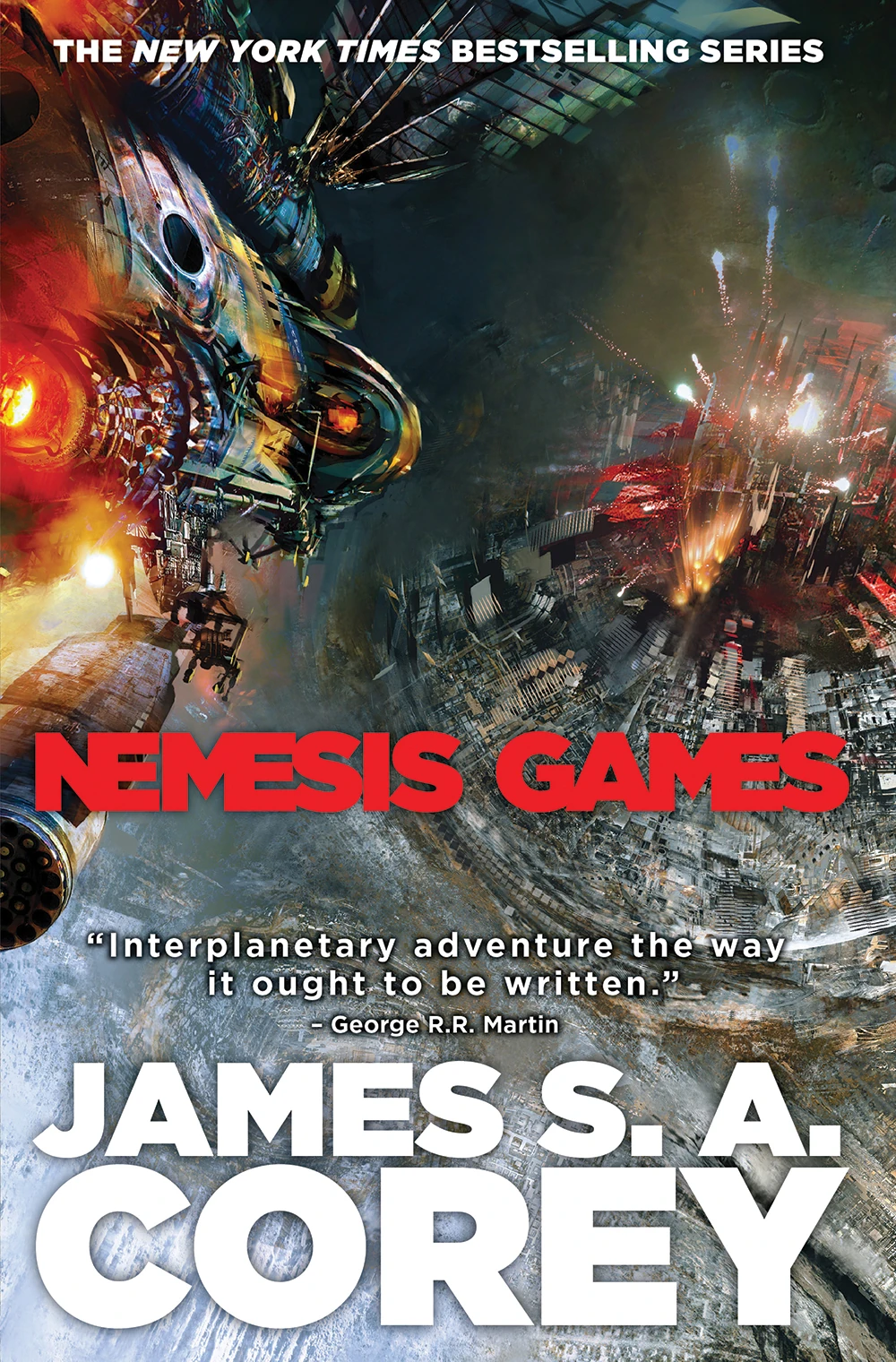
Since there was a bit too much familiarity about the crew of
the Roci by book four—a sense that if they pooled their efforts they could
somehow triumph against any obstacle, even an alien one—it seemed the series
was building to a problem serious enough to jeopardize the synergistic
relationship the four had. Sure enough, Nemesis Games almost immediately sends
all four main crew members off on disparate quests, with little chance to
affect each others’ situations.
This sort of ‘scattered to the ends of the earth solar
system’ setup entails some risks. Since we have grown accustomed to having the
Roci’s crew (not to mention the Roci herself, practically a fifth main cast
member at this point) demonstrate the importance of interpersonal relations by
solving every problem together, how will the story proceed if we, the readers,
are denied the pleasure of seeing them work together (and denied any meaningful
glimpse of the Roci, out of commission temporarily due to damage sustained in
Cibola Burn)?
I’m pleased to say that the authors of The Expanse did a
masterful job of what is essentially back-story exposition (no easy task to
avoid the typical sort of “You know I don’t like snakes…(and I'm saying this now because lots of snakes are in the near future)” clumsiness, but they managed it!), giving
us a major glimpse into everyone’s past (well, everyone but Holden). We learn,
in essence, some of the key reasons such a skilled group were on the Canterbury
in the first place: what they were running from, and why. Since the core
relationship on the Rocinante is the one between Holden and (Naomi) Nagata, it
is only fitting that it is this romance which is most directly imperiled by the
reemergence of these shady pasts.
All this might sound pretty small-time—the ghosts of the
main characters’ misdeeds rearing their ugly heads might be scary to those
individuals, but it would hardly measure up to the sort of civilization-ending
threat these four (+ the Roci) have faced previously. At the risk of being
terribly mysterious (thank you, The Sphinx from Mystery Men!), I’ll say only that the stakes
turn out to be all too high, the threat all too dire. Just when we thought the
worst that was in store was the addition of new crew members to the Roci, and
the risk that both the diegetic dynamic and the reader’s appreciation for the
tight-knit crew of four could be shaken, we discover that the true danger is to
the core of human civilization itself!
Does the "Holden+Nagata, Alex and Amos too" dynamic survive this
dire challenge? Is this, in fact, the best Expanse book yet? (Given The G's almost visceral dislike for the first book in the series, one could optimistically say that it must be getting better overall!) You’ll just have to read it to find out! (Alternatively, you
could check out my forthcoming review of book six, Babylon’s Ashes—check back here on NOAF soonish!)
The Math:
Objective Assessment: 7/10
Bonuses: +1 for masterful exposition, without a single “But
you KNOW I can’t eat strawberries!” ham-fisted foreshadowing, +1 for
successfully upping the ante—with a vengeance!
Penalties: -1 for describing Nagata’s protracted ordeal in what struck
me as a conspicuously pseudo-scientific manner (in essence, hit stuff with a
wrench after a serious physical injury/setback, but still get one’s message
through without being “permanently damaged”, to quote Vader)
Funny how main characters seem to survive just about anything, eh Naomi? Keep swimming around unprotected in deep space--I'm sure everything will work out!
Nerd coefficient: 8/10 “A bit of alright”, as the
Australians say!
***
[Puzzled by our scoring system? Learn why 8/10 is an
exceedingly high score here.]
Reference: Abraham, Daniel and Ty Frank. Nemesis Games. Orbit, 2016.
All the comments and opinions written here are solely
Zhaoyun’s, longtime lover of space opera and fantasy literature and reviewer
for Nerds of a Feather since 2013, and should not necessarily be taken to
represent all Nerd-kind.
7 Wonders Duel by Repos Production - My wife was kind enough to get me this game as a Christmas gift even though she had no intention of playing it with me. I was worried that it might be a bit too much for my 10 year old son, but after playing it I was amazed at how slick this game is and how it streamlines the decision making process. 7 Wonders Duel attempts to provide a two-player experience based on the mega-hit card drafting game 7 Wonders. You are competing with a rival city to develop as much as you can over three ages. You are working towards the construction of wonders, while also cultivating a quality of life for your residents with a solid military, investment in the arts, and others. Turns are quick and simply and involve taking a card from the available area, and either purchasing it and building it in your city or cashing it in for gold. In addition to maintaining your city and working towards your wonders, you have to keep an eye on the military balance between your city and your opponents. While I wasn't blown away in my first play through, I immediately wanted to play again to mix things up. It was quick to learn, quick to setup, and offered multiple strategies on the path to victory. Definitely happy to have this in my collection and cannot wait to play it again.
Dastardly Dirigibles by Fireside Games - This is a game all about building your own steampunk blimp in order to score the most points. Game play is extremely simple and this game makes a good filler game or one to play with non-gamer or younger players. The twist in Dastardly Dirigibles is that when you build on your airship, your opponents must build the same part if possible. This can take away from their bonus or potentially provide a bigger bonus depending on the suit. There are few "event" type cards that mix things up a bit more, but in the end this game is extremely light and quite a bit of fun. I don't imagine it will hit my table a ton, but it will be a game that pops out from time to time depending on the group. One nice thing about each round is that you get to marvel at everyone's dirigibles as the game includes some pretty cool art.
POSTED BY MIKE N. aka Victor Domashev -- comic guy, proudly raising nerdy kids, and Nerds of a Feather contributor since 2012.
[Warning: spoilers everywhere]
I'll admit I'm not the biggest fan of HBO's Game of Thrones. I'd read the first four A Song of Ice and Fire books twice by the time the show debuted in 2011, and have strong, positive feelings about the first three. I love the characters, the meticulous detail that George R. R. Martin put into world building, and the lore. And of course on top of that, the books are impossible to put down. I spent many a night prying my eyes open by sheer force of will, determined to find out what happened next.
Then came the show, which in its first season seemed like a near perfect distillation of A Game of Thrones. The actors embodied the characters they played; the sets brought Westeros to life; and the lore--it was there too. I was beyond excited for Season 2, when the show would move on to the events portrayed in my favorite of the books, A Clash of Kings.
Only, I found myself slowly falling out of love with the show. You see, it's impossible to capture all the detail of a 700+ page book in a 10-episode season, and that was doubly true once the scale of the drama shifted from the closed-door intrigues of A Game of Thrones to the cross-continental wars of A Clash of Kings. So the writers and producers had to pick and choose what they would bring to screen, as well as take some shortcuts. All quite understandable, really.
Unfortunately, they chose to emphasize what are to me the most problematic and least attractive elements of the books, namely, their excess of cruelty and sexual violence. And the show didn't *just* emphasize these elements; it made them more central, upfront and over-the-top. Meanwhile, I was getting less of the things that made reading the books a magical experience for me--less than I wanted, at least.
At the same time, the source material was still really good, so despite having issues with the show, I was still getting a visually arresting, immersive television adaptation of books I really liked. Thus I could hold out hope that show might actually fix A Feast for Crows and A Dance with Dragons, the latter of which I found simultaneously tedious and splatterpornographic.
I would be disappointed, as the show retained most of the tedium and, once again, chose to amplify the splatterporn. The worst came in Season 5, which lingered on some of the most agonizingly boring storylines in A Feast for Crows (e.g. the sparrows, Dorne) and then chose to depart from the books in order to burn a child alive at the stake. That was it for me. I was done.
Only, then Season 7 rolled around--the first that would not have Martin's novels as a guide.* And given that we're still waiting for The Winds of Winter, six years after A Dance with Dragons, there's a good chance that the book series will never be done. So for those of us who've invested a lot of time and thought into the story, this may be the only form of closure we ever get. I decided to catch up with Season 6--which was very good at points, and not very good at others. But I was excited again, more than I had been since the start of Season 2.
[*The show moves past the books midway through Season 6, to be precise.]
So how was Season 7? To quote...
"It Was the Best of Times...
Season 7 is, in a word, campy. But don't take that the wrong way--campy can be great too. And this season was gratifying in a lot of ways.
To begin, I appreciated the shift in how the show treats sexual relationships. Both Game of Thrones and A Song of Ice and Fire are very rapey. The books feature more rape than the show, while the show makes up for that by making every rape graphic and in-your-face rather than, say, a reference within in conversation. The low point, for me, was Sansa's rape by Ramsey in Season 5 (which, one notes, is not in the books). Season 7 stops using rape as a go-to device to illustrate how grim and dark this world is. And as far as I'm concerned, that's a very positive development.
But that's not all. Season 7 also allows its characters genuinely romantic moments, so much that the contrast with previous seasons is immediately striking (Jon's doomed relationship with Ygritte notwithstanding). And somehow, among all the things that don't make sense about Season 7 (more on that later), the budding romance between Jon and Danaerys does--on a personal level, at least.
I also appreciated the renewed focus on action. One thing Martin does exquisitely well, and which has also translated well in the TV adaption, is maneuvering chess pieces to build tension and momentum toward rare but superbly-rendered set-piece action scenes. Well, the first 3 books/4 seasons of the show do that at least. In truth, the maneuvering got really wearying in A Feast For Crows/A Dance with Dragons, as well as in Seasons 5 and 6 of the show, where it essentially became an exercise in wheel spinning. So it was nice to see the producers de-emphasize intrigue in favor of more action. That's what the series needs at this point. Even Euron Greyjoy, that most ridiculous and cartoonish of characters, stops talking long enough to give us an epic sea battle.
Trogdor!!!!! I mean...Drogon!!!!!
Also welcome, while Season 7 contains a lot of violence, it doesn't linger on moments of cruelty like the show has previously, to ever-diminishing effect. That breaks the cycle of always needing to go further, from rape to torture to castration to child sacrifice. Instead, we get dragons burninating the countryside--a moment we've all been waiting for. Hell, I don't even think I'd mind if the rest of the show was just Danaerys engulfing the show's many villains in flames. Especially Euron. That guy's annoying as shit.
If that means Game of Thrones feels a bit more like an Arnold Schwarzenegger film, and a bit less like I-Claudius-with-extra-splatter, then that's okay in my book. Oh, and Littlefinger getting punked by badass sisters Sansa and Arya? That was a lot of fun.
...it was the Blurst of Times."
As much fun as Season 7 is, it's also littered with incongruities, plot holes and absurd narrative devices. Readers/viewers who have invested a lot of time and energy into the story may be on board with the shift in tone (emphasis on may), but most I've spoken to are frustrated with the decline in plotting.
The most obvious sign is the emergence of teleportation in Westeros. Armies traverse land or sea in hours rather than days or weeks, while ravens deliver messages instantaneously--from the northernmost to southernmost points of the Seven Kingdoms, no less. I get that the writers need to speed things up, but this strains credulity.
Worse, in my opinion, is the revelation that Jon isn't just the child of Lyanna Stark and Rhaegar Targaryen, but the legitimate heir to the throne. Because apparently the High Septon annulled Rhaegar's marriage to Princess Elia Martell--for reasons unknown and despite their having multiple children--and simply didn't bother to tell anyone about it. Oh, and Jon's real name, Aegon Targaryen, is already the name of Rhaegar's other son.
WTF is this garbage
This isn't just implausible, though it is certainly that. Rather, it's the show reverting to that hoariest of hoary fantasy tropes: the proverbial pig farmer who turns out to the the prophesied one, which in turn allows him to ascend to the throne and marry the princess without upsetting the precious class hierarchies of medieval pseudo-Europe.
In doing so, the show violates a core tenet of Martin's novels: that the true heroes are not the obvious heirs, but rather the outsiders and castaways. Not Ned, Robb, Stannis, Viserys or Jaime, but Jon, Arya, Davos, Danaerys and Tyrion. (Also Sansa, but only after circumstances force her to shed her insider status.) The pig-farmer-to-prince trope does away with that by telling us that, appearances notwithstanding, the outsider was in fact never an outsider at all. It's corny, and actually kind of fucked up when you think about it. To be a hero, you have to be born with a hero's blood in your veins. I have a very hard time imagining that Martin signed off on this one; it feels like an innovation born of convenience by people who are now adrift at sea without the sage as their navigator.
The absolute worst thing about Season 7, though, is Jon's ill-fated quest to bag a wight. Why does he do this? To convince Cersei, the entirely self-interested and wholly dishonest usurper of the throne, to join up in the fight against the Night King and his army of undead warriors. This is, prima facie, a bad idea because, as I mentioned, you simply cannot trust Cersei to do anything but look out for herself. It is also a baffling idea because, as we see in Episode 4, Cersei no longer has an army to offer.
Even if Jon doesn't get this at first, you'd think that someone would tell him. Danaerys, for example, who crushed the Lannister army and executed its Warden of the South (and his heir). Or Tyrion, who watched it happen and is allegedly a pretty smart fellow.
The smart play, of course, would have been to occupy Highgarden. It is the breadbasket of Westeros, its castle is currently unoccupied, and the one-time army of occupation done got burninated. Cersei's ability to raise another army, and keep it loyal over time, is predicated entirely on her access to the riches of Highgarden.
But no! Instead Jon, one of the two most important figures in the fight against either Cersei Lannister or the Night King, traipses off north of the wall with a motley crew of other important figures in order to bag the wight, only to attract literally the whole army of the dead. So what do they do? They call Danaerys via insta-raven, who shows up with all her dragons. The Night King throws an ice spear through Viserion, who then becomes a fucking badass ice dragon. And at the end of the season closer, Viserion the Ice Dragon burninates (freezinates?) the Wall.
Cool, but...
The emergence of an ice dragon in and of itself is not surprising--Martin did wrote a novel called The Ice Dragon, after all. But it only happens, in the show, because Jon starts acting a careless idiot, risking everything for nothing, when he could have risked far less for much more. Now, thanks to his stupidity, the wall is toast, the Army of the Dead is on the march and the Night King has a fucking ice dragon.
This is a hallmark of bad writing, to the point where it has a name (coined by SF writer James Blish, no less): the idiot plot. It's clear, in my eyes at least, that the writers are now just looking for the fastest way to get their ducks in a row. And in this case, the duck is a dragon on the other side of the wall.
Conclusion: Dumb Fun is Both Dumb and Fun
Summing up my feelings about Season 7 is basically a fight between heart (which likes it) and head (which does not). Heart wins out, in the end, for the simple reason that head's been increasingly lonely since the end of Season 1. Despite its many problems, Season 7 has a ton of gratifying fan moments, while (1) upping the action quota, (2) moving on from Dorne and the sparrows and (3) abandoning earlier seasons' obsession with sexual violence and cruelty all help transform the show into something I can just have fun with again, rather than endure for the sake of keeping up with things.
At the same time, it is dumb. At times it is very, very dumb. It's too bad the writers didn't have a full 10 episodes to work with, something that might have helped them get the Night King over the wall in a way that's more consistent with the spirit of Martin's books. Nonetheless, I'm glad I got back on board. Here's to Drogon and Rhaegal burninating the shit out of the Night King in 2019.
***
POSTED BY: The G--purveyor of nerdliness, genre fanatic and Nerds of a Feather founder/administrator, since 2012.
Author Donny Cates is a Texas native and put together a quick fundraiser to raise money for the Houston Coalition for the Homeless in the wake of Hurricane Harvey. For only $25, not only can you get this awesome t-shirt, but you can help an amazing organization that could greatly use your support. Click here to place an order if you are so inclined.
Pick of the Week: Saga #46 - An emotional issue of Saga sees the conclusion of the abortion that Alana needed to survive. The fetus had already passed, but it is clear that Marko and Hazel still had a lot of emotions to work through as they grieved together. Hazel's relationship with her imaginary brother is beautiful and heart breaking at the same time. We are reminded about how much suffering Hazel has had to endure in her short life and how fragile life is for the group of outcasts that currently make up this story. Not to be outdone, Prince Robot and Petrichor deal with issues of loss and suicide in one of the heavier issues. Brian K. Vaughan does a great job treating these topics with care and attention in a non-judgmental way that seems very appropriate. For a book that can get extremely bizarre and gratuitous, this issue really stands out and is one I will likely read many times over.
The Rest: Secret Empire #10 - Is this the issue where Nick Spencer will finally stop taking so much crap for turning Captain America a Hydra agent? The finale of this summer's big Marvel event takes us inside the sentient cosmic cube that is Kobik as the Captain America that we all know and love returns. Would he lose this battle? Would there be a lasting impact on the Marvel Universe? Nope. In the end I am ok with this and really enjoyed this arc from the beginning. Was Captain America being a sleeper Hydra agent a gimmick? Absolutely, but it was one that had a great team behind it and a compelling story to boot. Well done Mr. Spencer. Well done.
Mace Windu: Jedi of the Republic #1 - Following the conclusion of the Battle of Geonosis, Mace Windu finds himself conflicted about the Jedi's new role in the name of the Republic. Preferring peace to war, Windu is now a General and must lead various military forces in a quest for peace. Windu's first mission takes him to the planet Hissrich and he assembles a team that includes Kit Fisto, the blind Jedi Prosset Dibs, and pilot Rissa Mano. While we don't quite know what the separatists are up to on this planet, it is clear that the Jedi must find out quickly and intervene. This was an enjoyable first issue that gives Windu the additional attention that his character deserves.
Star Wars #35 - Han Solo is the galaxy's only hope as the Republic needs someone to smuggle Grakkus the Hutt past enemy lines so that he can be properly interrogated. After the demise of Sunspot Prison it is imperative to get Hutt to a new holding facility. If you recall, this Hutt is a muscular foe with a set of robotic scorpion legs and quite the formidable foe. Solo has to deal with not only the smooth talking ways of the Hutts, but one of the strongest characters that exists in the comics to boot. This was a highly entertaining issue and a great way to get your Star Wars fix in before Force Friday this weekend. POSTED BY MIKE N. aka Victor Domashev -- comic guy, proudly raising nerdy kids, and Nerds of a Feather contributor since 2012.
The Stone Sky is the culmination of the best fantasy trilogy written today and that might be an understatement.
The Stone Sky is a novel in conversation with the two Hugo Award winning novels which precede it, it is a novel in conversation the fantasy genre as a whole, and it is a novel in conversation with the culture in which it was written. That's a lot for one novel to take on, but N.K. Jemisin is more than up to the task. The first two volumes of The Broken Earth trilogy set the bar so incredibly high that it would take a remarkable novel to even approach that level, let alone meet it. The Fifth Season and The Obelisk Gate were masterworks. Jemisin has set an impossible standard for herself, but her control in telling one unified story shows off the skill of an author at the height of her powers. The Stone Sky more than lives up to the promise and standard of those first two Broken Earth novels.
Each novel in The Broken Earth requires a moment of centering, a moment to process and figure what sort of story Jemisin is telling - because even though this it truly a cohesive whole, each novel has its own distinct and tight focus setting it apart.
"Imprisonment of orogenes was never the only option for ensuring the safety of society." I pause deliberately, and she blinks, perhaps remembering that orogene parents are perfectly capable of raising orogene children without disaster. "Lynching was never the only option. The nodes were never the only option. All of these were choices. Different choices have always been possible."
When I wrote that The Stone Sky is a novel in conversation with the culture in which it was written, I did so will the full understanding and recognition that I may not be the most appropriate commentator for this. Jemisin is writing about race and power and privilege; I'm an upper middle class white male. It's not that I do not get to have thoughts and opinions about this, but my understanding of the systematic oppression Jemisin is writing about is necessarily limited.
The Stone Sky is a novel about the consequences of oppression, about how a utopia is built on the backs of a persecuted race and a persecuted class. Utopia for whom, is a great question. Even mentioning utopia in commentary on The Stone Sky is absurdity because readers at all familiar with the first two novels of the trilogy know there is no utopia here. There is nothing close to a utopia in The Broken Earth.
Like The Obelisk Gate, the primary viewpoint characters of The Stone Sky are Essun, her daughter Nassun, and the stone eater Hoa. Hoa, we find out in The Obelisk Gate, was the narrator not only of his own chapters (it is a while before we know this), but also is the one telling Essun's story. This was incredibly important because, even though I didn't question it for far too long, who was telling the story mattered and it changed the shape of the narrative I thought I was reading.
In The Stone Sky we learn early on that Hoa is, remarkably, more than forty thousand years old and has memories stretching all the way back to before there were cataclysmic Seasons. Through Hoa's first person narration we discover the utopian continent spanning city of Syl Anagist. Syl Anagist is, in just a handful of chapters, one of the great cities of speculative fiction. It is a city of wonder and amazing technological developments. It is on the cusp of moving to a post scarcity economy.
It is also built on the back of genocide and persecution and oppression and manufactured hatred.
Perhaps it began with whispers that white Niess irises gave them poor eyesight and perverse inclinations, and that split Niess tongues could not speak truth. That sort of sneering happens, cultural bullying, but things got worse. It became easy for scholars to build reputations and careers around the notion that Niess sessapinae were fundamentally different, somehow - more sensitive, more active, less controlled, less civilized - and this was the source of their magical peculiarity. This was what made them not the same kind of human as everyone else. Eventually: not as human as everyone else. Finally: not human at all.
It is all too real and fresh. It is reminiscent of recent world history and of the tendrils of a rotten past still rolling through America's present. While The Stone Sky is not necessarily about directly engaging with American history, readers can't help but bring that knowledge and background into the narrative.
I may be putting too fine of a point on this aspect of The Stone Sky and ultimately I think the corollary to the real world is subtext, though perhaps very pointed subtext. Throughout the story, Jemisin offers an examination and a condemnation of how the privileged and powerful treat those deemed "other", especially when that prejudicial classism and racism and prejudice just happens to protect their own power and position. That's the story of the fall of Syl Anagist and throughout The Stone Sky we see how that fall resonates and directly impacts the stories of Essun and Nassun.
Don't worry, I didn't forget about Essun and Nassun. As she has done with every other aspect of The Broken Earth, Jemisin completely nails the parallel stories of mother and daughter.
Following the destruction of Essun's temporary refuge, the Castrima comm which very effectively showed a way for orogenes and to live in harmony with "regular" humans, Essun is on the move with the remnants of the comm looking for a new home offering safety during the Season. After the events of The Obelisk Gate, Essun is much like her mentor Alabaster was - she overextended the use of her powers and now additional use of orogeny will cause her to more rapidly turn to stone. The problem is that she can't just follow Castrima and not use her power because Essun's true goal is to find her daughter and, oh yeah, pull the moon back into proper orbit with the planet.
When we say that "the world has ended", remember - it is usually a lie. The planet is just fine.
Nassun, on the other hand, is hell bent on using her prodigious power to destroy the world Essun is hoping to save. She is only ten years old but has experienced pain and loss and horror the likes of which can scarcely be comprehended, and she's got the righteous and focused anger of a child and the raw power to do something about it.
As with so much of The Broken Earth, the stories of Essun and Nassun are as wrenching and compelling as anything in fiction today. While perhaps nothing in The Stone Sky is as brutal as that scene in The Fifth Season where Syenite kills her own child rather than allow the Fulcrum take him and enslave him and use him up to feed the nodes stabilizing the Stillness, the revealed origin story of the orogenes is filled with equal amounts of pain and horror that calls complicit all those who benefit from the oppression of others and do nothing to alleviate that oppression and suffering.
The world is broken and you can fix it; that's what Alabaster and Lerna both charged you to do. Castrima is more reason for you to do it, not less. And it's tie you stopped being a coward, too, and went to find Nassun. Even if she hates you. Even if you left her to face a terrible world alone. Even if you are the worst mother in the world . . . you did your best.
Essun is one of the remarkable and notable characters in fantasy literature. She has endured so much, suffered so much, and she has come out still pushing to make a world better for her daughter. She's not a hero, at least not in the generic epic fantasy sense of the world. Essun is a woman with incredible power and though the whole world is not her responsibility, her daughter is. Even as impossibly difficult Essun's life has become (again) and how impossible the Season has made long term survival, the focus never gets too far away from Essun finding a way to find Nassun.
Normally we would say "rescue" Nassun, especially given that her daughter is only ten years old, but Nassun comes across as so preternaturally assured and powerful that it's so easy to forget she's so young. She is running a parallel course with Essun because the nexus of power Essun needs to pull the moon back into course correction with the world is the same nexus Nassun needs to finish the work of the emergent Season.
The Stone Sky caps off a stunning epic fantasy trilogy, one which began with the threaded narrative of three orogenes and concludes with the story of a woman and daughter finally coming back together. If you think there's going to be a truly happy ending, you haven't been paying attention. That's not the story N. K. Jemisin is telling here. The Stone Sky weaves deep personal drama and trauma with the overarching racial commentary that underpinned the entire trilogy.
The Broken Earth is a monumental achievement in fantasy fiction. The Stone Sky is the culmination of the best fantasy trilogy written today and that might be an understatement.
The Math Baseline Assessment: 8/10
Bonuses: +1 because Jemisin somehow makes Schaffa somewhat sympathetic and that's absolutely amazing given where Schaffa started in The Fifth Season
Penalties: None.
Nerd Coefficient: 9/10 "Very High Quality / Standout in its category". See more about our scoring system here.
Reference: Jemisin, N.K. The Stone Sky. [Orbit, 2017]
POSTED
BY: Joe Sherry - Co-editor of Nerds of a Feather, 2017 Hugo Award
Finalist for Best Fanzine. Writer / Editor of the mostly defunct Adventures in Reading since 2004. Minnesotan.
If you love horror, monsters, science, mystery, you will enjoy this book.
I will let you know right now, I loved this book. This book made me laugh, cry, and generally fall in love with all the characters (well, minus the super bads).
Dr. Greta Helsing, a descendant of the famous Professor Abraham Van Helsing, is living in modern day London following in her father's footsteps. After medical school, Greta joined her father's practice, taking over after his passing. However, this isn't just any medical practice, Greta treats all manner of the otherworldly, from vampires and vampyres to mummies and ghouls. A firm believer that all persons, including the undead, should receive respect and properly medical care.
When a vicious attack on a vampyre friend of one of Greta's patients appears connected to the serial murders occurring in London, Greta, and her friends end up squarely in the sights of an evil unlike anything they've seen.
Without a doubt, the best thing about this book are the characters. Shaw beautifully blends Greta's analytical mind and intelligence with deeply connected friendships and compassion. Lord Edmund Ruthven, he prefers you abstain from using Lord, is the best host, a considerate friend, willing to help tend a baby ghoul, a vampire you can depend on no matter what the situation, and a dear friend to Greta. (And yes, there is a difference between vampires and vampyres, a detail I adore.)
Shaw clearly did her research when it comes to undead history and tales. There are so many references fans of horror will truly love and respect. It adds a richness to the text and an authority to the voice behind each character. Many times urban lore surrounding a certain undead will be openly addressed during conversations yet never felt forced into the narrative. Weaving such history into the story itself allows Shaw to make her Helsing tale wholly her own.
The attacks and murders lead into a pretty straight forward mystery where Greta and her companions start unraveling clues Scotland Yard is not privvy to since the undead are a bit harder to kill and become a witness to the crime versus victim. Greta is driven to solve the murders in order to protect those closest to her. The undead can't afford a lot of police and investigations poking around. She fears the worst from abductions for experimental probing to the pitch fork brigades. Protecting her patients and friends is of the utmost importance to her, and it is a credit to Shaw's skill that I was right there alongside Greta wanting to protect everyone.
It takes a bit to make me cry at a book, Black Beauty and Where the Red Fern Grows managed it and now I can add this one to the list as well. It wasn't because of a tragic thing (to avoid spoilers that is all I will say) it was because there is a moment when Greta is so upset she is a slobbering, sobbing mess and I was so invested in these characters I found myself tearing up and having to blow my nose, once again, right alongside Greta. It is that kind of character-building that will carry this series for as long as Shaw wishes to write it. As soon as I finished the book I went looking to see if I could at least pre-order the next in the series, sadly it isn't listed yet.
Every time I think I am firmly in the the "I prefer standalones always and forever" a book like this will come along and sweep me away selling me on the idea of series and spending more time with characters.
If you love horror, monsters, science, mystery, you will enjoy this book. If you are like me, you will keep checking Orbit's listings to see when the second is on the horizon and available for pre-order.
The Math: Baseline Assessment: 8/10
Bonuses: +1 for truly wonderful characters
Penalties: Not a one.
Nerd Coefficient: 9/10 - A seriously great cast I look forward to following for many, many books!


 Star Wars Adventures #1 - I'm not sure how IDW has the licence to write Star Wars comics, but I am pleasantly surprised with this incredibly fun debut. Aimed for a younger audience than the Marvel books, Star Wars Adventures features two short stories that are both very enjoyable. The first is part one of a bigger series that focuses on the life of Rey when she was a scrapper on Jakku. The second is a one-off story that centers around Obi-Wan during the Clone Wars. Both are lighthearted, entertaining, and highly recommended for Star Wars fans both young and old. I definitely am looking forward to sharing my copy with my kids.