Showing posts with label vampire. Show all posts

Wednesday, April 16, 2025

Book Review: The Buffalo Hunter Hunter by Stephen Graham Jones

Stephen Graham Jones’ latest novel delivers on the promise of the title with a historical, fantastical spray of blood.

a buffalo head in profile with red letters spelling out the title The Buffalo Hunter Hunter

Since I heard the concept of this novel last year, it’s been one of my most highly anticipated titles. For regular readers of Nerds, you may have noticed that some books I was excited about didn’t quite land the way I hoped—not so with The Buffalo Hunter Hunter. This fast-paced story within a story of an Indigenous vampire hunting the buffalo hunters was exactly the kind of gory read I wanted in these troubling times. 

The basic idea of the book is mostly summed up in the title: Good Stab accidentally becomes a vampire and decides to hunt down white hunters as they eradicate the buffalo herds for profit. Jones delivers on the plot’s promise of revenge, but the novel isn’t so one-dimensional as that. First, the novel is a frame narrative. Nearly failed academic Etsy Beaucarne thinks she’s struck gold when she is able to transcribe, and hopefully publish, the journal of her distant relative Arthur Beaucarne. In his journal, Beaucarne has recorded the story of a Blackfeet man named Good Stab, where he explains how he became a vampire and hunted down the hunters. This frame narrative sets up not only the extractive nature of higher education when it comes to Indigenous topics but the idea of audience as Good Stab tells his story to a white man in order to achieve his goal. This idea of audience reaches beyond the novel, asking whom are these stories for

While Jones has been recognized in and outside of the horror genre as a top-tier writer, this layered frame narrative really demonstrates his control of voice. His ability to shift between Beaucarne’s journal entries and Good Stab’s “oral” story never felt jumbled. Both characters were clearly delineated, their voices unique especially when in contrast to the other. 

This emphasis on voice is particularly important to how Jones takes on the time-honored horror of the vampire. In the novel’s acknowledgements, Jones talks about starting this novel while wrapping up a graduate seminar course on “Writing the Vampire,” which is reflected in the way he picks and chooses what aspects of vampire lore to include, such as the quick healing abilities but not the lack of reflection. Good Stab keeps track of his reflection and the changes made by being a vampire because these new powers and restrictions make him unable to participate in the lifestyle that he sees as making him a Blackfeet. What makes one Indigenous is a throughline in this novel as Good Stab must come to terms with the changes his abilities bring as he is no longer able to go back to his home or his family and friends. 

While this book is deeply character driven via Good Stab’s voice, it is also a violent tale of revenge against the American empire. As Good Stab says: “What I am is the Indian who can’t die. I am the worst dream America ever had.” The novel’s plot begins with a white man found skinned on the prairie. Good Stab comes to the Lutheran pastor Beaucarne to tell his tale as the reader slowly figures out why Beaucarne is his chosen audience. While described on the inside flap as “literary horror,” the more literary aspects of the prose and frame narrative never get in the way of the blood and gore, but rather make the moments of intense violence more poignant or shocking.  

There’s so much more I could write about with this novel—the environmental commentary, the use of oral storytelling, the fun reinterpretation of the vampire—but this novel is my current top read of 2025. I’d rather leave you with a taste in hopes that you pick it up for yourself. Gabino Iglesias was right when he called this novel Jones’ “masterpiece” in his review for NPR. The prose, the characters, the plot, the commentary all come together seamlessly to create a book nearly impossible to put down. Good Stab’s voice will stay with me for a long time, and I know this is only the first of many rereads. 

--

Reference: Jones, Stephen Graham. The Buffalo Hunter Hunter [Saga Press, 2025].

POSTED BY: Phoebe Wagner is an author, editor, and academic writing and living at the intersection of speculative fiction and climate change.

Monday, December 30, 2024

Review: Nosferatu (2024)

Robert Eggers delivers a terrifying, graphic, and atmospheric take on the classic vampire tale, managing to inject fresh horror back into a story that has spent decades being sanitized by sedutive pop culture bloodsuckers.

Remaking a film that is the progenitor of modern vampire cinema is an interesting undertaking; it's also been done before (Herzog's 1979 Nosferatu). So why did Robert Eggers —director of The Witch and The Lighthouse— feel compelled to put his own spin on the story?

Because he loves it. Like, really loves it. As a kid, he saw an image of Max Shreck's Orlok and became infatuated. As a teenager, he directed a stage version of it, and has been consumed by the tale ever since. If there was anyone going to develop a new (and different enough) film version of Nosferatu, it could have only been Eggers. His production design, especially, as well as immaculate choice in casting, are two primary reasons why this film works, and they're superb. Seeing a Depp in a desaturated and gothic town hasn't been this fun since 1999's Sleepy Hollow, which is a master class in horror vibes (Eggers is the heir apparent to Tim Burton, harnessing all of the atmospheric darkness of Gothic ambience without the tweeness).

I won't recount the plot bit by bit as literally everyone knows the story, but I do want to focus this review on what's different and great about this new version.

Depicting Orlok as a gruff, disgusting, and aggressive Transylvanian folk vampire

While Max Shreck originated the concept of the tall, lanky, creepy and quiet vampire, Hollywood in the intervening years has gotten really into sexy and dashing anti-heroes with its Gary Oldmans and Robert Pattinsons. Eggers bucks both of these and goes in an opposite direction with a festering, (literally) maggot-ridden, butch, and mustachioed Orlok. He is cloaked in shadow for the vast majority of the film, and you never get a really good look at him, which perhaps adds to his unsettling countenance. This Orlok is more Vlad the Impaler and Nandor the Relentless than Bela Lugosi.

In an interview with Eggers, he talks about all the research he did prior to making Nosferatu, and how he wanted to move away from more contemporary and well-known details that people are familiar with. A perfect example of this is the way Nosferatu feeds in his version —instead of the picture-perfect two fang marks on the soft part of a neck (the "I vant to suck your blood" marks), we get a viscerally disturbing scene of Orlok crouched over his victims and sucking the blood straight from their chest. The lore of vampires and cool and seductive sexiness is not here— it is crude copulation and a bodily hunger that results in death.

Placing all the agency in Ellen's story and giving her a powerful physical presence

Eggers makes a great choice and starts the film off with a young Ellen Hutter, who we learn is psychically connected to Orlok from the very beginning. This simple decision not only better bookends the narrative, it also makes the story make more sense. Why does everything transpire as it does? Because of the unearthly power of Orlok and the power of their horrible bond. But Ellen, as an upper-class woman in a repressive German Victorian society, literally has no power. Throughout the film, Ellen reveals her feelings multiple times to her husband and to Friedrich, and each time is rebuffed. Her seizures and literal possessions don't serve to showcase that she's telling the truth—instead she is ignored, tied to beds, and silenced with ether. Ellen knows that Orlok can only be destroyed by a fair maiden who offers herself to him willingly, and she does so. While the 1922 version originated this sacrifice requirement, it doesn't really make sense to the story because we know nothing about her. Eggers' version sets it up from the beginning, and the payoff works.

Showcasing the plague narrative in a way that shows the utter devastation Orlok brings

My issue with the prior two Nosferatus (Nosferati?) is that they feel so claustrophobically self-contained. The first, of course, because it's more than 100 years old and the technology simply wasn't there to tell an expansive, wide-ranging story. When Orlok boards the ship and brings forth the plague —both to the ship's crew and the people of Wisberg— you really see how horrible the disease is and its effects on society. The oozing and infected rat bites, the hysterically screaming patients in the hospital hallways, and the frightened populace hiding behind shuttered doors paint a picture of depravity and emergency that build to the climax. Ellen must put an end to this plague (both the literal one killing people and the figurative one stalking her) and only she can do it.

Finally, to return to the question of whether another Nosferatu needed to be made—I pose you this question: Do we need more Spider-Man movies? Is another Superman reboot wanted? This year, for the first time in history, the top ten grossing movies were all sequels. No film is ever truly needed. But if a filmmaker can expand on a story that's known and loved, resulting in you liking both the new one and the inspiration a little bit more, then it's successful. I dug this version, and look forward to seeing it again to really revel in the set design and the characters a bit more.


The Math

Baseline Score: 8/10.

Bonuses: Bill Skarsgard as Orlok is a novel and terrifying take on Dracula; Lily-Rose Depp's physical acting is captivating; the cinematography stuns you shot after shot.


POSTED BY: Haley Zapal, new NoaF contributor and lawyer-turned-copywriter living in Atlanta, Georgia. A co-host of Hugo Award-winning podcast Hugo, Girl!, she posts on Instagram as @cestlahaley. She loves nautical fiction, growing corn and giving them pun names like Timothee Chalamaize, and thinking about fried chicken.

Thursday, June 9, 2022

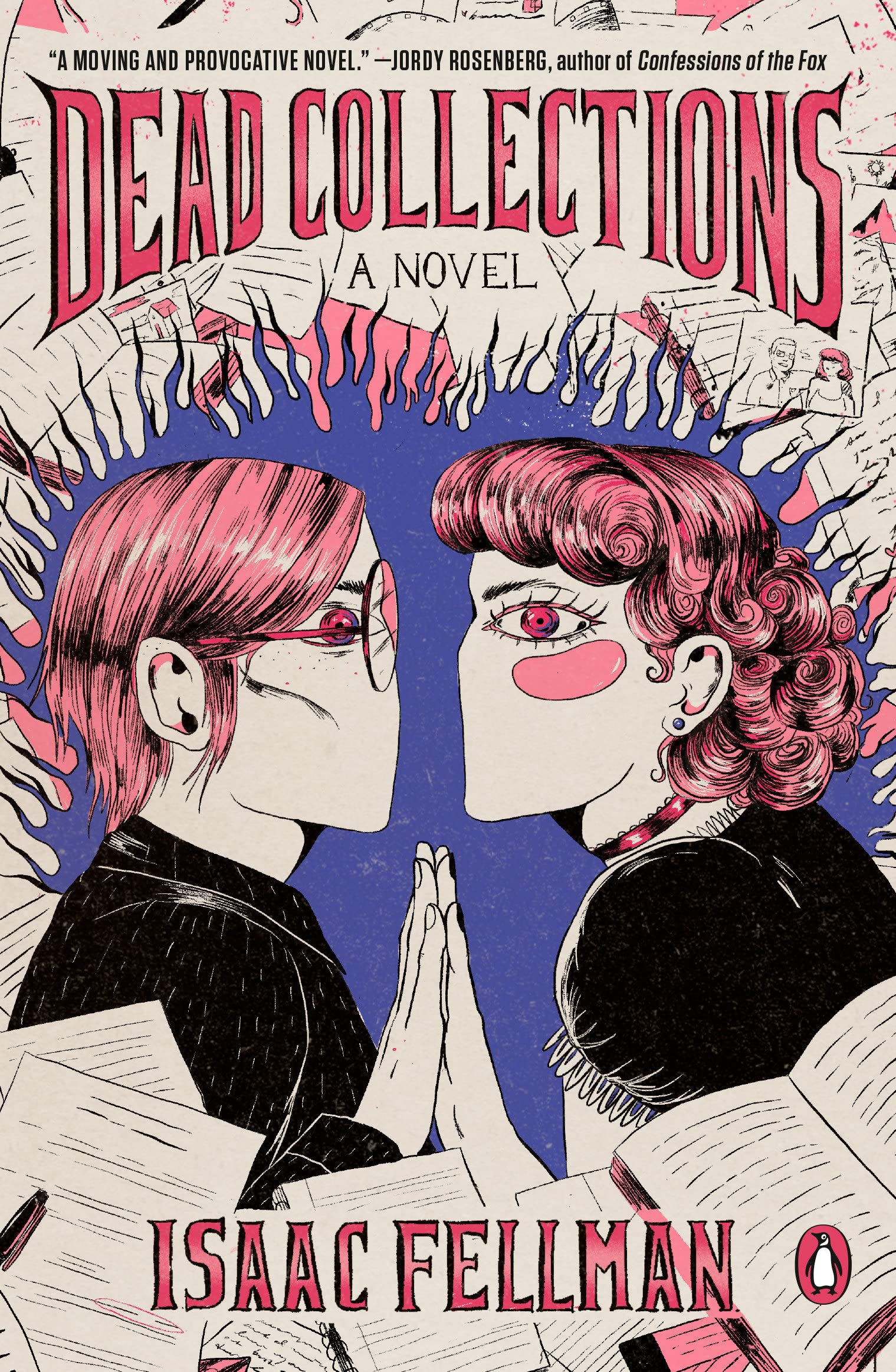
Microreview [Book]: Dead Collections by Isaac Fellman

Dead Collections offers a unique spin on vampires that just seems so right: of course a vampire would live in the archives!

An illustrated cover in pink, white, and blue. Papers, books, and other ephemera surround the two characters, a man and woman pressing their hand together, leaning in as if about to kiss.

Note: This novel deals with the struggles of the LGBTQIA+ community while also being an entertaining vampire romance. Some content warnings I would include: transphobia, transphobic violence, abusive work spaces, emotionally-manipulative relationship, “outing” of personal details. 

Dead Collections by Isaac Fellman follows Sol, an archivist who suffers from a vampirism disease after he “died” of a tetanus mishap contracted in the archives. While all vampire novels are always a little different in what lore they follow, Fellman’s vampires are deathly averse to sunlight. While Sol can drink human blood, it’s a crime, so he receives his needed transfusions at a clinic. As it turns out, being an archivist is a perfect job for a vampire: no sunlight. While Sol was a great archivist before he became a vampire, he now relies on his work to keep him safe since there are so few jobs he could perform as a vampire. Rather than immortality, vampires in Fellman’s world rarely live past three years because of how inhospitable the US is. 

Isaac Fellman, also a trans archivist, brings a depth of knowledge to the archival process that added a level of fun to the text, particularly as an artifact. For instance, in a great rumination on the archive, Sol writes: “My body is an archive. This is not a new idea […] but I always think that people who aren’t archivists miss the ways that archives are quite specifically vampiric” (176). Such moments shine in the book. Like his archivist character, Fellman curates what documents the reader sees as Sol attempts to archive the boxes of Tracy “Trace” Britton’s written work. Secrets are revealed about Britton’s life, but Sol also reminisces on his love of a 1990s TV show called Feet of Clay, on which Britton was a showrunner. 

The novel begins with Britton’s wife Elsie bringing in the boxes, still very much grieving and dealing with Britton’s death. Sol is quickly attracted to Elsie, and the feeling is mutual. Their love blooms, but the remnants of Britton’s life, which both of them are entangled in—Elsie through relationships and Sol through fandom—still haunt them and must be put to rest, or the entire archive could be in peril.

In some ways, the vampirism is the least interesting thing about this novel. It forces some of the social issues, such as Sol not having safe living accommodations. The vampirism also provides a figurative space to discuss issues of trans identity and transphobia, such as the fact that Sol’s transition isn’t continuing the way Sol wishes due to vampirism essentially freezing his body in time. Where the novel shines is less in the vampire lore and more in the archives.

The book itself becomes an archive as Sol narrates his story, but some of that narration is created through archived digital documents, such as e-mails and texts, but also through created documents, such as a series of scripts recounting some of Sol’s experiences in the office. Additionally, some of Britton’s work is collected in the book, such as excerpts from the novel she was attempting to write in the Feet of Clay universe, which was supposed to provide a more satisfying ending for a TV show that was cancelled to soon (I’m sure most of us have felt that gut-wrenching emotion). 

On top of all these archival moments, fandom plays an important role throughout the story as Sol comes to Britton’s archive as a fan. Additionally, Elsie is also involved in archiving as a board member for the Organization for Transformative Works, which runs the very real Archive of Our Own (Ao3). Analogous to the vampire, fandom and fanfiction has created an important space for exploration in the queer community (which is not to say that fanfiction has not also done harm). 

By archiving Britton’s work, Sol reckons with his love of Feet of Clay but also his interest in the show’s creator. As formative to his identity, returning to Sol’s fandom era is a unique way to learn more about his character. The rumination on fandom between Elsie and Sol captures a nostalgia and comfort that favorite, formative narratives can create.

Ultimately, this novel is a queer romance with a happy ending, made all the more interesting through the importance of the archive and fandom. While the vampirism didn’t always seem tightly woven into the story, Isaac Fellman is right: an archive is a perfect space for a vampire.   

_________

The Math

Baseline Assessment: 6/10 

Bonuses: +2 for the archival setting and the meditation on fandom as formative

Penalties: -1 for an interesting take on the vampire, but not so tightly woven into the story

Nerd Coefficient: 7/10: an enjoyable experience, but not without its flaws

Reference:  Isaac Fellman, Dead Collections [Penguin, 2022]

Posted by: Phoebe Wagner (she/her) is an author, editor, and academic writing and living at the intersection of speculative fiction and ecology. She tweets as @pheebs_w.

Tuesday, January 12, 2021

Reading Octavia E. Butler: Fledgling and Collected Stories

One of my reading goals for 2021 is to read the remainder of Octavia E. Butler's work, as well as revisiting some of the classics that have already earned a place on my favourites shelf. And what better way to stick to a reading goal than to tell you lovely readers about it? With Lilith's Brood, Kindred and the Parable books all read in previous years, I decided my first read would be the initial volume of the Library of America's collection of her works, containing Kindred, Fledgling and Collected Stories. I didn't reread Kindred this time - though I consider it to be as close to essential reading as any single book can be (content warnings for its depictions of chattel slavery in the US South), but I devoured the other two thirds of this bind-up, with excellent results.

Fledgling is Butler's last completed novel, a story which stands well alone but in another world could have been the start of something much longer. It reimagines the vampire myth in a way that plays upon the psychological appeal vampires can exert on their prey, creating the Ina, a symbiont species which gathers a group of humans and forms a mutual bond with them, feeding on them in exchange for increased longevity and healing and a whole lot of mutual pleasure. The protagonist of Fledgling is Shori, a juvenile (though still super old in human terms) Ina who is the result of genetic experimentation by her mothers: unlike the rest of her species, Shori is able to control her sleep cycle and move around relatively freely during the day, rather than going to sleep or being severely burned by sunlight. As part of this genetic enhancement, Shori is Black - a fact we find out relatively far into the novel's own text, although like Kindred before it, the marketing is likely to have given this away before the reader encounters it in the story. She is also, when we encounter her, an amnesiac, and through the novel's opening chapters we piece together the fate of her family and the challenge that now faces her to re-establish her own safety and right to exist against uncertain forces determined to wipe her out.

Like Lilith's Brood, Fledgling immediately engages the reader in a world where humanity encounters a more powerful alien force, one which fundamentally challenges specific biological truths we build our self-identity and social structure around. Complicating that alien interaction is, of course, a big helping of human prejudice, and both race and gender (particularly masculinities) sit at the heart of Shori's experience, and the experiences of her symbionts. In Fledgling's opening scenes, Shori is picked up by Wright, a human man who becomes her first symbiont before she's entirely aware of her own power and what she's doing. Wright is shown as being a decent person with a basically sound moral compass before he comes under Shori's influence, but his relationship to her as a symbiont, and his acceptance of the other symbionts she brings into their "family", is clouded by his conception of his masculinity and the expectation that his sexual relationship with Shori includes an element of ownership, at least where other men are concerned. The powerlessness that comes with being a symbiont, biologically unable to challenge a structure that he's intellectually resistant to, makes for a lot of interesting tension as the novel progresses and Shori's relationships with her humans and other Ina become denser. And then there's the impact of Shori's Blackness, and the challenge it presents to those around her trying to understand the truth of her family's murder. Because the Ina have never previously had races, her extended family strongly resist the explanation that the violence done to her was a result of racism, brushing it off as a human affliction and not something they would entertain. Unsurprisingly, the truth turns out to be rather different, and the challenge which Shori presents just by existing is treated delicately but unflinchingly within the story.

Fledgling is a fairly slow narrative: it has its action sequences, but a lot of its story simply involves exploring the society of the Ina and their symbionts, and Shori's journey to rediscover her heritage and come to terms with what was done to her. It doesn't pack the same level of punch as Kindred or the Parable books - and it didn't make me ache for lost sequels in the same way that Parable of the Trickster does - but for the kind of story it's supposed to be, Fledgling deserves to stand among the best reimaginings of the vampire mythology, one that pushes the psychological elements of the myth to fascinating new levels.

The short fiction in here is an intriguing mix (all of it originally published in the second edition of Bloodchild and Other Stories), and much of it also deals with the subject of humanity pushed beyond its biological "comfort zone" to a point where societies, or even survival, look very different. Sometimes, that's about contact with the alien: "Bloodchild", perhaps Butler's most famous piece of short fiction, is an alien symbiosis story in which humans are offered a home on the planet of the alien T'Lic, in return for carrying their eggs to gestation, while "Amnesty" posits an alien society of "Communities" which gain pleasure from contact with humans, and hold economic sway over earth. Both offer complex pictures of the choices their human protagonists make, though Xuan Hoa, in Bloodchild, is much younger and at a different stage of reckoning to Noah, the older and more resigned protagonist of Amnesty. In other stories - like the post-apocalyptic "Speech Sounds", or the story of a fictional degenerative disease and those who know they carry it that is told in "The Evening and the Morning and the Night" - the challenges are more internal, though no less overwhelming. The latter, in particular, stayed with me long after the curtain fell for its strange hopefulness in the face of the inevitable. Its protagonists, both sufferers of a disease that causes people to disassociate and compulsively self-harm in later life, bond and make plans for their future despite knowing it will end in violent, self-afflicted death; when it is discovered that there might be another alternative (one which relies on a well funded private healthcare institute of the kind unavailable to most sufferers), its a moment that opens doors without diminishing the impact of the disease on their autonomy and self-preservation. It's a weird effect, one which I struggle to put into words, but which really hit home for me and made this probably my favourite story of the collection. And while I had less luck with the non-alien stories, the non fiction pieces here are well worth reading for their insights into the life and challenges of a Black woman trying to push the boundaries of science fiction in a world that couldn't fathom someone like her doing so.

I'm excited to see where my Butler reading takes me from here: next stop, the world of the Patternist, beginning with chronologically-first Wild Seed. See you then!

POSTED BY: Adri, Nerds of a Feather co-editor, is a semi-aquatic migratory mammal most often found in the UK. She has many opinions about SFF books, and is also partial to gaming, baking, interacting with dogs, and Asian-style karaoke. Find her on Twitter at @adrijjy


Monday, December 21, 2020

Nerds on Tour: The Route of Ice and Salt (1996 Novella)


Dossier: The Route of Ice and Salt (La Ruta del Hielo y la Sal) by José Luis Zárate, tr. David Bowles (1996/2020)

Location: Mexico

Package Type: Novella

ItineraryThe Route of Ice and Salt fills in a piece of the narrative of the original Dracula novel, by Bram Stoker, springing out of the journey that Dracula takes from Istanbul to England by sea. As vampires are notable for not being particularly good sea-travellers, this voyage involves a lot of large crates full of earth, and the crew of the Demeter all meet mysterious fates, ending with the captain, who is found lashed to the wheel, his log telling the story of how he had tried to keep the ship and its monstrous passenger from landing. The novella expands on the voice of the Demeter's captain during the voyage, imagining the character as a repressed, traumatised and lonely gay man attempting to maintain his position amongst his crew, while grappling with erotic fantasies about the other men around him.

Once the vampire comes on board, these fantasies - and the Captain's dreams - become progressively more disturbing, but it's not until the crew members start disappearing that the Captain, and his dwindling circle, begin to investigate their otherworldly cargo and the curse it's brought upon them, that the scope of what they are up against becomes clear. The monster on board - whose identity is known to us, but not to the crew, and presented here in a way which fits with the original mythos while leaning even more on psychological manipulation abilities which, in the Captain, find a very easy mark for most of the book. However, While we know the Captain's ultimate fate from the outset, however, The Route of Ice and Salt does justice to his fight against the monster and his eventual act of sacrifice, providing him with an arc that offers him a renewed understanding of himself and his desires, and the ability to harness them against the much greater evil he faces.


Travel Log
The Route of Ice and Salt was published in translation for the first time this year by Silvia Moreno-Garcia at Innsmouth Free Press, who has noted its cult status in Mexico and its importance particularly as a queer horror novella at a time when Mexican culture was conservative and hostile to queer people. While it's impossible, as an English language reader in 2020, to fully appreciate the context in which this story was originally published, the themes it tackles and the fact that it riffs off a text that is very well known and very accessible to English speaking audiences makes it an important book on multiple levels, one that I'm very glad has been made available. Indeed, The Route of Ice and Salt literally lifts the log of the Demeter, as presented in the text of Dracula, and while it's definitely possible to read the entire novella without getting that reference (I read Dracula long enough ago that I don't remember its detail super well) I think it adds a layer of enjoyment just to know that this is a novella in conversation with a significantly older and more culturally entrenched piece of media.

Vampires, of course, come with a long history of exploring taboo sexualities and societal transgressions, and that very much includes queer desire. In The Route of Ice and Salt, male homoerotic desire is front and centre of the narrative, with early chapters almost entirely taken up by the Captain's fantasies about his crew's bodies, their presence around the ship and what he'd like to be doing with them. He also fantasises about a prior lost love, one who apparently met a terrible end. Even as the Transylvanian soil gets loaded up and we start to worry about what's coming down the line for the Demeter's crew, it's already clear that the Captain's life is one of trapped horror, the combination of homophobia and trauma from his past making his narrative painful from the outset. These parallels only get more overt as we learn more about his past, and particularly the fate of his lover, who as a queer man faced violence of the sort that, in a less thought-provoking vampire story, would only be levelled at monsters. Zárate uses the Captain's acute awareness of his forbidden sexuality to push these parallels, especially the parallel of hunger and appetite (as when the Captain fantasises about licking salt of his crew members' skin) and the question of what we become when we give into fantasy, especially those involving people we hold power over.

The language of this translation of The Route and Ice and Salt is consistently poetic and evocative, conveying the sense of desperate fantasy transmuted into psychological horror extremely well. While the Demeter's eventual end is a fixed point, there's a lot of suspense here as well, particularly once the crew start being picked off. There's also some business with rats which is very convincingly squicky, and I don't normally say that about small fuzzy mammals no matter their reputation. While it's the Captain's fight - first against his own desires, and then against the vampire - which takes up centre stage, there's a sense of a convincing dynamic on the Demeter, and the fact that the crew only really start becoming more than objects of desire once the threat is already on board makes the impact of their disappearances much more felt.

But really, what I want to say about this book - the reason you should pick it up - basically boils down to this: it's interesting. It's an interesting book, with an interesting premise, with a really interesting context surrounding it, and it held my attention from start to finish. The depiction of homophobia and the painfully unfulfilled erotic opening scenes will mean this isn't for everyone, but if those aren't a problem and you're interested in picking up some horror this winter, this is not a book you will regret. Highly recommended, for sure.


Analytics

The Adventure: 4/5

The Scenery: 5/5

NerdTrip Rating: 9/10


POSTED BY: Adri, Nerds of a Feather co-editor, is a semi-aquatic migratory mammal most often found in the UK. She has many opinions about SFF books, and is also partial to gaming, baking, interacting with dogs, and Asian-style karaoke. Find her on Twitter at @adrijjy

Monday, October 12, 2020

Nerds on Tour: A Girl Walks Home Alone at Night, Ana Lily Amirpour, dir. (2014, film)


Dossier: A GIRL WALKS HOME ALONE AT NIGHT

Location: Iran (Persia)

Package Type: Film

Itinerary: Here in Bad City, there's a ditch where the town dumps its dead. That should tell you a lot about Bad City. Arash lives in Bad City, but he's a good dude. In a city full of drug dealers and worse, Arash works hard, and has worked for years to save up in order to buy a classic car. His pride and joy.

Arash also takes care of his widower father, who is addicted to heroin. It feels like a pain-pills-gave-way-to-worse situation. But Arash's father, Hossein, is nevertheless in deep to a drug dealer, who takes Arash's car as partial payment. This dealer guy sucks a lot. So none of us feel too bad when he picks up an innocent-looking Girl, tries to convince her to become a prostitute, but instead she grows fangs and murders the dealer for his blood. Not a huge loss, and when Arash comes by to try to get his car back and finds the dealer dead and mutilated, it's the easiest thing in the world to take his money, and his unsold drugs, and dump his body in the ditch where these things go.

Turns out, Arash isn't a great drug dealer! He tries to offload some of his stuff at the club, but a pretty girl instead convinces him to ingest some of it himself. So Arash gets blitzed. Stumbling around, lost in an unfamiliar neighborhood, dressed in a Dracula costume, Arash comes upon The Girl. An actual vampire. He assures her that he is not to be feared. It's only a costume. He is harmless and charming, so she takes him home.

That's where things get more complicated, and where they begin to unravel.


Travel Log: Let the Right One In is the character-driven, off-the-beaten-path vampire movie par excellence, and A Girl Walks Home Alone at Night owes a lot to that earlier, Swedish film. While the plot points and age-ranges differ, the vibe is decidedly similar. 
 
And in a low-budget film with only a small number of characters, it must be said, it's pretty easy to predict the ways in which these few characters might intersect. That doesn't take away, however, from the charm of this film. 
 
For a movie where people have their limbs bitten off, bodies are routinely dumped in ravines, and drug addicts are used as prey, it's a super-charming adventure! Throughout, the audience knows more than the characters, so one of the most interesting balancing acts the movie pulls off is the shifting of perspective between Arash and The Girl. The ways in which they come to see each other, and to interpret one another, are the areas in which this movie really shines.
 
It was a little disappointing to learn that, though the film was written and directed by Iranian-American filmmaker Ana Lily Amirpour and billed as "the first Iranian vampire movie," it was actually shot in California. It's set in a fictitious Iranian city, though, and the actors all speak Persian. The Iranian life it depicts is one of nightclubs, music, drugs, prostitution, and wealth disparity. It's probably a vision of Iran that many Westerners wouldn't expect, and a depiction that would make it dangerous, if not impossible, to actually shoot the movie in Iran. Hence, the California stand-in. Walking into this sphere of decadent nightlife, wearing a traditional chador covering, The Girl presents as something very different from what she really is. She looks like a modest, possibly devout individual, when in fact she is the most powerful — and depending on your definition, unholy — being in the film. It's a clever redirect that plays on cultural codes and expectations. 
 
Also, it must be noted that the movie has an all-time great movie cat, and the black-and-white cinematography is gorgeous.  

Analytics

The Adventure: 4/5
The Scenery: 4/5.
NerdTrip 8/10

Posted by Vance K — cult film reviewer and co-editor of nerds of a feather since 2012, fan of vampire movies since the local channel showed that blue-tinted print of Dracula one Halloween, lo these many years ago.

Friday, December 1, 2017

Microreview [TV]: Lore

Trying to serve two masters, or...?


I haven't listened to the Lore podcast, so going into the Amazon TV adaptation, I had a totally open mind and very few expectations. But it sounded like something that would be right up my alley — a look at the true stories and origins of a wide variety of horrors and beliefs, many of which were held in the shockingly recent past. I'm the kind of person who enjoys reading about the real Vlad Dracula more than I enjoy Bram Stoker's tedious novel, and the kind of person who generally enjoys The Crucible more than, say, The Witch and other tales hinting at supernatural evils in the forest. From the description provided by Amazon, I thought this was going to be a look at the real monsters (hint: it's us!) behind many of the misdeeds attributed to made-up monsters.

In form, Lore is pretty interesting. It's probably about as faithful an adaptation of a podcast as you could make for TV. In each episode, a combination of strong visual design and graphics underneath narration from the show's creator and host, Aaron Mahnke, is paired with a live action re-creation of some singular story relating to the topic. As a rule, I found the narrated portions more involving than the re-creations, even though there are some great actors involved, and — it must be said — portions that are legitimately hard to watch, even without being particularly gory. Campbell Scott, for instance, must watch his daughter be exhumed and her chest cracked so that her heart and liver can be extracted and burned. That's pretty grim. Colm Fiore plays Dr. Walter Freeman, who gives patients — including children! — ice pick lobotomies in his comfortable office. It's hard to watch, but I never found it engaging. I couldn't put my finger on why, exactly, until I got to the episode "The Beast Within," about werewolves.

At the end of the Campbell Scott episode, "They Made a Tonic," the show absurdly suggests that the death and exhumation of Mercy Brown was the inspiration for Stoker's Dracula novel. I've read that some people suggest Stoker may have loosely based the character of Lucy on Mercy, but who knows? The claim the show made felt way, way overblown, and kind of put me back on my heels. By the time I got to "The Beast Within," I had started to think that type of overreach was a feature, not a bug, of the show. In the werewolf episode, the re-enactment focuses on the story of Peter Stubbe, a 16th century German farmer publicly executed for his crimes committed as a werewolf. While it's impossible to know what really happened in the German village of Bedburg over 400 years ago, and it's possible that Peter Stubbe actually was a killer, and not simply a vessel for superstitious people and power-hungry religious leaders during a time of war and political upheaval to pour their suffering into, he certainly wasn't a werewolf. His Wikipedia page is more interesting than the re-creation presented in Lore, in which Stubbe isn't a farmer, but some type of town elder, who is apparently crazy and has been waiting a dozen years to kill the daughter of one of the townspeople and just biding his time. The result is a weak, not-scary twenty-minute period horror movie, that bears only a passing resemblance to the real-world events. And that, I thought, was the hook of the show. looking at the real-world events that have passed into, well, lore.

So it left me flat. I felt like it was somehow trying to be scholarly (or pseudo-scholarly) and also exploitative or titillating, and it wound up not doing either one particularly well.

The Math

Baseline Assessment: 6/10

Bonuses: +1 for the graphical elements in the most podcast-y parts; +1 for trying something new

Penalties: -1 making the real life stories less interesting; -1 for dubious claims of sweeping significance; -1 for I-really-wanted-to-like-it-but-couldn't

Nerd Coefficient: 5/10, equal parts good and bad

Posted by Vance K — cult film reviewer and co-editor of Nerds of a Feather since 2012, and person who will one day, really, write that vampire and werewolf story he's been stewing over forever.

Tuesday, September 26, 2017

Microreview [book]: A Small Charred Face by Kazuki Sakuraba


Have you ever read a book or watched a movie and you know bad things are going to happen? You can sense it on a deeper level, almost taste it in the air. You aren't sure of how bad or when, just that they are coming.

Kazuki Sakuraba weaves suspenseful tension onto every page of A Small Charred Face. Only a few times did I somewhat anticipate/predict what was going to happen during particular events and yet, Sakuraba still made those moments, even if slightly predictable, emotionally powerful.

But I'm getting a tad ahead of myself and haven't told you anything about anything have I? Kyo is a small boy whose mother married a small-time criminal that quickly worked his way up in the Japanese organized crime syndicates. Unfortunately for Kyo, that man, his fourth papa by marriage, decided to steal the boss's money and woman and a contract was put out on the man's entire family, which included Kyo.

Yet, Kyo finds himself saved by a Bamboo, an ancient Chinese vampire born of the tall grasses. However, the greatest crime a Bamboo can commit is harboring and communicating with a human.

A Small Charred Face is not the story of single human or Bamboo. Rather it is the story of life and death, of retaining a sense of humanity in the face of terrible events. The narrative takes place over decades and follows multiple characters as their lives touch, like a baton being passed in a relay race.

I think Sakuraba has written one of the most touching and simultaneously horrific novels I've read in some time. The horror is not in gore, or jump scares, or anything remotely [air quotes] Traditional Horror. These characters, both human and Bamboo alike, must confront what it truly means to live. You see, Bamboo have long lives but they are not immortal. They can heal but they can and do die of old age.

Multiple times I was brought to tears while reading because Sakuraba so eloquently conveyed the depth of love these characters felt for life and each other. It is one of the most beautiful horror novels I've had the pleasure of reading.

Even now, as I sit here to write this, I am struck by the sense of life and fire this book carries within. This is a book I want to give out as gifts simply so I can talk about it with more people. So, do me a favor and go buy it so we can all talk about it, please? Seriously, I'll wait here for you.


The Math:
Baseline Assessment: 8/10  
Bonuses: +1 for brilliant tension throughout Penalties: None from me!
Nerd Coefficient: 9/10 -- a truly refreshing vampire novel
  ***
POSTED BY: Shana DuBois--extreme bibliophile and seeker of raindrops.
Reference: Sakuraba, Kazuki. A Small Charred Face [Haikasoru, 2017]
Our scoring system explained.

Tuesday, August 29, 2017

Microreview [book]: Strange Practice, by Vivian Shaw

If you love horror, monsters, science, mystery, you will enjoy this book.


I will let you know right now, I loved this book. This book made me laugh, cry, and generally fall in love with all the characters (well, minus the super bads).

Dr. Greta Helsing, a descendant of the famous Professor Abraham Van Helsing, is living in modern day London following in her father's footsteps. After medical school, Greta joined her father's practice, taking over after his passing. However, this isn't just any medical practice, Greta treats all manner of the otherworldly, from vampires and vampyres to mummies and ghouls. A firm believer that all persons, including the undead, should receive respect and properly medical care.

When a vicious attack on a vampyre friend of one of Greta's patients appears connected to the serial murders occurring in London, Greta, and her friends end up squarely in the sights of an evil unlike anything they've seen.

Without a doubt, the best thing about this book are the characters. Shaw beautifully blends Greta's analytical mind and intelligence with deeply connected friendships and compassion. Lord Edmund Ruthven, he prefers you abstain from using Lord, is the best host, a considerate friend, willing to help tend a baby ghoul, a vampire you can depend on no matter what the situation, and a dear friend to Greta. (And yes, there is a difference between vampires and vampyres, a detail I adore.)

Shaw clearly did her research when it comes to undead history and tales. There are so many references fans of horror will truly love and respect. It adds a richness to the text and an authority to the voice behind each character. Many times urban lore surrounding a certain undead will be openly addressed during conversations yet never felt forced into the narrative. Weaving such history into the story itself allows Shaw to make her Helsing tale wholly her own.

The attacks and murders lead into a pretty straight forward mystery where Greta and her companions start unraveling clues Scotland Yard is not privvy to since the undead are a bit harder to kill and become a witness to the crime versus victim. Greta is driven to solve the murders in order to protect those closest to her. The undead can't afford a lot of police and investigations poking around. She fears the worst from abductions for experimental probing to the pitch fork brigades. Protecting her patients and friends is of the utmost importance to her, and it is a credit to Shaw's skill that I was right there alongside Greta wanting to protect everyone.

It takes a bit to make me cry at a book, Black Beauty and Where the Red Fern Grows managed it and now I can add this one to the list as well. It wasn't because of a tragic thing (to avoid spoilers that is all I will say) it was because there is a moment when Greta is so upset she is a slobbering, sobbing mess and I was so invested in these characters I found myself tearing up and having to blow my nose, once again, right alongside Greta. It is that kind of character-building that will carry this series for as long as Shaw wishes to write it. As soon as I finished the book I went looking to see if I could at least pre-order the next in the series, sadly it isn't listed yet.

Every time I think I am firmly in the the "I prefer standalones always and forever" a book like this will come along and sweep me away selling me on the idea of series and spending more time with characters.

If you love horror, monsters, science, mystery, you will enjoy this book. If you are like me, you will keep checking Orbit's listings to see when the second is on the horizon and available for pre-order.


The Math: 
Baseline Assessment: 8/10

Bonuses: +1 for truly wonderful characters

Penalties: Not a one.

Nerd Coefficient: 9/10 - A seriously great cast I look forward to following for many, many books!

Our scoring system explained.


Reference: Shaw, Vivian. Strange Practice [Orbit, 2017]


POSTED BY: Shana DuBois--extreme bibliophile and seeker of raindrops.