We continue our journey through the 2016 Hugo Awards with a look at the finalists for Best Fancast. Before this year, I seldom listened to any podcasts that were not named Rocket Talk (not currently a finalist for a Hugo Award). I would listen to a sports themed podcast from time to time, but that's about it. Something changed this year, though I'm not quite sure what, and I find myself listening to a LOT of podcasts, though only a small number of them are SFF themed. All five of this year's finalists are new to me.
When I think about the category of "Fancast", I think of an audio podcast. I think of downloading the podcast and listening at work, in the car, or when I'm out mowing the lawn (something which I'm probably overdue to accomplish right now). The thing is, audio is only half of the definition.
Per section 3.314 of the WSFS Constitution, a Fancast is "any generally available non-professional audio or video periodical devoted to science fiction, fantasy, or related subjects" and "which does not qualify as a dramatic presentation".
I only mention this because of how it impacts my own thoughts of the category. I think of audio when I think of fancast, but video is very much a part of the definition of the category - though this is the first year a finalist has been a video fancast.
With all of that said, let's talk about the finalists. I have several biases regarding fancasts which will come into play and I'll mention each one as it comes up.
8-4 Play
Cane and Rinse
HelloGreedo
The Rageaholic
Tales to Terrify
Tales to Terrify: Let's start with an Admission of Bias: I do not enjoy listening to audio fiction. Tales to Terrify is an audio fiction podcast. You might have guessed from the title, but Tales to Terrify focuses on horror.
I tried. I really did. I don't think there's anything wrong with Tales to Terrify (it's part of the "District of Wonders", which also produces the Hugo Award winning StarShipSofa), but man, it's audio fiction. I have to work extremely hard to stay engaged and pay yet deeper attention to have any glimmer of an understanding of what is occurring in the story and given when I have time to listen, that's nearly impossible for me. I do so much better with a nonfiction podcast. I tried two episodes, and I struggled to maintain my focus / attention on either of them.
8-4 Play: Is 8-4 Play actually eligible? I ask this for the same reason I have nominated Rocket Talk as Related Work instead of Fancast. Rocket Talk is hosted by Tor.com, a professional publication. 8-4 Play is hosted by 8-4, Ltd, a professional video game localization company. Section 3.2.10 of the WSFS Constitution defines a professional publication as one which "was owned or published by any entity which provided at least a quarter of the income of any of its staff and/or owner." Just as Tor.com is a professional publication, I have believe that 8-4, Ltd is considered a professional company. Now, given that 8-4 Play is on the final ballot, I have to assume the Hugo Committee deemed 8-4 Play to be a "fancast" so we'll treat it as such (though I'm skeptical).
Admission of Bias Time: The longer the podcast, the less interested I am in listening to it. 30 minutes is my sweet spot, I'm comfortable up to an hour, and the farther a podcast goes past an hour the less interested I become, even when the topic and conversation is interesting. Most of the episodes of 8-4 Play run over 90 minutes, with a not insignificant number running over 120 minutes.
8-4 Play did not include links to recommended episodes, so I pulled one from 2015 that was focusing on some video games I was interested in (Zelda and Dragon Quest). 30 minutes later, I was done. 8-4 Play is a video game focused podcast, and it took way too long for the hosts to actually start talking about the games. The opening seemed more focused on refreshing each other what they've been up to than moving on to the games. Now, first main section on one guy's Retro Collection was okay (and I love me some old school games) and they were only just moving into Fallout 4 by the time I gave up on the podcast, so maybe there is solid game talk and a reason why I should consider listening to 8-4 Play in the future, but this particular episode is more than two hours long and that's really tough for me to overcome, and given that for this particular episode the hosts took waaaaaay too long getting to the meat, I won't be coming back to it. Perhaps I selected the wrong episode and perhaps I should have skipped forward to the 38 minute mark, but perhaps this podcast is simply not for me. Pass.
The Rageaholic: While I think The Rageaholic could work as a straight up audio podcast, I'm not sure I really want someone yelling at me for ten to twenty minutes straight. If I wanted that I'd put The Rageaholic on in the background and not watch the screen. I appreciate Razorfist's passion and ability to pull out a ten plus minute rant seemingly without pausing to take a breath. I'm exhausted just listening to the man. I'm slightly curious how much of this is off the cuff brilliance or if he scripts up enough talking points to pull it off. Either way, the man has the ability to just blow and to do so with some profane eloquence. These video game rants, even on the stuff he loves, isn't entirely my cuppa (assuming I actually drank a cuppa, which I do not), but The Rageaholic comes with a fresh (and angry) perspective and I'd much rather watch / listen to this than either 8-4 Play or Tales to Terrify. I'm not going to, but I'd rather.
HelloGreedo: A Star Wars focused parody, reviews and news YouTube channel. I have two primary thoughts here. The first is solely my issue. I don't really have the time to watch all the tv shows and movies that I want to watch today. Sorry, Friday Night Lights and actually going to the movies. So, a YouTube channel is always going to be a tough sell for me even when it's good and is something I'm interested in. I can listen to podcasts during my drive to work, while mowing the lawn, or even quietly in the office. I can't do that with video. This ties into my second thought: HelloGreedo is good. It's fun and funny and entertaining and the guy behind HelloGreedo clearly knows and loves his Star Wars. He also does it in full Stormtrooper costume, which is fun. I would happily watch more HelloGreedo, but it also is not quite enough to force itself into any sort of regular watching rotation.
Cane and Rinse: So, what I said about 2 hour podcasts still stands, but there are apparent exceptions. I do wish that Cane and Rinse was a significantly shorter podcast, but I've now listened to upwards of ten episodes and I really enjoy what they do. Cane and Rinse is a video game focused podcast, and my interest level waxes and wanes with how familiar I am with the particular game they are breaking down and how interested I am in said game. For example, their episodes working through the Legend of Zelda series and the episode featuring Goldeneye are standouts for me. I enjoyed their digging into the history of each game, the music, the production, the playthrough, all the varied aspects. However, I just couldn't get into a more recent episode on Golden Axe (which was not part of my Hugo Listening). The hosts are personable, very British, and overall a delight to listen to. Cane and Rinse has made its way into my semi-regular rotation of podcasts.
My Vote
1. Cane and Rinse
2. HelloGreedo
3. The Rageaholic
4. 8-4 Play
5. Tales to Terrify
Also, feel free to look at the rest of our Hugo Awards coverage:
Novel
Short Story
Dramatic Presentation: Long Form
POSTED BY: Joe Sherry - Writer / Editor at Adventures in Reading since 2004. Nerds of a Feather contributor since 2015, editor since 2016. Minnesotan.
Tuesday, June 28, 2016
Monday, June 27, 2016
New Books Spotlight
Welcome to another edition of the New Books Spotlight, where each month or so we curate a selection of 6 forthcoming books we
find notable, interesting, and intriguing. It gives us the opportunity
to shine a brief spotlight on some stuff we're itching to get our hands
on.
What are you looking forward to? Anything you want to argue with us about? Is there something we should consider spotlighting in the future? Let us know in the comments!
Allan, Nina. The Race [Titan, 2016]
Publisher's Blurb
Carriger, Gail. Imprudence [Orbit, 2016]
Publisher's Blurb
Higgins, C.A. Supernova [Del Rey, 2016]
Publisher's Blurb
Rowling, J.K., Jack Thorne, and John Tiffany. Harry Potter and the Cursed Child: Parts One and Two [Scholastic, 2016]
Publisher's Blurb
Why We Want It: While there is a "Definitive Edition" coming early next year, I don't know if I'll be able to hold off reading the "Special Rehearsal Script Edition" because, come on! It's a new and official Harry Potter story! Reading the script is as close as I'm going to come to seeing the play for any number of years. New Harry Potter!
Strahan, Jonathan (editor). Drowned Worlds [Solaris, 2016]
Publisher's Blurb
Why We Want It: I'm a sucker for any number of things, but included in that epically long list are anthologies from Jonathan Strahan, the literary destruction of our world, and giant floods. Drowned Worlds is just what I'm looking for, isn't it?
VanderMeer, Ann and Jeff VanderMeer (editors). The Big Book of Science Fiction [Vintage, 2016]
Publisher's Blurb
Why We Want It: Some 750,000 words and 1200 pages of science fiction goodness curated by the VanderMeers. One hundred years of science fiction, with fiction from some of the legends of SF as well as works being translated into English for the first time. This is a must read.
POSTED BY: Joe Sherry - Writer / Editor at Adventures in Reading since 2004. Nerds of a Feather contributor since 2015, editor since 2016. Minnesotan.
What are you looking forward to? Anything you want to argue with us about? Is there something we should consider spotlighting in the future? Let us know in the comments!
 |
| Cover Art by Julia Lloyd |
Publisher's Blurb
A child is kidnapped with consequences that extend across worlds… A writer reaches into the past to discover the truth about a possible murder… Far away a young woman prepares for her mysterious future…Why We Want It: Originally published by the smaller Newcon Press in 2014, The Race received a significant amount of buzz for how good it was. Now it is receiving a larger publication push from Titan, so we'll all get the chance to read it.
In a future scarred by fracking and ecological collapse, Jenna Hoolman lives in the coastal town of Sapphire. Her world is dominated by the illegal sport of smartdog racing: greyhounds genetically modified with human DNA. When her young niece goes missing that world implodes... Christy’s life is dominated by fear of her brother, a man she knows capable of monstrous acts and suspects of hiding even darker ones. Desperate to learn the truth she contacts Alex, a stranger she knows only by name, and who has his own demons to fight… And Maree, a young woman undertaking a journey that will change her world forever.
The Race weaves together story threads and realities to take us on a gripping and spellbinding journey…
 |
| Photo by Shirley Green, Illustration by Don Sipley, Design by Lauren Panepinto |
Carriger, Gail. Imprudence [Orbit, 2016]
Publisher's Blurb
Rue and the crew of the Spotted Custard return from India with revelations that shake the foundations of England's scientific community. Queen Victoria is not amused, the vampires are tetchy, and something is wrong with the local werewolf pack. To top it all off, Rue's best friend Primrose keeps getting engaged to the most unacceptable military types.Why We Want It: I may be a touch behind on my Gail Carriger reading, having only read the first two books of The Parasol Protectorate and Imprudence is the second volume of the sequel series The Custard Protocol. But Carriger's novels of Victorian era manners, steampunk, and urban fantasy are simply not to be missed and the publication of Imprudence serves to remind me that I simply need to get cracking.
Rue has family problems as well. Her vampire father is angry, her werewolf father is crazy, and her obstreperous mother is both. Worst of all, Rue's beginning to suspect what they really are... is frightened.
 |
| Cover Artist Unknown |
Higgins, C.A. Supernova [Del Rey, 2016]
Publisher's Blurb
C. A. Higgins’s acclaimed novel Lightless fused suspenseful storytelling, high-caliber scientific speculation, and richly developed characters into a stunning science fiction epic. Now the dazzling Supernova heightens the thrills and deepens the haunting exploration of technology and humanity—and the consequences that await when the two intersect.Why We Want It: I reviewed Lightless back in March and found it a delightfully good science fiction novel. Though Lightless worked as a complete story on its own, I am very much into seeing what else Higgins does with this setting.
Once Ananke was an experimental military spacecraft. But a rogue computer virus transformed it—her—into something much more: a fully sentient artificial intelligence, with all the power of a god—and all the unstable emotions of a teenager.
Althea, the ship’s engineer and the last living human aboard, nearly gave her life to save Ananke from dangerous saboteurs, forging a bond as powerful as that between mother and daughter. Now she devotes herself completely to Ananke’s care. But teaching a thinking, feeling machine—perhaps the most dangerous force in the galaxy—to be human proves a monumental challenge. When Ananke decides to seek out Matthew Gale, the terrorist she regards as her father, Althea learns that some bonds are stronger than mortal minds can understand—or control.
Drawn back toward Earth by the quest, Althea and Ananke will find themselves in the thick of a violent revolution led by Matthew’s sister, the charismatic leader Constance, who will stop at nothing to bring down a tyrannical surveillance state. As the currents of past decisions and present desires come into stark collision, a new and fiery future is about to be born.
 |
| Cover Artist Unkown |
Publisher's Blurb
The Eighth Story. Nineteen Years Later.
Based on an original new story by J.K. Rowling, Jack Thorne and John Tiffany, a new play by Jack Thorne, Harry Potter and the Cursed Child is the eighth story in the Harry Potter series and the first official Harry Potter story to be presented on stage. The play will receive its world premiere in London's West End on July 30, 2016.
It was always difficult being Harry Potter and it isn't much easier now that he is an overworked employee of the Ministry of Magic, a husband and father of three school-age children.
While Harry grapples with a past that refuses to stay where it belongs, his youngest son Albus must struggle with the weight of a family legacy he never wanted. As past and present fuse ominously, both father and son learn the uncomfortable truth: sometimes, darkness comes from unexpected places.
Why We Want It: While there is a "Definitive Edition" coming early next year, I don't know if I'll be able to hold off reading the "Special Rehearsal Script Edition" because, come on! It's a new and official Harry Potter story! Reading the script is as close as I'm going to come to seeing the play for any number of years. New Harry Potter!
 |
| Cover Art by Les Edwards |
Strahan, Jonathan (editor). Drowned Worlds [Solaris, 2016]
Publisher's Blurb
We live in a time of change. The Anthropecene Age - the time when human-induced climate change radically reshapes the world - is upon us. Sea water is flooding the streets of Florida, island nations are rapidly disappearing beneath the waves, the polar icecaps are a fraction of what they once were, and distant, exotic places like Australia are slowly baking in the sun.
Drowned Worlds asks over a dozen of the top science fiction and fantasy writers working today to look to the future, to ask how will we survive? Do we face a period of dramatic transition and then a new technology-influenced golden age, or a long, slow decline? Swim the drowned streets of Boston, see Venice disappear beneath the waves, meet a woman who's turned herself into a reef, traverse the floating garbage cities of the Pacific, search for the elf stones of Antarctica, and spend time in the new, dark Dust Bowl of the American mid-west. See the future for what it is: challenging, exciting, filled with adventure, and more than a little disturbing.
Whether here on Earth or elsewhere in our universe, Drowned Worlds give us a glimpse of a new future, one filled with romance and adventure, all while the oceans rise...
Why We Want It: I'm a sucker for any number of things, but included in that epically long list are anthologies from Jonathan Strahan, the literary destruction of our world, and giant floods. Drowned Worlds is just what I'm looking for, isn't it?
 |
| Cover Artist Unknown |
VanderMeer, Ann and Jeff VanderMeer (editors). The Big Book of Science Fiction [Vintage, 2016]
Publisher's Blurb
Quite possibly the greatest science fiction collection of all time—past, present, and future!
What if life was neverending? What if you could change your body to adapt to an alien ecology? What if the pope were a robot? Spanning galaxies and millennia, this must-have anthology showcases classic contributions from H. G. Wells, Arthur C. Clarke, Octavia E. Butler, and Kurt Vonnegut, alongside a century of the eccentrics, rebels, and visionaries who have inspired generations of readers. Within its pages, you’ll find beloved worlds of space opera, hard SF, cyberpunk, the New Wave, and more. Learn about the secret history of science fiction, from titans of literature who also wrote SF to less well-known authors from more than twenty-five countries, some never before translated into English. In The Big Book of Science Fiction, literary power couple Ann and Jeff VanderMeer transport readers from Mars to Mechanopolis, planet Earth to parts unknown. Immerse yourself in the genre that predicted electric cars, space tourism, and smartphones. Sit back, buckle up, and dial in the coordinates, as this stellar anthology has got worlds within worlds.
Including:
· Legendary tales from Isaac Asimov and Ursula K. Le Guin
· An unearthed sci-fi story from W. E. B. Du Bois
· The first publication of the work of cybernetic visionary David R. Bunch in twenty years
· A rare and brilliant novella by Chinese international sensation Cixin Liu
Plus:
· Aliens!
· Space battles!
· Robots!
· Technology gone wrong!
· Technology gone right!
Why We Want It: Some 750,000 words and 1200 pages of science fiction goodness curated by the VanderMeers. One hundred years of science fiction, with fiction from some of the legends of SF as well as works being translated into English for the first time. This is a must read.
POSTED BY: Joe Sherry - Writer / Editor at Adventures in Reading since 2004. Nerds of a Feather contributor since 2015, editor since 2016. Minnesotan.

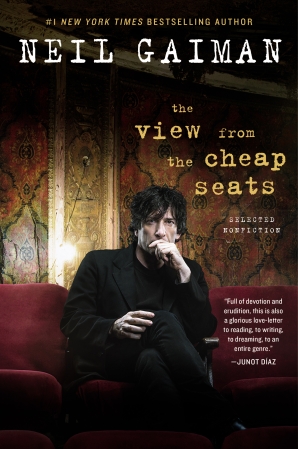
Microreview [book]: The View from the Cheap Seats by Neil Gaiman
A thoughtful collection of essays
POSTED BY: Chloe, speculative fiction fan in all forms, monster theorist, and Nerds of a Feather blogger since 2016.
Diana Wynne-Jones. Jack Kirby. Douglas Adams. These are just
a few of the artists that Neil Gaiman lovingly tackles in the essays included
within The View from the Cheap Seats—a
fairly comprehensive (though it states “selected non-fiction”) of Gaiman’s nonfic
work.
Divided into thematic sections that include essays on music,
comic books, films, fairy tales, and more, the book feels mostly like a love
letter to the things that Gaiman finds most wonderful about writing, reading,
and taking part in the world. I’ve always loved Gaiman’s introductions to his
own books, there’s a sense of humor, playfulness, and kindness always in the
intros Gaiman weaves, and I thoroughly enjoyed seeing these same things applied
to such a wide array of subjects.
Of course, that being said, I might be one of the perfect
kinds of audiences for this collection—the people, texts, and subjects, that
Gaiman writes about are some of the people, texts, and subjects, that have
meant the most to me throughout my life. His essays on Diana Wynne-Jones (and
on her book Dogsbody) made me tear
up. His intro to Jim Steinmeyer’s Art and
Artifice (one of the few Steinmeyer’s I hadn’t read or, really even heard
of) made me go out and immediately order it. And that’s one of Gaiman’s
greatest skills as a non-fiction author: he always sounds like he’s telling a
story to a friend, he’s telling you about this book or author or piece of music
that meant so much to him and he’s telling it in such a way that you have to
believe him.
If there is a slight issue with the book, it’s a small one
for me, it’s that occasionally some of the essays feel slightly
repetitive—sometimes in subject matter, but also, often, in tone. Tone is what
makes these essays individually so wonderful, but when reading bunches of them
at once it can also feel less engaging as a whole.
Still, I’d highly recommend this to anyone interested in
speculative genres (if you’re well read in the field—you’ll be reading
excellent essays about things you
already know and love, if you’re less well read in the field then you’ll be
reading about things you probably want to know and love), comic books, or, of
course, Neil Gaiman’s work itself. These are often beautifully written essays
that make one glad to be in a world of books and art.
The Math
Baseline Assessment: 9/10
Bonuses: +1 for the heartfelt odes to some truly great artists
Penalties: -1 for repetitiveness, -1 if you’re a Gaiman fan but not very into speculative fiction as a whole
Nerd Coefficient: 8/10 “well worth your time and attention”
Reference:
Gaiman, Neil. The View from the Cheap Seats [William Morrow, 2016]
POSTED BY: Chloe, speculative fiction fan in all forms, monster theorist, and Nerds of a Feather blogger since 2016.
Saturday, June 25, 2016
Guest Post: Cover Reveal for S.C. Flynn's Children of the Different
S.C. Flynn is a long time Friend of the Feather and has reached out to the flock in order show off and reveal for the first time the cover for his debut novel Children of the Different , which takes place in a post-apocalyptic Australia. The cover is the work of Eric Nyquist. Take a look and then check out the excerpt that follows!

Preorder: Amazon (US), Amazon (UK)
***
About the Author:

S. C. Flynn blogs on science fiction and fantasy at scflynn.com. He is on Twitter @scyflynn and on Facebook. Join his email newsletter list here
 , which takes place in a post-apocalyptic Australia. The cover is the work of Eric Nyquist. Take a look and then check out the excerpt that follows!

Excerpt from Children of the Different
by S.C. Flynn
The group were getting ready to go on a Wrecking when Arika’s Changing started.
Narrah heard the strangled choke in Arika’s throat and spun around. Arika was lying on the wooden floor of the hut, her limbs tense. Her green eyes turned up in her head and then closed. Narrah gulped. His mouth was dry and his heart was racing as he watched his twin sister turn pale and shiver like rippling water. Her little face looked very fragile under her black shoulder-length hair. The water lily drawn in dots of white clay paint that curved around her left eye from forehead to cheekbone twisted and jumped. Narrah had painted the lily on his sister’s face with his fingers just yesterday. How long ago that seemed now.
‘It’s started,’ Manya, the twin’s foster-mother said. ‘It is time.’
Manya had taken care of the twins ever since they had become orphans at five years old. Was Arika leaving him now? Narrah never wanted to feel alone like he had when their parents died. It had been raining that day and the forest was dark. He could still smell the strong eucalyptus scent rising off the huge karri trees that stood like crying gods dripping tears on the little lost humans far below. He and Arika used to think of the giant trees as forest deities. It was impossible not to, having grown up underneath their trunks, squinting into the sun every day to try and see their waving tops tickling the sky. But if they were gods, Narrah thought, then they were just as cruel and indifferent as any others he had heard about in Manya’s stories and in the Settlement’s few books she had used to teach the twins to read.
Narrah glanced at Manya’s wrinkled face and then back at Arika. Yes, it was time, he knew. Arika was thirteen.
‘Soon, it will be your turn,’ Manya said to him, ‘but not yet.’
Narrah stared down at Arika’s face, normally so like his own but now a set mask twisted by occasional spasms. Each time the nerves under Arika’s skin flickered, Narrah felt a chill run through him. Arika shuddered a little and Narrah jumped. Was she in pain? What was she feeling? Did she know he was there?
Up until a few moments before, Arika had been standing normally and Narrah had been in touch with her feelings, as he always had. The twins had shared their lives like that, from a distance, for as long as they could remember. They called it the Path. It was like a road that linked them. They could walk along it, meet and then sense each other’s precise thoughts as if they were standing together. They used the Path for their most secret and personal things.
Now the Changing had separated them. Since the Great Madness, it had happened to everyone they knew who reached their teens. It seemed to wait inside them until then. The twins had desperately wanted to understand the Changing and find the truth about the Great Madness before their time ran out. And now it had.
For months the twins had talked about it, and Narrah had sensed Arika’s fear while she had sensed his. They had known that girls entered the Changing earlier than boys, and that meant they couldn’t experience it together. Now Narrah could feel nothing of what Arika was going through. The Path had not given any warning that Arika was about to go into her Changing right at that moment, and now the Path was closed. That separation scared Narrah more than he could have expected. The simple wooden hut and the life the twins had always known seemed very small.
A kookaburra’s cackling laugh broke out nearby. Narrah glanced out the window. The chunky brown bird was sitting out there somewhere among the endless trees. The kookaburra always sounded jolly, and Arika used to love watching the family building its nest and the chicks growing up. But the kookaburra laughed just as loudly while it broke the backs of the snakes it ate.
Preorder: Amazon (US), Amazon (UK)
***
About the Author:

S. C. Flynn was born in a small town in South West Western Australia. He has lived in Europe for a long time; first the United Kingdom, then Italy and currently Ireland, the home of his ancestors. He still speaks English with an Australian accent, and fluent Italian.
He reads everything, revises his writing obsessively and plays jazz. His wife Claudia shares his passions and always encourages him.
S. C. Flynn has written for as long as he can remember and has worked seriously towards becoming a writer for many years. This path included two periods of being represented by professional literary agents, from whom he learnt a lot about writing, but who were unable to get him published.
He responded by deciding to self-publish his post-apocalyptic fantasy novel, Children of the Different and, together with an American support team, aimed for a book as good as those created by the major publishers.
S. C. Flynn blogs on science fiction and fantasy at scflynn.com. He is on Twitter @scyflynn and on Facebook. Join his email newsletter list here
Friday, June 24, 2016
Summer Reading List 2016: Zhaoyun
Zhaoyun’s Totally Reasonable Summer Reading List, 2016
Edition
Summer is here, and that means fond memories of long-ago
encounters with great (okay, probably not that
great, but they seemed so at the time) books pilfered (or, you know, just
loaned, mostly) from the library in the twilight before racing (more of a
tortoise than a hare, to be honest) back home on my bike: the perfect end to
perfect summer days! And aside from the library part, which is now out of
biking range (i.e., I’m too lazy to go to libraries or bookstores or, in fact,
anywhere, nowadays) I still feel there are few pleasures greater than a
well-crafted, intriguing fantasy or science fiction novel to be sipped or
gulped down in “those summer nights”, as John Travolta would warble. Will I get
through all of these? No idea (some idea, actually: probably not), but I relish
the challenge! (And that’s another thing I love: relish! Mustard/ketchup...ugh! What is it good for? Absolutely nothing!)
 1. Pines, by Blake Crouch
Yeah, the
Matt Dillon one, but with words and pages and stuff, not Netflixery. Actually,
I’ve already finished this book, and found it interesting if a bit uneven (or
to put it in a more flattering light, it had a surprising structure); overall,
I liked it enough to be annoyed by the subtle yet enormous changes from book to
screen. I also liked it enough to add…

The just
bearable hopelessness of the first book was intriguing enough to pique my
curiosity: how will things develop in the horrid little town? How will the
Burkes adjust to their idyllic prison? Is there any real future for the entire
enterprise? I want to see how Crouch tunnels his way out of the dark-as-can-be
pit of despair he left Wayward Pines in at the end of book one. Come to think
of it, maybe he should change his name to “Bleak”…

Because how
could I not read it? I loved the first book in this new series (and, indeed,
everything by Jemisin), and have high hopes for the second. I won’t be
reviewing it at NOAF, because I’m not alone in my admiration for Jemisin, but
that won’t stop me from reading it—in fact, nothing could possibly stop me!

4. Summerlong, by Peter Beagle
I’m trying
to become shallower, more impulsive, and capable of baseless snap-judgments, so
I base most book decisions these days on—you guessed it—the covers! Summerlong’s
is delightful, and has raised my expectations quite high. But aren’t I just
setting myself up for disappointment, you say? Maybe…but it’s the world’s fault
for making such a pretty cover J

Intriguing
title, and plus it’s based upon Japanese folk tales and legends, of which I am
something of a connoisseur (or at least I aspire to be). On the potential
minus-side is the fact that this is a collection of short stories (and unlike
idiots like Edgar Allen Poe, I utterly reject the idea that a story should be
short enough to enjoy in a single sitting—quite the opposite, in fact), but
some of them are apparently about kaiju, and everybody loves kaiju! This is the
perfect segue into…

6. The Kaiju series, by Jeremy Robinson
They say
you shouldn’t read books by people you know (actually, I have no idea if ‘they’
say that, but I just felt instinctually like it was a bad idea), so for a long
time I resisted the urge to read anything by this guy, who I knew as an older
acquaintance/family friend long ago, in the halcyon days of my childhood. Then
I tried reading something by him, and didn’t really like it, but it was the
first book he’d written, and it didn’t seem really fair to judge him by his
earliest effort (though that didn’t/doesn’t stop me from roundly condemning
Patricia Cornwell and the cringe-worthy Postmortem—maybe the Kay Skarpetta
series got better after that, but I certainly hope it didn’t manage to get any
worse!). So I thought I’d give Jeremy another try, and somewhat randomly
selected this Kaiju series. I’m a bit of the way into the series now, and am
not at all disappointed—he’s really upped his game, as even if the story is
somewhat familiar/well-trodden ground, the quality of the writing is top-notch,
especially the “as ___ as ______” descriptive one-liners! Best of all (though not for the
unfortunate characters caught by the monster thereabouts), much of the action
takes place near, and a few scenes almost within sight of, my childhood home!
This list brought to you by Zhaoyun, ruthless devourer of fantasy and sci-fi novels and films since primordial times, and reviewer for Nerds of a Feather since 2013.
Thursday, June 23, 2016
Thursday Morning Superhero
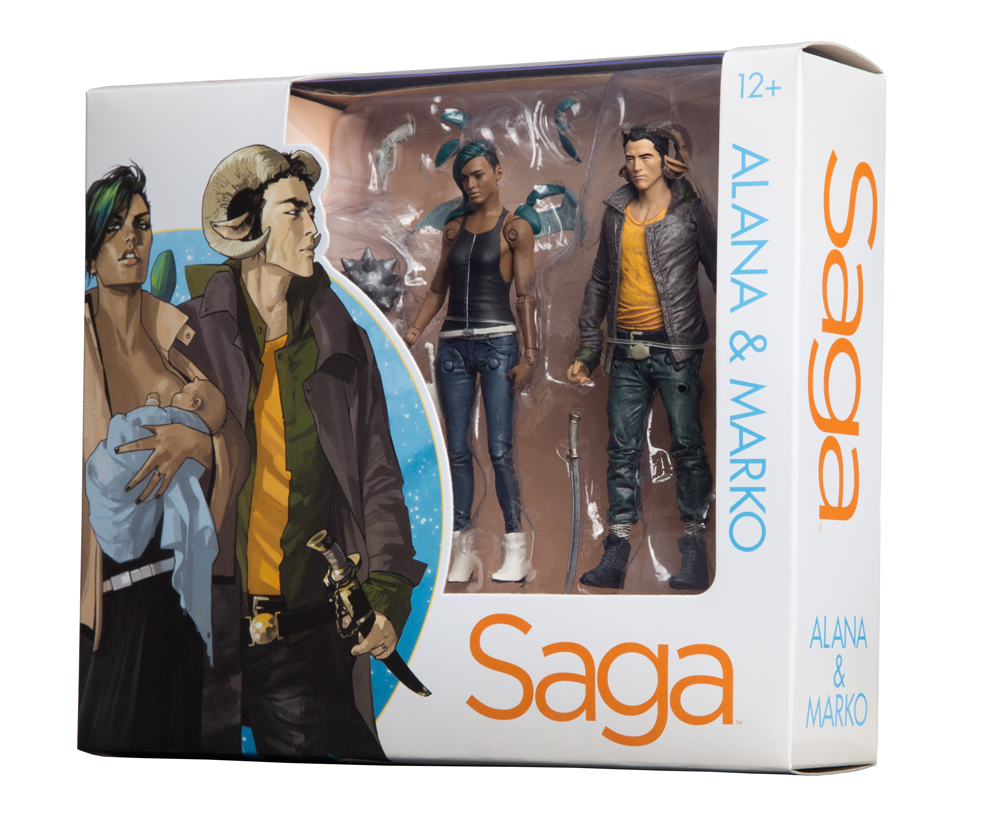
I can't believe how rapidly San Diego Comic Con is approaching! While I prepare my pre-con coverage, I wanted to share with you possibly the best exclusive that you will find at SDCC this summer. Skybound has announced some impressive exclusives, from the Lucille keychains to the Superfight decks, nothing is as impressive as the Saga action figures. Fans will be able to pick up a Marko and Alana two-pack and it opens the door for more figures from this amazing series. Just look at this two-pack!! I sure hope I get my grubby hands on it.
Pick of the Week:
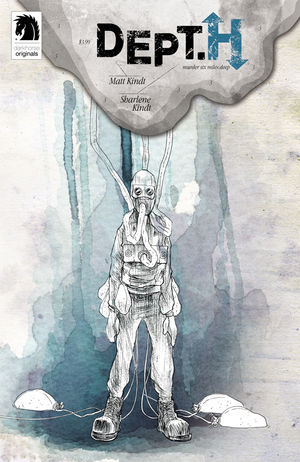
Dept. H #3 - Mia isn't any closer to solving the mystery of who murdered her father at Dept. H, the underwater research facility, and the situation has only worsened. Her brother is lost unconscious in the ocean and there may be a contagion lose that is impacting the cognitive functions of the crew. Matt and Sharlene Kindt's harrowing tale took a turn for the worse and I fear that Mia may never know who killed her father or why. It appears that there was a lot of research being conducted on various specimens, but the big question is for what purpose? We peeled back a few more layers on this mystery and I look forward to what we will uncover in the next issue. This is a brilliant follow-up to Mind MGMT and if you haven't read anything from Kindt then you should pick this up immediately.

She Wolf #1 - I'm still not quite sure what I read, but it was one of the most visually interesting and appealing comics that I've seen recently. The way that creator Rich Tommaso jumped around in the story I don't think that this comic is for me, but it is unlike anything I've read and fans of werewolves will likely enjoy it. From what I gathered, Gabby is a werewolf who infected her boyfriend Brian. This ultimately led to his demise and sets the stage for a punk rock, teenage werewolf who has a lot on her plate. Not my cup of tea as the story was a bit too jumpy for my taste, but I do think that this title has a target market and kudos for Image for green lighting this unique title.
 Star Wars: The Force Awakens #1 - When I heard that the Force Awakens was joining its Star Wars family in the form of a Marvel comic I was quite excited. While well executed, I was disappointed to learn that it is a literal translation of the movie. The first issue of the mini-series provided no additional insight to the events in the movie. As I read the comic I kept waiting to see it veer from the script, but sadly it didn't. If you are a big fan who wants to enjoy the movie in comic book fan then you will enjoy the debut issue, but if you are looking for more depth or side stories this isn't the book you are looking for.
POSTED BY MIKE N. aka Victor Domashev -- comic guy, proudly raising nerdy kids, and Nerds of a Feather contributor since 2012.
Wednesday, June 22, 2016
Reading the Hugos: Short Story
Today we continue our journey through the Hugo Award finalists with a look at the Short Story category, but before we do so I would like to engage in a little bit of housekeeping first.
While I am clearly not blind to the controversy surrounding this year's Hugo Awards (nor is The G, for that matter), I have mostly chosen to cover each category on the relative subjective merits of the nominated works. I understand that this is something that not everyone can or will choose to do, but it is the way that I have elected to engage with the Hugo Awards. While the result of the Hugo Awards short list is not significantly different in regards to the Rabid Puppies straight up dominating most of the categories / finalists with their slate, the difference is that this year they have selected to bulk nominate a group that includes more works that might have otherwise had a reasonable chance of making the ballot and also that meets my subjective definition of "quality". That slate from the Rabid Puppies also includes a number of works that come across as little more than an extended middle finger to the people who care about the Hugo Awards. Feel free to argue with any or all of my opinions here.
The reason I bring this up here is that the Short Story category is one that contains works that one might easily construe as being that extended middle finger I mentioned previously.
With that said, let's take a look at the Hugo Award finalists for Short Story.
“Asymmetrical Warfare”, by S. R. Algernon (Nature 3/15)
"Cat Pictures Please", by Naomi Kritzer (Clarkesworld 1/15)
The Commuter, by Thomas A. Mays (Stealth)
“Seven Kill Tiger”, by Charles Shao (There Will Be War: Volume X)
“If You Were an Award, My Love”, by Juan Tabo & S. Harris (Vox Populi 6/15)
Space Raptor Butt Invasion, by Chuck Tingle (self-published)
If You Were an Award, My Love: On the one hand, and this is worth mentioning but not reading all that much into, "If You Were an Award, My Love" may be the first piece of fan fiction to ever be nominated for a Hugo Award. Now, I suspect that the authors would argue the "fan" aspect of fan fiction in this case, but the fact remains that it is a clear reworking of Rachel Swirsky's wrenching and graceful, Hugo Award Nominated and Nebula Award winning story "If You Were a Dinosaur, My Love". In a different year, with a different story, the fact that fan fiction made the Hugo ballot would be a fairly big deal and a major talking point. This is not that year.
"If You Were an Award, My Love" is a somewhat bitter parody of Swirsky's story and awkwardly and unsubtly pokes at the general response of those who were upset with the partial Hugo Award takeover last year by the combined Sad and Rabid Puppy slate campaigns. The story digs specifically at John Scalzi, one of the targets du jour of the Rabid Puppy supporters while also digging directly at Swirsky's story beyond simply aping its format. Taken solely as a piece of fiction and in consideration for an award, "If You Were an Award, My Love" is truly one of the worst stories I have encountered on an award's short list. While I don't consider the comments on a story as part of my consideration, I do have to consider the two "updates" to the story as part of the story itself - which are a picture of Swirsky and a personal attack on her appearance couched in an unsubtle joke.
I have spent far too many words already on this. "If You Were an Award, My Love" is unworthy of an award.
Space Raptor Butt Invasion: Speaking of unsubtle jokes, let's talk about Chuck Tingle's Space Raptor Butt Invasion. Let's be clear here, the story itself isn't the joke. This is another one of the "extended middle finger" nominees from the Rabid Puppies slate. There's no real way around that, except this time the middle finger is more about the title itself, which from a certain perspective can be used as another dig at Rachel Swirsky's "If You Were a Dinosaur, My Love". Also, Space Raptor Butt Invasion is science fiction / fantasy dinosaur erotica, which is not historically the sort of work that is recognized for major genre awards, which is also a likely reason why this was selected by the Rabid Puppies.
The story itself is half of a science fiction story which begins with astronauts on a major shift change (one is leaving, the other is staying in space alone for a year) and proceeds to a surprise meeting with a dinosaur astronaut and continues on to an extended sexual encounter between the human and velociraptor astronauts. Space Raptor Butt Invasion is a very specific sort of story and independent of the unfortunate usage of the Rabid Puppies slate nomination, it likely has a strong audience which is looking for this specific sort of erotica. It does not, however, make it a good science fiction story (or a fantasy story, given that we have a dinosaur astronaut here).
I could easily spend several more paragraphs writing about Space Raptor Butt Invasion in terms of what it represents, how it is being used, the overall entertainment value of Chuck Tingle as performance art in light of his nomination and how he has flipped the script of how he was used as a joke nomination into something far cooler - but all of that, which for me is the most notable part of the nomination, is beside the point if we're really looking at how Space Raptor Butt Invasion stacks up as a piece of fiction. It doesn't.
No Award: As a general rule, I use No Award in a very surgical manner. I understand that not every work is to my personal taste and that simply because I do not like something does not mean that it is inherently bad or unworthy of a Hugo Award. I may prefer that something else would win and that a particular work was not on the ballot, but again, that does make the work bad. Unfortunately, there are also instances where my subjective view is that the work is so bad that it is also objectively bad and unworthy of receiving (or being considered for) an award. There may also be examples of a work being so bad it comes out the other side and is somehow entertaining. In both of these instances No Award will be used.
Asymmetrical Warfare: "Asymmetrical Warfare" features an alien race attacking Earth with an initial set of assumptions about what humanity is and how humans might "renew", only to discover otherwise. It seems that the attacking race is similar to starfish and so regenerate when damaged. The story is told over a number of very short episodes time stamped months apart (but in galactic years). So here we have an example of a story that doesn't at all work for me, but I don't think it is inherently bad.While I appreciated the quiet desperation the narrator exhibits as it realizes humanity is the sort of species it thought we were, "Asymmetrical Warfare" does not hold together as enough of a coherent narrative due to how fragmented and short the story is. All of the pieces are there, and perhaps at twice or three times the length I'd have appreciated it more, but in its current form "Asymmetrical Warfare" is too disjointed to work.
Seven Kill Tiger: While "Seven Kill Tiger" is a more cohesive story than "Asymmetrical Warfare", it similarly suffers from being far too short of a story. The rising threat of a targeted virus which will wipe out most of the human population of Africa and at not insignificant percentage of the rest of the world as a way to forward Chinese business and investment is one which could build to be a supremely interesting and taut thriller. Being part of Jerry Pournelle's There Will Be War: Vol X anthology, Charles Shao addresses a possible demilitarized method of fighting a war of conquest, but the characterization and the storytelling comes across as flat and one note. "Seven Kill Tiger" is conceptually interesting, horrifying, and terrifying to consider. The idea is there. The execution is simplistic. The concept of "Seven Kill Tiger" expanded out to be a longer but still tighter thriller may not be the story Shao wished to tell, and we can all to easily fall into the trap of trying to review the story we, as readers, think the author should have written, but Shao's story has so much unrealized potential. The germ of a better story is there, but that's not the story Shao has written. As it stands, "Seven Kill Tiger" may be a stronger story than "Asymmetrical Warfare", but it suffers in comparison to the significantly stronger "Cat Pictures Please".
Cat Pictures Please: A story of an artificial intelligence which wants to help humanity. In another story, this premise would somehow lead to The Terminator and every one would die in nuclear explosions, but Kritzer has a much more pleasant story than that. Note the title. But humanity remains baffling to a benevolent AI. "Cat Pictures Please" is a sweet little story and was on my nomination ballot. It's also a relentlessly positive story, and that's not something that we see very often, especially when it comes to literary awards. I like the story, which is obvious from my nomination, but I'm not sure if I truly love it as much after reading it a second time as I did the first time. But with that said, it is easily the strongest of the finalists. I also now wonder if my computer is trying to tell me something.
By this point you've likely noticed The Commuter is listed above as one of the finalists, but is crossed out. There is a very good reason for that. Thomas Mays goes into greater detail on his website, but the shorter version is that Mays declined his nomination after the finalists were announced. This allowed the story with the next highest number of nominations to make the ballot, which was Naomi Kritzer's "Cat Pictures Please".
My Vote
1. Cat Pictures Please
2. Seven Kill Tiger
3. Asymmetrical Warfare
4. No Award
Also, feel free to look at the rest of our Hugo Awards coverage:
Novel
Dramatic Presentation: Long Form
POSTED BY: Joe Sherry - Writer / Editor at Adventures in Reading since 2004. Nerds of a Feather contributor since 2015, editor since 2016. Minnesotan.
Subscribe to:
Posts (Atom)