Showing posts with label nonfiction. Show all posts

Friday, May 9, 2025

Documentary Review: Don't Die

On Bryan Johnson's obsessive quest to bring science fiction to real life

Cards on the table: I fully agree that death is bad. Zero stars, don't recommend. I'll be among the cheering crowd if medical technology somehow succeeds at solving all diseases and making it possible for us to live thousands or millions of years—emphasis on if. So far I've found no reasons to expect that über-rich tech bro Bryan Johnson will succeed at outrunning his own body and unlocking the secret to immortality. The current state of scientific progress simply isn't there yet. However, his Netflix infomercial documentary Don't Die, which you shouldn't for a second believe isn't part of his meticulously curated regimen of 24/7 self-branding, does something more interesting than expositing on the state of the art of the study of aging. Where he aimed at portraying himself as a bold pioneer opening up the next frontier of human history, what actually comes off is a tragic character study whose inadvertent revelations reach beyond the power of his obvious control over the narrative.

That's right, people: I'm taking the message from the enemy of death and applying Death of the Author to it. Irony engines, engage!

You can easily guess my verdict on Don't Die by the fact that it presents itself as a true story from real life but this is a science fiction blog. Johnson's self-imposed mission to eliminate death is, in the most literal sense, science fiction: his goal is unfeasible in this century, no matter how vehemently he persists in preaching the gospel of eternal youth. It's been a while since fellow anti-death prophet Raymond Kurzweil made one of his eyebrow-raising predictions about extending human life to infinity by digital means, and until actual results are shown, we should remain no less skeptical of Bryan Johnson's promise to achieve the same by chemical means. (And no, his massive abs don't count as "results." At a decade older, Jason Statham looks just as ripped and far less stressed.) We won't know for certain whether those numbers on the chart of Johnson's biomarkers mean something until he enters actual old age.

While we wait for the big news, he's hard to tell apart from other enthusiasts of extreme body modification, such as Henry Damon, Michel Praddo, or Dennis Avner, whom I don't recommend you look up. However, those guys tend to describe their transformations in terms of artistic self-expression. Despite his habit of posing half-nude for Instagram, Bryan Johnson doesn't appear to be motivated by an aesthetic ideal, or at least doesn't claim to be. His grueling routine of over a hundred pills, brutal weightlifting, sessions of artificial light, a set of diet restrictions that can only be described as sadistic, and the occasional injection of plasma from his son (because why try to live forever if you can't go full vampire) don't add up to an enjoyable life. The documentary even recognizes the incongruity of spending so much of his waking hours working so hard to buy himself more days of life... which he ends up not living because he's too busy trying not to die. If this were a form of artistic self-expression, its message would be legible as a cry for help. Could Johnson be staging an elaborate performance project, a vociferous statement on the commercialization of healthcare and the fundamental inequality that lets him fly outside of US jurisdiction to receive super-illegal genetic therapies for a sum that could buy years' worth of deworming pills for Third World kids? Or is he instead the world's worst case of orthorexia? Is he like French artist Orlan, who uses her own body as the shapeable material of her work, or is he like Chinese emperor Qin Shi Huang, who spent his old age desperately seeking an alchemist who could brew the elixir of eternal life?

Regardless of whatever useful scientific advance may eventually result from this, the one thing that is clear about Johnson is that he's a businessman, and he's learned very well how to sell his product. At the start of the documentary, the camera quickly scans over a long list of the blood tests he takes regularly, conspicuously stopping at the exact position where his testosterone levels would appear right in the center of the frame. In a later scene, text on the screen summarizes his progress according to various medical parameters, the unmissable last of which is the quality of his erections. Johnson knows exactly the demographic of insecure young men that his message is likely to attract. He ought to know; he's been there.

Johnson lets us glimpse bits of his psychology when he starts recounting his youth in the Mormon church, his way too early marriage, his first business successes and the soul-draining rhythm of nonstop work that it took to become a multimillionaire. He describes a period of suicidal depression around his 30s, when he realized that he didn't know in what direction he wanted to go with his life. He did end up leaving the Mormon church, but he seems to have never noticed how the particularly twisted Mormon version of patriarchal expectations must have contributed to his mental breakdown. Like many people with depression, he correctly identified that he shouldn't listen when his mind was telling him that he had to die. Unlike probably everyone else with depression, he took that insight too far, and decided to stop listening to his mind about anything. When he describes how he built an inflexible algorithm that makes all life decisions for him, his evident relief is hard to empathize with. It's like hearing Victor Frankenstein tell the happy story of how all his worries went away after he gave himself a lobotomy.

The way Johnson puts it, "Removing my mind has been the best thing I've ever done in my life." Such an admission comes from a man who claims to be working to help people stop behaving self-destructively, a profoundly troubled man who hears his son tell him during casual conversation that he's disconnected from his own emotions and still doesn't get the hint. That fateful step of surrendering his agency to impersonal laws, of ceasing to make his own choices (which for all purposes is equivalent to ceasing to be a person) is the key to the whole puzzle. Johnson developed his self-hatred to its logical conclusion: in the contest against natural death, his winning move was to snatch its victim first. Time can no longer annihilate him, not because he hardened his body against all harm, but because he preemptively severed that body from consciousness before nature could do it. That's how he finally ensured that he won't die: by the standards of humanism, he has already committed suicide.

POSTED BY: Arturo Serrano, multiclass Trekkie/Whovian/Moonie/Miraculer, accumulating experience points for still more obsessions.

Wednesday, March 12, 2025

Review: Speculative Whiteness: Science Fiction and the Alt-Right

Jordan Carroll uncomfortably probes the connections between the field and the right wing of America

Jordan Carroll’s academic book Speculative Whiteness: Science Fiction and the Alt-Right sets out to do what it says on the tin. His thesis is that the alt-right, as constituted, has undeniable links to the science fiction field, which go back to its earliest eras, and whose consequences and ties remain to this day. He explores how the alt-right’s antisemitism, racism, sexism, queerphobia and other toxic beliefs have manifested, been encouraged, and grown in the soil of science fiction from its inception.

His thesis:

Science fiction serves as more than just a pop culture reference in fascist discourse
[...] the alt-right has interpreted science fiction to say that a fascist world is possible.

It was unfortunately inevitable. Some of the same impulses, ideas, beliefs and interests in the early part of the 20th century bore fruit in a number of, as it turns out, rather interconnected loci. The interest in space exploration (and colonization) bore fruit not only in the stories shepherded by Hugo Gernsback and, more importantly, John C. Campbell, but in the whole strain of the work of Wernher von Braun and his rocket program, first for Nazi Germany, and later, for the United States.

This interchange of conscious and subconscious ideas has had consequences for science fiction as a field, and that is what Carroll examines here. He varies between the historical perspective and that of more recent events. He leans on Alec Nevala-Lee’s book on John C. Campbell (Astounding: John W. Campbell, Isaac Asimov, Robert A. Heinlein, L. Ron Hubbard, and the Golden Age of Science Fiction) to show how Campbellian science fiction has had some of these toxic themes and ideas right from the start, and that the alt-right has been looking at science fiction for models of a fascist future for a long time.

As Carroll notes, this pervasive toxicity has led to some very strange results. He notes The Iron Dream by Norman Spinrad, an out-and-out satire and a strike against the technocratic fascist impulses of science fiction that, quite frankly, probably wouldn’t get a publisher today. The book is not subtle with its points (or even in its cover). And yet, as Carroll points out, there are those on the right who take it as a model to emulate. Carroll also brings up authors like Pournelle and Niven, focusing on Lucifer’s Hammer and its rather lurid racial politics (just as one prominent example, the PoC cannibal army) as mainstreaming the ideas of the alt-right, all the worse because of its blockbuster bestseller status. The darker connections of racial and eugenic politics in science fiction (again, Campbell, but not just Campbell, that’s the point of this book) were kickstarted and encouraged by books like this.

And so, yes, he also naturally tackles Dune. Dune probably could have an entire book written on just its role in politics and science fiction—positive, negative, and neutral. Carroll focuses on how, despite Herbert’s attempt to show the horror and hell of Paul’s life and his role, the whole idea of a “God-Emperor” has been enthusiastically taken up as a role model by elements of the alt-right. They ignore the non-Western elements of the culture of Paul’s society (from the Emperor all the way to the Fremen) and delight in the power of Paul as God-Emperor with his Führerprinzip as something to wish for. And yes, Carroll drags in Warhammer 40K and how, for all that it is overtly a criticism of this grimdark future, like Dune, it is seen as an aspirational future by the alt-right.

Naturally, he also goes on to tackle The Turner Diaries, which is perhaps the most poisonous science fiction or science-fiction-adjacent book of them all. With its explicitly racist and fascist politics, Caroll calls it as a Bible of the white nationalist movement, and I think he’s absolutely right. This is the future the alt-right has always wanted. It’s a manifesto of the darkest order. I am myself reminded of “From my Nightmare 1995 to my Utopian 2050” by William S Lind as being absolutely in this terrible tradition. There is a whole strain of post-apocalyptic novels and stories that Carroll could have gone into that could come in for criticism or at least discussion in interrogating these ideas. Consider the underground city society of A Boy and His Dog and how the girls (and some of the men as well) all wear heavy white makeup.

In the more modern and recent context, Carroll looks at people like Richard Spencer, and also at people like Theodore Beale (a.k.a. Vox Day) and the whole saga of the Rabid and Sad Puppies (once again, relying on an excellent source, this time Camestros Felapton) to show how, in more recent times, this mixture of far-right politics and science fiction has been wrapped around each other. In this era, we don’t just get odious books by authors such as Tom Kratman; we get political action and activity in a direct fashion.

It’s not all doom and gloom, as he highlights authors such as N. K. Jemisin and her award-winning Broken Earth trilogy as countervailing reactions to the alt-right’s attempts to go from simmering beneath the surface to fuller control of science fiction. But in that, I think that Carroll missed a few tricks. The Rabid and Sad Puppies were a fulmination, a fungal bloom of these right, alt-right, far-right movements. But while that tide, as of the writing of the book, and as of the writing of this review, has receded, there is still a strain of writers and authors who attempt to, to various degrees, mainstream reactionary politics. Yes, I could drag Baen Books here, and I already mentioned Kratman, but there are less odious authors who are not quite as overt in these fascist-friendly futures, or futures that the alt-right can wish for.

And to that point, unaddressed and undiscussed in this book (it’s a slim volume, to be fair), some of those currents are present in a greater total mass as subtext (perhaps, to be fair, probably subconsciously) in much more mainstream science fiction. Carroll doesn’t consider or interrogate the problems that this subtext has had in the main run of science fiction. The emphasis on technocracy über alles, the devaluing (or just not even a consideration) of the importance and power of labor, a general rightward bent to the prevailing politics of societies, the overwhelming white-maleness of characters, even today, are all echoing consequences of the Speculative Whiteness. Admittedly, again, to dive into the vast pool of science fiction and try and disentangle even one of these particular fruits would make the book many times its size, and perhaps Carroll did not want to handwave in that particular direction without going into a deep dive. But even as he says that his book is a historical study, I think that not talking about this is precisely part of the problem. I spoke earlier of the soil of science fiction leading to alt-right science fiction blooming, but really, the soil itself has a taint in it. It takes effort for writers to try and detoxify their own work as best they can.¹

That said, and returning to a more positive bent, this is a slim, powerful, and sometimes rather damning look at science fiction and the poisonous and destructive politics of the alt-right. I’ve been aware of these issues for a long time, in a sometimes direct fashion (cf. my own small speaking role in the Sad and Rabid Puppies drama) and an indirect fashion (cf. my engagement and reengagement with Heinlein, Pournelle, Niven, Anderson, et cetera, as well as reading the aforementioned book by Nevala-Lee). This academic work puts it all together, and then some, and presents it with the receipts, as it were.

This is an important book (and I don’t use that phrase lightly). Is it going on my Hugo nomination ballot this year for Best Related Work? Unquestionably yes. And even if you aren't the Hugo-nominating type, if you are at all interested in the field of science fiction and want to experience a more critical analysis of how it has proven to be a fertile soil for the alt-right and their fascist dreams, I strongly recommend Carroll's work.


Reference: Carroll, Jordan. Speculative Whiteness: Science Fiction and the Alt-Right [University of Minnesota Press, 2024].


¹ To give one example: take a look at the Expanse novels by James S. A. Corey... but then look at the TV adaptation, which took visible pains to address some of the problems of the novels. In many ways, it is superior to the source material for the changes and detoxification that it has done. Is it perfect? No. Is it better than the books? Yes. But it takes a lot of capital (in all senses) to not only recognize the problem, but even try to address it.

POSTED BY: Paul Weimer. Ubiquitous in Shadow, but I'm just this guy, you know? @princejvstin

Tuesday, October 15, 2024

Nonfiction Review: Play Nice: The Rise, Fall, and Future of Blizzard Entertainment by Jason Schreier

From king of the world to a cog in the system, Play Nice blows open Blizzard's rise to fame and its fall from grace

Play Nice, the most recent book from renowned journalist Jason Schreier, says all in the title. The book follows the Blizzard from inception to acquisition to scandal. Though the future for the company is rather uncertain (what with the recent Xbox acquisition), the past holds a lot of dramatic development fuel (at least enough for an almost four-hundred-page book). Though I’ve never been a hardcore Blizzard fan, I’ve sunken many hours into Overwatch and was curious to see how some of their development choices unfolded. Instead, I got a whole lot more that I didn't know I wanted.

Schreier begins with Allen Adham and Mike Morhaime’s (Blizzard’s co-founders) initial foray into the industry and hits on every success, cancellation, and acquisition that comes their way. The industry darlings of the 90s continued to pump out hit after hit after hit. The Warcraft, Diablo, and Starcraft franchises were all massive successes, but the history behind each plays out here. For instance, the Diablo team was originally a separate studio that was brought into the company. Play Nice details how Blizzard’s primary Irvine offices contrasted with the Blizzard North, how the two companies’ ethos were at odds, in some cases, with their newly acquired brethren, and at other times in harmony.

Schreier, to his credit, paints this era of booze-fueled frat fantasy video game development in vivid detail, partly from his own description, but mostly from the quotations he managed to secure from the many past and present Blizzard employees. At times the book gets crass, though that is in line with the content being represented. Schreier’s commentary is often comical. At one point he references a past advertisement/mantra that came into being from a past World of Warcraft customer service call. In the background of the call, a man’s wife claims: “This game is why we don’t have sex anymore.”

But the book covers more than the early days. The transition from fraternity game developer to full-time publicly traded company brings with it many issues. Sometimes the dream of becoming big has an entirely different reality, and Schreier finds quotes to help nail that sentiment. The consistent rotating door of executives, owners, and employees left me (never mind the company) on unstable footing. So many names are introduced and quickly discarded that I had to do a double take (or at least flip a few pages back to see if I was still reading about the same person from a few pages ago). Schreier will build up an employee with a bit of backstory, and then not mention them for a while (or ever again), while others stay in the periphery, bouncing back into view every so often. It’s a bit disorienting, but completely understandable considering the company’s thirty-plus-year history of confusion, success, and most recently, scandal.

As someone who is opposed to CEOs making hundreds of times what their workers make, I found it tough to read about the disgusting practices carried out by Activision and Blizzard’s upper management. Developers found it difficult to live while their bosses made millions of dollars. While Schreier brings in voices from all tiers of development, the main focus, especially later on, comes from those affected by the poor policies implemented to ensure that Blizzard would become a profit-first company (as opposed to their initial player-first mentality). Arbitrary rules put in place would see employees compete in unhealthy ways to keep their jobs. Not to mention, all the time that Blizzard continued to put out hit games with commercial success (including in their early days), their staff was paid less than other studios. To work for Blizzard was its own sort of payment.

One of my main issues with the book is the inconsistent timeline. The book, overall, is chronological, following the earliest days of Blizzard to the recent Microsoft acquisition and layoffs. At some points, however, Schreier goes back in time to discuss other projects and put emphasis on things in a time that I thought I had already moved past. So, like with the many different employees that are mentioned and dropped, I found myself flipping back to make sure I knew where I was chronologically. Again, it's hard to fault Schreier for this, considering the studio had multiple projects in the works, and he tried his best to cover each with their own highlight. Despite some of the timelines coming into conflict, it’s digestible, even if I needed to take a few moments to review my notes. Minus some poor fool pressing Enter and starting a new paragraph instead of the space bar multiple times, another issue I have is how Schreier ends each chapter. Almost every chapter ends with what feels like a dun, dun, dun… To Be Continued. Look, I get it, but the content is interesting enough. It isn't necessary, and eventually comes off as unintentionally comical.

Discovering many of the intricacies of not only Blizzard, but Activision, Vivendi, and Davidson & Associates (Blizzard’s original parent company), and how the company and its parent companies work (or don't work) was incredibly insightful. The constant bureaucracy from Blizzard’s owners and eventual erosion of what made the studio unique and successful slowly begins to creep up on you as you read through the book, and it’s quite fascinating to see it unfold. From the sexual assault scandals to poor implementation of morale-destroying policy to leeching almost all creative juice from the teams in favor of profit, Play Nice covers one of most influential video game studios of all time with vivid clarity. Thanks to the many interviews Schreier conducted to make this book, it feels like a triumph for those poorly affected by ABK’s (Activision Blizzard King) harmful policy and in some cases inadequate response to employee grievances. While I think Schreier should have waited a bit longer to see how Microsoft and ABK’s merger plays out over a longer period, the content here is informative and reflective of an ever-changing industry. If one wants insight into how one of the most beloved developers in the world has become a shell of what it once was, this is the best way to do it.


Posted by: Joe DelFranco - Fiction writer and lover of most things video games. On most days you can find him writing at his favorite spot in the little state of Rhode Island.

Monday, October 7, 2024

Book Review: Glamour Ghoul by Sandra Niemi

A compelling, moving chronicle that over-performs on every level

Do you know Vampira? If so, maybe you know her, like me, from Tim Burton's 1994 film Ed Wood, in which she is never referred to by her actual name—Maila Nurmi. Or maybe you know her from the Misfits song. Or maybe you know of her only vaguely, from the gauzy way in which her name has been attached to that of Elvira.

It is hard to overstate just how famous Vampira was for one vanishingly brief window of time in 1954. The creation of an essentially unknown actress, Maila Nurmi, Vampira was the host of a late-night program on Los Angeles' local ABC affiliate ABC 7, in which she showed public domain horror films starring the likes of Bela Lugosi and offered innuendo-laced commentary. From the launching pad of local late-night television, she wound up on live, nationally broadcast variety shows, and was featured in national magazines and papers across the country. And then a contract wasn't renewed, and... poof. Later, in the 1980s, there was a new spark of interest in the name, but soon it was attached dismissively to a failed lawsuit against Elvira, and the connotation was that some has-been was trying to cash in cynically on a new performer's success.

Maila in Vampira garb in a famous 1954 photo from Life magazine

I have written on this site many times about the impact watching (and re-watching ad infinitum) Ed Wood had on me and the direction of my professional and creative life. So I feel like going into this book I knew maybe as much about Vampira as anybody who didn't know Maila Nurmi personally. She was the actual character model for Disney's Maleficent, in addition to her TV show. But after the limelight of the 1950s faded, she was reduced to dire poverty, living by herself in an apartment that sometimes didn't have basic utilities. In her later years, Maila sold jewelry on Melrose Avenue in Los Angeles, made friends with a few people, like the comedian Dana Gould, who both helped her as her physical ailments overwhelmed her, and also were sometimes on the receiving end of her mercurial and curmudgeonly temperament. When she passed, there were online fundraisers, in the days when MySpace still stalked the Earth, for her interment and headstone, in which I participated. About ten years ago, an excellent documentary called Vampira and Me came out, which includes the only surviving kinescope footage from her TV show. I knew all of this going into Glamour Ghoul, but friends, I was not prepared.

This book was written by Maila's niece, Sandra Niemi, the daughter of Maila's estranged and never-reconciled brother. She and Maila only met once, when Sandra took a sightseeing trip to Los Angeles. Sandra is neither a writer, historian, nor researcher, so I have to admit, my expectations going into the book were pretty low. As it happens, Maila had been working off-and-on at an autobiography for many years. She kept stacks of notes and diaries, and some cassettes on which she'd recorded aspects of her story. Sandra worked through all of this material to tell a profoundly engaging story with a final emotional punch that I won't spoil, but recounts a circumstance that simply wouldn't have ever happened if the author had not undertaken the writing of this book.

Maila Nurmi grew up in a Finnish immigrant community where her most likely prospect for the future was working in a fish canning factory. So in 1941, at age 18, she got on a bus for Hollywood. A stunning beauty, it didn't take her long to catch the attention of people like Orson Welles, who impregnated her and then vanished from her life. In interviews in later years, Maila would discuss being seduced by Welles, and claim that he gave her the clap. This book reveals that instead, this was Maila's little personal code for "child," and a way to throw shade at Welles without revealing the true nature of their relationship, and the pain involved in giving her child up for adoption.


Maila Nurmi, 1947

As the decade rolled over into the 1950s, Maila became a fixture of Googie's diner, which was both a social scene and the inspiration for an architectural style. She became close friends with Marlon Brando (the book does not discuss whether or not their relationship exceeded the bounds of friendship, but given Brando's reputation, it seems like a reasonable conclusion), and was perhaps closer to James Dean than anyone else. His death destroyed Maila, and left her feeling completely unmoored, coming in close proximity to the loss of her show. Brando seems to have done all he could to help—paying for her to go to therapy and paying her phone bill for years so the two of them could stay connected and Maila could stay connected to the outside world, from which she was withdrawing.

After sliding deeper and deeper into poverty, the book discusses the afternoon where four weird-looking guys showed up at her apartment and peered through her window. When Maila went to chase them off, she discovered they were... The Misfits. They adored Vampira, and asked her to come make an appearance at their record release show that night in Hollywood. This began a return to the spotlight, and kicked off new interest in the character.

This is where the book does a tremendous service to the memory of Maila (and Vampira). Sandra dives deep into the circumstances leading up to the lawsuit against ABC 7 and Elvira, and the lawsuit itself. Contrary to the popular understanding of the suit, ABC 7 actually approached Maila and Cassandra Petersen about launching a new version of the Vampira show, in which Vampira would be Elvira's grandmother. Negotiations went on for some time, contracts were signed, but then ABC 7 decided to go ahead with the show without Maila. Cassandra Petersen became Elvira and continues her success with the character to this day. Sandra reveals through documentation that Maila was the victim of her own poverty, having to rely on ineffectual lawyers who missed deadlines and misfiled paperwork, leading to the dismissal of the suit (did didn't lose on the merits) and her being cut out of participation in the Elvira show that she was entitled to.

Even though Maila never truly rose out of the poverty that dogged her, the resurgence of Vampira's name recognition, coupled with the attention to Edward D. Wood, Jr. that came about largely as a result of the Tim Burton movie, did allow Maila to make meaningful connections with a younger generation of fans and friends. After she passed and Sandra received all of her papers and recordings, Sandra did some digging into things that Maila never had access to, and uncovers a truly powerful revelation that literally left me in tears as I finished the book.

In the end, this book is a gift to fans of old horror movies, fans of Hollywood history, and in a very real sense, to a few specific individuals who have a greater understanding of themselves in the world as a result of this book.


The Math

Highlights: A loving but nuanced portrait of a complicated individual, amazing 1950s old Hollywood vibes, unequalled context added to a pop culture mystery that seemed straightforward

Nerd Coefficient: 9/10.

Reference: Niemi, Sandra. Glamour Ghoul: The Passions and Pain of the Real Vampira [Feral House, 2021].

Posted by Vance K—resident cult film reviewer and co-founder of nerds of a feather, flock together

Monday, October 23, 2023

Review: Space Craze

A sojourn through the history of star-spangled science fiction


Gene Roddenberry called outer space ‘the final frontier,’ and those three words have become an iconic tagline of his most famous creation; after all, he pitched Star Trek as ‘wagon train to the stars.’ Such a comparison, of the gulf of space with the American West, is so common that we tend to forget how quintessentially American that conflation is, indeed how very American the science fiction genre has been. All that, and more, is the subject of the 2022 nonfiction book Space Craze: America’s Enduring Fascination with Real and Imagined Space Flight by Margaret A. Weitekamp.

Weitekamp is perhaps the most qualified person on the planet to write such a book; she is the chair of the Space History Department at the National Air and Space Museum in Washington D.C., a place I spent so many happy hours with my dad as a child growing up in the DC suburbs (although I probably made my dad sit through the planetarium movie too many times). Every chapter, she starts with a discussion of a piece of memorabilia in the museum’s archive that she has personally handled, grounding the book in a reality that many of us have seen if only second-hand.This book is, ultimately, a cultural history of America’s love affair with the heavens, the story of the dreaming that led to that one small step for a man.

Weitekamp clearly knows her stuff; she goes all the way back to the nineteenth century and the earliest literature that could be described as ‘science fiction.’ It allows her to do what she does best in this book: contextualize works of fiction that many of us have read or watched, indeed loved, but never thought of the world it came from. She talks about the strong influence of Westerns on early science fiction, and how its fingerprints are still felt today. She talks about the evolving role of extraterrestrials as the ‘other.’ She goes into great detail about the influence of Buck Rogers and the tropes that it spawned. One particularly striking moment is when she gets to the 1970s and is talking about the original Star Wars. She mentions a Black critic in California who calls that film, now a beloved classic (by myself included) as the most racist film he had ever seen, because it implied that no people of color would exist in the future (fortunately, this would improve in franchise history, but I can’t deny that the original is very white in its cast).

As I previously remarked with the chapter openings, she also does a wonderful job of humanizing this history. A lot of the book is about the history of science fiction fandom, from the earliest conventions to the myriad websites of today. I joined my local science fiction society in 2019, and I believe I am still its youngest dues-paying member; I was stunned to learn that people I was talking to had met Isaac Asimov. With the long view Weitekamp provides, you can see the world of fandom from an age where you could read every SFF book released that year evolve slowly into the world of today, with a plethora of work to lose yourself in.

There’s a part of me, though, that wishes Weitekamp were a bit more radical. A big theme here is the notion of frontier and its role in American mythology. Recent works on the American frontier, such as Roxanne Dunbar-Ortiz’s An Indigenous People’s History of the United States, Greg Grandin’s The End of the Myth: from the Frontier to the Border Wall in the Mind of America, and John Grenier’s The First Way of War: American War Making on the Frontier 1607-1814 have problematized the rosy, white-centric view of the frontier, rather revealing the truth that it was, to put it bluntly, a successful continent-scale genocide, a history that has defined America’s self-conception ever since (it makes sense, then, that a country that has never known a day of peace would create military science fiction).

This is a period of wholesale annihilation of entire peoples that is the basis of so much of America’s literature of futuristic dreaming. Weitekamp discusses Garrett Putman Serviss’ novel Edison’s Conquest of Mars, a novel that ends with the white male protagonist releasing floods to commit genocide against the Martians, because they are a ‘dying race.’ In his book A History of Bombing, Sven Lindqvist contextualized that book, among with many others, with the history of waging war on entire peoples that started in the colonial world and culminated in the Holocaust. Indeed, the American West was one of the great inspirations for Hitler’s plan for Eastern Europe (for the curious, I recommend Carroll P. Kakel’s book The American West and the Nazi East), a genocidal process of ‘civilized’ white people exterminating the ‘inferior’ natives and creating an idyllic land of hardy soldier-farmers living off the land. I’d imagine that an employee of a government-funded museum cannot be so candid about such history, but I feel like this was a missed opportunity (or the subject of another book - Lindqvist touches on this nasty history in the formation of apocalyptic narratives in American culture, but not enough to sate my curiosity).

Space Craze is a good, solid history of American science fiction, albeit whitewashed in the way that our mainstream history usually is. As a history of people, who played with toys and went to conventions and loved dreaming of new worlds, it is astounding, and I recommend it to every science fiction fan.

--

The Math

Highlights: seeing how SF fandom became what it is today

Nerd Coefficient: 8/10

POSTED BY: Alex Wallace, alternate history buff who reads more than is healthy.

Wednesday, October 5, 2016

Microrevew [book]: The Geek Feminist Revolution by Kameron Hurley

A rallying cry


In the introduction to her new essay collection, Kameron Hurley states “There’s a revolution going on. We’re seeing some of the loudest and most violent of its battles inside a seemingly strange place: fan and creator communities of science fiction and fantasy media.” Hurley then goes on to explain why she wrote the essays in the collection, how they are part of the narrative of persistence, particularly for women fans and creators, in the face of this battle.

The essays in The Geek Feminist Revolution are divided into four distinct sections that tackle writing, fandom, the personal, and revolution itself. Of course, as in any collection like this, these threads can be found in most of the essays in one way or the other and some of the anecdotes from one essay will often influence how one reads a later essay. Hurley’s voice throughout is engaging and forceful. It’s hard not to see the power behind her arguments and to feel moved to some kind of action within one’s own space as a writer or as a fan.

Some of her essays deepened my own perceptions of a work that I’d enjoyed, such as “Wives, Warlords, and Refugees: The People Economy of Mad Max,” and others, such as “Some Men are More Monstrous than Others: On True Detective’s Men and Monsters,” made me want to argue with Hurley but in the best possible way. Hurley often reads like listening to an excellent professor’s lecture: she’s seeking to expand your knowledge on a subject, but also to bring your voice into the conversation.

If there’s an issue with this collection, it’s less one with Hurley’s work itself, and more with how this book will be read. Hurley is writing about vital issues and in a way that shows their importance, but she’s also writing to an audience who will probably already agree with her. I’m a writer of SFF and horror, I’m a fan of SFF and horror, and I’m also a woman who understands and thinks about gender and feminism a lot, so this book feels like a great championing cry to me. However, I wonder if it’s going to be read by people who need this book, but in a different way than I need this book: those who might truly argue with Hurley’s stances or who might take offense at the concepts that she’s bringing up. There’s not an easy fix to this issue and I do hope it gets read much more widely than I’m assuming its target audience will be. As Hurley says, “…there are a whole lot more of us now, connected via online spaces, and all of us speaking out together are stronger than any one of us speaking out alone.”


The Math

Baseline Assessment: 8/10


Bonuses: +1 for the excellent essay “We Have Always Fought”


Penalties: -1 for some essays working within the greater whole, but seeming to be somewhat superfluous on their own


Nerd Coefficient: 8/10 “well worth your time and attention”


***

POSTED BY: Chloe, speculative fiction fan in all forms, monster theorist, and Nerds of a Feather blogger since 2016.

Reference: Hurley, Kameron The Geek Feminist Revolution [Tor, 2016]  

Monday, June 27, 2016

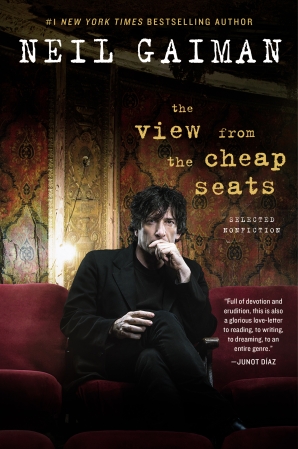
Microreview [book]: The View from the Cheap Seats by Neil Gaiman

A thoughtful collection of essays


Diana Wynne-Jones. Jack Kirby. Douglas Adams. These are just a few of the artists that Neil Gaiman lovingly tackles in the essays included within The View from the Cheap Seats—a fairly comprehensive (though it states “selected non-fiction”) of Gaiman’s nonfic work.

Divided into thematic sections that include essays on music, comic books, films, fairy tales, and more, the book feels mostly like a love letter to the things that Gaiman finds most wonderful about writing, reading, and taking part in the world. I’ve always loved Gaiman’s introductions to his own books, there’s a sense of humor, playfulness, and kindness always in the intros Gaiman weaves, and I thoroughly enjoyed seeing these same things applied to such a wide array of subjects.

Of course, that being said, I might be one of the perfect kinds of audiences for this collection—the people, texts, and subjects, that Gaiman writes about are some of the people, texts, and subjects, that have meant the most to me throughout my life. His essays on Diana Wynne-Jones (and on her book Dogsbody) made me tear up. His intro to Jim Steinmeyer’s Art and Artifice (one of the few Steinmeyer’s I hadn’t read or, really even heard of) made me go out and immediately order it. And that’s one of Gaiman’s greatest skills as a non-fiction author: he always sounds like he’s telling a story to a friend, he’s telling you about this book or author or piece of music that meant so much to him and he’s telling it in such a way that you have to believe him.

If there is a slight issue with the book, it’s a small one for me, it’s that occasionally some of the essays feel slightly repetitive—sometimes in subject matter, but also, often, in tone. Tone is what makes these essays individually so wonderful, but when reading bunches of them at once it can also feel less engaging as a whole.

Still, I’d highly recommend this to anyone interested in speculative genres (if you’re well read in the field—you’ll be reading excellent essays  about things you already know and love, if you’re less well read in the field then you’ll be reading about things you probably want to know and love), comic books, or, of course, Neil Gaiman’s work itself. These are often beautifully written essays that make one glad to be in a world of books and art.

The Math

Baseline Assessment: 9/10

Bonuses: +1 for the heartfelt odes to some truly great artists

Penalties: -1 for repetitiveness, -1 if you’re a Gaiman fan but not very into speculative fiction as a whole

Nerd Coefficient: 8/10 “
well worth your time and attention”


Reference: Gaiman, Neil. The View from the Cheap Seats [William Morrow, 2016]


POSTED BY: Chloe, speculative fiction fan in all forms, monster theorist, and Nerds of a Feather blogger since 2016.

Tuesday, April 12, 2016

STRANGER THAN FICTION: Merchants of Doubt, by Naomi Oreskes and Erik M. Conway

A true story of organized disinformation that takes on Shakespearean proportions


I have to preface this review by saying that when it comes to American politics, I am non-partisan - Ed.

Written by two science historians, Merchants of Doubt is a deeply unsettling account of the organized campaign against science in order to achieve political or financial gain that has been going on in the United States since the 1960s. It begins with the cigarette industry hiring former Manhattan Project physicists to cast doubt on the then-emerging scientific consensus that smoking causes cancer and other diseases, and the book continues through organized misinformation campaigns waged in favor of the Strategic Defense Initiative (a space-based anti-missile defense system dubbed "Star Wars" in the 1980s), against nuclear winter, acid rain, the hole in the ozone layer, the ban on DDT, and climate change. What all of these campaigns have in common are, a) the same cast of characters, chiefly retired government physicists, b) the same playbook, and c) their stunning effectiveness.

This is, flat-out, the most Orwellian true story I've ever read.

Through extensive (and boy do I mean extensive) research and citations, authors Naomi Oreskes and Erik M. Conway assembled essentially a timeline of scientific knowledge on each of these topics, and then chronicled the well-funded and strategically-orchestrated attempts to cast doubt on that knowledge by using an arsenal that included:
  • a pattern of bypassing the scientific peer-review process by taking spurious (or completely unfounded) scientific claims directly to the mass media
  • exploiting a residual media bias left over from the "Fairness Doctrine" to ensure coverage
  • accusing scientists of "politicizing" their findings (which is what the accusers were, in fact, doing themselves)
  • publicly asking incriminating questions whose answers were known in the scientific community but not by the lay public
  • accusing dissenting voices of being enemies of freedom
  • mounting ad hominem attacks on scientists whose work they could not discredit
The book details how, starting in the Reagan White House and continuing through every Republican administration since, the strategies established to confuse the public about the dangers of smoking have been employed to, increasingly, discredit science itself, and the idea that facts are superior to opinions in general. This was all done in the name of free market economics and making U.S. domestic policy more business friendly (read: de-regulated). If you really pull this thread, it becomes truly terrifying — and illuminating — to think how far the ripples from these stones have extended. Of course US students lag behind those of other developed nations — business interests have spent two generations working to show that science is a leftist, subversive attack on freedom. Of course an increasing number of Americans deny scientific knowledge in favor of religious explanations of natural phenomena — business interests have spent two generations equating scientists with "godless" communists. Of course the American public thinks there is still no scientific consensus on man-made climate change — business interests have spent two generations trying to confuse them.

I realize that this sounds like anti-GOP propaganda or a liberal agenda masquerading as science reporting. But that's kind of the point. That reaction is how we've been, for lack of a better word, programmed. Despite the extensive citations and references, I didn't want to believe that this book's argument was legit, so I did my own brief research before writing this review just to confirm that the reporting behind the book was sound, and it sure seems to be. I even wrote to the authors, and they wrote back. If there is a problem with this book, it is that some of the chapters are so dense with blow-by-blow chronologies of events, reports, review comments, internal memos, meeting minutes and the like that the read does get a little bogged down. But I think that level of minutiae was necessary to protect the book's contents from partisan attacks, as well as simply casual denials. "That can't be true. That strains credulity. No way that happened." But it did. And it's all proven.

Ok, so terrifying-dystopian-nightmare-is-actually-terrifying-reality. That's bad. But that's only one aspect of the book. If you think a little outside the lines — pull the thread a little bit, like I said before — and think about the guys behind these long cons, the story takes on epic, Shakespearean proportions on a human level. What would prompt decorated scientists who spent their entire careers working for the U.S. government to spend their retirement as consultants who actively undermined the very field that they had given their entire professional lives to? Well, money, sure. But I think it goes beyond that, and the authors do, too.

Some of these guys feel like classic villains in that they didn't receive the accolades they felt they deserved from the larger scientific community, so they took their revenge later by discrediting that community. Ok. But for the rest of them, they feel more like tragic heroes. These guys won the Cold War, and they did it with science. More than giving their lives to science, they gave it to Freedom. And once the Cold War was won by these men who were assuredly warriors, what was left to fight? I was reminded of Richard III, who opens his eponymous play saying that while others may enjoy the fruits of a hard-earned peace, he is not shaped for such pleasures, and "since I cannot prove a lover...I am determined to prove a villain." Late in Merchants of Doubt, we see specific examples of how, starting in the 1980s as actual communism loosened its grip on Europe, people began claiming that environmentalists were actually communists in disguise. They brought out the old saw of the "slippery slope," saying that anyone who wanted to regulate anything only did so out of a hidden, communist agenda. So the Cold Warriors went back to work. The sad irony is that their lasting legacy was one of undermining their own life's work.

But in Richard III, we see the comeuppance, the realization by the tragic figure of his own failure, and what it has cost. "My kingdom for a horse" has lived for four hundred years because audiences relish watching a man who has caused so much misery and bloodshed to possess power offer it all away for a horse. In reality, though, there was no comeuppance. These men (those who have now died) went to their graves wealthy, thinking they had fought the good fight. The ones left bleeding, shot full of arrows, were us.

The Math

Objective Quality: 7/10

Bonuses: +1 for the extensive research; +1 for the conclusion, which really puts a human face on what has come before; +2 for being a Really Important Book

Penalties: -1 for being quite tedious in parts; -1 for depressing the shit out of me

Nerd Coefficient: 9/10. This is essential reading.

Published by Vance K — cult film reviewer, occasional book reviewer, and co-editor of nerds of a feather, flock together since 2012.

Monday, July 14, 2014

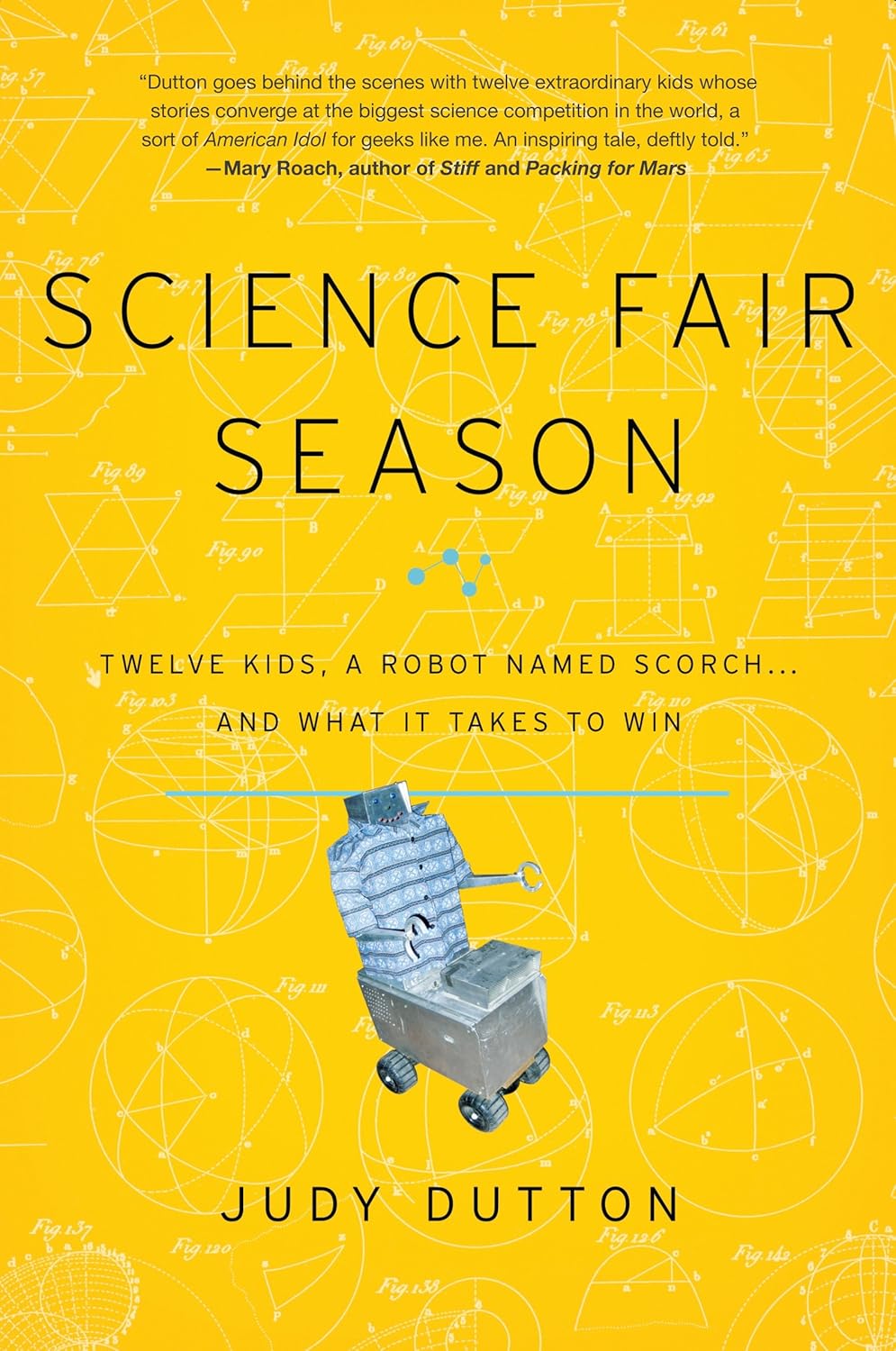
Microreview [book]: Science Fair Season by Judy Dutton

An Unexpectedly Emotional Peek Behind the Posterboard


Dutton, Judy. Science Fair Season [Hyperion, 2011]

This book was on my Summer Reading List I posted a few weeks back, and I think was actually the first book I ever bought for the Kindle after hearing a story about it on NPR after the book was released in 2011. I'm glad I finally got to it, because it was simultaneously exactly what I'd hoped it would be and yet something I had not expected.

Science Fair Season is a journalistic profile of a number of kids who competed in the 2009 Intel International Science and Engineering Fair (ISEF), and others who were either in their orbits or who had set precedents certain of these kids built upon. Lots of the summaries and press materials for this book talk about kids building nuclear reactors in their basements and creating flame-throwing robots. Those claims got me interested in the book in the first place, but they turn out to be either hyperbolic or amalgamations of different kids, which is a true shame, since I think the actual stories inside the book are far more compelling than the splashy blurbs they were shoehorned into on the book's covers. Author Judy Dutton interviewed and profiled kids who were among the 1502 competitors at the ISEF, digging into the paths that got them there, and where not only their projects, but their more fundamental involvement with the sciences, began. She then takes us to the competition itself, going into the presentations, the judging, and the awards ceremony, which has the power to utterly transform kids' lives.

And these kids, man. I was expecting to be blown away by their outsized smarts, but instead, I was consistently floored, humbled, and heartbroken by their spirit. So many of them came from unimaginable hardship — abuse, dire poverty, medical trauma, social dysfunction, or familial upheaval — and yet each of them found a way to be uniquely true to him- or herself and accomplish feats of astounding imagination and sweat equity. One of the few failings of Science Fair Season, however, is in seemingly biting off a little more than it can chew, in terms of the number of individuals profiled. There are multiple kids who have an entire chapter dedicated to them who get no follow-up. Even with a "Conclusion" chapter that ties up a few loose ends, not getting a little more about what happened to some of the people left out of that section was frustrating.

But more frustrating, and compelling, are the questions suggested in between the lines of all these kids' stories. Dutton does an extremely elegant job of bringing up larger social implications, trends, and failures without getting bogged down in these areas. Instead, the reader has to ask the next question, and ponder the implications of what is usually an ugly answer. For example: Several of the disadvantaged kids she profiles have no hope of attending college if they don't win/place/show at ISEF. This should be an outrage. We give so much lip-service to the idea that America needs to perform better in math and the sciences, and that we need more women in the STEM fields, and yet here, every year, is assembled a collection of the 1500 brightest young minds in those areas, many of them young women, and dozens of them will never be able to even attend college. It was five years ago Judy Dutton followed these kids around, and the introduction of abysmal Common Core teaching standards, the blossoming of the student debt crisis, the widening wealth gap, and the increase in the percentage of Americans living in poverty have all made the situation worse since then. As gut-wrenching as many of these kids' stories are, even more so is the knowledge that many kids just like them are tumbling headlong through the cracks — even kids that may have stood right alongside them at the nation's premiere high school science competition.

I feel like a miser for doing this last thing, but I have to point out how poorly edited this book is. I only bring it up because this is a) a book about science, and b) the product of a Big-Five publisher. I'm not a scientist, but I am a nerd and I know enough to understand that atomic nuclei don't have electrons, you don't need formal musical training to hear the difference between one three-note piano sequence and another, and to catch several other factual slip-ups throughout the book. In addition, the word "hypothesis" is consistently used incorrectly, which either the author or editor confused with the "Ask a Question" step in the Scientific Method, and with so many kids leaving high school for college in this book, the persistent use of the grammatically incorrect (and infuriating!) "graduated high school" instead of "graduated from high school" made me want to pull my hair out.

The Math

Objective Quality: 7/10

Bonuses: +1 for the tremendous emotional impact so many of Dutton's stories make; +1 for not romanticizing the social difficulties so many of these kids have as a result of their advanced intelligence or single-minded fixation on things like electricity or radiation; +1 for simply being here to shine a light onto this world and sub-culture in an accessible way

Penalties: -1 for failure to provide closure on some kids' stories; -1 for grammatical errors, factual errors, or a muddiness on how some of the science actually works

Nerd Coefficient: 8/10. We tend to be pretty tough with our scoring here, but this one gets a bump for its subject matter being particularly near and dear to our readership's heart.

Posted by — Vance K, reader of over-his-head books about quantum physics, unapologetic lover of terrible movies, and Nerds of a Feather contributor since 2012.

Wednesday, December 11, 2013

Microreview [book]: Rocket Science, edited by Ian Sales


The Meat

   As my recent reviews have amply attested, I have an almost instinctive dislike for anthologies. Analyzing my own knee-jerk dislike for the third time now, I've hit upon a new potential reason: I think the real problem is I don't really like short stories very much. After all, let's be honest—most short stories have, at their heart and core, either sub-par ideas which cannot sustain a novella or novel length treatment, or really clever ideas that should have been expanded into a novel. It's a rare story whose ideal (in the Leibnitz sense of the best of all possible worlds) length is just a few thousand words. I mean, that's only like three pictures!
   Maybe this resentment at the existence of short stories comes from the fact that by nature I personally am firmly in the "Why use 100 words to say something pithily when you could use 10,000 prettier ones to say it floridly?" camp. In other words, I am incapable of writing short stories; even simple ideas take so long for me to dress them up in description and hyperbole that they quickly become anything but short.
   However, I will certainly acknowledge the existence of a certain rare beast, that short story so cleverly done even I cannot imagine it any longer (or shorter, come to think of it!) than it is. A few of Philip K. Dick's stories, despite their inevitably atrocious titles, are like that: he sketches out a brilliant and intriguing idea, spins together a little story-meat to hang onto the idea-bones, and then poof! it's over, at least until it's made into a fantastic (Verhoeven's Total Recall, Scott's Blade Runner), acceptable (Tamahori's Next, Woo's Paycheck, Spielberg's Minority Report) or puzzlingly bad (the other Total Recall, A Scanner Darkly, etc.) movie.
   Yes, great short stories can haunt readers big-time with their pithy goodness. No less a literary giant than Edgar Allen Poe once famously said (or at least, someone once claimed to me that he said), no one should ever write anything longer than one can read in a single brief sitting. On the other hand, he was a creep-toid who married his thirteen year old first cousin, and I liked the novel inspired by his poem Annabel Lee way more than I liked anything actually written by Poe himself, so in that sense I'd say the score is People who Write Novels: 1, People who Write Short Stories/Marry Teenage Relatives: 0. Purloin that, Poe!
   This seems like as good a time as any to turn to Rocket Science, which I can say is unlike any other anthology I've ever read or even heard of, and I definitely mean that as a compliment. What surprised me was how much I enjoyed reading it, despite it being an anthology full of very short stories, and me with an instinctive dislike for both a) anthologies, and b) short stories. Some such stories are really excellent—I think editor Ian Sales got the volume started on exactly the right foot with the first story, Kimmel's multi-generational, whimsical romp through space which has a children's book about the moon as its timeless anchor. This is the sort of story that can recapture for all of us former children the sense of wonder we all must surely have felt at the thought of space flight or travel, or indeed space in general.
   Thematically, the anthology is strongly rooted in hard science (fiction), specifically space travel and the various logistical and other issues such travel has already raised or may raise in the future. With such a consistent theme, it avoids the most common pitfall ensnaring anthologies everywhere: having a loose, ill-defined generic theme that lacks cohesion (another way of saying "having an editor who isn't invested in the project or, for political reasons, can't or won't reject/demand heavy revision of the weirder or less thematically appropriate entries"). Some of the better-themed anthologies out there will refuse to limit themselves to a single genre, instead exploring ways the theme can maintain cohesion even across genres.
   But this anthology took the idea of a unifying theme to a whole new level, including—get ready for it—non-fiction articles as well! My goodness, I learned things about space and traveling in it, cold hard facts no less, from reading this book! How often can one say one genuinely learned something from one's ostensibly fluffy nighttime sci fi reading material? I am totally on board with this editing strategy—perhaps this will start a trend and we'll begin seeing more volumes that put the science back into science fiction, breaking down the Great Schism between 'fiction' and 'non' still further! I hope so.
   That said, a few of the non-fiction entries (especially the final one), while informative, read more like plugs for the author's own books and accomplishments than an attempt to explain to today's mindless youth some genuine problems humans already do and will continue to face in attempting space travel. This is another way of saying that a few, though by no means all (the one on radiation was great, for example), of the non-fiction pieces could have used more bells and whistles writing-wise and fewer self-promotional statements, which are doubtless to be expected in publications for the scientific community where precedence and name recognition are presumably of vital importance, but feel out of place in a volume like this.
   My only other gripe with the volume is my usual one: while some of the stories were perfect as is, several others felt like the fascinating beginnings of a longer story, ending just when things were getting interesting and readers began to form emotional bonds with characters. So, ultimately, I pose this challenge to all you short story writers and fans out there: how can you be certain that leaving a story in 'short' form is the best length? I have yet to hear a convincing argument in favor of short stories as a medium, and would instead suggest that most short stories are failures by virtue of their length—bring on the indignant responses! (And if you try to bring in Poe to support your "short stories are best" argument, keep in mind that you'll automatically lose tons of points because he was an incestuous weirdo.)

My new favorite short story (until now it was Hemingway's "For sale: baby shoes. Never worn.")

The Math

Baseline assessment: 6/10

Bonuses: +1 for having real gems like Kimmel's story (and editorially for leading off with it, making full use of the primacy effect), +1 for (mostly) seamlessly weaving non-fiction into the volume, +1 for having such a strong unifying theme

Penalties: -1 for being mostly (too) short stories, -1 for the self-promotion in some of the non-fiction (if I wanted to read about how awesome you are, brainiacs, I'd just read your articles in Nature or whatever!)

Nerd coefficient: 7/10   "an enjoyable experience, but not without its flaws"


See here why anyone could and should be proud of a 7/10 from us!