Showing posts with label C.L. Polk. Show all posts

Friday, July 17, 2026

Book Review: The Feywild Job by C. L. Polk

 A solid piece of D&D tie-in fiction; a missed chance for more

After the heights of 2nd- through 4th-edition Forgotten Realms tie-in fiction, where we got dozens of books across a quarter century, Wizards of the Coast seems to have gone into a bit of a lull in the setting over the decade since 5e bedded in (at least as far as characters not named Drizzt are concerned). That ‘90s TSR fiction is what I cut my fantasy nerd teeth on as a pre-teen and younger teenager; I have very fond memories of it. So I was pleased to see Wizards of the Coast return to tie-in fiction and return to a book set (at least partially) in the Realms. I was equally pleased to see they’ve tapped C. L. Polk, a writer with a great backlist, to write The Feywild Job.

The premise is that two pairs of adventurers are essentially blackmailed by a “client” into a reverse heist: steal a MacGuffin back from someone and return it to its proper place before anyone notices it’s gone. Each pair is led by half of an old duo of thieves—the warlock Saeldian and the bard Kell. That partnership fell apart a decade before the book started, when feelings started to develop between them. This was a problem for Saeldian’s warlock pact (the deal with an Archfey which gives him his powers), which requires him to never fall in love, so he walks out, and the next time he sees Kell is at the start of this heist. The two tagalongs are Kell’s orc druic companion Lorzok and Saeldian’s rogue companion Jubilee. This leads into a heist plot, a potential second-chance romance, and some very of-the-moment cozy-adjacent vibes.

A shift to cozy-adjacent romantasy might seem an odd choice for D&D tie-in fiction, but in a lot of ways I think it actually honours the tradition of the field. The heist-quest plot thread is absolutely classic TSR tie-in stuff. The point of tie-in fiction is at least in part to attract new audiences to the TTRPG product, and romantasy—and its audience—is a potential untapped market for WotC. And to dive into some deep lore, in fact one of the earliest examples of D&D tie-in was what we’d now call romantasy. A spinoff of the early ‘80s Endless Quest Choose Your Own Adventure books was 6 HeartQuest books. Before Drizzt, before the Dragonlance Chronicles, we had CYOA romantasy aimed at teenagers. So the choice of genre seems both perfectly judged for the current moment and a well judged nod to tradition.

And it all works quite well without being a total triumph. If I’d read this as a 13-year-old just realising he was queer at the height of TSR Forgotten Realms fiction, I’d have loved it. And it is a solid, largely well executed example of both a cozy romantasy and a piece of RPG tie-in fiction, but it isn’t more than that, either. I’d certainly put it in the top quartile of D&D fiction ever released, but with the greatest of respect, that isn’t the world’s most searching standard, and I don’t think it quite matches the absolute best of the old 2nd- to 4th-edition tie-ins (notably the best work of Erin Evans and Elaine Cunningham, for example). For the rest of the review I want to talk about why it reaches that upper quartile and why it also doesn’t, in my eyes, extend beyond solidly pretty good.

Polk is a technically excellent writer, and the prose in the book is very well done. A nice eye for imagery, a bit of personality to the narrative voice. One of the risks of D&D fiction is you can sometimes hear the dice rattling in the background, but the integration of spells, combat, and shared world elements is done seamlessly here—this may seem like damning with faint praise, but it really isn’t. It’s a key element of RPG tie-ins, and it is not often done as smoothly as Polk does it here. A number of the action set pieces are done very well, and the lick of horror imagery in the back half of the narrative is well judged and effective. Our non-binary lead in Saeldian is also written sympathetically and subtly. In a lot of ways The Feywild Job is a really good piece of writing in this genre.

But some of the bigger picture elements are not quite at the level of the sentence-by-sentence work. The major forward plot drive for the book is the heist element, and I really just wanted more of it: the planning, the traps, the complications. The first quarter of the book provides a bit of that, but for a book whose title creates an expectation for heist-heavy narrative, it was a little underdone. If you create the expectation, the reader (or I, at least), wants it to be fulfilled. What fills the narrative space not taken up by the heist is the second-chance romance plot between Saeldian and Kell, and unfortunately it doesn’t really compensate. For a romance of this type, understanding the nature of the first breakup, getting a good grasp on motivations and pining and missed opportunity is in my view essential to the whole thing working. And given the nature of that romance plot, the backstory is a little too thinly sketched to get the full effect. There are also a few misplaced details that just leave the break, and the level of bitterness being carried by both parties, feels a little contrived. Finally, for a book with four main cast members, the two leads’ companions are done a little dirty; both Lorzok and Jubilee have glimmers of real interest and very obvious possibility for more in Polk’s capable hands, but just don’t get the time or page space to be fully developed. The unrealised potential really does frustrate.

There is a place for 3-star fiction that doesn’t push—particularly when I was younger, I read a lot of it, I enjoyed a lot of it, and to a lesser degree I still do now. And The Feywild Job is firmly in that bracket. Perhaps because of the nature of tie-in fiction, perhaps because of the reasonably tropey cozy and romance elements, perhaps because of the combination between all of those and a moderately undercooked heist, it just doesn’t rise above it. It’s not a page count issue—it’s a reasonably typical length for this sort of book—but somehow it does seem to be trying to do a bit too much a bit too briefly.

Ultimately, if this is the quality of D&D tie-in we're going to get in the future, we should all be happy: it sets an enjoyable, highly competent standard. The Feywild Job is exactly what it needs to be. I just found myself the slightest bit disappointed it wasn’t more.

Highlights:

  • Well crafted prose and engaging imagery
  • Tie-in fiction which speaks to both tradition and the current moment
  • Just a whiff of missed opportunity

Nerd coefficient: 6/10.

Reference:  Polk, C. L. The Feywild Job [Random House Worlds, 2026].

POSTED BY: Eddie Clark. Professional nerd by day, amateur nerd by night. @dreddieclark.bsky.social

Wednesday, September 21, 2022

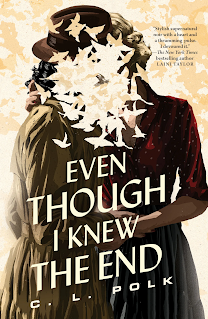
Nanoreviews: The Genesis of Misery, Even Though I Knew The End


The Genesis of Misery by Neon Yang (Tor Books)

As a huge fan of Neon Yang’s Tensorate novellas, I’ve been very eagerly awaiting this first novel from them and The Genesis of Misery does not disappoint, pulling together a whole bunch of worldbuilding elements that combine seamlessly into an outstanding action-y space read. There’s the Catholic religious vibes (the one liner for the novel is “Joan of Arc in space”); the ritualistic, authoritarian trappings of empire around that which call to mind Yoon Ha Lee’s Hexarchate or Ann Leckie’s Imperial Radch; and the giant sacred space robots and the battles between the Empire’s space robots and the forces of the rebel Heretics – smaller in number but able to engage in more novel formations thanks to said heresy. Add to that the plucky squad of variously damaged folks brought together around the promise of a bold new strategy – with a special shout-out to the haughty but hot space princess, initially out for her own political gain, forced to undergo a crash course in humility – and then, into the middle of it all, throw one (1) absolute mess of a human called Misery Nomaki. It’s a lot, but we’re in very safe hands with Yang’s storytelling, and the combination of Misery’s narrative voice and the regular interludes by a third party narrator make for a powerful prose combo.

There’s a lot of things I could pull out to talk about (and would, if this were a full length review), but what I love most about The Genesis of Misery is Misery themself. Misery’s journey has a lot of familiar storytelling beats, and yet the setting and their choices combine to make something that feels quite fresh, from the moment we meet them, on the run and apparently suffering from beginning of the same illness (voidmadness, aka another fantastic concept) which killed their mother, to their co-optation by elites within the empire who compel them to play the part of a prophet even when they are convinced they are a fraud, to the actual awakening of their powers and the impact this has on their religious beliefs and their role within the system that’s trying to use them. (As a side note, Misery uses she/they pronouns, with the book sticking mostly to having Misery call themself “she” in narration and everyone else use “they”. This definitely isn’t how all non binary folk use multiple pronouns, but it’s the first time I’ve seen a character depicted using more than one pronoun by choice at all, and that’s a long overdue thing). Misery’s journey in this first book of a trilogy doesn’t end up where I expected it to from the tropes at play here, but that makes me even more intrigued about what comes next, and I’m excited to see more of this world.


Even Though I Knew The End by C.L. Polk (Tor dot com Publishing)

Polk’s first published novella is a bittersweet gem of a noir fantasy romance. Set in the Chicago of the 1930s, in an urban fantasy setting where magic and demons exist alongside the more mundane monstrosities of human society, Even Though I Knew the End is the story of Helen, a jaded detective and former medium who gets pulled in for one last job, pushing herself through by thinking of the time she’ll get to spend with her lover afterwards. Helen knows this is her last job because ten years ago she sold her soul to a demon, in an exchange that felt worthwhile at the time, but now she only has three days left until her debt comes due. But her employer dangles a tantalising promise before her: use her three remaining days to catch the White City Vampire, a vicious serial killer, and her soul can be returned to her along with a tidy reward, letting her retire for real and live out the rest of her days with her darling Edith.

Like many good urban fantasies (historical or otherwise), Even When I Knew The End works because it blends its supernatural elements so effectively with the day to day business of being human. In Helen and Edith’s case, that means being queer women in love and living as part of a marginalised but quietly flourishing queer community, and Helen specifically deals with the disapproval and estrangement from her magical brother, who is still part of the Brotherhood which kicked her out when she lost her soul. Noir doesn’t need any supernatural elements to deliver the genre’s brand of horror, and while this story introduces us to angels and demons with plenty of convoluted, impenetrable motives, it also grounds Helen’s core decision – the choice to sell her soul, even knowing what it would mean for her a decade down the line – in an incident with such a mundane sense of tragedy and unfairness that it sets the whole story spinning around a real, recognisable emotional core. As to the ending, Even Though I Knew The End gives us a genre-compliant romance ending that nevertheless hits some of the most bittersweet notes of the whole narrative. It’s painful, beautiful and very fitting, and it caps off a novella that’s well worth checking out.

Adri (she/her), Nerds of a Feather co-editor, is a semi-aquatic migratory mammal most often found in the UK. She has many opinions about SFF books, and is also partial to gaming, baking, interacting with dogs, and Asian-style karaoke. Find her on Twitter at @adrijjy

Monday, November 15, 2021

The Subjective Chaos Kind of Awards: Results

Over the past almost-year, a top secret group of bloggers and fans has been plotting the most nefarious of plots: to decide, subjectively upon the best genre works of 2020, and then throw rocks at them. By "throw" we mean "lovingly post", and the rocks all have a nice message painted on them, and it's... an award? We suppose?

Yep, it must be time for Subjective Chaos Kind of Awards (SCKA) again!

SCKA last made an appearance on Nerds of a Feather at the longlist stage, when our team of epic jurors (including Adri and Sean) nominated their favourites across the seven categories. Since then, we've read furiously, narrowed each category down to a shortlist of two or three nominees, and then picked our favourite from among them. I'm therefore excited to introduce both our winners and other shortlisted works in this post: all are worthy of your consideration, so go and check them out!

Without further ado, the winners:

Best Short Story

Winner: "You Perfect, Broken Thing" by C.L. Clark (Uncanny Magazine Issue 32)

Our jury said: This is a story about an athlete competing in a Race which forces her to push her sick body to its limits to win a cure. There's a perfect blend of cameraderie between the main character and their training partners, and the desperate, unfair competition they are pushed into to survive; these are characters still fighting in the face of constant, overwhelming struggle and that's a powerful, challenging, necessary thing. 

Also Shortlisted: "Yellow and the Perception of Reality" by Maureen McHugh (Tor.com)

Adri says: These two stories rose to the top of a strong, wide-ranging ballot, but there was only ever one choice for me, and that was Clark's Ignyte winning story.

Best Novella

Winner:
The Empress of Salt and Fortune by Nghi Vo (Tor.com Publishing)

Our jury said: The Empress of Salt and Fortune is an epic tale in miniature: a mosaic of moments and manipulations that resolve into a bigger picture of rebellion

Also Shortlisted: Ring Shout by P. Djeli Clark (Tor.com Publishing)

Adri says: Our SCKA shortlists don't often overlap directly with the Hugo awards, but this pair happen to be the two I am agonising about most on that ballot too. Empress of Salt and Fortune is a well deserved winner, but this really could have gone either way.


Best Debut Novel

Winner: Legendborn by Tracy Deonn (Simon & Schuster)

Our jury said: With a young woman discovering magic at an elite school, Legendborn could have felt like we’d read it all before. Instead, the panel were impressed with how Deonn combined familiar tropes and well-known legends into something different, avoiding the obvious to deliver a tender exploration of grief and Black girl magic in a richly crafted world touching on slavery, privilege and secret societies.

Also Shortlisted: Cemetery Boys by Aiden Thomas (Swoon Reads); Raybearer by Jordan Ifueko (Hot Key Books)

Adri says: We ended up with three excellent books shortlisted from a very YA-heavy new category: I love all of these books, but Legendborn's smart, sideways take on a classic genre story set it apart.

Best Blurred Boundaries Novel

Winner: Mexican Gothic by Silvia Moreno-Garcia (Jo Fletcher Books)

Our jury said: This stylish thriller blends Gothic tropes with 50s noir and body horror. Expect modern themes of prejudice and complicity in an unapologetically creepy tale of controlling families and psychedelic fungus.

Also Shortlisted: Interior Chinatown by Charles Yu (Pantheon Books); The Bone Shard Daughter by Andrea Stewart (Orbit)

Adri says: Blurred boundaries is always a very diverse category, as "blurred" encompasses anything we think crosses lines of genre and/or style. Interior Chinatown was a great literary dark horse, and The Bone Shard Daughter brings really interesting SF elements into a fantasy setting, but it's ultimately fitting that ultra-talented genre-hopper Silvia Moreno-Garcia took this one in the end.

Best Fantasy Novel

Winners(!!)
The Once and Future Witches by Alix E. Harrow (Orbit); The Midnight Bargain by C.L. Polk (Erewhon)

Our jury said: Alix E. Harrow has crafted something truly special with The Once and Future Witches. Her prose is by turns powerful and deft of touch, and blends together fantasy, fairytale and history into a thoroughly modern classic.

The Midnight Bargain is not only a wonderful story about witches in a richly imagined Regency-style setting, but it’s a clever exploration of reproductive rights and bodily autonomy. It is a thoroughly modern and political book while masquerading as a gorgeous escapist fantasy, and that makes it a fantastic read.

Adri says: Two winners! Yep, we had a tie in our final round of voting, and while we could have gone to some sort of dramatic internal tiebreaker, instead we decided in true chaotic fashion to give out a second rock. This pair both utterly deserve it.

Best Science Fiction Novel

Winner:
The Space Between Worlds by Micaiah Johnson (Hodder & Staughton)

Our jury said: A beautiful intelligent story exploring the parallel worlds concept but also combining it with issues of racism and classism, with a core of hope running throughout.

Also Shortlisted: Goldilocks by Laura Lam

Adri says: One of my favourite things about SCKA is getting to focus on books that feel like they've been overlooked in the more mainstream awards, and both finalists here certainly fit that bill. The Space Between Worlds really pushed the envelope for me, an excellent dimension-hopping tale in a category full of space and cyberpunk and all sorts of sub-genres.

Best Series

Winner:
The Poppy War by R.F. Kuang (HarperVoyager)

Our jury said: R.F. Kuang's trilogy starts off as an academic fantasy, transforms into a military historical fantasy, and ends as a grimdark narrative. This Asian-inspired series delves into the layers and the consequences of power and warfare.

Also Shortlisted: Dominion of the Fallen by Aliette de Bodard

Adri says: Another powerful pairing - and another underrated gem, in de Bodard's Dominion of the fallen series - but in the end, it felt inevitable that The Poppy War was going to take this home. Brilliant, brilliant stuff.


Monday, March 15, 2021

New Books Spotlight: March 2021

Welcome to another (slightly belated) edition of the New Books Spotlight, where each month or so we curate a selection of 6 new and forthcoming books we find notable, interesting, and intriguing. It gives us the opportunity to shine a brief spotlight on some stuff we're itching to get our hands on.

What are you looking forward to? Anything you want to argue with us about?


Chambers, Becky. The Galaxy and the Ground Within [Harper Voyager]
Publisher's Description:
Return to the sprawling, Hugo Award-winning universe of the Galactic Commons to explore another corner of the cosmos—one often mentioned, but not yet explored—in this absorbing entry in the Wayfarers series, which blends heart-warming characters and imaginative adventure.

With no water, no air, and no native life, the planet Gora is unremarkable. The only thing it has going for it is a chance proximity to more popular worlds, making it a decent stopover for ships traveling between the wormholes that keep the Galactic Commons connected. If deep space is a highway, Gora is just your average truck stop.

At the Five-Hop One-Stop, long-haul spacers can stretch their legs (if they have legs, that is), and get fuel, transit permits, and assorted supplies. The Five-Hop is run by an enterprising alien and her sometimes helpful child, who work hard to provide a little piece of home to everyone passing through.

When a freak technological failure halts all traffic to and from Gora, three strangers—all different species with different aims—are thrown together at the Five-Hop. Grounded, with nothing to do but wait, the trio—an exiled artist with an appointment to keep, a cargo runner at a personal crossroads, and a mysterious individual doing her best to help those on the fringes—are compelled to confront where they’ve been, where they might go, and what they are, or could be, to each other.
Why We Want It: Chambers has said this will be the final Wayfarers novel and we can't pass up one last opportunity to visit this galaxy full of very different people trying to do right by each other.


Gailey, Sarah. The Echo Wife [Tor]
Publisher's Description:
I’m embarrassed, still, by how long it took me to notice. Everything was right there in the open, right there in front of me, but it still took me so long to see the person I had married.

It took me so long to hate him.


Martine is a genetically cloned replica made from Evelyn Caldwell’s award-winning research. She’s patient and gentle and obedient. She’s everything Evelyn swore she’d never be.

And she’s having an affair with Evelyn’s husband. Now, the cheating bastard is dead, and both Caldwell wives have a mess to clean up.

Good thing Evelyn Caldwell is used to getting her hands dirty.
Why We Want It: Well, first and foremost, it's Sarah Gailey. It's also one of the best sci fi thriller concepts I've seen in years. Did I mention that it's Sarah Gailey? There's no way we'd be passing this one up.


Martine, Arkady. A Desolation Called Peace [Tor]
Publisher's Description:
A Desolation Called Peace is the spectacular space opera sequel to Arkady Martine's genre-reinventing, Hugo Award-winning debut, A Memory Called Empire.

An alien armada lurks on the edges of Teixcalaanli space. No one can communicate with it, no one can destroy it, and Fleet Captain Nine Hibiscus is running out of options.

In a desperate attempt at diplomacy with the mysterious invaders, the fleet captain has sent for a diplomatic envoy. Now Mahit Dzmare and Three Seagrass—still reeling from the recent upheaval in the Empire—face the impossible task of trying to communicate with a hostile entity.

Their failure will guarantee millions of deaths in an endless war. Their success might prevent Teixcalaan’s destruction—and allow the empire to continue its rapacious expansion.

Or it might create something far stranger . . .
Why We Want It: A Memory Called Empire was an incredible debut (see Adri's review), winning the Hugo Award for Best Novel - it's a significant science fiction novel that will be read for years. There was a larger story set up in that first novel, plus the hope that Martine could write a follow up that lived up to the promise of A Memory Called Empire. Spoilers, it does. Adri has reviewed A Desolation Called Peace here and I've read it as well. It's excellent.


Polk, C.L. Soulstar [Tor.com Publishing]
Publisher's Description:
With Soulstar, C. L. Polk concludes her riveting Kingston Cycle, a whirlwind of magic, politics, romance, and intrigue that began with the World Fantasy Award-winning Witchmark. Assassinations, deadly storms, and long-lost love haunt the pages of this thrilling final volume.

For years, Robin Thorpe has kept her head down, staying among her people in the Riverside neighborhood and hiding the magic that would have her imprisoned by the state. But when Grace Hensley comes knocking on Clan Thorpe’s door, Robin’s days of hiding are at an end. As freed witches flood the streets of Kingston, scrambling to reintegrate with a kingdom that destroyed their lives, Robin begins to plot a course that will ensure a freer, juster Aeland. At the same time, she has to face her long-bottled feelings for the childhood love that vanished into an asylum twenty years ago.

Can Robin find happiness among the rising tides of revolution? Can Kingston survive the blizzards that threaten, the desperate monarchy, and the birth throes of democracy? Find out as the Kingston Cycle comes to an end.
Why We Want It: After Stormsong, we'll follow Polk anywhere (and Witchmark was pretty darn good as well!) and Robin's story is one we're excited to read.


Wagers, K.B. Out Past the Stars [Orbit]
Publisher's Description:
Gunrunner empress Hail Bristol must navigate alien politics and deadly plots to prevent an interspecies war, in the explosive finale to the Farian War space opera trilogy.

When Hail finally confronts the Farian gods, she makes a stunning discovery. There are no gods—only the Hiervet, an alien race with devastating powers who once spread war throughout the galaxy long before humanity’s ancestors crawled out of the sludge of Earth’s oceans.

But this knowledge carries with it dire news: the Hiervet have returned, eager to take revenge on those of their kind who escaped. And they don’t care who gets caught in the middle of the battle—Shen, Farian, or Indranan.

Once again, the fate of the galaxy is on the line and Hail will have to make one final gamble to leverage chaos into peace.
Why We Want It: Wagers is a particular favorite of several of our writers and we have adored her Indranan War and Farian War novels. Out Past the Stars wraps up the story of Hail Bristol. We've been following Hail since Behind the Throne and this has been a killer series.


Yu, E. Lily. On Fragile Waves [Erewhon]
Publisher's Description:
The haunting story of a family of dreamers and tale-tellers looking for home in an unwelcoming world.

Firuzeh and her brother Nour are children of fire, born in an Afghanistan fractured by war. When their parents, their Atay and Abay, decide to leave, they spin fairy tales of their destination, the mythical land and opportunities of Australia.

As the family journeys from Pakistan to Indonesia to Nauru, heading toward a hope of home, they must rely on fragile and temporary shelters, strangers both mercenary and kind, and friends who vanish as quickly as they’re found.

When they arrive in Australia, what seemed like a stable shore gives way to treacherous currents. Neighbors, classmates, and the government seek their own ends, indifferent to the family’s fate. For Firuzeh, her fantasy worlds provide some relief, but as her family and home splinter, she must surface from these imaginings and find a new way.

This exquisite and unusual magic realist debut, told in intensely lyrical prose by an award winning author, traces one girl’s migration from war to peace, loss to loss, home to home.
Why We Want It: On the strength of "The Cartographer Wasps and the Anarchist Bees" Yu won the John W. Campbell Award (now Astounding) for Best New Writer back in 2012 and we've been reading her ever since. We're particularly excited to read her debut novel.


POSTED BY: Joe Sherry - Co-editor of Nerds of a Feather, 4x Hugo Award Finalist for Best Fanzine. Minnesotan. He / Him.

Monday, January 4, 2021

Top 9 Books of the Year

Some people do a top ten list, others do a top eleven (insert your outdated Spinal Tap joke here), some may go shorter, though I don't understand those people. My list is 9 books long. Why? Partly to be a little bit different and partly because I want the tenth spot on my list to be reserved for that really great book which I simply did not get the chance to read during 2020. That really great book may also be something I have only heard whispers about and I may not discover for several more years. Whatever that tenth great book is, I’m holding a spot for it on my list.

Also, there is no doubt that this list, like every other list out there is built entirely on the combination of the books I've actually read with my own prejudices, taste, preferences, and the choices I made when selecting books to read across the breadth of 2020. That's really what we're saying when we say we've put together a list of the "Best Books of the Year". It's the best we've read, the best we can remember, the best based on what we appreciate in speculative fiction. One of the other best books I've read this year is Louise Erdrich's latest novel The Night Watchman, but this is a speculative fiction blog focusing on more nerdy endeavors, so for the sake of theme I'll limit this list to science fiction, fantasy, and everything in between and around the edges.

Most years I think I stay fairly well on top of the genre and will read most of the significant novels of the year. I'll miss some, of course, but granting my abovementioned prejudices, taste, preferences, and choices - on the whole, I know the shape of the year and there's usually only a handful of books that I wanted to read that I didn't get to before it comes time to make this list. 

This is obvious, but 2020 has not been a typical year in any stretch of the imagination and for numerous reasons I've missed out on a whole lot of really exciting novels which I do still absolutely plan to read next year - but I can only consider those books which I've actually read. Keeping reading after the list for a brief discussion of the stuff I missed out on. Remember that open tenth spot? 

This Top Nine List is more or less in order. The top two slots are a complete lock, but ask me tomorrow and some titles may shift around a bit. The order you see below is not the order in which I started this article. Whichever order the list is in, these are the nine novels published in 2020 which I feel were the strongest titles of the year.


1. The City We Became
: I find it difficult to write about The City We Became without talking about N.K. Jemisin's previous novels even though they have absolutely nothing to do with The City We Became, but that's because the explosive excellence of her Broken Earth trilogy set a level of expectation that I was legitimately anxious that The City We Became would not be able to live up to. It was an impossible task that was only relieved by this novel being just about as different from those historic novels as can be - but the thing is that N.K. Jemisin is writing at the top of her game and while my apprehensions were founded because how the hell do you follow The Broken Earth, the answer is - with this. 

The City We Became is the personification of New York City writ large, a city being born into something greater and distinct beyond just being a significant city(which is a concept I absolutely adore) and Jemisin turns the whole thing into a cosmic battle that is absolutely intense and raw and everything I didn't know that I wanted from a novel. This was an absolutely incredible experience. Adri reviewed The City We Became earlier in the year and thought highly of it, but I absolutely loved it. I don't think that's because I had a childhood on Staten Island and Adri did not, but you never know. Also, having a childhood on Staten Island would not make me the hero of this book so perhaps I won't lean too much onto that connection.


2. Harrow the Ninth
: Gideon the Ninth was an impossible debut, bold and astounding and groundbreaking and, as Adri put it in her review, "the queer NecRomantic murder mystery you've been missing all your life". It was just about as spectacular a debut as a writer could have and Tamsyn Muir could have ridden the coattails of that novel and given readers more of the same. Even granting the ending, Gideon's voice was so singular and so iconic that to move away from it would be unthinkable. And yet, Harrow the Ninth does exactly that and throws everything you think you know from Gideon the Ninth in question. Frankly, its maddening. It is also flawlessly accomplished. 

The scope of what Tamsyn Muir attempts and achieves in Harrow the Ninth is staggering, which is why I'd like to quote Adri's review of Harrow to conclude. Muir spends at least half of Harrow on a knife edge and a single slip would invite disappointing failure. Muir's hand is steady.

"And that's the real big question, with a book this dense and complex and self-contradictory: is Muir going to pull it off? In a word: fuck yes. It's that payoff to a deeply ambitious structure that really puts Harrow over the top, even when compared to its juicy but more classically-plotted predecessor; it takes serious talent to turn part of your sequel into a nonsensical retcon of the events of the previous book without completely losing your audience, let alone to turn that retcon into a vital strand of the plot and a vehicle for character growth in its own right. Even when it's refusing to take itself and its own genre seriously on the surface, every twist in Harrow's tale draws the audience deeper into its terrifying, ridiculous, mystical world and the people within it. This is a rare series that lives up to its hype and then some, and Harrow the Ninth one of the best books I've ever read."


3. Savage Legion
: I've written at various lengths about Matt Wallace's Sin du Jour series of gonzo-culinary urban fantasy novellas (here's my review of the final volume, Taste of Wrath, with links to the previous six). While I'm going to talk about Savage Legion a bit here, I can't help but to make my strongest recommendation to go find a copy Envy of Angels, starting reading, and thank me later. But we're not here to talk about Sin du Jour (well, you're not. I'm always here to talk about Sin du Jour). We're here to talk about Savage Legion - Matt Wallace's epic fantasy debut, a twist in the concept of what Epic Fantasy (capital letters) does and can do within the framework of the sub genre. We're here to talk about why it's so friggin good. 

Paul Weimer wrote about Savage Legion back in June (which feels like two lifetimes ago) and does a great job covering the scope of what Wallace is working with here. Weimer writes, "the novel is a much more complicated and inventive novel than the title, cover and promotional matter led me and might lead you to believe. There are potent themes here that Wallace is exploring, the writer’s ambition to write a story that talks about some fundamental and difficult subjects, even in a secondary world setting far removed from our own, is done with verve, nuance and burgeoning skill. The role and power of the poor in society. Oppression, control of news and information, and endless war. The horror of war, environmental degradation, resource extraction and the uses of power. It’s a heady cocktail that Wallace plays with. It’s even more impressive with the savage and bloody battle scenes, the slice of life character moments, and the nuanced relationships that develop between various characters in the novel. While I am annoyed and call out again the novel is not what it seems to be, the action sequences are top notch, pulse pounding, and excellently done, a real highlight of the book."
 
While I acknowledge Paul's point that the promotion of the book focused on Evie's storyline of forcibly joining the legion and the novel is so much more, but I do not share his annoyance with that fact because I've never expected Matt Wallace to just tell a simple story of pulse pounding action. Matt Wallace doesn't write simple. Of course, far be it for me to complain about someone else taking issue with a book's promotion given my own history.  The point, of course, is not about the promotion of Savage Legion, successful as it may have been in drawing Paul and I towards the novel. 

The point is that everything about Savage Legion kicks ass. Yes, the action scenes which are specifically written to kick ass do, in fact, kick ass. Wallace writes action like nobody's business. But it is Wallace's deft treatment and handling of the socio-political in this novel which really sings. Everything is vibrant and rich and immediate. It's not that you can't look away, it's that you don't want to. Savage Legion is a fucking accomplishment.


4. Unconquerable Sun
: These days Kate Elliott is most known for her epic fantasy novels - Crossroads, Spiritwalker, Crown of Stars, Black Wolves, and Court of Fives. Unconquerable Sun is a return to her science fiction roots - though like a good space opera it does read in some ways like epic fantasy in space (which, I think, it is an entirely separate essay and conversation). Given the high concept of "gender-bent Alexander the Great in spaaaace", that works remarkably well. High concepts and elevator pitches are nice and fun, but at least for me it's all about the execution and my trust in the writer. I have nothing but trust in Kate Elliott and she has earned every bit of it. Unconquerable Sun nails the whole thing. 

Other than having once seen Oliver Stone's Alexander movie starring Colin Farrel and having forgotten just about everything in that movie, I don't know the story of Alexander the Great. It's just a name, a half forgotten legend. It doesn't matter. Kate Elliott may be using that as the framework, but it shouldn't be considered a barrier to entry. Unconquerable Sun is a science fiction epic, a story of family and high political plotting and drama. It's a novel of ambition, both Sun's and of the author's. Kate Elliott doesn't reach for the stars, she lives there and Unconquerable Sun shines as brightly as can be. 

If you don't believe (which you should), perhaps check out Paul's review of the novel. He mentions one bit of Elliott's worldbuilding which might be my favorite bit of this wonderful novel, "her use of the idea of Channel Idol. How does one try and come up with an interstellar idea of Arete (excellence) in a way to mirror Alexander’s rise to power, fame and reputation? Easy. Create an interstellar network of news and entertainment called Idol. Add in a Eurovision like contest called Idol Faire." It's a side bit of shade and color to the novel, but it is so well constructed it feels as natural as it anything else.


5. The Ministry for the Future
: This is the first novel on the list that I've previously written about, so I'm going to crib from myself while talking about it. 

"It may be a stretch to call The Ministry for the Future the last major novel of Kim Stanley Robinson, though I listened to an interview with Robinson where he did suggest this may be exactly that because he was changing his novel writing focus after the intensive work to put together this novel and the last several. If so, The Ministry for the Future is one heck of a way to close out this chapter of his career.

Though it begins with absolute horror, The Ministry for the Future is ultimate a hopeful novel. Robinson looks hard at our present and pushes towards the global, societal, ecological, and economical catastrophes that are looming and makes them happen. Then, he offers hope for how humanity could (and arguably must) transform our cultures to tackle the very real climate breakdowns that are occurring. This isn't much of a spoiler to say that it would require a fundamental change to human culture and that there will be some nations (the United States, say) who lag behind in effective response.

The Ministry for the Future is an impressive work of imagination and prognostication. It offers a road map that we are unlikely to take until things are too late, but then that is not much different from the path taken in the novel."
 
One point which I'd like to rehash a bit is the idea that The Ministry for the Future is a significant work of imagination and a major and important novel. As big as Kim Stanley Robinson is within the field of science fiction, I believe his work has ranging impact in the wider world. While I'm not sure the extent of Robinson's impact, he is very effective in shining a light on the consequences of our collective actions and to propose a way forward.  He's also a heck of a storyteller. If you don't believe me, maybe Barack Obama's opinion carries a little more weight.


6. A Pale Light in the Black
: In just four years K.B. Wagers has become one of my favorite science fiction storytellers. They have published five books in the Indranan and Farian War series (so far!) and I was surprised that A Pale Light in the Black came out before The Farian War was complete, but any (brief) hesitation I might have about starting a new series from a favorite author was gone on the first page. Oh. Right. I'm in good hands and on comfortable ground. 
 
More than anything else, A Pale Light in the Black is fun. There is heady, serious science fiction that wants to teach you a lesson while telling a story (this is not a knock, look back at my thoughts on The Ministry for the Future) and that science fiction is great (told you). There is also room for the science fiction that takes your hand and pulls you along on a romp of a ride, thrilling you at every turn. Some do it with epic space battles an others do it with a fabulous cast of characters you want to be friends with and follow along on any of their adventures, whether it is drinking with your crew in the bar or participating an an intra-service military skills competition. A Pale Light in the Black is the second kind and is a pure friggin delight to read from start to finish. 

By now I've pretty much ceded the reviewing of K.B. Wagers' novels to Paul. He's done a bang up job and, frankly, he's far more prolific and consistent of a review than I can hope to be right now. As such, this would be an excellent time to check out his review of A Pale Light in the Black

What I think I appreciate most about A Pale Light in the Black is *who* the book is focused on. The Near Earth Orbital Guard. NEO-G. It's the Coast Guard in space, which is just about perfect. They, like the actual U.S. Coast Guard perform an incredibly important mission and are highly skilled professionals who save lives. They, like the actual U.S. Coast Guard are often looked down upon as being a lesser branch of the military (which is wrong and incorrect, they have a particular mission and perform it with excellence, but the idea remains - I also wrote that previous sentence the week the new Space Force were announced to be Guardians, so we'll see how that condescension shakes out). So when it comes to the Boarding Games, the aforementioned military competition, the NEO-G team has a lot of somethings to prove. 

I've also gotten this far without mentioning Jenks, the most delightful damn character I've read this year, which is why we've got Paul taking point on the reviews.


7. Stormsong
: Witchmark was one of the quietly buzziest debuts of 2018, which sounds absurd on the face of it but (at least from my perspective) the story of Witchmark built and built until it was one of the most significant novels of the year. In the end, Witchmark was a World Fantasy Award winner and a Nebula Award finalist, among others. I described Witchmark as "a lovely novel and excellent debut" and I stand by that. It was excellent, but it is also a novel that has been slightly diminished in my estimation by the passage of time. I admit, I may be one of the only readers to have had that reaction given how beloved a novel it was and the award recognition it received. 
 
Then came Stormsong, a novel which exceeded any expectation I had. Everything Witchmark did well (which was a lot) Stormsong did better. Plus, it added a more than heavy dose of political intrigue to go with the top notch interpersonal relationships C.L. Polk crushed in Witchmark. But what Polk does so exceptionally in Stormsong is the melding of the political with the personal - which, I suppose is what politics can be, the personal writ large. 

Stormsong is exceptional storytelling. The smoothness and the naturalness of Polk's storytelling in Stormsong is an absolute wonder.


8. Architects of Memory: Each year has several prominent debut novels and, generally, two or three or them are likely to make my list of favorites. Architects of Memory was one of my more anticipated debuts and I'm quite happy that it live up to the anticipation. I may not have been able to read all of the books (debuts or otherwise) I wanted to this year, but the ones I did were quite good. I'm not the only one who thinks so. Sean Dowie wrote about Architects of Memory back in October and had this to say:

"The most singular talent of Architects of Memory is finding a new bent on a space opera story—a genre that’s been well-trodden so thoroughly and covered in footprints that it can seem impossible to find a patch of your own. And while Karen Osborne does steps on patches that have been stepped on by seemingly every sci-fi author, there are idiosyncrasies to characters and twists regarding alien life that more than make it fresh. While characterization isn’t at the top of the novel’s mind, it does do a much-more-than-serviceable job of establishing believable motivations and ample depth to keep you caring.

But the greatest joy of Architects of Memory lies in its plot and the themes they develop. Whether it tackles individuality and collectivity, the belligerent survival instincts of humanity, or relationships in secrecy, it lays the foundation for those themes and builds upon them, never leaving them underdeveloped along the way. The most intriguing theme is how memory is so tied up with our sense of self. We’re a collection of the knowledge we accrue and the relationships we build, but without memory, those things slip through our fingers like sand. Love can change from everlasting to a brief sensation. Familial bonds that we preoccupy ourselves with if the world around us is rotten becomes lost if our memory – our personal storage locker that tethers all our meaning – is gone.  

Space operas can sometimes be so unwilling to take risks and stray from conventions that they’re forgettable. Stories that have edifying substance don’t matter if they immediately leave our memory. The best way to counteract that is to have original characters, and hard-hitting themes despite how well-trodden some story beats are. Architects of Memory does that. Its craft, emotional intelligence, and smooth writing style work to create a gem that will be at the top of my mind for a long time."


9. The Relentless Moon
: One thing I appreciate about Mary Robinette Kowal's science fiction is that it is ultimately optimistic. If I may be excused the pun, and even if not, I might suggest that her science fiction is relentlessly optimistic. Sure, the Lady Astronaut series began with a meteorite crashing into and devastating the Earth, but each of the novels have been about problem solving and a belief that the seemingly insurmountable is something that - with enough science, ingenuity, and hard work - can actually be overcome. To quote myself, The Relentless Moon is "about striving towards excellence and truly building a better tomorrow even in the face of a devastating future."

With The Relentless Moon, Kowal moves past the focus of Elma York of the first two Lady Astronaut novels, away from the race first into space and then Mars. Kowal brings the focus to the Moon (it's in the title, after all). The focus is on the moon, but also on the challenges of Earth. Not everyone is satisfied (let alone happy) about the existence of the space program and the diverted resources that could be better used to recover from the meteorite. That's the deepest core of the novel. 
 
To further quote myself, 
 
"There's a lot going on in The Relentless Moon and Kowal keeps everything moving and flowing together with remarkable deftness and an underlying compassion that smooths the edges off even the harshest aspects of the novel - including Nicole's eating disorder, racial issues, domestic terrorism, and a desperate fight for survival on the Moon. Everything is handled with sensitivity, though Kowal does not shy away from the emotion of the worst moments - it's more that Kowal is such a smooth writer that the reader is in safe hands. The novel leans into the pain, but with a light touch.

The Relentless Moon is more than the pain, of course. I am very much not the first to appreciate the generally healthy marriages in the Lady Astronaut novels, but reading about a relationship where both partners support each other and recognize the sacrifices they make to achieve goals and just build each other up is absolutely refreshing. Equally refreshing, especially perhaps when reading this novel during a pandemic, is that science is celebrated and problems are typically solved by smart people working very hard to come up with a solution. To paraphrase both Mark Watney (The Martian) and Vanilla Ice: if they have a problem, yo they'll solve it by sciencing the shit out of it. That's delightful. It's also important. There is violence in The Relentless Moon, but it is mostly off stage. The struggle is that of science, engineering, imagination, and decency. This novel, like the two Lady Astronaut novels before it, is about striving towards excellence and truly building a better tomorrow even in the face of a devastating future. The Relentless Moon is hopeful science fiction, and that's something worth celebrating - especially when it's this good."

 
As I mentioned in the introduction, for as many books as I read in a year, there is always something amazing that I missed and that I just didn't have time to get to. Or, as plugged in as I try to be, that I just haven't heard of (or heard enough about). As much as I wanted to, I did not read Black Sun (Rebecca Roanhorse), The Burning God (R.F. Kuang), Ring Shout (P. Djeli Clark), Network Effect (Martha Wells), Elatsoe (Darcie Little Badger), The Once and Future Witches (Alix E. Harrow), Piranesi (Susanna Clarke), Mexican Gothic (Silvia Moreno-Garcia), Machine (Elizabeth Bear), Axiom's End (Lindsay Ellis), A Deadly Education (Naomi Novik), The Angel of Crows (Katherine Addison), among others. The list of highly recommend and presumably stellar novels that I just didn't get to read this year is long and distinguished. That's the reason for the tenth spot on the list.
 

POSTED BY: Joe Sherry - Co-editor of Nerds of a Feather, 4x Hugo Award Finalist for Best Fanzine. Minnesotan. He / Him.

Wednesday, November 11, 2020

Microreview [book]: The Midnight Bargain by C.L. Polk

Combining magic, romance, intercultural politics and the struggle against patriarchy, The Midnight Bargain is a delight from start to finish

Beatrice Clayborn is a woman with plans. As a woman from a high-class family in the highly patriarchal society of Chasland, she is expected to spend her first "Bargaining Season" attending dances, handing out her card to eligible suitors, entertaining callers and finally settling down with a man who is comfortable trading her talent for sorcery for the financial resources to get her family out of crippling debt. It's a deal that will secure her family's future and ensure that her sister can benefit from the finishing school education she couldn't afford, but there's one problem: for Beatrice to marry, as a woman with magical abilities, means that she will have to give up her magical powers, putting on a warding collar throughout what her husband deems to be her childbearing years in order to prevent her from being attacked by spirits during a pregnancy. Beatrice has far more attachment to her magic than to a future as someone's wife, and if she can only find the text she needs for a specific ritual, she can call a greater spirit into herself and become both powerful and unmarriagable: a combination that will offer her freedom to help her family in her own way.

What Beatrice hasn't reckoned on is the arrival of the Lavan siblings, both attending this Bargaining Season from the more powerful neighbouring country of Llanadras. Ysbeta Lavan quickly establishes herself as a rival to Beatrice's scholarly knowledge, before establishing that she has the same goal: escaping a politically convenient marriage to one of Chasland's most eligible elites. Her brother, Ianthe, establishes himself as an obstacle of a rather different kind, because he's smoking hot and totally amazing and it's not long before the two are rather hopelessly in love. Ianthe offers the chance at marriage in relatively more egalitarian Llanadras, where Beatrice could still practice minor magic but not call a greater spirit and train as a sorceress, and the Lavan's wealth means it would support her family as well. Of course, if that were actually a solution to Beatrice's real problems, we wouldn't be reading a book about it, and thus begins a romance that's as much about the growth of the individuals involved as it is about their growing together.

The Midnight Bargain benefits from an absolutely delightful setting, with a plot that breezes by in a whirl of regency intrigue. Over the course of her season, Beatrice encounters dances, card parties, picnics, chance meetings at bookshops, symbolic greenhouse conversations with prospective parents-in-law, heated debates in carriages and over breakfast, and even a fabulous boat party, with each set piece given exactly the time it needs to unfold and advance the plot while leaving plenty of time to enjoy each one. Of course, the patriarchal nature of Chaslander society is always on display, and every charming, witty conversation or clever use of feminine wiles comes with an edge: this is a society which burns alive women who give birth without shutting themselves off from magic, after all. Beatrice never loses sight of the game she's playing, in which she's expected to balance the number of men she encourages to chase her until she can strike the best possible deal and get smoothly handed off from father to husband. It's a tricky balance even before factoring in the danger of her attempts to escape the system entirely, or the occasional murder attempt by a jilted suitor, or the fulfilment of bargains made to Nadi, the luck spirit Beatrice invokes to help her in her quest. Beatrice's multiple competing dilemmas and the constant novelty of the scene changes kept me thoroughly hooked on The Midnight Bargain, without ever being overwhelmed or weighed down with the amount of drama it threw at me.

It helps, of course, that Beatrice is a very easy protagonist to love. This being, at heart, an m/f romance, the relationship between Beatrice and Ianthe just about edges out everyone else in terms of screentime, and that's no bad thing: Ianthe is perhaps a little too willing to let go of his ingrained cultural biases about the role of women, but I can't dispute that not being an ass about Beatrice's ambition makes him far more enjoyable to spend time with. Much of the worldbuilding of The Midnight Bargain is built on its portrayal of the different cultures of Chasland and Llanandras, with the cultural power very much held by the latter.  Unlike Chasland, where women are expected to have as many children as possible and sorceresses therefore need to wear warding collars from marriage to menopause, Llanandras allows women to plan their families and only ward themselves while pregnant or trying for children. The assumption of cultural superiority underpins the Lavan siblings' interactions with Beatrice, particularly when her feelings for Ianthe begin to conflict with her desire to pursue magic. For Ianthe, learning to respect Beatrice means interrogating his biases about the role of women in his own culture, and to take her ambition and talent seriously, and he rises to the challenge brilliantly, bringing several more juicy plot twists along the way.

Ianthe isn't the only important relationship in Beatrice's life: her growing friendship and trust with Ysbeta is just as important, as the two learn to work towards their mutual goal. Ysbeta's relationship with Beatrice is also shaped by her assumptions about the superiority of her own culture, and also by her judgement of Beatrice's sexuality: it's not outright stated in the text, but it's pretty explicit that Ysbeta is aromantic, and she finds it impossible to believe that Beatrice wouldn't be better off abandoning her magical dreams even as she pursues the same goal. Ysbeta is a wonderful character and her chemistry with Beatrice is just as good as Ianthe's (until the reveal of her sexuality, I was open to this becoming a poly romance, but it was not to be). The only point at which her characterisation falls down is a spoilery late book scene, which hinges on withholding key information and a point of distrust between Ysbeta and her brother at a point when it felt like their character arcs should have moved past that point. It's a key moment to setup the book's climax, but it was the only point where I felt that The Midnight Bargain's character arcs were at odds with what its intricate plot was demanding of them at that moment.

I could go on for days about the other wonderful characters and moments in this book: aside from the main trio, there's also Beatrice's novel-reading, political-game-playing sister Harriet, her quietly supportive mother, the cast of other ingenues and men in the bargaining season who are pursuing various agendas of their own, and of course her difficult, patriarchal father, who fails to take seriously any of Beatrice's attempts to bring him into her plans for her own future. There's also Beatrice's relationship with Nadi, the luck spirit she initially conjures to help her through a dangerously high-stakes card party, and then continues to work with throughout the book, through whom the majority of the book's magical component is conducted. Nadi and Beatrice's relationship both deepens and challenges our understanding of the spirit bonds which form the heart of The Midnight Bargain's magic system, offering a counterpoint to the universally held assumption that sorcerers must control and dominate the spirits they work with for the bond to be effective. It is also, like everything else in this treasure of a book, an absolute delight.

And that's my main takeaway from The Midnight Bargain: this is just a delightful book, from start to finish, in a way that balances intrigue, incisiveness, drama and flights of fancy to create a reading experience that was pure enjoyment for me. If you're looking for any of the above, in a magical period romance setting, you really can't go wrong with this book.

The Math

Baseline Score: 8/10

Bonuses:  +1 Everything about this book just made my heart very happy. If that's not worth a point, nothing is.

Penalties: Nothing, it is too fun to take things away

Nerd Coefficient: 9/10


POSTED BY: Adri, Nerds of a Feather co-editor, is a semi-aquatic migratory mammal most often found in the UK. She has many opinions about SFF books, and is also partial to gaming, baking, interacting with dogs, and Asian-style karaoke. Find her on Twitter at @adrijjy

Reference: Polk, C.L. The Midnight Bargain [Erewhon, 2020]

Friday, October 30, 2020

New Books Spotlight

Welcome to another edition of the New Books Spotlight, where each month or so we curate a selection of 6 new and forthcoming books we find notable, interesting, and intriguing. It gives us the opportunity to shine a brief spotlight on some stuff we're itching to get our hands on.

What are you looking forward to? Anything you want to argue with us about? 


Harrow, Alix E. The Once and Future Witches [Orbit]
Publisher's Description

In the late 1800s, three sisters use witchcraft to change the course of history in Alix E. Harrow’s powerful novel of magic and the suffragette movement.

In 1893, there’s no such thing as witches. There used to be, in the wild, dark days before the burnings began, but now witching is nothing but tidy charms and nursery rhymes. If the modern woman wants any measure of power, she must find it at the ballot box.

But when the Eastwood sisters — James Juniper, Agnes Amaranth, and Beatrice Belladonna — join the suffragists of New Salem, they begin to pursue the forgotten words and ways that might turn the women’s movement into the witch’s movement. Stalked by shadows and sickness, hunted by forces who will not suffer a witch to vote — and perhaps not even to live — the sisters will need to delve into the oldest magics, draw new alliances, and heal the bond between them if they want to survive.

There’s no such thing as witches. But there will be.

An homage to the indomitable power and persistence of women, The Once and Future Witches reimagines stories of revolution, sapphic love, motherhood, and women’s suffrage–the lost ways are calling.

Why We Want It: When she wrote her breakout Hugo Award winning story "A Witch's Guide to Escape" Harrow dealt with both witches and portal fantasies. Her debut novel was all portal fantasy. This, her second, returns to witches. That's more anecdotal than anything, but interests me all the same. The real reason we're excited for The Once and Future Witches is because her previous novel, The Ten Thousand Doors of January was fucking excellent and we'll read anything she writes. 


Kuang, R.F. The Burning God [Harper Voyager]
Publisher's Description

The exciting end to The Poppy War trilogy, R. F. Kuang’s acclaimed, award-winning epic fantasy that combines the history of twentieth-century China with a gripping world of gods and monsters, to devastating, enthralling effect.

After saving her nation of Nikan from foreign invaders and battling the evil Empress Su Daji in a brutal civil war, Fang Runin was betrayed by allies and left for dead.

Despite her losses, Rin hasn’t given up on those for whom she has sacrificed so much—the people of the southern provinces and especially Tikany, the village that is her home. Returning to her roots, Rin meets difficult challenges—and unexpected opportunities. While her new allies in the Southern Coalition leadership are sly and untrustworthy, Rin quickly realizes that the real power in Nikan lies with the millions of common people who thirst for vengeance and revere her as a goddess of salvation.

Backed by the masses and her Southern Army, Rin will use every weapon to defeat the Dragon Republic, the colonizing Hesperians, and all who threaten the sh
amanic arts and their practitioners. As her power and influence grows, though, will she be strong enough to resist the Phoenix’s intoxicating voice urging her to burn the world and everything in it?

Why We Want It: Let's face, we're gluttons for punishment and want our hearts stomped repeatedly. Lucky for us, we have R.F. Kuang to do exactly that because the first two Poppy War novels have been brutal and perfect bits of epic fantasy filled with betrayal and incredible personal sacrifice. There's no way this ends well for any of the characters and we wouldn't have it any other way.

Lethem, Jonathan. The Arrest [Harper Collins]
Publisher's Description

From the award-winning author of The Feral Detective and Motherless Brooklyn comes an utterly original post-collapse yarn about two siblings, the man that came between them, and a nuclear-powered super car.

The Arrest isn’t post-apocalypse. It isn’t a dystopia. It isn’t a utopia. It’s just what happens when much of what we take for granted—cars, guns, computers, and airplanes, for starters—quits working. . . .

Before the Arrest, Sandy Duplessis had a reasonably good life as a screenwriter in L.A. An old college friend and writing partner, the charismatic and malicious Peter Todbaum, had become one of the most powerful men in Hollywood. That didn’t hurt.

Now, post-Arrest, nothing is what it was. Sandy, who calls himself Journeyman, has landed in rural Maine. There he assists the butcher and delivers the food grown by his sister, Maddy, at her organic farm. But then Todbaum shows up in an extraordinary vehicle: a retrofitted tunnel-digger powered by a nuclear reactor. Todbaum has spent the Arrest smashing his way across a fragmented and phantasmagorical United States, trailing enmities all the way. Plopping back into the siblings’ life with his usual odious panache, his motives are entirely unclear. Can it be that Todbaum wants to produce one more extravaganza? Whatever he’s up to, it may fall to Journeyman to stop him.

Written with unrepentant joy and shot through with just the right amount of contemporary dread, The Arrest is speculative fiction at its absolute finest.

Why We Want It: The description from the publisher is a touch pretentious because, really, fuck you about this not being post apocalyptic or dystopic when technology stops working. That's exactly the tradition Lethem is working with and he damn well knows it, regardless of how the the publisher wants to market the novel. I haven't read Lethem in thirteen years since the incredibly disappointing You Don't Love Me Yet - but his earliest work was inventive and exciting even as he slid farther away from genre while still touching its edges. Regardless of what the publisher wants to call The Arrest, it's the sort of thing I like to read.


Muir, Tamsyn. Princess Floralinda and the Forty Flight Tower [Subterranean]
Publisher's Description

When the witch built the forty-flight tower, she made very sure to do the whole thing properly. Each flight contains a dreadful monster, ranging from a diamond-scaled dragon to a pack of slavering goblins. Should a prince battle his way to the top, he will be rewarded with a golden sword—and the lovely Princess Floralinda.

But no prince has managed to conquer the first flight yet, let alone get to the fortieth.

In fact, the supply of fresh princes seems to have quite dried up.

And winter is closing in on Floralinda…
Why We Want It: Taking a pause between Harrow the Ninth and the forthcoming Alecto the Ninth, Tamsyn Muir has a shorter and completely unrelated work. I'm not familiar with her short fiction before Muir exploded on the scene with Gideon the Ninth - but I'm excited to see what else Muir can do.


Polk. C.L. The Midnight Bargain [Erewhon]
Publisher's Description

From the beloved World Fantasy Award-winning author of Witchmark comes The Midnight Bargain, a sweeping, romantic new fantasy set in a world reminiscent of Regency England, where women’s magic is taken from them when they marry. A sorceress must balance her desire to become the first great female magician against her duty to her family.

Beatrice Clayborn is a sorceress who practices magic in secret, terrified of the day she will be locked into a marital collar that will cut off her powers to protect her unborn children. She dreams of becoming a full-fledged Magus and pursuing magic as her calling as men do, but her family has staked everything to equip her for Bargaining Season, when young men and women of means descend upon the city to negotiate the best marriages. The Clayborns are in severe debt, and only she can save them, by securing an advantageous match before their creditors come calling.

In a stroke of luck, Beatrice finds a grimoire that contains the key to becoming a Magus, but before she can purchase it, a rival sorceress swindles the book right out of her hands. Beatrice summons a spirit to help her get it back, but her new ally exacts a price: Beatrice’s first kiss . . . with her adversary’s brother, the handsome, compassionate, and fabulously wealthy Ianthe Lavan.

The more Beatrice is entangled with the Lavan siblings, the harder her decision becomes: If she casts the spell to become a Magus, she will devastate her family and lose the only man to ever see her for who she is; but if she marries—even for love—she will sacrifice her magic, her identity, and her dreams. But how can she choose just one, knowing she will forever
regret the path not taken?
Why We Want It: I'm not as familiar with C.L. Polk's fiction as I'd like to be, but Witchmark was superb, I have Stormsong on deck at home and I remember a long time ago she wrote several episodes of Shadow Unit. Shadow Unit, mind you, is one of my favorite things - which doesn't have a lot to do with the fiction she's written since Witchmark, but it built up an immense amount of goodwill on my part. The Midnight Bargain is also one of the first books published by Erewhon Books, the imprint founded by Liz Gorinsky (Hugo Award winning editor) - it's a pairing I don't want to miss.


Sanderson, Brandon. Rhythm of War [Tor]
Publisher's Description

The Stormlight Archive saga continues in Rhythm of War, the eagerly awaited sequel to Brandon Sanderson's #1 New York Times bestselling Oathbringer, from an epic fantasy writer at the top of his game.

After forming a coalition of human resistance against the enemy invasion, Dalinar Kholin and his Knights Radiant have spent a year fighting a protracted, brutal war. Neither side has gained an advantage, and the threat of a betrayal by Dalinar’s crafty ally Taravangian looms over every strategic move.
Now, as new technological discoveries by Navani Kholin’s scholars begin to change the face of the war, the enemy prepares a bold and dangerous operation. The arms race that follows will challenge the very core of the Radiant ideals, and potentially reveal the secrets of the ancient tower that was once the heart of their strength.

At the same time that Kaladin Stormblessed must come to grips with his changing role within the Knights Radiant, his Windrunners face their own problem: As more and more deadly enemy Fused awaken to wage war, no more honorspren are willing to bond with humans to increase the number of Radiants. Adolin and Shallan must lead
the coalition’s envoy to the honorspren stronghold of Lasting Integrity and either convince the spren to join the cause against the evil god Odium, or personally face the storm of failure.
Why We Want It: The Stormlight Archive is Brandon Sanderson's Magnum Opus, a ten volume series likely spanning decades of work even if we don't consider the other tangentially related  Cosmere based novels that will bring the total upwards of thirty. This is doorstopper fantasy and Sanderson is the truest successor to Robert Jordan's Wheel of Time that we are likely to come across, for everything that entails.


POSTED BY: Joe Sherry - Co-editor of Nerds of a Feather, 4x Hugo Award Finalist for Best Fanzine. Minnesotan. He / Him.