Showing posts with label Sci-Fi TV. Show all posts

Monday, July 7, 2025

Rebellions Are Built on Hope: Andor S2E10

In season two, I never expected to become such a fan of Luthen and Kleya.

With an intense stare, Luthen fixes his wig in the mirror. He's richly dressed, with a large ring on his hand.

In some ways, episode nine is the end of Andor season two in that it wraps up the Ghorman plotline and Cassian’s arc with Bix and his dedication to the rebellion. In the final three episodes, the season pivots to align with Rogue One and present the characters we expect to see in the movie (and wrap up the loose ends of the ones we don’t). While not as smooth a storytelling experience as season one, episode ten is an intense story that stands alone to show the beginning and end of Luthen and Kleya’s relationship. 

In “Make It Stop,” Kleya and Luthen prepare to meet Lonni (Robert Emms), their inside person at the ISB. This type of meeting has become even riskier after Mon Mothma’s speech a year ago. Back then, Cassian had urged Luthen to leave Coruscant because it was only a matter of time before the ISB found him, but Luthen has held on for another year. Even he recognizes the risk as he says to Kleya: “I think we used up all the perfect.”

When Luthen meets with Lonni, the plan that was revealed by Krennic in episode one becomes clear to Luthen. The energy program was a lie to obscure building the Death Star. Lonni was able to find this information by breaking into Dedra Meero’s files. Unfortunately for Lonni, Luthen’s dedication to the cause means Lonni cannot walk away with this information, and Luthen leaves him dead.

After Luthen walks away, the next shot is sideways, showing how this information has repositioned his worldview. Now, all that matters is that someone is able to deliver the information to the Rebel Alliance—but Lonni revealed to Luthen that Dedra is going to target him very soon.

Luthen leaves out Lonni’s warning about Dedra’s impending raid when he gives Kleya the information about the weapon and the engineer, Galen Erso. In a rare protective moment, Luthen insists Kleya leave with the information while he returns to the shop to burn their comms, knowing Dedra might arrive—and that she does. 

Watching Dedra and Luthen finally meet was a scene we’d all been waiting for and had a level of intensity that had me literally at the edge of my seat. After the violence of Ghorman and the espionage surrounding Mothma’s speech, this moment of doublespeak where they both, for a few seconds, play at not knowing the other, was a different kind of intensity. 

Luthen resumes his role one last time as the rare artifact salesman for the wealthy as Dedra walks in, claiming she has an artifact to sell him. At first, they test each other, such as when Dedra asks if everything is “real” and Luthen states there are only two pieces of “questionable provenance,” which is of course a reference to them standing there, but Dedra ends their conversation by revealing the Imperial starpath unit that had originally brought Luthen and Cassian together. Luthen knows this is the end for him, and Dedra revels in the moment, producing a memorable exchange between fascist and anti-fascist:

Dedra: “You disgust me.”

Luthen: “You want to know why?”

Dedra: “Everything you stand for.” 

Luthen: “Freedom scares you.”

He goes on to say one of my favorite lines from Luthen: “The rebellion isn’t here anymore. It’s flown away. It’s everywhere now. There’s a whole galaxy out there waiting to disgust you.”

While Luthen has quite the bodycount to his name, one reason he’s good at what he does is because he is not exempt from this same violence. In order to take his secrets with him, he stabs himself. At this moment, the episode turns, and the second half focuses on Kleya as she realizes she must make sure Luthen dies. 

The second half of the episode is interspersed with flashbacks, including when Kleya and Luthen first meet. In a parallel to Cassian, Luthen rescues Kleya from another genocide committed by the Empire. He is complicit in this genocide as a Sergeant, his radio calling out the acts of violence being committed outside the ship he is currently hiding in: people are ordered to stand against a wall, followed by blaster fire and screaming. Other orders demonstrate the mass killing. It’s never made clear what planet this genocide is happening on, but it parallels Ghorman and Cassian’s planet of Kenari, where there are so few survivors. 

As Kleya prepares to infiltrate the hospital where Luthen is being kept alive by a machine, the flashbacks show them fencing antiquities and observing Imperial atrocities. At first, young Kleya, radicalized by genocide, is frustrated with their progress, but the more senior Luthen helps her keep from burning up in her rage: “We fight to win. That means we lose, and lose and lose and lose, until we’re ready. All you know now is how much you hate. You bank that. You hide that. You keep it alive until you know what to do with it.”
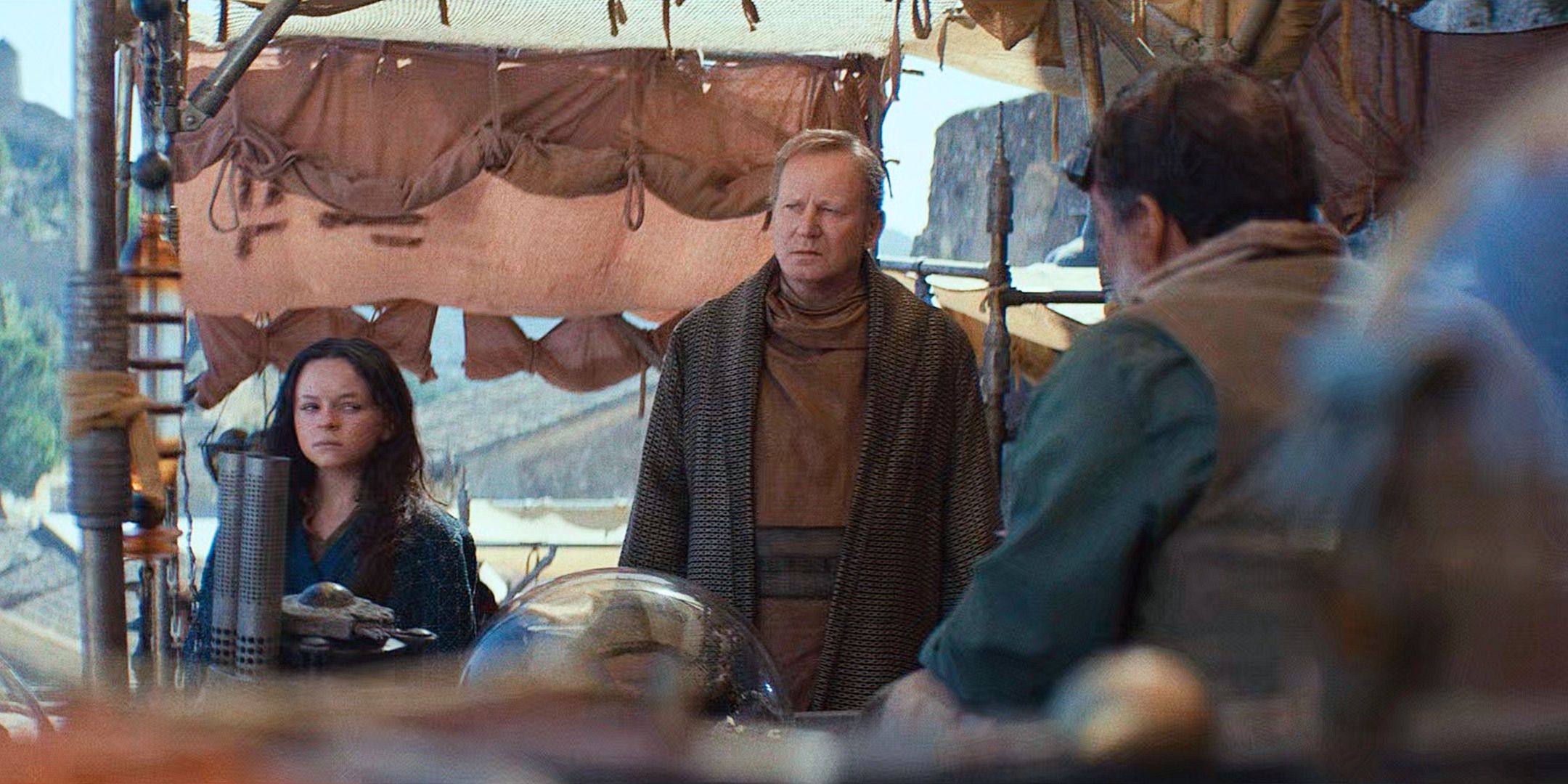
A young child with long hair, Kleya, stands next to the ruggedly dressed Luthen as they try to sell an item at a market on a sunny day.

Even as a child, Luthen doesn’t call Kleya his daughter, and throughout the show, while there is care in their relationship, they appear more as partners than familial. Yet, Kleya’s careful mask comes down as she murders her way into the ISB-controlled hospital wing and reaches Luthen’s bedside. Without hesitation, she releases the machine keeping Luthen alive, but she does allow herself a brief show of affection before she hurries out, escaping back to the Coruscant hideout with the information about the building of the Death Star. 

While most of the episode is focused on Kleya and Luthen, Dedra is in the process of learning an important lesson about fascism—they eat their own. As Robert Evans and his co-hosts on It Could Happen Here point out in their breakdown of episodes 10-12, Dedra is a parallel of the spunky cop who breaks a few rules to take down the big bad, but Andor reveals the copoganda of this type of figure through Dedra, who is not someone we root for but rather a fascist who committed genocide. Dedra is arrested by the ISB even though she’s finally completed her longtime mission to capture Axis. She's worked hard to achieve this moment, but rather than be rewarded, she's immediately arrested by a man who used to be her underling and is now put in a position of power over her. She cannot breakthrough the fascist patriarchy even though she is a believer in their ideology.  

The episode’s final shot is a slow fade to black of Luthen’s body. Without him, it’s questionable if Yavin would have existed, and certainly, Cassian wouldn’t have joined the rebellion. While Luthen is not the most sympathetic character, he does dedicate everything to the cause, as he points out in his monologue to Lonni in episode ten of season one: “I’ve given up all chance at inner peace. […] I’m damned for what I do.” 

In perhaps a less dramatic tone, activist Dean Spade puts it this way: “Do I want to be in the fight until I die, even though I don’t know how it’s going to turn out? Because that’s how everyone who has fought for liberation had to BE. It’s being with the uncertainty. Part of that, for me, is shifting our sense of ourselves from some good outcome that can definitely happen towards just the pleasure of being with each other in the struggle.”

Many characters exhibit this sense of purpose, and the show demonstrates multiple ways of living in this moment, from Luthen’s loss of inner peace to Maarva’s speech at the end of season one where she describes how she’d live her life differently, declaring, “Fight the empire!” Luthen and Kleya are one of these paths, and the show makes few judgements about the different paths or tools to fight the Empire, but what it is important is that dedication to the fight.

--

POSTED BY: Phoebe Wagner (she/they) is an author, editor, and academic writing and living at the intersection of speculative fiction and environmentalism.

Monday, June 9, 2025

Rebellions Are Built on Hope: Andor S2E6

As things heat up on Ghorman, episode six provides an important look into Luthen's character.

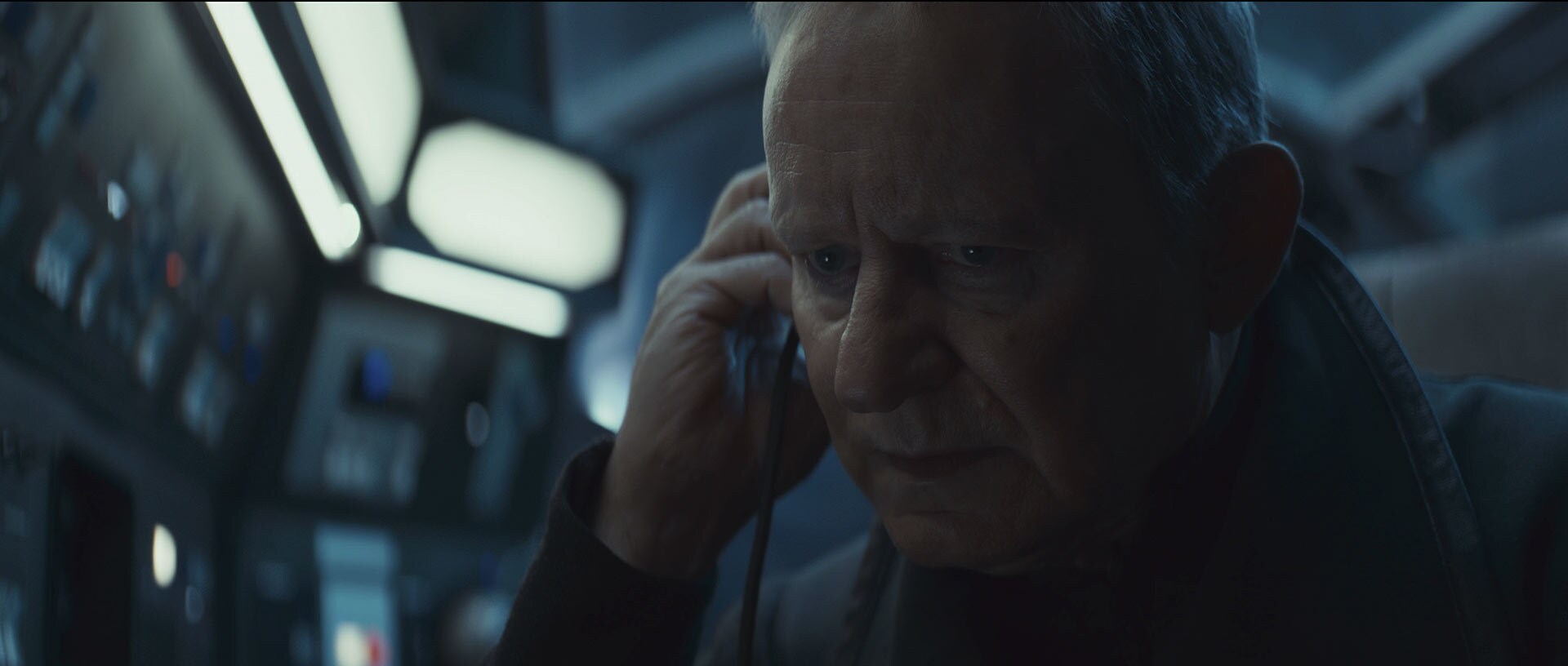
a close up of Luthen's face--an older man with gray hair--as he listens to a listening device. Behind him in dull blues and silvers is a blurry space ship interior.

Episode six, “What a Festive Evening” marks the end of the second small arc out of four. The next arc is, arguably, the most important of the show and a high point in U.S. television. While this episode does not contain the gravitas of the next three episodes, it still has an important job of showcasing that Luthen’s ability as a leader is rarely rooted in kindness or empathy.  

Luthen picks up Cassian still disguised as a fashion designer after his interview with the Ghorman Front, but he’s surprised and disappointed when Cassian says to not be involved: “They started too late, now they’re rushing.” Luthen pushes back, which leads to one of the great exchanges that starts to shift Cassian’s thinking:

Cassian: “I’m thinking like a soldier.”
Luthen: “Think like a leader.”

With Luthen, Cassian obeys orders. He doesn’t think beyond that. He goes where he’s told and completes missions with great success. In order to become the Cassian of Rogue One, though, that will have to change. In season one, Cassian goes from a-political thief to becoming part of Luthen’s team determined to defeat the Empire at any cost. In season two, he needs to become the leader able to inspire a group of rebels to sacrifice themselves to deliver the Death Star plans. This exchange with Luthen begins to mark that change in Cassian. 

But, Luthen doesn’t listen to Cassian. On Ghorman, Vel (Faye Marsay) has now arrived, unbeknownst to Cassian. She’ll be working with her former lover from the Aldhani heist, Cinta (Varada Sethu). Vel told Luthen she’d only take the job if Cinta were on it. Their love rekindles, and they both realize that it is Luthen keeping them apart. Much like Luthen’s meddling with Cassian and Bix’s relationship, Vel says that she and Cinta are worth more to him apart than together. To Luthen, they are tools in his mission to destroy the Empire at any cost—not to support them as full human beings.

Together, Vel and Cinta try to teach the untested Ghorman Front how to run an operation. While the Ghormans chafe under their orders, they agree to work together and do as they’re told, including remaining unarmed. At first, the heist to steal the secret imperial weapons—organized by Syril to trap the Ghorman—goes smoothly, until one of the Ghorman, Lezine from the townhall, arrives and wants to know what’s going on. Another Ghorman pulls a gun on him, a struggle ensues, and ultimately Cassian’s prediction comes true. They weren’t ready. They didn’t follow orders and brought a gun when only Vel and Cinta were supposed to be armed. 

The gun goes off—and Cinta dies.

As they escape with Lezine carrying Cinta’s body and Vel struggling to contain her emotions, she says one of the great lines of season two. To the young rebel who accidentally shot Cinta and is now breaking down into tears, she says: “This is on you now. This is like skin.”

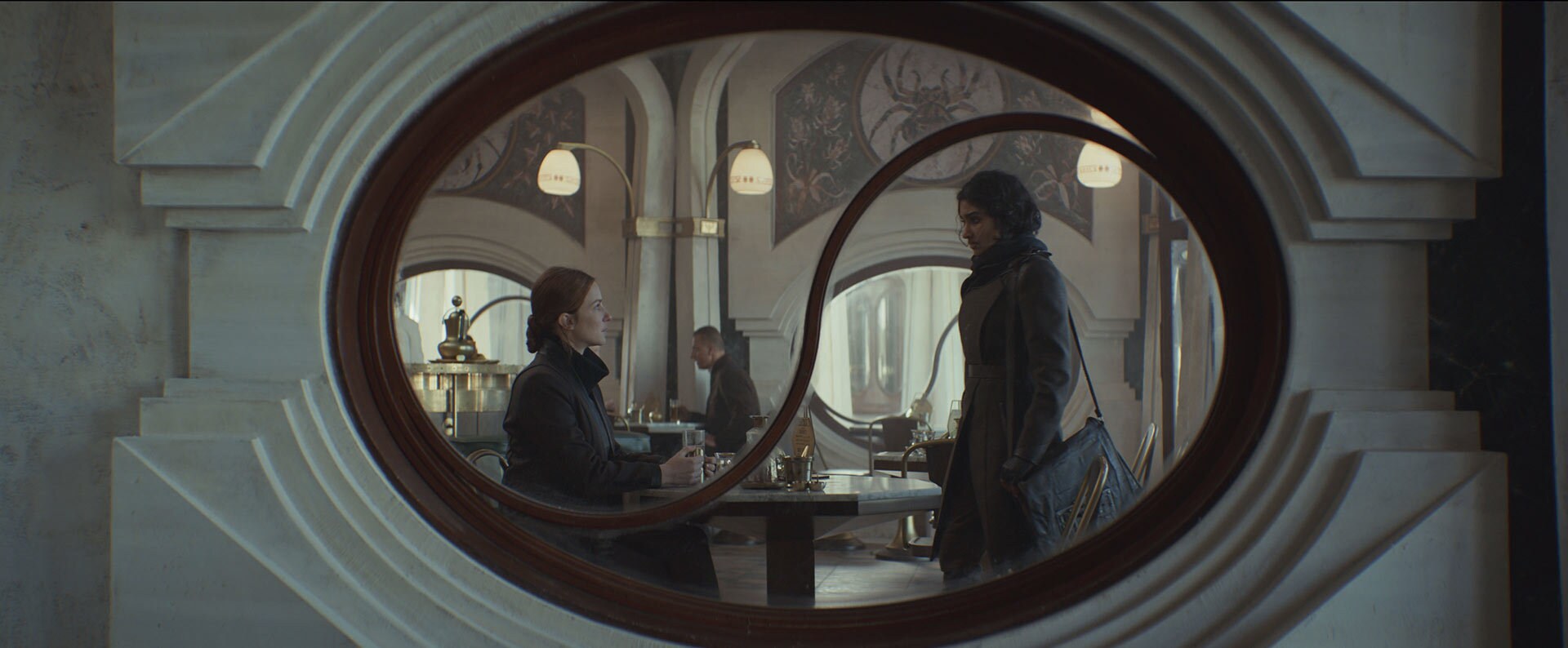
Vel and Cinta face each other in a fancy tea shop. Vel is sitting a table while Cinta stands before her.

Meanwhile, Luthen and Kleya have their own problems as a listening device they planted in an antique in Davo Sculden’s home is about to be discovered. They get dressed up and party with the Imperial officers and politicians, including Mon Mothma and Director Orson Krennic. In one of the standout performances of the episode, Kleya must sneakily remove the bug right in front of Krennic. Much like this whole three-episode arc, this party sequence leans into Tony Gilroy’s previous work on spy films. As the tension rises, though, we also get to see two incredible actors traded barbs from opposite sides of the aisle as Mothma needles Krennic. She greets him immediately with: “How pleasant to see you free of the witness stand,” which prompts the snarky back and forth. 

While Mothma is unaware that Kleya is trying to remove a listening device, the rising tension between her and Krennic is the perfect cover for Kleya, leading to one of Krennic’s great lines: “My rebel is your terrorist, something like that.” Of course, this is the great irony of watching any Star Wars property in the twenty-first century. The actions the “good guy” rebels take are what the U.S. government would label as acts of terrorism (this is especially clear in Rogue One where Saw Gerrera’s forces are dressed to look West Asian). While many commentators have made this connection between rebel/terrorist in the past, Andor including it so openly in the dialogue continues to build the antifascist narrative as clearly as possible.

The episode ends on two high notes. As Luthen and Kleya walk out, they joke that they should have offed Krennic at the party, which, considering all the pain that Krennic and his Death Star cause, is a darkly funny moment. Additionally, the episode ends with a delightful moment of revenge. Luthen sends Bix on a mission to kill the man who tortured her. We learn earlier in the episode that his method of torture was so successful that the Emperor wanted to expand it—but Bix gets there first. She puts him in the chair and leaves him to the same torture he put her through. On the way out, Cassian blows up the building as they walk away in an epic shot. One of my favorite small details about that moment is, on the soundtrack, Nicholas Britell titled that track “The Bix Is Back.”

While this trilogy of episodes doesn’t end on the high note of “Harvest” in the first arc, it does set up the viewer for some of the best television I’ve seen in years—perhaps some of the best storytelling Star Wars has to offer. Importantly, we see Luthen beginning to crack. While he’s been effective in building the rebellion in the early stages, as it continues to grow and face opposition, he and Kleya struggle, even leading him to say to her: “We’re drowning.” He’s never been the comforting type to Cassian or Bix, but as he struggles to defeat the Empire at any cost, the people under him suffer. 

But even so, the rebellion is growing and spreading….


POSTED BY: Phoebe Wagner (she/they) is an author, editor, and academic writing and living at the intersection of speculative fiction and environmentalism.
Monday, August 19, 2024

TV Review: Scavengers Reign

 Hopefully the move from Max to Netflix will help this fantastic series find a broader audience

Scavengers Reign is an animated sci-fi series (very much) for adults that sets up a great premise, then unfurls its surprises judiciously, dispenses its violence suddenly and shockingly, and episode-by-episode, earns its emotional pay-offs. 

When the colony ship Demeter is forced to crash land on the planet Vesta, the crew members rush into escape pods. But upon landing, they find themselves distributed across the planet’s surface, with no way to communicate with one another. With no way of knowing if any other crew members survived the crash, Azi and her robot Levi (a pair), Sam and Ursula (a pair), and Kamen (on his own) each make the decision to try to make their way back to the Demeter. Not only does it seem like the only way to survive and possibly get off of this planet, but there is also a shipload of colonists in cryosleep on board.

But the thing about Vesta is that it’s crawling with flora and fauna — and all of it, if it considers human space travelers at all, considers them food. Or worse…hosts.

Azi and Levi work well together, but when some spores get into Levi, the robot begins changing — and, profoundly. Where will this hyper-speed evolution end? Kamen, wracked with guilt over something that happened on the ship, and experiencing increasingly material hallucinations of his wife, makes a cuddly friend. But Kamen, blinded by these hallucinations, misses some…warning signs, let’s say. Sam, the oldest member of the crew, seems like he might hold Ursula back, until something about Vesta begins agreeing with his constitution. But when his ability and drive tips toward the superhuman, alarm bells begin ringing for Ursula.

And unbeknownst to any of them, the Demeter itself is facing challenges of its own. If any of the survivors manage to navigate this hostile planet and get back to the ship, what will they find when they get there?

When I was a kid, survival fiction had a big boom. I read books about kids stuck under houses, alone and bitten by rattlesnakes, stranded in the woods, stranded on a glacier, stranded on an island, you name it. My teachers characterized them as man vs. nature narratives, rather than man vs. man, or man vs. self. And they were everywhere. Gendered nouns aside, the dawning realization I had in the first episode of Scavengers Reign that this was a character vs. nature survival narrative dressed in sci-fi clothes got me very excited. But over the course of the 11 episodes, creators Joseph Bennett and Charles Huettner find ingenious ways of developing cascades of character vs. character and character vs. self arcs that build upon one another and interweave with the overarching struggle against a planet that is both indifferent to the survivors and also stunningly lethal.

The writers also seem to have done their homework on Earth creatures that use unconventional camouflage or seemingly innocuous enticements to attract prey, because there is a stunning breadth of metaphorical tripwires present on Vesta, many of which the characters are able to navigate, but some they aren't. So each time a character experiences awe at seeing some magnificent offering of a brand new world, and when they feel drawn to it, the sense of dread that began around the edges of the viewer's experience creeps ever closer to the center of the frame.

Because when characters die in Scavengers Reign, it hurts. And each time it happens, that death has broader consequences that ripple out across the narrative. As Sam says, in a line that pretty much sums up the characters' experience of Vesta, "God damn this place."

On just a storytelling level, beyond the widening narrative that continues to bring surprises, the flashback structure deployed to various degrees throughout the different episodes parcels out information just as needed, giving the viewer crucial context when it is the most meaningful and feels the least like exposition. And lest I forget, the art and animation style is gorgeous.

I could spend a lot of time exploring the symbolism and metaphorical structures that weave in and out of this show, but that's not what this review is. Instead, this review is just to encourage folks to jump in and watch, because in the notes I made to myself while watching the series, the last thing I wrote feels like a good way to sum up my overall feelings about Scavenger's Reign:

This is extraordinary science fiction.

--

Highlights

  • Compelling characters who reveal more of themselves as we spend more time with them
  • Beautiful environments and creatures that evoke Studio Ghibli in many ways, and then bend and contort them into horrors
  • A rich text that rewards re-watching and reconsidering the characters, their motivations, and their ability to accurately perceive their own situations at any given time

Nerd Coefficient: 9/10

Posted by Vance K - cult film nerd, music guy, Emmy Award-winning producer/director, and co-founder of nerds of a feather, flock together

Friday, November 10, 2023

Star Wars Subjectivities: Hello There, General Kenobi

Obi-Wan fanboying INCOMING


Despite being at the very center of the Star Wars universe, first training (in-universe chronology) training Anakin Skywalker's whiny ass, and then beginning to train Anakin's whiny progeny (there's a pattern with Skywalkers) before following in his own master's footsteps and being bisected by a Lord of the Sith, Obi-Wan never got to be the star of the show. That may not be a bad thing - some characters should just stay out of the spotlight, or stick to being supporting characters. There's no shame in that. While being fairly center stage in the prequels (and being damn near the only good part of them) and The Clone Wars, those feature the likes of Anakin, Ahsoka, and a host of clones and other Jedi sharing the stage. 

Kenobi takes all that away and asks him to stand on his own, in exile, watching the kid who he hid in literally the most obvious spot in the galaxy from his father who has infinite resources at his disposal. The good news is, we have heard Luke's story, we know where it starts and where it ends, and that is the first thing Kenobi gets right is by not trying to shoehorn Luke into this story. 

The second thing it gets right is by recognizing that we are no longer bound by the conventions of television, with set run times and commercial breaks. Every episode is as long as it needs to be, tells the story it needs to tell, and then we move on. More series do this please

I'll be honest - there's not much that Kenobi gets wrong, which is what you're going to get when you hand Deborah Chow the reigns. The story construction, alongside the variable runtimes, means this is a tight, well-executed Star Wars story. As I've said in several of these pieces, I think Star Wars exists best in the margins, and Kenobi is true to that. There are no earth-shattering revelations, not anything that pretends to change the complexion of the galaxy in the middle space between Order 66 and A New Hope, but what we get adds to both of those, in the same way that the final season of The Clone Wars did.

For all the margins that get filled in by the likes of Andor, The Madalorian, etc., Kenobi may be the most important. Anakin Skywalker/Darth Vader is the central figure for pretty much all of Star Wars, and directly responsible for most of the events and storylines in that universe. Arguably, the two most important people in his life are Ahsoka and Obi-Wan - even more so than Padme and his children. The Clone Wars' final season brought his relationship with Ahsoka (mostly) full circle, and what Kenobi gives us is a brilliant finality to their relationship, while adding to what we have already seen from it.


Kenobi also makes the very wise choice to add some color to a couple underserved characters - Lars shows a little spine, and we get a bit of an understanding about why he's so grumpy in ANH (besides, you know, being a moisture farmer on a backwater world). The Inquisitors get some live-action screen time, and are predictably badass.

I hesitate to call Leia underserved, but at the same time... she kind of is. Again, steering clear of Luke is a great choice, but Kenobi succeeds where the sequels fail - her reluctance to train in the force is sort of shoehorned into a trilogy where literally everything feels shoehorned. Here we get Young Leia, excellently portrayed by Vivien Lyra Blair, who is wise beyond her years, but stubborn and headstrong - qualities we see honed in Carrie Fisher's Leia, and serve her well as a senator and Rebel leader. They are not, however, qualities befitting a Jedi - and this is where I think Kenobi excels in its storytelling - simply showing her being like Anakin does more to draw a line between them then saying She's Luke's sister - she stands more on her own, as a character, as Anakin's daughter, and her choices, both in the show proper and the entire arc of her character have more fidelity. 

Star Wars - the franchise is still finding out what it is. There is some good, and some bad, and a lot of fans are inclined to be on one side of that line. The OT, for all that it revolutionized, is a fairly paint-by-numbers heroes journey about Good vs Evil. But that's not a world that we or anyone else lives in, and as that universe grows, we start to, by necessity, ask questions about the reality of it. Are the Jedi pure bastions of good? Clearly not, but I think Kenobi - the person - always tried to do good, regardless of any code, order or structure, and this is driven home nowhere better than in his penultimate duel with his former pupil - defeated, literally buried by Anakin's overwhelming hatred, anger and lust for power. Ready to accept fate in lieu of continuing a life in exile, watching over a new generation that might fail him just as the last did, as the Order he dedicated his life to did - instead he finds resolve in those new charges, and wills himself back into the fight - that, and love and the vague home that Anakin can be redeemed. The fight concludes, not with either of them victorious or defeated, but with Obi-Wan tearfully apologizing to Anakin, and then being forced to confront the fact that Anakin no longer exists.

Because that, lately, as much as anything defines Star Wars - the franchise - lately: missed opportunities. Kenobi could have just been another one, another paint-by-numbers affair, where the titular character set off on adventure, challenges ensued, were overcome, fade to black. Instead, we get a brilliant exploration into the heart of a character that is, himself, at the heart of the franchise. 

Dean Smith-Richard is the author of 3204AD, loves to cook, play baseball, and is way too much of a craft beer nerd. He lives in the Pacific Northwest, and likes the rain, thank you very much

Wednesday, February 28, 2018

Altered Carbon Episodes 4-6


Now we're getting into the meat of the story. Kovacs is still trying to solve the murder of Laurens Bancroft, but now he's also trying to solve the sleeve-murder of Lizzie Elliot--part of a deal Kovacs strikes with her father, Vernon, so that Vernon agrees to be his sidekick. Unfortunately, some gangsters set Kovacs up, thinking he's some dude named Ryker. Who the hell is Ryker, you ask? We progressively get answers to that, and a whole lot more, across these three episodes.

You'll recall I was pretty lukewarm on episodes 1-3, but enjoyed it enough to continue. Episodes 4-6 are different--I don't feel lukewarm about any of these ones, though the cumulative reaction is still "like not love." Allow me to explain...

Episode 4 centers on the Lizzie/Ryker mysteries. A gangster named Dimi the Twin abducts Kovacs as he seeks answers about Lizzie. Dimi the Twin is actually a double sleeved individual, which is highly illegal. The other Dimi, you may recall, was turned into meaty pulp by Poe's retractable machine guns. This Dimi wants to know why Ryker killed him, and wants revenge. So he brings him to a private lab offering virtual reality torture chambers for a price. What ensues is 45 minutes of torture porn that manages to be both gratuitous and tedious. To put it another way, this is cheap shock n' schlock with a ho-hum payoff. I almost quit the show in disgust.

...thankfully I did not, as Episode 5 is everything Episode 4 is not. It is exciting, well-paced and very human. Though it centers on a plot reveal you will have seen coming more or less since the pilot, it is executed well. There is also a shocking event that unnerved me, but in a really good way, as it made me realize that finally I care what happens to these characters. They are now people rather than moving action figures.

Episode 6 isn't quite as good as Episode 5, but it is still quite good. And there is a really cool, though somewhat nonsensical, scene at the end.

I'm still on board, and like the uptick in quality we've seen over the past two episodes. At the same time, I have some concerns going forward. First, I'm wary of more shock and schlock. I'm fine with violence but it has to move the plot forward, and should be proportional to what's that movement calls for. Cheap shock n' schlock is a waste of good science fiction, in my opinion. Second, we've now had quite a few plot twists, some of which make more sense than others. The key to a good mystery is to leave just enough red herrings, but still make sure everything feels intuitive to the reader/viewer. We're starting to get into "huh?" territory now. We'll have to see where things go from here.


Tuesday, January 23, 2018

The Demigorgon is in the Details

Or, Dean really needs to learn how to use video editing software

One of the best follows on Twitter, if you like film, is Todd Vaziri. He is a visual effects artist who has work on the likes of Star Wars and Trek, Transformers, Mission Impossible and more. You may not know him, but you know his work:


One of the things I love about following him is the attention he has taught me to pay to films. He often does breakdowns of how things were shot, blocked or achieved. More than that, while I have always been a detailed movie watcher, I now pay a lot more attention to the how and why of those details.

I recently finished watching Stranger Things 2, upon which there has been a ton of praise heaped, and deservedly so. And while some of the things it does, like relying too much on nostalgia, it is fantastic storytelling. One of those reasons is the details, and I want to take the time to talk about my favorite one.

***Spoilers and crappy screencaps from Stranger Things 2 follow***

So here's my favorite detail. It's in E7 at about 15:20, although it pops up a couple times:


Let's talk about this set design. Set design is an art to itself. When done well, it communicates much about the characters who occupy it. For example, let's say you have a mob boss who fancies himself a king:


On the nose? Perhaps; but you learn everything you need to know about his drive and goals without a word being spoken. Can you use a chair to communicate a character, an environment? You bet. Or, as in the case of The Lost Sister, you need to communicate they are rebels, living outside of society, what do you do? Put them in a decrepit warehouse covered in graffiti, of course.

Good set design is separated from bad by serving the story. Great set design does more than that, and Stranger Things has great set design. So, let's look at that still again - what's the detail?


Everything about it screams rebel and outcast, right? But our protagonists aren't just outcasts - they have mental powers which have driven them outside of society. How do you communicate that?

Webster defines bedlam thusly:
a place, scene, or state of uproar and confusion

Sorry, that's definition three. Let's look at two:
an asylum for the mentally ill

Sorry, sorry, the graffiti says O'Bedlam. Why? The word Bedlam comes from the Bethlem Mental Hospital - fitting enough for our girls, but let's dig deeper. The O'Bedlam graffiti is a reference to the poem Tom O'Bedlam, which became a term for beggars and vagrants who had or pretended to have a mental illness, released from Bethlem. In fact, in King Lear, Edgar disguises himself as a mad beggar - Tom O'Bedlam.

In fact, Eight's lair is littered with clues about her character, as well as her relationship with Eleven, and their relationship with the outside world.


King Mob was a radical group in the 60's and 70's, violent and celebrated killers. King Mob was later the name of a character in The Inivisbles, and this isn't the only reference to it:


Wikipedia describes it this way:

Barbelith is the name of the "placenta" for humanity; a satellite-like object located on the dark side of the moon. It recurs throughout the story as a supernatural moon seeming both intelligent and benign. Barbelith's role is like that of a placenta in that it connects the hologram of our subjective reality to the realm outside of our space-time, the domain of the magic mirror, and helps humans to realize their true nature beyond the subjective concept of "self".
Prior to contact with Barbelith, most characters undergo some sort of trauma.
 This is the graffiti that appears prominently as Eleven enters the warehouse; very appropriate, given her trauma, and trying to find her true self - exactly what lead her there. This plays even more as the episode progresses; in two conversations following her introduction to the gang, Eight and Eleven have a series of conversations. They are shot like this, as Eight explains that this is where she and Eleven belong:

A series of shot/reverse shot, medium depth, over the shoulder. Notice the location and set- first on the roof, as Eight shows her the butterfly, with nothing around them, in the open air, implying freedom. Then in Eleven's bedroom; it's very maternal. She's made comfortable as Eight talks to her, with no clutter, no legible graffiti, but bookshelves and light, and the background is mostly out of focus.

But this all occurs before the exchange at the 15 minute mark, before we learn anything sinister about the gang - and the O'Bedlam and King Mob graffiti is apparent and in focus. Eleven then meets the gang- "properly this time" - and learns what they really do. Eleven and Eight don't have a one-on-one until almost the 33 minute mark. This is how it's presented:

The background is in evidence; Eleven feels removed from her surroundings. And a neon sign blares SPIRITUAL ADVISOR; except the sign is only part lit, as Eight is an incomplete guide.
It switches back to a over the shoulder shot/reverse, but this time the positons are reversed - Eleven is in the chair, seated higher than Eight. Eight is at home; Eleven is not. Eleven has the power this time, not Eight. Eleven welcomed the conversation, and the background was blurred the first time; now:

Where there was no graffiti visible in the first conversation; now it blares a warning. The palmist's sign was not seen in the first exchange; but as the conversation progresses and Eight moves from pleading to trickery, the glow of the light shines on both of them, reminding us Eight is not an adequate adviser.


Eight is completely transformed from loving sister to sinister manipulator. I could break this episode down a million different ways; it is brilliant from top to bottom. But what it does so, so well is build on itself - not just the writing and the story, but the layers that support it. The set design, the blocking and the shooting are so brilliant, so subtle, you don't even realize all the information you're being provided with.

So, shout outs to Paula Kramer, Candace Kualii, Victor Giarrusso, Jess Royal, A.J. Bruno, Meghan Gillenwater, Molly Johnson and whoever else was involved in some brilliant set design.

-DESR


Dean is the author of the 3024AD series of science fiction stories (which should be on YOUR summer reading list). You can read his other ramblings and musings on a variety of topics (mostly writing) on his blog. When not holed up in his office
tweeting obnoxiously writing, he can be found watching or playing sports, or in his natural habitat of a bookstore.

Wednesday, May 10, 2017

This Ain't Your Daddy's Review: American Gods

This Ain't Your Daddy's Review


For someone who writes every spare moment he gets, sings (poorly), and plays music (slightly less poorly), and is that guy who breaks down every stupid detail of a movie, there are some forms of art I just don't get. I went to an art museum recently, which all those things I just listed are, and it had an ostensibly moving exhibit of portraiture. They were pictures, of people, but to spruce the joint up, they put little plaques with words next to them. Now, this is me, but one hundred times out of one hundred, if you put a picture and a set of words next to each other, I am taking the words.

Not that the pictures were bad. The person who took/painted/whatever them just thought they were way better than I did. To a person, the words said they were going to change the world with their portrait.

To date, this has not happened.

All of this is to say, I am frequently out in left field when it comes to art appreciation. So it is that I find the television adaption of American Gods quite refreshing. Not because it is the greatest show ever- it might be, who knows, and if I think it is, that means most of you hate it and vice versa- but I wanted to use this space to appreciate some of the details of it, details which make it a good piece of art, two episodes in.

Consider this your spoiler warning.


Narration sucks. The vast, vast majority of the time it is stupid, and redundant. So opening with it didn't exactly fill me with optimism, but that quickly passes. It gives way to something else, though, which is a tough thing to execute, namely, curiosity.

If you boil the first couple episodes down, the beats are... infrequent. But that's what happens when you have to set up a world. But what must be done is to keep interest up, and Gods does this in spades. It teases well, by virtue of Shadow Moon, who is just as - possibly more- lost as us. For every piece that is revealed, two questions seem to pop up, and e (at least, I) really want to know the answer.

My other complaint about a lot of things- Harry Potter, anything vampires or werewolves, etc- is the 'hidden world' motif, which is to say, some world that exists with ours and the story bends itself backwards to justify why these creatures are secret.

American Gods doesn't really have time for that. Two hours in, and, basically, it just doesn't address it. It doesn't ignore it, exactly, but it just presents it as this is the way it is. Note to writers: This is way better. Without going into the book, and letting the show speak for itself, I love this handling of it, because it feels immersive. We just get to go along for the ride without a convoluted explanation pulling us out of it.

Finally, for a show about gods and secret worlds, this show does a really good job of having human moments. Shadow, for a hunky slab of man with a limited number of tones and facial expressions, is incredibly sympathetic. As a character, his job is basically not to get in our way and give us emotions to identify with, and this is done very well. The moments- so far- I have been most invested in the show are moments that deal with his (past) life and revelations about it.

It's early yet, obviously, so this could all come apart, but details like this give me a lot of hope going forward. That casting, incidentally, is pretty spot on. Ian McShane is vastly underrated and completely disappears into this role. A few moments of weak CGI and the occasional dull spot, American Gods is shaping up to be an amazing series.

The Math:

[incomplete]

(Note: I focused purely on the TV series, if you would like a review of the book, Tia did that)

-DESR

Dean is the author of the 3024AD series of science fiction stories (which should be on YOUR summer reading list). You can read his other ramblings and musings on a variety of topics (mostly writing) on his blog. When not holed up in his office
tweeting obnoxiously writing, he can be found watching or playing sports, or in his natural habitat of a bookstore.

Friday, November 4, 2016

Westworld at Mid-Season

Too mysterious for its own good?

HBO's new series Westworld hit the mid-season mark this week, and it feels like there's enough there to finally talk about in terms other than wild internet fan theories.

If you haven't been watching, that's cool. I wanted to weigh in without spoilers, on what the show's actually doing (and maybe not doing), and if it's worth checking out. I remember seeing the original 1973 movie for the first time about five years ago, and I wasn't floored, but it was cool and it occurred to me that if I'd seen it when I was 12 or 13, it maybe would've been my favorite movie. It was a pretty straightforward wish-fulfillment sci-fi adventure. And hell, Westerns and robots? Man, sign me up.

HBO's new series is anything but straightforward — and that goes for both on- and off-screen aspects. I saw the first trailer for the show right after the 2016 Television Critics Association press tour, when HBO's president of programming was confronted with a series of questions about the pervasiveness of violence against women in its shows. Coupled with Emilia Clarke's repeated calls earlier this year to "Free the Penis" and get some more equitable nudity on Game of Thrones, this show is arriving at a moment where it's under the microscope right from the jump in a way previous HBO shows maybe haven't been. And the first Westworld trailer did nothing to assuage the violence-against-women accusations leveled in those TCA panels. Quite the opposite.


But what about the show? Well, that's where I'm a little bit at a loss how to talk about it. The long and short of the story is that there are a couple of guys visiting the futuristic resort of Westworld, where you can live out your fantasies (violent and sexual, mostly) with AIs that are indistinguishable from real people. The operators of the park start to notice something is wrong with a few of the units, and the signs point to a couple of them "waking up." Meanwhile, the guests in the park don't know any of this is going down, and one guest in particular, The Man in Black (Ed Harris, not Johnny Cash) has a secret mission he's on that no one else knows about. The pilot episode does the "alternate reality" bit to perfection, and I found myself caught up in the giddy feeling of "this would be so cool, to actually walk off a train in the Old West!" I'd like to think I wouldn't be as big an asshole as the guests on the show, but it seemed cool. But the storytelling is so oblique, so insistent that "there are lots of mysteries going on," that to be honest I didn't have much of a connection to anyone in that pilot episode, and if they hadn't, toward the end, gotten into the notion of these robots waking up, I don't think I would've stuck around for episode two.

But I did stick around. And this is where the internet comes into the story again. Because of that obliqueness in the storytelling, because there were clearly lots of different breadcrumb trails being laid out in different directions, but none of them explored in depth (yet), and because the internet abhors a wild-theories vacuum, we got a lot of real elaborate fan theories right from the start. My favorites are that the show is actually taking place in two distinct time periods, but I think subsequent episodes have ruled that out, for the most part. The issue for me is that I can't separate the experience of watching the show from its footprint in fandom. I keep looking for clues to an eventual, massive reversal, but it could very well be that the show is just weaving mysteries and moving linearly. It's kind of pissing me off, to tell you the truth, now that we're halfway through season one and I still basically know that the robots are waking up, but not anything else.

So there's that. And then in Episode 5 they did Free the Penis, but not as much as they freed the boobs again. Probably half the episode takes place during an orgy in a bordello, and I found myself right back to wondering if the purpose is just titillation, or... What are we doing here, guys? Are we really driving at insights into humanity and what consciousness means, or is that just a flimsy framework for showing gold-painted boobies?

But without equivocation, I can say that the performances are fantastic. Evan Rachel Wood and Thandie Newton both play strong, interesting characters, and their performances are truly kick-ass, especially considering how much of them they have to give while naked. Anthony Hopkins, Jeffrey Wright, and Ed Harris are all amazing. Even if I'm not sure that the ride is going somewhere I'm going to feel totally satisfied getting to, I'm happy to spend an hour a week watching these amazing performers.

Posted by Vance K - cult film reviewer and co-editor of nerds of a feather, flock together since 2012, musicians, and Emmy-winning producer.

Monday, July 18, 2016

Microreview [TV]: 12 Monkeys (SyFy)

Initiate splinter sequence


Beware spoilers.

Tonight is the season finale of SyFy's 12 Monkeys (Season 2), leaving a giant splinter machine-sized hole in my life. Now normally, I’m not a fan of time travel sci-fi. I find that the logic is often unsound, the reasons for travelling often flaky, and that it is always full of too many awkward “I can’t let myself/my loved one/etc. see me” moments. I am also not usually a fan of apocalypse sci-fi either, primarily because it’s been so overdone these days. But 12 Monkeys is so much more than time travel and apocalypse; it’s a story of love, sacrifice, and self-preservation. It's about the human condition.

In case you haven’t been watching, 12 Monkeys is based off of the 1995 movie of the same name and is set 30(ish) years in the future. A biological apocalypse has struck the planet, and only those immune to the virus have survived; but the virus is constantly mutating, and soon even the immune won't be safe. Bitter and anguished over the loss of loved ones (and culture) and fighting for the few resources that remain, the survivors band together into clans/colonies. One such group includes those under the direction of the brilliant scientist Katarina Jones (played by Barbara Sukowa), who succeeded in her life’s ambition of creating time travel, but at much cost. In a quest to undo the plague and the loss of her daughter, Jones follows clues from the past to devise the present mission. One of those clues involves James Cole (played by Aaron Stanford), who must be the one to travel through time and stop the plague, and Dr. Cassandra “Cassie” Railly (played by Amanda Schull), a CDC employee who left a cryptic message for them before her death in 2017. Cole’s first mission begins by travelling to 2015 to find Dr. Railly before the plague hits, forever changing both their lives, but not in the tired butterfly effect way normally associated with time travel stories. The fully loaded Season 1 ends with Cole sending a badly wounded Cassie to 2043 so Jones can save her life.

Jones and her machine
Now in Season 2, Jones and her team have bigger fish to fry than the plague, which’s effect they were able to squelch somewhat but not by any means prevent from happening. This season focuses on the team trying to save time itself, which is being eradicated by a figure known only as the Witness, causing the destruction of, well, everything. Cassie has become hardened in the future, wracked with guilt over the death of her ex Aaron and eventually the disappearance of (a-hole) Ramse’s son. Cole blames himself for ruining her life, but Cassie constantly reminds him that she’s not a 'kitten stuck up a tree' (-Ani) and that he doesn’t get any of the credit for her life and or the choices she makes. This is a wonderful segue into the reason I love 12 Monkeys so much: super stellar character development and acting. The show stars three incredible female characters, Jones, Cassie, and Jennifer – the latter being bat-shit crazy and totally embracing it. But these awesome women don’t fall into the now age-old trope of being ‘strong female characters’ because they are essentially honorary men or perfect human specimens. In 12 Monkeys, Jones is a brilliant scientist, a leader, AND a mother. Cassie is an incredibly smart and well-renowned doctor, but she is also a complex and deeply flawed character, and is borderline unlikable for most of this season. And Jennifer, well, words can not describe her, but if you watch, you know – and here is where I give props to Emily Hampshire, whose portrayal of Jennifer Goines is breathtaking.

Hello chicken, I'm egg.
Most importantly, I think, is that none of these women are the objects of men. Yes, they have relationships here and there, and it is painfully obvious Cole and Cassie are deeply in love, but there is no objectification, no nudity, and no sex (mostly).

Cole and Cassie
But I can’t just talk about the ladies because all of the characters are complex, well-developed, and extremely well-acted. James Cole is by far my favorite (fake) human being ever, and his relationship with Cassie is heartbreaking and believable. The scene where the two finally do admit their love, to themselves and each other, is beautiful and perfect and how every love scene should be. Gratuitous sex for entertainment purposes has its own genre, and it is nice to see a show, SF/F or not, that relies on its story and characters to buy viewers, not boobs. For the record, I was kind of expecting their ‘union’ to save the world but it didn’t (at least not yet), and that’s what I love about this show - it doesn’t give you the expected, it’s not the same old tired tale. You see, Cole and Cassie were on their final mission, sent back right before the fissure in time destroyed Jones and the time machine, and if the two failed the world would be lost, though a sliver of hope rested in (a-hole) Ramse’s hands, who is attempting to find and kill the Witness. But Cole and Cassie failed, and Ramse failed, and who knows what is going to happen next. One of the big questions to be answered tonight is: who is the Witness? I think the answer is pretty obviously Ramse’s son, but we’ll see. So far 12 Monkeys has really kept me on my toes.


Whatever the outcome, 12 Monkeys is by far one of the best televisions shows on air, which is saying a lot considering the plethora of great shows in this Golden Age of TV. Hopefully, if you aren’t watching it now you will be soon.

The Math

Baseline Assessment:  7/10

Bonuses: +1 for 'strong' female characters who are more than honorary men, +1 for taking 2 seasons to fully develop Cole and Cassie's relationship, and +1 for presenting Jones as a scientist and a mother, both through her own choosing.

Penalties: -1 for Ramse because I find the both the character and his portrayal irritating

Nerd Coefficient: 9/10 - effing awesome, go binge watch it right now

-----
POSTED BY: Tia,  aspiring couch potato and Nerds of a Feather contributor since 2014 


Reference: Creators, Terry Matalas and Travis Fickett. 12 Monkeys [SyFy, 2015, 2016]


Monday, May 2, 2016

Nanoreviews [TV]: 2015-2016 Speculative TV Shows


I have been busy fulfilling my 2016 resolution to watch more TV. This task has been made incredibly easy by the plethora of great speculative shows that have hit the airwaves, not to mention all the different methods of viewing them. Having recently broken up with my cable service, I am finally experiencing the joy that is Hulu, Netflix, and Amazon video streaming in this golden age of television.

In the spirit of my resolution, I have vowed to be less prejudiced when it comes to selecting which shows to watch, but I still have some criteria.  Mainly, no romances or supernatural beings (which are usually romances anyway), no superheroes (I'm burnt out), and the show must stay consistently below incredibly on the cheese-o-meter (tiny surges are tolerable in small doses).

So, without further ado, here are some minute reviews of what I've been watching and what’s next on my list:


The Expanse (SyFy): Space Opera.

Though a slow starter, The Expanse quickly became one of my all time favorite TV shows. The politics, while complex, was surprisingly easy to follow, the set was magnificent, and the acting superb. The only character I didn’t really care for was Miller. Thomas Jane’s stereotypically suave but mildly corrupt cop routine seems out of place in this world. But pretty much every other character blew my socks off, most notably Dawes, Holden, Nagata, and my favorite, Amos Burton. I am so excited for Season 2. Can. Not. Wait. Score: 9/10

The Shannara Chronicles (MTV): Heroic Fantasy.

The cheese is, at times, strong with this one. For the record, I know nothing about these books, except that they are Lord of the Rings-ish and the show definitely reflects that sentiment. But MTV pulled out all the stops here. It is filmed in New Zealand so the scenery is beautiful, and the CG is pretty spot on. At it’s heart Shannara is a show about teenagers in a love triangle,
but it hits some high notes along the way. The show opens with one of the main female characters training for and secretly competing in an all-male warrior competition, which, of course, she becomes the first female to win. The show has some powerful female characters all around and the relationships between characters are surprisingly complex. For the record, I am absolutely obsessed with Eretria. She is no nonsense and can hold her own, often having to bail the others out. But through her tough exterior she is also selfless and caring. Score: 7/10


The Magicians (SyFy): Urban Fantasy.

Watching truly great book to TV adaptions like this (and Jonathan Strange and Mr. Norrell) makes me doubly realized how some have really dropped the ball (coughGameOfThrones). What truly amazed me about The Magicians was how it deviated so far from the books at times, but never truly lost the narrative. My TV buddy is a non-reader and in explaining the book to TV differences, I was always able to justify why the show did what it did which surprised me because I’m usually pretty bratty about that kind of stuff. Each character except Alice is nearly perfectly cast, but Hale Appleman as Eliot wins for most perfectly cast adaptation character ever.  I do have to put a disclaimer here though, as this nanoreview does not contain the final episode, which I am refusing to watch. I thought we might get away without the god awful rape scene but I read the finale recap and discovered that not only do they air the rape scene, but they chose to make the woman dote on the event (not in the book) and have it drive her further arc (also not in the book). They also seem to have disregarded Alice’s great sacrifice all together, removed Eliot's sexuality, and seemingly negated everything good I have said about them. So, I’m not watching it. Head, meet sand. All but the finale score: 8/10


X-Files (Fox): Science Fiction.

I loved every second of this reboot. It was funny and at times moving, but always incredibly self aware. It goes without saying that Anderson and Duchovny have more on-screen chemistry than should be possible, and it is as strong now as ever. The only thing I didn’t like was the William story line. I guess they had to at least bring it up but it was gut wrenching at times and never got resolved. And speaking of not resolving things, how about that finale?! I loved it actually, and while it may seem like a major cliff hanger, I found it oddly satisfying because everyone finally saw what Mulder has been saying all along. Score: 8/10


Not necessarily speculative, but still relevant:


Mr. Robot (USA): Drama.

Mic drop.

No really, I don’t know what else to say about this show. First, I am shocked and impressed that it aired on USA. Mr. Robot is testament to the true nature of this golden age of television, which is a cascade of high quality material without regard to network or viewing medium. When I try to tell people about Mr. Robot, the words that come out of my mouth sound hollow and dull in comparison. “It’s a show about hackers, and it makes hacktivism seem tangible, and its kind of like Anonymous” only scratches the surface. Saying too much will give it all away. So if you haven’t watched it, do so now, even if you have to pay for it (like I did), it's worth every penny. Score: 10/10


Full Frontal with Samantha Bee (TBS): Satire.

I’ve only started watching Full Frontal. It’s a short, satirical topic show starring Daily Show alum Samantha Bee. Bee’s stage presence is slightly awkward at times, but the show is funny and the content is extremely relevant. Feminist and liberal in nature, Full Frontal is informative and entertaining. You can get a pretty good taste of what appears on the show from its Facebook pageScore: 7/10


What’s next:

Colony (USA): Science Fiction.

I am currently giving this one a try, but I’m not sure about it. The premise is intriguing, taking place in a dystopian near-future Los Angeles which is under military rule and encased within a giant wall. The presumption is that the invaders are aliens. The main characters are husband and wife and during the colonization they were separated from one of their children. But one partner is secretly a member of the rebellion and the other has openly been forced to work for the occupiers. I actually really hate the convention/trope where partners who are both main characters that we are supposed to like are hiding things from one another. Usually there is no believable justification for it, as is the case here, and it never works out well so I feel an uncomfortable anxiety whenever I encounter it. Overall, Colony has a heavy feel to it and I’m not sure the juice is worth the squeeze. Score: too soon to tell


12 Monkeys (SyFy): Science Fiction.

I’ve only watched the first four episodes so far, but am surprisingly impressed. I’m normally not a fan of time travel stories but this one had me captivated from the start. It is intense and exciting and mysterious and I want more. Amanda Schull completely captivates me as Cassandra. I can’t wait to catch up and I hope it doesn’t get stale. Score: looking good so far


What I’m looking forward to:

Preacher (AMC): Comic Adaption.

All I know of Preacher is what I saw in the trailer and it looks amazing, but possibly too gory for my taste. I must admit that it makes me think of Nicholas D. Wolfwood which pulls at my nostalgia strings hard. 


American Gods (Starz): Urban Fantasy.

 We have some time to wait for this but I have a feeling it is going to be fantastic. The casting is impressive and even though I love the book, I haven’t ready any of the other supporting material so I think the show will be even more intriguing.


Librarians (TNT): Urban Fantasy.

Others are starting to pick up on the greatness that is The Librarians, something I have pronounced before. The show doesn't take itself too seriously but tackles some serious issues and has some seriously kickass female characters. Season 3 is on its way.


See something I've missed? Let me know what to watch next!

----
POSTED BY: Tia   up and coming TV junkie and Nerds of a Feather contributor since 2014.


Friday, November 13, 2015

STF: Finding Serenity

It's often hard to cope when a life is cut tragically short. Of course, none of us want it to happen at any point, but after a long run, we can often nod once youth and beauty have faded, look at a frail shadow of what once was and say "its time". Not so when they are taken in their prime- we look at all the energy and potential and forever dream of what might have been.

I am, of course, talking about Firefly.

To say I miss Firefly is nothing special. I was one of the eight or so people who watched it while it was on TV (SciFi being one of the few things my dad and I agree on, so we watched anything SF we could together). They were amazing and special, even with Fox doing their best to ruin them.

Turns out the fans aren't the only ones who miss it. Finding Serenity is a collection of essays edited by the incomparable Jane Espenson (writer, Buffy, Once Upon a Time- she chimes in with fantastic insights and anecdotes about Firefly and Joss).

The essays cover a variety of topics, from the significance of facial hair in firefly (which will completely change the show for you) to existentialist, examining the meanings and concepts Joss explores in the show to the use of race in the Firefly universe.

Finding Serenity is a fantastic piece for this Stranger Than Fiction, because it encapsulates everything about Firefly- the cast, crew, production as well as the characters, concepts and meanings. It is fantastic in manifold ways, and is a must-read for Browncoats.

-DESR

The D is for Dean.me
 He is also an aficionado of good drinks (extra dry martini; onions, not olives), good food and fine dress. When not holed up in his office tweeting obnoxiously writing, he can be found watching or playing sports, or in his natural habitat of a bookstore.

He also has an unhealthy obsession with old movies and goes through phases where he plays video games before kind of forgetting they exist.
He lives in the Pacific Northwest and likes the rain, thank you very much.
You can buy his debut release, 3024AD: Short Stories Series One here: Kobo | Nook | Amazon