Showing posts with label survival. Show all posts

Wednesday, August 19, 2026

Film Review: The End of Oak Street

Come for a bite of big lizard action, stay for the biting social commentary

You’d think that dinos going nom nom on people is a sure winning formula that should be impossible to flunk, but then you look at the lamentable state of the Jurassic franchise and notice how easily it’s put to shame by The End of Oak Street. Its simple premise of an entire neighborhood mysteriously snatched in time and transported to prehistoric Earth allows for plenty of cool monster action in assorted combinations that maintain a heightened level of tension throughout. The ending, however, feels abrupt and incongruously happy after all the terror that precedes it. If you can excuse a less than elegant resolution, this movie rewards with abundant people-munching gore. And if you take a look beneath the surface narrative, you’ll realize this is a far smarter movie than its primeval beasts would suggest.

The story is set in a suburb of Detroit in 1982, a very difficult time that writer/director David Robert Mitchell experienced personally in his childhood. The deterioration of the American carmaker sector resulted in waves of closed factories and thousands of newly unemployed. This crisis coincided with the start of Reaganomics and its devastating effect on the income gap, and with the cultural shift toward a conservative moral agenda anchored in the past. In the film, Ewan McGregor’s character is shown to be struggling to provide for his family after being fired, while his wife, played by Anne Hathaway, is stuck in the position of desperate housewife with unfulfilled professional aspirations. When they’re thrown into prehistoric Earth, her husband reacts with the same naïve optimism that characterized the average 1980s American patriarch, complete with purely performative religiosity. Even before they’re faced with the task of surviving a horde of ravenous dinosaurs, this family is already in the middle of the epic quest to survive Reaganism.

And if the historic parallels aren’t enough by this point, please look up General Motors Poletown and the depressing tale of how, in a desperate attempt to revive the past glories of the car industry, an entire neighborhood of Detroit was demolished in the 1980s to clear up space for a new car factory, displacing hundreds of families in the process. This is a movie about what happens when the past comes uninvited to tear your house down and wreck your everyday life. At the symbolic level, surviving a horde of ravenous dinosaurs is surviving Reaganism.

Put yourself in the shoes of a kid growing up in 1980s Detroit. There’s a spiraling crime wave, a crack epidemic, deadly gang wars, a dwindling job market, and a perverse new hobby of setting houses on fire. That’s the city in utter chaos that inspired The Crow and Robocop. That’s the Detroit where Mitchell grew up, and the anxiety that he expresses in this movie is not a fantasy scenario. The movie translates that feeling into thrilling action with dinosaurs, but the numerous scenes of abandoned houses crumbling to pieces, of background characters being randomly killed all over the neighborhood in broad daylight, and the protagonists’ dread that the same violence could target their family at any moment, is precisely what it felt like to grow up in 1980s Detroit.

And Mitchell has very specific points to make about society’s response to those changes. The 1980s provided mass culture with a limited repertoire of role models. The protagonists’ son likes to play with a bow and arrow, à la John Rambo, but once the dinosaurs show up, that weapon proves useless. Pay close attention to a couple of scenes in the first act: first, during a family meal, the daughter remarks on her brother’s annoying boys-will-be-boys attitude, and a joke is made about a massive load of poop that he once made as a baby; the morning after, the next-door neighbor, a guy previously established as a gun-happy jerk, shows up to complain that he’s found a man-sized pile of poop on his backyard, and blames the protagonists. To defuse the situation, the father decides that it will be the son’s responsibility to clean it up. The audience knows that it’s actually dinosaur poop, in a clear allusion to Jurassic Park, but hidden there is also a clever commentary on the role that gun violence plays in constructing the 1980s macho archetype (which Mitchell evidently judges to amount to a big load of poop) and the responsibility that falls onto young men to help dismantle it.

Am I stretching my interpretation too far? Consider a later scene, which I think makes the point even more obviously: a Titanoboa enters undetected through the parents’ bedroom window and sneaks past each kid’s bedroom, even though the doors are open and its presence should be obvious if only they bothered to look. It finds the mother and prepares for the fatal bite, but the son injures it with one of his arrows, giving his mother a snap-instant opening to fight back. Note that (a) this is the only time in the movie that the protagonists are attacked inside their house, and (b) this is the only time in the movie that the son’s weapon is good for something. This scene is a metaphor for sexual violence. The real Titanoboa was a snake, but in the movie it’s portrayed with a smooth, off-white skin that makes it look like a gigantic penis. When it’s about to attack the mother and opens its mouth, its tongue looks nothing like a snake’s tongue; it looks unmistakably like female genitalia. The point here is that sexual violence can go on undetected inside your own house (starting in the parents’ bedroom and spreading from there), even when it should be obvious, and women shouldn’t have to fight it alone without the help of male power.

It would be irresponsible and pointless to try to speculate on which of these horrific social scourges were specifically part of Mitchell’s lfe, and in the movie itself he takes pains to let us know as much: the mother has been writing a novel in her free time, in which she describes an unhappy housewife who plans to abandon her family, but she makes it clear that her urge to explore those feelings through her art doesn’t mean she’s describing herself. The End of Oak Street is 1980s Detroit as Mitchell saw it, and it’s there to make us feel like it felt for him. The fact that our heroes escape the prehistoric Earth through a shiny spherical bubble, like in the Terminator movies, gives us the last key for interpretation: whatever his personal hell, science fiction presented him with a way out. Just like it was for so many of us who grew up in the tumultuous 1980s, science fiction was how he escaped.

Nerd Coefficient: 8/10.

POSTED BY: Arturo Serrano, multiclass Trekkie/Whovian/Moonie/Miraculer, accumulating experience points for still more obsessions.

Thursday, August 13, 2026

Film Microreview: The Last House

Coronavirus allegories are needed in film, but this is the wrong allegory

At the start of this decade, when mass quarantine briefly reduced the footprint of human activity on the world, the meme “Nature is healing” achieved viral popularity. In the new Netflix movie The Last House, the premise seems to be: “Nature is healing… BUT AT WHAT COST?”

It all starts when the creatures of the sea revolt against humanity’s predation (there are a lot of references to dead fish in this movie) and weaponize the water cycle to produce a special type of water that seals houses hermetically. Their revenge comes in the form of a continuous rain that coats houses in a self-reparing layer, keeping people locked inside. The plot of the movie follows a suburban family (whose hobbies and interests are a bit too obviously gender-coded) as they find themselves forced to work together, contributing their respective talents, so they can survive with the food they have until they figure out how to force their front door open.

The movie is sharply divided in two parts: at the beginning, this family deals with their situation with a light-hearted attitude—at times too light-hearted, as if it wanted to be a comedy. The second part abruptly becomes survival horror when the neighbors start dying of starvation and it’s revealed that there are big, scary creatures lurking in the rain, and they can unlock the doors whenever they want.

Movies about the collective trauma of the coronavirus pandemic were to be expected, but it’s strange that they have been so few. In The Last House, an even bigger strangeness is that, while it’s unafraid to explore directly the psychological toil of a worldwide crisis that forced us to stay apart from each other, the movie’s attention is aimed at the isolation, not at the underlying crisis. Translating the allegory back into real life, it seems to be saying that the real disaster wasn’t so much the widespread infection as the quarantine, that the generation-defining scar we’ll carry forever isn’t the count of possibly tens of millions of deaths, but rather, having had to stay indoors for some months. This is a movie that wants to say something about a tragedy but prefers to focus on a related inconvenience.

This attitude is noticeable in the way the parents try to keep the kids occupied during the first weeks of isolation. Helpfully for the scope of the plot, phone and internet service is lost immediately, but somehow electricity, water and gas keep functioning for far longer. This family happens to own just two DVDs that they rewatch a sickening number of times: Annie and Air Force One, a melodrama about finding a home for a child and a hyper-patriotic thriller structured like a home invasion movie. Such choice of allusions reveals The Last House’s conservative stance: the priority is to safeguard a home for the kids, and prolonged separation denies them a proper childhood. This echoes the real-life argument that mandatory quarantine was an invasion of personal freedom. Nevermind that, in the world of The Last House, the weird rain has also conjured tentacled horrors that kill anyone who makes it outside. The movie heavily implies that Homo sapiens is to blame for the suffering of sea creatures, but our heroes’ response in the end is to wield those big brains and opposable thumbs to hunt and kill sea creatures.

So the elements for a story that comments on the early 2020s are there: people can’t leave their houses, the outside world has a mysterious deadly enemy, and the feeling of powerlessness is stressful for everyone. But it has its commentary backwards: in real life, being confined indoors was a solution, not the problem. The problem was that the virus made physical socialization dangerous, and isolation was what we decided to do to protect each other. In the movie, isolation is treated as the problem, an excessive punishment on humankind imposed by monsters, and protecting each other means finding a way to break the forced isolation.

The Last House works better when it feels small, when it cares about the value of mutual care and the cumulative weight of uncertainty. But it mutates into a power fantasy for doomsday preppers, with confusing editing and quick flashing lights during action scenes that detract from the emotional content. And again, it mistakes the nature of the crisis it’s trying to talk about. This is not the right way to contribute to collective catharsis. This is a reassuring pat on the back for those who whined that quarantine was an unacceptable affront that needed to be opposed with violence.

Nerd Coefficient: 3/10.

POSTED BY: Arturo Serrano, multiclass Trekkie/Whovian/Moonie/Miraculer, accumulating experience points for still more obsessions.

Tuesday, April 7, 2026

TV Review: Paradise season 2

A welcome jump in quality over season 1

Season 1 of the Hulu post-apocalyptic mystery show Paradise left me with rather tepid expectations for whichever continuation the story would have. The recently released season 2 has been a happy surprise with deeper characterization, tighter worldbuilding and more cohesive plotting.

A big part of the reason for this improvement is the change in focus toward life outside of the city-sized survival bunker where season 1 was set. Now that our protagonist Xavier has found evidence that his wife survived the fall of civilization, we follow his quest to the coordinates she sent from a makeshift radio transmitter. On the way there, his small airplane crashes, but he’s rescued by Annie, a former medical student who happened to be working as a tour guide at Elvis Presley’s house in Memphis when the world-ending disaster happened. Annie’s presence on screen is brief, but she turns out to indirectly play a major role in subsequent events.

It’s impressive how well delineated Annie’s character gets to be during the short time we spend with her. The neglectful way she was raised left her avid for structure, which makes her a good fit for a job where she has to recite the same script in the same order every day. This personal history equips her well for the boring routine of surviving alone, but after a few years without human contact, its resumption takes huge effort and patience.

Which brings us to Link, another character newly introduced in this season. He leads a loose band of survivalists who want to invade the titular Paradise bunker, but first he has a short encounter with Annie that results in pregnancy. The flashbacks about Link reveal that he used to research advanced quantum physics, which is connected to the vaguely alarming weirdness that starts to gradually creep over the story. I won’t spoil the details, but if you thought that Samantha, the over-prepared creator of the bunker, was a bit too paranoid about securing every avenue of survival, in this season we discover that those measures were nowhere near paranoid enough—she has backup plans inside backup plans, and the flashbacks about those preparations fill the gaps about how she became the ruthless control freak we know her as.

As you can surmise by now, the show continues its tradition, firmly established in the previous season, of delivering half the story via flashbacks. This is a story about saving the future, but its version of the future is never free from the pervasive, life-defining influence of the past. In fact, this time the flashbacks are used more effectively, with a more solid connection to the themes of each episode. Whereas they sometimes intruded in the flow of narration in season 1, here they serve a more intentional function.

The main plot threads of this season have to do with Samantha finding her way back to a dominant position in the bunker microcosmos state after the political shocks that ended season 1, Xavier making it alive to the remote place where his wife has been living after the disaster, and the common people in the bunker coming up with clandestine ways to oppose the authoritarian turn in their government. A theme that unifies much of the plot is motherhood: just as Annie, as well as our favorite psycho murderer Jane, were shaped by the destructive parenting style of their respective mothers, the survival bunker is an incarnation of the extreme opposite: Samantha’s obsessive urge to protect her children at literally any cost. The healthy equilibrium is to be found in Annie herself, whose wish to protect her daughter has to be coupled to her need to trust that Xavier will be a good caretaker for her; and in Xavier’s wife Teri, who unexpectedly finds herself in the position of a substitute mother to a lost child, and whose judgment of character with regard to motherly tasks gives Xavier an accurate hint about someone’s secret sinister side.

The emphasis on motherhood is related to a persistent argument made through the season: the end of the world will not be survived by rough macho warriors, but by compassionate caretakers.

Sadly, a few key characters from season 1 are greatly diminished this time, in particular Xavier’s children, Secret Service agent Nicole Robinson, and former First Son Jeremy Bradford, who get basically no inner development and are reduced to plot levers. Even Jane Driscoll, the fascinating secondary antagonist of season 1, ceases to be interesting in season 2 after all the mystery about her is lost.

The story ends with another cliffhanger: a new mission for Xavier to try to fix the world permanently with the help of the quantum weirdness that the season slowly develops. This means that season 3 will, once again, focus away from the bunker, which has already proved to be the right choice. The future trajectory of this show seems bound to eschew political drama in favor of world-breaking technobabble, certainly a tough target to aim for, but if the writing of season 2 is any indication, we can trust that this story is in good hands.

Nerd Coefficient: 8/10.

POSTED BY: Arturo Serrano, multiclass Trekkie/Whovian/Moonie/Miraculer, accumulating experience points for still more obsessions.

Thursday, May 8, 2025

TV Review: The Eternaut

The end of the world feels different when it's the Third World that's affected

A pioneering work of Argentinean science fiction, The Eternaut is a serialized comic strip published during the late 1950s and endowed later with a prophetic aura when its author, Héctor Germán Oesterheld, was kidnapped by his country's far-right dictatorship because of the political content of his stories and his participation in an armed resistance group linked to Liberation Theology. Just like what happened with his four daughters and sons-in-law, Oesterheld was never seen again. His legacy as a writer, however, has prevailed and risen to the status of legend.

After decades of frustrated attempts, The Eternaut has finally been given the live-action treatment, in the form of a Netflix series whose first season has just been released, while a second one is on its way. It tells the story of a group of middle-aged Porteños suddenly caught in the middle of an anomalous climatic event that, while devastating on its own, is only the prelude to a much bigger threat: an invasion of Earth by mind-controlling aliens. The source material also contains elements of time travel and multiverse travel, but the show's first season only gives very indirect hints of those plot points, preferring to start on a firm grounding by focusing the story on ordinary people's Herculean efforts to stay alive, stay together, and cling to hope.

Oesterheld wrote his masterpiece during the early period of the Cold War, when the terrifying prospect of nuclear fallout and nuclear winter was just entering the public consciousness, but his version of it is much more dramatic: the mysterious snowfall that opens the narration kills instantly with the slightest touch. That's the reason for the iconic image of the protagonist wearing a diving mask that used to appear on the covers of The Eternaut's collected editions. It's also an example of the story's aesthetic, distinguished by the creative use of common tools repurposed to deal with a world-ending catastrophe. The choice to follow characters with no specialized expertise or ties to the centers of power also sets The Eternaut apart from the tone that has become usual in the apocalypse disaster genre.

Because the process of adaptation inevitably recontextualizes every story, the TV version of The Eternaut doesn't evoke the fears associated with the Atomic Age that were so relevant to the comic's first readers. Instead, the imagery of snow in the middle of summer brings to mind the nightmare predictions about global climate change; the dread of stepping outside, the masses of dead bodies and the ubiquitousness of protective gear dig into the unhealed wounds we still carry from the coronavirus quarantine; and the scenes of social disintegration and the downfall of modern civilization carry painful echoes from the violent protests that shook Argentina as a result of the collapse of its economy at the turn of the century.

Maybe the choice to postpone all the time travel and multiverse travel until a later season was made to carefully steer the show's reception by today's viewers, who are yet to recover from Marvel exhaustion. This frees up much-needed space for the story to explore its large cast, which the production team has described as a collective hero as opposed to Hollywood's individualist bent. Much of the runtime is used in portraying the complicated evolution of personal relationships put under a strain that no amount of decades of closeness can prepare anyone for. Lifelong friendships are tested by the primal struggle for survival, and viewers can identify moments in the story when a survival strategy based on competition is pitted against one based on cooperation. Some pillage and some share; some swindle and some trust; some would sacrifice others for any reason and some would sacrifice anything for others. It's a truism of scriptwriting that true character is revealed at moments of crisis; in The Eternaut, a persistent state of crisis spreads everywhere and in doing so lays bare the spirit of a whole community.

Also, the tension is skillfully handled with a steady series of escalations: at first, the characters' sense of urgency is about staying indoors and not touching the deadly snow; next, about finding survivors without attracting the notice of hostile neighbors; next, about avoiding capture by the alien monsters that overrun the city; and finally, about thwarting the mind control conspiracy that might bring about the defeat of humankind. For us watching in Latin America, it's an added bonus that the action involves characters whose outlook on life and sensibilities are closer to ours. We've always watched the end of the world happen in New York or London, and such locations may as well be Mars to us. Bringing The Eternaut to worldwide streaming is one more step in the march of the ongoing Rainbow Age of science fiction, one of whose main features is what I like to call opening up the future to the rest of the planet. It's no small thing that this time, for a change, the heroes defending Earth speak Spanish and listen to tango.

Nerd Coefficient: 8/10.

POSTED BY: Arturo Serrano, multiclass Trekkie/Whovian/Moonie/Miraculer, accumulating experience points for still more obsessions.

Tuesday, November 5, 2024

Film Review: Never Let Go

What's there to be afraid of? Wouldn't you want to go see it for yourself?

In a remote house in the woods, a mother raises two kids. They have no contact with other people. This is by choice. They subsist on what they can find in the forest, but they're terrified of what could lurk out there. Whenever they walk outside, they tie themselves to a long rope whose other end is attached to the foundations of the house. As long as they're tethered to a place built from love, they can feel safe. There's no telling what might happen if they lost contact with the rope.

Never Let Go is a subtle kind of horror, one based on the anticipation of unseen things. It's no coincidence that the Bible gives "anticipation of unseen things" as a definition of faith. The mother (Halle Berry) has created a cultish dynamic in the house, constantly warning her kids about a nameless, formless evil that could devour them with a single touch without the protection of the rope. She makes them recite litanies and spend hours inside a dark box to purify their souls. It soon becomes clear that she'd have no problem killing any member of the family touched by the evil, and the dialogues establish that she has already done it more than once. Understandably, the kids are growing up in a very confused state, unsure of what they should fear more: the forest and its mysteries, or their mother and her zeal.

Several questions emerge as we learn what few bits of backstory the mother is willing to disclose. The central one in the movie is: Do you feel afraid because you're seeing monsters, or are you seeing monsters because you feel afraid? And also: Is there such a thing as loving your family too much? Are the archetypal intrafamilial betrayals (Hansel and Gretel's parents, or Cain and Abel) fated to reoccur in each generation? How do you tell when love is starting to demand too high a price? And what space is there for you to grow when the extent of your world is one person?

The child characters are far from prepared to face those questions, and the child actors convey that anxiety marvelously. Samuel (Anthony B. Jenkins) is the more devoted one, happy to be disciplined and eager to prove his loyalty to his mother. Nolan (Percy Daggs IV) is the more curious one, willing to question arbitrary rules and investigate what the real danger is. When the family's food supply dwindles to an alarming degree, and the mother makes a desperate proposal to ensure everyone's survival, the children's opposite perspectives finally clash, and the fragility of their self-imposed isolation is shattered by uncomfortable truths.

The ever-present rope that connects this family is a powerful symbol. A rope can be a lifeline, or it can be a noose. Adhering to an invariable rule of never letting go can blur the line between staying safe and staying trapped. The mother is eventually revealed to have lacked a healthy model of parental love, and the way she's chosen to handle her own turn at parenting makes the kids' doubts justified.

The movie plays a clever game with the audience's beliefs. The dreaded evil has so far been invisible to the children; it only manifests to the mother's eyes in the shape of people she's watched die. Why don't the children see it? Is the evil merely in the mother's head, or is it playing a long game to catch her sons with their guard down? For a good stretch of the movie's runtime, both possibilities are presented as equally likely. It's immediately obvious that the mother isn't entirely reliable, but (and here's one of the oldest tricks in the horror arsenal) what if she's right? What if the world really did end in mass murder and this family is all that is left?

Later plot developments that must not be spoiled give a cruel spin to these questions. The choices that the kids make when their mother is not next to them appear to demonstrate the resourcefulness of evil. Then again, the evil that those choices express wouldn't have happened if the mother hadn't taught them about evil in the first place. Do we become tainted from simply hearing about the human imperfections? Does this mean that not even solitude in pristine nature is a refuge from the flaws of society?

Never Let Go starts as a survival movie about a mother bravely fighting to protect her children, but it gradually reaches the idea that you cannot shield children from evil forever. They will grow, and you will die. They need to learn how to face evil without you, and if you seriously try to keep them safe forever, what you're actually doing is make them your prisoners. Obsession with hidden enemies typically leads to seeing enemies in each other. He who fights monsters, etcetera.

In a scene loaded with layers of meaning, the mother explains to the kids that pictures do more than show images: they show feelings. To me, that's an invitation to not read the movie literally. This picture is not simply the story of a family hiding from a threat that ended the world. It's a picture that says that our fears don't have to be our children's fears, that what creates enemies is the very concept of enemies, and that a form of love that is unwilling to let you go is precisely the form of love you most need to let go of.


Nerd Coefficient: 7/10.

POSTED BY: Arturo Serrano, multiclass Trekkie/Whovian/Moonie/Miraculer, accumulating experience points for still more obsessions.

Monday, August 19, 2024

TV Review: Scavengers Reign

 Hopefully the move from Max to Netflix will help this fantastic series find a broader audience

Scavengers Reign is an animated sci-fi series (very much) for adults that sets up a great premise, then unfurls its surprises judiciously, dispenses its violence suddenly and shockingly, and episode-by-episode, earns its emotional pay-offs. 

When the colony ship Demeter is forced to crash land on the planet Vesta, the crew members rush into escape pods. But upon landing, they find themselves distributed across the planet’s surface, with no way to communicate with one another. With no way of knowing if any other crew members survived the crash, Azi and her robot Levi (a pair), Sam and Ursula (a pair), and Kamen (on his own) each make the decision to try to make their way back to the Demeter. Not only does it seem like the only way to survive and possibly get off of this planet, but there is also a shipload of colonists in cryosleep on board.

But the thing about Vesta is that it’s crawling with flora and fauna — and all of it, if it considers human space travelers at all, considers them food. Or worse…hosts.

Azi and Levi work well together, but when some spores get into Levi, the robot begins changing — and, profoundly. Where will this hyper-speed evolution end? Kamen, wracked with guilt over something that happened on the ship, and experiencing increasingly material hallucinations of his wife, makes a cuddly friend. But Kamen, blinded by these hallucinations, misses some…warning signs, let’s say. Sam, the oldest member of the crew, seems like he might hold Ursula back, until something about Vesta begins agreeing with his constitution. But when his ability and drive tips toward the superhuman, alarm bells begin ringing for Ursula.

And unbeknownst to any of them, the Demeter itself is facing challenges of its own. If any of the survivors manage to navigate this hostile planet and get back to the ship, what will they find when they get there?

When I was a kid, survival fiction had a big boom. I read books about kids stuck under houses, alone and bitten by rattlesnakes, stranded in the woods, stranded on a glacier, stranded on an island, you name it. My teachers characterized them as man vs. nature narratives, rather than man vs. man, or man vs. self. And they were everywhere. Gendered nouns aside, the dawning realization I had in the first episode of Scavengers Reign that this was a character vs. nature survival narrative dressed in sci-fi clothes got me very excited. But over the course of the 11 episodes, creators Joseph Bennett and Charles Huettner find ingenious ways of developing cascades of character vs. character and character vs. self arcs that build upon one another and interweave with the overarching struggle against a planet that is both indifferent to the survivors and also stunningly lethal.

The writers also seem to have done their homework on Earth creatures that use unconventional camouflage or seemingly innocuous enticements to attract prey, because there is a stunning breadth of metaphorical tripwires present on Vesta, many of which the characters are able to navigate, but some they aren't. So each time a character experiences awe at seeing some magnificent offering of a brand new world, and when they feel drawn to it, the sense of dread that began around the edges of the viewer's experience creeps ever closer to the center of the frame.

Because when characters die in Scavengers Reign, it hurts. And each time it happens, that death has broader consequences that ripple out across the narrative. As Sam says, in a line that pretty much sums up the characters' experience of Vesta, "God damn this place."

On just a storytelling level, beyond the widening narrative that continues to bring surprises, the flashback structure deployed to various degrees throughout the different episodes parcels out information just as needed, giving the viewer crucial context when it is the most meaningful and feels the least like exposition. And lest I forget, the art and animation style is gorgeous.

I could spend a lot of time exploring the symbolism and metaphorical structures that weave in and out of this show, but that's not what this review is. Instead, this review is just to encourage folks to jump in and watch, because in the notes I made to myself while watching the series, the last thing I wrote feels like a good way to sum up my overall feelings about Scavenger's Reign:

This is extraordinary science fiction.

--

Highlights

  • Compelling characters who reveal more of themselves as we spend more time with them
  • Beautiful environments and creatures that evoke Studio Ghibli in many ways, and then bend and contort them into horrors
  • A rich text that rewards re-watching and reconsidering the characters, their motivations, and their ability to accurately perceive their own situations at any given time

Nerd Coefficient: 9/10

Posted by Vance K - cult film nerd, music guy, Emmy Award-winning producer/director, and co-founder of nerds of a feather, flock together. 

Tuesday, March 28, 2023

Nanoreview: Nothing but the Rain by Naomi Salman

A painful monologue on the violence of oblivion

In the rainy town of Aloisville, people have been forgetting the recent details of their lives. It began gradually, without anyone noticing, until repeated episodes removed longer and longer portions of their memories and someone finally figured out that the cause was something in the rain. Contact with water in this town makes you forget. Not all at once: a single drop will only take away the last minute or so. But if you're not careful outside, if you're not covered enough or watchful enough, a downpour will erase your identity in full.

Naomi Salman's novella Nothing but the Rain is told as a series of journal entries by an elderly doctor, Laverne, who desperately holds on to what's worth remembering by writing it down, the notebook effectively serving as a substitute for her mental faculties. She has lost count of how long Aloisville has endured the endless shower of forgetting. There are rumors, half-remembered theories, constantly rediscovered facts that never complete the picture of their situation. She knows that the town has been cut off from the world, that there's no phone signal and no internet, that food aid is airdropped every so often, that armed guards prevent anyone from leaving. What caused it? Why there? Why them? If the truth has ever been found, it's lost now. The humidity in the air suffices to make you uncertain of the passage of time, dooming you to a perpetual present.

Nothing but the Rain narrates a brief series of episodes in Laverne's life, centered on her ties to the neighboring families she's built a mutual support network with. Although solitary by nature, Laverne still upholds her medical oath, and thus fulfills her share of responsibility for keeping Aloisville alive. But the successive entries in her journal reveal dangers she's already forgotten, as well as regrets she stubbornly refuses to forget. A society deprived of its history, and therefore of its identity, reverts to the most elemental tasks of survival. Fight or flight, eat or be eaten. There are no certainties. As Laverne puts it, "I found myself wondering if this had happened before. I didn't know everything I'd seen; I didn't remember everything I knew." Life is reduced to the most immediate necessities, because there's no point in settling debts or making plans. Without memory, human dignity is lost too.

This is a book that reads fast and hits hard. I typically have a terrible time with unreliable narrators, but in this novella the explanation for the lack of details and the biased recollection is fully believable. It's not that the narrator has an agenda in her way of telling events, but rather that she can't trust her own side of the story. This way she has no advantage over the reader: she's as disoriented as us. She has nothing to hide; she just has many parts missing. This authorial choice overcomes the automatic mistrust that unreliable narrators produce, and instead sparks an empathy that feels true. We can't get to know Laverne more closely than she's letting us see, but it's not a frustrating experience because that's the limit of how closely she knows herself. The effect is a tone of sincerity that one rarely finds in tales of the apocalypse. Even when she's feeling jaded and pessimistic, it comes from a place of care instead of cynicism. Her use of irony brings the story closer instead of setting a distance.

Laverne confesses to her diary the impossible choices that impossible circumstances can force upon us. The point of the story is not finding the answer to what caused the rain, but exploring what's left of the human spirit when it loses everything that defines it.


Nerd Coefficient: 8/10.

POSTED BY: Arturo Serrano, multiclass Trekkie/Whovian/Moonie/Miraculer, accumulating experience points for still more obsessions.

Reference: Salman, Naomi. Nothing but the Rain [Tor, 2023].

Thursday, January 20, 2022

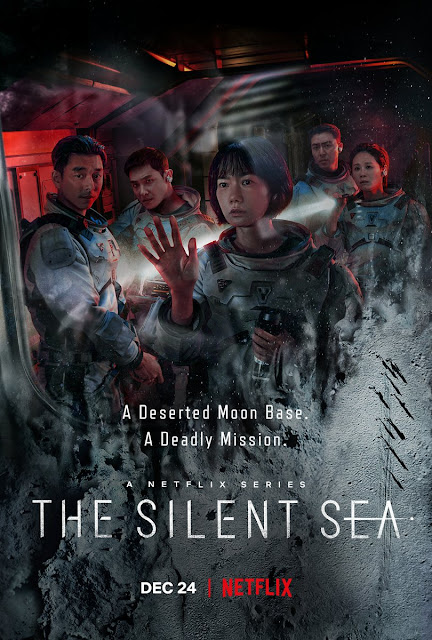
'The Silent Sea' is a cautionary parable about infinite greed

This space survival thriller about a mysteriously deserted lunar station hides an effective thought experiment about economics

Conservation of mass is the fundamental principle of chemistry. Evolution by natural selection is the fundamental principle of biology. That each thing is identical to itself is the fundamental principle of logic. If such basic facts are not taken into account, everything else stops making sense.

Likewise, in economics the fundamental principle is scarcity. It means that resources are not infinite. Even our access to sunlight is limited by our technological capabilities, the position of Earth, and the amount of fuel in the Sun. Every resource has a limit. No matter your political persuasion, your ethical guidelines, your partisan agenda or your pet cause, every single theory of economics has to deal with the solid fact that there just isn't enough to satisfy all desires. This is why all economic problems have to do with choice: resources are not infinite, so we have to choose. How we choose and who does the choosing is where economic schools differ, but the underlying principle remains; it's almost like it's written in the laws of nature.

So what would happen if there actually were an infinite resource?

Now that would be a violation of the laws of nature.

It would be an aberration. Something monstrous.

Countless works of utopian science fiction have imagined a post-scarcity society, where production is not constrained by availability of raw materials and our basic physical needs are permanently covered—in a sense, all post-scarcity theories are in themselves science fiction. We can imagine, as in Star Trek, a society that has moved beyond such preoccupations.

Or we can, as in the new Korean Netflix miniseries The Silent Sea, ask the hard questions about what such a state of affairs would actually entail.

The Silent Sea tells the story of a government-led mission to retrieve a suspiciously unexplained piece of laboratory equipment from an abandoned lunar station. The astronauts recruited for the trip come from a future Earth where water has become so precious that access to it has become the criterion of social stratification. The once blue planet now looks deserted from space, and the seas have become as dry as those on the Moon.

What our heroes find on the Moon, however, could change everything: there's an impossible new form of water that reproduces upon contact with living tissue. If brought to Earth, it would solve the climate crisis and the political volatility forever. It would effectively provide infinite amounts of water. What's not to love?

Well, there's only so much water the human body can take. Infinite water will kill you. If you bring that to Earth, you're going to kill everyone.

The gruesome image of sick bodies bending over and vomiting gallons upon gallons of water brings to mind the curses of dark fairy tales, which makes sense, because this is a fairy tale, of the sort that were spun in antiquity to teach universal moral principles, for example, that greed can hurt and you should be responsible with what you have. Think King Midas, and multiply it by everyone who has ever wanted something.

The inconceivable scale of the monstrosity is subtly explored at a more personal level early in the series. One of the astronauts, Dr. Song Ji-an, has received government compensation for her sister's death. She's now a gold-class citizen, meaning she has the legal right to infinite water. She's been taken out of the queue, out of the rules of allocation. By every school of economics, she's an aberration.

The series treats her undeserved new status with the appropriate disgust. People are on the brink of rioting over the unfairness of water distribution, and here she's being given the royal treatment. The incongruity of the situation is not lost on her: she has the thing everyone on the planet wants the most, but it doesn't satisfy her. It's futile as compensation for the loss of her sister. There's no compensating for human life. The value of human life does not lend itself to that kind of calculation. Now that's something truly infinite.

Economic inequality and the myriad wrong ways to deal with it appear to have become a staple of Korean drama. We've had, in quick succession, Parasite, Space Sweepers, Squid Game, and now The Silent Sea. It's doubtlessly an everyday concern for Koreans, who are now becoming painfully familiar with the American paradox of immense national wealth and heartbreaking individual poverty. What The Silent Sea has to say about that topic is that illusions of abundance are not the solution to the crisis of inequality, and even if we could have everything, it would solve nothing.

Who could even live with infinite water? Well, this dark fairy tale comes with its own angry spirit: Luna, the unnatural child, the only survivor of an assembly line of clones expended in the hope of controlling infinite water. Those clones are the embodiment of the sacrifice of entire generations for the dream of ever-increasing resources. Even if you found a way to reliably obtain ever-increasing wealth, producing it would require you to defile nature and defile humanity. Luna's tortured life is what results from following that imperative. So no, that's not the solution either.

Because the series ends with Luna nowhere to be found, humanity will not be transformed into her, and the self-replicating water from the Moon will not save Earth. This is fitting with the theme of the story: Luna is an impossible creature. We'd all need to become impossible creatures in order to both create infinite wealth and make any use of it. Having everything is equivalent to needing nothing: once we reached that hypothetical state, we might as well throw away our physical protections and walk, like Luna, in the vacuum of space. That's not going to happen.

So let's recap: you can't satisfy every single desire, and if you did, the human cost would be unacceptable, and if you paid it, you'd have to make everyone pay it, and if everyone did, we'd no longer have a world.

The lesson is the same as in the tales of old. Greed can hurt. You need to be responsible. We need to abandon the illusion that we're going to solve inequality by finding a magical source of endless riches. The only way is to distribute better.


The Math

Baseline Assessment: 8/10.

Bonuses: +1 for great visual effects.

Penalties: −1 because the dialogue overexplains the plot, −1 for some flat characterizations.

Nerd Coefficient: 7/10.

POSTED BY: Arturo Serrano, multiclass Trekkie/Whovian/Moonie/Miraculer, accumulating experience points for still more obsessions.
Friday, June 29, 2018

Microreview [book]: Adrift by Rob Boffard

Lost in Space


The Red Panda is adrift (see what I did there?). While on a tour of the Horsehead nebula, its home base and all other ships have been destroyed by an unknown vessel. But how will an aging tour boat of a spacecraft and its 10 passengers make it out alive, and who attacked their defunct space station? The answers are surprisingly straight forward.

Adrift is a bottle episode of a novel, but it’s not a bad one. The vast majority of it is confined to the Red Panda, an innocuous tour ship with an innocuous name. The passengers, however, all seem to have secrets and not everyone gets to make it home. The novel jumps around, following almost every passenger’s perspective per chapter. Sometimes we’re treated to memories or flashbacks that flesh out the characters, which is essential for this “god mode” perspective and helps build out the drama. Sometimes things happen in the real world that call back to previously revealed memories and, while it’s spelled out all too often in case you weren’t paying attention, it’s effective at showing before telling.

But at some point the broad questions get boiled down to a couple possibilities. Once a major reveal is given on the question of who attacked the space station and why, the rest of the novel outside the confines of the Red Panda kind of writes itself. The things you think are going on are going on with little deviation. We’re still left to see how the passengers will or won’t make it out alive, but the broader plot becomes a little too predictable. It’s not that I expected mind blowing reveal after mind blowing reveal, but the first one is exciting enough that I was hoping for more out of the rest.

Adrift then becomes a tale of two tales: the survival of the passengers inside the Red Panda, and the broader conflict in the world they exist, with the first being the more interesting of the two. It’s a solid survival tale that throws two handfuls of characters into a tough situation and watches to see where the bodies lay at the end. The external plot isn’t bad either, just a little too predictable.

The Math

Baseline Assessment: 7/10

Bonuses: +1 good use of multiple perspectives

Penalties: -1 what goes on outside of the space ship is more predictable that what happens inside the space ship

Nerd Coefficient: 7/10 (an enjoyable experience, but not without its flaws)

***

POSTED BY: brian, sci-fi/fantasy/video game dork and contributor since 2014

Reference: Boffard, Rob. Adrift [Orbit, 2018]