Tuesday, February 15, 2022

Questing in Shorts, January 2022: Saturation Part 2

 I said I'd be back for a second part of my short-fiction-of-2021-marathon wrap-up, and I'm here to make good on that promise! Let's talk about some more of my favourite short stories read in January, covering a whole bunch of magazine issues from last year. (Part 1 is here, if you missed it!)

Unfettered Hexes: Queer Tales of Insatiable Darkness ed. dave ring
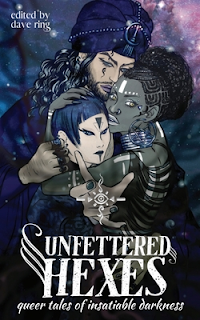
In just a couple of short years, Neon Hemlock have become one of my favourite publishers with their range of queer speculative fiction from diverse, boundary-pushing perspectives, and this collection is an excellent place to start if you haven't picked up one of their books before. Both the theme and the aesthetic are excellent: each story comes illustrated with a full page image from Matthew Spencer, and the stories involve a range of witchy and occult premises covering everything from space station cults and oxygen maintenance (Effects of Altitude on the Blood Elevations of Love by Marianne Kirby) to sapphic triads exacting supernatural revenge on their landlord (Love and Light by H.A. Clark). There's also two comics, some poetry and two narrative adventure games: Exterior, by Mercedes Acosta, about leaving the safety of your home into the unknowable dangers of the outside; and Hold the Dark, by Allie Bustion, about you and your coven preparing for a mysterious oncoming darkness. There's even some classifieds by Jordan Shiveley, of Dread Singles fame! It adds up to a really cool package where every piece of work contributes to an engaging whole.

 But let's talk about some of my favourite short stories! Kel Coleman (and, look, I could go off on another whole tangent about how many great stories Kel Coleman put out in 2021, but you should just go check them out and not take my word for it) knocks it out of the park with "Before, After, and the Space Between", a story about an innately talented witch and her daughter, growing up as outsiders in a society where magic has been co-opted by a dominant culture that requires artefacts imbued with spirits of the dead to conduct it. Sanguine's mother narrates the growing rift with her daughter as she grows up, the circumstances of her death, and their eventual attempts at reconciliation from beyond the grave. The way the story navigates prejudice and cultural domination, wrapped up in a story between mother and daughter who have to overcome enormous barriers to come to an understanding, makes it heartbreaking and powerful and very much worth reading. I also really liked "Sutekh: A Breath of Spring" by Sharang Biswas, which creates a world based on a fictional game with strong parallels to Hades, where Osiris tries to fight his brother Set, constantly being resurrected in a pool of blood in Isis's cave when he fails. Except one day he wakes up and it's Amun-Au, not Isis, who greets him, and the two strike up a flirtatious rapport that becomes a high point of Osiris' frequent deaths, and blossoms into romance. As the scope widens to show us that this is a mod, one which becomes unstable with a subsequent game patch and stops the player from being able to progress in that version of the game, the story raises some really interesting questions about how fan engagement builds queer content into works that don't canonically care about them, blurring the line between that meta-commentary and the feelings of the characters themselves. If anything, the strong parallels to Hades and its real life studio Supergiant were drawbacks for me (Hades itself has two significant and inescapably canonical m/m romances, no modding required) but it doesn't take much to look beyond that mismatch to the general point that Biswas's story makes, and it's a good one.

There are also several great stories which build around specific places, be those the magical houses of "The Passing of Sinclair Manor, or, The House of Magical Negroes" by Danny Lore and "FOR CLOSURE" by Tania Chen, the supernatural contemporary city of "Dizzy in the Weeds" by L.D. Lewis and the future capitalist dystopia of "Undercity Spellwork", or the otherwordly juxtaposition of a trendy underground-carpark-turned-hotel (except don't call it a hotel, it's a Transitory Dwelling Experience) with the group of Black men dressed in intricate animal masks who come for a late night check-in, in "Antelope Brother" by Craig L. Gidney. That last story is narrated to perfection by bored hospitality worker Malik, who spends his mostly-dead shift reading and talking to his friend Kiki before investigating a supposed disturbance that turns into something more involved than he expected, and the slow ramping up of supernatural elements makes for a really funny, engaging story. Honestly, though, there's just not a bad story in here, and Unfettered Hexes covers a really impressive amount of ground while keeping its theme at the heart of every story. Well worth investing the time in.

Beneath Ceaseless Skies
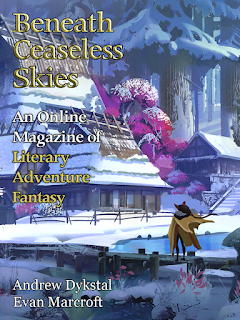

Between all the issues I read last month, Beneath Ceaseless Skies has really cemented itself as one of my favourite publications, and I'd particularly urge anyone looking for slice-of-life fantasy to give their short fiction a try. Sure, there's plenty of adventure and weirdness, but some of BCS's best stories involve presenting a small corner of a much larger world, focusing on unlikely protagonists or niche professions, and building out mythologies and worlds around those folks. So you get stories like The Fox's Daughter by Richard Parks, about the challenges a spirit faces while trying to foster a high ranking Kitsune's daughter, or the fussy, nervous travelogue of "Letters from a travelling man" by W.J. Tattersdill, whose protagonist writes about visiting the home of his elderly friend and the changes it has undergone since she left. Even stories with more "traditional" fantasy elements: like the dragon slaying in "The Lingering Weight of Estrian Steel" by Rajan Khanna, or the fae power struggle in March McCowan's "Song So Pure and Cruel" or the build-up of rebellion in "The Last Days of Summer in the City of Olives" by Filip Hajdar Drnovsek Zorko, focus heavily on the protagonists' lives and hopes and fears outside of their call to adventure. The old soldier of Khanna's story has defected from the army after losing his fight with the dragon and finding love and new perspectives in the village below; the story of the fairy goddess of "Song So Pure and Cruel" is told through a childhood companion whose only interest is playing with her and hanging out, an interest that is reciprocated in the goddess' current incarnation; and Drnovsek Zorko's story features a reluctant princess who refuses to take up the position of challenging her sister directly, questioning the foundation of the rebellion that seeks to make her its figurehead even as she comes around to their objectives. Reluctant protagonists aren't new to fantasy, but at shorter length it becomes easier for that day to day life to take centre stage, and to emphasise the weight of human (or, you know, fae, whatever) connections and finding a purpose that doesn't involve violence or scheming, and the result is a reading experience that really enriches my overall fantasy diet.

With that in mind, it's not a surprise that the two standout stories from my recent readings are epics of an unusual type. "Quintessence", by Andrew Dykstal, is about a group of miners wintering at the top of an impossibly high mountain, kept alive by supplements and unable to venture outside due to the cold and lack . When Loren's compatriots start dying of what should be a preventable illness, and the mine's witch refuses to release the cure that would help them, he ends up murdering her and being possessed by her soul (the relationship that develops out of this is not as grim as it possibly should be, with that setup, but go with it). Between them, Loren and Rose begin to unravel the mystery behind their circumstances and the deaths, and hatch a desperate plan to escape their situation. There's a bucketload of tension and danger, and Rose is a fantastic character who gets plenty of time to shine despite not getting what she deserves within the story itself. And "A Manslaughter of Crows" by Chris Willrich is a story I want to press into everyone's hands, because it's about electoral fraud and gerrymandering in a fantasy city built on the principles of pirate democracy (otherwise known as the "swabocracy"), and the protagonist is a sentient cat who is part of a special investigations unit. Shadowdrop and his group of friends and allies (including a seagull called Purloiner-of-Chips, Hope the very good dog, and assorted humans) need to rush to unravel the plot threatening the city's election, and its connection to the newly formed bird party, before the tenets of their democracy are overthrown altogether. It's an adventure from start to finish, and I will never not be here for fantasy electoral politics.

Adventures Elsewhere
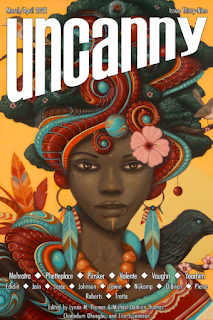

I caught up on several issues of Uncanny Magazine, which delivered its usual high quality mix from a lot of authors I know I love. "Colours of the Immortal Palette" by Caroline M. Yoachim is a really engaging story about a mixed race 19th century woman aspiring to be an artist but being held back both by her race and gender, and working mostly as a model for more famous artists around her (including Monet). When she gets an offer from an immortal painter to become immortal herself, she is given more time to break through, even as her benefactor insists that her artistic perspective is the wrong one to be worth paying attention to. Yoachim's protagonist prevails, of course, but her immortality and the difficulty of outlasting her peers makes this both a satisfying and bittersweet conclusion. "Where Oaken Hearts do Gather" by Sarah Pinsker is a story told through what are effectively genius.com annotations against a set of folk song lyrics, simultaneously telling the story within the song while also building out the characters and the simultaneous story of the commentators, one of whom stops commenting after a visit to the location where the song allegedly took place. It's haunting stuff, and the out-of-chronology comments are handled really impressively to build the tension even with the early reveal that something is amiss. I was also really impressed by the emotional resonance of "For All Those Who Sheltered Here" by Del Sandeen, which tells the story of a lynching from the perspective of the tree, and the tentative healing when it comes to be part of a family's life much later.

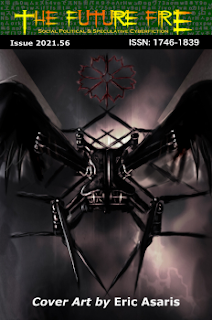
The Future Fire continues to impress too, and the pair of novelettes in Issue 56 were a real highlight of my reading (yes, they came out almost a year ago, no I'm not sorry for only just reading them, stories do not have an expiry date! "k.a. (birthright) by Lam Ning is the story of two former soldiers, part of a criminal warlord's army, who after several years years and a spell in prison find themselves in medical services on the other side of the conflict. The whole story takes place in a broadly sketched hostile environment - it's a planet, maybe earth, but suits and oxygen masks are required to go outside, not to mention the ongoing conflicts and rampant death-capitalism - and it's a really interesting story about struggling to survive amidst hostility, no matter how ugly your past or present might look. Then there's Listener, by Sim Kern, which is about a woman who grows up with the ability to talk to trees and plants, and how that ability and the events around it shape her relationships with her family and her best friend Delia. It's told from the perspective of the main character returning for a reunion years later, so we can see how she has built her life around an ability that she has increasingly rejected, and how returning to her home and reuniting with her family also lets her reconnect with what's actually great about talking to trees (aaaaah, sun!) and to put the pain of the past into a context that lets her move forward with self-acceptance of all she is.

Finally, I have to throw in a word for an unconventional Twitter story: Unknown Number, by Azure Husky, is a Twitter thread of text message screenshots portraying a conversation where Gaby, a 46-year-old trans woman, is randomly contacted by an unknown number who turns out to be much closer to her than she realises. It's a powerful story of the decisions around transition, and how the smallest things can make that decision either possible and validating, or difficult to the point of impossibility. I think it's worth reading for how kind the two characters are to each other, and particularly the affirmations that Gaby gives her caller  as we realise how unworthy of love and validation they feel about themselves. It's a delight, is what I'm saying, and you should read it. That's all.

POSTED BY: Adri, Nerds of a Feather co-editor, is a semi-aquatic migratory mammal most often found in the UK. She has many opinions about SFF books, and is also partial to gaming, baking, interacting with dogs, and Asian-style karaoke. Find her on Twitter at @adrijjy

Monday, February 14, 2022

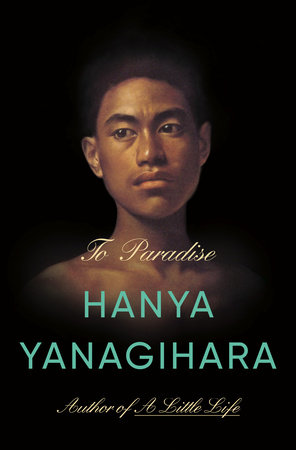
Microreview: To Paradise by Hanya Yanagihara

Three looks at the nightmarish side of the American Dream

The multi-timeline epic saga is in vogue these days. However, even if this is still a somewhat nascent tradition, what Hanya Yanagihara has done in her new novel To Paradise is already a leap forward. Very much unlike such established referents as The Actual Star or Cloud Cuckoo Land, the characters in each section of To Paradise are not directly connected to one another: they are not descendants, or reincarnations, or admirers, or followers of previous characters. The three timelines might not even share the same world. So, instead of reading this novel as one continuous plot across three centuries, one could read it as a mythical cycle, a retelling of itself with a common cast of characters repeatedly cast in archetypal slots. What links these timelines is not causal succession, but thematic resonance.

The three sections of To Paradise are actually telling the same story: the story of America's contradictory nature as the place that makes you want in, but would rather keep you out. The choice of setting is indicative of that tension: on one hand, New York City, the symbol of America par excellence, the iconic entry point for newcomers from the whole world, and at the same time a dizzyingly elitist competitive jungle; on the other hand, Hawaii, the last piece of land snatched by America's insatiable hunger, and thus a place where painful questions of belonging, welcoming, rootlessness and exclusion are still part of living memory.

America is still too drunk on its own myth, too reluctant to look at itself honestly. It takes an outsider (or, in this case, an American who has spent her life being treated like an outsider) to present America with this unflattering mirror. For Yanagihara, this was a book she simply couldn't not write.

In the first section, set in 1893, the sensitive and pampered David, the eldest and only unmarried heir of a banking dynasty descended from the revered founders of a queer utopia in New York, is torn between the gentlemanly and predictable love of Charles, the respectable suitor his grandfather has found for him, and the spontaneous and volcanic love of Edward, a penniless musician who may or may not be bad news for his family's fortune and reputation.

In the second section, set in 1993, another David, the last member of the Hawaiian royal lineage (not that anyone would care to ask him about it or believe him if he spoke) is a joyless paralegal at a New York law firm, not quite settled among the inaccessible social elite of his absurdly privileged boyfriend/boss Charles, and secretly ashamed of the childlike simplicity of his estranged father, who let himself be dragged, years earlier, into the utopian nationalist deliriums of another Edward.

In the third section, set in 2093, our last David, a disaffected youngster pushed by racist bullying to the dangerous road of political extremism, is seldom present in the plot, but the evidence the reader gathers of his thoughtless actions suffices to explain the lasting consequences endured by his father Charles and his daughter Charlie, who try their best to keep a clean conscience as willing accomplices of an authoritarian dystopia.

Each section is told from one primary perspective that corresponds to its present time and one secondary perspective that provides extensive backstory. In 1893, it's via personal letters and detective reports; in 1993, it's in a lengthy internal monologue; in 2093, it's through clandestine confessional mail. These commentaries take up a sizable portion of the novel, but they're integral to building a full picture of the events. We learn the deep reasons for grudges our main characters are loath to admit, and the true stakes behind choices other characters find indefensible. There's no action without a cost, and a question that persists across the novel is whether making it in America is ultimately worth it.

In each section, the main character has to give up the benefits of family origins in order to pursue their own form of happiness. This requisite of renunciation becomes one of the key themes of the novel. The spiel America likes to tell about itself says that it's founded on the rejection of aristocracy, and that all merits it offers shall be earned with effort. To Paradise suggests that the myth twists what really happens: America demands that you give up something precious about yourself, and buy into the search for a dubious mirage, before it will consider welcoming you. This can refer to any individual who tries to become American, but also, in the second section of the novel, to the process by which Hawaii became American.

In her interview with Goodreads, Yanagihara explained that she chose the title To Paradise to openly challenge America's claim to be one. The taint of sin in America's heart ("One group of people sent away from their land; another group of people stolen from their land") runs against the myth that America is any sort of refuge that everyone ought to aspire to reach. To become American is therefore to accept a part in that taint of sin. Worse still, there's no escaping it: as the second section of the novel implies, to attempt to build your own American Dream apart from America is to fall into the same trap.

It's one thing to pursue happiness; that's a universal human impulse. But the danger of America, in every century, is that it pushes people to take unreasonable risks in order to feel accepted, to attain a semblance of belonging. America is hard to impress. And people who have been told enough times that they will never belong may look for other, less advisable spaces to fulfill that need. One of the key points this novel makes is that those less advisable spaces are no less part of America than polite society. If, like Anna Karenina, each unhappy society is unhappy in its own way, the special cruelty of the social system that is America is that it teaches you to desire the utmost recognition and prestige, and then punishes you for not having it.

It's curious to see how starkly divided the reception of To Paradise has been. In the unfavorable reviews, a common thread can be discerned: a lamentable unwillingness to receive the novel in the terms it sets for itself. The New Republic asserts that it "shows little interest in the big questions it asks," but that reproach comes from applying to the novel a rigid set of political expectations it never promised to play by. To Paradise is a story that uses individual characters to explore a collective theme. We can debate how effectively that device works, or doesn't, but it's unfair to fault it for using the device in the first place. The review in The New Republic looks at these characters crushed by circumstance and stretched thin between competing desires and mistakes them for "flattened characters."

Another unfair accusation is that To Paradise fails to deliver a resolution for its three timelines. According to the Irish Independent, "Like all ambitious, utopian projects, it feels nothing like Utopia, really." AV Club complains, "What’s almost lost in all the noise is that none of the characters ever make it there." In Slate we read, "Seven hundred and twenty pages makes for a very long tease." All three agree, in similar wording, that To Paradise demands too much of the reader in proportion to the (supposedly) meager reward it offers.

What these remarks allude to is the fact that each section of To Paradise ends just before the main character takes the decisive step that will seal their fate, so we never know whether their desire for heaven on earth is fulfilled. What is it, reader: the lady, or the tiger? However, to focus on plot resolution is to analyze this novel on the most literal level, and that's not the level at which ambiguous endings operate. To find the same device three times should have been enough of a hint that Yanagihara is trying to say something more important than the conclusion of a particular journey. For a novel about the experience of loneliness and rejection in America, it's only fitting that the denial of satisfaction is part of its aesthetic arsenal. The outsider's experience in America is defined by never being certain of your place, never knowing for sure whether you've "made it," never reaching a stable condition. The way each section of the novel ends serves to convey a fleeting sample of a sensation that is much more long-lasting for those whose survival depends on earning the approval of American society.

What Yanagihara achieves with this structural choice is to make the reader feel the same uncertainty, anxiety and frustration that afflict her characters. You're supposed to feel uneasy about America's seductive promise. It's not a defect of the novel; it's its core message. This is the reason why the most absurd criticism made of To Paradise is the one that appeared in the Los Angeles Times, which has the embarrassingly wrongheaded title, "Hanya Yanagihara’s new novel proves her reputation for ‘empathy’ is all wrong." The article joins the peculiar ongoing trend of accusing Yanagihara of torturing her characters for perverse fun. I can't speak for her previous novels, which I haven't read, but To Paradise is an emotionally and morally aware story through and through. If it's difficult to read, it's because it follows aesthetic conventions of an earlier era of novel writing. This is a novel that sincerely means what it says, no tricks hidden up its sleeve.

Maybe it's what it says that has rendered literary reviewers so disoriented.

The characters of To Paradise face the fundamental injustice that the path to happiness exacts an unacceptably high toll. To remain where it seems safe means to forgo their unique individuality; to chase after a dream means to open themselves to every form of hostility. In the queer utopia of 1893, "the house felt oppressive [...] a place that possessed him as much as he did it." In the sophisticated decadence of 1993, "life was something that David wasn't experiencing but was, rather, having bestowed upon him." In the totalitarian prison state of 2093, "their happiness would be complete, because they would never know the agony of wanting to be someone else."

The malaise that pervades these three eras is the self-negation demanded of those who would aspire to America. To earn a place in America, to truly become American, is to drastically deform yourself into something you no longer recognize. But the alternative isn't any more tolerable: if you try to keep true to yourself, America will never stop reminding you that you're a wrong version of you.

In 1893, David can be said to have been born in the best possible circumstances: he has all the money, prestige and safety he could wish for. What bothers him is that the free republic that solved homophobia has not solved classism, which prevents him from living in full honesty. His society is more divided and restrictive than it proclaims, and ends up failing the promise of freedom even for the most privileged. The situation becomes so impossible that David finds he will have to exit the safest place in the world for gay people in order to take control of his life. Paradise just comes with too many conditions.

In 1993, this other David resents the years his father lost in a quest to restore the Hawaiian kingdom in an empty lot of land that would never grow food or sustain a dwelling. Hawaii didn't ask America to come to it, but it came anyway, and Hawaii was dragged into the American experiment, and what that meant for Hawaiians is that their own projects suddenly became irrelevant. This is a different kind of relationship to paradise: it's a paradise that takes its desirability for granted, regardless of what you have to say about it. But what does David want? He doesn't know. He was never allowed to explore that question on his own. His father tried to build his own miniature paradise, and failed in the most shameful way. At least David had the courage to leave, but what is left for him in mainstream society is to try to fit, never perfectly, in a space that was not made for him.

In 2093, Charlie is prisoner of decisions she didn't make. The gradual rise of dystopia through successive lethal pandemics has ended up trapping her as a cog in the machine of state repression. Her grandfather was declared a public enemy by one regime, and her father likewise by another, and her position now is one of precarious immobility. However, her grandfather has made sure that she can be the kind of person who can thrive in this environment. She has a good job and a kind husband, she obeys the rules and respects the system, but she still needs to do the hard work of realizing that's not what happiness consists of. There are forms of happiness she has never known are possible. There are other, freer ways of living she has never known exist out there.

At one point, her grandfather writes, "I have always wondered how people knew it was time to leave a place."

A key part of becoming American is leaving your old place, both physically and mentally. The tacit assumption in the Americanization process is that you're never going to need to leave America, but that's the unspeakable scenario Yanagihara broaches in this novel. When is America too much to bear? When does it start asking too much of you? How much of yourself do you have to lose in order to turn into the kind of person who can thrive in America?

Several times in this novel, characters fantasize about another life they'd rather be living. Their dead friends are back, their unruly children are polite, their faraway parents are just within reach. It sounds so simple when put like that. It sounds so doable.

If only.


The Math

Baseline Assessment: 7/10.

Bonuses: +2 for an uncompromising artistic vision.

Penalties: −1 for some, let's say, strange choices of wording.

Nerd Coefficient: 8/10.

POSTED BY: Arturo Serrano, multiclass Trekkie/Whovian/Moonie/Miraculer, accumulating experience points for still more obsessions.

Reference: Yanagihara, Hanya. To Paradise [Doubleday, 2022].

Thursday, February 10, 2022

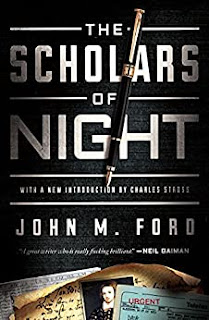
Microreview: Scholars of Night

 The reissue of the late John M Ford’s work continues with Scholars of Night, a novel very much of its 1980’s time, and one on the evaporating edges of genre.


Nicholas Hansard is a professor of history at a college in New England in the early 1980’s.. After the unexpected death of one of his colleagues, he is drawn into a mystery involving cryptography, wargames, espionage and double agents, in England. Oh, and most importantly for Hansard...a lost Christopher Marlowe play.  But Hansard is a minor player in the espionage game himself, a minor outside player who is going to find himself with a more leading role than he can imagine.


This is the story of John M Ford’s The Scholars of Night, a not quite SFF novel now reissued for the first time in decades.

There are two espionage threads and mysteries running through the novel...the lesser, in the time of Marlowe, revolves around the identity of someone in Spain who may or may not be a spy, may or may not be working for Walshingham, may or may not be a double agent. Or even a triple agent!  The parts of the lost Marlowe play that Ford invents for this book feel and read just like the extant real work of Christopher Marlowe, based on the limited sample that I’ve read. 

Thus it can be said the Marlowe material, instead of being a full partner in the narrative, is really just a frosting, an addition, a sheen on the major spy narrative.  Or perhaps an inciting incident to provide a rational way to put our protagonist into the main plot.  And it is in this narrative that the meat of the novel unfolds, and shines.

Nicholas Hansard is the classic “semi-outsider to the world of ghosts and shadows” who gets himself in too deep in espionage doings beyond his grade leve; and way over his head, fast. His is the primary narrative, we start with him playing a very Roleplaying infused game of the War of the Roses board game Kingmaker, and from a certain perspective, this is a metaphor for the entire novel, right at the start. He is an outsider, a more powerful piece than he knows or suspects, and while he cannot “win the game” himself (even if he has the fuzziest notion of the Great Game) he certainly can and does influence the outcome. With the two sides of the Great Game seen as York and Lancaster in Kingmaker, and loyalties and who is who always up for play in the narrative, in a way, Ford has written a novel that is to Kingmaker the board game that Chess is to John Brunner’s Squares of the City. There aren’t exact moves, but the theme and flow of the novel follows the internecine machinations of the players.  

The other thing to parallel this to in the narrative is also wargames. A lot of the plot runs around modern wargaming on the part of the British navy and just how that fits in with the espionage plot would be telling. Shakespeare may have said all the world’s a stage, but between the Kingmaker and wargaming motifs and plotlines in this novel, Ford is saying all the world is a game. It’s definitely of its time and place as far as technology is concerned. A good touchstone for readers might be Tea with The Black Dragon, which while it does have a more fantastical element than anything this novel has (the titular Dragon), the computer technology and concerns with it are very much in line with what happens in this book. But this is a book that focuses on character, first, with the toys and technology secondary at best. And that starts with Hansard and goes off to the characters as well.

Aside from Hansard, we have a couple of other points of view, including the mysterious WAGNER, who is one of the spies in this drama, but for which side, and what do they want, and who are they, really? WAGNER, throughout the narrative, herself, is trying to figure out who the other code named agents are. It all is of an interesting period piece now, espionage in the 1980’s, in the era of Wargames, particularly. But as far as what to expect, and maybe have a hope of staying ahead of Ford in reading it for the first time, you need to know which espionage writers influenced Ford.

In his introduction, Charles Stross, whose Laundry Files and Merchant Princes novels have borrowed, if not been nearly pastiches of, various espionage novel authors, provides a Rosetta Stone, a cryptography key, to what Ford was doing here.  Ford’s inspiration, model, and some might even say passion is Anthony Price. Anthony Price’s Dr David Audley/Colonel Jack Butler novels are counter espionage thrillers and highly regarded in that genre. I’ve never read any of them, but I know enough about espionage thrillers, both novels and movies, to fit into the plot, characters and story quite well. It is no coincidence that George Smiley (of Tinker Tailor Soldier Spy) gets invoked on more than one occasion.

And that is where ultimately this novel sits. The relatively small amount of Marlowe material, and the speculative fictional material about some of the technology (at the time) isn’t all that much, either. This novel is an espionage thriller written by a SFF author, and so sits on the borders of genre, daring readers to pick it up and engage with it. At the time I think it would feel definitely SFNal, but now its definitely a historical espionage novel in the tradition of, say, Tim Powers DECLARE, but without the Djinn or fantastical elements whatsoever.

Like the other Ford novels I’ve read, he plays fair with his mysteries and revelations, and like the late Gene Wolfe, Ford is a writer to pay attention to what is going on every page. There is an intensity to reading a Ford novel, trying to keep up and figure out his game and what he intends, and have a hope of not being stone-cold surprised at the revelations.  The nuances and small bits, the telling details, attention and thought are the cryptographic keys needed to unlock a Ford novel and The Scholars of Night is no exception.

And there is a joy and a vibrancy and enthusiasm in the novel that is also his signature. There is a lot of fun to be had, lots of subtle and broad humor both. And plenty of heart and character as well. This IS the man who wrote a Star Trek novel as a Gilbert and Sullivan style opera, and he throws that enthusiasm into this spy caper as well. His observations of the preferences of KGB agents, or of two adults trying to figure out a relationship. 

So should you read it? I don’t think this is the definitive John Ford novel, but then, figuring out what THAT is could be an entire essay in and of itself. I don’t think it is his best work, but a man who liked to write in every genre and subgenre he came in contact with, its a good work in Espionage/Thrillers. I would say that if you have read a John Ford novel already and want more now that they are being re-released, yes, get this one too if you have the mildest interest in Espionage fiction.  Should this be your FIRST John Ford novel?  If you like Espionage thrillers and want to see what the “fuss” is all about Ford’s work, get this book. If Espionage thrillers leave you cold, if James Bond and George Smiley are not your cup of tea (the plotting and feel here is definitely of its time, and not of contemporary Espionage thrillers), then this book can wait for you to get hooked on Ford’s work through one of the other gems in the brilliant constellation of his work, every star unique, and different.

---

The Math

Baseline Score: 8/10

Bonuses: +1 fo the joy of a newly re-released of a John Ford novel

+1 for excellent use of theme in this novel, a levelling up of the writer's talents and skill

Penalties: -1  Needed a tad more Marlowe stuff, it really is a veneer to the novel rather than a richly integral part.

Nerd Coefficient: 9/10

Reference: Ford, John M.The Scholars of Night (Tor, 2021)

POSTED BY: Paul Weimer. Ubiquitous in Shadow, but I’m just this guy, you know? @princejvstin.


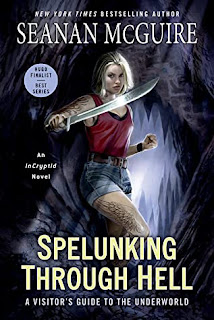
Microreview [book]: Spelunking Through Hell, by Seanan McGuire

The culmination of a long and satisfying journey.


Friends. Spelunking Through Hell is a JOURNEY. A literal one for the plotline of the novel as Alice does, in fact, go on a journey to find / recover her long missing husband Thomas and bring him back to the mortal realm. But, also, a deeply emotional journey. Spelunking Through Hell is the culmination of the previous eleven novels that set up everything we need for this novel to feel as earned as it does.

I wouldn’t normally think to quote the acknowledgements page in talking about a novel, but I’ve known for a while that this is the book Seanan McGuire has built entire Incryptid series up to and she puts it far better than I could.
“Here we go again, and finally. You see, Spelunking Through Hell was literally the book I used to pitch this series in the first place and everything since then has been one long con to convince you all to care about this vaguely disturbed, definitely damaged woman and her wild, possibly futile search for the man she lost fifty years before. Alice came before everything else.”
You *could* go into this book cold and enjoy and appreciate Spelunking Through Hell. Seanan McGuire is really, really good at setting up the beginning of a novel with just enough recap and context to pull the reader along. I just wouldn’t know what that looks like because I’ve hooked on this series since book one and I’ve read all of McGuire’s Incryptid stories on Patreon that’s been filling in the family history up through Alice and Thomas. I can’t get my mind in the place to understand what cold reading would look like. I’m invested.

Throughout the series Seanan McGuire has been seeding the idea of Alice Price-Healy. She is referenced by the current generation almost as a legend, but they know that Alice is still around and searching for her husband, Thomas. The current generation, Verity, Alex, and Antimony, are grown. Alice is their grandmother. Thomas has been lost for more than fifty years - except Alice looks like she is the same age as her grandkids because magic and mystic quests. Spelunking Through Hell gets into it (and uses the worse “flense” far more often than one would expect).

We also actively meet Alice in the novel Chaos Choreography and in the bonus short story “Follow the Lady” that is included with the novel Imaginary Numbers.

There’s a point to this - which is that the legend of Alice and Thomas is a founding principle of the Incryptid series and of the Healy / Price family. Thomas didn’t die, he was lost. Readers of the short stories know that he made a deal with the Crossroads to save Alice’s life. In the opening chapter of Spelunking Through Hell we see the Crossroads come collect.

Alice has spent the rest of her life searching for Thomas. *She* knows that he isn’t dead, even if nobody else does. And when Antimony destroys the Crossroads in That Ain’t Witchcraft (spoilers, but what are you really here for?) that finally opens the very real possibility that Alice will find Thomas. She doesn’t have anything else except her quest. Not really.
“Until one day I’d looked around and realized the only real anchors I had left were a dead girl, a house that wasn’t mine, a forest that loved me, and a colony of talking mice.”
Spelunking Through Hell is a quest story, an adventure across multiple worlds and dimensions and we see just how much of a bad ass Alice Healy-Price is and has become, as well as how much this obsession has cost her.
“There’s only so much pain the mind can process before it starts shutting things down, and while the liquid I hung suspended in was designed to keep me from slipping into shock and dying from the sheer intensity of it all, it was impossible for them to deaden my nerves enough to keep the removal of my skin from being the worst thing I had ever experienced”
For the most part, Seanan McGuire’s novels never approach being true horror (she writes as Mira Grant to get closer to that). McGuire has such a light touch with her prose and she seldom lingers on the details, but damn, she can really turn an image when she wants to. This is a novel where she wants to.

For me, Spelunking Through Hells works because Seanan McGuire is a phenomenal storyteller and she has spent the previous ten novels earning my trust. With each book she introduces just a little bit more until we get to Antimony destroying what seems like a fundamental part of the world and Sarah Zellaby moving between worlds and dimensions. Spelunking Through Hell perhaps does not work nearly so well if it is the second novel in the series because what it does is such a leap from the smaller ideas of “supernatural” creatures being real things in our world and a family studying and protecting against those who would kill them simply for existing. Getting from there to here is a journey itself. Earning that journey is something else. McGuire does.


The Math

Baseline Assessment: 8/10

Bonuses: +1 for paying off the Alice / Thomas story in such a satisfying way.

Penalties: -1 because I'm not sure the whole "Visitors Guide to the Underworld" subtitle paid off, which is absolutely small potatoes

Nerd Coefficient: 8/10, "well worth your time and attention" See more about our scoring system here.


Reference: McGuire, Seanan. Spelunking Through Hell [DAW, 2022]


Joe Sherry - Co-editor of Nerds of a Feather, Hugo Award Winner. Minnesotan. He / Him

Wednesday, February 9, 2022

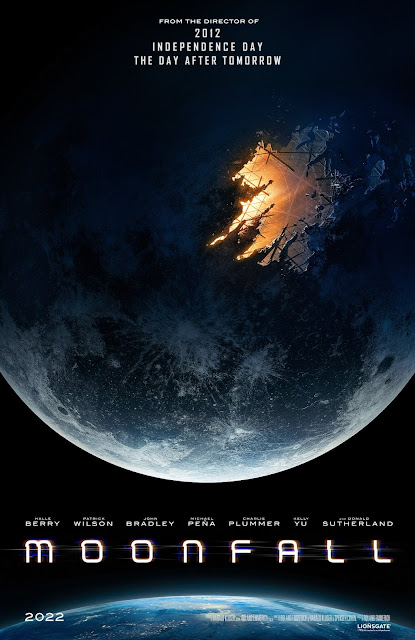
'Moonfall' puts the disaster in disaster movie

That's no moon, and that's barely a movie, either

First, let's get the boring physics out of the way: although it's not technically impossible that the Moon could be an artificial structure, the notion that it could harbor a white dwarf star inside it is beyond laughable. The lightest viable dwarf stars have a mass, and therefore a gravity, around one-half of our Sun. If we had one in our backyard, we'd definitely have noticed.

However, the intention of Moonfall is not to make sense. It's to provide thrills, spectacle, great action, a good time. And it fails at that, too.

The plot of Moonfall starts in 2011, when astronaut Brian Harper witnesses the mysterious death of a colleague during a space mission, only to be blamed for it, publicly disgraced, and pushed to the brink of destitution. However, what he thinks he saw (an angry mass of gray goo emerging from a lunar crater) turns out to be real: annoying conspiracy theorist KC Houseman, whose second job is sneaking into university offices to steal astronomical data, has found evidence that the Moon has shifted its trajectory. Meanwhile, the members of an emergency mission launched by NASA to investigate the changes happening to the Moon are eaten alive by the gray goo, only this time it happens on camera, so Harper's estranged former colleague Jocinda Fowler finally believes him. It's time to send another mission to the Moon before its new orbit causes chaos on Earth.

The entire planet is vulnerable to the rising gravity of the approaching Moon, but the movie doesn't do a good job of conveying the sense of danger. The human cost of the cataclysm is confined to TV newscasts; if the characters are already removed from those events by the screen they're watching, then we, who watch them watch the TV, are kept at one additional remove from them. That's not an effective way to make the end of the world matter to the story. The only characters we follow on Earth are those immediately related to our heroes, which means they may as well carry a sign on their foreheads that says Designated Survivors. Their desperate escape from armed looters and falling meteorites carries zero tension because we already know this isn't the kind of movie that will let named relatives die.

Of course, everyone else on the planet is fair game for the digital maelstrom of crumbling earth and rising waves and falling chunks of lunar rock. Director Roland Emmerich is by now well experienced in tearing the world apart, so we're treated with serviceable shots of entire cities being wiped from the map. The director knows that's what we came for, and he delivers.

When Moonfall stops blowing stuff up and remembers to be about something, it's about parental sacrifice. On the grand scale, the alien ancestors of humankind gave up their corporeal existence to give us a chance to survive; on the personal scale, parents risk their lives at various moments in the story to keep their children safe. However, it frequently feels as if the movie deemed it indispensable to pair this theme to a disturbingly conservative worldview. This is the curiously specific kind of crisis where turning on your cell phone will get you killed, the world is saved by spaceships and spacesuits that are literal museum pieces, the future of the nation lies in abandoning the coasts and retreating to the heartland, the only hero capable of doing the job is the millionth iteration of the retired guy who has to be coaxed out of retirement, divorce is a Bad Thing that Makes Everyone Sad, the final lesson for humanity is along the lines of "respect your elders," the efforts of parents give their kids the (literal) extra lift they need to solve their problems, and the protagonist's son has an entire arc about evading legal consequences for his irresponsible behavior and growing into the mythical Good Guy with a Gun.

These plot points sound more organized when laid out like this. On the screen, the first and second acts suffer from a wildly irregular pacing, their scenes joined without a discernible sense of intention. The random jumps between subplots get a bit better as the story progresses, but that first impression of aimless editing doesn't fade from memory. After we get to the pretty decent visual effects used for the alien spacecraft in the third act, it's hard to justify why early scenes of a more mundane nature resorted to a less competently executed and more painfully obvious green screen. What does retain a uniform standard throughout the movie is the stilted style of dialogue that no real human being has ever uttered.

The most jarring problem with Moonfall is how openly uninterested it is in having an original story to offer. Not only is the destruction of cities interchangeable with the destruction of any other city in any other big disaster movie; the epic ending is a mashup of plot beats shamelessly stolen from the endings of 2001, Mission to Mars, Armageddon, Wrath of Khan and Independence Day. When you approach the end of this movie, you know exactly how it's going to resolve, what the next shot is going to show, even what trite line the hero is just about to say. And Houseman... Houseman is an entire problem in himself. He's a walking provider of unnecessary commentary, the most irritating exemplar of an era of cinema that seems to be cursed with characters made entirely of quippy one-liners.

For all its world-spanning scale and astronomical stakes, Moonfall offers a largely forgettable story, built from a barebones approach to dramatic effect. This is a movie that says it's about humanity earning a second chance, but it has no intention of doing anything new with it.


The Math

Baseline Assessment: 5/10.

Penalties: −1 for the criminal waste of Donald Sutherland, −1 for the entire character of KC Houseman.

Nerd Coefficient: 3/10.

POSTED BY: Arturo Serrano, multiclass Trekkie/Whovian/Moonie/Miraculer, accumulating experience points for still more obsessions.

Tuesday, February 8, 2022

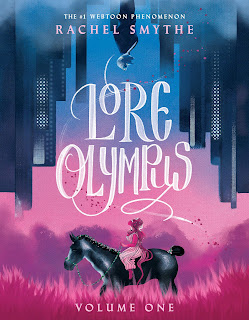
Microreview [Graphic Novel]: Lore Olympus Volume One by Rachel Smythe

Lore Olympus is a retelling of the Hades/Persephone myth from Greek mythology, originally published as an Eisner-nominated webcomic on webtoon starting in 2018, with the first physical volume released in 2021. It translates the world of the Greek gods to a magical, glitteringly futuristic cityscape, and modernises some of their existence and relationships, while attempting to retell and reimagine some of their original stories.

Content warning: discussion of rape in classical mythology


Smyth's pages are incredibly dynamic

The first thing I noticed about Lore Olympus, and why I bought it, is that it is an incredibly pretty book. Rachel Smythe chooses a strikingly simple art style, with strong, bold colours for each character, and flat backgrounds to highlight them, with a lot of white space on the page to focus on the central images. There’s very little in the way of extraneous environmental art – you just get what you need for the plot and the atmosphere, well spaced-out on the page and often laid out using that white space to highlight the movement of the narrative. This means that although the physical book is 384 pages, it’s actually an extremely pacey read, and you get a sense of what’s happening, what the feeling of each page is, before you even get to processing the pictures and words. On the one hand, it’s a very communicative way of doing things, allowing you to get really immersed in the storytelling, but on the other, it massively exacerbates the problem that graphic novels can often have, of being such quick reads that they don’t feel good value for money, when you think purely of the time you spend with them. In some, the art style forces you to slow down, to appreciate all the little nuances (I personally find Christian Ward’s art style excellent for this), but in Lore Olympus, the pared-down, simple visuals are something of a double-edged sword, and it was extremely difficult to pace myself reading it, however much I liked them aesthetically.

 
And her character art is distinctive and appealing
It didn’t help that the story as it presents itself is also pretty damn readable. The characters are very immediate, and show themselves vividly almost as soon as they appear on the page. And the two protagonists are incredibly likeable dorks, amid a world of glamour, which is always appealing to me personally. Smythe does a great job of this – creating personable characters in a quick and smooth way, so you can get into the feel of who they are at a pace that feels matched to the speed of the narrative. I was invested, from page one, in them as people.

However, once you get past the loveliness of the art and the book as an object (the cover is also, frankly, gorgeous), and the loveliness of the characters as they are presented to you, there is a glaring problem that does need to be addressed.

There has always been a market for retellings of Greek myths, but they seem to be particularly in vogue at the moment, both within SFF and in the wider literary sphere (from Madeleine Miller’s Circe, Natalie Haynes’ A Thousand Ships and Pat Barker’s The Silence of the Girls, to graphic novels like Kieron Gillen’s The Wicked + The Divine). And one of the flavours that seems to be particularly prominent is retellings of the Hades and Persephone myth. The much acclaimed (and in my opinion fantastic) game Hades weaves it into its narrative, and both Lore Olympus and Linda Sejic’s Punderworld published their first physical volumes in 2021, likewise taking this myth as their focus. And what a lot of these particular modern retellings have in common is a decision to rewrite the relationship between Hades and Persephone into a mutual romance.

If you’re not familiar with the original myth, “romance” is not the word most people would use when describing it. In the title of most translations and direct scholarly works, the word “rape” is used in its traditional sense of “stealing women away by force”, with a strong implication of its modern usage underlying it.

To be clear, the original myth is about as casually violent in its treatment of women as Greek mythology gets. It is a story of a young woman on the cusp of adulthood suddenly grabbed and stolen away by an older man, a relative (though how close depends on which version of their family tree you want to use), through a hole in the ground, and trapped with him in the underworld while her mother Demeter weeps, not knowing where her daughter has gone, and in her grief and rage inflicts a ravaging winter upon the world. Eventually, she discovers where her daughter is, and wants her back, but by trickery, Hades manages to ensure that Persephone cannot leave his domain permanently, and so they agree that she will spend half of her year back home with her mother, and half with her new “husband” in the underworld. It’s a myth in which not one but two women’s happiness and lives are upended because a man – albeit a god – wants something he shouldn’t have, and so takes it by force.

And so I find it particularly troubling when this myth is rewritten to make that violent act into something good and beautiful.

In Lore Olympus, Persephone is the sheltered daughter of a helicopter parent who has trapped and hidden her only child away from all society, and finally allowed her out simply because it was into the care of a sworn virgin (Artemis) to look after her while she attends university to follow that same, chaste path. Demeter is an unseen shadow in the background of Persephone’s life for much of the book, only visible in flashbacks, affecting her actions and choices but without showing up on the page, but unambiguously portrayed as a problem at best. Hades, meanwhile, is an introverted and slightly awkward part of the high society of Olympus, who likes Persephone on sight but is too shy to act upon that attraction until various events leave her in his care while drunk. He is the perfect gentleman throughout their encounters, and we see both of them thinking about the other, but convinced there’s no chance of a mutual interest.

Hades is specifically contrasted in this portrayal at several points with Zeus, whose own behaviour is (mildly) decried, and yet that behaviour is exactly equivalent to Hades’ own in the original myth. Likewise, at one point in the story, a character is sexually assaulted in a way that parallels some parts of Persephone’s myth. It is portrayed as the traumatic act it is, and the perpetrator as a villain for it.

And yet that core part of the myth is disregarded, and we are shown the beginnings of a delicate, fragile romance that might, just might, allow a sheltered girl to escape the clutches of her overbearing mother. It’s not only discarding the original myth, but directly inverting it, making someone who ought to be the villain, a rapist and a kidnapper, into a delicate, gentle love interest playing a part in “liberating” Persephone from her previous life, while at the same time shifting her grieving mother into a more antagonistic role.

Now, I don’t think the story needs to be accurate to the original myth – many of the best retellings very much are not – but it seems a particularly problematic instance here, and as a trend in general, to rewrite a rapist (I’m going to keep saying it because it’s true) into a hero, a liberator, a lover and a friend. In the wake of so many good reinterpretations, ones that seize upon forgotten, overlooked or victimised characters and give them their own voices, it seems a really awful choice to decide to champion instead someone who we are now in a position to be able to critique more openly, in a way that much reception of the myth – written, as it was, by men in patriarchal structures – has never grappled with. We exist in a time where we really can dismantle those stories, and lay bare the truth of them… so why instead choose not only to go along with them, but to help them along, to continue that cycle?

Lore Olympus itself is not responsible for the entire trend. It cannot, of course, be blamed for all these stories existing in the current narrative. But Smythe did take a rapist character and rewrite him into a sweet, kind love interest, and I think even aside from being part of a really unpleasant general trend, this decision at the core of the story permeates outwards and taints everything else. Yes, the art is beautiful, the layouts clever, the storytelling pacy and the characters engaging… but it’s not enough, nor should it be, to get past the problem at the core.

The Math

Objective Assessment: 6/10

Bonus: +1 for genuinely lovely and visually interesting art style

Penalties: -3 for rapist rehabilitation attempt

Nerd Coefficient: 4/10 not very good

Reference: Lore Olympus Rachel Smythe [Cornerstone, 2021]

POSTED BY: Roseanna Pendlebury, the humble servant of a very loud cat. @chloroform_tea

Monday, February 7, 2022

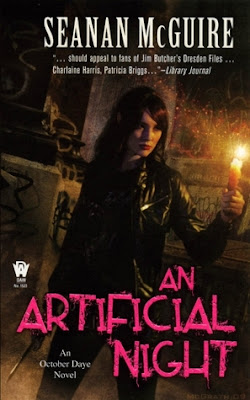
The October Daye Reread: An Artificial Night

Welcome back, dear readers. Today we’re going to revisit the third novel in Seanan McGuire’s October Daye series: An Artificial Night. We assume you’ve been reading along with us because this will be rife with spoilers. You have been warned.

When I wrote about A Local Habitation I noted that this was the book that fully hooked me on the series and that’s for damn sure. I’ve enjoyed revisiting Rosemary and Rue and A Local Habitation, but Seanan McGuire goes HARD in this book. An Artificial Night is a on the edge of being a straight up horror novel with Blind Michael taking the children and Toby’s borderline suicidal quest to get them back, not to mention the body horror and emotional trauma (as if the series isn’t rife with emotional trauma).

US Cover

I continue to be amazed at what McGuire introduced so early in the series because I’ve been reading it for so long and I assume some of these things don’t show up for several more books, but no - events that I assumed took place later start here. I’m not talking Blind Michael, which could be an essay just on that, but May. October’s Fetch, the harbinger of her impending death.

Let’s circle back to the plot for a moment. Children have gone missing. Two of her friend Stacy’s children are missing, there are weird traces of magic in their room, and another daughter of that family is asleep and cannot be woken. As if that is not bad enough, Tybalt asks Toby for help finding the missing kids from the Court of Cats. And then - Toby’s not yet squire Quentin tells her that his human girlfriend is *also* gone.

Blind Michael was mentioned several times in Rosemary and Rue. We never have to wonder if a major plot point at any time in the series hasn’t been already seeded into the story because it has even if we have no idea why.

Blind Michael is one of the Firstborn of the faerie - so that means immense power. It means other things, but I think a discussion of the Firstborn can be held for another couple of books until it really comes to the forefront. The way this series has gone so far, I’ll be talking about the Firstborn in the next book, but we’ll see how this goes. But - Blind Michael’s deal is that every one hundred years he Rides - but to ride, he steals mortal and fae children to transform into mounts and riders. An Artificial Night opens into the lead up to that Ride.
Part of me - most of me - wanted to say, “Yes, it would matter; please tell me to stay here. If you tell me, I’ll stay.” I didn’t want to go. I’m not a hero; I never have been. I just do what has to be done.

But when you get right down to it, isn’t that the definition of a hero?
An Artificial Night would be a depressing short story if that was all there would be, that this would be an unending cycle every hundred years and nothing would be done. But this is October Daye. This is Toby. Her family and friends have been taken and things will be done, even if it takes her life. Enter Toby’s Fetch, a creature that has all of Toby’s memories and experiences right up until the moment the Fetch was created.

German Cover

May feels like she should be a one-off character, but this is Seanan McGuire and she keeps everything. Also, I’m not 100% convinced that McGuire didn’t introduce May because she did, in fact, want to make fetch happen.

Regardless of that, May becomes one of my favorite characters in the series (along with the Luidaeg, but I’m not sure I can actually talk about the Luidaeg too much. Like how even though we don’t know her very well yet in this third novel, but we can still hear the heartbreak (as well as fear and anger and curses) when she is being asked for help by those she cares for - which also suggests just how tired she must be of anyone asking her for help, because she knows that it costs and she knows the price is commensurate with how big of an ask something is. This being an October Daye novel and with how things work around here, it is Toby coming with the requests and there is a deeper relationship between Toby and the Luidaeg than the reader knows and frankly, deeper than Toby knows - but that is something that gets fleshed out later.

There is a lot of conversation about heroism in An Artificial Night, but there are also hints that a “hero” is more of a thing than just the actions that a person does. There may be heroic actions, but then there is being a hero. So much of this series involves Toby settling into the mantle of being a Hero as a thing that a person is. That really begins in An Artificial Night.
Maeve’s children are hot and strange and come in every shape imaginable. Oberon doesn’t claim most of his descendants, leaving them to the mercies of their mothers. Those few races that he does claim…those are Oberon’s children. And Oberon’s children are heroes.
There is a point in this novel when the Luidaeg calls Toby “child of Oberon” even though the Daoine Sidhe are claimed by Titania and not Oberon. That’s not a mistake. That’s groundwork being laid.

Toby is a hero and very soon in the series she will be straight up a Hero and she is standing up to a Firstborn as a still relatively weak changeling that so many other full blooded faerie (and I believe some Firstborn) tried and failed to reign in. There is a pervading sense of menace in An Artificial Night and everytime she invades Blind Michael’s realm there is a very real sense that Toby isn’t coming back and that’s even knowing there are eleven further novels already published and in which Toby prominently features. It doesn’t matter. An Artificial Night is scary.

I was going to spend a little bit of time talking about how Toby ends up absolutely drenched in blood and how that later in the series it becomes almost a joke (especially in When Sorrows Come) - but instead I think I’m going to leave you with some words of wisdom from the Luidaeg.
Patience! Dad’s balls, they don’t teach kids any manners anymore. I should slaughter the lot of you.
Open roads and kind fires, my friends.


Previous Rereads
Rosemary and Rue
A Local Habitation

Joe Sherry. Co-editor of Nerds of a Feather, Hugo Award Winner for Best Fanzine. Minnesotan. He/Him