Tuesday, September 13, 2022

The Wheel of Time Reread: The Shadow Rising

Welcome back, dear readers, to The Wheel of Time Reread. Today we’re going to talk about The Shadow Rising, the novel I’ve long considered to be my favorite in the series. The Wheel of Time is what could be affectionately (or derisively) called Big Fat Fantasy.

I first discovered The Wheel of Time somewhen between the publications of The Shadow Rising and the next book, The Fires of Heaven. I have strong memories of the Rush City Public Library, browsing the shelves, finding new epic fantasies to read, the comfort of Darrel K. Sweet’s cover art, going through a really primitive semi-online catalog to find and request new books that I was so excited to read.

They say that the Golden Age of Science Fiction is twelve, and that feels right because even now when science fiction and fantasy has permeated the “culture”, it’s the age of discovery for kids who start to have more agency in choosing exactly what they want to read and diving into all the things on their own. That would be a much larger conversation to refine that idea and it’s one that many other people have had - so we should go back to The Wheel of Time.

The larger point here is that I was thirteen when The Shadow Rising was published and was either thirteen or fourteen when I started mainlining this series. The fact that The Shadow Rising is the longest book in The Wheel of Time was just gravy for me at the time. But, how does it hold up?

Well, let’s take a look at the map and the spot marked Here Be Spoilers, and find out.

If you reduce The Shadow Rising to the biggest and most significant moments it’s easy to gloss over just how long the opening of the novel feels. This seems to be a trend with the series, that after “The Wheel of Time turns and Ages come and pass” and after the wind blows and it isn’t the beginning but “a beginning” Robert Jordan eases us back into the novel at a very leisurely pace.

It just so happens that I *like* spending time in this world - as much as the waiting periods can be a couple hundred pages of frustrating, though it’s interesting that the characters are also equally (if not moreso) frustrated about being stuck in Tear because Rand won’t say what he’s going to do. Narratively, it (mostly) works because it builds the particular concerns that Moiraine needs Rand to be moving towards the Last Battle and fulfilling what he needs to (and specifically, what *she* thinks he needs to) as well as the Black Ajah hunting that Egwene / Nynaeve / Elayne need to do and Mat’s need to be *somewhere* else and Perrin’s desire for the stability of not following Rand. Once there is a further Trolloc attack inside Tear, Jordan begins to move the pieces on the board and once the group splits - the story really kicks into the gear it needs to.

I considered ending this essay with my favorite part of the novel, but why bury that lede? Possibly one of my favorite aspects of the entire series, which I clearly love otherwise I wouldn’t spend so many words on it, is the time Rand spends at Rhuidean. There are these magical rings that Rand has to walk through, the same rings that the Wise Ones and the Clan Chiefs of the Aiel must walk through to be given glimpses of the past, of the truth of who the Aiel were and how they became who they are now. It is those glimpses that show us the Age of Legends and moments leading up to the Breaking of the World and the aftermath, of how the Aiel were tasked to save so much knowledge and so many artifacts but how much of that was lost in the generations upon generations upon generations. And how the fierce warrior culture of the Aiel we know is so far from the sworn to peace Aiel that served the Aes Sedai.

The Shadow Rising is packed with a lot more than I remember, even in the thirteen years since I’ve last read this book. I didn’t remember that THIS is the book where Nynaeve fights and defeats Moghedien, one of the Forsaken. That’s a Crowning Moment of Awesomeness. This is also the book where Rand meets / fights Asmodean, which is going to work out for him because the only person who can help Rand learn to control his power is another man and those are few and far between, so Rand gets his pet-Forsaken. Perrin becomes a “Lord” of the Two Rivers. Not really, but kind of really and truly. It’s a weird sub-plot but it sort of makes sense in a hand-wavy Ta’veren sort of way. A lot of these books can get waved away with a mutter of “ta’veren” and just accept it.

The battle for / rebellion of The White Tower is in The Shadow Rising and that’s really something I thought was in the next book. I both can’t wait for that scene in the show and dread it because the stilling of Siuan Sanche and Leane is just brutal and wrongheaded (though that it eventually leads to the quiet rebellion of Egwene in the Tower, which is another of my favorite bits is an ultimate mark in its favor) - but having The White Tower ineffectively led at best and under the control of the Black Ajah at best is just really a damn shame for the world. I just didn’t realize that was *this* book.

Which is a long way to say that despite the several hundred pages of inaction, when Robert Jordan pushes the story he really gives it a strong shove and if you’re inclined to like this sort of thing you’re inclined to love this book.

Here are some random final notes I took while I was reading. :

*The visit to Rhuidean is still absolutely thrilling. I love learning the history of the Aiel. I want more of this even if I don’t think I want an actual prequel novel or even novella. I just want more glimpses of the Age of Legends and how the Aiel became the Aiel. How the Tinkers were an early splinter off the Aiel, still following the Way of the Leaf but following a path trying to find the song (or songs) they were known for as Aiel serving the Aes Sedai. Then the warrior Aiel we know were a later splinter off to protect themselves while the Jenn Aiel continued to follow the Way of the Leaf AND who stayed true to their original mission of protecting the artifacts from the Aes Sedai and to find a home where they could be safe. How hard it is for Aiel to accept this (which is why only those chosen to lead are allowed to learn of this, to see and live that history through the ter’angreal rings at Rhuidean).

*I think I just appreciate the time spent in the Waste, in the Three-Fold Land, with Egwene learning.

*Mat and his spear and his trips through the ter’angreal doorways. Snakes and Foxes.

*Nynaeve and Elayne on a Sea Folk ship - the customs and learning that the Windfinders can channel.

*Ordeith means to scour the Two Rivers (as he did with Perrin's family farm and all his family) - obvious reference to the Scouring of the Shire.

*I don't remember being a big fan of the Perrin / Faile / Two Rivers plotline, but it is a nice anchor and reminder that all of this war (waves hands) has an impact on regular people and not just lords and prophesied heroes and magicians and dragons reborn. RJ is, overall, very good at that even when those common dead are unnamed and just burned out villages.

*At the Two Rivers there is a proper introduction to Alanna - she who will hold Lan's Warder Bond when Moiraine disappears.

*A little bit of background on the Tower of Ghenji and a glimpse of Birgitte and Gadal Cain, though neither are named. More on this MUCH later.

*I also don't remember how much Verin is acting against the Light up until she is discovered much later.


*Part of the game Faile plays with Perrin is super annoying - but remember Perrin and Faile are all of 20 years old and it's more of a kids game of relationships, but it's a pain to read.

*Verin recoginizing that Perrin's growing authority is very quickly going to change the nature of the Two Rivers - and also that he is ta'verening all over the place.

*The raw hate of Couladin and the Shaido Aiel

*Twice and twice he shall be marked.

*The idea that the ancestors of Cairhain let the Aiel have water three thousand years ago, which led to the friendship between the Aiel and Cairhain later, which led to the Avendesora cutting as a pledge of friendship, Laman cutting it down, the Aiel War and all of that leading to Rand being born during that war and carried off to the Two Rivers. Each step that needed to be taken to bring to where he would be,.

*Rand's insistence that he has to carry the load. Duty is heavier than a mountain.

*A quote:
"You knew my mother," he said. Egwene leaned forward as intent as he, and Mat shook his head.

Amys's hand paused on his face. "I knew her"

"Tell me about her. Please"

*Confirmation that Bors is Jaichim Carridan - High Inquisitor as he is threatened by Liandrin.

*Jain Nateal - a gleeman in the Waste (later revealed to be Asmodean) notes “Aiel? Not what I would have expected. I can still hardly credit it” which reads at first as a man who had never met the Aiel before but when you know that he is Asmodean you realize that he knows what the Aiel were during the Age of Legends and before the breaking. What Rand got glimpses of, Asmodean lived.

*Male A’dam - given to Bayle Domon to dump in the deepest part of the sea. Probably not going to end up well.

*Major showdowns in the Two Rivers - probably partial ta’veren stuff where Perrin ends up as the functional Lord of the Two Rivers - fights off waves of trollocs and sends the Whitecloaks running - this would have been a very different novel if the Whitecloaks actually helped to defend the Two Rivers and Perrin would have turned himself in (and likely been executed).

*There’s this whole thing with a Slayer in the world of dreams where the person looks like he could be a relative of Lan - but it’s Lord Luc in the real world, and that person looks like he could be related to Rand. Connections and only moderately important spoilers for the rest of the series.

Luc is the brother of Tigraine - the Daughter-Heir of Andor who disappeared to become Far Dareis Mai and eventually Rand’s birth mother. Luc eventually disappeared into The Blight.

Isam, which is also the word the trollocs were chanting, is cousin of Lan and is of the Malkieri royal family. They are some sort of an amalgamation where both exist in the same body and can change forms? I don’t fully understand and I don’t think we get a lot of answers until late in the series. But collectively, they are Slayer.

Alright. That’s it.

Next up, The Fires of Heaven, in which things happen (probably). Plus: the power of balefire, more battles with the Forsaken, Rand takes over another city, and Robert Jordan’s adaptation of Gandalf and the Balrog.


Previous Re-reads
The Eye of the World
The Great Hunt
The Dragon Reborn

Joe Sherry - Co-editor of Nerds of a Feather, Hugo Award Winner. Minnesotan. He / Him

Monday, September 12, 2022

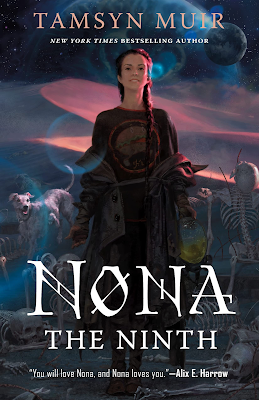
Microreview [book]: Nona the Ninth by Tamsyn Muir

Its plot is thinner and its protagonist less vibrant, but Nona the Ninth still delivers the full Locked Tomb experience

So, unless you’ve been locked in a tomb (with no wifi signal) since 2020, I’m going to assume you know about Tamsyn Muir’s Locked Tomb series. Starting with Gideon the Ninth and continuing into Harrow the Ninth, the Locked Tomb is a series of (obligatory “spoilers start here” warning) wisecracking cosmic cultists, of necromancers and their swordhands and the (literally) soul destroying things they’ve done to keep their cursed empire safe from the vengeful ghosts of its own planets, and of the absurd number of poor emotional choices they have made while doing so. As far as we all knew, the Locked Tomb was to be a trilogy, ending this year with Alecto the Ninth. And yet, we were all of us deceived, for another book was made. Before we get to hang out with Alecto, first we must make time… TO MEET NONA.

…Nona? Who the fuck is Nona?

Well, yes. That’s the question, first asked in the epilogue of Harrow the Ninth and which provides much of Nona the Ninth’s central mystery. Six months after the dramatic climax of the previous book, Muir introduces us to the six-month old consciousness inhabiting Harrow’s body, by all accounts enjoying her life in a wartorn city in the apartment she shares with Camilla Hect, Palamedes Sextus (different person, same body) and Pyrrha Dve. Aside from being a six-month-old consciousness in a nineteen-year-old’s body, Nona has a whole bunch of other things going on. She heals absurdly fast, she’s completely incapable of reading or writing but can inherently understand all spoken languages, she detests eating human food  but sometimes thinks about how nice it would be to eat sand - and her hair grows really, really fast. Oh, and she’s also relentlessly chipper and optimistic, exuding a vibe that is somewhere between “born sexy yesterday” and “live laugh love” in the face of the pretty relentless misery of her surroundings. After the edginess of Gideon and Harrow, it’s a bold move to centre book three around a protagonist who could be outperformed on the edginess stakes by a Minions meme, but it’s the kind of bold move that The Locked Tomb is all about, and here we are.

Speaking of bold moves, Nona the Ninth plunges the reader into a story that jumps off from a fundamentally different place to its predecessor, and while it doesn’t use the reader’s likely confusion as a plot point in the same way Harrow the Ninth does, there’s still zero contextual hand holding if you don’t remember the finer details of that book. (Note: if you do need a refresher, this is a fantastic video recap which covers the key points and some of the meme highlights). The vibes of the setting are different: rather than being at the heart of the empire’s elite, Nona the Ninth’s city setting is – on first glance, at least – full of the ordinary people who make up the world of the Locked Tomb, albeit those living under the threat of annihilation. Even the book’s divisions lean into a more “slice of life” feeling: instead of acts, we have days, and the events of those days are summarised with a combination of whimsical and ominous statements: “Regarding Nona – Hot Sauce Is Watchful – the City Has a Bad Day – Nona Gets a Bedtime Story – Five Days until The Tomb Opens.” To hear Nona tell it, the blue light in the sky threatening planetary destruction is noteworthy but still less interesting than her day at school, where she looks after the teacher’s six-legged dog and is a tolerated low status member of the “cool kid” gang. Of course, plenty of things that happen to Nona which serve to give the reader information: not least her dreams, which we experience as intermissions where Harrowhark and John wander an empty post-apocalyptic environment and John talks about the world before the Nine Houses. She also has an extended family beyond Cam, Pal and Pyrrha which includes Coronabeth Tridentarius, now a high ranking member of the local Blood of Eden group, and while Nona doesn’t have many insights into “Crown” beyond how hot she is, she is at least in the room where more interesting discussions happen between the characters who are more than six months old.

Nona, if it wasn’t clear already, is a source of frustration for me as a character. It’s not that her characterisation is bad: she is perfectly designed to be loveable, the ultimate cinnamon roll doling out affection to characters like Camilla and Palamedes who, frankly, deserve to have someone telling them she loves them on a regular basis. And her role as an innocent sacrifice, happy to live for as long as possible while accepting that ultimately she will die for someone more “important” to return, fits perfectly and heartbreakingly within the broader religious symbolism of the series, and is especially well balanced with John’s sinister personal story and the reprehensible actions he has taken as a self-proclaimed God. On the other hand, Nona is passive, has very little critical insight and because her personal mystery is heavily implied to be tied up with her death, her presence feels like it serves as a brake on the story, rather than helping it to progress. We won’t get back to the main events until we solve whether Nona is Person A or Person B, and once that happens, it’ll be very sad that we no longer have the cinnamon roll, but we can get on with all this tomb unlocking business and maybe kill some more resurrection beasts, so what are we waiting for?

This serves to make the first half of Nona the Ninth feel slow, with a niggling sense that this is a narrative originally conceived as a single act of a bigger book, now stretched over a whole book by itself. Perhaps the reason that wasn’t originally the plan is because there wasn’t quite enough material here to go “oh, yeah, this is a whole book”, especially when shoved between a big Act 2 showdown and a hopefully even bigger finale? It’s nowhere near Victor Hugo levels of “let me stop the plot to tell you about day-to-day life in a nunnery”, but somehow even with the countdown to the opening of the tomb, the physical reminder of destruction hanging over the city, and Nona’s constant references to her own mortality, Nona the Ninth is missing some of the urgency and momentum that made Gideon the Ninth and Harrow the Ninth so utterly irresistible. Things do pick up significantly in the second half, as events around the war and the Blood of Eden presence on the planet come to a head and more familiar faces re-emerge (like, you’ll NEVER GUESS WHO – actually, no, you’ll find out in good time). By the end of the book, I was absolutely raring to go for Alecto the Ninth, but I was also missing the sense of pure emotional turmoil that I got from the previous books, especially Harrow the Ninth.

Regardless, the weakest of the Locked Tomb series is still a spectacular book, and as a piece of serial storytelling, I suspect Nona is going to look more impressive as part of the whole. While Nona’s saccharine sweetness is no substitute for the, uh, spice of Gideon and Harrow, it’s nothing short of an expert move to make a tonal shift work like this at all, and Nona’s story expands the world of the Locked Tomb in ways which I am excited to see pay off. Now it’s time to sit tight, scan the horizon, and wait to see how one or more fleshes might meet one or more ends in the final volume.

Adri (she/her), Nerds of a Feather co-editor, is a semi-aquatic migratory mammal most often found in the UK. She has many opinions about SFF books, and is also partial to gaming, baking, interacting with dogs, and Asian-style karaoke. Find her on Twitter at @adrijjy

Reference: Muir, Tamsyn. Nona the Ninth (Tor dot com Publishing, 2022)

Friday, September 9, 2022

Microreview: Needle (inverted Frontier #3) by Linda Nagata

In Needle, Linda Nagata continues the story of Clemantine, Urban, Vytet, and the rest of the crew of The Dragon, as their inward quest to discover what has happened to the core systems of humanity leads them to perilous encounters in the star system of Tanjiri.

When last we left the crew of Dragon, they had escaped the very dangerous nanotech infused world of Verilotus (as detailed in the first and second book in the series, Edges, and Silver) and the entities they encountered there. They escaped the peril of that world (formerly seen in the novel Memory) and continued on their decades long quest toward the Hallowed Vasties, the former beating heart of humanity among the stars. Now, as decades pass and they reach their next target, the solar system Tanjiri, the question of what lies in this solar system is twisted and entwined with another: how to open and use the indecipherable titular Needle they obtained at Verilotus. The Needle, if accessed and used, could make and sculpt whole worlds and star systems...or destroy them. And much more. All the knowledge of the God like entity known as Lezuri is contained with it...if it could but be opened.

This is the story of Needle, the third Inverted Frontier novel from Linda Nagata.

If Edges was the story of a Call to Adventure and running right into a cliffhanger resolved in Silver, and confronting ancient nanotech and a god like figure, Needle by comparison is very much a novel of re-contact and the divergence of humanity, and what they brought with them, or didn’t, on their journeys. The non FTL pace of Nagata’s verse here means that it is years, decades between systems, and between novels, and significant time (months bordering on years) happens in the space within novels.

The Tanjiri system is the closest to the explorers of Dragon (and their small flotilla of other ships) as they continue to explore and discover the world of Nagata’s grand concept--the concept of an inverted frontier (hence the series name). This is a brilliant idea (that the folks at Stellaris should scoop up and put in as a DLC as soon as possible). The adventurers from, Deception Well and elsewhere(Urban being the prime mover of the expedition with his captured alien ship) started on the frontiers, the edges of where humanity had expanded to, and the novels are the rediscovery of what lies in the ruins and remnants in the core systems, the dangers, possibilities, and wonders within. What HAS happened to the decaying megastructures and amazing feats of construction, engineering and more in the “Hallowed Vasties”, the core systems of humanity who rose to building ringworlds and dyson sphere like objects...but now are radio silent and their structures (at least from telescopes) falling apart? What does it mean to explore the ruins of the past of one’s own ancestors and find those huddling (or hopefully more than huddling) within?

Imagine a group of adventurers from Britain in the 7th century AD, traveling to find out what has happened to Rome, with all the perils, dangers and more along that road to Rome. Or imagine, more science fictionally, if a comet wiped out the east and west coast of the US in 1880, and decades later, a group from Tulsa Oklahoma journey toward one of the coasts to find out what really happened and what remained. In each case, what was once the “frontier” is now where civilization still stands--but what has happened at the core, and what remains? Or Gustave Doré’s The New Zealander (1872), which depicts a ruined London and a visitor from New Zealand sketching the ruins.
 

The Inverted Frontier novels are a nanotech infused non-FTL space opera version of this core concept. This does lead to a style and direction that is much less frenetic than the solar system space opera of The Expanse, or the FTL verses of Gareth Powerll and Adrian Tchaikovsky. These novels, this world are much more measured pace in their approach, and much more of consensus (and breaking that consensus) approach to problems and opportunities in their adventures. The crew of the Dragon and the outrider ships (which are often versions of the crew) are much more Picard era The Next Generation (or more contemporarily, Pike era Enterprise) than, say, the original series Star Trek. Yes, they have secrets, concerns, and do things without permission, but there is a lot of debate and discussion, playing into the time scales that the novel is dealing with.

One of those discussions and a major factor in the book, is the creation, out of one of the main characters, an artificial personality named The Cryptologist, to investigate the aforementioned Needle. The creation, nature and the evolution of the Cryptologist brings together a lot of what makes Nagata’s writing work at it in its best--the speculation and far future nanotech and high technology needed to make her not just a ghost in the machine, but later (on her own initiative) get unsubstantiated into a body. It allows us to explore the ethics and considerations of having multiple versions of yourself, sometimes quite different than yourself, running around in one form or another. That last is already present as a feature of the verse, as Urban has several apparatchiks helping to run Dragon and its systems (and given the alien nature of the ship, he certainly needs them) but seeing the consequences of building one from the ground up, and the perils and promise of doing so, and the social considerations of doing so, are fascinating. Consider that the Cryptologist was made for a specific task. How does one navigate creating an artificial being that is designed to do (how difficult a thing)? And what happens when that being uses methods and procedures and avenues you did not intend, or want? What happens when the Cryptologist *grows*?

Nagata further enhances this unique new member of the crew developing and growing throughout the story with the story of Jolly. Jolly chose to join Dragon at the end of the Edges/Silver duology and is committed to the spirit and promise of exploration. He is much less experienced and younger than Urban and Clemantine, and thus provides an entry point of wonder and youth to the proceedings. It is no surprise, given the Cryptologist’s newness, that their stories intertwine. Their two stories sit front and center, giving sharp relief to the more experienced Urban, Clementine and Vytet.

Even as this social dynamic plays out (in some surprising ways as the plot goes on), the main action of the plot grabs the readers attention. At Tanjiri, Dragon encounters two very different human societies, one in the ruins of a megastructure with the most precarious of existences, and one seemingly in plenty and free from want--but yet near to but never touching the mysteriously lush planet and moon right next door. Nagata explores a lot with these two cultures--the nature of memory and remembering past wrongs (or not remembering them), how to build societies to external social and physical strictures, and what happens when those deprived are finally given power long denied them. All of this, combined with the mystery of what really is going on in this system, that Lezuri warned Urban about, provides the meat of the crackerjack plotting. I relished the landscapes, technology and the cultures of the societies that Dragon interacts with. And to go all Star Trek again, how the Dragon’s visit irrevocably alters and changes both of these cultures, especially since it is not intended. The road to hell is indeed paved with good intentions, as The Dragon’s crew learns in this novel.

I had been a fan of the Nanotech Succession novels back in the day, and once again, I am very delighted by the return to that verse, centuries hence, in the Inverted Frontier novels. This book, unlike Edges and Silver, is a single standalone. Given how rich this novel is and how much it relies on the reaction to the events in those first two novels. I would not counsel starting here--since as much as Nagata packs in ties and grounding to the past, there is a LOT going on in this verse, even within the relatively limited world of Dragon and where it visits. So if you are interested in adventure in a far future high tech world, I commend you to start with Edges and come to here through that and Silver. (and then if you like, catch up with the earlier novels, particularly Memory, which will resonate directly with Silver). The Inverted Frontier novels continue to be some of my favorite space opera.

---

The Math


Baseline Assessment: 8/10.


Bonuses: +1 for a strongly interesting new setting and set of problems for the crew of Dragon to explore

+1 for interesting ethics and ideas explored throughout


Penalties: -1 at this point, the novels no longer stand alone. 


Nerd Coefficient: 9/10 very high quality/standout in its category


Reference:  Nagata, Linda  Inverted Frontier: Needle [Mythic Island Press, 2022]


Paul Weimer. Ubiquitous in Shadow, but I’m just this guy, you know? @princejvstin.


Thursday, September 8, 2022

[Microreview]Novella: The Bruising of Qilwa by Naseem Jamnia

 A queernormative story of refugees, oppression and the legacies of empire, against the backdrop of a magical medical mystery.

Cover art by Elizabeth Story

The Bruising of Qilwa follows Firuz-e Jafari, a healer fled to the Free Democratic City State of Qilwa to escape the dangers to their people in their homeland, and particularly for those of their people who practice blood magic. In Qilwa, Firuz has found a clinic that will hire them - Sassanian heritage and all  - and so they masquerade as a practitioner of more acceptable magics, trying to eke out a sufficient existence to feed their family and find them a home outside of the dangerous slums. But when a mysterious new disease starts to show itself, they find themself unable to resist using blood magic to delve into it.

There are three major strands to the plot and themes of the book, the first of which is the medical mystery - Firuz works in a healer's clinic that particularly is willing to cater to those who can't pay in money (or sometimes at all), and so we get to see their daily experience of illness as it affects those on the margins of society, and those who have been forced into the direst of circumstances, many of whom are refugees like Firuz. This in and of itself is well-done, but it gets better when it's intertwined with magic - magic used in small ways, day to day, for small things and as part of a broader set of healing sciences. It's a super effective way of creating a world in which magic is incredibly normalised, and giving space for us to see it as an intrinsic part of Qilwan life, as well as Firuz's life, and that of Kofi (their boss). We don't get to see the schools that teach it, or learn much about it in the abstract, but this is all in favour of seeing it as a part of people's general experience, and how it touches on daily life, rather than magic as something apart. And particularly, in the case of the mystery, it may be the only way the healers will discover exactly what's causing the lethargy, strange bruises and other ailments that seem to be increasingly plaguing the clinic's patients. While the mystery is in many ways the main plot driver, it also dips in and out of focus, as we look at Firuz's life outside of their work, but it never feels forgotten or abandoned - because the plot is so rooted in Firuz's life, and how incredibly busy they are, juggling so many different responsibilities, it feels extremely natural in context for their attention to shift between whatever the current crises are as needed, which gives the story space to put certain things on the back burner for a little while, without seeming to drop them entirely. The work in the clinic is a touchstone the plot always returns to, and the ebb and flow of patients an easy way to introduce and reintroduce themes that affect the healers and their patients.

We also get to see the intersection of the clinic's patients' refugee status and their political position, as the powers that be, and the general populace, in Qilwa, seek to blame them for the spread of plague through the city, and the effect that has on how Qilwa legislates medical care, and tries to protect itself, or the parts of itself it cares about, further.

And this is the second strand, on refugees, and how the world looks at them, treats them and holds them to account for things beyond their control. The precarity of life in a hostile world for those fleeing for their lives. The standards they are held to, the barriers they have to cross. While I can think of many SFF stories in which one could argue that the protagonist or major characters are refugees in their contexts, I cannot think of many that choose to grapple with that as one of their major focusses, and so it is extremely welcome here, doubly so because, as the story progresses, we see that the political issues at play, both in Qilwa itself and in the refugees' homeland of Dilmun, have further complexities and histories to them than we might have seen at first.

Which is the third thread, though one only briefly explored, about empire and its legacy, and how different people experience those histories. About the changing shape of nations, cultures and communities, and how power can shift and change, how people can shape that power, and those changes, based on the histories they've experienced. In their afterword, Jamnia talks about how their background, how their parents were Persians emigrating from Iran to the USA, influenced the world they created - the multidirectional tides of oppression and persecution, pride in the history of one's culture and the awareness of what that culture may have done, the flawed and the good, and how the good cannot be disentangled from the flaws in the society that made it. And this thoughtfulness and awareness constantly shows through in the story, in how they portray the three cultures, Qilwan, Dilmuni and Sassanian, throughout the story. There's very little in the way of big paragraphs of exposition explaining each's relation to each. Instead, we learn their histories primarily through how the people in the story interact with each other in the present, and how those histories have left a mark on them and their own conceptions of the world - and how those can differ, even among those who are friends. Jamnia has the knack for creating a complex world told in short ways and little space, while never sacrificing that complexity, and it is a joy to behold.

All of this is set against a backdrop of an immersive, evocative city, of which we see little, but feel very clearly, even from the first moment. It is also a city, and presumably a world, which is quietly but constantly queer-normative - we see it in the casual mentions of pronouns and terms of address (when being politely introduced, our protagonist is styled "they-Firuz", and another of their colleagues "she-Malika"), in references to people's parents or friends or mentors or past loves. We see a teenager who wants to medically alter their body's gendered characteristics as they go through puberty, and how magic can have an impact on that. None of these are the primary purposes of the plot, but nor are they sidelined or backgrounded - they are an intrinsic part of the world of Qilwa, and again, they are done with a deft hand at creating complexity in swift strokes.

The Bruising of Qilwa manages to marry an interesting medical mystery plot with the feeling of a slice of life view into moving through a fantasy world as a refugee, giving us realistic-feeling politics, sympathetic characters (who have very sympathetic disputes, where both sides have a genuine point) and above all, a protagonist who, run ragged as they are, is striving extremely hard to do good in a world that is making their life as difficult as it can be. It's a fantastic book, and I'd be extremely keen to read more from Naseem Jamnia, whether written in this world or something new.

--

The Math

Baseline Assessment: 8/10

Bonuses: +1 tension between protagonist and their brother is really well-managed, with both sides of the argument incredibly sympathetic
+1 being partly based (according to the author) on Anders and his clinic from Dragon Age 2

Penalties: -1 would have enjoyed seeing more of some of the other characters outside of Firuz

Nerd Coefficient: 9/10 very high quality

Reference: The Bruising of Qilwa Naseem Jamnia [Tachyon, 2022]

POSTED BY: Roseanna Pendlebury, the humble servant of a very loud cat. @chloroform_tea

Wednesday, September 7, 2022

Review: The Book of Tea Duology by Judy I. Lin

These are books you can safely judge by their covers: gorgeous in their concept, rich with symbols, all the more exquisitely detailed the closer you look

In the gods-touched land of Dàxī, the delicate art of Shénnóng can heal and comfort, reveal secrets and connect hearts, weaken and kill. By pouring boiling water over the right mix of herbs, a practitioner of Shénnóng magic can hold the fate of entire kingdoms in a cup of tea.

But someone has tainted the magic: all over Dàxī, some batches of tea leaves have turned out to be lethal. Shénnóng apprentice Zhang Ning accidentally kills her mother and makes her sister gravely ill with a recipe made from the adulterated tea. Without her mother's guidance, she must rely on her incomplete training to figure out an antidote before her sister dies. When a message arrives from the capital city, summoning all Shénnóng apprentices for a competition to appoint a new court mage, Ning thinks that may be her chance to learn from more experienced tea brewers and study the advanced manuals that she can't find in her village. For her sister's sake, she'll try anything.

However, when she arrives at the imperial palace, she finds that the government has its own problems to deal with: princess Li Ying-Zhen has been placed in charge of the empire because her father is suffering from an unexplained sickness, and her tenuous hold on power creates an opening for schemers and opportunists to gain favor by all means. Meanwhile, the emperor's banished brother is rumored to be gathering forces to make a daring move for the throne. As Ning laboriously advances through the competition, she becomes more and more entangled in the dirty games of politics, and falls for the charms of an enigmatic young man who seems to be pursuing his own agenda in the imperial court. Will Ning survive the rounds of cutthroat intrigue and unexpected backstabbing in time to solve the case of the poisoned tea and save her sister?

Judy I. Lin's debut novel A Magic Steeped in Poison is a quick, effortless read, but it packs a surprising amount of high-stakes drama within its short page count. Through Ning's eyes, we're introduced to a political system on the brink of abrupt change, a setting molded by centuries of complex history, and a mystical world fertile in possibilities.

That last element is the strongest hook of the story. The author has created a magic system based on the selection and combination of ingredients taken from real-world Chinese medicine, but endowed with otherworldly powers. The steps of each recipe are narrated in loving detail and constitute the main anchor from which the tone of the prose emerges. Even the most violent scenes are filtered through a dreamlike style that maintains the reader's sense of wonder. Descriptions are meticulous; dialogues are heartfelt; spells are extraordinary. This is powerful magic, but it doesn't produce any flashy explosions. It requires subtlety, patience. All the ingredients of a cup of tea need to interact harmoniously and in the right amounts. Just sharing a cup is an intimate ritual with lingering effects.

The other elements of the story are handled with no less mastery. The imperial court harbors ambitious sages and ministers whose trustworthiness can be best summarized as fluid, and the head-spinning chain of betrayals toward the end of the novel escalates the danger to world-spanning proportions.

The sequel and conclusion, A Venom Dark and Sweet, follows Ning after running away from the palace, and alternates her story with that of Kang, the son of the banished pretender, who is now mere steps from securing the throne. This time, Ning needs to travel to the northern provinces of the empire to find soldiers who are still loyal to princess Zhen and are willing to retake the capital city for her. As she explores landscapes ruled by ancient and unpredictable magic, Kang conducts his own inquiries, spurred by the suspicion that his father's military campaign may be under the influence of someone with more sinister intentions.

In this second book, the author takes Shénnóng magic beyond what seemed to be its limits. Ning's empathic connection to herbs grows deeper and more versatile, and when the true nature of the threat to the world is revealed, divine forces begin to get involved in the plot. (Here you need to take your Western eyeglasses off, because the deus ex machina trope does not apply to other narrative traditions.) Once it is fully presented, the focus of the conflict refers back to a question briefly mentioned in the first book: Is human nature good or evil? In a refreshing move away from the Protestant concept of inborn taint we're familiar with, the conclusion of the story delves into both the strength and the frailty of humanity, and sets these qualities in contrast with the timeless battles between gods. All this time, Ning and other mages like her have been drawing power from the divine realm, but is the reverse possible? Is there something about humanity that would lure a god?

What's certain is that there are abundant ideas in these two books to lure the reader. Every story about magic is, deep down, a story about power. And against the power of tyrants who would sacrifice thousands of lives to expand their dominion, the Book of Tea duology rejects the easy route of fighting fire with fire. Instead, it proposes the humble power of gathering with your chosen family around a table, having drinks poured from the same teapot, and creating a moment of true connection. The weapons are right there in the pantry. Every seat added to the table is one fewer enemy. Togetherness is the measure of victory.


The Math

Baseline Assessment: 8/10.

Bonuses: +1 for an enthralling feat of worldbuilding.

Penalties: −1 because, after dozens of dangerous situations solved with the quiet charm of tea, the big final battle leans closer to flashy explosions.

Nerd Coefficient: 8/10.

POSTED BY: Arturo Serrano, multiclass Trekkie/Whovian/Moonie/Miraculer, accumulating experience points for still more obsessions.

Reference: Lin, Judy I. A Magic Steeped in Poison [Feiwel and Friends, 2021]; Lin, Judy I. A Venom Dark and Sweet [Feiwel and Friends, 2022].

Tuesday, September 6, 2022

Microreview [Video Game]: Cyberpunk 2077 by CD Projekt Red

Hackin' and Packin'.

It’s no secret that the launch of Cyberpunk 2077 was an abysmal mess. The console versions were unable to run on their native hardware. Constant crashes, massive game-breaking bugs, and wonky animations (among many other things) made the flame of day one adopters’ enthusiasm flicker, and their trust in the revered developer CD Projekt Red turn to ash in their mouths. Okay, maybe that was a bit much, but it’s fair to say a lot of people were upset. As a day one buyer, I knew I couldn’t play the game in its release state and instead waited for the promised next-gen patch (for PS5 and Series X). Fast forward one and a half years later. The game that was announced in 2012, delayed numerous times, and released in 2020 is finally playable in 2022! What a ride. I wanted to ensure I played the game at its best before giving it a go for two reasons; A) to witness the developer’s final vision, and B) because I wanted to enjoy the game (as I’d been highly anticipating it).

And enjoy it I did. Cyberpunk 2077 is a great game filled with lots of lore, plenty of gameplay options, and unique and interesting characters with well-written quests. Almost two years later, Cyberpunk 2077 is worth putting some time into.

Night City is a place of contrasts. It holds both beauty and hideousness. In some parts, it's bright and vivid, in others grime and filth are prominent. Slums surround hundred-story buildings that glisten in the sun’s shine. This is a place where high-class citizens intermingle frequently with the lowest of the low. Gang members make pacts with CEOs to get jobs done that need doing, while fixers send hired assassins to kill corpos who harmed some poor soul living in a hovel. In Night City, many are out to become a legend—to be remembered for their deeds. Most die in the process or fizzle out. But now it's V’s turn to shoot their shot. V is a mercenary who does jobs for her local fixer. Do enough gigs in Night City and you just might get noticed.


V is whoever the player wants them to be. For my review, I will refer to them as female, as that's how I built the character. The player is given many options to customize their V right from the start. They can alter how they present V’s gender as well as which gender V identifies as. The customization even allows for a choice of genitals (which are seen in some romance cutscenes). The player is also allowed to make their character look cybernetic or natural. There are only two options for voice, however.

While I didn’t get a chance to hear V’s masculine voice in action, I had plenty of time with the feminine one. At first, the voice actor (Cherami Leigh) would grate on my nerves, a mix of the dialogue and the actor’s portrayal of the character irritated me. Over time, I came to appreciate Leigh’s performance, even if there were a few lines here and there that seemed off (the character always sounds like they have a rough grittiness about them, even during sensitive line delivery). In the end, I think she was the right choice for the role and I'm glad I stuck with my decision.

What am I doing talking about voice actors and environments before actual gameplay? Well, Night City is not just a setting, it’s the impetus of every character’s actions. It forms their opinions and personalities. It’s one of the most realized game worlds since Rapture. In most games, the environment is a backdrop, a place for the player to traverse that takes a back seat to gameplay and/or narrative. But Night City is wound into every quest you do and the effects of the city and its inhabitants are with you every step of the way, there’s no way to talk about Cyberpunk 2077 without first mentioning what makes the game work. The city isn’t perfect, but it’s incredibly well done. Night City is the star, and V is just one of the many planets orbiting it. The game makes you feel special like you've got what it takes, but you don’t ever truly feel like a legend. There’s always something further to achieve, and I found that Cherami Leigh’s contribution in combination with the other VO performances and the ever-present Night City fully immerses the player in their quest to be remembered.


In the initial hours of the game, you’re offered a big job. A heist to be precise. What starts as an elaborate robbery somehow goes wrong and suddenly Keanu Reeves is in V’s consciousness and you spend the next seventy hours trying to get him out. I say Keanu Reeves because even though the character he portrays is rocker-boy terrorist Johnny Silverhand, it is still always Keanu Reeves (just go watch one of his movies if you don’t understand). It doesn't help that the character is modeled after him. This may work for some people, but for me, it was disengaging. His delivery was stiff and unnatural at most times. And though he came to irritate me less later in the game, Keanu never sold me. This wouldn't be a problem if the character was needed for a one-off side quest, but this isn't the case. He’s with you the entire game. I’m not saying Keanu’s not a great person, he is. His brand of acting, however, was one of the biggest hindrances to my enjoyment of Cyberpunk.

Despite Keanu’s overall performance, he does deliver a few good lines that made me chuckle. Not to mention, Johnny Silverhand plays into the plot quite well and it makes for good entertainment to see V engage with the construct in her head that’s slowly killing her. The main quest is pretty straightforward, but CD Projekt Red gives the player the ability to solve the issue in multiple ways. A multitude of endings are available for players who complete certain character’s side missions, and each one is distinctly different unlike some other—yes, I’m looking at you Mass Effect 3. I save-scummed for the multiple endings (I certainly wasn’t playing the game four times at eighty hours a pop). I was pleased by the detail that went into each ending, as each one has playable portions that could have easily been accomplished as a quick cutscene. And, depending on the players’ romance option in the game (Hi Judy, I miss you already), the ending may present that character for a final dialogue. This means that there are technically many more than four endings, though the template for them will be similar.


Many praise CD Projekt Red for their quest design on The Witcher 3, myself included. I’m happy to say that Cyberpunk 2077 doesn't disappoint. Whether I was chasing down a serial killer that keeps people locked up like farm animals, retrieving a set of lost vehicles—each with an individual personality—that were separated from their AI host, getting revenge on gang leaders for selling sex workers for spare parts, helping a convicted murderer to reenact the crucifixion of Christ, or if I was just assisting a sentient vending machine named Brendan, I appreciated the creativity and effort that went into the writing.

Everyone in Night City is looking for a good high. Whether that’s sexual or substance-induced comes down to the individual (though most frequently take advantage of both). Cyberpunk 2077 is rated M for Mature for a reason; every city block and every elevator has ads for a pleasure offering establishment. In the world of Cyberpunk, many opt to use a brain dance instead of going for the real deal. BDs, as they’re often referred to, record one’s experience and put it into a file that someone else can then participate in for their pleasure or a thrill. BDs are primarily used for pornographic purposes in the game’s world, but some main quests use a hacked BD that allows the player to become a detective of sorts. Going through someone else’s mind and using that to discover clues and create plans for upcoming quests was an enjoyable aspect of the game, even if solving the brain dances was quite simple.


The core gameplay is that of a first-person shooter. The game gives you many options when tackling your quests. You can use melee (either blunt or sharp, think spiked bat or katana), you can use guns, you can use stealth, or you can use your hacking skills. It’s possible to hack a camera so you can see things from a different angle, then hack enemies from the perspective of the camera. The game lets you play any way you want, and the gameplay is quite satisfying. You can slash someone up with a katana, knock them back ten feet with a heavy swing of your crowbar, blast their arm off with a shotgun, or simply use the short-circuit hack and fry them out. Whichever way I approached a situation, I consistently enjoyed the combat. I did have a few issues where the game had a bit of slowdown during intense engagements with lots of enemies, but not always. The music that accompanies combat can get irritating at times, but it doesn’t outweigh the enjoyment of the gameplay. Blasting my way through a stronghold with my double-barreled shotgun while hacking everything in my way always felt good, especially combined with my cybernetic enhancements. After all, who doesn't love a double jump?

The beauty of the gameplay is that not only do they give you the tools to use all of the skills, but they also allow you to solve most missions with them. There is always a way to sneak into/out of a building if you wish to focus on stealth. While there are a few missions you can’t sneak your way out of, they are never overwhelming or unbalanced (now I'm looking at you, Deus Ex: Human Revolution). Many times after blasting my way through a building (what can I say? It’s what I do), I would discover a back door or side window that I could have accessed had I wanted to use stealth, something I appreciate from a level design perspective.

There are five skills in the game, each with two to three sub-skills. To level up the sub-skills, the main skill must first be leveled up. Intelligence, Body, Cool, Reflexes, and Technical Ability are the skills that govern everything you do. Want to be able to hack turrets, craft the best items, and open tech-locked doors? Technical Ability is where you'd invest. Want to have a lot of HP, be able to tear doors off their hinges, and control the spread of shotguns and LMGs better? You want to put those points into Body (bet you couldn't guess I maxed out this skill). However you invest, each of the skill sets is fleshed out, with each sub-skill offering perks to tweak to your gameplay style.

Though most of the bugs had been ironed out by the time I finally got around to playing Cyberpunk 2077, a few remained. At one point, I was stuck in a tutorial for twenty minutes. I had to deflect an incoming attack and I couldn't understand what I was doing wrong. I eventually reloaded a save and discovered it was a glitch. Another time I found that when I fast-traveled out of an area before my previous “Quest Complete” marker popped up, I couldn't do anything. I couldn't hack, I couldn't pull out my guns, I couldn't climb. It was the weirdest thing and I essentially had to become a QA tester to figure out what was going on. Eventually, I figured it out, but it took over a half hour. I had about a dozen game crashes as well. Luckily the SSD booted the game back up quickly and my saves weren't corrupted. Even still, another minor irritation.

Unfortunately, Cyberpunk also suffers the plague of many other open-world games: too much padding. Many of the little extra missions are quite similar, especially the NCPD missions (which pretty much all have you stopping gang violence). The map is littered with so much to do, but as you go down the list, you find a lot of it is quite similar. But amidst the padding, the good stuff does shine.


Cyberpunk 2077
had me riding a motorcycle at one hundred-sixty miles per hour, speeding between traffic on the highway, and narrowly avoiding pedestrians—yes, I was that person. I would blame myself, but I believe that Night City brought it out of me. I went around hacking and shotgunning every gang-banger and corp-loving jerk in my way. In a world where corporations manipulate everything at the expense of the poor, what better way to make a name for yourself than to take the power into your hands? While CD Projekt Red doesn't always hit the notes they want with their vision for Cyberpunk 2077, when it does, it’s fantastic. And even when it doesn’t, it’s still an enjoyable game to play. It’s a shame it took so long to become playable. In the end, I'm glad I waited to play.

For those on the fence; put on your mercenary gear, update your cybernetic enhancements, and call your closest fixer. Night City awaits.

The Math

Objective Assessment: 8/10

Bonus: +1 for incorporating fluid sexuality seamlessly. +1 for a great dystopian open world. +1 for exciting gameplay. +1 for multiple fleshed out endings.

Penalties: -2  for technical issues. -1 for too much Keanu. -1 for too much padding.

Nerd Coefficient: 8/10

Posted by: Joe DelFranco - Fiction writer and lover of most things video games. On most days you can find him writing at his favorite spot in the little state of Rhode Island.

Friday, September 2, 2022

Microreview: Stars and Bones by Gareth Powell


--

 A Deus Ex Machina is a person or thing (as in fiction or drama) that appears or is introduced suddenly and unexpectedly and provides a contrived solution to an apparently insoluble difficulty. In Gareth Powell’s Stars and Bones: A Continuance Novel, the Deus Ex Machina is in the prologue and sets up our verse for the rest of the novel.


After an god like alien intervention stops what would be a civilization-ending nuclear war, the price of that intervention is humanity’s exile from Earth and any other such world. Humanity now lives on a series of great arks, comfortable, well supplied, but on an eternal wandering among the stars. Man is still a curious species, though, and does have scout ships and the like to look at planets and other things, so long as they don’t try to land and settle. But on planet Candidate 623, a Borg-like threat that could wipe out or consume humanity entirely emerges, and it may take yet another Deus Ex Machina from the “Angels”  to solve and save the problem. As it so happens, the  person best able to possibly contact the aliens who saved humanity the last time is in an undisclosed location. And the entity, the power on Candidate 623 is looking for him, too...


This is the world of Gareth Powell’s Stars and Bones.


If Powell’s Embers of War series, his previous series was straight up far future Big Dumb Object Space Opera, The Continuance is much more closely tied to our own place and time, a Humanity that has been saved at the cost of having its wings clipped. They are only a couple of generations into that voyage, however, which makes the knitting of the early thread where we learn the details of Humanity’s salvation, and the main narrative following the dangerous threat on Candidate 623. Powell’s main POV is Eryn but he knows when to change the POV to one of the past ones, or a different view of the current situation. There is a good balance here and it helps show off Powell’s verse.


What the novel felt like in terms of overall tone was a dialogue and discussion, and a love letter and a riff on many other novels of this type, but framed in Powell’s style and diction. There are elements and allusions to the work of Peter F Hamilton (with whom Powell has collaborated), Larry Niven, the movie Wall-E, Star Trek, Star Wars, Tanya Huff, Alasdair Reynolds, Melinda Snodgrass, Adrian Tchaikovsky, Cordwainer Smith, and likely other influences and references that I missed entirely. This is a novel that  was written by someone who loves Space Opera, loves what his fellow writers do in a Space Opera environment, and puts his work squarely in dialogue and resonance with many of them.


So what else is here besides those resonances?  Plenty. There is a style, a feel to Powell’s work that is well represented here, and that is in the theater of character. While Powell may riff on some of his worldbuilding on bits from other and classic works of SF, it is in the realm of his characters that he turns the full powers of his invention on the characters he creates and their relationships between them that bring the novel to life.


Stars and Bones has a wide and varied cast, but it is really at its heart the story of Eryn. Eryn has grown up in the fleet, has know the world of the migrating arks for all of her life. The fate of her sister, being one of the people who disappeared and presumably was continued on Candidate 623, propels her into the plot and connects with the other characters who wind up standing against the threat (as it slowly becomes known, and as it slowly becomes an ever greater problem for Humanity. 


The real standout characters, besides Eryn, I found, were the non-human ones. Readers of the Embers of Wars series knows that Powell likes to use AI as characters, and this novel is no exception. In addition to providing the arks themselves, the arks create physical avatars, humanoid (usually) interacting entities that members of a particular ark can communicate with. These avatars range from the scout ship Furious Ocelot all the way up to the huge ships like Great Barrier Reef. These avatars have distinct and sometimes sharp personalities, and also can show the possibility of change and adaptation, especially once the enemy starts infiltrating and attacking the arks themselves. In particular, the bond between Eryn and the Furious Ocelot avatar is a strong and well developed relationship that is a real highlight of the novel.


Although they are literally a Deus ex Machina, I also found the angels (as they are called) vast intelligences and beings that nonetheless Powell brings into relief. Raijin, the Angel that Eryn eventually seeks to meet in order to combat the threat from Candidate 623 (and indeed, is the Angel that saved the Earth and meted its judgment) is literally quite like a god in comparison to humanity and why and how what he does is above the comprehension of the characters, Powell has a good hold on him as a character. It’s tricky to have superhuman characters as other than plot devices, but Powell manages it with Raijin. 


There is also some lovely imagery here, sparked by Powell’s imagination. The arks are a rich and diverse lot of vehicles and spaces, both on the outside as well as on the inside. From tropical parks, to giant oceanic spaces to Mediterranean seacoast towns to more traditional corridors and decks, the arks provide humanity with not quite the wide range of lost Earth, but enough that there is plenty to explore. It is even mentioned that some people have tried to “walk through” every ark but none have succeeded. There are also other rather striking images here, including a dive into a Black Hole, a megastructure and a fantastic chase scene through it, and much more. It’s a richly envisioned novel. 


That goes to culture and sensibilities as well. Thanks to transport technology, the very technology that saved humanity,  and the arks generally being close to each other, humanity has self selected and self sorted into communities and societies. With one notable exception, thanks to the technology of the arks, all of these communities are in effect, post-scarcity economies and societies and Powell shows a selection of communities with that sort of economics and base. It also rather pointedly makes fun of capitalism (as the main characters do find themselves at that aforementioned  major exception) and the characters reaction at the absurdity of Capitalism in a post-scarcity environment is delightful. Given that there was a ticking clock of a threat, we couldn’t get a tour of more ships, but I would love to see more of the arks. And, given that there are many arks only named, and many not even given that, I am sure that future novels in the series will have plenty of room to invent.


There is also a sense of found family here, but coming from it sideways as a theme. Given that when humanity was put onto the arks (willingly or no, as one of the flashback sequences makes painfully clear) and given that people self sorted and selected themselves to the arks and do that to the present day, there is a sense that the old bonds of humanity have largely been excised, and that humanity sorting has created a whole raft of found families, finding and sorting themselves in a way they never could on Earth. In a way, while posing new strictures, the angels have liberated humanity as well. 


And finally, if this is your first Gareth Powell novel, you should know that he leavens his work with a lot of humor, especially of the dry British kind. This ranges from titles of chapters to quirks of characters.  In this I especially think of the tabby cat, Sam . All animals have been uplifted by the Angels, and so we wind up with Sam as a secondary character who has opinions on the proceedings and provides some wry observations, especially about Eryn’s budding relationship with her inamorata, Li. 


The one thing that is unusual, and VERY welcome in Stars and Bones is that for all of this apparently being the first novel set in this verse, it is a complete and whole story. You can read this story, get a satisfying narrative from start to finish, get introduced to the setting and the verse and feel satisfied with that, and, at least in my case, be curious as to the questions raised about the verse and what else is out there in the Continuance universe. Powell’s experience in crafting a story really comes into his powers here, and I look forward to what happens to the fleet and its inhabitants in the next installment.


---

The Math

Baseline Score: 7/10

Bonuses: +1 Strong resonances and dialogue with other Space Opera novels and stories

+1 For some excellent imagination on what future societies on the ships might be like, shorn of the constraints of our world.

Penalties: -1 The Dry British humor may not be to the taste of all readers

Nerd Coefficient: 8/10  

POSTED BY: Paul Weimer. Ubiquitous in Shadow, but I’m just this guy, you know? @princejvstin

Reference: Powell Gareth Stars and Bones [Titan Books, 2022]