Showing posts with label Performatively irreverent tagging. Show all posts

Monday, September 12, 2022

Microreview [book]: Nona the Ninth by Tamsyn Muir

Its plot is thinner and its protagonist less vibrant, but Nona the Ninth still delivers the full Locked Tomb experience
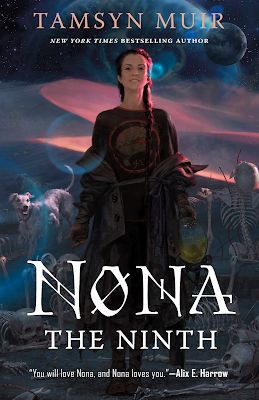
So, unless you’ve been locked in a tomb (with no wifi signal) since 2020, I’m going to assume you know about Tamsyn Muir’s Locked Tomb series. Starting with Gideon the Ninth and continuing into Harrow the Ninth, the Locked Tomb is a series of (obligatory “spoilers start here” warning) wisecracking cosmic cultists, of necromancers and their swordhands and the (literally) soul destroying things they’ve done to keep their cursed empire safe from the vengeful ghosts of its own planets, and of the absurd number of poor emotional choices they have made while doing so. As far as we all knew, the Locked Tomb was to be a trilogy, ending this year with Alecto the Ninth. And yet, we were all of us deceived, for another book was made. Before we get to hang out with Alecto, first we must make time… TO MEET NONA.

…Nona? Who the fuck is Nona?

Well, yes. That’s the question, first asked in the epilogue of Harrow the Ninth and which provides much of Nona the Ninth’s central mystery. Six months after the dramatic climax of the previous book, Muir introduces us to the six-month old consciousness inhabiting Harrow’s body, by all accounts enjoying her life in a wartorn city in the apartment she shares with Camilla Hect, Palamedes Sextus (different person, same body) and Pyrrha Dve. Aside from being a six-month-old consciousness in a nineteen-year-old’s body, Nona has a whole bunch of other things going on. She heals absurdly fast, she’s completely incapable of reading or writing but can inherently understand all spoken languages, she detests eating human food  but sometimes thinks about how nice it would be to eat sand - and her hair grows really, really fast. Oh, and she’s also relentlessly chipper and optimistic, exuding a vibe that is somewhere between “born sexy yesterday” and “live laugh love” in the face of the pretty relentless misery of her surroundings. After the edginess of Gideon and Harrow, it’s a bold move to centre book three around a protagonist who could be outperformed on the edginess stakes by a Minions meme, but it’s the kind of bold move that The Locked Tomb is all about, and here we are.

Speaking of bold moves, Nona the Ninth plunges the reader into a story that jumps off from a fundamentally different place to its predecessor, and while it doesn’t use the reader’s likely confusion as a plot point in the same way Harrow the Ninth does, there’s still zero contextual hand holding if you don’t remember the finer details of that book. (Note: if you do need a refresher, this is a fantastic video recap which covers the key points and some of the meme highlights). The vibes of the setting are different: rather than being at the heart of the empire’s elite, Nona the Ninth’s city setting is – on first glance, at least – full of the ordinary people who make up the world of the Locked Tomb, albeit those living under the threat of annihilation. Even the book’s divisions lean into a more “slice of life” feeling: instead of acts, we have days, and the events of those days are summarised with a combination of whimsical and ominous statements: “Regarding Nona – Hot Sauce Is Watchful – the City Has a Bad Day – Nona Gets a Bedtime Story – Five Days until The Tomb Opens.” To hear Nona tell it, the blue light in the sky threatening planetary destruction is noteworthy but still less interesting than her day at school, where she looks after the teacher’s six-legged dog and is a tolerated low status member of the “cool kid” gang. Of course, plenty of things that happen to Nona which serve to give the reader information: not least her dreams, which we experience as intermissions where Harrowhark and John wander an empty post-apocalyptic environment and John talks about the world before the Nine Houses. She also has an extended family beyond Cam, Pal and Pyrrha which includes Coronabeth Tridentarius, now a high ranking member of the local Blood of Eden group, and while Nona doesn’t have many insights into “Crown” beyond how hot she is, she is at least in the room where more interesting discussions happen between the characters who are more than six months old.

Nona, if it wasn’t clear already, is a source of frustration for me as a character. It’s not that her characterisation is bad: she is perfectly designed to be loveable, the ultimate cinnamon roll doling out affection to characters like Camilla and Palamedes who, frankly, deserve to have someone telling them she loves them on a regular basis. And her role as an innocent sacrifice, happy to live for as long as possible while accepting that ultimately she will die for someone more “important” to return, fits perfectly and heartbreakingly within the broader religious symbolism of the series, and is especially well balanced with John’s sinister personal story and the reprehensible actions he has taken as a self-proclaimed God. On the other hand, Nona is passive, has very little critical insight and because her personal mystery is heavily implied to be tied up with her death, her presence feels like it serves as a brake on the story, rather than helping it to progress. We won’t get back to the main events until we solve whether Nona is Person A or Person B, and once that happens, it’ll be very sad that we no longer have the cinnamon roll, but we can get on with all this tomb unlocking business and maybe kill some more resurrection beasts, so what are we waiting for?

This serves to make the first half of Nona the Ninth feel slow, with a niggling sense that this is a narrative originally conceived as a single act of a bigger book, now stretched over a whole book by itself. Perhaps the reason that wasn’t originally the plan is because there wasn’t quite enough material here to go “oh, yeah, this is a whole book”, especially when shoved between a big Act 2 showdown and a hopefully even bigger finale? It’s nowhere near Victor Hugo levels of “let me stop the plot to tell you about day-to-day life in a nunnery”, but somehow even with the countdown to the opening of the tomb, the physical reminder of destruction hanging over the city, and Nona’s constant references to her own mortality, Nona the Ninth is missing some of the urgency and momentum that made Gideon the Ninth and Harrow the Ninth so utterly irresistible. Things do pick up significantly in the second half, as events around the war and the Blood of Eden presence on the planet come to a head and more familiar faces re-emerge (like, you’ll NEVER GUESS WHO – actually, no, you’ll find out in good time). By the end of the book, I was absolutely raring to go for Alecto the Ninth, but I was also missing the sense of pure emotional turmoil that I got from the previous books, especially Harrow the Ninth.

Regardless, the weakest of the Locked Tomb series is still a spectacular book, and as a piece of serial storytelling, I suspect Nona is going to look more impressive as part of the whole. While Nona’s saccharine sweetness is no substitute for the, uh, spice of Gideon and Harrow, it’s nothing short of an expert move to make a tonal shift work like this at all, and Nona’s story expands the world of the Locked Tomb in ways which I am excited to see pay off. Now it’s time to sit tight, scan the horizon, and wait to see how one or more fleshes might meet one or more ends in the final volume.

Adri (she/her), Nerds of a Feather co-editor, is a semi-aquatic migratory mammal most often found in the UK. She has many opinions about SFF books, and is also partial to gaming, baking, interacting with dogs, and Asian-style karaoke. Find her on Twitter at @adrijjy

Reference: Muir, Tamsyn. Nona the Ninth (Tor dot com Publishing, 2022)

Tuesday, July 28, 2020

Microreview [Book]: Harrow the Ninth by Tamsyn Muir

Can Tamsyn Muir's queer gothic necromancy series get any better? Yes it can.


Cover Art: Tommy Arnold
All right, limber up folks, because today we're diving into one of 2020's most anticipated sequels: more lesbians, more space, more everything. As you'd expect, this will have spoilers for Gideon the Ninth, but I will keep the description of Harrow the Ninth as spoiler free as its possible to be in this riddle-wrapped-in-an-enigma of a book - save for one thing, which I will call "The Big Question". If you have read Gideon the Ninth, you probably already know (and are possibly quite desperate to find out about) the Big Question. This is a safe space and I won't anybody who comes here needing to know *spoiler spoiler spoiler* before it gets naturally unravelled within the text. However, in order to help you out while making sure that this page is free of Harrow spoilers, all I can do if you want the answer to the Big Question is offer you a link to the most accurate way I can answer it. I'm sure this clears everything up and we can now all move on, yes? Good.

Harrowhark Nonagesimus, last surviving child of her insular death-worshipping family, has survived the trials of Canaan House and come out the other side a Lyctor: one of the Emperor's deathless servants, able to work with apparently limitless amounts of necromantic power and fulfil what she feels is her ultimate purpose in life. Unfortunately, she's also a complete mess, incapable of doing anything except screaming and vomiting for the first several weeks of her Lyctorhood - and once she reattains consciousness and finds out the whole deal with the empire and why her presence is now needed, things don't get much better either internally or externally. See, it turns out that in order for the Resurrection ten thousand years ago to have created the House system and restarted the sun, the Necrolord Prime and Emperor of the Nine Houses (a man also known as "John") needed to effectively kill the planets on which the nine houses are based and modify their energies into those on which necromancy itself is based. Only in the same way that murdered humans can end up as vengeful revenants, so too can murdered planets turn into planet-sized undead cosmic horrors, who can only be defeated by humans through complex and equally horrific acts of magic. The Emperor and his surviving coterie - all of whom have been around since the start of the process as well - have managed to take down some of the beasts, but now one is on its way, and Harrow and fellow baby Lyctor Ianthe need to train up to become part of the battle to vanquish it.

Harrow's present is interspersed with scenes from the house, and from the trials she faced... except these don't match up with our own experience of the events, particularly when it comes to the necromancer at her side. Because what Harrow remembers is undergoing the trials with Ortus Nigenand, the indolent, cowardly cavalier who fled the scene early in Gideon the Ninth and ended up making space for Gideon to join. Though Harrow doesn't have the information to figure this out, as readers we're pretty sure that these weird memories probably have something to do with why Harrow's Lyctor powers aren't working properly. Because - and this is your last warning for Gideon the Ninth spoilers - Lyctors need to take in and absorb the souls of their dead cavaliers in order to power parts of their magic, in particular their uncanny healing abilities and the ability to remain physically adept at self-defence while mentally battling in "the River": aka the weird necromancy subdomain which also allows for instantaneous space travel as long as you can survive all the ghostly horrors and the weird metaphors your new colleagues will use to explain it to you. Without Gideon's presence in Harrow's mind or memories, she apparently has no access to the most important weapons she has to stay alive, meaning there's no point in worrying how good a necromancer she is because she's not going to be able to survive to tell the tale.

The apparent development of a Gideon-free Ninth House adventure could outstay its welcome in other hands, especially if we weren't pretty sure from the very start that this absence is a mystery to be solved in the text. Instead, the combined present-and-not-quite-past narratives allow Harrow the Ninth to expand on some of the mechanics of necromancy through Harrow's eyes, and offer a better sense of just what this millennia-old system of houses has been set up for and what's behind the Emperor's mysterious disappearance from his own empire. There's also the introduction of The Sleeper into the past narratives, a deadly mystery force who appears to be unrelated to all the previous deaths, and who starts picking off the characters of Canaan house in a different order to the one we originally saw, though with similar effect. All of this is told in a style that, while  less overtly irreverent than Gideon's running commentary, still doesn't skimp either on the loving descriptions of human anatomy (this time around, the bones usually have specific names, because of course Harrow wants to tell you exactly what bone a construct has come from) or the occasional deployment of metatextual memeage used without knowledge by the characters (though there's at least one who knows exactly what they are doing). These moments regularly come at a point where they kick a scene from poignant and/or brutal to "I am now feeling all of the emotions", and reader, I did feel all of the emotions, messily and out loud.

As in Gideon the Ninth, the characters are delightfully human and also delightfully awful to each other. Because the First House has been pared back so brutally, and is comprised entirely of people who have killed their loved ones in order to ascend to their current powerful states, the dynamics and interactions between its members are claustrophobic and excruciating, and Harrow's weakness and... Harrow-ness... means that she very much becomes part of the negative dynamic as a written-off walking corpse. That claustrophobia makes it almost a relief to escape into the past Canaan, and to see the ways that relationships start developing differently in the murder house - particularly with Abigail Pent taking the fore, a character who only had the briefest time to shine in the first book. It's difficult to talk about the Canaan plot without giving too much away, but I will note that the way the dead characters are handled ends up being an advancement of plot lines rather than a relitigation, and this alternate reality ends up dovetailing with Harrow's present to build to a glorious climax.

And that's the real big question, with a book this dense and complex and self-contradictory: is Muir going to pull it off? In a word: fuck yes. It's that payoff to a deeply ambitious structure that really puts Harrow over the top, even when compared to its juicy but more classically-plotted predecessor; it takes serious talent to turn part of your sequel into a nonsensical retcon of the events of the previous book without completely losing your audience, let alone to turn that retcon into a vital strand of the plot and a vehicle for character growth in its own right. Even when it's refusing to take itself and its own genre seriously on the surface, every twist in Harrow's tale draws the audience deeper into its terrifying, ridiculous, mystical world and the people within it. This is a rare series that lives up to its hype and then some, and Harrow the Ninth one of the best books I've ever read.

The Math

Baseline Score: 10/10

Bonuses: +1 a split narrative that knocks it out of the park in terms of character development and timeskipping mystery solving; +1 bones

Penalties: -1 Hard to put down before the Big Question gets resolved, may impact on sleep and other basic life functions (but it's OK, it's a necromancy book); -1 Harrow's lack of upper body strength

Nerd Coefficient: 10/10

POSTED BY: Adri, Nerds of a Feather co-editor, is a semi-aquatic migratory mammal most often found in the UK. She has many opinions about SFF books, and is also partial to gaming, baking, interacting with dogs, and Asian-style karaoke. Find her on Twitter at @adrijjy.

Reference: Muir, Tamsyn. Harrow the Ninth [Tor.com Publishing, 2020]

Monday, September 9, 2019

Microreview [Book]: Gideon the Ninth by Tamsyn Muir

The Queer NecRomantic Murder Mystery You've Been Missing All your Life

Cover art by Tommy Arnold

To say that Gideon the Ninth, the debut novel from Tamsyn Muir, has been the subject of some hype is like saying the Pacific Ocean is a bit wet. The hype about this skeleton-based queer adventure has been slowly taking over my Twitter feed since the end of last year, and its regularly felt like the universe was divided into those "lucky" few who had already read it (and were therefore falling over themselves to talk to the rest of us about skeletons) and everyone else waiting for the release to roll around. At last, dear readers, I have graduated into the ranks of the skeleton analysts.

Was it worth it? Oh, very yes.

Gideon is an orphan raised in indenture to the Ninth House, a crumbling ruined cult living on a nigh-uninhabitable planet, now facing total extinction. Ignored by most and openly tormented by the only other girl her age, Reverend Daughter Harrowhark, Gideon has been plotting her escape for years and on her eighteenth birthday, now finally has her chance to make her way off planet and into a marginally better life. On the verge of making good on her escape, Harrow outwits her at the last minute, only to instead offer to take her as a "cavalier", a sworn bodyguard to the House's necromancer, on a very different sort of quest. The First House - that of the Emperor - has offered a challenge, enabling a representative from one of the houses to ascend to the Emperor's services if they can successfully complete a task on the deserted First House planet. Left without a choice (and clearly intrigued and also maybe a bit into Harrow) Gideon takes on the challenge, taking a crash course in what it takes to be a cavalier before setting off to a crumbling house for an uncertain contest with the other seven houses. And then, of course, the murders begin.

In its worldbuilding, Gideon the Ninth takes a particular kind of claustrophobic gothic sensibility - one that's embodied in speculative work like Gormenghast and Under the Pendulum Sun - and applies it on an interplanetary scale whose mechanics are vague but also irrelevant. There's an empire, which we don't get a whole lot of information on, but whose leadership appears to be at the least chronically absent from the house structure its created. These houses specialise in upholding different aspects of the empire, ranging from practical services like "being soldiers" or "managing the library" to more nebulous professions like "being likeable", "thinking you're good at diplomacy but you're not, actually", "dying of attractive forms of consumption" and, of course, "skeletons". There's definitely an evolution to be drawn here from the districts of the Hunger Games or factions of the Divergent trilogy (and before those, the Hogwarts Houses) to this distinctly non-YA portrayal of a dysfunctional and yet internally meaningful classification system; in practical terms, the houses allow Muir to introduce a lot of characters and give them motivations in a relatively short space of time, and to allow the representatives of the Ninth House their own pre-existing prejudices and conflicts with those houses, while still maintaining them as outsiders to civilised company. Almost all of the supporting characters grow beyond the stereotypes of their house depiction (the main exception is the soldiers of the Second House, but they play their role and further nuance is not really missed), creating a highly satisfying political-necromantic soap opera which gets more desperate as the body count starts to build.

At the centre of it all are Gideon and Harrow, and their deeply dysfunctional relationship, all told through Gideon's lens. Muir may have written Gideon the Ninth in third person but it's most definitely Gideon's voice, and the portrayal of someone who has spent so long putting up with overblown spooky bullshit that she has no more fucks or reverence to give is utterly hilarious. Though Gideon makes no explicit cultural references to anything but her dirty magazines (and those play less of a role in the narrative than you'd think), her voice is imbued with what in other mediums would be referred to as "easter eggs": occasional memetic pop culture references to things like Mean Girls, which don't detract from the text if you don't read them as such but add to the idiosyncratic irreverence if you do. Because the atmosphere is so well defined beyond Gideon's perception, it makes for some highly amusing moments where Gideon's internal descriptions contrast with what's objectively going on: for example, her enforced vow of silence in early chapters allows her to come across as a creepy, mysterious hooded-and-painted skull figure to the rest of the group, even as she's walking around being internally rude, judgemental, and bored. The fact that the atmosphere isn't really dented by Gideon's irreverence is testament to Muir's skill in balancing the tone of what could have been a very uneven book. Instead, it all meshes together to create something that feels unique and fresh with a wonderful character voice, and a strain of heartbreak that really creeps up on you under all the hardened sword-wielding snark.

Another point of skill is the way that Gideon and Harrow's enemies to "it's complicated" relationship unfolds (complete with multiple complications including the aforementioned attractive consumptive necromancer), completely against the intention of either character, against a backdrop of general queerness despite their being very little in the way of explicit romance. Although I found it mildly frustrating that the few more "established" couples seem to be heterosexual, the way queerness is incorporated normalises it in a way which then enables Gideon and Harrow to be utterly obtuse about each other without it coming across as "baiting" or textually ambiguous that they could jump each other's bones (I promise that's the only skeleton pun that's going to make it in here) (but only because I'm kind of tired and don't expect any more low-hanging fruit). It's an important balance to strike particularly in a book like this where the trajectory is not towards an uncomplicated happy ending for the disastrous duo, because if lesbians are going to end the story unhappy and/or out-of-action, I need an author to have earned my trust along the way. However, this is a point where individual mileages may vary, and if you're a reader steer clear of "bury your gays" in the broadest sense then it may be worth seeking out a more spoiler-heavy review to work out if Gideon the Ninth is a book you want to invest in.

For me, therefore, this book has certainly earned its pre-release buzz, and I expect the community excitement is only going to increase as more people get to experience the world and characters Muir has created here (there was already a Gideon cosplay wandering around Worldcon one day, which I was pretty excited to see even before getting to read the book). In a strong year, Gideon the Ninth has effortlessly risen to near the top of my 2019 reads, and while its combination of gothic-grimdark worldbuilding sensibilities and post-Potter Millennial teen snark isn't going to work for everyone, it certainly does capture a genre zeitgeist which I was thoroughly delighted by. Best of all, there's just so much more of this bizarre world to see, and it sounds like we won't be waiting long before the next adventures of our skeleton faves in Harrow the Ninth.

The Math

Baseline Score: 8/10

Bonus: +1 Double Bones with Doctor Skelebone; +1 I could probably write a second review on all the other necromancers and cavaliers and my feelings about them (except the Second House)

Penalties: -1 Worldbuilding is a bit light on everything that doesn't play into the "Double Bones with Doctor Skelebone" aesthetic

Nerd Coefficient: 9/10

POSTED BY: Adri is a semi-aquatic migratory mammal most often found in the UK. She has many opinions about SFF books, and is also partial to gaming, baking, interacting with dogs, and Asian-style karaoke. Find her on Twitter at @adrijjy.

Reference: Muir, Tamsyn Gideon the Ninth (Tor.com Publishing, 2019)