Tuesday, March 11, 2014

True Detective Conquers All

Today Philippe and I mourn the passing of True Detective, a show that will return but in fundamentally different form. We present our eulogies, point-counterpoint style, though in truth we agree far more than we disagree. WARNING: some heavy-duty spoilers, so don't continue if you haven't finished the series yet.


The G - Remember when people used to argue over whether The Wire or Breaking Bad was the best American TV show of all-time? Yeah, fuck that. Sure, I still haven't gotten around to Breaking Bad (I know, I know), but here's the thing: True Detective isn't just the best TV show I've ever seen, it's pretty much the best TV show I can imagine ever seeing.

Now, I could cite any number of things as proof of its greatness: the acting, the dialogue, the depth of characterization. But plenty of other Golden Age of Television shows have these things as well. And it's not the deep social commentary either. The Wire is, in essence, a literary ethnography of the American inner-city and its on-going decay; Breaking Bad, I've heard, does the same for the suburban middle-class; The Sopranos for the American family; etc. True Detective has that kind of stuff too, though its philosophical musings are a bit more abstracted.

It is worth lingering on the acting for a minute, though. It's a thing now for well-regarded film actors move to the small screen, but most of them, frankly, kinda blow. I mean, that Christian Slater/Steve Zahn bullshit ABC is currently trying to smear on the walls? Come on. Matthew McConaughey's portrayal of the idiosyncratic pessimist philosopher/cop Rust Cohle, on the other hand, is a revelation--a portrayal so focused and purposive that, for each 60 minute episode, it positively annihilates any memory of Dazed and Confused. For 60 minutes, McConaughey is Rust Cohle. And as the show progresses, it dawns upon you that Woody Harrelson's meat-and-potatoes cop Marty Hart may in fact be the more complex character. It's a subtle portrayal, which McConaughey's Rust is not, and that's partially attributable to the writing and direction, but it's also testament to how fucking good these actors are in these roles.

And then there's Michele Monaghan's Maggie Hart. She's has gotten some flak for her "vindictiveness" from some, and written off as a plot device by others, but those are shallow readings in my book. Maggie is a good mother and wife driven to the edge by her philandering drunk of a husband, and who, when she reaches that point of no return, stands up to Marty and refuses to back down--even when he threatens violence. This is a scene about consequences (for both Marty and Maggie) of the choices we make, and about agency--Maggie's agency. To the degree that it is about Marty and Rust, it exists to outline the uncomfortable relationship between Marty's personal misogyny and the gendered violence he and Rust confront during the course of their work as detectives.

It is also worth lingering on that confrontation scene, because in fact no violence comes. And for a show centered on the serial murder of women and girls, True Detective for the most part eschews the exploitative, sexualized and festishized violence that plague this category of show, and resists splatterpornography. True Detective lingers on the threat or intimation of violence, not the cheap thrills of graphic cruelty and gore. 

And I could go on about how True Detective, more than any other show I've seen, manages to be both highly critical of religious power and deeply respectful of religious beliefs and religious people.

But while of these things are unambiguously good, if I were to identify the elements of this show that are near unprecedented, the things that set it apart from just about anything ever made or anything that will ever be made for the small screen, American or otherwise, it would be two things and two things only.

No American show has ever had such a clear artistic vision

This is art, the way Ingmar Bergman and Andrei Tarkovski films are art. Plenty of Golden Age shows have great dialogue, memorable characters and heady atmosphere. But True Detective is the first show I've seen since Twin Peaks that cares--I mean, really, really cares--about what image and sound can actually do. But Twin Peaks was only really good in that way when David Lynch was in the director's chair. Cary Joji Fukunaga, by contrast, directs all eight episodes. True Detective has a distinct, consistent and incredibly well-implemented artistic vision. It's slow, ponderous, abstracted and careful, the way The Seventh Seal or Solyaris are slow, ponderous, abstracted and careful.
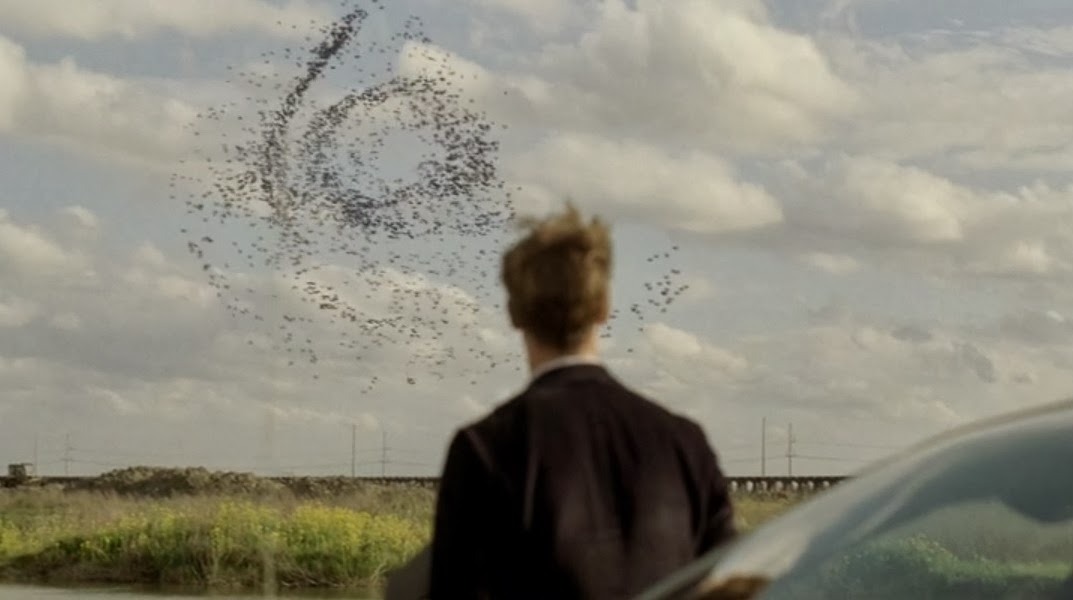
There are so many little moments of wonder in True Detective, from the cultish death scene that opens the premiere to the quasi-Lovecraftian horror of Childress' Carcosa, from the overhead shots of Rust's pickup on the freeway to the panoramic views of Louisiana--its foreboding jungles, swamps and the evidence of humanity's decline. And they fit the script as well as you could imagine. As James Poniewozik writes, on one of my absolute favorite moments in the series:

Streetlights streak like heavenly bolts; clouds on the horizon take on an apocalyptic glow; the swamp and backwoods seem haunted. “The visions—there were times that I was convinced that I’d lost it,” Rust says. “There were other times I thought I was mainlining the secret truth of the universe,” and that hits home with a striking visual at the end of the episode, when a flock of birds seems to briefly resolve itself into an intelligible pattern before Cohle’s eyes and ours.

This is the heart of genre darkness

Shows that contain mysteries about the nature of the mystery (Twin Peaks, Lost, BSG, etc.) tend to produce an awkward discourse between writers and fans, where writers drop clues and red herrings, fans develop theories, and writers struggle to create a solution that both satisfies the investigators and still manages to surprise everyone.

The result is almost inevitably disappointing to at least some corners--and True Detective is no different. Sure, True Detective came in familiar packaging--the police procedural, the hardboiled detective story, the hunt for a serial killer, etc. But it kept hinting that it would metamorphose into full-blown horror. There were the little hints sprinkled throughout the season--the recurring patterns, the more-than-coincidental names, the literary references, the signposting. The Yellow King! Carcosa! We grew certain of such things.

But in truth, True Detective used the symbolism and iconography of horror to establish its apocalytptic atmosphere. This is noir, pure and simple, a small-scale holocaust of the human soul--Lovecraft without the tentacled bodies; Revelations without the horsemen.

At heart, True Detective is noir, real noir the way Raymond Chandler wrote it. Not the crapsack pessimism of James M. Cain or Jim Thompson, but the deep anguish of Marlowe's world, where the good take punch after punch and still get up and come back for more; where victories are small but meaningful.

The series ends on an optimistic note, as if to argue that it isn't all meaningless. “Well," Rust says as he looks to the stars. "Once there was only dark. You ask me, the light’s winning.” 

With Fukunaga leaving and the show reverting to direction-by-committee, True Detective may never scale these heights again. Perhaps no TV show ever will. I'm fine with that.


***

Philippe: There was never a King in Yellow. No Carcosa, no black stars, no Hastur emerging from the bayou.

Your disappointment was intentional. There were never going to be any revelations or resolutions, nothing that would make sense of it all. It was just murder. Creepy fucking murders that we all overanalyzed. Like Rust, we frantically sought meaning in True Detective, though we feared, perhaps unconsciously, that there was nothing there there. And there wasn’t.

Nic Pizolatto did something brilliant: he’s made manifest the madness that Robert W. Chambers associated with the The King in Yellow.

The play at the center of The King in Yellow not only drives its readers insane, but it provokes obsession, fervent speculation, and endless theorizing among the masses. Did Pizzolatto intend for True Detective to provoke a similar outcome, to cause us to ponder every possible angle, to fall into an online rabbit hole, Googling “Carcosa” and “the Yellow Sign”? Did Pizzolatto seek to make real the madness Chambers imagined?

I want to say yes. Perhaps I am giving him too much credit. Perhaps our collective obsession was simply a typical reaction to such a symbolically dense work of art.


There’s no need to rehash the theories and speculations—we’ve all been proven wrong. There is a larger conspiracy that remains unsolved. As the anchor revealed, Errol Childress’s relation to the Tuttle clan was denied. Maybe there was witchcraft, bayou voodoo meshed with medieval Catholic folklore. Or maybe the Tuttles are a bunch of sadistic psychos whose pageantry was intended to instill terror in their victims.

The pessimistic season finale would certainly have pleased Rust. There’s no resolution in life, no bigger picture, no hidden meanings. There’s flesh and murder. Pain, suffering, and senselessness. Nietzsche, Lovecraft, and Camus knew this. Rusyy knows it. Some of us have accepted this fact, though most of us cling franticly to mythologies and empty platitudes that prevent us from seeing the world in all its meaningless and chaotic glory. “Everything happens for a reason.” Sorry, things just happen. Like murder.

So, in case you didn’t listen to Rust’s pontificating this season, the finale was there to remind you: there’s no fucking point to all.

The philosophy of True Detective has been criticized by philosophers. I am a philosophical layman, but I feel that this criticism is misplaced. The haters have called out Rust for being a rather shallow and superficial philosophers. But what exactly is wrong with his philosophy? Life is a pointless circle from which we cannot escape. As anyone who has struggled with addiction or bad relationships knows all too well, this is how the world works. This may go against out Protestant American individualist penchant for self-improvement. It’s certainly possible, but few of us ever become better people. We remain who we are. And we keep smoking.

This isn’t Satre’s analytical acrobatics, 50,000 words to make a simple point. This is Camus’s directness, bashing us over the head with the simple and seemingly cruel absurdity of it all. There’s no need to read Being and Nothingness, at least not for most of us. The Stranger and True Detective have the same message: It’s all pointless. (Read this for someone smarter than me making a better argument. I’m a sociologist, after all.)

 Of course, Rust doesn’t live by his own philosophy. He is seeking meaning through solving the case, the paying the debt he and Marty owe. And that’s the point: we all seek meaning, because the chaos of it all is terrifying. Plus, it’s a cop show. That we got any philosophy from it is a considerable accomplishment.

Last point: I absolutely loved the show’s last scene. Rust and Marty finally got to be buddies. Buddies are the best.

***

Monday, March 10, 2014

GUEST POST: Is There Such A Thing As A Book That Belongs To Only One Genre? by Peter Higgins

We are thrilled to welcome Peter Higgins, author of the genre-bending novel Wolfhound Century and its sequel, the forthcoming Truth and Fear (published by Orbit Books)! You may recall Jemmy's review of Wolfhound Century, which he called a "fantastic debut" that "defies easy classification." Well, today Peter delves deeper into the subject of classification, problematizing the very assumption that books can or should be placed in neat, tidy categories. Without further ado, then, I present Peter's essay:

Is There Such A Thing As A Book That Belongs To Only One Genre?


My reading hinterland is haunted by lost genres. Kinds of book I once loved to read, whose memory is still warm, but whose moment has passed. The young adult space opera. The Cold War spy story. The epic adventure quest with a largely adult readership where all the characters are talking animals. They sold in millions once, and not so long ago, but they’ve largely fallen out of print. You can still write books like that but publishers rarely touch them. Their time has gone.

When a genre becomes massively popular it seems to prepare the way for its own demise. It booms and multiplies for a while because the unique pleasure it gives strikes a chord at a moment in history. It works again and again, and people go back for more and more of the same, until the formula becomes so well defined, so clear-cut and repeatable, so good at delivering one particular kind of pleasure, that you look for nothing else there. Read one, you’ve read them all. And then the world moves on and readers look for new pleasures.

I wish this didn’t happen, this tendency to put stories into genre boxes which then get more and more constrained until the pleasure they give is suffocated. For me, books aren’t like that, not really. For me, fiction isn’t fractal.

A fractal pattern is always the same: look at it whole, and it’s one thing; magnify a tiny part, and it’s still the same thing. But the way I see it, books aren’t like this: no book belongs so thoroughly to one genre that it’s the same all through and doesn’t draw in other genres as well. Look inside any work of fiction and you'll find lots of genres, shifting and shimmering, nested one inside another, claiming your attention, now one, now another.

The idea of mixing genres is as old as the book. When collections of scrolls of holy scripture were brought out of their chests, put into an agreed and permanent order, and sewn together between covers to make a single aretfact, the idea began to grow that the gathering together of prophecy, song, poem, chronicle, genealogy, parable and vision created a single comprehensive whole. All parts of one larger story, together they made something comprehensively and fully true which no single genre could capture. Later the concept was retrospectively applied to other great works. Homer’s Odyssey, Virgil’s Aeneid. These towering ancient classics came to be seen as encyclopedias of different genres: it was part of their "all-encompassing-ness." In the Renaissance, writers set out deliberately to repeat the trick, proving their own prowess and the greatness of their national language and literature by absorbing and demonstrating as many genres as possible in their epic poems. They had a term for it, genera mista, and Edmund Spenser wrote one for England, The Faerie Queene.

Ambitious writers have come back to this idea from time to time ever since. T S Eliot in The Waste Land. James Joyce in Ulysses. But now more than ever, in our age of democritized reading and writing, it’s true of all books, not just the ones that overtly make a point of being genre mixes. Stories move from genre to genre, often within a chapter, even within a paragraph, even within a sentence.

Here’s an example of the kind of thing I mean:

A year past her emergence into society, with no suitors in sight, Alise had resigned herself for the role of maiden aunt. She played the harp, tatted excellent lace, was very good at puddings, and even had selected a suitably whimsical hobby.

This reads like something you might find in a 19th century novel. Not Jane Austen – Jane Austen characters aren’t good at puddings – but Little Women, maybe. Yet here’s the next sentence:

Long before Tintaglia had jolted her dreams, she’d become a student of dragon lore, with a strong secondary knowledge of Elderlings.

It’s from Chapter 3 of Robin Hobb’s The Dragon Keeper: Book One of The Rain Wild Chronicles. Alise belongs to a family of Rain Wild Traders: second or third generation pioneers, living on a frontier they’ve only partially made their own, but they’ve been there long enough, and they’ve become secure and prosperous enough, to absorb themselves in petty social hierarchies. By dipping into the language and conventions of a 19th century genre, Robin Hobb brings in a whole set of intuitions about the Rain Wild Traders that she doesn’t need to spend time explaining, because we already understand them. But The Dragon Keeper doesn’t pause long in Alcott land. The dragon is coming.

This is great non-fractal genre writing, but I think all books live like this. In Ark, Stephen Baxter kicks a slow time on the generation starship into new life by shifting into murder mystery mode for a while. In The Sea, The Sea, Iris Murdoch deepens her picture of an isolated aging man’s bizarre rekindling love story by bringing in poltergeists and glimpses of UFOs.

Characters that breathe the air of only one genre struggle to come alive, but let them open windows into other genres - even one-phrase micro-genres - and they're the more vivid for it. If a genre gives a unique pleasure, a unique insight, then letting in other genres enriches the mix. That way, genres can morph and grow, absorbing other ways of writing and new ideas. Robin Hobb takes epic fantasy in one direction, other writers take it into harsher, grittier territories. And when a popular genre’s moment in the sun passes, it gets absorbed back into the inexhaustible well of story possibility, with all the promise and potential it ever had, waiting to be used again.

I think this process of absorption, morphing and re-use is at work everywhere in works of fiction, at every level. I’d go so far as to say that, though some books foreground the technique and others don’t, it’s universal. Look at a page, a paragraph, in any book and, if you want to, you can see flashes of other genres living there: as a turn of phrase, a way of handling point of view, an echo, a single word. They’re open windows. Breaths of different air.

And maybe someone’s out there now, breathing dark and gritty new life into a book with talking animals. Maybe it already exists and I haven’t found it yet. I hope so.

Thursday, March 6, 2014

Thursday Morning Superhero

Before moving into the world of comics I feel the need to bring your attention to the upcoming David Lynch art show, "In Dreams", that is going to be opening at the Spoke Art Gallery in San Francisco.   The opening reception is this Saturday and you can get more information by checking out the blog here.   Spoke Art hosts some fabulous shows and this one looks to be spectacular.  Too bad I am trapped in Indiana.  Well, at least I have my comics to keep me company!


Pick of the Week:
Magneto #1 - Cullen Bunn has demonstrated his mastery over horror so pairing him with Magneto is a match made in heaven.  Before I review this book, as someone who resides in the Midwest, it pains me to see this title open in Cape Girardean, Missouri.  I can only imagine that it was intended to be Cape Girardeau and was an honest mistake, but I want the good folk who live in Cape Girardeau to feel excited that Magneto had coffee there!  Despite this minor flaw, this title is simply compelling.  Bunn delves into the psyche of this notorious villain and reminds people of how simply vicious this mutant can be.  Magneto is currently investigating crimes against mutants and appears to be living in a world that is a cross between Memento and Bottle Rocket.  It is definitely interesting to see him in the role of detective and I am very excited about where Bunn is going to take this series.  Go buy this title right now!

The Rest:
The Auteur #1 - When I learned the good folks at Oni Press sent advance copies of this book to the Westboro Baptist Church I knew I was in for a treat.  The Twitter account of the "church" sent a reply to Oni Press and told them they could keep their pornography to themselves.  While The Auteur is far from pornography, it is easy to see how one could be offended from such a book.  While I would not recommend this book to all, I quite enjoyed the tale of a struggling Hollywood producer and found it to be like nothing on the market currently.  The gore is over the top and feels like a Garbage Pail Kids card, but it fits the trippy tale of one man's quest to reclaim his career.  Unique series that is worth your time if you are not easily offended.

Secret #6 - Jonathan Hickman's crime noir delivered an action packed sequence straight out of summer blockbuster that was over before I knew it.  Not wanting to spoil anything, things get a little messy as Steadman and company prove to be formidable foes.  We are left with a stressful situation that has me yearning for a quick turnaround on issue #7.  Not sure if I would suggest picking this up now, but would definitely recommend picking up the trade whenever it is released.  This is a phenomenal series.

Quantum and Woody: Goat #0 - The good people at Valiant tricked me into reading a goat's origin story and I am happy they did.  This is a funny, heart-felt tale about two partners and their goat.  As a newcomer to Quantum and Woody, I plan on checking out what the series has to offer after picking up this title.  The writing is fresh and witty, there are references to Dolly the Sheep, and the ending hook left me wanting more of this series.  Valiant is really establishing itself as a strong independent publisher.

Moon Knight #1 - The insane life of Moon Knight has always intrigued me since a friend introduced me to him a few years back.  Marc Spector, Moon Knight, appears to be suffering from multiple personalities and is absolutely bonkers.  Despite this, he is on the side of good and is assisting police in an investigation.  While nothing groundbreaking occurs in this issue, it appears that Moon Knight is in capable hands and that the great Warren Ellis has big plans for Mr. Spector.  I will continue reading this series and hope you do as well.

POSTED BY MIKE N. -- comic guy, proudly raising nerdy kids, and Nerds of a Feather contributor since 2012.

Tuesday, March 4, 2014

Microreview [book]: Honor's Knight, by Rachel Bach


Bach, Rachel. Honor's Knight. Orbit Books, 2014 (last week!).
Buy it here .

Honor's Knight: Or, the Rom-Act Grows a Conscience

The Meat 

Recently I've been rather curmudgeonly about second installments (in trilogies or longer series), pointing out that almost none manage to equal, and astonishingly few surpass, the 'original' work from the first installment. How many Empire Strikes Back-level sequels have there really been, after all? But as various songs would have it, "This is it!" Rachel Bach (a.k.a. Rachel Aaron) charts a thrilling ride for Devi Morris and the reader, bringing her and us several giant steps closer to the clearly apocalyptic denouement looming just over the horizon (in book three if not beyond). She's managed to improve on the already excellent foundations laid in book one, ramping up both action and a sense of emotional engagement between characters (and between the characters and the readers) to dizzying new heights.

Bach also delves deeper into the mechanics, so to speak, of the various races and their physical (and more ethereal) attributes, treating the reader to a fascinating and fully fleshed out rendering of their capabilities. And she's also brought a new level of attention to the possibility of shifting loyalties and alliances, even for Devi (who by her Paradoxian upbringing is a bit of a samurai, "Death before dishonor or betrayal" kind of loyalist). She finds new allies in the unlikeliest of figures, and friends turn into enemies and then into the intermediate limbo of frenemies with breathtaking speed. Yet Bach handles such situations with considerable care, ensuring the reader can follow such rapid changes in alignments without any difficulty accepting their plausibility.

In fact, Bach even raises the philosophical level of her tale from relatively harmless rom-act (romantic action) in book one to a more serious "At what price (individual/species/universe) survival?" It is this greater level of nuance, more than anything, that humanizes both allies and frenemies alike, because as readers we instinctively sympathize on an emotional level with the romantics who insist some prices are too high to be worth paying even as intellectually we are forced to concede the logic of the utilitarians who insist that for the survival of the many, a few must be sacrificed...in short, there are no Voldemorts or Dumbledores, no simple paragons of good and evil, in this tale.

That said, Honor's Knight never risks becoming too gloomy in tone or losing its (or, one might imagine, Devi's own) irrepressible sense of optimism, that classical Hollywood-esque feeling that everything not only might, it surely will turn out all right in the end. Whether you approve of this sunny quality will depend, of course, on whether you think the world is getting better or getting worse (let me just say, for all you committed pessimists out there: what evidence can you possibly have that the world is getting worse? And don't you dare say "because it's more violent/dangerous," because invasion of the Ukraine notwithstanding, humankind has never enjoyed such relative freedom from violence, on such a (nearly total) global scale, in all of recorded history!) And speaking of violence, Devi brings the goods: Honor's Knight contains plenty of good old fashioned awesomeness in the form of Devi using her fancy armor to devastating effect against a host of different enemies.

What isn't there to like about this sequel, in short? I can only think of one thing, and that's the on again, off again romance between now frenemies Devi and Rupert. Naturally we can all appreciate why a man would fall for Devi—she's pretty amazing, after all—but why would she keep doting on this guy (even leaving aside for a second the difficulty I have with the seriously uncool name "Rupert") after all the crap he's put her through, and more importantly, after she figures out his deal? Perhaps the title should be "White Knight", because she's definitely got the syndrome, wanting to save him from his own crappiness...

Be that as it may, however, Bach really delivered in this volume, and she's got at least one reader who can't wait to read book three! Will Devi uncover the mystery of the phantoms? Discover how to restore the Daughters to themselves? Or just die in a blaze of (cool but ultimately ineffectual) glory? Given the inexorability of a happy ending, something tells me it won't be the latter!


The Math


Baseline assessment: 7/10

Bonuses: +1 for graying the story and characters up, and rising above a Harry Potter-style simplistic view of good and evil... and +1 for doing so without losing the essential action-packed awesomeness at the heart of book one

Penalties: -1 for still not quite selling the Devi-Rupert "love conquers all" plotline


Nerd coefficient: 8/10 "Well worth your time and attention"

For more info on our scoring system--and thus, why an 8 is a fantastic score--see here!  

Monday, March 3, 2014

Microreview [book]: Then Will The Great Ocean Wash Deep Above by Ian Sales


Sales, Ian. Then Will The Great Ocean Wash Deep Above [Whippleshield Books, 2013]
Buy: Print or Kindle
File Under: science fiction, hard


Sales four-part alternate history of the Apollo space program is one of my favorite on-going series in SF/F. But I use the term "series" in the most abstract sense possible, given that the novellas do not appear to take place in the same timeline, do not involve the same personnel and are, really, only bound to one another by dint of being alternate histories of a space program Sales clearly loved, albeit with some significant reservations.

Of the three installments published to date, Then Will The Great Ocean Wash Deep Above, is the most centered on on those reservations--specifically, the institutional sexism that barred women from space until the 1980s. It explores this theme through (surprise, surprise) an alternate timeline in which the Korean War drags on far longer than the actual one did, creating opportunities for women that wouldn't have been there had the men not been off fighting a war.

The women pilots chosen for the space program, called the Mercury 13, are modeled after actual historical figures who, in the late 1950s and 1960s, were tested as candidates for the space program. The real Mercury 13 were denied their chance, thanks to a combination of institutional sexism within NASA and dogged personal rivalries that undermined the possibility, however slim, that said sexism could be overcome. In Then Will The Great Ocean Wash Deep Above, Sales reproduces the personal rivalries, but in the context of women being the only astronauts.

Though Then Will The Great Ocean Wash Deep Above is undoubtedly a political story, and specifically a story about sexism, the politics are subtle enough so as not to overwhelm other elements of the narrative, thus broadening its appeal beyond the subset of fellow-travelers who are specifically looking for politically progressive SF. And as it happens, the story about the Mercury 13 pilots only takes up half the real estate in the novella, the other half dedicated to a deep-sea search for a missing cache of film from  a spy satellite, and a rather remarkable discovery made in the process.

As with its predecessors, Then Will The Great Ocean Wash Deep Above is decidedly "hard" SF--meticulously researched, pre-singularity SF that would recall Arthur C. Clarke, had Clarke possessed more interest in human subjects. It is both nostalgic and forward-thinking in a way I find deeply appealing, and of the three Apollo Quartet novellas I've read, this was the one that most made me rethink my assumptions about the historical space program.

At the same time, it feels a bit disjointed in comparison to the ultra-tight Adrift on the Sea of Rains and The Eye With Which The Universe Beholds Itself. The two narratives don't lock together as neatly as I had hoped, while the Mercury 13 storyline is, at least to me, significantly more interesting than its deep-sea counterpart. On balance, however, this is an excellent novella and a worthy edition to an eye-opening series.

The Math

Baseline Assessment: 8/10

Bonuses: +1 for this being the most historical of these alternate histories, and for doing it right; +1 for striking a good balance between clarity and subtlety with the politics.

Penalties: -1 for lack of narrative lock; -1 for unevenness of two narratives.

Nerd Coefficient: 8/10. "Well worth your time and attention."


***

POSTED BY: The G--purveyor of nerdliness, genre fanatic and Nerds of a
Feather founder/administrator (2012).

Friday, February 28, 2014

Microreview [book] : The Martian, by Andy Weir


The Martian; Weir, Andy [2014, Random House]

The Meat

This book has been around a while; self-published three years ago, it found a fan base and got picked up by the big leagues, and in the time I've been reading it a poster campaign has hit the London Underground walls. So this is a huge success for Weir, and in many ways deservedly-so. The set-up is great, and ripe for a film adaptation. After an accident during a storm on Mars (in the near-future) a manned mission aborts and heads for home, with one injured member lost and left for dead in the storm. He is however alive and becomes the titular Martian, the only human on an entire planet.

Descriptions of his feelings, or his surroundings are almost entirely absent; too much present-day colloquialisms ("owned", starting statements with "so") to feel right, combined with a casual jocular and slightly jock manner. Feels too samey, too safe. And the admirable technical and scientific details Reid flood the tale with take more in emotion and drama than they bring in vermissitude. I wanted the terror his humour holds at bay to surface. 

Just as I was starting to get bored the narrative switched to third person of mission control back home and then it gets more interesting, however this blessing is a mixed one. When we get back to Mark on Mars's diary, it's twenty days later . The flow and intensity of the situation has been eased even more and he is still hookah about old tv shows like the geeky blogger he is rather than the trained astronaut he should be. And I still couldn't feel what he felt , couldn't get a sense of his environment and what it's like to be alone on a planet. One of the greatest and most chilling endings to a book I've read was the end to Jed mercurio's Ascent, (spoilers) with the cosmonaut stranded forever on the dark side of the moon, alone with no one aware he was there.

The log nature of the telling continued to wind me up the wrong way. When Watney writes things like "Sorry I haven't been keeping the log up to date" I felt relief that I could for once just be told what happened in one chunk. This is largely because Weir knows his stuff. And his stuff is air pressure, water supplies, drill voltage and hydrogen separation. All, literally, vital stuff for our stranded hero, and the issues with equipment, environment and maths are the fibres of his survival suit, but honestly I don't want to know how James Bond's ejector seat gets fixed, I just want to see it work. 

Yet to appreciate a moment of disaster one has to have understood the previous ten pages of science. I'll admit to being a failed student and also admit to enjoying the straightforward and unpretentious way Weir guides us through telemetry or airlock pressurisation. Although I stand by my point that the wads of exposition dragged, there were also several moments where it felt like I finally had the physics teacher I would have wanted at school. However, overall, the lasting effect was for me a drain on my concentration and a further drain on the tension of the situation.

And then (spoilers) he makes contact with Nasa and soon millions are watching the daily news shows centred on his situation, and we as readers are freed from the chain of log entries, introduced to new characters and see a months-long rescue plan kick into gear. During this mid-section of the book, as the people on Earth wrestled with how to resupply, the crew who unknowingly left Watney behind wrestle with their guilt and what to do next and Watney's fate becomes more uncertain, my interest rose again and the returns from others' stories to his log entries made me fonder for them.

Still, though, his unflagging and unflappable optimism held, and no true understanding of what such isolation and fear would do to a mind emerged. This is an inter-planetary tale that remains all surface. 


The Math

Baseline Assessment: 6/10

Bonuses: +1 for amazing detail and research; Reid seems to know and love his science. 

Negatives: -1 for unconvincing emotional journey of main protagonist and failure to put my heart with him on Mars 

Nerd Coefficient: 6/10 good but too many flaws to ignore 

By English Scribbler, starman and Nerds contributor since 2013

Thursday, February 27, 2014

Thursday Morning Superhero

So many good comics out this week.  Alyssa Milano continues to impress, Valiant gives us three decades of nostalgia, and we have a new series from Cullen Bunn.  This is the biggest week of this column to date.  Nine, count 'em, nine books have been reviewed and most of them were quite good.  If the wallet would have allowed, I might have reached double digits this week.  There is always next week.

Pick of the Week:
Bloodshot and H.A.R.D. Corps: H.A.R.D. Corps #0 - The fine folk at Valiant sure know how to introduce an event in its universe.  Entitled "Three Decades of Destruction", this issue features different art teams that produced art remnicent of the 70s, 80s, and 90s.  When you complete this issue it feels like you have gone on a journey with your old comic books.   The upcoming Valiant event centers around a rouge Bloodshot.  A creation of Project Rising Spirit (a private security contractor), Bloodshot is free of his programming and needs to be stopped.  In an act of desperation, Project Rising Spirit reactivates the H.A.R.D. Corps in one last attempt to stop him.  This issue features the troubling past of the H.A.R.D. Corps project and has me excited to pick up the next issue in this event.  If you are longing for a nostalgic trip down 90s comic memory lane then you owe it to yourself to pick up this issue.

The Rest:
The Remains #1 - This four part mini-series from Cullen Bunn and MonkeyBrain Comics is off to a tremendous start.  At only 99 cents you should stop reading this and simply go out an buy it.  A harrowing tale from a farm that reaches out for help from the wrong individual, the debut issue of this series will leave a lasting impression on you and have you clamoring for issue #2.  Bunn once again delivers the horror goods and the art from A.C. Zamudio is simply spectacular.  I think MonkeyBrain might have figured this whole industry out.  Deliver high quality comics for less than a dollar an issue.  I don't think I have read a bad MonkeyBrain title yet and this one deserves your attention.


Chew #40 - I always knew that John Layman was a little crazy, but as his masterpiece winds its way down to its conclusion he may be an insane genius.  Much is revealed in Chew #40 and I ate it up (I am truly sorry for that one).  Tony and John consume some of the gallasberry cooked in the juices of a psychedelic chog (I told you he was crazy) and have a trippy good time attempting to help the FDA.  I really want to reveal more, but would hate to spoil a fitting conclusion to the Family Recipes arc.  I would be remiss if I didn't give Rob Guillory a pat on the back for another stellar issue.  As this series advances I tend to take the great work he does on this series for granted.  He delivers A+ work each issue.   I can't move on to the next book without enjoying the fact that Layman gave us a ABC toe (already been chewed toe) and a nice shout out to the great Ghosted from Joshua Williamson.  So happy to be back into this series.

Serenity: Leaves on the Wind #2 - The action and drama are ramped up in issue #2 of this new series from Dark Horse.  Fans of the original series should be all over this series as Zach Whedon continues to remain faithful to the beloved franchise.  The writing feels like it is a continuation of the television show and this issue really delivered a strong hook that could bring in casual fans like myself.  Zoe is finally transported to get the medical care she desperately needs after giving birth, but this ultimately leads to her capture and puts the Alliance hot on the tail of Serenity.  After the tease of Jayne in the first issue, fans will be pleased to learn that he is featured more prominently in this book.  The tension between Jayne and Mal felt very real and the ending will have you desperately waiting for issue #3.  Even as a casual fan of the series I am hooked on this title.

Tomb Raider #1 - Dark Horse did not mess around when it set out to create a sequel to the most recent Tomb Raider video game.  Dark Horse went out and got Gail Simone to deliver the goods.  As a fan of the game, I was happy with this debut.  Simone did not waste any time setting the scene for the next chapter in Lara's life.  She and the surviving crew are suffering nightmares and it may be connected to the gold they took from the island.  To me what made this title work so well was the art from the team of Nicolas Daniel Selma, Juan Gedeon, and Michael Atiyeh.  Their combination of pencils, ink, and colors create a cell shaded effect that feel like a video game.  Most impressive and looking forward to more.

Mind MGMT #19 - Matt Kindt's latest spy series has reached its midway point and the second chapter looks to be as engrossing and exciting as the first.  In the first installment, Meru, Lyme, and company seek to recruit another Mind MGMT agent to their side.  This time the Magician is at stake and things don't go quite according to plan.  Meru's ability to cancel out an agents powers is turning out to be more of a crutch than a weapon.  Add that to the fact that the Eraser and company have officially formed the second coming of Mind MGMT and Lyme and Meru have their work cut out for them.  This is feeling like a good time to go back and revisit the journey from issue #1.  Love this series.

Hacktivist #2 - It turns out that Alyssa Milano should have begun writing comics quite some time ago.  Hacktivist has been a fun ride and the new twists and turns in issue #2 were unexpected and exciting. Nate and Ed, at the suggestion of Nate, team up with the U.S. government to seemingly aid the Tunisian rebels.  By leveraging coding skills and social media, Nate and Ed understand how to create a movement with technology similar to this.  Ed, aka, ..sve_Urs3lf, doesn't seem fully on board with the agreement.  Not wanting to spoil anything, Milano does a nice job throwing in some surprises and delivering a hook that will bring you back to issue #3.  With a nod to Snowden, Hacktivist feels almost as if it is reporting current events, not merely telling a story via the comic medium.  If you are someone who is into coding and social media then look no further than this title.

The Wraith #4 - This title is such a departure from Locke and Key that I am curious what fans of the series think of this.  While Joe Hill is the master of horror, he always includes so much heart in both his comics and novels (well maybe not The Cape).  The Wraith is pure evil and it can be difficult to stomach at times, but still manages to capture my attention.  If you have not read NOS4A2 I don't know if this title is for you.  As a fan of NOS4A2, this has been a disturbing look at Charles Manx, but if you aren't familiar with the story I don't know how enjoyable this would be.  Highlight this week was the nod to Curious George with the names Punch and Judy.  I am enjoying this, but would be cautious with who to recommend it to.

The Walking Dead #122 - "All out War" is rabidly reaching its conclusion and I am not sure how I am going to cope with the loss of Negan (assuming he is lost).  This vile individual has breathed new life into this series that, while still good, had lost some of its early charm.  This issue is clearly setting the stages for the final issues in this arc.  Can Negan trust everyone in his clan?  Is Rick's plan going to be effective against the relentless Negan?  I really want to spoil how Negan took Lucille to the next level, but that wouldn't be fair.  A seemingly calm issue in what has been an exciting arc.