Showing posts with label English Scribbler. Show all posts

Monday, February 19, 2018

Microreview [film]: The Cloverfield Paradox [2018]


An astonishingly wasted chance to revitalise space horror
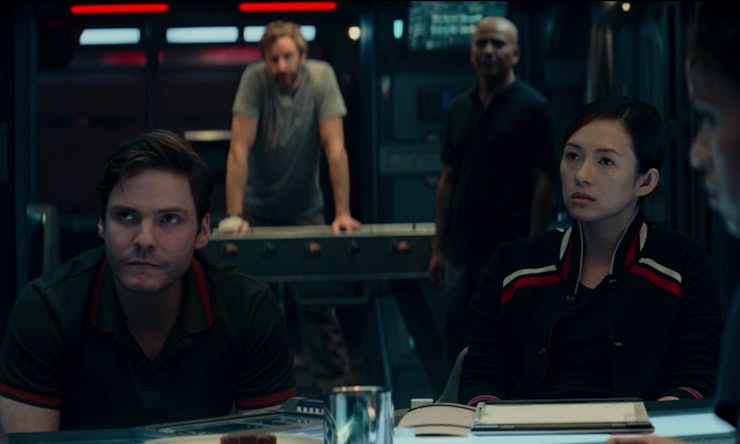
"Can we please have a new script now? I was in bloody House of Flying Daggers, you know"

Some Netflix viewing experiences require the 15 second rewind button : ‘What did they say?’, or, ‘Woah, what was that?!’, or perhaps, ‘Oh that’s beautiful, let me see it again!’  Some, however, make you wish there was a skip-forward option instead : ‘Urgh, this is boring’, or, ‘Yikes, this is too gruesome’. A rare few, like The Cloverfield Paradox, make you want to do both. There are moments so amusingly-misguided or off-key that they invoke an urge to go back and check you didn’t mishear, like a third of the dialogue. On the other hand, there are twice as many points in the ‘narrative’ that inspire a desperate desire to skip ahead, like the tedious renditions of the age-old (and age-weary) ‘lone person walks slowly and nervously towards something no sane person would as the music screams at you how to feel’ device, or the repeated cuts after a violent or dramatic incident to wide exterior shot then moody silent shots of cast looking moody for ages before anything else happens.

The fact that this entire film is entirely made of sections of either skip-aheads or ‘wait, did they just commit that to the screen on purpose?!’ tells you all you need to really know about whether to see this. Yet the reason this review and indeed the reasons for my viewing The Cloverfield Paradox in the first place exist bears some scrutiny in relation to this new age of streaming commissions taking over from traditional channels of creation, coming at a time of renewed (and profitable) proliferation of Science Fiction and Fantasy filmmaking. Arguably at no time since the late 1950s have sci-fi dramas been so numerous in cinema and television. Yet so few do more than ape their forebears. And here comes what is essentially a crap B-movie Event Horizon with a bit of Alien and Sunshine thrown in, the sort of shameless rip-off film you see littering Netflix’s homepage once you get past the fifty or so decent movies. Yet it has been showered with attention because of the Cloverfield element, which has garnered it a decent budget and cast. Sadly, a decent story wasn’t necessary for this cynical business construct to be given life. I won’t go into the Cloverfield factor of this, for a few reasons. Firstly, so many others already have. Secondly, it feels so weakly connected that it might as well have been called the Battleship Paradox, or the Predator Paradox. Thirdly, the previous two films don’t deserve to be sullied by association. Suffice to say though that the sense of helpless dread the first two films created through artistry is barely touched on here in the poorly-depicted hints of [spoiler alert] ...... apocalypse on Earth. 

What remains then is a creation that feels like a commercial construction rather than a story. The cast are almost all lost, as if all required to be there against their will, like a shit theatre workshop retreat in space. When glimmers of personality surface, they glare awkwardly in the dim light of both the set and the script. The best example of this is Chris O’Dowd, clearly brought in to bring some wise-cracking light relief but despite his natural talents and charm failed to make me more than smile once or twice, and his ‘humorous’ lines and deployment as light relief agent jar terribly with the seriousness of the situation. Two spoilers as examples- fellow crew member for last two years dies in explosion of worms (don’t bloody ask) and he says, “So that’s where the worms went”. If he was in a broad comedy-horror (which actually would have been great), fine; here, it kills any tiny fragments of sympathy or connection we might have with the poorly-drawn characters. He later loses an arm in the most ridiculous way and the attempt to make a running gag of this drains the meagre resources of tension the plot thus far had managed to conjure, and kills the fear of bad things happening to other crew by how random and unbelievably daft it is. At least Event Horizon knew to play its body-horror madness straight. At no point does the threat of the random and deadly accidents, which result in the horror and befall most of the crew, achieve any sense of causality beyond the idea of two dimensions overlapping.
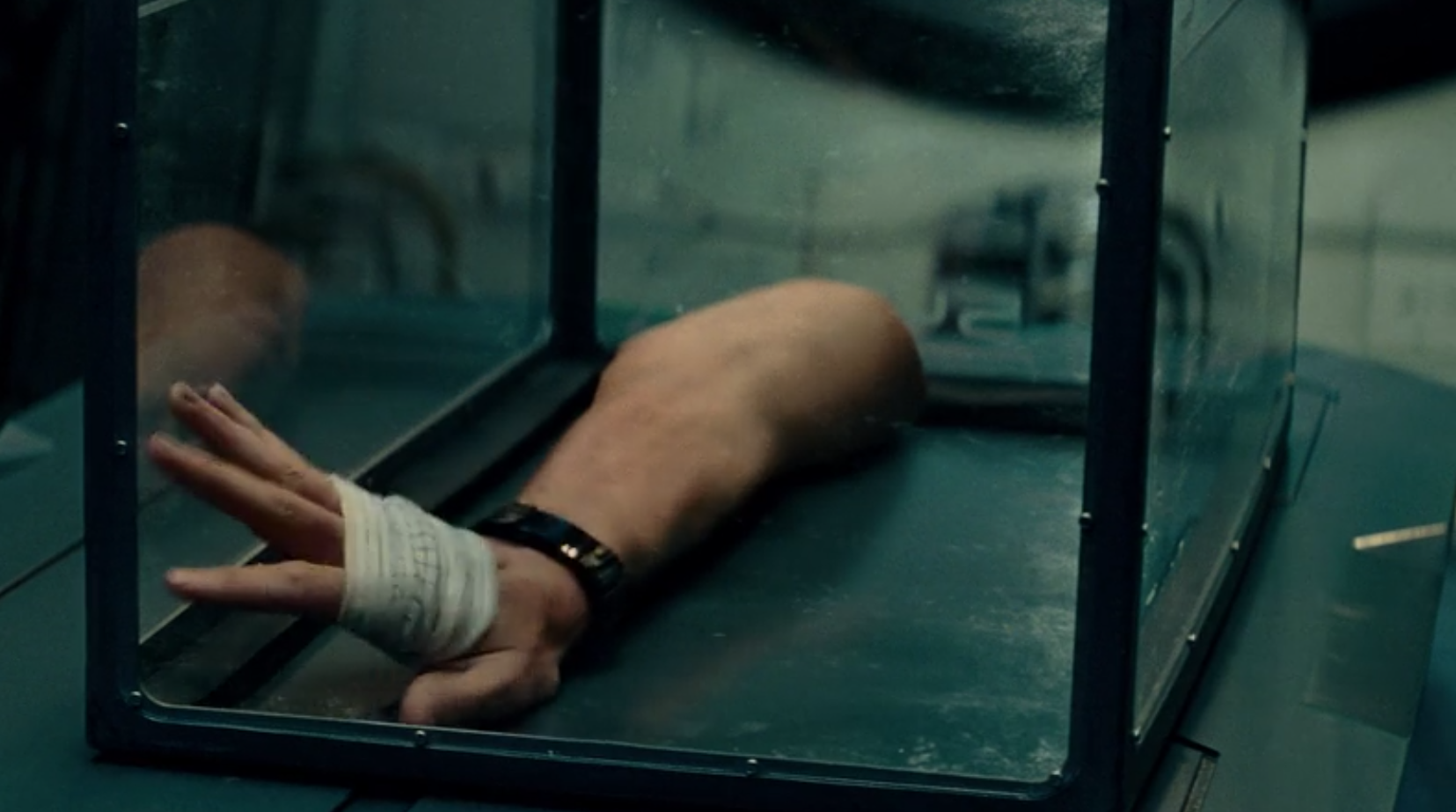
yes, this really happens

The rest of the cast are, bluntly, wasted or badly miscast. A couple retain dignity solely by not having to say more than a handful of lines, but some are simply not up to the challenge, and sadly the lead is chief among them. Gugu M'Batha-Raw fills almost all her moments with a singular emotion of fearful worry and despite being our lead-in to the crew, seems to have little connection to any of them in the dialogue and so is left in the background and it took me a while to clock what her role actually was. In fact, one of the worst elements is the poor interaction between the cast which suggest they were dumped on set in as sudden a manner as their characters are dumped far from home. A few merciful moments of genuine human connection, mainly told through the eyes of some of the underused actors, like Daniel Bruhl and David Oyelowo, only serve to hint at what could have been. As for the filmmaking, the cinematography is fairly bland and the sound design often awful, especially the use of Bear McCreary’s overly-wrought big, traditional orchestral score, which strikes the wrong tone regularly, especially in action scenes. Music can be the wings of a films as Zimmer said; here, it is the concrete boots.

Finally, it is vital that those reading this don’t fall into the trap of thinking it’ll be a mindless fun genre thrill. This film is actively bad. It is frustratingly poor storytelling that is a stain on the already fairly tarnished sub-genre of space horror and undeserving of the attention and resources it has. As for that much-discussed final ‘shock’ shot - I would have laughed out loud at how shoddy it is if my spirits weren’t already brought so low by the dire final act of inexplicable murder and resolution-through-fighting nonsense that preceded it. If you want to show (spoiler....) the world taken over by monsters, meanwhile, you need more effort than one guy looking worried and texting whilsts saving a random kid, and a final shot that makes your viewer think of the Jaws gag from Airplane. JJ Abrams and co had better find a seriously great script and a much better director for their next instalment.
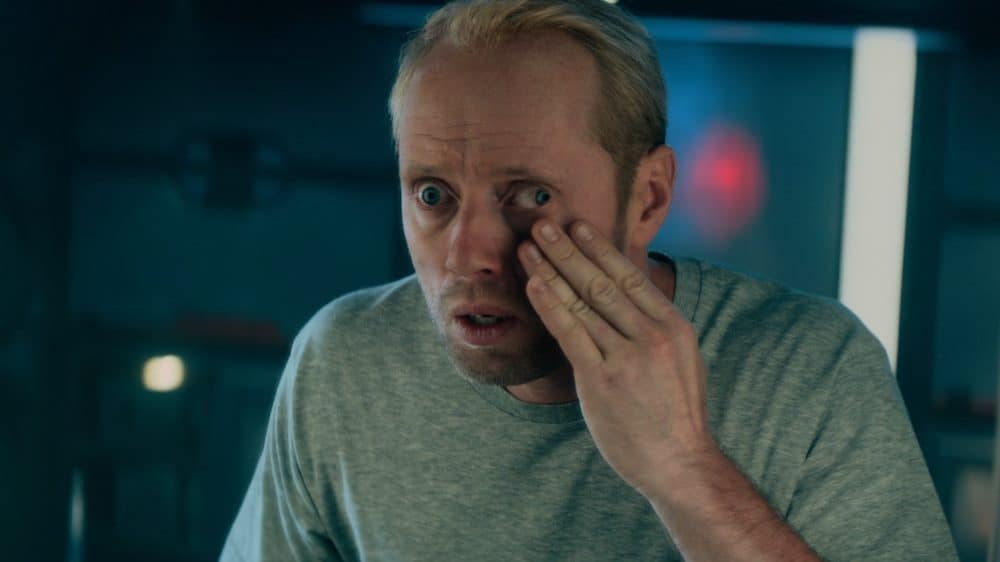
You won't be able to un-see this film but at least you'll forget it almost immediately
The Math

Baseline Assessment : 4/10

Bonuses : +1 for... well... I finished it. It certainly enthralls you in the hope it'll sort itself out, like watching a drunk trying to do up their shoelaces.

Penalties : -1 for showing you actors you love do... nothing; -1 for the rubbish 'oh ok one person will suddenly decide to kill everyone' device; -1 for never once scaring me

Nerd Coefficient : 2/10 which is "really, really bad" on our scoring system

Written by English Scribbler, space horror obsessive and NOAFFT contributor since 2013

Thursday, December 21, 2017

Television review of 2017 - the year it beat cinema


This was finally the year I admitted to myself that I preferred television/streaming dramas to feature films. The level of production quality has risen, at least in the small perspective I have had, to such a point that these novels of the small screen have succeeded big screen entertainment as the most vital and compulsive form of getting a story fix. We could repeat the old argument of film versus books and short stories, and I think the merits of both remain matching enough that the conclusions remain the same. I admit, meanwhile, almost no knowledge of the gaming world's large strides in the area of telling tales, and offer opportunity to those with that experience to shoot my viewpoint down. However, small-screen drama has done several things to transcend traditional short-comings of televisual story-telling.

The rare hallmark of exceptional TV drama in years past (the Six Feet Unders, the Crackers, the Wires, the Sopranos, the older world of miniseries like Roots and Edge of Darkness) was defined by not being full of what most were - mediocre dialogue, small budgets, bland shots, near-amateur acting. This is now an expected norm in many countries, especially in most of central and northern Europe, and the US and Canada. Given my UK-USA bias, I'll stick to works in those countries. And given the abundance of series out there, I'll stick to the few I've seen this year, with the strong proviso that I avoid shows like Westworld and Game of Thrones because they are on Sky TV here, and that is too much Murdoch for me to stomach.

In short, it's probably not a bold bet that most of you reading this were more moved by and emotionally invested in long-form in the last twelve months than by what you saw in the cinema or later. I'm not saying that feature films at their best aren't still to my eyes and ears the finest pinnacle of story-telling outside of a novel, I'm just saying that the little cousin has caught up, and in such volume as to overwhelm features. I frown to think back on the new films that blew me away this year - perhaps three or four - and realise that this is because I no longer make the time and money investment of cinema visits. Whilst parenthood has been partly the cause, it's more because I fail to believe much can trump  (I will still use that word in its rightful context despite the shudder) the incredible dramatic experiences this year in particular has brought me on the TV, and, yes, on my phone, often on public transport (as books once did, I'm often sitting amongst other viewers, with a smile or a tear on their face). Sure, I went to see The Last Jedi  this week like everyone else with the inclination and ability to do so, and it was wonderful. But it felt like, well, a box of popcorn in nutritional terms compared to the hearty vegetable stew of series below. So in no particular order, here is a very personal, haphazard list of series I have been amazed by. Whilst they don't all quite fit into the classic Nerds Of A Feather, Flock Together genre areas, all share a spirit and flavour with the incredible works highlighted on these pages (I have left out other standouts like Transparent, Peaky Blinders, Homeland, Ozark, Line of Duty, Catastrophe and many more, for those sort of don't).

(1) Halt and Catch Fire (AMC)
Originally feeling like a compelling yet shallow computer nerd version of Mad Men (all mysterious arrogant male protagonist dipped in retro nostalgia), this series became, long before this astonishing forth and final season, one of the most accomplished and daring dramas of this decade, and culminated in the best conclusion to a series I've seen since possibly Six Feet Under (a work to which this owes much debt). Nothing else this year matched the emotional impact of seeing these five colleagues and friends arrive at a finish line that for once was allowed to be set with purpose and patience by the creators. The setting and subject became less and less relevant (though no less enjoyable) as the masterplan of the writers emerged - that this, like all the greatest tales, was about emotional connections and the rewards that they bring, and the tolls they take. The last three episodes made my smile and cry more than any film, book or other show this year. Exemplary acting, music, sound, cinematography, dialogue to wallow in... superb.

(2) Mr Robot (USA Network)
The talk of the town online is that this third series had some acceleration issues, yet managed to bring the tale of Elliot and co back from the nervy and stalled second series' worrying lack of popularity. 'Worrying', because the idea of this being cancelled by a less assured network like USA was not unimaginable, as so few get to go out how they want to, like Halt was given reign to, and the thought of what I'd unreservedly call the most stylish and daring show in the English-speaking world at this moment being axed is almost unbearable. What Sam Esmail manages in the central section of this propulsive, confusing, depressing, amusing and compelling season is to bring back the sheer excitement the first season had in spades. Indeed, in the 'one-shot' middle episode and its kinetic immediate follow-up, he and the mind-boggling talented crew and cast delivered perhaps the finest cinematic moments of the year, outside or inside of a cinema. And as with my number 1 pick, this has had more influence on my music listening than any radio show or music blog .


(3) Preacher (AMC)
Coming in a close second to Robot in the cinematic ambition stakes, this adaptation of the comics really hit its stride in a sophomore season that felt like a different and better beast to the opening one. At times it and its downbeat understated protagonist tried the patience, but like a drunken master, could suddenly wow with scenes and performances so audacious as to make me laugh out loud. Violent for the sake of it, yes, and perhaps a little to content with itself, Preacher nevertheless did more outrageous and rebellious things even in its cold opens than most features have the bold guts to do over two hours or so. And all whilst British people do bad American accents. Seriously, doesn't it annoy you all? It's like Bruce Willis playing a cop on Sherlock (and he knows a bad accent when he hears one - R.I.P. Alan Rickman, by the way).


(4) Godless (Netflix)
Staying with hats, guns and whiskey, and wonky accents by people from England, Godless was a late but welcome surprise. The Western hasn't exactly gone away, and a lot of what this new minseries did was cliche and in the shadow of Deadwood and Hatfield and McCoys et al. At times, indeed, when a hat was tipped against a sunset once too often, Godless wobbled on the edge of self-parody. Yet what brought me to it (the cast, the ambition of the shooting format, the promise of those big skies I grew up dreaming of) stood firm against these flaws, and began to take off into those big skies when the score swelled and the actors were given room to breathe (seriously, why are Brits still stealing all the roles? When the kid from Love Sodding Actually is superbly playing a deputy sheriff, you know your industry is in trouble). The long finale had major plot issues but beguiled bloodily with the sight of tens of determined women shooting up their own town in defiance of fate.


(5) Turn : Washington's Spies (AMC)
Set even further back in time, this series ended with its head held high and looking to the future (and gave me another tear in the eye), having been saved by the passion of its small following and the dedication of its makers to display as accurate a rendering of the Revolutionary War as John Adams but with a much smaller budget. As with Halt, it was a joy to see the central characters' stories play out to the end, and as with Godless the teetering on the edge of worthy cliches made the moments of clear human truths and excitement all the more rewarding. I admit this one stretches the genre remits of this site beyond standard limits, but given its huge liberties with the timeline of historical occurrences and real people's actual actions, it could be fairly labelled as Alternate History Fantasy, right, editors...? ;)


(6) The Handmaid's Tale (Hulu)
Perhaps the most widely celebrated of this list, the crisp visuals and unwaveringly-committed performances wove a hypnotic web across the eyes, managing the feat of letting Atwood's mad nightmare seem like something that could almost actually happen, very soon (I'm still not buying the bonnets or reliance on rape in an age of IVF, but still...). As with Robot, the unfortunate shadow of the current Republican administration was a benefit to the underlying messages of the story, and no other drama this year felt quite so urgently in need of being heard, whether for its defiant championing of diversity, sexual equality and political freedoms, or for its simpler and deeper call for individual spiritual freedom. Elisabeth Moss was just astonishing, and this is the first time I have tolerated watching something with Joseph Fiennes in.


(7)all the ones I haven't even seen yet!
American Gods, Legion, Twin Peaks, and Stranger Things - those all sprang to mind without even looking. Some of these have been covered already on this site recently, and I aim to catch up on Gods in the new year, when we will also have a new Dark Materials adaptation to (hopefully) savour. The embarrassment of riches out there is astounding. There really isn't enough time unless you are single, unemployed, a very light sleeper, rich, stoned or a combination of those. Whereas features are increasingly struggling in the face of relectant ticket buyers like me, increasing production costs, and an over reliance on franchise action that can play well across the world. But still the stories come... next year Netflix will release a film twice a week... whoever said all the stories have been told already had never seen so many told so well, and in such number, as this.

written by English Scribbler, occasional contributor since 2013

Wednesday, April 26, 2017

DYSTOPIAN VISIONS : Nineteen Eighty-Four


Dossier: Orwell, George. Nineteen Eighty-Four [Martin Secker & Warburg, 1949].

Filetype: Book

File Under: Statist Dystopia

Executive Summary: Winston Smith, a worker for the oppresive Oceania state, helps in the rewritting of history to support the Party's propaganda. The population is divided into the Proletariat and the Inner Party members, whose iron fist bans any rebellion or sedition, even in an individual's mind. An endless war with the other regions on earth and a constant barrage of misinformation on enemies of the state ensures loyalty to the mythical leader, Big Brother. Smith begins small acts of rebellion which psychologically-coalesce into a secret love affair with a young woman from the Junior Anti-Sex League and discovers what may be the truth behind the Party's lies. Meanwhile mysterious Party official O'Brien and the Thought Police close in...

Dystopian Visions: The Party, and, one assumes, its two counterparts in the other regions, have absolute and immortal power over society, through a perpetual police state which extends its powers to controlling our very thoughts and desires. Family members shop each other in for Thought Crimes, work is unrelenting, a pointless charade, and prevents a private life of any note, culture and fun are replaced by rallies and all jointly staring in pure hate at a face on a big screen. 


Utopian Undercurrents: Even the Inner Party officials like O'Brien enjoy no seeming freedom of thought, and although they might go off and enjoy a glass of wine behind the scenes, our only viewpoint is from a prole, and for them life offers no hope or joy (if you don't count a cheeky painting, looking at a field and a few shags before being tortured and beaten for months). Even the gin is crap. Only the human hope in small moments like Julia's note of "I love you" shines through bleakly as a flickering flame of humanity, long after the story is over. I still see Orwell's statist hell as an allegory rather than a real possibility, that humans' individual spirit will out. But then maybe I just need some gentle rat-in-a-cage educating...


Level of Hell: Sixth. Or Tenth. There are no mutants, no everyday threat to life for most, and food (albeit shite) is available. People still hang out washing in the sun. People still make coffee after (illegal) sex. But when thought itself is controlled, does it matter how nice the coffee is or how warm the sun is? Any idea of hope is crushed in the final part, forever. It's almost worse that no physical apocalypse occured, that it was all the result of power-obsessed politicians and the blind nationalism of the masses. So Tenth.

Legacy: I was ready to find a disappointment in me at the end of re-reading this, one of the more astonishingly-bleak and impressive books of my childhood years (and I have read all of William Golding, so...). I based this mainly on its legacy. Endlessly-referenced phrase like 'two and two make five' , 'freedom is slavery', and 'Big Brother is watching you', and lines such as,'imagine a boot stamping on a human face - forever', had made Orwell's final novel close to a self-parody in my mind. However, the depth and detail of the discourse here, and political world-building, outshine any senses I had that perhaps its originality was buried under its own subsequent fame. Everything from V For Vendetta to The Handmaid's Tale to Children of Men in our season on Dystopian Visions owe a huge debt to this novel, and I would suggest his warning - initially praised (and indeed marketed as in the U.S.) as an anti-communist one - has influenced us all, even those who who have never read it. The fear of loss of individual thought, the fear of the loss of diversity of culture and country, the fear of dictatorial control, all were ancient notions before Orwell even began writing, yet his masterpiece raised the flag of 'where-never-to-go' over so many minds that it can only be hoped that his vision will never see the light of day.


In Retrospect: In popular understanding, this is the benchmark of dystopian fiction, and this stems partly from the unrelenting grey hell it promises us. Even as the numerical year of the title is left far behind us, the threat of a time where power wins over individuality utterly and forever is a constant fear. ' What can you do, thought Winston, against the lunatic who is more intelligent than yourself, who gives your arguments a fair hearing and then simply persists in his lunacy?'. Reading this line again in our current times of false-populism, fake news, revised history and a revival in personality politics, I shudder with that same fear. 'America First', 'Brexit means Brexit', and anything by Le Pen et al. Philosophy of almost calming horror fills the pages that Eric Blair ended his days by filling. He was writing not just from the experience of WW2, Nazism and Stalinism, but of the failure of the British Left to uphold values in the pursuit of power, and his own personal experiences of the totalitarian Soviet machine lying to the people and creating false enemies while fighting in the Spanish Civil War. 
On reflection, I discovered a Smith-esque rebellion against the authority the book's renown held over me, an authority ordering me to respect and adore it. I found fuel for this rebellion in its partial, and ultimately slight, failings as literature - the one-dimensional supporting characters, the lack of recognisable everyday human warmth in interactions (which of course is the point, but the film with Hurt and Burton did much to overcome this through the actor's eyes) and the determination in its singular purpose - the scream as hope is crushed. However, like Smith toward the end, but without the need for dials of torture, I found the last gasp of my resistance collapse under the sheer excellence in the piece. It is that rare thing - a classic that should by now bore with obviousness due to its novel ideas rendered into cliche, its fame the killer of its verve, but which flares out at you still, even decades on from your first experience of it. More than this it is greater than merely a dazzling prose exercise, or a political nightmare. It was often mocked as one of those books you 'had to' read at school here in Orwell's home country. Yet like fellow standards of the teenagers' curriculum like Lord of The Flies, it shows our darkest natures back at us and dares us to fight the hard fight to resist the darkness. This is a harsh lesson we would do well to hear loud and clear in the coming years.

Analytics

For its time: 5/5
Read today: 4/5, for it cannot help but slightly pale as history and literature catch up and overtake its ideas.
Oppressometer Readout: 9/10.


Posted by English Scribbler, who lives in hope, and in a flat, and has contributed to Nerds of A Feather since 2013.

Wednesday, November 2, 2016

Microreview [book] : Europe In Winter by Dave Hutchinson

Part three of Hutchinson's Fractured Europe sequence hits close to home


Dave Hutchinson, according to his enjoyable blog The Automatic Cat, began this most engrossing series of novels as not much more than a side hobby to his other work, but it strikes me as appropriate to a story that reveals more and more complexity as we learn of hidden worlds, fragmented universes, doubled identities and conspiracies. This third novel, published this week after Europe In Autumn and Europe At Midnight, plunges the reader ever further into Hutchinson's astonishing imaginative feat. What was initially frustrating as this one drew to a close, however, was how much more I felt I didn't understand; what for me is his finest achievement is how enjoyable his dance with our confusion is, for that frustration was neatly spun into excited anticipation for the next instalment by the closing pages.

To explain the plot, or even the concept, of this book is something of a fool's errand, unless one wanted to, as one of the more Cold War-esque characters might say, 'spill the beans'. In short summary, however, the world as you and I understand it has been revolutionised by the discovery of hidden worlds. Not alternative dimensions, as such, but fully artificially-created worlds lying alongside our own, like two maps overlapping. This secret has been kept for nearly two centuries whilst Europe has become a dangerous parody of its current state (Hutchinson himself has marvelled bitterly at how life is starting to imitate his art), splintered into ridiculously-small independent states, the EU as we know it essentially disintegrated and an ominously-secretive and private train line sliced across it. Both previous novels revealed this world and the 'Community' and 'Campus' worlds that lie beyond, and also the players such as Rudi, the hero of the first book and our key protagonist here.

It's a welcome return to the fore for Rudi, a wry and suitably-pessimistic cook-turned-spy, but I was relieved that Rupert, Midnight's main character, is now essentially Rudi's partner-in-espionage, as (at least until Winter settles into my mind more comfortably) his traumatic and disjointed journey in book two had been my favourite part of the series. They, along with Seth and Gwen, zip around Europe and beyond and eventually reveal a conspiracy of control that combines criminality and politics better than the current US election.

One of the greatest elements of these books and particularly this one is how Hutchinson manages to juggle multiple narratives across space and time, and allow the reader to return to each character gently and with the breathing space needed for these jumps in perspective. Occasionally, I found the leaps a little exhausting and craved a more singular journey of self, but like any good journey the next destination revived my energy and hunger for more discovery. One way in which the author manages this is in his descriptive prose, which doesn't tire on a Dickens or Clancy level of detail but gives just enough colour and background to enlighten the mind's eye as Rudi meets another stranger or we encounter another character in another town.

To describe any more than this would spoil not just this excellent, disturbing, intelligent, daft and wonderful book but of course the previous two for those unfortunate enough to not read them yet. So my shortest review in a while is nevertheless the most certain in its conclusion : Read. This. Now. ...well, not if you haven't read the first two. Read them first, then this. Please. Thank you.

The Math

Baseline Assessment: 7/10

Bonuses: +1 for the either very coincidental or unusually prescient mirroring of real life Europe at the moment; +1 for superbly researched use of places all overt the continent, including a finale in a pathway not four minutes walk from my home!

Penalties: -1 sometimes, only sometimes, Hutchinson's wild journeys of multiple characters, times and places are a bit of a jolt to move between, but this discomfort is eased by the ultimate sewing together of (most) threads.

Nerd Coefficient: 9/10 'very high quality/standout in its category'

***

POSTED BY: English Scribbler , embarrassed Brit and guilty European and NOAF contributor since 2013.

Reference: Hutchinson, Dave. Europe In Winter [Solaris, 2016]

Wednesday, August 3, 2016

Counter-microreview : My Problems With Preacher [TV series]

... or why Preacher is that cool friend that lets you down


I walked into Preacher  (AMC, 2016) with an open and eager mind. Much like our amazing reviewer Tia who looked at this series on Monday, I had not read the comic series nor have I (unusually for me) watched the review shows or read many articles. I knew enough that Sam Catlin, Seth Rogen and Evan Goldberg were keen despite or perhaps because of being huge fans to reinvent the structure and landscape of the comics in order to have a more accessible, continuity-friendly universe, and has therefore set up the stories to revolve around the town of Annville rather than the global road trip of the source material. I also had read how they knew they couldn't go all-out with the extreme and often offensive (unless you're 15) elements in the books. The 'N' word and the apparently-frequent anal sex bigotry were to be removed, and a more sedentary existence for the titular character was to be the plan.

And so the pilot, the fan reaction, the excitement over some great performances and generally positive buzz. I watched from day one and the large caveat I must include to the following comments is that I gobbled it up each week without fail - particularly-keenly once Turn Season 3  had finished (sobs into his flagon of ale). The action direction, the music, the twisted physical comedy, the use of language, the merging of horror-western-farce-fantasy-thriller-drama - fantastic. This was self-aware comedic fantasy with lovely dollops of true darkness, ridiculously cartoonish violence and outstanding dialogue. Particularly for me, I was excited by the presence of Joe Gilgun and Ruth Negga, two of the surprisingly European-heavy cast list (SERIOUSLY, America, do your guys just charge too much??). Both were stellar in the UK series Misfits (if you don't know of this, read this then getting watching, or get off my planet), and if you haven't seen Gilgun in This Is England you are missing out (although his real accent might be as tricky for some as his 'Oirish' one in Preacher ). Nevermind the presence of Rorschach himself. The fringe factoid that Negga and Dominic Cooper are a real-life couple was a bonus nugget for hope in that rare thing - a portrayal of a proper relationship with performances grounded in real history, although I'm still not sold on Cooper, who doesn't seem to lose himself in his roles and always seems to be 'acting' in my eyes except for rare moments.

And it is in Cooper's Jesse character that the majority of the issues I have with Preacher are centered. I know, he's an anti-hero. I know, we don't need to love characters or even like them to enjoy their journey. I largely disliked Walter White with a physical squirm yet rooted for him and followed him to the end. I hated Martin Freeman in Fargo, but cared deeply for his fate (namely, that he not get away with it). I find Nurse Jackie disagreeable to the point of disgust at times but she is one of the best lead protagonists of our times. And so on. But Jesse is a frustrating enigma for so much of the series. Staring out at a beautiful sunrise with an arrogant yet peaceful smile, he dares you to ask what is behind those eyes, and Cooper is in his element in these respects. But the actions he takes, or fails to take, with those around him smack of a mildly depressed, self-absorbed stoner rather than the deep, complex person struggling with who he is and where that places him on the moral ladder. As a supposed (albeit very compromised) man of faith (lapsed, faltered, severely wounded, whatever - belief is belief, something I don't have but Jesse is clearly supposed to), the Preacher is pretty much a failure of writing. He clearly wants to be left alone; he clearly needs affirmation from others. He clearly wants to put the stress and danger of his past behind him; he clearly has no interest in doing the easy or safe thing. He is shy and cautious with his affections; he thinks nothing of abusing Emily's adoration of him. A few such conflicts would suggest an interesting and human protagonist; all of these and more in the sort of character study Breaking Bad exemplified would be vital ingredients in a heady brew. In the case of this series, where Jesse is largely quietly reactive and evasive with what he wants or who is is, whilst other characters leap from the screen in a few words and actions, is nothing short of poor storytelling focus. It left me just annoyed with him and disinterested in his fate, and nearly collapsed the powerful portrayals of Tulip and Emily because they came across as passionate for someone who gave so little back. It also didn't help that the plot sometimes kept him at arm's length, particularly in the run up to the finale.

In Emily however we had the first proper moment where I felt my emotions disengaged from proceedings. Her actions with the mayor were not in keeping with her character before, shockingly so, but a shock is fine if it reveals a new deeper truth, or sends them off on a new tack. Yet she sort of went back to normal and smiled about it a little, and no explanation was apparent other than he was creepy, had a horrid giggle and had been a bit mean towards Jesse. No sense that she was doing anything other than sexually controlling him while waiting on Jesse, and certainly no sense she would flip to the dark side of evil, rather than run a mile from Cassidy and warn Jesse of his monstrous mate. Deeper currents of emotion may have been at play and Lucy Griffiths has the chops to pull that off with a glance but never was really allowed except for a brief rebellious, celebratory moment at the organ).

Now, this is where the finale comes in as the slap in the face for the journeys of her and others. If it was a bold cliffhanger, then fine but --- spoiler ahead, skip to next paragraph if not seen finale yet ------ SPOILER BREAK---------------------
ready? --- ok---- the massive destruction of the entire town and its inhabitants was suggestive of a darkly comic trick like the Tom Cruise death sub-sub-plot, not the shock culmination of weeks of character development and inter-personal relationship drama. If they are all dead, well then what was the point of those journeys? Why, for instance, suddenly shift a good deal of attention to Donny's S&M wife, regardless of how great a performance it was, in the final episode, yet ignore several key people? Why build up the conflict of Quincannon and Jesse, with Root in the middle, and all the dark politics of the town, to then drop it abruptly and spend time explain the frankly dull Carlos backstory? And how, for the love of the God of Meat, did Jesse, Tulip and Cassidy all get to just wander out unarrested, and be off in a diner distant enough to not hear or see the explosion.. and why... and ...and... grrrrRRRRR!

SPOILER BREAK OVER, WELCOME BACK ------------
Too many holes, too many liberties with emotional journeys, not enough genuine thrills or jeopardy, and definitely not enough Fiore and DeBlanc. I would even dub it plain lazy if it wasn't for the clear effort of filmmaking on display. But I do wonder what it would have been like if less time was devoted, say, to the endless fight in the motel room against the Arcangel, or the powerful but hopelessly-extended Saint of Sinners sequences. I love me a western. I mean, I really Love me a Western. But his scenes, especially the final reveal of his existence, took up so much time! Time that could have been spent better establishing Jesse's everyday life, his friendship with Cassidy, his struggle with faith, and above all his connection with others in the town. Those others also got short shrift. Yes, the key man in the control room that leads to disaster (spoiler-free I hope there) was a wonderfully-mysterious addition, but did we need to return to him so many bloody times when we could have been elsewhere?

Like Tia, however, I loved all she loved - the cinematography and artistic framing, the appealingly 90s tang to many elements, the acting in general. Some of the dialogue and direction is the best I've seen in ages. The theme tune is stuck in my head. Quincannon and the angels are three of the finest characters to appear in fiction for many a moon. It was in the wider plot and narrative pacing that I was thrown into uncertainty for the duration of the series, and the finale on Monday sadly put the nail in the coffin of my concerns. It will take a heavenly being of considerable power to resurrect my hopes in season two. And yet. And yet... The mere fact that I am considering watching the second series says it all. This was a beautiful, foul, flawed failure that engrossed me despite my better intentions. Goddamnit to Hell.

The Math

Baseline Assessment : 6/10

Bonuses : +1 for every time Cassidy or Tulip or Quincannon opened their mouths ("yeah.." has never been so threatening); +1 for some superb filmmaking as described above, and also some excellent sound; +1 for a rich and complex world-build full of characters with mysterious actions and backstories

Penalties : -3 for taking the above world and characters and f£@%ing it all off seemingly without a care; -1 for talking the talk of big cosmic and religious revelations but fudging it for some silly gags and vagueness

Nerd Coefficient : 5/10 problematic, but has redeeming qualities (ratings system explained)

Written by English Scribbler, no stranger to neither Bible classes nor desert roads and worrying Texan lawmen, and NOAF contributor since 2013


Friday, July 1, 2016

Summer Reading List (European Scribbler)

It's been a disquieting and stressful recent time in British politics and Europe in general. With violence in football and horror in Istanbul, and a narrowly-won yet regressive, small-minded result (I'm trying not to use swearwords here so will stick to my name-change to show my feeling) in the deceitful Tory plot of the UK referendum, I yearn for a mental escape even as I find it near-impossible to not flick to refresh the headlines on my phone every few minutes...
Solace in fiction is a long-admired element of reading, as well as its ability to hold a mirror to our world, so my Summer Reading List reflects this, along with a open desire to find the ties that bind Europeans across language, racial genetics and culture, and an additional and depressing influence of the grey, grey, drizzly June my patch of this continent has been 'enjoying'....


1. The Trial. Kafka, Frank (1914, penguin modern classics)
"Someone must have been telling lies about Josef K., because he had done nothing wrong, but one day he was arrested." One of the more famous opening lines in European literature, this century-plus old masterpiece of unease sprang to mind as the EU storm began brewing earlier in the Spring, and its brief hit of paranoia and confusion is perhaps more a mirror than an escape to another world right now. A fantasy and dystopia, Kafta nevertheless makes such clear parellels to his times and ours that to suggest it as such is perhaps straining the barriers of genre. One of those few 'required reading' novels that actually is such, it is also with my current re-reading of it a humbling reminder of how law and control in society can be a disease more than a medicine. The propaganda that British people could somehow 'take back control' was powerful yet as empty and bleak as Josef's fate. On a brighter note, it reminds me how wonderful such literature can be, even in translation, to bring us together as humans across borders and less physical divides.


2. Europe In Autumn, Hutchinson, David (Solaris, 2014)

Hutchinson's Twitter feed is a recommended read in itself (@HutchinsonDave), with its mix of political anger and surreal and pun-ridden humour (basically all my favourite human traits), and of late he has noted how his nightmare vision of a near-future Europe fracturing into smaller and smaller states feels more fact than the wild fiction he no doubt intended. Rudi the chef-turned-spy is our fascinatingly-drawn protagonist across this bizarre yet increasingly-familiar landscape. The sci-fi elements blend seamlessly with the future-reality and the thriller framework bolts along toward the (to my mind) superior sequel, so will be rapid and comforting mind fuel in anticipation of the third part in the series, due for publication in the Autumn- sorry, Fall... sorry, l'automne... sorry, Jesień...


3. The Troubled Man. Mankell, Henning (2011, Knopf)

Having just watched the English-language television version of this final story by perhaps the godfather of scandi-noir, and bowled over emotional and stylistically by its dignified and beautiful depiction of Wallender's (spoiler....) affliction with early on-set Alzheimers as he races to solve the mystery of his son-in-law's father, I'm very keen to go back to the novels which I struggled to get through. I hope I can shake Branagh's amazingly warm yet distant face from my mind however. An odd choice perhaps to start at the end, yet these slate-grey skies push me to such sombre codas, perhaps with James Blake or Radiohead on the headphones...


4. La Planète Des Signes. Boulle, Pierre (1963, France)

In search of some foreign (to Britain) sci-fi to defy this country's power elite's nationalism, I was reminded by my good friend Dr Wiki of the fact that one of my all time favourite films was first a French novel, and given my French needs a polish (in the same way you might say David Cameron needs a personality transplant) I thought I'd attempt to read it dans la langue original, innit, mate. Wish me bonne chance.. It can't be harder than sitting through Burton's remake, at least...


5. Belshazzar's Daughter. Nadel, Barbara (1999, Felony and Mayhem)

This is the first in the near-annually published detective series English author Nadel wrote set in Istanbul, a city I like very much. The first thing I did after hearing the referendum result was go into my nearby Turkish deli, buy some groceries and baklava, and ask to be retaught 'hello' and 'thank you' by the old lady behind the counter who spoke almost no English. It revitalised my belief that showing friendly interest in our differences brings us together and that much can be said with a smile and hand gestures, just as so much damage can be done through lies drawing on fear. Anyway, the plot seems ripe with cross-cultural intrigue for these fraught times : "When a brutal murder shocks Istanbul's rundown Jewish quarter, the Turkish police force unleashes their best weapon - the chain-smoking, brandy-swilling Inspector Cetin Ikmen, husband to a strict Muslim woman". Sign me up, hopefully when the sun is warm enough to make me feel I could be by the Bosphorus...


6. Excessiom. Banks, Iain M. (1996, Orbit)
As Scotland seems to represent all I like about the UK at the moment, as England Wales seem to have taken bad acid, and being a generally massive fan of Scottish culture in general and Banks (both genres) in particular, I'm going to attempt after all the above and as Autumn approaches his fifth Culture novel, which I stumbled on starting years back. Like a good haggis, the dense and uncompromising nature of his texts requires the consume too be in right mood. And to have a smooth Scotch to hand.

Posted By: European Scribbler, nervously-English writer and contributed to Nerds of a Feather since 2013.

Tuesday, February 2, 2016

Microreview [book] : Europe At Midnight by Dave Hutchinson

A complex, intelligent follow-up to Europe In Autumn


Buy it here or via publisher Solaris books

Europe In Autumn (review here) was a favourite of mine a couple of years ago. It managed that trick of providing a challenging read full of complex scenarios and political intelligence without ever stopping itself from feeling like a great spy thriller. Its sequel is equally challenging, taking the springboard of the first novel's brain-warping twist and running with it. I say 'running', but Hutchinson again takes a calm, detailed pace, keen to keep us feet-on-ground with small moments like people actually needing a drink or some food, or noticing the weather, as well as plunging through byzantian conspiracies and violent confrontations.

For those wishing to take on this series without spoilers, please stop here and go off to read Autumn.

Have they gone? Sure? I can hear one of them still putting on their coat?
Okay, cool.

Right, the rest of you I can only assume have read Autumn, don't care about spoilers, or are the kind of person who walks through doors marked 'danger, keep out' with a wry grin. That last set of people will identify with Rudi a little, the last book's hero (who, spoilers, makes a slight return here), but less so with Rupert and Jim , our two main protagonists here. Jim is an intelligence officer in London of the future, the future we know from Autumn - a Europe dissolved and decimated by a virus. Rupert is, meanwhile, a resident and key official of the mysterious, dystopian world of the Campus, and Hutchinson boldly starts his tale here, slowly revealing the dark history of the place, before moving focus to meet Jim and follow a case that leads us first to the big reveal of Ernshire in book one, and then connects through to the Campus world.

More details than this would ruin a compelling, profound and moving story but suffice to say I recommend this novel whole-heartedly, with one piece of advice - stick with it. Like many a great political thriller (like with Le Carre, whom it references again) and many a complex sic-fi world-build, you need to allow the soil to form before you can run free across its land, and Hutchinson isn't immune to the needs of info-dumping at times (but who is), yet some elements are deliberately mysterious without character-motivation, particularly in the early chapters on Campus. So some patience is required as he holds back information seemingly purely for the sake of it at times. This is me stretching for issues however in a novel that challenges, entertains and moves me in such a way that anything else I read this year is going to have to be something special to match up to. The horrific climax to this book brings home how close we are to such horrors today - Hutchinson fractured Europe grows more likely every day - and all the mystical portals up canals don't dilute the harsh reality he bases his excellent fiction on.

The Math

Baseline Assessment: 8/10

Bonuses: +1 for scaring me with just how close the future world of Europe is to our own; +1 for some excellent humour ( including a future vision of the Eurovision Song contest ) that my review failed to touch on which lightens some of the info-dumps necessary
Penalties: -1 minor quibble but it feels in its primarily male and old-school characters a little too 1980s rather than 2050s

Nerd Coefficient: 9/10 “well worth your time and attention”


Written by English Scribbler

Friday, December 18, 2015

2015 HOLIDAY GIFT GUIDE : TOYS

English Scribbler
For the future mad scientist teenager in your life
Cubelets, from Modrobotics


While your zombie nerd dog waits forlornly until the new year for their Daryl Dixon Squirrels On a Rope Chew Toy (no, seriously, look : http://tinyurl.com/ridiculouswalkingdeadcash-in ), spare a thought for that staple of the holiday family-get-together - the sullen young teen seething with dormant rage at being marooned in a warm house full of free food and people who care about them. The poor bastard. What better way to cheer them than with a toy that connects them to you and makes them think, ‘hey, maybe when I run away and leave these shitheads behind, and become the next Steve Jobs only with a base on the moon, maybe I'll send Ol’ Aunt/Uncle Debbie/Hanesh/Shania/Nikolai (delete as appropriate) an email or two of me doing all the amazing shit this world is currently denying me, maaaan’.

Or something.

I have no idea how teenagers talk or feel these days so there may be disappointment around the tree in my family this year… However, these things cost a small fortune so at least the ungrateful buggers can sell them on eBay to buy Taylor tickets or skateboards or drugs or something instead. But they should not, for these things are simply brilliant, and make me feel like I'm living in the future even more than the kid down the road with a hoverboard does. Connect the cubes - which all have different functions - to create responsive and mobile robotic structures. And harness them to take over the world!!!


Via Amazon
 
Brian

For the Destiny fan in your life ...

Sparrow 3D Wood Model


Listen. I know Brad jumped straight off of the Destiny boat at House of Wolves, and I was right there with him. To a point, it was not a fun game for adults. But then Bungie updated the game to 2.0 with The Taken King, and it got way better. They recently introduced Sparrow Racing League, where you can race sparrows! It’s lots of fun and the sparrow is kind of an iconic shape in the Destiny world, so get this great little wood model for your Destiny fan. It’s classy enough to put on your office desk, or anywhere. Give coworkers and friends a reason to ask “what’s your light at?”

Via Bungie.


Zhaoyun

For the twisted individuals in your life who like body horror, dressing up and who can't be trusted with real animals...


Hmm… I just can’t decide which horribly bizarre toy to recommend this year! (Needless to say, the two toys discussed below are a) not for the faint of heart, and b) probably not for kids, unless the kid is him/herself a little creepster.)

Any Attack on Titan fans? Then you’ll love toy #1, affordably priced at just 400 yen (about $3 right now): wowsers! For the less... extreme titan-lovers, you can also pick up a cosplay cloak courtesy of Amazon, and given all the opportunities to pretend to be part of the Scout Legion it’ll afford you, it’s a gift that’ll keep on giving the whole year (to quote Randy Quaid’s “Eddie” in Christmas Vacation!). Where can you find one of these, you ask? Unfortunately, they appear to be only sold (officially, at least) in Japan; they’re sold here and there in those little capsule machines called ‘gacha gacha’ (rattle rattle), like gumball machines but for toys.
Option #2: for robot/cat lovers. Why? Because it’s a robotic cat. I’m afraid one look at this genuine product--which ships internationally--plunged me deep into the uncanny cat valley. Plus, I’m allergic to cats (and possibly to robots too, though that’s something I have yet to test). But for the right person, this could be quite the winner this holiday season! The bad news--these things are practically hopping off the shelves. They appear to be sold out right now!


Tia
For the doesn't have to be a nerd but doesn't take the world too seriously type of person in your life…

Hillary Rodham Clinton Presidential Playset


THIS has got to be SO MUCH fun to play with. The set comes with 10 paper dolls including Hillary, Bill, Oprah, the Notorious RBG, and other political friends and adversaries (Trump comes in a free downloadable expansion set from publisher Quirk Books). You get 4 different rooms to play in to act out your aggression, frustration, or sheer sense of utter ridiculousness at the current American presidential race. You can bop your Hillary figure up and down and have her say “I want to take your guns” and then have bathrobe Bill rock side to side with his coffee mug and Arkansas accent and say “I’ll got a gun you can take” after which Bono (yes, there's Bono) breaks out into an a cappella rendition of “Sunday, bloody Sunday…” and all the while Trump is off in the corner muttering nonsense to the wall.


I mean, you could use it as a teaching toy and have our favorite political figures act out appropriate responses to the cutting edge issues of the day...but where's the fun in that?


This pop-up book is sturdy, has a front pocket to keep your dolls and accessories (alternate faces and outfits, Bill's lawnmower and sax) in, and has an elastic strap to keep the book closed and all the fun inside. Plus, it's incredibly inexpensive at around $8 right now, so it makes a great gift for the Hillary lover, hater, or general wtf’er in your life.


Via Amazon.
The G

For the worryingly-Lecteresque child in your life...

Avenging Narwhal Playset

Sometimes, you just can’t beat the marketing copy:
“Too much "cute" in your world? Here's the solution. The narwhal is an arctic-dwelling whale that's been called "the unicorn of the sea" due to its long, pointed tusk. While there's much debate about the true purpose of this appendage, the truth is finally revealed! The narwhal uses its mighty tusk to skewer the cute smaller animals of the world… specifically baby seals, baby penguins, and koalas. This 5 1/2-inch long, hard-vinyl narwhal comes with 1 detachable tusk to impale the adorable 1 1/2-inch, soft-vinyl penguin included. Don't let cute overrun the world. Fight back with your own Avenging Narwhal! Ages 12 and up.”


Via the only place that seems to still have it in stock.


Vance
For the Minecraft and/or animation nerd in your life...

Minecraft Stop-Motion Movie Creator Studio


I’m not sure what’s behind the current stop-motion craze in toys. There are these little Stikbot things everywhere, but I can barely get the suction cups on those things to work. There’s a Crayola stop-motion studio that uses some type of runes to create mo-cap performances in your iPad, which looks cool but also a little limiting/frightening. Lego is also in on the game, of course. But I have hands-on experience with the Minecraft Stop-Motion Movie Creator and a child, and I’m not too proud to admit that after a few minutes I kind of wanted to tell the child to go away so I could make my own movies. There are quite a lot of pieces, which allows for a tremendous amount of variety, and the widely available Minecraft mini-figures are compatible, so you can easily and cheaply expand beyond the included characters. The free app is really something to take note of, too. While the iconography is somewhat bizarre, it doesn’t take long to figure out what the mystery squiggles control, and with a tremendous range in frame rates, transparency for previous frames, and built-in soundtracks, you can make as complex a stop-motion creation as you care to. As a lifelong animation fan, it’s been tremendously fun to introduce the kids to a hands-on way of experiencing stop motion that gives them enough variety to keep them interested.

Via Amazon


***

Curated (which is posh talk for sorting out fonts and spelling mistakes) by English Scribbler. Wishing you all a fantastic holidays and thanks for supporting another great year at Nerds of A Feather, Flock Together !