Tuesday, May 10, 2022

Review: Ignyte Awards - Short Story Nominees

The Ignyte Awards (created by FIYAHCON to shine a light on the vibrancy and diversity of spec fic) are my favorite awards, and short fiction is probably my favorite thing. What better way to spend my time than reading through what I was sure were going to stories that fired on all cylinders? And boy, was my certainty validated. My thoughts on all these masterful, deservedly nominated stories are below.

Center of the Universe (Nadia Shammas) is centered, of sorts, on Abigail who’s in a simulation in which she’s a real human and everyone else is virtual. But the story is not a simple exercise in solipsism. There are simulated people who vie to be seen—to exist under her gaze. And that existence is eventually seized through drastic measures. It’s a unique and fluid premise in which solipsism exists but the narrator is in the periphery of it—a premise that could convolute and crumble from a lesser writer. This is a story that kept me captivated – gaze locked on its words – through its pain. But also, its beauty, its poetry, and the sympathetic struggle of attaining meaning. While reading, it quite easily became the center of my universe.

Delete Your First Memory For Free (Kel Coleman) showcases the bumps in the road that anxiety presents with a story that is antithetically smooth. When Devin and their friends use technology that takes away specific, non-vital memories, their relationships start to change. Kel Coleman writes with such vigor that their writing style smooths over a lot. Not so different from how the developing themes of the story smooths over some emotionally charged situations. Additionally, the nuances in the interpersonal interactions with just about every character were so rich and fully-formed. This is a vital story to many people whose small enemies can feel as cumbersome as their major ones. It might be so instructive and critical to someone, that the memory of reading it would be hard to extract.

If the Martians Have Magic (P. Djèlí Clark) offers an engaging story, but most importantly, it offers a WORLD that felt lived in and thoroughly explored, all while telling a pacy story. Martians are widely persecuted by humans--pigeonholed negatively because of some bad seeds in the group. But there’s a way to save those who mean no harm, and the protagonist Minnette is going to try her best to fulfill it in a rollicking, entertaining fashion. Martians do have magic, and everyone who’s read anything P. Djèlí Clark has written probably knows he has a lot of it, too.

The Fifth Horseman (Martin C. Cahill) starts with The Four Horseman of the Apocalypse after they’ve “apocalypized” the world. But they have a sibling that they don’t know too well—the fifth horseman. And that horseman has someone additional work to do. That work is described in beautiful, lyrical prose that shows off the beauty of the world – as ephemeral as it is – along with a sympathetic backstory for the fifth horseman. There’s a sense of distance with her due to her circumstances, but there’s also some warmth that’s beautifully paired with the writing style that finds the beauty in the world despite its cataclysmic situation. I really dug this. The potency of the story’s descriptions alone is damn near apocalyptic.

The Tale of Jaja and Canti (Tobi Ogundiran) bears a little similarity to Pinocchio, but its wooden boy’s journey veers in engagingly unexpected directions. The tone is like a fairy tale and the way its split into chapters enhances that feeling. It has a spare word count but is able to do so much without feeling rushed or choppy. And without spoiling anything, the story is bookended in a way that’s structurally ingenious. Like the other Ignyte nominees, this story is a banger.

POSTED BY: Sean Dowie - Screenwriter, stand-up comedian, lover of all books that make him nod his head and say, "Neat!"

Monday, May 9, 2022

'Star Trek: Picard' season 2 is aimless and inconsistent

Its examination of the neofascist dangers of the 2020s breaks down into pointless nostalgia and superficial psychoanalysis

Season 2 of Star Trek: Picard bites more than it can chew. In the span of ten episodes, it tries to explore xenophobia, eugenicism, the weight of self-blame, repressed trauma, the tragedy of finitude, the tension between open and closed societies, the human yearning for intimate connection, the fear of loneliness, the responsibilities that come with parenthood, immigration policy, the purpose of life in old age, the narcissism inherent to the search for a legacy, authoritarianism, temporal paradoxes, suicide, and the uncertainty about the turbulent direction of humankind in the 2020s. Unfortunately, the show doesn't manage to say anything insightful about any one of its myriad themes.

The season begins by proposing a knock on the door: the Borg, old enemies of the United Federation of Planets, all of a sudden ask to join it. However, Admiral Jean-Luc Picard chooses to self-destruct his ship before allowing his old tormentors a foot in the door. This encounter sets up the argument between inclusion and exclusion that will continue in later episodes, and it gains heightened resonance by virtue of the characters who participate in it: captain Ríos, a Latino who gives commands in Spanish; Seven of Nine, an ex-Borg who was given a second chance at humanity; Elnor, a refugee from a destroyed world; Agnes and Raffi, chronic loners; and Jean-Luc himself, a techno-organic creature whose existence was illegal in the Federation just months before. This crew is composed of identities that, either in the real world or in the show's setting, have at some point been rejected, ignored, and excluded. And this is the crew that chooses to reject the Borg's open hand. This is the crew that consciously chooses death instead of risking further openness. So it's fitting that this is the moment when cosmic trickster Q steps in and shows Jean-Luc the flipside of that mindset.

Even before the revelations in the season finale, the thought of welcoming the Borg into the Federation shouldn't have been off the table. Star Trek has an established tradition of dissolving enmities: we've seen Earth gladly cease hostilities with the Klingons, the Xindi, the Andorians, the Romulans, the Orions. The Federation grows stronger each time it makes rivals into allies.

Q creates an alternate timeline where the fascist Confederation has a darker way of dissolving enmities: the eradication of every species that is not humankind. This world's version of Jean-Luc Picard is a mass murderer who serves supremacist ideals and gleefully performs televised executions. This reality is everything Star Trek has always warned against, which is why it's disappointing that we only spend one episode there.

To be fair, Star Trek had already shown us several examples of galactic history gone wrong in the Mirror Universe. But there was always the implied relief that those horrific events didn't happen to us, didn't affect our history. Our history was meant to be the peaceful Federation. The choice in this season of Picard to have the bad future happen in our universe makes the dystopia feel much more threatening. The cruelty and hopelessness of the Mirror Universe can no longer be relegated elsewhere. The potential for endless horror is right here.

Literally right here: one of the most compelling plotting choices of this season is to set the point of divergence in the real world's present. It's Earth in the 2020s where the future is decided. It's you and me watching Picard. It's up to us to decide whether our future will be an egalitarian utopia or a fascist nightmare. However, the show doesn't do anything interesting with that enormous idea. Captain Ríos suffers a random teleport mishap that conveniently puts him in the crosshairs of ICE, but his ordeal through arrest and imprisonment has a perfunctory air to it. The subplot where Ríos is in danger of disappearing forever in immigration jail has an obvious thematic link to the kind of future our heroes are trying to prevent, but the episode occurs in isolation from the rest of the story. The draconian proceedings of US immigration policy feel like they should, but really aren't, related to the flow of historical events at the center of the plot. By turning the capture and rescue of Ríos into a side quest completely untethered from the main mission, the show missed its best chance for relevant commentary.

There's nothing wrong per se in a story having a large number of themes. The problem with season 2 of Picard is that those themes have little to do with one another, and sometimes lead to contradictory messages. For example: when we learn that the crucial event that must be preserved in today's Earth in order to avoid the dystopian future is the participation of a certain ancestor of Jean-Luc's in a space mission (making this the millionth story to fall for the Great Man myth of history), we meet Tallinn, an alien secret spy tasked with protecting said ancestor until she flies to space. In the final episode, Jean-Luc tries to prevent Tallinn from sacrificing herself to complete her mission (in fulfillment of an Unnecessarily Cryptic Prophecy), and Tallinn protests that her life is hers to risk, and Jean-Luc has no right to interfere with her choices. However, interfering with someone's life and even guiding their choices to keep them from risk is exactly what Tallinn has been doing to Jean-Luc's ancestor for years. The point made in this discussion comes too close to mirroring the evil future's implied stance that some deaths are more acceptable than others. Moreover, the thematic thread about Jean-Luc's need to stop holding himself responsible for everyone else conflicts with the thematic thread about our historical responsibility to protect the future. These two messages didn't have to clash, but they have that result in this particular intersection of plots.

This incoherence reocurrs in regard to Jean-Luc's inner conflict. Q points out that his choice to leave his personal past intact and not prevent a chain of events that resulted in his mother's suicide shows growth on Jean-Luc's part. However, serenely accepting a painful reality is the opposite of what our team of heroes have been trying to accomplish the entire season. If it's a valid ethical choice to alter the past so that billions of people won't live in misery, why is it praiseworthy of Jean-Luc to not save his mother and himself? Tallinn asserts that we don't get to choose what losses we have to bear, which is an argument worth considering, but it comes off as a weak argument when presented in the same story where the main mission is to fix a cosmic loss. With these conflicting positions, the season comes off as uncertain of what it wants us to care about.

The key issue Q hoped his old frenemy would dare to face turns out to be family trauma, but there's no causal or even symbolic connection between Jean-Luc's mother and Jean-Luc's 21st-century ancestor. Q effectively assigned Jean-Luc one mission while intending him to complete another, and the narrative disjointedness feels too big at times, like two separate plots competing for centrality. The scenes we spend dealing with his difficult memories come at the expense of his time travel mission, not in the service of it.

This failure to achieve cohesion is especially regrettable when it comes to Jean-Luc's personal growth. The moment Q's actions affect is the self-destruction of Jean-Luc's ship (i.e., a suicide); the moment he expects Jean-Luc to not affect is his mother's release from confinement, which allowed her to hang herself. By helping Jean-Luc relinquish his guilt for his mother's suicide, Q means to prevent Jean-Luc's own suicide. And yet again, the method of execution has no relation to the ultimate goal. The switch to a dystopian timeline is something entirely apart from Jean-Luc's personal problems, and Jean-Luc's reward for fixing the galaxy is a trip back to his time at the cost of Q's suicide, which muddles whatever statement Q was trying to make.

The other big threat in this season, the emergence of a new Borg Queen in the 2020s, feels similarly undercooked. The writers don't take advantage of the chance to present the dangers of absolute control and enforced conformity that the Borg symbolize as a mirror for the similar tendencies reemerging in our real world. What would it look like for the Borg to come in contact with a culture that has already experienced the Trump era? That would have been a fascinating change of perspective, because in Star Trek the Borg have always served as a contrast to the Federation, but this season suggests that we, the humans of Earth, have the potential in our nature to become the same type of heartless all-devouring conquerors that the Borg are. That obvious low-hanging fruit is inexplicably left untouched.

Another missed opportunity occurs during the Borg attack on the Picard mansion, where our heroes retreat to the tunnels beneath. Those tunnels fulfill a double role in the backstory: they're the place where the young Jean-Luc learned that his mother's mental health was deteriorating, and also the shelter where the French resistance hid from the German occupiers. That history presented a fertile narrative possibility in connecting a refuge in the mind to a refuge against fascism. But once again, the writers didn't do anything with a thematic resonance that was crying out to be used.

Finally, the whole Soong situation makes no sense. It's already beyond tiresome to have Brent Spiner be the only face of the Soong family, but his role in this season is another instance of the Great Man myth. The new Borg Queen describes the forking road thusly: will humankind go the way of Picard, or the way of Soong? It's an extremely narrow view of how history works, an oversimplification of ongoing cultural trends that the writers should have been more aware of if they were going to set the story in our present day.

Yes, humankind in the 2020s is very much at risk of becoming the opressive regime of the Confederation. But this season of Picard only uses our present day as set dressing. The resolution of the threat Q created has nothing to say about our current situation, and repeats the familiar mistake of making a huge societal problem hinge on the choices of one individual.

It's even more frustrating to watch the season finale of Picard on the same day that Strange New Worlds premiered. In this new entry in the franchise, captain Christopher Pike recounts the difficult journey that Earth had to go through before becoming a Star Trek utopia. Using real footage from the violent conflicts of the past couple of years, Pike reaffirms the established canon that says 21st-century Earth had a world war motivated by eugenics. That's the immediate future Star Trek is saying awaits us. So what should we glean from our heroes' success at preserving the timeline in Picard?

This season had good material to work with, but didn't make the effort to make the best use of it. The writers knew that the season's themes had great significance for our current times, but didn't develop them beyond the barest box ticking. And the details added to Jean-Luc's backstory overcomplicate a character we already had a clear feel for. This portion of Picard's story is more notable for what it wastes than for what it adds to the ongoing Star Trek saga.


The Math

Baseline Assessment: 5/10.

Bonuses: +2 for Kirsten Beyer, who seems to always elevate any script she has a hand in.

Penalties: −1 for too much empty fan service, −1 for a contrived resolution to Kore's journey, −1 because it's incongruous to devote so much attention to Jean-Luc's childhood without acknowledging his troubled relationship to his brother.

Nerd Coefficient: 4/10.

POSTED BY: Arturo Serrano, multiclass Trekkie/Whovian/Moonie/Miraculer, accumulating experience points for still more obsessions.

Friday, May 6, 2022

Review: The Memory Librarian and Other Stories of Dirty Computer

The story of Dirty Computer continues in five richly plotted scenarios set in a dystopian future

Taken as a whole, Janelle Monáe's Dirty Computer art project consists of a music album (nominated for the Grammys in two categories), a short film (nominated for a Hugo), and now, from Harper Voyager, a collection of short stories written in collaboration with other authors of color. This production is not connected to Monáe's previous Metropolis storyline, centered on the android Cindi Mayweather. Both the album and the film of Dirty Computer follow a different character, Jane 57821, as she escapes an oppressive future in the company of her lovers. This book serves as a window into exactly what horrific world Jane is escaping.

The introduction to the collection is a quick summary of the rise of a totalitarian regime, New Dawn, whose control over society was possible because "we accepted their offer that an eye in the sky might protect us from… ourselves." With the assurance of total visibility, an immediate problem emerged regarding privacy and deviancy, and the regime decided that "what they struggled to see, they began to deem not worthy of being seen—inconsistent, off standard. Began calling it dirty—unfit to be swallowed by their eyes."

In the backstory that this introduction presents, the new social category of the dirty started being applied to modes of thought and identity that did not fit the rigid standards of the regime. The stories that compose this collection explore various characters' struggle to reclaim, preserve, and even celebrate the dirty.

The titular story, The Memory Librarian, cowritten with Alaya Dawn Johnson, follows Seshet, a government employee whose job is to gather, catalog, inspect and, if necessary, redact memories routinely collected from the citizens of New Dawn. What she thought she knew about her position in society is challenged by an unexpected romance with Alethia, an underground dissident whose thirst for independence of mind forces her to face thorny questions of power and intimacy. How can you learn to respect your partner as an equal when you have the legal authority to manage their mind? Is full access to your partner's every thought enough for you to say you know them? Why is it so difficult to be vulnerable in front of someone you don't control? And what does it do to you when you're given the power to edit how people—even you—remember you?

In the story that follows, Nevermind, cowritten with Danny Lore, we meet our main heroine, Jane 57821, in hiding after having survived New Dawn's attempt to remove her most precious memories (as seen in the Dirty Computer short film), and now turned into the unofficial leader of an intentional community that inhabits a hotel in the desert where women can experiment with alternative forms of social organization. Free from New Dawn's monopoly on memory, the members of this breakaway community find comfort in a storytelling ritual where each participant contributes the bits that the other struggles to articulate. Against this joyful act of sharing stand the hunters of the regime, mutated humans for whom sharing feelings is physically painful. While New Dawn weaponizes memory as an assault on reason, the dissidents paradoxically wield emotional openness as a protective deterrent. This story draws from ongoing discussions in contemporary activism about the need for an ever-expanding scope of inclusiveness.

Then comes Timebox, cowritten with Eve L. Ewing, about Raven, a newly independent young woman with barely any time for all her daily obligations, who discovers that her apartment has a paranormal room where the flow of time is suspended relative to the outer world. Her chronic sense of deprivation clashes with her girlfriend's shallow performance of generosity when they set out to decide what to do with an infinite resource.

We are next treated to Save Changes, cowritten with Yohanca Delgado. This is a brilliantly multilayered exploration of the fantasy of fixing the past. On the surface, this story is about the social difficulties experienced by the family of a political prisoner, whose shaky mental state after being sentenced to memory revision is placed in symbolic parallel with her daughter's project of repairing clocks dating from before New Dawn. But on a deeper level, this story is about the heart-rending sacrifices people are willing to make for their loved ones under unbearable oppression. In a regime that lays claim to all facts, a blatant lie can be the most unpredictable tool of resistance.

The last story is Timebox Altar(ed), cowritten with Sheree Renée Thomas, an uplifting metaphor about the social power of media representation (and therefore, a metafictional statement of purpose for the book itself). In a plot of overgrown land with disused rail tracks and rusty fairground equipment, a small child whose mother was taken away by New Dawn reshapes the abandoned objects into something new, following an inborn urge toward the raw potential of artistic creation. In doing so, they produce a miracle. This event establishes a correspondence between the fictional artists inside the story and the real artists writing the story, as well as between the characters who are shown a vision of a brighter future and the readers who might feel similarly inspired by seeing themselves in that future. The link between memory and time—namely the metaphor of reclaiming memory as a form of time travel—extends further to Monáe's role as a musician. As the protagonist of this story wisely proclaims, music is fundamentally made of time. This notion invests the musical record (and, by extension, any work of art) with the properties of a time machine. To make art is to reclaim memory is to exert power over time. This theme brings the book full circle back to the Dirty Computer album as a ritual whose performance is meant to effect change in the material world, as a cry for a liberation whose realization is contained in its utterance.

In each of these stories, but most notably in the introduction, which Monáe wrote by herself, her talent as a songwriter shines. Her prose vibrates with the telltale cadences that tell you this was written by an artist intimately familiar with the music of language. It takes an experienced lyricist to produce sentences with such rich sonority that they all but demand to be sung, like "She missed the music of the hotel the moment she exited, even as the wind hit her face, just cool enough to mimic the feeling of misting water," and "So they stared at the gray obelisk in the distance, shuddered and turned away, running in the opposite direction, racing down a path, not caring where it would go."

This collection adds important details to the otherwise barebones worldbuilding Monáe had laid out in her album and film. The characters she and her collaborators have created for these stories feel profoundly, compellingly human, even as the conditions they have to endure threaten to rob them of their most human qualities. That's the most remarkable trait that these stories have in common: even in the absolute worst of circumstances, the characters we meet here are not broken. They abound in hope and kindness, and meet each new day with the bold refusal to become jaded. In the nightmarish future of Dirty Computer, marginalized communities still fight to create spaces for solidarity, safety, and pure joy.


The Math

Baseline Assessment: 8/10.

Bonuses: +2 for the intricate work of worldbuilding and characterization.

Penalties: −1 for sometimes relying on overused turns of phrase.

Nerd Coefficient: 9/10.

POSTED BY: Arturo Serrano, multiclass Trekkie/Whovian/Moonie/Miraculer, accumulating experience points for still more obsessions.

Reference: Monáe, Janelle. The Memory Librarian and Other Stories of Dirty Computer [Harper Voyager, 2022].

Wednesday, May 4, 2022

Thursday Morning Superhero: Free Cmio

FCBD Logo

We are rapidly approaching the first Saturday in May which means that it is almost Free Comic Book Day!  I will be celebrating in a new city and am curious how things are going to flow, but at the end of the day I am going to enjoy free comics and support my local comic book store.  Here are my most wanted books and to find a store near you click here.

Valiant FCBD Cover

Year of Valiant 2022 - I will admit that I have fallen behind on the Valiant universe and have been a bit underwhelmed by their foray into the movie theaters, but I feel it is time to revisit some amazing characters.  This book features original stories for Bloodshot, Archer and Armstrong and Ninjak. It is rated Teen so you may want to keep some younger eyes off of these titles.

Jonna and the Unpossible Monsters Cover

Jonna and the Unpossible Monsters - This is a reprint of a fantastic all-ages series that centers around Rainbow's quest for her missing sister, Jonna.  There are mysterious monsters that appeared right around the time of her disappearance who are now roaming all over.  Volume two came out recently and it is a great time to introduce this story to your younger readers.

Fuzzy Baseball Cover

Fuzzy Baseball - This book is a fantastic example about why I love Free Comic Book Day.  I don't know if I would normally explore a topic like this, but it has animals, baseball, ninjas and robots all in one title.  I enjoy all of those things and this is from John Steven Gurney who illustrated the Bailey School Kids books in addition to some other amazing titles. 

Avengers X-Men Cover

Avengers X-Men - Not to leave out any of the big studios, this title had me on board when I saw it included a story from Gerry Duggan.  It is the set-up for the big summer event, and while I am typically not too interested in the big events, they do manage to find their way to my shelves at home and I am entertained in the end.

10 Ton Stories Cover

10 Ton Tales - This book promises a modern day Gumby and Pokey, a story about a freed Genie and the people who attempt to enslave him once again in his oil lamp, and a prequel to an upcoming Foo Fighters autobiographical comic that features Dave Grohl between his time with Nirvana and before the Foo Fighters were formed.


There are so many other amazing books.  See the full line-up here, and consider buying something when you enjoy Free Comic Book day because the books are free for us, but not participating stores.  They foot the bill to allow us to enjoy the wonderful world of comics.

POSTED BY MIKE N. aka Victor Domashev -- comic guy, proudly raising nerdy kids, and Nerds of a Feather contributor since 2012.

Microreview [Book]: Home Is Not a Country by Safia Elhillo

A novel written in verse that is both economically and lyrically potent. 


A novel in verse isn’t bound by conventional formatting. Home Is Not a Country isn’t bound by a traditional definition of home. Just how the words on its pages shift and contort in forms that deliver the most impactfully economic messages, so does the protagonist’s sense of place, until the story's transformative structure and plot arrive at a location that dovetail nicely. Home Is Not a Country is a story that I couldn’t see working any better way than in verse. It’s streamlined enormously, often to its benefit. But on occasion it throws away subtlety for bluntness and plotting that feels conspicuously developed rather than fluid and invisible.

Nima is a teenager living in America. She's from an unnamed Arabic-speaking country in a post-9/11 world. Her father is dead, she wishes her mother was different, she wants to be more popular and feels like she can't because of her background. Everything bad that could be happening to her feels to her like it's happening. But then she starts seeing a figure who looks like her--a figure who evokes a sense of magic. The novel jumps between the past and present, arriving at a climax that changes Nima's outlook of both her history and her current values.

Safia Elhillo manages to be both lyrical and fluid in her writing--every sentence is expertly constructed. Whether it be Nima wrestling with her lack of father, her identity with both the positives that come with it as well as the baggage packaged with a post-9/11 America, and her friendship/struggles with Haitham. The writing steps up an extra level in the book's latter half, when the speculative elements are at the forefront. It's used to both raise the stakes and explore characterization in ways inaccessible from realism. Without spoiling, there is history that is uncovered and internal struggles that are fought in such an imaginatively incisive way that could only be brought about from fantasy. That imagination is undercut by a few characters who are key to the story but only feel remotely developed. They all had promising set-up, but by the time the story went into high gear, some characters felt only identifiable by a few markers rather than dimensioned personality.

Home Is Not a Country shows that in face of adversity, looking back with rose-colored, nostalgia glasses isn’t a viable way to survive. The hue might seem more comforting with them on, but if you take them off, you might find that colors that seemed disgusting to you at first glance are much more inspiring upon careful study. If thinking of the past goes down like water, the present is like a jagged pill that will do you good if you take the extra effort to swallow. In this novel, an effort is also needed to feel like you’re truly home. You might not be surrounded by your culture, have two parents taking care of you, or be the most popular person at school—but there is a way to maybe not live at ease but with pleasure. Home Is Not a Country beautifully conveys that and much more, making it a winner that I don't have to look hard at to admire.

 The Math:

Baseline Score: 7/10

Bonuses: +1 For brilliantly conceived speculative elements.
+1 For using the novel-in-verse structure beautifully.

Negatives: -1 For some plot points being a little too blunt.

Nerd Coefficient: 8/10

Elhillo, Safia. Home Is Not a Country [Make Me a World, 2021].

POSTED BY: Sean Dowie - Screenwriter, stand-up comedian, lover of all books that make him nod his head and say, "Neat!

Tuesday, May 3, 2022

Microreview [Book]: Book of Night by Holly Black

Holly Black’s first foray into adult fiction, blending her YA vibes with a bit of extra darkness. Both literally and figuratively.

I read a lot of Holly Black YA when I was growing up, and she has a Vibe. She tends to have slightly feisty female protagonists who come from less-than-ideal circumstances, and succeed in magical or strange situations using their wits and grit to overcome people with more power than them. They also often meet men on the way who are tied into those magical worlds, and go past initial dislike or apathy to find that they’d do absolutely anything – even dangerous, disastrous, extremely inadvisable things – to keep hold of them. It’s not a desperately original formula, but it’s one that absolutely worked on me in my teens and kept me coming back for more. None of them were groundbreaking books, but they were fun, pacy page-turners with sympathetic (if not always likeable) main characters and interesting, immersive worlds.

Her first foray into writing for adults is simultaneously definitely more grown up, but also 100% the same feel. Which is quite interesting.

The story follows Charlie Hall, a reformed con artist and thief who used to work adjacent to the shady (ha) world of the gloamists, who work magic on shadows, but she’s now trying to keep on the straight and narrow. She’s working a normal job bartending at a dive bar, dating a reliable boyfriend about whom she’s having some doubts and trying to help her little sister get into college. Obviously, this doesn’t last, and she gets pulled back into the world she tried to leave behind. Much like Black’s YA books, the plotting isn’t desperately original, but that’s also not what it’s aiming for, really.

What it is aiming for, and succeeds at, is a fun, dark, enthralling bit of world building, something that the reader can immediately get sucked into and get the feel of, while still with plenty of mileage to build throughout the story. And her gloamists are absolutely that. There’s sexy crime – daring heists of secret magical books – as well as secrecy, hidden arts, a potential pedigree stretching way back into history – the secret magical tomes to be stolen have to come from somewhere, right? – and plenty of scope for there being downtrodden people who can use their wits to outfox the powerful. It's got a lot of common themes, both of Black’s previous YA work and a lot of successful fantasy more generally, but some of its own twists and originality too, so it doesn’t feel too samey. Black also does a solid job of providing good exposition while not oversaturating the reader with it – again, a strength very present in her YA work – so that you’re left wanting to find out more, even by the end of the book. I do not now have a full and comprehensive understanding of… pretty much anything to do with shadow magic, just what was necessary to drive the plot along at a heady pace.

And some of this is because she chooses to have a protagonist who is not a practitioner of the magic she’s come up with, a choice I think is pretty excellent. So much of Charlie Hall’s character is about introspection on her past failings, living with her own limitations and flaws, and having her start the book as one of the powerful would have made all that the much more difficult. Her role in the story and the world is to be a problem or an employee of those with power, and she needs to exist outside of that power, at least a little, for this to work.

And this is very much where a lot of the not-YA feel comes in. The story and some of the characters are very invested in social power, social status, and how it is misused, in a way that I think would have been unusual in Black’s earlier books like Tithe. None of her books are particularly cheery, and none of her protagonists from easy, happy lives, but the extent to which Hall dwells on her failings, and the way that Hall is that bit older and it’s her own failings, not the difficulties of her background, has a jadedness which I think would be a little out of place in her YA toned books.

That being said, I think this is also the failing of Book of Night (well, one of the two failings). Hall spends a lot of time in the book – and I mean a lot – on fairly repetitive introspection focussing on her own dark past, poor choices and the events of her life. At first, it seems to work well, and it gives you a really good sense of who she is, where she’s coming from, why she exists in the world she exists in, and why she’s trying to distance herself from gloamists and her past as a thief. But as she gets pulled back in, she spends less time reacting to the events of the book than one might expect, and the story feels pulled in two directions, between the events we’re seeing and the focus on Hall’s introspection, bogged down in her past. By the end of the story, we do manage to punch through, but there’s a hard slog around 2/3 way into the book where it just begins to feel like A Lot, and that it is hindering the actual plot from progressing. The resolution doesn’t quite make it all worthwhile, and has all the tortured romance hallmarks one would expect from Holly Black, but it does do some legwork to make it all square out eventually, which is something. It’s just a bit difficult to get there at times.

It does, however, also serve to feel like the way Black is adultifying (that’s definitely a word) the story is precisely by stressing this stuff, while not really doing much to change up how she’s crafted anything else. And so at times it feels like the grown-upness is a thin veneer on top of a YA book, rather than a fundamental difference in approach.

The other failing is a minor one. Throughout the story, we are told about the Liber Noctem, a key book to the plot and several characters, which is, unsurprisingly, translated throughout as “the Book of Night”. The Latin is, however… not quite correct (it ought to be Liber Noctis). Does this actually matter in any real sense? No, not at all. But it came up enough times it was niggling me throughout the story. And it would be so easy to have got it right.

Aside from those two issues, it really is a good, fun read. I’m no longer 16, so no longer quite so in love with the story structure, tropes and vibes that Holly Black does (and does well!), which is sad. But I still tore through it, and felt like I was stepping back into an old childhood bedroom. The nostalgia was lovely, it was familiar and cosy and comforting, but it’s not where I want to live anymore.

The Math

Baseline Assessment: 7/10.

Bonuses: +1 for interesting magic system 

Penalties: -1 for not entirely committing to it being an adult book, more just a sprinkling of murder and adult themes on top of a YA book

Nerd Coefficient: 7/10

Reference:  Holly Black. The Book of Night [Cornerstone, 2022]

POSTED BY: Roseanna Pendlebury, the humble servant of a very loud cat. @chloroform_tea


Monday, May 2, 2022

Questing in Shorts: Spring 2022

Hello and welcome to another edition of Questing in Shorts, the sometimes-monthly SFF short fiction roundup where Adri (that's me) recommends some of her favourite recent reads!

The last couple of months have been quiet for me on the short fiction front, as I've been catching up on longer reading after a big burst in January. But the past two weeks have been good to me, reading-wise, and I sure have some stories to tell you about! Let's get to it:


Fantasy Magazine, Issues 75 - 78 (January - April)

There are some really experimental flash fiction pieces across recent issues of Fantasy Magazine, and I'm left with not much to say beyond "that was cool" about a lot of them. "isio" by Martins Deep in Issue 78 is kind of poetry, but also not, and it riffs off a night of stargazing to create some really interesting imagery about childhood wonder and the mundanity of real life. My notes for "I have reached into the quantum baskets" by Marie H. Lewis (Issue 77) read, in their entirety, "Hades + Persephone but weird quantum shit" and I don't feel I can improve on that (it's good!). "Collecting Ynes" by Lisa M. Bradley (Issue 77) is also firmly in the weird but good category, and I just don't know what to say about "The Mirror Test" by Moses Ose Utomi (Issue 75), which tells the story of a pet dog being forced to take a bath in a way that makes you go "sure, that's an interesting speculative take on the subject". I like the vibes of weird flash, but I struggle to put review words down for it (for the same reason as I very rarely review poetry), so thank you to Fantasy Magazine for the opportunity to expand my skillset!

I'm on more solid reviewer ground with the short stories, and there's some great stuff here. "Slow Communication" by Dominique Dickey (Issue 76) is the story of Darla, who inherits a conversation with a Leviathan: an ancient, slow moving being that speaks once per generation to the women of her family, and allows them to ask one question to move their discussion along. Darla is under pressure to perform because of this lineage and the importance of her one question, but she's also under pressure to conform and maintain this line of women despite being genderqueer and desperate to assert her own identity. It's a great premise, solidly executed, and I really enjoyed watching Darla's journey. It's paired with "Cousins Season" by S. Fambul, a much darker story about family expectations and the labour we perform for our relatives even when it veers into exploitation.

A big recommendation also for "Christopher Mills, Return to Sender" by Isabel J. Kim, a very slice-of-life-y story about a teenage boy, murdered on prom night, who is brought back by his (now much older) twin sister so she can bring about justice for his murder. Christopher has become a demon and gone to hell, because he died in rage and pain, and what makes the story so fascinating is how his narration brings to life all the misery and unfairness and big feelings of dying a teenager and the circumstances of his murder, while portraying Christopher himself as relatively emotionless after his death. The challenging but satisfying resolution rounds off a great story.


Amazon Original Stories: Trespass Collection and Black Stars Collection

Despite having a Kindle e-reader, I very rarely buy things directly from the Kindle store and so it took a while for me to notice that Amazon has had two short story "collections" out in the last year: The Trespass Collection, out February 2022, features six animal-focused horror and fantasy stories, while the Black Stars collection from August 2021 features six science fiction stories from Black authors. The stories are packaged individually, but are free if you have a Prime subscription (guilty), so I read two thirds of them over the last week.

Both collections have great authors attached, and the fiction almost entirely lives up to expectations: in Black Stars, the only dud I've read so far is Chimamanda Ngozi Adichie's The Visit, which features a surface level matriarchy/patriarchy reversal that doesn't bring anything new to the table beyond "what if male oppression meant wanking was banned!" Fortunately, the other stories here felt a lot more thoughtful. I enjoyed 2043 (A Merman I should Turn to Be) by Nisi Shawl despite feeling there were layers of the story that I didn't quite understand, and C.T. Rwizi's These Alien Skies is a story about space exploration, connections, and grief which packs a ton of great concepts into its short length. And We Travel the Spaceways by Victor LaValle blew me away from concept to characterisation to execution. We follow Grimace, a homeless protagonist in New York City, as he tries to carry out a mission given to him by the empty drink cans he carries around. Grimace's narration is idiosyncratic but clear, his motivations as a "Signalman" always explained to us, even as the reader can see how unhinged his behaviour must seem from the outside; as he comes into contact with Kim, a trans sex worker who becomes Grimace's partner-in-crime, we begin to see how the world he inhabits might be part of something bigger. I loved it.

Highlights of Trespass include Carmen Maria Machado's academic-paper-as-story Bloody Summer, about a town in Pennsylvania with a tragic past and a higher-than-usual number of tiger related clapping rhymes (are they related? yes); Tochi Onyebuchi's epistolary missionary story, A Righteous Man (featuring hyenas and colonial reckoning), and the weird-in-the-best-possible-way The Backbone of the World by Stephen Graham Jones, in which a Blackfeet woman tries to deal with a prairie dog infestation outside her trailer. Instead of a warren of prairie dogs, though, she ends up dealing with a warren of time travel, grief, vengeance and alien horrors, at turns terrifying and touching. Bonus shout out to Horizon: Forbidden West, which taught me last month what a prairie dog looks like so I could imagine it properly.

In short, if you're still plugged in to the Amazon ecosystem, I recommend checking these collections out: the fact that they come individually packaged also makes them a great way to jump into short fiction without committing to a whole magazine or anthology (and they come with blurbs, so you know exactly what you're getting). I can't wait to catch up on the stories I haven't read yet.

Questing Elsewhere

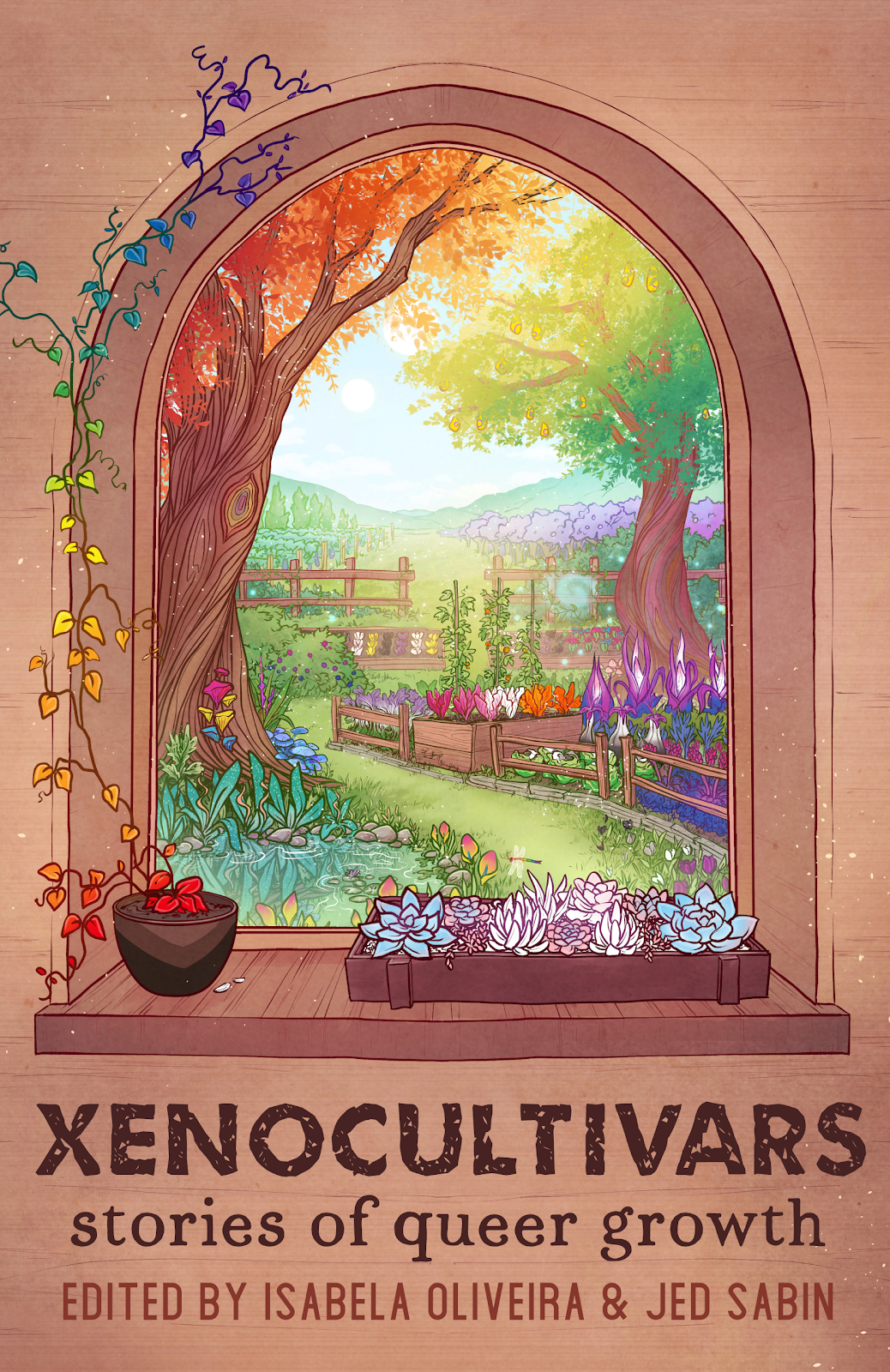
Xenocultivars: Stories of Queer Growth, edited by Isabela Oliveira and Jed Sabin, is a solid collection, the kind that hangs together so well around its theme that it becomes quite hard to highlight individual stories that stand out. As of today, I'd point to the metafictional ingritue of P.H. Lee's "This Story is called 'The Transformation of Things'", Jennifer Lee Rossman's witchy fairytale riff "The Princess and the P. Sativum", and the researcher-student relationship in Hanna A. Nirav's "Reclaiming Our Roots", but ask me another time and I'd probably pick three completely different stories to tell you about. It's worth checking out It Gets Even Better, the previous anthology by Speculatively Queer, as they're doing consistently good work.

Beneath Ceaseless Skies' science fantasy issues are always worth a look, and issue 349 has a great line-up: Jason Sanford's "Blood Grains Scream in Memories" is the conclusion to their sequence of Blood Grains stories (published annually in previous BCS science fantasy issues!), pitting his assembled caravan of protagonists against the overwhelmingly powerful adversary intent on wiping them out in a world dominated by nanotech which kills most humans who stay in one place for too long, in service of environmental protection. It's not the place to start with this universe (that would be "Blood Grains Speak Through Memories") but it's great to see this sequence come to a satisfying end. Yoon Ha Lee's "Bonsai Spaceships" is also excellent (it does what it says on the tin, with a plucky young apprentice protagonist leading the show), and "Rich Growth" by Aliya Whiteley is a beautiful story of death, growth and gemflowers.

Finally, in FIYAH 21, I had a great time with "From Earth to Io, With Love" by Adelehin Ijasan, in which a man teleporting across the solar system for work gets caught up in a nightmare-inducing system glitch which exposes the grim realities of the technology. Ijasan's tone is light and wry throughout the horrors being narrated, which really drives home the capitalist bureaucracy Idris finds himself in.

Adri (she/her), Nerds of a Feather co-editor, is a semi-aquatic migratory mammal most often found in the UK. She has many opinions about SFF books, and is also partial to gaming, baking, interacting with dogs, and Asian-style karaoke. Find her on Twitter at @adrijjy