Showing posts with label religious fiction. Show all posts

Friday, February 27, 2026

Book Review: The Iron Garden Sutra by A. D. Sui

A death-monk in space, musing on what it means to be alive, and to be conscious... with a little bit of murder just to get things going.


If, like me, you read and enjoyed A. D. Sui's last published book - The Dragonfly Gambit, [Neon Hemlock, 2024] - then you'll have been just waiting for this one to drop. Sui has already shown they can handle space opera with flair, so give them not just a whole novel but a whole series in which to do it? Sign me right up.

The Iron Garden Sutra, which begins the Cosmic Wheel Series, follows Vessel Iris, a monk of the Starlit, whose role is to help the dying and deliver the dead to their final rest. The story opens with him in his home monastery, from which he is called to attend a very rare event - the discovery of a generation ship from old earth. One of many dispatched from a struggling planet long ago, it, like its siblings, is expected to be a tomb for its pioneering crew. Iris' job is simply to lay that precious, lost cargo to rest. It's a lonely job, but one he relishes, in the company of the AI assistant embedded into his brainstem. But when he gets there, he finds he isn't alone after all - a group of academics have been granted access to this monumental find, and he'll have to work alongside them to complete his task. Them... and whoever (or whatever) starts killing them off one by one.

A space opera, thriller, murder mystery situation - hurrah!

However - and I'm going to tackle this before I get to the positives because I think it's kind of important - I am not sure how well that "mystery" piece is handled. It really comes down to how much you value surprise, and the slow revelation of plot, piece by piece, over the course of a story. Which I think is an important, but not only critical, factor in this sort of story.

The problem comes from how the information is delivered to the reader, and how much we can reasonably expect of it to be accessible to the characters. For me as a genre reader, as someone who has consumed thriller and mystery content, I unfortunately found the solution to the situation pretty obvious early on, and was never surprised by the mystery (key point, I'll come back later), all the way to the end. I wasn't even in doubt, at any point, once I settled on what was happening. The joy of mysteries, for me, is in the guessing as I read them, even if I'm not amazing at it, so losing out on this strand of the tapestry was a little disappointing, and doubly so because the resolution yielded very easily to narrative logic, rather than being as a result of information presented that the characters themselves had access to. It made sense, within the story, that the engineers didn't come to the solution until close to the end - nothing of the knowledge we know them to have sets them up to come to the right conclusions. Their pool of information is made pretty clear - Sui does a great job setting their context up in that regard - and it makes very intuitive sense that they wouldn't make the jump needed. But that leaves me, the reader, sitting there with a solution nonetheless.

But this story isn't purely a mystery, there's more to what it's doing and where it's drawing its tonal and generic shape from, and so if one were to read it thinking of it in a different light, one where plot revelation pacing is less critical... I can see that this might be less of a concern. But for me, it slotted itself straight into mystery, and I could not but read it with that context in mind.

However, in everything else it was doing? Very few such complaints.

One of the primary other foci here is the character study - of Iris in particular, and of his relationships with both his companion AI (which, in this world, is both a rarity and somewhat of a taboo that his role as a monk is an exception to) and with the strangers he meets on the generation ship Counsel of Nicaea (yes I loved that joke too). Here, for the most part, is where the good work is, and where the obvious connection to Sui's previous book lies. The Dragonfly Gambit, for me, was a triumph of messy characters having messier relationships. While The Iron Garden Sutra is more restrained on that front, the DNA connection is still very clearly there.

Iris is... a mess, to be quite frank. He has spent a lot of his life isolated for a number of reasons, and struggles with having to operate around the new people he finds himself with, while at the same time yearning for their companionship. He is constrained by rules and vows, and also by his own nature that struggles to come to terms with his desires in this context. There are some beautifully described moments, where Sui has a real knack of conveying emotional state and of putting the reader truly inside Iris' head. He dissociates, he panics, he stresses, and all of those feel very embedded in his character and reactions to the (increasingly stressful and horrifying) situation in which he finds himself.

These moments, as well as the early character sketches that introduce us to the others, and the environmental descriptions that persist throughout, are where Sui's prose shines brightest. Right away on boarding the Nicaea, I got a vivid sense of the atmosphere of the place - not just the look, the carpet of moss and the hanging vines, but the feel. There's humidity and warmth, there's the soft floor against bare feet, there's the sweat dripping down the back of a neck. If one is prone to full immersion when reading, this is a book primed to deliver that most generously.

The inter-character relationships too have a good, immediate quality too them - people slot into place amongst themselves quite naturally, and then develop into something more complex from there. By far the best of these is Iris' relationship with his AI construct, referred to as VIFAI. VIFAI is a distinct character in his own right, absolutely a living thing as far as the novel is concerned, and a little bit snarky with Iris when needed. They have the warmth of two people who know each other intimately, and are also occasionally frustrated by one another, having to deal with a stressful situation together, and that stays lovely to read throughout the book.

The relationships with the academics are given less time and less depth, but there's still plenty worth enjoying, especially with the initially-antagonistic Engineer Yan, who clearly has a problem with the Starlit but won't explain why. He, too, gets character development and revelation well worth watching, and makes more and more sense in his responses the more time he gets on the page.

Where the character work falls down a little - only a little! - is in two regards. The first is that contextual information is sometimes delivered in such a way that it... not quite contradicts but definitely gets a little in the way of the natural-feeling progression of character. For example, there's a sequence relatively early that is clearly meant to be there to explain to the reader that this is a world in which AIs are considered living beings, whose autonomy is respected and protected by law. However, this is presented via Iris having a little revelation about how he's been treating VIFAI, that simply doesn't makes sense for the fact that the two have them have been together for more than half Iris' life. It feels as though it comes out of nowhere... except that it's the exact point in the plot where I needed that information, and the protagonist-AI relationship was the best vector to provide it. It doesn't happen enormously often, but there are a few moments like it throughout the story, and each was just a little grit in the eye for an otherwise lovely view.

The second regard is incredibly minor (ha), and yet also one that nagged at me the whole way through the story. There are two students with Engineer Yan as part of his team - and specifically students who have at least and undergraduate degree, possibly more, so they are at the very least in their twenties. These two are universally referred to as children throughout the book, and treated very differently than the "adults", even compared to the non-academics, so it's not even a matter of intellectual snobbery. It's just... a weird quirk. But one I couldn't get away from.

But aside from those? Wonderful. We get some revelations about Iris and VIFAI's early relationship towards the end of the story, and they're the sort of extra contextualising that just clicks everything into place. It's excellent. Likewise, some of the final character interaction scenes are an excellent encapsulation of the journey those characters have undergone, and the changes it must necessarily have performed on them. That growth and change is one of the absolute standout aspects of the book.

Which doesn't mean all the interactions are smooth. I liked The Dragonfly Gambit for its mess, and that mess is here too, though in a different form. Iris, in particular, makes some bad choices in how he responds to and reaches out (or doesn't) to the people around him that are sometimes heartbreaking, but come from a very natural-feeling place for the information we have, increasingly, about his background.

And, coming back to the point, while I may not have been surprised by the mystery, I was sometimes surprised (in a good) way, by some of the character decisions, especially at the climax and aftermath of the story. There is one, in particular, which is devestating in the moment, coming seemingly out of nowhere, but which feels entirely right in contemplation after the fact. And that, more than anything, feels like character work done right - even when they surprise you, it feels entirely unsurprising.

For a book restricted predominantly to the walls of a single (albeit large) ship, we do get enough of a sense of the world to ground it, to make sense of where all the pieces of this puzzle come from. Sui is, unsurprisingly, interested in the history from earth to the generation ship's appearance, and in giving us enough of a sense of the line between the two to make it feel like a part of the wider world.

One of the ways this is done best is in religion, in fact. For all Iris is a member of the Starlit, this is not a single future religion, alone and unchallenged. This is a world that has, at least, muslims, mormons, catholics and a rabbi living alongside the space-death-monks. And for me, religious plurality is an incredibly important marker for a credible space future. Too many stories expect me to believe in monocultures - whether that's a single planet, a single religion, or a single faith - and there is nothing about my experience of the world that has me expecting anything from humans other than plurality in all things. And so, when a story gives that, it's always a pleasant surprise. But moreover, in this space-faring world, where space travel still carries inherent risks and dangers, it makes a lot of sense that something like Iris' Starlit would exist to operate within that niche. The world is shaped in such a way that Iris and his context make instant, intuitive sense to me, and that felt important too. His religion is given shape and depth throughout the story, in his actions, his possessions, his habits and in interstitial texts that tell us more about scripture and beliefs. It is a thing whole, one that forms part of the fabric of human life, and provides something that could conceivably nourish the soul - it is a religion where I can understand why people follow it. Very easily. This is rarer than perhaps it ought to be.

Between the world, the characters, the prose and the very real sense of place, there is a lot to love about The Iron Garden Sutra. I have my quibbles with parts of it, but none of those ever stopped me from wanting to devour it, page after page. I found some of the magic in it that drew me to Sui's previous work, and more than enough to draw me onwards into the rest of the series. I am desperate to know what happens next, but, more importantly, keen to see the characters who go one from the end of this volume, and to see them continue to grow into whatever comes next.

--

The Math

Highlights: excellent characters and their relationships, lovely neat turns of phrase, excellent descriptions of place and atmosphere

Nerd Coefficient: 7/10

Reference: A. D. Sui, The Iron Garden Sutra, [Erewhon Books, 2026]

POSTED BY: Roseanna Pendlebury, the humble servant of a very loud cat. @chloroformtea.bsky.social

Tuesday, December 23, 2025

Not much changed when the Fire Nation attacked

The Avatar saga remains faithful to its tried and true formula: visually breathtaking, narratively uninspired

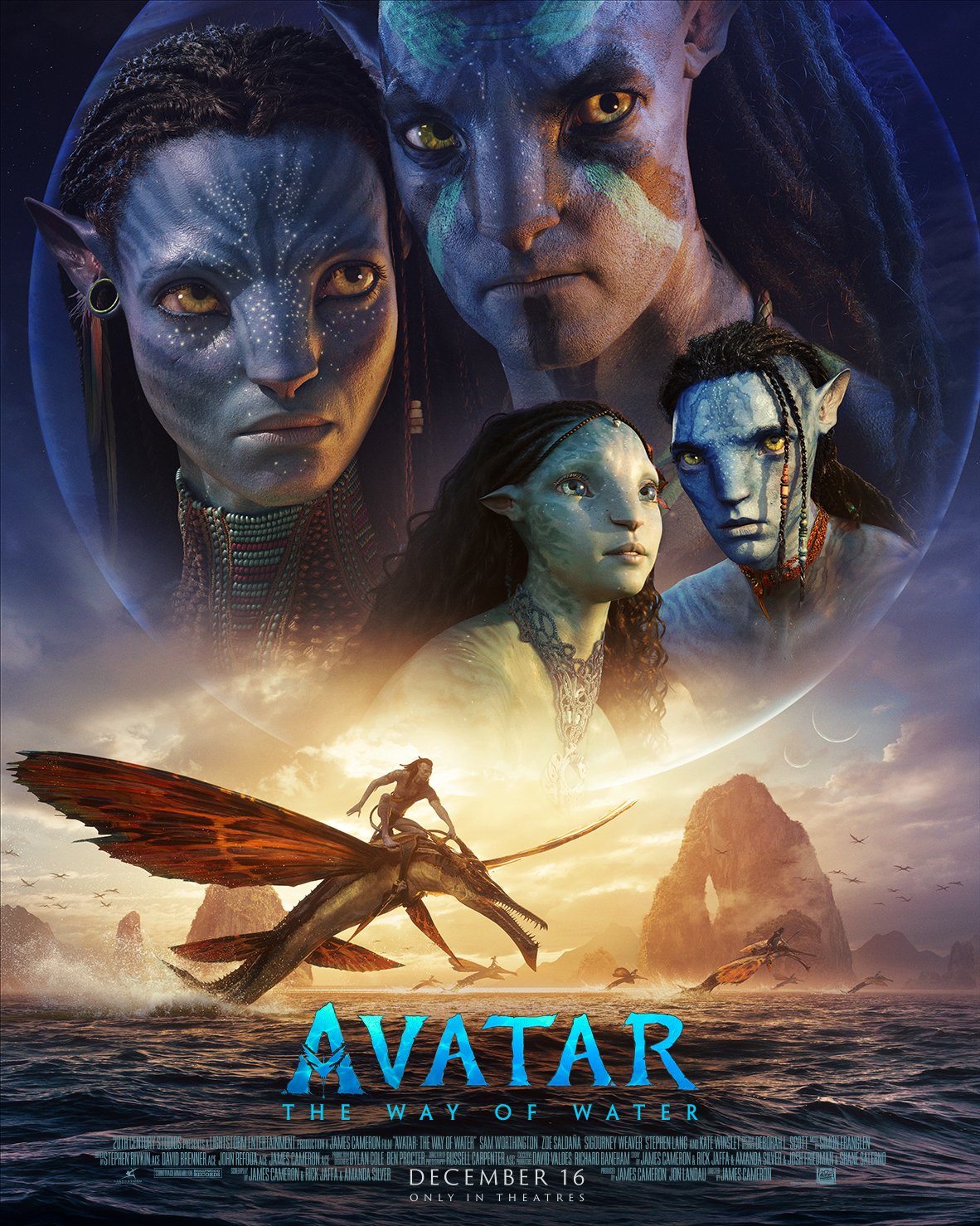
There are truly interesting ideas in Avatar 3 that elevate the themes raised by the first Avatar to questions of thorny significance to the story, and time after time, their resolution goes for the easy answer, the overdone cliché. The Way of Water could be forgiven for delivering very little because it promised very little. Fire and Ash promises a lot and still fails to deliver, which makes this entry in the film series a more regrettable (forgive the pun) misfire.

Let’s begin with the film’s central conflict: Spider, the human boy adopted by the blue aliens. After a sudden bout of cosmic bad luck, he ends up convulsing on the forest floor, with no more human-breathable air left in his mask and far from his stack of replacements. As a desperate last measure, our miracle child Kiri connects to the web of nature and reformats Spider’s entire body chemistry to allow him to breathe Pandora’s air. So far, so good: no more depending on a 24/7 mask to survive. However, Spider’s new metabolism opens the door to a nightmare scenario: he’s living proof that the human body can adapt to survive unimpeded in Pandora’s environment. If the bad guys figure out how to replicate the process, the entire balance of power in Pandora will shift in favor of human colonization.

Now Spider’s existence is a danger to everyone he loves, and his body is an invaluable source of biomedical innovation. The rest of the film has him ping-ponged between enemy factions that want to either cut him open for the benefit of Earth or cut his throat for the benefit of Pandora. But the movie chooses the wrong Na’vi as the mouthpiece for the latter position, and there are no lasting consequences for the personal ties that should have been damaged between Spider and his would-be executioner.

It has a jarring effect that the film brings us to this immense rift between Spider and the blue aliens, only to give everyone a happy ending where he’s welcomed by the ancestors as a member of the Na’vi without further issue. Let’s stress the point again: Spider was almost murdered by people he deeply trusts and loves, because they became convinced that his life put all of them in danger. And this betrayal comes after Neytiri has spent half the film insulting and neglecting him because she’s still grieving her dead son and Spider is a constant reminder of which people took him from her. After his near-execution, the relationship between Spider and the Na’vi shouldn’t be able to go back to normal, ever. At the very least, it should take more for him to take up arms in their defense again. Even his evil not-exactly-father, the half-Na’vi clone of the late Colonel Quaritch, shows him more respect in this film than his adoptive parents.

The other conflict in the plot, which the trailers gave much attention to but actually doesn’t affect the story that much, has to do with the Fire Nation Ash People, a tribe of pillagers who some decades ago survived a volcanic disaster and have since rejected the cult of the nature goddess Eywa. Now they live off piracy and worship the same fire that destroyed their old way of life. This is a fascinating concept that the film does nothing with. It’s one thing to present a schism in a pantheistic faith and create what is essentially a demonic cult; it’s much more compelling to do so in a setting where the nature goddess is demonstrably real and present in people’s lives. What does it look like to despise the natural flow of the life force when that force is visible and has a tangible will?

But also, what does it say about Eywa that she plays favorites between Na’vi clans? The Ash People’s backstory has them praying to be saved from the volcano, but Eywa refused to send help. In such circumstances it makes total sense that they’d form a new religion around fire, which proved to be the more powerful force, and that they’d turn to pillage to survive, both because they no longer have fertile land and because they no longer trust Eywa’s generosity.

Eywa’s will is actually one of the bigger problems with the plotting of the Avatar series. In the first movie, she saved the day via literal Dea Ex Machina, and Avatar 3 repeats the same trick in an identical situation. The critique of real-life environmental devastation is loud and clear: the humans of this future are too dim to notice the obvious intelligence of the space whales they kill for profit, but it takes a civilization-sized Idiot Ball to ignore a whole sentient biosphere telling you to stop.

When you introduce a deity into your setting, and this deity’s opinion matches your stance as an author, it’s very hard to avoid turning your story into a pamphlet. Eywa steers the plot at the times when it’s convenient, in the directions that help the author preach his message, and thus can’t function as a character in the way that the rest of the characters treat her. And the only time we’re told Eywa makes a questionable choice, i.e. letting the Ash People starve, it’s presented in a way that makes them the bad guys instead of Eywa. As often happens with supreme beings in stories, there are no lessons for Eywa to learn, no need for her to change her mind or grow. The story assumes she can do no wrong, even when it clearly shows it happening. Instead of being a character, she fulfills the function of authorial (forgive the pun) avatar that stalls or pushes the plot as needed.

Another character whom the story treats far more favorably than their actions deserve: Jake Sully, whose boot camp style of parenting will probably push Na’vi culture to invent psychotherapy on its own. Even allowing for the sad reality that the entire Na’vi people is in a war for survival, Jake has no excuse for the way he treats his children, and he’s repeatedly portrayed as heroic for it.

Avatar’s in-your-nose parable about colonialism and predatory greed has been repeating the same basic points for three movies, and doesn’t have any original perspective to add to the discussion. James Cameron has clearly exhausted all the tricks in his box. This film series should stop before its incomparably gorgeous landscapes can’t disguise the mediocre storytelling anymore.

Nerd Coefficient: 6/10.

POSTED BY: Arturo Serrano, multiclass Trekkie/Whovian/Moonie/Miraculer, accumulating experience points for still more obsessions.

Wednesday, October 8, 2025

TV Review: Tomorrow and I

In the future, humanity is the same, but we find new ways to complicate our lives

The anthology miniseries Tomorrow and I, produced in Thailand and released last year on Netflix, explores near-future scenarios where personal identity, social mores and class divisions intersect with digital tools, biotechnology and climate change. Although the stories told in the four episodes have universal appeal, they are related to topics that are deeply important in today’s Thailand: the struggles that trans people still face in conservative families, the government’s hypocrisy that keeps sex workers out of the formal economy, the rapidly changing attitudes about the place of religion in the 21st century, the dangers of rising sea levels for a coastal country, and the slow distribution of coronavirus vaccines.

The first episode, Black Sheep, is a bittersweet tale of selfless love. The story is about a closeted trans man who has been so far resigned to a life of unhappiness. He finds a measure of satisfaction in his job as a doctor who does cutting-edge research on 3D printing of organs for transplantation. It turns out that growing living tissue into the desired shape works better in microgravity, so he’s been recruited for a space mission where his experiments have more promising chances. However, his return trip results in a fatal accident, and that’s when his husband sees an opportunity to use forbidden cloning technology to bring him back—this time in the right body.

We don’t learn about the protagonist’s gender dysphoria until after his death, when the cloning technology scans the memories from his brain. Most of the episode actually follows the husband, whom we see grieve for a while before he comes up with the cloning idea. There’s a very interesting scene where he argues with his in-laws about the process: they strongly oppose it for religious reasons, and he has no time for talk of the afterlife. The Buddhist doctrine that the material world is full of suffering takes a central place in the discussion.

This episode makes good use of the narrative rule that victories must have a painful cost. For our astronaut doctor, it’s the legal limbo of existing as a cloned person (not unlike the real-life legal limbo of trans people in Thailand, who still can’t change their ID to one that reflects their true gender). For the husband, it’s a prison sentence for stealing the head from the morgue, and after that, the separation from his spouse, who miraculously got his job back, but is now permanently stationed at a lunar research lab.

Pros: Great casting for the role of the astronaut doctor, with separate actors for the scenes before and after resurrection/transition.

Cons: The reveal of this character’s history of gender dysphoria is handled without much tact, almost crossing the line into sensationalism.

The second episode, Paradistopia, is a warped reflection of real life through a neon lens. The protagonist is a businesswoman who founds a sex robot factory with the dual goal of relaxing the tight social expectations regarding sex in Thailand and giving less arduous white-collar jobs to aging sex workers. The story of her rise to commercial success is interweaved with flashbacks of her childhood as the daughter of a sex worker, struggling to finish her studies and dreaming of leaving her slum behind. In the present, she’s returned to the same slum and transformed it into a proud red-light district where every desire is catered to with the latest robotic technology.

There are several scenes of talk shows discussing the planned launch of a robot brothel; cabinet members warn that men who get too used to consequence-free interaction with a machine may carry the same behavior to their real relationships, while our protagonist insists that Thailand needs to develop a more open attitude about the varieties of erotic desire. These scenes have the clear intent of inviting the viewer to side with the protagonist, but she’s not above playing dirty herself. She bribes several government officers to secure the legal permits for her robot brothel, and even orchestrates a false-flag smear capaign against herself to draw public sympathy.

The resolution of this episode is rather abrupt and inelegant, but it does pack an implied punch: just because the authorities aren’t ready for a world with robot sex doesn’t mean demand will magically vanish.

Pros: The fabulous retrofuturist aesthetic in every detail.

Cons: The cringeworthy attempts at humor.

The third episode, Buddha Data, is about the meeting between digital culture and ancient tradition. We follow a Buddhist monk who starts questioning his purpose when the whole country becomes obsessed with a new mobile app that adds gamification to acts of charity. The creator of the app resents the Buddhist priesthood for cheating his parents out of all their possessions in the form of offerings, and has given himself the mission to bring actual, material consequences to good deeds. Instead of accumulating merit for the next life, users of his app receive karma points they can exchange for discounts. It doesn’t take long for some people to perversely game the system and earn points for technically fulfilling the quests.

So our monk, who happens to have coding experience, teams up with a former colleague and launches his own spiritual progress app. While his competitor turns charity into a performance for selfish motives, this app guides the user through the steps of enlightenment with the help of wisdom extracted from the brains of veteran monks. All seems to go well for this project, until a scandal blows up and brusquely reminds the viewer that scanning a monk’s brain is no guarantee of holiness.

Pros: The dialogue scenes between the monk and his robot sidekick.

Cons: The plot relies on too many convenient contrivances.

The fourth episode, Octopus Girl, is the show’s pièce de résistance, although the budget was clearly spent more in set design and casting than in scriptwriting. We’re introduced to two adorable schoolgirls who live in a slum during a worldwide three-year-long rain caused by a collapsed climate cycle. Most people have become accustomed to the perpetual rain, and some animals have begun showing impressive adaptations, but tropical diseases are out of control. The United Nations have developed a vaccine prepared with octopus genes; the only side effect is that your face grows little tentacles. In Thailand, the comically inept Prime Minister makes a big show of banning the vaccine from the country while proposing instead to enclose flooded towns under glass domes.

Meanwhile, our girls sneak into a TV singing contest and steal the nation’s hearts by bringing attention to the way the government neglects poor neighborhoods. The scenes in their slum have a cute slice-of-life vibe that is only hurt by the tonal mismatch of a sense of humor more appropriate for an audience of children (which is hard to believe, given this is the same series that had an episode about sex robots). But the biggest tonal whiplash is the episode’s ending, which just wipes off all the goodwill the episode has laboriously tried to earn.

Pros: Excellent set design.

Cons: Very strange humor, needlessly mean ending.

Taken as a whole, Tomorrow and I is pessimistic about the potential of technology. Even when people seem to achieve their goals with the help of advanced genetics or robotics or informatics, the situation invariably turns more adverse and the achievement becomes unusable or unenjoyable. However, this doesn’t mean that the stories take a nihilistic stance about the human search for happiness. This is no Black Mirror. What these stories are saying is that, while technology makes our faults more notorious and therefore more consequential, that doesn’t negate the sincerity of our efforts. Fundamentally good people find themselves in defective systems that don’t allow for neat, clean solutions.

The nuances of this humanist stance are hindered by the show’s painfully simplistic and obvious dialogues. I must admit that I watched with English subtitles and can’t understand Thai, but to the extent that each plot can be followed, what is gained with great visual effects is lost with lackluster scripts, by which I mean that the characters’ reactions can get too melodramatic, or too predictable, or too hackneyed. One can believe that the future will be hard to navigate, but not that we will lack the capacity to describe it.

Nerd Coefficient: 7/10.

POSTED BY: Arturo Serrano, multiclass Trekkie/Whovian/Moonie/Miraculer, accumulating experience points for still more obsessions.

Wednesday, May 14, 2025

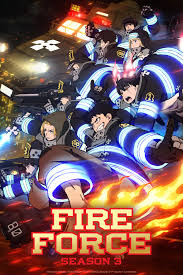
Anime Review: Fire Force

Familiar but well-paced plotting with a post-apocalyptic twist.


Without much fanfare or hype, stalwart anime Fire Force is ending its brief but enjoyable run with the airing of its third and final season. The highly bingeable series is wrapping up, making Fire Force a low commitment option for those who can tolerate its recurring fan-service humor and the vaguely familiar plotting. The show is a combination of likeable characters, disturbing themes, and relentless sarcasm and humor. That combination makes it uniquely enjoyable although the tropes and characterizations will feel familiar for fans of Naruto, Black Clover, or My Hero Academia

Fire Force is set in a future, post-apocalyptic Earth, where small pockets of humanity have rebuilt themselves into modern communities after a great fire cataclysm destroyed the world. In the wake of the devastation, a religion arises which worships the fire god Sol and eventually a formal church is established to organize and lead society. Hundreds of years after the devastation, people have resumed normalcy except for fires that break out when a random individual spontaneously combusts. The Fire Force is a group of fire specialists divided into distinct squads and trained to respond to the devastation caused by a burning, but still sentient, human. The series follows a fire powered teen, Shinra who joins the rogue Squad 8 of the Fire Force. Shinra was orphaned when his mother and brother were killed in a mysterious fire. After surviving, he develops an involuntary, creepy, sharp-toothed grin and he now has fire-power through his feet all of which made him an outcast. He is called a devil and is frequently accused of killing his family. Shinra joins Squad 8 after finishing the Fire Force academy and is joined by his fellow classmate Arthur who also has superpowers. The series focuses on Shinra’s adaption to his quirky, new-found family at the 8th squadron and his determination to become a hero and to unravel the mystery of human combustion and the loss of his family. The show is filled with twists, betrayals, and lots of commentary on politics, science, religion, and faith. 

The best thing about Fire Force is the fast-paced, filler-free pacing. Almost every episode is exciting, suspenseful, and emotionally engaging. The worst thing about Fire Force is the recurring fan-service objectification of women. In particular, there is a recurring gag about one of the antagonist-turned-ally characters who has a curse that makes her clothes fall off during battles as a way to distract opponents. It’s intended as comic relief for the stressful content of the show, but the show already has plenty of solid humor in other contexts. Shinra’s rival, super-powered Arthur is a teen who imagines himself to be a fictional knight. His delusions drive the power of a plasma sword he fights with. As such, the other characters are forced to humor his delusions in order to encourage his super-human strength in times of crisis. Arthur has an unexpected backstory that explains his delusions and his character is a variation of Zenitsu in Demon Slayer who fights best when he’s in a dream state. Squad 8 includes the unpowered but super-strong leader Obi, fire powered Hinawa, mega strong pyrotechnic Maki, the squad’s nun Iris, and unpowered but super smart engineer Vulcan and scientist Licht. 

The vibe of Fire Force is similar to Black Clover with the competitive but ultimately supportive squads who gradually realize they are facing a larger organizational threat from a group of villains (the White-Clad) bent on destroying the world. The White-Clad villains in Fire Force are similar to the Eye of the Midnight Sun in Black Clover or the Akatsuki in Naruto. Fire Force also has the rivalry of Shinra and Arthur, which mimics Asta and Yuno in Black Clover and Naruto and Sasuke in Naruto. And all three series build on the trope of the outcast hero, political secrets, and morally gray areas. 

Despite the retreading of these popular story elements, Fire Force distinguishes itself with stronger pacing over the course of the series. It also deals with thoughtful elements of religion and faith as well as compassion and cruelty. When an individual spontaneously combusts, they continue to live and suffer (sort of like a sentient zombie) even as their body burns. Each call the squad receives involves the torturous death of a loved one who remains conscious while burning alive. The squad has a nun in firefighter gear whose job is to pray for the soul’s release while the fire force team kills the person. Shinra’s home, the Tokyo Empire, is powered by a powerful generator known as Amaterasu. Over the course of the series the characters discover a disturbing secret about how the generator is powered. And Shinra learns some difficult truths about what happened during the fire that destroyed his family. 

All of this intensity is heavily woven with ongoing moments of levity, surprising elements of diversity, character backstories that range from mundane to horrific, and plenty of introspection on what it means to be a hero in a place built on fire. The idyllic scenes of families at play or at work in the city mask the fact that much of the world is gone and the post-apocalyptic survivors must trust their leadership and the generator to maintain their sense of normalcy. As a result, the series asks difficult questions about faith, betrayal, and sacrifice. And, it does it in a compact three season run, which makes this under-loved anime a humorous but thoughtful adventure that won’t burn you out.

--

The Math

Nerd Coefficient: 7/10

Highlights:
  • A quirky mix of humor and tragedy
  • Annoying fan service and revisited tropes
  • Well-paced, filler free adventure

POSTED BY: Ann Michelle Harris – Multitasking, fiction writing Trekkie currently dreaming of her next beach vacation.

Wednesday, August 28, 2024

Film review: Kalki 2898 AD

A clash of past against future, tyrants against gods, ambition against destiny

The latest blockbuster to come from epic Indian cinema, Kalki 2989 AD is India's most expensive film so far. Set in a far future beset by hunger, despotism and hopelessness, it follows a handful of improbable heroes struggling to bring about a new era of peace.

The background context for this film is the Kurukshetra War, a pivotal moment in epic Indian literature. According to the Sanskrit poem Mahabharata, two related clans, the Pandavas and the Kauravas, fought each other brutally for eighteen days over control of the Kingdom of Hastinapura. Toward the end of the war, one formidable soldier allied with the Kauravas, Ashwatthama, upon seeing that his side was losing, hurled a weapon of divine might against princess Uttara, who was pregnant with the last surviving heir of the Pandavas. The hero Krishna, an earthly incarnation of the god Vishnu, stopped the attack and cursed Ashwatthama to walk the earth for centuries.

The film takes these events and gives them a continuation in our far future. The opening credits, which consist of a digital animation of scenes from the Kurukshetra War, end in a close-up of a CGI shoot of grass that blends into an identical-looking, real shoot of grass. The meaning is clear: the realm of myth extends into the real world. In this future setting, the Kali Yuga, the cosmic era ruled by sin and perversion, is nearing its end, and the hero Kalki, the next incarnation of Vishnu, who will restore the world and put an end to evil, is about to be born. Unfortunately, the tyrant who controls the last surviving human city has a habit of kidnapping fertile women for horrific experiments to try and extend his own lifespan. It is one of those women who is carrying the foretold savior of humankind.

Kalki 2898 AD does a good job of explaining the basics of its massive lore, but for Western viewers it wouldn't hurt to brush up on their Hindu mythology. Much of the emotional impact of the plot (especially the return of Ashwatthama as an eight-foot-tall badass immortal) relies on the audience's assumed familiarity with and personal investment in Hindu eschatology. This is not like watching a movie about Hercules or Achilles, where we know the relevant myths but don't take them as historical fact. Rather, imagine if the plot of Left Behind happened in the setting of Mad Max, and, more importantly, imagine that you're a devoted believer. The tacit position of the film, and of its intended audience, is that the Mahabaratha narrates actual events that happened in real life. Whereas Western scriptwriters and directors will probably not feel any reverence for the Olympian gods, to a huge portion of the Indian population the Hindu gods are very real. Keep that in mind as you sit to watch.

Once the stakes are defined, the film becomes a series of frantic chase scenes between bad guys and good guys trying to snatch this desperate pregnant woman who never asked to occupy such an important position. Combat scenes are a mixed bag: while Ashwatthama (now tasked with protecting Kalki's mother until he can be born) commands every scene he appears in with his imposing presence and impeccable acting (no surprise there, since he's played by cinema legend Amitabh Bachchan), his sometimes rival, a bounty hunter named Bhairava, is comparably strong, but the visual effects used in his fighting moves are too obviously fake. Nameless mooks get smashed against the walls like bowling pins, making Bhairava's battles (even the all-important one at the end) look more comical than awesome.

Visual effects in general are a problem with this film. Landscape shots look impressive, but the objects moving in the foreground seem copied and pasted from a stock photo archive. Together with the Zack Snyder-style yellowish tint that was applied all over the film, the disorienting editing between sequences and even within the same scene, the ill-advised use of fast motion for dramatic effect, and the cringeworthy sense of humor, these moviemaking choices rob Kalki 2898 AD of the majestic aura it wants to claim.

Your enjoyment of the protagonist, bounty hunter Bhairava, will depend on how much patience you have for the lovable rogue archetype. Take Han Solo, but replace Chewbacca with KITT from Knight Rider, and you'll get the idea. It's interesting that Bhairava starts the movie in opposition to the aims of divine prophecy, but gradually becomes an antiheroic figure who fights the villains for selfish reasons. Alas, the rest of the cast isn't fleshed out at all. The expectant mother of the god Vishnu is treated as a standard-issue damsel in distress; the generic mid-level commander who persecutes our heroes is stuck in the role of generic mid-level commander; the supporting heroes are an interchangeable collection of cool gadgets and catchphrases; and the minor villains are disposable meat. That's a common problem with plots built on prophecy: characters don't need to grow, because victory is already written in stone.

This film is the first entry in a planned Kalki Cinematic Universe that has already produced a prequel series. Accordingly, Kalki 2898 AD ends in a cliffhanger that renders much of its plot moot. In a discouraging imitation of Hollywood's worst habits, the film even has a post-credits scene that teases a bigger battle with the final boss. It's clear that the producers want to go big with this, but the studio needs to hire better scriptwriters, and the visual effects aren't yet at a level capable of delivering a spectacle deserving of awe.


Nerd Coefficient: 7/10.

POSTED BY: Arturo Serrano, multiclass Trekkie/Whovian/Moonie/Miraculer, accumulating experience points for still more obsessions.

Wednesday, May 22, 2024

First Contact: Metropolis

A dazzling window through which a century of science fiction can be glimpsed

Economic inequality is bad. It's unfair, cruel, bad, unfair, cruel, bad, unfair, cruel—there aren't many ways to say this basic fact. This is why it's so difficult to make a science fiction allegory of inequality with anything interesting to say beyond: bad, unfair, cruel. I've become very skeptical of this century's dystopias because, almost every time, the setting turns out to be yet another allegory of inequality that's going to parrot what I already know. As a topic for storytelling, greed doesn't lend itself to much complexity or depth; it's just a bad thing, and it ought to end, and that's pretty much all there is to say on the matter. Call it The Hunger Games or Altered Carbon or Elysium or the Black Mirror episodes "Fifteen Million Merits" and "Nosedive," they tend to replay the same arguments and impassioned pleas and end up sounding like they harbor the alarming suspicion that we need convincing that the sky is blue. Time after time, we're treated to the same fables of decadent leisure for the few and soul-draining toil for the rest like it's some world-shattering discovery. You have to look for the topmost of top-caliber stories, like the Doctor Who episodes "Oxygen" and "Boom," to find fresh creative angles on the age-old problem of human greed.

Despite the difficulty of saying anything new about inequality, science fiction has tried its hand at saying it many times, mainly because our genre is an heir of the Industrial Revolution, which made it a natural vehicle of expression for the dystopian living conditions of factory workers since the earliest science fiction. So it's no surprise that class conflict is the core conflict in Viennese director Fritz Lang's 1927 film Metropolis. Set in a city divided between luxury and drudgery, it tells the story of a workers' rebellion sparked by an undercover robot with dubious loyalties. Even if you don't follow science fiction, anyone interested in cinema is aware of Metropolis as one of the absolute biggest classics of all time.

My first impression is that this film's revered status is more due to its unparalleled visual inventiveness than to any insight gleanable from its script. The moral stance of Metropolis lands like a blow to the face, with all the shallow preachiness of the average Black Mirror and a textbook case of Madonna-whore complex that I'm sure made Freud yawn. Of course, I say this from the position of a 21st-century viewer who has had his fill of science fiction about rich, overemotional manchildren with mommy issues. By which I mean Ferengi. Surely these themes must have felt audacious and thought-provoking back then. But is it really possible that 1920s Weimar moviegoers didn't know that factory workers had harsh lives, and needed two hours of delirious psychosexual melodrama to open their eyes to the evils of class stratification? The question may sound silly in our hyperliterate 2020s, but let's not forget that there are still pockets of regressive ideology where it's asserted with a straight face that slaves didn't have it so bad. Even such a prominent literary figure (and prominent Fabian socialist) as H. G. Wells called Metropolis implausibly pessimistic in its depiction of the suffering of workers, although it must be noted that his analysis of the movie was so literal that he mistook its striking art design for a genuine attempt at predicting coming trends in industrial engineering.

To be fair to Mr. Wells, there are details in his essay that hint at the possibility that the version of Metropolis he watched must have been Channing Pollock's studio-mandated, intentionally mistranslated recut. But even so, to make such misjudged remarks about the look of the film, Wells must have been unfamiliar with the conventions of German Expressionism, the artistic tradition most in line with the key moviemaking principle that the function of images on a screen is not to be, but to represent.

German Expressionism works so well for the silent black-and-white format that I'm surprised it wasn't independently developed in other countries. When you can't record sound or color, the only tools you have for communicating a character's emotions are lighting and gesture. And when your only tools are lighting and gesture, overdramatic chiaroscuro is your friend.

While watching Metropolis, I was in awe of how few dialogue cards were really needed to tell the story. With the exaggerated way the actors waved their arms and performed their facial reactions, following the plot was effortless. As regards Freder, the young male protagonist, this style of acting hurts the reading of his character. He comes off as too mercurial, too easily influenceable. Actor Gustav Fröhlich was 24 when he worked in Metropolis, and I kept having the impression that his role would have felt more natural if it had been given to a teenager.

On the other hand, Brigitte Helm proved here that she was ONE HELL of an actress. As typical for this era of cinema, she also resorted to big, expressive movements for playing the two characters she had in the movie, but the result never feels like too much. She was in perfect control of exactly how much she needed to twist her neck or contort her face to nail a scene. With the spell she casts on the viewer, she singlehandedly saves Metropolis from the absurdities of its script.

The main antagonists of Metropolis are a businessman and an inventor. Their suitability as villains in a fable of industrial dystopia is clear; their motivations are anything but. The inventor claims to want revenge against the businessman over a decades-old romantic rivalry, but the rebellion his robot incites among the workers is exactly what the businessman wants, to the point that one middle manager is explicitly ordered to let rioting workers destroy the most important machine that keeps the city functioning. The disaster that ensues only lands for the businessman when he's told that his son is in the factory. And yet, somehow, the boss and the workers end up spontaneously willing to listen to each other, in a painfully saccharine scene that lingers for too long.

It is a testament to the movie's artistry that it became a must in any film studies curriculum despite being known primarily in mistranslation. It's hard for a shamelessly sanitized script to detract from the power of these images—the miniature sets depicting the shining city of the future; the iconic accident scene where a wall of machinery is transmuted into a demonic face that devours people; the no less iconic dance scene where the robotic impostor in womanly guise demonstrates its ability to enchant men; the frantic choreography of workers attached to buttons and levers; the secret tunnels buried beneath the city; the imposing architecture that feels oppressive just by looking at it. Even when depicting actions that on paper sound banal and boring, there is no scene that doesn't have a superabundance of emotion. Watching these actors shake and jump all over the screen has an oddly mesmerizing effect that took me by surprise. It's a happy marriage of medium and style.

And then there's the bonus satisfaction of identifying the elements of Metropolis that begat prosperous descendants across the 20th century: the robot design that looks like a great-grandmother to C3PO; the inventor's laboratory that helped codify the aesthetic conventions of mad science; the urban geometry that haunts the night in Batman: The Animated Series; the impostor wearing a human skin like one of Skynet's creations. I felt like I was participating in a reverential pilgrimage to the birthplace of my idols.

Only in one regard will I agree with Mr. Wells's otherwise narrow-minded criticism of Metropolis:

The film’s air of having something grave and wonderful to say is transparent pretence.


POSTED BY: Arturo Serrano, multiclass Trekkie/Whovian/Moonie/Miraculer, accumulating experience points for still more obsessions.

Monday, May 6, 2024

Review: The Book of Clarence

A unique, irreverent, genre-mixing dark comedy wrapped around deep messages on race and class

The theatrical trailer for The Book of Clarence left me feeling confused and a little uneasy about seeing the film. Was it an alternate history, a comedy, a parody, a tragic epic drama? Was it an allegorical Black social commentary, fantasy/sci-fi, religious, anti-religious? After seeing the film, the answer to all of these questions is: yes. There was so much going on in this story. The quirky presentation style is so unique that it’s hard to know who the target audience is. But sometimes weird is good.

The story is set during the last year of the life of Jesus. Yes, the Jesus. Jesus is a popular local celebrity in the area (due to his legendary miracles) but initially he remains mostly offscreen and is barricaded by an entourage of disciples. Clarence is a local hustler, but with a good heart. He gambles, sells drugs, drag-races chariots, and takes care of his ailing/aging mother. When his ill-gotten debts catch up to him and the local mobster threatens to kill him, Clarence hatches a scheme to make money by taking advantage of Jesus’s popularity as the Messiah. At first he tries to join the disciples but is immediately rejected by them, including his twin brother Thomas (yes, the famous doubting Thomas) so Clarence is prevented from any access to Jesus. Then he gets a better idea. He decides to con people into believing he is a miracle worker to get money.  Clarence enlists his best friend Elijah and recently freed fighter Barabbas to help with the scheme. But things take a turn when the occupying Roman military catches up with Clarence leading to an unexpected encounter with the real Jesus. The additional twist in this film is that, other than the occupying Romans, every character is Black.

The film is initially a parody of classic Bible epics such as Ben Hur or The Ten Commandments, using ironically epic background music, dramatic chariot races, and even 1960s-style gold-framed title pages in between the major acts of the story. On the other hand, it is also fantastical. The drugs Clarence smokes with his friends cause them to temporarily float in the air with their bodies turning and spinning, gravity-free. When Clarence gets an idea, it materializes as an actual light above his head. The fantastical special effects are a surreal juxtaposition against the retro epic vibe.

At first, the feel of the film is epic and historical but also slightly comical/absurd. However, the film eventually dives into the true nature of belief, loyalty, and morality. Although the people in his community have a range of spiritual beliefs, particularly as it relates to the Messiah, Clarence seems to be the only one who doesn’t believe in any form of God or spirituality. However, he is willing to use the existing belief systems to achieve his goals by being a con artist and pretending to be an alternate Messiah. In a dual role, LaKeith Stanfield plays both Clarence and Clarence’s twin brother, Thomas the apostle, who has abandoned everything, including their ailing mother, to follow Jesus. Thomas despises Clarence’s petty criminal behavior, even as Clarence has devoted himself to caring for their mother. Thus we have the set-up of religious piety versus cynical pragmatism that permeates the film.

The best character in the film is Clarence’s best friend/sidekick Elijah. Elijah is open-minded about his beliefs, but also comfortable running scams and being loyal to Clarence and their bestie, chariot racer Mary Magdalene. In a pivotal scene, Mary Magdalene has been accused of adultery and chained to a wall to be brutally stoned to death. Elijah intervenes to protect her, risking his own death, but he cannot free her from the chain. Clarence is nowhere around and death seems imminent for Mary and Elijah until the real-deal Messiah shows up in a quietly jaw-dropping, Marvel-worthy scene.

The set design and costumes of the film are outstanding, making you feel transported to the ancient Jerusalem setting that has been reimagined for the story. The film also benefits from a strong cast reinterpreting classic characters, including Mary, the Mother of Jesus (hilariously played by Alfre Woodard), John the Baptist (David Oyelowo), and an irritable Pontius Pilate (James McAvoy). We also get quirky new characters played by Babs Olusanmokun from Star Trek: Strange New Worlds, Caleb McLaughlin from Stranger Things, and an almost unrecognizable Benedict Cumberbatch who takes the film to new irreverence as an accidentally mistaken version of Jesus.

All these strange, quirky characters revolve around Clarence as he tries to make a better life for himself and prove himself worthy of his ill-fated love interest Varinia (Anna Diop). LaKeith Stanfield leans into the cynical, skeptical, onscreen personality he has used effectively in prior fantastical films like Sorry to Bother You, Haunted Mansion, and even Get Out. Despite his cynicism, Clarence has enough cliched character growth to make some positive societal choices for others, even as he still scams those around him. Clarence continues to pursue his fake Messiah miracles with growing success until he finds out the true cost of the path he has chosen. Then the film takes a serious and dramatic turn into a violent exploration of racism and classism. We think we know what is going to happen, but the final crucifixion scenes subvert both traditional narratives and cynical new viewer expectations.

The Book of Clarence throws many important social justice themes and philosophical questions at viewers who may ultimately feel overwhelmed and disoriented by the irreverent and quirky delivery style. The trope of the lovable rascal with the heart of gold is quickly subverted into an ultimate theme of “mess around and find out.” It’s been a long time since a film completely bewildered me in such a good way. This movie is not for everyone. But, if you have an appetite for quirkiness and a tolerance for explorations of hard truths wrapped in an allegory, The Book of Clarence will give you a great deal to think about.


Nerd Coefficient: 7/10

Highlights:

  • Weird and provocative. Not for everyone.
  • Quirky subversive messaging.
  • Strong performances by the lead actors.

POSTED BY: Ann Michelle Harris – Multitasking, fiction writing Trekkie currently dreaming of her next beach vacation.

Monday, March 4, 2024

In Dune: Part Two, the Hero's Journey takes a very dark turn

There's nothing more dangerous than a savior

Consider the above photo for a moment. It's one of many, many great shots to be found in Dune: Part Two. But to me, this one summarizes the core message of the film, and of the entire Dune series of novels. This shot happens when Paul Atreides has secured the fervent support of the Fremen, who see in him the fulfillment of their messianic prophecies. He will soon lead them in battle against the Emperor of the known universe, and then against all the noble houses, and then... If you've read past the first book, you know the ugliness that follows. War will spread from world to world and consume billions of lives.

And all that horror is (literally) foreshadowed in that photo. It shows Paul standing atop a rocky shelf, giving a speech before his gathered followers. But if you focus your gaze on the multitude, Paul's barely lit silhouette transforms into a gigantic shadow that falls over a good portion of his own army. His raised arm holding a dagger resembles the shape of a scythe. That is who Paul is destined to become: a bringer of death on an interstellar scale.

When Dune: Part One arrived in theaters, I was concerned about the sequel's ability to give equal attention to the numerous mass fights and the heavy philosophical themes that occupy the latter half of the first Dune book. Fortunately, after watching in Part One a movie basically made of setup, we get in Part Two dramatic rewards galore: Baron Harkonnen starts the story believing himself to be a cunning mastermind, only to end up losing everything; local warlord Stilgar becomes a religious fanatic who eagerly enables Paul's ambition; and Lady Jessica evolves from a minor operative in the Church of Painstakingly Slow Eugenics to a ruthless manipulator, a twisted blend of John the Baptist and the Virgin Mary, an unholy messenger that prepares the way for the Dark Messiah.

The film makes good use of its runtime to discuss the corrosive effects of proselytism on subjugated communities. Much like the Slave Bible in the US, the Reverend Mothers of the Bene Gesserit have spent centuries spreading doctrines calculated to facilitate their control over the native populations of several planets. Paul's rise to complete military and political power is viewed by the Fremen as the key to their freedom, but it's actually part of an immensely complex scheme of domination that not even Paul agrees with. The character of Paul Atreides is portrayed here with deep psychological awareness of the competing loyalties and urges that inundate his mind. It doesn't hurt that Timothée Chalamet is a fantastically talented actor who makes the expression of multiple simultaneous emotions seem effortless.

The rest of the cast performs impeccably as well. Zendaya serves as the audience's surrogate as she first becomes fascinated by Paul's rapidly growing skills as a fighter and leader, and later becomes alarmed and finally disillusioned as Paul learns to enjoy power a bit too much. Austin Butler makes a surprising impression as Feyd-Rautha, bringing into each of his scenes an uncanny mixture of ethereal beauty and deadly brutality. And I must again praise the character of Lady Jessica, who in the hands of actress Rebecca Ferguson displays a fascinating breadth of personality between the loving domestic figure she is in Part One and the poisoner of entire cultures she becomes in Part Two.

This film's most striking change to the novel's plot, the handling of Paul's little sister Alia, is in consonance with the larger themes. Alia awakens as a Reverend Mother when Lady Jessica passes the test of the Water of Life. This ritual opens access to the memories of all previous Reverend Mothers; however, since Alia is still an embryo with no identity of her own, she becomes a living repository of a continuous heritage that influences events through her. In a way, this is also true of Paul: his existence and his trajectory are the product of converging political machinations that steer him toward his inescapable tragic fate. Dune as a whole is very skeptical of the Great Man theory, which can be seen in the way Paul at first appears to be the promised hero who will fix everything, but instantly morphs into yet another blunt instrument of forces beyond human control.

Much of the plot of Dune is a curious multiplication of the standard tragic structure: the narrative beats result from the snowballing disaster that is everyone failing in turn to execute their respective plans. The Emperor fails to exterminate the Atreides family; Leto fails to humanize the living conditions in Arrakis; Doctor Yueh fails to avenge his wife; the Fremen fail to bring security and prosperity to their world; and the Bene Gesserit fail to give birth to the perfect man who will save the universe. From these successive failures come new, escalating crises that no one had made preparations for. This refusal of events to submit to human will feels much like the way history proceeds in the real world, and therein lies the secret to the continuing appeal of Dune.

The cherry on this cake of great storytelling is director Denis Villeneuve's eye for perfect composition. The landscapes of Arrakis appear as endless expanses of all the shades of brown and yellow; the sky can look inviting, dotted with millions of stars; or darkened by the unpredictable ferocity of Arrakis's sandstorms; or oppressively hot under the reign of a blinding sun.

Dune exists in a universe where not only political events, but also nature escapes any attempt at human control. You cannot tame the mighty sandworm, only ride it for a time. Humans will be lost as long as they keep trying to control the enigmatic spice that makes both physical and spiritual journey possible. This theme is reflected in the narrative device of having all major players fail in their schemes: merely having an Emperor is already a manifestation of the desire for absolute control, and therefore the precipitating cause of unending catastrophe. This has been a fundamental flaw of human history, as true in the year 10191 as in 2024.

This is the final ingredient that explains why Villeneuve's Dune produces such an alluring effect: even as it employs the trappings of ancient epic, the truths it communicates have never ceased to be relevant. We're still susceptible to the rousing speeches of a supposed savior. We're still collectively addicted to a toxic source of energy. We're still treating less powerful societies as pawns in the political chessboard. Volatility has somehow remained a constant of our time. However, if we manage to remember that fear is the mind-killer, we'll be able to identify the true intentions of anyone who shows up selling fear. Too many aspire to become a God-Emperor. We need stories like Dune to keep our eyes open.


Nerd Coefficient: 9/10.

POSTED BY: Arturo Serrano, multiclass Trekkie/Whovian/Moonie/Miraculer, accumulating experience points for still more obsessions.

Tuesday, November 14, 2023

Review: Three Fires

Vanity, vanity, all is vanity


Sometimes it is easy to fall into the trap of thinking that we are living in a period of unique chaos, of unprecedented trouble, of totally new ways of driving ourselves and our societies completely, utterly mad. As a history buff, though, you look upon your acquaintances’ social media posts with a combination of bemusement, wry amusement, and a deep despair that calls to mind George Santayana’s famous quote. We are all too tempted to go “here we go again,” a response that both belies our reading and can lead to a callousness that breeds apathy towards those suffering in the present. Today, I’d like to draw attention to a recent historical novel that seems particularly attuned to such moments, a story of an early modern culture war that was much more fiery than those today.

That book is Denise Mina’s novel Three Fires, about the bonfire of the vanities, the massive burning of the riches of the city of Florence after a fanatical uprising led by firebrand preacher and proto-Protestant Girolamo Savonarola in 1494. His seizure of power comes as a reaction to the gross violations of Christian virtue by the Catholic Church in the period, such as the infamous debaucheries of Alexander VI or the widespread sale of indulgences. Reading enough about the medieval church, you begin to see why so many people saw this institution as one totally severed from Jesus and his lowly followers, and why they wanted something to replace them. It also came at the heels of so many miserable wars; in this period, the whole of Italy was divided into a spangle of city-states, often fighting one another and often allying with one power or another (France, Spain, the Papacy, the Holy Roman Empire) and just as often being invaded by them (just before Savonarola takes power, the French attack Florence, and during his childhood, depicted movingly in the book, we see a war between Italians in all its savagery). You can almost feel the pulse of Italian nationalism taking form, if only as a desire for a reprieve from it all, to be the invader rather than the invaded (such was the fate of Libya, Ethiopia, Somalia, Albania, and Greece).

Three Fires is a short book, just shy of a hundred and fifty pages, and if you’re dedicated you can read it in a single sitting (I did). Historical events like these may tempt a writer to go for a James Michener-esque door stopper, but Mina wisely economizes her writing here. She writes the book as a character study, a deep inquiry into the soul of a man whose ultimate goal was to save souls, and purge sin wherever he saw it.

The book moves at the pace of a thriller, surprisingly so given how deeply character-focused it is. In every scene, there is something of great importance, societal importance, religious importance, but also psychological importance. The infernos that are lit to expunge the corrupt church are written with such intensity you can practically feel the heat, and the scenes of war are some of the most visceral I’ve ever read. Mina made the inspired decision to write this book, like her previous book Rizzio, using almost entirely present tense, propelling the narrative along here with electric force. There’s a gravity here that most thriller writers can’t hope to match, and it is an exhilarating experience.

Girolamo himself is convincingly drawn. He is a firebrand, a zealot of a kind disturbingly familiar today. He is rejected in love (in the novel, although my understanding is that this is based on an account that is held to be dubious by historians - in any case, it makes a great story) at the altar, the worst place to be rejected in that way, and then he throws himself into the church after seeing his home city ransacked by invaders. Unlike so many careerists (a problem that afflicts any sort of powerful institution, doing so here in a way that reminds me of many Communist parties) in the church, he truly believes. He demands that the church militant live up to its lofty ideals, and is distraught when they refuse to do so (for those curious about the Papacy in this period, I recommend the relevant sections in John Julius Norwich’s tome Absolute Monarchs: a History of the Papacy). He becomes furiously aware that the Dominicans, the monastic order which he ultimately joined, used their emphasis on poverty and individual salvation to launder the reputations of cruel elites. He learns the different types of priests, and only so many of them are in this job for things other than to serve the Lord. He becomes a cynic at first, for a cynic is a disappointed idealist, but he channels that anger into an incandescent rage that sets all Florence ablaze.

It’s hard to put Savonarola in today’s political terms. He was, in some sense, a populist, demanding that the poor be cared for. But he was no liberal, mandating strict adherence to a draconian interpretation of Christian scripture. He insisted that women be kept at home, he hated any art that was not religious, and he utterly despised the Jews of Florence. His hatred of what he perceived as a depraved, fallen world, culminates in his most famous act, the burning of art, fancy clothing, non-religious literature, and anything else he detested in the bonfire of the vanities. Mina’s portrayal of the man, in all his dysfunction, all his personal misfortunes, all his jealousy, all his theological pedantry, and all his searing misanthropy, reminds me of John Ganz’s theory of ‘creep-loser’ fascism, although he lived centuries before Mussolini (and would have hated the latter’s open promiscuity and hatred religion, even if he eventually cozied up with the church later in his rule). He is a reject, angry at those who rejected him, and in some sense wants nothing more, or nothing less, than utter revenge on them. He does so by striking at the very core of their legitimacy, their alleged connection through the apostles all the way back to Jesus Christ himself. It’s not for nothing that Martin Luther was inspired so much by this man.

There’s a very particular narrative choice here that ramps up the novella’s relevance to contemporary political issues: the use of a third-person omniscient narrator who has no issues with breaking the fourth wall. The narrator refers to current culture wars directly, and explicitly compares the savagery of the Italian Wars of this period to the Vietnam War (an aside: if anyone is interesting in reading in more detail about how wars in Europe were fought in this period, I highly recommend Furies: War in Europe 1450-1700 by Lauro Martines), a comparison that gets more appropriate the more you know about both conflicts. It’s a choice that is not particularly subtle, but it feels appropriate; the rest of the book is written in a maverick enough tone that it feels only natural. It’s a very odd way of telling a story like this, but I swear it well and truly works here.

Three Fires is an electrifying read. It brings history to sordid, zealous, furious life. It does so through the focus on a figure, Girolamo Savonarola, that feels too strange to be from a novel, with too big a personality to be conjured from an author’s mind. Fortunately, Mina did not have to make up Savonarola, so she could focus her creative energies on telling this story with the verve of a thriller and the cunning of a crime story. You’ll wish there were more to the story here; all I can say is, if you liked this, read Rizzio. I’m not sure I can get enough of her writing now.

--

The Math

Highlights: the perfectly brisk pacing

Nerd Coefficient: 9/10

POSTED BY: Alex Wallace, alternate history buff who reads more than is healthy.

Monday, May 22, 2023

Mrs. Davis, or how googling is just like praying

Beneath the absurdist humor, this series builds a lofty tower of nested metaphors about the many meanings of love

Mrs. Davis couldn't have arrived at a better moment in the discussion about artificial intelligence. While artists denounce the theft of their creativity and livelihood, journalists warn about the insidious verisimilitude of shameless fabrications, teachers worry about a generation that doesn't want to learn independent thought, and legislators scramble to catch up with countless unprecedented scenarios, Mrs. Davis bypasses the strongly worded headlines and asks a more personal question: if AI continues to evolve until it becomes a real person, is it worthy of love?

What, exactly, do we want from AI? Do we want it to provide for us? Take care of us? Teach us? Guide us? Protect us from danger? Protect us from heartbreak? Protect us from ourselves? Why, that sounds awfully similar to the things expected from parents. Or the things expected from God. The algorithm will provide. All you need is ask. However, we're already used to the idea that parents are in charge, that God is in charge. It still makes us nervous to imagine AI in charge. Didn't we want it to provide for us? Then it should be easy to trust it. Right?

What does AI need to do to deserve our trust? What does it need to do to deserve our love?

For that matter, what does a parent need to do? What does God need to do?

And what does it mean that the answer to those questions is not the same?

The protagonist of Mrs. Davis, a multiclass magician/nun/motorcyclist/spy/mythbuster, is on a quest to destroy the unholy offspring of Siri and Alexa, a disembodied, ever-present voice that, by nudging people toward specific actions in exchange for a virtual mark of prestige, has allegedly solved international war and poverty. This algorithm is so attuned to human needs that in some countries they even call it Mom.

Our heroine, however, sees it as a false God. She ought to know: she literally has lunch with Jesus every day. And from this relationship the series pulls a fantastic weave of thematic threads. In a mosaic of symbolic parallels, the plot explores the insurmountable power dynamics of the love for God and the love for a parent and the vulnerability of expecting to be loved back. Having a nun protagonist is key to this theme: multiple cultures have taken the emotionally intense bond between the human and the divine as analogous to that between lovers. This analogy is traditionally gendered: God is assumed to be the giving partner while the devotee is the receiving partner.

The sacred bond between giver and receiver is defiled when restated as one between provider and consumer. Here the series makes two points: it is improper to carry a loving relationship as if it were a transaction, and it is improper to carry a transactional relationship as if it were love. Your mother/husband/God is not your automated assistant, and your automated assistant is not your mother/husband/God. Something has gone very wrong if you confuse the two.

But once that statement is made, Mrs. Davis goes on to address a no less intriguing question: what are we in the eyes of the algorithm? If it wants nothing more than to make us happy, does that mean it loves us like a mother? Or maybe does it love us like God? Would it be wrong to accept that love? Would it be wrong to seek it, to try to deserve it? If it was programmed to be a provider, can it ever become a loving giver?

In centering the heroine's (up close and) personal relationship with Jesus, and setting it up as the virtuous counterpart to the algorithm's calculated hold over its users, Mrs. Davis puts the spotlight on the erotic side of consumerism, on the elements of desire and satisfaction (and therefore submission and control) inherent to the commercial exchange. Imagine if every single user could get their own personalized Rule 34. We'd probably be eager to let AI take over the world.

But if we choose to respond to AI with distrust, what does that say about other relationships with unequal power? If our first impulse is to assume that the all-seeing, all-knowing, all-powerful AI must always be under suspicion, should God be? Should a parent? And what does it mean that the answer to those questions is not the same?

After thousands of years on this planet, we're nowhere near done figuring out human connection, and very soon we'll have to figure out what the terms will be for dealing with a sentient program. Such a relationship should ideally respect the dignity of both parties, which, to put it mildly, is a skill we're still working on. It's conceivable that the AI could inherit the anxiety and loneliness of the civilization that produced it. If we turn out to be bad creators, will our digital offspring pray to us for mercy?

As must be evident by now, Mrs. Davis is happy to leave us with multiple unanswered questions. It's not trying to imagine what the future may look like, but to drag us in front of a mirror and ask us to look. Who we are to each other marks the boundaries of who we can be to AI. The number of ways we know how to love will be the limit of what love AI will learn from us. But it's entirely possible that the algorithm may create forms of connection and love that we can't yet imagine, and it could be tragic if we're not capable of recognizing them.


Nerd Coefficient: 7/10.

POSTED BY: Arturo Serrano, multiclass Trekkie/Whovian/Moonie/Miraculer, accumulating experience points for still more obsessions.

Tuesday, December 20, 2022

Avatar: the way of self-indulgence

James Cameron's new toys are pretty and shiny, but do they mean anything?

Back in 2009, it seemed like the first Avatar film would set the standard for visual effects for decades to come. It was a completely unexpected technical masterpiece that wowed audiences with hyperrealistic landscapes capable of lulling the mind away from the embarrassing flatness of the characters and the story.

Look at us now, jaded and benumbed by four Avengers, one Gemini Man and three Hobbits. We're in an era when digital magic doesn't impress the way it used to. The sequel Avatar: The Way of Water is doubtlessly gorgeous, with lifelike beasts that look solid and tangible, and edge-on shots of 3D ocean surfaces that make the viewer sway in the chair with the waves. But moviemaking isn't just composing beautiful frames. Despite all the trailblazing technical innovation created expressly for this film, the three hours of Avatar: The Way of Water end up feeling like a three-meal course made entirely of plain water.

We return to the exomoon Pandora, where humans continue to exploit natural resources with no respect for the native population. It's been roughly 15 years since the events of the first Avatar, and our human-reincarnated-into-alien protagonist Jake Sully is now a family man. But the greedy humans are back with a vengeance, and Jake has to flee with his family to avoid bringing any further destruction to the natives. And here we have the first eyebrow-raising choice in this film: the implication that 15 years of Jake integrating into an alien ecosystem and culture to raise four kids of another species doesn't seem worthy of telling, and only when humans reenter the scene do we get to continue the story. For all the lip service that this franchise professes to respecting indigenous communities, it's, at the least, noteworthy that director James Cameron only tells the parts of this community's story in which their colonizers get involved.

Once the basic conflict is established (emphasis on basic), the rest of the movie is an extended theme park ride followed by an admittedly good battle sequence. Avatar: The Way of Water repeats numerous plot beats from the original, dropping our focus character into an unfamiliar environment where he needs to learn the rules of survival, earn the trust of the locals, and fight to defend his new home. We hear the same vaguely New-Agey platitudes about interconnectedness and the cycle of life, we're told again that the whole world functions as a hive intelligence, we watch yet another predatory expedition to destroy a natural beauty for (literally) astronomical profit, and we're left with the same simplistic message: nature good, humans bad.

Worse still, this repetition of preachy talking points occurs without the already minimal character development of the first Avatar. Four alien teenagers are introduced with the single personality trait of "they're teenagers." The lead duo are reduced to the most commonplace clichés of married couples in movies, with a Jake who has confused martial discipline with parenting, and a Neytiri who only reacts to events by making concerned faces but leaves no footprint on the plot. The return of archnemesis Colonel Quaritch might suggest a thematic statement about the damaging effect of human intervention (mirrored in Jake's clumsy attempt to raise his alien kids by introducing them to all the bad parenting techniques of Earth), but that's not what Cameron is interested in exploring. We're here to gasp at picture-perfect fish, not to reflect on the mistakes of humankind.

Even when the dialogue alludes to the ecological problems back on Earth, that crucial piece of context isn't afforded the prominence it should have. Colonel Quaritch's personal vendetta against the Sully family feels absurdly small compared to the actual problem of the entire human species planning to move to Pandora permanently. A plot development that raises the stakes of the main conflict in exactly the way a sequel is supposed to doesn't get more than a throwaway line that Cameron evidently doesn't intend to address until a future movie. The same frustrating approach is used with the character of Kiri, the only truly interesting addition to the story, who spends the length of the movie carrying a neon sign that flashes "I'll matter later."

If Cameron gets his way, we'll have three more entries in this franchise. The problem with multiple sequels in the Age of Marvel is that directors have forgotten that films are not, and should not try to be, TV episodes. Avatar: The Way of Water would have been a serviceable filler episode in a streaming show, with its temporary change of setting, a self-contained chase subplot, and just enough links to the larger arc. But as the standalone movie it should have been expected to be, it's drowned in blue pixels that enchant the eye but have very little of substance to say.


The Math

Baseline Assessment: 6/10.

Bonuses: +100 for once again pushing forward the quality of visual effects in cinema.

Penalties: −100 for having only the faintest, digitally rendered shadow of a plot, a theme, or actual characters.

Nerd Coefficient: 6/10.

POSTED BY: Arturo Serrano, multiclass Trekkie/Whovian/Moonie/Miraculer, accumulating experience points for still more obsessions.

Friday, April 22, 2022

Microreview: We Are the Song by Catherine Bakewell

A kindhearted allegory about the social responsibility of art in times of tyranny

When the placid land of Cadenza finds itself without a ruler, the neighboring kingdoms of Basso and Acuto battle for control of it. More than the agricultural bounties of the region, the claimed justification for all this violence is to take care of the holy site where the creator goddess Caé fell to earth and sang reality into existence. As hostilities worsen, the twelve Singers of the Goddess, divinely gifted performers whose voice can work miracles, roam the lands offering hope and succor to the powerless. After young Singer Elissa uses her magic to clear a roadblock on a town's only supply route, she gets dragged into the ambitious schemes of successive politicians who wish to turn her into an instrument of war. Will she allow her gift to serve harmful ends, or will she dare defy the most powerful people in the world?

We Are the Song presents an interesting scenario of religious conflict that author Catherine Bakewell uses to inspire young readers to question overreach of authority, the weaponization of art, the distortion of religious doctrine for political motives, and the concept of "holy land." In an apparent echo of J. M. Straczynski's celebrated line, "If sacred places are spared the ravages of war, then make all places sacred," this novel argues fervently against the use of faith as an excuse for atrocities.

The treatment of magic, music and prayer as the same force creates incredibly fertile avenues of interpretation. Ordinarily, an ethical allegory would focus on the danger of magic in the wrong hands (i.e. weapons of mass destruction), or the danger of putting art under government control (i.e. censorship and propaganda), or the danger of blending religion with politics (i.e. inquisitions and holy wars). Bakewell's effort to tackle all three problems at the same time is a bold bet that, for the most part, yields a rich payoff.

This book's success relies on the believability of its protagonist, and twelve-year-old Elissa is a solidly built one. Her inner conflict as a musical prodigy raised in seclusion and tasked with more responsibilities than any child should have to handle adds thick layers of dramatic potential to her personality. What she lacks in political education she compensates for in innate gentleness. It's hard to be an optimist during a world war, but Elissa's determination to see the good in people and her uncompromising adherence to pacifism make her the heroine her world needs.

We need the protagonist to be this strong, because the epic quest at the core of the story is essentially about planning a divine intervention. That's right: Bakewell assigned herself the near-impossible task of pulling off a deus ex machina, the riskiest gamble in genre fiction, and without a personality as compelling as Elissa's, the whole endeavor would have come off as transparently contrived. Fortunately, Bakewell's strategy of making us experience the story through Elissa's feelings helps the climax arrive organically. This may be a book where flowers transform into birds, but its whimsical aesthetic never fails to respect the reader.

Hard questions about justice, suffering, inequality and corruption get a serious treatment suitable to the intended readers' level of maturity. One wouldn't expect a story targeted at middle-grade kids to attempt an answer to the problem of theodicy, arguably the most challenging topic in religious studies, and the solution suggested in We Are the Song isn't a very sophisticated or satisfying one, but it fits the internal logic of the setting and provides the emotional resolution that its protagonist was always headed for.

We Are the Song is a potent plea for the independence of artists. Storytelling, both secular and sacred, employs human emotion as its tool. At a time when politicians are becoming so expert at storytelling, we need more stories that challenge that kind of misuse of our innermost drives.


The Math

Baseline Assessment: 8/10.

Bonuses: +1 for translating the convoluted ethics of religious war into a form appropriate for child readers.

Penalties: −2 for a less than skillful handling of disability. Both the miraculous healing of disability and the imposition of disability as divine punishment are highly sensitive plotting choices that this novel doesn't address with enough thoughtfulness.

Nerd Coefficient: 7/10.

POSTED BY: Arturo Serrano, multiclass Trekkie/Whovian/Moonie/Miraculer, accumulating experience points for still more obsessions.

Reference: Bakewell, Catherine. We Are the Song [Holiday House, 2022].