Showing posts with label Climate Fiction. Show all posts

Monday, February 16, 2026

Film Review: Arco

Look up and make a wish

First we have the far future. People live on platforms above the clouds, where they practice subsistence farming. With the help of multicolored robes adorned with pretty diamonds, they routinely travel to the prehistoric past to recover samples of usable species; there are hints that something caused an ecological catastrophe that made the surface unlivable. The family we follow has a girl and a boy, but the boy, Arco, is still too young to join the time-traveling expeditions. Because it’s a human universal, even after the end of civilization, that kids have an instinct for getting in trouble, the boy steals a suit and attempts a time jump on his own. As can be expected, he gets lost, and thus we have a movie.

Then we have the not too far future. The environment is still in the middle of falling apart; one day can bring a killer hurricane and the next a massive forest fire, and the solution of rich people is to have retractable glass domes built around their houses. That way you can have your dinner in peace while nature rages outside. The family we follow in this era has a preteen girl, a baby boy and a robot nanny. The parents are perpetually busy at work in some other city, and the girl, Iris, is tired of feeling lonely. So fate fulfills her wishes one day, when Arco crash-lands in her neighborhood.

The plot of the French animated film Arco brings to mind E.T., with the strange visitor hiding in a child’s house until they can return to their parents. The main difference in this case is that Iris and Arco can talk to each other. She’s excited about showing him all the cool things of her modern life, but he’s rather guarded about how much of his time she can be allowed to know. This dynamic only gets a brief time to develop before we have adult authorities, mysterious stalkers and natural disasters converging to get in the way of this adorable pair.

A curious contrast to the beauty of this moment in the kids’ lives is the stunted development of the trio of stalkers who jump out of nowhere to find Arco and obtain proof that time travel is real. They’re introduced as antagonists, but soon enough their clumsiness neutralizes any threat they may pose, and they spend the rest of the movie looking goofy and obstructing our heroes’ quest for no good reason. I hear many viewers enjoyed these characters; I found them mostly annoying.

One feature that stands out about the overall tone of Arco is how obviously it’s not an American or Japanese cartoon. It’s far too common for children in American cartoons to be overly expressive of their emotions, whereas children in Japanese cartoons can sometimes speak with such deep introspection that believability is stretched. The two lead children in Arco come off as more relaxed in their inner life, which makes the stakes feel starker later, when it’s time to panic. The naturality with which they let themselves feel their emotions ends up being key to the gradual way these two start falling in love without having a clue of what romance is.

There’s an element of irony in the suggestion that Arco’s description of the post-disaster world will inspire Iris to get to work to mitigate the disaster that in her time is still ongoing. But her success is more visible in the personal sphere. Her family life is strained because she almost never gets to see her parents, who work a lot to afford the storm-proof house where she lives. When one looks at the family Arco comes from, and the magnitude of the effort it takes for his parents to find him, the implication is that Iris changed a society where parents rarely spend time with their kids into a society where parents move heaven and earth to see them. This side of the story is more impactful than any environmentalist lesson that could be read in the plot. Viewers probably already know the dangers that surround us, so Arco can just show the full extent of the climate crisis without turning preachy; the images suffice.

The gorgeous animation and the careful balancing of tension and humor highlight the small tragedy at the core of the story: two children having a wonderful, one-in-a-lifetime experience whose full meaning they can’t yet grasp. They just know something special is happening to them, and they don’t have a name for it, and it will take them decades of growth to appreciate those fleeting days of magic. The part of the movie’s ending that is happy gives both Iris and Arco a blunt reminder of the cruelty of time, a hard truth that not even time travel can fix. That’s the thing about growing up: if it tastes bittersweet, you’re doing it right.

Nerd Coefficient: 9/10.

POSTED BY: Arturo Serrano, multiclass Trekkie/Whovian/Moonie/Miraculer, accumulating experience points for still more obsessions.

Wednesday, October 8, 2025

TV Review: Tomorrow and I

In the future, humanity is the same, but we find new ways to complicate our lives

The anthology miniseries Tomorrow and I, produced in Thailand and released last year on Netflix, explores near-future scenarios where personal identity, social mores and class divisions intersect with digital tools, biotechnology and climate change. Although the stories told in the four episodes have universal appeal, they are related to topics that are deeply important in today’s Thailand: the struggles that trans people still face in conservative families, the government’s hypocrisy that keeps sex workers out of the formal economy, the rapidly changing attitudes about the place of religion in the 21st century, the dangers of rising sea levels for a coastal country, and the slow distribution of coronavirus vaccines.

The first episode, Black Sheep, is a bittersweet tale of selfless love. The story is about a closeted trans man who has been so far resigned to a life of unhappiness. He finds a measure of satisfaction in his job as a doctor who does cutting-edge research on 3D printing of organs for transplantation. It turns out that growing living tissue into the desired shape works better in microgravity, so he’s been recruited for a space mission where his experiments have more promising chances. However, his return trip results in a fatal accident, and that’s when his husband sees an opportunity to use forbidden cloning technology to bring him back—this time in the right body.

We don’t learn about the protagonist’s gender dysphoria until after his death, when the cloning technology scans the memories from his brain. Most of the episode actually follows the husband, whom we see grieve for a while before he comes up with the cloning idea. There’s a very interesting scene where he argues with his in-laws about the process: they strongly oppose it for religious reasons, and he has no time for talk of the afterlife. The Buddhist doctrine that the material world is full of suffering takes a central place in the discussion.

This episode makes good use of the narrative rule that victories must have a painful cost. For our astronaut doctor, it’s the legal limbo of existing as a cloned person (not unlike the real-life legal limbo of trans people in Thailand, who still can’t change their ID to one that reflects their true gender). For the husband, it’s a prison sentence for stealing the head from the morgue, and after that, the separation from his spouse, who miraculously got his job back, but is now permanently stationed at a lunar research lab.

Pros: Great casting for the role of the astronaut doctor, with separate actors for the scenes before and after resurrection/transition.

Cons: The reveal of this character’s history of gender dysphoria is handled without much tact, almost crossing the line into sensationalism.

The second episode, Paradistopia, is a warped reflection of real life through a neon lens. The protagonist is a businesswoman who founds a sex robot factory with the dual goal of relaxing the tight social expectations regarding sex in Thailand and giving less arduous white-collar jobs to aging sex workers. The story of her rise to commercial success is interweaved with flashbacks of her childhood as the daughter of a sex worker, struggling to finish her studies and dreaming of leaving her slum behind. In the present, she’s returned to the same slum and transformed it into a proud red-light district where every desire is catered to with the latest robotic technology.

There are several scenes of talk shows discussing the planned launch of a robot brothel; cabinet members warn that men who get too used to consequence-free interaction with a machine may carry the same behavior to their real relationships, while our protagonist insists that Thailand needs to develop a more open attitude about the varieties of erotic desire. These scenes have the clear intent of inviting the viewer to side with the protagonist, but she’s not above playing dirty herself. She bribes several government officers to secure the legal permits for her robot brothel, and even orchestrates a false-flag smear capaign against herself to draw public sympathy.

The resolution of this episode is rather abrupt and inelegant, but it does pack an implied punch: just because the authorities aren’t ready for a world with robot sex doesn’t mean demand will magically vanish.

Pros: The fabulous retrofuturist aesthetic in every detail.

Cons: The cringeworthy attempts at humor.

The third episode, Buddha Data, is about the meeting between digital culture and ancient tradition. We follow a Buddhist monk who starts questioning his purpose when the whole country becomes obsessed with a new mobile app that adds gamification to acts of charity. The creator of the app resents the Buddhist priesthood for cheating his parents out of all their possessions in the form of offerings, and has given himself the mission to bring actual, material consequences to good deeds. Instead of accumulating merit for the next life, users of his app receive karma points they can exchange for discounts. It doesn’t take long for some people to perversely game the system and earn points for technically fulfilling the quests.

So our monk, who happens to have coding experience, teams up with a former colleague and launches his own spiritual progress app. While his competitor turns charity into a performance for selfish motives, this app guides the user through the steps of enlightenment with the help of wisdom extracted from the brains of veteran monks. All seems to go well for this project, until a scandal blows up and brusquely reminds the viewer that scanning a monk’s brain is no guarantee of holiness.

Pros: The dialogue scenes between the monk and his robot sidekick.

Cons: The plot relies on too many convenient contrivances.

The fourth episode, Octopus Girl, is the show’s pièce de résistance, although the budget was clearly spent more in set design and casting than in scriptwriting. We’re introduced to two adorable schoolgirls who live in a slum during a worldwide three-year-long rain caused by a collapsed climate cycle. Most people have become accustomed to the perpetual rain, and some animals have begun showing impressive adaptations, but tropical diseases are out of control. The United Nations have developed a vaccine prepared with octopus genes; the only side effect is that your face grows little tentacles. In Thailand, the comically inept Prime Minister makes a big show of banning the vaccine from the country while proposing instead to enclose flooded towns under glass domes.

Meanwhile, our girls sneak into a TV singing contest and steal the nation’s hearts by bringing attention to the way the government neglects poor neighborhoods. The scenes in their slum have a cute slice-of-life vibe that is only hurt by the tonal mismatch of a sense of humor more appropriate for an audience of children (which is hard to believe, given this is the same series that had an episode about sex robots). But the biggest tonal whiplash is the episode’s ending, which just wipes off all the goodwill the episode has laboriously tried to earn.

Pros: Excellent set design.

Cons: Very strange humor, needlessly mean ending.

Taken as a whole, Tomorrow and I is pessimistic about the potential of technology. Even when people seem to achieve their goals with the help of advanced genetics or robotics or informatics, the situation invariably turns more adverse and the achievement becomes unusable or unenjoyable. However, this doesn’t mean that the stories take a nihilistic stance about the human search for happiness. This is no Black Mirror. What these stories are saying is that, while technology makes our faults more notorious and therefore more consequential, that doesn’t negate the sincerity of our efforts. Fundamentally good people find themselves in defective systems that don’t allow for neat, clean solutions.

The nuances of this humanist stance are hindered by the show’s painfully simplistic and obvious dialogues. I must admit that I watched with English subtitles and can’t understand Thai, but to the extent that each plot can be followed, what is gained with great visual effects is lost with lackluster scripts, by which I mean that the characters’ reactions can get too melodramatic, or too predictable, or too hackneyed. One can believe that the future will be hard to navigate, but not that we will lack the capacity to describe it.

Nerd Coefficient: 7/10.

POSTED BY: Arturo Serrano, multiclass Trekkie/Whovian/Moonie/Miraculer, accumulating experience points for still more obsessions.

Thursday, July 3, 2025

Double Feature: Weeping for Mother Earth

When nature can't speak for itself, is it our duty to carry its scars with us?

Let's forget for a moment the alarming detail that my progress through my TBR is still stuck in 2021 (I have a system, I swear). Without planning to, I recently read in succession two novellas that not only share the same theme, but the same publisher: Stelliform Press. A look at their website helps explain the coincidence, as Stelliform is specialized in climate fiction. But these two books in particular speak of a sadness that descends upon their characters and makes them suffer deeply for the forms of life that modern civilization has doomed.

In Octavia Cade's The Impossible Resurrection of Grief (previously reviewed on this blog), a new mental illness has emerged across the world. It's called simply Grief (always written with an almost audible uppercase initial), and it's a sort of super-ultra-hyper-mega-depression on steroids that is caused by awareness of our central role in causing environmental devastation. It's not just that we've killed countless precious species; it's that, more damningly, we were fully aware of it, knew how to stop, and didn't bother stopping. People afflicted with Grief are in a state of permanent mourning for the innocent creatures we've destroyed, to the exclusion of any care for humanity. So they abandon their daily lives and spend all their attention and effort in some form or another of obsessive artistry, which can become quite intricate, to channel their fury at the evil we've uncaringly caused. After a few months, Grief invariably results in suicide.

Meanwhile, Cynthia Zhang's After the Dragons shows us a world where all the dragons from all legends are real: they have evolved naturally on Earth, as another branch in the tree of life (despite the cover illustration, they seem to grow no bigger than dog size). As cool as they are, they don't fare too well. European dragons, being fire-breathers, were hunted to extinction long ago. And Chinese dragons occupy the niche of urban pests, like rats or pigeons. Some are bred for clandestine fights, some are kept in shelters waiting to be adopted as pets, some are butchered for use in traditional medicine, and some roam the streets subsisting on trash. Only their apparent resistance to air pollution draws enough interest in their preservation, because they could provide the cure for a new form of chronic respiratory disease that people acquire from living in big cities.

Cade's novella follows Ruby, a marine biologist whose friend Marjorie has contracted Grief because nothing was done to save the last coral reefs. In her new state, Marjorie calls herself the Sea Witch, and does nothing but compulsively cut out plastic bags into the shape of jellyfish. As it happens, jellyfish are Ruby's specialty, and they have managed to survive the warmer seas in the way coral couldn't. The implication is that the Sea Witch resents the jellyfish for moving into the places where coral used to live, and resents Ruby for being able to live in a dying world and not contract Grief. A seductive, poisonous argument is developed throughout the book: if human mistreament of nature is absurd, the only rational response is to succumb to the absurdity and throw oneself into the Grief. The magnitude of the evil is just too mind-boggling; aren't we complicit when we go on with our normal lives? Under this lens, to be untouched by Grief is a sign that one cares less than one should. However, in the book, Grief doesn't move people toward restorative action. Even those who apply their talents to reviving lost species intend to weaponize them to take revenge on humanity. This is the uncontrollable firehose of rage that ultimately leads those with Grief to the logical consequence: self-destruction.

In Zhang's novella, environmental damage is less obvious, but it lingers in the background of every space. Industrial pollution is slowly killing people at random, in the form of an irreversible rotting of the lungs that progresses over years. Our protagonist, Eli, is a medical student doing an exchange semester in China, where he researches the therapeutic applications of dragon physiology. He falls in love with Kai, who has all but dropped out of college after contracting the disease, and who now rescues stray dragons to give them what little first aid he can afford. Kai has cut off all contact with his friends and family, spending all his time in his one-man quest to save dragons, forgoing even his own treatment. But he knows that what he's doing makes close to no difference. He despairs for a world that grows warmer and dirtier and that has lost the due respect for such magnificent creatures. He barely has the energy to tend to the dragons that crowd his apartment, and scoffs at Eli's pleas to seek help for his condition. For Kai, his mission is too important for distractions. For Eli, such overexertion is merely a slower form of suicide. Where both agree is in the likely futility of individual effort in a civilization that has collectively decided to not care.

So we have these characters, Ruby and Eli, who care deeply for Marjorie and Kai, while the latter chastise the former for aiming their care in the wrong direction. They seem to be saying: Why do you worry so much about me, when the world is falling to pieces? Why aren't you instead doing what I'm doing? Why aren't you consumed by the insatiable empathy that this world deserves? What do I matter next to that? It would be easy to read these reactions as directed at the reader, as an indictment for our failure to do what must be done. And that interpretation has merit: it's true that Mother Earth needs emergency care right now. But these stories are aware of the paradox of individual action. I could tell you to stop wasting time reading this blog and go plant a tree, but we both know how little impact that will have. And yet, big, collaborative achievements are built from the synergy of individual actions. The malaise described in these two books is the simultaneous recognition that saving nature has always been in our hands, but if you look at a pair of hands, they're too weak and small to save anything. We made this mess, and it's up to us to fix it, but seriously, have you met humans?

So Marjorie fakes her suicide to force Ruby to reckon with what Marjorie considers her hipocrisy: Ruby may not mourn for the corals (and she got lucky that her jellyfish still live), but she'll do some mourning for Marjorie. After a while, as is normal for anyone, the mourning will end. And that, Marjorie thinks, is the problem: we grow accustomed to death too easily. What prevents us from reacting to the death of the world is that we already see death as a normal, everyday occurrence. It's inevitable, therefore we don't fight it, when it should spur us to action. When Marjorie shows up alive and confronts Ruby with these accusations, Ruby admits that her life was easier with Marjorie dead. When death happens, one is freed from the responsibility to prevent it. But the twisted logic of Grief doesn't stop at recrimination. It seeks to use the inexhaustible human talent for destruction and turn it back at its perpetrator.

Less consciously, Kai engages in a similar form of self-punishment, as if it could atone for all the other deaths. In his moral calculation, the deterioration of his body matters infinitely less than the dragons' crawl toward extinction. It doesn't change his priorities to hear that something in the biology of dragons could cure him. It barely registers to have Eli love him, because to Kai that's a waste of love. That's the peculiar cruelty of this form of sadness: it treats worth as an inherent quality instead of a human construct. The truth is that the universe couldn't care less if our biosphere were ruined forever; it's we who label it valuable. The type of self-denial that has taken hold of Kai makes him ignore the necessary logical implication that the work of healing nature only matters if we're around for it to matter to. Granted, humans are to blame for the ongoing destruction, but blame, too, is a human construct. Removing ourselves would only be a misguided pretense of heroism, and would provide no restoration. By itself, nature is just molecules bumping against molecules. For it to be beautiful, or important, or deserving of protection, we must assign those labels to it. Kai is right to care so much about endangered animals, but neglecting his own health doesn't help anyone. He fails to see himself as worthy of preservation, too. So he believes he's acting responsibly, even morally, in refusing Eli's love.

There is a tangible pain running underneath both novellas; a confession of guilt that recognizes that the purpose of reparation isn't to earn forgiveness; a clear-eyed acceptance of facts that doesn't entail resignation. The outraged cry that each hurls at the reader is more than justified; our complacent inaction is inarguably criminal. It's not a cliché that in killing the planet we're killing ourselves, and these stories explore what it would look like if we were deliberate about that equation. But the extent of the damage is so unfathomably immense that it short-circuits our moral intuitions: it's dangerously easy to want to punish all of humankind for the depredation committed by the big polluters. And there's a good argument to make for the shared responsibility of the entire human species. We, in aggregate, perpetuate our way of life by our small daily decisions. It's just too comfortable to go on this way, and that's a big part of the problem. You may have heard a similar position from political activists: it's dysfunctional to be well-adjusted to a dysfunctional world. The trick is how to stop the harm without causing more harm. When we target ourselves as the enemy, the thirst for revenge collapses into a black hole that nullifies every ethical standard.

Coordinating the big powers of the world to forget about profit for five minutes is, as recent history shows, not one bit easy. Of course, the authors of these two novellas don't have the answer either, which is why their stories end without reaching a complete resolution. What they do leave us with is a sobering assessment of the stakes of climate action at the personal level, which is the scale of analysis at which literature usually excels.

References
Cade, Octavia. The Impossible Resurrection of Grief [Stelliform Press, 2021].
Zhang, Cynthia. After the Dragons [Stelliform Press, 2021].

POSTED BY: Arturo Serrano, multiclass Trekkie/Whovian/Moonie/Miraculer, accumulating experience points for still more obsessions.

Friday, January 17, 2025

Review: Saturation Point by Adrian Tchaikovsky

A tight first-person recollection of an expedition to the now uninhabitable tropical regions of the planet... and what is found there

Doctor Jasmine Marks is a solution to a problem. A couple of decades ago, she was on an expedition to The Hygrometric Dehabitation Region, the “Zone,” a growing band of rainforest on the equator. The Zone is way too hot, long-term uninhabitable to humans, but if one could... its economic potential could be invaluable. And so Marks is recruited for another mission to the Zone. Another mission to try and complete the goals of the first mission, and a chance to find her lost mentor, Doctor Fell.

This is the story of Saturation Point by Adrian Tchaikovsky.

Tchaikovsky’s near-future world, his worldbuilding, plot and narrative twists, rely on the concept of “wet bulb” temperature. That is to say, high temperature, high humidity environments, extreme by even modern standards. You see, even in a desert at extreme temperatures, the human body can sweat, and try and cool itself, and hydration can stave off and make life possible, or at least plausible in hot and dry conditions. But in hot and humid conditions, when the wet bulb temperature, as it is called, is too high, the human body cannot sweat to cool itself. No mammal can, in fact. And so the body temperature rises, proteins denature, and death occurs. Thus a spreading zone of tropical heat, hot and wet, is a death zone for humans and most forms of life. In a world where climate change has ravaged inhabitable land, trying to make a go of the Zone would be of enormous economic benefit. Or at least to a megacorporation or two, anyway.

And thus, two decades after her previous trip, Dr. Marks is recruited by a corporation to go back in the Zone with a team, acting as the “native guide” due to her previous experience. They are suited, kitted and seemingly ready to tackle the dangers of the Zone. The cover story they give Marks and the others is a plane crash inside the tropics, a chance to save the survivors. It’s a lie, of course. But by the time Marks and company are told the truth, it is far too late and they are committed to the project and deep within the Zone.

It does not go well.

The story is told in a series of first-person debriefing sessions of Dr. Marks after the expedition. This narrative structure gives Tchaikovsky a lot of room to play with form and hold and withhold information. Marks’s may be a reliable narrator and tell us what she sees and experiences in a given moment, but the strength of a first-person point of view is that things can and do happen outside of that camera lens. Also, since it is in a debriefing format, this gives Marks the opportunity to curate and shape her answers, experiences and recollections, which Tchaikovsky makes great use of as well to make this a careful narrative experience.

There is one more aspect to this, one I didn’t catch at first, but as the narrative went on, I noticed it more and more. The session debriefings are not all there. We hop, skip and jump across numbers. We get a necessarily narrowed and limited set of recollections of the expedition, and the author makes ever greater use of those blank narrative spaces to help shape the story. It’s something that comes into focus and best appreciation once the story is done (this is a story for writers and fans interested in the craft to read and then reread to look at *structure*). I have noticed that shorter forms by the author are where he likes to play with narrative devices and forms and ideas like this in various ways, compared to the more traditional form of many of his bigger novels. While those bigger novels are bigger canvases and I would not trade those for the world, these shorter works are refreshing and interesting.

In a tight novella format with that point of view, we get a curated experience of worldbuilding. Tchaikovsky moves briskly, moving Marks to the Zone in short order, but not before we get a sense of his megacorporation-dominated near-to-medium-future world. And again, like with the use of sessions and the like, what he doesnt’t say and doesn’t mention weighs as heavily as the details we do get. Things flip on their head when we are in the lushness of the Zone and we get the riot of life and its alien-planet-like conditions. This is Tchaikovsky in his main element, and the Zone would be a terrifying and dangerous place even if there weren’t dangerous animal life... or on the other hand, if the wet bulb temperatures weren’t deadly to humans. Together, it makes for an experience of waiting for the dominoes to fall. We know Marks must survive... but everyone else is fair game.

We get thumbnail sketches of all the characters, just enough to know them and care about them as they face the horrors of the Zone. This human factor really is the secret sauce that lifts the author’s work an extra notch. The alien ecology of the jungle environment is a keeper, but add the characters, and I found myself impatient to get back to the book to listen to the next “session” from Dr. Marks as her journey progresses, to find out what happened next, and who might be the next to fall to the dangers of the Zone.

I listened to this book in audio. This is not the first book I’ve listened to by Adrian Tchaikovsky that has been narrated by Emma Newman (she seems to like narrating books by Tchaikovsky with female protagonists). Newman brings the passion, sometimes desperation that Jasmine Marks shows in her session entries. And as the secrets of the narrative reveal, Newman helps sell the narrative with her vocal talents.

With Saturation Point, Tchaikovsky’s interests in strange alien ecologies and the interface between them and the human factor wind up in a winning narrative combination. The short novella format, with the session structure, is sharp, punchy and hits the line between not being too short and not being overlong either. This is the sort of novella that you don’t wish was really a novel, especially given the ending. It’s a fascinating and engaging world, but this narrative is quite well contained.

In a thematic and artistic sense, Saturation Point feels like a first cousin to Tchaikovsky’s Alien Clay. While there are connections to be had through all of his work, the resonances of these two books make them feel like a package deal, and if you liked one, I can heartily recommend the other to you to complete the pair of definitive 2024 SF experiences from Tchaikovsky.


Highlights:

  • Engaging audio version narrated by Emma Newman 
  • Strong use of point of view 
  • Future tropics Earth as deadly alien landscape
  • Cover art gives clues as to what Marks and her team find in the Zone

Reference: Tchaikovsky. Adrian. Saturation Point [Rebellion Publishing, 2024].


POSTED BY: Paul Weimer. Ubiquitous in Shadow, but I’m just this guy, you know? @princejvstin.

Thursday, November 14, 2024

Book Review: Absolution by Jeff VanderMeer

Area X gets weirder (and more male-driven) in Jeff VanderMeer’s fourth installment, the prequel Absolution.


I’m a big fan of Jeff VanderMeer’s Southern Reach trilogy (2014). I’ve presented on it at conferences, taught Annihilation multiple times, and wrote a dissertation chapter on the trilogy. I’ve spent a lot of time thinking about these books—perhaps too much time to accurately write a review of the fourth book, Absolution, so do with that what you will. Also, there will be light spoilers for the trilogy. 

The original trilogy explores a place on the Florida coast called Area X through multiple characters and points of view. Area X is a transitional environment where things that enter it do not remain the same (to put it mildly), with sometimes horrific results. The Southern Reach is a quasi-governmental agency created to control (or defeat) Area X and try to figure out what exactly is going on. By the end of the trilogy, it’s clear Area X cannot be contained.

Ten years later, VanderMeer has released Absolution, which takes place before Area X becomes the infamous location of the trilogy. Like the environment that VanderMeer has released this prequel into, much has changed—including VanderMeer as a writer. His more direct works (which is perhaps a misnomer) such as Finch (2009) and Southern Reach trilogy have been replaced with more dense, circular stories that give up linearity for the weird. While VanderMeer has always been part of the new weird, his later novels, such as Dead Astronauts (2019), really lean into the weird in terms of structure and prose. I wondered how he would approach this change in his style when it came to returning to Area X or if he would double down on his current style. He chose the latter, so while the novel doesn’t read quite the same as the original trilogy, it retains the weirdness.

Much of Absolution is told from the point of view of Old Jim, who owned the bar in the town on the Forgotten Coast in the original trilogy. In the prequel, we learn Old Jim was sent there by Central in an operation to see what was going on with the strange things happening on the Forgotten Coast (which becomes Area X). Old Jim has a rambling, near stream of consciousness style that makes for a dense, rich reading experience. He’s also an unreliable narrator, which adds another layer of weirdness to what is actually going on in the Forgotten Coast as it is difficult to discern what is trauma from Old Jim’s decades as an operative and what is actually something bizarre happening. Old Jim is obsessed with the Dead Town expedition, an early group of biologists that mirror the later expeditions into Area X in the original trilogy. He scours Central’s archives for notes from the biologists’ journals for clues of what actually happened before being deployed to the Forgotten Coast.  

Without dipping into spoilers, there is a time jump to a later point in the Area X timeline, with the story told from the point of view of Lowry, an unlikeable drug-obsessed and “fuck”-addled member of the first expedition into Area X (and a character from the original trilogy). Much like Old Jim’s section, the writing is dense and fully stream of consciousness with an intense amount of profanity that adds to the difficulty of reading the prose out of pure stuttering repetition. 

As these two sections suggest, the book is much more character driven and focused on the voices of these characters as opposed to uncovering the mystery of Area X, as in the original trilogy. The other main character is Cass, another Central agent who works with Old Jim to discover what is going. She is a spy but also a lookalike for his missing daughter, and the two become conflated for him as she becomes a surrogate for his daughter—not just his colleague. Her character felt most like a callback to some of the multi-dimensional women who populated the original trilogy, such as the Biologist.

Perhaps because this book functions as a prequel, there are very few answers in its pages. Much of the book is simply weird in the unique ways that VanderMeer explores the weird. What surprised me about this addition to the Southern Reach was the focus on the human. While the place of the Forgotten Coast and Area X are certainly important characters to this novel, the human voices are overwhelming in their narrative style. VanderMeer’s trilogy of 2014 had clear parallels to how environmental thinkers were engaging with the climate crisis, which has led to the 2014 trilogy being on many environmental and climate-focused reading lists and syllabi, mine included. In Absolution, the environmental commentary is much less clear cut. Some of this change comes from the characters. In this book, we don’t have a biologist point of view character to comment on the transitional environments or how humanity is impacting different species. Rather, these two men, Old Jim and Lowry, are infected with their jobs (and in Lowry’s case, drugs) as much as by Area X, which is supported by referencing Dr. Alison Sperling’s theoretical work on the body in the novel’s acknowledgements. 

While weirdness for the sake of weirdness might be enough for some people, it wasn’t for me. Then again, I’ve spent a lot of time in Area X. If you preferred reading about the Biologist (from Annihilation) and Ghost Bird (from Acceptance), then Absolution might leave you feeling hollow. If book two, Authority, was your favorite of the original trilogy, then you will most likely enjoy this prequel that investigates these disintegrating human systems in all their toxic weirdness.

--

Reference: VanderMeer, Jeff. Absolution [MCD, 2024].

Posted by: Phoebe Wagner is an author, editor, and academic writing and living at the intersection of speculative fiction and climate change.

Wednesday, April 3, 2024

Review: Austral, by Paul McAuley

Antarctica gets its chance to be the final frontier


It is easy to forget about Antarctica. If it is on a global map, it is almost always distorted, deformed by the Mercator projection, looking like some sort of white monster lurking at the bottom of the world. It has no cities, no countries (barring the claims of a handful, and many of those claims overlap, resulting in what is essentially a frozen conflict without any leftover military bases), no human life beyond the research stations, and not much obviously apparent effect on the rest of human history. If we do remember it, it is about penguins or doomed expeditions or peculiar geopolitics or remote research stations or the new linguistic features of those researchers or the randiness of aforementioned researchers. It is a continent almost entirely forgotten in fiction, barring a Kim Stanley Robinson novel and some lovecraftian horror. In light of all that, Paul McAuley has radically reimagined the continent in his novel Austral, published in 2017 by Gollancz (I only recently discovered it, as my local library had bought it only last year).

It is in the not-too-far future (but not too near, either), and climate change has wracked the world, the haughtiness of the twentieth century giving way to the devastation of the twenty-first. To find new land, to find a new place even somewhat hospitable to human life, our species decides to terraform Antarctica, to turn it green, to make a place where Robert Falcon Scott could have thrived, and not frozen to death like he did in our world. The end result is something that feels vaguely like a science fiction-tinged western, for this is a frontier land, albeit without indigenous. There are, however, rogue terraformers, called ecopoets (derived from ‘ecopoiesis,’ although the resemblance to ‘poet’ is certainly welcome) who seek to create a more pristine environment, as opposed to a ravenous industrial economy spread from the new Antarctic cities outwards, threatening to repeat the mistakes of the past.

The end result is something that feels a bit like space opera, but is more believable than space opera, as there is no wrangling over precisely how the laws of physics are broken in regards to faster-than-light travel; people here can simply take boats to New Zealand or Argentina or Chile. To quote TVTropes, “Space Opera is an Earth-sized story lifted onto the galactic scale,” and you see how a story that could easily be set in another galaxy (perhaps a long time ago) can be brought down to Earth without losing the sense of awe and adventure.

As mentioned previously, you can see the fingerprints of Westerns in this book, although perhaps filtered through that genre’s influence on science fiction more broadly. The core of a plot is an escape through hostile wilderness, with peculiar locals who are not so much evil as they are skeptical of outsiders (and the authorities in the cities have very much given them reason to be wary). Beyond the cities, Antarctica is inhabited by hardy frontier people, with the remnants of a cooperative, communal culture here and there, particularly in shelters known only by hints in the nature, an argot of signs known only to ecopoets and their ilk.

The protagonists, too, are out of a Western. Your main character is a woman, down on her luck, who falls in with a criminal gang, partially out of raw fiduciary need and partially out of her status as a person modified in the womb to better survive the harsh Antarctic climate (she is called an animal by non-modified humans, and she retorts that all her added genes are from different human groups, such the Inuit, that have adaptations to cold climates). She is assigned on a criminal job when she takes pity on the daughter of a magnate, and whisks her away, fleeing both the government and her former criminal compatriots, hoping to exchange this teenage girl for a handsome ransom. There’s a combination of hardy self-interest and human kindness in her, which makes her a protagonist with enjoyable depths. It is, in a sense, the dichotomy between ‘civilization’ and ‘barbarism’ within one person, although it is interesting to note that both positive and negative elements come from the cities. There are other characters, too, one with a maverick swagger blended seamlessly with a callousness that renders him all too believable, which adds to the narrative tapestry.

I do wonder, though, upon writing this review, that the whole thing does feel sort of like a ‘guilt-free colonialism’ scenario, although in such a scenario there would not be anything to be guilty over in contrast to, say, the American Old West, and the continental genocide that unfolded during that period. The closest analogues to the indigenous are the rogue ecopoets, very much in touch with nature, with a love and connection that may have echoes of stereotypes to certain readers. In this regard, it repeats the sin, if you want to call it that, of a lot of space opera, but I’m not sure how much blame McAuley really deserves; it certainly does not strike me as deliberate. As I said in my review of Space Craze, Margaret Weitekamp’s history of American science fiction, it’s a matter of assumptions more than conscious choices.

Austral is an update of an older narrative form for the gun barrel that is climate change that we all have no choice but to stare down. It is fun, it is human, and its speculations feel ever so believable. I can see something like this happening in the future, although I hope, for all our sakes, that the rest of the world doesn’t become so hostile that we need to terraform Antarctica to dig ourselves out of it. Penguins deserve nice things too.

--

The Math:

Nerd Coefficient: 8/10

POSTED BY: Alex Wallace, alternate history buff who reads more than is healthy.

Tuesday, August 15, 2023

Nanoreviews: The Coral Bones, The Devil You Know

The Coral Bones by E.J. Swift (Unsung Stories, 2022)

The Coral Bones has made a pretty big splash within UK-based awards, picking up nominations for the Kitschies, BSFAs, Clarke Award and, of course, the Subjective Chaos Kind of Awards (a very and not-at-all serious blogger award which I continue to drag Nerds of a Feather into, and which I absolutely think you should consider reading from the lists of). That splash is well-deserved, and it's also a fitting metaphor for a book which looks at three women's love of the Great Barrier Reef across time, through the destructive forces of colonialism and climate catastrophe and (we hope) beyond. To me, it also continues the trend of small presses (Stelliform, Android Press, Luna Press) doing the best work on climate fiction, and that's one of several reasons I'm going to miss this book's publisher, Unsung, now that they are shutting their doors for good.

Enough about the state of the genre, though: what about the state of this book? Well, The Coral Bones splits its narrative between Hana, a modern day naturalist bearing witness to the death of the reef while trying to hide the fact that she has abandoned her pregnant partner; Judith, a 19th century naval captain's daughter who escapes the boredom of a British colonial lifestyle in Sydney to pursue her naturalist passions aboard her father's ship; and Telma, an older 22nd century naturalist whose job takes her across Australia, enforcing rules around animal ownership, and seeking out extinct species including her latest assignment: the leafy seadragon. All three narratives use a distinct literary style, from the florid Victorian prose of Judith's diary to Hana's introspective letters home to Telma's sparsely told third person narrative, and all three women end up connected both geographically and through the passing on of Judith and Hana's documented stories to Telma at the end of the timeline. 

Each of the stories here stands up enjoyably on its own, but it's only through their interplay that the strength of The Coral Bones comes through, with each woman's personal struggles tying effectively into the wider story about environmental collapse and what might come after. Judith, a plucky young woman fighting patriarchy every step of the way, is hard not to root for even as we bear witness to the destructiveness of her era's "naturalism" (breaking coral! fishing up sharks and killing them on deck and then deciding they are actually too gross to document properly!), and watching her aspire to greatness through destruction of something she loves feels like a direct challenge to... well, the whole human condition. At the other end of the timeline, Telma grieves both the natural world and her adult daughter, a firefighter who died in a bushfire, and ponders the loneliness of a life spent travelling away from her remaining family, but her story is also characterised by action, and by the belief that a better world is both hoping and working for. It's Hana, in the middle, whose grief appears to freeze her in fear and inaction, and we spend most of our time with her pondering the self-destructive decision she took to separate herself from family. It's impressive that this action doesn't make Hana automatically unsympathetic (though I'm sure plenty of readers will rightly not feel that sympathy for her), but her combination of self-destructiveness and passiveness feels like a perfect encapsulation of 21st century attitudes towards the climate, and later discoveries only serve to reinforce that fact.

With its three diverging styles and a relatively thin, mostly thematic connecting thread between them, The Coral Bones demands quite a bit from its reader, but it's worth doing so. And since Unsung will not be around to sell books for much longer, the time to get this one is now. 

The Devil You Know by Kit Rocha (Tor, 2021)

This is the second book in Kit Rocha's Mercenary Librarians trilogy, which blends dystopian hyper-corporate-post-post-apocalypse thriller with sexy romance between attractive, quippy, traumatised super-soldiers. And what a fun genre blend this turns out to be, especially in the hands of an author duo who know how to work the angles of dystopia to bring out very hot tropes around hurt/comfort, negotiated boundaries and selective vulnerability, while also taking the dangers of the world seriously and building a solution that is primarily about community, not the individual actions of very sexy people. That overall arc isn't designed to be encapsulated in this middle book, so while The Devil You Know will be intelligible to a reader who hasn't read the first book in the series (Deal With the Devil), it won't have its whole impact; nor are all the chickens coming home to roost until we finish Dance With the Devil, which is gazing at me as sexily as a paperback can from my TBR shelf.

The catalyst for romance across the trilogy is the meeting of a trio of genetically enhanced women (the titular Mercenary Librarians) and a group of male mercenaries implanted with supersoldier tech chips (The Silver Devils), both of whom have escaped from the TechCorps, the corporation which controls power in Atlanta, Georgia after a tech apocalypse led to the collapse of former society. In Deal With the Devil, an exciting journey of double crossing shenanigans led to the pairing off of Mercenary Librarian leader Nina and her Silver Devil counterpart Knox; in this book, we turn to the story of Grey, the menacing but secretly-quite-soft sniper of the Silver Devils, and Maya, whose genetic engineering means she is incapable of forgetting anything and whose past as a data courier means that she is a walking repository of incriminating facts about TechCorps leadership, and that they will stop at nothing to kill her. Maya lives with technicolour memories of past trauma and is convinced that her mind will, at some point, stop working on her entirely; Grey has just been handed a death sentence as his brain chip is malfunctioning and the only means to repair it lies with the evil corporation he's defected from. The two are immediately and obviously drawn to each other, but there's just so much baggage, so it's time for a slow burn to see if these crazy kids can come together before time runs out on either of them (except it's romance, so there's a HEA, so time isn't running out on anyone we care about in this circumstance).

Unlike its predecessor, whose action side was heavily connected to Nina and Knox's relationship, The Devil You Know doesn't integrate the non-romance angle of the plot (the gang attempting to intercept the smuggling of a group of the next generation of genetically enhanced kids) as effectively, but it does create reasons for Maya in particular to use her strengths, and develop new ones, with Grey's guidance and support. TechCorps, and the main antagonist in particular, come across as cartoonishly villainous at points, but this is probably because we all exist in a state of denial about the ethics of corporations and how they might behave in a post-apocalyptic world, and it also just works for the kind of story that this is. The Devil You Know can be slow, but it knows where its going and while it gives us the promised HEA for its main couple, there are a few knife twists to set up for the final book (featuring Dani and Rafe, the commitment-averse ones who have been radiating sexual tension for two books now and are going to be fake dating in Dance with the Devil) and I'm very intrigued to see whether it sticks the landing.


Posted by: Adri Joy, Nerds of a Feather senior co-editor, @adrijjy

Thursday, June 29, 2023

Review: The Book of Rain by Thomas Wharton

A symphony made of successive voices, some as elegy, some as warning

A little Canadian town surrounded by forest, some distance off from the beaten path, sits on the world's biggest deposit of the world's most potent hydrocarbon fuel. A volcanic island in the Atlantic Ocean matches Plato's description of Atlantis, and might sink for real any day now. A thirsty world builds nanobot clouds to bring rain back, but the clouds reject human control and fly away to make rain where they please. A wounded biosphere shouts its pain in a language no one remembers. A rip in the stitches that keep reality in one piece leaves wrinkles in people's memories, and each time the anomaly seems to calm down, they can't be sure that they're still in the same world. A random family that was just passing by is pulled into the center of the anomalies by one too many bad rolls of fate's dice. All over the world, species are disappearing. Life is still so plentiful in its beauty that it takes deliberate attention to notice how quickly it's fading. There are no heroes, but that doesn't mean ordinary people have no effect. Rescuing even one endangered egg may not only ensure there will be a future, but earn enough goodwill to make a place in it for us.

What I'm describing is one of those precious instances when literary and speculative fiction hold hands and trace a passionate tango on the page. Such embrace between narrative forms that needn't be rivals is not a novelty in Thomas Wharton's writing career, but in the larger publishing ecosystem it's still infrequent enough to merit celebrating each occurrence of it. The Book of Rain not only draws from both traditions, but integrates their respective techniques to create an outstanding consonance of theme and form.

Like many of its animal characters, who make repeated attempts to communicate with humans and can only be understood in tragic hindsight, the fragmented, nonlinear text of The Book of Rain abounds in scattered clues that may not click together the first time, but neatly cohere once the full story is apprehended. This novel is a generous rewarder of rereading. Fittingly for a work of climate fiction, the experience of reading it and failing to catch all the little interconnected facts brings to mind the accumulated negligence of a civilization that chose to ignore the little signs of coming disaster until they piled up into an undeniable colossus. Fittingly for a novel so concerned with what birds think of human actions, its meaning can't be perceived in the details, only from a bird's-eye view. This is a book that asks you to trust it with your continued curiosity. It won't impart the answers to you; you have to reconstruct them from the multiple accounts contained in it.

There's the perpetual wild child who feels more at home in a paranormal disaster zone with a propensity for reality-warping accidents than among the mundane motions of small-town life; there's the globe-trotting secret agent who smuggles rare animals out of ruined habitats while pretending to write tourist guidebooks and is one day visited by a miracle; there's the exhausted game designer who dreams of impossible worlds where he wishes he could hide from the terror of living; there's the doomsday cult that waits for a divine sign about the end times while guarding their sacred place with hunting rifles; there's the underground geothermal laboratory that looks for a way to replace the universe with a marginally less unfavorable one; there's the assembly of birds unexpectedly burdened with deciding whether there's anything worth preserving of humankind; there are the nameless scholars who patiently compile the ancient tale of how the world was saved from final silence. There are the places where lifepaths briefly meet before diverging in irreversible directions. There are the unsuspected consequences that cascade from those chance encounters and are dragged downstream to a realm that from here looks like eternity. There are myriad novels within this novel, their stories incomplete memories that emerge and vanish in endless iterations, their characters a mass of lonely souls facing the blurry, foggy outline of posterity and stumbling confusedly toward it.

Maybe I'm not making much sense. One is supposed to provide an appetizer, a truncated plot summary, in a book review. Trying to do so for The Book of Rain would be beside the point. Each of the main narrators is introduced to the reader in the middle of a search for something crucially valuable, but this is not the story of how they find it. Although the conventions of the novel as a mode of writing were developed in tandem with the cultural shifts that led to the rise of the individual as a psychological and moral fact, here the form of the novel is stretched to encompass the long course of time, a torrent that can be diverted but not stopped, one where the pressing worries of individual lives don't amount to a drop. The Book of Rain is a story about the place that ordinary people occupy amid events that overpower and exceed them. It's a lament for the world we're killing, but its fatalist prediction of inevitable catastrophe doesn't lead to nihilism. This world will end, but another can be built after we pay for our mistakes. That opportunity is not a given: we won't deserve the grace to try again without accepting a position of equality with our fellow creatures. Their voices carry no less weight than ours; their needs are no less urgent. After this world is forgotten, those of our descendants who remain will still have a chance, if they learn the required humility, to share with the rest of nature a common memory. And if they attain such fortune, maybe one of them will read The Book of Rain to the birds.


Nerd Coefficient: 9/10.

POSTED BY: Arturo Serrano, multiclass Trekkie/Whovian/Moonie/Miraculer, accumulating experience points for still more obsessions.

Reference: Wharton, Thomas. The Book of Rain [Penguin Random House, 2023].

Wednesday, March 2, 2022

Nanoreviews: Goliath, All the Horses of Iceland, The Ones We're Meant to Find

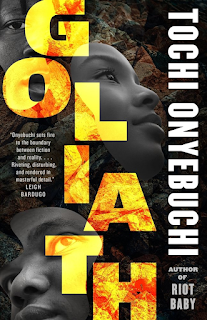
Goliath by Tochi Onyebuchi [Tordotcom Publishing, 2022]

Let's not mess around here: Goliath is one of the most impressive works of science fiction I've ever read. Tochi Onyebuchi's novel bills itself as "a primal biblical epic flung into the future", and it certainly delivers on that sense of both scale and mythology: a mosaic novel set in New Haven, Connecticut, centred on the lives of those left on a radioactive, oxygen deprived Earth by a space colonisation movement that was only ever accessible to the elite, the shifting dynamics as some of the spacefarers begin to return, and the damage that this gentrification causes to communities who have only ever tried to build a safe, comfortable life for themselves. Within that broad framework, Onyebuchi populates his narrative with a range of perspectives and characters, taking us through a meticulous, non-linear journey through their lives and concerns. At the heart of it are two groups, given equally sympathetic portrayals despite their very different positions. There's the young gay couple, Jonathan and David, who are returning from space and whose perspectives are portrayed as sympathetically as any others, albeit with an eye to showing how much their perspectives differ from those already living in the neighbourhood that they consider a blank slate opportunity (in the opening paragraph, Jonathan talks about the warnings he receives about "gangs" who populate Earth, before dismissing them in favour of his enthusiasm for the "shadow country" that is his vision of the planet). And then there's Linc, Bishop and their crew of demolitionists, whose job is to tear down houses (using a very cool bit of futuristic technology with potential for grim malfunctions that are quickly demonstrated) and then stack the bricks left behind so that they can be transported to the colonies. It's through the eyes of Linc and his buddies that we really come to grips with the extent to which the world has been broken, and the inescapably racist dynamics of who suffers from it. The group's banter swings from wild second-hand stories about former house parties to furious deconstructions of their political reality, and it's their reactions which sets the tone for the rest of the novel's politics.

There's no grand showdown or dramatic set pieces in Goliath: Jonathan and David's lives briefly intersect with Bishop, but not in any way that changes the course of the future history we are watching. Instead, Goliath just concerns itself with setting out that history: built, as the acknowledgements demonstrate, from a deep understanding of the dynamics of our recent past and extrapolating them into an era of space travel. The result is a very particular kind of novel: one which demands a lot of attention while reading and isn't in the business of giving instant narrative gratification, but which takes a sledgehammer to a lot of genre assumptions about near future science fiction, including how the sexy, exciting bits of those future get distributed and whose stories we consider worth telling because of that. I expect I'll be evaluating every book set in this narrative space against Goliath for the rest of my days, and I can't think of any better sign of quality than that.

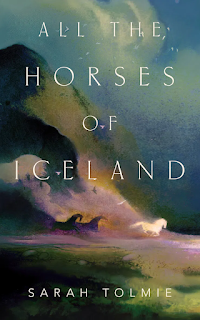
All the Horses of Iceland by Sarah Tolmie [Tordotcom Publishing, 2022]

From a speculative future history to a speculative history-history, Sarah Tolmie's new Tor dot com novella tells the story of Eyvind of Eyri, an 8th century Icelandic trader who travels through central Asia and into Mongolia to bring a herd of horses back to his homeland, including a mare whose supernatural origins have a far-ranging impact on the future of Icelandic horse genes. Except, the story isn't really about Icelandic horse breeding, so let's set all of that aside until it gets explained in the epilogue. It's Eyvind's story, and there is also a really cool horse. Right. 

Immediate bonus points must be awarded for the fact that I'm in a real mood for travelogue stories at the moment, and Tolmie's is a great example of the form, with Eyvind chronicling the adventure with his fellow travellers - most of whom are from the historic trading empire of Khazaria, through which Eyvind travels on his way to Mongolia - and the customs and concerns of the places he passes through, especially during his time in Mongolia where he successfully barters for his herd of horses and takes on responsibility for a white mare who everyone else claims not to see. Tolmie has a fantastic literary style, switching between language that reflects the myth being created here and the supernatural origins of Eyvind's mare, and more down-to-earth descriptions of the journey itself. 

Because it's a travelogue, the challenges along the way end up being very episodic - and, in fact, there's not much in the way of external challenge here at all, beyond a sequence towards the end (where, it turns out, having a supernatural mare comes in very handy). Instead, the tension is built up through watching a man travelling far beyond the boundaries of his own world to do something new, and the way the novella's mythmaking turns that novelty into something of foundational importance for his people. This is a short and delightful read, and well worth a look.

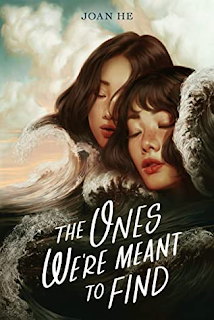
The Ones We're Meant to Find by Joan He [Roaring Brook Press, 2021]

It feels a bit unfair covering another near future climate change-y book in the same review set as Goliath - and it definitely felt a bit unfair to read this after having my expectations affected by Goliath -  but Joan He's young adult science fiction sets out to do quite different things with its story, and it very solidly achieves those aims. The Ones We're Meant to Find tells two intertwining stories about sisters who are heavily implied (but not outright stated) to be looking for each other: there's Cee, who has been trapped alone on a desert island for three years, with amnesia clouding everything about her former life except the fact that she needs to escape and find her sister Kay; and then there's Kasey Mizuhara, who lives in a carefully designed eco-city designed to protect humanity from natural disasters while minimising their carbon output to the smallest possible amount, and is searching for her sister Celia who went missing at sea three months ago. 

As Cee struggles with survival, Kasey pushes against her own limitations and restrictions to retrace her sister's steps and understand why she chose to leave on a journey that everyone else assumes would have killed her. Along the way, resonances start to appear between the two stories: names turn up in Kasey's city which Cee independently uses to name things on her island, even as the circumstances that each is living under seem to get further and further apart. Frankly, for a long time I was ready to give up on Kasey and Cee's worlds ever colliding, and things with Cee get particularly slow and annoying at points (although she does get to meet a nice boy, who also has amnesia, and this is not baffling at all). But it does come together, and it's a reveal that's worth waiting for: one which contextualises and builds off both characters' struggles and personalities, and it leaves us with a powerful dilemma to work through at its closure. While it has its ups and downs, The Ones We're Meant to Find was ultimately a story I'm glad I spent time on.


Adri, Nerds of a Feather co-editor, is a semi-aquatic migratory mammal most often found in the UK. She has many opinions about SFF books, and is also partial to gaming, baking, interacting with dogs, and Asian-style karaoke. Find her on Twitter at @adrijjy