Showing posts with label Colonialism. Show all posts

Monday, March 4, 2024

In Dune: Part Two, the Hero's Journey takes a very dark turn

There's nothing more dangerous than a savior

Consider the above photo for a moment. It's one of many, many great shots to be found in Dune: Part Two. But to me, this one summarizes the core message of the film, and of the entire Dune series of novels. This shot happens when Paul Atreides has secured the fervent support of the Fremen, who see in him the fulfillment of their messianic prophecies. He will soon lead them in battle against the Emperor of the known universe, and then against all the noble houses, and then... If you've read past the first book, you know the ugliness that follows. War will spread from world to world and consume billions of lives.

And all that horror is (literally) foreshadowed in that photo. It shows Paul standing atop a rocky shelf, giving a speech before his gathered followers. But if you focus your gaze on the multitude, Paul's barely lit silhouette transforms into a gigantic shadow that falls over a good portion of his own army. His raised arm holding a dagger resembles the shape of a scythe. That is who Paul is destined to become: a bringer of death on an interstellar scale.

When Dune: Part One arrived in theaters, I was concerned about the sequel's ability to give equal attention to the numerous mass fights and the heavy philosophical themes that occupy the latter half of the first Dune book. Fortunately, after watching in Part One a movie basically made of setup, we get in Part Two dramatic rewards galore: Baron Harkonnen starts the story believing himself to be a cunning mastermind, only to end up losing everything; local warlord Stilgar becomes a religious fanatic who eagerly enables Paul's ambition; and Lady Jessica evolves from a minor operative in the Church of Painstakingly Slow Eugenics to a ruthless manipulator, a twisted blend of John the Baptist and the Virgin Mary, an unholy messenger that prepares the way for the Dark Messiah.

The film makes good use of its runtime to discuss the corrosive effects of proselytism on subjugated communities. Much like the Slave Bible in the US, the Reverend Mothers of the Bene Gesserit have spent centuries spreading doctrines calculated to facilitate their control over the native populations of several planets. Paul's rise to complete military and political power is viewed by the Fremen as the key to their freedom, but it's actually part of an immensely complex scheme of domination that not even Paul agrees with. The character of Paul Atreides is portrayed here with deep psychological awareness of the competing loyalties and urges that inundate his mind. It doesn't hurt that Timothée Chalamet is a fantastically talented actor who makes the expression of multiple simultaneous emotions seem effortless.

The rest of the cast performs impeccably as well. Zendaya serves as the audience's surrogate as she first becomes fascinated by Paul's rapidly growing skills as a fighter and leader, and later becomes alarmed and finally disillusioned as Paul learns to enjoy power a bit too much. Austin Butler makes a surprising impression as Feyd-Rautha, bringing into each of his scenes an uncanny mixture of ethereal beauty and deadly brutality. And I must again praise the character of Lady Jessica, who in the hands of actress Rebecca Ferguson displays a fascinating breadth of personality between the loving domestic figure she is in Part One and the poisoner of entire cultures she becomes in Part Two.

This film's most striking change to the novel's plot, the handling of Paul's little sister Alia, is in consonance with the larger themes. Alia awakens as a Reverend Mother when Lady Jessica passes the test of the Water of Life. This ritual opens access to the memories of all previous Reverend Mothers; however, since Alia is still an embryo with no identity of her own, she becomes a living repository of a continuous heritage that influences events through her. In a way, this is also true of Paul: his existence and his trajectory are the product of converging political machinations that steer him toward his inescapable tragic fate. Dune as a whole is very skeptical of the Great Man theory, which can be seen in the way Paul at first appears to be the promised hero who will fix everything, but instantly morphs into yet another blunt instrument of forces beyond human control.

Much of the plot of Dune is a curious multiplication of the standard tragic structure: the narrative beats result from the snowballing disaster that is everyone failing in turn to execute their respective plans. The Emperor fails to exterminate the Atreides family; Leto fails to humanize the living conditions in Arrakis; Doctor Yueh fails to avenge his wife; the Fremen fail to bring security and prosperity to their world; and the Bene Gesserit fail to give birth to the perfect man who will save the universe. From these successive failures come new, escalating crises that no one had made preparations for. This refusal of events to submit to human will feels much like the way history proceeds in the real world, and therein lies the secret to the continuing appeal of Dune.

The cherry on this cake of great storytelling is director Denis Villeneuve's eye for perfect composition. The landscapes of Arrakis appear as endless expanses of all the shades of brown and yellow; the sky can look inviting, dotted with millions of stars; or darkened by the unpredictable ferocity of Arrakis's sandstorms; or oppressively hot under the reign of a blinding sun.

Dune exists in a universe where not only political events, but also nature escapes any attempt at human control. You cannot tame the mighty sandworm, only ride it for a time. Humans will be lost as long as they keep trying to control the enigmatic spice that makes both physical and spiritual journey possible. This theme is reflected in the narrative device of having all major players fail in their schemes: merely having an Emperor is already a manifestation of the desire for absolute control, and therefore the precipitating cause of unending catastrophe. This has been a fundamental flaw of human history, as true in the year 10191 as in 2024.

This is the final ingredient that explains why Villeneuve's Dune produces such an alluring effect: even as it employs the trappings of ancient epic, the truths it communicates have never ceased to be relevant. We're still susceptible to the rousing speeches of a supposed savior. We're still collectively addicted to a toxic source of energy. We're still treating less powerful societies as pawns in the political chessboard. Volatility has somehow remained a constant of our time. However, if we manage to remember that fear is the mind-killer, we'll be able to identify the true intentions of anyone who shows up selling fear. Too many aspire to become a God-Emperor. We need stories like Dune to keep our eyes open.


Nerd Coefficient: 9/10.

POSTED BY: Arturo Serrano, multiclass Trekkie/Whovian/Moonie/Miraculer, accumulating experience points for still more obsessions.

Friday, January 12, 2024

Novella Project: Virgin Land by Chloe Smith

 A small story in a frighteningly complex world


Throughout the history of genre: most space-setting science fiction has agreed on one thing: space is scary. Lots can go wrong when you put fragile life into in an unimaginably big place full of forces and phenomena that could obliterate us in an instant (or, if we're unlucky, longer). Fewer stories lean into what I think should be a similarly fundamental "truth": alien worlds are even scarier. Oh, sure, maybe the lifeless rock balls are only a little bit more frightening than the void, but if you start putting mercurial oceans or endless ion storms or spooky-deep space crevasses into the picture, things get "no thanks" pretty fast. And when we start speculating about other planets with life? With their own complex ecosystems and moving parts and hungry bundles of biological process looking for the next convertible energy source? Well, that's the sort of place where nightmares can be born. Like, for example, the armoured snakes and giant flying predators of Erde, the "newly discovered" planet of Chloe Smith's novella Virgin Land.

Of course, scary locations aren't scary without some humans to be ill-advisedly in them, and Erde's settlement is the result of a corporate planetary settlement system that we only get a glimpse of through the novella. Human expansion is big business in Smith's world, but we are told that ordinary people usually only get to live in cramped cities on barely viable planets, while corporations keep the best worlds uninhabited for spurious reasons. That we are told this from the perspective of an anachronistic patriarchal community of "settlers" desperate to claim large parts of fertile new planets in order to play at being oldy-timey homesteaders, doesn't make it less believable, but it immediately becomes clear that the settler movement isn't a great place to be either, particularly if you're a woman. 

Virgin Land is told from the perspective of Shayla Gainrad, a newlywed who has moved to an otherwise-uninhabited hemisphere of Erde with her garbage husband Gerald. Shayla is now trying to reconcile the achievement of "her" dream as a settler with the realities of being a subjugated, isolated woman trying to achieve a wildly outdated and unrealistic dream home in the middle of a voracious alien planet. The book starts with her seeing a shikra - the aforementioned flying predator, which was supposedly eradicated by the company which prepared the planet for settlement - flying overhead, and the wildlife encounters only get closer from there. Shayla's only recourse to fight infestation is to constantly check the perimeter for entry points, which she does obsessively and with resentment at her husband's lack of similar care. Garbage husband Gerald, meanwhile, is busy enacting his plan for subsistence farming, which definitely has the steps "??????" and "profit" written in it somewhere. His belief in self-sufficiency does not stretch to literally doing all the work to set up his farm himself, however, and he hires a crew of spacers to help him with some of the heavy lifting. These strangers quickly turn out to know far more about the system which the Gainrads are trying to fit themselves into, and the challenges ahead of them, than Gerald believes there is to know - but this is where he gets (temporarily) taken out of the picture by some supposedly exterminated wildlife, and things get real.

Gerald's absence firmly frames this as Shayla's story - not that it wasn't all along, but Smith makes the right choice to get the human embodiment of ignorant, arrogant colonisation out of the picture at the point where we have seen all there is to see of him. Instead, the "conflict" between Shayla and the spacers (particularly the attractive Captain Alis Tinsdale) on one hand, and the natural world that the settlers have begun meddling with on the other, takes centre stage. As the various aspects of Gerald's terrible farming plan begin to unravel, Shayla doubles down on her attempts to create a safe space for the group, but she also pushes herself well beyond her community's expectations to learn about the principles of farming and ecosystem management, which in turn prove the impossibility of the settler colonialist dream she has been raised to want. Shayla is very far from perfect, and when given her agency she uses it to do some damaging things. But her growing empowerment is enjoyable to watch, as is her relationship with Alis.

The actual explanation of ecosystem collapse that we see in Virgin Land isn't complex in terms of what is represented on the page. The plant which the Gainrads have introduced to Erde is kudzu, which is a very neat shorthand for "oh god no that's so invasive why would you", and the extremely fragile genetically modified livestock calves hardly inspire confidence either. On the other hand, we mostly see how the Gainrads' interference with the landscape causes imbalances in predator-prey relationships through encounters with creepy armoured snakes and the shikra, with other prey animals given interchangeable names and existing on a nebulous scale of cuteness. It works, though: the limited ecosystem relationships we see on page give the sense of a much bigger, unknowable system at work, one which Shayla and Gerald have no chance of winning against, while making the direct threats to Shayla and the others feel tangible. Nothing in Virgin Land is given an overtly unpleasant description, but the whole environment feels terrifying, even more so for its sense of isolation from the rest of humanity.

Perhaps inevitably, given that it's about a complex problem that human interference can only make worse, Virgin Land's conclusion doesn't end with answers to its big picture questions. The ecosystem that Shayla and Gerald have lived in is changed forever, and the interplanetary system that let them settle on Erde in the first place is unchanged and barely influenceable. There is a bit of Gerald-related denouement that I honestly didn't need - it makes him look even worse, but he was already garbage and I don't think he needed hypocrisy on top of his other shortcomings to make him look bad. Shayla has an uncertain future, but at least she winds up with the agency to make her own choices about what is worth pursuing in life. It's a small but satisfying victory in an uncaring world, and that's the best you can get in a story like this. Great stuff.

--

Reference: Smith, Chloe, Virgin Land, [Luna Press, 2023]

Posted by: Adri Joy, Nerds of a Feather Senior Co-Editor, @adrijjy on Twitter

Wednesday, October 27, 2021

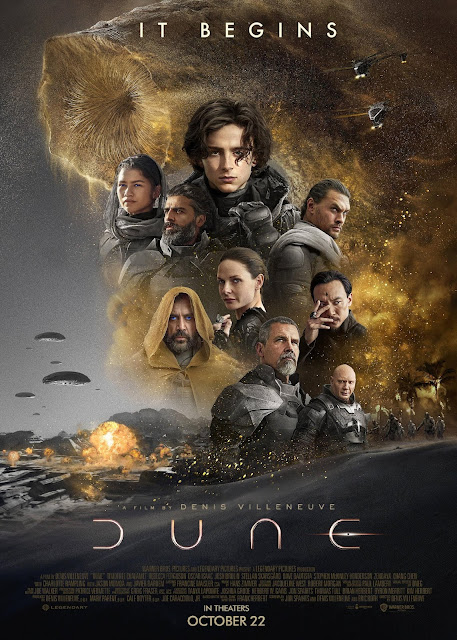
'Dune: Part One' is pure visual perfection, but it doesn't stand on its own

The newest adaptation of the science fiction classic makes a high-stakes bet with an uncertain reward

Dune: Part One is a work of beauty. Stunning, captivating, jaw-dropping beauty. You could turn the volume all the way down and just gape for the whole two-and-a-half hours at the impeccable use of lighting and contrast, the narrative meaning added by the camera angles, the precise geometric elegance of every single shot. This film is sure to snatch next year's technical awards. But that's the extent of its achievements. Dune: Part One is a glorious feast for the eyes, and for the eyes only. Storywise, it has several issues, and they stem from the choice to split the novel in two.

The beginning proceeds like your classic political drama: in a far future, in which humankind has apparently learned nothing from history and returned to feudal monarchy, the Emperor grows suspicious of an ascending noble house and schemes to destroy it. He decrees that the Atreides shall take over production of the universe's most expensive substance, which is not only as a metaphor for the role of oil in modern geopolitics, but also brings to mind the literal spice trade, which used to motivate greed and betrayal at a similar scale in older times. This move by the Emperor reeks of obvious duplicity, but the Atreides can't just refuse it without exposing the true positions of the game. So Duke Leto Atreides obeys and moves his household to the hostile planet Arrakis, where he knows for a fact that he'll be targeted, so he sets about making alliances with the local population.

Dune: Part One takes the story up to the usual point where a Greek tragedy would end: the Atreides are betrayed, their patriarch is captured, and his relatives are sent to deadly exile. But that's the point where the weird stuff blows up and Dune reveals the universe-spanning repercussions of its events.

Part Two has just been officially announced, which is welcome but not expected news. The deal between director Dennis Villeneuve and Warner Brothers stipulated that he would only get to make the sequel if the first movie did well enough. So the project was overshadowed with uncertainty from the start. It was not a fatal risk; if you're eager to know how Dune ends, you can always buy the book. However, at the time of release, Part One did not have a solid assurance of continuation. Instead of telling a reasonably complete story, Villeneuve preferred to tempt fate and make a majestic spectacle, rich in cinematic artistry, but made primarily of setup. From conception, Part One wasn't meant to be watched alone.

A movie adapted from a book series full of repeated warnings about the dangers of seeing into the future shouldn't have been so overtly plotted and structured on the assumption that a sequel would happen. Part One shows narrative choices that seem intended to help the story maintain better cohesion, but which clash against the hard fact that Part One is telling an incomplete story. Many of the trailer's suggestive shots of Paul Muad'Dib living and fighting next to the Fremen turn out to be flashforwards, prophetic hints of events that don't happen in this installment. There are so many of these tantalizing visions that at times it feels like we're watching a two-and-a-half-hour trailer for the actual plot of Dune.

By the moment reached at the end of this movie, readers of Dune have already been introduced to the Emperor, and to his scholar-minded daughter Irulan, and to Baron Harkonnen's other nephew Feyd, and to the powerful Spacer Guild. However, since their respective arcs don't go anywhere until the end of the book, they're completely absent from this adaptation. On one hand, removing them frees Part One to focus more on the protagonists it needs us to still remember and root for in Part Two. On the other hand, this silence on events beyond the House of Atreides makes the plot feel dangerously smaller than it actually is. Dune is not supposed to be mainly the story of Paul's family tragedy. It's supposed to be an epic of cosmic proportions. Multiple powerful factions have competing hidden agendas that are only now converging, which means that the story suffers by planting itself on one world and staying stuck there.

Both previous adaptations of Dune began with voiceover narration by the imperial princess and scholar Irulan. Because Villeneuve's version omits all scenes at the imperial court, there is no Irulan in this movie, which leads to a more interesting choice: voiceover narration by the Fremen warrior Chani, accompanied by a montage of Fremen guerrilla attacks on Harkonnen infrastructure. To place these images at the start of the story does much to counter the accusations of white saviorism often thrown at Dune: these Fremen were not sitting on their hands, waiting for Paul to come and save them. They were busy fighting for their own liberation.

This discussion is central to Dune fandom. A story as complex and as loaded with real-world symbolism as Dune is too easy to misread. The classic complaint is that it celebrates hero worship, which is easy to disprove by reading on. To put it bluntly, Paul becomes a murderous monster, and the sequel novels reinforce the original's message that nothing is more dangerous than a hero. What David Lynch failed to understand, and through him, audiences failed to see, is that Paul's arc in Dune is not a canonical hero's journey. If anything, it's a supervillain origin story. Paul is scared now, but in time, he will buy eagerly into his own legend, which will ultimately burn the universe. Even as early as Part One, the recurring visual reminders of his bullfighting grandfather cement the unspoken warning that a trait of the Atreides family is the tendency to court danger.

By focusing on Paul's misadventures in Arrakis, Part One skips most of the novel's philosophical and anthropological themes. That choice needs a serious course correction in the sequel. Dune is not Game of Thrones in space, nor should it ever try to be. One of the tasks that Part Two must fulfill is to present, in their full complexity, the heavy discussions on fate, ego, evangelization, exploitation, environmentalism, fanaticism and generational responsibility that made the original Dune the most acclaimed novel in the entire history of science fiction.

Fans need not worry that a more ponderous and cerebral Part Two will turn people off. Part One works well enough as an explosive adventure, but the whole reason why Dune is so respected and beloved is precisely because it is ponderous and cerebral. A less thrilling, more meditative sequel would do more justice to what makes Dune special. That sounds contrary to the direction Hollywood prefers to go these days, but now that we know for sure that Part Two is coming, Villeneuve can afford to jump deep into the thematic substance that sustains the story.

It sounds risky, but fans should not fear. Remember: fear is the mind-killer.


The Math

Baseline Assessment: 9/10.

Bonuses: +3 for flawless cinematography, +2 for Timothée Chalamet's wonderful acting.

Penalties: −1 for overcorrecting the earlier Dune versions by giving too little exposition, −2 because the choice to not include the Emperor in this half of the story severely diminishes its sense of scope and makes the Arrakeen invasion feel like a rushed detour in pace, −3 for erasing the Middle Eastern influence on the source material.

Nerd Coefficient: 8/10.

POSTED BY: Arturo Serrano, multiclass Trekkie/Whovian/Moonie/Miraculer, accumulating experience points for still more obsessions.
Friday, April 5, 2019

Microreview [Book]: Terra Nullius by Claire G. Coleman

This stealthily speculative look at invasion and oppression in Australia is as difficult as you'd expect, but accomplished and rewarding.

Cover design by Grace West
I thought I knew what to expect, going in to Terra Nullius. I'd seen the book recommended on speculative sites, I'd read enough about it to know that its take on colonisation and extermination of indigineous people was almost but not quite based on the experience of Australia's indigenous communities following the British invasion in 1788. And yet, by a hundred pages in, I was starting to doubt what everyone and everything (including the book's own blurb) was telling me. Was I missing clues to a larger mystery? Were there adjectives that I was misreading or apparently historical references that I was misinterpreting? Where, to be blunt, was all the science fiction?

Of course, if you're paying attention, that's an intentional feature of Claire G. Coleman's brilliant debut novel, which offers a perspective on the invasion of Australia which is very much a speculative novel, and yet still inexctricably and uncomfortably intertwined with the real historical treatment of Aboriginal Australians over centuries of white rule. Coleman herself is Noongar, a community from the south coast of what is now Western Australia, and Terra Nullius is the product of a black&write! indigenous writers fellowship. Despite being a first novel, this is a book that's utterly confident both in its content and its narrative structure, and for very good reason.

Terra Nullius incorporates the stories of a rotating cast of both Settlers and Natives living in Australia, from the few remaining natives living in precarious remote settlements, to variously well-meaning or abusive nuns running homes for Native children, to turncoat Settlers trying to find their place (with all the unconscious bias and assumption of primacy that entails) among the Native resistance. Its heart, however, is Jacky, a young Native who has just escaped from the abusive clutches of the abusive religious "school" where he and other children were slowly starved and locked up in cages at the slightest provocation. Jacky is now running across the continent in the vague hope of finding the place he was originally taken from, despite no memories and very little hope that it will still be around. Jacky's story, centred around the energy of his desperate, hungry run, forms the backbone of Terra Nullius around which all the other narratives intertwine and eventually come together in brutal but not hopeless conclusion.

As noted above, there's a very distinct turning point in Terra Nullius. In the Small Beer Press paperback version, it sits in what an initially unassuming sentence at the bottom of page 121, just under halfway through the book. It brings the science fictional elements to the fore by changing the context of information that the reader is receiving and catches us up with visual and historical clues which are, of course, immediately available to everyone inside the narrative. As a literary device, I'm sympathetic to people who find this kind of artificial mystery frustrating and hard to get past, but in the case of Terra Nullius I think it's used to great effect, especially if you're already aware that something is going on. By setting up a narrative where we understand that there's a twist of some kind, but not exactly what it's going to be, Terra Nullius invites us to constantly question what parts of its story we believe, and to engage with the sense of historical reality in its first half, and the speculative elements are tied to that historical record in a way which reinforces the things we found plausible and drives home the implications of those parallels. It's a device reminiscent of the sudden left turn into speculative content in recent horror films like Get Out and Sorry to Bother You and it has a similar impact here, even if the execution is different in novel form.

(I'm going to discuss spoilers directly now and, in case it's not obvious, I HIGHLY recommend you go and read the book first!)


It transpires, of course, that despite the fact this is the Australia of our world, the division between Settlers and Natives is not one between Australian Aboriginals and White European invaders, but between the remnants of the human race and a grey-skinned amphibian species of aliens who are generally referred to as Toads. The Settlers have basically exterminated humanity from most of the earth, with only a few outposts like dry desert Australia where they are completely unsuited to living which remain the last frontiers of human freedom and resistance. There's a very clear and artificial language shift after the initial reveal happens, and suddenly the discussion of Toads' different physiology and tolerances are everywhere in a way which re-contextualises elements like the slow starvation of children in the nun's school or the references through Settler eyes to Australia's hostile alien landscape. As noted above, there are characters like Johnny Star, a former trooper who abandons the Settler cause after being forced to participate in a massacre, and Sister Mel, one of the few nuns who acts compassionately to children in her care, which introduces complexity to the cast of characters without letting the Settler mentality as a whole off the hook.

The success of this story for a reader is likely to stand or fall on the success of the twist, and for me it was extremely effective on every level. Each chapter is preceded by historical quotes and extracts dealing with policies towards Natives, taking a variety of tones from condescendingly paternalistic to backing outright extermination, interspersed with some stories and perspectives from Natives themselves. It took until the "turning point" for me to begin questioning the veracity of these records, as they line up so exactly with the kind of historical records we'd expect to see from the historical records of policy towards Aboriginal people in Australia. In revealing that these were not real documents, Terra Nullius really makes us think about why they might be real, and what it says about humans that yes, this really was how we compartmentalised and exterminated our own in the not-at-all-distant past. As Coleman points out in her Author's Note at the end of the book, the concept of Australia as "Terra Nullius", empty land open for the taking, was not overturned in Australia's legal system until 1992, and the real historical events which inform narrative elements like the School and the oppression that the free Natives are running from are still very much felt in Australia today.

Terra Nullius is a hard book, full of desperation and powerlessness against an unstoppable system which has ground its victims into dust. However, it's also an important story from a perspective which remains marginalised and under-understood, and one which I'm very glad I made time for. I'm continuing to expect more good things from Coleman, whose second book is due out in Australia later this year, and I'm extremely grateful that her voice and perspective has reached the global SF conversation.

The Math
Baseline Assessment: 8/10

Bonuses: +1 A novel where form and content complement each other brilliantly; +1 Speaks to the historical context in a complex but unforgiving way

Penalties: -1 The abruptness in the twist might be off-putting to some

Nerd Coefficient: 9/10

POSTED BY: Adri is a semi-aquatic migratory mammal most often found in the UK. She has many opinions about SFF books, and is also partial to gaming, baking, interacting with dogs, and Asian-style karaoke.