Showing posts with label middle grade. Show all posts

Wednesday, September 18, 2024

Film Review: Uglies

Meaningful messaging wrapped in predictable plotting

Decades ago, the television series The Twilight Zone presented an episode called “Eye of the Beholder” in which a disfigured woman gets a chance to have plastic surgery to become beautiful. Throughout the episode, we never fully see the faces of the characters until the very end. And, in traditional Twilight Zone form, there’s a twist in the reveal. Last year, the film Barbie gave us a thoughtful, poignant exploration of the pressure of unrealistic beauty standards that left women around the world cheering. The new Nexflix film Uglies is the latest story to tackle the concept of beauty. However, unlike its predecessors, the positive messaging in Uglies gets a bit tangled in the execution.

Uglies is based on Scott Westerfeld’s 2006 middle grade novel set in a future dystopian society where children are required to undergo cosmetic surgery to become beautiful (“Pretties”) when they turn sixteen. Until then, teens who have not yet had the surgery are called “Uglies.” Once the surgery occurs, the beautiful ones get to live in a perpetual frat party in the futuristically cool Pretty City (yes, that’s the name). How exactly does this help society? According to the backstory, the old world destroyed itself with overuse of fossil fuel, environmental pollution, and wars. Beautiful people had unfair advantages over ugly people and people had conflicts based on physical appearances. To solve this problem, everyone is made beautiful. This setup comes from the source material, but it’s confusing for appearance-based conflicts to be solved by making everyone look like the primary discriminators. Also, the racial and ethnic differences continue after the surgery, so it requires a willing suspension of disbelief to theoretically create peace by turning everyone into Balenciaga models. Of course, we eventually find out there is more to the surgery than just creating facial symmetry, and eventually the story slides into The Stepford Wives territory.

The film follows protagonist Tally Youngblood (Joey King) as she anxiously awaits her turn to become pretty while she attends the boarding school for Uglies. In flashbacks, we see her long-term, close friendship with her bestie Peris (Chase Stokes), who is a few months older than her. The two promise to remain best friends for life, and Peris promises to visit her after his surgery. However, when the story opens, Peris has been transformed and now has cut off communications with Tally. Tally engages in low-stakes shenanigans, like sneaking into New Pretty City to see him, but on a return trip she encounters a new friend: Shay (Brianne Tju), who tells her about an alternative, surgery-free community outside the city (called The Smokes), run by a mysterious leader called David. When Shay disappears, Tally gets caught up in the government’s search, led by the cruel and severe Dr. Calder (Laverne Cox), for David and the Smokes community.

Although the story has several departures from the novel, the film is entertaining in a low-stakes way. The special effects of the hover skateboarding are fun, and the visuals of the dystopian community and the gorgeous scenery of Tally’s journey to the Smokes is appealing. The acting from all the leads is solid and engaging throughout the film. The problem is the plot. There are so many incongruities that eventually they become distracting. For example, except for Peris, the appearance differences between the existing Uglies and the existing Pretties ranges from minimal to non-existent. Tally’s new bestie Shay is supermodel gorgeous despite being an “Ugly.” When Tally gets to the Smoke, outsiders David (Keith Powers) and his best friend Croy (Jan Luis Castellanos) look like they fell out of GQ. A few characters undergo the long-discussed surgery during the film. Again, with the exception of Peris, the big glow-up amounts to an anti-climactic addition of department store makeup and a quick trip to the salon for clip-ins. Anyone who understands the concept of mascara and lipliner will be rolling their eyes at the “change.” If this were a stage play, it would be understandable. But the unwillingness to take visual risks in a big-budget Netflix film is a little disappointing. The only character who stands out as particularly changed or uniquely “pretty” is Peris. Between the makeup and the special effects, he manages to look artificially chiseled, with razor-sharp cheekbones, piercing eyes, and a perpetual William Shatner in Star Trek glow about him. His visual is the best example of what creepy, out of control beauty would look like. The similarity in attractiveness between Pretties and Uglies may be an intentional choice in the film, perhaps designed to be an ironic social commentary on the relativism of beauty. If so, the premise of the story, that universal beauty eliminates societal problems, becomes irrelevant.

In addition to the lackluster visuals, the plot itself is problematic. David, who is a likeable classic hero/prophet/leader archetypal character, falls too suddenly in love with Tally, almost at first sight, and certainly too shortly after meeting her. The acting is fine, but the behavior is inconsistent with both David’s reputation as a sharp, elusive, pragmatist and with their short and relatively meaningless relationship. Tally’s character is also inconsistent. She is initially presented as inquisitive, rebellious, and fierce, but she is simultaneously whiny, cowardly, and indecisive. Teen emotions are complicated, but by the end of the film it was hard to take her character seriously. Joey King’s acting is solid and appealing, but some of the cliché lines she is forced to recite were eyeroll-worthy.

If you are expecting a Barbie-esque discourse into the superficiality of societal standards, or commentary on racism and sexism, this is not that film. Uglies is a traditional middle grade/YA dystopian adventure where the grown-ups are bad, besties betray you, the rebel-boy is boyfriend material, and in the end, you finally find your true self. Depending on what you are in the mood for, this may be the perfect low-stress film for you.

Nerd Coefficient: 6/10.

Highlights

  • Appealing actors
  • Incongruous plot and visuals
  • Perfectly fine background entertainment

POSTED BY: Ann Michelle Harris – Multitasking, fiction-writing Trekkie currently dreaming of her next beach vacation.

Monday, February 27, 2023

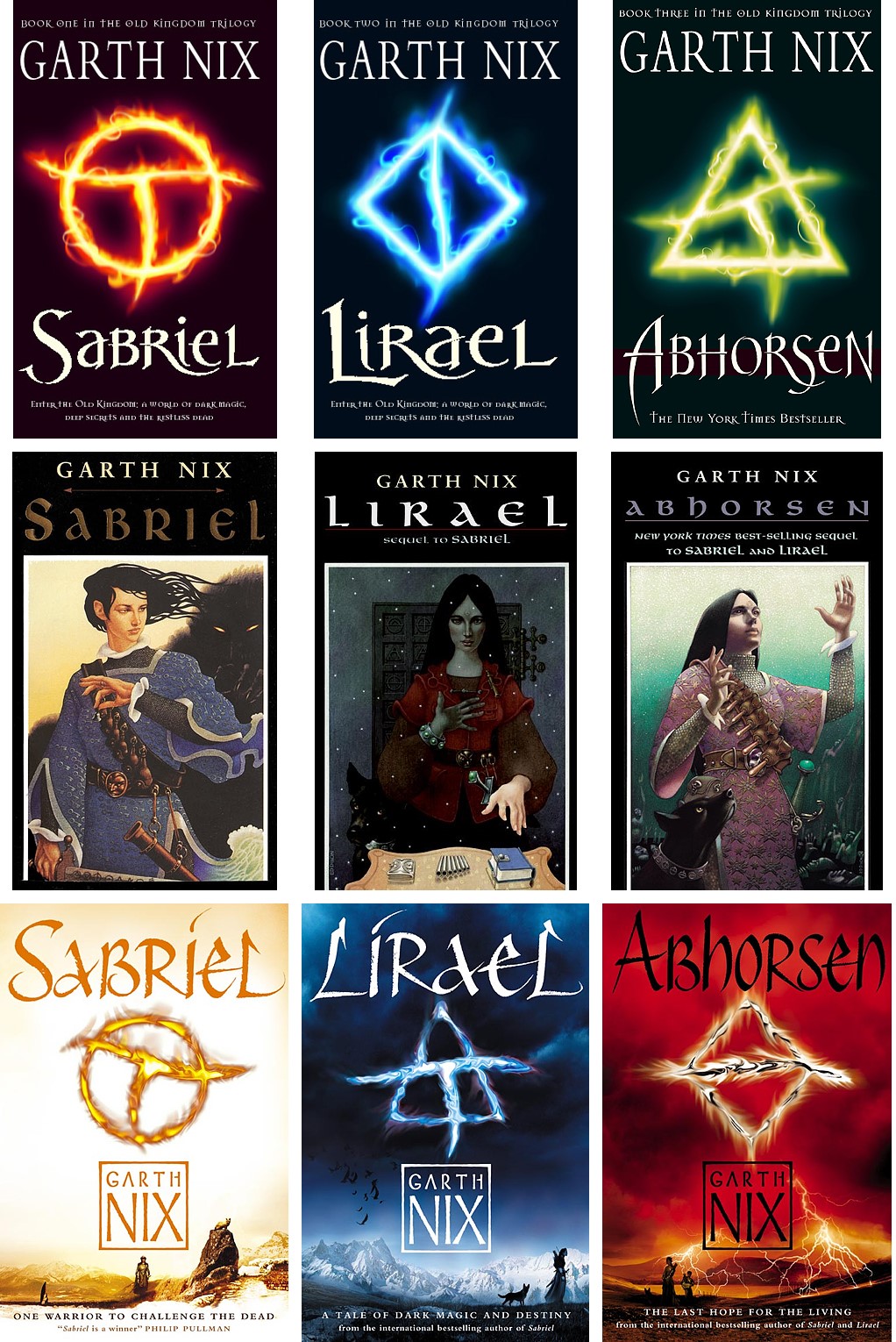
Rereading The Old Kingdom Series by Garth Nix

 First published 27 years ago, the Old Kingdom series by Garth Nix was a big part of many people’s childhoods, but does it still hold up to a reading in 2023? Elizabeth and Roseanna look back at the original three books of Sabriel, Lirael and Abhorsen, and reflect on how their opinions of the series have changed, and how they’ve stayed the same. 


Sabriel follows a young woman as she leaves school and heads back across the Wall into her mysterious home country, after finding out that something has happened to her father. Who happened to be a necromancer, and has been teaching her to follow in his footsteps - not to raise the dead, as most necromancers do, but to lay them to their final rest. Her journey into the Old Kingdom will reveal to her how little she knows of her craft, the charter magic of her homeland, her father and her heritage, and will test her resolve as she faces an evil far greater than she anticipated.

Roseanna: I first read Sabriel when I would have been about 12 - it came out in Australia in the 90s, but didn’t make it to the UK until 2002 - and I was exactly the right age to fall completely in love with it. There’s a strong memory that still sits with me of some book-selling group coming into my school with a pile of various delights, and of me seeing the UK hardback edition, which was bright white, with an extremely fancy clear plastic dust jacket with a gold illustration on and thinking to myself “ooooooh”. The series was also one of the first I remember reading with female characters I genuinely liked and thought were well done, ones that seemed heroic and exciting and like people whose adventures I wanted to follow. That it was set in a gorgeous world with an interesting magic system was absolutely a bonus, but it was the characters that really did it for me the first time around, and who kept bringing me back to the series over and again.

Elizabeth: Honestly, I’m not sure I can remember exactly how I first came across the series – it seems almost by osmosis. Certainly, I’d read it by 2004 when I started studying Creative Writing at the same university as Garth Nix, where he was something of a hometown hero. Although I was in my early twenties, the mix of adventure and magic drew me in and kept me hooked. I’m not much of a rereader (there are always so many new books!) so the details have faded over the years. But the Abhorsen’s bells remain etched clearly in my memory.

Roseanna: One of the things that really stuck with me after reading the series for the first time was the magic system - particularly the bells. It’s one of the best examples I remember reading as a child of a magic system that manages to be neat, easily comprehensible and fully integrated into the world-building. The bells aren’t just bells, the Abhorsen isn’t just a person, they’re all woven into other parts of the Old Kingdom, and this only gets deepened and deepened as the series goes on - the more we learn, the more we understand how things fit together. And part of how well that worked was the little rhymes that explained parts of it - even years after I first read the books I could recite you segments of them, because they were catchy and exactly the sort of thing that would be taught to children, or memory rhymes, or other bits and bobs - the world-building works in the how, as well as the what, and I love that it captured child-my imagination.

Elizabeth: I love what you said about the bells not being just bells. Not only does each one have a particular purpose – a particular kind of magic it’s used for – but even a personality. Some are serious, others mischievous, and all worthy of caution. They even correspond to a particular Precinct of Death and the way that precinct manifests: whether the river of death comes in tidal waves or looks calm but has hidden potholes.

In addition to mnemonic rhymes, the lore of the world offers a visual language in its heraldry: the silver key of the Abhorsen, the gold tower of the King, the silver trowel of the Wallmakers. We know our heroes by their colours.

That visual language is less well defined when it comes to the magic itself, but is no less evocative for allowing the readers to picture their own Charter Marks. 

Roseanna: And the Charter Marks are such a neat part of how the world is visualised - not least because they’re everywhere. Magic isn’t distant and ethereal in the story as we see it. Important places and objects are spelled, and to those who have been baptised with a Charter Mark are able to see, and read in what they see, the magic in the world around them. It means that our characters – and especially Lirael in the second book, who is a skilled Charter Mage working in a library full of peculiar, old and magical objects – connect us to the lore of the world simply by looking around. 

I love too that this is tied into how the books are presented. The British editions I had as a child were bold, plain hardcovers with a single charter mark each on the cover, while the paperbacks that came after had smaller marks printed all over them in clear gloss, so they were invisible until they caught the light - just as we are told of the marks in the story. For twelve year old me, that felt utterly magical… and still does to my somewhat older self now.

But the magic isn’t just the written symbols - there are links to all sorts of other elements, many of which are older, more folkloric, and so while we learn about one part, the other parts – especially around the Free Magic side of things, or the wardings and bindings – feel already familiar.

Elizabeth: Part of this is because Nix draws on existing folklore to create the Old Kingdom and its magic. For example, when Lirael is researching how to banish a powerful Free Magic creature, the book she finds tells her to use “...an ensorcelled sword or a rowan wand, charged with the first circle of seven marks for binding the elements…” Rowan has long been popular in European folklore for holding protective properties, and rowan growing by stone circles – echoed by the Charter Stones of the Old Kingdom – was believed to be the most potent. This weaving together of old folklore with the unique elements of the world grants it a solid foundation and that feeling of strange familiarity.

It’s also an element of world-building that points to the strong influence of English children’s literature. After all, this is European folklore, European plants, not Australian like the author. While this is a common trend among Australian fantasy, it is by no means a foregone conclusion. For example, Cecilia Dart-Thornton’s Bitterbynde Trilogy (the first book of which was published in the same year as Lirael) subtly weaves in Australian flora and fauna into the background of a tale strongly influenced by English fairy lore. Much more recently, Sam Hawke’s Poison Wars books eschews our world entirely in favour of making up plants and poisons from whole cloth.

In the Old Kingdom Trilogy, we get rowan and Charter Stones. Across the Wall in Ancelstierre, we get boarding schools, bobbed hair and firearms. Although Sabriel isn’t strictly a portal fantasy, the story functions in much the same way. In rereading it, I felt like I had stepped into a world adjacent to the Chronicles of Narnia… although one with rather stronger representation of women.

Roseanna: And this is one of the things that really drew me to the stories as a child - Sabriel herself, despite being young, and often afraid or out of her depth, was the first protagonist I remember reading in a “proper” book who was both female and fighty, and she’s written with a depth and reality that really sells it, rather than just being the pattern of a 90s female action hero, who has to be all machismo and “one of the boys” to fit in. Especially with her all-girls-school, jolly-hockey-sticks background, she feels grounded in a realistic idea of a young woman on a journey, albeit one who has been learning to do necromancy since she was very young and taking fighting arts classes at school.

It isn’t just Sabriel herself though - Lirael too manages a great balance of competence, inner strength and doubt, as well as being the first representation of depression I recall reading. She’s not strong in the same way as Sabriel; her fighting skills aren’t at all her focus. But she’s compelling, willing to go out and achieve what needs achieving, and brave confronting dangers those around her find difficult to face.

What they both contrast beautifully is the men around them too. It seems to be something of a theme in Nix’s work to write competent women who, for all their turmoil, get the job done, alongside men with strong emotional focuses who, for whatever reason, are unwilling or unable to solve the problems of the story alone, or struggle to live up to the roles set out for them. For Sabriel, it’s Touchstone, a man out of time being overcome by guilt over his past actions, to the point of sometimes being unable to act at all. For Lirael, it’s Sam, the man who is supposed to be learning necromancy to follow in his mother’s footsteps, but fears the dead, the bells and Death itself right into his bones. Neither man is weak, both of them are brave at points in the plot and very good at their areas of expertise, but neither have the driving determination and ability to just Get On with things that their female counterparts have. This holds true even among the side characters - the whole series is peopled with various no-nonsense women who just get on with things, including an entire glacier of matriarchal seers.

This isn’t even restricted to just the human women - Lirael’s Disreputable Dog companion epitomises the exact same attitude in her oft-repeated statement of “it’s better to be doing” whenever any of the characters get a little too mopey for her liking.

Elizabeth: Contrast this with Mogget, arguably the most memorable of Nix’s animal companions. This powerful and somewhat malevolent spirit has been forced to take the shape of a white cat for so long that he has taken on many of the traits of that form. The contrast here is not like that between the female and the male characters of the book; Mogget does not by any means have a strong emotional focus and would be perfectly happy to Get Things Done, if this meant burning them to the ground. Instead, he contrasts the Disreputable Dog’s drive to action with pure laziness. For the most part, he rides around in the backpack of his companion and rarely takes initiative, responding only to commands and providing snarky comments.

Actually, that’s not entirely accurate. Mogget does have a driving focus on eating fish.

While Mogget may be the most well-remembered animal companion of not just the Old Kingdom Trilogy, but Nix’s oeuvre, the Disreputable Dog is particularly significant for being the first of Nix’s many canine companions. His middle-grade fantasy adventure Frogkisser! springs to mind. This story has a pack of canine advisers to the royal family. They're presided over by a matriarch, and one of the younger dogs serves as a companion to the main character on her adventures.

Nix’s adult works are less likely to feature canine companions, but are not entirely devoid. For example, his 2006 story “Dog Soldier”, published in Jim Baen’s Universe. In the story, a military engineer on the front of a space war receives a package from R&D containing a robot with the mind of a dog.

However, while canine companions are more prevalent in Nix’s work for younger audiences, one does not need to be young to appreciate them – or, indeed, the themes of the Old Kingdom Trilogy.

Roseanna: Absolutely. And this was something that was particularly obvious to me coming back to reread as an adult - there’s a strong theme in both Sabriel and Lirael of the death of one’s childhood and childhood dreams, and moving past them to becoming the person you’ll be as an adult, which hits really hard in a way it didn’t when I first read them. In many ways, some of the themes become more appropriate to someone reading them looking back, rather than forward, as you have the experiences to really appreciate how well those emotions have been put across on the page. Unsurprisingly for books that centre the experience of death, however fantastically, they are often unflinching in dealing with hard topics in ways that make them both appropriate for a young audience while still poignant to older readers. The darkness and emotionality never overwhelms the more fun aspects of the stories, but neither are they trivialised and sidelined. 

There is a sadness running through so many of the characters’ stories - Touchstone, trapped out of time and away from everyone he ever knew and loved, forced to reckon with the worst of his own experiences alone, at least at first; Sabriel, facing the death of her father right on the cusp of her potential adult opportunity to join him in her homeland; Lirael, constantly reckoning with the idea that she may never achieve the one thing that her family seem to think is worth being, and the loneliness of never being part of the community that surrounds her. There is depression, suicidal ideation and a lot of really sensitively handled big topics that I think just become better and better when you come back to them.

And for me, they are at the heart of what makes these somewhat timelessly good stories. They have a solid emotional core that rewards new perspectives from the reader, and in many ways feels sufficiently universal to be able to touch something in everyone, even if it may not be quite the same something.

Elizabeth: I think you’re right about there being something here for everyone. Even if the reader is not taken in by Lirael’s teenage angst – or her desperate and genuine need for belonging that is so relatable – there’s Sabriel repeating (and, arguably, making worse) her father’s mistakes in raising her own children. 

It may have been the magic and adventure that enchanted us as young readers, but the themes hold wisdom that will have us coming back all our lives.


Monday, September 26, 2022

Nanoreview: The Paper Museum by Kate S. Simpson

A promising recipe with an underbaked execution and very little to chew on

Young Lydia lives in a future where paper is obsolete (why?) and everyone uses a tiny portable computer that can be worn on the hand as a ring. Her family runs the last place (in the city? in the world?) that still keeps paper, a museum whose real function is about much more than preserving the printed word. She's happy to spend every day browsing those pieces of history (where are schools?), which sometimes contain ancient, inexplicable symbols like # and &, that have gone out of use (how?) and lend an air of mystery to the relics she lives with.

But one day, her parents vanish (what do they even do?) and Lydia, desperate to find them, files a report with the city government, with the unexpected consequence that, if her parents don't show up, the city will take ownership of the museum (who in their right mind approved that law?). Now Lydia must solve the case of her missing parents before she loses her home too (but what does that mean if we don't know how the rest of society works?).

The Paper Museum is a frustrating read. The microcosm inside the museum is described in abundant, at times excessive detail, while the world outside of it is a nebulous blank that may as well be made of air. Since we only follow Lydia, who basically never leaves the museum, the significance of a world without paper is lost because we never get to see that world. Her quest to locate her parents (and thus the reader's interest in the plot) is interrupted by the arrival of an uncle whose personality stops at "grumpy because reasons," and the duty to train new interns who happen to come to work with Lydia at this same time. Much is made of an ominous "mayor's initiative" that somehow threatens the museum, but neither the initiative nor the nature of the threat are explained. Days pass without anything really happening because the plot needs to give Lydia time to get to know the interns, but the importance of these characters in the final resolution is at best tangential (one of them is more than they claim, but even that one is underwhelming).

It's a pity that so much opportunity for wonder and excitement is wasted here. The idea of a sheltered place dedicated to preserving paper is immensely interesting, but hardly anyone visits the museum, so we don't learn what the place means to the people of this future. The educational system in this society is clearly different from ours, but we only get the barest essentials to explain the plot, so we don't get a sense of what our young heroine thinks about her prospects in life and her place in the cultural scene. This novel is made of concrete events without a context, written with a hyperfocused lens covered with blinkers. Only Lydia and her immediate interactions matter.

At some point we're told that this is a world that has banned magic, and part of Lydia's quest to find her parents is about rediscovering magic, but again, we're missing the why, the how, the when. The use of a narrator restricted exclusively to Lydia's thoughts and interests may be intended to reflect how little a child really understands about the larger world and the big picture, but what little remains in view is not solid enough to sustain a story. Lydia herself is a painfully generic character, and the rest of the cast is consistently one-note. Her best friend is gentle (and nothing else), her uncle is harsh (and nothing else), the mayor is malicious (and nothing else). When Lydia figures out the clues to where her parents went, we just have to trust that she got it right, because we're not even told enough rules about the magic to follow her reasoning or feel any anticipation about her solution.

There's undeniable potential in this story that could have been fulfilled with more rounds of revision and polishing. This is a novel with plenty of material to spark curiosity, but nothing to satisfy it.


The Math

Baseline Assessment: 6/10.

Penalties: −1 for less than barebones worldbuilding, −1 for overly simple characterization.

Nerd Coefficient: 4/10.

POSTED BY: Arturo Serrano, multiclass Trekkie/Whovian/Moonie/Miraculer, accumulating experience points for still more obsessions.

Reference: Simpson, Kate S. The Paper Museum [Union Square Kids, 2022].

Friday, April 22, 2022

Microreview: We Are the Song by Catherine Bakewell

A kindhearted allegory about the social responsibility of art in times of tyranny

When the placid land of Cadenza finds itself without a ruler, the neighboring kingdoms of Basso and Acuto battle for control of it. More than the agricultural bounties of the region, the claimed justification for all this violence is to take care of the holy site where the creator goddess Caé fell to earth and sang reality into existence. As hostilities worsen, the twelve Singers of the Goddess, divinely gifted performers whose voice can work miracles, roam the lands offering hope and succor to the powerless. After young Singer Elissa uses her magic to clear a roadblock on a town's only supply route, she gets dragged into the ambitious schemes of successive politicians who wish to turn her into an instrument of war. Will she allow her gift to serve harmful ends, or will she dare defy the most powerful people in the world?

We Are the Song presents an interesting scenario of religious conflict that author Catherine Bakewell uses to inspire young readers to question overreach of authority, the weaponization of art, the distortion of religious doctrine for political motives, and the concept of "holy land." In an apparent echo of J. M. Straczynski's celebrated line, "If sacred places are spared the ravages of war, then make all places sacred," this novel argues fervently against the use of faith as an excuse for atrocities.

The treatment of magic, music and prayer as the same force creates incredibly fertile avenues of interpretation. Ordinarily, an ethical allegory would focus on the danger of magic in the wrong hands (i.e. weapons of mass destruction), or the danger of putting art under government control (i.e. censorship and propaganda), or the danger of blending religion with politics (i.e. inquisitions and holy wars). Bakewell's effort to tackle all three problems at the same time is a bold bet that, for the most part, yields a rich payoff.

This book's success relies on the believability of its protagonist, and twelve-year-old Elissa is a solidly built one. Her inner conflict as a musical prodigy raised in seclusion and tasked with more responsibilities than any child should have to handle adds thick layers of dramatic potential to her personality. What she lacks in political education she compensates for in innate gentleness. It's hard to be an optimist during a world war, but Elissa's determination to see the good in people and her uncompromising adherence to pacifism make her the heroine her world needs.

We need the protagonist to be this strong, because the epic quest at the core of the story is essentially about planning a divine intervention. That's right: Bakewell assigned herself the near-impossible task of pulling off a deus ex machina, the riskiest gamble in genre fiction, and without a personality as compelling as Elissa's, the whole endeavor would have come off as transparently contrived. Fortunately, Bakewell's strategy of making us experience the story through Elissa's feelings helps the climax arrive organically. This may be a book where flowers transform into birds, but its whimsical aesthetic never fails to respect the reader.

Hard questions about justice, suffering, inequality and corruption get a serious treatment suitable to the intended readers' level of maturity. One wouldn't expect a story targeted at middle-grade kids to attempt an answer to the problem of theodicy, arguably the most challenging topic in religious studies, and the solution suggested in We Are the Song isn't a very sophisticated or satisfying one, but it fits the internal logic of the setting and provides the emotional resolution that its protagonist was always headed for.

We Are the Song is a potent plea for the independence of artists. Storytelling, both secular and sacred, employs human emotion as its tool. At a time when politicians are becoming so expert at storytelling, we need more stories that challenge that kind of misuse of our innermost drives.


The Math

Baseline Assessment: 8/10.

Bonuses: +1 for translating the convoluted ethics of religious war into a form appropriate for child readers.

Penalties: −2 for a less than skillful handling of disability. Both the miraculous healing of disability and the imposition of disability as divine punishment are highly sensitive plotting choices that this novel doesn't address with enough thoughtfulness.

Nerd Coefficient: 7/10.

POSTED BY: Arturo Serrano, multiclass Trekkie/Whovian/Moonie/Miraculer, accumulating experience points for still more obsessions.

Reference: Bakewell, Catherine. We Are the Song [Holiday House, 2022].

Thursday, October 22, 2020

Microreview [Book]: King and the Dragonflies by Kacen Callender

A story that expertly tackles a number of topical issues and adds a dash of magical realism to create something sublime.

In many ways, humanity is similar – made from the same fabric – yet the times have found ways to knot our fabric up into warring sects. Our nuances override the potential kinship of our shared fundamentals. Some cultures have been raised more so than others to perpetuate racism, homophobia and stoicism, setting up a sort of dam that blocks opportunities for acceptance or cathartic tears. King and the Dragonflies is centered around that fabric, and through a story of love and understanding, tries to unknot our shared cloth, and should make some readers a little more well-rounded than they were before opening the book. It’s marketed as middle grade, but like some of the most special works in the genre, has the potency and perceptiveness to stand shoulder-to-shoulder with any novel.

King and the Dragonflies follows King, a boy whose older brother Khalid recently passed away. At Khalid’s funeral, King sees a dragonfly, and becomes convinced that his brother has taken the form of said insect. Meanwhile, Sandy, one of his best friends came out as gay to him, and he’s been ostracizing Sandy for fear of going down with him in homophobic humiliation. But there’s something more to the situation – both in terms of his brother’s involvement, and King’s personal feelings to the matter, which I will not spoil.

King is Black, which is vital to the story, as both racism against his people, as well as homophobia carried by a portion of the Black community is explored. The novel presses the paradox that the racism Black people experience and fight against is comparable to the level of hate and narrow-mindedness exhibited by homophobes, and yet Queer and anti-racist movements aren’t always interwoven. That contradictory dichotomy is heightened when Sandy, who is white, meets head-on with the traditionalist Black teachings of King’s family. And it’s heightened even more when Sandy’s family – including the father who is the sheriff of the town - has a besmirched reputation of being blatantly racist.

There’s so much emotional suppression in King and the Dragonflies, in which what characters say often oppose what they think. But the novel takes King and some of the supporting characters on a transformative journey, in which they become comfortable with what they keep hidden, until they no longer feel a need for suppression. If the novel starts out with a obstruction that blocks out translating thoughts into action, each page turned in the book moves the characters progress a little bit forward and gnaws on that obstruction, until a close approximation of liberty is granted.

For those who enter the book with the expectation of a lot of speculative fiction elements, you will be disappointed. The book is very loosely magical realism, with Khalid’s alleged transformation into a dragonfly being the most prominent fantastical element. The story later builds on the premise of time and space being fluid, and without spoiling anything, it ends up eclipsing the dragonfly as the most salient fantastical element and the greatest symbol of King’s grief and development.

The fabric of our world could be so smooth, in which prejudices are flattened out into indistinct fallacies. But instead, our world is a patchwork, with threads frayed off and inaccessible to others. Some patches are rough to the touch and seem to have no way of mending. But there are some pieces that are detached but capable of threading into more fabric. King and the Dragonflies speaks to readers, both of the middle grade and adult age, of how to weave into areas that you were ignorant of. Even if a dragonfly doesn’t grace you with its beauty and land on your fabric, you have comfort knowing that you’re attached to even greater things.

The Math

Baseline Score: 8/10

Bonuses: +1 For covering incredibly heavy topics with full-forced depth while being accessible to a middle grade readership.
+1 For insightful and incisive observations and emotional depth.

Negatives: -1 For an ending that ends a little too conveniently and quickly.

Nerd Coefficient: 9/10

POSTED BY: Sean Dowie - Screenwriter, stand-up comedian, lover of all books that make him nod his head and say, "Neat!

 Callender, Kacen. King and the Dragonflies [Scholastic Press, 2020]

Wednesday, March 25, 2020

The Great Escape: Books to Escape Into

Need some escapism?

Need some comfort reads?

Need them to be available as e-book, for a variety of reasons?

I gotcha covered.

The following series are all available as e-book, they'll all suck you right in, and we've all earned some escapism. Because I'm the person who made this list, the science fiction books on this list are "soft scifi" - relationships, feelings, found families. Lots of science, yes, but lots of other things too. These are my comfort reads.

Kage Baker's Company series offers time travel, immortal cyborgs, the long game, romance, world travel, humor, and ten books to keep you busy. The first book in the series, In the Garden of Iden, follows young Mendoza as she survives the Spanish Inquisition and the surgeries that will make her into an immortal cyborg. Surviving being in love, well, that’s another matter entirely. Enjoy the teen angst, and grab some tissues. The second book, Sky Coyote, is much lighter and much much funnier, I promise. Oh, you’ve already read this series?  Read In the Garden of Iden again, there are so many hints there that I missed last time!

Like a good heist? Give Scott Lynch's The Lies of Locke Lamora a whirl. Young con artist Locke Lamora pulls stunts, cons, and long games that even the gods wouldn't dream of. But one of these days, his past is going to catch up with him and his crew. How long can he out run it? And how much can he steal along the way? This series is chock full of heartwarming friendships, intrigue, swear words, wry humor, and unrequited love. Characters are brave, loyal, and have friends in all the right places, except when they don't. Highly recommended for fans of The Witcher.

You want a heist, but in the future? You're sure to enjoy Derek Kunsken's The Quantum Magician and The Quantum Garden. Genetic engineered new races of humanity, a religion gone horribly wrong, galaxy spanning governments, and a con artist who can see quantum physics at the molecular level. Pick these books up for the science, get hooked on them from the excellent characters, the incandescent plot, and the rapid fire pace.


How does a space opera series that’s heavy on politics, melodrama, humor, and romance sound? If that got your attention, you’ll be pleased to know that Lois McMaster Bujold’s Vorkosigan Saga now has 20-some novels. Even better, if you read these out of order, you'll be ok. Download the first two or three, see what you think, and then bounce around to whichever ones look interesting. It's been a few years since I read a Vorkosigan novel, and no, I haven't read anywhere close to all of them, and yes, I read them in random order. And yes, there's a reason McMaster Bujold has six Hugo awards.


Short stories more your thing? The Clockwork Phoenix anthology series, edited by Mike Allen, is criminally underrated and under-known.  The tagline "Tales of Beauty and Strangeness" enfolds genre-defying fiction from Tanith Lee, Catherynne M. Valente, Laird Barron , Rich Larson, Barbara Krasnoff, Marie Brennan, Saladin Ahmed, C.S.E. Cooney, Carlos Hernandez,  Benjanun Sriduangkaew, Nicole Kornher-Stace, Gemma Files, and about a million more. Within these pages you'll find surrealism,  fantasy, ghost stories, horror, magical realism, endings and beginnings. Bedtime stories don't get any better than this!


Your school age kids need something too, and what better than something you can read with them? If they haven't discovered this heartwarming coming of age story yet, the whole family has just enough time to read Carlos Hernadez's Sal and Gabi Break the Universe before the second book comes out in May.  When a pre-teen uses his skills as a magician to hide his ability to manipulate space time, who better to help him out than his cheeriest (and nosy-est!) classmate? Also: middle school hijinks, unusual families, the best Cuban food you've ever had, and characters who'll make you feel like you're walking through sunshine.  If you don't have any children in the house, read this for yourself. You can thank me later.

When you’re done with these, let me know, I’ll give you some more. In the meantime, what are your comfort reads?