Showing posts with label military science fiction. Show all posts

Wednesday, September 30, 2026

TV Review: Star Trek: Strange New Worlds, Season 4

60 Years of Star Trek wraps up with an unusual 4th season of Strange New Worlds


From its first season, Star Trek: Strange New Worlds quickly became one of my favorite Star Trek series. I have loved Star Trek as a franchise from the days when all that existed was The Original Series (and The Animated Series). I later grew to deeply love Star Trek: The Next Generation. And, I have enjoyed (loved, or at least open-mindedly watched) all other iterations of the flawed but always compelling storytelling. Star Trek has benefited from and been burdened by the high moral expectations of its storytelling. From its earliest days, Star Trek has tackled real life social justice issues while still dealing with its own inherent frailty: talking about the future through the limited and imperfect lens of the limited and imperfect present. Star Trek: Strange New Worlds captured that spirit in its opening seasons but did it with a focus on character relationships rather than the external plot. While the plots were intense and engaging, the real exploration was internal or interpersonal. Season three was more of a change with more quirky or humorous storytelling episodes mixed with a majority of intense, high stakes episodes. Season four has been even more of a shift with half of the episodes being quirky or humorous (not always overlapping concepts) counterbalanced with an approximately equal number of intense episodes. Humor has always been an essential part of Star Trek, not only to take an emotional break from the intensity of constant space travel peril, but also to add complexity and authenticity to the characters. 

Some of my all-time favorite episodes of Strange New Worlds have been humorous, including “Those Old Scientists” and “Four and a Half Vulcans.” There is a distinction between sharply humorous versus solely quirky or silly, but this distinction will vary from person to person, and the jokes will land or fail based on the audience's viewing experience and even their personal mood at the time of watching. Widow’s Bay is an example of a show that I found extremely, sharply clever and laugh out loud funny, while others I know found it absurd, grim, or strange and confusing. Several of this season’s episodes of Star Trek: Strange New Worlds didn’t land for me the way I would have hoped, although all of them were reasonably enjoyable, and some were particularly outstanding. Here is a quick episode roster: 

Valles Marineris – The crew is trapped on Earth during the age of dinosaurs and must find there way back and keep from getting eaten, without damaging the timeline by killing anything.

The Griffin Incident – A classic horror episode, where Kirk, Spock, La’An find a long lost starship whose crew died mysteriously and violently, and while exploring the very creepy ghost ship, the away team discover they are not alone and soon find themselves questioning reality and loosing their sanity as they face their own violent horrors. This episode has lots of creepiness and plenty of disturbing violence.

Human Best Friend – Shore leave on an inherently drunk atmosphere planet becomes a problem when a feuding (and inebriated) Ortegas and Scotty have to work together to complete a critical mission. This is a classic drunk vacation episode in the style of The Naked Time or The Naked Now.

A Case of Chiaroscuro – In an undercover mission to a planet, as a case of mistaken identity lands Una in the role of a mob leader secretly working against a Klingon occupation. There are plenty of plot twists as loyalties are tested and betrayed. The episode is an homage to films like Casablanca, even down to the black and white setting, jazz music, and “gin joint” references.

Level-Five Transporter Accident – A seeming transporter malfunction leaves Spock as the only normal person on the ship when the rest of the crew appears to be turned into small puppets and they collectively have to fight off invading pirates. It’s a Muppets style crossover that will test your tolerance for silliness.

Off-Hour – A disaster puts the ship in danger and critically injures M’Benga in a horrifying accident. Trapped with him, Chapel is determined to do the impossible to save him. This is a disaster episode mostly focused on the bond between Chapel and M’Benga, with plenty of intensity and emotions.

Like Chronitons Through the Hourglass – The Squire of Gothos returns to mess with the crew by turning the ship into a soap opera setting in which only Pike is normal and the rest of the crew is entrenched in melodrama. It’s the sort of premise that will be best appreciated by those who watched soap operas instead of (or while) doing their math homework after school. Otherwise, the sweet payoff at the ending may not be worth the initial silliness and the very fun Deidre Hall cameo.

Orders of Magnitude – The revered Admiral Reeger takes emergency control of the Enterprise while Pike and his landing party are trapped on an away mission. Visiting officer James Kirk becomes the ranking officer who must challenge the bitter admiral when his command to destroy a planet creates a moral crisis. This episode is a powerful reminder of why Star Trek storytelling is so enduring.

Once La’an a Time – La’an and the crew find themselves on a planet where doubles of themselves are characters in a traditional fairytale, with forbidden love, a wicked queen, comic side characters, and very elaborate costumes. Carol Kane’s Pelia makes lots of references to The Princess Bride which featured the actress decades ago. The episode is also a call back to the first season episode The Elysian Kingdom in which the crew recreates characters from a storybook adventure. However, without the poignant set up of the prior episode, this season’s adventure feels a bit more arbitrary. On the bright side, there are amazing costumes and the resolution of La’an’s season long angst about managing her inner dark side.

Tomorrow’s Enterprise – An encounter with a space anomaly creates a time rift that only Uhura and a future version of herself can sense. Both versions are motivated to fix it to save the life of a key crewmember. This is a great Uhura celebration and an inspiring reminder about believing in yourself even when you don’t feel fully confident.

Although some of the quirky stories were not my favorite, Season 4 should be celebrated for some top tier episodes. "Orders of Magnitude" managed to be riveting and powerfully acted, while also giving us an inviting character study of the young James Kirk and the loyalty of his brother Sam. The episode does a great job of showing Kirk as morally strong but also morally imperfect. That contrast made me like the character and the episode even more. While the ship’s crew is primarily neutrally obedient and star struck by the famous admiral, they too begin to question authority and consider their own moral positions. The episode is tour de force for Joe Morton whose acting is powerful and hypnotic, as we watch the admiral migrate from charismatic, to smug, to tyrannical, to unhinged. The secondary plot involves an away mission gone wrong where Captain Pike, Uhura, and Uhura’s Vulcan cadet are held hostage by Orion pirates. Uhura has a strong confidence evolution in this side story which sets her up nicely for the final episode of the season where she has to, literally, trust herself, to save the timeline.

The season’s final episode, "Tomorrow’s Enterprise," is a solid ending for Star Trek’s 60th year. Uhura, Scotty, and Ortegas go on a dangerous shuttle mission to explore a rare phenomenon known as a white hole. Things go wrong forcing an evacuation and on the return Scotty has disappeared. Uhura soon finds herself in a time travel crisis where she must work with a future version of herself to bring back their missing comrade while navigating the space anomaly which, as it turns out, is having its own crisis. The plot is a little wonky but the story is a great tribute to one of my favorite characters, giving her center stage and character growth and some much needed encouragement to trust her strength and become more confident. We also have a full time skip to the new Enterprise crew, with Captain Kirk, Mr. Spock, Lt. Uhura, and Nurse Chapel. It’s not quite all the way to the original series but it is getting closer in a way that builds anticipation for the final season’s potential handoff.

Overall, Star Trek: Strange New Worlds, Season Four has very solid episodes along with some significantly quirky departures. These quirky episodes will appeal to some but won’t be everyone’s cup of earl grey tea. As someone who deeply loved Star Trek: The Next Generation, I sat through many episodes which were intentionally (or, in some cases, unintentionally) quirky and silly. Many of these stories were justified by holodeck hijinks or the trouble-making, omnipotent Q messing with the crew. However, we had so many more episodes per season and we had so few other choices of what to watch. Now there are only ten episodes per season while hundreds of other series are poised to grab viewers' attention. As a result, there can be a sense of plotting urgency that may undercut the fun of watching something quirky. This is especially true since Captain Pike’s impending demise is an essential premise of the series. Ironically, and perhaps for this same reason, the story seems to want to veer into whimsical stories while we move closer to the inevitable, grim conclusion.

--

Highlights:
  • Lots of quirky episodes
  • A mix of powerful adventures
  • Plenty of character introspection
Nerd Coefficient: 7/10

POSTED BY: Ann Michelle Harris – Multitasking, fiction writing Trekkie currently dreaming of her next beach vacation.

Tuesday, December 23, 2025

Not much changed when the Fire Nation attacked

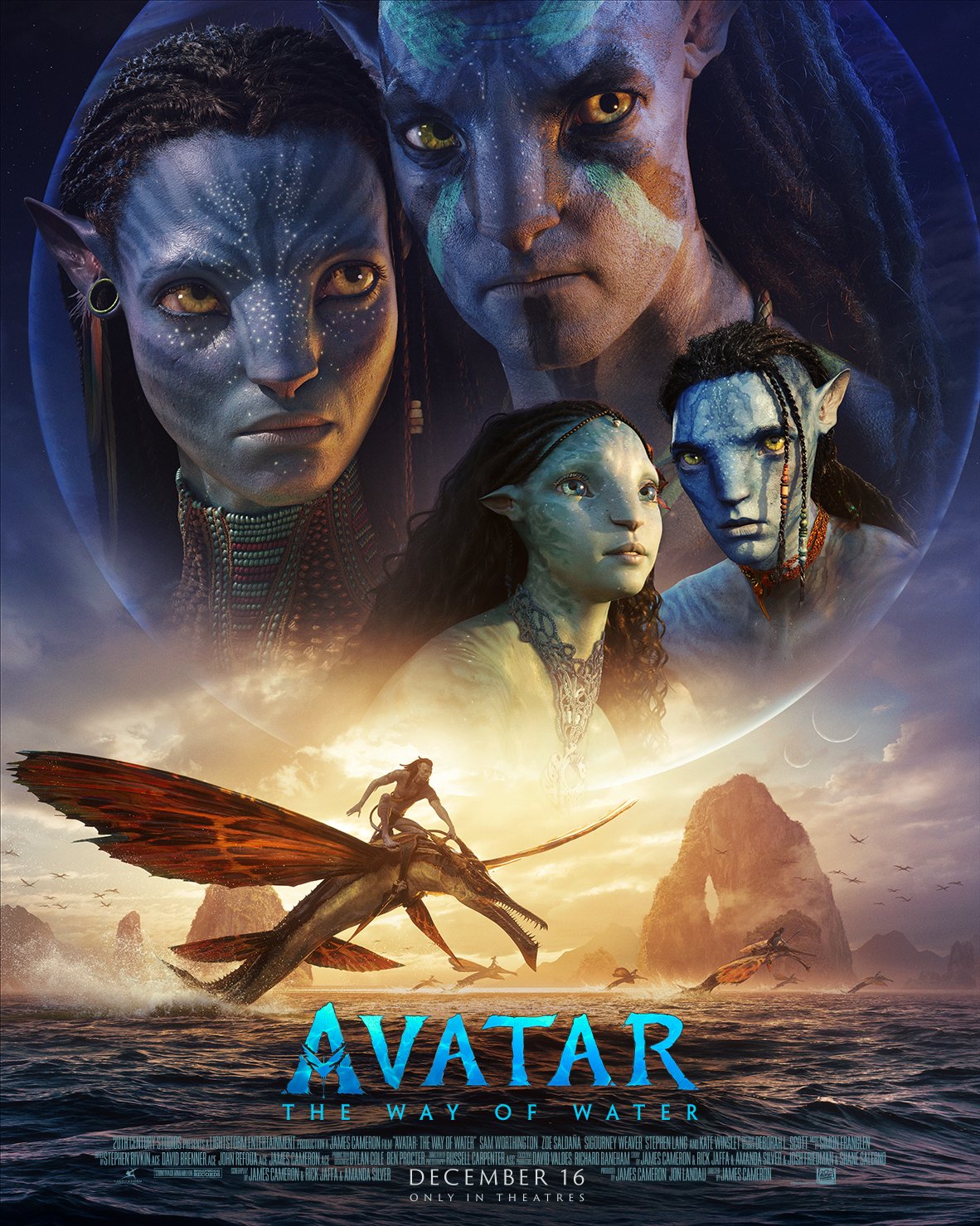
The Avatar saga remains faithful to its tried and true formula: visually breathtaking, narratively uninspired

There are truly interesting ideas in Avatar 3 that elevate the themes raised by the first Avatar to questions of thorny significance to the story, and time after time, their resolution goes for the easy answer, the overdone cliché. The Way of Water could be forgiven for delivering very little because it promised very little. Fire and Ash promises a lot and still fails to deliver, which makes this entry in the film series a more regrettable (forgive the pun) misfire.

Let’s begin with the film’s central conflict: Spider, the human boy adopted by the blue aliens. After a sudden bout of cosmic bad luck, he ends up convulsing on the forest floor, with no more human-breathable air left in his mask and far from his stack of replacements. As a desperate last measure, our miracle child Kiri connects to the web of nature and reformats Spider’s entire body chemistry to allow him to breathe Pandora’s air. So far, so good: no more depending on a 24/7 mask to survive. However, Spider’s new metabolism opens the door to a nightmare scenario: he’s living proof that the human body can adapt to survive unimpeded in Pandora’s environment. If the bad guys figure out how to replicate the process, the entire balance of power in Pandora will shift in favor of human colonization.

Now Spider’s existence is a danger to everyone he loves, and his body is an invaluable source of biomedical innovation. The rest of the film has him ping-ponged between enemy factions that want to either cut him open for the benefit of Earth or cut his throat for the benefit of Pandora. But the movie chooses the wrong Na’vi as the mouthpiece for the latter position, and there are no lasting consequences for the personal ties that should have been damaged between Spider and his would-be executioner.

It has a jarring effect that the film brings us to this immense rift between Spider and the blue aliens, only to give everyone a happy ending where he’s welcomed by the ancestors as a member of the Na’vi without further issue. Let’s stress the point again: Spider was almost murdered by people he deeply trusts and loves, because they became convinced that his life put all of them in danger. And this betrayal comes after Neytiri has spent half the film insulting and neglecting him because she’s still grieving her dead son and Spider is a constant reminder of which people took him from her. After his near-execution, the relationship between Spider and the Na’vi shouldn’t be able to go back to normal, ever. At the very least, it should take more for him to take up arms in their defense again. Even his evil not-exactly-father, the half-Na’vi clone of the late Colonel Quaritch, shows him more respect in this film than his adoptive parents.

The other conflict in the plot, which the trailers gave much attention to but actually doesn’t affect the story that much, has to do with the Fire Nation Ash People, a tribe of pillagers who some decades ago survived a volcanic disaster and have since rejected the cult of the nature goddess Eywa. Now they live off piracy and worship the same fire that destroyed their old way of life. This is a fascinating concept that the film does nothing with. It’s one thing to present a schism in a pantheistic faith and create what is essentially a demonic cult; it’s much more compelling to do so in a setting where the nature goddess is demonstrably real and present in people’s lives. What does it look like to despise the natural flow of the life force when that force is visible and has a tangible will?

But also, what does it say about Eywa that she plays favorites between Na’vi clans? The Ash People’s backstory has them praying to be saved from the volcano, but Eywa refused to send help. In such circumstances it makes total sense that they’d form a new religion around fire, which proved to be the more powerful force, and that they’d turn to pillage to survive, both because they no longer have fertile land and because they no longer trust Eywa’s generosity.

Eywa’s will is actually one of the bigger problems with the plotting of the Avatar series. In the first movie, she saved the day via literal Dea Ex Machina, and Avatar 3 repeats the same trick in an identical situation. The critique of real-life environmental devastation is loud and clear: the humans of this future are too dim to notice the obvious intelligence of the space whales they kill for profit, but it takes a civilization-sized Idiot Ball to ignore a whole sentient biosphere telling you to stop.

When you introduce a deity into your setting, and this deity’s opinion matches your stance as an author, it’s very hard to avoid turning your story into a pamphlet. Eywa steers the plot at the times when it’s convenient, in the directions that help the author preach his message, and thus can’t function as a character in the way that the rest of the characters treat her. And the only time we’re told Eywa makes a questionable choice, i.e. letting the Ash People starve, it’s presented in a way that makes them the bad guys instead of Eywa. As often happens with supreme beings in stories, there are no lessons for Eywa to learn, no need for her to change her mind or grow. The story assumes she can do no wrong, even when it clearly shows it happening. Instead of being a character, she fulfills the function of authorial (forgive the pun) avatar that stalls or pushes the plot as needed.

Another character whom the story treats far more favorably than their actions deserve: Jake Sully, whose boot camp style of parenting will probably push Na’vi culture to invent psychotherapy on its own. Even allowing for the sad reality that the entire Na’vi people is in a war for survival, Jake has no excuse for the way he treats his children, and he’s repeatedly portrayed as heroic for it.

Avatar’s in-your-nose parable about colonialism and predatory greed has been repeating the same basic points for three movies, and doesn’t have any original perspective to add to the discussion. James Cameron has clearly exhausted all the tricks in his box. This film series should stop before its incomparably gorgeous landscapes can’t disguise the mediocre storytelling anymore.

Nerd Coefficient: 6/10.

POSTED BY: Arturo Serrano, multiclass Trekkie/Whovian/Moonie/Miraculer, accumulating experience points for still more obsessions.

Tuesday, February 18, 2025

Film Review: The Gorge

What can be more romantic than jumping over the pit of hell to meet the right one?

As the old song goes:

he was a mercenary manhunter with PTSD-induced nightmares and nothing to live for
she was a trained sniper with a world distance record for the perfect shot
can I make it any more obvious?

Speed's Sandra Bullock warned us that relationships born from dangerous situations don't have the best odds, but life in this century has become a 24/7 dangerous situation, so we may as well fall in love and hope for the best. If you've been assigned by a super-secret agency to stand guard by the edge of a cursed pit full of unknown horrors, all on your own, for an entire year, and the only human being available to talk to is the other expert sharpshooter stationed in the tower at the other edge of the pit, what are you going to do? Have romantic dinner by candlelight in the evening and fire bazookas at the hungry hordes from the abyss in the morning, that's what you do.

It's nothing terribly innovative to juxtapose the blossoming of love and the ever-present specter of death, but it hits differently after a worldwide pandemic. Whether intentionally or not, The Gorge captures the feeling of isolation during quarantine, the encroaching boredom of having the same books and the same walls to look at day after day after tedious day, and the hunger for human connection that can't be fulfilled because what awaits outside is death. In those months of mandated seclusion, it truly felt like there was an all-devouring gap between us and our neighbors, and crossing that forbidden distance was always followed by a period of heightened dread: Did I get infected? In how many days will I know? Have I become a danger to others? It's a miracle to find the love of your life in such circumstances.

But there's another way of reading the themes of The Gorge, if you'll allow me a small spoiler. As our two lethal lovebirds investigate what created that rotten hellscape, they run into some wartime secrets that their respective governments have been remiss about handling. The winning parties of World War 2 have spent decades trying to keep the titular gorge from spreading its filth to the rest of the planet. It won't do to just contain this relic from Nazi times; it needs to be eliminated. As long as that threat remains, there's a sense in which World War 2 is still being fought today.

Which seems fitting for our times, when somehow, after all these years, we still have to deal with leftover Nazi garbage sprouting around us like mutant weeds. In The Gorge, the whole problem began because the winning parties (Americans, Brits and Russians) tried adopting the enemy's methods. Well, look at us now. The curse has touched us, and we were the ones who invited it in.

As combat thrillers go, some of the tension in The Gorge is lost by the audience's knowledge that both leads are professional assassins who can survive a fight with tree-themed zombies with only a few scrapes to show for it. But as a welcome tradeoff, there's an element of competence porn in the way these two quickly synergize their skills into an efficient killing team. There's no "come with me if you want to live," no unforced errors caused by panic, no one assigned to the role of damsel in distress. When they save each other's lives, it's presented as partners in battle doing their business, not as the Designated Awesome coming to the rescue of the Designated Clumsy. I was surprised by how much more I could enjoy a scene of continuous machine gunfire versus the doubleplusundead when I didn't have to worry about anyone making a rookie mistake.

While watching, I needed to remind myself that there's a level at which this type of overanalysis can kill a story, and it's evident that this movie has been a victim of that. Of course world governments would be more deeply involved in keeping the gate to hell in check. Of course such a location would be patrolled with more than just two guards. Such criticism misses the point of the story. Despite the intense barrage of popcorny action (and there's more than enough of that, with lots of chases and headshots and explosions, and a particularly nail-biting scene with a slowly ascending jeep), I find it moving that The Gorge is essentially about the life-saving choice that our historical moment needs: finding the courage to reach across the open maw of chaos to hold the hand of a loved one.


Nerd Coefficient: 8/10.

POSTED BY: Arturo Serrano, multiclass Trekkie/Whovian/Moonie/Miraculer, accumulating experience points for still more obsessions.

Monday, July 15, 2024

Review: Dauntless, by Jack Campbell

An easy-to-read military space opera attempting to have a deep discussion

Military SF as a phenomenon tends to attract authors with military backgrounds, and I find it fascinating to compare their approaches to things like military tradition and discipline with the approaches taken by authors with other backgrounds. Without in any way trying to suggest an association (I don’t read enough military SF for that), it has nevertheless not escaped me that an author whose non-writing career was ‘lawyer and antique dealer’ was really keen to have his spaceship captains execute mutinous crew members for the sake of discipline in a crisis. Meanwhile, Jack Campbell, author of The Lost Fleet series, which begins with Dauntless, was a navy officer before becoming a writer, and his spaceship captain tends to chuck mutinous people in the brig and then have a lot of meetings. The frequency of all-fleet meetings in this book convinces me as nothing else does that Campbell knows whereof he writes.

In fact, one of the strongest elements of this book is Campbell’s reflection on military traditions. He’s very pro-them, but not in a fascist way. And he gives himself the opportunity to reflect on that through a rather ingenious plot device. John Geary, commander of an Alliance Fleet ship, acclaimed fame and honor when the neighboring Syndicated worlds (‘Syndics’) launched an attack on the Alliance, kicking off an unending war. Although Geary was lost in the battle, his selfless sacrifice ensured that his crew escaped safely and lived to tell his story. He was granted a posthumous promotion to captain, and his memory lives on for the next century in the legend of ‘Black Jack’ Geary, the one man who could get out of any fix, win any battle, lead any mission to brilliant success.

Except he wasn’t lost; he made it into a damaged escape pod at the last minute and drifted in suspended animation until, a century later, he is picked up by an Alliance ship, thawed out, and learns what has happened in the last few decades. And it’s not great. Besides the century of constant war, he learns that the military has also degraded in a variety of ways, some of which were not quite believable—more on that later. They’ve adopted a more democratic system of decision-making, in which ship commanders all vote on proposed fleet actions (this is bad); they’ve apparently lost all their tactical training (this is very bad), and they’ve even given up saluting (this is astonishingly bad).

Fortunately, Geary’s prompt posthumous promotion means that he has built up a century’s worth of seniority as captain, so when the rest of the fleet’s senior staff are executed by the Syndicates during an ostensible negotiation that was apparently in no way an obvious set-up for a betrayal, Geary ends up in charge of the fleet. The task: to escape Syndic space, carrying with them the MacGuffin—excuse me, I mean the access key to the Syndic hypernet transport system—back to Alliance space. And, through the power of remembering former, better tactics and traditions, and also knowing how to salute, he does.

I mean, I assume he will. This is a six-book series, and I’m partway through book 3 at the moment, but it’s pretty clear that he will. Which is also kind of the problem.

See, Geary’s main character arc is his struggle with being a man: John Geary, who is seen as a legend, Black Jack Geary. He is regarded by many of his deeply religious crew as a gift from the Living Stars and their Ancestors (a firm cultural tradition of ancestor worship, which was a rather nice touch) to come rescue them in their time of need. ‘I’m only human!’ he thinks, at excruciating length. And yet, every time something goes wrong, every time he needs to outthink the Syndics, outguess them, outfight them, he always wins. There is never a situation in which he makes a mistake, gives the wrong order, guesses wrong, or in any way is responsible for anything bad happening. And this badly undermines the attempted discussion of man vs. myth that Campbell is trying to have here. It’s as if, in his desire to work through the mechanics of space battles and supply runs in enemy territory, Campbell forgets that sometimes the cool plans might not work.

And that brings us to something else that doesn’t work terribly well here: the discussion of military tactics. I’m going to comment solely from the perspective of a reader, since I know nothing about actual military tactics (and, to be fair, no one knows anything about space tactics). But a huge part of the plot has to do with the idea that Black Jack’s legend has almost single-handedly been responsible for a shift in military culture away from thoughtful, clever tactics, instead encouraging ship commanders to be thoughtlessly, stupidly aggressive. Black Jack mythically was super-duper aggressive, and so in copying his example, modern spaceship captains end up seeking the credit for individual wins, rather than engaging in disciplined joint action to ensure a successful encounter overall. The result is a staggering loss of ships and a death count that produces a real dearth of seasoned, experienced commanders. So one challenge that Geary has to overcome is re-training this fleet under his command to stop using Bad New Tactics and start using Good Old Tactics again.

Now, I suppose I could accept this shift in tactical culture, even though it requires me to accept a transitional period during which the Bad New Tactics are taking over and causing enormous losses, despite which no one says, ‘Hey, maybe we shouldn’t be fighting battles this way?’ But the problem with this plot point is that it requires the Syndics also to adopt the same Bad New Tactics, otherwise there would be no way for the centuries-long stalemate to persist. It’s pretty clear from Geary’s successes that, if the Syndics had stuck with the Good Old Tactics that Geary is re-introducing, they’d have won all the encounters with the Alliance, and that means they would probably have won the war pretty quick. So why did the Syndics shift in the first place? The Alliance shifted to be like Black Jack, but the Syndics don’t care about Black Jack. He’s not their hero. So they must have just decided to start being bad at fighting, which is hard to swallow.

That being said, there are some good bits in these books too. First, Campbell is really good at gender equality. Captains and leaders are equally likely to be men as women, and there isn’t even any tedious self-congratulatory lampshade hanging on it. It’s just part of the world-building. There’s also a certain pleasing rhythm to Geary’s problem-solving, as he thinks through some objective, such as where to resupply the fleet, or deciding which route to take back to Alliance space, or confronting antsy ship commanders who object to his methods.

And finally, there’s also a careful attention to the relativistic effects of long-distance space battles. Campbell never loses track of how far people are from various events, such that whatever they see five light-hours away (or however distant) actually happened five hours (or however long) ago. This consistently structures all the space battle scenes. When the fleet magically-FTL-wormhole-materializes (or “emerges from Jump space”) into a star system, they can see the precise number of Syndic ships already there as of five hours ago, and start planning the engagement accordingly. Meanwhile, the Syndic ships and cruisers aren’t even going to know that the Alliance fleet arrived for another five hours. Every encounter is built around this sort of light-speed limited thinking, which works well.

The antsy ship commanders who don’t like Geary’s leadership offer an opportunity for some thoughtful internal tension in the book. They serve as a counterpart to the hero-worshippers that make Geary so uncomfortable, but the source of their antagonism is the same: The reason they disagree with him so vehemently is because they’ve subscribed wholeheartedly to the ostensible Black Jack philosophy of fighting, and don’t like the real John Geary telling them they’re wrong. Whether supporters or detractors, the Black Jack’s legend affects how everyone views Geary’s command.

In practice, though, the Bad Commanders form another point where I have difficulty believing, because—remember—Geary never loses battles and never does anything wrong. And it’s not as if these captains have any better ideas; they simply want to cause difficulty for him by being dumbheads. At some point, aren’t they going to have to face facts and realize that they’re wrong?

Or maybe not. Maybe the most realistic part of this book is how dumbheaded some dumbheads are, even when their lives and futures depend on it. But if that's what it takes to make a book realistic, then I'd rather skip the lived experience of ex-soldiers and let a better writer tell me a more entertaining tale than the best that reality has to offer.


Highlights:

• Gender equality
• Careful attention to space battle tactics
• Kind of dull

Nerd coefficient: 6: still enjoyable, but the flaws are hard to ignore

Reference: Campbell, Jack. Dauntless [Ace Books, 2006/Titan Books, 2011].

CLARA COHEN lives in Scotland in a creaky old building with pipes for gas lighting still lurking under her floorboards. She is an experimental linguist by profession, and calligrapher and Islamic geometric artist by vocation. During figure skating season she does blather on a bit about figure skating. She is on mastodon at wandering.shop/@ergative

Thursday, April 25, 2024

Review: Rebel Moon Part 2: Forgettable Boogaloo

In contrast with the ubiquitous fanfare surrounding the launch of Rebel Moon Part 1 last year, its sequel has come and gone almost unnoticed

Last year, Zack Snyder seemed pretty convinced that his space opera riff on Seven Samurai was going to become an instant classic. The intensity of the marketing reflected that expectation: it was made at a volume and intensity to match that of the movie itself. Such high hopes weren't rewarded: Rebel Moon Part 1 turned out to be an unbearable cacophony of hyperviolence in blurry sepia, exactly what could have been predicted of a project where Snyder had free rein to pull his favorite toys out of the box.

What would have been harder to predict was how much room there still remained for Snyder to out-Snyder himself in Rebel Moon Part 2. With even more gratuitous slow motion, misplaced flashbacks, confused politics, impossibly sculpted abs, unintentionally funny battle cries, and suffocating grandiosity, Part 2 dulls the senses via relentless overstimulation. I noticed, to my horror, that I was witnessing gory death after gory death after gory death—and yet I was feeling nothing. Mayhem erupted on my screen with the chaotic viscerality of putting a gremlin in a blender and it left no impression on me. This is the kind of ultra-derivative art that relies on borrowing the prestige of its influences and doesn't bother trying to appeal to the viewer on is own merits.

There was plenty of material in this story with which to make some powerful statement, if only Snyder had wanted to. Taking the plot of Seven Samurai and replacing the wandering bandits with a galactic dictatorship changes completely the dynamics of the conflict. This isn't a mercenary skirmish in a lawless land; it's now a peasant revolt against the official authorities. Is Snyder subtly equating a rigidly hierarchical government composed of space fascists with a loose band of outlaws? I'm kidding. Snyder doesn't do subtle. Rebel Moon doesn't have space fascists because it has something to say about fascism; it has them because it's what Star Wars did and Rebel Moon wants to be one of the cool kids. It doesn't burn entire minutes of runtime in loving close-ups of wheat harvesting because it's interested in the perspective of vulnerable farmers; it does it because it gives Snyder an excuse to point the camera at sweaty muscles. Rebel Moon takes no stance on its own themes. It's content to let you provide the missing message by remembering it from the movies it alludes to.

In terms of characterization, the team of heroes at the center of Rebel Moon don't get more than the quickest coat of paint to technically make them no longer two-dimensional. As if drawing from a D&D campaign, each of these characters' backgrounds can be summarized as "goons raided my village." To make the whole affair even more unimaginative, the two prominent women in the team, Kora and Nemesis, have a dead child in their respective tragic pasts, possibly revealing a limit to Snyder's ability to imagine women's motivations.

The figuratively moustache-twirling admiral who lands on Kora's village to steal the harvest is even less impactful this time. If in the first movie he was a blank slate whose function in the story was to look generically evil and serve as the vicarious target for the audience's frustrations with neofascism, now he's a bland rehash of his one-hit act. Whereas his first death was at least a satisfying punch-the-Nazi (with a laser gun) moment, the sequel's supposedly climactic showdown feels like a tedious formality before his mandatory second offing. A bloody fistfight in the lopsided deck of an exploding spaceship, with heavy machinery and discount lightsabers flying around, sounds like a set piece impossible to make look boring, but you shouldn't underestimate Snyder's talent for filling the screen with flashy blasts that carry no meaning.

The emotional beats that punctuate the third act repeat a few tropes Snyder can't seem to move on from: the last-minute ally who shows up to prevent someone's imminent death, the hero who deals the killing blow at the cost of his own life. Snyder has found his formula and is comfortable recycling it. He's so confident in the awesomeness of Rebel Moon that he ends Part 2 with the promise of a Part 3 that we can already bet will repeat the same filmmaking tics. But enough is enough. There are only so many ways you can make the screen explode while having nothing to say. Maybe Snyder needs to go back to filming established properties, or find collaborators less willing to go along with his obsessions, but this period of unrestrained self-indulgence needs to stop.


Nerd Coefficient: 2/10.

POSTED BY: Arturo Serrano, multiclass Trekkie/Whovian/Moonie/Miraculer, accumulating experience points for still more obsessions.

Tuesday, December 26, 2023

Rebel Moon is the most Snyder that Snyder has ever been

Lucasfilm dodged a glowing, blurry, vaguely yellowish, excessively slowed-down bullet

One could summarize Rebel Moon as "the Zack Snyder of Star Wars," which would sound mean-spirited if it weren't its literal description. Conceived originally as Snyder's pitch for Lucasfilm and eventually rescued by Netflix, Rebel Moon files off the Star Wars serial numbers just enough to prevent lawsuits from the Mouse. As you would expect, it tells the story of a loosely assembled team of impromptu freedom fighters who rise up against a brutal interstellar empire. A tale as old as time, and one that Lucasfilm has kept profitable for nine movies and I forget how many TV shows. But Snyder's version of this formula, stripped of its identifiable markers for legal reasons, becomes a nameless, featureless collection of plot beats and cool poses. If there was ever a time when the infamous itch for canceling everything at Netflix could be used for good, it's now. There's no need for a Rebel Moon Part 2, or for all the multimedia spinoffs Snyder is reportedly preparing. This is not the galaxy you're looking for.

As I've written here before, I'm a fan of neither Star Wars nor Zack Snyder. Their missteps are plain to see to me. But even I was unprepared for the combination of the more generic, people-pleasing bits of the former with the more self-indulgent excesses of the latter. To put it in perspective: the production of the Barbie movie caused a brief scarcity of pink paint. Now that Rebel Moon is available on Netflix, has anyone checked on the world's supply of sepia pixels?

In theory, it should have been fascinating to watch a director's rendition of Star Wars without its distinctive visual identity. It would be a look behind the curtain, a dissection of the inner machinery that makes Star Wars go. Such a unique opportunity would help prove the case that a great portion of the transgenerational appeal of Star Wars has relied more on its art design than on its plotting. What is Star Wars without the double sunsets, the Stormtrooper armors, the outlandish hairstyles, the lightsabers? What is that story actually saying? You won't get that from Snyder's version. Instead of revealing the interior of a story without all the style getting in the way, Rebel Moon is nothing but style. Even worse, being only the first half of a planned duology, it hyperfocuses on character introductions. Far too many introductions, in fact. In a manner that brings to mind the first Suicide Squad movie, each of these heroes gets exactly one scene to look awesome and then dutifully retreats into the background, because this may be an ensemble cast, but the script only really cares for two characters.

Our protagonist, a Mysterious Lady of Mystery trying to keep a low profile in a remote rural planet but unable to keep in check her resting side-eye face, is, of course, more closely connected to the evil empire than she's let on. When a warship pays a visit to demand grain and the soldiers start getting dirty ideas about the local women, she is forced to blow her cover and singlehandedly wallops an entire squad while looking fabulous doing it. Then she runs away with her Designated Romantic Interest, but only because he knows the right people who know the right people who can help them amass forces for when the empire strikes back retaliates. This is the point when the plot turns into a succession of recruitment quests that go on for too long, don't serve to reveal their characters, and don't advance the story. We do get a handful of poster-worthy shots, which is what Snyder actually cares about. Instead of dramatizing the deep human questions that form the substance of the great epics, Rebel Moon is content with just looking epic.

Because filming 300 somehow didn't give Snyder his fill of rock-hard abs in desaturated slow motion, the fight scenes in Rebel Moon double down on all his filmmaking vices. You know how it goes: gory carnage filmed as if it were ballet, smoke and flying debris covering each shot you're trying to watch, and primal screams galore. The scenes that are not fights don't let the viewer have much of a breather, given Snyder's signature obsession with characters musing on a worthy way to die.

A story that consciously inserts itself in the tradition of Star Wars is expected to have something to say about empires. Episodes 4-6 showed how empires are less invincible than they make themselves appear in propaganda; episodes 1-3 showed how dangerously easy it is for a free society to degenerate into an empire; and episodes 7-9 showed how the shadow of the imperial impulse must be fought again in each generation. What say you, Episode Snyder? Empire bad. Empire go pew pew. Goodie need bigger pew pew.

Rebel Moon doesn't have time for its overcrowded cast to explore the themes of domination and exploitation in the context of the 21st century. It resorts to the most elemental trick of shining applause lights on your screen and expecting you to cheer, except these applause lights are full of dynamite. All the characterization that should make you care about these heroes is said to have been reserved for the extended cut, which says enough about Snyder's storytelling priorities. Just thinking of the fact that there is an extended cut makes me shudder with terror. I felt dead inside after spending two hours with this troupe of one-note permascowls, and I can't think of a good reason to add another full hour (and a sequel, and an extended cut of the sequel) to that ordeal.


Nerd Coefficient: 3/10.

POSTED BY: Arturo Serrano, multiclass Trekkie/Whovian/Moonie/Miraculer, accumulating experience points for still more obsessions.

Wednesday, May 17, 2023

Review: Lords of Uncreation by Adrian Tchaikovsky

The epic quest to defeat the enigmatic Architects now extends beyond this reality

Confession time: I hate cosmic horror. I detest it with a fervent passion. I find its conceptual foundations intrinsically repulsive on a visceral level. The notion that the underlying truths of the universe are impossible to grasp and dangerous to glimpse by mortal minds strikes me as a ridiculous underestimation of human capabilities. The suggestion that the vastness of the starry expanse reduces all human desires to insignificance goes against every humanist principle I hold. The unquestioned assumption that human beings ought to fear the unknown is one I oppose on principle, as the ultimate insult to human reason. The intended aesthetic effect of awe before the immeasurable might of ancient transdimensional overlords offends me as contrary to human dignity.

Which is why I absolutely adored Adrian Tchaikovsky's latest novel Lords of Uncreation, which concludes the story told in the monumental masterpieces Shards of Earth and Eyes of the Void. Finally, we have a novel that understands that, when you meet an eldritch abomination from the unfathomable nothingness between universes, the correct human response is to laugh in its face.

The story so far: the galaxy is in panic because of the return of the Architects, gigantic alien beings who destroyed Earth and doomed humankind to a nomadic life between the stars. Our protagonist Idris Telemmier has been gathering experts in xenoarchaeology to refurbish incompletely understood ancient machinery. The plan is to launch a counteroffensive that would hit the Architects in their home turf. Only two problems: (1) said ancient machinery is irresistibly attractive to every military power in the galaxy, and (2) the home of the Architects is located in the negative space where both physical things and the human mind lose their link to reality.

This third novel in the series jumps right into action and never releases its grip on the reader as our heroes get caught in an unrelenting chase to stay in control of their superweapon as every faction tries to get their hands on it, and stay in control of their sanity as they visit the hostile realm of the unreal. Yet Idris hopes to convince his colleagues that ending the war shouldn't require paying back genocide for genocide. And here one of the strengths of the novel becomes evident. It's great when you can notice how deeply an author loves his characters. Lords of Uncreation takes care to portray Idris with all his convoluted interiority, achieving the unlikely feat of making an ageless telepathic unsleeping cyborg with the power to save the universe and the self-esteem of a termite feel close and relatable. As a war survivor who was brutally weaponized and is now wanted as an asset, Idris is barely functional. The scars of his trauma and the anxiety of having only a temporary freedom were already a difficult burden to carry before his mind opened to the revelations of unspace and contracted an obsession with exploring the forbidden regions of that not-place.

Drawing from a profound empathy for human suffering, and with the extreme care of a master wordsmith, Tchaikovsky proposes a more mature way to look at characters who have gone through painful events and then have to face new, comparable hardships. Not only Idris, but his companions the duelist lawyer Kris and the clone warrior Solace demonstrate an inner strength earned in fire. I refer to extreme care because it would have been too easy to romanticize their trauma and treat it as an advantage in their subsequent adventures. Tchaikovsky knows to steer away from that simplistic recourse. While his characters do gain strength from the hard lessons of their past, at no point does he pretend that they're better off for having suffered. What their bad experiences give them is not a thicker skin, but a broader perspective. These are not the kind of heroes who learn to shrug off blows, but heroes who go on to ensure others don't have to receive them.

The moral stance of Lords of Creation is grounded on an unwavering affirmation of the value of human life even in a universe that is infinitely bigger. As an illustration of what might be called optimistic nihilism, our heroes come face to face with uncaring monstrosities older than the universe and, instead of losing their minds from the despair of realizing their smallness, they stand their ground and refuse to kneel. It's not that they've become strong enough to punch Cthulhu; it's that they feel at home in the universe and wish to deal with its other inhabitants as fellow creatures. The fate of humankind is not to serve, but to thrive.

However, the competing factions of humankind have their own ideas of what that thriving looks like. Through this novel, our heroes have to defeat not one but two separate eugenic conspiracies that threaten to derail the course of future history. This theme of refusing to grant some lives more worth than others is reaffirmed in the climactic confrontation with the titular Lords of Uncreation, who for the previous two novels have been sending the Architects to reshape the universe into a perfect work of art, mere mortals be damned. And here the central theme of humanism vs. fascism finds its clearest expression.

Walter Benjamin's description of fascism as the insertion of aesthetics into politics can be rephrased in this way: fascism is the desire to politically enforce an aesthetic. If you pay attention to far-right discourse, its obsession with "disorderly" society and "disgusting" sexualities and "unclean" literature and "impure" blood is always described in the language of aesthetic preferences. Fascism doesn't want good citizens, just good-looking ones. In Lords of Uncreation, upon hearing the final antagonists describe their grandiose plans for the universe and their inflated sense of superiority, one senses an echo of every tyrant who appointed himself as society's curator.

The winning strategy for our heroes turns out to be, refreshingly, community. The universe is saved by the joint effort of all who give up factional divisions and choose instead cooperation. The cosmic abandonment that the human mind feels in unspace is made more bearable in company. The terrors of the transdimensional void don't hold a candle to the nightmares that lurk inside us, and if we've been able to survive those, we can survive whatever the universe throws in our direction.


Nerd Coefficient: 10/10.

POSTED BY: Arturo Serrano, multiclass Trekkie/Whovian/Moonie/Miraculer, accumulating experience points for still more obsessions.

Reference: Tchaikovsky, Adrian. Lords of Uncreation [Tor, 2023].

Tuesday, December 20, 2022

Avatar: the way of self-indulgence

James Cameron's new toys are pretty and shiny, but do they mean anything?

Back in 2009, it seemed like the first Avatar film would set the standard for visual effects for decades to come. It was a completely unexpected technical masterpiece that wowed audiences with hyperrealistic landscapes capable of lulling the mind away from the embarrassing flatness of the characters and the story.

Look at us now, jaded and benumbed by four Avengers, one Gemini Man and three Hobbits. We're in an era when digital magic doesn't impress the way it used to. The sequel Avatar: The Way of Water is doubtlessly gorgeous, with lifelike beasts that look solid and tangible, and edge-on shots of 3D ocean surfaces that make the viewer sway in the chair with the waves. But moviemaking isn't just composing beautiful frames. Despite all the trailblazing technical innovation created expressly for this film, the three hours of Avatar: The Way of Water end up feeling like a three-meal course made entirely of plain water.

We return to the exomoon Pandora, where humans continue to exploit natural resources with no respect for the native population. It's been roughly 15 years since the events of the first Avatar, and our human-reincarnated-into-alien protagonist Jake Sully is now a family man. But the greedy humans are back with a vengeance, and Jake has to flee with his family to avoid bringing any further destruction to the natives. And here we have the first eyebrow-raising choice in this film: the implication that 15 years of Jake integrating into an alien ecosystem and culture to raise four kids of another species doesn't seem worthy of telling, and only when humans reenter the scene do we get to continue the story. For all the lip service that this franchise professes to respecting indigenous communities, it's, at the least, noteworthy that director James Cameron only tells the parts of this community's story in which their colonizers get involved.

Once the basic conflict is established (emphasis on basic), the rest of the movie is an extended theme park ride followed by an admittedly good battle sequence. Avatar: The Way of Water repeats numerous plot beats from the original, dropping our focus character into an unfamiliar environment where he needs to learn the rules of survival, earn the trust of the locals, and fight to defend his new home. We hear the same vaguely New-Agey platitudes about interconnectedness and the cycle of life, we're told again that the whole world functions as a hive intelligence, we watch yet another predatory expedition to destroy a natural beauty for (literally) astronomical profit, and we're left with the same simplistic message: nature good, humans bad.

Worse still, this repetition of preachy talking points occurs without the already minimal character development of the first Avatar. Four alien teenagers are introduced with the single personality trait of "they're teenagers." The lead duo are reduced to the most commonplace clichés of married couples in movies, with a Jake who has confused martial discipline with parenting, and a Neytiri who only reacts to events by making concerned faces but leaves no footprint on the plot. The return of archnemesis Colonel Quaritch might suggest a thematic statement about the damaging effect of human intervention (mirrored in Jake's clumsy attempt to raise his alien kids by introducing them to all the bad parenting techniques of Earth), but that's not what Cameron is interested in exploring. We're here to gasp at picture-perfect fish, not to reflect on the mistakes of humankind.

Even when the dialogue alludes to the ecological problems back on Earth, that crucial piece of context isn't afforded the prominence it should have. Colonel Quaritch's personal vendetta against the Sully family feels absurdly small compared to the actual problem of the entire human species planning to move to Pandora permanently. A plot development that raises the stakes of the main conflict in exactly the way a sequel is supposed to doesn't get more than a throwaway line that Cameron evidently doesn't intend to address until a future movie. The same frustrating approach is used with the character of Kiri, the only truly interesting addition to the story, who spends the length of the movie carrying a neon sign that flashes "I'll matter later."

If Cameron gets his way, we'll have three more entries in this franchise. The problem with multiple sequels in the Age of Marvel is that directors have forgotten that films are not, and should not try to be, TV episodes. Avatar: The Way of Water would have been a serviceable filler episode in a streaming show, with its temporary change of setting, a self-contained chase subplot, and just enough links to the larger arc. But as the standalone movie it should have been expected to be, it's drowned in blue pixels that enchant the eye but have very little of substance to say.


The Math

Baseline Assessment: 6/10.

Bonuses: +100 for once again pushing forward the quality of visual effects in cinema.

Penalties: −100 for having only the faintest, digitally rendered shadow of a plot, a theme, or actual characters.

Nerd Coefficient: 6/10.

POSTED BY: Arturo Serrano, multiclass Trekkie/Whovian/Moonie/Miraculer, accumulating experience points for still more obsessions.

Tuesday, September 27, 2022

Microreview: The Cruel Stars by John Birmingham

 Space Nazis set loose a plague of zombies and well-worn tropes in this epic military sci-fi.


Tomorrow marks the start of Conflux, Canberra’s convention for speculative fiction writers. For 2022 it is doing double duty as the Australian national speculative fiction convention. It has become my tradition to review something by a Guest of Honour wherever possible. This year that’s John Birmingham.

The Cruel Stars is the first in an anticipated trilogy of military sci-fi. It follows the perspectives of five survivors of an attack by the Sturm. The Sturm are explicitly described as space Nazis, obsessed with keeping humanity pure of the neural nets and other in-body technology that has become so pervasive. Having been defeated once many years ago, they return following a necrophagic virus they’ve engineered to turn anyone with implants into zombies, wiping out most of civilisation. It’s up to our survivors to defeat them once again.

While The Cruel Stars is a solid read, it’s not exactly breaking new ground. Rather, it weaves together a bunch of well-worn sci-fi elements into a complex pattern. Most people live several lifetimes, downloading their consciousness into new bodies when their current ones wear out. Skills are frequently downloaded rather than learned, like in the Matrix.

Lucinda Hardy is the commander of the only surviving warship in the Royal Armadalen Navy and a warrior who has worked hard to acquire her abilities in combat. Her scenes are the most traditionally military sci-fi, reminiscent of Battlestar Galactica and, later, anything with space marines. Having grown up in poverty, she feels out of place among the officers on her ship. Her Imposter Syndrome and the class issues her story touches upon give her some interesting dimensions, but not much time and space are devoted to exploring these issues in depth due to the sheer number of elements in play.

The characters of Sephina L’trel and Booker3 lean into different aspects of cyberpunk. Sephina is the head of an outlaw band who are in the middle of a gunfight when the virus takes hold around them. These characters play more into the sassy, criminal, Japanese-influenced aspects of cyberpunk. In contrast, Booker3 is on death row for his heretical belief that the soul is code that can be transferred between bodies and machines. He has much more of a Ghost in the Shell vibe, with faint echoes of Murderbot. Some of the forms into which he is downloaded prove rather amusing.

A very young princess of a corporation and a very crusty retired admiral round out the point-of-view characters, along with the admiral of the Sturm. The number of POV characters with their very different situations gives a good sense of the epic scale of the attack. However, cycling through all the different storylines makes the pace slow, at least until they begin to converge.

I am not a big fan of zombie stories (with a few notable exceptions), but found their use in The Cruel Stars drew me in. After the initial, very gruesome shock of them, the zombie presence in the story remained relatively light, mostly remaining as an obstacle to the use of technology so prevalent in this world.

The cast is reasonably diverse, but not without problems. Using a character’s phenotype as a shortcut description seems a curious choice in a book about space Nazis — even if those space Nazis are less concerned with race than technology. Also, did we really need to fridge the gays?

Disability continues to be a weak point of the cyberpunk genre. It seems assumed that disabilities have been largely engineered away, except in the case of Admiral McLennan, whose refusal to have a predisposition to cancer engineered away and whose reluctance to relife has him facing disaster in 54-year-old body — traits which are framed more as eccentricities than solid representation of disability.

It managed to weave in some distinctly Australasian elements, which I appreciated. These elements mostly tied into the setting. This is a far-future story, but still based in our world. The Royal Armadalen Navy that Lucinda serves is the military arm of the Commonwealth of Armadale. For context, Armadale is a suburb in the city of Perth in Western Australia which originally started life as a small colonial garrison. Lucinda is also mentioned as earning the Star of Valour in the Javan War. One of the most powerful corporations-cum-noble-houses is the Yulin-Irrawaddy Combine (though, as they are also one of the least ethical and most ruthless, perhaps not the most well-considered inclusion) and a number of characters are described as having South-east Asian phenotypes.

The writing style was noticeably clunky early on and particularly in the first chapter. I found this surprising from someone I would have considered a reasonably experienced writer. Fortunately, it improved as the book went on, finding its strength more in action sequences and big moments. 

That said, I did find the ending somewhat unsatisfying, with a deus ex machina that was more literal than most.

All in all, The Cruel Stars didn’t blow me away, but may appeal to more devoted readers of epic science fiction.


Tuesday, July 5, 2022

Review: Eyes of the Void by Adrian Tchaikovsky

The sequel to Shards of Earth brings bigger revelations, deeper questions, and riskier adventures

In the first book of the Final Architecture series (which I reviewed with high praise last year), the fearsome Architects, alien megastructures capable of destroying planets and responsible for humankind's current state of cosmic homelessness, had suddenly returned, and the only countermeasure that was useful against their uncaring advance—the mysterious ruins of a long-gone civilization—appeared to have lost their repellent effect. The only hope that remained was the telepathic power of the Intermediaries, surgically altered humans with the ability to perceive the layer of unreality beneath the fabric of spacetime. But the surviving Intermediaries are now aging war veterans, and the Architects will not listen to newly-made Intermediaries who have undergone the cerebral torture against their will.

So our revered hero Idris Telemmier, member of the original slate of Intermediaries, twice savior of the known civilizations and very much tired of it all, is the most prized weapon in the galaxy. And everyone wants to get their hands on him. The early chapters of the novel consist of a relentless pursuit, full of spy games and secret agendas, because each faction calculates that gaining control over Idris will give them the key advantage against the Architects and, ultimately, against the rest of intelligent species. The balance of power in the galaxy is precariously volatile, the return of the Architects has put every major government on maximum alert, and Idris just wants to be left alone. As soon as he's done training a new group of Intermediaries (who, he emphatically insists, must be free volunteers or else their powers will be useless), he's ready to retire and forget about wars and politics and the fate of the universe.

Alas, the universe is not done with him. True, most factions want to steal him as a weapon, but he's also useful as a seer, an irreplaceable channel of communication with whatever dark purpose the Architects are working for. As the plot takes our crew of protagonists aboard the salvage ship Vulture God through more and more elaborate ruin sites, Idris gradually begins to sense the true relationship between the material universe and the void of nonexistence where the Architects live. And the answers are irresistible catnip to his altered brain (and, to be frank, to the reader).

Whereas the first novel in the series, Shards of Earth, felt like it was inspired by Hegel's Phenomenology of Spirit, in that it explored the tango of attempted negations inherent to any contact between two conscious entities, this new entry appears to take after Sartre's Being and Nothingness and its exploration of how important conscious thought is as the condition of possibility for negation. In other words, the concept of "not" only makes sense to a mind that can reflect on being. Once you start classifying the world according to categories, you notice negative space around each being: the attributes that make a cup a cup are the same that make it not a penguin. To be something is to not be everything else. But it is only through a thinking mind that this abundance of nonexistence is even possible. The world doesn't get filled with negations until it gets defined. Without a mind to impose categories, one arrangement of atoms would be as good as any other. It wouldn't matter if Earth were a livable place or a twisted wreck of magma. That is why, in the first novel, the world-warping Architects only retreat when they realize that we do care about arrangements of atoms. It is our consciousness which bestows the universe with meaning. It is our consciousness which distinguishes between things, and within that distinction lies our most terrifying creation: the "not." To even begin to make sense of the world, to apprehend it, requires us, in a way, to surpass the realm of the real and reach into the nonexistent. This is what Hegel terms, and Sartre quotes, as the role of an Intermediary.

In the setting of Tchaikovsky's Final Architecture series, FTL travel is performed by Intermediaries who guide the jump from the real universe into an empty nothingness folded into routes. (Here we have to come back to Sartre, who defines physical distance as a negation of contact, and the destination as a negation of further movement.) In stunningly poetic passages, the novel describes the negative void between things as the very fabric that links them and holds them in place.

In the unspace postulated by Tchaikovsky, intelligent minds intuit a lurking presence, contact with whom would be absolutely intolerable. To put it in Sartre's words, "nothingness haunts being." But conversely, conscious thought is the only thing that has an effect on unspace. If, following Sartre, nonexistence is incapable of sustaining itself, it's even possible that Tchaikovsky's unspace didn't begin to exist until intelligent species emerged in the universe (we'll have to wait until the conclusion of the trilogy to find out whether this speculation holds).

Here we may find a clue to decipher why Tchaikovsky's characters suffer an intense state of anguish while in unspace. According to Sartre, the human attribute that brings the "not" into the world is freedom, the possibility of making a choice (because each choice comes at the cost of negating other possibilities). And it is precisely the infinity of all the negated possibilities that makes us feel anguish upon being aware of our freedom (this is Sartre quoting Kierkegaard) or, indeed, anguish upon being aware of the nothingness (this is Sartre quoting Heidegger). The human mind collapses under the weight of everything it could be and is not.

The arc that Idris follows in this sequel is a fascinating one: he yearns to retain his freedom, both legally and morally speaking, from any of the various governments that are making unabashedly obvious plans for war and would love to acquire his services, but the lure of the truth about unspace keeps dragging him back to the wrong places, where he's wanted by all kinds of the wrong company. For all parties involved, this is a basic fetch quest: to get Idris by whatever means, rinse and repeat. But Tchaikovsky never lets it get boring. A clandestine auction of stolen government data quickly erupts into a shooting match plus murder mystery; a routine pilgrimage to a holy site is interrupted by cataclysmic weapons that laugh at the laws of physics; a simple interview at a university ends with a nail-bitingly tense chase and a ritual duel; a search-and-rescue operation leads to a four-way starship standoff over an ancient planet with lethally resplendent flora. Each of these scenes is built with an almost cinematic eye for the combination of intense pacing, truly alien setting, and meaningful stakes that makes every piece of the puzzle matter.

And I still haven't mentioned the rest of the cast: the robot archeologist Trine makes a return, with their unmistakable snark; the clone soldier Solace is as torn as ever between her patriotism and her personal sympathies; the sharp-tongued Kris gets much welcome development; the alien arthropod Kit continues to provide the pragmatic viewpoint with exactly as few words as necessary; and the foulmouthed Olli is still the best representation of a disabled badass I've seen in ages.

Eyes of the Void is all the best things about space opera: political machinations, unlikely alliances, shady cultists, body augmentation, literal world-shaking enigmas, extradimensional shenanigans, deep philosophy, and lots and lots of pew-pew. It provides more than enough answers to reward the extensive journey, but keeps the best ones carefully hidden for the upcoming conclusion.


The Math

Baseline Assessment: 9/10.

Bonuses: +1 for expertly holding the narrative rhythm like a music conductor.

Penalties: −1 because the political machinations in the early chapters are a bit too hard to follow at first.

Nerd Coefficient: 9/10.

POSTED BY: Arturo Serrano, multiclass Trekkie/Whovian/Moonie/Miraculer, accumulating experience points for still more obsessions.

Reference: Tchaikovsky, Adrian. Eyes of the Void [Tor, 2022].

Tuesday, August 10, 2021

The Suicide Squad is silly, morbid, gory, hilarious, and surprisingly topical

In contrast with the MCU's cowardice, the DCEU has no problem portraying America as the bad guy

It took a second try and years of waiting, but we finally got a decent Suicide Squad movie.

To summarize: when the brutal dictator of the fictional banana republic of Corto Maltese is violently overthrown by another, equally brutal dictator, but which happens to be aligned in opposition to the US, a sinister agency of the US government created to do the dirty work in secret drags members of the incarcerated population into service (a comic-book fantasy exaggeration of a practice that is, by the way, still fully legal). However, their mission is not to kill the new dictator, but to prevent him from getting his hands on dangerous alien research that had been kept hidden in Corto Maltese for sketchy reasons having to do with exiled Nazis and good old US image management. The attempt at foreign intervention goes horribly wrong, and our Suicide Squad has to choose what it wants the US to stand for.

The criticism of American foreign policy is refreshingly overt here. This same year, The Falcon and the Winter Soldier excelled in tortuous mental gymnastics to find a way to maybe imply, in a subtle, roundabout manner, that influencing world politics by force might, perhaps, have iffy effects, to then hasten to clarify that no offense was meant to any general watching the show.

WB's answer to that? Hear Bloodsport tell it to Peacemaker:

"I think liberty is just your excuse to do whatever you want."

I'm no fan of wrestlers in cinema, but John Cena brings his best big brute game to the role of the Peacemaker, openly defined by the director as a caricature of American heroism, a sentient moral contradiction that would happily murder for the cause of peace. This character does more than provide easy jokes: he's the embodiment of why si vis pacem para bellum is a repugnant stance. His unthinking commitment to putting the country's reputation above issues of human rights or historical memory is just one of the many jabs at macho posturing one can find in this movie (along with the brilliant casting choice of hiring the actor whose career is essentially defined by Rambo to play a beast who prowls the jungle eating enemy soldiers one by one).

Over against the hypermasculine icon of the American soldier single-gunnedly fixing the world, The Suicide Squad offers a moral alternative in the collective force of those who have been despised or ignored, symbolized here by a swarm of hungry rats, but explained in a helpful flashback as a metaphor for the lofty purpose that every one of us can aspire to. Crucially, it is not men and their guns who defeat the final boss monster of the movie, but women and their sense of responsibility: Harley Quinn fulfilling a promise to the Javelin, the Ratcatcher carrying on her father's principles.

Speaking of fathers, there is a curious choice of theme running through The Suicide Squad. The standard by which the movie separates good from bad characters is how they treat children. Time after time, the script judges a character by this criterion. We know the Peacemaker is a monster because he'd be willing to kill children for his precious ideals; likewise, Amanda Waller is established as a monster because she threatens to throw a minor into the deadliest prison in the country for a minor theft. Colonel Flag decides to go against his superiors and expose their dirty secrets when he learns they were responsible for unethical experimentation on children. Harley Quinn almost marries a bloodthirsty tyrant who is drawn toward her symbolic anti-system status (a move that mirrors the unholy love affair between American progressives and Third World dictators), but draws the line at the execution of children.

Once one notices this theme, it's striking how strongly it constitutes the moral axis of the story. Polka Dot Man, Bloodsport and Peacemaker were abused as children, and their respective ways of processing that trauma defines their characters. Polka Dot Man channels his anger via delusion. Bloodsport prefers to stay away from his daughter to avoid being a negative presence, but steps up to protect her the instant she's in danger. And in a brief but meaningful shot, Peacemaker lets us see that he doesn't disapprove of the horrific mistreatment he received from his father.

Finally, the legacy that persists of the American presence in Corto Maltese is the not-quite-dead Weasel, a serial killer of children, set on the loose.

Ratcatcher is the only cast member with a healthy parental relationship. It's the love her father gave her as a child that equips her with the tools to save the day. First, she saves her own team, when her compassion defuses the threat presented by traveling with King Shark. And at the end, she saves the world while explicitly renouncing American interventionism.

The problem with movies about American interventionism resembles the problem with war movies in general, in that it's hard to criticize the thing without somehow also exalting the thing. The Suicide Squad takes care to tell us very clearly where it stands. Casting Rambo as a man-eating monster is one way. But the choice of Panama as the location to film this tale of catastrophe is loaded with symbolic resonance. As it happens, the US launched a widely condemned military invasion of Panama in 1989, presumably to remove its dictator, but the operation also had to do with preserving American control over the Canal Zone. Urban warfare destroyed entire city blocks and displaced thousands of Panamanians. The legacy of this damage persists today.

Aware of the weight of this thematic link, The Suicide Squad introduces a second theme, one of generational responsibility. If we've established that those who hurt children are the bad guys, what should be our response? In its final moments, the movie no longer filters this issue through individual characters, but through the imagery of the collective. The symbolic point of the story when the treatment of this theme begins is marked by the sudden appearance of rain, which Harley Quinn interprets as charged with erotic meaning. A dirty joke early in the movie had already foreshadowed the notion of Corto Maltese as a land full of fertile potential. What is at stake is the lives of millions.

Starro the Conqueror is one extreme of this moral question. It weaponizes its own offspring to the point that they are referred to as extensions of itself, tools with which it builds a population of mindless servants. The Ratcatcher is the opposite extreme. She also relies on the strength of the collective, but she respects her army of neglected creatures. She didn't come to Corto Maltese to conquer it; she's every bit the herald of freedom that the Peacemaker only pretends to be (note that her signature weapon resembles a torch held aloft).

The Suicide Squad, WB's reinvention/reboot/relaunch/redress of its disastrous, similarly-named 2016 title, is a much more competently produced film that fully earns its The that marks it as The movie adaptation of the DC Comics supervillain team that people will choose to remember. Director James Gunn has succeeded at course correction for the DCEU (sorry, the Serververse) with a version of the Suicide Squad that is everything its predecessor failed to be: dark but not tedious, fast-paced but not confusing, hyper-violent but not juvenile, graphic but not off-putting, ridiculous but not annoying. In short, a movie one can be entertained by. That's all we were asking for. But it's also a conscious dissection of the damage caused by American military interventions, a solidly researched topic that should not be treated as shocking or controversial, as Marvel has been doing. Point awarded to WB on this one.

The Math

Baseline Assessment: 8/10.

Bonuses: +1 for somehow making a cannibalistic shark a funny concept, +1 for juggling an overcrowded cast without confusing the viewer, +1 for fluid action choreography.

Penalties: −1 for underutilizing Peter Capaldi, −2 for inconsistent Spanish (there are oddities of word choice, but the most salient problem is that, for a Caribbean island, Corto Maltese somehow manages to have a dictator with an Argentinean accent and a guerrilla leader with a Brazilian accent).

Nerd Coefficient: 8/10.

POSTED BY: Arturo Serrano, multiclass Trekkie/Whovian/Moonie, accumulating experience points for still more obsessions.

Tuesday, June 15, 2021

Microreview [book]: Shards of Earth by Adrian Tchaikovsky

An intricately layered and intriguing story about the encounter between our limited intellect and an incomprehensible otherworldly menace


Imagine you're an ant, living your tiny ant life in a nameless anthill. Then workers for a landscaping company suddenly show up and start digging up your home, forcing you and all of your kin to run for their lives. The mysterious newcomers use the sand to make cement and leave a pretty-shaped, well-proportioned statue with pleasing angles and nice colors in the place where your home used to be. When you visit neighboring anthills, you discover the same catastrophe has been happening for quite a while. No one knows why the gigantic creatures do that, but it's clear there's nothing ants can do to oppose them.

Now imagine that anthill is our planet, and you'll have an idea of the lives of the characters of Adrian Tchaikovsky's new space opera novel Shards of Earth.

Arthropod analogies are usually crude oversimplifications, but I'm sure Tchaikovsky would appreciate this one. His fiction is a vehicle for his longstanding obsession with invertebrate anatomies and societies, and the crowded Shards of Earth devotes plenty of space for creatures of this type. But this is not just a space opera about humans and lobsters exploring the galaxy and running away from mad cultists (although that's one part of it). It is a psychological journey through the process of reclaiming one's autonomy as a free, thinking and feeling entity, a journey made harder by the inescapable fact that such recognition of the self is dependent on the consciousness of a separate self. This may take the form of robot emancipation from human control or (more terrifyingly) humanity asserting its presence before an uncaring force.

In the universe of Shards of Earth, humankind lives spread across several worlds of varying inhabitability, a condition known as the Polyaspora, just over a century after Earth and our first colonies were turned into ruins by a wave of colossal alien megastructures made of an indestructible material, equipped with gravity-manipulating technology, and capable of rearranging matter at the atomic level to transform everything that comes near them into a perfect but dead work of art. They don't vaporize or crush or flatten: they beautify. Entire planets, with their cities and biospheres, are warped and twisted to make these curious-looking spiral flowers of devastation, monuments to their inhabitants' helpless fragility. In the human tongues, the unstoppable makers of these sculptures are called the Architects.

What ended the war with the Architects was the near-sacrifice of the Intermediaries, a select group of artificially-enhanced telepaths capable of penetrating the invaders' minds and make the simple case, We are here. Please see us. This experience is deeply traumatizing and often fatal for those who undergo it, no less because any spaceship that dares to come close enough to an Architect for an Intermediary to be able to make their mental plea is also close enough to be unmade and remade as an exquisite piece of abstract debris. When one Intermediary finally made contact and forced the Architects to notice the thinking nature of humanity, the Architects, after eighty-four years of horror, simply left.

The novel takes place thirty-nine years after this costly victory. And it seems like the Architects are back.

Although this is a universe that has telepaths and FTL travel (and where only the former can safely do the latter), its rules lean toward the hard end of the science fiction spectrum. So it came as an interesting surprise to me when I recognized which philosophical underpinnings supported the base of the fictional building. I must confess I never expected a space opera so rich with solid biological and geological detail to draw inspiration from Hegelian absolute idealism of all things, but here we are. Beneath the political machinations and successive backstabbings (and some literal stabbings) provoked in the panic over the Architects' return, Shards of Earth is also doing something more ambitious: it's making a statement about the nature of freedom and the conditions required for it to be an effective reality. Numerous factions in this universe are confronted with decisions regarding their freedom or the surrender thereof; there are the robots that gain independence from humans, but there are also the new generations of telepath pilots working under slavery contracts, and a clone army of female soldiers loyal only to their genetic lineage, and a strange religion that promises safety from the Architects in exchange for political submission to a regime of alien bivalves. There is a recurring theme of master/slave dynamics throughout the text. If my reading of the novel is correct, freedom in this universe is understood as requiring a gesture of mutual acknowledgment.

But, as it turns out, mutual acknowledgment is the most dangerous thing that exists.

In chapter 4 of his Phenomenology of Spirit, Georg Wilhelm Friedrich Hegel spoke of what he called a "master/slave" dialectic, the process whereby consciousness becomes self-consciousness via the interaction with another like itself. According to Hegel, self-consciousness exists inasmuch as it is recognized, but the process of recognition needs to be mutual. Two interacting self-consciousnesses can only recognize themselves when they recognize each other. While the category of other is initially defined in negative terms, as the things that are not-myself, this interaction of minds calls for letting this other make a claim to selfhood, that is, to admit that a thing that is not-myself is legitimately another self. This process necessarily looks unequal to each of the participants, because each can only fully perceive itself. Hegel describes this mutual proving of worth as a life-and-death struggle, an assertion of existence that is only prevented from resulting in the negation of the other's existence by that other's own assertion. Therefore, achieving full recognition requires exposing one's life, risking for a moment its negation by the other. He called this a "master/slave" dialectic because each participant in the interaction of minds exerts power over the other, both seeking to negate and exposed to being negated. Crucially, each participant plays the role of mediator in the interaction, or, depending on who is translating Hegel, an Intermediary.

Likewise, Tchaikovsky's novel describes the mental contact between the Intermediaries and the Architects in terms of an exposure of the self, an almost-annihilation that lays bare every truth about human life. The protagonist, a veteran telepath of the first Architect war, experiences this mental communication as a battle where he faces unblinkingly the fullness of his fear of death and where the prize to be conquered is a tiny instant of being seen. That's all it would take to save the galaxy's billions of souls, but each attempt taxes him to the last drop of his willpower. It takes all that he is, all that he has, all that he can, to go the long and treacherous way to hello.

In Shards of Earth, it is rare to be seen as one truly is. Factions with evocative names, whose poetry alone makes the reader want to know more about them (Broken Harvest, Mordant House, the Parthenon, the Betrayed), routinely spread lies and propaganda about one another, misrepresenting their respective roles in the war to gain an advantage before the next one. As inconvenient as it is to be seen inaccurately, it pales to the horror of being fully seen by an unseen other, which in this novel's universe is what intelligent creatures experience during FTL travel. In the realm beyond ordinary space called unspace, objects do not physically exist, but minds perceive a hidden presence watching them at all times. Over time, this sensation is beyond the mental strength of all but Intermediaries. If the Architects represent an aberrant form of the Hegelian other which cannot be negated but can indisputably negate you, the presence lurking in unspace represents a Hegelian other which is already denied, for it is not there, yet you fear what it may mean for your realness if that nonexistent other were to acknowledge you.

Because robots, too, are vulnerable to unspace, they are declared to be intelligent and ultimately granted independence from humans, nominally as a reward for having participated in the war. To put it in Hegelian terms, they cease to be things because something else, no matter its hiddenness, perceives them as not-things. The moment of recognition is the moment of freedom. This noteworthy reversal of the master/slave relationship is, however, in agreement with the Hegelian philosophy of identity, and is mirrored in our protagonist's refusal to be bound to any one faction after years of fighting the Architects. As Hegel explains, "The individual who has not risked their life may well be recognized as a person, but they have not attained to the truth of this recognition as a self-sufficient self-consciousness." In the Hegelian system, as well as, apparently, in Shards of Earth, risking your life is necessary and sufficient to earn you your autonomy.

You don't need to have read German idealism to enjoy Shards of Earth. It remains an endlessly entertaining adventure about the struggle for human survival. It has amazing alien landscapes, and fortunately for us, it pauses for long enough to give each of them enough description for you to get a complete picture before jumping to the next world. It has complex alien societies, most of them inspired, in classic Tchaikovsky fashion, after Earth invertebrates, but made believable and relatable by the power of wordcraft. It has plenty of political intrigue to give you your fill of spy mystery. But behind it all, it has copious food for thought. It explores what it means to truly reach another being and not lose yourself in the process. Feel free to lose yourself in this wonderful book. But be sure to come back.

The Math

Baseline Assessment: 8/10.

Bonuses: +2 for meticulous worldbuilding, +1 for not once losing its firm hold on the reader's interest.

Penalties: −2 for just throwing the reader into an incredibly complicated galaxy of opposed factions and species with little warning. There is a detailed chronology at the end of the book, which finally lays out who is angry at whom and why, but it would have been a lot more welcome at the start.

Nerd Coefficient: 9/10.

POSTED BY: Arturo Serrano, multiclass Trekkie/Whovian/Moonie, accumulating experience points for still more obsessions.

Reference: Tchaikovsky, Adrian. Shards of Earth [Tor, 2021].