Showing posts with label cold war. Show all posts

Wednesday, January 21, 2026

Anime Review: Spy x Family: Season 3

Spy x Family returns for a bold, emotional, and action packed season 3.

Anime seasons ebb and flow, with some seasons feeling slower and others being absolutely amazing. After an uneven second season, everyone’s favorite fake family has returned in fierce form for an action-filled and emotion packed Season 3. The latest stories of super-spy Loid, lethal assassin Yor, mind-reader Anya, (and clairvoyant dog Bond), are poignant, stressful, and very entertaining.

Spy x Family takes place in Ostania, a fictional 1960’s style country in a cold war with its enemy, the neighboring Westalis. To prevent another devastating war between the neighboring countries, a cynical Westalis super-spy (Agent Twilight) is ordered to spy on an extremely reclusive Ostanian political party leader. The only way to do this is to enroll a child in the elite Ostanian private school that the political leader’s son attends. To create the required fake family, the spy takes on the fabricated identity of psychiatrist Loid Forger and adopts young Anya from an orphanage but is unaware that the child is a telepath. He then meets Yor, a sweet and kind city hall clerk who needs a fake marriage to help with her own job security because, in Ostania, single women over a certain age are often suspected of being spies or insurgents. Unbeknownst to Loid, his new wife Yor is secretly an elite assassin. Yor is genuinely kind when she’s not killing people at her night job, but she is a little clueless when it comes to normal life and she is unaware that mild-mannered Loid is a super-spy. 

Only telepathic Anya knows the truth about her adoptive parents’ true identities but, thanks to her obsession with violent crime tv shows, Anya finds Loid’s and Yor’s hidden occupations to be very exciting. After a wild adventure, the family adopts a clairvoyant dog they name Bond but only Anya can sense Bond’s premonitions about the future. Rounding out the cast are Anya’s grade school classmates, Damian, the political target’s young son, and Becky, a pampered but friendly heiress. We also meet Franky, the comic relief informant, and we meet Yor’s stressed out younger brother Yuri, whom she helped raise after their parents died. Unbeknownst to Yor, her brother is a member of the secret police who is suspicious of Loid. Because Loid, Yor, and Anya are all orphans, the show emphasizes the importance of both biological and chosen family ties. The balance of cuteness and violence is what sets the story apart, especially with a cast of funny supporting characters, all with 1960’s fashionable clothing and a cool retro setting. 

Season 3 has three primary story arcs. The first and strongest arc is the long awaited deep dive into Loid’s backstory. Throughout the series, we are reminded that “Loid” is a fake name for the spy “Twilight” which a fake name for a person whose true identity remains a mystery, even to viewers. Like Sai in Naruto Shippuden, Loid/Twilight has lost his original identity and takes on a new transient persona for every job. Also like Sai, Loid begins to change when he takes on a role in his new found family that reignites his long hidden emotions. But who was Loid before he accepted his life of deception? Other than a few fleeting flashes of a crying child, we know nothing about Loid other than that he suffered the devastation of war. Over a series of beautifully written episodes in Season 3, we learn about Loid’s creative childhood friends, his harsh father, his protective mother, and the idyllic town in which he was born. Without revealing his or his parents’ names, the story shows us how he went from being a playful imaginative boy to being a war orphan, then a jaded soldier (including a poignant early encounter with his current informant Franky), and eventually accepting recruitment into the spy program. After losing everything he loved, he learns to be distrustful of others and to use deceit to survive. However, despite the repeated negative impressions of the Ostonians who attacked his country, it is ironic to see how close and protective he has become of his make-believe Ostonian family. 

The second major story is a terrorist hijacking of Anya’s school bus. Conveniently for the plot, Loid and Yor are unavailable to help, which means this story is focused on Anya and her school crew who are on their own against a violent group of hostage takers. Unlike Loid’s backstory arc, the hijacking episodes have lots of traditional Spy x Family humor notwithstanding the tense premise. Despite the weapons pointed at her, Anya’s mindreading gives her an upper hand with the kidnappers as does Damian’s grumpy bravery and protectiveness, and Becky’s cleverness and loyalty. But the key to cracking the situation occurs when Anya discovers tragedy involving the main hijacker’s daughter and her involvement in a political protest. This gut-punch of sadness sits in sharp contrast to the primary humor and adventure tone of the story. 

The third major story is the spy conflict that ultimately pits Loid against his brother-in-law Yuri in a tense battle of wits and fists. Loid’s Westalis spy agency is betrayed by a double agent who steals their information and plans to sell that data, including the identity of their agents, to Ostania. Loid is ordered to stop the traitor before he makes it to his meeting with the Ostanian secret police. Unfortunately, Yor’s brother Yuri is part of the squad meeting the traitor and he is on the lookout for the famous spy Twilight to make his move. After much speculation throughout the series, we finally see Loid and Yuri facing each other in their true spy versus secret police personas. The result is intense and fast paced excitement with just enough family drama and irony to tie it together. 

A shorter but still funny mini-story is the introduction of Damian’s seemingly cheerful mother, Melinda whose encounter with Yor leads to a day of fun in which Yor repeatedly and inadvertently shows off her superhuman strength. However, in the hijacking arc we later find out that Melinda’s cheerful exterior hides disturbing thoughts and emotions towards her mostly neglected son. 

A common thread throughout the third season is the importance of family in all of its various forms. A second, less endearing theme, is the harm caused by authoritarian regimes and political machinations. Spy x Family’s premise is modeled on regimes that are politically repressive. Yor was originally willing to accept the fake marriage because being a single woman makes her look suspicious in their society. However, in Season 3 we truly get to see how repressive a society Ostania is. We also finally get to see Yor’s brother Yuri in action as an agent of the Ostanian Secret Police. His single-minded dedication to the government is unsettling, especially since it is the same government that puts people at risk just for being “different.” Overall, Season 3 of Spy x Family has the strongest storytelling thus far. It dives into difficult subjects and pauses the humor long enough to do those moments justice. But there are still moments of the traditional Spy x Family dark comedy, especially with Anya having to navigate a dangerous situation with the help of her elite school classmates instead of her super powered parents. This combination of intense storytelling and complex emotions make Season 3 of Spy x Family the strongest so far.

--

The Math

Nerd Coefficient: 8/10

Highlights:
  • Tragic and poignant backstory
  • Big themes of family and political machinations
  • Strongest storytelling so far

POSTED BY: Ann Michelle Harris – Multitasking, fiction writing Trekkie currently dreaming of her next beach vacation.

Wednesday, July 5, 2023

Asteroid City lays bare the scaffolding of narration

It's an outstanding magic trick to expose the inherent insubstantiality of storytelling by means of such a solid, heavy-hitting story

Onto this Earth has landed an otherworldly fabulation: a film by Wes Anderson, which tells a [fictional] documentary filmed as monologue, which reenacts [allegedly real] events in the life of a writer, who writes a play with a troubled production, which narrates a short quarantine in a tiny town in the US southwestern desert, where an actress rehearses her upcoming movie. That's at least five layers of stories within stories. Asteroid City not only boasts Anderson's signature punctiliousness in set design, shot composition and character blocking, but also extends that deliberate artificiality beyond the look of the screen, reshaping its authorial relation from a single straight line to a segmented chain of railwagons, one leading to the next, serving as yet another form of expression of Anderson's artistic and personal fascination with trains.

In this Cold War-set multi-story, ironically structured as an Old West satirical paean to American achievements that is contained inside a set of Russian dolls, visitors to the town of Asteroid City, whose children are competing in a hilariously advanced science fair, are suddenly forced to stay at their motel for several days, overseen by the army, because the prehistoric meteorite that is the town's only tourist attraction has been stolen by aliens. This plot by itself is fertile ground for drama, and the film more than delivers on that front. However, in a reverse manner compared to a movie made by literally any other director (except for maybe Christopher Nolan), where the formal choices are a vehicle to deliver the message contained in the story, in Asteroid City the story is a vehicle to deliver the message contained in the form. Marshall McLuhan would approve.

The multi-story device that Anderson had already used in The Grand Budapest Hotel is here blown up to the stratosphere: the theater play is shown to us as a movie, set in a desert that extends to the far horizon, shot from several angles (always straight angles, mind you), with digital visual effects, with titles superimposed—you know, what any movie does. But there's the catch: that's the story that is supposed to be a play, but you experience it the way its supposed audience in the theater never could. You're not watching the play; you're watching what the play represents. For extra mind-blown-ness, at one point the perspective is reversed and we see the backstage as one of the actors leaves the play. And for a brief second, in a shot worthy of Las Meninas, we get a glimpse of the audience. We see us. Not literally us, because the function of images on the screen isn't being, but representing; that's what makes the trick possible. The best stories are those about stories, and Asteroid City achieves a SierpiƄskian level of structural beauty in the way it folds upon itself. Even the dialogues are self-referential, with frequent use of easily missable constructions such as "He said that he said," "I believe that I think," "I wonder if I wish."

Every level of the production is influenced by this self-folding. In your typical Anderson shot, a main event happens in the foreground while equally important events are simultaneously happening at one or two degrees of separation in the background. The difficulty of reading an Anderson movie lies in the fact that each shot has a main focus, but you have to be fully aware of the entire screen all the time. Asteroid City takes the basic design of that multilayered space (three dimensions flattened into two) and uses it to create a multilayered plot (parallel lines converging into one). An actress rehearses her movie in a motel room; the play where she exists is shown to us as a movie; its author's life is shown to us as a play; and all those layers of fiction are shown to us as a documentary (that is, the genre of truth), but the documentary itself exists inside Anderson's scripted movie (the genre of lies). For super extra mind-blown-ness, the three acts signaled by the title cards inside the play-shown-as-movie contain some scenes of the upper levels, as if the documentary were part of the play that is mentioned in the documentary. This referential loop ends up eating itself when the layers start blurring together and the most significant emotional beat is revealed to take place offscreen, in a deleted scene, set in a dream, performed by an actress who was removed from the play. The secrets that explain the story rest on a moment that doubly doesn't exist, that its audience will never know.

In a tale that contains a [tale that contains a [tale that contains a [tale that contains a [tale]]]], where does the innermost level lie? In English, folk tales start with "Once upon a time..." In Tamil, it's "Having been said and said and said..." In Arabic, it's "There was and there was not..." The complex relationship between recursively referenced layers of reality and unreality reaches a hard limit when one considers that, although some characters in the play-shown-as-movie seem aware of the audience, none of them show any awareness that they're in a larger movie, the one made by Anderson. In the first level, the narrator of the documentary talks to the camera, but he's addressing an imagined audience, not us. For mega super extra mind-blown-ness, Asteroid City ends where the play ends, but we don't return to the upper layers to see how they end. For all we know, they're still happening. (Another possible explanation, which closes the referential loop, is that we occupy the same layer of the play, and the upper layers contain us.)

So let's look more closely at that play. It contains several signifiers of quintessential Americana: cowboys, UFOs, absurd military guys, the Space Race, a roadside diner, vending machines, summer flings, overconfident teenagers, oblivious parents. This microcosm of US life is bordered on one side by a perpetual police car chase and on the other side by perpetual nuclear weapon tests. The script barely acknowledges them. Small and big violence are so commonplace that they've become part of the landscape, while the army looks with greed upon the children's fantastical futuristic inventions that prove completely useless to defend one coconut-sized rock. One marvels that the screen doesn't melt with how caustic the sarcasm is here.

Wes Anderson's distinctive style has recently been repurposed for hundreds of insultingly superficial, horrific, lifeless imitations. Asteroid City should come as a relief for artists worried that an algorithm may one day do their job. A machine that scoops up image files and regurgitates their rearranged bits can't express the intimate experience of solitude, regret, self-doubt, and compassion that you get from Asteroid City, nor can it design the web of narrative threads that support the plot, nor can it think of drawing from the influences and the context that complete the movie's meaning. Anderson is in every sense a human being and in every sense an artist if either has ever existed in Hollywood.


Nerd Coefficient: 10/10.

POSTED BY: Arturo Serrano, multiclass Trekkie/Whovian/Moonie/Miraculer, accumulating experience points for still more obsessions.

Tuesday, March 29, 2022

Review: Until the Last of Me by Sylvain Neuvel

The saga of the Kibsu continues in this second installment with literally astronomical stakes

In the first novel of this series, A History of What Comes Next (which I reviewed for this blog last year), we learned that the progress of science on this planet has always been secretly guided by the Kibsu, a humanlike species of superstrong, supersmart aliens whose genetic line split at some point in antiquity, with the female line dedicated to developing mathematics and teaching it to humans, and the male line sworn to hunting down their female counterparts as punishment for some supposed treason no one remembers anymore. For centuries, these aliens have been spreading both knowledge and death as each lineage pursues their mission while hiding in plain sight among us. The title of the series is Take them to the stars, but in that first novel the full meaning is revealed as Take them to the stars before we come and kill them all.

The newly released continuation, Until the Last of Me, displays the hallmark signs of Middle Book Syndrome: the plot gets a bit repetitive in the early chapters, feels a bit directionless toward the middle, and is suddenly hijacked at the end by the need to put all the pieces in position for the upcoming final confrontation. Instead of the intricate web of goals that the characters had in the first book, here the daughters and the sons of the Kibsu are each obsessed with a single puzzle quest that makes the story feel smaller this time. The Kibsu women try to learn more about their past by researching the cryptic message engraved on a hunting bow that belonged to one of their earliest mothers, while the Kibsu men follow obscure archaeological clues to the location of a buried machine that might end their exile on Earth.

In a way, this narrowing of the focus was necessary. The timeline of the series has now reached the space age, the time when humans became finally capable of exploring the solar system without any more alien help. The author is aware of this shift in priorities, and lets it influence the character's inner monologue: now that humans can build their own rockets and calculate their own travels, what's the point of the Kibsu? So it makes sense for the narrative to now start swerving away from the cool equations and toward finally resolving the core mystery about these people's arrival on Earth and their original intentions.

However, this sequel does not have a gentle start. The author perhaps wished to "hit the ground running;" the problem is that this kind of story requires training wheels. Your familiarity with the previous novel and its revelations is very much taken for granted. In the chapters that follow the Kibsu women, you're expected to already understand why this single mother is keeping a low profile yet plotting interplanetary trajectories while her daughter is a natural-born hand-to-hand fighter; in the chapters about the Kibsu men, you're thrown head-first into an abusive family situation where creepy identical brothers struggle with monumental daddy issues.

Now that the story has revealed more about these aliens, one can attempt to infer thematic intentions. The first novel was, for the most part, a spy/survival/heist thriller. But this entry contains deeper psychological twists about the hunters and the hunted, and about the toil their legacy has left on them. For the first time in a hundred generations, both sides seem willing to put an end to their murderous game. For the first time, there will be a set of Kibsu descendants without the knowledge of their ancient mission, without the burden of guiding the humans to space.

I keep thinking back to a sentence near the ending, a brief line that hides volumes: "Despite the uncertainties about the sun, what everyone agreed on was that it was doomed to die and everyone with it, which, in Annie's mind, made understanding how it worked a moral imperative."

That is the foundation of this entire series. Doing science is not just an expensive pastime. It's not a prestige thing you do to impress people at parties. Doing science, especially in the painstaking, unglamorous way portrayed in these novels, is how you take care of civilization. In the individual journeys of the handful of unrecognized scientists that make up half of the Kibsu lineage, the author has condensed in speculative form the very real collective responsibility to learn and to grow. And in the obsessive persecution perpetrated by the other half of the Kibsu, one can discern the multiple historical forces that have been hostile to our development.

When the story picks up, the rules of the game will have changed. Humankind has made its giant leap into space. The mission of a hundred Kibsu daughters has been fulfilled. But the repercussions of the sons' mission will complicate everything in the next book.


The Math

Baseline Assessment: 8/10.

Bonuses: +1 for meticulously crafted puzzles. They are the guiding throughline the whole book relies on, and they get the job done.

Penalties: −2 for the same reason as the earlier book: the characters change countries and assumed identities far too easily and too often to be believable without at least some explanation. Several times in the story, the protagonists on both sides of the chase give up their entire lives and start anew, but we don't learn what they do for a living or how they afford their frequent intercontinental hopping. They get away with murder, leave everything behind, and somehow start from scratch at a new address. This is the main point of pressure on the reader's suspension of disbelief, and by this point it's leaking water. It's like the author forgot that the pleasure of watching a spy thriller is not only in seeing how the ruse is executed, but also how it's planned.

Nerd Coefficient: 7/10.

POSTED BY: Arturo Serrano, multiclass Trekkie/Whovian/Moonie/Miraculer, accumulating experience points for still more obsessions.

Reference: Neuvel, Sylvain. Until the Last of Me [Tordotcom, 2022].

Tuesday, June 22, 2021

Interview: Neil Sharpson, author of When the Sparrow Falls

Photo credit: Ste Murray
If you love cold war thrillers, if you're intrigued by AIs, if you're looking for your next favorite read, this is the interview for you!  In the world of When the Sparrow Falls, there is an entire planet where AIs are everywhere. They sounds like us, they look like us, but they are smarter and stronger. And there is the Caspian Republic, the last place on earth where AIs are not allowed.  That's not to say that AIs have never snuck into the Caspian Republic and passed for human . . . 

Sharpson's impressive debut novel was born out of a few real life disasters, a love for Le Carre, and a stage play that grew too large for the stage. The play was The Caspian Sea, and it became When the Sparrow Falls, a Kafka-esque novel that's funny in that Vonnegut sort of way, available on June 29th from TOR.  Click here for information about the virtual book lauch.  

Sharpson lives in Dublin and enjoys watching and ranking as many Disney and Marvel movies as he can get his hands on, watching all the cartoons, and writing of course!  You can learn more about him at his website and blog, unshavedmouse.com,   and follow him on twitter at @UnshavedMouse.

We chatted over email about his process to convert a stage play into a novel, what it must be like to live in the Caspian Republic, and how the story came together.  And of course we found time for some fun stuff too!  Let's get to the interview!

NOAF: Congratulations on your novel, When the Sparrow Falls! Where did the idea for this book come from, and what is the significance of the book's title?

Neil Sharpson: Thank you kindly! The first germ of the idea that would become Sparrow came about when I saw the 2011 version of Tinker Tailor Soldier Spy which is still one of my favourite films. It was my first exposure to Le CarrĂ© and I was instantly hooked on the whole aesthetic. I wanted to write something set in a world like this; foggy streets, foggier morals, enemies behind every rain-slick wall and very quiet, very meticulous men very quietly and very meticulously destroying each other. But I’ve always been terrified of getting details wrong so I decided to set my story in a country of my own creation rather than a real Eastern Bloc nation. That’s where the Caspian Republic came from. I had the idea knocking around in my head for a while and then an actor friend of mine asked me to write her a dialogue for an audition. That became the scene where Augusta Niemann calls Nikolai South into her office and gives him the Xirau detail and with that I was away. Writing the play was actually a very difficult process and I ended up putting it down and picking it up again over the course of six years. 

A lot of stuff happened in those six years; Trump, Brexit, a global surge of nationalism and toxic nostalgia and all that ended up getting baked into the play as I wrote it. As for the significance of the title, well, that would be a spoiler so I’ll just say that it’s a reference to Matthew 10:31 where Jesus tells his followers that God knows when a sparrow falls so not to worry, because they are worth more than “many” sparrows. It’s one of my favorite passages because it’s at once very comforting but also really hard not to read as Jesus throwing ridiculously petty shade.

NOAF: In the story, the Caspian Republic is the last bastion of humanity. No AI's (except a few special visitors) are allowed into the country, and the Republic is in a permanent cold war with the rest of the world. How does that affect the populace of the Caspian Republic, to know that their cold war will never end? What kind of society do they live in? 

NS: It’s pretty damn awful. It’s not quite as hellish as, say, Oceania, but definitely on the level of present day states like North Korea. In the beginning (around 56 years prior to the start of the novel) the Caspian Republic had a somewhat bohemian spirit and a commitment to artistic expression and equality between human beings. But that became eroded steadily over the decades and now it’s a decayed, intellectually exhausted, brutally repressive state sustaining itself through sheer, bloody-minded refusal to die. 

That said, life is by no means equally bad for all of its citizens. A high-ranking party member living in an affluent neighborhood in Ellulgrad (the capital) for instance, will have a life a million miles removed from one of the native Azerbaijani, who were dispossessed from their lands when Caspian was formed. One thing I wanted to show in the book was how plenty of people in Caspian are free to voice dissent and criticize the ruling party and the security services, as long as they are the “right” people. However, by the time the novel begins there have been harsh trade embargoes placed on Caspian and even the “right” people are starting to go hungry. Which is why Lily Xirau is invited into Caspian, and how our story begins.


NOAF: When the Sparrow Falls was adapted from your stage play The Caspian Sea. What was that process like, to take a stage play that is all movement and dialog, and adapt it into a novel? 

NS: It was an absolute joy. I’ve always struggled with structure but when I set out to write Sparrow I already had the structure laid out for me as well as most of the major characters, themes, etc. The first draft only took me three months because all the hard work had been done by that idiot patsy, Past Neil.

NOAF: While you were adapting the play into a novel, where there any scenes that had to cut entirely? Were there any scenes that aren't in the play and were created exclusively for the novel?

NS: The novel is to all intents and purposes the play with some extra characters and sub-plots, a lot of extra world-building, backstories for most of the main players and resolution to several mysteries that were left ambiguous in the stage version. The biggest change, without a doubt, is that my favorite character, Sally Coe, is entirely absent from the play.

There is one scene in the play that is not in the book and that is because it’s the only scene in the play where Nikolai South is not present and so, since the book is told first person from his perspective, there was no elegant way to include it. It’s a scene where Lily wakes up in her cloned human body and a nurse helps her learn how to walk and navigate in the physical world for the first time. It’s a scene I really like, and shows a slightly snarkier side to Lily while also showing how other natural born humans such as the nurse view the Caspian Republic (they’re not fans).

NOAF: What was your favorite scene in When the Sparrow Falls to write?

NS: The scene in the Morrison Hotel where Grier and South get to enjoy a good meal and actually start to bond as they go over the death of Paulo Xirau. Just a scene I felt really came together nicely.

NOAF: Now for some fun stuff! Which Marvel movie is your favorite?

NS: MCU? Thor: Ragnarok. Any Marvel movie? Into the Spider-Verse. Any comic book movie? Into the Spider-Verse. Any animated movie? Into the Spider-Verse. Any movie? Into the Spider-…

NOAF: Who is your favorite character from Futurama?

NS: Oh come on, how is that even a question? It’s obviously Doctor John Zoi…ALL HAIL THE HYPNOTOAD.

NOAF: ALL HAIL THE HYPNOTOAD

POSTED BY: Andrea Johnson lives in Michigan with her husband and too many books. She can be found on twitter, @redhead5318 , where she posts about books, food, and assorted nerdery. 

Thursday, March 18, 2021

Review: A History of What Comes Next

Sylvain Neuvel's new book features secret history, rocket science, spies, betrayal, forbidden romance, duty to family and a centuries-long higher calling


Since before recorded history, a hand has been guiding our growth. A hand covered in blood. The Kibsu, a secretive family of women belonging to a not-quite-human lineage that reproduces via gynogenesis, have been cleverly manipulating the right people and intervening at the right moments to steer scientific advancement toward the space age. They've always been at the center of progress yet staying under the radar. They've given us their knowledge and eschewed the spotlight. Their mission is to take us to the stars, but their actual reasons are lost to time, and those who have gotten too close to the truth have invariably met with a gruesome death.

A History of What Comes Next by Sylvain Neuvel follows the early years of the Cold War space race from the alternating perspectives of Sarah, the 98th daughter of the Kibsu, and Mia, the 99th. Like all their mothers before them, they are spies, schemers, geniuses, fugitives, survivors, killers. They follow a strict list of rules to maintain their hidden influence on world affairs while avoiding detection, because a mysterious enemy, which they only know as the Tracker, has spent as many centuries chasing their bloodline as the Kibsu have been pulling the strings of human development. At times, the Tracker has been dangerously close to ending their mission. Now both the United States and the Soviet Union are obsessed with grabbing the knowledge (and the engineers) behind the Nazi V2 rocket, and the Kibsu need to be even more careful to not invite too much attention as they give us the last push into space.

If this had been written as a uchronia, the plot would have been attractive enough. But Neuvel makes the deliberate effort to not stray beyond the facts, which places the novel in the more challenging genre of secret history. An extended note at the end of the book reveals in stunning detail how much care Neuvel took to make every one of his plot points match with reality, including little-known stories that the casual reader might have taken as fantastical but are supported by the written record. This choice of inserting the Kibsu in the lives of real historical figures instead of making up fictional incidents enhances for us the uncanny sense of being watched from the shadows. Neuvel didn't need to add to history: the Kibsu have always been here.

That's a lot of history to cover, but the first-person narration keeps the focus on the Kibsu's mission. The thrill of this book is to watch the protagonists' minds as they assess the scene and improvise tactics and escape routes in the heat of the moment and even interrupt their own thoughts to react to sudden threats. Sarah and Mia are every bit as patient planners as they are expert fighters, and the combat scenes are written with just the right note of immediacy without letting go of the reader's hand. This gives us a more complete sense of who these protagonists are. Even while gently nudging humankind toward greatness, they don't hesitate to remove those who get in their way, and this adds an interesting layer of characterization: are we supposed to cheer for their success or fear why they're seeking it?

Sarah and Mia lead a breathless life, constantly changing countries and names and jobs while weaving their network of contacts near the seats of power. However, at several points in the novel they pause to comment on the human character and weigh their duties versus our merits. Every woman of the Kibsu has forced onto her daughter a legacy and an obligation that she doesn't fully understand, but that is all each of them has left of her own mother, and that has become all they define themselves by. At each step in the chain of generations, the question resurfaces of how much right they have to condemn their daughters to an endless race for survival they didn't choose. They have very little information on why their mission started all those centuries ago, and after witnessing the carnage of the world wars, they're starting to have doubts on whether we're worth helping, especially now that they're getting their hands dirty by working with Nazi scientists and helping them emigrate to the new Cold War superpowers. Through all this, they have to navigate the patriarchal maze of government and academia and stay ahead of the deadly Tracker, who is getting closer on their trail.

A handful of standalone chapters tell us that the Kibsu have tried many times to put down roots and have a normal life, but it always ends in disaster. The mere fact that their daughters are identical clones arises enough suspicion, but what truly sets them apart is their intellect and their combat reflexes. Humans are helpless simpletons compared to them, and the Tracker is never far behind. The price they pay for bringing this planet to the stars is that they don't get a moment's rest, and they don't even know why. All they have is the rules handed down from mother to daughter, and a strange stone they wear as a necklace. There is more to that stone than they suspect, but after the revelations in store for us, we still have much left to know.

A History of What Comes Next invites the reader to reassess what they think they know about human potential, ancient legend, and the role of women in science. History books only contain so many names; there were countless more who contributed to the advancement of civilization and were forgotten. Neuvel suggests that some of them chose to be forgotten, and could have easily taken over if they had so wished. The enigma of the Kibsu will surely be unveiled in future entries of the Take Them to the Stars series, but this first glimpse of the world Neuvel has created offers a great foretaste of what's coming.

The Math

Baseline Assessment: 8/10 well worth your time and attention.

Bonuses: +2 for meticulous research that lets the author play within the limits of established history (I'm a sucker for stories where the limits are part of the fun), +1 for achieving the elusive balance of including the right amount of revelations in the first entry in a series while leaving enough unsaid that the reader yearns to learn more.

Penalties: −2 for stretching credulity. Migration to and from the Soviet Union, settling abroad under fake names and finding a government job on short notice are extremely delicate operations that the novel appears to consider not worth explaining. We're expected to believe our super-capable protagonists can just move anywhere and get in contact with anyone, even across the paranoid borders of the Cold War, but for us to believe those amazing feats, we need to watch them get done.

Nerd Coefficient: 9/10 standout in its category.

POSTED BY: Arturo Serrano, multiclass Trekkie/Whovian/Moonie, accumulating experience points for still more obsessions.

Reference: Neuvel, Sylvain. A History of What Comes Next [Penguin Books, 2021].

Tuesday, April 12, 2016

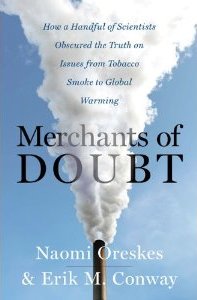
STRANGER THAN FICTION: Merchants of Doubt, by Naomi Oreskes and Erik M. Conway

A true story of organized disinformation that takes on Shakespearean proportions


I have to preface this review by saying that when it comes to American politics, I am non-partisan - Ed.

Written by two science historians, Merchants of Doubt is a deeply unsettling account of the organized campaign against science in order to achieve political or financial gain that has been going on in the United States since the 1960s. It begins with the cigarette industry hiring former Manhattan Project physicists to cast doubt on the then-emerging scientific consensus that smoking causes cancer and other diseases, and the book continues through organized misinformation campaigns waged in favor of the Strategic Defense Initiative (a space-based anti-missile defense system dubbed "Star Wars" in the 1980s), against nuclear winter, acid rain, the hole in the ozone layer, the ban on DDT, and climate change. What all of these campaigns have in common are, a) the same cast of characters, chiefly retired government physicists, b) the same playbook, and c) their stunning effectiveness.

This is, flat-out, the most Orwellian true story I've ever read.

Through extensive (and boy do I mean extensive) research and citations, authors Naomi Oreskes and Erik M. Conway assembled essentially a timeline of scientific knowledge on each of these topics, and then chronicled the well-funded and strategically-orchestrated attempts to cast doubt on that knowledge by using an arsenal that included:
  • a pattern of bypassing the scientific peer-review process by taking spurious (or completely unfounded) scientific claims directly to the mass media
  • exploiting a residual media bias left over from the "Fairness Doctrine" to ensure coverage
  • accusing scientists of "politicizing" their findings (which is what the accusers were, in fact, doing themselves)
  • publicly asking incriminating questions whose answers were known in the scientific community but not by the lay public
  • accusing dissenting voices of being enemies of freedom
  • mounting ad hominem attacks on scientists whose work they could not discredit
The book details how, starting in the Reagan White House and continuing through every Republican administration since, the strategies established to confuse the public about the dangers of smoking have been employed to, increasingly, discredit science itself, and the idea that facts are superior to opinions in general. This was all done in the name of free market economics and making U.S. domestic policy more business friendly (read: de-regulated). If you really pull this thread, it becomes truly terrifying — and illuminating — to think how far the ripples from these stones have extended. Of course US students lag behind those of other developed nations — business interests have spent two generations working to show that science is a leftist, subversive attack on freedom. Of course an increasing number of Americans deny scientific knowledge in favor of religious explanations of natural phenomena — business interests have spent two generations equating scientists with "godless" communists. Of course the American public thinks there is still no scientific consensus on man-made climate change — business interests have spent two generations trying to confuse them.

I realize that this sounds like anti-GOP propaganda or a liberal agenda masquerading as science reporting. But that's kind of the point. That reaction is how we've been, for lack of a better word, programmed. Despite the extensive citations and references, I didn't want to believe that this book's argument was legit, so I did my own brief research before writing this review just to confirm that the reporting behind the book was sound, and it sure seems to be. I even wrote to the authors, and they wrote back. If there is a problem with this book, it is that some of the chapters are so dense with blow-by-blow chronologies of events, reports, review comments, internal memos, meeting minutes and the like that the read does get a little bogged down. But I think that level of minutiae was necessary to protect the book's contents from partisan attacks, as well as simply casual denials. "That can't be true. That strains credulity. No way that happened." But it did. And it's all proven.

Ok, so terrifying-dystopian-nightmare-is-actually-terrifying-reality. That's bad. But that's only one aspect of the book. If you think a little outside the lines — pull the thread a little bit, like I said before — and think about the guys behind these long cons, the story takes on epic, Shakespearean proportions on a human level. What would prompt decorated scientists who spent their entire careers working for the U.S. government to spend their retirement as consultants who actively undermined the very field that they had given their entire professional lives to? Well, money, sure. But I think it goes beyond that, and the authors do, too.

Some of these guys feel like classic villains in that they didn't receive the accolades they felt they deserved from the larger scientific community, so they took their revenge later by discrediting that community. Ok. But for the rest of them, they feel more like tragic heroes. These guys won the Cold War, and they did it with science. More than giving their lives to science, they gave it to Freedom. And once the Cold War was won by these men who were assuredly warriors, what was left to fight? I was reminded of Richard III, who opens his eponymous play saying that while others may enjoy the fruits of a hard-earned peace, he is not shaped for such pleasures, and "since I cannot prove a lover...I am determined to prove a villain." Late in Merchants of Doubt, we see specific examples of how, starting in the 1980s as actual communism loosened its grip on Europe, people began claiming that environmentalists were actually communists in disguise. They brought out the old saw of the "slippery slope," saying that anyone who wanted to regulate anything only did so out of a hidden, communist agenda. So the Cold Warriors went back to work. The sad irony is that their lasting legacy was one of undermining their own life's work.

But in Richard III, we see the comeuppance, the realization by the tragic figure of his own failure, and what it has cost. "My kingdom for a horse" has lived for four hundred years because audiences relish watching a man who has caused so much misery and bloodshed to possess power offer it all away for a horse. In reality, though, there was no comeuppance. These men (those who have now died) went to their graves wealthy, thinking they had fought the good fight. The ones left bleeding, shot full of arrows, were us.

The Math

Objective Quality: 7/10

Bonuses: +1 for the extensive research; +1 for the conclusion, which really puts a human face on what has come before; +2 for being a Really Important Book

Penalties: -1 for being quite tedious in parts; -1 for depressing the shit out of me

Nerd Coefficient: 9/10. This is essential reading.

Published by Vance K — cult film reviewer, occasional book reviewer, and co-editor of nerds of a feather, flock together since 2012.

Monday, April 4, 2016

Microreview [book]: A Canticle for Leibowitz by Walter M. Miller, Jr.

A disheartening look at humanity, and the perfect Cold War zeitgeist book


Published in 1960, A Canticle for Leibowitz is one of the books credited with forcing the mainstream press to begin taking speculative fiction seriously. Upon publication, even if it wasn't reviewed terribly positively, it was at least reviewed in some heavyweight publications that normally wouldn't touch sci-fi with a ten-meter cattle prod. In the five-plus decades since, it has continued to make appearances on prominent lists of the Greatest Sci-Fi Books ever.

To cut to the chase, reading it with fresh eyes today, it's not the pinnacle of the genre. It is, however, an engaging cornerstone of Cold War science fiction.

Over the last year, and for no particular reason apart from random chance, my reading list has included On the Beach by Nevil Shute and The Man Who Fell to Earth by Walter Tevis. I realized in reading A Canticle for Leibowitz, however, that these three books together give a profound, eerie, and usually moving picture of the Cold War-era zeitgeist. Tevis' book is about an alien that comes to Earth in an effort to save his own people, but falls victim to crushing alcoholism due in part to his realization that the planet cannot help but do itself in with its rapidly proliferating nuclear weapons. On the Beach is a haunting, unshakable portrait of the post-war world, where the few Australian survivors of the nuclear wars wait for the fallout clouds to come far enough South to poison and eventually kill them all.

Walter Miller's book begins several hundred years after the wars. Or, "The Flame Deluge," as the book's inhabitants refer to it. After the wars, there were few unaffected humans left, but those that remained rebelled against all knowledge, as too much knowledge had caused their destruction. The cities were all flattened, the books burned, literacy made verboten, and the outlands became dotted with tribes of murderous mutants. Seemingly the only thing that survived the transition from industrialized, nuclear-capable society to the new dark ages was the Catholic church. A Canticle for Leibowitz, like a medieval painting, presents a triptych of tales that cover some 1800 years of future history.

The first story concerns a young novice who stumbles across a fallout shelter that likely belonged to "the blessed Leibowitz." The cosmic joke here is that Leibowitz was probably a low-level electrical technician in Bell Labs or General Electric who probably worked on government contracts (and happened to be Jewish, to boot), but after 600 years he is on the doorstep of beatification. The second story takes place in essentially the second Middle Ages, when mankind has only just rediscovered science, and the monks of the Order of Leibowitz, who have been keeping the sacred documents (basic science texts and blueprints) for 1200 years, unwittingly hold the keys to scientific knowledge that predates The Flame Deluge. The final story, set some 1800 years after the nuclear decimation of the Earth, presents a futuristic setting that finds mankind capable of space travel, but on the verge of another nuclear conflict. History repeating, no less.

As grim as it may be to think that we'd annihilate the entire human race out of hubris and then do it again (...and again...and again...and again...), Miller's reminder is a prescient one. When the United States is currently locked into a presidential race that is echoing the worst rhetoric of the last 100 years of institutionalized mistakes, it is a chilling, and motivating, reminder about where we were as a nation just a half century ago. This is the best of what science fiction does. Through the lens of a fantastic world, it shines a light on our own. Walter Miller's book did that in 1960, and it continues to do it today.

Some of the prose, and some of the insights, are truly eloquent. That said, the book comes across as pretty solidly dated. There are, by my count, three women in the book. One of the things that the efforts of so many writers over the last few generations have shown us is that if we limit our storytelling to one group of people, or one gender, we're necessarily missing part of the story. So when I read the book today, I felt like there were a lot of good ideas that went into the world-building, and that the book presented a lot of philosophically and historically interesting notions, but I keenly felt aware that I was only getting part of the story. As much as I admired the noble intentions of the Brothers of Leibowitz, I found myself wondering often about the sisters outside of the abbey walls, and how they were navigating this post-apocalyptic future. And why did we return to a solid patriarchy? If we burned the books and plans and literacy that nearly wiped us out the first time, why did we not burn the patriarchy? The answer is probably because Walter Miller took it for granted. That's not intended as a knock on him, given the time he was writing and all that, but as a reader I was keenly aware of the fact that I was looking at "history" through the eyes of a bunch of white guys, and that there was a lot more going on in this world that I simply wasn't hearing about because those people's experiences were just out of frame.

On the whole, the book was keenly observed, and a solid, early example of thoughtful world-building, but not as emotionally resonant as the other two books I now consider the Cold War Zeitgeist Trilogy, and by virtue of the things it left out, it simply couldn't be, today, as pointed an examination of the human condition as it seemed evident it was intended to be.

The Math

Bonuses: +1 for managing the hand-off between three different tales in an emotionally continuous way; +1 for being such a precise barometer of the Cold War zeitgeist

Penalties: -1 for feeling dated in the very essence in the story it was telling

Nerd Coefficient: 7/10. It's still pretty good, but don't necessarily defer to every Best Sci-Fi poll you read online.

Posted by Vance K -- cult film reviewer, Cold War aficionado, occasional book reviewer, and co-editor of nerds of a feather, flock together, since 2012.

Reference:
Miller, Walter M. A Canticle for Leibowitz [EOS, 1996 (Reprint)].

Wednesday, September 17, 2014

Microreview [book]: On the Beach by Nevil Shute

On the Beach had been on my bookshelf for years, and I had always looked forward to reading it since the author, Nevil Shute, also penned the novel one of my favorite Jimmy Stewart movies (No Highway in the Sky) was based on. On the Beach was an entirely different experience. On the one hand, it is possibly the most interesting take on the end of the world I've ever read. On the other hand, I kept finding myself questioning the authenticity of the characters' actions and outlooks.

The 1957 novel was written in the early Cold War-era and explores the outcome of mutually assured self-destruction from a profoundly interesting vantage point: Australia. Two years after a nuclear holocaust between Russia, China, the United States, and other, smaller and less-accountable nuclear powers wiped out all of humanity in the Northern Hemisphere in six days, this book begins as the southernmost inhabitants of the planet wait for the global winds to bring the lethal radiation to them. Everyone will die. There is no escape. This is the end of humanity, and there's nothing to do but wait for it. To quote T.S. Eliot, as Shute does, "This is the way the world ends / This is the way the world ends / This is the way the world ends / Not with a bang, but a whimper."

The novel follows Lieutenant Peter Holmes, a newlywed and new father in the Australian Navy, as he is assigned to one of the only two remaining American naval vessels, a submarine that was submerged when the war happened, and surfaced to find it had nowhere to go but Australia. It's no spoiler to say we then read about Peter, his family, and his friends, both on the submarine and on the mainland, living out their – and all of humanity's – last days on Earth. The characters are well-drawn and each is endearingly noble. It's sad to see them go. But the thing that irked me about the novel was how normally everyone acted. There was no looting, no particular lawlessness, and only a couple of people who were even habitually drinking too much. Believe me, if somebody told Americans there were only six months left for all of us, we'd be beyond Thunderdome in no time. Maybe it's the British stuff-upper-lip-and-all-that influence, but almost everyone in the novel just goes about their business, making plans for next year, and generally acting as though the world were normal. I get it, it's a coping mechanism, but I never believed everybody would use the same one.

That said, this novel really got under my skin, so much so that I dreamed one night that I was in the same spot the characters were in, having a goodbye party at my office to say "we'll meet again" to all my coworkers, and all we'd ever known, and life on this planet. It is an unrelentingly bleak book, like the movie Fail-Safe, but a nevertheless moving testament to the bullet we all collectively dodged, and should hope to never encounter again, and all that should be lost if we are not so lucky.

The Math

Baseline Assessment: 6/10

Penalties: -1 for what seems to be a far-too-civilized take on the end of civilization

Bonuses: +1 for fundamentally decent characters who, while far-fetched, are admirably noble; +1 for being a far more human look at the end of the world than most others in the genre; +1 for a slow, but inexorable pace that actually heightens the impact of what's to come

Nerd Coefficient: 8/10. Well worth your time and attention.

Posted by — Vance K, Nerds of a Feather contributor since 2012, and singer-songwriter for the band Sci-Fi Romance, whose debut album cover bears an eerie similarity to the 1960 Signet edition of On the Beach seen above