Showing posts with label stranger than fiction. Show all posts

Monday, April 10, 2023

STRANGER THAN FICTION: River Kings by Cat Jarmon

 Don't meet your heroes


Recent years have seen a resurgence of popular interest in Vikings - those Scandinavian seafarers who, in the early Medieval era, settled Iceland, reached North America and generally made life difficult for everyone from Ireland to Iran. From television (History's Vikings and Vikings: Valhalla series) and film (Valhalla Rising and The Northman) to video games (Assassin's Creed: Valhalla), there is arguably more high-quality, Viking-centric content than at any time since Wagner's day. 

While none of these works are historically accurate, all have moved away from Wagnerian tropes to a more anthropologically accurate portrayal of Viking-era Scandinavians. The horned helmets are, mercifully, gone; in their place, face paint, long hair that is shorn on the side and an growing sense that Scandinavian Paganism was much closer to the animism of indigenous peoples than previously assumed in normative, Eurocentric imaginings.  

But this new generation of Viking media has also dispensed with the tired old takes that framed Vikings either as "savage" agents of destruction or ahistorical avatars for modern Germanic nationalism. In its place, an understanding that Vikings were farmers and traders as well as raiders and conquerers and that they didn't really have much sense of ethnicity in the modern sense (let alone nationalism, which is a social construct of the modern era). 

Another assumption - not only in popular media, but among many scholars as well - is that different Vikings went in different directions: Norwegians and Danes to the West, Swedes to the East. Of the media mentioned above, only The Northman problematizes this assumption - with the story of Amleth starting in Norway, proceeding to the riverine expanses of present-day Russia and Ukraine and ending in Iceland. 

This dovetails with one of the key arguments made in Cat Jarmon's highly engaging historical anthropology, River Kings - that the Viking world was inherently more interconnected than previously assumed. She begins with an archeological puzzle - a carnelian bead, likely made in the Abbasid Caliphate, found in a mass grave in Repton, England. Then, silver dirhams (coins) from the Caliphate - also found nearby, matching larger caches discovered in contemporary Sweden. At the least, these findings suggest trade networks, centered on Swedish markets, that linked West to East. Then we learn that these networks also connected people. 

The people they connected, unfortunately, weren't just Vikings. One of the major findings of recent scholarship (portrayed vividly in The Northman)  is the centrality of the slave trade to Viking commerce. Viking raiders in the East targeted rural Slavs and others for capture and eventual sale to the Khazars, Arabs and Byzantine Greeks. Vikings also kept slaves themselves; these "Thralls" were treated differently and were subject to rules and social norms that don't line up neatly with popular assumptions based on the modern Atlantic or ancient Roman modes of slavery we are most familiar with. Thralls had fewer restrictions on movement, more agency and a higher chance of being freed - but make no mistake: Thralls were still considered property, were valued less highly in the event of their murder and were still, despite some legal protections, at the mercy of their owners. 

One of the primary ways a slave could be freed is through marriage, and Jarmon asserts that this was likely a key goal of Viking slave-taking. She presents DNA evidence comparing matrilineal and patrilineal descent lines in Iceland, which suggest that Iceland's population is primarily descended from Scandinavian fathers and Celtic mothers. We don't know exactly why Viking men sought out Celtic brides, but one logical possibility is that the early voyages were primarily undertaken by men, and perhaps it wasn't easy to convince Norwegian women to relocate in large numbers to the new land. 

(It's also possible that contemporary Scandinavians practiced gendered infanticide - leading to a surfeit of young men and a distorted marriage market. Indeed, this has been suggested as a broader explanation for the Viking age writ large. But there isn't really any evidence for this, either in the written or archeological record.)

Another fascinating observation is that Viking expansion followed a similar pattern in East and West: first they came as traders, then returned as raiders and finally, in the last phase, as settlers/conquerers. There is evidence both in present-day Russia and England of a Scandinavian trading presence prior to the infamous sack of the Lindisfarne monastery in 793 CE, traditionally viewed as the starting point of the Viking age. 

What's more, despite the clear bias in popular media toward the Vikings' Westward expansion, their presence along the Eastern river networks was actually significantly larger and more advanced - reflecting the fact that Byzantium and the Abbasid Caliphate were the wealthiest and most advanced societies west of the Indus. The Eastern routes, at that time, provided the most stable and lucrative source of silver - which in Viking age Scandinavia was used as currency. In fact, the upsurge of Viking activity across Western Europe may have only started in earnest after a domestic supply crisis within the Caliphate disrupted the flow of silver northward. Jarmon is careful not to fully endorse this theory, as evidence for it is pretty scarce - but it's an enticing thought and wholly logical. 

Jarmon also wades into the contentious debate over gender in the Viking world. It had long been assumed that Viking society was highly patriarchal, with men doing the trading, raiding and conquering - while women tended the home. This may, however, reflect the biases of later ages - long after Scandinavia converted to Christianity. Today there is broad agreement that women enjoyed significant rights and privileges in Viking society. But debates have raged over whether Viking women may have also been, well, Vikings. 

The sagas do suggest that women warriors did exist in Viking-age Scandinavia - but that they were comparatively rare in relation to their male counterparts. The sagas, however, were largely written down in the 12th century and are not considered accurate records of history. Archeological evidence, which Jarmon reviews, suggests that women may have taken up arms more frequently than previously assumed - not to the degree men did, but with far more frequency than in the Christian or Muslim societies Vikings frequently interacted with. The evidence - burials with arms - is not conclusive but it is highly suggestive.

To wrap up, River Kings is an excellent work of popular history - bringing the latest in archeological evidence out of scholarly journals and into the public sphere. It doesn't - and can't - answer every outstanding question about the Viking world, but it does a great job bringing it to life. Running through Jarmon's narrative is the argument that Viking expansion was a form of globalization - linking North and South, West and East - that transformed all the places and peoples it touched. Highly recommended. 


Highlights

  • Highly engaging archeological history of the Viking Age
  • Brings cutting edge scholarship into the public sphere
  • Argues successfully for a reimagining of Viking expansion as a form of globalization
  • Brisk writing style - a true page-turner


Nerd Coefficient: 9/10


POSTED BY: The G--purveyor of nerdliness, genre fanatic and Nerds of a Feather founder/administrator, since 2012

Friday, September 9, 2016

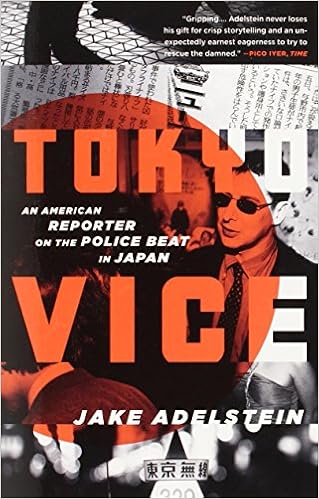
Stranger than Fiction: Tokyo Vice, by Jake Adelstein

If this is really what (being a reporter in) Japan is like, I’d rather be cleaning (or living in) a toilet!

Adelstein, Jake. Tokyo Vice: An American Reporter on the Police Beat in Japan. Vintage Crime: 2010.


People bandy around the phrase ‘stranger than fiction’ a lot (NB: I have no idea if this claim is statistically accurate), but it’s not often that something written and presented as an entirely true story can actually succeed in shocking its readers with its seeming fictionality. Why is that? Because non-fiction writing, like all writing, operates according to narrative conventions, and generally, the things we know belong to the category of non-fiction don’t resemble, in a narrative sense, the things we know are firmly in the category of fiction. Lo and behold, most of the “non-fiction” books that do jolt us with their ‘stranger than fiction’ vibe manage the feat by borrowing liberally from the conventions of whatever genre of fiction writing their true story most closely resembles.

So if someone wishes to write the true story of a mystery or whodunit, consciously or unconsciously (but probably consciously—see below) the would-be author might drift over into the narrative world of mystery (fiction) writing. If done poorly, this raises all sorts of red flags for the reader, because the same markers of fictionality in a straightforward mystery novel are popping up in a supposedly non-fiction story, and that strikes many readers as problematic. If done well, I suppose this narrative drift might simply make the story more of a page-turner. Either way, it’s certainly no surprise authors are tempted to mix literary genres (non-fiction plus a fiction genre or genres), because unless they are in academia, authors want, naturally enough, to sell books, and presumably a non-fiction story that reads like a mystery novel will jump off the shelves a lot faster than a painstakingly factual, dry non-fiction story.

Suppose you had experienced more than most people’s share of interactions with a crime syndicate, and wanted to report those experiences…in the most riveting way possible. Would you:

A)   Limit yourself to a regurgitation of your own notes, in chronological order, of what happened and when, and strive for an objective tone in reporting the events, or
B)    Jazz it up a little, using “caper (fiction) story” narrative tricks to make what happened sound more exciting?

If you chose option (A), congratulations! You’re a career academic, and your books will sell literally dozens of copies. If, however, you chose (B), then you and Jake Adelstein have something in common.

Everything about Tokyo Vice, from its cover and title down to the witty, entertaining first-person narration, feels like a novel. In fact, it’s so novelistic that if someone later comes forward to confess that “Jake Adelstein” was just a literary character s/he invented, and the entire tale was made up, I don’t think I’d be particularly surprised (though I have no reason to believe this or something like it is actually the case, especially since Adelstein managed to publish his work in places like the Washington Post, an impressive feat if imaginary!). In a way, this is a compliment to Adelstein’s writing style, because it really was a page-turner, an in-depth glimpse into the murky world of organized crime—and (at least to me) the even more interesting phenomenon of the inner workings of the police-media love/hate-fest—in Japan over the last two decades.

What about it screams “novel”, then? 1) Bribery, corruption, international conspiracies, the FBI making deals with the Japanese mob in exchange for information, a sort of international black-market organ trade of sorts, at least one dirty cop, a serial killer (possibly more than one depending on whether mob hitmen count!), “hits” on those who get in the yakuza’s way, several physical confrontations from which the intrepid protagonist managed to extricate himself only by violently subduing his attacker, and—it is strongly implied—the revenge killing of one of the protagonist’s closest friends and allies.

All of these elements, however, could have been recounted very dryly and impersonally, but for better or worse (on balance, I think “better”) Adelstein chose a far more engaging approach. First of all, the book isn’t consistently in chronological order, though it certainly moves roughly “in order”, from his early career in Japan up to the end of his Japan-based reportage. Adelstein deserves praise for turning what might have seemed largely rather monotonous work, of relentlessly befriending cops in order to wheedle them into awarding an exclusive to one’s own paper, into a riveting account full of sex, sleaze, drugs, human trafficking, money laundering, and murder. But the question is: did he go too far in sensationalizing the material? If even half of what he’s claiming in his book is indeed true, then the material is plenty sensational all by itself; this reader, at least, wonders whether, say, Adelstein humble-bragging about his “poor” martial arts skills that, nevertheless, proved sufficient to incapacitate a yakuza enforcer/bouncer, etc., really adds substantively to the story he’s telling.

I guess what I’m saying is that the Ivory Tower in me longs for a thicker veneer of objectivity, of dispassionate reporting of “just the facts”, whereas the avid reader in me crows at the deeply personal nature of the tale. Be that as it may, this is a book worth reading, especially for anyone out there who clings to the belief that Japan is utterly safe and pristine. Adelstein’s harrowing account of Kabukicho and its apparently then- (and, perhaps, still today?) rampant human trafficking of non-Japanese women, left me queasy, while the ‘antagonist’ of the book, Tadamasa Goto, would make anyone’s blood boil given the underhanded way he arranged his liver transplant—at UCLA, no less. This much seems clear: Adelstein would probably have a relatively easy time transitioning into writing fictional first-person caper or mystery stories!


Strangeness factor: 7 (on a scale from 1, A.R. Burn’s snooze-worthy History of Greece, to 10, the life story of Roy Sullivan, a guy who shot himself in the head…after being struck by lightning a ridiculous seven times over the course of his life)


This intervention between true stories and fiction was brought to you by Zhaoyun, who loves all tales, whether they’re as genuine and trustworthy as a degree from Trump University or just seem like they’re imaginary, and reviewer on Nerds of a Feather since 2013.  

Tuesday, April 12, 2016

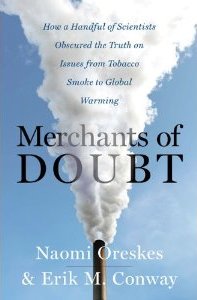
STRANGER THAN FICTION: Merchants of Doubt, by Naomi Oreskes and Erik M. Conway

A true story of organized disinformation that takes on Shakespearean proportions


I have to preface this review by saying that when it comes to American politics, I am non-partisan - Ed.

Written by two science historians, Merchants of Doubt is a deeply unsettling account of the organized campaign against science in order to achieve political or financial gain that has been going on in the United States since the 1960s. It begins with the cigarette industry hiring former Manhattan Project physicists to cast doubt on the then-emerging scientific consensus that smoking causes cancer and other diseases, and the book continues through organized misinformation campaigns waged in favor of the Strategic Defense Initiative (a space-based anti-missile defense system dubbed "Star Wars" in the 1980s), against nuclear winter, acid rain, the hole in the ozone layer, the ban on DDT, and climate change. What all of these campaigns have in common are, a) the same cast of characters, chiefly retired government physicists, b) the same playbook, and c) their stunning effectiveness.

This is, flat-out, the most Orwellian true story I've ever read.

Through extensive (and boy do I mean extensive) research and citations, authors Naomi Oreskes and Erik M. Conway assembled essentially a timeline of scientific knowledge on each of these topics, and then chronicled the well-funded and strategically-orchestrated attempts to cast doubt on that knowledge by using an arsenal that included:
  • a pattern of bypassing the scientific peer-review process by taking spurious (or completely unfounded) scientific claims directly to the mass media
  • exploiting a residual media bias left over from the "Fairness Doctrine" to ensure coverage
  • accusing scientists of "politicizing" their findings (which is what the accusers were, in fact, doing themselves)
  • publicly asking incriminating questions whose answers were known in the scientific community but not by the lay public
  • accusing dissenting voices of being enemies of freedom
  • mounting ad hominem attacks on scientists whose work they could not discredit
The book details how, starting in the Reagan White House and continuing through every Republican administration since, the strategies established to confuse the public about the dangers of smoking have been employed to, increasingly, discredit science itself, and the idea that facts are superior to opinions in general. This was all done in the name of free market economics and making U.S. domestic policy more business friendly (read: de-regulated). If you really pull this thread, it becomes truly terrifying — and illuminating — to think how far the ripples from these stones have extended. Of course US students lag behind those of other developed nations — business interests have spent two generations working to show that science is a leftist, subversive attack on freedom. Of course an increasing number of Americans deny scientific knowledge in favor of religious explanations of natural phenomena — business interests have spent two generations equating scientists with "godless" communists. Of course the American public thinks there is still no scientific consensus on man-made climate change — business interests have spent two generations trying to confuse them.

I realize that this sounds like anti-GOP propaganda or a liberal agenda masquerading as science reporting. But that's kind of the point. That reaction is how we've been, for lack of a better word, programmed. Despite the extensive citations and references, I didn't want to believe that this book's argument was legit, so I did my own brief research before writing this review just to confirm that the reporting behind the book was sound, and it sure seems to be. I even wrote to the authors, and they wrote back. If there is a problem with this book, it is that some of the chapters are so dense with blow-by-blow chronologies of events, reports, review comments, internal memos, meeting minutes and the like that the read does get a little bogged down. But I think that level of minutiae was necessary to protect the book's contents from partisan attacks, as well as simply casual denials. "That can't be true. That strains credulity. No way that happened." But it did. And it's all proven.

Ok, so terrifying-dystopian-nightmare-is-actually-terrifying-reality. That's bad. But that's only one aspect of the book. If you think a little outside the lines — pull the thread a little bit, like I said before — and think about the guys behind these long cons, the story takes on epic, Shakespearean proportions on a human level. What would prompt decorated scientists who spent their entire careers working for the U.S. government to spend their retirement as consultants who actively undermined the very field that they had given their entire professional lives to? Well, money, sure. But I think it goes beyond that, and the authors do, too.

Some of these guys feel like classic villains in that they didn't receive the accolades they felt they deserved from the larger scientific community, so they took their revenge later by discrediting that community. Ok. But for the rest of them, they feel more like tragic heroes. These guys won the Cold War, and they did it with science. More than giving their lives to science, they gave it to Freedom. And once the Cold War was won by these men who were assuredly warriors, what was left to fight? I was reminded of Richard III, who opens his eponymous play saying that while others may enjoy the fruits of a hard-earned peace, he is not shaped for such pleasures, and "since I cannot prove a lover...I am determined to prove a villain." Late in Merchants of Doubt, we see specific examples of how, starting in the 1980s as actual communism loosened its grip on Europe, people began claiming that environmentalists were actually communists in disguise. They brought out the old saw of the "slippery slope," saying that anyone who wanted to regulate anything only did so out of a hidden, communist agenda. So the Cold Warriors went back to work. The sad irony is that their lasting legacy was one of undermining their own life's work.

But in Richard III, we see the comeuppance, the realization by the tragic figure of his own failure, and what it has cost. "My kingdom for a horse" has lived for four hundred years because audiences relish watching a man who has caused so much misery and bloodshed to possess power offer it all away for a horse. In reality, though, there was no comeuppance. These men (those who have now died) went to their graves wealthy, thinking they had fought the good fight. The ones left bleeding, shot full of arrows, were us.

The Math

Objective Quality: 7/10

Bonuses: +1 for the extensive research; +1 for the conclusion, which really puts a human face on what has come before; +2 for being a Really Important Book

Penalties: -1 for being quite tedious in parts; -1 for depressing the shit out of me

Nerd Coefficient: 9/10. This is essential reading.

Published by Vance K — cult film reviewer, occasional book reviewer, and co-editor of nerds of a feather, flock together since 2012.

Wednesday, April 6, 2016

STRANGER THAN FICTION (ish): The Orphan Master's Son, by Adam Johnson

Johnson, Adam. The Orphan Master's Son. Random House: 2012.

Okay, technically this book is fiction, or at least fictionalized. But it’s got a haunting amount of truthiness, all the same. From the accounts of abductions of Japanese by North Korean agents to the exploration of how to survive in a totalitarian regime, it all feels plenty real. So perhaps I should dub it “As Strange As the Truth”, because even though individual characters were invented for this book, and the author writes plenty of speeches for Kim Jong Il despite having no way on earth to verify if the Dear Leader ever actually uttered something like that, those speeches sound all too plausible, and the characters heartrendingly vivid as they suffer.

It’s the best treatment, fictional(ized) or otherwise, of North Korea ever, in my opinion, and also, apparently, in the opinion of the people who were handing out the Pulitzer Prize in 2013. But does it really belong in this series, which is supposed to be devoted to factual, non-fiction writing whose content is so bizarre it reads like fiction? My answer is an emphatic yes, and here’s why.

I don’t know of a single factual account of everyday life in contemporary North Korea, and while any such book would doubtless be stranger, indeed, than fiction, the absence of credible information makes any such reportage nigh impossible. Instead, with so little hard data about what life is actually like day to day in North Korea, fiction is the only option left. But rather than taking the literary low road and focusing on only the upper echelon of decision-makers, Johnson took the opposite tack, filling his account with ordinary characters so realistic their suffering cannot fail but to batter the reader with punishing waves of empathy.

How has Johnson managed this miracle? Everyone knows “those North Koreans” are all brainwashed idiots, blind to the reality of their horrible state, and anyone with such a condescending attitude, when witnessing the plight of the North Koreans, can only experience the ugliest emotion of all: pity. What Johnson does is build empathy for the ordinary North Koreans from the bottom up, so that when we witness Park Jun Do (i.e., John Doe) caught in the merciless horns of an impossible dilemma, we wince, not in patronizing pity, but in genuine commiseration. Johnson has made the reality of totalitarian life visible, and while he certainly doesn’t condone such a system of government, he has managed to humanize its internal victims.

Tim O’Brien wrote once about the proverbial soldier falling on a grenade to save a battalion, and used this unlikely idea to meditate about stories and truth. If all we mean by ‘truth’ is ‘factual accuracy’, then we are forced to admit this sort of story is probably not true; it would be more accurate to say that in most cases, the soldier gets shredded but his sacrifice isn’t enough to save the people around him, and in a few cases the grenade doesn’t explode at all, and so forth. But what if we have a wider definition of ‘truth’—a definition that emphasizes emotional bonds more than factual accuracy? In that case, the soldier who successfully absorbed the explosion of a grenade and thereby saved his fellow soldiers’ lives might be even truer than the more accurate story of his sacrifice having been meaningless.

It is in this sense that The Orphan Master’s Son, I believe, belongs in the Stranger than Fiction camp after all. It’s possible that not a single incident covered by the book happened in quite the way it was described, that many, perhaps all of the details in the book are in some sense inaccurate, but do we really read non-fiction only for ‘facts’? Not at all—we read to quench a thirst for something more than that. There is no meaningful difference, to my mind, between fact and fiction, provided of course that a sort of “O’Brien truth” lies at the heart of the fictional endeavor to tell its readers something true.


That’s what Johnson is doing: showing us one way of understanding the plight of the North Koreans, and empathizing with them. And yet, he’s hardly an apologist for the regime; the book won’t make any readers think any better of North Korea as a place/idea/system of government. If anything, their revulsion for the existence of this horrible place/idea/government is bound to increase a great deal…yet without causing readers to transfer that disgust to the people trapped within the thing called North Korea. In truth, it’s precisely because the reader begins to empathize with those people that the horrors of the regime become intolerable: Johnson has managed to create an emotional connection that supersedes the clinical, rather disinterested and almost knee-jerk judgment of North Korea as a ‘bad place’. Paradoxical, isn’t it? By spelling out in such detail why the place is so bad, Johnson arouses in all of us a strange melancholy, a fellow suffering that cannot end so long as the place remains. It turns out O’Brien was right: we readers rightly prefer, not the version of a story that is most accurate and meticulously, carefully constructed (which rarely moves us), but rather the one in which some glimpse of a deeper truth is possible. Emancipate yourself from the prison of facts, and break through to the truth!

Scientific analysis:
Strange factor: 9/10
Factual factor: 3/10
Awesomeness: 8/10


On behalf of Nerds of a Feather (and fellow-feathered nerds), Zhaoyun has been searching through fact and fiction for truthiness in all its forms, and reporting the results here, since 2013.

Monday, November 23, 2015

STRANGER THAN FICTION: Masters of Doom by David Kushner

The Two Johns in Prose


Growing up, I was an enormous id Software fan. For me, it started with a pirated copy of Wolfenstein 3D on my Packard Bell 386, but Doom 2 was really my jam. I spent countless hours finding and playing user-made levels and modifications. I lived through the split, when John Romero broke from id to form Ion Storm. I anxiously awaited each new game. Even now, hearing a Doom alum worked on something gives me enough reason to take a look at it. I thought Masters of Doom wouldn't contain much I didn't already know, but I was quite wrong.

Masters of Doom: How Two Guys Created an Empire and Transformed Pop Culture primarily follows the two Johns of id Software, John Romero and John Carmack. Though the narrative involves all members of the id team, it starts with the two Johns. Masters of Doom follows their lives from early adulthood, through the formation of id Software, their formal split, and closes shortly after the release of Quake 3: Team Arena. It's primarily focused on the early days of id, Doom, and Doom's impact on the company.

Masters of Doom is a excellent look at the wild days of 90's game development. I'm talking about when a team of less than 10 can make a game that changes the game industry and makes them bazillions of dollars, which is precisely what id did. Even more incredible, they did so without much of a plan beyond "make games" and "have fun". When you consider how video game hits today are made, it's shocking to me that they got as far as they did. Sure, we occasionally get a Minecraft, but most games are done with teams of hundreds.

What is also surprising is how much internal strife occurred along the way. id made big moves, and stepped on a lot of toes along the way. It's arguable that they didn't even properly utilize the resources they had, with people instrumental to their games' development either half-hearedly doing so, or outright unhappy with the games direction. When Romero split from id, it was huge and public because Romero was a huge, public figure in the gaming community, but there were equally important and devastating losses throughout id's history.

If you're not a fan of Doom, or id Software's games, or game development in general, there might not be a lot of reasons to read Masters of Doom. It knows its audience, the 90's PC gamer, and its audience should know something about the time before heading in. However, if you have any interest in those things, Masters of Doom is truly compelling for providing an inside look at one of the most important video game developers of all time.

***

POSTED BY: brian, sci-fi/fantasy/video game dork and contributor since 2014

Reference: Kushner, David. Masters of Doom: How Two Guys Created an Empire and Transformed Pop Culture [Random House, 2003] 

Friday, November 6, 2015

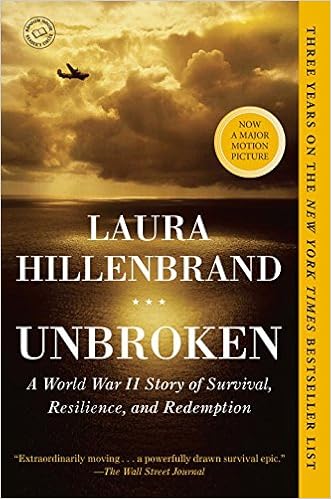
STRANGER THAN FICTION: Unbroken, by Laura Hillenbrand

Hillenbrand, Laura. Unbroken: A World War II Story of Survival, Resilience, and Redemption. Random House: 2010.


Here’s a typical-sounding tagline for a novel (make sure to read it in Movie Trailer Voice): “In a world where evil is ascendant, one man must rise to meet it. He must run faster, fight harder, and cling to life more fiercely than anyone has ever done before. The enemy may find him; they may knock him down, but never out. Through torments unimaginable, he remains…unbroken.”

A story with a blurb like that could be set almost anywhere, from grim fantasy to grim sci fi to grim urban fantasy to just grim. Even when we add details like the hero is a best-in-the-whole-world-level middle distance runner, had to survive on the open sea for like a gazillion days, and was captured by the enemy and then tormented by an almost shockingly evil jerkazoid, it still sounds super fictional. But here’s where things get really crazy: as literally all of you dear readers already know, Unbroken is a freakin’ true story!

Whaaaaat? Yes, that’s right: Louis Zamperini really was an Olympic competitor (and was close to a 4-minute mile!), crashed in his B-24 and, along with two companions (then one), he survived on a life raft for almost nine weeks as he drifted across half the Pacific, was captured by the Japanese and held as a POW for about three years, during which time he was brutally beaten and starved, at times nearly to death. But the best part is, with all that grim, we still get a novel-esque happy ending—he lived into his 90s!


You really have to read this guy’s life story to believe it. I haven’t seen the Angelina Jolie movie, partly because I’ve heard it was only so-so, but I’m glad the movie exists all the same, because unfortunately, we nerds (who read books) are still outnumbered by the vast, faceless hordes who only see the movie versions of things (I’m looking at you, millions of people who still haven’t read LOTR but “liked those Peter Jackson movies”!).  Read a book, you phonies J

This Stranger than Fiction message brought to you by Zhaoyun, who mostly reads and reviews *actual* fiction for Nerds of a Feather, and has done so since 2013.   


Wednesday, October 7, 2015

Announcing...STRANGER THAN FICTION

We here at 'nerds of a feather, flock together' are inveterate tinkerers--part of our commitment to always keepin' it fresh... 


...and in that tradition, we are excited to announce a new review series: STRANGER THAN FICTION!

What's STRANGER THAN FICTION, you ask? The truth, of course! Or, at least, "stuff that happened and was then recorded and/or interpreted for your enlightenment and entertainment."

So yeah--we'll be reviewing nonfiction now. But not just any nonfiction, and not just any kind of review. Rather, we'll be looking at three things:

1. Nonfiction published in a medium we cover (e.g. comics, cult films).

2. Nonfiction about a medium or fictional genre we cover (e.g. books about the history of comics, about the making of cult films, or collections of essays about science fiction and fantasy).

3. Nonfiction that may illuminate, problematize or contextualize how we think about a medium or fictional genre we cover (e.g. books about medieval warfare, astrobiology, police procedures, etc.)

So look out for it, because stuff that happens is often STRANGER THAN FICTION!