Showing posts with label climate science. Show all posts

Tuesday, March 28, 2023

Nanoreview: Nothing but the Rain by Naomi Salman

A painful monologue on the violence of oblivion

In the rainy town of Aloisville, people have been forgetting the recent details of their lives. It began gradually, without anyone noticing, until repeated episodes removed longer and longer portions of their memories and someone finally figured out that the cause was something in the rain. Contact with water in this town makes you forget. Not all at once: a single drop will only take away the last minute or so. But if you're not careful outside, if you're not covered enough or watchful enough, a downpour will erase your identity in full.

Naomi Salman's novella Nothing but the Rain is told as a series of journal entries by an elderly doctor, Laverne, who desperately holds on to what's worth remembering by writing it down, the notebook effectively serving as a substitute for her mental faculties. She has lost count of how long Aloisville has endured the endless shower of forgetting. There are rumors, half-remembered theories, constantly rediscovered facts that never complete the picture of their situation. She knows that the town has been cut off from the world, that there's no phone signal and no internet, that food aid is airdropped every so often, that armed guards prevent anyone from leaving. What caused it? Why there? Why them? If the truth has ever been found, it's lost now. The humidity in the air suffices to make you uncertain of the passage of time, dooming you to a perpetual present.

Nothing but the Rain narrates a brief series of episodes in Laverne's life, centered on her ties to the neighboring families she's built a mutual support network with. Although solitary by nature, Laverne still upholds her medical oath, and thus fulfills her share of responsibility for keeping Aloisville alive. But the successive entries in her journal reveal dangers she's already forgotten, as well as regrets she stubbornly refuses to forget. A society deprived of its history, and therefore of its identity, reverts to the most elemental tasks of survival. Fight or flight, eat or be eaten. There are no certainties. As Laverne puts it, "I found myself wondering if this had happened before. I didn't know everything I'd seen; I didn't remember everything I knew." Life is reduced to the most immediate necessities, because there's no point in settling debts or making plans. Without memory, human dignity is lost too.

This is a book that reads fast and hits hard. I typically have a terrible time with unreliable narrators, but in this novella the explanation for the lack of details and the biased recollection is fully believable. It's not that the narrator has an agenda in her way of telling events, but rather that she can't trust her own side of the story. This way she has no advantage over the reader: she's as disoriented as us. She has nothing to hide; she just has many parts missing. This authorial choice overcomes the automatic mistrust that unreliable narrators produce, and instead sparks an empathy that feels true. We can't get to know Laverne more closely than she's letting us see, but it's not a frustrating experience because that's the limit of how closely she knows herself. The effect is a tone of sincerity that one rarely finds in tales of the apocalypse. Even when she's feeling jaded and pessimistic, it comes from a place of care instead of cynicism. Her use of irony brings the story closer instead of setting a distance.

Laverne confesses to her diary the impossible choices that impossible circumstances can force upon us. The point of the story is not finding the answer to what caused the rain, but exploring what's left of the human spirit when it loses everything that defines it.


Nerd Coefficient: 8/10.

POSTED BY: Arturo Serrano, multiclass Trekkie/Whovian/Moonie/Miraculer, accumulating experience points for still more obsessions.

Reference: Salman, Naomi. Nothing but the Rain [Tor, 2023].

Wednesday, May 25, 2022

Microreview: The Impossible Resurrection of Grief by Octavia Cade

Octavia Cade offers a short but brilliant meditation on humanity's relationship to nature in The Impossible Resurrection of Grief.

Cover art and design by Rachel Lobbenberg.

In the near future, ecosystem collapse is endemic. This has brought with it Grief, a kind of severe depression in humans that leads to madness and, ultimately, suicide. Once it has infected a person, the decline into death is inevitable.

Although Ruby is a marine biologist working in conservation, she has so far managed to escape Grief's grasp. This is in part because her beloved jellyfish are thriving in the warming oceans. Her friend and colleague Marjorie hasn't been so lucky. After Marjorie commits suicide, a bundle of her letters is delivered to Ruby, kicking off a series of encounters with other Grief-stricken individuals.

The Impossible Resurrection of Grief packs in a lot in under a hundred pages. There is, of course, the climate change aspects and humanity's relationship to nature. Grief is the central expression of this: the exhaustion and despair of watching the Earth die around you (especially that element you are particularly attached to -- be it a species of small bird or the Great Barrier Reef) and not being able to do anything about it, seeing only the futility of your efforts. Anyone with a background in ecology or conservation, or with even the smallest interest in the natural world, will find this relatable.

However, Cade is not interested in presenting uncomplicated pictures. Throughout the story, she reminds us of humanity's capacity to compartmentalise. We ignore what doesn't directly affect us -- or even what affects us only indirectly. It allows us to continue on more or less as normal while the world slowly dies around us. Ruby is a prime example of this. On an intellectual level, she understands that things are dire -- which is why she has elected not to have children. She works hard on helping her colleagues obtain vital research grants to support species that are rapidly disappearing. However, on an emotional level she remains unaffected, caught up in the wonder of her jellyfish and a worldview that could be seeing the silver lining or could be toxic positivity.

The concept of Grief also acknowledges the colonialist aspects of ecological disaster. We're told that rates of Grief are higher amongst indigenous and First Nations people, reflecting their deeper ties to land. The story also discusses the near extinction of the Indigenous populations of Tasmania. While it is in many respects deeply problematic to put Indigenous people on the level of animals (a troublesome pattern that continues to crop up particularly in Western SFF), the author is at pains to show how rhetoric of white settlement equated them and used the same tactics to achieve annihilation.

But again, this perspective is not allowed to be uncomplicated; indigenous people are not a monolith. In this case, Ruby's husband George provides a counter example. Of Maori descent, George left behind his homeland in Aoteroa to immigrate to Australia. Like Ruby, George is good at compartmentalising and is untouched by Grief. In fact, he still hopes to have children, which is why he and Ruby are undergoing a very amicable divorce.

The relationship between Ruby and George may strike some as a little underdeveloped, but that seems to me to be a very intentional decision. In fact, many apparent flaws of The Impossible Resurrection of Grief are, on closer inspection, actually features. Ruby and George's relationship is a microcosm of humanity's position in the world: a comfortable habit lacking in deep affection that will have to be let go in order to move on to something truly worthwhile.

The structure of the story is another example. The opening and ending focus on Ruby's relationship with her friend Marjorie, and these bookend three encounters Ruby has with other Grief-afflicted characters. The transitions between these sections can be a little jarring, particularly as Ruby travels from Tasmania to New Zealand. However once again, I feel this is by design. After all, it so aptly reflects the compartmentalisation that is an important central theme of the story.

Criticisms of the story as needing to be longer are patently ridiculous. What more is needed? Certainly not worldbuilding. The world of the story is just a breath away from our own, where crown-of-thorns starfish plague the Great Barrier Reef and species extinction and endangerment are rising rapidly in Australia after a record summer of bushfires.

This is a difficult story to discuss without spoilers, and the ending especially so. Consider this your warning and feel free to skip to the end of the review.

The ambiguity of the ending may not be to everyone's taste, but fits the Little Mermaid motif that runs through the story, stealing away Ruby's voice just as Anderson's Sea Witch does. It also serves to make Ruby's choice our own. Are we going to compartmentalise this as just a story and continue on our usual way? Are we going to succumb to despair? Or are we going to take our grief and anger and forge it into a weapon to fight back for nature?

The writing style was excellent and the uneasy atmosphere it invoked reminded me of Kaaron Warren at her finest. This was particularly the case during Ruby's encounter with Granny, a scientist who has managed to resurrect the extinct thylacine or Tasmanian Tiger. It was also particularly present in Ruby's final encounter with the Sea Witch, as her friend Marjorie has become. It gave a real sense of humans as predators, giving a glimpse into a world where any separation that might have existed between humans and nature has been obliterated, allowing the use of human technology to help nature fight back against humans. The veil is pulled back and we see how these predators have camoflaged themselves, preying on the humans who have ruined the world and setting a trap for Ruby.

I find myself wanting to give this book to everyone but aware that, like Marjorie, I have to pick my targets carefully.

The Impossible Resurrection of Grief is on the shortlist for the Sir Julius Vogel Awards, Aoteora's premier award for speculative fiction -- and where it will go up against Cade's own Scales, Tails and Hagfish in the category of Best Novella/Novelette. While I'm pleased to see it being recognised in the author's home country, it seems an oversight that it hasn't received the same recognition on international stages.


The Math

Baseline Assessment: 8/10

Bonuses: +1 for managing a nuanced perspective of a complicated topic in such a short story

Nerd Coefficient: 9/10


Tuesday, April 12, 2016

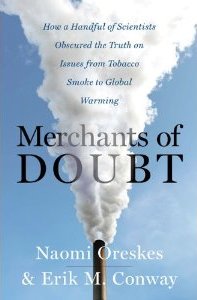
STRANGER THAN FICTION: Merchants of Doubt, by Naomi Oreskes and Erik M. Conway

A true story of organized disinformation that takes on Shakespearean proportions


I have to preface this review by saying that when it comes to American politics, I am non-partisan - Ed.

Written by two science historians, Merchants of Doubt is a deeply unsettling account of the organized campaign against science in order to achieve political or financial gain that has been going on in the United States since the 1960s. It begins with the cigarette industry hiring former Manhattan Project physicists to cast doubt on the then-emerging scientific consensus that smoking causes cancer and other diseases, and the book continues through organized misinformation campaigns waged in favor of the Strategic Defense Initiative (a space-based anti-missile defense system dubbed "Star Wars" in the 1980s), against nuclear winter, acid rain, the hole in the ozone layer, the ban on DDT, and climate change. What all of these campaigns have in common are, a) the same cast of characters, chiefly retired government physicists, b) the same playbook, and c) their stunning effectiveness.

This is, flat-out, the most Orwellian true story I've ever read.

Through extensive (and boy do I mean extensive) research and citations, authors Naomi Oreskes and Erik M. Conway assembled essentially a timeline of scientific knowledge on each of these topics, and then chronicled the well-funded and strategically-orchestrated attempts to cast doubt on that knowledge by using an arsenal that included:
  • a pattern of bypassing the scientific peer-review process by taking spurious (or completely unfounded) scientific claims directly to the mass media
  • exploiting a residual media bias left over from the "Fairness Doctrine" to ensure coverage
  • accusing scientists of "politicizing" their findings (which is what the accusers were, in fact, doing themselves)
  • publicly asking incriminating questions whose answers were known in the scientific community but not by the lay public
  • accusing dissenting voices of being enemies of freedom
  • mounting ad hominem attacks on scientists whose work they could not discredit
The book details how, starting in the Reagan White House and continuing through every Republican administration since, the strategies established to confuse the public about the dangers of smoking have been employed to, increasingly, discredit science itself, and the idea that facts are superior to opinions in general. This was all done in the name of free market economics and making U.S. domestic policy more business friendly (read: de-regulated). If you really pull this thread, it becomes truly terrifying — and illuminating — to think how far the ripples from these stones have extended. Of course US students lag behind those of other developed nations — business interests have spent two generations working to show that science is a leftist, subversive attack on freedom. Of course an increasing number of Americans deny scientific knowledge in favor of religious explanations of natural phenomena — business interests have spent two generations equating scientists with "godless" communists. Of course the American public thinks there is still no scientific consensus on man-made climate change — business interests have spent two generations trying to confuse them.

I realize that this sounds like anti-GOP propaganda or a liberal agenda masquerading as science reporting. But that's kind of the point. That reaction is how we've been, for lack of a better word, programmed. Despite the extensive citations and references, I didn't want to believe that this book's argument was legit, so I did my own brief research before writing this review just to confirm that the reporting behind the book was sound, and it sure seems to be. I even wrote to the authors, and they wrote back. If there is a problem with this book, it is that some of the chapters are so dense with blow-by-blow chronologies of events, reports, review comments, internal memos, meeting minutes and the like that the read does get a little bogged down. But I think that level of minutiae was necessary to protect the book's contents from partisan attacks, as well as simply casual denials. "That can't be true. That strains credulity. No way that happened." But it did. And it's all proven.

Ok, so terrifying-dystopian-nightmare-is-actually-terrifying-reality. That's bad. But that's only one aspect of the book. If you think a little outside the lines — pull the thread a little bit, like I said before — and think about the guys behind these long cons, the story takes on epic, Shakespearean proportions on a human level. What would prompt decorated scientists who spent their entire careers working for the U.S. government to spend their retirement as consultants who actively undermined the very field that they had given their entire professional lives to? Well, money, sure. But I think it goes beyond that, and the authors do, too.

Some of these guys feel like classic villains in that they didn't receive the accolades they felt they deserved from the larger scientific community, so they took their revenge later by discrediting that community. Ok. But for the rest of them, they feel more like tragic heroes. These guys won the Cold War, and they did it with science. More than giving their lives to science, they gave it to Freedom. And once the Cold War was won by these men who were assuredly warriors, what was left to fight? I was reminded of Richard III, who opens his eponymous play saying that while others may enjoy the fruits of a hard-earned peace, he is not shaped for such pleasures, and "since I cannot prove a lover...I am determined to prove a villain." Late in Merchants of Doubt, we see specific examples of how, starting in the 1980s as actual communism loosened its grip on Europe, people began claiming that environmentalists were actually communists in disguise. They brought out the old saw of the "slippery slope," saying that anyone who wanted to regulate anything only did so out of a hidden, communist agenda. So the Cold Warriors went back to work. The sad irony is that their lasting legacy was one of undermining their own life's work.

But in Richard III, we see the comeuppance, the realization by the tragic figure of his own failure, and what it has cost. "My kingdom for a horse" has lived for four hundred years because audiences relish watching a man who has caused so much misery and bloodshed to possess power offer it all away for a horse. In reality, though, there was no comeuppance. These men (those who have now died) went to their graves wealthy, thinking they had fought the good fight. The ones left bleeding, shot full of arrows, were us.

The Math

Objective Quality: 7/10

Bonuses: +1 for the extensive research; +1 for the conclusion, which really puts a human face on what has come before; +2 for being a Really Important Book

Penalties: -1 for being quite tedious in parts; -1 for depressing the shit out of me

Nerd Coefficient: 9/10. This is essential reading.

Published by Vance K — cult film reviewer, occasional book reviewer, and co-editor of nerds of a feather, flock together since 2012.