Showing posts with label LGBTQIA fiction. Show all posts

Friday, December 20, 2024

Let's hear it for The People's Joker

This is the rude shakeup that today's pathologically risk-averse studios need

It's often been said that superhero comics are this generation's mythology, to which it's often been replied that classical mythology wasn't constrained by copyright law and didn't have to obey corporate mandates. To fulfill the cultural function of myths, superhero comics would have to be freely usable by anyone. That's the approach that comedian Vera Drew has followed with the building blocks of the Batman mythos: to borrow a well-worn phrase, she's seized the means of narration, making them her own, resignifying them as milestones in her personal coming-of-age story and creating the first interesting live-action portrayal of the Joker since 2008.

Take note, Zaslav. You might learn something.

Drew's artistically and legally adventurous exploration of her life's journey, The People's Joker, is a nonstop riot of queer joy transmuted into queer pride sublimated into queer wrath. Via multiple formats (cartoon animation, action figures, glitch art, superposition of live actors onto handdrawn backgrounds, the occasional callback to actual DC movies), The People's Joker breathes new life into the plot of 2019's insufferably pretentious Joker movie.

In this version of Gotham City, Batman is a closeted child predator, the Daily Planet is a far-right conspiracist podcast, Arkham Asylum provides conversion therapy, and the deadly laughing gas that has for decades been the Joker's signature weapon is a common medication prescribed to suppress bad feelings. Our protagonist, an aspiring comedian who moves to Gotham City to escape her transphobic and outrageously narcissistic mother, founds a clandestine "anti-comedy" club with fellow members of Batman's rogue gallery to oppose the city's violent monopoly on comedy. While she strives to bring the power of laughter back to the people, she also has to navigate toxic romance, the surveillance state, institutional discrimination, overmedicalization, transgenerational trauma, and her own issues with self-acceptance.

It's hard to do justice to the explosion of art styles with which this movie is put together. Outdoor and action scenes feature material from dozens of artists, each with their unique take on character design, palette, and degree of detail. Yet somehow the incompatible parts build a harmonious pastiche where any search for uniformity matters less than playfulness, experimentation, and sincerity. Underneath the neverending mockery of Batman lore, a very personal truth can be perceived. This isn't the type of art that results from executive producers trimming the rough edges off a piece of soulless cashgrab. This is a scream from the depths of a generous heart that has been wounded and betrayed but still holds on to the promise of human goodness that can be found in comic book tales. Where official DC productions such as Aquaman 2 or Shazam 2 or Flash 1 flailed about in futile search of something genuine to say, The People's Joker lolsobs openly, with a vulnerable earnestness that authorized house style would never risk. Sure, there are tons of irony here, but the movie never wields it as a cushion against its own feelings.

The People's Joker looks at societal cruelty in the eyes and responds by baring its soul, making the incisive statements 2019's Joker wishes it had the audacity to attempt. Joker's facile edginess is left looking like the juvenile posturing it truly is next to Drew's carefree irreverence and raw intensity. In a year that has already given us pleasant surprises from independent queer SFF filmmakers, The People's Joker takes a wry look at a corporate media ecosystem saturated by too much content carrying too little meaning, and loudly, fearlessly, effortlessly gets the last laugh.


Nerd Coefficient: 9/10.

POSTED BY: Arturo Serrano, multiclass Trekkie/Whovian/Moonie/Miraculer, accumulating experience points for still more obsessions.

Wednesday, January 11, 2023

Microreview [book]: Wolfpack by Rem Wigmore

 Wolfpack is a spiky solarpunk that wrestles with questions of leadership and belonging.

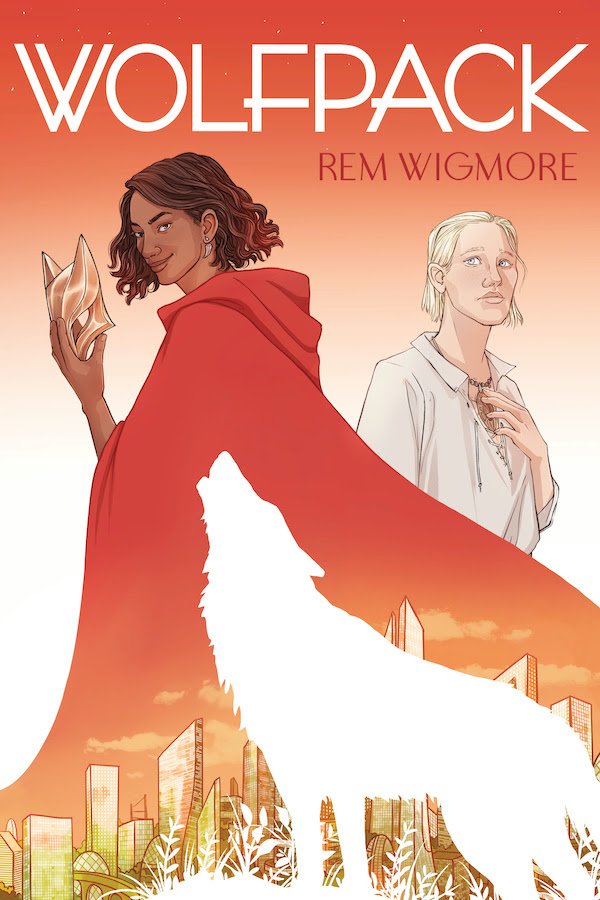
Cover by Layla Rose Mutton-Rogers

Wolfpack is the second book in the Foxhunt series, so spoilers ahoy! Also, please be aware that this review (and the book being reviewed) contains passing references to suicide. While this series has many traits of solarpunk in its worldbuilding and its focus is on healing, the inclusion of material relating to trauma, violence, mental health and disaster (both natural and manmade) makes it a little spikier than other examples of the subgenre.

For those new to the series, it is set in a version of our world in which humanity has managed to step back from the brink of ecological disaster. It has done so by instituting some strict rules about the reasonable use of resources and enshrining the laws of hospitality. When someone breaks those laws, the Order of the Vengeful Wild is called. While the Order's mission may be noble, they have a well-earned reputation for bloodshed and violence.

The story picks up two months after the previous book. The previous Leader of the Order, Luga, committed suicide in a way that framed Orfeus, making her Leader. Orfeus went along with it because it put her in a position to implement changes to the Order, such as a no-kill policy.

Her relationship with Faolan remains uneasy. He's still very much in love with her, but resents her for having killed his surrogate father figure. He also feels the changes she has implemented come from weakness. While the story is mostly focused on Orfeus, one thread shows Faolan coming to terms with the fact Luga was not a good father to her and had no intention of handing over leadership to her. She also wrestles with the nature of leadership: can it be done without the self-destructive sacrifice Luga believed was necessary? Can it instead be done like a pack, a family?

As a side note, if the pronouns in the previous paragraph just did your head in, an important element of this series is its representation of gender. Faolan's pronouns tend to alternate between he and she. There are also a variety of other pronouns used throughout the story. A number of the characters are transgender, including Orfeus. And if there's a straight, cis-gender character anywhere in the book, I must have overlooked them. (As a straight, cis-gender woman, I'm fine with that).

The Order has undergone some membership turnover since the previous book. One or two members left, unwilling to tolerate Orfeus' leadership. A new member was also gained and is finding eir feet with Orfeus' support. The relationship that develops between Velvet Worm and Orfeus is rather sweet and a good counterpoint to some of Orfeus' other relationships.

Speaking of which, Orfeus too has finally found a place she belongs, though she is slow to realise that. Being used to thinking of herself as an outsider makes it difficult for her, as does the baggage that comes with some of her relationships, particularly Faol and Tai. She is quick to protect others, but can get prickly around them wanting to protect her.

There's a lot in this story about belonging. Another thread of this book focuses on Jean, a runaway from a cult. Jean's path soon crosses with Arcon, an AI programmed to protect a DNA bank Orfeus damaged in one of her ill-conceived adventures. Jean's upbringing with the Truest Church of the Most Ancient God (which is most definitely Christian inspired) leads him to conceive of Arcon as an angel, so when Arcon asks for the use of Jean's body (being damaged and needing somewhere to store his nanites), Jean agrees.  Jean has been looked down on by the cult he grew up in and Arcon has been lonely without company for decades, perhaps gone a little mad and suffering from errors in his programming. They don't always see eye-to-eye, but they do find belonging together.

But going back to Orfeus' ill-conceived adventures, I found the story a little frustrating in places because it is one of those stories where the characters just need to sit down and have an honest conversation. Orfeus is aware of this need, but works to avoid it, instead opting for grand gestures which tend to leave destruction in her wake (sometimes physically, sometimes emotionally). Her tendency towards keeping her intentions hidden and actively lying about them damages her relationships. While the honest conversations do happen eventually, it's still pretty annoying, especially since I'm not sure Orfeus really learns from her mistakes. I certainly appreciate a flawed character, but there needs to be a sense that they can learn and grow; Orfeus' tendency to make the same or similar mistakes makes it difficult to trust she has changed.

Although Wolfpack makes a reasonable entry point for the series, with the history behind ongoing relationships being either explained or easily inferred, I'd recommend starting the series from the beginning. Returning readers will enjoy cameos from characters from the previous book, such as Orfeus' neighbour Linden and Rivasoa, the Archivist of Eldergrove.

The book offers a reasonably satisfying conclusion while leaving the way wide open for more. There's a looming threat left as a loose end and while some of Orfeus' relationships are left in a good place, others are in need of repair.


The Math

Baseline Assessment: 6/10

Bonuses: +1 for the sheer diversity of queer representation, +1 for mature handling of themes of family and belonging

Penalties -1 for Orfeus' dubious personal growth

Nerd Coefficient: 7/10


POSTED BY: Elizabeth Fitzgerald, a writer, binge reader, tabletop gamer & tea addict. @elizabeth_fitz@ wandering.shop


References

Wolfpack. Wigmore, Rem (Queen of Swords Press, 2023)

Thursday, June 9, 2022

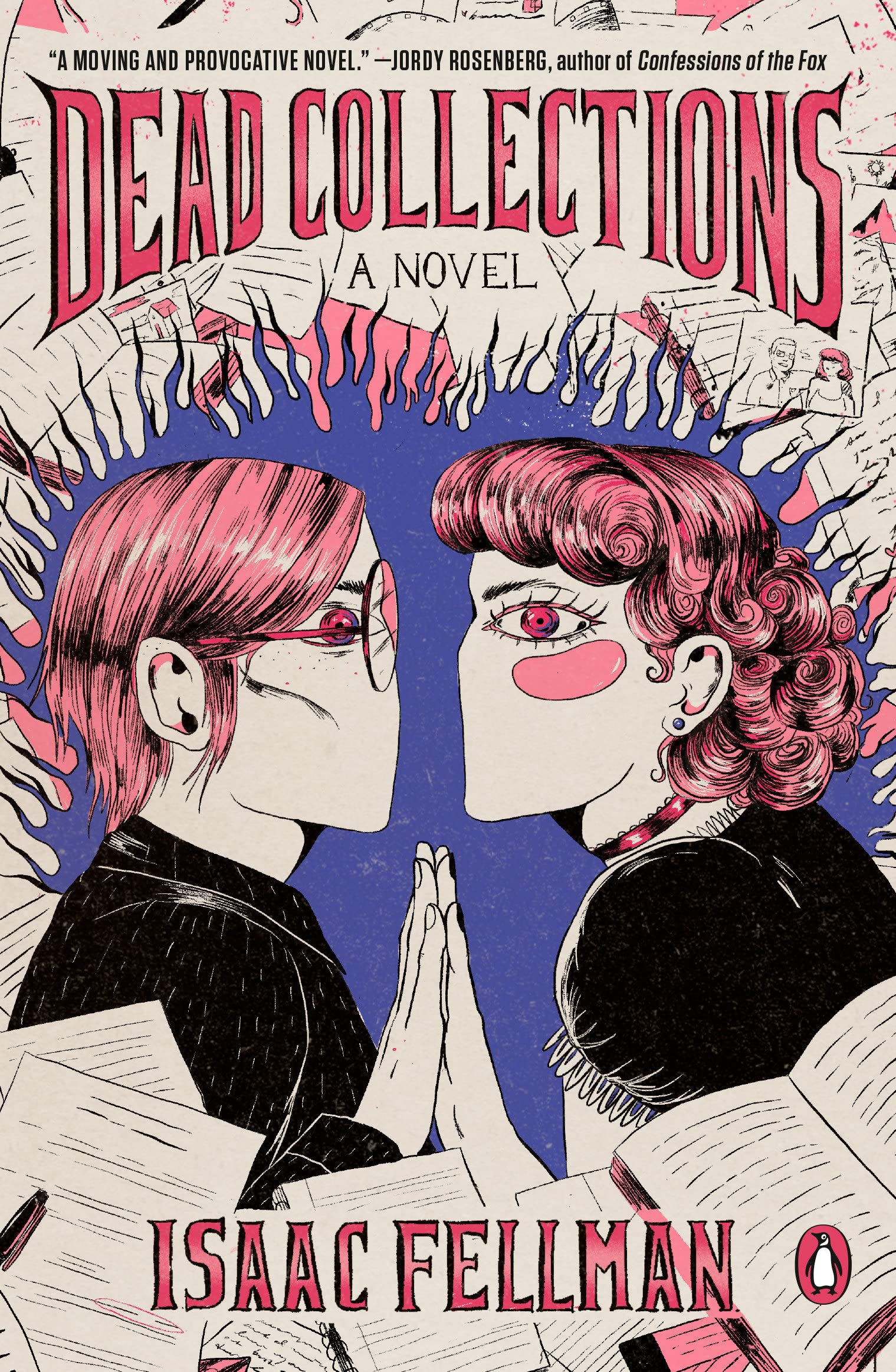
Microreview [Book]: Dead Collections by Isaac Fellman

Dead Collections offers a unique spin on vampires that just seems so right: of course a vampire would live in the archives!

An illustrated cover in pink, white, and blue. Papers, books, and other ephemera surround the two characters, a man and woman pressing their hand together, leaning in as if about to kiss.

Note: This novel deals with the struggles of the LGBTQIA+ community while also being an entertaining vampire romance. Some content warnings I would include: transphobia, transphobic violence, abusive work spaces, emotionally-manipulative relationship, “outing” of personal details. 

Dead Collections by Isaac Fellman follows Sol, an archivist who suffers from a vampirism disease after he “died” of a tetanus mishap contracted in the archives. While all vampire novels are always a little different in what lore they follow, Fellman’s vampires are deathly averse to sunlight. While Sol can drink human blood, it’s a crime, so he receives his needed transfusions at a clinic. As it turns out, being an archivist is a perfect job for a vampire: no sunlight. While Sol was a great archivist before he became a vampire, he now relies on his work to keep him safe since there are so few jobs he could perform as a vampire. Rather than immortality, vampires in Fellman’s world rarely live past three years because of how inhospitable the US is. 

Isaac Fellman, also a trans archivist, brings a depth of knowledge to the archival process that added a level of fun to the text, particularly as an artifact. For instance, in a great rumination on the archive, Sol writes: “My body is an archive. This is not a new idea […] but I always think that people who aren’t archivists miss the ways that archives are quite specifically vampiric” (176). Such moments shine in the book. Like his archivist character, Fellman curates what documents the reader sees as Sol attempts to archive the boxes of Tracy “Trace” Britton’s written work. Secrets are revealed about Britton’s life, but Sol also reminisces on his love of a 1990s TV show called Feet of Clay, on which Britton was a showrunner. 

The novel begins with Britton’s wife Elsie bringing in the boxes, still very much grieving and dealing with Britton’s death. Sol is quickly attracted to Elsie, and the feeling is mutual. Their love blooms, but the remnants of Britton’s life, which both of them are entangled in—Elsie through relationships and Sol through fandom—still haunt them and must be put to rest, or the entire archive could be in peril.

In some ways, the vampirism is the least interesting thing about this novel. It forces some of the social issues, such as Sol not having safe living accommodations. The vampirism also provides a figurative space to discuss issues of trans identity and transphobia, such as the fact that Sol’s transition isn’t continuing the way Sol wishes due to vampirism essentially freezing his body in time. Where the novel shines is less in the vampire lore and more in the archives.

The book itself becomes an archive as Sol narrates his story, but some of that narration is created through archived digital documents, such as e-mails and texts, but also through created documents, such as a series of scripts recounting some of Sol’s experiences in the office. Additionally, some of Britton’s work is collected in the book, such as excerpts from the novel she was attempting to write in the Feet of Clay universe, which was supposed to provide a more satisfying ending for a TV show that was cancelled to soon (I’m sure most of us have felt that gut-wrenching emotion). 

On top of all these archival moments, fandom plays an important role throughout the story as Sol comes to Britton’s archive as a fan. Additionally, Elsie is also involved in archiving as a board member for the Organization for Transformative Works, which runs the very real Archive of Our Own (Ao3). Analogous to the vampire, fandom and fanfiction has created an important space for exploration in the queer community (which is not to say that fanfiction has not also done harm). 

By archiving Britton’s work, Sol reckons with his love of Feet of Clay but also his interest in the show’s creator. As formative to his identity, returning to Sol’s fandom era is a unique way to learn more about his character. The rumination on fandom between Elsie and Sol captures a nostalgia and comfort that favorite, formative narratives can create.

Ultimately, this novel is a queer romance with a happy ending, made all the more interesting through the importance of the archive and fandom. While the vampirism didn’t always seem tightly woven into the story, Isaac Fellman is right: an archive is a perfect space for a vampire.   

_________

The Math

Baseline Assessment: 6/10 

Bonuses: +2 for the archival setting and the meditation on fandom as formative

Penalties: -1 for an interesting take on the vampire, but not so tightly woven into the story

Nerd Coefficient: 7/10: an enjoyable experience, but not without its flaws

Reference:  Isaac Fellman, Dead Collections [Penguin, 2022]

Posted by: Phoebe Wagner (she/her) is an author, editor, and academic writing and living at the intersection of speculative fiction and ecology. She tweets as @pheebs_w.

Wednesday, May 18, 2022

Microreview [Book]: Lakelore by Anna-Marie McLemore

A lyrical, magical realist story about accepting the difficult parts and learning to love yourself.

two young people emerge from a lake with hills in the background. Butterflies flutter around their faces.


Lakelore by Anna-Marie McLemore focuses on what’s above and below not only the surface of the titular lake, but also the two point-of-view characters, Bastián and Lore. In this magical-realist, young adult novel, Bastián, Lore, and the lake all have trouble fitting into society’s designated roles. Bastián and Lore are both neurodivergent, trans, and Latinx, so they are often made uncomfortable by those around them and struggle with what to do with these feelings. When they meet, they find kindred spirits in each other and work to understand the other’s unique way of experiencing the, often magical, world. Bastián and Lore find solace in each other, even though that means developing a certain level of trust they don’t share with many. Over the course of the novel, their attraction turns to love in a slow, touching way that reminded me of Aristotle and Dante Discover the Secrets of the Universe by Benjamin Alire Sáenz. But their friendship and burgeoning love is threatened by their secrets and the pain stored beneath the lake.

As suggested by the focus on the world under the lake, much of the novel centers the interiority of the characters, demonstrating how Bastián and Lore understand themselves and their places in the world. While not a coming out story—both characters are very established in their trans identities—Bastián and Lore are figuring out when their bodies feel true, such as Bastián taking testosterone and Lore fluidly changing whether they present more masculine or feminine. While these moments are sometimes painful, such as remembering when they’ve been misgendered or scenes of bullying that could be triggering for some readers, there’s also a lot of joy in being accepted, particularly between Bastián and Lore, such as a delightful passage where they talk about making a “gender forecast” for each other. Bastián describes the day’s gender as “a perfectly folded T-shirt,” which feels absolutely accurate for them that day. As Lore says, “Sometimes you can’t separate the hard things from the good things” (213).

Similarly, McLemore doesn’t shy away from describing Bastián’s life with ADHD and Lore’s dyslexia impacting their schooling. According to the author’s note at the back of the book, this is an own voices story as the author is writing from their lived experience being neurodivergent (with both ADHD and dyslexia), nonbinary, and Mexican American. In the novel, the ADHD and dyslexia feel integral to how the characters experience the world rather than simply being tropes or tags. Through the novel’s alternating POV structure, McLemore shows how Bastián and Lore each adapt, spending time describing how each character feels inside their head. While developing their friendship, Bastián and Lore describe how their brains work to each other, which creates a greater depth of understanding, regardless of whether the reader experiences ADHD or dyslexia or not. 

A highlight of this book is certainly the lyrical prose. While the description can be skimpy at times, McLemore focuses their writing prowess on the lake and its magical moments. For instance, one of my favorite moments occurs after Bastián gives Lore a glitter jar. The lake’s underworld spills its shores and imitates the colorful curves created by the glitter, as McLemore writes: “High above us, [the bubbles] break like they’re reaching the surface, the glitter spreading out and sticking there in constellations of cotton-candy pink and deep green, pale blue and copper” (177). Such lyrical passages provide a balance to the passages of interiority. 

While the novel accomplishes the goal of capturing the characters’ successes and struggles, the structure of the novel made it harder to sink into a single character. Alternating between Bastián and Lore as point-of-view characters often feels unnecessary because the characters are together and experiencing the same things. Where the POV switching is effective is when they are having separate experiences that speak to their own identities, pasts, or passions. For instance, the scenes where Lore meets with an education specialist about their dyslexia or the scenes where Bastián is creating alebrijes (sculptures of mythical beasts made from papier mâché). In contrast, switching POV when Bastián and Lore are having similar experiences with the lake or are in the same location feels jumpy and scattered. Additionally, the chapters are usually the length of a single scene, and sometimes that scene is less than a page. Especially in the beginning of the novel, I struggled to engage with both characters because of the constant switching after only a page or two, even when the characters would be together in the next scene, thus making me question why we’d switched POV to begin with. 

The short chapters and switching POV between the characters could help keep a young reader hooked in what is, in many ways, a slow, character-driven story. Rather, I found the structure works against this issue because it doesn’t allow the characters to really develop until much later in the book. Because this novel is more character-driven than plot-driven (what’s happening with the lake is not so much dangerous as spooky and beautiful), hooking the reader with these thoughtful, brave narrators is necessary.

All that being said, a voracious young reader would probably blow right past that opening, and for a young person who identifies with Bastián and Lore, the passages that detail their experiences with adapting to a system that their brains work against, their identities, their passions for art, could help a reader feel seen an understood, which is what the best young adult literature accomplishes.  
_________

The Math

Baseline Assessment: 6/10 

Bonuses: +2 for lyrical prose that can describe an alebrijes-filled lake and living with ADHD and dyslexia.

Penalties: -1 for a novel structure that felt jumpy and undermined getting to know the characters

Nerd Coefficient: 7/10: an enjoyable experience, but not without its flaws

Reference:  Anna-Marie McLemore, Lakelore [Feiwel and Friends, 2022]

Posted by: Phoebe Wagner is an author, editor, and academic writing and living at the intersection of speculative fiction and ecology. She tweets as @pheebs_w.

Wednesday, April 20, 2022

Book review: Sanctuary by Andi C. Buchanan

 Sanctuary centres diversity through a found family ghost story.


Autumn is arriving in the southern hemisphere and the season wouldn't be complete without a good ghost story.

Casswell Park is a sanctuary to many, including the queer, the neurodivergent and the non-corporeal. Morgan and their housemates have made a home for themselves in the dilapidated manor, a place that might be impossible to heat but affords a privacy and understanding that most of them have not experienced elsewhere. Even the ghosts (mostly) respect personal boundaries and live in harmony with the other occupants. That balance begins to tip out of control when the house receives an old collection of ghosts trapped in bottles... along with something far more malevolent.

In my previous review, I complained that the diversity in The Aurora Cycle by Amie Kaufman and Jay Kristoff remained very much at surface level. Sanctuary by Andi C. Buchanan serves as a brilliant contrast, centring diversity throughout the story.

It is told in first person from the perspective of Morgan, a non-binary person with autism, social anxiety and some minor psychic abilities. Speaking can be difficult for them and throughout the book they change up the way they communicate -- switching between talking, typing and sign language -- sometimes within the same conversation. The first person perspective lets the reader get a sense of how their capacity fluctuates and changes, depending on the circumstances.

Morgan has quite a few housemates, all of whom are marginalised in multiple ways. All of them are neurodiverse in some way and most of them are queer. All along, the story shows their struggle to get by: the difficulty in holding what's considered a regular job or even to make enough money to survive. It also shows the accommodations that aren't a struggle, but simply necessity: things like the need for quiet or privacy, the understanding that the use of fidget toys isn't a sign of inattention, or that eye contact can be hard. These character also encompass a range of ages, which I found immensely refreshing.

If this sounds like it has found-family feelings, you'd be right. The book opens with a communal dinner to celebrate the last day of the holidays before the two youngest housemates return to school. Its focus on how the characters live and interact give it a cosy, slice-of-life vibe, at least in the beginning. This makes the pace naturally a bit slower than many readers may be used to. While I mostly enjoyed it, things did start feeling a bit slow towards the middle and the finale involved a battle sequence that dragged out a bit. That said, I appreciate seeing what that fight cost everyone, how it impacted them as people with disabilities, chronic illnesses and neurodiversity.

This focus on diverse characters is part of a theme of treating people with respect. Morgan and their housemates make a point of treating the ghosts as people rather than objects. Morgan's own difficulties with communication makes them well placed to understand that the ghosts' difficulties expressing themselves in a way that the living recognise doesn't make them somehow lesser; even if the ghosts don't seem to understand, it's not right to assume that's the case. The housemates do their best to communicate clearly with the ghosts, offering them choice and consent wherever possible.

Place is important to the ghosts in this book. While it seems they aren't necessarily tied to the place of their death, they do need a place to anchor themselves to. This is perhaps a little ironic, since I considered place a weakness of the book. The majority of work I've read from the author has been set in New Zealand. But while the seasonal references make it clear early on that the story's location was in the northern hemisphere, it took me a little while to work out that it was set in Britain. A reference to a ghost from the Civil War (I assumed US) threw me off and it wasn't until the characters started talking about pence and pounds that I finally figured it out. Beyond Cresswell Park itself, very little description is given of the landscape, nor does wildlife appear to ground things (though Morgan's kitten Mallard was a delight).

The plot also felt a bit underdeveloped in a few places. A necklace serves as a McGuffin, its One-Ring-like influence seeming to fluctuate as necessary for the story along with Morgan's psychic abilities. While all the pieces of the explanation are there for the most part, they felt flimsy.

Chapters of the story are also interspersed with the occasional interlude, mostly from the ghost Isobel's life centuries in the past. These interludes serve to explain some of what is going on in the present day. However, Isobel herself, while present, doesn't have much of a role to play in the current time. There are occasional glimpses of her on the fringe of things, which felt unsatisfying, given the vibrancy of the living characters and their relationships.

While I found the vibe of the story generally pretty cosy, it's not all sunshine and roses. The second half of the book introduces more spookiness, There's some unpleasantness that happens to a number of the ghosts and there's also a suicide attempt that takes place offscreen, but whose immediate aftermath is dealt with.

But on the whole, I very much enjoyed Sanctuary and am keen to see more stories like it. Given it's one of the first books out from Robot Dinosaur Press, a collective of queer SFF authors from around the world, I have high hopes this wish might be fulfilled.


The Math

Baseline Assessment: 7/10

Bonuses: +2 for a diverse cast with depth

Penalties:  -1 for pacing issues, -1 for weak setting 

Nerd Co-efficient: 7/10


POSTED BY: Elizabeth Fitzgerald, a writer, binge reader, tabletop gamer & tea addict. @elizabeth_fitz

References

Buchanan, Andi C. Sanctuary [Robot Dinosaur Press, 2022]

Monday, October 8, 2018

Microreview [Book]: The Phoenix Empress by K. Arsenault Rivera

Their Bright Ascendancy continues with a slower volume that focuses on its queer women protagonists to the near-exclusion of everything else.


I've been looking forward to The Phoenix Empress, second in the "Their Bright Ascendancy" series by K. Arsenault Rivera, for a while: as a sequel to The Tiger's Daughter, a book that I very much enjoyed despite its flaws, I was intrigued to see where the author would take both the plot and the form of this queer romance-heavy fantasy trilogy. Structurally, The Tiger's Daughter is an odd book, told mostly in the form of a second-person letter from Qorin warrior Barsalai Shefali to her wife, Hokkaran O-Shizuka (better known by the time the letter is written as Empress Yui). Shefali effectively retells the story of her childhood with Shizuka, moving between the steppes on which the Qorin people live and the royal Hokkaran palaces, their cross-cultural friendship enabled by the close relationship their own mothers had at the time of their birth. Shefali and Shizuka fall in love in a society where same-sex relationships are more or less taboo, particularly in Hokkaran culture, and their battles include the fight for acceptance as well as some actual battles with a plague of black-blooded contagious zombies from north of Hokkaro. Spoilers for The Tiger's Daughter will follow, so if you're not caught up, and you want to try a slow-burning epic fantasy with a same-sex relationship between women at its heart, this is the book for you.

The Phoenix Empress pick up almost exactly where its predecessor leaves off, and while the "present" takes up more of the narrative in this volume, there's still a substantial story-within-a-story as Shizuka fills Shefali in on the events that led to her becoming empress, not to mention developing an alcohol addiction and a severe phobia of water. Shefali has returned from her own travels even more changed, following events in that have led to her being contaminated by black blood but not succumbing to the usual progress of the illness, and now expects to die on her next birthday in four months' time. A great deal of the book is therefore based on learning each others' secrets and renewing their relationship, as well as working out what the wider implications of Shefali's return are for the future of Hokkaro and the black- blood plague.

I suspect that the unusual structure of these novels is playing an important trope-subverting role as well as being a narrative choice. It allows Rivera to incorporate a long, traumatic separation into Shizuka and Shefali's story without turning the relationship itself into a tragedy, particularly during the ending of The Tiger's Daughter (Shefali's letter ends with the separation of the two lovers; the plot of the frame narrative, eight years later, with their being reunited). By averting a "bury your gays" moment, Rivera definitely wins my trust as a reader on one level, but it does also change my relationship to the tensions in the novel. Despite Shizuka's trauma and Shefali's impending doom, part of me is convinced from a meta-narrative sense that we are reading a story where the pair will triumph in the end, and all that matters is how. Unfortunately, there's not much in The Phoenix Empress that really invests me in that question, and I suspect this is largely due to the happy couple themselves.

Shizuka and Shefali are entirely consumed by each other, and while in The Tiger's Daughter that made for an interesting romance plot, by The Phoenix Empress, this feels more like family drama than the trials of star-crossed lovers. Their relationship blazes so bright that a lot of other story elements are obscured or left blank, with worldbuilding and characterisation outside of the pair often feeling sketchy and two-dimensional. It's worth noting that some concerns were raised about cultural appropriation in the Tiger's Daughter, and while I'm not personally sure how fair that claim is - this is a secondary world fantasy, after all - I don't think there is any change in The Phoenix Empress that will mitigate that concern, and there's a lack of overall depth to the world Shefali and Shizuka inhabit in this volume which is likely to frustrate readers invested in these aspects. Insofar as Hokkaro, Xian (a former territory of Hokkaro recently given independence) and Qorin are undergoing their own political transformations, this all seems to happen off-screen, or in the time between Shizuka's past and Shefali's present. There's also almost no queerness represented in The Phoenix Empress beyond the main pair: our elite battle wives find themselves in a world that's otherwise oppressively heteronormative at every level. In addition, some elements of Shefali and Shizuka themselves - like, say, the fact that they are both superpowered Gods - is taken bizarrely at face value by the narrative.

What frustrates me most is the treatment of Shizuka's past arc, which involves her precipitating a major un-natural disaster after a narrow escape from a river spirit whose agreement she breaks. On its own, the tragedy of this story doesn't prevent us from being sympathetic to Shizuka, who is horrified and traumatised by what has happened and was only trying to do her best to protect her people from the black-bloods. However, the narrative treats this as if the most important thing for Shizuka to gain is Shefali's forgiveness, and through that, her own peace of mind. I couldn't help but compare the way this element was treated to the atrocities which take place in R.F. Kuang's The Poppy War, where the first-person protagonist reacts to war crimes in a way that is personal but centres the crimes and the death themselves - a distinction which is even more important because Kuang is writing about fictionalised versions of real historical events. In The Phoenix Empress, the tragedy isn't really allowed to stand on its own: it's all about how Shizuka and Shefali's reconciliation might be affected by its aftermath.

At this stage, it feels uncomfortably like I have been railing at a book for not being what I wanted, rather than not being "good". I have to acknowledge that, while I love a queer romantic subplot, the slow burning soap opera at the heart of The Phoenix Empress was always going to be a hard sell for me. However, if that is a selling point for you, there is definitely an accomplished and unusual story here, and Their Bright Ascendancy is still a valuable addition to a still-too-small canon of wlw fantasy novels. There's an intriguing quest set up in the last chapters of The Phoenix Empress and while the jury's still out on whether I'll be along for the ride, I'm very glad that Shefali and Shizuka will be setting out on their final adventure together regardless.

The Math

Baseline Score: 6/10

Bonuses: +1 The world needs more books like this; +1 Pulls off an interesting story-within-a-story structure without diminishing my interest in either tale

Penalties: -1 Everything that isn't Shefali or Shizuka is washed out by the intensity of focus on the pair.

Nerd Coefficient: 7/10.

POSTED BY: Adri is a semi-aquatic migratory mammal most often found in the UK. She has many opinions about SFF books, and is also partial to gaming, baking, interacting with dogs, and Asian-style karaoke. Find her on Twitter at @adrijjy.

Reference: Rivera, K. Arsenault. The Phoenix Empress [Tor, 2018]