Captain (A)merica must die
 |
| cover artist: Marcel de Neuve |
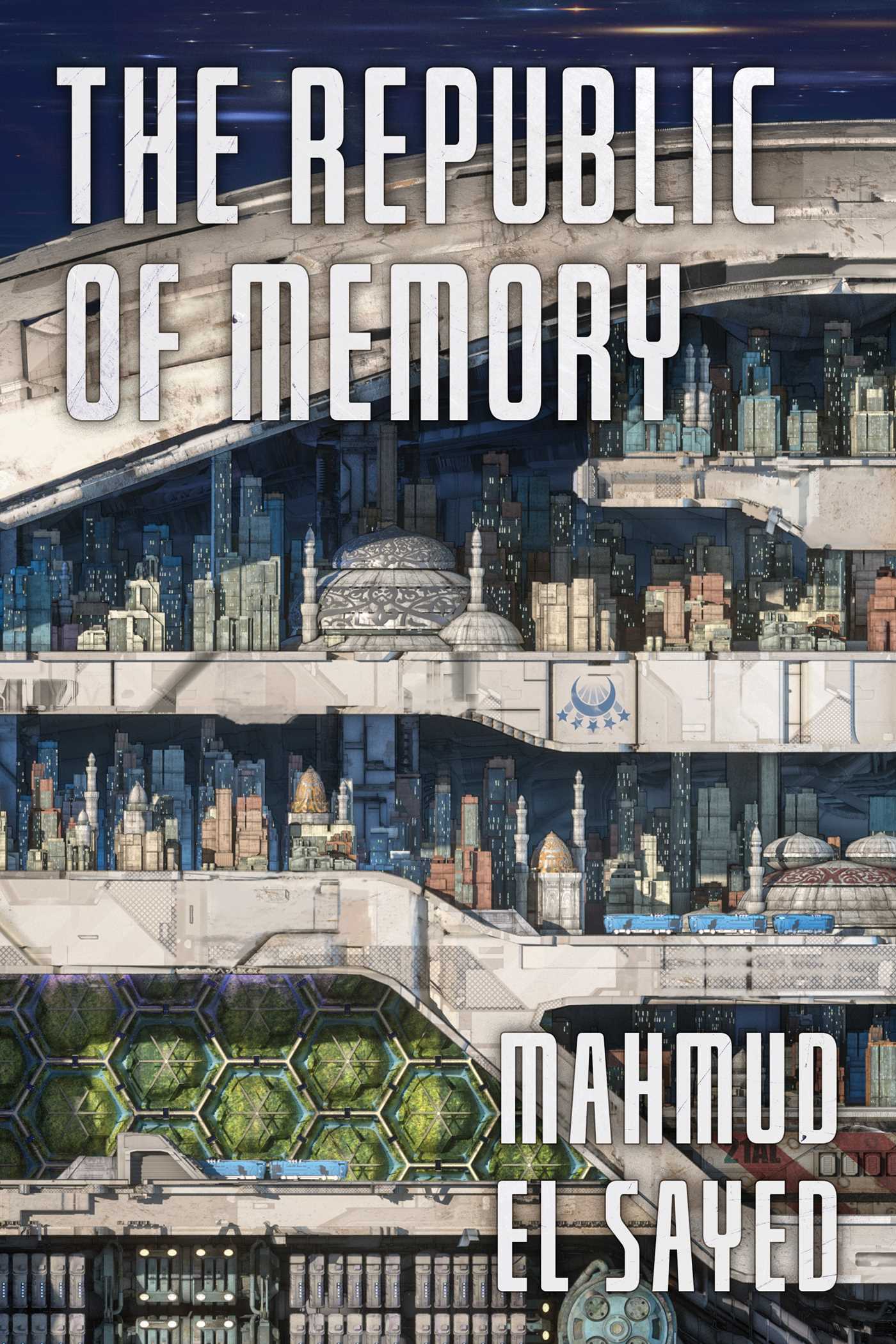
Mahmud El Sayed’s The Republic of Memory is that rarest of things - a proper space opera that has no real interest in what the West has to say about space or stories. El Sayed is a former journalist of Egyptian descent and he was there for the Tahrir Square protests in Egypt largely known to westerners (if they know it at all) because of its central role in the Arab Spring as it unfolded in Egypt.
Mahmud is London based right now and won the Future Worlds prize in 2023 for an earlier version of this story that now finally makes it into print.
I mention these biographical facts because they are pertinent not just to the style and nature of the story in an authorial sense but also in terms of the themes and characters within the pages.
This next paragraph contains mild spoilers about the plot so if you want to skip it and move on to the next part of the review feel free to do so. The Republic of Memory is about a generation ship sent out from earth on a very long (centuries long) journey to colonise another world. The people sending them are, if not quite then almost a world government centred in the Levant and entirely ruled over by an AI overclass. As becomes clear right at the start of the novel, something goes wrong back home, the threat of mutually assured destruction finally becoming a promise and the ship is ordered to turn back with its precious cargo of rich and powerful people to rebuild in the aftermath. Instead of doing so, the crew destroy the AI and continue on their way – their reasons not fully clear to themselves or us. What follows is set centuries later but still far from their destination as the various societies and factions that manage the functioning of the generation ship reach a breaking point.
(Spoilers over) The story follows a number of PoVs but the crucial two, Damietta and Iskander, begin the novel. El Sayed puts these two characters (young family members) on seemingly opposite sides of the social divide and through this we have our way into the story. Damietta is a young woman in a close knit and culturally conservative family who chafes at the constraints she feels in her life. She is privileged as far as it goes with a good life laid out before her, but that’s the problem – that life is laid out before her with no deviations, no creativity and no chance at making choices other than those the people around her approve of.
Damietta doesn’t know what choices she really wants to make – her horizons are too constrained for her to understand what she might actually want and, as for so many people, this leaves her with the only choice available – break things. Damietta is the person who reminds us that we all want to be able to make choices (not in the sense of the hero’s journey but in the sense of being able to determine who we are for ourselves) and when those choices are suppressed we will, reasonably even if the choices themselves are unreasonable, make choices to break whatever is within reach – be that ourselves or others.
Damietta cannot see her privilege – her constraints leave her idolising resistance movements, rejecting authority and looking to engage in acts of rebellion regardless of the consequences because she cannot see how her life could be worse. And sure, in the immediate her life can be worse but a life whose practical choices might deteriorate is still nothing when compared to a life where self-determination is absent. One is waves on the ocean rocking the boat, the other is drowning without being able to die.
Iskander is a lawyer (of sorts) working for Administration, the distant overclass that manages the entire generation ship (called the Safina which literally means vessel or ark in Quranic Arabic). He is the face of authority, able to open doors and go places others can’t because of his role. He sits with two faces – one facing his community as the person they look to when they want to get married or get things done and one facing Administration as their loyal functionary ensuring their rules are followed without causing riots. Iskander is the willingly colonised actor, trying to see both sides, aware of the tensions, embodying them in his very person but looking to make the world work. Sometimes that’s for the better, sometimes that’s bending the rules and sometimes that’s following them. Iskander exists on a kind of personal capital – a currency he has to spend that is built up through the cautious and cunning use of his position. His effectiveness built on people seeing him as just reliably enough on their side to help them get what they need and want when Admin might otherwise say no while knowing that his power comes from Admin’s overall approval.
Iskander is the classical sepoy, the good native, the conflicted coconut, the collaborator who both legitimises the oppressor but also subverts their authority.
El Sayed does a truly brilliant job of ensuring that we see their points of view. This isn’t a political treatise; it’s a story about people whose lives are political from the moment they’re born to the moment they die (and beyond). Why? Because for so many people this is the world they live in and to see it on the page is utterly brilliant.
What I mean is that El Sayed isn’t writing about politics here – the story isn’t a metaphor for non-western experiences of colonialism. He’s both way beyond that, deep into postcolonial Arabfuturism, but also interested in these people in and of themselves. What Iskander wants, what his dreams are, what Damietta discovers in her journey to finding a way to express what’s inside her in a way that makes sense to her, consequences and all, is at the heart of this story. Whatever else it is, The Republic of Memory is a personal journey for people whose lives are…complicated.
And how complicated they are because the Safina isn’t just Iskander, Damietta, their family and their community. It’s made up of communities from across old earth whose roles and cultures are disparate and essential to making the ship work. From hydroponics to medical to engineering and those who mine for resources beyond the ship, the tasks of keeping a mechanical world flying through the void are endless and demanding. What’s worse is that the ship is gradually deteriorating no matter how hard the people work at keeping it all working in harmony.
It’s unclear whether the slow collapse of the ship’s systems is the fault of Administration, the inevitable result of destroying the AI at the start of the voyage or whether it’s simply entropy presenting its bill. The answer to the question depends on who you ask and their place within the ship.
El Sayed has rolled together caste (or class if you’re a westerner), gender, functional essentialism, racism and post-colonialism into a single pressure cooker of a story. He is aware of and plays with a host of different ideas; from a variety of communisms and communitarianisms to capitalisms, religious expressions of different kinds including manifest destiny through to AI as god.
However, central to everyone’s life in this novel is a gift economy. In a capitalist society where the rule of law tries to ensure transparent equity for all concerned this would be called bribery. Where there is no cash, per se, and the levers of power are invisible and asymmetric beyond family and community units it is called gift economy – bringing an official’s favourite sweets, making sure someone’s cousin got the car they wanted at a good price and so on. You might call it a society built on social obligation.
What I’m trying to say is that El Sayed’s novel is that truly remarkable thing in English – a speculative story that regurgitates precisely none of the prevailing Western ideas about how the world should be run and rests on none of those foundations. Beyond that it does what it wants not by eschewing consideration of these possibilities (after all, Administration is a specific proxy for American hegemonic power over countries like Egypt and how client states must come to operate for maximum benefit for their rulers), but by understanding and reflecting how complex politics between different factions is especially when relationships are stable. After all, it is successfully navigating complexity that allows stability to be sustained as the deliberately untrained and willingly ignorant are discovering in the Strait of Hormuz at the time of writing this.
The last thing I want to comment on here is language. It seems to me that language and its use, its control and its boundaries are central to building consensus but also to building and controlling communities. The societies in The Republic of Memory aren’t split by culture or skin colour but by language with the mantra that anyone can learn a new language with the goal of preserving social mobility. It’s a cunning sleight of hand because it wilfully ignores the power of community and relationship and culture in building social capital while remaining superficially utopian.
El Sayed delivers so much of this novel through conlangs, creoles and macaronic structures that you need to take your time to understand the rhythms of what he’s built. I think that is very, very important because in language and how people use and deploy it you find the real levers of power being expressed. What words you use at home versus what you use when speaking to power are revelatory, and throughout El Sayed reminds us that language is, at all times, a tool not simply for consensus but for control and subversion.
The Republic of Memory is the first of a duology and as a way of working through modern global politics, personal lives within that context and as an exploration of how you and I survive such potentially crushing pressures it’s an extraordinary achievement.
--
The Math
Highlights:
- Amazing languages!
- Proper political SF
- Non-western viewpoint
Nerd coefficient: 9/10, a powerful exploration of what worlds look like when seen from a postcolonialist perspective. A superb starting point for people interested in Arabfuturism.
Reference: El Sayed, Mahmud,
The Republic of Memory [Orion 2026
].
STEWART HOTSTON is an author of all kinds of science fiction and fantasy. He's also a keen Larper (he owns the UK Fest system, Curious Pastimes). He's a sometime physicist and currently a banker in the City of London. A Subjective Chaos, BSFA and BFA finalist he's also Chair of the British Science Fiction Association and Treasurer for the British Fantasy Society. He is on bluesky at: @stewarthotston.com.
