Showing posts with label 80s. Show all posts

Tuesday, January 13, 2026

Review: Stranger Things Season 5 Volume II & Finale

The Duffer brothers stick the landing, bringing a close to nine years of epic storytelling

Volume II of the Stranger Things final season dropped on Christmas day, and when we last left our heroes, we discovered that Will could tap into the hive mind and hijack its powersWill the sorcerer, indeed! I've now watched these episodes twice,  and simultaneously so much and so little happens in them. The vibe is a little different from Volume I, as somehow there's even more exposition to get through. Rather than go through the plot, I thought I'd go through what really works, and why the epilogue to episode 8 was fantastic.

What works

Discovering what the Upside Down really is

After discovering some of Dr. Brenner's notebooks in the Upside Down version of Hawkins Lab, Dustin pieces together that everything they thought was wrong. The Upside Down is actually a wormhole to  Dimension X, the place Vecna was transported to by El. It was sort of a Chekhov's Wormhole, though, as the crew had discussed wormholes in Mr. Clarke's science class years before. We still don't learn exactly why the Upside Down is the way it is, all decaying matter and dark skies, but ultimately that's less important than just knowing it was never the ultimate bad place. It's just a tunnel to another dimension. On the other side of the gooey, fleshy wall surrounding the Upside Down is sheer space, as noted by Steve's BMW getting sucked into it and vanishing into the galaxy.

Bringing Mr. Clarke into the crew

Everyone's favorite science teacher is recruited to help build a telemetry device so they can locate Dustin and company, and watching him finally join was absolutely heartwarming. Without him, the kids never would have succeeded in the prior seasons, and his reward is getting to witness all the insane things that have led to this point. It's a very sweet payoff, and he adds a lot to the team. Also, I love that Mr. Clarke is always sleeping with a different member of the Hawkins High School staff. 

Karen "Walk 'Em Down" Wheeler proves she's a badass once again

Still recovering from vicious demogorgon slash wounds in the hospital, Karen saves the day yet again when Lucas, Robyn, and Vicki are cornered by demodogs. After ripping her IV out, she deftly places oxygen tanks into huge commercial dryers, triggering an explosion that takes them all out. Moms in '80s movies are rarely given such agency, and watching her stagger down to the basement to take care of the kids is truly epic. In the epilogue, we see a fully recovered Karen at the kids' graduation, her huge scars visible but worn proudly on display in a V-neck dress.

The epic Mindflayer kaiju battle

When the team finally makes it to Dimension X, they're set to face off against the corporeal forms of the Mindflayer and Vecna. A lot of folks online complained that the battle was too short, but the team literally spent 5 seasons getting to this point. I thought it was awesome, as it actually felt like watching a D&D game in real time, from Steve and Dustin stabbing the Mindflayer's belly to Nancy leading them into the trap where Robin and Lucas and Will could rain down fire from above. Also, Joyce getting to hack off Vecna's head with an axe was a gift she truly deserved. I don't think anyone suffered more than her throughout every season, given her constant panic and stress.

Being the first TV show to license Prince's music

The two needle drops of "When Doves Cry" and "Purple Rain" were not only incredibly appropriate, the Duffer brothers somehow managed to convince Prince's estate that their show was worth granting the green lightno doubt because of the viral success that seemed all but promised. Having the record literally be the detonation devices for the destruction of the Upside Down is a fantastic choice, and El and Mike's final conversation set to "Purple Rain" is absolutely heartbreaking.

Why I choose to believe El is alive

A lot has been said about El's fate, but I think the Duffer brothers did it exactly right. By leaving El's death open to a different interpretation—namely, that she survived thanks to one final illusion by Kaliit gives everybody what they need. Some people are fine with a final sacrifice by a hero, while others (like myself) can choose to believe Mike's ending, that she escaped and is living far away, safe. I choose to believe she's still alive because it's what her character deserves, and at heart, I'm an optimist. But more importantly, I like that we, as the audience, get to choose our ending. It's like D&D itself! I personally don't need a ton of deaths to make a finale more meaningful.

What didn't work for me

There are too many characters

By season 5, we're dealing with upwards of a dozen folks that we have to check in on (somewhat) equally, and that starts to make things cumbersome. I wouldn't trade Robin and Steve for the world, but the subplot of Nancy and Jonathan's relationship was given way too much screen time for a duo that most folks couldn't care less about. (There's a reason no one was buying the Jonathan Byers Funko-Pop.) Will's coming out scene, meant to be a vulnerable and tender moment for his immediate family and ride-or-ride friends, ends up giving his speech to a room full of people, including his science teacher, his friend's girlfriend he's never met, and Murray, everyone's favorite mean weirdo.

The Marvelification of Stranger Things

Season 1 of Stranger Things was the little show that could, made by an unknown duo of brothers with a super small budget. As the fame of the show grew, so did its budget, and by season 5, we had something that felt visually and thematically more like X-Men or The Avengers. Superpowers, excessive CGI, different dimensionsit all feels a little too much. The grandiose nature of the final season, for the most part, felt light on the nostalgia (the show's bread and butter) and heavy on the special effects. To put it another way: light on the bowl cuts and heavy on the white-out eyes of Will Byers. Vecna is the big bad in Stranger Things, but his motivations aren't entirely clear to me. He was abused, clearly, but he feels more like a Thanos than anything else, unfortunately. By giving him such a broad impetus, I think the show really missed out on a meaningful villain.

Too much plot, too little room to breathe

A product of both the extraneous characters and the Marvelification is the fact that the plot was fairly thudding. In Volume II, nearly every other scene sees characters grabbing objects and telling us the plot, "Imagine this record is Will, and this one's Holly." Everything felt jam-packed, with no room for characters to just be. It's more than just a sense of urgency, though, because it felt like something was missing. I read that most of the episodes went through some pretty extensive scene-cutting, and I think it's definitely apparent. The only time characters really have heart-to-hearts is when they're on the way to a battle. Maybe it's because the show finally lost a bit of the childlike wonder that made it so special, because the kids are all in their 20s now.

Overall

Season 5 is definitely worth watching, and I think it's a fitting conclusion to the near-decade-long run of the show. It suffers from the issues I mentioned (and more), but if you really loved the characters and the story, I think the ending pays off. When I looked up after the epic battle in the finale and saw that there were still 45 minutes left, I wondered if there was going to be another stand-off with Dr. Kay and her army.

Instead, I thoroughly enjoyed the slow, thoughtful ending and watching our kids graduate. The scene of everyone putting up their D&D books on the shelf was heart-wrenching as they literally were closing the book on their childhoods.

Show endings are hard, because not every show knows at the outset how long it's going to last. While not perfect, the Stranger Things finale sticks the landing and leaves the viewer with a tale well told and a happy ending. And that's all we can really ask for.

Nerd Coefficient: 7/10.

POSTED BY: Haley Zapal, NoaF contributor and lawyer-turned-copywriter living in Atlanta, Georgia. A co-host of Hugo Award-winning podcast Hugo, Girl!, she posts on Instagram as @cestlahaley. She loves nautical fiction, growing corn and giving them pun names like Timothee Chalamaize, and thinking about fried chicken.

Monday, October 28, 2024

First Scare: Poltergeist

A house that hides much worse than skeletons in its closet

My most persistent thought during the runtime of Poltergeist was about how much of this movie's DNA can be recognized in Stranger Things. The tropes of nightmarish suburbia, a childhood immersed in pop culture, electric devices as a conduit to the paranormal, a child trapped within the walls of a house, and a danger too big for parents to protect against are elements that the Netflix show clearly inherits from this '80s classic. I wasn't so much scared as amused by its visual effects, at times reminiscent of Close Encounters of the Third Kind, which in my book is not a good sign. When it aims for spooky, it overshoots and lands on goofy. I admit that in my childhood this movie would have terrorized the hell out of me, but watching it now leaves me with an impression similar to live-action Scooby-Doo. I suspect this is a recurring trait in the Spielberg-Lucas axis of storytelling: if it doesn't hook you when you're young, it never will.

Poltergeist feels like a condensation of mystical currents of thought that had gained strength during the hippie era but really date back to the spiritualist fad of the 19th century. Advances in the understanding of electromagnetism coincided with a growing interest in the inner workings of the mind, and it was only natural that a theory eventually formed linking electromagnetism with the paranormal. If you didn't know any better, it made some sort of sense: if you consider radio waves, they're an invisible force that exists all around us and can even pass through us, and have very tangible effects if you have a properly sensitive machine at hand. So it wasn't too much of a stretch to suppose that ghosts worked the same way. Poltergeist is an heir to over a century of superstition that viewed in electrical devices a viable tool for contacting the spiritual realm.

But Poltergeist does more than that. It also takes advantage of the moral panic that was forming around mass media and the way the TV set ended up altering not only the inner dynamics of the American family, but also the rhythm of daily life. People in Poltergeist time their activities by the programming schedule of TV; their day ends when the last broadcast ends. Even before malevolent spirits jump out of the screen, they're already under the spell of TV.

Putting spirits in the TV suggests an unspoken pun, as a riff on Marshall McLuhan's aphorism "the medium is the message." The movie plays with a medium (as in channel of communication) but also with a medium (as in speaker with the dead), and by blurring the difference between the technological and the mystical, it opens space for a new discursive position, one that treats electronic media as another battlefield between good and evil. Instead of a mindless machine, the TV set becomes a subject of moral analysis. And because anything that can make moral choices is effectively a person, the TV set becomes a character in the movie. You can talk to it, and it will answer. It has wants and goals. And it is very angry with you.

The family to whom all this happens in Poltergeist is presented as aspirational: upper-middle class homeowners who genuinely love each other and whose biggest headache at the moment is the construction of their private swimming pool. They don't have problems in their lives. Why make a movie about happy people?

As it turns out, their comfort rests on a pile of hidden cruelty. Their entire suburb was built on a cemetery that the developers didn't bother relocating. And this serves as an indictment of an entire way of life: these are the Reagan years, when the individualistic model of success was being preached as the definitive fulfillment of every human need. Our protagonists certainly look like they have nothing to worry about. But their happiness requires literally sweeping a lot of suffering under the rug. I don't need to recount the centuries of injustice and violence upon which American prosperity was amassed. Nor does Poltergeist pause for a single moment to moralize against our protagonists. The nightmare scenario it proposes speaks for itself: all your comfort created a debt, and that debt will come calling. And it will devour your children.

It's interesting that '80s suburban mythologizing focused so much on the children who were growing up in that space. The quasi-Puritan anxiety that rose against cities as alleged dens of vice and crime led to the creation of those artificial bubbles for raising children. But in those same '80s movies, the children are the first to fall through the cracks on that bubble.

In Poltergeist, the suburban children couldn't be more absurdly privileged. Their bedroom boasts a hodgepodge of product placement that must have sufficed to pay for the movie. They're innocent of the evil awakened by their parents, but they're its chosen targets, with their instruments of everyday joy, their toys, serving as the weapons through which their lives are snatched away. And at the top of those toys sits the ultimate entertainment invention, the provider of hours upon hours of cheap smiles: the TV.

It would seem odd to pair the unacknowledged blood left behind by American growth and the specific concerns that were circulating about the omnipresence of TV. They're two very different sources of fear. But what the TV symbolizes is precisely that prosperity. The medium is the message, and the message is that you now have luxury of spare time to sit and watch. The moral panic warned that guiding your life by the TV schedule was a scourge on society, but in reality, if you even have the time to live by the TV schedule, you're immensely fortunate. In the '80s, the TV is one of the ultimate signifiers of mass-accessible affluence (along with other traditional American life milestones, such as owning a car). So it's fitting that Poltergeist turns the TV into the executioner's weapon that will collect the old debt.

When the veil of mystery is parted and we get to see the otherworldly creatures that threaten this life of comfort, they don't seem all that scary. Of course, I say this now, having survived through The Thing and Gremlins and The Fly and Predator and Hellraiser and Beetlejuice and They Live and Child's Play and plenty of others. It's too late for me to experience those images for the first time. I have no way of confirming how horrifying Poltergeist really was, and, as I said above, the stylistic resemblance to Close Encounters of the Third Kind does its scare factor no favors. I bet many moviegoers in 1982 must have drawn the same connection in their head. Poltergeist remains as a very acute piece of social commentary, but as a horror movie, I find it rather quaint. Almost cute.


POSTED BY: Arturo Serrano, multiclass Trekkie/Whovian/Moonie/Miraculer, accumulating experience points for still more obsessions.

Monday, February 12, 2024

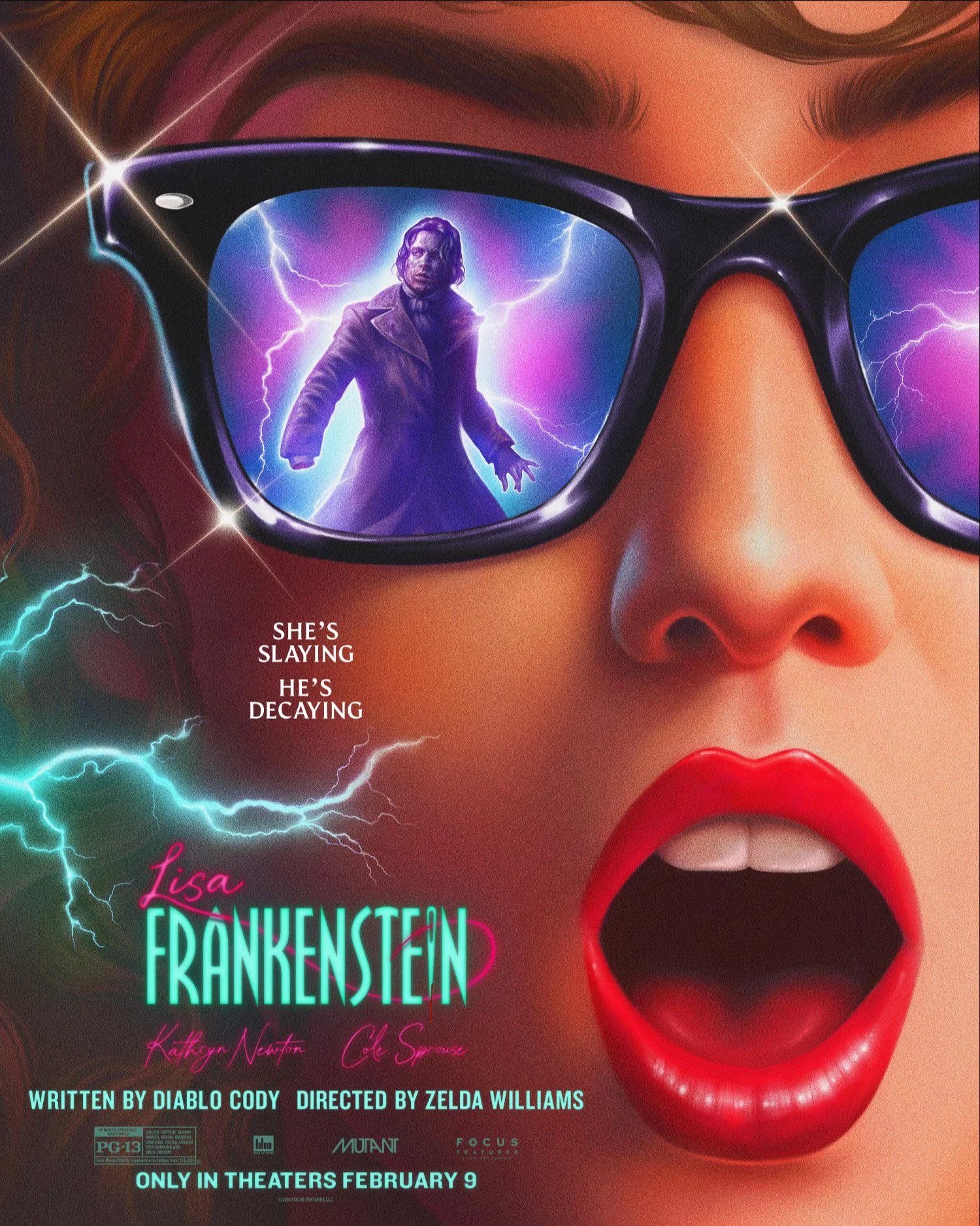
Review: Lisa Frankenstein

Journey back to the 80s with a black horror comedy "coming of rage" story featuring a script by Diablo Cody and an impressive retro vibe and soundtrack.


Diablo Cody, writer of Jennifer's Body, and Zelda Williams, director and daughter of Robin Williams, made a movie that I've been waiting 30 years for — a black comedy with a gothy female lead that's got a killer soundtrack and is an ode to 80s (and earlier) horror movies. 

Lisa Frankenstein — a stellar pun of a title that sets the scene and mood, all bright colors and crimped hair and pastel wallpaper — follows the adventures of the unfortuitously named Lisa Swallows, a high school senior in 1989 who's just... a bit odd.  A few years prior, Lisa's mother died in a freak slasher/home invasion attack, and her dad remarried soon after, blending families with another mother and daughter. Carla Gugino is perfectly cast as an aerobics-attired-clad, conservative 80s evil stepmom. 

Like her cinematic forebears Lydia Deetz and Veronica Sawyer, Lisa is herself strange and unusual. She loves The Cure, Universal horror movies, and spending time in the graveyard with a beautiful sculpture of a young man who died 200 years ago. 

The plot sparks into motion when a lightning bolt brings the dead young man back to life somehow (we're not really told how or why, but honestly, does it matter? Even Victor Frankenstein just used lightning and an old body, so check). He shows up at Lisa's house and their relationship begins in earnest. 

The Creature (played almost entirely silently by the wonderful Cole Sprouse of Riverdale fame) is missing a few parts — an ear, a hand, some genitalia. Together, he and Lisa start harvesting body parts from local town denizens to help get patched up. He's giving Billy Butcher vibes from Hocus Pocus, if we're being honest, and it works. 

Each time he gets a fresh new body part, a quick trip to Lisa's backyard tanning bed makes him just a bit more human and life-like. This neon-red 80s take on the doctor's slab from old Frankenstein movies made me laugh every time I saw it — this film has absolutely delightful visual gags and retro throwbacks that just work. There's a pun concerning Pabst beer and Pabst the director that is absolutely chef's kiss. 

There's not a terrible amount of plot, as this is a fairly short comedic romp that's somehow light-hearted but also simultaneously violent and funny.  It's a movie that I look forward to rewatching, and if I were still in high school, it would definitely become my personality for a few months.

If you liked similar movies in the 80s and 90s like Jawbreaker, Weird Science, Heathers, My Boyfriend's Back, But I'm a Cheerleader, or Beetlejuice, you'll probably get a kick out of Lisa Frankenstein.

--

The Math

Baseline Score: 8/10

Bonuses: Incredible needle drops(including a Pixies' song that's worth the price of admission), superb set design, and an authentic and successful 80s vibe.

POSTED BY: Haley Zapal, new NoaF contributor and lawyer-turned-copywriter living in Atlanta, Georgia. A co-host of Hugo Award-winning podcast Hugo, Girl!, she posts on Instagram as @cestlahaley. She loves nautical fiction, growing corn and giving them pun names like Timothee Chalamaize, and thinking about fried chicken.

Thursday, August 4, 2022

'Paper Girls' is a more honest look at the 80s generation

If 80s kids must write stories that look back at their young selves, why not make it literal?

Yes, I know, it's yet another show about the 80s, but this one doesn't pretend it was a glorious time to live in. Each generation is handed their own rough deal, and the one that befell us 80s kids was to witness the beginning of the end of upward mobility, the rise of trickle-down Reaganomics, and the social damage caused by moral panic. We have, to put it mildly, a lot of baggage to process. To complicate matters further, we are now entering our middle-age crisis phase, which is why the world has been subjected to so many nostalgia stories this decade. We've seen the return of Ghostbusters, Full House, He-Man, Saved by the Bell, Top Gun, The Dark Crystal, DuckTales, and Baywatch, and we'll soon see the return of Willow, Quantum Leap, and Max Headroom. And of course, Stranger Things aspires to be the distillation of the entire vibe of the era.

So what does Paper Girls bring to the conversation about the 80s? For starters, it's not nostalgic. Its intention is not to make you feel warm and cozy about your childhood. It recognizes, and assumes that so do you, that the 80s were an awful decade. And so were the 90s. And so is the 21st century. There were never any "good old days." Whenever you are, that is your present, and in any present, life is hard. Having friends certainly helps, but the demons you carry are still yours.

Where Stranger Things tries to portray teen friendships as the foundation on which personal growth happens, Paper Girls demands that its characters first grow in order to learn to bond. Stranger Things takes kids who were already best friends and throws the end of the world at them. In Paper Girls, dealing with the end of the world is what turns the kids into friends. The interactions are more organic, the group dynamic is more realistic, the thought process behind hard choices is more compelling. Characters in Stranger Things are designed to allude to the archetypes of 80s movies. Characters in Paper Girls are designed to feel like people.

The other thing Paper Girls does with the 80s is turn the whole exercise of looking back into a two-way conversation. Our nostalgia binge is full of commentary on the 80s, but the use of time travel in this series allows the 80s to comment back. Generations are put face to face and given numerous chances to question each other, to try to figure out where things went wrong, and ultimately, to try to understand each other. Again, life is hard; it is in every decade. Much of the resentment and blame and scapegoating that one generation can hurl at the previous one or the next one can be explained by the failure to remember that life for them is hard too. We forget it so much that we often direct those hard feelings at ourselves.

Dialogue scenes between different versions of the same character are the best moments of the series. It's one thing to feel disappointed in yourself, and it's another to hear your past self or your future self say it to your face. It's a humbling experience to be shown a wider view of your life trajectory and discover that, every time you think you've got this life figured out, you're wrong. You may even convince yourself that the aspirations you ceased to have are no longer important, but the version of you that had those aspirations was no less real than you are now. Likewise, the person you will become may have valid complaints to make about the direction you went. You are your own harshest judge. If anyone has the right to be brutally honest about your mistakes, it's you.

This type of interaction intensifies the emotional stakes of Paper Girls to the limits of what the dramatic medium permits. In any narration it's normal for characters to challenge and call out each other, but it creates a very different dramatic situation to have a character argue with their own self. Science fiction uses this trick all the time, because it works really well, but very few stories have done it to the extent that Paper Girls does. To realize the fantasy of knowing your future opens the door to forms of vulnerability and introspection that would have been harder to achieve in more conventional coming-of-age stories. The focus of this series is not who will win the temporal war, but rather who these girls are capable of becoming.

Not that the temporal war plot is unimportant. It takes place in the background, as the excuse that allows for all the inner drama to happen, but it illustrates quite plainly the meaning of the story. It's a war between youngsters who want to improve the world and elders who want to keep it the way it's always been. In other words, the eternal struggle of every generation as it grows up and tries to reclaim its place. It's easy to imagine a window into the past and the future, but it takes a rare dedication to sincerity to let the past and the future judge us. And surely we'd have as many reasons to judge them in turn. But once you've had that conversation, once you've sat the child and the adult in the same room and given them time to scream their grievances and shoot their missiles, where do you go from there?

With the tease for a season 2, the plot of Paper Girls is not over yet, so it's premature to venture an all-encompassing interpretation. But isn't that the way life feels all the time? You don't have the full picture until it's over, and you never know when that is. You can only walk the road you see immediately ahead. When are you done growing up? You never know for sure. When are you complete? Maybe you already were and didn't know it. One reason why it's dangerous to view life as a story is that, for any present moment, the story is incomplete. And that's terrifying, because with enough time, you may become a completely different person. You may regret it. Or you may be glad it happened. Or you may not even have the chance to reflect on it.

Paper Girls takes the anxiety of our always incomplete story and makes it tangible in the conversations between child and adult. Now that we're inundated in reminders of the 80s, it's refreshing to have this series point out the folly of yearning for the past. You are the person you are. To truly return to the past, you'd have to forget everything you are now (a scenario that the series makes literal). That's what the obsession with 80s nostalgia has failed to understand: if time travel stories have taught us anything, it's that getting stuck reliving the same experiences is hell. We need to let the past be past. We need to live. That's the simplest message a story can carry, and perhaps the most essential. The road is not finished, and we can't see where it ends, but as long as we're on it, we need to live.


The Math

Baseline Assessment: 8/10.

Bonuses: +1 for the refreshing emotional honesty that has been so lacking in the 80s nostalgia subgenre.

Nerd Coefficient: 9/10.

POSTED BY: Arturo Serrano, multiclass Trekkie/Whovian/Moonie/Miraculer, accumulating experience points for still more obsessions.

Tuesday, October 20, 2020

Microreview [book]: My Best Friend's Exorcism by Grady Hendrix

What if Stranger Things and The Exorcist had a child? A book child. 

Grady Hendrix is probably best known for Paperbacks from Hell, a nonfiction tribute to the outlandish and fun world of horror novels in the 1970s and 1980s. But he's also an accomplished horror novelist in his own right. My Best Friend's Exorcism is, in essence, Hendrix's attempt to write his own "paperback from hell" - an endeavor you might expect to go the full hipster route, complete with all the winks, nudges and avalanche of pop culture references that weigh down similar exercises, like Ernest Cline's Armada. Credit Hendrix for instead threading the needle, and producing a novel that is both loving paean to the paperbacks of yesteryear and a legitimate horror novel with a solid emotional core. 

My Best Friend's Exorcism tells the story of Abby Rivers and Gretchen Lang, teenagers and best friends in late 1980s Charleston, SC. Both attend a prestigious private school, but whereas Gretchen comes from a wealthy family with a sought-after address, Abby is a latchkey kid on scholarship. In their review, the AV Club offers this succinct synopsis of the plot:

Abby Rivers and Gretchen Lang are entering their sophomore year of high school, part of a four-girl clique both popular and academically successful. Abby and Gretchen have been besties since grade school, possessing the kind of near-telepathic communication and her-before-me selflessness that characterizes the most intimate friendships. So naturally, Abby is the first to notice when Gretchen returns—after disappearing for the night during a sleepover—a little… different. Soon, she barely recognizes her oldest friend, as Gretchen begins executing progressively more malicious schemes that rain down disaster upon everyone in her orbit. Surely, Abby reasons, this can’t be the work of her friend. Someone or some thing has taken hold, and is twisting her, forming her into someone fearsome and new. After a school assembly visit from a bodybuilding troop of Christian brothers, Abby suspects her worst fear might be true: The devil has taken her best friend.

This is not a YA novel, though it has a certain YA sensibility. At its core, My Best Friend's Exorcism is a novel about friendship, and more specifically, about the kinds of friendship you only make when you're young, still forming as a person and so struggling to make sense of the world and your place in it. It feels emotionally authentic, which is not something I take for granted with genre fiction. Honestly it's pretty rare for me to feel to wholly invested in a genre novel's characters when you discount the plot and setting. But I'd honestly read this novel about Abby and Gretchen and their lives even if it didn't have anything to do with demonic possession. 

Of course it is also a novel about demonic possession, and it's here that Hendrix really threads that needle between serious horror and campy retro fun. The story of Gretchen's possession is unnerving, unsettling and at times pretty shocking - but it's also peppered with elements of humor, especially when the '80s-tastic exorcist comes into play. The result isn't exactly funny and isn't exactly scary, but by blending the two, he does capture the feel and thrill of those old paperbacks. 

It's worth noting that this isn't a gory book - it certainly has its moments but, in the aggregate, it's pretty low on the gush and splatter. Instead it burns slow, amping up the creep factor and occasionally venturing into the macabre. A lot is left to the imagination, which as often is the case, ends up in a darker place than the book itself.

Next comes the question of who the book is for, and I imagine some people will bounce of the retro '80s concept. That, in turn, begs the question: could someone less invested in '80s nostalgia enjoy the book as much as I did? I think so. You will get more mileage out of the book if you've also sung the wrong words to "Against All Odds," but the story and emotional core are strong enough that your enjoyment doesn't hinge on it. And this is what sets My Best Friend's Exorcism apart from many other entries into the '70s and '80s nostalgia cottage industry - the nostalgia is pretty well backgrounded.

There are also lots of little details I appreciated as well, many of which suggest things but don't outright say them. For example, we know Abby's family is struggling financially but she attends an elite school on scholarship - we get hints throughout the novel that her family has fallen on hard times, and *might* have once been prominent in the community, but it's never stated outright. It may not be true at all. I always like this kind of approach, the kind that leaves questions to be answered by your imagination. 

Bottom line, this is a fun book that delivers mood, thrill and more than its share of heart. It's also hard to put down, and leaves enough questions unanswered that I'm already contemplating a re-read. One complaint: it's too short. I would happily have spent another one or two hundred pages with Abby and Gretchen. 


The Math

Baseline Assessment: 7/10

Bonuses: +1 for this is how you do nostalgic art; +1 for copious references to Phil Collins

Penalties: -1 for it's too short

Nerd Coefficient. 8/10. Well worth your time and attention. 


***

POSTED BY: The G--purveyor of nerdliness, genre fanatic and Nerds of a
Feather founder/administrator, since 2012. 


Tuesday, November 7, 2017

The Lost World of Hawkins, Indiana


Someone on my Facebook feed posted a really interesting article on Stranger Things and the enduring pop cultural appeal of '80s nostalgia. Unfortunately I can't find it now, but one of the more notable tidbits was the observation that the current wave of '80s nostalgia, which traces back to the late '90s, has now been around almost twice as long as the '80s themselves.

In truth, it's phased in and out, but never gone away. Now, in 2017, it is in full bloom: we've gotten a remake of It, a sequel to Blade Runner, an '80s themed entry in the Thor movie franchise and, most importantly, a second season of Netflix's unabashedly nostalgic sci-fi horror show, Stranger Things. Meanwhile, synthwave--the overtly retro '80s music that I make (shameless plug)--is more popular and visible than ever.

I've long wondered why I'm so attracted to '80s nostalgia, why I've always been attracted to it, but also why I'm so particularly attracted to it now. The simple answer is that I grew up in the '80s, but that's only part of the story. I was a teenager in the '90s, so you might think I'd be nostalgic for that cultural moment. I probably will be at some point, but I'm not right now, not really. So there's clearly more going on there, and I suspect that's the case for most people. What follows is an attempt to make sense of it all, with special reference to Stranger Things.


An Evolving Aesthetic

In 1997, VH1 debuted what would become its signature program in the post-video age: Behind the Music. Though not limited to '80s musicians, episodes that featured that decade's more ridiculous figures were instant hits. In 2002, VH1 adapted the British program I Love the '80s, which surveyed the decade's pop culture landscape a year at a time. (I Love the 70s and I Love the 90s followed soon thereafter.)


These programming decisions both reflected and contributed to the wave of nostalgia for '80s pop culture that, according to Simon Reynolds, cast its shadow over the entire decade. Indeed, if you look at independent music in the early '00s, it's positively drenched in the stuff: from the "punk funk" aesthetics of LCD Soundsystem, Franz Ferdinand and Datarock to the new wave revivalism of Ladytron, Fisherspooner and Scissor Sisters. And it wasn't limited to music either. The cult TV show Freaks and Geeks (1999-2000) was, in a sense, the Stranger Things of its day. And Napoleon Dynamite (2004), though not technically set in the 1980s, had a distinctly '80s nostalgic aesthetic. So why does the current round of '80s nostalgia feel different?

In 2005, VH1's Michael Hirschorn had this to say about the '00s wave of '80s nostalgia:

[It] applies to a specific kind of Gen X, self-mocking, slightly ironic thing. For this group of people, you can't give them straight nostalgia of the sort of baby- boomer, "everything was wonderful and great when we were kids" feel. People Gen X and younger know that things weren't that great. We never thought that Motley Crue was saving the world. We identify with them passionately, but with a certain wink.

The ironic take still holds, to a degree, but it's never been the only thing going. Revivalists from the ''00s, such as Daft Punk and Ariel Pink, described their approach in decided unironic terms, as less an attempt to recapture a specific sound (with the addition of a wink and a nudge) as to recapture the "blissfully indiscriminate" way in which music was consumed at that time, something that evaporated with the decline of radio and MTV's switch to scripted programming. And if anything, the current wave of retro enthusiasm feels much less ironic and much more earnest than it did in the '00s.

There are plenty of haters, who dismiss the current wave of '80s nostalgia as insipid or emblematic of cultural exhaustion (for example, here and here). But I think those people vastly miss the point, namely, that '80s nostalgia in 2017 is purposive, and says more about where we are today than it does about the moment it portrays. And nowhere is that more apparent than in the lost world of Hawkins, Indiana.


The Lost World of Hawkins, Indiana


When I first starting watching Stranger Things, I was struck by how familiar Hawkins, Indiana felt. I grew up in a place more or less like that, an old Northeastern mill town. It was a twenty minute drive from a small city, and just under an hour from a big one. But it was also a self-contained universe. Most people worked in factories, making calculators, school uniforms or costume jewelry. Others worked in supporting industries--one friend's father owned a small metal treating company, which served the factories. There was a vibrant main street, and a great diner that got so packed on Sundays you could think the whole town was there. There was little crime, and it felt like everyone was looking out for everyone else. It was the kind of place where you knew the police and firefighters by name. The real locals, by which I mean those with roots in the community, probably knew them all from school or little league.

A lot has changed since then. Most of the factories have closed, with the work they once did (and the work that supported them) outsourced to cheaper labor markets. Main Street, like so many across the US, is a dilapidated shadow of its former self. The town as a whole is still okay--its proximity to the aforementioned cities meant it was able to transition from a place that made things to a commuter suburb. And the diner's still there. Many factory towns have not been so lucky.

But when I see the town of Hawkins, Indiana, it feels like I'm looking back at the place I grew up in, as it once was, but which no longer exists in the same form. This feels important. Stranger Things isn't just a celebration of pop culture from a previous moment, but a window into a lost world--one where things that have become deeply uncertain are rendered certain again.

The appeal of peeking into this world makes a lot of sense when you consider the political trend, both in the US and globally, toward economic populism. Strikingly, this trend is evident across the political spectrum, though it manifests differently on each end. Both sets of populists want to turn back the clock on several decades of globalization, outsourcing and the financialization of the economy. They just apportion blame differently. Left wing populists are angry over the dissolution of what George Packer calls "the Roosevelt Republic," a 50-year period of state-regulated economic security and egalitarianism, which was broken up in wake of late '70s stagflation to encourage faster growth, which in turn has disproportionately benefitted the richest of the rich. Right wing populists, by contrast, blame mass immigration for driving down wages and labor unions for driving out the factory owners. Both blame free trade for making it cheaper to build things abroad, though left wing populists also stress its negative effects on emerging markets.

The window to Hawkins shows a place where none of these things have happened yet. Though deregulation was already well underway by 1983 (when season one of Stranger Things takes place), the effects were not yet evident. We are looking at a place that hasn't experienced the financial crises of 1987, 2000 and 2008 or the cancerous spread of Walmart--a place where economic security and a middle class standard of living are still assumed. I imagine that most people who watch Stranger Things, regardless of their politics, find this comforting.

Another aspect of Hawkins that strikes me is its whiteness. I don't mean that in strictly racial terms; after all, Lucas is black, as are some other town residents. Rather, I mean it in cultural terms. No one in the town listens to hip-hop, funk or r&b, just rock and country. Aside from this season two's California transplants, no one seems to come from anywhere except Hawkins. There are no immigrants. There doesn't even appear to be a Chinese restaurant.

I also recognize this aspect of Hawkins from my own childhood, when we had to drive to the city for decent Chinese, or to the big city for Thai. That started the change in the '90s, when the area grew more diverse. In 1983, it wasn't very diverse at all. As part of a multilingual household and with an immigrant mother, I was basically the diversity.

This is not something I'm nostalgic for. Even at a young age, I found the hegemony of the monoculture oppressive. The '90s felt like an awakening to the world, with all the promise that entails. I am decidedly not nostalgic for the days when everyone died where they were born.

But I'm sure other people are. In 2016, pundits spoke at length about economic anxieties related to uneven globalization, but surveys have shown that more people have what you might call cultural anxieties. In extreme form, these manifest as racism, xenophobia and other exclusionary ideas that divide people into categories and then rank them by acceptability. More often, though, it isn't so much about accepting people from other backgrounds as accepting other cultural practices as valid and normal. It is possible, from this view, to accept individual people who look different as long as they don't act different. As long as they don't challenge the hegemony of the monoculture.

It would not surprise me to find out that some people are attracted to this element of Hawkins, Indiana, and more specifically, its portrayal of a world before multiculturalism and a time when the myth of strict assimilation still ruled supreme. Hawkins, one could argue, is a utopia for the culturally anxious, a place where the few non-white residents are perfectly comfortable within the monoculture, which in turn makes everyone perfectly comfortable with them. Put another way, Hawkins is exactly what people mean when they use "I don't see color." It means, "I don't want to think about difference."

I don't fault the Duffer Brothers for portraying Hawkins this way. Not everything has to center race, and I appreciate the fact that Lucas is treated as just another kid by everyone in the town. But as I examine my own feelings for this show, and for the place and time it portrays, I have to be honest about what I'm looking at, and how that makes me feel. Stranger Things is portraying my own lost world accurately, but there are things you lose and wish you could get back, and other things that are better left in the past.


The Lost World of Personhood Beyond Politics


Yet there are plenty of things I do wish we could go back to. Among those, the days when political identities were not so much a defining feature of your personhood as an element of color. Now, politics have always mattered, as have political disagreements. I remember the strong differences of opinion in the '80s: on welfare and taxes, on nuclear weapons and the threat of mutually assured destruction and so forth. But life was not as polarized as it is now. My dad and my friend's dad used to joke on election day that they were canceling out each other's votes. Can you imagine that now--not only saying it, but saying it to a friend and both of you thinking it's funny?

The shift in attitudes is widespread. As Pew noted in a 2014 report:

The overall share of Americans who express consistently conservative or consistently liberal opinions has doubled over the past two decades from 10% to 21%. And ideological thinking is now much more closely aligned with partisanship than in the past. As a result, ideological overlap between the two parties has diminished: Today, 92% of Republicans are to the right of the median Democrat, and 94% of Democrats are to the left of the median Republican.
Partisan animosity has increased substantially over the same period. In each party, the share with a highly negative view of the opposing party has more than doubled since 1994. Most of these intense partisans believe the opposing party’s policies “are so misguided that they threaten the nation’s well-being.”

The causes of this effect are multiple. Partisan gerrymandering has disincentivized median voter strategies, while unlimited campaign financing means politicians are more beholden to the wishes of individual donors than their districts. Concurrently, the decline of the newspaper and rise of both shrill partisan media and social media all contribute to the emergence of parallel echo chambers, which generate internal solidarity and views of the other as intrinsically threatening. What political polarization has done, then, is transform every political disagreement into a zero sum game, when in past days it might not have been treated as such.

You might be wondering where I'm going with all this; Hawkins, after all, is not a political world. In the series, the only political markers in the town are a solitary Reagan/Bush '84 sign on Mike's yard, as well as his father's bland statement to the men in black, "we're all patriots here." But that's exactly the point. We know very little about anyone's politics--no one even talks about it. So instead we form our opinions on the goodness of people through other means. And that's when it struck me: can you imagine deciding whether you think someone is a good person or not without knowing their political worldview? This was possible at one time, but it feels weird and alien now.

Some issues bely compromise--of that there can be no doubt. But today it often feels like everyone is fighting everyone on everything, and are so hideously polarized that they can't even think of the other side as equally human. Hawkins provides a comforting antidote to that paradigm, a glimpse back to a moment when people weren't as likely to other the political other. We don't know who Hopper or Joyce vote for; all we know is that they do right by people.


The Lost World of Childhood


Most strikingly, Stranger Things captures the freedom accorded to children in days past, and the lack of freedom accorded today.

I'm a parent now, and I'm clear-eyed about of how different it is to raise a child now compared to when I was a kid. Some things have improved--there's much more awareness of bullying, for example, and parents (dads especially) are a lot more involved in day-to-day child rearing than they once were. And, as mentioned above, I see immense value in exposing children to different cultures--something much easier to do now than before, especially if you live in a Hawkins. But I do lament the fact that my kids don't have the freedom I had as a child. The freedom to roam, explore and learn by doing.

Partly that's because I no longer live in a Hawkins. Since college, I've chosen to live in big cities. I've chosen that path on purpose; I find them more stimulating and exciting. But big cities come with crime and traffic, and their populations are transient. There is more to worry about, and fewer people around who you can trust implicitly. It is not possible to simply let your kid roam free at a young age the way you can in a small town. If you did, someone might even report you to the police.

But it's also cultural--not in the sense of ethnic or religious culture, but the prevalent culture of the moment. The zeitgeist. In many countries, the US included, the lives of children are increasingly structured. As journalist Hanna Rosin writes:

I used to puzzle over a particular statistic that routinely comes up in articles about time use: even though women work vastly more hours now than they did in the 1970s, mothers—and fathers—of all income levels spend much more time with their children than they used to. This seemed impossible to me until recently, when I began to think about my own life. My mother didn’t work all that much when I was younger, but she didn’t spend vast amounts of time with me, either. She didn’t arrange my playdates or drive me to swimming lessons or introduce me to cool music she liked. On weekdays after school she just expected me to show up for dinner; on weekends I barely saw her at all. I, on the other hand, might easily spend every waking Saturday hour with one if not all three of my children, taking one to a soccer game, the second to a theater program, the third to a friend’s house, or just hanging out with them at home. When my daughter was about 10, my husband suddenly realized that in her whole life, she had probably not spent more than 10 minutes unsupervised by an adult. Not 10 minutes in 10 years.
It’s hard to absorb how much childhood norms have shifted in just one generation. Actions that would have been considered paranoid in the ’70s—walking third-graders to school, forbidding your kid to play ball in the street, going down the slide with your child in your lap—are now routine. In fact, they are the markers of good, responsible parenting. One very thorough study of “children’s independent mobility,” conducted in urban, suburban, and rural neighborhoods in the U.K., shows that in 1971, 80 percent of third-graders walked to school alone. By 1990, that measure had dropped to 9 percent, and now it’s even lower. When you ask parents why they are more protective than their parents were, they might answer that the world is more dangerous than it was when they were growing up. But this isn’t true, or at least not in the way that we think. For example, parents now routinely tell their children never to talk to strangers, even though all available evidence suggests that children have about the same (very slim) chance of being abducted by a stranger as they did a generation ago. Maybe the real question is, how did these fears come to have such a hold over us? And what have our children lost—and gained—as we’ve succumbed to them?

Rosin presents a theory of how this happened: the largely irrational fear of child abduction, combined with well-intentioned attempts to reduce the risks children face in their daily lives (for example, a largely ineffective campaign to reduce playground accidents). The end result is a safer, though in some ways less stimulating environment. Hawkins, by contrast, is a place where kids still roam free and only go home for meals. In so doing, it shines a light on all our misgivings with overprotective helicopter parenting in 2017. 

You may or may not buy Rosin's argument; I do, at least in the abstract. I see my own childhood in a place like Hawkins and lament that my kids may never experience those endless days spent on bikes, exploring in the woods or climbing around house construction sites. All done as a matter of course, of course--as long as we were home for dinner. But in practice I find it very hard to let go in that way. Clearly, so does Rosin, and I assume this is true for many parents who grew up the way I did but now find the world changed around them. We appreciate the things that have changed for the better, but we mourn the loss of things we once took for granted. And so, we look through the window into the lost world of Hawkins, Indiana, a place we can see but not touch. 


Endless '80s


Stranger Things exemplifies the purposive dimensions of '80s nostalgia in 2017. But how long can it last? By all rights it shouldn't have lasted this long. Only, rather than fade away, it appears to have metastasized. 

The fact is we are no longer locked into pop culture moments the way we once were. Recall that the '80s themselves were nostalgic for both the '50s and '60s, embodied in everything from The Stray Cats to The Wonder Years. Stranger Things is, itself, an homage to the way these earlier decades were reinterpreted in the '80s, through the form of the late '50s/early '60s monster movie that's really about fear of communism or McCarthyism. And then there's Steve's haircut:


The genius of the '80s was to mash its nostalgias up with a heady dose of futurism and neon. At a time when the future is scary as shit, the dead futures of past times can be comforting, even when they themselves are reimaginings of even older futures. Meanwhile, the microgenrefication of music and other entertainment media mean that popular culture can sustain all nostalgias at any given moment. Plus there's the fact that a lot of retro stuff is actually pretty creative. Synthwave, for example: this isn't '80s music made today, but rather a modern style of music that draws as much on incidental soundtrack and corporate music as it does on pop or indie stuff.

Or compare the pastiche of references in Stranger Things to those in Ernest Cline's 2011 novel Ready Player One. The references never overwhelm the narrative in Stranger Things, nor are they ever made explicit. In other words, if you haven't seen ET, Poltergeist or Aliens, you won't know the winks and nudges are there. Rather, they are window dressing on what is, at its center, a compelling human drama. Ready Player One, by contrast, hits you over the head with its unending stream of '80s references--delivered through a series of encyclopedia-style infodumps that are as jarring as they are unsubtle. Now, I realize that Ready Player One has its legion of fans; but I've tried to read it twice and in found myself unable to suspend disbelief. With Stranger Things, by contrast, I practically live in Hawkins for each 45 minute episode.

All this is a longwinded way of saying that, while it's possible that '80s nostalgia will recede from popular view, I don't see it going away. Not as long as we still dream of lost worlds.


***

POSTED BY: The G--purveyor of nerdliness, genre fanatic and Nerds of a
Feather founder/administrator, since 2012. 


Tuesday, October 24, 2017

Fright vs. Fright: The Fly

Fright vs. Fright is a series of comparisons between classic horror films and the lesser-known works that inspired them, or subsequent remakes that stand on their own merits.

The Film: The Fly (1958)

The Plot: Starting with a bang, The Fly introduces us to Helene Delambre as she smushes her husband Andre in a hydraulic press, then calls his brother Francois and tells him what she's done. Not sparing a thought for Andre, Francois comes over to make sure Helene's all right. The police arrive, and after careful sleuthing, determine that yes, Helene did turn her husband into a blood puddle in the press. But why??? After a nice long rest, Helene recounts the story of how Andre had begun experimenting with transporting matter from one place to another, lost the family cat in the ether, but successfully transported a guinea pig, and then accidentally scrambled his own atoms with those of a fly when he tried to send himself through. Up until the last possible moment, there was some hope that a certain "white-headed fly" (presumably a fly with Andre's head, since Andre's body now sported a fly head) might be the key to reversing the experiment. But Andre was becoming more beast than man rapidly, and asked Helene to smush him before he lost all reason and turned dangerous. Dangerouser?

The Good, The Bad, The Indifferent: This is not the first time I've tackled The Fly for this site, but it's been several years, so I revisited my old review to see if my opinion had changed any over the last five years. It hasn't. The Fly has a few indelible moments, but those are linked together by a whole lot of not much. And not yet in his horror heyday, Vincent Price is largely wasted. That said, this movie is not without its charm, and if you have kids you'd like to introduce to creature features, this is not such a bad way.

Remade As: The Fly (1986)

How It Stacks Up: This re-imagining is just a flat-out better movie than its predecessor. While the broad strokes of the plot are the same, David Cronenberg and co-writer Charles Edward Pogue sifted the original film through a sieve and got out everything extraneous — including the little kid at the center of the original who keeps asking, "When's Daddy coming home?" What remains is a tight drama with only three characters, which could really happen on stage (and would no doubt be really cool). I could spend a long time talking about all the things this movie does right, and how great Jeff Goldblum and Geena Davis are in it, but it should be sufficient to say, as our reviewer Molly wrote when we first looked at these films in a different context, "this movie is a disturbing, lasting experience." She's right.

Worth a Watch? Slam dunk, must-watch for horror fans.

Fun bit of connective tissue: Jeff Goldblum also appeared in the 1978 Invasion of the Body Snatchers, last week's installment in this series.

Posted by Vance K — cult film reviewer and co-editor of nerds of a feather, flock together since 2012. Perennial watcher of dozens of horror movies each October. Avoider, in general, of telepods, unless they're from the Angry Birds universe.

Monday, November 28, 2016

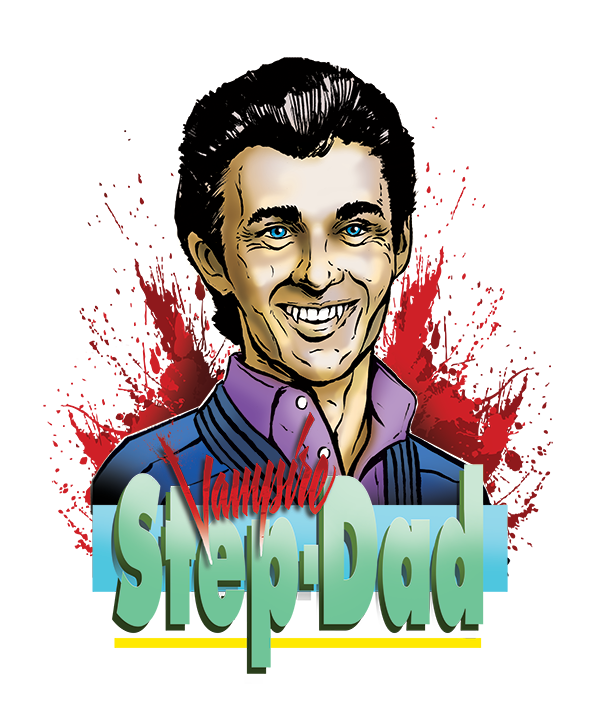
NERD MUSIC: Interview with Vampire Step-Dad

NERD MUSIC is excited to present an interview with Vampire Step-Dad, a high-concept synthwave act by an up-and-coming artist in the scene. [Disclaimer: The G mastered Vampire Step-Dad's last two releases.] Please join Vlad and I as we talk music, nerdery and '80s pop culture! And if you like what you see/hear, you can support Vampire Step-Dad by purchasing his music via Bandcamp, and follow him on Facebook and Twitter, where he is very active.

Thanks for "sitting down" with me! To begin, how did you get into making synthwave music?

Glad to be "here." To answer your question, I first discovered synthwave from a video on YouTube called "MiniDrones Blew Up My Toys!" It's this awesome video where RC cars and mini quadcopters are fighting, using explosions and it's all stylized like a Michael Bay movie. But good. Anyway, they used "Hang 'Em All" by Carpenter Brut, and I was instantly in love. This was just before EP III came out, so just after finding him, he released EP III and I was blown away. It sounded familiar but different than anything I'd heard before. It took me a month or two to look into what style of music it was, and that's when I discovered Synthwave. I was instantly fascinated and had to try and make some myself.

One of the things I love about Vampire Step-Dad is the concept, the idea that the music is made by the protagonist in an Alf-like sitcom. How did you come up with that?

Well, I knew I needed something really original. At first I was thinking of a "name" style ..um...name, like "Skip Tracer" or something like that, but I realize it had two flaws: 1. It was already taken by a country band 2. Personal names are easily forgotten. "Was it Chip Tracker? Skip Lazer? I know it was a name of some sort..." So I had to avoid that route. The most important thing to me was that it screamed "80s" all on it's own. There was plenty of trope names already, nights, neon, lazer, miami...it had all been done to death. And on top of that I've never really been able to take myself too seriously, so I didn't want to try to put on airs of badassness.

So I thought hard about what I experienced the most out of the 80s. For me, it was the TV shows. I loved 80s action movies, but if I'm honest, most of what I watched was family sitcoms. Cosby Show, Family Ties, Alf, as you mentioned. So I knew I wanted to go that route. Expounding on this, the 80's had a lot of non-nuclear families, like My Two Dads and Three Men and a Baby. So that was another facet that said "80s" to me. And LASTY, you know... monsters.

Zombies are overdone, werewolf didn't roll of the tongue very well, and Frankenstein's Monster would leave you too limited. So, Vampire + Step-Dad. It fit all my needs. It sounded 80s. It was memorable, because it makes you immediately start imaging what he'd look like and what situations that could cause. And it aligned with my sense of humor very well. Of course, I didn't realize "Stepdad" is the proper way to spell it until after I got my logo designed, so I had to embrace my own idiocy and run with the dash. (Yeah, that's right, dad jokes. brace yourself.)


You explore different aspects of '80s pop culture in your music. Is this a conscious part of your creative process, or something that emerges organically?

Very, very conscious. My attraction to synthwave is all about the nostalgia. I totally respect the guys making old sound new (like Carpenter Brut) but for me, I want to sound like someone forgot to release the soundtrack to an old movie you've not seen before. Also, with the way I write, sporadically and with no real theme, it serves me well to just go with what's inspiring me at the moment, and see where it takes me. This is why it surprises me when people say my release have any sort of coherence. But hey, I'm not going to argue with anyone that's liking my stuff. But yes, ultimately, I want the first few chords of a song to scream "THIS IS AN 80S SONG! GET IT? DOESN'T THIS FEEL SOOO 80S?" Some people think this is a path that leads to a dead end, but oh well. Maybe I'll shift gears when I feel like it. Right now: EIGHTIES.

When I first heard "Green Berets for Breakfast," I felt like it was straight out of a Stallone and Schwarzenegger buddy flick that was never made, but should have been. A live action Contra. Or Ikari Warriors.

Which version? Original, or Redux? "Berets" was on my first EP, and the response I got with it was very lackluster. But I knew I had something good there. The original has a very slow start, and doesn't do anything special for a good long time, so I can totally understand why people moved on from it. But I new it deserved better, so I revamped it for my second release, Sweater Weather. I gave it a much more powerful open, I sped it up just a tad, and I threw in some new synth solos, to really drive the point home that this is all about badass sweaty dudes with camo paint on their faces. I grew up in a military family loving action movies, so I spent plenty of time running through the woods playing "army" so I knew I wanted to make a track worthy of being in Commando. Man I love that movie.


"Redux!" That was the first time I heard your music, and the Commando vibe is unmistakable. I'm still waiting for the VSD ode to Predator, though. You could call it "Get to the Choppah."

No, I think I'd call it "Puddle of Mud" just to throw people off.

Another thing I enjoy about your music is that it doesn't align neatly with any one of synthwave's dominant tropes, like "retro cyberpunk" or "teen romance." Instead you cover a range of references and approaches, even on a single release. At the same time, there's an unmistakable VSD sound. Conveying a range of aesthetic interests while cultivating a signature sound is no easy task. How do you pull it off?

Completely by accident. I'm not "aligned with a trope" because I can't be that consistent. I rarely sit down and go "OK, I'm going to write an action song!" Cause it always comes out forced. Most of the time I fiddle through presets for an hour until something grabs me, then I build on that. A lot of the time it feels like the song itself wants to be something. Like I'm just digging up something that already exists. I often just feel like I'm along for the ride. A few months ago I noticed I had a few songs and ideas that feel along two paths, so I thought to myself "I can make these two EPs, and actually have a themed EP! Like the pros do! SO I continued with that plan, but I've been stuck for a month now cause saying "I need to write this kind of song" to fill out an EP has me sapped for motivation. My brain has a really hard time working that way. The fact that I have a "sound" is immensely gratifying to hear, as I think most artists are unable to really know what their sound is, or even if they have one. The way people hear your music can be completely different than what you intended.


A lot of our readers are fans of science fiction, fantasy, role-playing games--you know, geek culture in general. And synthwave arguably fits into that category too. How would you describe the connection between this music and broader geek culture? In general or in specific reference to your own music.

You know, I've always felt like geek culture, and this is especially true today, is not so much a discrete culture, but just pop culture in overdrive. Anyone can enjoy a good sci-fi movie, but we're the ones that want to fully understand the universe it's set in, and create a board game, a graphic novel series, and a pen and paper RPG set in it. We want to bathe in it. In the same way, synthwave is just the 80s in overdrive. We're not actually interested in recreating the REAL 1980s. We want to recreate what our memories tell us it was. The distilled, hyperreal version of the 80s. And a lot of sci-fi and fantasy is similar. Look at Blade Runner. There's not a normal street in the whole movie. Everything is wet and lit by neon. People are holding umbrellas with fluorescent lights in them. It's ridiculous, but we love it. So synthwave has that same feel. Soaked in aesthetic. Just drenched with it. And of course, it's also referencing all those movies to, so it has a doubling down effect.

What other groups or artists are you into these days?

Hello Meteor is my go to. When I don't know quite what I want to listen to, but I know I want it to be good, Hello Meteor is it.

I'm obsessed with Oscillian's Shakedown EP. It's like he mainlined Harold Faltermeyer, and it's just so perfect. And Brandon is another one I listen to a lot lately. His debut EP, Neon Haze, is a ridiculously good foot to start on. He's got great songwriting skills, not to mention his production is stellar.

How about your upcoming projects—I think I heard something about a Valentine's Day release...

Yes, I've got a romance themed EP, set to come out in time for VD Day. V Day. Sorry. I've got another one after that that I'm pretty excited about. Not to say I'm not excited about the V Day EP, I'm just stuck working on it right now, so I'm less happy with it.

For all the fellow producers out there, I've got to ask: what kind of gear/software do you use?

I use Reaper for my DAW. Got tired of paying for Pro Tools over and over again and checked out Reaper and was blown away. Never looked back. I use pretty much all stock plugins for mixing, save reverbs. The stock plugins in Reaper sound great and are easy to use. You can actually get them as a free plugin suite if you're on PC. Use them in whatever VST supporting DAW you want.

I work entirely in the box. Software synths, drum samples, amp simulators. I actually have my DAW set up within Dropbox so I can hop between my desktop and my laptop seamlessly. I can start writing a song while on the train, and then when I get home, I can hop on my desktop and it's right there, just as it was on my laptop. It's a pretty awesome workflow. If this intrigues anyone, feel free to find me and ask questions.

My favorite softsynths are Synth1, and OP-X Pro II. Synth1 is free, and the stock bank is cheesy, so a lot of people write it off, but it's so easy to work with once you understand the signal flow, and I've been able to make some great sounds with it. OP-X Pro II is an Oberheim ripoff, and it sounds great, and has a million amazing presets to start from. So good for basses and leads. They sound huge.

***

POSTED BY: The G--purveyor of nerdliness, genre fanatic and Nerds of a
Feather founder/administrator, since 2012. 

Friday, July 22, 2016

Stranger Things: A New Dramatic Animal?


Within two days of Stranger Things appearing on Netflix, I had three separate friends reach out to tell me they'd binge-watched it and I had to see it. That I would love it.

So I did. And I did. But...

I want to be very clear at the outset and say this isn't a review. I'm not going to say bad things about Stranger Things, and I'm going to try to avoid spoilers. What I'm really interested in is more of a formal analysis.

One of the biggest appeals of Stranger Things is its retro-80s vibe. I mean, just look at this poster! It's amazing. 


And that font, which looked out at me from the cover of so many Stephen King paperbacks as a kid gives me all kinds of warm fuzzies. By the end of the first episode, I was hooked. But I turned to my wife and said, "If Hopper winds up in the Black Lodge at the end of this thing, I'm going to be pissed."

See, Stranger Things doesn't just have a retro poster and a retro vibe, it actually seems to be made up of Lego bricks taken from 80s and early-90s touchstones. It's really not enough to say that it's "inspired" by E.T., Twin Peaks, Akira, The X-Files, and the music of John Carpenter. It appears to actually be constructed of those things. There are moments lifted directly from E.T., dynamics transposed whole cloth from Twin Peaks, a key character and plotline from Akira, and at one point there was a scene so reminiscent of Stephen King's It that I was able to tell my wife what was going to happen before it played out onscreen. 

I love all of those movies and stories. Seeing them all in one place was pretty cool. But I felt an odd pull I've never experienced before — part of me felt that warm, familiar nerd glow of spotting references from beloved hallmarks I grew up with, but I felt a difference between spotting the posters for Evil Dead and The Thing on the walls in characters' rooms, and saying "oh, this scene is from..."

Now here, to me, is the really interesting thing: this is a Netflix show, and with the exception of Akira, every other work I've mentioned here has been available for streaming on Netflix. Netflix was very clear when it launched House of Cards, its first original, scripted show, that its programming decisions were based on user viewing patterns. So it's probably safe to assume that people are watching the hell out of E.T., The X-Files, and Twin Peaks on Netflix. And maybe Netflix's development team said, "Can we get a show that's just all of those things, but a mini-series?"

This could be a one-off thing, or it could be a harbinger of a new phenomenon that is a direct result of the time we're living in. With viewership metrics available on a level like nothing we've ever seen before,  the slow demise of the traditional network television model, and a trend toward limited series, rather than 22-episode-per-season non-serialized dramas or comedies, there is a very real possibility that Stranger Things is something like a new narrative form. The G referred to it in conversation as a bricolage, which may be correct. Or a four-dimensional version of Picasso's early experiments with collage. 

I suppose part of me is fighting the urge to be dismissive about a work that in some ways lacks originality, but the fact that I really enjoyed it is telling. I think it will be interesting to see where this goes. I argued in 2013 that Breaking Bad was the signature show of our time not just because of its content and narrative qualities, but because of the way it used streaming services and social media to expand its audience and change viewing patterns. Maybe something similar is happening right now.

Maybe we'll have a Western to look forward to where a Civil War veteran with deep hatred of the Comanche (The Searchers) gets wind of a coming confrontation, and when he can't get anyone in town to stand with him (High Noon), he must confront his racism out of desperation and recruit a team of seven Comanche braves to help him defend the town (Seven Samurai/The Magnificent Seven). Who knows? 

Also, I'm available for meetings, if anybody wants to talk about setting up that project...

Posted by Vance K - co-editor and cult film reviewer at nerds of a feather since 2012. Netflix subscriber since 2004.