Showing posts with label retrofuturism. Show all posts

Monday, March 17, 2025

Film Review: The Electric State

It's almost admirable how completely this film wastes a great concept

In an alternate 1990s, after an almost-successful robot rebellion was crushed with the last-minute help of human-operated telepresence drones, the defeated robots have been exiled to a huge secluded area in the southwestern US, and it's declared illegal for robots to be anywhere else. For some unexplained reason, this blatant act of forced displacement is called a peace treaty. Anyway, the plot proper begins when a runaway robot sneaks into a teenage girl's house and claims to be remotely operated by the little brother she thought had died years before. So she runs away with the robot, since she doesn't like her foster family anyway, and teams up with a smuggler who can get her into the zone where the surviving robots are confined, because that's where her brother's body is being kept. During this rescue mission, they uncover the evil secrets of the company that provides the world with telepresence drones, and create a new state of affairs where robots have a better chance of being free.

This rather average-sounding summary doesn't do justice to how aggressively generic the new Netflix film The Electric State is. Its cardboard characterizations, absolutely predictable beats, self-sabotaging style of humor, uninspired action sequences, unforgivably misjudged casting, overwritten dialogues, and toothless politics would suffice to render it just another forgettably mediocre Netflix production. What sets this disappointing exhibit of laziness apart is the fact that it purports to be an adaptation of the far more interesting illustrated novel of the same title published in 2018 by Swedish artist Simon Stålenhag. While the Netflix version goes out of its way to sand down its own themes and confine itself to family-friendly palatability, the source material was a scathing portrait of American modern vices: ubiquitous advertisements, irrational consumerism, and self-absorbed numbness. None of that commentary survives the adaptation process, because God forbid a Russo brothers character feel a true emotion or express a controversial viewpoint. The version of The Electric State they deliver is an empty carcass painted over with a cartoon smile.

Instead of its paint-by-numbers attempts at comedy or pathos, what actually reaches into the viewer's soul about this film is the unbelievably expert degree to which it avoids sparking any interest or empathy. Its happy scenes feel bland, its sad scenes come off as glib, its surprises are derivative, its scary bits are more deserving of embarrassment, and its appeal to righteous indignation doesn't know which value to care about. It's as if the Russo brothers had deliberately designed an experiment to craft a film that leaves every human emotion untouched. It doesn't even manage to provoke a memorable negative reaction: it should be boring, but it's too absurd for that; so it should be irritating, but it's too insecure for that; so it should be tiresome, but it's too scattershot for that; so it should be confusing, but it's too preachy for that; so it should be offensive, but it's too insincere for that. This production so fundamentally misunderstands what makes movies work that it may as well have been made by its robot characters.

To mention just one of many missed opportunities: in 2005's The Island, a universally and justly disliked movie, the villain has a henchman hunting down our protagonists because they're legally less than people, until the henchman has a moment of reflection and realizes that he, as a Black man, has a common cause with the targets he's chasing. He rebels against the villain explicitly because he knows what happens when a category of people is treated as less than people. As it happens, The Electric State also has a Black henchman hunting down our protagonists because they're legally less than people, and he also ends up rebelling against the villain, but somehow the movie never makes the obvious connection. The reason given for this plot point is the least imaginative possible. It should be cause for alarm for any movie that The Island has a clearer sense of its own stance than you.

Even with the mangled plot that was used instead of the original, The Electric State could have made urgently relevant points about the evils of inventing separate categories of personhood, the possibilities of resistance under total oppression, the temptation to replace the harshness of real life with a soothing fantasy, or the danger of inputting profit and human life in the same equation. This could have been a strong story, both by its own merits and in relation to our times. But perhaps it's an even more telling reflection of our times that the duo of the most successful directors in the history of cinema have settled for building the appearance, rather than the intention, of having something to say.

--

Nerd Coefficient: 3/10.

POSTED BY: Arturo Serrano, multiclass Trekkie/Whovian/Moonie/Miraculer, accumulating experience points for still more obsessions.

Tuesday, February 20, 2024

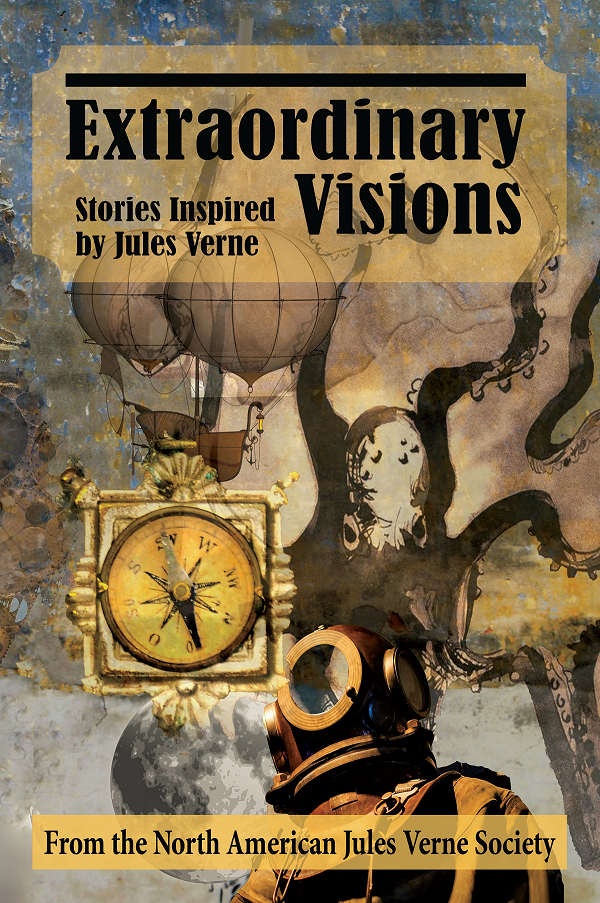
Review: Extraordinary Visions: Stories Inspired by Jules Verne

A curious experiment in probing the minds of fans

More or less a year and a half ago, the North American Jules Verne Society posted a call for submissions to a planned anthology of short stories inspired by Verne's oeuvre. These could be sequels, prequels, sidequels, or original pieces using the same vibe or setting. The result is the book Extraordinary Visions, which contains thirteen stories from across the Anglosphere.

What this collection contains is the purest form of fanfiction—and here I must be very clear that by "fanfiction" I don't mean anything derogatory. These stories consciously seek to honor and perpetuate Verne's style, buttressed by the state of scientific knowledge that existed during his lifetime. This is the highest form of flattery Verne could have hoped for from his readers; indeed, one can read Extraordinary Visions as a historical register of the state of English-speaking Verne fandom at this moment of the 21st century. However, in terms of literary quality, the success of the experiment is mixed.

The Dominion of All the Earth, by Joseph S. Walker, a belated epilogue to Journey to the Center of the Earth, suffers from too much loyalty to the original text. The dialogues try for antique but come off as stilted and verbose. The protagonist has done all his actions prior to the story proper, leaving him only with the role of sitting and listening to seven pages of exposition, and that's the end. If we judged this text by today's narrative conventions, the first criticism would be that this is not a protagonist propelling the action; this is a protagonist having the action dumped onto him.

However, when considered as what it really tries to be, an epilogue to the original novel, it fits perfectly. On its own, this story can't boast much in the way of structural quality (nor can the novel), but if we imagine this story printed at the end of the novel, extending the plot beyond its original non-ending, it helps it reach the completion Verne couldn't give it.

To Hold Back Time: A Baltimore Gun Club Adventure, by Michael Schulkins, more a stealth remake than a true sequel to The Purchase of the North Pole, also shows the limitations of prioritizing faithfulness to the original. In speech, mannerisms, personalities and interests, this story achieves a credible recreation of the Baltimore Gun Club, one of the most suffocatingly ultramasculine creations of literature. However, this outdated vision of scientific progress still finds resonance. The scenes where the Club's entrepreneuring gentlemen meet to plan the improvement of human life via the all-purpose power of firearms bring to mind today's equally overconfident tech bros, obsessed with moving fast and breaking things.

This time, the Club's big idea is to give themselves more free time each day "for extended gunnery practice" by slowing down the rotation of Earth. How, you ask? With huge, carefully positioned cannons, of course. The story delivers the bits of humor that can be expected from such a premise, but the plot follows the beats of The Purchase of the North Pole so closely that the reader will not be surprised to find a similar ending that happens for similar reasons, with the added disadvantage that this ending requires experienced cannoneers to commit an elementary mistake about how recoil works.

A Drama in Durango, by Alison L. Randall, is a more original story, even if it's partly inspired by A Drama in Livonia and less directly by Master Zacharius. Its protagonist is a fan of Verne's books who lives in the age of cowboys and uses the same logical methods of Verne's characters to solve the case of a wandering bank robber who turns out to be linked to a much larger conspiracy. The plot is woven impressively tight, with each step in the chain of secrets, betrayals, plans and counterplans fulfilling its function in harmonious order.

Old Soldiers, by Gustavo Bondoni, is rather problematic. It's set decades after the ending of The Steam House and deals with the reconstruction of its mechanical elephant so that it can be used in World War I. Although the idea of defending France from the Kaiser's troops with a steam-powered robot is a potent premise, that adventure is only reported in a late flashback by a minor character; we don't see it happen. The focus of the story is centered instead on an Indian man who worked as a servant of the British pilot of the Steam House, and who even in his last years continues to feel for his old master a reverence that is disturbing to read. The abusive power dynamic between colonizer and colonized is never addressed, and the rightness of arming the British Empire with a huge metallic fighting machine is simply taken for granted, as it was in the original novel. Add to these problems the two lead characters' fixation with manly emotionlessness and the story's unquestioned pro-militarism, and the result is a deeply uncomfortable read.

Want of Air, by Janice Rider, is another story about Verne fans. With a gentle touch over the wounds of grief, the author draws a poetic parallel between a widow and a son comforting each other during a winter night and an episode in Twenty Thousand Leagues Under the Seas where Nemo and his crew are trapped with only a few hours of oxygen left. This story gets the closest to the stated spirit of the anthology in that, instead of playing with Verne's fantastic machines, it goes straight to the more vital topic of readers' shared love for Verne and what that shared love can bring to your life.

Nellie and Jules Go Boating, by David A. Natale, alludes to a real-life incident. In 1889, American journalist Nellie Bly embarked on a solo trip around the world, in an (eventually successful) attempt to complete it faster than Verne's imagined 80 days. During one of the stops in her itinerary, she happened to be close to Verne's house in France, so of course she took the opportunity to meet him and discuss the adventure she was undergoing. No one knows what they said to each other. This story imagines what might have happened in those brief hours.

The premise is a good one, but the dialogues suffer from the frequent appearance of untranslated French in the middle of lines supposed to be transcribed in English for the reader. Also, for a story about a woman's determination, independence, and accomplishments, there's a bit too much of focus on Verne's relationship with his father. Those sections distract from the events that are actually of interest, and are written with less technical finesse than the rest of the text.

The Highest Loyalty, by Mike Adamson, is a standard rescue adventure starring Captain Nemo. He receives a call for help, he helps, the end. The briefly mentioned backstory, where the Nautilus was part of the Underground Railroad carrying Black people to freedom, would have been far more exciting to read than the plot that is instead told here.

Embrace of the Planets, by Brenda Carre, is a surreal potpourri of Verne references, as well as a multilayered dramedy about the stories we keep about ourselves and that not everyone deserves to hear. Bonus points for Doctor Who vibes.

Rust and Smoke, by Demetri Capetanopoulos, plays with the possibility that Captain Nemo's diaries might have been found ashore in Norway, but not recognized for what they were. This story carries a bittersweet aftertaste of how quickly the most precious memories can fade into the indifference of time.

Gabriel at the Jules Verne Traveling Adventure Show, by Joel Allegretti, captures with the sincerity that can only come from first-hand knowledge that primordial experience of being a child who meets the worlds born of Verne's imagination for the first time and naturally, as we all once did, wants to become part of them.

Tyranny Under the Sea, by Christopher M. Geeson, presents a terrifying scenario: what if a fragment of the Confederacy had survived in a secret city on the ocean floor? And what would a slave revolt look like in such a place?

Trumpets of Freedom, by Kelly A. Harmon, merges the plots of Robur the Conqueror and The Lighthouse at the End of the World into something less tragic than either. Vasquez, the lighthouse keeper, has built mechanical workers to help him with his daily tasks, which makes him exactly the type of unconventional thinker that Robur is eager to befriend.

Raise the Nautilus, by Eric Choi, is the blood-pumping adventure you want a collection like this to end with. The British Empire has its hands full, what with fighting the Kaiser in Europe, so what good would it do to send warships to the South Pacific in an improbable attempt to salvage what could remain of Captain Nemo's shipwrecked invention from the ruins of the Mysterious Island?

It is to be commended that this story takes the time to consider the moral tensions inherent to having British soldiers steal the life's work of an enemy of the British Empire. Unlike in World War II, the Great War had no good/bad divide: all parties were criminally culpable. The single-minded, never-ending pursuit of bigger and bigger guns is hinted at in some dialogues. However, the story stops short of attributing any tactical advantage to possession of the Nautilus; one central character explicitly predicts that, in the new kind of war that the 20th century has brought, even Nemo's advanced weaponry will make very little difference regardless of who captures it. So, in the end, the core question this story hinges on is not whether the British will remain unconquered by the Germans, but whether Nemo will remain unconquered by the British.

Extraordinary Visions is a worthy read despite the uneven selection it's composed of. It especially piques my curiosity that the most innovative, thoughtful and creative of its stories are those written by women. If I may be allowed a very rough generalization, the men wrote about interacting with Verne's settings and characters, while the women wrote about what Verne means. Verne himself might have felt more at home with the first style of writing, but both are compelling ways of exploring the legacy of one of science fiction's biggest forefathers.


Nerd Coefficient: 7/10.

POSTED BY: Arturo Serrano, multiclass Trekkie/Whovian/Moonie/Miraculer, accumulating experience points for still more obsessions.

Reference: Southard, Steven R. and Hardesty, Matthew T. [editors]. Extraordinary Visions: Stories Inspired by Jules Verne [BearManor Media, 2023].

Tuesday, April 11, 2023

On the American nightmare of 'Hello Tomorrow!'

See the 1950s not as they happened, but as they wish they had

Welcome to postwar America, a land of ambition, opportunity, and pie-in-the-sky dreams. Everything is possible if you can affo— erm, imagine it. Why put off until later what you can purchase today? Fortune favors the brave, and today's name for fortune is the free market. At the push of a button, happiness can be yours in affordable installments; all you need to do is believe hard enough. So, what more could you desire in this cornucopia of pastel and chrome? Sign on the dotted line, and you can boast your very own piece of the Moon.

The new Apple TV+ series Hello Tomorrow! is a funhouse mirror version of the mid-century prosperity boom that cemented American world dominance. All the miracles that technology was supposed to bring to our daily lives are made real here: robot waiters, self-heating popcorn, personal jetpacks, smell-o-vision, hovercars, self-adjusting neckties, lunar telephones. The lifestyle of domestic leisure that the Space Age failed to deliver is presented in full, oversaturated color, with a populuxe glee that would make George Jetson nod with pride.

Although daily life in this world is as bright and comfortable as the real 1950s merely hoped to be, it's built on the same soul-crushing cutthroat grind, and the character types created for this story are fascinating examples of the coping strategies required to survive in consumerist utopia. If the production design of Hello Tomorrow! is award-worthy, the casting is pitch-perfect. The roles played by Haneefah Wood and Alison Pill carry the weight of being the only sensible women in a world of excitable manchildren, whereas Susan Heyward and Dagmara Domińczyk play more cynical characters who have learned to game the system in their favor. Hank Azaria as a compulsive gambler with odd Freudian superstitions represents the weary worker who does the exact minimum required by his job while despising every day of it, while Dewshane Williams as a compulsive people-pleaser with a creepy practiced smile represents the fully absorbed worker who has sincerely bought into the myth of self-made success via hard effort. Matthew Maher as a compulsive rule-enforcer who implausibly speaks in misspellings represents the lawful acquiescence that keeps the dehumanizing machinery running, and Billy Crudup as a compulsive fraudster who can't refrain from phrasing everything in ad copy represents, paradoxically, the most honest portrait of how business is actually done.

If marketing, as I've said before, is the Dark Side of rhetoric, Crudup's character has the vilest, most despicable job in the galaxy: he's a salesman. A very skilled one. Even if he weren't a silver-tongued smoke peddler, even if his polished spiel about offworld luxury property were true, his strategy of tugging on people's deepest aspirations to get them to part with their money would suffice to instantly detest his manipulative personality. Crudup does a fantastic job of expressing the layers of pretense that envelop this conniving trickster who always needs to keep in mind which version of the lie he's telling to whom. In the real world, selling real estate on the Moon has no legal basis, but that hasn't stopped many a self-proclaimed entrepreneur from trying, nor will this be the last time shameless speculators point to the Moon to make their case. What this salesman has figured out is that lunar property is the kitschiest form of conspicuous consumption, a mark of distinction for the whole planet to watch with open envy. Something to literally look up to.

It is precisely the concept of "looking up to" that drives the best character dynamic in the show: that between the con man played by Crudup and his son, played by Nicholas Podany, a spectacularly cast role that explores with passionate earnestness the whole range that goes from American optimism to American heartbreak. If every story about the future is actually saying something about the present, every alternate history is actually telling something about reality. The shiny future didn't fail to come because we didn't invent personal jetpacks. The world of Hello Tomorrow! has all the technological delights that industrialized capitalism promised American workers, those same workers who grew up traumatized by the Great Depression and apparently swore to never look poor again. Our fraudster protagonist doesn't want to be an honorable father; he wants to seem one. He doesn't want to do honest business; he wants to be seen performing it.

American mid-century prosperity was real, but it was supported by a gigantic effort in aesthetics. We're currently plagued by nostalgia for the 80s, which in turn dealt with nostalgia for the 50s. But what is remembered about the 50s is what got photographed, filmed, advertised, not the actual experiences of the people on whose backs that prosperity rested.

Carl Sagan is often misquoted as having said, "that which can be destroyed by the truth deserves to be." It's fittingly ironic that the popular attribution of the phrase is likely mistaken. In Hello Tomorrow!, that which can be destroyed by the truth is too shiny and pretty to let go. Success, prestige, glamour is what America promises, what the protagonist of this series trades in. He's not selling plots of land; he's selling a vision of self-realization that consists in vacuum-sealing oneself from the undeserving rabble. Just like he's become isolated from everything that was genuine in his life, he's inviting others to buy the same isolation. His inability to open up to his son is a microcosm of the anxiety that underlied 1950s America, a place where your honesty limits your achievements, where you may have no more than the shirt on your back, but as long as it's sufficiently starched, you can dream of the stars.


Nerd Coefficient: 9/10.

POSTED BY: Arturo Serrano, multiclass Trekkie/Whovian/Moonie/Miraculer, accumulating experience points for still more obsessions.

Tuesday, November 7, 2017

The Lost World of Hawkins, Indiana


Someone on my Facebook feed posted a really interesting article on Stranger Things and the enduring pop cultural appeal of '80s nostalgia. Unfortunately I can't find it now, but one of the more notable tidbits was the observation that the current wave of '80s nostalgia, which traces back to the late '90s, has now been around almost twice as long as the '80s themselves.

In truth, it's phased in and out, but never gone away. Now, in 2017, it is in full bloom: we've gotten a remake of It, a sequel to Blade Runner, an '80s themed entry in the Thor movie franchise and, most importantly, a second season of Netflix's unabashedly nostalgic sci-fi horror show, Stranger Things. Meanwhile, synthwave--the overtly retro '80s music that I make (shameless plug)--is more popular and visible than ever.

I've long wondered why I'm so attracted to '80s nostalgia, why I've always been attracted to it, but also why I'm so particularly attracted to it now. The simple answer is that I grew up in the '80s, but that's only part of the story. I was a teenager in the '90s, so you might think I'd be nostalgic for that cultural moment. I probably will be at some point, but I'm not right now, not really. So there's clearly more going on there, and I suspect that's the case for most people. What follows is an attempt to make sense of it all, with special reference to Stranger Things.


An Evolving Aesthetic

In 1997, VH1 debuted what would become its signature program in the post-video age: Behind the Music. Though not limited to '80s musicians, episodes that featured that decade's more ridiculous figures were instant hits. In 2002, VH1 adapted the British program I Love the '80s, which surveyed the decade's pop culture landscape a year at a time. (I Love the 70s and I Love the 90s followed soon thereafter.)


These programming decisions both reflected and contributed to the wave of nostalgia for '80s pop culture that, according to Simon Reynolds, cast its shadow over the entire decade. Indeed, if you look at independent music in the early '00s, it's positively drenched in the stuff: from the "punk funk" aesthetics of LCD Soundsystem, Franz Ferdinand and Datarock to the new wave revivalism of Ladytron, Fisherspooner and Scissor Sisters. And it wasn't limited to music either. The cult TV show Freaks and Geeks (1999-2000) was, in a sense, the Stranger Things of its day. And Napoleon Dynamite (2004), though not technically set in the 1980s, had a distinctly '80s nostalgic aesthetic. So why does the current round of '80s nostalgia feel different?

In 2005, VH1's Michael Hirschorn had this to say about the '00s wave of '80s nostalgia:

[It] applies to a specific kind of Gen X, self-mocking, slightly ironic thing. For this group of people, you can't give them straight nostalgia of the sort of baby- boomer, "everything was wonderful and great when we were kids" feel. People Gen X and younger know that things weren't that great. We never thought that Motley Crue was saving the world. We identify with them passionately, but with a certain wink.

The ironic take still holds, to a degree, but it's never been the only thing going. Revivalists from the ''00s, such as Daft Punk and Ariel Pink, described their approach in decided unironic terms, as less an attempt to recapture a specific sound (with the addition of a wink and a nudge) as to recapture the "blissfully indiscriminate" way in which music was consumed at that time, something that evaporated with the decline of radio and MTV's switch to scripted programming. And if anything, the current wave of retro enthusiasm feels much less ironic and much more earnest than it did in the '00s.

There are plenty of haters, who dismiss the current wave of '80s nostalgia as insipid or emblematic of cultural exhaustion (for example, here and here). But I think those people vastly miss the point, namely, that '80s nostalgia in 2017 is purposive, and says more about where we are today than it does about the moment it portrays. And nowhere is that more apparent than in the lost world of Hawkins, Indiana.


The Lost World of Hawkins, Indiana


When I first starting watching Stranger Things, I was struck by how familiar Hawkins, Indiana felt. I grew up in a place more or less like that, an old Northeastern mill town. It was a twenty minute drive from a small city, and just under an hour from a big one. But it was also a self-contained universe. Most people worked in factories, making calculators, school uniforms or costume jewelry. Others worked in supporting industries--one friend's father owned a small metal treating company, which served the factories. There was a vibrant main street, and a great diner that got so packed on Sundays you could think the whole town was there. There was little crime, and it felt like everyone was looking out for everyone else. It was the kind of place where you knew the police and firefighters by name. The real locals, by which I mean those with roots in the community, probably knew them all from school or little league.

A lot has changed since then. Most of the factories have closed, with the work they once did (and the work that supported them) outsourced to cheaper labor markets. Main Street, like so many across the US, is a dilapidated shadow of its former self. The town as a whole is still okay--its proximity to the aforementioned cities meant it was able to transition from a place that made things to a commuter suburb. And the diner's still there. Many factory towns have not been so lucky.

But when I see the town of Hawkins, Indiana, it feels like I'm looking back at the place I grew up in, as it once was, but which no longer exists in the same form. This feels important. Stranger Things isn't just a celebration of pop culture from a previous moment, but a window into a lost world--one where things that have become deeply uncertain are rendered certain again.

The appeal of peeking into this world makes a lot of sense when you consider the political trend, both in the US and globally, toward economic populism. Strikingly, this trend is evident across the political spectrum, though it manifests differently on each end. Both sets of populists want to turn back the clock on several decades of globalization, outsourcing and the financialization of the economy. They just apportion blame differently. Left wing populists are angry over the dissolution of what George Packer calls "the Roosevelt Republic," a 50-year period of state-regulated economic security and egalitarianism, which was broken up in wake of late '70s stagflation to encourage faster growth, which in turn has disproportionately benefitted the richest of the rich. Right wing populists, by contrast, blame mass immigration for driving down wages and labor unions for driving out the factory owners. Both blame free trade for making it cheaper to build things abroad, though left wing populists also stress its negative effects on emerging markets.

The window to Hawkins shows a place where none of these things have happened yet. Though deregulation was already well underway by 1983 (when season one of Stranger Things takes place), the effects were not yet evident. We are looking at a place that hasn't experienced the financial crises of 1987, 2000 and 2008 or the cancerous spread of Walmart--a place where economic security and a middle class standard of living are still assumed. I imagine that most people who watch Stranger Things, regardless of their politics, find this comforting.

Another aspect of Hawkins that strikes me is its whiteness. I don't mean that in strictly racial terms; after all, Lucas is black, as are some other town residents. Rather, I mean it in cultural terms. No one in the town listens to hip-hop, funk or r&b, just rock and country. Aside from this season two's California transplants, no one seems to come from anywhere except Hawkins. There are no immigrants. There doesn't even appear to be a Chinese restaurant.

I also recognize this aspect of Hawkins from my own childhood, when we had to drive to the city for decent Chinese, or to the big city for Thai. That started the change in the '90s, when the area grew more diverse. In 1983, it wasn't very diverse at all. As part of a multilingual household and with an immigrant mother, I was basically the diversity.

This is not something I'm nostalgic for. Even at a young age, I found the hegemony of the monoculture oppressive. The '90s felt like an awakening to the world, with all the promise that entails. I am decidedly not nostalgic for the days when everyone died where they were born.

But I'm sure other people are. In 2016, pundits spoke at length about economic anxieties related to uneven globalization, but surveys have shown that more people have what you might call cultural anxieties. In extreme form, these manifest as racism, xenophobia and other exclusionary ideas that divide people into categories and then rank them by acceptability. More often, though, it isn't so much about accepting people from other backgrounds as accepting other cultural practices as valid and normal. It is possible, from this view, to accept individual people who look different as long as they don't act different. As long as they don't challenge the hegemony of the monoculture.

It would not surprise me to find out that some people are attracted to this element of Hawkins, Indiana, and more specifically, its portrayal of a world before multiculturalism and a time when the myth of strict assimilation still ruled supreme. Hawkins, one could argue, is a utopia for the culturally anxious, a place where the few non-white residents are perfectly comfortable within the monoculture, which in turn makes everyone perfectly comfortable with them. Put another way, Hawkins is exactly what people mean when they use "I don't see color." It means, "I don't want to think about difference."

I don't fault the Duffer Brothers for portraying Hawkins this way. Not everything has to center race, and I appreciate the fact that Lucas is treated as just another kid by everyone in the town. But as I examine my own feelings for this show, and for the place and time it portrays, I have to be honest about what I'm looking at, and how that makes me feel. Stranger Things is portraying my own lost world accurately, but there are things you lose and wish you could get back, and other things that are better left in the past.


The Lost World of Personhood Beyond Politics


Yet there are plenty of things I do wish we could go back to. Among those, the days when political identities were not so much a defining feature of your personhood as an element of color. Now, politics have always mattered, as have political disagreements. I remember the strong differences of opinion in the '80s: on welfare and taxes, on nuclear weapons and the threat of mutually assured destruction and so forth. But life was not as polarized as it is now. My dad and my friend's dad used to joke on election day that they were canceling out each other's votes. Can you imagine that now--not only saying it, but saying it to a friend and both of you thinking it's funny?

The shift in attitudes is widespread. As Pew noted in a 2014 report:

The overall share of Americans who express consistently conservative or consistently liberal opinions has doubled over the past two decades from 10% to 21%. And ideological thinking is now much more closely aligned with partisanship than in the past. As a result, ideological overlap between the two parties has diminished: Today, 92% of Republicans are to the right of the median Democrat, and 94% of Democrats are to the left of the median Republican.
Partisan animosity has increased substantially over the same period. In each party, the share with a highly negative view of the opposing party has more than doubled since 1994. Most of these intense partisans believe the opposing party’s policies “are so misguided that they threaten the nation’s well-being.”

The causes of this effect are multiple. Partisan gerrymandering has disincentivized median voter strategies, while unlimited campaign financing means politicians are more beholden to the wishes of individual donors than their districts. Concurrently, the decline of the newspaper and rise of both shrill partisan media and social media all contribute to the emergence of parallel echo chambers, which generate internal solidarity and views of the other as intrinsically threatening. What political polarization has done, then, is transform every political disagreement into a zero sum game, when in past days it might not have been treated as such.

You might be wondering where I'm going with all this; Hawkins, after all, is not a political world. In the series, the only political markers in the town are a solitary Reagan/Bush '84 sign on Mike's yard, as well as his father's bland statement to the men in black, "we're all patriots here." But that's exactly the point. We know very little about anyone's politics--no one even talks about it. So instead we form our opinions on the goodness of people through other means. And that's when it struck me: can you imagine deciding whether you think someone is a good person or not without knowing their political worldview? This was possible at one time, but it feels weird and alien now.

Some issues bely compromise--of that there can be no doubt. But today it often feels like everyone is fighting everyone on everything, and are so hideously polarized that they can't even think of the other side as equally human. Hawkins provides a comforting antidote to that paradigm, a glimpse back to a moment when people weren't as likely to other the political other. We don't know who Hopper or Joyce vote for; all we know is that they do right by people.


The Lost World of Childhood


Most strikingly, Stranger Things captures the freedom accorded to children in days past, and the lack of freedom accorded today.

I'm a parent now, and I'm clear-eyed about of how different it is to raise a child now compared to when I was a kid. Some things have improved--there's much more awareness of bullying, for example, and parents (dads especially) are a lot more involved in day-to-day child rearing than they once were. And, as mentioned above, I see immense value in exposing children to different cultures--something much easier to do now than before, especially if you live in a Hawkins. But I do lament the fact that my kids don't have the freedom I had as a child. The freedom to roam, explore and learn by doing.

Partly that's because I no longer live in a Hawkins. Since college, I've chosen to live in big cities. I've chosen that path on purpose; I find them more stimulating and exciting. But big cities come with crime and traffic, and their populations are transient. There is more to worry about, and fewer people around who you can trust implicitly. It is not possible to simply let your kid roam free at a young age the way you can in a small town. If you did, someone might even report you to the police.

But it's also cultural--not in the sense of ethnic or religious culture, but the prevalent culture of the moment. The zeitgeist. In many countries, the US included, the lives of children are increasingly structured. As journalist Hanna Rosin writes:

I used to puzzle over a particular statistic that routinely comes up in articles about time use: even though women work vastly more hours now than they did in the 1970s, mothers—and fathers—of all income levels spend much more time with their children than they used to. This seemed impossible to me until recently, when I began to think about my own life. My mother didn’t work all that much when I was younger, but she didn’t spend vast amounts of time with me, either. She didn’t arrange my playdates or drive me to swimming lessons or introduce me to cool music she liked. On weekdays after school she just expected me to show up for dinner; on weekends I barely saw her at all. I, on the other hand, might easily spend every waking Saturday hour with one if not all three of my children, taking one to a soccer game, the second to a theater program, the third to a friend’s house, or just hanging out with them at home. When my daughter was about 10, my husband suddenly realized that in her whole life, she had probably not spent more than 10 minutes unsupervised by an adult. Not 10 minutes in 10 years.
It’s hard to absorb how much childhood norms have shifted in just one generation. Actions that would have been considered paranoid in the ’70s—walking third-graders to school, forbidding your kid to play ball in the street, going down the slide with your child in your lap—are now routine. In fact, they are the markers of good, responsible parenting. One very thorough study of “children’s independent mobility,” conducted in urban, suburban, and rural neighborhoods in the U.K., shows that in 1971, 80 percent of third-graders walked to school alone. By 1990, that measure had dropped to 9 percent, and now it’s even lower. When you ask parents why they are more protective than their parents were, they might answer that the world is more dangerous than it was when they were growing up. But this isn’t true, or at least not in the way that we think. For example, parents now routinely tell their children never to talk to strangers, even though all available evidence suggests that children have about the same (very slim) chance of being abducted by a stranger as they did a generation ago. Maybe the real question is, how did these fears come to have such a hold over us? And what have our children lost—and gained—as we’ve succumbed to them?

Rosin presents a theory of how this happened: the largely irrational fear of child abduction, combined with well-intentioned attempts to reduce the risks children face in their daily lives (for example, a largely ineffective campaign to reduce playground accidents). The end result is a safer, though in some ways less stimulating environment. Hawkins, by contrast, is a place where kids still roam free and only go home for meals. In so doing, it shines a light on all our misgivings with overprotective helicopter parenting in 2017. 

You may or may not buy Rosin's argument; I do, at least in the abstract. I see my own childhood in a place like Hawkins and lament that my kids may never experience those endless days spent on bikes, exploring in the woods or climbing around house construction sites. All done as a matter of course, of course--as long as we were home for dinner. But in practice I find it very hard to let go in that way. Clearly, so does Rosin, and I assume this is true for many parents who grew up the way I did but now find the world changed around them. We appreciate the things that have changed for the better, but we mourn the loss of things we once took for granted. And so, we look through the window into the lost world of Hawkins, Indiana, a place we can see but not touch. 


Endless '80s


Stranger Things exemplifies the purposive dimensions of '80s nostalgia in 2017. But how long can it last? By all rights it shouldn't have lasted this long. Only, rather than fade away, it appears to have metastasized. 

The fact is we are no longer locked into pop culture moments the way we once were. Recall that the '80s themselves were nostalgic for both the '50s and '60s, embodied in everything from The Stray Cats to The Wonder Years. Stranger Things is, itself, an homage to the way these earlier decades were reinterpreted in the '80s, through the form of the late '50s/early '60s monster movie that's really about fear of communism or McCarthyism. And then there's Steve's haircut:


The genius of the '80s was to mash its nostalgias up with a heady dose of futurism and neon. At a time when the future is scary as shit, the dead futures of past times can be comforting, even when they themselves are reimaginings of even older futures. Meanwhile, the microgenrefication of music and other entertainment media mean that popular culture can sustain all nostalgias at any given moment. Plus there's the fact that a lot of retro stuff is actually pretty creative. Synthwave, for example: this isn't '80s music made today, but rather a modern style of music that draws as much on incidental soundtrack and corporate music as it does on pop or indie stuff.

Or compare the pastiche of references in Stranger Things to those in Ernest Cline's 2011 novel Ready Player One. The references never overwhelm the narrative in Stranger Things, nor are they ever made explicit. In other words, if you haven't seen ET, Poltergeist or Aliens, you won't know the winks and nudges are there. Rather, they are window dressing on what is, at its center, a compelling human drama. Ready Player One, by contrast, hits you over the head with its unending stream of '80s references--delivered through a series of encyclopedia-style infodumps that are as jarring as they are unsubtle. Now, I realize that Ready Player One has its legion of fans; but I've tried to read it twice and in found myself unable to suspend disbelief. With Stranger Things, by contrast, I practically live in Hawkins for each 45 minute episode.

All this is a longwinded way of saying that, while it's possible that '80s nostalgia will recede from popular view, I don't see it going away. Not as long as we still dream of lost worlds.


***

POSTED BY: The G--purveyor of nerdliness, genre fanatic and Nerds of a
Feather founder/administrator, since 2012. 


Monday, November 28, 2016

NERD MUSIC: Interview with Vampire Step-Dad

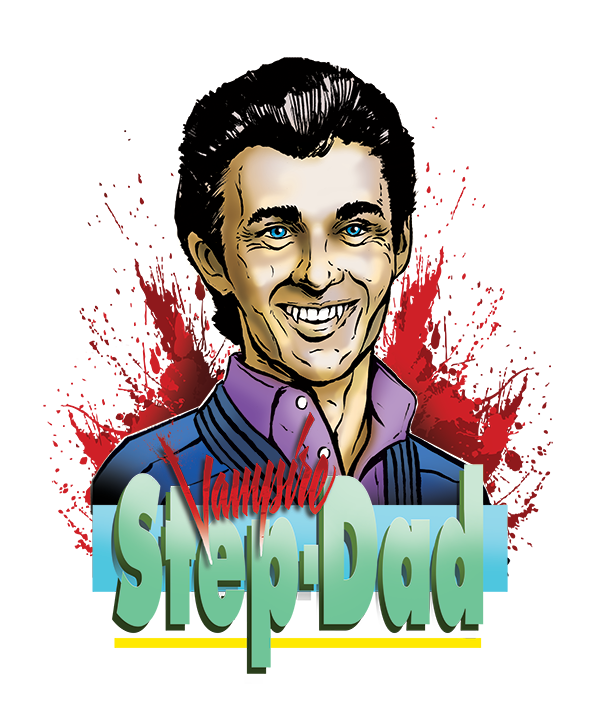
NERD MUSIC is excited to present an interview with Vampire Step-Dad, a high-concept synthwave act by an up-and-coming artist in the scene. [Disclaimer: The G mastered Vampire Step-Dad's last two releases.] Please join Vlad and I as we talk music, nerdery and '80s pop culture! And if you like what you see/hear, you can support Vampire Step-Dad by purchasing his music via Bandcamp, and follow him on Facebook and Twitter, where he is very active.

Thanks for "sitting down" with me! To begin, how did you get into making synthwave music?

Glad to be "here." To answer your question, I first discovered synthwave from a video on YouTube called "MiniDrones Blew Up My Toys!" It's this awesome video where RC cars and mini quadcopters are fighting, using explosions and it's all stylized like a Michael Bay movie. But good. Anyway, they used "Hang 'Em All" by Carpenter Brut, and I was instantly in love. This was just before EP III came out, so just after finding him, he released EP III and I was blown away. It sounded familiar but different than anything I'd heard before. It took me a month or two to look into what style of music it was, and that's when I discovered Synthwave. I was instantly fascinated and had to try and make some myself.

One of the things I love about Vampire Step-Dad is the concept, the idea that the music is made by the protagonist in an Alf-like sitcom. How did you come up with that?

Well, I knew I needed something really original. At first I was thinking of a "name" style ..um...name, like "Skip Tracer" or something like that, but I realize it had two flaws: 1. It was already taken by a country band 2. Personal names are easily forgotten. "Was it Chip Tracker? Skip Lazer? I know it was a name of some sort..." So I had to avoid that route. The most important thing to me was that it screamed "80s" all on it's own. There was plenty of trope names already, nights, neon, lazer, miami...it had all been done to death. And on top of that I've never really been able to take myself too seriously, so I didn't want to try to put on airs of badassness.

So I thought hard about what I experienced the most out of the 80s. For me, it was the TV shows. I loved 80s action movies, but if I'm honest, most of what I watched was family sitcoms. Cosby Show, Family Ties, Alf, as you mentioned. So I knew I wanted to go that route. Expounding on this, the 80's had a lot of non-nuclear families, like My Two Dads and Three Men and a Baby. So that was another facet that said "80s" to me. And LASTY, you know... monsters.

Zombies are overdone, werewolf didn't roll of the tongue very well, and Frankenstein's Monster would leave you too limited. So, Vampire + Step-Dad. It fit all my needs. It sounded 80s. It was memorable, because it makes you immediately start imaging what he'd look like and what situations that could cause. And it aligned with my sense of humor very well. Of course, I didn't realize "Stepdad" is the proper way to spell it until after I got my logo designed, so I had to embrace my own idiocy and run with the dash. (Yeah, that's right, dad jokes. brace yourself.)


You explore different aspects of '80s pop culture in your music. Is this a conscious part of your creative process, or something that emerges organically?

Very, very conscious. My attraction to synthwave is all about the nostalgia. I totally respect the guys making old sound new (like Carpenter Brut) but for me, I want to sound like someone forgot to release the soundtrack to an old movie you've not seen before. Also, with the way I write, sporadically and with no real theme, it serves me well to just go with what's inspiring me at the moment, and see where it takes me. This is why it surprises me when people say my release have any sort of coherence. But hey, I'm not going to argue with anyone that's liking my stuff. But yes, ultimately, I want the first few chords of a song to scream "THIS IS AN 80S SONG! GET IT? DOESN'T THIS FEEL SOOO 80S?" Some people think this is a path that leads to a dead end, but oh well. Maybe I'll shift gears when I feel like it. Right now: EIGHTIES.

When I first heard "Green Berets for Breakfast," I felt like it was straight out of a Stallone and Schwarzenegger buddy flick that was never made, but should have been. A live action Contra. Or Ikari Warriors.

Which version? Original, or Redux? "Berets" was on my first EP, and the response I got with it was very lackluster. But I knew I had something good there. The original has a very slow start, and doesn't do anything special for a good long time, so I can totally understand why people moved on from it. But I new it deserved better, so I revamped it for my second release, Sweater Weather. I gave it a much more powerful open, I sped it up just a tad, and I threw in some new synth solos, to really drive the point home that this is all about badass sweaty dudes with camo paint on their faces. I grew up in a military family loving action movies, so I spent plenty of time running through the woods playing "army" so I knew I wanted to make a track worthy of being in Commando. Man I love that movie.


"Redux!" That was the first time I heard your music, and the Commando vibe is unmistakable. I'm still waiting for the VSD ode to Predator, though. You could call it "Get to the Choppah."

No, I think I'd call it "Puddle of Mud" just to throw people off.

Another thing I enjoy about your music is that it doesn't align neatly with any one of synthwave's dominant tropes, like "retro cyberpunk" or "teen romance." Instead you cover a range of references and approaches, even on a single release. At the same time, there's an unmistakable VSD sound. Conveying a range of aesthetic interests while cultivating a signature sound is no easy task. How do you pull it off?

Completely by accident. I'm not "aligned with a trope" because I can't be that consistent. I rarely sit down and go "OK, I'm going to write an action song!" Cause it always comes out forced. Most of the time I fiddle through presets for an hour until something grabs me, then I build on that. A lot of the time it feels like the song itself wants to be something. Like I'm just digging up something that already exists. I often just feel like I'm along for the ride. A few months ago I noticed I had a few songs and ideas that feel along two paths, so I thought to myself "I can make these two EPs, and actually have a themed EP! Like the pros do! SO I continued with that plan, but I've been stuck for a month now cause saying "I need to write this kind of song" to fill out an EP has me sapped for motivation. My brain has a really hard time working that way. The fact that I have a "sound" is immensely gratifying to hear, as I think most artists are unable to really know what their sound is, or even if they have one. The way people hear your music can be completely different than what you intended.


A lot of our readers are fans of science fiction, fantasy, role-playing games--you know, geek culture in general. And synthwave arguably fits into that category too. How would you describe the connection between this music and broader geek culture? In general or in specific reference to your own music.

You know, I've always felt like geek culture, and this is especially true today, is not so much a discrete culture, but just pop culture in overdrive. Anyone can enjoy a good sci-fi movie, but we're the ones that want to fully understand the universe it's set in, and create a board game, a graphic novel series, and a pen and paper RPG set in it. We want to bathe in it. In the same way, synthwave is just the 80s in overdrive. We're not actually interested in recreating the REAL 1980s. We want to recreate what our memories tell us it was. The distilled, hyperreal version of the 80s. And a lot of sci-fi and fantasy is similar. Look at Blade Runner. There's not a normal street in the whole movie. Everything is wet and lit by neon. People are holding umbrellas with fluorescent lights in them. It's ridiculous, but we love it. So synthwave has that same feel. Soaked in aesthetic. Just drenched with it. And of course, it's also referencing all those movies to, so it has a doubling down effect.

What other groups or artists are you into these days?

Hello Meteor is my go to. When I don't know quite what I want to listen to, but I know I want it to be good, Hello Meteor is it.

I'm obsessed with Oscillian's Shakedown EP. It's like he mainlined Harold Faltermeyer, and it's just so perfect. And Brandon is another one I listen to a lot lately. His debut EP, Neon Haze, is a ridiculously good foot to start on. He's got great songwriting skills, not to mention his production is stellar.

How about your upcoming projects—I think I heard something about a Valentine's Day release...

Yes, I've got a romance themed EP, set to come out in time for VD Day. V Day. Sorry. I've got another one after that that I'm pretty excited about. Not to say I'm not excited about the V Day EP, I'm just stuck working on it right now, so I'm less happy with it.

For all the fellow producers out there, I've got to ask: what kind of gear/software do you use?

I use Reaper for my DAW. Got tired of paying for Pro Tools over and over again and checked out Reaper and was blown away. Never looked back. I use pretty much all stock plugins for mixing, save reverbs. The stock plugins in Reaper sound great and are easy to use. You can actually get them as a free plugin suite if you're on PC. Use them in whatever VST supporting DAW you want.

I work entirely in the box. Software synths, drum samples, amp simulators. I actually have my DAW set up within Dropbox so I can hop between my desktop and my laptop seamlessly. I can start writing a song while on the train, and then when I get home, I can hop on my desktop and it's right there, just as it was on my laptop. It's a pretty awesome workflow. If this intrigues anyone, feel free to find me and ask questions.

My favorite softsynths are Synth1, and OP-X Pro II. Synth1 is free, and the stock bank is cheesy, so a lot of people write it off, but it's so easy to work with once you understand the signal flow, and I've been able to make some great sounds with it. OP-X Pro II is an Oberheim ripoff, and it sounds great, and has a million amazing presets to start from. So good for basses and leads. They sound huge.

***

POSTED BY: The G--purveyor of nerdliness, genre fanatic and Nerds of a
Feather founder/administrator, since 2012. 

Friday, March 25, 2016

NERD MUSIC Weekend Mixtape: House and Techno Classics


The G's House and Techno Mix (3.25.16)

Most people think of house and techno as European music, likely because both styles are significantly more popular in Europe than the U.S. But house is actually from Chicago and techno is from Detroit, and though both are thoroughly globalized now, they were originally made by Black artists--reflecting the specific experiences of African Americans in these postindustrial U.S. cities.

I was a bit late to the party, so to speak, only really discovering house and techno in the early/mid 90s. But it blew my mind--here was a music that captured the zeitgeist perfectly: the epochal shift from mass employment to automation, the onset of urban decay, the rise of cybernetics and information networks, the increasing pervasiveness of surveillance and the breakdown of all the old music industry hierarchies and mechanisms for gatekeeping.

So enjoy this "tape" of 12 exquisite house and techno classics, mostly but not exclusively from the 1980s and early 1990s--tracks that I believe capture the pure joy and thrill of that era...


Tuesday, March 8, 2016

Microreview [film]: Kung Fury

Swedish steel.


Like Turbo Kid, which I reviewed last week, Kung Fury is a parody of/homage to the low-rent action films of the '80s. Only this one's much heavier on the irony. See, for example, the plot:

Sometime in the early 1980s, Miami-Dade Police Department detective Kung Fury and his partner Dragon apprehend a red ninja in a back alley, but Dragon is sliced in half by the ninja while Kung Fury is suddenly struck by lightning and bitten by a cobra, giving him extraordinary kung fu powers that enable him to defeat his foe. Years later in 1985, after defeating a rogue arcade machine robot, Kung Fury quits the force when he is assigned to partner with Triceracop, fearing that he would lose another partner in the line of duty. Meanwhile, Adolf Hitler, a.k.a. "Kung Führer", enters the timeline and remotely guns down the police chief and attacks the precinct through a mobile phone. Intent to avenge the chief, Kung Fury has computer whiz Hackerman send him back in time to kill Hitler in Nazi Germany. A glitch in the system, however, sends him back into the Viking Age. After Kung Fury meets the Viking valkyries Barbarianna and Katana, the Norse god Thor sends him to Nazi Germany for him to finish his job.

Or consider the fact that Kung Fury (Sandberg) opens the doors to his Lamborghini Countach by shooting it. Or the scene where two Nazi guardsmen argue, in fake German (it's really Swedish) over who has the more Aryan mustache. Or the VHS glitch effects that periodically reappear. Or the fucking amazing Mitch Murder soundtrack, which features David Hasselhoff on vocals:


Indeed, Kung Fury may be the ultimate film for that certain kind of person who both seeks out a certain kind of ironic humor and enjoys a bit of '80s nostalgia--ironically, of course. For others Kung Fury may lay the insanity on a bit thick. Personally, I thought it was funny as hell, but also noted that, in comparison to Turbo Kid (and the comparison is inevitable), it's a pretty superficial film. And that was even more apparent second time I watched it, when all the surprises had already been sprung. 

At the same time, Kung Fury is only 30-minutes long, which is just about perfect for what is, in essence, a superbly well done one-note symphony. Oh, and Kung Fury's partner, Triceracop? Yes, he is an anthropomorphic triceratops--something that remains thankfully unexplained. 


The Math

Baseline Assessment: 6/10

Bonuses: +1 for the concept of Triceracop; +1 for the amazing soundtrack: +1 for TOTAL INSANITY.

Penalties: -1 for the moment when the joke starts to get a bit old. 

Nerd Coefficient: 8/10. "Well worth your time and attention."


***

POSTED BY: The G--purveyor of nerdliness, genre fanatic and Nerds of a
Feather founder/administrator, since 2012.


Reference: Kung Fury, directed by David Sandberg [Laser Unicorns/Lamprey, 2015]

Tuesday, February 23, 2016

Microreview [film]: Turbo Kid

Back to the future


Turbo Kid is another entry in the semiserious/semi-ironic '80s retro movement linking artists working across multiple media. This one, specifically, is a cinematic homage to the cheap Mad Max ripoffs that only ever seemed to play at the one surviving drive-in left in town, but took up significant real estate at your local video store. I remember, at a young age, holding the fat laminated boxes--marveling at the disfigured faces of post-apocalyptic mutants and foam spike armor of the inevitable raiders, wondering what thrills I might receive if my parents would just let me rent something with that much gore. But when that glorious day arrived, I would inevitably realize, as Peter Sobczynski notes, that these were films whose boxes "always promised more than they ever came close to delivering."

This is the story of the Kid (Munro Chambers), a teenager who rides his bike across the post-apocalyptic wasteland of 1997, scavenging junk to trade for water. While out in the field, he meets Apple (Laurence Lebouef), a very manic pixie dream girl who follows the Kid to his hideout and, through her irrepressible joie de vivre (this is a French-Canadian production, after all), wins over the initially suspect Kid.


Then shit starts to go south. Local badman Zeus (Michael Ironsides) first kidnaps the area protector, Kiwi cowboy and arm-wrestling champion Frederick (Aaron Jeffery), then Apple. All seems lost when, in the midst of trying to escape Apple's kidnappers, the Kid discovers an underground military vessel left over from humanity's catastrophic war with the robots (i.e. the apocalyptic event). Inside there is a jump suit complete with a Nintendo Power Glove, which--if fully charged--can instantly disintegrate a human being. He goes to save Apple (who it turns out can take care of herself quite ably), and in the process sets up a confrontation with Zeus and his gang of foam spike clad marauders.

Standard '80s B-movie fare, right? On the surface, yes--and Turbo Kid does a good job of reinterpreting its source material with a good balance of satire and appreciation for what makes grindhouse film fun to watch--not least of which the hilariously over-the-top gore, which gets more and more absurd as the film goes on. Oh, and it sports a phenomenal soundtrack by synthwave group Le Matos.

What makes Turbo Kid really stand out, though, is its emotional core--propelled by its central relationships, and especially the friendship between the Kid and Apple, which is surprisingly heartfelt and affecting. In the end, Turbo Kid isn't really about action or '80s nostalgia--it's about lonely people finding friendship, and here it doesn't play for laughs, winks or nudges. Sure, Apple starts off as your standard manic pixie dream girl (albeit extra manic), while the Kid doesn't even merit a name; still, by the end of the film I realized how deeply invested I'd become in what happens to them--in a way I rarely am with unserious films made after 1990.

I guess that's the thing about '80s culture that people in 2016 find so attractive, whether we're talking action schlock, John Hughes romances or the digital keyboard sounds used by Billy Ocean--there's a sincerity about all of it, even when that sincerity is corny as hell. And Turbo Kid does a fantastic job capturing that. It's funny and silly, but also distinctly bittersweet, and deeply romantic. Just as importantly, Turbo Kid is the kind of film you can't wait to watch again.


The Math

Baseline Assessment: 8/10

Bonuses: +1 for the highly resonant emotional core of the film, which is what separates it from other attempts to pull of this kind of thing; +1 for the fantastic Le Matos soundtrack, which really accentuates everything the director is going for.

Penalties: -1 for the first 10-15 minutes of the film, which are a bit awkward relative to the rest. '

Nerd Coefficient: 9/10. "Very high quality/standout in its category."

***

POSTED BY: The G--purveyor of nerdliness, genre fanatic and Nerds of a
Feather founder/administrator, since 2012.


Reference: Turbo Kid, directed by Simard, Whissell and Whissell [Epic Pictures, 2015]