Showing posts with label John Carpenter. Show all posts

Thursday, October 9, 2025

Cult Film Review: In The Mouth of Madness (1994)

Cosmic horror without the Lovecraft


This month, just in time for Halloween, the Criterion Channel launched a John Carpenter retrospective. I took the opportunity to revisit 1994's In the Mouth of Madness, one of the strangest John Carpenter films... and I feel like that's saying something.

Fresh off of Jurassic Park in 1993, Sam Neill went to work for John Carpenter, playing insurance investigator John Trent. We meet Trent ranting and raving as orderlies at an insane asylum drag him into a padded room. The next morning, when asylum psychiatrist Dr. Wrenn visits Trent to get his story, he opens the door to find Trent has drawn symbols all over his room, clothes, and face, and he begins to unfold his tale of madness.

John Trent was not always the raving maniac Dr. Wrenn sees before him. No, indeed. Trent was once a successful, can't-bullshit-a-bullshitter insurance investigator. The popular horror author Sutter Cane, Arcane Publishing's biggest literary star, has disappeared, and Arcane wants Trent to find him. Trent reluctantly accepts the assistance of Cane's editor, Linda Styles, but believes from the start that this whole thing is a fakeout—an elaborate publicity stunt designed to generate headlines for Cane's new novel, In the Mouth of Madness. Trent tries to do his research, grabbing copies of all of Cane's novels, but they're too scary. They wind up getting inside his dreams, and maybe even into his waking reality. Maybe everybody's waking realities. A spike in violent crime seems to be tied to people who read Cane's books. And it comes home for Trent while he sits at a restaurant and a man wielding an axe smashes through a plate glass window, coming for Trent before the police shoot the attacker. It turns out this madman was Cane's agent, and right before he raised the axe over Trent's head, he asked a question everyone seems to be asking:

"Do you read Sutter Cane?"

In the same way that Stephen King sets much of his work in the fictional town of Derry, Maine, in the film Sutter Cane sets his work in the idyllic New England town of Hobb's End. Trent realizes that design elements consistent across Cane's various novel covers fit together and form a map to the fictional town. So he and Styles set off to follow the map and see where it takes them. After trading off behind the wheel, Trent falls asleep in the passenger seat, and while Styles drives, things get weird. A figure looms up out of the darkness, the road seems to vanish, the figure returns, but different, then again, then there's a crash, or is there? The radio distorts, goes out, the night seems to bend around Styles, and then... poof. It's daytime and they're in Hobb's End.

That's all the plot summary you get, because after that, the film begins playing with reality in very interesting and increasingly labyrinthine ways. If you haven't seen the film, I don't want to take any of the fun out of it. But extremely telling is the exchange about Cane's books that Trent and Styles have on the road right before he hands over the wheel:

Trent: What's to get scared about? It's not like it's real or anything.

Styles: Well, it's not real from your point of view, and right now reality shares your point of view. What scares me about Cane's work is what might happen if reality shared his point of view.

Trent: Whoa, we're not talking about reality here. We're talking about fiction. It's different, you know?

Styles: But reality is just what we tell each other it is. Sane and insane could easily switch places if the insane were to become the majority.

I have to be honest: that line hit a little closer to home these days than it probably did in 1994. I do remember renting this movie (on VHS!) when it came out, and when it ended, I felt so perplexed, so surprised by the final moments of the film, thinking that I must have missed something, that I rewound it back to their arrival in Hobb's End and watched it again. Watching it this time, having vaguely remembered that experience from 30 years ago, I was a little more prepared to simply go on the journey that Carpenter and writer Michael De Luca wanted to take me on.

If you are a fan of Carpenter and/or Stephen King, this movie is a ton of fun. Carpenter throws in a number of signature visuals that are reminiscent of The Thing, and the movie really nails the Stephen King vibe, not only with the setting but down to the author font on the paperbacks. But one of the most enjoyable aspects of the film is the way it manages to give the viewer a full-on cosmic horror experience without H.P. Lovecraft. Sure, there are a ton of homages to Lovecraft, but it's not his mythos, not his settings, and not his baggage.

Like many people, I can no longer enjoy the work of Lovecraft—certainly not the way I could at maybe 13 years old, reading paperbacks with evocative titles full of odd, elliptical stories that hinted at a hostile cosmos and latent dangers outside of the realms of our perception. But Lovecraft's racism and eugenicist views, which revealed themselves in tropes I wasn't equipped to fully understand at that age, make the experience of reading him one I can no longer find much joy in. And while there are a couple of good ones, Lovecraft film adaptations tend toward the schlocky and cheap, as name-recognizable IP in the public domain might lead you to believe.

So I'm grateful to John Carpenter for In the Mouth of Madness. It scratches the cosmic horror itch in a satisfying way, and wraps it in something of a puzzle box narrative that's akin to a film like Mulholland Dr. but very much in the horror genre. I'm happy to recommend this without having to caveat it.

In the Mouth of Madness is currently streaming on the Criterion Channel (October 2025), and Tubi with commercials.

Tuesday, November 21, 2017

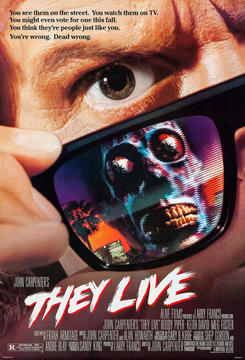
Microreview [film]: They Live directed by John Carpenter

Cardboard Carpenter


I’ve always been a huge John Carpenter fan, and I have fond memories of They Live. So I recently decided to revisit the film and see if it has stood the test of time. Verdict: not a bad film, but not exactly good either.

They Live is the story of a drifter named John Nada (Rowdy Roddy Piper) who arrives in Los Angeles seeking work after an unspecified economic crisis. It’s never clear whether the film takes place in the present or near future, so the crisis is either the 1987 savings & loan crash or a stand-in for it. John  finds work on a construction site, where he meets Frank Armitage (Keith David). Armitage takes Nada to a homeless encampment straight out of Steinbeck. But the encampment, it turns out, is actually a cover for an underground movement seeking to expose the fact that the world is being taken over by aliens, who see humans, and the Earth, as resources to be exploited. After discovering a pair of sunglasses that allow him to see who is human and who is not, Nada embarks on a vision quest to destroy the transmitter that makes the aliens look human.

It’s pretty interesting to watch They Live in 2017. It serves as a reminder that the anxieties of the present—economic precarity, inequality, environmental degradation, the militarization of law enforcement and declining social mobility—were just as scary in 1988 as they are now. The anti-capitalist, anti-elite message of They Live might also resonate with viewers in 2017, given the emergence of “democratic socialism” (i.e. continental social democracy with a pointless new name) and economic populism in general. I also thought it was interesting that Carpenter made the connection between alien exploitation of the Earth and the historical exploitation of the developing world.

Beyond that, though, it's just not a great film. Carpenter's best films, like Halloween, Escape from New York and The Thing, have incredible presence. They are moody, full of atmosphere and deep shadows. For that, one can credit both his peculiar approach to direction and the memorable synth scores he made himself. They Live just doesn't match up. The music--such an integral part of his earlier work--does nothing to build tension. Worse, the film suffers from uncharacteristically poor direction. There are all these weird pauses throughout the film: between lines, in the middle of action scenes, and so forth. And it doesn't help that both Piper and co-star Meg Foster turn in the most wooden of wooden performances.


In the end, They Live has some neat ideas but suffers from execution problems that I found frustrating. It's okay, but not better than okay.


The Meat

Baseline Assessment: 6/10.

Bonuses: +1 for Keith David, the world's greatest character actor.

Penalties: -1 for weird pauses and sluggish pace; -1 for disappointed score from a great film composer.

Nerd Coefficient: 5/10. "Meh."

***

POSTED BY: The G--purveyor of nerdliness, genre fanatic and Nerds of a
Feather founder/administrator, since 2012. 

Friday, July 22, 2016

Stranger Things: A New Dramatic Animal?


Within two days of Stranger Things appearing on Netflix, I had three separate friends reach out to tell me they'd binge-watched it and I had to see it. That I would love it.

So I did. And I did. But...

I want to be very clear at the outset and say this isn't a review. I'm not going to say bad things about Stranger Things, and I'm going to try to avoid spoilers. What I'm really interested in is more of a formal analysis.

One of the biggest appeals of Stranger Things is its retro-80s vibe. I mean, just look at this poster! It's amazing. 


And that font, which looked out at me from the cover of so many Stephen King paperbacks as a kid gives me all kinds of warm fuzzies. By the end of the first episode, I was hooked. But I turned to my wife and said, "If Hopper winds up in the Black Lodge at the end of this thing, I'm going to be pissed."

See, Stranger Things doesn't just have a retro poster and a retro vibe, it actually seems to be made up of Lego bricks taken from 80s and early-90s touchstones. It's really not enough to say that it's "inspired" by E.T., Twin Peaks, Akira, The X-Files, and the music of John Carpenter. It appears to actually be constructed of those things. There are moments lifted directly from E.T., dynamics transposed whole cloth from Twin Peaks, a key character and plotline from Akira, and at one point there was a scene so reminiscent of Stephen King's It that I was able to tell my wife what was going to happen before it played out onscreen. 

I love all of those movies and stories. Seeing them all in one place was pretty cool. But I felt an odd pull I've never experienced before — part of me felt that warm, familiar nerd glow of spotting references from beloved hallmarks I grew up with, but I felt a difference between spotting the posters for Evil Dead and The Thing on the walls in characters' rooms, and saying "oh, this scene is from..."

Now here, to me, is the really interesting thing: this is a Netflix show, and with the exception of Akira, every other work I've mentioned here has been available for streaming on Netflix. Netflix was very clear when it launched House of Cards, its first original, scripted show, that its programming decisions were based on user viewing patterns. So it's probably safe to assume that people are watching the hell out of E.T., The X-Files, and Twin Peaks on Netflix. And maybe Netflix's development team said, "Can we get a show that's just all of those things, but a mini-series?"

This could be a one-off thing, or it could be a harbinger of a new phenomenon that is a direct result of the time we're living in. With viewership metrics available on a level like nothing we've ever seen before,  the slow demise of the traditional network television model, and a trend toward limited series, rather than 22-episode-per-season non-serialized dramas or comedies, there is a very real possibility that Stranger Things is something like a new narrative form. The G referred to it in conversation as a bricolage, which may be correct. Or a four-dimensional version of Picasso's early experiments with collage. 

I suppose part of me is fighting the urge to be dismissive about a work that in some ways lacks originality, but the fact that I really enjoyed it is telling. I think it will be interesting to see where this goes. I argued in 2013 that Breaking Bad was the signature show of our time not just because of its content and narrative qualities, but because of the way it used streaming services and social media to expand its audience and change viewing patterns. Maybe something similar is happening right now.

Maybe we'll have a Western to look forward to where a Civil War veteran with deep hatred of the Comanche (The Searchers) gets wind of a coming confrontation, and when he can't get anyone in town to stand with him (High Noon), he must confront his racism out of desperation and recruit a team of seven Comanche braves to help him defend the town (Seven Samurai/The Magnificent Seven). Who knows? 

Also, I'm available for meetings, if anybody wants to talk about setting up that project...

Posted by Vance K - co-editor and cult film reviewer at nerds of a feather since 2012. Netflix subscriber since 2004.