Showing posts with label paranormal. Show all posts

Tuesday, January 13, 2026

Review: Stranger Things Season 5 Volume II & Finale

The Duffer brothers stick the landing, bringing a close to nine years of epic storytelling

Volume II of the Stranger Things final season dropped on Christmas day, and when we last left our heroes, we discovered that Will could tap into the hive mind and hijack its powersWill the sorcerer, indeed! I've now watched these episodes twice,  and simultaneously so much and so little happens in them. The vibe is a little different from Volume I, as somehow there's even more exposition to get through. Rather than go through the plot, I thought I'd go through what really works, and why the epilogue to episode 8 was fantastic.

What works

Discovering what the Upside Down really is

After discovering some of Dr. Brenner's notebooks in the Upside Down version of Hawkins Lab, Dustin pieces together that everything they thought was wrong. The Upside Down is actually a wormhole to  Dimension X, the place Vecna was transported to by El. It was sort of a Chekhov's Wormhole, though, as the crew had discussed wormholes in Mr. Clarke's science class years before. We still don't learn exactly why the Upside Down is the way it is, all decaying matter and dark skies, but ultimately that's less important than just knowing it was never the ultimate bad place. It's just a tunnel to another dimension. On the other side of the gooey, fleshy wall surrounding the Upside Down is sheer space, as noted by Steve's BMW getting sucked into it and vanishing into the galaxy.

Bringing Mr. Clarke into the crew

Everyone's favorite science teacher is recruited to help build a telemetry device so they can locate Dustin and company, and watching him finally join was absolutely heartwarming. Without him, the kids never would have succeeded in the prior seasons, and his reward is getting to witness all the insane things that have led to this point. It's a very sweet payoff, and he adds a lot to the team. Also, I love that Mr. Clarke is always sleeping with a different member of the Hawkins High School staff. 

Karen "Walk 'Em Down" Wheeler proves she's a badass once again

Still recovering from vicious demogorgon slash wounds in the hospital, Karen saves the day yet again when Lucas, Robyn, and Vicki are cornered by demodogs. After ripping her IV out, she deftly places oxygen tanks into huge commercial dryers, triggering an explosion that takes them all out. Moms in '80s movies are rarely given such agency, and watching her stagger down to the basement to take care of the kids is truly epic. In the epilogue, we see a fully recovered Karen at the kids' graduation, her huge scars visible but worn proudly on display in a V-neck dress.

The epic Mindflayer kaiju battle

When the team finally makes it to Dimension X, they're set to face off against the corporeal forms of the Mindflayer and Vecna. A lot of folks online complained that the battle was too short, but the team literally spent 5 seasons getting to this point. I thought it was awesome, as it actually felt like watching a D&D game in real time, from Steve and Dustin stabbing the Mindflayer's belly to Nancy leading them into the trap where Robin and Lucas and Will could rain down fire from above. Also, Joyce getting to hack off Vecna's head with an axe was a gift she truly deserved. I don't think anyone suffered more than her throughout every season, given her constant panic and stress.

Being the first TV show to license Prince's music

The two needle drops of "When Doves Cry" and "Purple Rain" were not only incredibly appropriate, the Duffer brothers somehow managed to convince Prince's estate that their show was worth granting the green lightno doubt because of the viral success that seemed all but promised. Having the record literally be the detonation devices for the destruction of the Upside Down is a fantastic choice, and El and Mike's final conversation set to "Purple Rain" is absolutely heartbreaking.

Why I choose to believe El is alive

A lot has been said about El's fate, but I think the Duffer brothers did it exactly right. By leaving El's death open to a different interpretation—namely, that she survived thanks to one final illusion by Kaliit gives everybody what they need. Some people are fine with a final sacrifice by a hero, while others (like myself) can choose to believe Mike's ending, that she escaped and is living far away, safe. I choose to believe she's still alive because it's what her character deserves, and at heart, I'm an optimist. But more importantly, I like that we, as the audience, get to choose our ending. It's like D&D itself! I personally don't need a ton of deaths to make a finale more meaningful.

What didn't work for me

There are too many characters

By season 5, we're dealing with upwards of a dozen folks that we have to check in on (somewhat) equally, and that starts to make things cumbersome. I wouldn't trade Robin and Steve for the world, but the subplot of Nancy and Jonathan's relationship was given way too much screen time for a duo that most folks couldn't care less about. (There's a reason no one was buying the Jonathan Byers Funko-Pop.) Will's coming out scene, meant to be a vulnerable and tender moment for his immediate family and ride-or-ride friends, ends up giving his speech to a room full of people, including his science teacher, his friend's girlfriend he's never met, and Murray, everyone's favorite mean weirdo.

The Marvelification of Stranger Things

Season 1 of Stranger Things was the little show that could, made by an unknown duo of brothers with a super small budget. As the fame of the show grew, so did its budget, and by season 5, we had something that felt visually and thematically more like X-Men or The Avengers. Superpowers, excessive CGI, different dimensionsit all feels a little too much. The grandiose nature of the final season, for the most part, felt light on the nostalgia (the show's bread and butter) and heavy on the special effects. To put it another way: light on the bowl cuts and heavy on the white-out eyes of Will Byers. Vecna is the big bad in Stranger Things, but his motivations aren't entirely clear to me. He was abused, clearly, but he feels more like a Thanos than anything else, unfortunately. By giving him such a broad impetus, I think the show really missed out on a meaningful villain.

Too much plot, too little room to breathe

A product of both the extraneous characters and the Marvelification is the fact that the plot was fairly thudding. In Volume II, nearly every other scene sees characters grabbing objects and telling us the plot, "Imagine this record is Will, and this one's Holly." Everything felt jam-packed, with no room for characters to just be. It's more than just a sense of urgency, though, because it felt like something was missing. I read that most of the episodes went through some pretty extensive scene-cutting, and I think it's definitely apparent. The only time characters really have heart-to-hearts is when they're on the way to a battle. Maybe it's because the show finally lost a bit of the childlike wonder that made it so special, because the kids are all in their 20s now.

Overall

Season 5 is definitely worth watching, and I think it's a fitting conclusion to the near-decade-long run of the show. It suffers from the issues I mentioned (and more), but if you really loved the characters and the story, I think the ending pays off. When I looked up after the epic battle in the finale and saw that there were still 45 minutes left, I wondered if there was going to be another stand-off with Dr. Kay and her army.

Instead, I thoroughly enjoyed the slow, thoughtful ending and watching our kids graduate. The scene of everyone putting up their D&D books on the shelf was heart-wrenching as they literally were closing the book on their childhoods.

Show endings are hard, because not every show knows at the outset how long it's going to last. While not perfect, the Stranger Things finale sticks the landing and leaves the viewer with a tale well told and a happy ending. And that's all we can really ask for.

Nerd Coefficient: 7/10.

POSTED BY: Haley Zapal, NoaF contributor and lawyer-turned-copywriter living in Atlanta, Georgia. A co-host of Hugo Award-winning podcast Hugo, Girl!, she posts on Instagram as @cestlahaley. She loves nautical fiction, growing corn and giving them pun names like Timothee Chalamaize, and thinking about fried chicken.

Thursday, April 3, 2025

TV Review: A.A.R.O.

Come for the Paranormal Mystery of the Week, stay for the animist theodicy

To the Western viewer, likely acquainted with The X Files, Fringe, Supernatural and Evil, a show like A.A.R.O. may at first feel like another iteration of the "whodunit, but make it spooky" genre. And the limited series that's been released on Netflix goes for that vibe in its initial episodes: this is a world where people can vanish into thin air, leaving just their empty clothes and bucketfuls of blood; where breaking the shrine of a fox spirit causes a wave of mass faintings; where pieces of an airplane that's been missing for years suddenly fall to the ground out of nowhere; where a shadowy terrorist faction can't succeed at planting bombs across Tokyo because a clairvoyant keeps frustrating their plans.

So far, so standard. But as we gradually get to meet the protagonists, a jaded misanthrope who can cite the classics of Japanese mythology from memory and a wide-eyed newbie with a keen nose for asking the right questions, we discover that the plot lurking under the surface is far more alarming than the occasional unexplained anomaly. It's not just that the monsters and curses from Japanese folklore happen to be real; it's that someone has declared war on the entire spiritual realm and has been extending tentacles at every level of Japanese society. This is a world where someone has been buying mummified mermaids to harvest their flesh; where someone has been running experiments with a spell that causes unending hunger; where someone has created a sound frequency that induces suicide; where someone is scheming to put heaven and hell under new management. What begins as a series of seemingly unconnected cases for a clandestine government agency to investigate turns out to lead to a potentially world-ending conspiracy whose best chance of succeeding is the fact that humans are the worst.

That's a fortunate thing for the viewer's enjoyment, because on the purely police investigation side of the story, A.A.R.O. just isn't very well written. The quiet pleasures of meticulously following the clues and formulating logical deductions are eschewed for impossibly lucky guesses, unprompted confessions, frequent instances of literal deus ex machina, and a tsunami of melodrama that would make Candy Candy blush. Also, the plot plays an increasingly ludicrous game of "guess who's possessing whom" that abuses the bait-and-switch trick with regard to the true identity of the villain four times, including one time it does reveal the actual villain, but still tries to pretend there's a further bigger villain behind. No, this detective/mystery show doesn't stand out because of its detectives or its mysteries. It stands out because of the ideological conflict it dramatizes on the nature of evil and the redeemability of humankind in an era when we've become almost godlike with technology we're too immature for.

It's worth highlighting once more the non-Western nature of this story, because the dynamic between mortals and the supernatural is very unlike what we're used to seeing in Western fantasy. Over here, we're still under the Miltonian spell, conceiving of spiritual power as flowing in a vertical direction, which makes humans either the helpless playthings of omnipotent overlords or the blasphemous rebels who seek to punish heaven for being too harsh on this world. But in the animist mindset, spiritual power flows horizontally, because humans are no less capable than the gods of influencing events in heaven, and if anyone seeks to punish heaven, it's for being too permissive with this world. With enough discipline and study, a determined human may turn into a worthy adversary for the gods.

A.A.R.O. thus twists the formula of the paranormal procedural: this time Earth isn't a means for spiritual factions to play out their eternal battles in; it's an end in itself, where all the spirits are responsible for protecting humans, even as humans grow more and more self-conceited, cruel and treacherous. Instead of fighting demonic incarnations of evil on behalf of humans, the protagonists of A.A.R.O. fight the demonic extremes that human hubris can reach. Instead of treating the gods the way, say, the Greek epics do, as capricious tyrants to fear or to pacify, in A.A.R.O. the gods are long-suffering, overworked benefactors who can only do so much in the face of human self-destructiveness. Whereas a story like God of War treats the quest to dethrone the gods as heroic liberation, A.A.R.O. treats the quest to dethrone the gods as a sad consequence of ignorance.

A case could be made that treating the Shintō gods as the preferrable status quo gives the show a conservative bent, and it would be hard to argue against that interpretation. The story clearly leans toward blaming human hubris for the problems in the world. However, it knows to avoid the extremes of anti-humanism and binary morality. The two protagonists constantly argue for opposite sides about the worth of humans, and a key reason why the good guys (somewhat) win in the end is because a god chose to trust a human. One villain is so strongly convinced that their cause is just that they can fool another character whose superpower is to cast detect evil. Moreover, a spell that reduces a god to human status isn't treated as a profanation every time. A former god reflects on this turn of events with admirable equanimity: yes, dying as a human is horrible, but living as a human can be full of wonders.


Nerd Coefficient: 7/10.

POSTED BY: Arturo Serrano, multiclass Trekkie/Whovian/Moonie/Miraculer, accumulating experience points for still more obsessions.

Tuesday, November 23, 2021

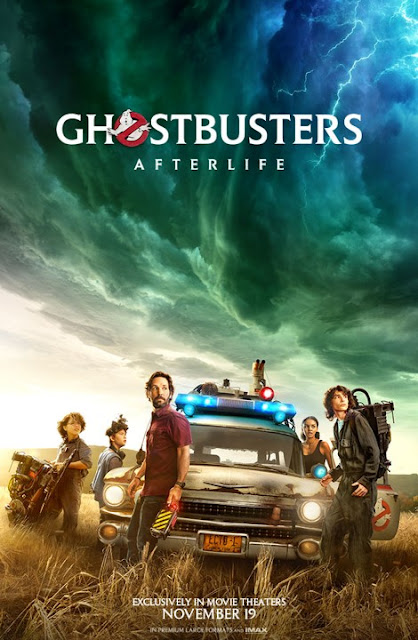
'Ghostbusters: Afterlife' is the latest round in a conversation we're tired of having

It's become a vicious cycle: we keep begging movie studios to do something original, and they keep refusing to learn from their bad choices

How to properly grapple with the fearsome cultural weight of the original Ghostbusters is a question that the franchise has acknowledged before. In 1997, the beloved cartoon The Real Ghostbusters was followed by an unexpected sequel: Extreme Ghostbusters, in which paranormal researcher Egon Spengler recruits a new team of young heroes to continue the fight against supernatural menaces. This show was darker and less goofy than the previous one, a necessary course correction given how The Real Ghostbusters had attempted, starting on its third season, an ill-advised shift toward a family-friendlier tone. Notably, the series finale of Extreme Ghostbusters is about Egon reconnecting with his old pals and going out to chase ghosts like they used to, annoying the new team with their obvious mid-life crisis and condescending attitude. Most of the humor in this two-part episode is done at the expense of the original team, portraying them as so self-absorbed and meddlesome that we can't wait to see them go. The villain is defeated by the collaboration of both teams, but not until the seniors acknowledge that the torch has been passed.

That degree of self-awareness is lost on Ghostbusters: Afterlife, the latest result of filmmakers' current state of utter terror of their own audiences. Just like Disney took the overblown hatred thrown at The Last Jedi seriously and gave us the insipid Rise of Skywalker, Sony Pictures let the vitriol about the 2016 Ghostbusters reboot scare it into delivering a safe, reassuring, bland, reverential, unimaginative, inoffensive-yet-fully-offensive pat on the head for all the entitled manchildren who couldn't accept women wearing a proton pack and spent the last half decade demanding that the studio go back and fix it.

This attitude of "go back and fix it" has done serious damage to the movie industry. When James Cameron returned to the Terminator franchise with the explicit intention of erasing everything after T2 (Cameron actually said the words "we’re pretending the other films were a bad dream," which by now ought to be taken as a prophecy of doom in Hollywood), hardcore fans cheered, only to be treated to the underwhelming Dark Fate. Even today, many fans still demand that George Lucas be brought back to supposedly save Star Wars, forgetting how the prequels are made entirely of bad choices. The same bizarre cult of personality forms the backbone of the #RestoretheSnyderverse movement.

Hidden beneath the rage and the hyperbole is an interesting discussion about the nature of authorship and canonicity. The fixation on canon stems from a misplaced need for veracity that belongs in historical studies, not in fiction. It actually matters if Nelson Mandela was freed and elected president of South Africa, and did not, as many misremember, die in prison. It does not matter if Superman gets married in one storyline and is back in high school in the next. To offer a not wholly unrelated example: each region of India has their own myths about the gods, and the Hindu attitude is to deem all of them valid. Conversely, in the Western world, there's only one official canon of Scripture, even though in the early Christian times there was an immense variety of gospels in circulation, and there were bitter disagreements about which selection of books were meant to belong to the One True Canon. The latter approach is the one taken by fans who demand that all pieces of a franchise fit together in a single, neat, agreeable lore. Viewed in this context, it's not surprising that genre canon is being treated with a reverence that crosses into dogmatic fanaticism. The Ghostbusters franchise repeats the fatal mistake of the Terminator franchise in adopting the position that only the Holy Word of Reitman is true.

Even worse, this disregards the franchise's own ethos. For all its flaws, the original Ghostbusters at least made the progressive statement that ordinary, working-class people could become heroes by dedication and effort (as bumbling and unprofessional such effort may be). Afterlife, instead, is an aristocracy where only the legitimate progeny of the heroes (and of the filmmaker) deserve to inherit the legacy. This feeds into a toxic possessiveness that shuts off possible avenues for innovative storytelling.

The many ways Ghostbusters: Afterlife fails to entertain have already been dissected in ample, gory detail. It's been called "a soulless ode to nepotism," "dead on arrival," "manipulative and ethically dubious," "nostalgia whack-a-mole at its worst," "a nightmare colored in shades of sepia," "an ouroboros of nostalgia cannibalizing itself," "a dungeon of necrophilia," "a slimy, stinking corpse of a sequel," and (my favorite) "a gloomy nostalgia trip through the ruins of American culture." There's no diplomatic way of putting it: a movie made this badly should be a career-ender.

But Ghostbusters isn't done with us. This is a conversation we cannot avoid, however much exhausting it is to have to tell angry Gen-Xers that the way they remember the 80s is very biased and that the rest of us shouldn't have to care about their hair-sprayed, mini-skirted, shoulder-padded, neon-lit, lead-fueled memories anyway.

So, time for a little bubble-bursting: the character of Peter Venkman in the original Ghostbusters is an insufferable narcissist, a parasitic excuse of a friend, and a serial sexual predator (and in the second movie, a xenophobic bigot) who would have been kicked out of academia (not to mention out of polite company) decades before we meet him in the first movie, and the fact that the actor who played him was brought into the 2016 reboot for the sole purpose of blasting him out a window was a fully deserved catharsis.

You need to do some serious work on your adulthood if your childhood is even capable of being retroactively "ruined." No movie, however much cherished, deserves to be treated as sacred and untouchable. The original Ghostbusters oozes with erotic subtext that is missing from devoted fans' starry-eyed recollection of their first viewing. The movie reaches its climax with the heroes smeared from head to toe in creamy white goo, and the second movie, even more overt in equating heroism with intercourse (see: Louis Tully), is obsessed with a different type of goo that is bluntly coded female (as in bright pink and highly emotional). When fans demand a sequel that respects Ghostbusters, it's hard to comprehend what exactly they find so respectable.

This phenomenon is not new. Haters of The Last Jedi protested that it didn't respect Star Wars, but what you get when you make a movie worried with respecting Star Wars is the nervous people-pleaser that is Rise of Skywalker. The same thing has happened with Ghostbusters: Afterlife. It's embarrassing to see a studio agree to perform any humiliation demanded of it, and it's depressing to consider that this won't be the last time fan feedback will intimidate filmmakers into abandoning all self-respect (it's no wonder that "don't be yourself" is made into a motif in Afterlife).

Even if we try to be generous and analyze it apart from its connection to the franchise and (for the sake of argument) apart from the torrents of discussion surrounding it, Ghostbusters: Afterlife fails at the basics of storytelling. We begin by following the story of Callie, a single mother who moves with her two children to a rural town in the middle of Nowhere, Oklahoma because they're penniless and the only thing they have left is the badly kept farmhouse where her estranged father died. Her son Trevor barely has a role beyond being a hormonal creep, but Phoebe, her genius daughter, quickly discovers that there's something not quite right about this place. There are unexplained earthquakes, and ominous rock carvings, and self-moving chess pieces, and people who call themselves "Podcast." As it turns out, her mysterious grandfather was not a jerk, but a hero who died trying to capture an evil deity before it could consume the world.

Phoebe reconnects to her family's heritage with the help of literally the first acquaintance she meets in the town, a summer school teacher who happens to know some geology and who by the magic of plotting chance is a big adoring fan of her grandfather's exploits. But once he's provided the mandatory exposition (with the implied moral that today's adults do their children a grievous disservice by not telling them about the Ghostbusters), this character ceases to be any help at all. Despite being the only person in the state of Oklahoma who even knows what a ghost trap does, his first impulse upon finding one is to poke it with a stick and irresponsibly release an undead monster that immediately runs to the ominous rock carvings to help bring the end of the world. The next thing our heroic teacher proceeds to do is get possessed by a dog demon, engage in a sexual ritual that couldn't possibly have been consensual, and... that's it.

So let's check up on the kids. The role of Phoebe was given to a decent actress, but the way she's written makes her the least believable portrayal of neurodiversity since Sheldon Cooper. Her petulance gets boring very fast, and her relationship with her mother is adversarial to the point of emotional wounding. One might say, in Phoebe's defense, that she comes from a difficult family background. Not only did her grandfather leave with no explanation; her father is also to blame. It's completely understandable to break up because you don't like your partner anymore; it's monstrous to break up because you don't like your child. However, that doesn't suffice to build a defense of Phoebe, because the movie has no interest in exploring that angle. The massive amount of trauma in her backstory is glossed over in the service of ancestor worship.

On her brother Trevor's side, the seams of the story become even more strained. He's not so much a character per se; he's more of a recognizable face that's useful for selling tickets. He has an instant crush on a girl who only keeps him around to play mean pranks on him and who by the magic of plotting chance is related to the only other adult in the town. The rest of the characters are treated as background decoration, which makes it hard to believe in the stakes when an ancient horror crawls out of its pit.

Said horror takes the shape of an androgynous fashionista who doesn't seem much interested in conquering; she likes to sit and pet her demon dogs and look menacing until someone comes to tell her bad jokes and steal one of her dogs. In the final battle, in which a family that have only behaved in a mean and resentful manner to each other have suddenly learned to cooperate, the young heroes prove incapable of completing the job, and a team of retired Ghostbusters come out of nowhere to show the kids how it's done. We meet the disturbingly wordless specter of the dead grandfather, who seemingly gets forgiven for simply showing up, and...

Yes, and... this movie doesn't even bother having a proper ending.

Where does this leave us? Yay because the monster is gone, boo because the heroic family is still destitute. Yay because the kids uncovered their true place in the world, boo because their own effort had no part in building it. Yay because the lonely mother landed a hot boyfriend, boo because he's a terrible teacher who makes zero effort at his job and despises his students. Yay because we got a girl Ghostbuster, boo because the only way Afterlife could think of to make the concept of a girl Ghostbuster palatable to the rage mob that savaged the previous movie was to remove from her character design all physical and behavioral markers of femininity.

In sum: seen on its own merits, it has none. Ghostbusters: Afterlife is not exciting, or scary, or funny, or interesting. It's just a very, very bad movie. But when we bring all the context back into the discussion, it becomes something worse. It's a capitulation to the rage mob and a validation of its abusive tactics. It's a vulgar stroking of the audience's nostalgia buttons. It's a set of manacles fastened around the creative potential of the franchise. It's a childish attempt to remove from memory the actually good 2016 reboot (and the actually good 1997 cartoon).

This movie pulls a back muscle with how hard it winks at the viewer. The repetition of the same villain with the same plan and the same methods as in the original movie is an appalling display of subservience to lore and plain unimaginativeness. The needless completion of Ivo Shandor's origin story is exemplary of the worst tendencies of explainer culture, which confuses mysteries with mistakes. The camera fetishizes every piece of merchandise prop with such awe that one expects the frame to include price tags. The ending includes a "go back and fix it" redo of dialogue from the original movie that was uncalled for and ultimately inconsequential to the fight. The post-credits scenes land with all the obnoxious box-ticking of Chewbacca's medal. And one can almost hear Phoebe say "I'm all the Jedi" when Harold Ramis is digitally dragged from the grave for a moment of cheap fanservice that is contemptible beyond words.

Ghostbusters: Afterlife has nothing valuable or memorable to add to the main continuity it so anxiously defends, shows no awareness of the raunchy tone that made the original a classic, and sets a disturbing new precedent for the dynamic between fans and filmmakers. That this was avoidable (they could simply have ignored the rabid manchildren and produced sequels to the 2016 reboot) makes the result even more lamentable. Instead of a loving homage to a generation of cinema, what we got is an era-definingly bad movie.


Nerd Coefficient: 2/10.

POSTED BY: Arturo Serrano, multiclass Trekkie/Whovian/Moonie/Miraculer, accumulating experience points for still more obsessions.

Monday, September 28, 2020

Interview: P. DjÚlí Clark, author of Ring Shout


Hatred. Racism. Marches in the streets. Violence.  Standing tall and doing what you need to do.

I might be describing America right this second, while at the same time describing the America of 1922, of P. DjÚlí Clark's novella Ring Shout, available Oct 24th from Tor.com Publishing.  In this dark fantasy historical novella, the film maker D.W. Griffith is a sorcerer, whose 1915 film Birth of a Nation cast a spell that forced our darkest thoughts to the surface. The Ku Klux Klan (and it grosses me out to even type those three words) gain power and have their own plans.  The hatred they feed on, it turns them into literal monsters.  And when monsters rise, so do monster hunters.  In prohibition Georgia, Maryse Boudreaux has a magic sword, a best friend whose a sharpshooter, and enough internal demons to keep anyone up at night. 

Anyone can write a novella about a girl who kills monsters with a magical sword. But it takes someone of Clark's skill to write Ring Shout. He makes it personal, he puts it in your face, he doesn't pull any punches. Visceral body horror, internalized hate, America's legacy of dehumanization. How he managed to cram all of this into less than 200 pages is it's own magic trick. You can read an excerpt of Ring Shout here.

Clark is the Nebula, Locus, and Alex award winning, and Hugo, and World Fantasy nominated author of the novellas and short stories The Haunting of Tram Car 015, The Black Gods Drums, The Secret Lives of the Nine Negro Teeth of George Washington, among many other short stories and short novels. His short fiction and essays have appeared in  Apex Magazine, Beneath Ceaseless Skies, Fireside Magazine, Fantasy Magazine, Strange Horizons, Lightspeed,  and Tor.com.  He is a founding member of Fiyah Literary Magazine. His first full length novel, A Master of Djinn, was recently announced. When not writing, he works as an academic historian, studying comparative slavery and emancipation in the Atlantic World.  You can learn more about Clark and his work by visiting his website or his blog, or by following him on twitter

Mr. Clark was kind enough to talk with me about the music behind his new novella, the novella's long (and then fast) journey to publication, how the novella got personal, and more. Let's get to the interview!

NOAF: You mention on your blog that this story was in your head for a long time before you wrote it down. Can you tell us about when and why you decided to write the story down? And while you were drafting it out, did were there any scenes or characters that ended up completely differently than how you had originally imagined them?

P. DjÚlí Clark: Yeah, the story was definitely with me for a while—mostly in dreamt up scenes and characters with a smattering of a plot. Visuals or a song could send me daydreaming for a minute. As I’m prone to do, it’s only when I have a full sketch of a story in my head that I start jotting down notes. That was in early August 2016. I sat down and wrote up Ring Shout from start to ending, on the Notes feature on my iPhone. Then I put it down and went and lived the rest of my life. It wasn’t until April of 2019 that it started to become “a thing.” I was sitting in a DC café, on the phone with my editor Diana Pho about a book contract for an unrelated completed full-length novel. The book world being the book world, it probably wouldn’t come out until 2021. My novella The Haunting of Tram Car 015 had just been released and that meant there’d be this big gap before I was next published. Diana asked if I might be interested in doing another novella in between—that is, if I had any ideas. I pitched two concepts, one of which was Ring Shout. It ended up in the contract.

Then came the real trouble. I had nothing written but a set of notes from almost 3 years back and a head full of ideas. I had until about September to turn it into a working story. Planned to get it done that summer. But nope. Academic work and copyedits on the unrelated full-length novel pretty much devoured my writing time. Finally, I got started on August 30, 2019. Two days before it was due. Had to ask for an extension. Then somehow, in the next four weeks, got it written. By that time whole new characters had been added, scenes had changed, and elements of the overall plot had been rewritten—so that it only resembles in passing those original notes from 2016. But hey, that’s the writing process.


NOAF: You also mentioned that “music is integral to this story.” Were there any songs in particular, that got you into the mindset of the story? If Ring Shout had a soundtrack, what might be on it?

PDC: Well, first actual ring shouts. I listened to a lot of those: recorded versions from the early twentieth-century, modern day re-enactors, even attended a live performance. It was those more than anything that kept the story alive. On a long drive, if I was by myself, I’d just play them over and over again and imagine the world I intended to build. I think I started doing that at least since 2015. But like I said there were also visuals mingled with the music. Scenes from Beyonce’s Formation video and the whole sound of it set my synapses firing. When I actually started writing, by chance I was listening to Lupe Fiasco’s album Drogas Wave, and the first five songs on there were a big influence—particularly with Maryse’s sword. In the original draft version there were lyrics from a range of artists: Beyonce, Stevie Wonder, Gregory Isaacs, Marlena Shaw, UGK, Outkast. Then my editor informed me about copyrights, and it was all cut. But yeah, the soundtrack would definitely include stuff like that.

NOAF: You don't pull any punches. Ring Shout is about hate, the Ku Klux Klan, and hate consuming the world. There's racism, racial hatred, body horror, and people (possibly including readers) facing their own demons. How hard (or easy) was this story to write?

PDC: It took some work. Dealing with the Ku Klux Klan, that part was maybe easiest. The whole idea of monstrous Klan members came from narratives I’d read by ex-slaves in the 1930s WPA, some 20 years ago. I’d also grown up in the South long enough to hear tales of the Klan and racial violence. Taking that and melding it into a fantasy, making it the external evil to be confronted—that was cathartic. Dealing with the inner demons the protagonist faces, about hate on an internal level, that was the hardest hill to climb. That took some soul searching and self-confrontations. That got personal.

NOAF: Talk to us about Maryse, Sadie, and Chef. Who are they, and what makes them such compelling characters?

PDC: Maryse is our main protagonist. A sword-wielding heroine out of a fantasy novel. She’s good at fighting monsters, less so at facing her own demons. And she’s got a choice to make. Chef is the Harlem Hellfighter, returned from WW1 to end up on another battlefield, and carrying her own scars. Maryse and Chef I knew were characters before I had names for them. Sadie came later. Brash, foul-mouthed, and deadly with a rifle, she’s the added bit of chaos I thought the story needed. I think, I hope, what makes them compelling is they each have backstories/personalities that make them distinct. That can lead to friction; but as a team, as friends, when they close ranks they’re damn formidable.

NOAF: More than a few reviewers have mentioned they wish the novella was longer, that they could spend more time with characters they loved, especially watching Maryse wield her sword. Were there any scenes that were cut from earlier drafts? Do you have any plans to write more of these characters, or in this world?

PDC: Be careful what you wish for! I’m a habitual over-writer. Every novella or novelette I’ve written started as a short story that got out of hand. With Ring Shout, at least I was aiming for a novella. Even so, there were lots of smaller scenes, longer interactions, character developments, dialogue, etc. that had to be cut, all to keep it under the magic 40k. The final draft I got in was something like 39,980 words. Every copyedit I’ve done since, has been me trying to get things I’d cut snuck back in by trimming prose here and there and not going over 19 more words. Pretty sure I’ve made my editors nervous! Plans to write more in this world? Don’t know yet. But I like to leave the door open.

NOAF: Who were some of your favorite writers and artists, when you were growing up? What about their work made you decide to become a writer?

PDC: Well in SFF, Madeleine L’Engle was a definite influence when I was younger—and there’s an ode to her, of sorts, in Ring Shout. But I didn’t decide to “become a writer” until later in life. Well into my late 20s. Before that, it just wasn’t a path I saw for someone like myself, with my particular identity and background. It was coming across writers like Octavia Butler or Tananarive Due that compelled me to think maybe I could do this—maybe I had a voice to add to genre.

NOAF: What are you working on now? Any new or current projects that you can tell us about?

PDC: A secondary world fantasy novella—about an assassin who is given a seemingly impossible, perhaps existential, assignment. Also, she’s quite undead.

NOAF: Thank you so much! Ring Shout looks incredible and you've also got me all intrigued about this undead assassin.

POSTED BY: Andrea Johnson lives in Michigan with her husband and too many books. She can be found on twitter, @redhead5318 , where she posts about books, food, and assorted nerdery.