Thursday, January 30, 2014

Thursday Morning Superhero

What a week of nerd rage. The good folks at SDCC announced that the badge system was going to be essentially a lottery and Gen Con had some hotel booking issues that left people high and dry. If you followed the action on social media it seemed like the world was ending and that blood will be shed in some hallowed halls. Once the dust settles I think we will all be fine and fortunately there are some great comics this week to distract us from the drama. On to the books!


Pick of the Week:
Serenity: Leaves on the Wind #1 - I am going to preface this by declaring I am not a huge Firefly fan (waits for the nerd rage to commence).  I did enjoy the TV series and the movie, but still remained surprised the level of fandom that exists for this complex world that Master Whedon has created.  I do revisit the series from time to time and am a fan and think its great, but not to the extent of most con goers (my brother included).  When I heard that Dark Horse was publishing a new Firefly comic I hoped that they would be as good as the new Star Wars comics and am pleased to report it is.  Now Joss is a pretty busy guy so who better to entrust such a beloved title to than your little brother who has worked on other Whedon properties in the past.  So what are we left with here.  The action picks up after the conclusion of the movie (sorry Wash fans) and both sides are actively seeking out Mal and his crew. The Alliance seeks to silence them and stop them at all costs, while the rebellion seeks to use the momentum of Serenity's last broadcast as a catalyst for change.  Zach does a great job maintaining the feel for the original series and the artwork will put you back on your couch circa 2002 watching Fox (I mean this in a good way).  This title feels very true to the original and like a natural continuation of a series that ended before it should have.  I hope Whedon and Dark Horse can maintain this trajectory. 


The Rest:
Saga #19 - Saga continues to impress me with each and every astounding issue.  The thought that Brain K. Vaughan put into each character is simply amazing.  One of the things I love about this book is, despite the fact that it is narrated by Hazel, I find myself worried that something is going to happen to her.  In addition to that, Vaughan makes me care for characters that on the surface seem one dimensional, but as the story develops end up being very complex beings.  I am still very worried about Marko and Alana, but I am happy to report that a malfunctioning Prince Robot IV is quite entertaining and who knew how amazing Izabel would turn out to be!  I have a feeling there is way more to her then we are getting right now.  If you aren't reading Saga then I feel sad for you and you should stop reading this and pick it up.  It doesn't get much better than this.


City: The Mind in the Machine #1 - In the not so distant future San Francisco has been outfitted with thousands of cameras in an attempt to thwart terrorism activity.  The issue lies in how to monitor so much activity. The answer, Golden Shield. The Golden Shield is an artificial intelligence that monitors all of the cameras and has the ability to manipulate traffic lights and take control of police cars to get where they're needed.  What can go wrong?  Quite a bit and we are left with a story of an ambitious programmer who desperately needs Golden Shield to be successful.  I don't want to spoil how things turn out in issue one, but an opening that left a lot to be desired delivered a setup that was quite satisfying.  Fischer, the man behind Golden Shield, undergoes quite the impressive transformation in this issue and finds himself even deeper in his code then he ever imagined. I need to keep my eye on this one.

Fables #137 - Winter, one of Bigby and Snow's cubs, learns that being the wind of the north is as much of a curse as it is a blessing.  While it is amazing to be everywhere at once, you are constantly breaking the rules and are privy to that which you should not see.  We get a new perspective on Rose and her roundtable and the magic that is gathering around her.  While from Rose's viewpoint it is good and powerful, but Winter notes that it may be beyond her ability to control it.  Winter decides to amass an army of those powerful beings she now controls (Santa!) in preparation of a war between her mom and her aunt.  Add in some intrigue about what has truly happened to Bigby and Fables continues to please.  


POSTED BY: Mike N.-- comic guy, proudly raising nerdy kids, and Nerds of a Feather contributor since 2012.

Wednesday, January 29, 2014

Microreview [book]: Traitor's Blade, by Sebastien De Castell

De Castell, Sebastien. Traitor's Blade. Jo Fletcher Books, March 2014
The Meat


  When you're making a sandwich, I think you'll agree that it's important to ensure relatively consistent quality among all the various ingredients. If, for example, you splurge and get the nicest tomatoes or whatever known to man, it really doesn't make much sense to slather the thing with Velveeta. You'd want a nice provolone, say, or something with enough oomph to support your investment in the tomatoes.
  As with sandwiches, so too with story-telling. Some stories can be first-rate in most areas and still fall apart, as an ensemble, over whichever element is Velveeta-quality, be it the protagonist, the dialogue, or the descriptions of the fighting.
  What makes De Castell's Traitor's Blade so delightful is that it's all provolone (so to speak). The story is very well crafted, from the dialogue to the fight scenes (I hear De Castell has worked as a fight choreographer!) and there's nary a hint of Velveeta to be found. Anybody can rally behind the much-abused Falcio as hero, especially because despite what the title might make you think, readers will almost immediately discover that this gold-hearted romantic, this ever so formidable warrior, is no traitor at all. Instead, he's been dumped on by everybody, Fates and Furies and everyone in between, and he's only got his blade(s) and his trusty Greatcoat (a half-magical coat which also functions as excellent armor, emergency cash reserve, bag of all tricks, and instant symbol of monarchy in, shall we say, a post-Charles I (but not at all Cromwellian) kind of world.
  Strictly speaking the tale De Castell tells has nothing to do with England, drawing its inspiration from late medieval/early modern Italy instead, but in any case, in the world De Castell shows us, it (to misquote Mel Brooks) is no longer at all good to be the king, nor to be his most trusted friend and compatriot, the aforementioned Falcio. The story is set up as a loose mystery, in which Falcio and his few remaining loyal companions must seek to clear their names/get away from the bad guys/right injustices everywhere/fulfill their king's last requests. So in the Abercrombie-esque, dog-not-only-eat-but-gleefully-tear-apart-dog world they're in, they've got their hands full, needless to say.
  De Castell is at his best as he periodically interjects flashbacks the better gradually to reveal more of the story's central relationship, that between the now (ahem) 'forcibly deposed' king and Falcio, who even years later remains totally loyal to his erstwhile monarch. We are offered a window deep into Falcio's interiority thanks to the first-person narration, even tempered as it is by the 'I write this little account years later' device, so we come to know what makes him tick, and what makes him go ballistic (or whatever the equivalent term is for rapiers—pointillistic, perhaps? Take that, Georges Seurat! That's too good a word to waste on boring quasi-impressionistic painting!).
  The story is captivating, and though many readers (even I figured it out!) will soon see through the king's cryptic assignment for Falcio, it's immensely satisfying to read. The only hint of Velveeta was in a third-act deus ex machina-esque appearance—and, soon, disappearance—of a sympathetic damsel who gives our broken-hearted Falcio one heck of a pick-me-up. The characterization of one particularly bloodthirsty duchy bothered me as well; I immediately thought of Riften from Skyrim, but like five billion times more lawless and dangerous. I mean, this place is like Frank Miller's Sin City bad.
True, random thieves appear to cause mayhem in Riften, but at least there isn't a week-long bloodbath!
  The duchy's tradition of a free-for-all general melee where anyone can be targeted within the time frame of the 'celebration' also immediately brought back memories of that creepy Ethan Hawke movie The Purge, which was certainly an intriguing premise for a sci fi/horror film, but fleshed out here in Traitor's Blade it teeters on the edge of being untenable as a premise. How could a city-state really indulge in such an elaborate orgy of violence at the whim of a despotic ruler and then continue to function normally—or at all—after it? So as interesting a place as it sounds, the uber-evil duchy felt like a melodramatic exaggeration of 'how bad things have gotten since our hero Falcio and his reformer king got screwed.' None of this is to suggest that the parts of the book devoted to describing that duchy are anything less than riveting, however!
  All in all, De Castell has produced a wonderfully inventive, thoroughly entertaining story and a fascinating world in which to set it. And I, for one, am excited to hear how Falcio will proceed in the remaining three volumes of the series! (I just hope he doesn't come down with a bad case of Robert Jordanism and end up writing four seven thirteen twenty thousand books in the series!)


The Math


Baseline Assessment: 7/10

Bonuses: +1 for creating a berserker with a heart of gold in Falcio, +1 for a story boasting such a consistently high level of quality throughout its many elements

Penalties: -1 for a hint of Velveeta in the deus ex machina of the woman near the end

Nerd coefficient: 8/10 "Well worth your time and attention"


[Here at Nerds of a Feather, we don't give out high scores like 8s lightly! See here for how our scoring system works.]

Tuesday, January 28, 2014

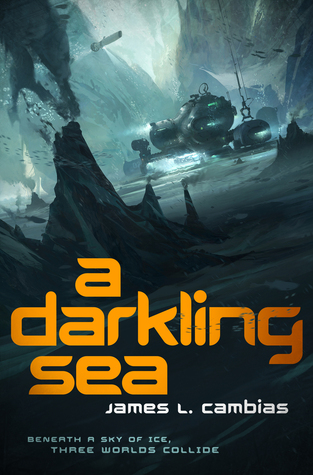
Microreview [book]: A Darkling Sea by James L. Cambias


Item: Cambias, James L. A Darkling Sea [Tor, 2014]
File under: science fiction, anthopological.
Buy: Print or Download for Kindle.

At some point during the transition to adulthood, I realized that questions of behavior were more interesting to me than questions of, say, whether particles can break the speed of light. But I didn't turn my back on science fiction--rather, I came to see it as a medium for exploring how behavior might change if you alter some of the key variables. Like Heinlein said, a "Simon-pure" SF story (whatever that means) is one that adheres to the following:
  1. The conditions must be, in some respect, different from here-and-now, although the difference may lie only in an invention made in the course of the story. 
  2. The new conditions must be an essential part of the story. 
  3. The problem itself—the "plot"—must be a human problem. 
  4. The human problem must be one which is created by, or indispensably affected by, the new conditions. 
  5. [Paraphrased as: be internally consistent in all departures from accepted science.]
Though I'm not exactly a huge Heinlein fan, I've long felt an attraction to his framing of the genre. Over time, I grew a special appreciation for science fiction that explicitly tackled the modalities of behavior--whether psychological, sociological or otherwise. (This kind of social science fiction is often referred to as "soft" SF, a term ostensibly created to differentiate it from physical science-obsessed "hard" SF, but which, in a lot of usages, is also coated in gendered bullshit.) But what about when some of the principle actors are not human?

Questions of how sentient alien species might behave, and how we might interact with them, provide some of the more fruitful avenues for social science fictional exploration. Ursula LeGuin's Hainish novels are without a doubt the paradigmatic examples of the anthropological approach, but you can also count Ian M. Banks' The Player of Games, Octavia Butler's Xenogenesis series or basically anything involving the Prime Directive in the Star Trek universe as well.

A Darkling Sea is James Cambias' debut novel, but it is, in fact, an evolution of previously published short fiction, most notably the 2004 story "The Ocean of the Blind"--which readers may recognize as the first chapter of the novel. The book, following from the earlier story, revolves around a scienfitic mission to the moon Ilmatar, which orbits a gas giant in a distant star system. Ilmatar is a bit like Europa, in that it's covered by 5km of ice, underneath which lies a pitch-dark ocean heated (to the degree that it is heated) by vents funneling hot gases from beneath the crust.

Somehow, humans and the relatively more advanced Sholen come to realize that there are intelligent creatures living at the bottom of Ilmatar's oceans. The Ilmatarans are crustacean-like creatures with hard shells and pincers; they are understandably blind but have advanced sonar capabilities. They have produced complex physical and social structures, and have developed a form of literacy. They even have scholars!

The humans want to study the Ilmatarans, but the Sholen are deeply concerned about anything that smacks of interference in the Imatarans' "natural development." So they allow the humans to set up a single underwater habitat, but only on the condition that they take every possible measure to avoid direct interaction. Forced by technological inferiority and the continued domestic view of the Sholen as "those friendly paternal spacepeople," accept the conditions and set up shop. Unfortunately, a vainglorious scientist/media personality, Henri Kerelec, decides to break the rules and get up, close and personal with the Ilmatarans. Things don't go as planned. 

The Sholen get word of what's happened, and send a fact-finding mission to ascertain whether or not the humans can be trusted to continue their scientific endeavor without a repeat performance. But as it turns out, the Sholen are themselves mired in a complex political struggle between pragmatist-explorers, who largely share the human perspective and would like nothing more than to collaborate in their studies, and militant-isolationists, who see only disaster coming from inter-species interaction (including Sholen/human).

I won't spoil the book, but I will say that Cambias builds a remarkable conflict out of this--one that, really, has no "bad guys." Though there are certainly some "conflict entrepreneurs," to use a social science jargon term, you always get where they are coming from--even the most committed militants among the Sholen and humans. Rather, conflict arises from the failure to communicate effectively, and by the assumptions individuals bring into interaction--the meanings to our own actions that we assume others will understand, and the meanings we ascribe to the actions of others based on our own experiences and cultural practices.

There's a great scene were some humans utilize non-violent resistance tactics, assuming the Sholen will know what they are doing. But instead, the humans baffle the Sholen. After all, Sholen society is built around the concept of decision-making through consensus--affecting change from resistance and conflict are things they do not quite understand (yet are not resistant to). And this speaks to another strength of the book: its ability to convincingly portray three different--alien--modes of cognition, and making them all relatable without making them "too human."

A Darkling Sea also contains within it political theory of inter-species interaction, a reaction if you will, to the aforementioned Prime Directive. In Cambias' own words:

Did I mention I think the Star Trek "Prime Directive" is a stupid idea? I do. I know Gene Roddenberry wanted to get away from the raygun-toting empire-builders of the pulp science fiction era, but the idea of a rigid ban on any contact with "less advanced" civilizations is still foolish. It assumes that cultures without advanced technology are somehow naive or innocent, and that the process of leaving that low-tech life is a step down somehow -- a Fall from Eden. That's simply not true. When Commodore Perry sailed into Tokyo Bay, he brought change to Japan; incredible, neck-snappingly rapid change. But Japan remained Japan. Its people were no better or worse morally than before.

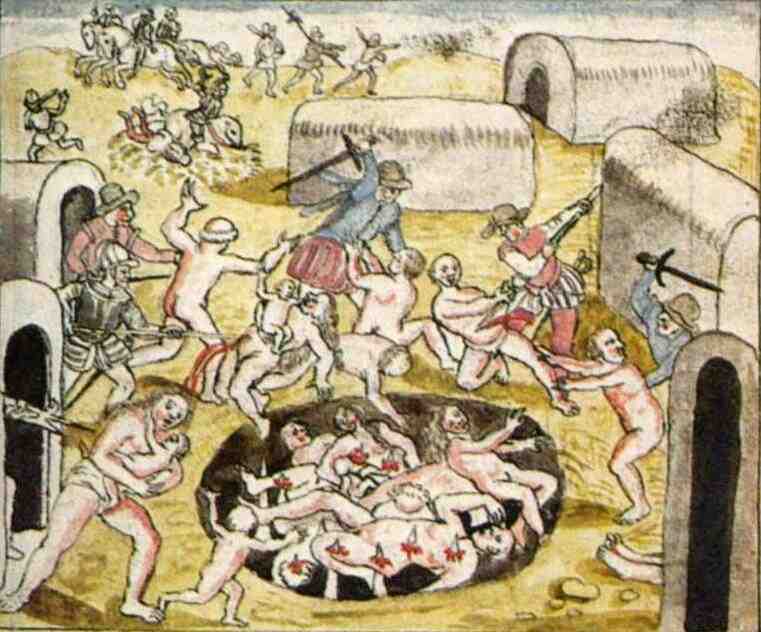
Taken at face value, this statement strikes me as problematic--after all, Japan might have emerged from the interaction with Commodore Perry (largely) unscathed, but at a high cost for its neighbors, who would be subjected to its violent industrial militarism for more than a half-century. And that's not even taking into account, say, those living in the Pre-Columbian Americas, few of whom could be described as emerging from their interactions with Europeans "no worse than before."

This...

...often led to this.
Nevertheless, there is a good point in there--that these interactions don't have to be negative, and can actually be mutually beneficial. I read A Darkling Sea as arguing for managed and responsible interaction between more and less technologically advanced groups, not open and unfettered interaction--let alone exploitation a la colonialism. Outside Henri, the humans are very cautious in their approach to the Ilmatarans, even after they abandon the restrictions imposed on them by the Sholen. My impression from the text is that it is the rigidity of the Prime Directive, and of the Sholen, that Cambias finds objectionable, not the underlying impulse. There's also a clear critique of fanaticism, in the sense that accommodation is repeatedly torpedoed by a relatively small number of "true believers" on each side.

Putting the !BIG IDEAS! aside for a minute, I'd also like to note that the book is very well-written. A Darkling Sea doesn't aspire to be a prose poem, but the prose is nevertheless much better than the average for the genre. The book is expertly paced, full of lively description that never ventures into the hellish realm of the infodump and kept me glued to it from the first to the last sentence. Cambias alternates human, Sholen and Ilmataran perspectives; he does so much more quickly that, say George R. R. Martin, but achieves the similar effect of making me want to skip ahead to the next perspective section for a particular character so I can see what happens right now. I also liked that the human future was suitably multicultural and multinational--not just America in Space.

Not the only future imaginable anymore.
The one major flaw I found in A Darkling Sea is the protagonist, Rob Freeman. He's just not that interesting--a sort of layabout "not-really-hero-ish-but-not-an-antihero" type who seems to accomplish a lot of what he accomplishes through dumb luck and never even seems that interested in what's going on around him. Like Yorick in Y: The Last Man. Thankfully the other characters, from the Ilmataran Broadtail (who has his own perspective sections) to the supporting character and director of the research colony, Dr. Sen, are much more well-rounded.

All in all, I'd highly recommend A Darkling Sea to anyone who wants to read a book that qualifies as "hard" SF but is more interested in the social scientific implications of space exploration and alien contact. Even if I didn't love or agree with everything contained within the book, I nevertheless found it to be challenging in all the ways SF can and should be challenging.

(Oh, and if you're interested in learning more about the world Cambias has created, check this out.]

The Math

Baseline Assessment: 8/10

Bonuses: +1 for the complex theorization on communication in interaction and conflict; +1 for the brilliantly realized alien perspectives.

Penalties: -1 for Rob Freeman, the "meh" protagonist.

Nerd Coefficient: 9/10. "Standout in its category."

Monday, January 27, 2014

AiIP: Is Self-Publishing Worth It?

It's not as if that is a particularly novel question. In fact, I would wager that nearly every person who has completed a manuscript in the last decade or so has puzzled over that very question. For some, the answer comes rather quickly, usually skewed to the self-publishing side of things (the exceptions being people who have published traditionally previously, or have only ever accepted that as the route to publication). For many, it comes after a string of rejections from agents and publishers. For still others, it's a result of sitting down and calculating costs, time and chances of success (to say nothing of how that success is defined; more on that in a bit).

I've broken down the general costs associated with self-publishing before, and while by no means definitive, it gives you a pretty good idea that self-publishing is an investment. Not a prohibitive one, but it's a cost without any manner of guaranteed return.

Nor should that in and of itself be a deterrent; one of the glories of self-publishing is that you are not married to sales numbers as the sole indicator of success. If your only goal is to make your book available, you can do that. Or perhaps it's a really niche market- also doable. If you're happy only selling a few copies, that is available in a way it wasn't before.

For most, though, they want more. The next 'Great American Novel' or some such thing. Avenues like Kickstarter open the door to defray some of the expenses, to say nothing of helping spread the word before the book is out. There are no promises there, obviously, but it can save a person several thousand dollars (if it is funded).

But then there is the ongoing problem of reach, which I have talked about a lot lately. I was actually going to take this post in a different direction until the purveyor of this fine blog (that's what they're called, right?) send me a link to this post, wherein a fledgeling author decides to invest in 2,000 print copies of his book to distribute to bookstores. As he points out, physical books still make up 80% of marketshare- no matter what die-hard indie publishers say about how many ebooks they sell- print still commands the majority of readership. This will change eventually, but for now, if you want to make it, I won't go so far as to say you have to have a print presence, but you basically do.

Those 2,000 books cost him the equivalent of nearly $5,000 and he hasn't sold, stored or mailed one of them. I'm not saying it's a bad idea; I'm saying it's a lot of cash and time to spend on something like that (to say nothing of the fact that if his garage burns down, he's out five grand).

Which in turn got me thinking, as I read somewhat incredulously, 'that's what I want to do'. Yet, at the same time, my estimator/engineer driven mind is analyzing cost. How much time does he have to spend to move 2,000 copies of his book? If we assume it takes a half hour of labor for every copy sold, that is six months at a forty hours a week. I hope it works for him, but that is a lot of time to spend for that amount of money- and there is the added problem of the stigma of self-published authors, even though he has put a ton of time and effort into making it a presentable as possible).

Time is money, and usually comes at a premium price (at least in my life- this column is already a week late), so I read that and I puzzle over again, is self-publishing worth it? I have always striven to define myself by the quality of my work, not the genre or publication method, but those are big questions a writer faces, and I find myself increasingly on the fence about it. Maybe it is worth it; maybe it's not. Or maybe it is for someone else, or for me, and not for others.

Either way, G knew what he was doing when he suggested 'Adventures in Indie Publishing'.

-DESR

Friday, January 24, 2014

Microreview [crime fiction]: The Heroin Chronicles


The Heroin Chronicles
Edited by Jerry Stahl
Akashic Books

The Meat

I suppose it’s the needle. I have been pondering the allure of heroin in fiction. From The Man with the Golden Arm to the most recent version of that story, heroin’s prevalence in film and fiction far outpaces its prevalence in actual society. Other drugs don’t get the same treatment. Meth is too scary; coke, for whatever reason, too comical. The only other drug that competes as a dramatic device is alcohol, but for very different reasons. Most of us know alcoholics. Most of us have been drunk. Some of us have struggled with our drinking—at the very least having had to “cut down” at some point. But heroin, elicits sympathy, rarely true empathy. This is a reality we will never experience firsthand. We can shake our heads and say “there if not for the grace of…” and not mean it. Like good Puritans.

Onto the review: The Heroin Chronicles is an excellent collection of strong, well-written, and often surprising stories. There are the kinds realist junkies stories one would expect, more often than not set in New York or Los Angeles. There’s a lot of hustling, a lot of sex work, a lot of scheming. And, when all that works, heroin. L.Z. Hansen’s wonderfully paced “Going Down” recounts a very terrifying, though not at all improbable struggle of a young junkie to find someplace to get high. “Fragments of Joe,” by Tony O’Neill, is notable for it’s macabre touches, reminiscent of The Damnation Game…but about heroin. “The Monster,” by John Albert, is an almost hardboiled, certainly violent revenge tale, of sorts. 

The Heroin Chronicles also features less stereotypical junkies. After three years of being clean, Nathan Larson’s protagonist Dos Mac—introduced in the Dewey Decimal Series, also by Akashic—finds himself looking for a score in a dystopian near-future New York in “Dos Mac + The Jones.” This is unsurprisingly a difficult task. Michael Albo’s “I Need to See a Man about a Duck,” perhaps my favorite of the book, is the comic tale of a seemingly straight-laced LA pornographer dealing with the hassles of stocking up for the weekend. Fair warning: there's a duck involved.

A couple of stories avoid junkies altogether, though not the heroin, of course. “Black Caesar’s Gold” by Gary Philips almost feels out of place: the only connection with heroin is a 1969 Mustang Fastback once owned by OG drug lord Frank Matthews. But our hero nerd’s struggle to get and then keep his hands on that piece crime memorabilia turns out to be a comical story of tables being turned.

All in all, The Heroin Chronicles is a very solid collection of stories, alternatively dark and funny, gritty but often lighthearted and sometimes poignant. In fact, the only disappointing entries were from Lydia Lunch and Eric Bogosian—the latter’s story being too insubstantial to say much about. 


The Math
Objective score: 7/10

Bonuses: +1 for junkie variety 

Penalties: -1 for Bogosian (because I generally like him)

Nerd Coefficients: 7/10

Thursday, January 23, 2014

Thursday Morning Superhero

Another great week of comics featuring an impressive debut from none other than Alyssa Milano!  Throw in an epic conclusion to All out War and sprinkle in some Mind MGMT just for fun and this is one solid week for the funny books.  Add to the mix that International TableTop day has been officially announced for April 5 and I am one happy camper.


Pick of the Week:
Batman #27 - This is the moment that I completely buy in to what Scott Snyder is doing with Zero Year.  This is the moment that I am a fan of the Riddler.  I have sung high praise for Snyder's run with Batman, as have countless others, but have struggled with Zero Year.  It had improved, but I feel that it truly came into its own in this issue.  From the frantic action to open the book, to the additional background provided about Gordon's coat, this issue truly felt like it was all coming together.  Snyder's vision for Zero Year finally paid off (not that it was ever bad by any means) and it was worth it.  Personally I have never been a fan of the Riddler, but with Snyder controlling the nefarious foe I am rapidly enjoying this duel with Batman.  Time to get excited about Batman again.

The Rest:
Hacktivist #1 - Alyssa Milano, actress, reality tv host, and possibly the boss, released her first comic this week on Archaia (now officially part of Boom).  Hacktivist pays homage to Anonymous and was inspired by Jack Dorsey, the creator of Twitter.  Hacktivist is the tale of SVE_URS3LF, a hacker that is helping overturn the Tunisian government.  Filled with intrigue, rivalries, deception, and get this, hacking, Hacktivist is an impressive debut from an unexpected person.  Well done Ms. Milano.  You have yourself a fan.

Mind MGMT #18 - Matt Kindt continues his impressive run with Mind MGMT and introduces us to another student of the Mind MGMT academy.  This month we learn about Ella, a Mind MGMT agent who has the ability to telepathically communicate with animals.  She had a troubled past (trips to the zoo were disasterous), but found support from Henry, her guardian bear.   Straight out of Richard Scary's Busytown, the perception of Mind MGMT from Ella's lens is fascinating and entertaining.  Ella's struggle to use the animals as weapons was heartfelt and crushing.  Still, Lyme and Meru need all of the help they can get if they are to stop Mind MGMT and the Eraser.  Things are getting intense and this remains one of the best titles on the market.

Chew #39 - The insanity that is John Layman is very apparent in the latest issue of Chew.  I am very happy I went back and reread this series as it has reinvigorated me on what an amazing world he has created.  I don't want to spoil anything, but if you are a fan of the series you will be pleased to know that issue 39 is insane and beautiful.  I want a spin-off of Amelia's sci-fi detective novel.  I want that novel produced by SyFy in a cheesy made for tv movie.  I want it all.  I also was pleased to see Olive Chu show off her impressive skills.  I think that the next Chew sculpt from the Skeleton Crew Studio should be Olive with a chocolate sword.  That is all.

Walking Dead #120 - Holy heroics Denise!  I was quite impressed with her can do spirit, but that is when it hit the fan.  Negan and his men conclude their all out assault on Hilltop. Just when you think Negan can't get any more vulgar, Kirkman finds a way.  Let's just say that throwing grenades at Rick and company has got him excited to the point that he is considering wrapping a certain body part with barbed wire and dubbing it Lucille 2 (Side note: I want to go back and look for other parallels between Negan and Buster from Arrested Development now).  The action is brutal as things look bleak for Hilltop.  Did Negan win?  What happened?  I don't want to wait.  Curse you Kirkman!

Wednesday, January 22, 2014

Draft 2014 Hugo Ballot

The Hugos suck! There, I said it. Well, not all the Hugo categories suck--the one for Best Short Story is often good. But, as Aidan Moher and Justin Landon have explained in detail, the marquee category--Best Novel--more often than not rewards insider status over things like "which book is the most profound/challenging/well-realized/etc." Best Fan Writer/Best Fanzine, meanwhile serve as the jealously guarded fiefdoms of traditional fanzines and their dwindling readerships. WorldCon voters are perceived, largely correctly, as being hostile to the new wave of blogs and bloggers--or at least averse to seeing blogs encroach on the traditional fanzine's turf. I don't mind people voting like that (it's their choice), but I can't really see the award as choosing the best fan writing out there when the choices are made on the basis of form, not content.

Last year felt like the last straw for me and the Hugos. Now, I love me some John Scalzi, but Best Novel winner Redshirts is the least impressive of the six Scalzi-authored novels I've read (four of which I hold in very high regard). It's clever, entertaining and very funny at times, but it's also essentially a 200+ page inside joke for Star Trek fans. Of course, I could deal if that was the only problem--after all, it is clever, entertaining and very funny at times. But, to my eternal frustration, the two best fantasy novels published in 2012, Elizabeth Bear's Range of Ghosts and N.K. Jemisin's The Killing Moon, weren't even on the ballot.

The underlying problem with the Hugos is that fans tend to vote for their "favorite" entry, rather than one they've determined to be "the best" after careful consideration of a wide-array of available options. True, as categories, "favorite" and "best" are often highly correlated--after all, we like things because we think they are good. But fans, as a species, are often so heavily invested in specific brands or creators that they feel compelled to relentlessly advocate for it/them wherever and whenever possible. It's the same kind of thinking that leads fans of EA's Battlefield series to leave negative reviews of the latest Call of Duty game on Metacritic, even (and perhaps especially) if they have never even played it. Yes, that's an extreme example, but you can see how these things are linked. I feel like Nebula voters engage in more critical exegesis and less fan advocacy than Hugo voters. Is that unfair? Maybe. But I'm calling it like I see it.

In any event, there I was, all set to ignore, abstain and eventually complain in 2014. Until, that is, fellow blogger and Hugo critic Aidan Moher convinced me that it only gets worse if people with serious concerns with the institutional PoV opt-out of the process. This is an argument I'm very sympathetic to, so consider me chastened and ready to be a part of the solution.

With that in mind, I present to you my draft ballot, so you can know who I would nominate if I get around to nominating. Why? Because all the cool kids (Aidan, Justin, Jared Shurin, Aliette de Bodard) are doing it, and I want to be one of the cool kids. Kidding! Though it's true that those are all cool kids.

...of course I can't really comment on all the categories. Best Fan Artist? I have no idea. Best Dramatic Interpretation, Long Form? I didn't see one I'd bother nominating that was released in 2013. And, sadly, 2013 was the first year in a decade in which I did not read a single graphic novel, something I plan to correct in 2014.

One final note: I read a lot of blogs and other writing on SF/F. Choosing just 5 nominees for Best Fan Writer and another 5 for Best Fanzine doesn't do justice to the wide array of great people reviewing and commenting on SF/F. Suffice to say, there are a number of high-quality people who didn't make my list this year, but easily could have, and may very well in future years. In cases where I really can't decide, I've included a sixth entry as a "possible last-minute substitution."

 
Part I: Original Fiction and Related

Best Novel
Time of Contempt by Andrzej Sapkowski (REVIEW - BUY) - This wasn't written in 2013 (actually in 1995), but was published in English for the first time in 2013--which means it's eligible. And this is hands-down the best book I read in 2013. Not only that, it's arguably the best fantasy book I've ever read--a complex fusion of sword & sorcery, political epic, romance and critical deconstruction of the fantasy genre. I'm tempted to learn Polish just so I don't have to wait for the next volume to be translated.

Shattered Pillars by Elizabeth Bear (REVIEW - BUY) - This is a bit of a make-up nomination for the sublime (and superior) Range of Ghosts--which was left off the 2012 ballot in the aforementioned horrifying travesty of fan justice. Shattered Pillars is an excellent book on its own, and a nice middle chapter in my other favorite on-going series.

Ancillary Justice by Ann Leckie (REVIEW - BUY) - Now, you may recall I didn't gush about one this like some others did. But I also noted that it's a challenging, rewarding bit of space opera. And it could *gasp* actually win! If I am nominating stuff, I'd like at least one to be seriously considered, so that the vote isn't completely in vain. Ancillary Justice has "award winner" written all over it, and not in the bad SMOF-y way I described above.

The Thousand Names by Django Wexler (REVIEW - BUY) - Wexler's flintlock fantasy is a true revelation--it's smart, meticulously constructed and incredibly interesting. Sure there are some flaws, but I love the way Wexler delves into the tactics and daily life of soldiers in this musket-era second world.

The Tyrant's Law by Daniel Abraham (REVIEW - BUY) - I felt much the same way about this series' opener, The Dragon's Path, as I did about The Thousand Names. Though the follow-up was a bit of a disappointment, I unambiguously loved book #3, going to far as to call it "an unusually smart installment in an unusually likable fantasy series."

POSSIBLE LAST-MINUTE SUBSTITUTION: Shaman by Kim Stanley Robinson (REVIEW - BUY) - Robinson probably should have won last year for 2312, but alas, it was not in the stars. Shaman seems a less likely candidate, as it stretches the definition of science fiction. (Is it "speculative historical fiction" or "biological-anthropological speculative fiction?" I'm not sure.) That said, it's a neat book--a plausible if imagined narrative of early homo sapiens sapiens after the migration into Europe.


Best Novella
"The Eye with which the Universe Beholds Itself" by Ian Sales (REVIEW - DOWNLOAD for Kindle) - The second installment of the Apollo Quartet is a lot of things: a compact novel masquerading as a novella, a throwback to 1950s SF that somehow feels totally fresh and, at the same time, a very human story about frayed relationships. Though this is technically the only novella I read in 2013 that was originally published in 2013, it is also definitely worthy of the award.


Best Novelette

“Leaf and Branch and Grass and Vine” by Kate Elliot (Fearsome Journeys - REVIEW - BUY) - One of the standouts from the almost universally good anthology Fearsome Journeys, this story is a "characteristically elegant tale, the story of a peasant woman's quest to save a kingdom from a dark conspiracy." In the review I also note that, "though the narrative form may be familiar, Eliot's empathetic gaze and capacity for vivid, atmospheric description set it apart from the pack."


Best Short Story
"Silent Bridge, Pale Cascade" by Benjanun Sriduangkaew (Clarkesworld - READ) - I might not have read a lot of short fiction this year, but this gender-bending military SF prose poem really blew my mind. Sriduangkaew is an awfully talented writer, and like Ken Liu in 2011 and 2012, she was seemingly everywhere in 2013. I could have picked any one of her stories and felt comfortable with the choice, but this was my favorite.

“Camp Follower”by Trudi Canavan (Fearsome Journeys - REVIEW - BUY)  - In my review of the anthology, I described this story as a "revelation...in turns, a meditation on power, oppression, loss and mortality" and boldly stated that it's "one of the best fantasy stories I've ever read." I can't really think of a better way to explain why this story deserves your attention.

“The High King Dreaming” by Daniel Abraham (Fearsome Journeys - REVIEW - BUY) - I know what you're thinking--OMG not another nomination from Fearsome Journeys! But this is a very, very good story--a mediation on parenthood and all its emotional complexities, not least of which is the particular bittersweetness that comes from watching your offspring grow into their own.

"Your Figure will Assume Beautiful Outlines" by Claire Humphrey (Beneath Ceaseless Skies - READ) - A smart and beautifully written story about boxing, of all things (as well as gender bias, romantic love and the base stupidity of doing things for no reason other than "because that's the way they've always been done").
“What Really Happened in Ficandula” by Rochita Loenen-Ruiz (We See a Different Frontier - BUY) - My review of this anthology is long overdue, and truth be told I haven't quite finished it yet, but thankfully I did read this gem by Loenen-Ruiz (one of my favorite short fiction authors). It is, in essence, an exploration of the aftereffects of massacre--a real one from the U.S. colonial period in the Philippines--in a science fictional context.  


Best Editor Short-Form

Jonathan Strahan (SITE) - Strahan could win on the strength of his annual The Best Science Fiction and Fantasy of the Year series alone, but he also edited the anthology Fearsome Journeys (which as you have probably realized by this point, I kinda sorta liked a bit), co-edited a collections of Jack Vance and Joe Haldeman's and served as Reviews Editor for Locus.
John Joseph Adams (SITE) - Though I felt like Lightspeed took a step backwards this year, Adams did also launch its sister magazine, Nightmare, while editing quality anthologies like The Mad Scientist's Guide to World Domination


Best Semiprozine

Strange Horizons (SITE) - The fiction is great--what more can you ask for? Equally good essays, that's what. Check Renay's piece on author/critic/fan interaction and the debate it produced (there, elsewhere and, of course, here.)
Beneath Ceaseless Skies (SITE) - BCS fills a void in the market for upscale fantasy that's both literary and unashamed of being second world adventure stories. And though BCS has been good for years, I thought the content took a big step forward in 2013.


Best Related Work
Speculative Fiction '12 (BUY - DOWNLOAD for Kindle) - Justin and Jared did a great job gathering the best of writing on SF/F from 2012--even if my epic interview with Paul Kincaid wasn't included (*sniff sniff*, oh wait...that's my fault for not submitting it, and may not have made it anyways, as Paul's even more epic piece for LARB was included). I'd like to see this nominated and then win. 


Part II: Fans, Critics and Commentary


Best Fanzine
A Dribble of Ink - (SITE) - A Dribble of Ink is sort of a special place for me--not only is it one of my favorite stops on the daily internet tour, but it served (and continues to serve) as a direct inspiration for Nerds of a Feather. Everything about A Dribble of Ink is great, from the design to the incredible list of guest posters to Aidan's own reviews, which have an unquantifiable, epic quality to them.

The Book Smugglers - (SITE) - I like The Book Smugglers for most of the same reasons I like A Dribble of Ink: it looks fantastic and is chock full of must-read guest posts, while the book reviews Ana and Thea post are, as a rule, exceptional. Plus there's the yearly event Smugglivus, which I'd argue has turned into something unique and truly special within fandom.

Pornokitsch - (SITE) - Is this a fanzine or is it a semiprozine? I have neither the inclination nor the care to find out, so I'm nominating Pornokitsch for Fanzine. Needless to say, Jared and Anne run one of the smartest, savviest and justifiably influential sites in the universe of SF/F fandom.
SF Signal - (SITE) - I would love to ignore the big dog in favor of the smaller pups, but the content is just too good. I'm a big fan of Paul Weimer's writing, and was also very happy to see them bring Ria Bridges (of Bibliotropic) and Rob Bedford on board this year as well.

Bookworm Blues - (SITE) - I'm a relatively new reader, but I love what Sarah is doing with her site. It's mostly a one-woman show, but qualifies by my standards because of the number of guest posts and especially for the excellent running feature Special Needs in Strange Worlds.


Best Fan Writer
Jonathan McCalmont - (BLOG) - Jonathan is both one of the most incisive critics in SF/F and one of the most entertaining. Acerbic in the best possible way, his broadsides against the hypocrisies and absurdities of fandom often remind me of Marx skewering Louis Napoleon. And his essay for Interzone (12/13) on superheroes and the future of SF was a thing of beauty.

Liz Bourke - (BLOG) - More than once I've come up with what I thought was an original, provocative argument, only to find that Liz got there first. Consistently insightful, I've come to admire Liz both for the high quality of her reviews and the sharpness of her argumentation. What's more, she has that unique ability to make you rethink your assumptions; as such, several of her essays function as auto-citations for me.
Justin Landon - (BLOG) - My first exposure to Justin's writing came when Night Shade Books imploded. His account of its demise is fascinating, and, I think, the most comprehensive. Now, of course, I log on to Staffer's Book Review daily. He's fun to read, and certainly erudite, but thing that really stands out to me about Justin's writing is how much he can pack into a single essay or review. Most blog pieces don't need to be read twice, but in this case I often find subtexts or tangents I missed on the first reading.

Ian Sales - (BLOG) - Ian gets a second nomination here, and it's well-deserved. Though we often disagree, I can't think of anyone who I've learned more about science fiction from. Plus he runs the excellent and important SF Mistressworks site, which helps bring attention to the science fiction's rich (and often unrecognized) history of female-authored books.

Foz Meadows - (SITE) - Foz combines academic-style argumentation with liberally sprinkled swear-words--an approach that can be a little hit-or-miss for me. But Foz is undeniably brilliant, and her forays into the SFWA sexism debacle and gritty/grimdark debates are masterpieces--must-reads for anyone who cares about how things going on within the genre intersect with the world outside.

POSSIBLE LAST-MINUTE SUBSTITUTION: Stefan Raets (SITE) - Between his own blog, running the Beyond Reality reading group on Goodreads and writing for Tor.com, Stefan has had an excellent 2013. He's also my go-to reviewer for anthologies and collections of short fiction.


Best Fancast
The Coode Street Podcast - Jonathan Strahan & Gary K. Wolfe (LISTEN) - This was the first SF/F podcast I listened to, but that's for good reason--Jonathan and Gary maintain a high level of discourse while being thoroughly entertaining. 
The Skiffy and Fanty Show - Shaun Duke & Jen Zink (LISTEN) - Another great podcast for high-level SF/F discussion, author interviews and more.