In space you still have to check your privilege.
Today's guest review comes from writer, reviewer and all-around nerd
Charles Payseur. His fiction has appeared, among other places, in
Perihelion Science Fiction, Dragon's Roost Press, and is forthcoming at
Fantasy Scroll Magazine. His fiction reviews have appeared in TeenReads
and Kidsreads, GraphicNovelReporter and Tangent Online.
Speculative fiction in general, and science fiction in particular, has a long history of examining injustice, in prompting deeper understand and a more complex view of the Other. In true Western fashion, though, the stories that get held up as shining examples of brilliant speculative fiction have been, and are still often from writers in the majority, white writers and male writers and straight writers and affluent writers, writing about (mostly) white and male and straight and affluent characters and problems. Much less prevalent have been voices from cultures directly marginalized by the mainstream through historical and cultural colonialism.
And it is that lack that We See a Different Frontier seeks to address by specifically and consciously presenting a collection of stories from a post-colonial point of view, from cultures and peoples dealing with the aftereffects of war and conquering, of assimilation and appropriation, of erasure. It is an incredibly complicated collection to approach, because the stories are not expected, are not uniform or typical, but come from a space that most people don't like approaching because it is uncomfortable to do so as a person in the majority.
Which makes me both an excellent and a terrible person to review this collection, because I am white and male and while not especially straight or the most affluent, I am most definitely Western. And I feel like because of that this collection represents something that is very important for me and for other Western readers to experience, because it confronts the reader with the effects of colonialism, both the brutality of war and the just-as-real suffering of cultural colonialism. It doesn't pull its punches, and it is not the happiest of collections, not the most fun to read. Not because the stories are less than amazing (they are great) but because they push at ideas that are left well alone in polite (affluent and white) society.
The diversity of the stories, though, does an admirable job of showing the range of voices and experiences that have largely been ignored in the wake of the massive colonial efforts of recent history (the last five hundred years, mostly). Not to say that all of these stories are historical in nature (though some are). The colonizing ranges from past to future, from India to Mexico to other worlds. There are historical fantasies like Sofia Samatar's "I Stole the D.C.'s Eyeglass" and Gabriel Murray's "Forests of the Night." There is the hard science fiction of "The Gambiarra Method" by Fabio Fernandes and the softer, near-future science fiction of Silvia Moreno-Garcia's "Them Ships" and the cyberpunk stylings of "Vector" by Benjanun Sriduangkaew. Characters are old and young, male and female, straight and queer.
And yet in the end the stories all share a cohesion that makes them powerful, that leads from one to the next and on, a parade of voices fighting back against the pressures of oppressor and colonizer. They are challenging, and they are deep, and they got me to think and to feel. My favorite stories in the collection were J.Y. Yang's "Old Domes" and Sunny Moraine's "A Heap of Broken Images," which are both haunting with a splash of hope, and like many of the stories confronted the ideas of identity and erasure, though in different ways. In Yang's piece, a young woman who exorcises the spirits of old buildings deals with a difficult assignment and learns a bit about history. In Moraine's, an alien tour guide begins to confront a past that his people are determined to ignore.
It is somewhat difficult for me to find critical things to say about any of the stories, in part because any criticism that I could find is also subject to thought and introspection. It forces in ways that other stories or collections might not the reader to confront how preference can be shaped by culture. I will say simply that We See a Different Frontier is one of the best collections I have ever read. I felt each story was worth reading, and that as a whole the anthology provides a mosaic of experiences that is important to read for anyone interested in speculative fiction today. It is a game-changer, it's uncomfortable in all the best of ways and the stories are amazing. There is representation, there is voice, emotion, everything.
The Math
Baseline Assessment: 9/10
Bonuses: +1 for the sheer range of genres, writers, and characters, +1 for addressing a part of the human experience often overlooked in speculative fiction.
Negatives: -1 for not being a particularly happy read (be ready to feel uncomfortable at times).
Nerd Coefficient: 10/10 "mind-blowing/life-changing."
***
Reference: Fernandes, Fabio and Djibril al-Ayad, eds. We See a Different Frontier [The Future Fire, 2013].
- Reviews
- _Book reviews
- _Film and TV Reviews
- _Game Reviews
- _Thursday Morning Superhero
- _Short Fiction Reviews
- Lists
- _New Books Spotlight
- _6 Books Posts
- _We Rank 'Ems
- Features
- _Interviews and Blogtables
- _Talking About Books
- _The Hugo Awards
- _Mini-Projects
- Projects
- _Nerds on Tour (2020)
- _The Hugo Initiative (2019)
- _Feminist Futures (2018)
- _Dystopian Visions (2017)
- Meet the Flock
- Review Policy
- Home
Showing posts with label anthropological SF. Show all posts
Tuesday, October 14, 2014
Tuesday, January 28, 2014
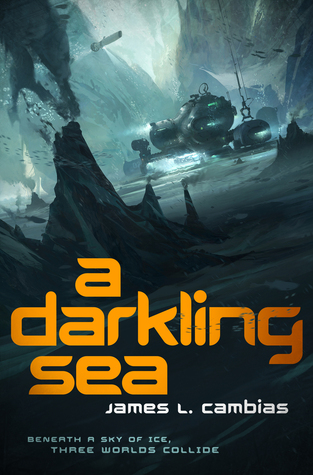
Microreview [book]: A Darkling Sea by James L. Cambias
Item: Cambias, James L. A Darkling Sea [Tor, 2014]
File under: science fiction, anthopological.
Buy: Print
At some point during the transition to adulthood, I realized that questions of behavior were more interesting to me than questions of, say, whether particles can break the speed of light. But I didn't turn my back on science fiction--rather, I came to see it as a medium for exploring how behavior might change if you alter some of the key variables. Like Heinlein said, a "Simon-pure" SF story (whatever that means) is one that adheres to the following:
- The conditions must be, in some respect, different from here-and-now, although the difference may lie only in an invention made in the course of the story.
- The new conditions must be an essential part of the story.
- The problem itself—the "plot"—must be a human problem.
- The human problem must be one which is created by, or indispensably affected by, the new conditions.
- [Paraphrased as: be internally consistent in all departures from accepted science.]
Questions of how sentient alien species might behave, and how we might interact with them, provide some of the more fruitful avenues for social science fictional exploration. Ursula LeGuin's Hainish novels are without a doubt the paradigmatic examples of the anthropological approach, but you can also count Ian M. Banks' The Player of Games, Octavia Butler's Xenogenesis series or basically anything involving the Prime Directive in the Star Trek universe as well.
A Darkling Sea is James Cambias' debut novel, but it is, in fact, an evolution of previously published short fiction, most notably the 2004 story "The Ocean of the Blind"--which readers may recognize as the first chapter of the novel. The book, following from the earlier story, revolves around a scienfitic mission to the moon Ilmatar, which orbits a gas giant in a distant star system. Ilmatar is a bit like Europa, in that it's covered by 5km of ice, underneath which lies a pitch-dark ocean heated (to the degree that it is heated) by vents funneling hot gases from beneath the crust.
Somehow, humans and the relatively more advanced Sholen come to realize that there are intelligent creatures living at the bottom of Ilmatar's oceans. The Ilmatarans are crustacean-like creatures with hard shells and pincers; they are understandably blind but have advanced sonar capabilities. They have produced complex physical and social structures, and have developed a form of literacy. They even have scholars!
The humans want to study the Ilmatarans, but the Sholen are deeply concerned about anything that smacks of interference in the Imatarans' "natural development." So they allow the humans to set up a single underwater habitat, but only on the condition that they take every possible measure to avoid direct interaction. Forced by technological inferiority and the continued domestic view of the Sholen as "those friendly paternal spacepeople," accept the conditions and set up shop. Unfortunately, a vainglorious scientist/media personality, Henri Kerelec, decides to break the rules and get up, close and personal with the Ilmatarans. Things don't go as planned.
The Sholen get word of what's happened, and send a fact-finding mission to ascertain whether or not the humans can be trusted to continue their scientific endeavor without a repeat performance. But as it turns out, the Sholen are themselves mired in a complex political struggle between pragmatist-explorers, who largely share the human perspective and would like nothing more than to collaborate in their studies, and militant-isolationists, who see only disaster coming from inter-species interaction (including Sholen/human).
I won't spoil the book, but I will say that Cambias builds a remarkable conflict out of this--one that, really, has no "bad guys." Though there are certainly some "conflict entrepreneurs," to use a social science jargon term, you always get where they are coming from--even the most committed militants among the Sholen and humans. Rather, conflict arises from the failure to communicate effectively, and by the assumptions individuals bring into interaction--the meanings to our own actions that we assume others will understand, and the meanings we ascribe to the actions of others based on our own experiences and cultural practices.
There's a great scene were some humans utilize non-violent resistance tactics, assuming the Sholen will know what they are doing. But instead, the humans baffle the Sholen. After all, Sholen society is built around the concept of decision-making through consensus--affecting change from resistance and conflict are things they do not quite understand (yet are not resistant to). And this speaks to another strength of the book: its ability to convincingly portray three different--alien--modes of cognition, and making them all relatable without making them "too human."
A Darkling Sea also contains within it political theory of inter-species interaction, a reaction if you will, to the aforementioned Prime Directive. In Cambias' own words:
Did I mention I think the Star Trek "Prime Directive" is a stupid idea? I do. I know Gene Roddenberry wanted to get away from the raygun-toting empire-builders of the pulp science fiction era, but the idea of a rigid ban on any contact with "less advanced" civilizations is still foolish. It assumes that cultures without advanced technology are somehow naive or innocent, and that the process of leaving that low-tech life is a step down somehow -- a Fall from Eden. That's simply not true. When Commodore Perry sailed into Tokyo Bay, he brought change to Japan; incredible, neck-snappingly rapid change. But Japan remained Japan. Its people were no better or worse morally than before.
Taken at face value, this statement strikes me as problematic--after all, Japan might have emerged from the interaction with Commodore Perry (largely) unscathed, but at a high cost for its neighbors, who would be subjected to its violent industrial militarism for more than a half-century. And that's not even taking into account, say, those living in the Pre-Columbian Americas, few of whom could be described as emerging from their interactions with Europeans "no worse than before."
![]() |
| This... |
![]() |
| ...often led to this. |
Putting the !BIG IDEAS! aside for a minute, I'd also like to note that the book is very well-written. A Darkling Sea doesn't aspire to be a prose poem, but the prose is nevertheless much better than the average for the genre. The book is expertly paced, full of lively description that never ventures into the hellish realm of the infodump and kept me glued to it from the first to the last sentence. Cambias alternates human, Sholen and Ilmataran perspectives; he does so much more quickly that, say George R. R. Martin, but achieves the similar effect of making me want to skip ahead to the next perspective section for a particular character so I can see what happens right now. I also liked that the human future was suitably multicultural and multinational--not just America in Space.
![]() |
| Not the only future imaginable anymore. |
All in all, I'd highly recommend A Darkling Sea to anyone who wants to read a book that qualifies as "hard" SF but is more interested in the social scientific implications of space exploration and alien contact. Even if I didn't love or agree with everything contained within the book, I nevertheless found it to be challenging in all the ways SF can and should be challenging.
(Oh, and if you're interested in learning more about the world Cambias has created, check this out.]
The Math
Baseline Assessment: 8/10
Bonuses: +1 for the complex theorization on communication in interaction and conflict; +1 for the brilliantly realized alien perspectives.
Penalties: -1 for Rob Freeman, the "meh" protagonist.
Nerd Coefficient: 9/10. "Standout in its category."
Subscribe to:
Posts (Atom)